training that fits your needs
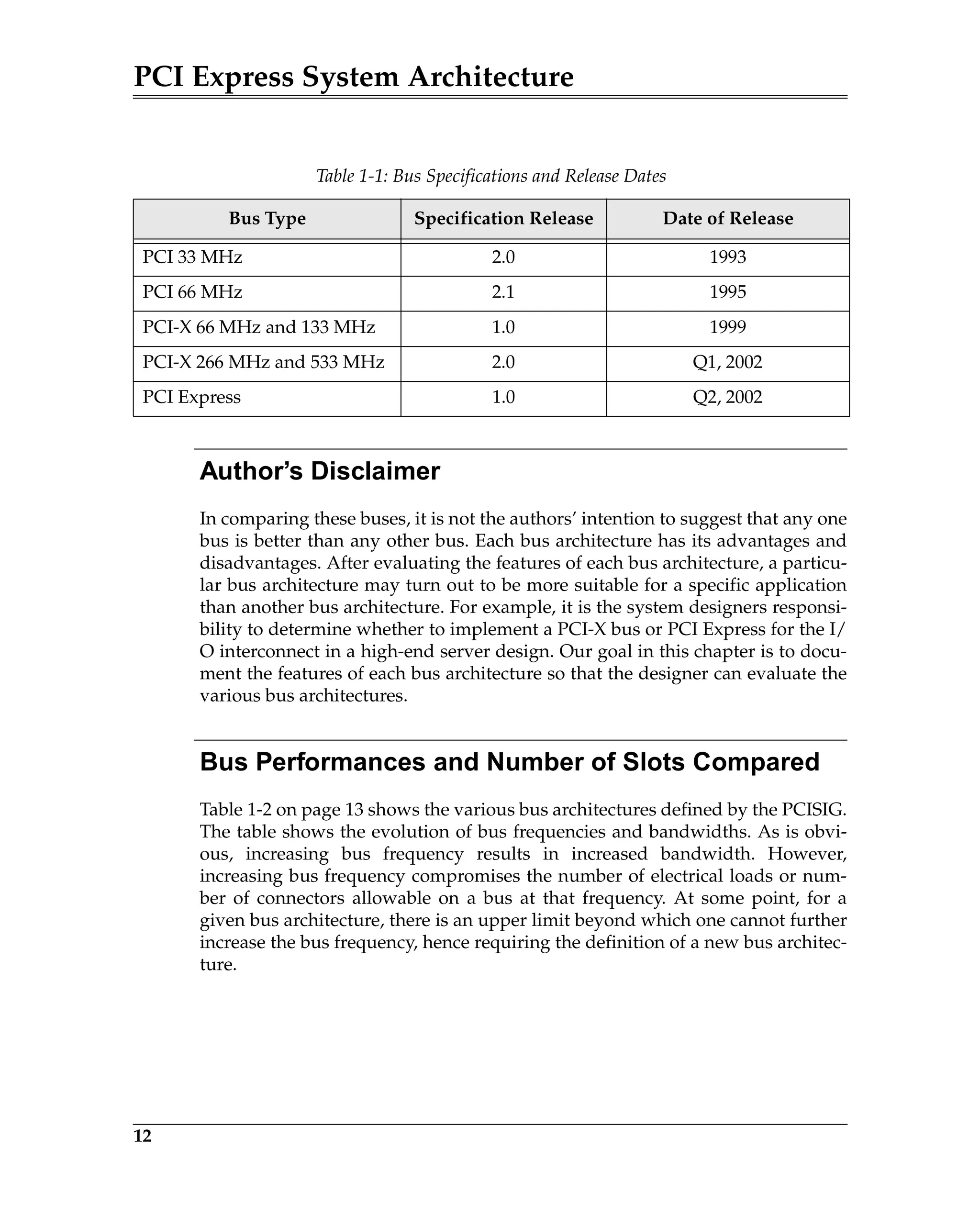
MindShare recognizes and addresses your company’s technical training issues with:
• Scalable cost training • Customizable training options • Reducing time away from work
• Just-in-time training • Overview and advanced topic courses • Training delivered effectively globally
• Training in a classroom, at your cubicle or home office • Concurrently delivered multiple-site training
bringinglife
toknowledge.
real-world tech training put into practice worldwide
Are your company’s technical training needs being addressed in the most effective manner?
MindShare has over 25 years experience in conducting technical training on cutting-edge technologies. We
understand the challenges companies have when searching for quality, effective training which reduces the
students’ time away from work and provides cost-effective alternatives. MindShare offers many flexible solutions
to meet those needs. Our courses are taught by highly-skilled, enthusiastic, knowledgeable and experienced
instructors. We bring life to knowledge through a wide variety of learning methods and delivery options.
2 PCI Express 2.0®
2 Intel Core 2 Processor Architecture
2 AMD Opteron Processor Architecture
2 Intel 64 and IA-32 Software Architecture
2 Intel PC and Chipset Architecture
2 PC Virtualization
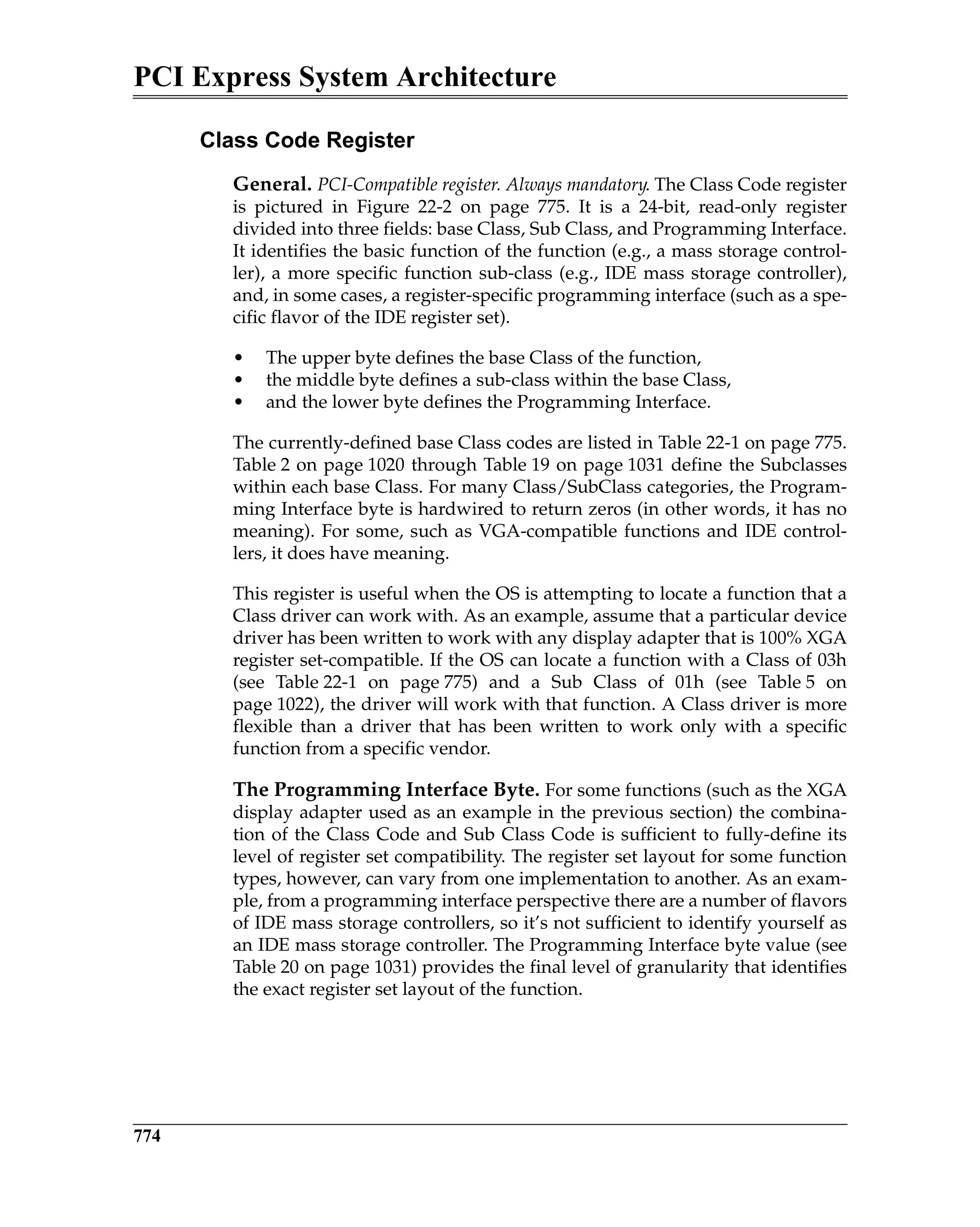
2 USB 2.0
2 Wireless USB
2 Serial ATA (SATA)
2 Serial Attached SCSI (SAS)
2 DDR2/DDR3 DRAM Technology
2 PC BIOS Firmware
2 High-Speed Design
2 Windows Internals and Drivers
2 Linux Fundamentals
... and many more.
All courses can be customized to meet your
group’s needs. Detailed course outlines can
be found at www.mindshare.com
world-class technical training
MindSharetrainingcoursesexpandyourtechnicalskillset
*PCI Express ® is a registered trademark of the PCISIG
www.mindshare.com
4285 SLASH PINE DRIVE COLORADO SPRINGS, CO 80908 USA
M 1.602.617.1123 O 1.800.633.1440 ravi@mindshare.com
Engage MindShare
Have knowledge that you want to bring to life? MindShare will work with you to “Bring Your Knowledge to Life.”
Engage us to transform your knowledge and design courses that can be delivered in classroom or virtual class-
room settings, create online eLearning modules, or publish a book that you author.
We are proud to be the preferred training provider at an extensive list of clients that include:
ADAPTEC • AMD • AGILENT TECHNOLOGIES • APPLE • BROADCOM • CADENCE • CRAY • CISCO • DELL • FREESCALE
GENERAL DYNAMICS • HP • IBM • KODAK • LSI LOGIC • MOTOROLA • MICROSOFT • NASA • NATIONAL SEMICONDUCTOR
NETAPP • NOKIA • NVIDIA • PLX TECHNOLOGY • QLOGIC • SIEMENS • SUN MICROSYSTEMS SYNOPSYS • TI • UNISYS
Classroom Training
Invite MindShare to train
you in-house, or sign-up to
attend one of our many public
classes held throughout the
year and around the world.
No more boring classes, the
‘MindShare Experience‘ is
sure to keep you engaged.
Virtual Classroom Training
The majority of our courses
live over the web in an inter-
active environment with WebEx
and a phone bridge. We deliver
training cost-effectively across
multiple sites and time zones.
Imagine being trained in your
cubicle or home office and
avoiding the hassle of travel.
Contact us to attend one of
our public virtual classes.
eLearning Module Training
MindShare is also an eLearning
company. Our growing list of
interactive eLearning modules
include:
• Intro to Virtualization
Technology
• Intro to IO Virtualization
• Intro to PCI Express 2.0
Updates
• PCI Express 2.0
• USB 2.0
• AMD Opteron Processor
Architecture
• Virtualization Technology
...and more
MindShare Press
Purchase our books and
eBooks or publish your
own content through us.
MindShare has authored
over 25 books and the list
is growing. Let us help
make your book project
a successful one.
MindShare Learning Options
MindShare
Classroom
MindShare
Virtual Classroom
MindShare
eLearning
MindShare
Press
In-House Training
Public Training
Virtual In-House Training
Virtual Public Training
Intro eLearning
Modules
Comprehensive
eLearning Modules
Books
eBooks
PCI Express
System
Architecture
MINDSHARE, INC.
Ravi Budruk
Don Anderson
Tom Shanley
Technical Edit by Joe Winkles
ADDISON-WESLEY DEVELOPER’S PRESS
Boston • San Francisco • New York • Toronto
Montreal • London • Munich • Paris • Madrid • Sydney
Cape Town • Tokyo • Singapore • Mexico City
Many of the designations used by manufacturers and sellers to distinguish their prod-
ucts are claimed as trademarks. Where those designators appear in this book, and Add-
ison-Wesley was aware of the trademark claim, the designations have been printed in
initial capital letters or all capital letters.
The authors and publishers have taken care in preparation of this book, but make no
expressed or implied warranty of any kind and assume no responsibility for errors or
omissions. No liability is assumed for incidental or consequential damages in connec-
tion with or arising out of the use of the information or programs contained herein.
Library of Congress Cataloging-in-Publication Data
ISBN: 0-321-15630-7
Copyright ©2003 by MindShare, Inc.
All rights reserved. No part of this publication may be reproduced, stored in a retrieval
system, or transmitted, in any form or by any means, electronic, mechanical, photocopy-
ing, recording, or otherwise, without the prior written permission of the publisher.
Printed in the United States of America. Published simultaneously in Canada.
Sponsoring Editor:
Project Manager:
Cover Design:
Set in 10 point Palatino by MindShare, Inc.
1 2 3 4 5 6 7 8 9-MA-999897
9th Printing, April, 2008
Addison-Wesley books available for bulk purchases by corporations, institutions, and
other organizations. For more information please contact the Corporate, Government,
and Special Sales Department at (800) 238-9682.
Find A-W Developer’s Press on the World-Wide Web at:
http://www.awl.com/devpress/
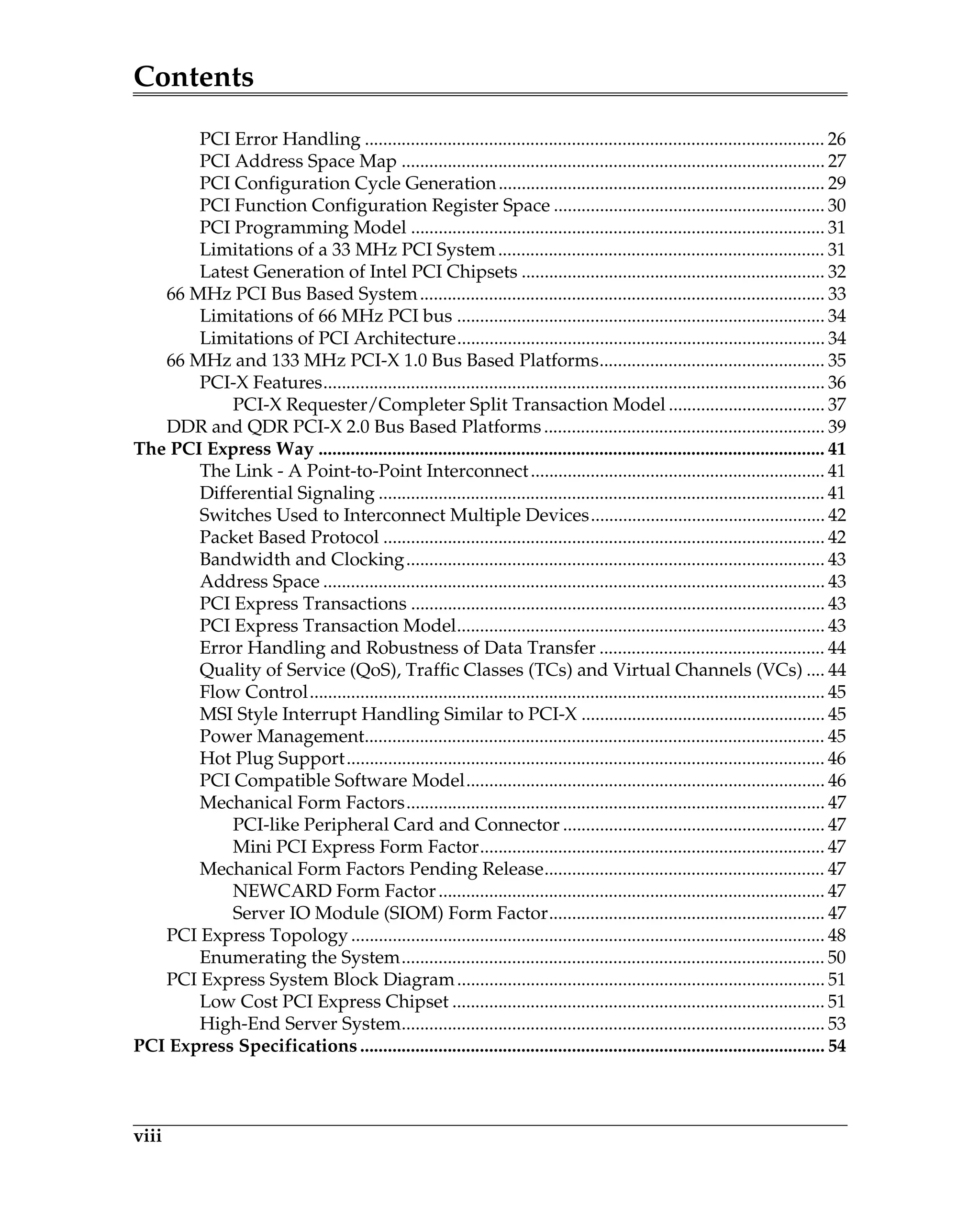
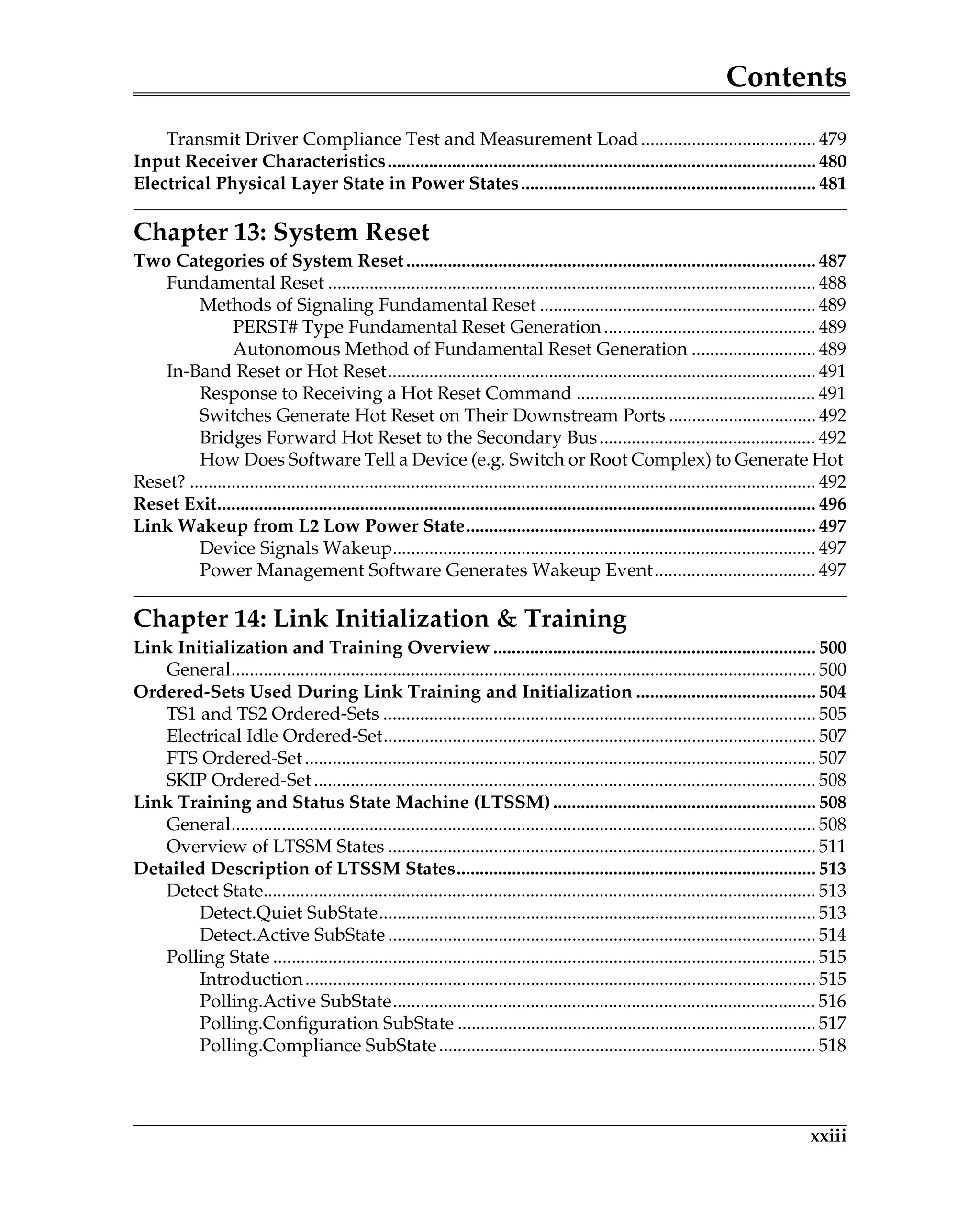
Contents
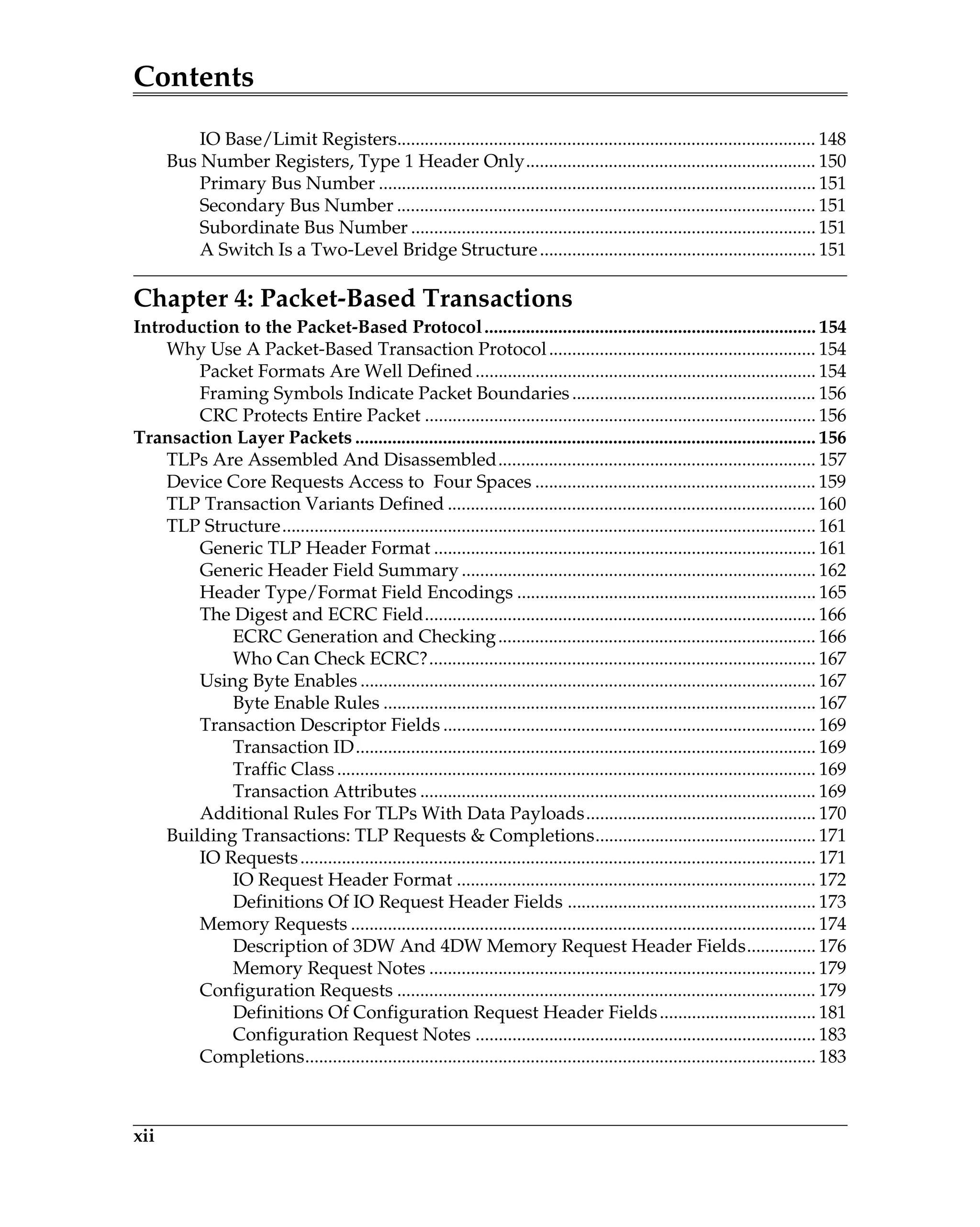
vii
About This Book
The MindShare Architecture Series ....................................................................................... 1
Cautionary Note ......................................................................................................................... 2
Intended Audience .................................................................................................................... 2
Prerequisite Knowledge ........................................................................................................... 3
Topics and Organization .......................................................................................................... 3
Documentation Conventions................................................................................................... 4
PCI Express™ ....................................................................................................................... 4
Hexadecimal Notation ........................................................................................................ 4
Binary Notation.................................................................................................................... 4
Decimal Notation................................................................................................................. 4
Bits Versus Bytes Notation ................................................................................................. 5
Bit Fields................................................................................................................................ 5
Active Signal States.............................................................................................................. 5
Visit Our Web Site..................................................................................................................... 5
We Want Your Feedback........................................................................................................... 6
Part One: The Big Picture
Chapter 1: Architectural Perspective
Introduction To PCI Express.................................................................................................... 9
The Role of the Original PCI Solution............................................................................. 10
Don’t Throw Away What is Good! Keep It ............................................................ 10
Make Improvements for the Future......................................................................... 10
Looking into the Future ............................................................................................. 11
Predecessor Buses Compared ................................................................................................ 11
Author’s Disclaimer........................................................................................................... 12
Bus Performances and Number of Slots Compared..................................................... 12
PCI Express Aggregate Throughput............................................................................... 13
Performance Per Pin Compared ...................................................................................... 14
I/O Bus Architecture Perspective ......................................................................................... 16
33 MHz PCI Bus Based System........................................................................................ 16
Electrical Load Limit of a 33 MHz PCI Bus............................................................. 17
PCI Transaction Model - Programmed IO .............................................................. 19
PCI Transaction Model - Peer-to-Peer ..................................................................... 22
PCI Bus Arbitration .................................................................................................... 22
PCI Delayed Transaction Protocol ........................................................................... 23
PCI Retry Protocol:.............................................................................................. 23
PCI Disconnect Protocol: .................................................................................... 24
PCI Interrupt Handling.............................................................................................. 25
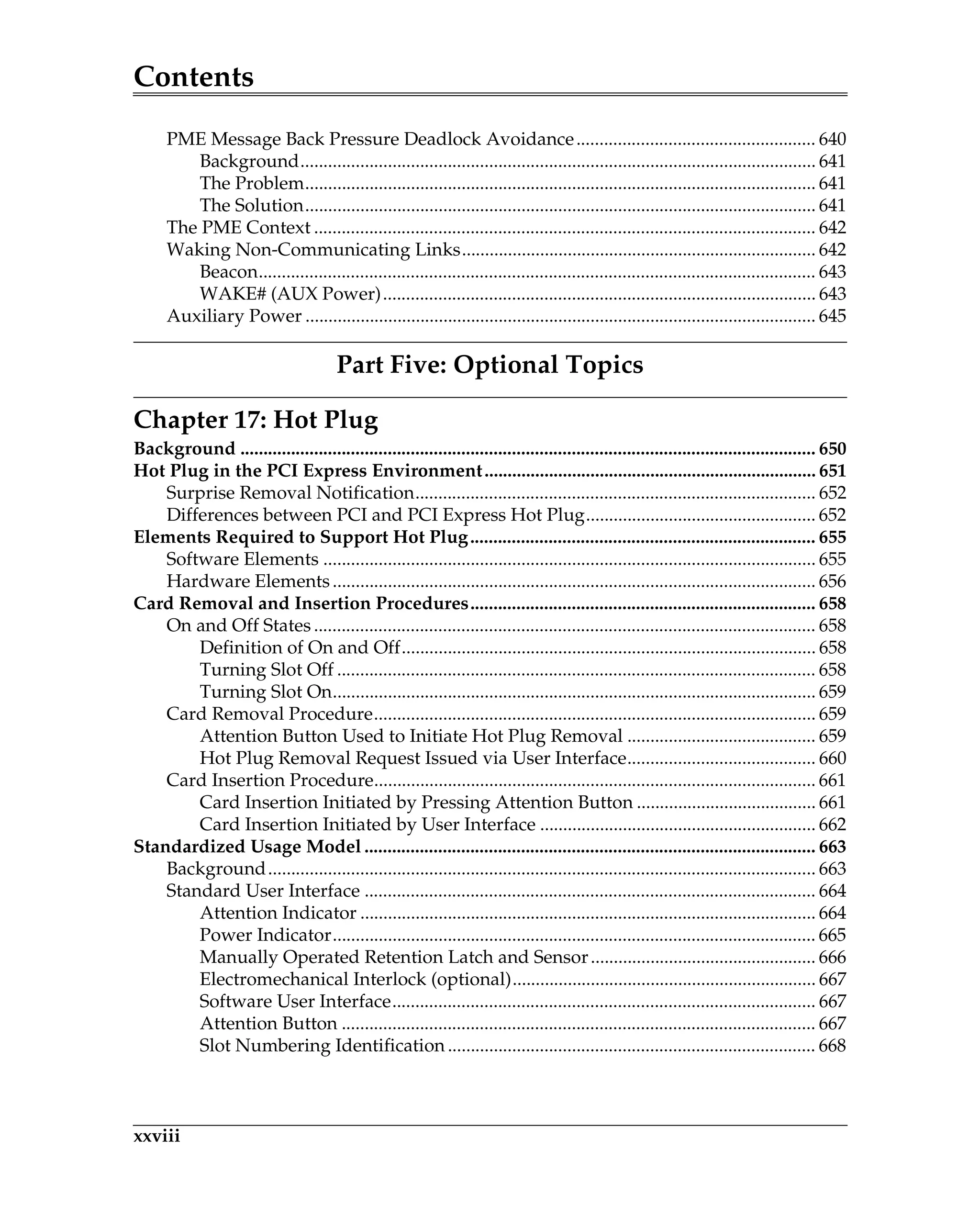
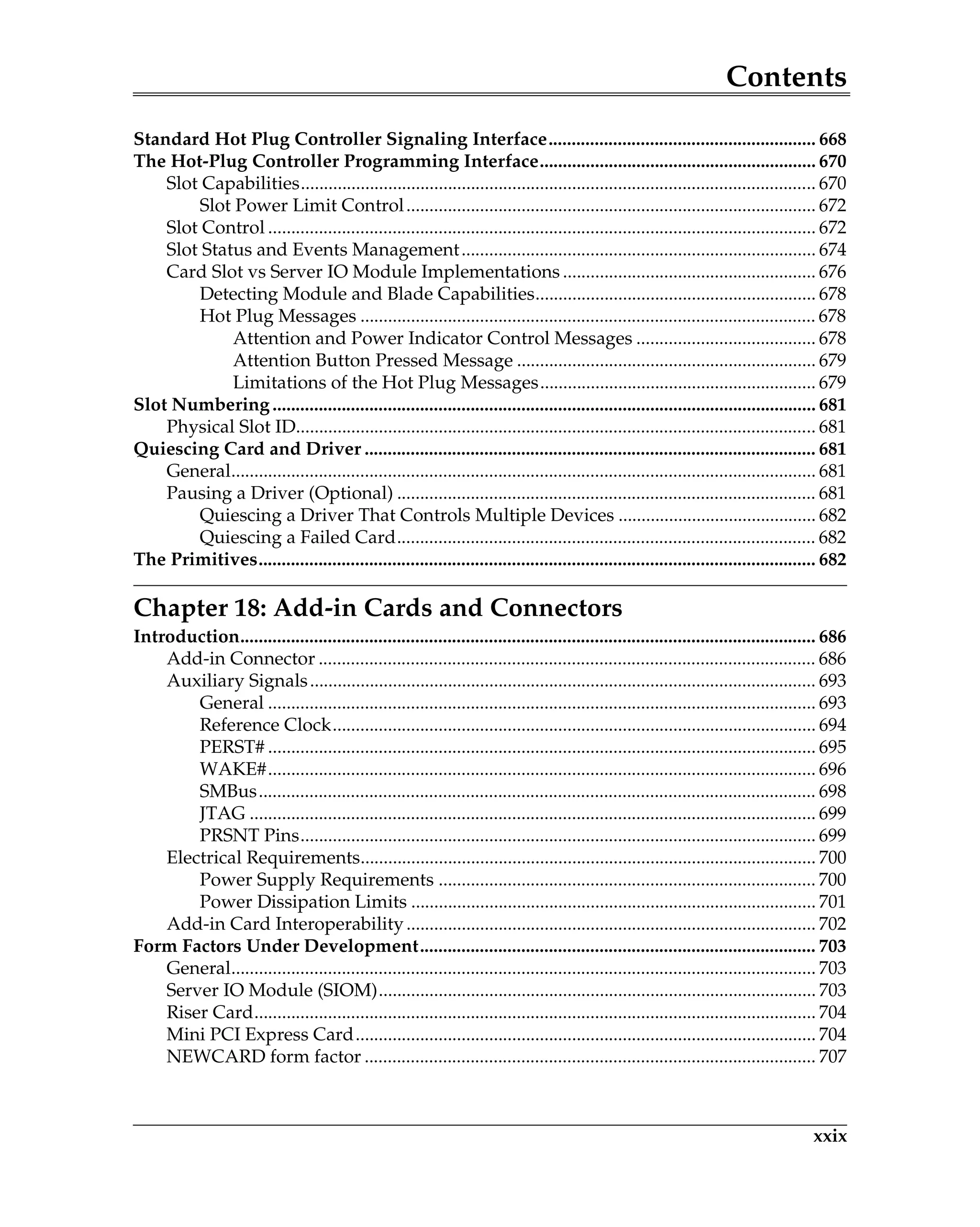
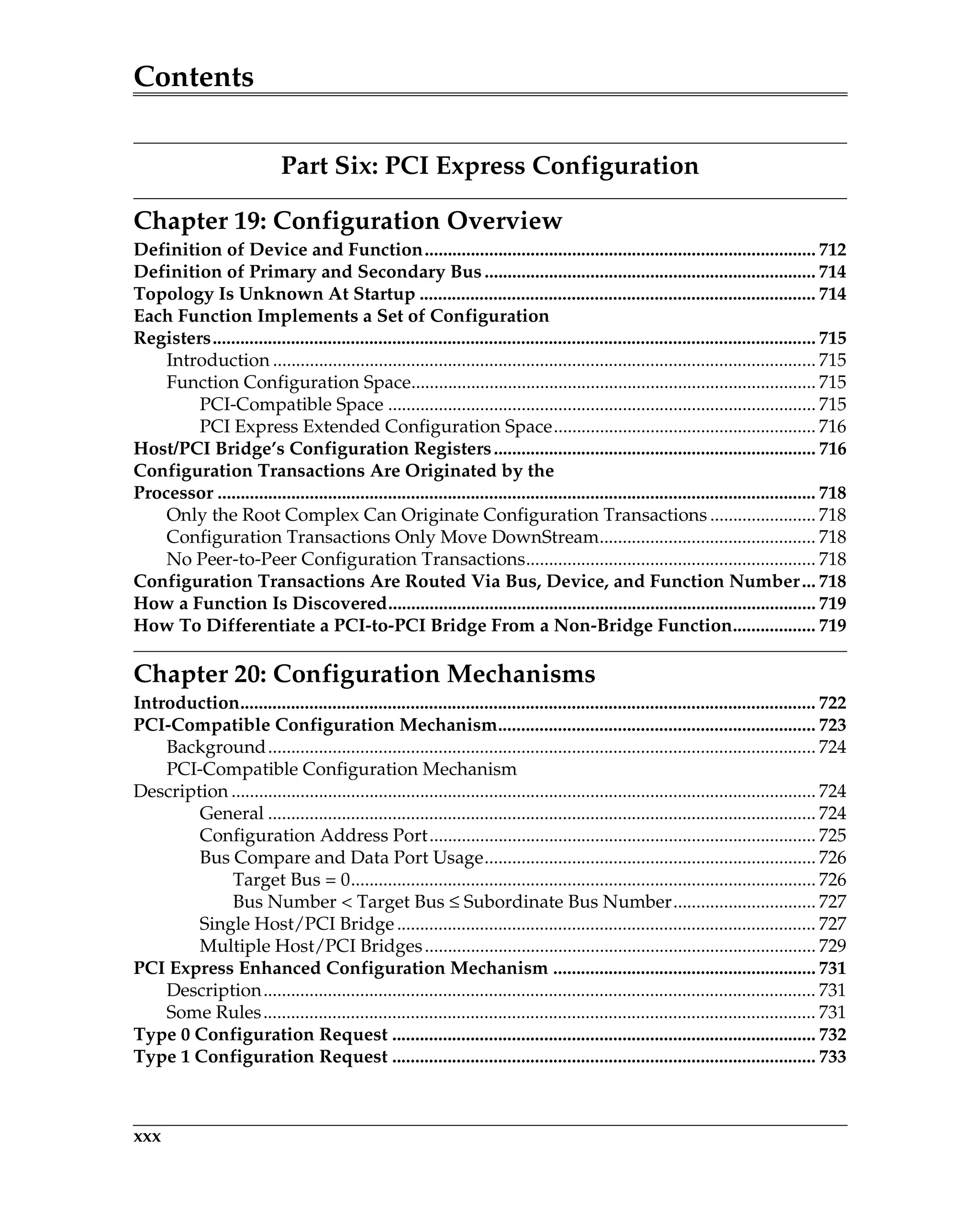
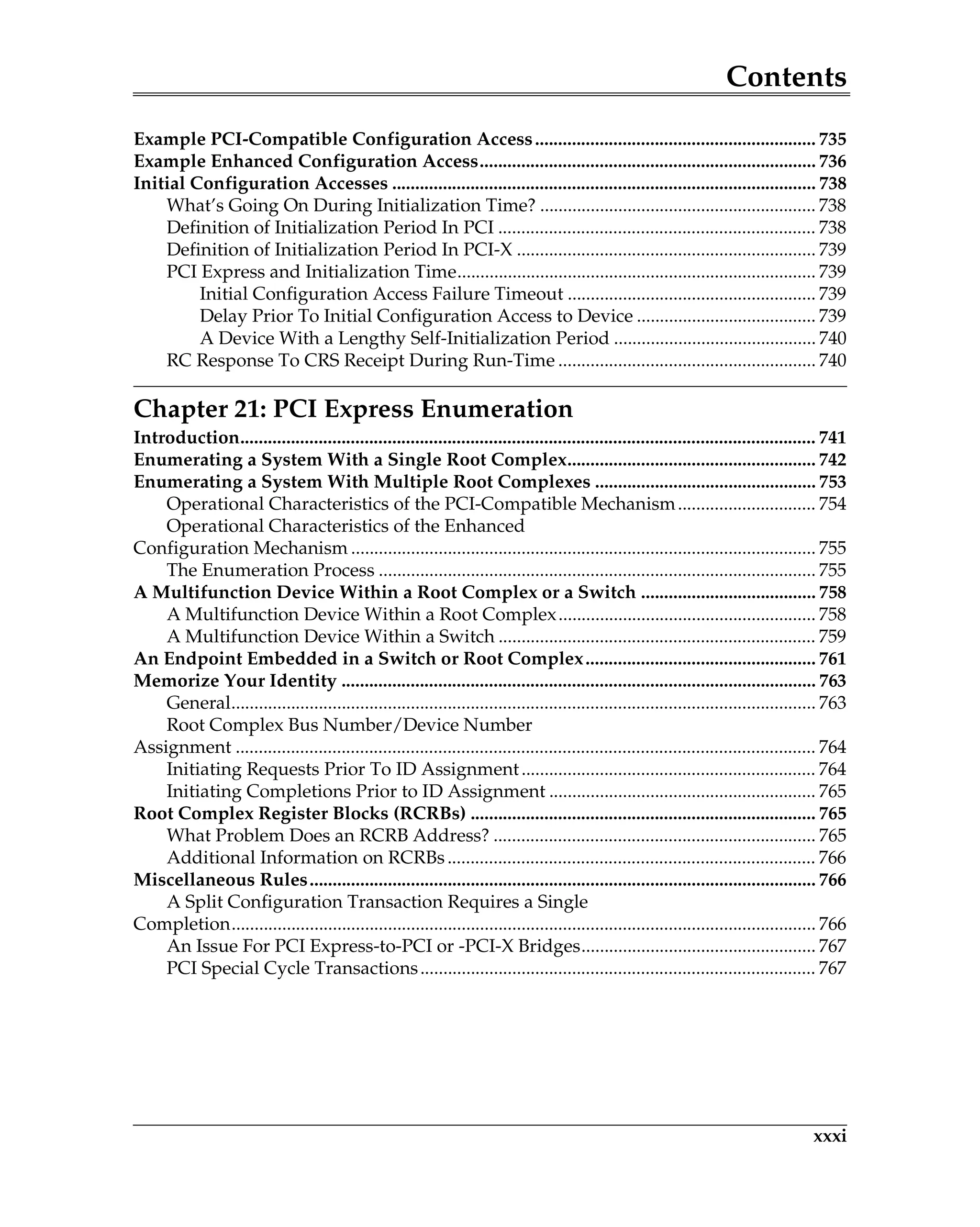
Contents
viii
PCI Error Handling .................................................................................................... 26
PCI Address Space Map ............................................................................................ 27
PCI Configuration Cycle Generation....................................................................... 29
PCI Function Configuration Register Space ........................................................... 30
PCI Programming Model .......................................................................................... 31
Limitations of a 33 MHz PCI System....................................................................... 31
Latest Generation of Intel PCI Chipsets .................................................................. 32
66 MHz PCI Bus Based System........................................................................................ 33
Limitations of 66 MHz PCI bus ................................................................................ 34
Limitations of PCI Architecture................................................................................ 34
66 MHz and 133 MHz PCI-X 1.0 Bus Based Platforms................................................. 35
PCI-X Features............................................................................................................. 36
PCI-X Requester/Completer Split Transaction Model .................................. 37
DDR and QDR PCI-X 2.0 Bus Based Platforms............................................................. 39
The PCI Express Way .............................................................................................................. 41
The Link - A Point-to-Point Interconnect................................................................ 41
Differential Signaling ................................................................................................. 41
Switches Used to Interconnect Multiple Devices................................................... 42
Packet Based Protocol ................................................................................................ 42
Bandwidth and Clocking........................................................................................... 43
Address Space ............................................................................................................. 43
PCI Express Transactions .......................................................................................... 43
PCI Express Transaction Model................................................................................ 43
Error Handling and Robustness of Data Transfer ................................................. 44
Quality of Service (QoS), Traffic Classes (TCs) and Virtual Channels (VCs) .... 44
Flow Control................................................................................................................ 45
MSI Style Interrupt Handling Similar to PCI-X ..................................................... 45
Power Management.................................................................................................... 45
Hot Plug Support........................................................................................................ 46
PCI Compatible Software Model.............................................................................. 46
Mechanical Form Factors........................................................................................... 47
PCI-like Peripheral Card and Connector ......................................................... 47
Mini PCI Express Form Factor........................................................................... 47
Mechanical Form Factors Pending Release............................................................. 47
NEWCARD Form Factor.................................................................................... 47
Server IO Module (SIOM) Form Factor............................................................ 47
PCI Express Topology ....................................................................................................... 48
Enumerating the System............................................................................................ 50
PCI Express System Block Diagram................................................................................ 51
Low Cost PCI Express Chipset ................................................................................. 51
High-End Server System............................................................................................ 53
PCI Express Specifications..................................................................................................... 54
Contents
ix
Chapter 2: Architecture Overview
Introduction to PCI Express Transactions........................................................................... 55
PCI Express Transaction Protocol ................................................................................... 57
Non-Posted Read Transactions................................................................................. 58
Non-Posted Read Transaction for Locked Requests ............................................. 59
Non-Posted Write Transactions................................................................................ 61
Posted Memory Write Transactions......................................................................... 62
Posted Message Transactions.................................................................................... 63
Some Examples of Transactions....................................................................................... 64
Memory Read Originated by CPU, Targeting an Endpoint................................. 64
Memory Read Originated by Endpoint, Targeting System Memory.................. 66
IO Write Initiated by CPU, Targeting an Endpoint............................................... 67
Memory Write Transaction Originated by CPU and
Targeting an Endpoint .............................................................................................. 68
PCI Express Device Layers ..................................................................................................... 69
Overview............................................................................................................................. 69
Transmit Portion of Device Layers........................................................................... 71
Receive Portion of Device Layers............................................................................. 71
Device Layers and their Associated Packets.................................................................. 71
Transaction Layer Packets (TLPs) ............................................................................ 71
TLP Packet Assembly.......................................................................................... 72
TLP Packet Disassembly..................................................................................... 73
Data Link Layer Packets (DLLPs) ............................................................................ 74
DLLP Assembly ................................................................................................... 75
DLLP Disassembly .............................................................................................. 76
Physical Layer Packets (PLPs) .................................................................................. 77
Function of Each PCI Express Device Layer.................................................................. 78
Device Core / Software Layer .................................................................................. 78
Transmit Side. ...................................................................................................... 78
Receive Side.......................................................................................................... 78
Transaction Layer ....................................................................................................... 79
Transmit Side. ...................................................................................................... 80
Receiver Side ........................................................................................................ 81
Flow Control......................................................................................................... 81
Quality of Service (QoS) ..................................................................................... 82
Traffic Classes (TCs) and Virtual Channels (VCs).......................................... 84
Port Arbitration and VC Arbitration ................................................................ 85
Transaction Ordering.......................................................................................... 87
Power Management ............................................................................................ 87
Configuration Registers...................................................................................... 87
Data Link Layer........................................................................................................... 87
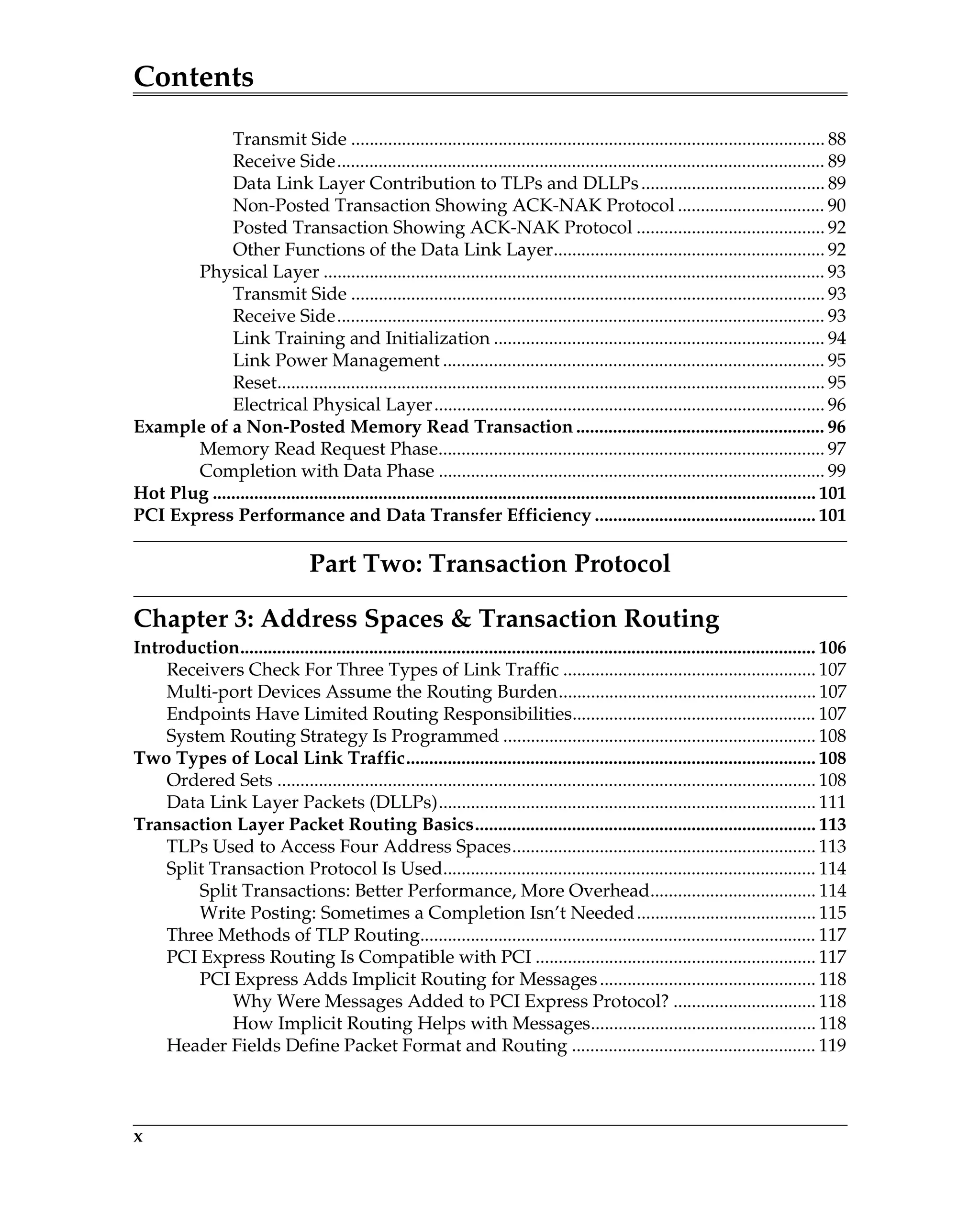
Contents
x
Transmit Side ....................................................................................................... 88
Receive Side.......................................................................................................... 89
Data Link Layer Contribution to TLPs and DLLPs........................................ 89
Non-Posted Transaction Showing ACK-NAK Protocol ................................ 90
Posted Transaction Showing ACK-NAK Protocol ......................................... 92
Other Functions of the Data Link Layer........................................................... 92
Physical Layer ............................................................................................................. 93
Transmit Side ....................................................................................................... 93
Receive Side.......................................................................................................... 93
Link Training and Initialization ........................................................................ 94
Link Power Management ................................................................................... 95
Reset....................................................................................................................... 95
Electrical Physical Layer..................................................................................... 96
Example of a Non-Posted Memory Read Transaction ...................................................... 96
Memory Read Request Phase.................................................................................... 97
Completion with Data Phase .................................................................................... 99
Hot Plug ................................................................................................................................... 101
PCI Express Performance and Data Transfer Efficiency ................................................ 101
Part Two: Transaction Protocol
Chapter 3: Address Spaces & Transaction Routing
Introduction............................................................................................................................. 106
Receivers Check For Three Types of Link Traffic ....................................................... 107
Multi-port Devices Assume the Routing Burden........................................................ 107
Endpoints Have Limited Routing Responsibilities..................................................... 107
System Routing Strategy Is Programmed .................................................................... 108
Two Types of Local Link Traffic......................................................................................... 108
Ordered Sets ..................................................................................................................... 108
Data Link Layer Packets (DLLPs).................................................................................. 111
Transaction Layer Packet Routing Basics.......................................................................... 113
TLPs Used to Access Four Address Spaces.................................................................. 113
Split Transaction Protocol Is Used................................................................................. 114
Split Transactions: Better Performance, More Overhead.................................... 114
Write Posting: Sometimes a Completion Isn’t Needed....................................... 115
Three Methods of TLP Routing...................................................................................... 117
PCI Express Routing Is Compatible with PCI ............................................................. 117
PCI Express Adds Implicit Routing for Messages............................................... 118
Why Were Messages Added to PCI Express Protocol? ............................... 118
How Implicit Routing Helps with Messages................................................. 118
Header Fields Define Packet Format and Routing ..................................................... 119
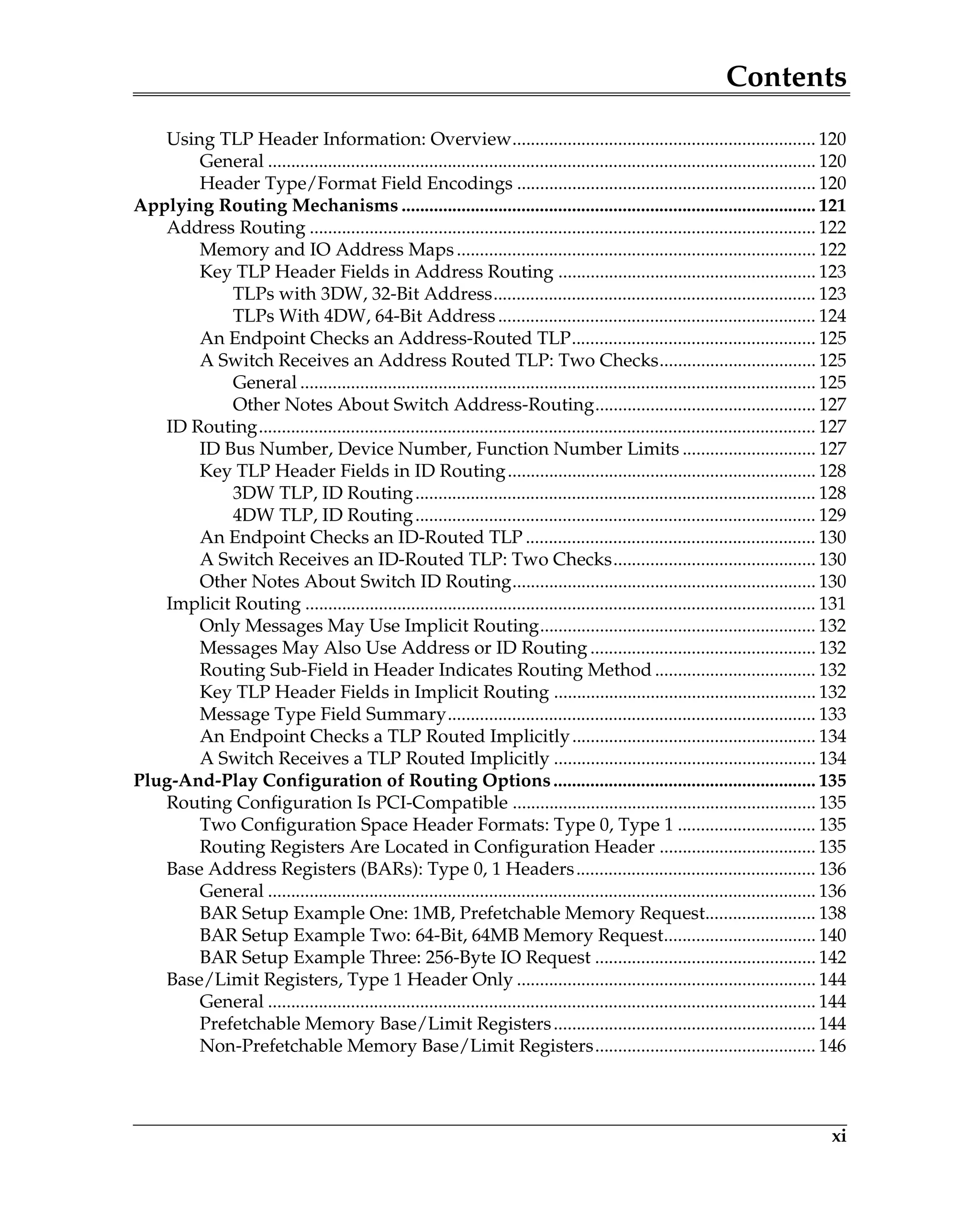
Contents
xi
Using TLP Header Information: Overview.................................................................. 120
General ....................................................................................................................... 120
Header Type/Format Field Encodings ................................................................. 120
Applying Routing Mechanisms .......................................................................................... 121
Address Routing .............................................................................................................. 122
Memory and IO Address Maps.............................................................................. 122
Key TLP Header Fields in Address Routing ........................................................ 123
TLPs with 3DW, 32-Bit Address...................................................................... 123
TLPs With 4DW, 64-Bit Address..................................................................... 124
An Endpoint Checks an Address-Routed TLP..................................................... 125
A Switch Receives an Address Routed TLP: Two Checks.................................. 125
General ................................................................................................................ 125
Other Notes About Switch Address-Routing................................................ 127
ID Routing......................................................................................................................... 127
ID Bus Number, Device Number, Function Number Limits ............................. 127
Key TLP Header Fields in ID Routing................................................................... 128
3DW TLP, ID Routing....................................................................................... 128
4DW TLP, ID Routing....................................................................................... 129
An Endpoint Checks an ID-Routed TLP ............................................................... 130
A Switch Receives an ID-Routed TLP: Two Checks............................................ 130
Other Notes About Switch ID Routing.................................................................. 130
Implicit Routing ............................................................................................................... 131
Only Messages May Use Implicit Routing............................................................ 132
Messages May Also Use Address or ID Routing ................................................. 132
Routing Sub-Field in Header Indicates Routing Method ................................... 132
Key TLP Header Fields in Implicit Routing ......................................................... 132
Message Type Field Summary................................................................................ 133
An Endpoint Checks a TLP Routed Implicitly..................................................... 134
A Switch Receives a TLP Routed Implicitly ......................................................... 134
Plug-And-Play Configuration of Routing Options......................................................... 135
Routing Configuration Is PCI-Compatible .................................................................. 135
Two Configuration Space Header Formats: Type 0, Type 1 .............................. 135
Routing Registers Are Located in Configuration Header .................................. 135
Base Address Registers (BARs): Type 0, 1 Headers.................................................... 136
General ....................................................................................................................... 136
BAR Setup Example One: 1MB, Prefetchable Memory Request........................ 138
BAR Setup Example Two: 64-Bit, 64MB Memory Request................................. 140
BAR Setup Example Three: 256-Byte IO Request ................................................ 142
Base/Limit Registers, Type 1 Header Only ................................................................. 144
General ....................................................................................................................... 144
Prefetchable Memory Base/Limit Registers......................................................... 144
Non-Prefetchable Memory Base/Limit Registers................................................ 146
Contents
xii
IO Base/Limit Registers........................................................................................... 148
Bus Number Registers, Type 1 Header Only............................................................... 150
Primary Bus Number ............................................................................................... 151
Secondary Bus Number ........................................................................................... 151
Subordinate Bus Number ........................................................................................ 151
A Switch Is a Two-Level Bridge Structure............................................................ 151
Chapter 4: Packet-Based Transactions
Introduction to the Packet-Based Protocol........................................................................ 154
Why Use A Packet-Based Transaction Protocol.......................................................... 154
Packet Formats Are Well Defined.......................................................................... 154
Framing Symbols Indicate Packet Boundaries..................................................... 156
CRC Protects Entire Packet ..................................................................................... 156
Transaction Layer Packets .................................................................................................... 156
TLPs Are Assembled And Disassembled..................................................................... 157
Device Core Requests Access to Four Spaces ............................................................. 159
TLP Transaction Variants Defined ................................................................................ 160
TLP Structure.................................................................................................................... 161
Generic TLP Header Format ................................................................................... 161
Generic Header Field Summary ............................................................................. 162
Header Type/Format Field Encodings ................................................................. 165
The Digest and ECRC Field..................................................................................... 166
ECRC Generation and Checking..................................................................... 166
Who Can Check ECRC?.................................................................................... 167
Using Byte Enables ................................................................................................... 167
Byte Enable Rules .............................................................................................. 167
Transaction Descriptor Fields ................................................................................. 169
Transaction ID.................................................................................................... 169
Traffic Class........................................................................................................ 169
Transaction Attributes ...................................................................................... 169
Additional Rules For TLPs With Data Payloads.................................................. 170
Building Transactions: TLP Requests & Completions................................................ 171
IO Requests................................................................................................................ 171
IO Request Header Format .............................................................................. 172
Definitions Of IO Request Header Fields ...................................................... 173
Memory Requests ..................................................................................................... 174
Description of 3DW And 4DW Memory Request Header Fields............... 176
Memory Request Notes .................................................................................... 179
Configuration Requests ........................................................................................... 179
Definitions Of Configuration Request Header Fields.................................. 181
Configuration Request Notes .......................................................................... 183
Completions............................................................................................................... 183
Contents
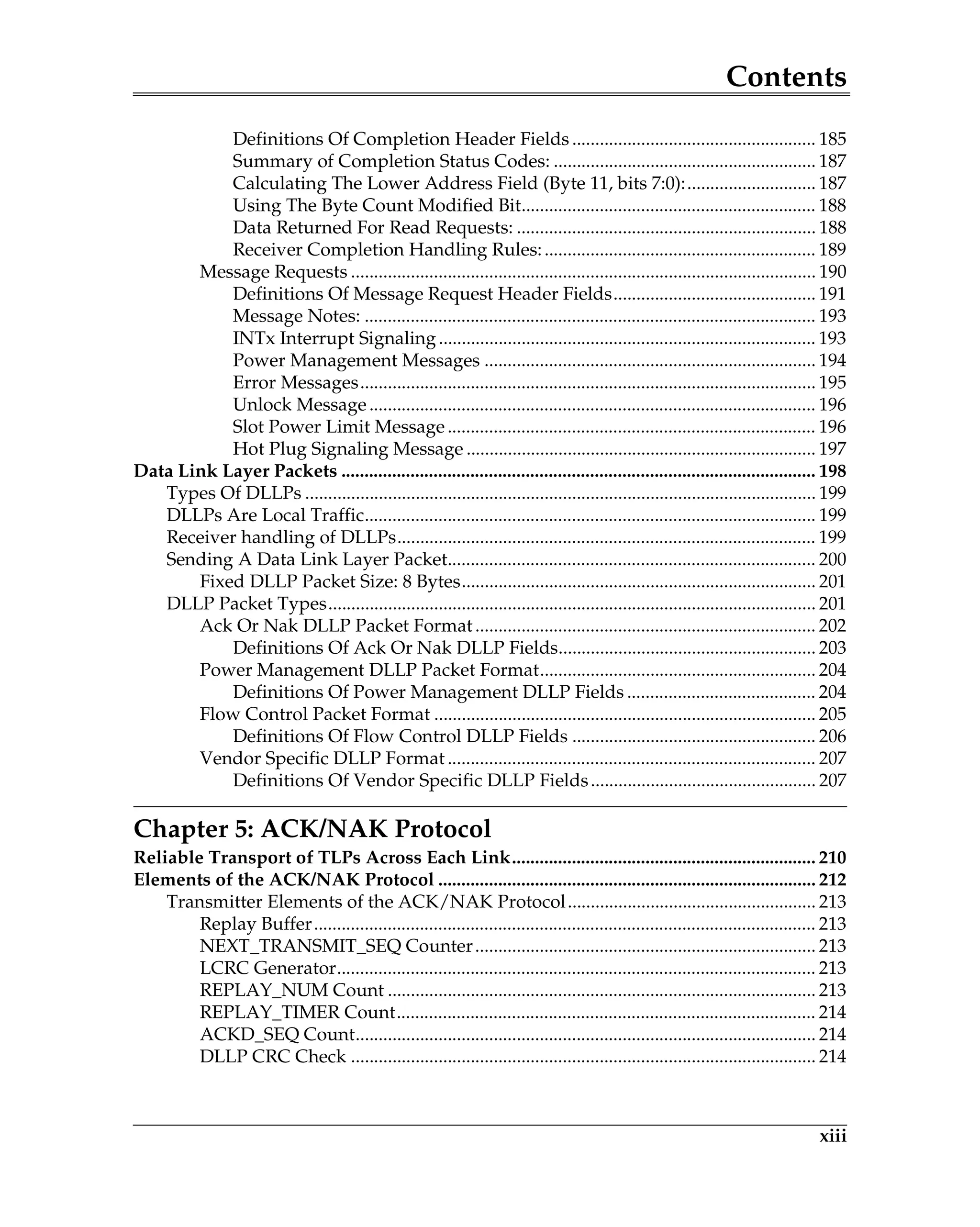
xiii
Definitions Of Completion Header Fields ..................................................... 185
Summary of Completion Status Codes: ......................................................... 187
Calculating The Lower Address Field (Byte 11, bits 7:0):............................ 187
Using The Byte Count Modified Bit................................................................ 188
Data Returned For Read Requests: ................................................................. 188
Receiver Completion Handling Rules:........................................................... 189
Message Requests ..................................................................................................... 190
Definitions Of Message Request Header Fields............................................ 191
Message Notes: .................................................................................................. 193
INTx Interrupt Signaling.................................................................................. 193
Power Management Messages ........................................................................ 194
Error Messages................................................................................................... 195
Unlock Message................................................................................................. 196
Slot Power Limit Message................................................................................ 196
Hot Plug Signaling Message ............................................................................ 197
Data Link Layer Packets ....................................................................................................... 198
Types Of DLLPs ............................................................................................................... 199
DLLPs Are Local Traffic.................................................................................................. 199
Receiver handling of DLLPs........................................................................................... 199
Sending A Data Link Layer Packet................................................................................ 200
Fixed DLLP Packet Size: 8 Bytes............................................................................. 201
DLLP Packet Types.......................................................................................................... 201
Ack Or Nak DLLP Packet Format.......................................................................... 202
Definitions Of Ack Or Nak DLLP Fields........................................................ 203
Power Management DLLP Packet Format............................................................ 204
Definitions Of Power Management DLLP Fields ......................................... 204
Flow Control Packet Format ................................................................................... 205
Definitions Of Flow Control DLLP Fields ..................................................... 206
Vendor Specific DLLP Format ................................................................................ 207
Definitions Of Vendor Specific DLLP Fields................................................. 207
Chapter 5: ACK/NAK Protocol
Reliable Transport of TLPs Across Each Link.................................................................. 210
Elements of the ACK/NAK Protocol .................................................................................. 212
Transmitter Elements of the ACK/NAK Protocol...................................................... 213
Replay Buffer............................................................................................................. 213
NEXT_TRANSMIT_SEQ Counter.......................................................................... 213
LCRC Generator........................................................................................................ 213
REPLAY_NUM Count ............................................................................................. 213
REPLAY_TIMER Count........................................................................................... 214
ACKD_SEQ Count.................................................................................................... 214
DLLP CRC Check ..................................................................................................... 214
Contents
xiv
Receiver Elements of the ACK/NAK Protocol............................................................ 216
Receive Buffer............................................................................................................ 216
LCRC Error Check.................................................................................................... 216
NEXT_RCV_SEQ Count .......................................................................................... 216
Sequence Number Check......................................................................................... 216
NAK_SCHEDULED Flag ........................................................................................ 217
ACKNAK_LATENCY_TIMER ............................................................................... 217
ACK/NAK DLLP Generator .................................................................................. 217
ACK/NAK DLLP Format ...................................................................................................... 219
ACK/NAK Protocol Details.................................................................................................. 220
Transmitter Protocol Details .......................................................................................... 220
Sequence Number..................................................................................................... 220
32-Bit LCRC ............................................................................................................... 221
Replay (Retry) Buffer................................................................................................ 221
General ................................................................................................................ 221
Replay Buffer Sizing.......................................................................................... 221
Transmitter’s Response to an ACK DLLP............................................................. 222
General ................................................................................................................ 222
Purging the Replay Buffer................................................................................ 222
Examples of Transmitter ACK DLLP Processing ................................................ 222
Example 1............................................................................................................ 222
Example 2............................................................................................................ 223
Transmitter’s Response to a NAK DLLP............................................................... 224
TLP Replay................................................................................................................. 225
Efficient TLP Replay................................................................................................. 225
Example of Transmitter NAK DLLP Processing.................................................. 225
Repeated Replay of TLPs.................................................................................. 226
What Happens After the Replay Number Rollover? ................................... 227
Transmitter’s Replay Timer..................................................................................... 227
REPLAY_TIMER Equation............................................................................... 227
REPLAY_TIMER Summary Table .................................................................. 228
Transmitter DLLP Handling................................................................................... 229
Receiver Protocol Details ................................................................................................ 230
TLP Received at Physical Layer.............................................................................. 230
Received TLP Error Check ...................................................................................... 230
Next Received TLP’s Sequence Number............................................................... 230
Receiver Schedules An ACK DLLP........................................................................ 231
Example of Receiver ACK Scheduling .................................................................. 232
NAK Scheduled Flag................................................................................................ 233
Receiver Schedules a NAK...................................................................................... 233
Receiver Sequence Number Check ........................................................................ 234
Receiver Preserves TLP Ordering .......................................................................... 235
Contents
xv
Example of Receiver NAK Scheduling.................................................................. 236
Receivers ACKNAK_LATENCY_TIMER ............................................................. 237
ACKNAK_LATENCY_TIMER Equation....................................................... 238
ACKNAK_LATENCY_TIMER Summary Table........................................... 238
Error Situations Reliably Handled by ACK/NAK Protocol........................................... 239
ACK/NAK Protocol Summary............................................................................................. 241
Transmitter Side............................................................................................................... 241
Non-Error Case (ACK DLLP Management)......................................................... 241
Error Case (NAK DLLP Management).................................................................. 242
Receiver Side..................................................................................................................... 242
Non-Error Case ......................................................................................................... 242
Error Case .................................................................................................................. 243
Recommended Priority To Schedule Packets................................................................... 244
Some More Examples ............................................................................................................ 244
Lost TLP............................................................................................................................. 244
Lost ACK DLLP or ACK DLLP with CRC Error......................................................... 245
Lost ACK DLLP followed by NAK DLLP.................................................................... 246
Switch Cut-Through Mode .................................................................................................. 248
Without Cut-Through Mode.......................................................................................... 248
Background................................................................................................................ 248
Possible Solution....................................................................................................... 248
Switch Cut-Through Mode............................................................................................. 249
Background................................................................................................................ 249
Example That Demonstrates Switch Cut-Through Feature ............................... 249
Chapter 6: QoS/TCs/VCs and Arbitration
Quality of Service................................................................................................................... 252
Isochronous Transaction Support.................................................................................. 253
Synchronous Versus Isochronous Transactions................................................... 253
Isochronous Transaction Management ................................................................. 255
Differentiated Services .................................................................................................... 255
Perspective on QOS/TC/VC and Arbitration.................................................................... 255
Traffic Classes and Virtual Channels ................................................................................ 256
VC Assignment and TC Mapping ................................................................................. 258
Determining the Number of VCs to be Used ....................................................... 258
Assigning VC Numbers (IDs) ................................................................................. 260
Assigning TCs to each VC — TC/VC Mapping .................................................. 262
Arbitration............................................................................................................................... 263
Virtual Channel Arbitration ........................................................................................... 264
Strict Priority VC Arbitration.................................................................................. 265
Low- and High-Priority VC Arbitration................................................................ 267
Hardware Fixed Arbitration Scheme.............................................................. 269
Contents
xvi
Weighted Round Robin Arbitration Scheme................................................. 269
Round Robin Arbitration (Equal or Weighted) for All VCs............................... 270
Loading the Virtual Channel Arbitration Table................................................... 270
VC Arbitration within Multiple Function Endpoints.......................................... 273
Port Arbitration ................................................................................................................ 274
The Port Arbitration Mechanisms.......................................................................... 277
Non-Configurable Hardware-Fixed Arbitration .......................................... 278
Weighted Round Robin Arbitration ............................................................... 279
Time-Based, Weighted Round Robin Arbitration ........................................ 279
Loading the Port Arbitration Tables ...................................................................... 280
Switch Arbitration Example........................................................................................... 282
Chapter 7: Flow Control
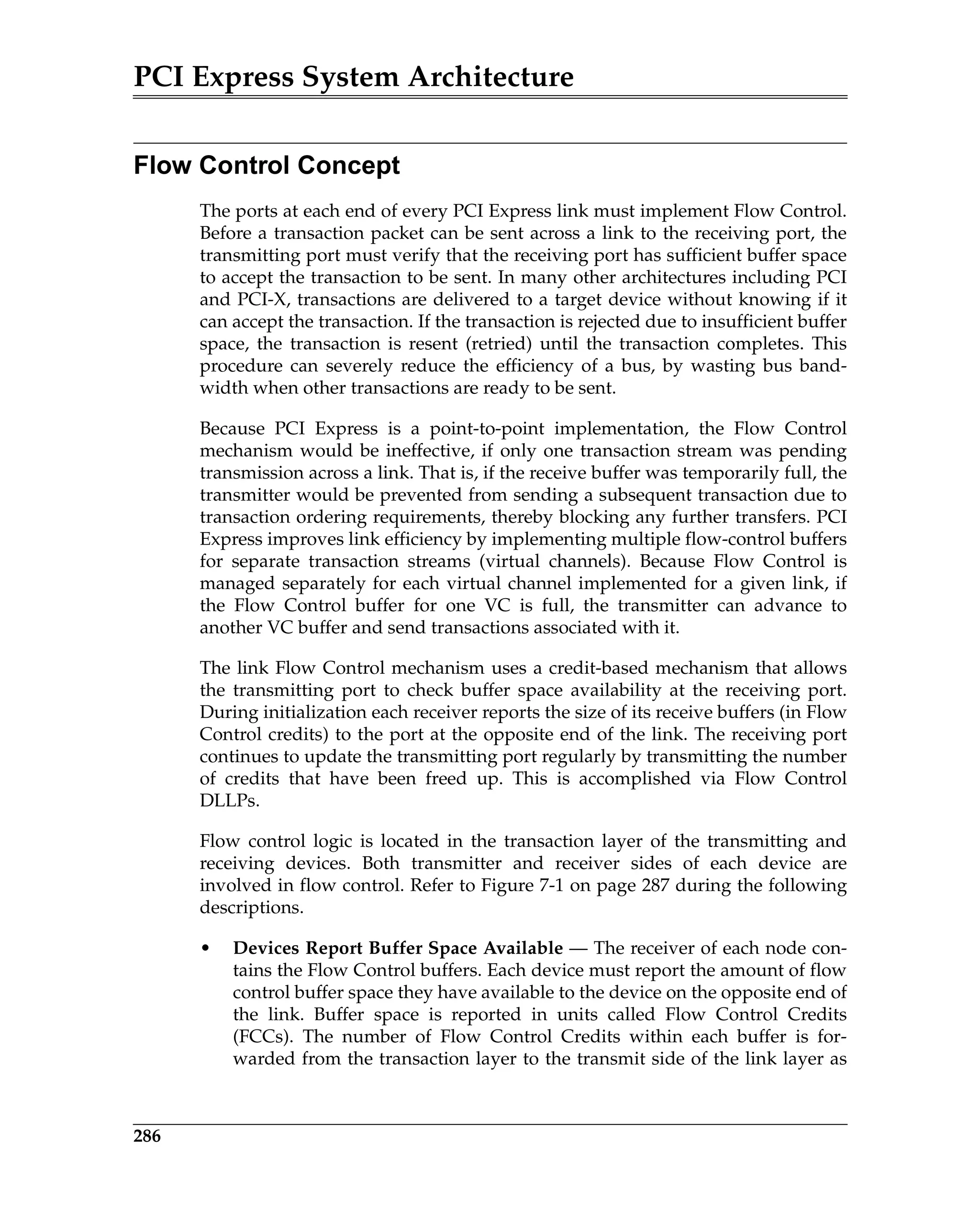
Flow Control Concept ........................................................................................................... 286
Flow Control Buffers............................................................................................................. 288
VC Flow Control Buffer Organization.......................................................................... 288
Flow Control Credits....................................................................................................... 289
Maximum Flow Control Buffer Size ............................................................................. 290
Introduction to the Flow Control Mechanism.................................................................. 290
The Flow Control Elements............................................................................................ 290
Transmitter Elements ............................................................................................... 291
Receiver Elements..................................................................................................... 291
Flow Control Packets............................................................................................................. 293
Operation of the Flow Control Model - An Example...................................................... 294
Stage 1 — Flow Control Following Initialization........................................................ 294
Stage 2 — Flow Control Buffer Fills Up........................................................................ 298
Stage 3 — The Credit Limit count Rolls Over.............................................................. 299
Stage 4 — FC Buffer Overflow Error Check ................................................................ 300
Infinite Flow Control Advertisement ................................................................................ 301
Who Advertises Infinite Flow Control Credits?.......................................................... 301
Special Use for Infinite Credit Advertisements........................................................... 302
Header and Data Advertisements May Conflict......................................................... 302
The Minimum Flow Control Advertisement.................................................................... 303
Flow Control Initialization................................................................................................... 304
The FC Initialization Sequence....................................................................................... 305
FC Init1 Packets Advertise Flow Control Credits Available.............................. 305
FC Init2 Packets Confirm Successful FC Initialization........................................ 307
Rate of FC_INIT1 and FC_INIT2 Transmission ................................................... 308
Violations of the Flow Control Initialization Protocol ........................................ 308
Flow Control Updates Following FC_INIT....................................................................... 308
FC_Update DLLP Format and Content........................................................................ 309
Flow Control Update Frequency ................................................................................... 310
Contents
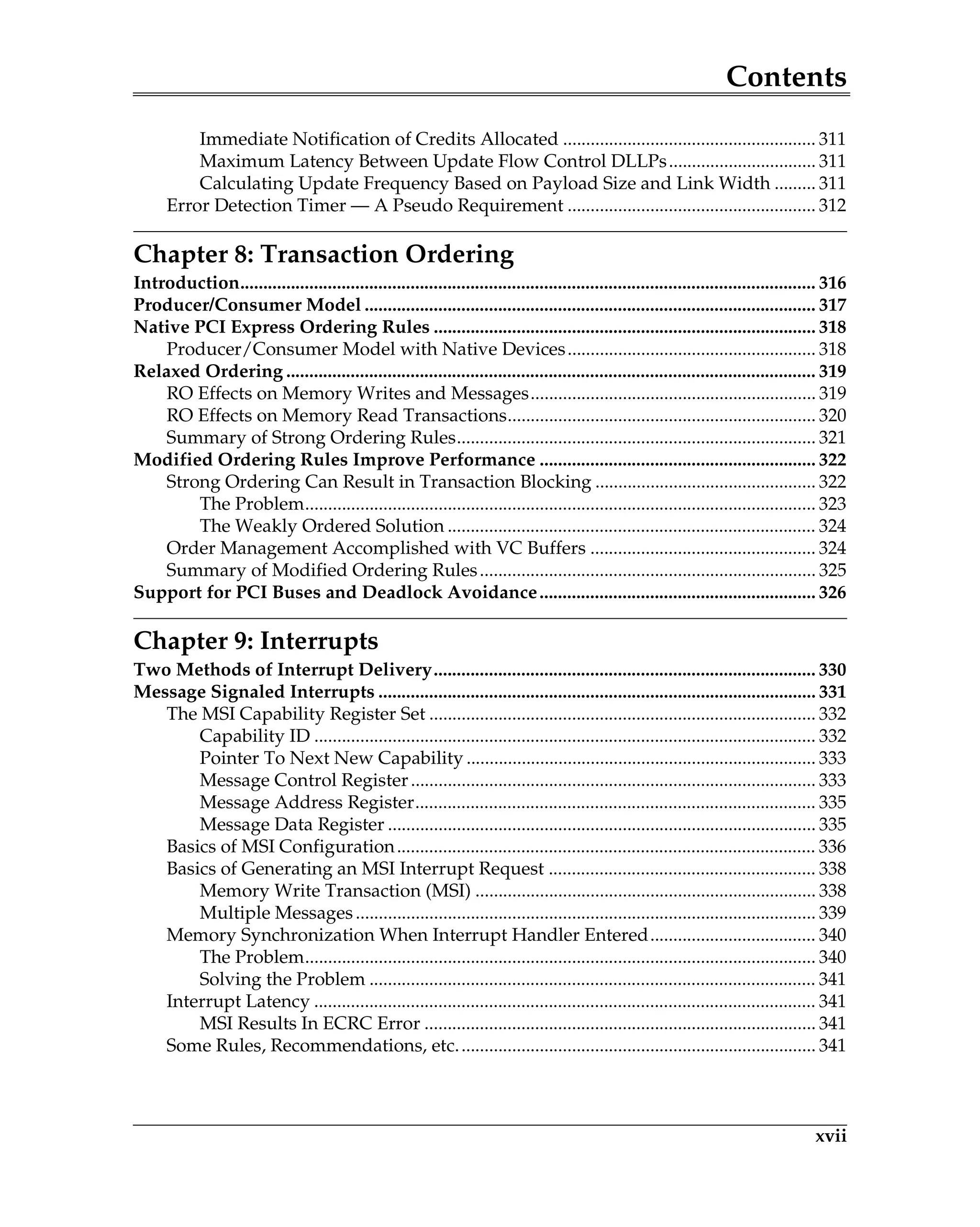
xvii
Immediate Notification of Credits Allocated ....................................................... 311
Maximum Latency Between Update Flow Control DLLPs................................ 311
Calculating Update Frequency Based on Payload Size and Link Width ......... 311
Error Detection Timer — A Pseudo Requirement ...................................................... 312
Chapter 8: Transaction Ordering
Introduction............................................................................................................................. 316
Producer/Consumer Model .................................................................................................. 317
Native PCI Express Ordering Rules ................................................................................... 318
Producer/Consumer Model with Native Devices...................................................... 318
Relaxed Ordering ................................................................................................................... 319
RO Effects on Memory Writes and Messages.............................................................. 319
RO Effects on Memory Read Transactions................................................................... 320
Summary of Strong Ordering Rules.............................................................................. 321
Modified Ordering Rules Improve Performance ............................................................ 322
Strong Ordering Can Result in Transaction Blocking ................................................ 322
The Problem............................................................................................................... 323
The Weakly Ordered Solution ................................................................................ 324
Order Management Accomplished with VC Buffers ................................................. 324
Summary of Modified Ordering Rules......................................................................... 325
Support for PCI Buses and Deadlock Avoidance............................................................ 326
Chapter 9: Interrupts
Two Methods of Interrupt Delivery................................................................................... 330
Message Signaled Interrupts ............................................................................................... 331
The MSI Capability Register Set .................................................................................... 332
Capability ID ............................................................................................................. 332
Pointer To Next New Capability ............................................................................ 333
Message Control Register........................................................................................ 333
Message Address Register....................................................................................... 335
Message Data Register ............................................................................................. 335
Basics of MSI Configuration........................................................................................... 336
Basics of Generating an MSI Interrupt Request .......................................................... 338
Memory Write Transaction (MSI) .......................................................................... 338
Multiple Messages.................................................................................................... 339
Memory Synchronization When Interrupt Handler Entered.................................... 340
The Problem............................................................................................................... 340
Solving the Problem ................................................................................................. 341
Interrupt Latency ............................................................................................................. 341
MSI Results In ECRC Error ..................................................................................... 341
Some Rules, Recommendations, etc.............................................................................. 341
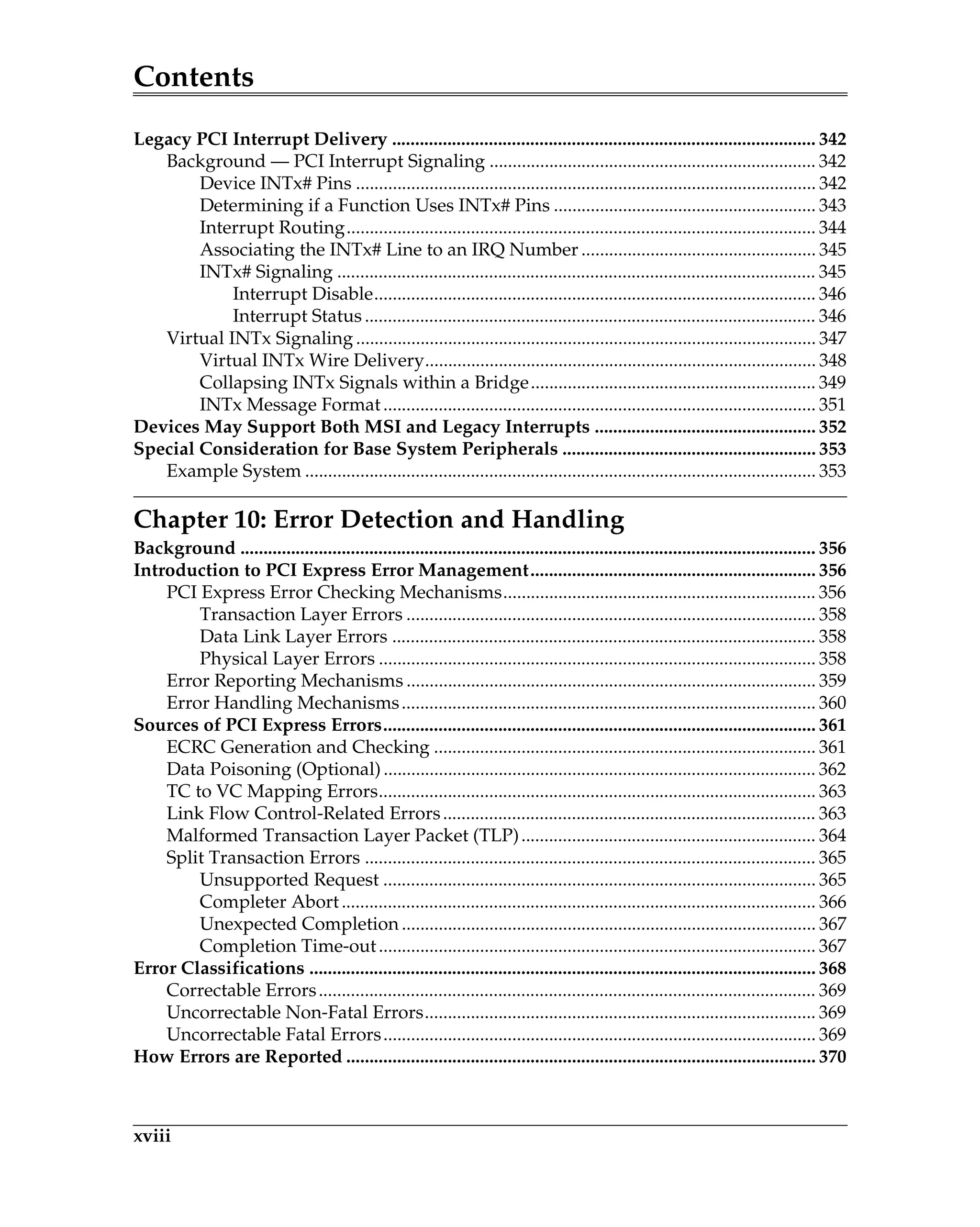
Contents
xviii
Legacy PCI Interrupt Delivery ............................................................................................ 342
Background — PCI Interrupt Signaling ....................................................................... 342
Device INTx# Pins .................................................................................................... 342
Determining if a Function Uses INTx# Pins ......................................................... 343
Interrupt Routing...................................................................................................... 344
Associating the INTx# Line to an IRQ Number ................................................... 345
INTx# Signaling ........................................................................................................ 345
Interrupt Disable................................................................................................ 346
Interrupt Status .................................................................................................. 346
Virtual INTx Signaling .................................................................................................... 347
Virtual INTx Wire Delivery..................................................................................... 348
Collapsing INTx Signals within a Bridge.............................................................. 349
INTx Message Format.............................................................................................. 351
Devices May Support Both MSI and Legacy Interrupts ................................................ 352
Special Consideration for Base System Peripherals ....................................................... 353
Example System ............................................................................................................... 353
Chapter 10: Error Detection and Handling
Background ............................................................................................................................. 356
Introduction to PCI Express Error Management.............................................................. 356
PCI Express Error Checking Mechanisms.................................................................... 356
Transaction Layer Errors ......................................................................................... 358
Data Link Layer Errors ............................................................................................ 358
Physical Layer Errors ............................................................................................... 358
Error Reporting Mechanisms ......................................................................................... 359
Error Handling Mechanisms.......................................................................................... 360
Sources of PCI Express Errors.............................................................................................. 361
ECRC Generation and Checking ................................................................................... 361
Data Poisoning (Optional).............................................................................................. 362
TC to VC Mapping Errors............................................................................................... 363
Link Flow Control-Related Errors................................................................................. 363
Malformed Transaction Layer Packet (TLP)................................................................ 364
Split Transaction Errors .................................................................................................. 365
Unsupported Request .............................................................................................. 365
Completer Abort....................................................................................................... 366
Unexpected Completion .......................................................................................... 367
Completion Time-out............................................................................................... 367
Error Classifications .............................................................................................................. 368
Correctable Errors............................................................................................................ 369
Uncorrectable Non-Fatal Errors..................................................................................... 369
Uncorrectable Fatal Errors.............................................................................................. 369
How Errors are Reported ...................................................................................................... 370
Contents
xix
Error Messages ................................................................................................................. 370
Completion Status............................................................................................................ 371
Baseline Error Detection and Handling............................................................................. 372
PCI-Compatible Error Reporting Mechanisms ........................................................... 372
Configuration Command and Status Registers................................................... 373
PCI Express Baseline Error Handling ........................................................................... 375
Enabling/Disabling Error Reporting..................................................................... 376
Enabling Error Reporting — Device Control Register................................. 377
Error Status — Device Status Register ........................................................... 378
Link Errors................................................................................................................. 379
Root’s Response to Error Message ......................................................................... 381
Advanced Error Reporting Mechanisms ........................................................................... 382
ECRC Generation and Checking ................................................................................... 383
Handling Sticky Bits ........................................................................................................ 383
Advanced Correctable Error Handling ........................................................................ 384
Advanced Correctable Error Status ....................................................................... 385
Advanced Correctable Error Reporting ................................................................ 385
Advanced Uncorrectable Error Handling.................................................................... 386
Advanced Uncorrectable Error Status................................................................... 387
Selecting the Severity of Each Uncorrectable Error ............................................. 388
Uncorrectable Error Reporting ............................................................................... 388
Error Logging ................................................................................................................... 389
Root Complex Error Tracking and Reporting ............................................................. 390
Root Complex Error Status Registers .................................................................... 390
Advanced Source ID Register ................................................................................. 391
Root Error Command Register ............................................................................... 392
Reporting Errors to the Host System ..................................................................... 392
Summary of Error Logging and Reporting ....................................................................... 392
Part Three: The Physical Layer
Chapter 11: Physical Layer Logic
Physical Layer Overview ...................................................................................................... 397
Disclaimer ......................................................................................................................... 400
Transmit Logic Overview ............................................................................................... 400
Receive Logic Overview ................................................................................................. 402
Physical Layer Link Active State Power Management .............................................. 403
Link Training and Initialization..................................................................................... 403
Transmit Logic Details.......................................................................................................... 403
Tx Buffer............................................................................................................................ 404
Multiplexer (Mux) and Mux Control Logic ................................................................. 404
Contents
xx
General ....................................................................................................................... 404
Definition of Characters and Symbols................................................................... 405
Byte Striping (Optional).................................................................................................. 408
Packet Format Rules................................................................................................. 411
General Packet Format Rules........................................................................... 411
x1 Packet Format Example............................................................................... 412
x4 Packet Format Rules..................................................................................... 412
x4 Packet Format Example............................................................................... 412
x8, x12, x16 or x32 Packet Format Rules......................................................... 413
x8 Packet Format Example............................................................................... 415
Scrambler........................................................................................................................... 416
Purpose of Scrambling Outbound Transmission................................................. 416
Scrambler Algorithm................................................................................................ 416
Some Scrambler implementation rules:................................................................. 417
Disabling Scrambling ............................................................................................... 418
8b/10b Encoding.............................................................................................................. 419
General ....................................................................................................................... 419
Purpose of Encoding a Character Stream.............................................................. 419
Properties of 10-bit (10b) Symbols.......................................................................... 421
Preparing 8-bit Character Notation........................................................................ 422
Disparity..................................................................................................................... 423
Definition ............................................................................................................ 423
Two Categories of 8-bit Characters................................................................. 423
CRD (Current Running Disparity).................................................................. 423
8b/10b Encoding Procedure ................................................................................... 424
Example Encodings........................................................................................... 424
Example Transmission...................................................................................... 425
The Lookup Tables ................................................................................................... 427
Control Character Encoding ................................................................................... 430
Ordered-Sets.............................................................................................................. 433
General ................................................................................................................ 433
TS1 and TS2 Ordered-Sets................................................................................ 434
SKIP Ordered-Set............................................................................................... 434
Electrical Idle Ordered-Set ............................................................................... 434
FTS Ordered-Set................................................................................................. 434
Parallel-to-Serial Converter (Serializer)........................................................................ 434
Differential Transmit Driver........................................................................................... 435
Transmit (Tx) Clock ......................................................................................................... 435
Other Miscellaneous Transmit Logic Topics ............................................................... 436
Logical Idle Sequence............................................................................................... 436
Inserting Clock Compensation Zones.................................................................... 436
Background ........................................................................................................ 436
Contents
xxi
SKIP Ordered-Set Insertion Rules................................................................... 437
Receive Logic Details ............................................................................................................ 437
Differential Receiver........................................................................................................ 439
Rx Clock Recovery........................................................................................................... 440
General ....................................................................................................................... 440
Achieving Bit Lock ................................................................................................... 440
Losing Bit Lock.......................................................................................................... 441
Regaining Bit Lock.................................................................................................... 441
Serial-to-Parallel converter (Deserializer) .................................................................... 441
Symbol Boundary Sensing (Symbol Lock)................................................................... 441
Receiver Clock Compensation Logic ............................................................................ 442
Background................................................................................................................ 442
The Elastic Buffer’s Role in the Receiver............................................................... 442
Lane-to-Lane De-Skew.................................................................................................... 444
Not a Problem on a Single-Lane Link.................................................................... 444
Flight Time Varies from Lane-to-Lane .................................................................. 444
If Lane Data Is Not Aligned, Byte Unstriping Wouldn’t Work ......................... 444
TS1/TS2 or FTS Ordered-Sets Used to De-Skew Link ........................................ 444
De-Skew During Link Training, Retraining and L0s Exit................................... 445
Lane-to-Lane De-Skew Capability of Receiver..................................................... 445
8b/10b Decoder................................................................................................................ 446
General ....................................................................................................................... 446
Disparity Calculator ................................................................................................. 446
Code Violation and Disparity Error Detection..................................................... 446
General ................................................................................................................ 446
Code Violations.................................................................................................. 446
Disparity Errors......................................................................................................... 447
De-Scrambler .................................................................................................................... 448
Some De-Scrambler Implementation Rules:......................................................... 448
Disabling De-Scrambling......................................................................................... 449
Byte Un-Striping............................................................................................................... 449
Filter and Packet Alignment Check............................................................................... 450
Receive Buffer (Rx Buffer) .............................................................................................. 450
Physical Layer Error Handling ............................................................................................ 450
Response of Data Link Layer to ‘Receiver Error’ Indication.............................. 451
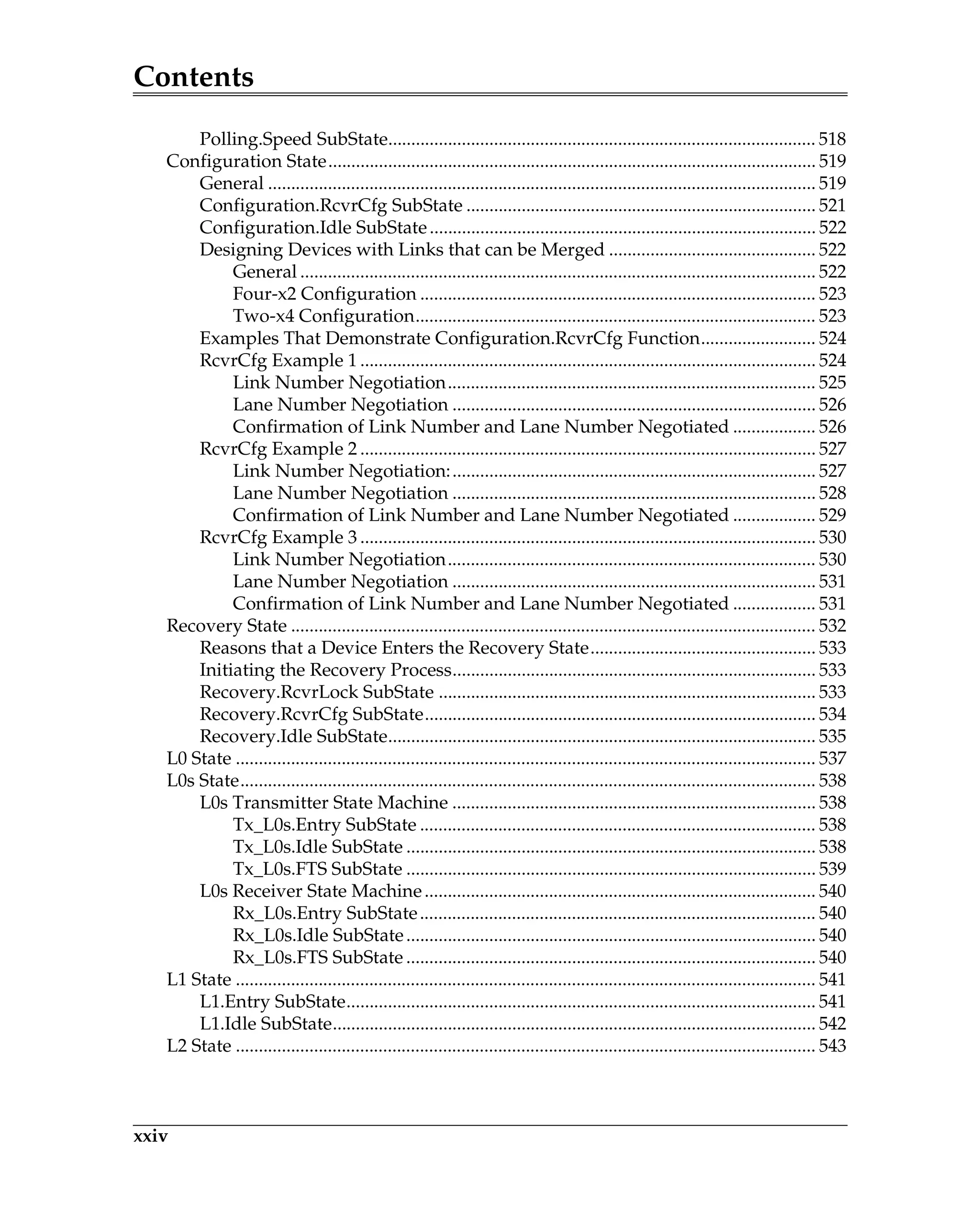
Chapter 12: Electrical Physical Layer
Electrical Physical Layer Overview .................................................................................... 453
High Speed Electrical Signaling ......................................................................................... 455
Clock Requirements......................................................................................................... 456
General ....................................................................................................................... 456
Spread Spectrum Clocking (SSC) ........................................................................... 456
Contents
xxii
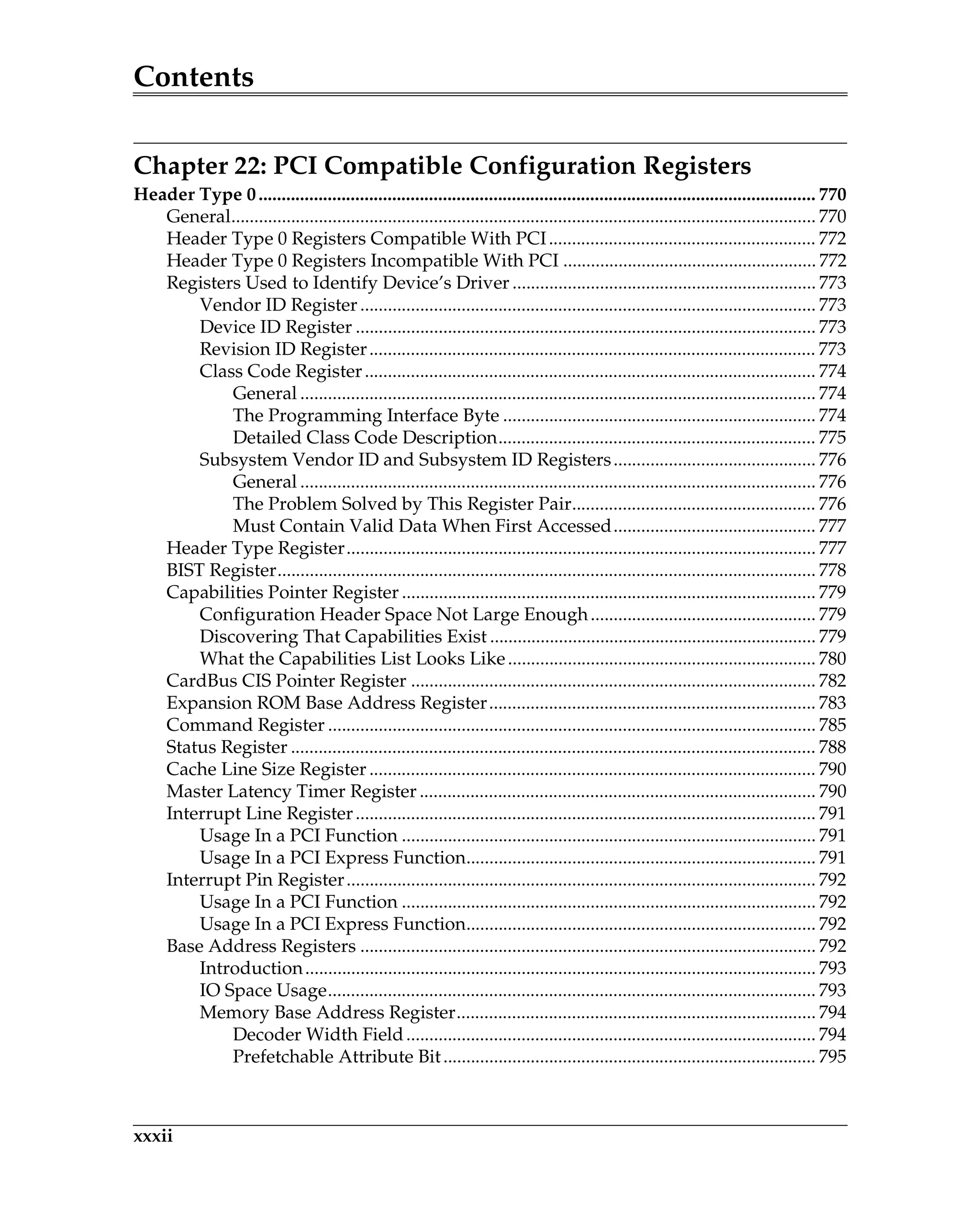
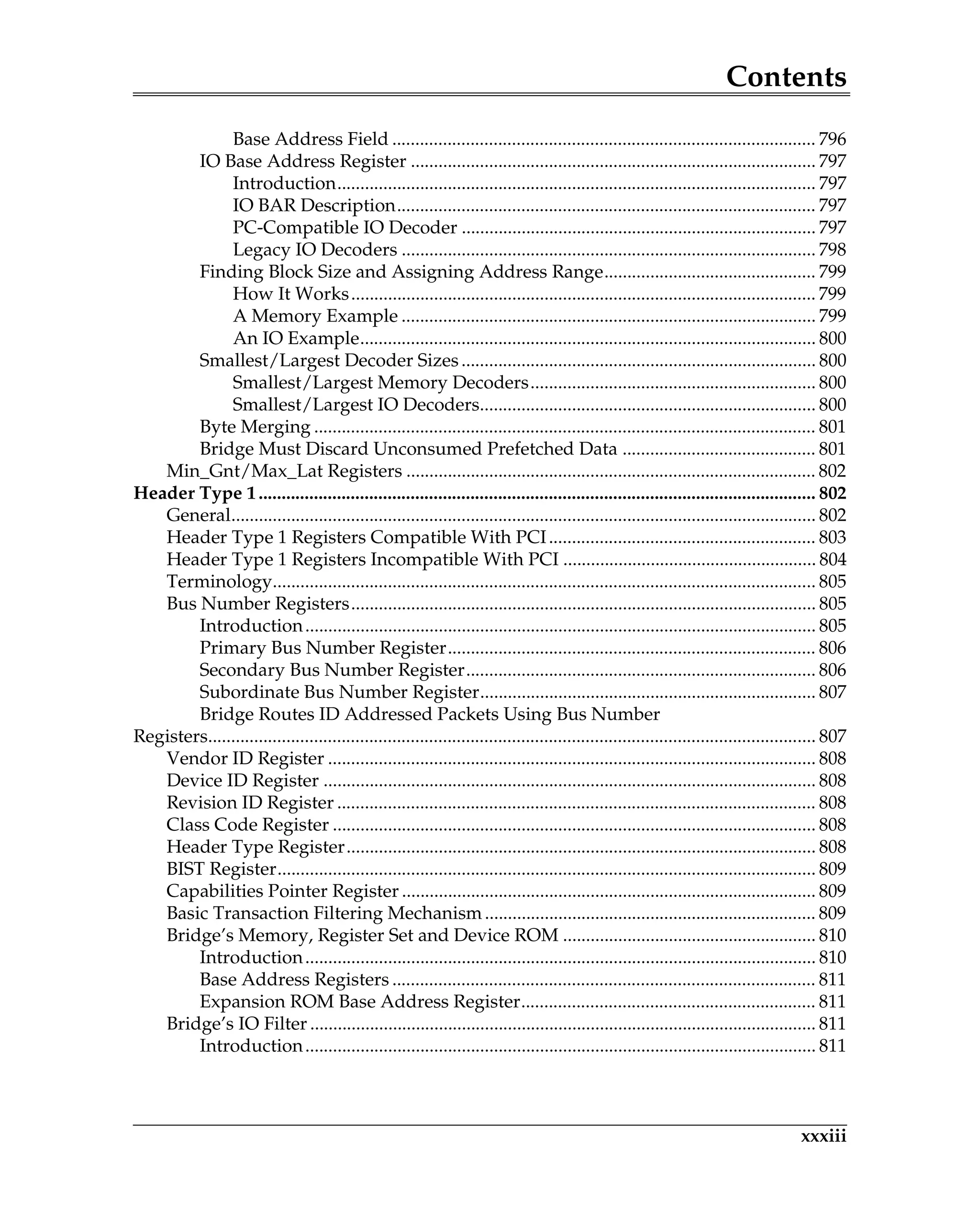
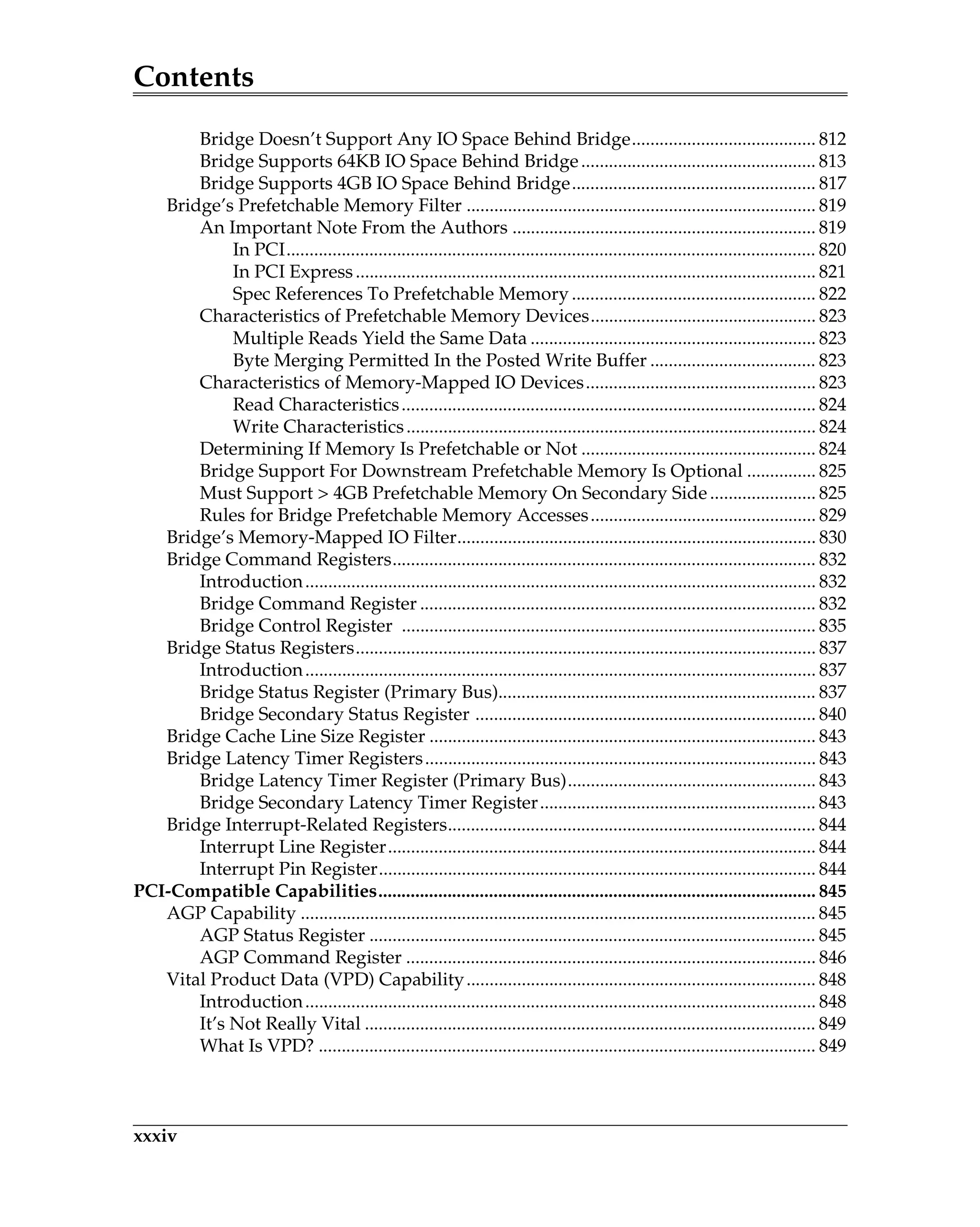
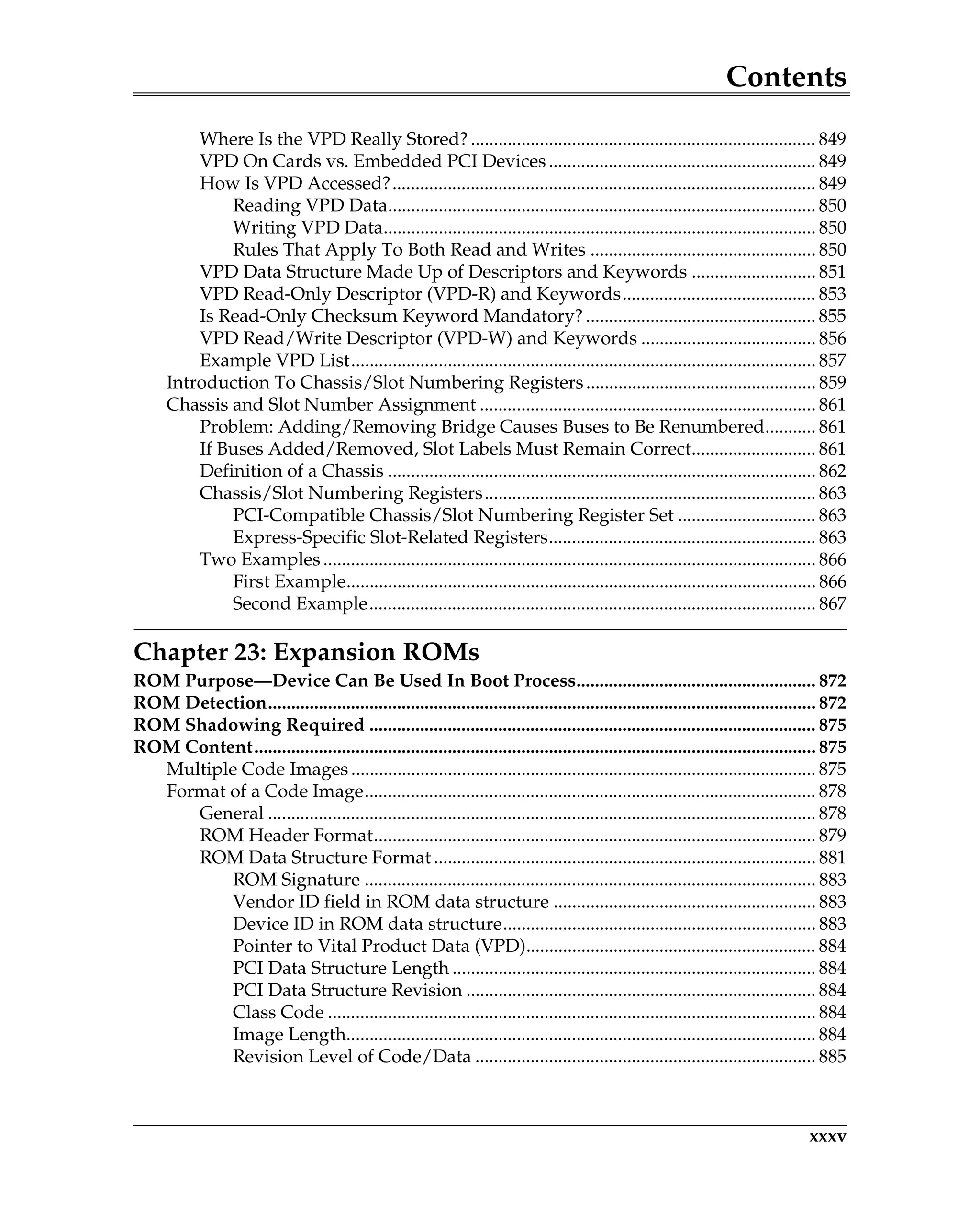
Impedance and Termination .......................................................................................... 456
Transmitter Impedance Requirements .................................................................. 457
Receiver Impedance Requirements........................................................................ 457
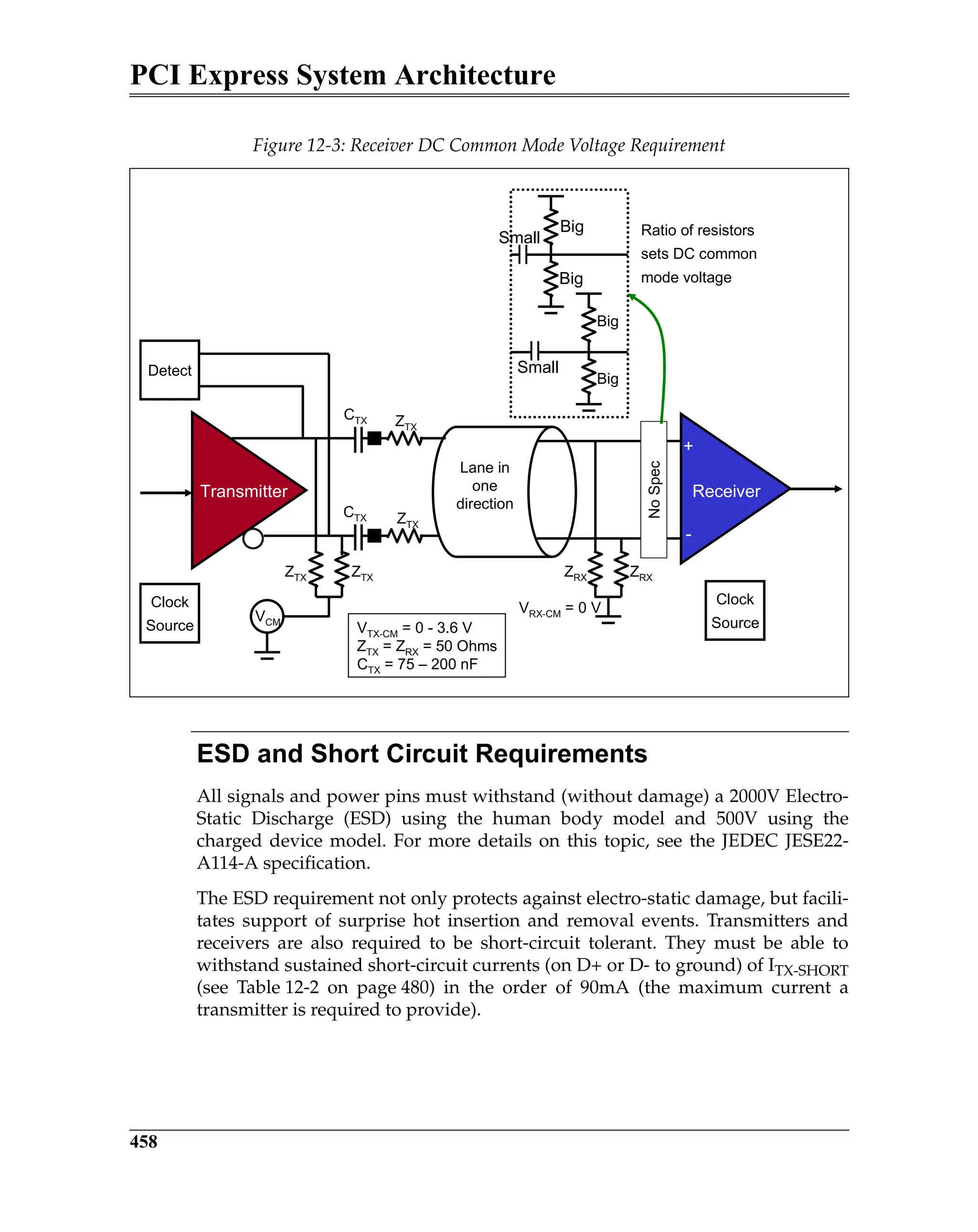
DC Common Mode Voltages ......................................................................................... 457
Transmitter DC Common Mode Voltage.............................................................. 457
Receiver DC Common Mode Voltage.................................................................... 457
ESD and Short Circuit Requirements............................................................................ 458
Receiver Detection ........................................................................................................... 459
General ....................................................................................................................... 459
With a Receiver Attached ........................................................................................ 459
Without a Receiver Attached .................................................................................. 459
Procedure To Detect Presence or Absence of Receiver ....................................... 459
Differential Drivers and Receivers ................................................................................ 461
Advantages of Differential Signaling .................................................................... 461
Differential Voltages................................................................................................. 461
Differential Voltage Notation.................................................................................. 462
General ................................................................................................................ 462
Differential Peak Voltage.................................................................................. 462
Differential Peak-to-Peak Voltage................................................................... 462
Common Mode Voltage ................................................................................... 462
Electrical Idle .................................................................................................................... 464
Transmitter Responsibility ...................................................................................... 464
Receiver Responsibility............................................................................................ 465
Power Consumed When Link Is in Electrical Idle State ..................................... 465
Electrical Idle Exit ..................................................................................................... 465
Transmission Line Loss on Link .................................................................................... 465
AC Coupling..................................................................................................................... 466
De-Emphasis (or Pre-Emphasis).................................................................................... 466
What is De-Emphasis? ............................................................................................. 466
What is the Problem Addressed By De-emphasis? ............................................. 467
Solution ...................................................................................................................... 468
Beacon Signaling .............................................................................................................. 469
General ....................................................................................................................... 469
Properties of the Beacon Signal .............................................................................. 469
LVDS Eye Diagram................................................................................................................ 470
Jitter, Noise, and Signal Attenuation ............................................................................ 470
The Eye Test...................................................................................................................... 470
Optimal Eye ...................................................................................................................... 471
Jitter Widens or Narrows the Eye Sideways................................................................ 471
Noise and Signal Attenuation Heighten the Eye ........................................................ 472
Transmitter Driver Characteristics ..................................................................................... 477
General............................................................................................................................... 477
Contents
xxiii
Transmit Driver Compliance Test and Measurement Load...................................... 479
Input Receiver Characteristics............................................................................................. 480
Electrical Physical Layer State in Power States................................................................ 481
Chapter 13: System Reset
Two Categories of System Reset......................................................................................... 487
Fundamental Reset .......................................................................................................... 488
Methods of Signaling Fundamental Reset ............................................................ 489
PERST# Type Fundamental Reset Generation .............................................. 489
Autonomous Method of Fundamental Reset Generation ........................... 489
In-Band Reset or Hot Reset............................................................................................. 491
Response to Receiving a Hot Reset Command .................................................... 491
Switches Generate Hot Reset on Their Downstream Ports ................................ 492
Bridges Forward Hot Reset to the Secondary Bus............................................... 492
How Does Software Tell a Device (e.g. Switch or Root Complex) to Generate Hot
Reset? ........................................................................................................................................ 492
Reset Exit.................................................................................................................................. 496
Link Wakeup from L2 Low Power State............................................................................ 497
Device Signals Wakeup............................................................................................ 497
Power Management Software Generates Wakeup Event................................... 497
Chapter 14: Link Initialization & Training
Link Initialization and Training Overview ...................................................................... 500
General............................................................................................................................... 500
Ordered-Sets Used During Link Training and Initialization ....................................... 504
TS1 and TS2 Ordered-Sets .............................................................................................. 505
Electrical Idle Ordered-Set.............................................................................................. 507
FTS Ordered-Set............................................................................................................... 507
SKIP Ordered-Set............................................................................................................. 508
Link Training and Status State Machine (LTSSM)......................................................... 508
General............................................................................................................................... 508
Overview of LTSSM States ............................................................................................. 511
Detailed Description of LTSSM States.............................................................................. 513
Detect State........................................................................................................................ 513
Detect.Quiet SubState............................................................................................... 513
Detect.Active SubState ............................................................................................. 514
Polling State ...................................................................................................................... 515
Introduction............................................................................................................... 515
Polling.Active SubState............................................................................................ 516
Polling.Configuration SubState .............................................................................. 517
Polling.Compliance SubState.................................................................................. 518
Contents
xxiv
Polling.Speed SubState............................................................................................. 518
Configuration State.......................................................................................................... 519
General ....................................................................................................................... 519
Configuration.RcvrCfg SubState ............................................................................ 521
Configuration.Idle SubState.................................................................................... 522
Designing Devices with Links that can be Merged ............................................. 522
General ................................................................................................................ 522
Four-x2 Configuration ...................................................................................... 523
Two-x4 Configuration....................................................................................... 523
Examples That Demonstrate Configuration.RcvrCfg Function......................... 524
RcvrCfg Example 1 ................................................................................................... 524
Link Number Negotiation................................................................................ 525
Lane Number Negotiation ............................................................................... 526
Confirmation of Link Number and Lane Number Negotiated .................. 526
RcvrCfg Example 2 ................................................................................................... 527
Link Number Negotiation:............................................................................... 527
Lane Number Negotiation ............................................................................... 528
Confirmation of Link Number and Lane Number Negotiated .................. 529
RcvrCfg Example 3 ................................................................................................... 530
Link Number Negotiation................................................................................ 530
Lane Number Negotiation ............................................................................... 531
Confirmation of Link Number and Lane Number Negotiated .................. 531
Recovery State .................................................................................................................. 532
Reasons that a Device Enters the Recovery State................................................. 533
Initiating the Recovery Process............................................................................... 533
Recovery.RcvrLock SubState .................................................................................. 533
Recovery.RcvrCfg SubState..................................................................................... 534
Recovery.Idle SubState............................................................................................. 535
L0 State .............................................................................................................................. 537
L0s State............................................................................................................................. 538
L0s Transmitter State Machine ............................................................................... 538
Tx_L0s.Entry SubState ...................................................................................... 538
Tx_L0s.Idle SubState ......................................................................................... 538
Tx_L0s.FTS SubState ......................................................................................... 539
L0s Receiver State Machine..................................................................................... 540
Rx_L0s.Entry SubState...................................................................................... 540
Rx_L0s.Idle SubState......................................................................................... 540
Rx_L0s.FTS SubState ......................................................................................... 540
L1 State .............................................................................................................................. 541
L1.Entry SubState...................................................................................................... 541
L1.Idle SubState......................................................................................................... 542
L2 State .............................................................................................................................. 543
Contents
xxv
L2.Idle SubState......................................................................................................... 543
L1.TransmitWake SubState ..................................................................................... 543
Hot Reset State.................................................................................................................. 544
Disable State...................................................................................................................... 545
Loopback State ................................................................................................................. 547
Loopback.Entry SubState......................................................................................... 547
Loopback.Active SubState....................................................................................... 548
Loopback.Exit SubState............................................................................................ 548
LTSSM Related Configuration Registers.......................................................................... 549
Link Capability Register ................................................................................................. 549
Maximum Link Speed[3:0] ...................................................................................... 549
Maximum Link Width[9:4]...................................................................................... 550
Link Status Register......................................................................................................... 551
Link Speed[3:0]:......................................................................................................... 551
Negotiate Link Width[9:4]....................................................................................... 551
Training Error[10]..................................................................................................... 551
Link Training[11] ...................................................................................................... 551
Link Control Register ...................................................................................................... 552
Link Disable............................................................................................................... 552
Retrain Link ............................................................................................................... 552
Extended Synch......................................................................................................... 552
Part Four: Power-Related Topics
Chapter 15: Power Budgeting
Introduction to Power Budgeting ....................................................................................... 557
The Power Budgeting Elements.......................................................................................... 558
Slot Power Limit Control...................................................................................................... 562
Expansion Port Delivers Slot Power Limit................................................................... 562
Expansion Device Limits Power Consumption........................................................... 564
The Power Budget Capabilities Register Set.................................................................... 564
Chapter 16: Power Management
Introduction............................................................................................................................. 568
Primer on Configuration Software ..................................................................................... 569
Basics of PCI PM .............................................................................................................. 569
OnNow Design Initiative Scheme Defines Overall PM ............................................. 571
Goals ........................................................................................................................... 572
System PM States...................................................................................................... 572
Device PM States....................................................................................................... 573
Definition of Device Context................................................................................... 574
Contents
xxvi
General ................................................................................................................ 574
PM Event (PME) Context ................................................................................. 575
Device Class-Specific PM Specifications ............................................................... 576
Default Device Class Specification.................................................................. 576
Device Class-Specific PM Specifications ........................................................ 576
Power Management Policy Owner ........................................................................ 577
General ................................................................................................................ 577
In Windows OS Environment.......................................................................... 577
PCI Express Power Management vs. ACPI.................................................................. 577
PCI Express Bus Driver Accesses PCI Express Configuration and PM Registers.
577
ACPI Driver Controls Non-Standard Embedded Devices ................................. 577
Some Example Scenarios ......................................................................................... 579
Scenario—OS Wishes To Power Down PCI Express Devices..................... 580
Scenario—Restore All Functions To Powered Up State .............................. 582
Scenario—Setup a Function-Specific System WakeUp Event..................... 583
Function Power Management.............................................................................................. 585
The PM Capability Register Set ..................................................................................... 585
Device PM States.............................................................................................................. 586
D0 State—Full On ..................................................................................................... 586
Mandatory. ......................................................................................................... 586
D0 Uninitialized................................................................................................. 586
D0 Active ............................................................................................................ 587
D1 State—Light Sleep............................................................................................... 587
D2 State—Deep Sleep............................................................................................... 589
D3—Full Off .............................................................................................................. 590
D3Hot State......................................................................................................... 591
D3Cold State....................................................................................................... 592
Function PM State Transitions................................................................................ 593
Detailed Description of PCI-PM Registers................................................................... 596
PM Capabilities (PMC) Register............................................................................. 597
PM Control/Status (PMCSR) Register .................................................................. 599
Data Register ............................................................................................................. 603
Determining Presence of the Data Register................................................... 604
Operation of the Data Register ........................................................................ 604
Multi-Function Devices .................................................................................... 604
Virtual PCI-to-PCI Bridge Power Data........................................................... 604
Introduction to Link Power Management......................................................................... 606
Link Active State Power Management............................................................................... 608
L0s State............................................................................................................................. 611
Entry into L0s ............................................................................................................ 611
Entry into L0s Triggered by Link Idle Time.................................................. 611
Contents
xxvii
Flow Control Credits Must be Delivered....................................................... 612
Transmitter Initiates Entry to L0s ................................................................... 612
Exit from L0s State.................................................................................................... 613
Transmitter Initiates L0s Exit........................................................................... 613
Actions Taken by Switches that Receive L0s Exit......................................... 613
L1 ASPM State.................................................................................................................. 614
Downstream Component Decides to Enter L1 ASPM ........................................ 615
Negotiation Required to Enter L1 ASPM.............................................................. 616
Scenario 1: Both Ports Ready to Enter L1 ASPM State........................................ 616
Downstream Component Issues Request to Enter L1 State........................ 616
Upstream Component Requirements to Enter L1 ASPM............................ 617
Upstream Component Acknowledges Request to Enter L1........................ 617
Downstream Component Detects Acknowledgement ................................ 617
Upstream Component Receives Electrical Idle............................................. 617
Scenario 2: Upstream Component Transmits TLP Just Prior to Receiving L1 Re-
quest .......................................................................................................................................... 618
TLP Must Be Accepted by Downstream Component .................................. 619
Upstream Component Receives Request to Enter L1................................... 619
Exit from L1 ASPM State ......................................................................................... 621
L1 ASPM Exit Signaling.................................................................................... 621
Switch Receives L1 Exit from Downstream Component............................. 622
Switch Receives L1 Exit from Upstream Component .................................. 623
ASPM Exit Latency .......................................................................................................... 624
Reporting a Valid ASPM Exit Latency .................................................................. 625
L0s Exit Latency Update................................................................................... 625
L1 Exit Latency Update .................................................................................... 626
Calculating Latency Between Endpoint to Root Complex ................................. 626
Software Initiated Link Power Management ................................................................... 629
D1/D2/D3Hot and the L1 State .................................................................................... 629
Entering the L1 State ................................................................................................ 630
Exiting the L1 State................................................................................................... 632
Upstream Component Initiates L1 to L0 Transition..................................... 632
Downstream Component Initiates L1 to L0 Transition ............................... 633
The L1 Exit Protocol .......................................................................................... 633
L2/L3 Ready — Removing Power from the Link....................................................... 633
L2/L3 Ready Handshake Sequence....................................................................... 634
Exiting the L2/L3 Ready State — Clock and Power Removed.......................... 637
The L2 State................................................................................................................ 637
The L3 State................................................................................................................ 637
Link Wake Protocol and PME Generation........................................................................ 638
The PME Message............................................................................................................ 639
The PME Sequence........................................................................................................... 640
Contents
xxviii
PME Message Back Pressure Deadlock Avoidance.................................................... 640
Background................................................................................................................ 641
The Problem............................................................................................................... 641
The Solution............................................................................................................... 641
The PME Context ............................................................................................................. 642
Waking Non-Communicating Links............................................................................. 642
Beacon......................................................................................................................... 643
WAKE# (AUX Power).............................................................................................. 643
Auxiliary Power ............................................................................................................... 645
Part Five: Optional Topics
Chapter 17: Hot Plug
Background ............................................................................................................................. 650
Hot Plug in the PCI Express Environment........................................................................ 651
Surprise Removal Notification....................................................................................... 652
Differences between PCI and PCI Express Hot Plug.................................................. 652
Elements Required to Support Hot Plug........................................................................... 655
Software Elements ........................................................................................................... 655
Hardware Elements......................................................................................................... 656
Card Removal and Insertion Procedures........................................................................... 658
On and Off States ............................................................................................................. 658
Definition of On and Off.......................................................................................... 658
Turning Slot Off ........................................................................................................ 658
Turning Slot On......................................................................................................... 659
Card Removal Procedure................................................................................................ 659
Attention Button Used to Initiate Hot Plug Removal ......................................... 659
Hot Plug Removal Request Issued via User Interface......................................... 660
Card Insertion Procedure................................................................................................ 661
Card Insertion Initiated by Pressing Attention Button ....................................... 661
Card Insertion Initiated by User Interface ............................................................ 662
Standardized Usage Model .................................................................................................. 663
Background....................................................................................................................... 663
Standard User Interface .................................................................................................. 664
Attention Indicator ................................................................................................... 664
Power Indicator......................................................................................................... 665
Manually Operated Retention Latch and Sensor................................................. 666
Electromechanical Interlock (optional).................................................................. 667
Software User Interface............................................................................................ 667
Attention Button ....................................................................................................... 667
Slot Numbering Identification ................................................................................ 668
Contents
xxix
Standard Hot Plug Controller Signaling Interface.......................................................... 668
The Hot-Plug Controller Programming Interface............................................................ 670
Slot Capabilities................................................................................................................ 670
Slot Power Limit Control......................................................................................... 672
Slot Control ....................................................................................................................... 672
Slot Status and Events Management............................................................................. 674
Card Slot vs Server IO Module Implementations ....................................................... 676
Detecting Module and Blade Capabilities............................................................. 678
Hot Plug Messages ................................................................................................... 678
Attention and Power Indicator Control Messages ....................................... 678
Attention Button Pressed Message ................................................................. 679
Limitations of the Hot Plug Messages............................................................ 679
Slot Numbering...................................................................................................................... 681
Physical Slot ID................................................................................................................. 681
Quiescing Card and Driver .................................................................................................. 681
General............................................................................................................................... 681
Pausing a Driver (Optional) ........................................................................................... 681
Quiescing a Driver That Controls Multiple Devices ........................................... 682
Quiescing a Failed Card........................................................................................... 682
The Primitives......................................................................................................................... 682
Chapter 18: Add-in Cards and Connectors
Introduction............................................................................................................................. 686
Add-in Connector ............................................................................................................ 686
Auxiliary Signals.............................................................................................................. 693
General ....................................................................................................................... 693
Reference Clock......................................................................................................... 694
PERST# ....................................................................................................................... 695
WAKE#....................................................................................................................... 696
SMBus......................................................................................................................... 698
JTAG ........................................................................................................................... 699
PRSNT Pins................................................................................................................ 699
Electrical Requirements................................................................................................... 700
Power Supply Requirements .................................................................................. 700
Power Dissipation Limits ........................................................................................ 701
Add-in Card Interoperability......................................................................................... 702
Form Factors Under Development...................................................................................... 703
General............................................................................................................................... 703
Server IO Module (SIOM)............................................................................................... 703
Riser Card.......................................................................................................................... 704
Mini PCI Express Card.................................................................................................... 704
NEWCARD form factor .................................................................................................. 707
Contents
xxx
Part Six: PCI Express Configuration
Chapter 19: Configuration Overview
Definition of Device and Function..................................................................................... 712
Definition of Primary and Secondary Bus........................................................................ 714
Topology Is Unknown At Startup ...................................................................................... 714
Each Function Implements a Set of Configuration
Registers................................................................................................................................... 715
Introduction ...................................................................................................................... 715
Function Configuration Space........................................................................................ 715
PCI-Compatible Space ............................................................................................. 715
PCI Express Extended Configuration Space......................................................... 716
Host/PCI Bridge’s Configuration Registers...................................................................... 716
Configuration Transactions Are Originated by the
Processor .................................................................................................................................. 718
Only the Root Complex Can Originate Configuration Transactions ....................... 718
Configuration Transactions Only Move DownStream............................................... 718
No Peer-to-Peer Configuration Transactions............................................................... 718
Configuration Transactions Are Routed Via Bus, Device, and Function Number... 718
How a Function Is Discovered............................................................................................. 719
How To Differentiate a PCI-to-PCI Bridge From a Non-Bridge Function.................. 719
Chapter 20: Configuration Mechanisms
Introduction............................................................................................................................. 722
PCI-Compatible Configuration Mechanism..................................................................... 723
Background....................................................................................................................... 724
PCI-Compatible Configuration Mechanism
Description ............................................................................................................................... 724
General ....................................................................................................................... 724
Configuration Address Port.................................................................................... 725
Bus Compare and Data Port Usage........................................................................ 726
Target Bus = 0..................................................................................................... 726
Bus Number < Target Bus ≤ Subordinate Bus Number............................... 727
Single Host/PCI Bridge........................................................................................... 727
Multiple Host/PCI Bridges..................................................................................... 729
PCI Express Enhanced Configuration Mechanism ......................................................... 731
Description........................................................................................................................ 731
Some Rules........................................................................................................................ 731
Type 0 Configuration Request ............................................................................................ 732
Type 1 Configuration Request ............................................................................................ 733
Contents
xxxi
Example PCI-Compatible Configuration Access............................................................. 735
Example Enhanced Configuration Access......................................................................... 736
Initial Configuration Accesses ............................................................................................ 738
What’s Going On During Initialization Time? ............................................................ 738
Definition of Initialization Period In PCI ..................................................................... 738
Definition of Initialization Period In PCI-X ................................................................. 739
PCI Express and Initialization Time.............................................................................. 739
Initial Configuration Access Failure Timeout ...................................................... 739
Delay Prior To Initial Configuration Access to Device ....................................... 739
A Device With a Lengthy Self-Initialization Period ............................................ 740
RC Response To CRS Receipt During Run-Time ........................................................ 740
Chapter 21: PCI Express Enumeration
Introduction............................................................................................................................. 741
Enumerating a System With a Single Root Complex...................................................... 742
Enumerating a System With Multiple Root Complexes ................................................ 753
Operational Characteristics of the PCI-Compatible Mechanism.............................. 754
Operational Characteristics of the Enhanced
Configuration Mechanism ..................................................................................................... 755
The Enumeration Process ............................................................................................... 755
A Multifunction Device Within a Root Complex or a Switch ...................................... 758
A Multifunction Device Within a Root Complex........................................................ 758
A Multifunction Device Within a Switch ..................................................................... 759
An Endpoint Embedded in a Switch or Root Complex.................................................. 761
Memorize Your Identity ....................................................................................................... 763
General............................................................................................................................... 763
Root Complex Bus Number/Device Number
Assignment .............................................................................................................................. 764
Initiating Requests Prior To ID Assignment................................................................ 764
Initiating Completions Prior to ID Assignment .......................................................... 765
Root Complex Register Blocks (RCRBs) ........................................................................... 765
What Problem Does an RCRB Address? ...................................................................... 765
Additional Information on RCRBs................................................................................ 766
Miscellaneous Rules.............................................................................................................. 766
A Split Configuration Transaction Requires a Single
Completion............................................................................................................................... 766
An Issue For PCI Express-to-PCI or -PCI-X Bridges................................................... 767
PCI Special Cycle Transactions...................................................................................... 767
Contents
xxxii
Chapter 22: PCI Compatible Configuration Registers
Header Type 0......................................................................................................................... 770
General............................................................................................................................... 770
Header Type 0 Registers Compatible With PCI.......................................................... 772
Header Type 0 Registers Incompatible With PCI ....................................................... 772
Registers Used to Identify Device’s Driver .................................................................. 773
Vendor ID Register................................................................................................... 773
Device ID Register .................................................................................................... 773
Revision ID Register................................................................................................. 773
Class Code Register.................................................................................................. 774
General ................................................................................................................ 774
The Programming Interface Byte .................................................................... 774
Detailed Class Code Description..................................................................... 775
Subsystem Vendor ID and Subsystem ID Registers............................................ 776
General ................................................................................................................ 776
The Problem Solved by This Register Pair..................................................... 776
Must Contain Valid Data When First Accessed............................................ 777
Header Type Register...................................................................................................... 777
BIST Register..................................................................................................................... 778
Capabilities Pointer Register .......................................................................................... 779
Configuration Header Space Not Large Enough................................................. 779
Discovering That Capabilities Exist ....................................................................... 779
What the Capabilities List Looks Like................................................................... 780
CardBus CIS Pointer Register ........................................................................................ 782
Expansion ROM Base Address Register....................................................................... 783
Command Register .......................................................................................................... 785
Status Register .................................................................................................................. 788
Cache Line Size Register ................................................................................................. 790
Master Latency Timer Register ...................................................................................... 790
Interrupt Line Register.................................................................................................... 791
Usage In a PCI Function .......................................................................................... 791
Usage In a PCI Express Function............................................................................ 791
Interrupt Pin Register...................................................................................................... 792
Usage In a PCI Function .......................................................................................... 792
Usage In a PCI Express Function............................................................................ 792
Base Address Registers ................................................................................................... 792
Introduction............................................................................................................... 793
IO Space Usage.......................................................................................................... 793
Memory Base Address Register.............................................................................. 794
Decoder Width Field......................................................................................... 794
Prefetchable Attribute Bit................................................................................. 795
Contents
xxxiii
Base Address Field ............................................................................................ 796
IO Base Address Register ........................................................................................ 797
Introduction........................................................................................................ 797
IO BAR Description........................................................................................... 797
PC-Compatible IO Decoder ............................................................................. 797
Legacy IO Decoders .......................................................................................... 798
Finding Block Size and Assigning Address Range.............................................. 799
How It Works..................................................................................................... 799
A Memory Example .......................................................................................... 799
An IO Example................................................................................................... 800
Smallest/Largest Decoder Sizes............................................................................. 800
Smallest/Largest Memory Decoders.............................................................. 800
Smallest/Largest IO Decoders......................................................................... 800
Byte Merging ............................................................................................................. 801
Bridge Must Discard Unconsumed Prefetched Data .......................................... 801
Min_Gnt/Max_Lat Registers ......................................................................................... 802
Header Type 1......................................................................................................................... 802
General............................................................................................................................... 802
Header Type 1 Registers Compatible With PCI.......................................................... 803
Header Type 1 Registers Incompatible With PCI ....................................................... 804
Terminology...................................................................................................................... 805
Bus Number Registers..................................................................................................... 805
Introduction............................................................................................................... 805
Primary Bus Number Register................................................................................ 806
Secondary Bus Number Register............................................................................ 806
Subordinate Bus Number Register......................................................................... 807
Bridge Routes ID Addressed Packets Using Bus Number
Registers.................................................................................................................................... 807
Vendor ID Register .......................................................................................................... 808
Device ID Register ........................................................................................................... 808
Revision ID Register ........................................................................................................ 808
Class Code Register ......................................................................................................... 808
Header Type Register...................................................................................................... 808
BIST Register..................................................................................................................... 809
Capabilities Pointer Register .......................................................................................... 809
Basic Transaction Filtering Mechanism........................................................................ 809
Bridge’s Memory, Register Set and Device ROM ....................................................... 810
Introduction............................................................................................................... 810
Base Address Registers ............................................................................................ 811
Expansion ROM Base Address Register................................................................ 811
Bridge’s IO Filter .............................................................................................................. 811
Introduction............................................................................................................... 811
Contents
xxxiv
Bridge Doesn’t Support Any IO Space Behind Bridge........................................ 812
Bridge Supports 64KB IO Space Behind Bridge................................................... 813
Bridge Supports 4GB IO Space Behind Bridge..................................................... 817
Bridge’s Prefetchable Memory Filter ............................................................................ 819
An Important Note From the Authors .................................................................. 819
In PCI................................................................................................................... 820
In PCI Express.................................................................................................... 821
Spec References To Prefetchable Memory ..................................................... 822
Characteristics of Prefetchable Memory Devices................................................. 823
Multiple Reads Yield the Same Data .............................................................. 823
Byte Merging Permitted In the Posted Write Buffer .................................... 823
Characteristics of Memory-Mapped IO Devices.................................................. 823
Read Characteristics.......................................................................................... 824
Write Characteristics......................................................................................... 824
Determining If Memory Is Prefetchable or Not ................................................... 824
Bridge Support For Downstream Prefetchable Memory Is Optional ............... 825
Must Support > 4GB Prefetchable Memory On Secondary Side....................... 825
Rules for Bridge Prefetchable Memory Accesses................................................. 829
Bridge’s Memory-Mapped IO Filter.............................................................................. 830
Bridge Command Registers............................................................................................ 832
Introduction............................................................................................................... 832
Bridge Command Register ...................................................................................... 832
Bridge Control Register .......................................................................................... 835
Bridge Status Registers.................................................................................................... 837
Introduction............................................................................................................... 837
Bridge Status Register (Primary Bus)..................................................................... 837
Bridge Secondary Status Register .......................................................................... 840
Bridge Cache Line Size Register .................................................................................... 843
Bridge Latency Timer Registers..................................................................................... 843
Bridge Latency Timer Register (Primary Bus)...................................................... 843
Bridge Secondary Latency Timer Register............................................................ 843
Bridge Interrupt-Related Registers................................................................................ 844
Interrupt Line Register............................................................................................. 844
Interrupt Pin Register............................................................................................... 844
PCI-Compatible Capabilities............................................................................................... 845
AGP Capability ................................................................................................................ 845
AGP Status Register ................................................................................................. 845
AGP Command Register ......................................................................................... 846
Vital Product Data (VPD) Capability............................................................................ 848
Introduction............................................................................................................... 848
It’s Not Really Vital .................................................................................................. 849
What Is VPD? ............................................................................................................ 849
Contents
xxxv
Where Is the VPD Really Stored? ........................................................................... 849
VPD On Cards vs. Embedded PCI Devices .......................................................... 849
How Is VPD Accessed?............................................................................................ 849
Reading VPD Data............................................................................................. 850
Writing VPD Data.............................................................................................. 850
Rules That Apply To Both Read and Writes ................................................. 850
VPD Data Structure Made Up of Descriptors and Keywords ........................... 851
VPD Read-Only Descriptor (VPD-R) and Keywords.......................................... 853
Is Read-Only Checksum Keyword Mandatory? .................................................. 855
VPD Read/Write Descriptor (VPD-W) and Keywords ...................................... 856
Example VPD List..................................................................................................... 857
Introduction To Chassis/Slot Numbering Registers.................................................. 859
Chassis and Slot Number Assignment ......................................................................... 861
Problem: Adding/Removing Bridge Causes Buses to Be Renumbered........... 861
If Buses Added/Removed, Slot Labels Must Remain Correct........................... 861
Definition of a Chassis ............................................................................................. 862
Chassis/Slot Numbering Registers........................................................................ 863
PCI-Compatible Chassis/Slot Numbering Register Set .............................. 863
Express-Specific Slot-Related Registers.......................................................... 863
Two Examples ........................................................................................................... 866
First Example...................................................................................................... 866
Second Example................................................................................................. 867
Chapter 23: Expansion ROMs
ROM Purpose—Device Can Be Used In Boot Process.................................................... 872
ROM Detection....................................................................................................................... 872
ROM Shadowing Required ................................................................................................. 875
ROM Content.......................................................................................................................... 875
Multiple Code Images ..................................................................................................... 875
Format of a Code Image.................................................................................................. 878
General ....................................................................................................................... 878
ROM Header Format................................................................................................ 879
ROM Data Structure Format ................................................................................... 881
ROM Signature .................................................................................................. 883
Vendor ID field in ROM data structure ......................................................... 883
Device ID in ROM data structure.................................................................... 883
Pointer to Vital Product Data (VPD)............................................................... 884
PCI Data Structure Length ............................................................................... 884
PCI Data Structure Revision ............................................................................ 884
Class Code .......................................................................................................... 884
Image Length...................................................................................................... 884
Revision Level of Code/Data .......................................................................... 885
Contents
xxxvi
Code Type........................................................................................................... 885
Indicator Byte..................................................................................................... 885
Execution of Initialization Code ......................................................................................... 885
Introduction to Open Firmware .......................................................................................... 888
Introduction ...................................................................................................................... 888
Universal Device Driver Format.................................................................................... 889
Passing Resource List To Plug-and-Play OS................................................................ 890
BIOS Calls Bus Enumerators For Different Bus Environments ......................... 890
BIOS Selects Boot Devices and Finds Drivers For Them .................................... 891
BIOS Boots Plug-and-Play OS and Passes Pointer To It ..................................... 891
OS Locates and Loads Drivers and Calls Init Code In Each............................... 891
Chapter 24: Express-Specific Configuration Registers
Introduction............................................................................................................................. 894
PCI Express Capability Register Set................................................................................... 896
Introduction ...................................................................................................................... 896
Required Registers........................................................................................................... 897
General ....................................................................................................................... 897
PCI Express Capability ID Register ....................................................................... 898
Next Capability Pointer Register............................................................................ 898
PCI Express Capabilities Register .......................................................................... 898
Device Capabilities Register................................................................................ 900
Device Control Register ........................................................................................... 905
Device Status Register.............................................................................................. 909
Link Registers (Required)........................................................................................ 912
Link Capabilities Register ................................................................................ 912
Link Control Register........................................................................................ 915
Link Status Register........................................................................................... 918
Slot Registers..................................................................................................................... 920
Introduction............................................................................................................... 920
Slot Capabilities Register......................................................................................... 920
Slot Control Register ................................................................................................ 923
Slot Status Register .................................................................................................. 925
Root Port Registers .......................................................................................................... 926
Introduction............................................................................................................... 926
Root Control Register............................................................................................... 926
Root Status Register.................................................................................................. 928
PCI Express Extended Capabilities .................................................................................... 929
General............................................................................................................................... 929
Advanced Error Reporting Capability.......................................................................... 930
General ....................................................................................................................... 930
Detailed Description................................................................................................. 930
Contents
xxxvii
Virtual Channel Capability............................................................................................. 939
The VC Register Set’s Purpose................................................................................ 939
Who Must Implement This Register Set?.............................................................. 940
Multifunction Upstream Port Restriction.............................................................. 940
The Register Set......................................................................................................... 940
Detailed Description of VCs.................................................................................... 940
Port VC Capability Register 1 ................................................................................. 941
Port VC Capability Register 2 ................................................................................. 943
Port VC Control Register......................................................................................... 944
Port VC Status Register............................................................................................ 945
VC Resource Registers ............................................................................................. 946
General ................................................................................................................ 946
VC Resource Capability Register .................................................................... 946
VC Resource Control Register ........................................................................ 948
VC Resource Status Register............................................................................ 950
VC Arbitration Table................................................................................................ 951
Port Arbitration Tables ............................................................................................ 952
Device Serial Number Capability.................................................................................. 952
Power Budgeting Capability .......................................................................................... 954
General ....................................................................................................................... 954
How It Works............................................................................................................ 955
RCRB ........................................................................................................................................ 957
General............................................................................................................................... 957
Firmware Gives OS Base Address of Each RCRB ....................................................... 957
Misaligned or Locked Accesses To an RCRB............................................................... 957
Extended Capabilities in an RCRB ................................................................................ 957
The RCRB Missing Link.................................................................................................. 958
Appendices
Appendix A: Test, Debug and Verification of PCI Express™ Designs ...................... 961
Appendix B: Markets & Applications for the PCI Express™ Architecture ................ 989
Appendix C: Implementing Intelligent Adapters and Multi-Host Systems With
PCI Express™ Technology........................................................................................... 999
Appendix D: Class Codes................................................................................................... 1019
Appendix E: Locked Transactions Series ........................................................................ 1033
Index ....................................................................................................................................... 1043
PCIEXTOC.fm Page xxxvii Thursday, March 13, 2008 4:41 AM
9
1 Architectural
Perspective
This Chapter
This chapter describes performance advantages and key features of the PCI
Express (PCI-XP) Link. To highlight these advantages, this chapter describes
performance characteristics and features of predecessor buses such as PCI and
PCI-X buses with the goal of discussing the evolution of PCI Express from these
predecessor buses. The reader will be able to compare and contrast features and
performance points of PCI, PCI-X and PCI Express buses. The key features of a
PCI Express system are described. In addition, the chapter describes some
examples of PCI Express system topologies.
The Next Chapter
The next chapter describes in further detail the features of the PCI Express bus.
It describes the layered architecture of a device design while providing a brief
functional description of each layer. The chapter provides an overview of
packet formation at a transmitter device, the transmission and reception of the
packet over the PCI Express Link and packet decode at a receiver device.
Introduction To PCI Express
PCI Express is the third generation high performance I/O bus used to intercon-
nect peripheral devices in applications such as computing and communication
platforms. The first generation buses include the ISA, EISA, VESA, and Micro
Channel buses, while the second generation buses include PCI, AGP, and PCI-X.
PCI Express is an all encompassing I/O device interconnect bus that has appli-
cations in the mobile, desktop, workstation, server, embedded computing and
communication platforms.
PCI Express System Architecture
10
The Role of the Original PCI Solution
Don’t Throw Away What is Good! Keep It
The PCI Express architects have carried forward the most beneficial features
from previous generation bus architectures and have also taken advantages of
new developments in computer architecture.
For example, PCI Express employs the same usage model and load-store com-
munication model as PCI and PCI-X. PCI Express supports familiar transactions
such as memory read/write, IO read/write and configuration read/write trans-
actions. The memory, IO and configuration address space model is the same as
PCI and PCI-X address spaces. By maintaining the address space model, exist-
ing OSs and driver software will run in a PCI Express system without any mod-
ifications. In other words, PCI Express is software backwards compatible with
PCI and PCI-X systems. In fact, a PCI Express system will boot an existing OS
with no changes to current drivers and application programs. Even PCI/ACPI
power management software will still run.
Like predecessor buses, PCI Express supports chip-to-chip interconnect and
board-to-board interconnect via cards and connectors. The connector and card
structure are similar to PCI and PCI-X connectors and cards. A PCI Express
motherboard will have a similar form factor to existing FR4 ATX motherboards
which is encased in the familiar PC package.
Make Improvements for the Future
To improve bus performance, reduce overall system cost and take advantage of
new developments in computer design, the PCI Express architecture had to be
significantly re-designed from its predecessor buses. PCI and PCI-X buses are
multi-drop parallel interconnect buses in which many devices share one bus.
PCI Express on the other hand implements a serial, point-to-point type inter-
connect for communication between two devices. Multiple PCI Express devices
are interconnected via the use of switches which means one can practically con-
nect a large number of devices together in a system. A point-to-point intercon-
nect implies limited electrical load on the link allowing transmission and
reception frequencies to scale to much higher numbers. Currently PCI Express
transmission and reception data rate is 2.5 Gbits/sec. A serial interconnect
between two devices results in fewer pins per device package which reduces
PCI Express chip and board design cost and reduces board design complexity.
PCI Express performance is also highly scalable. This is achieved by implement-
Chapter 1: Architectural Perspective
11
ing scalable numbers for pins and signal Lanes per interconnect based on com-
munication performance requirements for that interconnect.
PCI Express implements switch-based technology to interconnect a large num-
ber of devices. Communication over the serial interconnect is accomplished
using a packet-based communication protocol. Quality Of Service (QoS) fea-
tures provide differentiated transmission performance for different applica-
tions. Hot Plug/Hot Swap support enables “always-on” systems. Advanced
power management features allow one to design for low power mobile applica-
tions. RAS (Reliable, Available, Serviceable) error handling features make PCI
Express suitable for robust high-end server applications. Hot plug, power man-
agement, error handling and interrupt signaling are accomplished in-band
using packet based messaging rather than side-band signals. This keeps the
device pin count low and reduces system cost.
The configuration address space available per function is extended to 4KB,
allowing designers to define additional registers. However, new software is
required to access this extended configuration register space.
Looking into the Future
In the future, PCI Express communication frequencies are expected to double
and quadruple to 5 Gbits/sec and 10 Gbits/sec. Taking advantage of these fre-
quencies will require Physical Layer re-design of a device with no changes nec-
essary to the higher layers of the device design.
Additional mechanical form factors are expected. Support for a Server IO Mod-
ule, Newcard (PC Card style), and Cable form factors are expected.
Predecessor Buses Compared
In an effort to compare and contrast features of predecessor buses, the next sec-
tion of this chapter describes some of the key features of IO bus architectures
defined by the PCI Special Interest Group (PCISIG). These buses, shown in
Table 1-1 on page 12, include the PCI 33 MHz bus, PCI- 66 MHz bus, PCI-X 66
MHz/133 MHz buses, PCI-X 266/533 MHz buses and finally PCI Express.
PCI Express System Architecture
12
Author’s Disclaimer
In comparing these buses, it is not the authors’ intention to suggest that any one
bus is better than any other bus. Each bus architecture has its advantages and
disadvantages. After evaluating the features of each bus architecture, a particu-
lar bus architecture may turn out to be more suitable for a specific application
than another bus architecture. For example, it is the system designers responsi-
bility to determine whether to implement a PCI-X bus or PCI Express for the I/
O interconnect in a high-end server design. Our goal in this chapter is to docu-
ment the features of each bus architecture so that the designer can evaluate the
various bus architectures.
Bus Performances and Number of Slots Compared
Table 1-2 on page 13 shows the various bus architectures defined by the PCISIG.
The table shows the evolution of bus frequencies and bandwidths. As is obvi-
ous, increasing bus frequency results in increased bandwidth. However,
increasing bus frequency compromises the number of electrical loads or num-
ber of connectors allowable on a bus at that frequency. At some point, for a
given bus architecture, there is an upper limit beyond which one cannot further
increase the bus frequency, hence requiring the definition of a new bus architec-
ture.
Table 1-1: Bus Specifications and Release Dates
Bus Type Specification Release Date of Release
PCI 33 MHz 2.0 1993
PCI 66 MHz 2.1 1995
PCI-X 66 MHz and 133 MHz 1.0 1999
PCI-X 266 MHz and 533 MHz 2.0 Q1, 2002
PCI Express 1.0 Q2, 2002
Chapter 1: Architectural Perspective
13
PCI Express Aggregate Throughput
A PCI Express interconnect that connects two devices together is referred to as a
Link. A Link consists of either x1, x2, x4, x8, x12, x16 or x32 signal pairs in each
direction. These signals are referred to as Lanes. A designer determines how
many Lanes to implement based on the targeted performance benchmark
required on a given Link.
Table 1-3 shows aggregate bandwidth numbers for various Link width imple-
mentations. As is apparent from this table, the peak bandwidth achievable with
PCI Express is significantly higher than any existing bus today.
Let us consider how these bandwidth numbers are calculated. The transmis-
sion/reception rate is 2.5 Gbits/sec per Lane per direction. To support a greater
degree of robustness during data transmission and reception, each byte of data
transmitted is converted into a 10-bit code (via an 8b/10b encoder in the trans-
mitter device). In other words, for every Byte of data to be transmitted, 10-bits
of encoded data are actually transmitted. The result is 25% additional overhead
to transmit a byte of data. Table 1-3 accounts for this 25% loss in transmission
performance.
Table 1-2: Comparison of Bus Frequency, Bandwidth and Number of Slots
Bus Type Clock Frequency Peak Bandwidth *
Number of Card
Slots per Bus
PCI 32-bit 33 MHz 133 MBytes/sec 4-5
PCI 32-bit 66 MHz 266 MBytes/sec 1-2
PCI-X 32-bit 66 MHz 266 MBytes/sec 4
PCI-X 32-bit 133 MHz 533 MBytes/sec 1-2
PCI-X 32-bit 266 MHz effective 1066 MBytes/sec 1
PCI-X 32-bit 533 MHz effective 2131 MByte/sec 1
* Double all these bandwidth numbers for 64-bit bus implementations
PCI Express System Architecture
14
PCI Express implements a dual-simplex Link which implies that data is trans-
mitted and received simultaneously on a transmit and receive Lane. The aggre-
gate bandwidth assumes simultaneous traffic in both directions.
To obtain the aggregate bandwith numbers in Table 1-3 multiply 2.5 Gbits/sec
by 2 (for each direction), then multiply by number of Lanes, and finally divide
by 10-bits per Byte (to account for the 8-to-10 bit encoding).
Performance Per Pin Compared
As is apparent from Figure 1-1, PCI Express achieves the highest bandwidth per
pin. This results in a device package with fewer pins and a motherboard imple-
mentation with few wires and hence overall reduced system cost per unit band-
width.
In Figure 1-1, the first 7 bars are associated with PCI and PCI-X buses where we
assume 84 pins per device. This includes 46 signal pins, interrupt and power
management pins, error pins and the remainder are power and ground pins.
The last bar associated with a x8 PCI Express Link assumes 40 pins per device
which include 32 signal lines (8 differential pairs per direction) and the rest are
power and ground pins.
Table 1-3: PCI Express Aggregate Throughput for Various Link Widths
PCI Express
Link Width
x1 x2 x4 x8 x12 x16 x32
Aggregate Band-
width (GBytes/sec)
0.5 1 2 4 6 8 16
Chapter 1: Architectural Perspective
15
Figure 1-1: Comparison of Performance Per Pin for Various Buses
1.6 3.2 3.2 6.4
12.8
25.6
100
0
10
20
30
40
50
60
70
80
90
100
Bandwidth/Pin
(MBytes/s)
PCI
33
MHz
PCI
66
MHz
PCI-X
66
MHz
PCI-X
133
MHz
PCI-X
266
MHz
PCI-X
533
MHz
PCI-XP
x8,
2.5
Gbits/direction/s
PCI Express System Architecture
16
I/O Bus Architecture Perspective
33 MHz PCI Bus Based System
Figure 1-2 on page 17 is a 33 MHz PCI bus based system. The PCI system con-
sists of a Host (CPU) bus-to-PCI bus bridge, also referred to as the North bridge.
Associated with the North bridge is the system memory bus, graphics (AGP)
bus, and a 33 MHz PCI bus. I/O devices share the PCI bus and are connected to
it in a multi-drop fashion. These devices are either connected directly to the PCI
bus on the motherboard or by way of a peripheral card plugged into a connec-
tor on the bus. Devices connected directly to the motherboard consume one
electrical load while connectors are accounted for as 2 loads. A South bridge
bridges the PCI bus to the ISA bus where slower, lower performance peripher-
als exist. Associated with the south bridge is a USB and IDE bus. A CD or hard
disk is associated with the IDE bus. The South bridge contains an interrupt con-
troller (not shown) to which interrupt signals from PCI devices are connected.
The interrupt controller is connected to the CPU via an INTR signal or an APIC
bus. The South bridge is the central resource that provides the source of reset,
reference clock, and error reporting signals. Boot ROM exists on the ISA bus
along with a Super IO chip, which includes keyboard, mouse, floppy disk con-
troller and serial/parallel bus controllers. The PCI bus arbiter logic is included
in the North bridge.
Figure 1-3 on page 18 represents a typical PCI bus cycle. The PCI bus clock is 33
MHz. The address bus width is 32-bits (4GB memory address space), although
PCI optionally supports 64-bit address bus. The data bus width is implemented
as either 32-bits or 64-bits depending on bus performance requirement. The
address and data bus signals are multiplexed on the same pins (AD bus) to
reduce pin count. Command signals (C/BE#) encode the transaction type of the
bus cycle that master devices initiate. PCI supports 12 transaction types that
include memory, IO, and configuration read/write bus cycles. Control signals
such as FRAME#, DEVSEL#, TRDY#, IRDY#, STOP# are handshake signals
used during bus cycles. Finally, the PCI bus consists of a few optional error
related signals, interrupt signals and power management signals. A PCI master
device implements a minimum of 49 signals.
Any PCI master device that wishes to initiate a bus cycle first arbitrates for use
of the PCI bus by asserting a request (REQ#) to the arbiter in the North bridge.
After receiving a grant (GNT#) from the arbiter and checking that the bus is
idle, the master device can start a bus cycle.
Chapter 1: Architectural Perspective
17
Electrical Load Limit of a 33 MHz PCI Bus
The PCI specification theoretically supports 32 devices per PCI bus. This means
that PCI enumeration software will detect and recognize up to 32 devices per
bus. However, as a rule of thumb, a PCI bus can support a maximum of 10-12
electrical loads (devices) at 33 MHz. PCI implements a static clocking protocol
with a clock period of 30 ns at 33 MHz.
PCI implements reflected-wave switching signal drivers. The driver drives a
half signal swing signal on the rising edge of PCI clock. The signal propagates
down the PCI bus transmission line and is reflected at the end of the transmis-
sion line where there is no termination. The reflection causes the half swing sig-
nal to double. The doubled (full signal swing) signal must settle to a steady state
Figure 1-2: 33 MHz PCI Bus Based Platform
Processor
North Bridge
(Intel 440) SDRAM
South Bridge
AGP
2x
PCI-33MHz
IDE
HDD
USB
GFX
CD
Super
IO
COM1
COM2
Super
IO
COM1
COM2
SCSI
Audio
Chip
Modem
Chip
ISA
Boot
ROM
FSB
Ethernet
Slots
Arbiter
PCI Express System Architecture
18
value with sufficient setup time prior to the next rising edge of PCI clock where
receiving devices sample the signal. The total time from when a driver drives a
signal until the receiver detects a valid signal (including propagation time and
reflection delay plus setup time) must be less than the clock period of 30 ns.
The more electrical loads on a bus, the longer it takes for the signal to propagate
and double with sufficient setup to the next rising edge of clock. As mentioned
earlier, a 33 MHz PCI bus meets signal timing with no more than 10-12 loads.
Connectors on the PCI bus are counted as 2 loads because the connector is
accounted for as one load and the peripheral card with a PCI device is the sec-
ond load. As indicated in Table 1-2 on page 13 a 33 MHz PCI bus can be
designed with a maximum of 4-5 connectors.
Figure 1-3: Typical PCI Burst Memory Read Bus Cycle
1 2 3 4 5 6 7 8
CLK
FRAME#
AD
C/BE#
IRDY#
TRDY#
DEVSEL#
Addr Data
1
Data
2
Data
3
Bus
Cmd
Byte
Enables
Byte
Enables
Byte
Enables
GNT#
Address
Phase
Data Phase 1 Data Phase 2 Data Phase 3
Wait
State
Wait
State
Wait
State
Chapter 1: Architectural Perspective
19
To connect any more than 10-12 loads in a system requires the implementation
of a PCI-to-PCI bridge as shown in Figure 1-4. This permits an additional 10-12
loads to be connected on the secondary PCI bus 1. The PCI specification theoret-
ically supports up to 256 buses in a system. This means that PCI enumeration
software will detect and recognize up to 256 PCI bridges per system.
PCI Transaction Model - Programmed IO
Consider an example in which the CPU communicates with a PCI peripheral
such as an Ethernet device shown in Figure 1-5. Transaction 1 shown in the fig-
ure, which is initiated by the CPU and targets a peripheral device, is referred to
as a programmed IO transaction. Software commands the CPU to initiate a
memory or IO read/write bus cycle on the host bus targeting an address
mapped in a PCI device’s address space. The North bridge arbitrates for use of
the PCI bus and when it wins ownership of the bus generates a PCI memory or
IO read/write bus cycle represented in Figure 1-3 on page 18. During the first
clock of this bus cycle (known as the address phase), all target devices decode
Figure 1-4: 33 MHz PCI Based System Showing Implementation of a PCI-to-PCI Bridge
Processor
North Bridge
(Intel 440) SDRAM
South Bridge
AGP
2x
PCI-33MHz
IDE
HDD
USB
GFX
CD
Super
IO
COM1
COM2
SCSI
Audio
Chip
Modem
Chip
ISA
Boot
ROM
FSB
Ethernet
Slots
PCI
Bridge
PCI Bus 0
PCI Bus 1
Ethernet
Processor
North Bridge
(Intel 440) SDRAM
South Bridge
AGP
2x
PCI-33MHz
IDE
HDD
USB
GFX
CD
Super
IO
COM1
COM2
Super
IO
COM1
COM2
SCSI
Audio
Chip
Modem
Chip
ISA
Boot
ROM
FSB
Ethernet
Slots
PCI
Bridge
PCI Bus 0
PCI Bus 1
Ethernet
PCI Express System Architecture
20
the address. One target (the Ethernet device in this example) decodes the
address and claims the transaction. The master (North bridge in this case) com-
municates with the claiming target (Ethernet controller). Data is transferred
between master and target in subsequent clocks after the address phase of the
bus cycle. Either 4 bytes or 8 bytes of data are transferred per clock tick depend-
ing on the PCI bus width. The bus cycle is referred to as a burst bus cycle if data
is transferred back-to-back between master and target during multiple data
phases of that bus cycle. Burst bus cycles result in the most efficient use of PCI
bus bandwidth.
At 33 MHz and the bus width of 32-bits (4 Bytes), peak bandwidth achievable is
4 Bytes x 33 MHz = 133 MBytes/sec. Peak bandwidth on a 64-bit bus is 266
Mbytes/sec. See Table 1-2 on page 13.
Figure 1-5: PCI Transaction Model
Processor
North Bridge
(Intel 440) SDRAM
South Bridge
AGP
2x
PCI-33MHz
IDE
HDD
USB
GFX
CD
Super
IO
COM1
COM2
Super
IO
COM1
COM2
SCSI
Audio
Chip
Modem
Chip
ISA
Boot
ROM
FSB
Ethernet
Slots
1) Programmed IO
2) DMA
3) Peer-to-Peer
55
2 Architecture
Overview
Previous Chapter
The previous chapter described performance advantages and key features of
the PCI Express (PCI-XP) Link. To highlight these advantages, the chapter
described performance characteristics and features of predecessor buses such as
PCI and PCI-X buses with the goal of discussing the evolution of PCI Express
from these predecessor buses. It compared and contrasted features and perfor-
mance points of PCI, PCI-X and PCI Express buses. The key features of a PCI
Express system were described. The chapter in addition described some exam-
ples of PCI Express system topologies.
This Chapter
This chapter is an introduction to the PCI Express data transfer protocol. It
describes the layered approach to PCI Express device design while describing
the function of each device layer. Packet types employed in accomplishing data
transfers are described without getting into packet content details. Finally, this
chapter outlines the process of a requester initiating a transaction such as a
memory read to read data from a completer across a Link.
The Next Chapter
The next chapter describes how packets are routed through a PCI Express fabric
consisting of switches. Packets are routed based on a memory address, IO
address, device ID or implicitly.
Introduction to PCI Express Transactions
PCI Express employs packets to accomplish data transfers between devices. A
root complex can communicate with an endpoint. An endpoint can communi-
cate with a root complex. An endpoint can communicate with another end-
point. Communication involves the transmission and reception of packets
called Transaction Layer packets (TLPs).
PCI Express System Architecture
56
PCI Express transactions can be grouped into four categories:
1) memory, 2) IO, 3) configuration, and 4) message transactions. Memory, IO
and configuration transactions are supported in PCI and PCI-X architectures,
but the message transaction is new to PCI Express. Transactions are defined as
a series of one or more packet transmissions required to complete an informa-
tion transfer between a requester and a completer. Table 2-1 is a more detailed
list of transactions. These transactions can be categorized into non-posted trans-
actions and posted transactions.
For Non-posted transactions, a requester transmits a TLP request packet to a
completer. At a later time, the completer returns a TLP completion packet back
to the requester. Non-posted transactions are handled as split transactions simi-
lar to the PCI-X split transaction model described on page 37 in Chapter 1. The
purpose of the completion TLP is to confirm to the requester that the completer
has received the request TLP. In addition, non-posted read transactions contain
data in the completion TLP. Non-Posted write transactions contain data in the
write request TLP.
For Posted transactions, a requester transmits a TLP request packet to a compl-
eter. The completer however does NOT return a completion TLP back to the
requester. Posted transactions are optimized for best performance in completing
the transaction at the expense of the requester not having knowledge of success-
ful reception of the request by the completer. Posted transactions may or may
not contain data in the request TLP.
Table 2-1: PCI Express Non-Posted and Posted Transactions
Transaction Type Non-Posted or Posted
Memory Read Non-Posted
Memory Write Posted
Memory Read Lock Non-Posted
IO Read Non-Posted
IO Write Non-Posted
Configuration Read (Type 0 and Type 1) Non-Posted
Configuration Write (Type 0 and Type 1) Non-Posted
Message Posted
Chapter 2: Architecture Overview
57
PCI Express Transaction Protocol
Table 2-2 lists all of the TLP request and TLP completion packets. These packets
are used in the transactions referenced in Table 2-1. Our goal in this section is to
describe how these packets are used to complete transactions at a system level
and not to describe the packet routing through the PCI Express fabric nor to
describe packet contents in any detail.
Table 2-2: PCI Express TLP Packet Types
TLP Packet Types
Abbreviated
Name
Memory Read Request MRd
Memory Read Request - Locked access MRdLk
Memory Write Request MWr
IO Read IORd
IO Write IOWr
Configuration Read (Type 0 and Type 1) CfgRd0,
CfgRd1
Configuration Write (Type 0 and Type 1) CfgWr0,
CfgWr1
Message Request without Data Msg
Message Request with Data MsgD
Completion without Data Cpl
Completion with Data CplD
Completion without Data - associated with Locked Memory Read
Requests
CplLk
Completion with Data - associated with Locked Memory Read
Requests
CplDLk
PCI Express System Architecture
58
Non-Posted Read Transactions
Figure 2-1 shows the packets transmitted by a requester and completer to com-
plete a non-posted read transaction. To complete this transfer, a requester trans-
mits a non-posted read request TLP to a completer it intends to read data from.
Non-posted read request TLPs include memory read request (MRd), IO read
request (IORd), and configuration read request type 0 or type 1 (CfgRd0,
CfgRd1) TLPs. Requesters may be root complex or endpoint devices (endpoints
do not initiate configuration read/write requests however).
The request TLP is routed through the fabric of switches using information in
the header portion of the TLP. The packet makes its way to a targeted completer.
The completer can be a root complex, switches, bridges or endpoints.
When the completer receives the packet and decodes its contents, it gathers the
amount of data specified in the request from the targeted address. The compl-
eter creates a single completion TLP or multiple completion TLPs with data
(CplD) and sends it back to the requester. The completer can return up to 4
KBytes of data per CplD packet.
The completion packet contains routing information necessary to route the
packet back to the requester. This completion packet travels through the same
path and hierarchy of switches as the request packet.
Requesters uses a tag field in the completion to associate it with a request TLP
of the same tag value it transmitted earlier. Use of a tag in the request and com-
pletion TLPs allows a requester to manage multiple outstanding transactions.
If a completer is unable to obtain requested data as a result of an error, it returns
a completion packet without data (Cpl) and an error status indication. The
requester determines how to handle the error at the software layer.
Chapter 2: Architecture Overview
59
Non-Posted Read Transaction for Locked Requests
Figure 2-2 on page 60 shows packets transmitted by a requester and completer
to complete a non-posted locked read transaction. To complete this transfer, a
requester transmits a memory read locked request (MRdLk) TLP. The requester
can only be a root complex which initiates a locked request on the behalf of the
CPU. Endpoints are not allowed to initiate locked requests.
The locked memory read request TLP is routed downstream through the fabric
of switches using information in the header portion of the TLP. The packet
makes its way to a targeted completer. The completer can only be a legacy end-
point. The entire path from root complex to the endpoint (for TCs that map to
VC0) is locked including the ingress and egress port of switches in the pathway.
Figure 2-1: Non-Posted Read Transaction Protocol
Requester Completer
MRd, IORd,
CfgRd0, CfgRd1
CplD or Cpl
Legend:
MRd = Memory Read Request
IORd = IO Read Request
CfgRd0 = Type 0 Configuration Read Request
CfgRd1 = Type 1 Configuration Read Request
CplD = Completion with data for normal completion of MRd, IORd, CfgRd0, CfgRd1
Cpl = Completion without data for error completion of MRd, IORd, CfgRd0, CfgRd1
PCI Express System Architecture
60
When the completer receives the packet and decodes its contents, it gathers the
amount of data specified in the request from the targeted address. The compl-
eter creates one or more locked completion TLP with data (CplDLk) along with
a completion status. The completion is sent back to the root complex requester
via the path and hierarchy of switches as the original request.
The CplDLk packet contains routing information necessary to route the packet
back to the requester. Requesters uses a tag field in the completion to associate it
with a request TLP of the same tag value it transmitted earlier. Use of a tag in
the request and completion TLPs allows a requester to manage multiple out-
standing transactions.
If the completer is unable to obtain the requested data as a result of an error, it
returns a completion packet without data (CplLk) and an error status indication
within the packet. The requester who receives the error notification via the
CplLk TLP must assume that atomicity of the lock is no longer guaranteed and
thus determine how to handle the error at the software layer.
The path from requester to completer remains locked until the requester at a
later time transmits an unlock message to the completer. The path and ingress/
egress ports of a switch that the unlock message passes through are unlocked.
Figure 2-2: Non-Posted Locked Read Transaction Protocol
Requester Completer
MRdLk
CplDLk or CplLk
Legend:
MRdLk = Memory Read Lock Request
CplDLk = Locked normal Completion with data for normal completion of MRdLk
CplLk = Locked error Completion without data for error completion of MRdLk
Chapter 2: Architecture Overview
61
Non-Posted Write Transactions
Figure 2-3 on page 61 shows the packets transmitted by a requester and compl-
eter to complete a non-posted write transaction. To complete this transfer, a
requester transmits a non-posted write request TLP to a completer it intends to
write data to. Non-posted write request TLPs include IO write request (IOWr),
configuration write request type 0 or type 1 (CfgWr0, CfgWr1) TLPs. Memory
write request and message requests are posted requests. Requesters may be a
root complex or endpoint device (though not for configuration write requests).
A request packet with data is routed through the fabric of switches using infor-
mation in the header of the packet. The packet makes its way to a completer.
When the completer receives the packet and decodes its contents, it accepts the
data. The completer creates a single completion packet without data (Cpl) to
confirm reception of the write request. This is the purpose of the completion.
Figure 2-3: Non-Posted Write Transaction Protocol
Requester Completer
IOWr, CfgWr0, CfgWr1
Cpl
Legend:
IOWr = IO Write Request
CfgWr0 = Type 0 Configuration Write Request
CfgWr1 = Type 1 Configuration Write Request
Cpl = Completion without data for normal or error completion of IOWr, CfgWr0, CfgWr1
PCI Express System Architecture
62
The completion packet contains routing information necessary to route the
packet back to the requester. This completion packet will propagate through the
same hierarchy of switches that the request packet went through before making
its way back to the requester. The requester gets confirmation notification that
the write request did make its way successfully to the completer.
If the completer is unable to successfully write the data in the request to the
final destination or if the write request packet reaches the completer in error,
then it returns a completion packet without data (Cpl) but with an error status
indication. The requester who receives the error notification via the Cpl TLP
determines how to handle the error at the software layer.
Posted Memory Write Transactions
Memory write requests shown in Figure 2-4 are posted transactions. This
implies that the completer returns no completion notification to inform the
requester that the memory write request packet has reached its destination suc-
cessfully. No time is wasted in returning a completion, thus back-to-back posted
writes complete with higher performance relative to non-posted transactions.
The write request packet which contains data is routed through the fabric of
switches using information in the header portion of the packet. The packet
makes its way to a completer. The completer accepts the specified amount of
data within the packet. Transaction over.
If the write request is received by the completer in error, or is unable to write the
posted write data to the final destination due to an internal error, the requester
is not informed via the hardware protocol. The completer could log an error and
generate an error message notification to the root complex. Error handling soft-
ware manages the error.
Chapter 2: Architecture Overview
63
Posted Message Transactions
Message requests are also posted transactions as pictured in Figure 2-5 on page
64. There are two categories of message request TLPs, Msg and MsgD. Some
message requests propagate from requester to completer, some are broadcast
requests from the root complex to all endpoints, some are transmitted by an
endpoint to the root complex. Message packets may be routed to completer(s)
based on the message’s address, device ID or routed implicitly. Message request
routing is covered in Chapter 3.
The completer accepts any data that may be contained in the packet (if the
packet is MsgD) and/or performs the task specified by the message.
Message request support eliminates the need for side-band signals in a PCI
Express system. They are used for PCI style legacy interrupt signaling, power
management protocol, error signaling, unlocking a path in the PCI Express fab-
ric, slot power support, hot plug protocol, and vender defined purposes.
Figure 2-4: Posted Memory Write Transaction Protocol
Requester Completer
MWr
Legend:
MWr = Memory Write Request. No completions for this transaction
PCI Express System Architecture
64
Some Examples of Transactions
This section describes a few transaction examples showing packets transmitted
between requester and completer to accomplish a transaction. The examples
consist of a memory read, IO write, and Memory write.
Memory Read Originated by CPU, Targeting an Endpoint
Figure 2-6 shows an example of packet routing associated with completing a
memory read transaction. The root complex on the behalf of the CPU initiates a
non-posted memory read from the completer endpoint shown. The root com-
plex transmits an MRd packet which contains amongst other fields, an address,
TLP type, requester ID (of the root complex) and length of transfer (in double-
words) field. Switch A which is a 3 port switch receives the packet on its
Figure 2-5: Posted Message Transaction Protocol
Requester Completer
Msg, MsgD
Legend:
Msg = Message Request without data
MsgD = Message Request with data
Chapter 2: Architecture Overview
65
upstream port. The switch logically appears like a 3 virtual bridge device con-
nected by an internal bus. The logical bridges within the switch contain mem-
ory and IO base and limit address registers within their configuration space
similar to PCI bridges. The MRd packet address is decoded by the switch and
compared with the base/limit address range registers of the two downstream
logical bridges. The switch internally forwards the MRd packet from the
upstream ingress port to the correct downstream port (the left port in this exam-
ple). The MRd packet is forwarded to switch B. Switch B decodes the address in
a similar manner. Assume the MRd packets is forwarded to the right-hand port
so that the completer endpoint receives the MRd packet.
The completer decodes the contents of the header within the MRd packet, gath-
ers the requested data and returns a completion packet with data (CplD). The
header portion of the completion TLP contains the requester ID copied from the
original request TLP. The requester ID is used to route the completion packet
back to the root complex.
Figure 2-6: Non-Posted Memory Read Originated by CPU and Targeting an Endpoint
Processor Processor
Root Complex
DDR
SDRAM
Endpoint Endpoint Endpoint
Endpoint Endpoint
Switch A Switch C
Switch B
FSB
MRd
MRd
MRd CplD
CplD
CplD
Requester:
-Step 1: Root Complex (requester)
initiates Memory Read Request (MRd)
-Step 4: Root Complex receives CplD
Completer:
-Step 2: Endpoint (completer)
receives MRd
-Step 3: Endpoint returns
Completion with data (CplD)
MRd
105
3 Address Spaces &
Transaction Routing
The Previous Chapter
The previous chapter introduced the PCI Express data transfer protocol. It
described the layered approach to PCI Express device design while describing
the function of each device layer. Packet types employed in accomplishing data
transfers were described without getting into packet content details. Finally, this
chapter outlined the process of a requester initiating a transaction such as a
memory read to read data from a completer across a Link.
This Chapter
This chapter describes the general concepts of PCI Express transaction routing
and the mechanisms used by a device in deciding whether to accept, forward,
or reject a packet arriving at an ingress port. Because Data Link Layer Packets
(DLLPs) and Physical Layer ordered set link traffic are never forwarded, the
emphasis here is on Transaction Layer Packet (TLP) types and the three routing
methods associated with them: address routing, ID routing, and implicit rout-
ing. Included is a summary of configuration methods used in PCI Express to set
up PCI-compatible plug-and-play addressing within system IO and memory
maps, as well as key elements in the PCI Express packet protocol used in mak-
ing routing decisions.
The Next Chapter
The next chapter details the two major classes of packets are Transaction Layer
Packets (TLPs), and Data Link Layer Packets (DLLPs). The use and format of each
TLP and DLLP packet type is covered, along with definitions of the field within
the packets.
PCI Express System Architecture
106
Introduction
Unlike shared-bus architectures such as PCI and PCI-X, where traffic is visible
to each device and routing is mainly a concern of bridges, PCI Express devices
are dependent on each other to accept traffic or forward it in the direction of the
ultimate recipient.
Figure 3-1: Multi-Port PCI Express Devices Have Routing Responsibilities
Chapter 3: Address Spaces & Transaction Routing
107
As illustrated in Figure 3-1 on page 106, a PCI Express topology consists of
independent, point-to-point links connecting each device with one or more
neighbors. As traffic arrives at the inbound side of a link interface (called the
ingress port), the device checks for errors, then makes one of three decisions:
1. Accept the traffic and use it internally.
2. Forward the traffic to the appropriate outbound (egress) port.
3. Reject the traffic because it is neither the intended target nor an interface to
it (note that there are also other reasons why traffic may be rejected)
Receivers Check For Three Types of Link Traffic
Assuming a link is fully operational, the physical layer receiver interface of each
device is prepared to monitor the logical idle condition and detect the arrival of
the three types of link traffic: Ordered Sets, DLLPs, and TLPs. Using control (K)
symbols which accompany the traffic to determine framing boundaries and
traffic type, PCI Express devices then make a distinction between traffic which
is local to the link vs. traffic which may require routing to other links (e.g. TLPs).
Local link traffic, which includes Ordered Sets and Data Link Layer Packets
(DLLPs), isn’t forwarded and carries no routing information. Transaction Layer
Packets (TLPs) can and do move from link to link, using routing information
contained in the packet headers.
Multi-port Devices Assume the Routing Burden
It should be apparent in Figure 3-1 on page 106 that devices with multiple PCI
Express ports are responsible for handling their own traffic as well as forward-
ing other traffic between ingress ports and any enabled egress ports. Also note
that while peer-peer transaction support is required of switches, it is optional
for a multi-port Root Complex. It is up to the system designer to account for
peer-to-peer traffic when selecting devices and laying out a motherboard.
Endpoints Have Limited Routing Responsibilities
It should also be apparent in Figure 3-1 on page 106 that endpoint devices have
a single link interface and lack the ability to route inbound traffic to other links.
For this reason, and because they don’t reside on shared busses, endpoints
never expect to see ingress port traffic which is not intended for them (this is
different than shared-bus PCI(X), where devices commonly decode addresses
PCI Express System Architecture
108
and commands not targeting them). Endpoint routing is limited to accepting or
rejecting transactions presented to them.
System Routing Strategy Is Programmed
Before transactions can be generated by a requester, accepted by the completer,
and forwarded by any devices in the path between the two, all devices must be
configured to enforce the system transaction routing scheme. Routing is based
on traffic type, system memory and IO address assignments, etc. In keeping
with PCI plug-and-play configuration methods, each PCI express device is dis-
covered, memory and IO address resources are assigned to them, and switch/
bridge devices are programmed to forward transactions on their behalf. Once
routing is programmed, bus mastering and target address decoding are
enabled. Thereafter, devices are prepared to generate, accept, forward, or reject
transactions as necessary.
Two Types of Local Link Traffic
Local traffic occurs between the transmit interface of one device and the receive
interface of its neighbor for the purpose of managing the link itself. This traffic
is never forwarded or flow controlled; when sent, it must be accepted. Local
traffic is further classified as Ordered Sets exchanged between the Physical Lay-
ers of two devices on a link or Data Link Layer packets (DLLPs) exchanged
between the Data Link Layers of the two devices.
Ordered Sets
These are sent by each physical layer transmitter to the physical layer of the cor-
responding receiver to initiate link training, compensate for clock tolerance, or
transition a link to and from the Electrical Idle state. As indicated in Table 3-1 on
page 109, there are five types of Ordered Sets.
Each ordered set is constructed of 10-bit control (K) symbols that are created
within the physical layer. These symbols have a common name as well as a
alph-numeric code that defines the 10 bits pattern of 1s and 0s, of which they are
comprised. For example, the SKP (Skip) symbol has a 10-bit value represented
as K28.0.
Chapter 3: Address Spaces & Transaction Routing
109
Figure 3-2 on page 110 illustrates the transmission of Ordered Sets. Note that
each ordered set is fixed in size, consisting of 4 or 16 characters. Again, the
receiver is required to consume them as they are sent. Note that the COM con-
trol symbol (K28.5) is used to indicate the start of any ordered set.
Refer to the “8b/10b Encoding” on page 419 for a thorough discussion of
Ordered Sets.
Table 3-1: Ordered Set Types
Ordered Set Type Symbols Purpose
Fast Training Sequence (FTS) COM, 3 FTS Quick synchronization of bit stream
when leaving L0s power state.
Training Sequence One (TS1) COM, Lane
ID, 14 more
Used in link training, to align and
synchronize the incoming bit stream
at startup, convey reset, other func-
tions.
Training Sequence Two (TS2) COM, Lane
ID, 14 more
See TS1.
Electrical Idle (IDLE) COM, 3 IDL Indicates that link should be brought
to a lower power state (L0s, L1, L2).
Skip COM, 3 SKP Inserted periodically to compensate
for clock tolerances.
PCI Express System Architecture
110
Figure 3-2: PCI Express Link Local Traffic: Ordered Sets
153
4 Packet-Based
Transactions
The Previous Chapter
The previous chapter described the general concepts of PCI Express transaction
routing and the mechanisms used by a device in deciding whether to accept,
forward, or reject a packet arriving at an ingress port. Because Data Link Layer
Packets (DLLPs) and Physical Layer ordered set link traffic are never forwarded,
the emphasis here is on Transaction Layer Packet (TLP) types and the three
routing methods associated with them: address routing, ID routing, and
implicit routing. Included is a summary of configuration methods used in PCI
Express to set up PCI-compatible plug-and-play addressing within system IO
and memory maps, as well as key elements in the PCI Express packet protocol
used in making routing decisions.
This Chapter
Information moves between PCI Express devices in packets, and the two major
classes of packets are Transaction Layer Packets (TLPs), and Data Link Layer Pack-
ets (DLLPs). The use, format, and definition of all TLP and DLLP packet types
and their related fields are detailed in this chapter.
The Next Chapter
The next chapter discusses the Ack/Nak Protocol that verifies the delivery of
TLPs between each port as they travel between the requester and completer
devices. This chapter details the hardware retry mechanism that is automati-
cally triggered when a TLP transmission error is detected on a given link.
PCI Express System Architecture
154
Introduction to the Packet-Based Protocol
The PCI Express protocol improves upon methods used by earlier busses (e.g.
PCI) to exchange data and to signal system events. In addition to supporting
basic memory, IO, and configuration read/write transactions, the links elimi-
nate many sideband signals and replaces them with in-band messages.
With the exception of the logical idle indication and physical layer Ordered Sets,
all information moves across an active PCI Express link in fundamental chunks
called packets which are comprised of 10 bit control (K) and data (D) symbols.
The two major classes of packets exchanged between two PCI Express devices
are high level Transaction Layer Packets (TLPs), and low-level link maintenance
packets called Data Link Layer Packets (DLLPs). Collectively, the various TLPs
and DLLPs allow two devices to perform memory, IO, and Configuration Space
transactions reliably and use messages to initiate power management events,
generate interrupts, report errors, etc. Figure 4-1 on page 155 depicts TLPs and
DLLPs on a PCI Express link.
Why Use A Packet-Based Transaction Protocol
There are some distinct advantages in using a packet-based protocol, especially
when it comes to data integrity. Three important aspects of PCI Express packet
protocol help promote data integrity during link transmission:
Packet Formats Are Well Defined
Some early bus protocols (e.g. PCI) allow transfers of indeterminate (and unlim-
ited) size, making identification of payload boundaries impossible until the end
of the transfer. In addition, an early transaction end might be signaled by either
agent (e.g. target disconnect on a write or pre-emption of the initiator during a
read), resulting in a partial transfer. In these cases, it is difficult for the sender of
data to calculate and send a checksum or CRC covering an entire payload, when
it may terminate unexpectedly. Instead, PCI uses a simple parity scheme which
is applied and checked for each bus phase completed.
In contrast, each PCI Express packet has a known size and format, and the
packet header--positioned at the beginning of each DLLP and TLP packet-- indi-
cates the packet type and presence of any optional fields. The size of each
packet field is either fixed or defined by the packet type. The size of any data
payload is conveyed in the TLP header Length field. Once a transfer commences,
there are no early transaction terminations by the recipient. This structured
Chapter 4: Packet-Based Transactions
155
packet format makes it possible to insert additional information into the packet
into prescribed locations, including framing symbols, CRC, and a packet
sequence number (TLPs only).
Figure 4-1: TLP And DLLP Packets
PCI Express System Architecture
156
Framing Symbols Indicate Packet Boundaries
Each TLP and DLLP packet sent is framed with a Start and End control symbol,
clearly defining the packet boundaries to the receiver. Note that the Start and
End control (K) symbols appended to packets by the transmitting device are 10
bits each. This is a big improvement over PCI and PCI-X which use the assertion
and de-assertion of a single FRAME# signal to indicate the beginning and end
of a transaction. A glitch on the FRAME# signal (or any of the other PCI/PCIX
control signals) could cause a target to misconstrue bus events. In contrast, a
PCI Express receiver must properly decode a complete 10 bit symbol before
concluding link activity is beginning or ending. Unexpected or unrecognized
control symbols are handled as errors.
CRC Protects Entire Packet
Unlike the side-band parity signals used by PCI devices during the address and
each data phase of a transaction, the in-band 16-bit or 32-bit PCI Express CRC
value “protects” the entire packet (other than framing symbols). In addition to
CRC, TLP packets also have a packet sequence number appended to them by the
transmitter so that if an error is detected at the receiver, the specific packet(s)
which were received in error may be resent. The transmitter maintains a copy of
each TLP sent in a Retry Buffer until it is checked and acknowledged by the
receiver. This TLP acknowledgement mechanism (sometimes referred to as the
Ack/Nak protocol) forms the basis of link-level TLP error correction and is very
important in deep topologies where devices may be many links away from the
host in the event an error occurs and CPU intervention would otherwise be
needed.
Transaction Layer Packets
In PCI Express terminology, high-level transactions originate at the device core
of the transmitting device and terminate at the core of the receiving device. The
Transaction Layer is the starting point in the assembly of outbound Transaction
Layer Packets (TLPs), and the end point for disassembly of inbound TLPs at the
receiver. Along the way, the Data Link Layer and Physical Layer of each device
contribute to the packet assembly and disassembly as described below.
Chapter 4: Packet-Based Transactions
157
TLPs Are Assembled And Disassembled
Figure 4-2 on page 158 depicts the general flow of TLP assembly at the transmit
side of a link and disassembly at the receiver. The key stages in Transaction
Layer Packet protocol are listed below. The numbers correspond to those in Fig-
ure 4-2.
1. Device B’s core passes a request for service to the PCI Express hardware
interface. How this done is not covered by the PCI Express Specification,
and is device-specific. General information contained in the request would
include:
— The PCI Express command to be performed
— Start address or ID of target (if address routing or ID routing are used)
— Transaction type (memory read or write, configuration cycle, etc.)
— Data payload size (and the data to send, if any)
— Virtual Channel/Traffic class information
— Attributes of the transfer: No Snoop bit set?, Relaxed Ordering set?, etc.
2. The Transaction Layer builds the TLP header, data payload, and digest
based on the request from the core. Before sending a TLP to the Data Link
Layer, flow control credits and ordering rules must be applied.
3. When the TLP is received at the Data Link Layer, a Sequence Number is
assigned and a Link CRC is calculated for the TLP (includes Sequence
Number). The TLP is then passed on to the Physical Layer.
4. At the Physical Layer, byte striping, scrambling, encoding, and serialization
are performed. STP and END control (K) characters are appended to the
packet. The packet is sent out on the transmit side of the link.
5. At the Physical Layer receiver of Device A, de-serialization, framing symbol
check, decoding, and byte un-striping are performed. Note that at the Phys-
ical Layer, the first level or error checking is performed (on the control
codes).
6. The Data Link Layer of the receiver calculates CRC and checks it against the
received value. It also checks the Sequence Number of the TLP for viola-
tions. If there are no errors, it passes the TLP up to the Transaction Layer of
the receiver. The information is decoded and passed to the core of Device A.
The Data Link Layer of the receiver will also notify the transmitter of the
success or failure in processing the TLP by sending an Ack or Nak DLLP to
the transmitter. In the event of a Nak (No Acknowledge), the transmitter
will re-send all TLPs in its Retry Buffer.
PCI Express System Architecture
158
Figure 4-2: PCI Express Layered Protocol And TLP Assembly/Disassembly
209
5 ACK/NAK
Protocol
The Previous Chapter
Information moves between PCI Express devices in packets. The two major
classes of packets are Transaction Layer Packets (TLPs), and Data Link Layer
Packets (DLLPs). The use, format, and definition of all TLP and DLLP packet
types and their related fields were detailed in that chapter.
This Chapter
This chapter describes a key feature of the Data Link Layer: ‘reliable’ transport
of TLPs from one device to another device across the Link. The use of ACK
DLLPs to confirm reception of TLPs and the use of NAK DLLPs to indicate
error reception of TLPs is explained. The chapter describes the rules for replay-
ing TLPs in the event that a NAK DLLP is received.
The Next Chapter
The next chapter discusses Traffic Classes, Virtual Channels, and Arbitration
that support Quality of Service concepts in PCI Express implementations. The
concept of Quality of Service in the context of PCI Express is an attempt to pre-
dict the bandwidth and latency associated with the flow of different transaction
streams traversing the PCI Express fabric. The use of QoS is based on applica-
tion-specific software assigning Traffic Class (TC) values to transactions, which
define the priority of each transaction as it travels between the Requester and
Completer devices. Each TC is mapped to a Virtual Channel (VC) that is used to
manage transaction priority via two arbitration schemes called port and VC
arbitration.
PCI Express System Architecture
210
Reliable Transport of TLPs Across Each Link
The function of the Data Link Layer (shown in Figure 5-1 on page 210) is two
fold:
• ‘Reliable’ transport of TLPs from one device to another device across the
Link.
• The receiver’s Transaction Layer should receive TLPs in the same order that
the transmitter sent them. The Data Link Layer must preserve this order
despite any occurrence of errors that require TLPs to be replayed (retried).
Figure 5-1: Data Link Layer
Port
Link
Memory, I/O, Configuration R/W Requests or Message Requests or Completions
(Software layer sends / receives address/transaction type/data/message index)
Software layer
Transaction layer
Header Data Payload ECRC
Receive
Buffers
per VC
Transmit
Buffers
per VC
Data Link layer
Physical layer
Serial-to-Parallel
Parallel-to-Serial
Differential Receiver
Differential Driver
Link Packet
Start End
Link Packet
Start End
Decode
Encode
Transaction Layer Packet (TLP)
TLP Error
Check
TLP Replay
Buffer
Physical Packet
Physical Packet
Link Packet
Sequence TLP LCRC
ACK/NAK
DLLPs e.g.
CRC
Header Data Payload ECRC
Transaction Layer Packet (TLP)
Link Packet
Sequence TLP LCRC
De-mux
Mux
Transmit Receive
Flow Control
Virtual Channel
Management
Ordering
Link
Training
ACK/NAK
DLLPs
CRC
Chapter 5: ACK/NAK Protocol
211
The ACK/NAK protocol associated with the Data Link Layer is described with
the aid of Figure 5-2 on page 211 which shows sub-blocks with greater detail.
For every TLP that is sent from one device (Device A) to another (Device B)
across one Link, the receiver checks for errors in the TLP (using the TLP’s LCRC
field). The receiver Device B notifies transmitter Device A on good or bad recep-
tion of TLPs by returning an ACK or a NAK DLLP. Reception of an ACK DLLP
by the transmitter indicates that the receiver has received one or more TLP(s)
successfully. Reception of a NAK DLLP by the transmitter indicates that the
receiver has received one or more TLP(s) in error. Device A which receives a
NAK DLLP then re-sends associated TLP(s) which will hopefully, arrive at the
receiver successfully without error.
The error checking capability in the receiver and the transmitter’s ability to re-
send TLPs if a TLP is not received correctly is the core of the ACK/NAK proto-
col described in this chapter.
Definition: As used in this chapter, the term Transmitter refers to the device
that sends TLPs.
Definition: As used in this chapter, the term Receiver refers to the device that
receives TLPs.
Figure 5-2: Overview of the ACK/NAK Protocol
Replay
Buffer
ACK /
NAK
DLLP
De-mux
Mux
From
Transaction Layer
Data Link Layer
Tx Rx
TLP
Sequence TLP LCRC
Transmit
Device A
Receiver
Device B
Tx
Error
Check
TLP
Sequence TLP LCRC
De-mux
Mux
To
Transaction Layer
Data Link Layer
Tx Rx
ACK /
NAK
DLLP
Rx
TLP
Sequence TLP LCRC
ACK /
NAK
DLLP
Link
PCI Express System Architecture
212
Elements of the ACK/NAK Protocol
Figure 5-3 is a block diagram of a transmitter and a remote receiver connected
via a Link. The diagram shows all of the major Data Link Layer elements associ-
ated with reliable TLP transfer from the transmitter’s Transaction Layer to the
receiver’s Transaction Layer. Packet order is maintained by the transmitter’s
and receiver’s Transaction Layer.
Figure 5-3: Elements of the ACK/NAK Protocol
Link
Assign
Seq. Num.
NEXT_TRANSMIT_SEQ (NTS)
LCRC Generator
Increment
Replay Buffer
ACK/NAK CRC Check ?
Pass
Fail
Discard
REPLAY_NUM
REPLAY_TIMER
Reset
AckNak_Seq_Num Check
AckNak_Seq_Num =
ACK_SEQ (AS) ?
Block
TLP
during
Replay
DLLP
ACK/NAK
TLP
TLP TLP
ACK/NAK
Generator
Receive Buffer
LCRC Check ?
Seq. Num. Check
TLP Seq. Num (>, <, =)
NEXT_RCV_SEQ (NRS) ?
NEXT_RCV_SEQ (NRS)
Increment
TLP = NRS
NAK_SCHEDULED
Pass
Fail
NAK
TLP > NRS (Lost TLPs)
Schedule
ACK
TLP < NRS (Duplicate TLP)
TLPs
ACKNAK_LAT
_TIMER
Schedule
NAK
AckNak_Seq_Num[11:0]
From Transaction Layer
Transmitter Device A
To Transaction Layer
Receiver Device B
(NTS-AS) mod 4k >= 2048 ?
Yes - Block TLP, report DL
Layer protocol error
Good TLPs
Update ACK_SEQ (AS)
No (Forward Progress)
Purge Older TLPs
NAK
?
Yes
Yes
Replay
NAK
Increment
Chapter 5: ACK/NAK Protocol
213
Transmitter Elements of the ACK/NAK Protocol
Figure 5-4 on page 215 illustrates the transmitter Data Link Layer elements
associated with processing of outbound TLPs and inbound ACK/NAK DLLPs.
Replay Buffer
The replay buffer stores TLPs with all fields including the Data Link Layer-
related Sequence Number and LCRC fields. The TLPs are saved in the order of
arrival from the Transaction Layer before transmission. Each TLP in the Replay
Buffer contains a Sequence Number which is incrementally greater than the
sequence number of the previous TLP in the buffer.
When the transmitter receives acknowledgement via an ACK DLLP that TLPs
have reached the receiver successfully, it purges the associated TLPs from the
Replay Buffer. If, on the other hand, the transmitter receives a NAK DLLP, it
replays (i.e., re-transmits) the contents of the buffer.
NEXT_TRANSMIT_SEQ Counter
This counter generates the Sequence Number assigned to each new transmitted
TLP. The counter is a 12-bit counter that is initialized to 0 at reset, or when the
Data Link Layer is in the inactive state. It increments until it reaches 4095 and
then rolls over to 0 (i.e., it is a modulo 4096 counter).
LCRC Generator
The LCRC Generator provides a 32-bit LCRC for the TLP. The LCRC is calcu-
lated using all fields of the TLP including the Header, Data Payload, ECRC and
Sequence Number. The receiver uses the TLP’s LCRC field to check for a CRC
error in the received TLP.
REPLAY_NUM Count
This 2-bit counter stores the number of replay attempts following either recep-
tion of a NAK DLLP, or a REPLAY_TIMER time-out. When the REPLAY_NUM
count rolls over from 11b to 00b, the Data Link Layer triggers a Physical Layer
Link-retrain (see the description of the LTSSM recovery state on page 532). It
waits for completion of re-training before attempting to transmit TLPs once
again. The REPLAY_NUM counter is initialized to 00b at reset, or when the
Data Link Layer is inactive. It is also reset whenever an ACK is received, indi-
cating that forward progress is being made in transmitting TLPs.
PCI Express System Architecture
214
REPLAY_TIMER Count
The REPLAY_TIMER is used to measure the time from when a TLP is transmit-
ted until an associated ACK or NAK DLLP is received. The REPLAY_TIMER is
started (or restarted, if already running) when the last Symbol of any TLP is
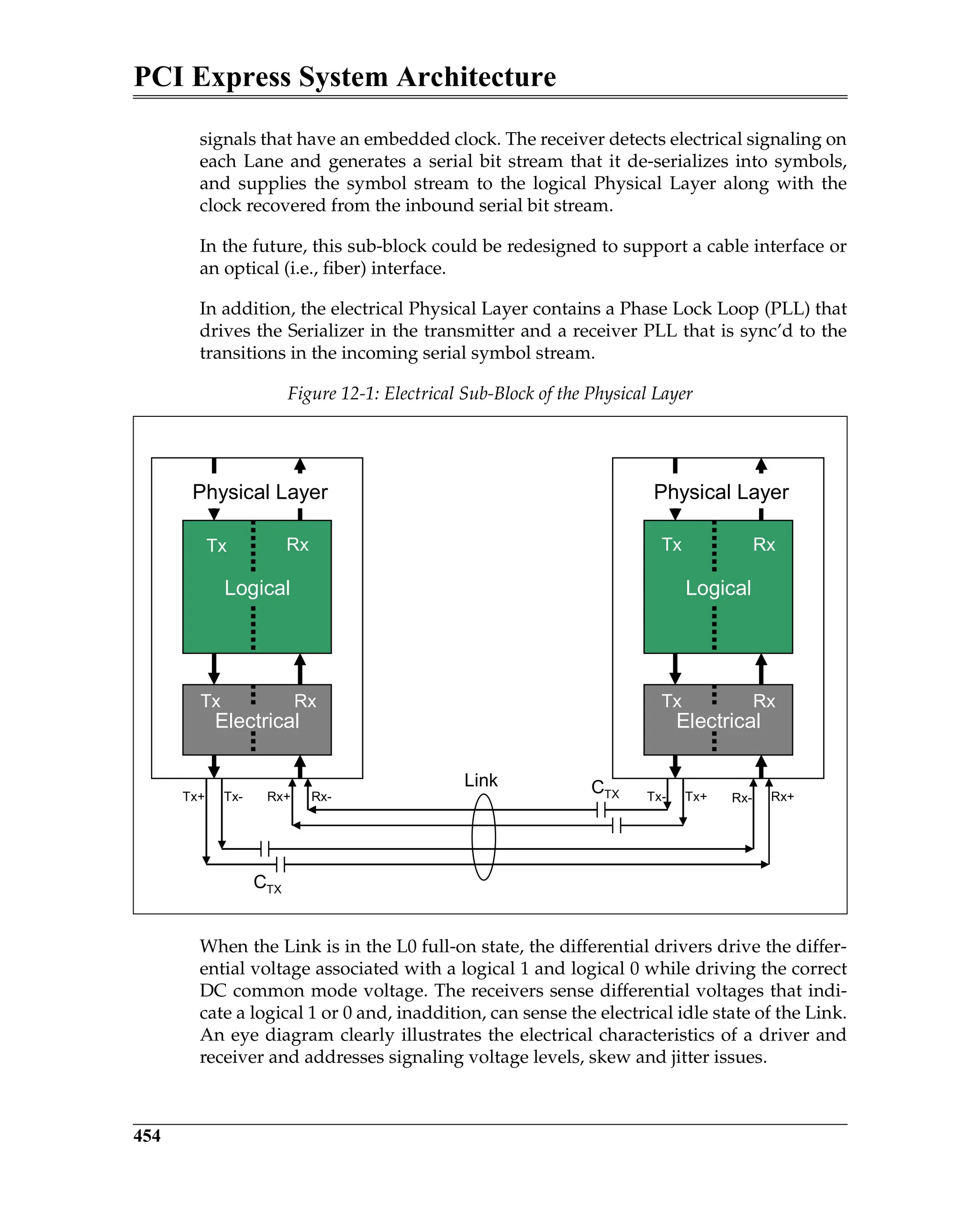
sent. It restarts from 0 each time that there are outstanding TLPs in the Replay
Buffer and an ACK DLLP is received that references a TLP still in the Replay
Buffer. It resets to 0 and holds when there are no outstanding TLPs in the Replay
Buffer, or until restart conditions are met for each NAK received (except during
a replay), or when the REPLAY_TIMER expires. It is not advanced (i.e., its value
remains fixed) during Link re-training.
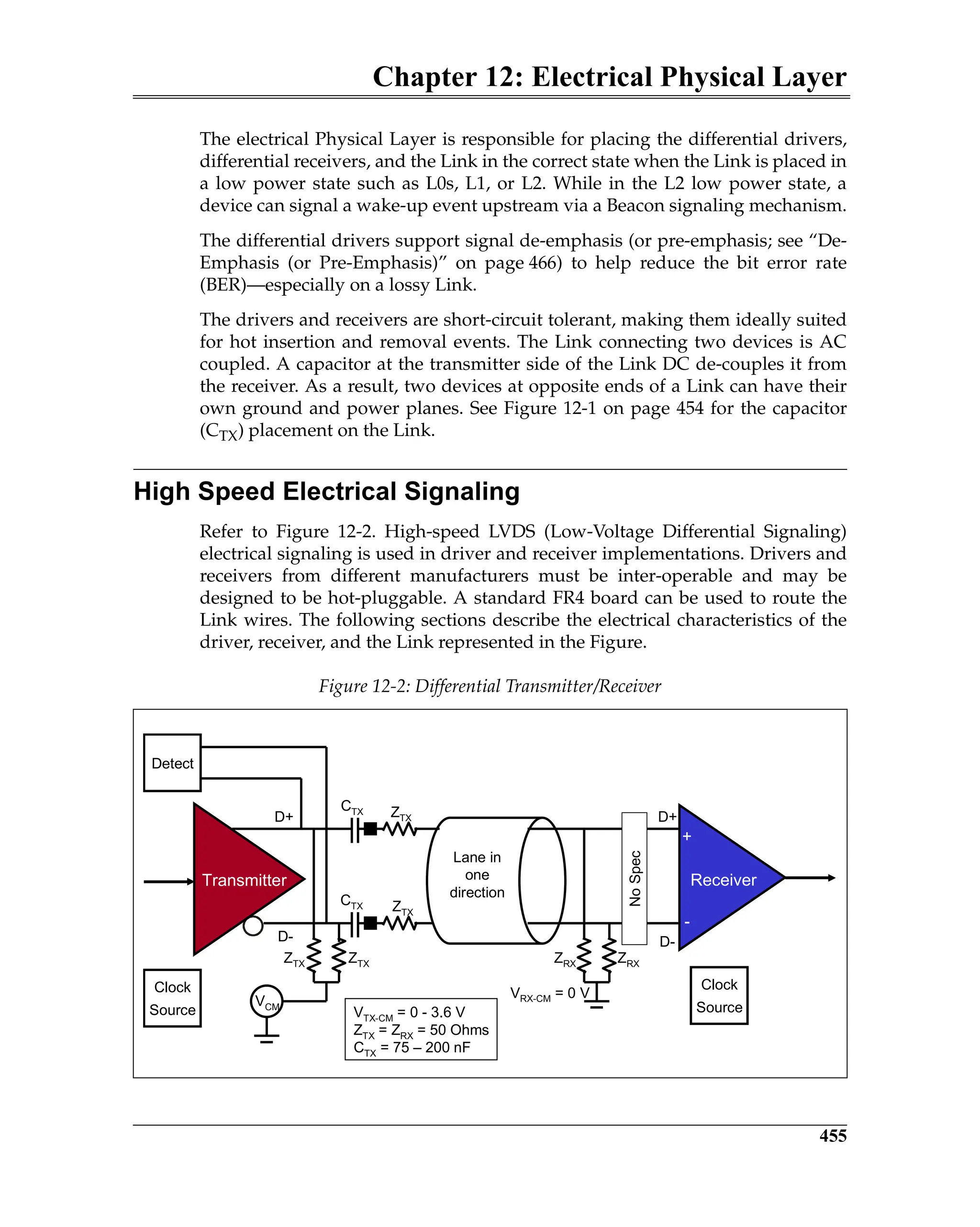
ACKD_SEQ Count
This 12-bit register tracks or stores the Sequence Number of the most recently
received ACK or NAK DLLP. It is initialized to all 1s at reset, or when the Data
Link Layer is inactive. This register is updated with the AckNak_Seq_Num
[11:0] field of a received ACK or NAK DLLP. The ACKD_SEQ count is com-
pared with the NEXT_TRANSMIT_SEQ count.
IF (NEXT_TRANSMIT_SEQ - ACKD_SEQ) mod 4096 ≥ 2048 THEN
New TLPs from Transaction Layer are not accepted by Data Link Layer until
this equation is no longer true. In addition, a Data Link Layer protocol error
which is a fatal uncorrectable error is reported. This error condition occurs if
there is a separation greater than 2047 between NEXT_TRANSMIT_SEQ and
ACKD_SEQ. i.e, a separation greater than 2047 between the sequence number
of a TLP being transmitted and that of a TLP in the replay buffer that receives an
ACK or NAK DLLP.
Also, the ACKD_SEQ count is used to check for forward progress made in
transmitting TLPs. If no forward progress is made after 3 additional replay
attempts, the Link in re-trained.
DLLP CRC Check
This block checks for CRC errors in DLLPs returned from the receiver. Good
DLLPs are further processed. If a DLLP CRC error is detected, the DLLP is dis-
carded and an error reported. No further action is taken.
Definition: The Data Link Layer is in the inactive state when the Physical Layer
reports that the Link is non-operational or nothing is connected to the Port. The
Physical Layer is in the non-operational state when the Link Training and Status
State Machine (LTSSM) is in the Detect, Polling, Configuration, Disabled, Reset
251
6 QoS/TCs/VCs and
Arbitration
The Previous Chapter
The previous chapter detailed the Ack/Nak Protocol that verifies the delivery
of TLPs between each port as they travel between the requester and completer
devices. This chapter details the hardware retry mechanism that is automati-
cally triggered when a TLP transmission error is detected on a given link.
This Chapter
This chapter discusses Traffic Classes, Virtual Channels, and Arbitration that
support Quality of Service concepts in PCI Express implementations. The con-
cept of Quality of Service in the context of PCI Express is an attempt to predict
the bandwidth and latency associated with the flow of different transaction
streams traversing the PCI Express fabric. The use of QoS is based on applica-
tion-specific software assigning Traffic Class (TC) values to transactions, which
define the priority of each transaction as it travels between the Requester and
Completer devices. Each TC is mapped to a Virtual Channel (VC) that is used to
manage transaction priority via two arbitration schemes called port and VC
arbitration.
The Next Chapter
The next chapter discusses the purposes and detailed operation of the Flow
Control Protocol. This protocol requires each device to implement credit-based
link flow control for each virtual channel on each port. Flow control guarantees
that transmitters will never send Transaction Layer Packets (TLPs) that the
receiver can’t accept. This prevents receive buffer over-runs and eliminates the
need for inefficient disconnects, retries, and wait-states on the link. Flow Con-
trol also helps enable compliance with PCI Express ordering rules by maintain-
ing separate virtual channel Flow Control buffers for three types of transactions:
Posted (P), Non-Posted (NP) and Completions (Cpl).
PCI Express System Architecture
252
Quality of Service
Quality of Service (QoS) is a generic term that normally refers to the ability of a
network or other entity (in our case, PCI Express) to provide predictable latency
and bandwidth. QoS is of particular interest when applications require guaran-
teed bus bandwidth at regular intervals, such as audio data. To help deal with
this type of requirement PCI Express defines isochronous transactions that
require a high degree of QoS. However, QoS can apply to any transaction or
series of transactions that must traverse the PCI Express fabric. Note that QoS
can only be supported when the system and device-specific software is PCI
Express aware.
QoS can involve many elements of performance including:
• Transmission rate
• Effective Bandwidth
• Latency
• Error rate
• Other parameters that affect performance
Several features of PCI Express architecture provide the mechanisms that make
QoS achievable. The PCI Express features that support QoS include:
• Traffic Classes (TCs)
• Virtual Channels (VCs)
• Port Arbitration
• Virtual Channel Arbitration
• Link Flow Control
PCI Express uses these features to support two general classes of transactions
that can benefit from the PCI Express implementation of QoS.
Isochronous Transactions — from Iso (same) + chronous (time), these transac-
tions require a constant bus bandwidth at regular intervals along with guaran-
teed latency. Isochronous transactions are most often used when a synchronous
connection is required between two devices. For example, a CD-ROM drive
containing a music CD may be sourcing data to speakers. A synchronous con-
nection exists when a headset is plugged directly into the drive. However, when
the audio card is used to deliver the audio information to a set of external
speakers, isochronous transactions may be used to simplify the delivery of the
data.
Chapter 6: QoS/TCs/VCs and Arbitration
253
Asynchronous Transactions — This class of transactions involves a wide vari-
ety of applications that have widely varying requirements for bandwidth and
latency. QoS can provide the more demanding applications (those requiring
higher bandwidth and shorter latencies) with higher priority than the less
demanding applications. In this way, software can establish a hierarchy of traf-
fic classes for transactions that permits differentiation of transaction priority
based on their requirements. The specification refers to this capability as differ-
entiated services.
Isochronous Transaction Support
PCI Express supports QoS and the associated TC, VC, and arbitration mecha-
nisms so that isochronous transactions can be performed. A classic example of a
device that benefits from isochronous transaction support is a video camera
attached to a tape deck. This real-time application requires that image and
audio data be transferred at a constant rate (e.g., 64 frames/second). This type
of application is typically supported via a direct synchronous attachment
between the two devices.
Synchronous Versus Isochronous Transactions
Two devices connected directly perform synchronous transfers. A synchronous
source delivers data directly to the synchronous sink through use of a common
reference clock. In our example, the video camera (synchronous source) sends
audio and video data to the tape deck (synchronous sink), which immediately
stores the data in real time with little or no data buffering, and with only a slight
delay due to signal propagation.
When these devices are connected via PCI Express a synchronous connection is
not possible. Instead, PCI Express emulates synchronous connections through
the use of isochronous transactions and data buffering. In this scenario, isochro-
nous transactions can be used to ensure that a constant amount of data is deliv-
ered at specified intervals (100µs in this example), thus achieving the required
transmission characteristics. Consider the following sequence (Refer to Figure
6-1 on page 254):
1. The synchronous source (video camera and PCI Express interface) accumu-
lates data in Buffer A during service interval 1 (SI 1).
2. The camera delivers the accumulated data to the synchronous sink (tape
deck) sometime during the next service interval (SI 2). The camera also
accumulates the next block of data in Buffer B as the contents of Buffer A is
delivered.
PCI Express System Architecture
254
3. The tape deck buffers the incoming data (in its Buffer A), which can then be
delivered synchronously for recording on tape during service interval 3.
During SI 3 the camera once again accumulates data into Buffer A, and the
cycle repeats.
Figure 6-1: Example Application of Isochronous Transaction
Chapter 6: QoS/TCs/VCs and Arbitration
255
Isochronous Transaction Management
Management of an isochronous communications channel is based on a Traffic
Class (TC) value and an associated Virtual Channel (VC) number that software
assigns during initialization. Hardware components including the Requester of
a transaction and all devices in the path between the requester and completer
are configured to transport the isochronous transactions from link to link via a
hi-priority virtual channel.
The requester initiates isochronous transactions that include a TC value repre-
senting the desired QoS. The Requester injects isochronous packets into the fab-
ric at the required rate (service interval), and all devices in the path between the
Requester and Completer must be configured to support the transport of the
isochronous transactions at the specified interval. Any intermediate device
along the path must convert the TC to the associated VC used to control transac-
tion arbitration. This arbitration results in the desired bandwidth and latency
for transactions with the assigned TC. Note that the TC value remains constant
for a given transaction while the VC number may change from link to link.
Differentiated Services
Various types of asynchronous traffic (all traffic other than isochronous) have
different priority from the system perspective. For example, ethernet traffic
requires higher priority (smaller latencies) than mass storage transactions. PCI
Express software can establish different TC values and associated virtual chan-
nels and can set up the communications paths to ensure different delivery poli-
cies are established as required. Note that the specification does not define
specific methods for identifying delivery requirements or the policies to be used
when setting up differentiated services.
Perspective on QOS/TC/VC and Arbitration
PCI does not include any QoS-related features similar to those defined by PCI
Express. Many questions arise regarding the need for such an elaborate scheme
for managing traffic flow based on QoS and differentiated services. Without
implementing these new features, the bandwidth available with a PCI Express
system is far greater and latencies much shorter than PCI-based implementa-
tions, due primarily to the topology and higher delivery rates. Consequently,
aside from the possible advantage of isochronous transactions, there appears to
be little advantage to implementing systems that support multiple Traffic
PCI Express System Architecture
256
Classes and Virtual Channels.
While this may be true for most desktop PCs, other high-end applications may
benefit significantly from these new features. The PCI Express specification also
opens the door to applications that demand the ability to differentiate and man-
age system traffic based on Traffic Class prioritization.
Traffic Classes and Virtual Channels
During initialization a PCI Express device-driver communicates the levels of
QoS that it desires for its transactions, and the operating system returns TC val-
ues that correspond to the QoS requested. The TC value ultimately determines
the relative priority of a given transaction as it traverses the PCI Express fabric.
Two hardware mechanisms provide guaranteed isochronous bandwidth and
differentiated services:
• Virtual Channel Arbitration
• Port Arbitration
These arbitration mechanisms use VC numbers to manage transaction priority.
System configuration software must assign VC IDs and set up the association
between the traffic class assigned to a transaction and the virtual channel to be
used when traversing each link. This is done via VC configuration registers
mapped within the extended configuration address space. The list of these reg-
isters and their location within configuration space is illustrated in Figure 6-2.
285
7 Flow Control
The Previous Chapter
This previous chapter discussed Traffic Classes, Virtual Channels, and Arbitra-
tion that supports Quality of Service concepts in PCI Express implementations.
The concept of Quality of Service in the context of PCI Express is an attempt to
predict the bandwidth and latency associated with the flow of different transac-
tion streams traversing the PCI Express fabric. The use of QoS is based on appli-
cation-specific software assigning Traffic Class (TC) values to transactions,
which define the priority of each transaction as it travels between the Requester
and Completer devices. Each TC is mapped to a Virtual Channel (VC) that is
used to manage transaction priority via two arbitration schemes called port and
VC arbitration.
This Chapter
This chapter discusses the purposes and detailed operation of the Flow Control
Protocol. This protocol requires each device to implement credit-based link flow
control for each virtual channel on each port. Flow control guarantees that
transmitters will never send Transaction Layer Packets (TLPs) that the receiver
can’t accept. This prevents receive buffer over-runs and eliminates the need for
inefficient disconnects, retries, and wait-states on the link. Flow Control also
helps enable compliance with PCI Express ordering rules by maintaining sepa-
rate virtual channel Flow Control buffers for three types of transactions: Posted
(P), Non-Posted (NP) and Completions (Cpl).
The Next Chapter
The next chapter discusses the ordering requirements for PCI Express devices,
as well as PCI and PCI-X devices that may be attached to a PCI Express fabric.
The discussion describes the Producer/Consumer programming model upon
which the fundamental ordering rules are based. It also describes the potential
performance problems that can emerge when strong ordering is employed,
describes the weak ordering solution, and specifies the rules defined for dead-
lock avoidance.
PCI Express System Architecture
286
Flow Control Concept
The ports at each end of every PCI Express link must implement Flow Control.
Before a transaction packet can be sent across a link to the receiving port, the
transmitting port must verify that the receiving port has sufficient buffer space
to accept the transaction to be sent. In many other architectures including PCI
and PCI-X, transactions are delivered to a target device without knowing if it
can accept the transaction. If the transaction is rejected due to insufficient buffer
space, the transaction is resent (retried) until the transaction completes. This
procedure can severely reduce the efficiency of a bus, by wasting bus band-
width when other transactions are ready to be sent.
Because PCI Express is a point-to-point implementation, the Flow Control
mechanism would be ineffective, if only one transaction stream was pending
transmission across a link. That is, if the receive buffer was temporarily full, the
transmitter would be prevented from sending a subsequent transaction due to
transaction ordering requirements, thereby blocking any further transfers. PCI
Express improves link efficiency by implementing multiple flow-control buffers
for separate transaction streams (virtual channels). Because Flow Control is
managed separately for each virtual channel implemented for a given link, if
the Flow Control buffer for one VC is full, the transmitter can advance to
another VC buffer and send transactions associated with it.
The link Flow Control mechanism uses a credit-based mechanism that allows
the transmitting port to check buffer space availability at the receiving port.
During initialization each receiver reports the size of its receive buffers (in Flow
Control credits) to the port at the opposite end of the link. The receiving port
continues to update the transmitting port regularly by transmitting the number
of credits that have been freed up. This is accomplished via Flow Control
DLLPs.
Flow control logic is located in the transaction layer of the transmitting and
receiving devices. Both transmitter and receiver sides of each device are
involved in flow control. Refer to Figure 7-1 on page 287 during the following
descriptions.
• Devices Report Buffer Space Available — The receiver of each node con-
tains the Flow Control buffers. Each device must report the amount of flow
control buffer space they have available to the device on the opposite end of
the link. Buffer space is reported in units called Flow Control Credits
(FCCs). The number of Flow Control Credits within each buffer is for-
warded from the transaction layer to the transmit side of the link layer as
Chapter 7: Flow Control
287
illustrated in Figure 7-1. The link creates a Flow Control DLLP that carries
this credit information to the receiver at the opposite end of the link. This is
done for each Flow Control Buffer.
• Receiving Credits — Notice that the receiver in Figure 7-1 also receives
Flow Control DLLPs from the device at the opposite end of the link. This
information is transferred to the transaction layer to update the Flow Con-
trol Counters that track the amount of Flow Control Buffer space in the
other device.
• Credit Checks Made — Each transmitter check consults the Flow Control
Counters to check available credits. If sufficient credits are available to
receive the transaction pending delivery then the transaction is forwarded
to the link layer and is ultimately sent to the opposite device. If enough
credits are not available the transaction is temporarily blocked until addi-
tional Flow Control credits are reported by the receiving device.
Figure 7-1: Location of Flow Control Logic
PCI Express System Architecture
288
Flow Control Buffers
Flow control buffers are implemented for each VC resource supported by a PCI
Express port. Recall that devices at each end of the link may not support the
same number of VC resources, therefore the maximum number of VCs config-
ured and enabled by software is the greatest number of VCs in common
between the two ports.
VC Flow Control Buffer Organization
Each VC Flow Control buffer at the receiver is managed for each category of
transaction flowing through the virtual channel. These categories are:
• Posted Transactions — Memory Writes and Messages
• Non-Posted Transactions — Memory Reads, Configuration Reads and
Writes, and I/O Reads and Writes
• Completions — Read Completions and Write Completions
In addition, each of these categories is separated into header and data portions
of each transaction. Flow control operates independently for each of the six
buffers listed below (also see Figure 7-2 on page 289).
• Posted Header
• Posted Data
• Non-Posted Header
• Non-Posted Data
• Completion Header
• Completion Data
Some transactions consist of a header only (e.g., read requests) while others con-
sist of a header and data (e.g., write requests). The transmitter must ensure that
both header and data buffer space is available as required for each transaction
before the transaction can be sent. Note that when a transaction is received into
a VC Flow Control buffer that ordering must be maintained when the transac-
tions are forwarded to software or to an egress port in the case of a switch. The
the receiver must also track the order of header and data components within the
Flow Control buffer.
Chapter 7: Flow Control
289
Flow Control Credits
Buffer space is reported by the receiver in units called Flow Control credits. The
unit value of Flow Control credits (FCCs) may differ between header and data
as listed below:
• Header FCCs — maximum header size + digest
o 4 DWs for completions
o 5 DWs for requests
• Data FCCs — 4 DWs (aligned 16 bytes)
Flow control credits are passed within the header of the link layer Flow Control
Packets. Note that DLLPs do not require Flow Control credits because they orig-
inate and terminate at the link layer.
Figure 7-2: Flow Control Buffer Organization
PCI Express System Architecture
290
Maximum Flow Control Buffer Size
The maximum buffer size that can be reported via the Flow Control Initializa-
tion and Update packets for the header and data portions of a transaction are as
follows:
128 Credits for headers
• 2,560 bytes Request Headers @ 20 bytes/credit
• 2048 bytes for completion headers @ 16 bytes/credit
2048 Credits for data
• 32KB @ 16 bytes/credit
The reason for these limits is discussed in the section entitled “Stage 1 — Flow
Control Following Initialization” page 296, step 2.
Introduction to the Flow Control Mechanism
The specification defines the requirements of the Flow Control mechanism by
describing conceptual registers and counters along with procedures and mecha-
nisms for reporting, tracking, and calculating whether a transaction can be sent.
These elements define the functional requirements; however, the actual imple-
mentation may vary from the conceptual model. This section introduces the
specified model that serves to explain the concept and define the requirements.
The approach taken focuses on a single flow control example for a non-posted
header. The concepts discussed apply to all Flow Control buffer types.
The Flow Control Elements
Figure 7-3 identifies and illustrates the elements used by the transmitter and
receiver when managing flow control. This diagram illustrates transactions
flowing in a single direction across a link, but of course another set of these ele-
ments is used to support transfers in the opposite direction. The primary func-
tion of each element within the transmitting and receiving devices is listed
below. Note that for a single direction these Flow Control elements are dupli-
cated for each Flow Control receive buffer, yielding six sets of elements. This
example deals with non-posted header flow control.
315
8 Transaction
Ordering
The Previous Chapter
The previous chapter discussed the purposes and detailed operation of the
Flow Control Protocol. This protocol requires each device to implement credit-
based link flow control for each virtual channel on each port. Flow control guar-
antees that transmitters will never send Transaction Layer Packets (TLPs) that
the receiver can’t accept. This prevents receive buffer over-runs and eliminates
the need for inefficient disconnects, retries, and wait-states on the link. Flow
Control also helps enable compliance with PCI Express ordering rules by main-
taining separate Virtual Channel Flow Control buffers for three types of transac-
tions: Posted (P), Non-Posted (NP) and Completions (Cpl).
This Chapter
This chapter discusses the ordering requirements for PCI Express devices as
well as PCI and PCI-X devices that may be attached to a PCI Express fabric. The
discussion describes the Producer/Consumer programming model upon which
the fundamental ordering rules are based. It also describes the potential perfor-
mance problems that can emerge when strong ordering is employed and speci-
fies the rules defined for deadlock avoidance.
The Next Chapter
Native PCI Express devices that require interrupt support must use the Mes-
sage Signaled Interrupt (MSI) mechanism defined originally in the PCI 2.2 spec-
ification. The next chapter details the MSI mechanism and also describes the
legacy support that permits virtualization of the PCI INTx signals required by
devices such as PCI Express-to-PCI Bridges.
PCI Express System Architecture
316
Introduction
As with other protocols, PCI Express imposes ordering rules on transactions
moving through the fabric at the same time. The reasons for the ordering rules
include:
• Ensuring that the completion of transactions is deterministic and in the
sequence intended by the programmer.
• Avoiding deadlocks conditions.
• Maintaining compatibility with ordering already used on legacy buses (e.g.,
PCI, PCI-X, and AGP).
• Maximize performance and throughput by minimizing read latencies and
managing read/write ordering.
PCI Express ordering is based on the same Producer/Consumer model as PCI.
The split transaction protocol and related ordering rules are fairly straight for-
ward when restricting the discussion to transactions involving only native PCI
Express devices. However, ordering becomes more complex when including
support for the legacy buses mentioned in bullet three above.
Rather than presenting the ordering rules defined by the specification and
attempting to explain the rationale for each rule, this chapter takes the building
block approach. Each major ordering concern is introduced one at a time. The
discussion begins with the most conservative (and safest) approach to ordering,
progresses to a more aggressive approach (to improve performance), and culmi-
nates with the ordering rules presented in the specification. The discussion is
segmented into the following sections:
1. The Producer/Consumer programming model upon which the fundamen-
tal ordering rules are based.
2. The fundamental PCI Express device ordering requirements that ensure the
Producer/Consumer model functions correctly.
3. The Relaxed Ordering feature that permits violation of the Producer/Con-
sumer ordering when the device issuing a request knows that the transac-
tion is not part of a Producer/Consumer programming sequence.
4. Modification of the strong ordering rules to improve performance.
5. Avoiding deadlock conditions and support for PCI legacy implementations.
Chapter 8: Transaction Ordering
317
Producer/Consumer Model
Readers familiar with the Producer/Consumer programming model may
choose to skip this section and proceed directly to “Native PCI Express Order-
ing Rules” on page 318.
The Producer/Consumer model is a common methodology that two requester-
capable devices might use to communicate with each other. Consider the fol-
lowing example scenario:
1. A network adapter begins to receive a stream of compressed video data
over the network and performs a series of memory write transactions to
deliver the stream of compressed video data into a Data buffer in memory
(in other words the network adapter is the Producer of the data).
2. After the Producer moves the data to memory, it performs a memory write
transaction to set an indicator (or Flag) in a memory location (or a register)
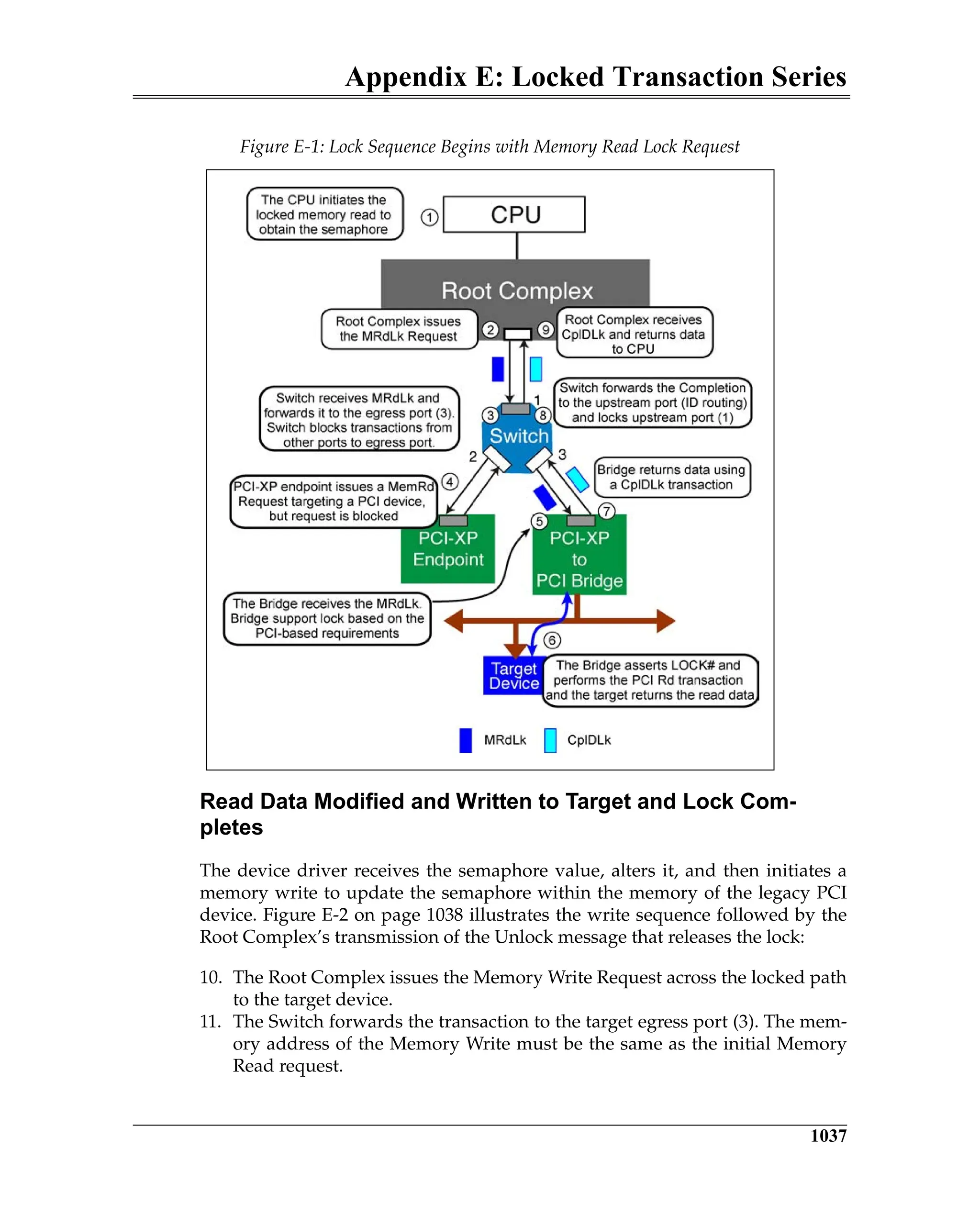
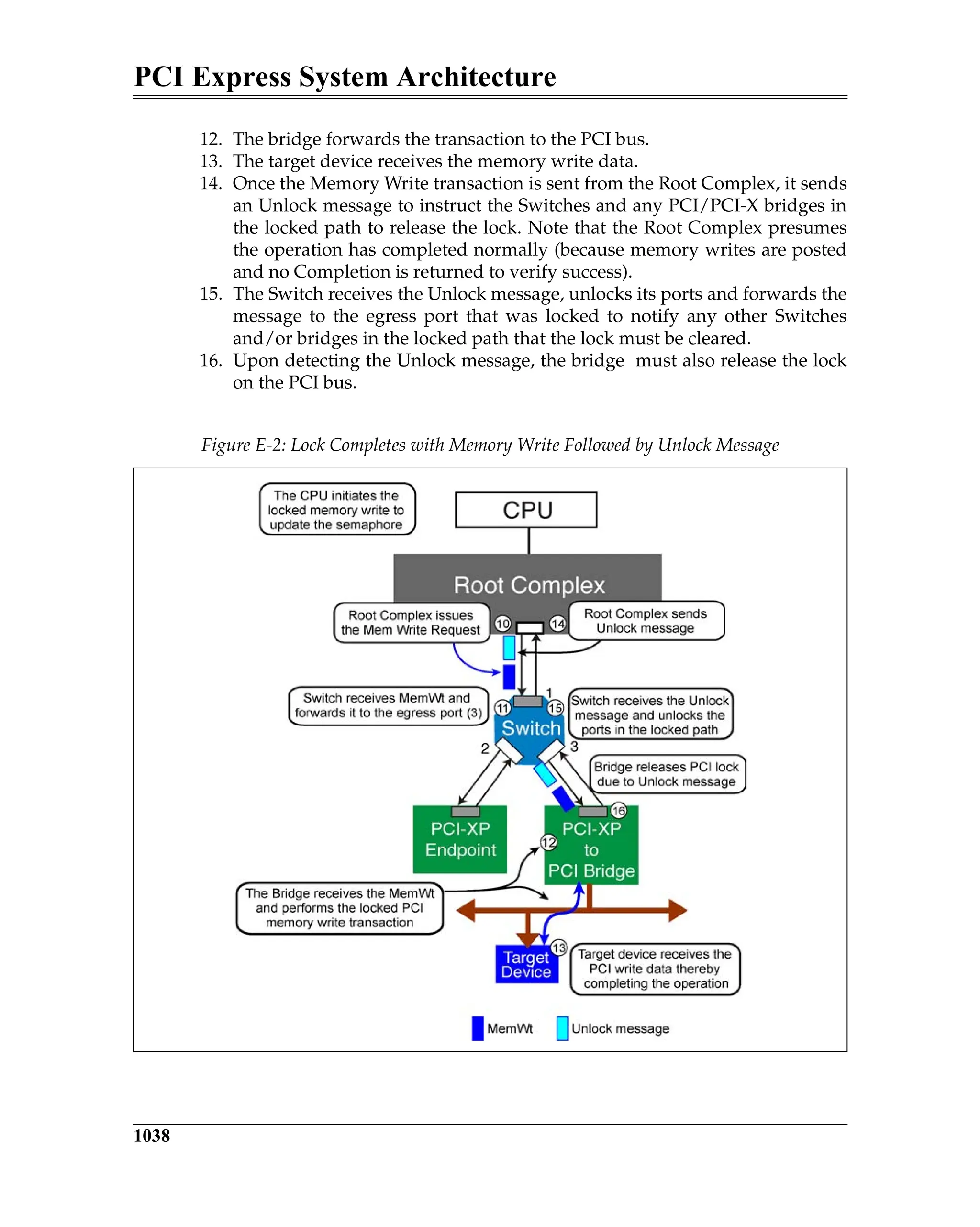
to indicate that the data is ready for processing.
3. Another requester (referred to as the Consumer) periodically performs a
memory read from the Flag location to see if there’s any data to be pro-
cessed. In this example, this requester is a video decompressor that will
decompress and display the data.
4. When it sees that the Flag has been set by the Producer, it performs a mem-
ory write to clear the Flag, followed by a burst memory read transaction to
read the compressed data (it consumes the data; hence the name Con-
sumer) from the Data buffer in memory.
5. When it is done consuming the Data, the Consumer writes the completion
status into the Status location. It then resumes periodically reading the Flag
location to determine when more data needs to be processed.
6. In the meantime, the Producer has been reading periodically from the Sta-
tus location to see if data processing has been completed by the other
requester (the Consumer). This location typically contains zero until the
other requester completes the data processing and writes the completion
status into it. When the Producer reads the Status and sees that the Con-
sumer has completed processing the Data, the Producer then performs a
memory write to clear the Status location.
7. The process then repeats whenever the Producer has more data to be pro-
cessed.
Ordering rules are required to ensure that the Producer/Consumer model
works correctly no matter where the Producer, the Consumer, the Data buffer,
the Flag location, and the Status location are located in the system (in other
words, no matter how they are distributed on various links in the system).
PCI Express System Architecture
318
Native PCI Express Ordering Rules
PCI Express transaction ordering for native devices can be summarized with
four simple rules:
1. PCI Express requires strong ordering of transactions (i.e., performing trans-
actions in the order issued by software) flowing through the fabric that have
the same TC assignment (see item 4 for the exception to this rule). Because
all transactions that have the same TC value assigned to them are mapped
to a given VC, the same rules apply to transactions within each VC.
2. No ordering relationship exists between transactions with different TC
assignments.
3. The ordering rules apply in the same way to all types of transactions: mem-
ory, IO, configuration, and messages.
4. Under limited circumstances, transactions with the Relaxed Ordering
attribute bit set can be ordered ahead of other transactions with the same
TC.
These fundamental rules ensure that transactions always complete in the order
intended by software. However, these rules are extremely conservative and do
not necessarily result in optimum performance. For example, when transactions
from many devices merge within switches, there may be no ordering relation-
ship between transactions from these different devices. In such cases, more
aggressive rules can be applied to improve performance as discussed in “Modi-
fied Ordering Rules Improve Performance” on page 322.
Producer/Consumer Model with Native Devices
Because the Producer/Consumer model depends on strong ordering, when the
following conditions are met native PCI Express devices support this model
without additional ordering rules:
1. All elements associated with the Producer/Consumer model reside within
native PCI Express devices.
2. All transactions associated with the operation of the Producer/Consumer
model transverse only PCI Express links within the same fabric.
3. All associated transactions have the same TC values. If different TC values
are used, then the strong ordering relationship between the transactions is
no longer guaranteed.
4. The Relaxed Ordering (RO) attribute bit of the transactions must be cleared
to avoid reordering the transactions that are part of the Producer/Con-
sumer transaction series.
Chapter 8: Transaction Ordering
319
When PCI legacy devices reside within a PCI Express system, the ordering rules
become more involved. Consequently, additional ordering rules apply because
of PCI’s delayed transaction protocol. Without ordering rules, this protocol
could permit Producer/Consumer transactions to complete out of order and
cause the programming model to break.
Relaxed Ordering
PCI Express supports the Relaxed Ordering mechanism introduced by PCI-X;
however, PCI Express introduces some changes (discussed later in this chapter).
The concept of Relaxed Ordering in the PCI Express environment allows
switches in the path between the Requester and Completer to reorder some
transactions just received before others that were previously enqueued.
The ordering rules that exist to support the Producer/Consumer model may
result in transactions being blocked, when in fact the blocked transactions are
completely unrelated to any Producer/Consumer transaction sequence. Conse-
quently, in certain circumstances, a transaction with its Relaxed Ordering (RO)
attribute bit set can be re-ordered ahead of other transactions.
The Relaxed Ordering bit may be set by the device if its device driver has
enabled it to do so (by setting the Enable Relaxed Ordering bit in the Device
Control register—see Table 24 - 3 on page 906). Relaxed ordering gives switches
and the Root Complex permission to move this transaction ahead of others,
whereas the action is normally prohibited.
RO Effects on Memory Writes and Messages
PCI Express Switches and the Root Complex are affected by memory write and
message transactions that have their RO bit set. Memory write and Message
transactions are treated the same in most respects—both are handled as posted
operations, both are received into the same Posted buffer, and both are subject
to the same ordering requirements. When the RO bit is set, switches handle
these transactions as follows:
• Switches are permitted to reorder memory write transactions just posted
ahead of previously posted memory write transactions or message transac-
tions. Similarly, message transactions just posted may be ordered ahead of
previously posted memory write or message transactions. Switches must
also forward the RO bit unmodified. The ability to reorder these transac-
tions within switches is not supported by PCI-X bridges. In PCI-X, all
PCI Express System Architecture
320
posted writes must be forwarded in the exact order received. Another dif-
ference between the PCI-X and PCI Express implementations is that mes-
sage transactions are not defined for PCI-X.
• The Root Complex is permitted to order a just-posted write transaction
ahead of another write transaction that was received earlier in time. Also,
when receiving write requests (with RO set), the Root Complex is required
to write the data payload to the specified address location within system
memory, but is permitted to write each byte to memory in any address
order.
RO Effects on Memory Read Transactions
All read transactions in PCI Express are handled as split transactions. When a
device issues a memory read request with the RO bit set, the request may
traverse one or more switches on its journey to the Completer. The Completer
returns the requested read data in a series of one or more split completion trans-
actions, and uses the same RO setting as in the request. Switch behavior for the
example stated above is as follow:
1. A switch that receives a memory read request with the RO bit set must for-
ward the request in the order received, and must not reorder it ahead of
memory write transactions that were previously posted. This action guar-
antees that all write transactions moving in the direction of the read request
are pushed ahead of the read. Such actions are not necessarily part of the
Producer/Consumer programming sequence, but software may depend on
this flushing action taking place. Also, the RO bit must not be modified by
the switch.
2. When the Completer receives the memory read request, it fetches the
requested read data and delivers a series of one or more memory read Com-
pletion transactions with the RO bit set (because it was set in the request).
3. A switch receiving the memory read Completion(s) detects the RO bit set
and knows that it is allowed to order the read Completion(s) ahead of previ-
ously posted memory writes moving in the direction of the Completion. If
the memory write transaction were blocked (due to flow control), then the
memory read Completion would also be blocked if the RO was not set.
Relaxed ordering in this case improves read performance.
Table 8-1 summarizes the relaxed ordering behavior allowed by switches.
329
9 Interrupts
The Previous Chapter
This chapter discusses the ordering requirements for PCI Express devices as
well as PCI and PCI-X devices that may be attached to a PCI Express fabric. The
discussion describes the Producer/Consumer programming model upon which
the fundamental ordering rules are based. It also describes the potential perfor-
mance problems that can emerge when strong ordering is employed and speci-
fies the rules defined for deadlock avoidance.
This Chapter
Native PCI Express devices that require interrupt support must use the Mes-
sage Signaled Interrupt (MSI) mechanism defined originally in the PCI 2.2 ver-
sion of the specification. This chapter details the MSI mechanism and also
describes the legacy support that permits virtualization of the PCI INTx signals
required by devices such as PCI Express-to-PCI Bridges.
The Next Chapter
To this point it has been presumed that transactions traversing the fabric have
not encountered any errors that cannot be corrected by hardware. The next
chapter discusses both correctable and non-correctable errors and discusses the
mechanisms used to report them. The PCI Express architecture provides a rich
set of error detection, reporting, and logging capabilities. PCI Express error
reporting classifies errors into three classes: correctable, non-fatal, and fatal.
Prior to discussing the PCI Express error reporting capabilities, including PCI-
compatible mechanisms, a brief review of the PCI error handling is included as
background information.
PCI Express System Architecture
330
Two Methods of Interrupt Delivery
Interrupt delivery is conditionally optional for PCI Express devices. When a
native PCI Express function does depend upon delivering interrupts to call its
device driver, Message Signaled Interrupts (MSI) must be used. However, in the
event that a device connecting to a PCI Express link cannot use MSIs (i.e., legacy
devices), an alternate mechanism is defined. Both mechanisms are summarized
below:
Native PCI Express Interrupt Delivery — PCI Express eliminates the need for
sideband signals by using the Message Signaled Interrupt (MSI), first defined
by the 2.2 version of the PCI Specification (as an optional mechanism) and later
required by PCI-X devices. The term “Message Signaled Interrupt” can be mis-
leading in the context of PCI Express because of possible confusion with PCI
Express’s “Message” transactions. A Message Signaled Interrupt is not a PCI
Express Message, instead it is simply a Memory Write transaction. A memory
write associated with an MSI can only be distinguished from other memory
writes by the address locations they target, which are reserved by the system for
Interrupt delivery.
Legacy PCI Interrupt Delivery — This mechanism supports devices that must
use PCI-Compatible interrupt signaling (i.e., INTA#, INTB#, INTC#, and
INTD#) defined for the PCI bus. Legacy functions use one of the interrupt lines
to signal an interrupt. An INTx# signal is asserted to request interrupt service
and deasserted when the interrupt service accesses a device-specific register,
thereby indicating the interrupt is being serviced. PCI Express defines in-band
messages that act as virtual INTx# wires, which target the interrupt controller
located typically within the Root Complex.
Figure 9-1 illustrates the delivery of interrupts from three types of devices:
• Native PCI Express device — must use MSI delivery
• Legacy endpoint device — must support MSI and optionally support INTx
messages. Such devices may be boot devices that must use legacy interrupts
during boot, but once its driver loads MSIs are used.
• PCI Express-to-PCI (X) Bridge — must support INTx messages
Chapter 9: Interrupts
331
Message Signaled Interrupts
Message Signaled Interrupts (MSIs) are delivered to the Root Complex via
memory write transactions. The MSI Capability register provides all the infor-
mation that the device requires to signal MSIs. This register is set up by configu-
ration software and includes the following information:
• Target memory address
• Data Value to be written to the specified address location
• The number of messages that can be encoded into the data
Figure 9-1: Native PCI Express and Legacy PCI Interrupt Delivery
PCI Express System Architecture
332
See “Description of 3DW And 4DW Memory Request Header Fields” on
page 176 for a review of the Memory Write Transaction Header. Note that MSIs
always have a data payload of 1DW.
The MSI Capability Register Set
A PCI Express function indicates its support for MSI via the MSI Capability reg-
isters. Each native PCI Express function must implement a single MSI register
set within its own configuration space. Note that the PCI Express specification
defines two register formats:
1. 64-bit memory addressing format (Figure 9-2 on page 332) — required by
all native PCI Express devices and optionally implemented by Legacy end-
points.
2. 32-bit memory addressing format (Figure 9-3 on page 332) — optionally
supported by Legacy endpoints.
The following sections describe each field within the MSI registers.
Capability ID
The Capability ID that identifies the MSI register set is 05h. This is a hardwired,
read-only value.
Figure 9-2: 64-bit MSI Capability Register Format
Figure 9-3: 32-bit MSI Capability Register Set Format
Chapter 9: Interrupts
333
Pointer To Next New Capability
The second byte of the register set either points to the next New Capability’s
register set or contains 00h if this is the end of the New Capabilities list. This is a
hardwired, read-only value. If non-zero, it must be a dword-aligned value.
Message Control Register
Figure 9-4 on page 333 and Table 9-1 on page 333 illustrate the layout and usage
of the Message Control register.
Figure 9-4: Message Control Register
Table 9-1: Format and Usage of Message Control Register
Bit(s) Field Name Description
15:8 Reserved Read-Only. Always zero.
7 64-bit Address
Capable
Read-Only.
• 0 = Function does not implement the upper 32-
bits of the Message Address register and is inca-
pable of generating a 64-bit memory address.
• 1 = Function implements the upper 32-bits of the
Message Address register and is capable of gen-
erating a 64-bit memory address.
PCI Express System Architecture
334
6:4 Multiple Message
Enable
Read/Write. After system software reads the Mul-
tiple Message Capable field (see next row in this
table) to determine how many messages are
requested by the device, it programs a 3-bit value
into this field indicating the actual number of mes-
sages allocated to the device. The number allocated
can be equal to or less than the number actually
requested. The state of this field after reset is 000b.
The field is encoded as follows:
Value Number of Messages Requested
000b 1
001b 2
010b 4
011b 8
100b 16
101b 32
110b Reserved
111b Reserved
3:1 Multiple Message
Capable
Read-Only. System software reads this field to
determine how many messages the device would
like allocated to it. The requested number of mes-
sages is a power of two, therefore a device that
would like three messages must request that four
messages be allocated to it. The field is encoded as
follows:
Value Number of Messages Requested
000b 1
001b 2
010b 4
011b 8
100b 16
101b 32
110b Reserved
111b Reserved
Table 9-1: Format and Usage of Message Control Register (Continued)
Bit(s) Field Name Description
355
10 Error Detection
and Handling
The Previous Chapter
Native PCI Express devices that require interrupt support must use the Mes-
sage Signaled Interrupt (MSI) mechanism defined originally in the PCI 2.2 ver-
sion of the specification. The previous chapter detailed the MSI mechanism and
also described the legacy support that permits virtualization of the PCI INTx
signals required by devices such as PCI Express-to-PCI Bridges.
This Chapter
To this point it has been presumed that transactions traversing the fabric have
not encountered any errors that cannot be corrected by hardware. This chapter
discusses both correctable and non-correctable errors and discusses the mecha-
nisms used to report them. The PCI Express architecture provides a rich set of
error detection, reporting, and logging capabilities. PCI Express error reporting
classifies errors into three classes: correctable, non-fatal, and fatal. PCI Express
error reporting capabilities include PCI-compatible mechanisms, thus a brief
review of the PCI error handling is included as background information.
The Next Chapter
The next chapter describes the Logical Physical Layer core logic. It describes
how an outbound packet is processed before clocking the packet out differen-
tially. The chapter also describes how an inbound packet arriving from the Link
is processed and sent to the Data Link Layer. Sub-block functions of the Physical
Layer such as Byte Striping and Un-Striping logic, Scrambler and De-Scrambler,
8b/10b Encoder and Decoder, Elastic Buffers are discussed, and more.
PCI Express System Architecture
356
Background
The original PCI bus implementation provides for basic parity checks on each
transaction as it passes between two devices residing on the same bus. When a
transaction crosses a bridge, the bridge is involved in the parity checks at both
the originating and destination busses. Any error detected is registered by the
device that has detected the error and optionally reported. The PCI architecture
provides a method for reporting the following types of errors:
• data parity errors — reported via the PERR# (Parity Error) signal
• data parity errors during multicast transactions (special cycles) — reported
via the SERR# (System Error) signal
• address and command parity errors — reported via the SERR# signal
• other types of errors (e.g. device specific) — reported via SERR#
Errors reported via PERR# are considered potentially recoverable, whereas,
errors reported via SERR# are considered unrecoverable. How the errors
reported via PERR# are handled is left up to the implementer. Error handling
may involve only hardware, device-specific software, or system software.
Errors signaled via SERR# are reported to the system and handled by system
software. (See MindShare’s PCI System Architecture book for details.)
PCI-X uses the same error reporting signals as PCI, but defines specific error
handling requirements depending on whether device-specific error handling
software is present. If a device-specific error handler is not present, then all par-
ity errors are reported via SERR#.
PCI-X 2.0 adds limited support for Error Correction Codes (ECC) designed to
automatically detect and correct single-bit errors within the address or data.
(See MindShare’s PCI-X System Architecture book for details.)
Introduction to PCI Express Error Management
PCI Express defines a variety of mechanisms used for checking errors, reporting
those errors and identifying the appropriate hardware and software elements
for handling these errors.
PCI Express Error Checking Mechanisms
PCI Express error checking focuses on errors associated with the PCI Express
interface and the delivery of transactions between the requester and completer
functions. Figure 10-1 on page 357 illustrates the scope of the error checking that
Chapter 10: Error Detection and Handling
357
is the focus of this chapter. Errors within a function that do not pertain to a
given transaction are not reported through the error handling procedures
defined by the PCI Express specification, and it is recommended that such
errors be handled using proprietary methods that are reported via device-spe-
cific interrupts. Each layer of the PCI Express interface includes error checking
capability as described in the following sections.
Figure 10-1: The Scope of PCI Express Error Checking and Reporting
PCI Express System Architecture
358
Transaction Layer Errors
The transaction layer checks are performed only by the Requestor and Compl-
eter. Packets traversing switches do not perform any transaction layer checks.
Checks performed at the transaction layer include:
• ECRC check failure (optional check based on end-to-end CRC)
• Malformed TLP (error in packet format)
• Completion Time-outs during split transactions
• Flow Control Protocol errors (optional)
• Unsupported Requests
• Data Corruption (reported as a poisoned packet)
• Completer Abort (optional)
• Unexpected Completion (completion does not match any Request pending
completion)
• Receiver Overflow (optional check)
Data Link Layer Errors
Link layer error checks occur within a device involved in delivering the transac-
tion between the requester and completer functions. This includes the request-
ing device, intermediate switches, and the completing device. Checks
performed at the link layer include:
• LCRC check failure for TLPs
• Sequence Number check for TLP s
• LCRC check failure for DLLPs
• Replay Time-out
• Replay Number Rollover
• Data Link Layer Protocol errors
Physical Layer Errors
Physical layer error checks are also performed by all devices involved in deliv-
ering the transaction, including the requesting device, intermediate switches,
and the completing device. Checks performed at the physical layer include:
• Receiver errors (optional)
• Training errors (optional)
Chapter 10: Error Detection and Handling
359
Error Reporting Mechanisms
PCI Express provides three mechanisms for establishing the error reporting pol-
icy. These mechanisms are controlled and reported through configuration regis-
ters mapped into three distinct regions of configuration space. (See Figure 10-2
on page 360.) The various error reporting features are enabled as follows:
• PCI-compatible Registers (required) — this error reporting mechanism pro-
vides backward compatibility with existing PCI compatible software and is
enabled via the PCI configuration Command Register. This approach requires
that PCI Express errors be mapped to PCI compatible error registers.
• PCI Express Capability Registers (required) — this mechanism is available
only to software that has knowledge of PCI Express. This required error
reporting is enabled via the PCI Express Device Control Register mapped
within PCI-compatible configuration space.
• PCI Express Advanced Error Reporting Registers (optional) — this mecha-
nism involves registers mapped into the extended configuration address
space. PCI Express compatible software enables error reporting for individ-
ual errors via the Error Mask Register.
The specification refers to baseline (required) error reporting capabilities and
advanced (optional) error reporting capabilities. The baseline error reporting
mechanisms require access to the PCI-compatible registers and PCI Express
Capability registers (bullets 1 and 2 above), while advanced error reporting
(bullet 3) requires access to the Advanced Error Reporting registers that are
mapped into extended configuration address space as illustrated in Figure 10-2.
This chapter details all error reporting mechanisms.
PCI Express System Architecture
360
Error Handling Mechanisms
Errors are categorized into three classes that specify the severity of an error as
listed below. Note also the specification defines the entity that should handle
the error based on its severity:
• Correctable errors — handled by hardware
• Uncorrectable errors-nonfatal — handled by device-specific software
• Uncorrectable errors-fatal — handled by system software
Figure 10-2: Location of PCI Express Error-Related Configuration Registers
397
11 Physical Layer
Logic
The Previous Chapter
The previous chapter discussed both correctable and non-correctable errors and
the mechanisms used to log and report them. Prior to discussing the PCI
Express error reporting capabilities, a brief review of the PCI error handling was
included as background information.
This Chapter
This chapter describes the Logical characteristics of the Physical Layer core
logic. It describes how an outbound packet is processed before clocking the
packet out differentially. The chapter also describes how an inbound packet
arriving from the Link is processed and sent to the Data Link Layer. The chapter
describes sub-block functions of the Physical Layer such as Byte Striping and
Un-Striping logic, Scrambler and De-Scrambler, 8b/10b Encoder and Decoder,
Elastic Buffers and more.
The Next Chapter
The next chapter describes the electrical characteristics of the Physical Layer. It
describes the analog characteristics of the differential drivers and receivers that
connect a PCI Express device to the Link.
Physical Layer Overview
The Physical Layer shown in Figure 11-1 on page 398 connects to the Link on
one side and interfaces to the Data Link Layer on the other side. The Physical
Layer processes outbound packets before transmission to the Link and pro-
cesses inbound packets received from the Link. The two sections of the Physical
Layer associated with transmission and reception of packets are referred to as
the transmit logic and the receive logic throughout this chapter.
PCI Express System Architecture
398
The transmit logic of the Physical Layer essentially processes packets arriving
from the Data Link Layer, then converts them into a serial bit stream. The bit
stream is clocked out at 2.5 Gbits/s/Lane onto the Link.
The receive logic clocks in a serial bit stream arriving on the Lanes of the Link
with a clock that is recovered from the incoming bit stream. The receive logic
converts the serial bit steam into a parallel symbol stream, processes the incom-
ing symbols, assembles packets and sends them to the Data Link Layer.
In the future, data rates per Lane are expected to go to 5 Gbits/s, 10 Gbits/s and
beyond. When this happens, an existing design can be adapted to the higher
data rates by redesigning the Physical Layer while maximizing reuse of the
Data Link Layer, Transaction Layer and Device Core/Software Layer. The Phys-
Figure 11-1: Physical Layer
Port
Link
Memory, I/O, Configuration R/W Requests or Message Requests or Completions
(Software layer sends / receives address/transaction type/data/message index)
Software layer
Transaction layer
Header Data Payload ECRC
Receive
Buffers
per VC
Transmit
Buffers
per VC
Data Link layer
Physical layer
Serial-to-Parallel
Parallel-to-Serial
Differential Receiver
Differential Driver
Link Packet
Start End
Link Packet
Start End
Decode
Encode
Transaction Layer Packet (TLP)
TLP Error
Check
TLP Replay
Buffer
Physical Packet
Physical Packet
Link Packet
Sequence TLP LCRC
ACK/NAK
DLLPs e.g.
CRC
Header Data Payload ECRC
Transaction Layer Packet (TLP)
Link Packet
Sequence TLP LCRC
De-mux
Mux
Transmit Receive
Flow Control
Virtual Channel
Management
Ordering
Link
Training
ACK/NAK
DLLPs
CRC
Chapter 11: Physical Layer Logic
399
ical Layer may be designed as a standalone entity separate from the Data Link
Layer and Transaction Layer. This allows a design to be migrated to higher data
rates or even to an optical implementation if such a Physical Layer is supported
in the future.
Two sub-blocks make up the Physical Layer. These are the logical Physical
Layer and the electrical Physical Layer as shown in Figure 11-2. This chapter
describes the logical sub-block, and the next chapter describes the electrical sub-
block. Both sub-blocks are split into transmit logic and receive logic (indepen-
dent of each other) which allow dual simplex communication.
Figure 11-2: Logical and Electrical Sub-Blocks of the Physical Layer
Logical
Electrical
Physical Layer
Logical
Electrical
Physical Layer
Link
CTX
CTX
Tx
Tx
Tx
Tx
Rx
Rx
Rx
Rx
Tx+ Tx+
Tx- Tx-
Rx+ Rx- Rx- Rx+
PCI Express System Architecture
400
Disclaimer
To facilitate description of the Physical Layer functionality, an example imple-
mentation is described that is not necessarily the implementation assumed by
the specification nor is a designer compelled to implement a Physical Layer in
such a manner. A designer may implement the Physical Layer in any manner
that is compliant with the functionality expected by the PCI Express specifica-
tion.
Transmit Logic Overview
Figure 11-3 on page 401 shows the elements that make up the transmit logic:
• a multiplexer (mux),
• byte striping logic (only necessary if the link implements more than one
data lane),
• scramblers,
• 8b/10b encoders,
• and parallel-to-serial converters.
TLPs and DLLPs from the Data Link layer are clocked into a Tx (transmit)
Buffer. With the aid of a multiplexer, the Physical Layer frames the TLPs or
DLLPs with Start and End characters. These characters are framing symbols
which the receiver device uses to detect start and end of packet.
The framed packet is sent to the Byte Striping logic which multiplexes the
bytes of the packet onto the Lanes. One byte of the packet is transferred on one
Lane, the next byte on the next Lane and so on for the available Lanes.
The Scrambler uses an algorithm to pseudo-randomly scramble each byte of
the packet. The Start and End framing bytes are not scrambled. Scrambling
eliminates repetitive patterns in the bit stream. Repetitive patterns result in
large amounts of energy concentrated in discrete frequencies which leads to sig-
nificant EMI noise generation. Scrambling spreads energy over a frequency
range, hence minimizing average EMI noise generated.
The scrambled 8-bit characters (8b characters) are encoded into 10-bit symbols
(10b symbols) by the 8b/10b Encoder logic. And yes, there is a 25% loss in trans-
mission performance due to the expansion of each byte into a 10-bit character. A
Character is defined as the 8-bit un-encoded byte of a packet. A Symbol is
defined as the 10-bit encoded equivalent of the 8-bit character. The purpose of
Chapter 11: Physical Layer Logic
401
8b/10b Encoding the packet characters is primarily to create sufficient 1-to-0
and 0-to-1 transition density in the bit stream so that the receiver can re-create a
receive clock with the aid of a receiver Phase Lock Loop (PLL). Note that the
clock used to clock the serial data bit stream out of the transmitter is not itself
transmitted onto the wire. Rather, the receive clock is used to clock in an
inbound packet.
The 10b symbols are converted to a serial bit stream by the Parallel-to-Serial
converter. This logic uses a 2.5 GHz clock to serially clock the packets out on
each Lane. The serial bit stream is sent to the electrical sub-block which differ-
entially transmits the packet onto each Lane of the Link.
Figure 11-3: Physical Layer Details
Tx
Buffer
8
8
Scrambler
8b/10b
Encoder
Parallel-to-Serial
Byte Striping
Scrambler
8b/10b
Encoder
Parallel-to-Serial
Lane 1, ..,N-1
Tx Clk
Lane 0 Lane N
Lane 1, ..,N-1
8
8
8
8
10
8
8
10
Transmit
From Data Link Layer
Control
Control
Mux
START/END/
IDLE/PAD
Code
Tx Tx
Tx Local
PLL
Control
Lane N (N=0,1,3,7,11,15,31)
Lane 0
Receive
To Data Link Layer
Rx Rx
Lane 0 Lane N
Lane 1, ..,N-1
Serial-to-Parallel
and Elastic Buffer
Serial-to-Parallel
and Elastic Buffer
Rx
Buffer
De-Scrambler
8b/10b
Decoder
Byte Un-Striping
De-Scrambler
Lane 0 Lane N (N=0,1,3,7,11,15,31)
Lane 1, ..,N-1
8
8
8
8
8
8
Control
10 10
8
Control
START / END / IDLE / PAD Character Removal and
Packet Alignment Check
Error
Detect
8b/10b
Decoder
Error
Detect
Rx Local
PLL
Rx Clk Rx Clk
D/K#
D/K#
D/K#
D/K#
D/K#
D/K#
D/K#
D/K#
D/K#
D/K#
Throttle
PCI Express System Architecture
402
Receive Logic Overview
Figure 11-3 shows the elements that make up the receiver logic:
• receive PLL,
• serial-to-parallel converter,
• elastic buffer,
• 8b/10b decoder,
• de-scrambler,
• byte un-striping logic (only necessary if the link implements more than one
data lane),
• control character removal circuit,
• and a packet receive buffer.
As the data bit stream is received, the receiver PLL is synchronized to the clock
frequency with which the packet was clocked out of the remote transmitter
device. The transitions in the incoming serial bit stream are used to re-synchro-
nize the PPL circuitry and maintain bit and symbol lock while generating a
clock recovered from the data bit stream. The serial-to-parallel converter is
clocked by the recovered clock and outputs 10b symbols.
The 10b symbols are clocked into the Elastic Buffer using the recovered clock
associated with the receiver PLL. The Elastic Buffer is used for clock tolerance
compensation; i.e. the Elastic Buffer is used to adjust for minor clock frequency
variation between the recovered clock used to clock the incoming bit stream
into the Elastic Buffer and the locally-generated clock associated that is used to
clock data out of the Elastic Buffer.
The 10b symbols are converted back to 8b characters by the 8b/10b Decoder.
The Start and End characters that frame a packet are eliminated. The 8b/10b
Decoder also looks for errors in the incoming 10b symbols. For example, error
detection logic can check for invalid 10b symbols or detect a missing Start or
End character.
The De-Scrambler reproduces the de-scrambled packet stream from the incom-
ing scrambled packet stream. The De-Scrambler implements the inverse of the
algorithm implemented in the transmitter Scrambler.
The bytes from each Lane are un-striped to form a serial byte stream that is
loaded into the receive buffer to feed to the Data Link layer.
453
12 Electrical
Physical Layer
The Previous Chapter
The previous chapter described:
• The logical Physical Layer core logic and how an outbound packet is pro-
cessed before clocking the packet out differentially.
• How an inbound packet arriving from the Link is processed and sent to the
Data Link Layer.
• Sub-block functions of the Physical Layer such as Byte Striping and un-
striping logic, Scrambler and De-Scrambler, 8b/10b Encoder and decoder,
Elastic Buffers and more.
This Chapter
This chapter describes the Physical Layer’s electrical interface to the link. It
describes the analog characteristics of the differential drivers and receivers that
connect a PCI Express device to the Link. Timing and driver/receiver parame-
ters are documented here.
The Next Chapter
The next chapter describes the three types of reset, namely: cold reset, warm
reset and hot reset. It also describes the usage of a side-band reset signal called
PERST#. The effect of reset on devices and the system is described.
Electrical Physical Layer Overview
The electrical sub-block associated with each lane (see Figure 12-1 on page 454)
provides the physical interface to the Link. This sub-block contains differential
drivers (transmitters) and differential receivers (receivers). The transmitter seri-
alizes outbound symbols on each Lane and converts the bit stream to electrical
PCI Express System Architecture
454
signals that have an embedded clock. The receiver detects electrical signaling on
each Lane and generates a serial bit stream that it de-serializes into symbols,
and supplies the symbol stream to the logical Physical Layer along with the
clock recovered from the inbound serial bit stream.
In the future, this sub-block could be redesigned to support a cable interface or
an optical (i.e., fiber) interface.
In addition, the electrical Physical Layer contains a Phase Lock Loop (PLL) that
drives the Serializer in the transmitter and a receiver PLL that is sync’d to the
transitions in the incoming serial symbol stream.
When the Link is in the L0 full-on state, the differential drivers drive the differ-
ential voltage associated with a logical 1 and logical 0 while driving the correct
DC common mode voltage. The receivers sense differential voltages that indi-
cate a logical 1 or 0 and, inaddition, can sense the electrical idle state of the Link.
An eye diagram clearly illustrates the electrical characteristics of a driver and
receiver and addresses signaling voltage levels, skew and jitter issues.
Figure 12-1: Electrical Sub-Block of the Physical Layer
Logical
Electrical
Physical Layer
Logical
Electrical
Physical Layer
Link
CTX
CTX
Tx
Tx
Tx
Tx
Rx
Rx
Rx
Rx
Tx+ Tx+
Tx- Tx-
Rx+ Rx- Rx- Rx+
Chapter 12: Electrical Physical Layer
455
The electrical Physical Layer is responsible for placing the differential drivers,
differential receivers, and the Link in the correct state when the Link is placed in
a low power state such as L0s, L1, or L2. While in the L2 low power state, a
device can signal a wake-up event upstream via a Beacon signaling mechanism.
The differential drivers support signal de-emphasis (or pre-emphasis; see “De-
Emphasis (or Pre-Emphasis)” on page 466) to help reduce the bit error rate
(BER)—especially on a lossy Link.
The drivers and receivers are short-circuit tolerant, making them ideally suited
for hot insertion and removal events. The Link connecting two devices is AC
coupled. A capacitor at the transmitter side of the Link DC de-couples it from
the receiver. As a result, two devices at opposite ends of a Link can have their
own ground and power planes. See Figure 12-1 on page 454 for the capacitor
(CTX) placement on the Link.
High Speed Electrical Signaling
Refer to Figure 12-2. High-speed LVDS (Low-Voltage Differential Signaling)
electrical signaling is used in driver and receiver implementations. Drivers and
receivers from different manufacturers must be inter-operable and may be
designed to be hot-pluggable. A standard FR4 board can be used to route the
Link wires. The following sections describe the electrical characteristics of the
driver, receiver, and the Link represented in the Figure.
Figure 12-2: Differential Transmitter/Receiver
+
-
Receiver
Transmitter
CTX
CTX
ZTX
ZRX ZRX
ZTX
ZTX ZTX
Lane in
one
direction
Clock
Source
Clock
Source
VCM
No
Spec
VTX-CM = 0 - 3.6 V
ZTX = ZRX = 50 Ohms
CTX = 75 – 200 nF
Detect
VRX-CM = 0 V
D+
D-
D+
D-
PCI Express System Architecture
456
Clock Requirements
General
The transmitter clocks data out at 2.5Gbits/s. The clock used to do so must be
accurate to +/- 300 ppm of the center frequency. It is allowed to skew a maxi-
mum of 1 clock every 1666 clocks. The two devices at the opposite ends of a
Link could have their transmit clocks out of phase by as much as 600 ppm.
A device may derive its clock from an external clock source. The system board
supplies a 100 MHz clock that is made available to devices on the system board
as well as to add-in cards via the connector. With the aid of PLLs, a device may
generate its required clocks from this 100 MHz clock.
Spread Spectrum Clocking (SSC)
Spread spectrum clocking is a technique used to modulate the clock frequency
slowly so as to reduce EMI radiated noise at the center frequency of the clock.
With SSC, the radiated energy does not produce a noise spike at 2.5GHz
because the radiated energy is spread over a small frequency range around
2.5GHz.
SCC is not required by the specification. However, if supported, the following
rules apply:
• The clock can be modulated by +0% to -0.5% from nominal a frequency of
2.5GHz.
• The modulation rate must be between 30KHz and 33KHz.
• The +/- 300 ppm requirement for clock frequency accuracy still holds. Fur-
ther, the maximum of 600 ppm frequency variation between the two
devices at opposite ends of a Link also remains true. This almost certainly
imposes a requirement that the two devices at opposite ends of the Link be
driven from the same clock source when the clock is modulated with SSC.
Impedance and Termination
The characteristic impedance of the Link is 100 Ohms differential (nominal),
while single-ended DC common mode impedance is 50 Ohms. This impedance
is matched to the transmitter and receiver impedances.
Chapter 12: Electrical Physical Layer
457
Transmitter Impedance Requirements
Transmitters must meet the ZTX-DIFF-DC (see Table 12-1 on page 477) parameters
anytime differential signals are transmitted during the full-on L0 power state.
When a differential signal is not driven (e.g., in the lower power states), the
transmitter may keep its output impedance at a minimum ZTX-DC (see Table 12-
1 on page 477) of 40 Ohms, but may also place the driver in a high impedance
state. Placing a driver in the high impedance state may be helpful while in L0s
or L1 low power states to help reduce power drain in these states.
Receiver Impedance Requirements
The receiver is required to meet the ZRX-DIFF-DC (see Table 12-2 on page 480)
parameter of 100 Ohms anytime differential signals are transmitted during the
full-on L0 power state, as well as in all other lower power states wherein ade-
quate power is provided to the device. A receiver is excluded from this imped-
ance requirement when the device is powered down (e.g., in the L2 and L3
power states and during Fundamental Reset).
When a receiver is powered down to the L2 or L3 state, or during Fundamental
Reset, its receiver goes to the high impedance state and must meet the ZRX-
HIGH-IMP-DC parameter of 200 KOhms minimum (see Table 12-2 on page 480).
DC Common Mode Voltages
Transmitter DC Common Mode Voltage
Once driven after power-on and during the Detect state of Link training, the
transmitter DC common mode voltage VTX-DC-CM (see Table 12-1 on page 477)
must remain at the same voltage. The common mode voltage is turned off only
when the transmitter is placed in the L2 or L3 low power state, during which
main power to the device is removed. A designer can choose any common
mode voltage in the range of 0V to 3.6V.
Receiver DC Common Mode Voltage
The receiver is DC de-coupled from the transmitter by a capacitor. This allows
the receiver to have its own DC common mode voltage. This voltage is specified
at 0V. The specification is unclear about the meaning of this 0V receiver DC
common mode voltage requirement and does not require the common mode
voltage to be 0V at the input to the receiver differential amplifier. Rather, a sim-
ple bias voltage network allows the receiver to operate at optimal common
mode. See Figure 12-3 on page 458.
PCI Express System Architecture
458
ESD and Short Circuit Requirements
All signals and power pins must withstand (without damage) a 2000V Electro-
Static Discharge (ESD) using the human body model and 500V using the
charged device model. For more details on this topic, see the JEDEC JESE22-
A114-A specification.
The ESD requirement not only protects against electro-static damage, but facili-
tates support of surprise hot insertion and removal events. Transmitters and
receivers are also required to be short-circuit tolerant. They must be able to
withstand sustained short-circuit currents (on D+ or D- to ground) of ITX-SHORT
(see Table 12-2 on page 480) in the order of 90mA (the maximum current a
transmitter is required to provide).
Figure 12-3: Receiver DC Common Mode Voltage Requirement
+
-
Receiver
Transmitter
CTX
CTX
ZTX
ZRX ZRX
ZTX
ZTX ZTX
Lane in
one
direction
Clock
Source
Clock
Source
VCM
No
Spec
VTX-CM = 0 - 3.6 V
ZTX = ZRX = 50 Ohms
CTX = 75 – 200 nF
Detect
VRX-CM = 0 V
Big
Big
Big
Big
Ratio of resistors
sets DC common
mode voltage
Small
Small
Big
Big
487
13 System Reset
The Previous Chapter
The previous chapter describes the Electrical Physical Layer. It describes the
analog characteristics of the differential drivers and receivers that connect a PCI
Express device to the Link. Timing and driver/receiver parameters are docu-
mented in that chapter.
This Chapter
This chapter describes 3 types of system reset generation capabilities: cold reset,
warm reset and hot reset. The chapter also describes the usage of a side-band
reset signal called PERST#. It describes the usage of the TS1 Ordered-Set to gen-
erate an in-band Hot Reset. The effect of reset on a device and system is
described.
The Next Chapter
The next chapter describes the function of the Link Training and Status State
Machine (LTSSM) of the Physical Layer. The chapter describes the initialization
process of the Link from Power-On or Reset, until the full-on L0 state, where
traffic on the Link can begin. In addition, the chapter describes the lower power
management states L0s, L1, L2, L3 and briefly describes entry and exit proce-
dure to/from these states.
Two Categories of System Reset
The PCI Express specification describes two reset generation mechanisms. The
first mechanism is a system generated reset referred to as Fundamental Reset.
The second mechanism is an In-band Reset (communicated downstream via the
Link from one device to another) referred to as the Hot Reset.
PCI Express System Architecture
488
Fundamental Reset
Fundamental Reset causes a device’s state machines, hardware logic, port states
and configuration registers (except sticky registers of a device that can draw
valid Vaux) to initialize to their default conditions.
There are two types of Fundamental Reset:
• Cold Reset. This is a reset generated as a result of application of main
power to the system.
• Warm Reset. Triggered by hardware without the removal and re-applica-
tion of main power. A Warm Reset could be triggered due to toggling of the
system ‘POWERGOOD’ signal with the system power stable. The mecha-
nism for generating a Warm Reset is not defined by specification. It is up to
the system designer to optionally provide a mechanism to generate a Warm
Reset.
When Fundamental Reset is asserted:
• The receiver terminations are required to meet the ZRX-HIGH-IMP-DC param-
eter of 200 kOhms minimum (see Table 12-2 on page 480).
• The transmitter terminations are required to meet the output impedance at
minimum ZTX-DC (see Table 12-1 on page 477) of 40 Ohms, but may place
the driver in a high impedance state.
• The transmitter holds a constant DC common mode voltage between 0 V
and 3.6 V.
After Fundamental Reset Exit:
• The receiver must re-enable its receiver terminations ZRX-DIFF-DC (see
Table 12-2 on page 480) of 100 Ohms within 5 ms of Fundamental Reset exit.
The receiver is now ready to detect electrical signaling on the Link.
• After Fundamental Reset exit, the Link Training state machine enters the
‘Detect’ state and the transmitter is ready to detect the presence of a receiver
at the other end of the Link.
• The transmitter holds a constant DC common mode voltage between 0 V
and 3.6 V.
Chapter 13: System Reset
489
Methods of Signaling Fundamental Reset
Fundamental Reset may be signaled via an auxiliary side-band signal called
PERST# (PCI Express Reset, asserted low). When PERST# is not provided to an
add-in card or component, Fundamental Reset is generated autonomously by
the component or add-in card.
Below is a description of the two mechanisms of Fundamental Reset generation.
PERST# Type Fundamental Reset Generation. A central resource
device, e.g. a chipset, in the PCI Express system provides this source of reset.
For example, the IO Controller Hub (ICH) chip in Figure 13-1 on page 490 may
generate PERST#. The system power supply (not shown in figure) generates a
‘POWERGOOD’ signal once main power is turned on and stable. The ICH Reset
logic in-turn uses this signal to assert PERST# when POWERGOOD (asserted
High) is deasserted. If power is cycled, POWERGOOD toggles and causes
PERST# to assert and deassert. This is the Cold Reset. If the system provides a
method of toggling POWERGOOD without cycling through power (as via a
button on the chassis) then also PERST# asserts and deasserts. This is the Warm
Reset.
The PERST# signal feeds all PCI Express devices on the motherboard including
the connectors and graphics controller. Devices may choose to use PERST# but
are not required to use it as the source of reset.
The PERST# signal also feeds the PCI Express-to-PCI-X bridge shown in the fig-
ure. The bridge forwards this reset to the PCI-X bus as PCI-X bus RST#. ICH
also generates PRST# for the PCI bus.
Autonomous Method of Fundamental Reset Generation. A device
can be designed to generate its own Fundamental Reset upon detection of
application (or re-application) of main power. The specification does not
describe the mechanism for doing so. The self reset generation mechanism can
be built into the device or may be designed as external logic, for example, on a
add-in card that detects Power-On and generates a local reset to the device.
The device must also generate an autonomous Fundamental Reset if it detects
its power go outside of the limits specified.
A device should support the autonomous method of triggering a Fundamental
Reset given that the specification is not clear about requirement of system
PERST# support.
PCI Express System Architecture
490
Figure 13-1: PERST# Generation
Processor
Root Complex
DDR
SDRAM
IO Controller Hub
(ICH) IEEE
1394
PCI Express
GFX
PCI
PCI Express
Add-In Add-In
GFX
FSB
PCI Express
Link
Switch
PCI Express
to-PCI-X
PCI-X
SCSI
Gigabit
Ethernet
PERST#
PRST#
PRST#
POWERGOOD
Chapter 13: System Reset
491
In-Band Reset or Hot Reset
Hot Reset is propagated in-band via the transmission of TS1 Ordered-Sets
(shown in Figure 13-2) with bit 0 of symbol 5 in the TS1 Ordered-Set asserted.
The TS1 Ordered-Set is transmitted on all Lanes with the correct Link # and
Lane# symbols. These TS1 Ordered-Sets are continuously transmitted for 2 ms.
Both transmitter and receiver of Hot Reset end up in the detect state (see “Hot
Reset State” on page 544). Hot Reset, in general, is a software generated reset.
Hot Reset is propagated downstream. Hot Reset is not propagated upstream.
This means that only the Root Complex and Switches are able to generate Hot
Reset. Endpoints do not generate Hot Reset. A switch that receives a Hot Reset
TS1 Ordered-Set on its upstream port must pass it to all its downstream ports.
In addition, the switch resets itself. All devices downstream of a switch that
receive the Hot Reset TS1 Ordered-Set will reset themselves.
Response to Receiving a Hot Reset Command
When a device receives a Hot Reset command:
• It goes to the ‘Detect’ Link State (via the Recovery and Hot Reset state) of
the Link Training state machine and starts the Link training process, fol-
lowed by initialization of VC0.
• Its state machines, hardware logic, port states and configuration registers
(except sticky registers) initialize to their default conditions.
Figure 13-2: TS1 Ordered-Set Showing the Hot Reset Bit
K28.5
D0.0-D31.7, K23.7 (0-255)
D0.0-D31.0, K23.7 (0-31)
D2.0 = 2.5 Gbit/s
TS ID
TS ID
TS ID
Train Ctl
Rate ID
# FTS
Lane #
Link #
COM
# of FTSs required by receiver to
obtain bit and symbol lock
D10.2 for TS1
D10.2 for TS1
D10.2 for TS1
0
1
2
3
4
5
6
14
15
13
Reserved
Bit 4:7
0 = De-assert Disable Scrambling
1 = Assert Disable Scrambling
Bit 3
0 = De-assert Loopback
1 = Assert Loopback
Bit 2
0 = De-assert Disable Link
1 = Assert Disable Link
Bit 1
0 = De-assert Hot Reset
1 = Assert Hot Reset
Bit 0
Training Control
Reserved
Bit 4:7
0 = De-assert Disable Scrambling
1 = Assert Disable Scrambling
Bit 3
0 = De-assert Loopback
1 = Assert Loopback
Bit 2
0 = De-assert Disable Link
1 = Assert Disable Link
Bit 1
0 = De-assert Hot Reset
1 = Assert Hot Reset
Bit 0
Training Control
PCI Express System Architecture
492
Switches Generate Hot Reset on Their Downstream Ports
The following are a list of bullets that indicate when a switch generates a Hot
Reset on ALL its downstream ports:
• Switch receives a Hot Reset on its upstream port
• The Data Link Layer of the switch upstream port reports a DL_Down state.
This state occurs when the upstream port has been disconnected or when
the upstream port has lost connection with an upstream device due to an
error that is not recoverable by the Physical Layer and Data Link Layer.
• Software sets the ‘Secondary Bus Reset’ bit of the Bridge Control configura-
tion register associated with the upstream port.
Bridges Forward Hot Reset to the Secondary Bus
If a bridge such as a PCI Express-to-PCI(-X) bridge detects a Hot Reset on its
upstream port, it must assert the PRST# signal on its secondary PCI(-X) bus.
How Does Software Tell a Device (e.g. Switch or Root Com-
plex) to Generate Hot Reset?
Software tells a root complex or switch to generate a Hot Reset on a specific port
by writing a 1 followed by 0 to the ‘Secondary Bus Reset’ bit in the Bridge Con-
trol register of that associated port’s configuration header. See Figure 13-3 on
page 493 for the location of this bit. Consider the example shown in Figure 13-4
on page 494. Software writes a 1 to the ‘Secondary Bus Reset’ register of Switch
A’s downstream left side port. Switch A generates a Hot Reset on that port by
forwarding TS1 Ordered-Sets with the Hot Reset bit set. Switch A does not gen-
erate a Hot Reset on its right side port. Switch B receives this Hot Reset on its
upstream port and forwards it on all downstream ports to the two endpoints.
If software writes to the ‘Secondary Bus Reset’ bit of the switch’s upstream port,
then the switch generates a Hot Reset on ALL its downstream ports. Consider
the example shown in Figure 13-5 on page 495. Software writes a 1 to the ‘Sec-
ondary Bus Reset’ register of Switch C’s upstream port. Switch C generates a
Hot Reset on ALL downstream ports by forwarding TS1 Ordered-Sets with the
Hot Reset bit set on both ports. The PCI Express-to-PCI bridge receives this Hot
Reset and forwards it on to the PCI bus by asserting PRST#.
A device is in the L0 state when the ‘Secondary Bus Reset’ bit is set. The device
(upstream device) then goes through the Recovery state of the LTSSM (see
“Recovery State” on page 532) before it generates the TS1 Ordered-Sets with the
Hot Reset bit set and then enters the Hot Reset state (see “Hot Reset State” on
499
14 Link Initialization
& Training
The Previous Chapter
The previous chapter described three types of system reset generation capabili-
ties: cold reset, warm reset and hot reset. The chapter also described the usage
of the side-band reset signal PERST#. The effect of reset on a device and system
was described.
This Chapter
This chapter describes the function of the Link Training and Status State
Machine (LTSSM) of the Physical Layer. The chapter describes the initialization
process of the Link from Power-On or Reset, until the full-on L0 state, where
traffic on the Link can begin. In addition, the chapter describes the lower power
management states L0s, L1, L2, L3 and briefly describes entry and exit proce-
dure to/from these states.
The Next Chapter
The next chapter describes the mechanical form factor for the PCI Express con-
nector and add-in card. Different slot form factors are defined to support x1, x4,
x8 and x16 Lane widths. In addition, the next chapter describes the Mini PCI
Express form factor which targets the mobile market, Server IO Module (SIOM)
form factor which targets the workstation and server market, and the NEW-
CARD form factor which targets both mobile and desktop markets.
PCI Express System Architecture
500
Link Initialization and Training Overview
General
Link initialization and training is a Physical Layer control process that config-
ures and initializes a device’s Physical Layer, port, and associated Link so that
normal packet traffic can proceed on the Link. This process is automatically ini-
tiated after reset without any software involvement. A sub-set of the Link train-
ing and initialization process, referred to as Link re-training, is initiated
automatically as a result of a wakeup event from a low power mode, or due to
an error condition that renders the Link inoperable. The Link Training and Sta-
tus State Machine (LTSSM) is the Physical Layer sub-block responsible for the
Link training and initialization process (see Figure 14-1).X
A receiver may optionally check for violations of the Link training and initial-
ization protocol. If such an error occurs, it may be reported as a ‘Link Training
Error’ to the error reporting logic (see “Link Errors” on page 379).
The following are configured during the Link training and initialization pro-
cess:
• Link Width is established and set. Two devices with a different number of
port Lanes may be connected. For example, one device with a x2 port may
be connected to a device with a x4 port. During Link training and initializa-
tion, the Physical Layer of both devices determines and sets the Link width
to the minimum Lane width of the two (i.e., x2). Other Link negotiated
behaviors include Lane reversal, splitting of ports into multiple Links, and
the configuration of a cross-Link.
• Lane Reversal on a multi-Lane device’s port (if reversal is required). The
Lanes on a device’s port are numbered by design. When wiring up a Link to
connect two devices, a board designer should match up the lane numbers of
each device’s port so that Lane 0 of one device’s port connects to Lane 0 of
the remote device’s port, Lane n to Lane n of the remote device’s port, and
so on.
Chapter 14: Link Initialization & Training
501
Due to the way the Lanes are organized on the pins of the device’s package,
it may not be possible to match up the Lanes of the two devices without
crisscrossing the wires (see Figure 14-2 on page 502). Crisscrossed wires
will introduce interference into the Link. If however, one or both of the
devices support Lane Reversal, the designer could wire the Lanes in paral-
lel fashion. During the Link training and initialization process, one device
reverses the Lane numbering so the Lane numbers of the two ports would
match up (Figure 14-2 on page 502). Unfortunately, the specification does
not require devices to support the Lane Reversal feature. Hence, the
Figure 14-1: Link Training and Status State Machine Location
Port
Memory, I/O, Configuration R/W Requests or Message Requests or Completions
(Software layer sends / receives address/transaction type/data/message index)
Software layer
Transaction layer
Header Data Payload ECRC
Receive
Buffers
per VC
Transmit
Buffers
per VC
Data Link layer
Physical layer
Serial-to-Parallel
Parallel-to-Serial
Differential Receiver
Differential Driver
Link Packet
Start End
Link Packet
Start End
Decode
Encode
Transaction Layer Packet (TLP)
TLP Error
Check
TLP Replay
Buffer
Physical Packet
Physical Packet
Link Packet
Sequence TLP LCRC
ACK/NAK
DLLPs e.g.
CRC
Header Data Payload ECRC
Transaction Layer Packet (TLP)
Link Packet
Sequence TLP LCRC
De-mux
Mux
Transmit Receive
Flow Control
Virtual Channel
Management
Ordering
Link
Training
(LTSSM)
ACK/NAK
DLLPs
CRC
PCI Express System Architecture
502
designer must verify that at least one of the two devices connected via a
Link supports this feature before wiring the Lanes of the two ports in
reverse order. If the device supports this feature, the Lane Reversal process
may permit a multi-Lane Link to be split into multiple Links that connect to
multiple devices. More on this feature later.
• Polarity Inversion may be necessary. The D+ and D- differential pair termi-
nals for two devices may not be connected correctly, or may be intentionally
reversed so that the signals do not crisscross when wiring the Link. If Lanes
are wired with D+ and D- of one device wired to D- and D+ of the remote
device, respectively, the Polarity Inversion feature reverses the D+ and D-
signal polarities of the receiver differential terminal. Figure 14-3 illustrates
the benefit of this feature on a x1 Link. Support for Polarity Inversion is
mandatory.
Figure 14-2: Example Showing Lane Reversal
Device A
(Upstream Device)
Device B
(Downstream Device)
0 1 2 3 0 1 2 3
0 1 2 3 0 1 2 3
Device A
(Upstream Device)
Device B
(Downstream Device)
0 1 2 3 0 1 2 3
3 2 1 0 3 2 1 0
Neither device A nor B
supports Lane Reversal
Device B
supports Lane Reversal
3 2 1 0 3 2 1 0 Before Lane
Reversal
After Lane
Reversal
Board designer has to crisscross
Lanes to wire Link correctly. Link
introduces signal interference
Board designer can wire Link with
parallel wires. Lane Reversal reverses
order of B’s Lane numbers so that Lane
Numbers now match up
Example 1 Example 2
Chapter 14: Link Initialization & Training
503
• Link Data Rate. Link initialization and training is completed at the default
2.5Gbit/s Generation 1 data rate. In the future, Generation 2 PCI Express
will support higher data rates of 5Gbit/s and 10Gbit/s. During training,
each node advertises its highest data rate capability. The Link is then initial-
ized with the highest common frequency that both neighbors can support.
• Bit Lock. Before Link training begins, the receiver PLL is not yet sync’d
with the remote transmitter’s transmit clock, and the receiver is unable to
differentiate between one received bit and another. During Link training,
the receiver PLL is sync’d to the transmit clock and the receiver is then able
to shift in the received serial bit stream. See “Achieving Bit Lock” on
page 440.
• Symbol Lock. Before training, the receiver has no way of discerning the
boundary between two, 10-bit sympols. During training, when TS1 and TS2
Ordered-Sets are exchanged, the receiver is able to locate the COM symbol
(using its unique encoding) and uses it to initialize the deserializer. See
“Symbol Boundary Sensing (Symbol Lock)” on page 441.
• Lane-to-Lane De-skew. Due to Link wire length variations and the different
driver/receiver characteristics on a multi-Lane Link, each of the parallel bit
streams that represent a packet are transmitted simultaneously, but they do
not arrive at the receivers on each lane at the same time. The receiver circuit
must compensate for this skew by adding or removing delays on each Lane
so that the receiver can receive and align the serial bit streams of the packet
(see “Lane-to-Lane De-Skew” on page 444). This deskew feature combined
with the Polarity Inversion and Lane Reversal features, greatly simplifies
Figure 14-3: Example Showing Polarity Inversion
Device A
(Upstream Device)
Device B
(Downstream Device)
D+D- D+D-
D- D+ D- D+
Before and After Polarity Inversion
Before Polarity
Inversion
After Polarity
Inversion D+D-
D+
D-
After Polarity
Inversion
PCI Express System Architecture
504
the designer’s task of wiring up the high speed Link.
Ordered-Sets Used During Link Training and Initialization
Physical Layer Packets (PLPs), referred to as Ordered-Sets, are exchanged
between neighboring devices during the Link training and initialization pro-
cess. These packets were briefly described in the section on “Ordered-Sets” on
page 433. The five Ordered-Sets are:
• Training Sequence 1 and 2 (TS1 and TS2),
• Electrical Idle,
• Fast Training Sequence (FTS), and
• Skip (SKIP) Ordered-Sets.
Their character structure is summarized in Figure 14-4 on page 504.
Figure 14-4: Five Ordered-Sets Used in the Link Training and Initialization Process
TS1 or TS2
K28.5
D0.0-D31.7, K23.7 (0-255)
D0.0-D31.0, K23.7 (0-31)
D2.0 = 2.5 Gbit/s
TS ID
TS ID
TS ID
Train Ctl
Rate ID
N_FTS
Lane #
Link #
COM
Number of FTSs required by receiver
to obtain bit and symbol lock
D10.2 for TS1, D5.2 for TS2
0
1
2
3
4
5
6
14
15
13
COM
IDL
IDL
IDL
Electrical IDLE
K28.5
K28.3
K28.3
K28.3
COM
FTS
FTS
FTS
FTS
K28.5
K28.1
K28.1
K28.1
COM
SKP
SKP
SKP
K28.5
K28.0
K28.0
K28.0
SKIP
Reserved
Bit 4:7
0 = De-assert Disable Scrambling
1 = Assert Disable Scrambling
Bit 3
0 = De-assert Loopback
1 = Assert Loopback
Bit 2
0 = De-assert Disable Link
1 = Assert Disable Link
Bit 1
0 = De-assert Hot Reset
1 = Assert Hot Reset
Bit 0
Training Control
Reserved
Bit 4:7
0 = De-assert Disable Scrambling
1 = Assert Disable Scrambling
Bit 3
0 = De-assert Loopback
1 = Assert Loopback
Bit 2
0 = De-assert Disable Link
1 = Assert Disable Link
Bit 1
0 = De-assert Hot Reset
1 = Assert Hot Reset
Bit 0
Training Control
557
15 Power Budgeting
The Previous Chapter
The previous chapter described the function of the Link Training and Status
State Machine (LTSSM) of the Physical Layer. It also described the initialization
process of the Link from Power-On or Reset, until the full-on L0 state, where
traffic on the Link can begin. In addition, the chapter described the lower power
management states L0s, L1, L2, L3 and briefly discusses entry and exit proce-
dure to/from these states.
This Chapter
This chapter describes the mechanisms that software can use to determine
whether the system can support an add-in card based on the amount of power
and cooling capacity it requires.
The Next Chapter
The next chapter provides a detailed description of PCI Express power manage-
ment, which is compatible with revision 1.1 of the PCI Bus PM Interface Specifica-
tion and the Advanced Configuration and Power Interface, revision 2.0 (ACPI). In
addition PCI Express defines extensions that are orthogonal to the PCI-PM
specification. These extensions focus primarily on Link Power and PM event
management. This chapter also provides an overall context for the discussion of
power management, by including a description of the OnNow Initiative, ACPI,
and the involvement of the Windows OS is also provided.
Introduction to Power Budgeting
The primary goal of the PCI Express power budgeting capability is to allocate
power for PCI Express hot plug devices, which can be added to the system dur-
ing runtime. This capability ensures that the system can allocate the proper
amount of power and cooling for these devices.
PCI Express System Architecture
558
The specification states that “power budgeting capability is optional for PCI
Express devices implemented in a form factor which does not require hot plug,
or that are integrated on the system board.” None of the form factor specifica-
tions released at the time of this writing required support for hot plug and did
not require the power budgeting capability. However, form factor specifications
under development will require hot plug support and may also require power
budgeting capability.
System power budgeting is always required to support all system board devices
and add-in cards. The new power budgeting capability provides mechanisms
for managing the budgeting process. Each form factor specification defines the
minimum and maximum power for a given expansion slot. For example, the
Electromechanical specification limits the amount of power an expansion card
can consume prior to and during configuration, but after a card is configured
and enabled, it can consume the maximum amount of power specified for the
slot. Chapter 18, entitled "Add-in Cards and Connectors," on page 685. Conse-
quently, in the absence of the power budgeting capability registers, the system
designer is responsible for guaranteeing that power has been budgeted cor-
rectly and that sufficient cooling is available to support any compliant card
installed into the connector.
The specification defines the configuration registers that are designed to sup-
port the power budgeting process, but does not define the power budgeting
methods and processes. The next section describes the hardware and software
elements that would be involved in power budgeting, including the specified
configuration registers.
The Power Budgeting Elements
Figure 15-2 illustrates the concept of Power Budgeting for hot plug cards. The
role of each element involved in the power budgeting, allocation, and reporting
process is listed and described below:
• System Firmware Power Management (used during boot time)
• Power Budget Manager (used during run time)
• Expansion Ports (ports to which card slots are attached)
• Add-in Devices (Power Budget Capable)
System Firmware — System firmware, having knowledge of the system design,
is responsible for reporting system power information. The specification recom-
mends the following power information be reported to the PCI Express power
budget manager, which allocates and verifies power consumption and dissipa-
Chapter 15: Power Budgeting
559
tion during runtime:
• Total system power available.
• Power allocated to system devices by firmware
• Number and type of slots in the system.
Firmware may also allocate power to PCI Express devices that support the
power budgeting capability configuration register set (e.g., a hot-plug device
used during boot time). The Power Budgeting Capability register (see Figure
15-1) contains a System Allocated bit that is intended to be set by firmware to
notify the power budget manager that power for this device has been included
in the system power allocation. Note that the power manager must read and
save power information for hot-plug devices that are allocated by the system, in
case they are removed during runtime.
The Power Manager — The power manager initializes when the OS installs, at
which time it receives power-budget information from system firmware. The
specification does not define the method for communicating this information.
The power budget manager is responsible for allocating power for all PCI
Express devices. This allocation includes:
• PCI Express devices that have not already been allocated by the system
(includes embedded devices that support power budgeting).
• Hot-plugged devices installed at boot time.
• New devices added during runtime.
Figure 15-1: System Allocated Bit
PCI Express System Architecture
560
Expansion Ports — Figure 15-2 on page 561 illustrates a hot plug port that must
have the Slot Power Limit and Slot Power Scale fields within the Slot Capabili-
ties register implemented. The firmware or power budget manager must load
these fields with a value that represents the maximum amount of power sup-
ported by this port. When software writes to these fields the port delivers the
Set_Slot_Power_Limit message to the device. These fields are also written when
software configures a card that has been added during a hot plug installation.
The PCI Express specification requires that:
• Any downstream port of a Switch or a Root Complex that has a slot
attached (i.e., the Slot Implemented bit within its PCI Express Capabilities
register is set) must implement the Slot Capabilities register.
• Software must initialize the Slot Power Limit Value and Scale fields of the
Slot Capabilities register of the Switch or Root Complex Downstream Port
that is connected to an add-in slot.
• The Upstream Port of an Endpoint, Switch, or a PCI Express-PCI Bridge
must implement the Device Capabilities register.
• When a card is installed in a slot, and software updates the power limit and
scale values in the Downstream port of the Switch or Root Complex, that
port will automatically transmit the Set_Slot_Power_Limit message to the
Upstream Port of the Endpoint, Switch, or a PCI Express-PCI Bridge on the
installed card.
• The recipient of the Message must use the value in the Message data pay-
load to limit usage of the power for the entire card/module, unless the
card/module will never exceed the lowest value specified in the corre-
sponding electromechanical specification.
Add-in Devices—Expansion cards that support the power budgeting capability
must include the:
• Slot Power Limit Value and Slot Limit Scale fields within the Device Capa-
bilities register.
• Power Budgeting Capability register set for reporting power-related infor-
mation.
These devices must not consume more power than the lowest power specified
by the form factor specification. Once power budgeting software allocates addi-
tional power via the Set_Slot_Power_Limit message, the device can consume
the power specified, but not until it has been configured and enabled.
Chapter 15: Power Budgeting
561
Device Driver—The device’s software driver is responsible for verifying that
sufficient power is available for proper device operation prior to enabling it. If
the power is lower than that required by the device, the device driver is respon-
sible for reporting this to a higher software authority.
Figure 15-2: Elements Involved in Power Budget
PCI Express System Architecture
562
Slot Power Limit Control
Software is responsible for determining the maximum amount of power that an
expansion device is allowed to consume. This power allocation is based on the
power partitioning within the system, thermal capabilities, etc. Knowledge of
the system’s power and thermal limits comes from system firmware. The firm-
ware or power manager (which receives power information from firmware) is
responsible for reporting the power limits to each expansion port.
Expansion Port Delivers Slot Power Limit
Software writes to the Slot Power Limit Value and Slot Power Limit Scale fields of
the Slot Capability register to specify the maximum power that can be con-
sumed by the device. Software is required to specify a power value that reflects
one of the maximum values defined by the specification. For example, the elec-
tromechanical specification defines maximum power listed in Table 15-1.
When these registers are written by power budget software, the expansion port
sends a Set_Slot_Power_Limit message to the expansion device. This procedure
is illustrated in Figure 15-3 on page 563.
Table 15-1: Maximum Power Consumption for System Board Expansion Slots
X1 Link X4/X8 Link X16 Link
Standard Height 10W
(max)
25W
(max)
25W (max) 25W
(max)
40W
(max)
Low Profile Card 10W (max) 10W (max) 25W (max)
567
16 Power
Management
The Previous Chapter
The previous chapter described the mechanisms that software can use to deter-
mine whether the system can support an add-in card based on the amount of
power and cooling capacity it requires.
This Chapter
This chapter provides a detailed description of PCI Express power manage-
ment, which is compatible with revision 1.1 of the PCI Bus PM Interface Specifica-
tion and the Advanced Configuration and Power Interface, revision 2.0 (ACPI). In
addition PCI Express defines extensions that are orthogonal to the PCI-PM
specification. These extensions focus primarily on Link Power and PM event
management. This chapter also provides an overall context for the discussion of
power management, by including a description of the OnNow Initiative, ACPI,
and the involvement of the Windows OS is also provided.
The Next Chapter
PCI Express includes native support for hot plug implementations. The next
chapter discusses hot plug and hot removal of PCI Express devices. The specifi-
cation defines a standard usage model for all device and platform form factors
that support hot plug capability. The usage model defines, as an example, how
push buttons and indicators (LED’s) behave, if implemented on the chassis,
add-in card or module. The definitions assigned to the indicators and push but-
tons, described in this chapter, apply to all models of hot plug implementations.
PCI Express System Architecture
568
Introduction
PCI Express power management (PM) defines two major areas of support:
• PCI-Compatible Power Management. PCI Express power management is
based upon hardware and software compatible with the PCI Bus Power
Management Interface Specification, Revision 1.1 (also referred to as PCI-PM)
and the Advanced Configuration and Power Interface Specification, Revision 2.0
(commonly known as ACPI). This support requires that all PCI Express
functions include the PCI Power Management Capability registers, which
permits transitions between function PM states.
• Native PCI Express Extensions. These extensions define autonomous hard-
ware-based Link Power Management, mechanisms for waking the system,
a Message transaction to report Power Management Events (PME), and low
power to active state latency reporting and calculation.
This chapter is segmented into five major sections:
1. The first section is intended as a primer for the discussion of power man-
agement, by reviewing the role of system software in controlling power
management features. This section restricts the discussion to the
power-management software from the Windows Operating System per-
spective.
2. The second section “Function Power Management” on page 585 discusses
PCI-PM required by PCI Express for placing functions into their low power
states. This section also documents the PCI-PM capability registers used in
PCI Express. Note that some of the register definitions are modified or not
used by PCI Express functions.
3. Next, “Link Active State Power Management” on page 608 describes the
autonomous Link power management that occurs when a device is in its
active state (D0). Active State Power Management (ASPM) is a hard-
ware-based link power conservation mechanism. Software enables ASPM
and reads latency values to determine the level of ASPM appropriate, but
does not initiate transitions into ASPM.
4. The third section “Software Initiated Link Power Management” on
page 629 discusses the link power management, which is triggered by
PCI-PM software when it changes the power state of a device. PCI Express
devices are required to automatically conserve link power when software
places a device into a low power state, including D3cold, (caused by the ref-
erence clock and main power being completely removed from a device).
5. Finally, “Link Wake Protocol and PME Generation” on page 638 covers
Power Management Events (PME) and wakeup signaling. Devices may
Chapter 16: Power Management
569
request that software return them to the active state so they can handle an
event that has occurred. This is done by sending PME messages. When
power has been removed from a device, auxiliary power is required to
monitor events and to signal Wakeup for reactivating the link. Once a
device has been re-powered and the link has been re-trained the PME mes-
sage can be sent.
Primer on Configuration Software
The PCI Bus PM Interface Specification describes how to implement the PCI PM
registers that are required in PCI Express. These registers permit the OS to man-
age the power environment of both PCI and PCI Express functions.
Rather than immediately diving into a detailed nuts-and-bolts description of
the PCI Bus PM Interface Specification, it’s a good idea to begin by describing
where it fits within the overall context of the OS and the system. Otherwise, this
would just be a disconnected discussion of registers, bits, signals, etc. with no
frame of reference.
Basics of PCI PM
The most popular OSs currently in use on PC-compatible machines are Win-
dows 98/NT/2000/XP. This section provides an overview of how the OS inter-
acts with other major software and hardware elements to manage the power
usage of individual devices and the system as a whole. Table 16-1 on page 569
introduces the major elements involved in this process and provides a very
basic description of how they relate to each other. It should be noted that neither
the PCI Power Management spec nor the ACPI spec (Advanced Configuration
and Power Interface) dictate the policies that the OS uses to manage power. It
does, however, define the registers (and some data structures) that are used to
control the power usage of PCI and PCI Express functions.
Table 16-1: Major Software/Hardware Elements Involved In PC PM
Element Responsibility
OS Directs the overall system power management.To accomplish this goal,
the OS issues requests to the ACPI Driver, WDM (Windows Driver
Model) device drivers, and to the PCI Express Bus Driver. Application
programs that are power conservation-aware interact with the OS to
accomplish device power management.
PCI Express System Architecture
570
ACPI Driver Manages configuration, power management, and thermal control of
devices embedded on the system board that do not adhere to any
industry standard interface specification. Examples could be
chipset-specific registers, system board-specific registers that control
power planes, etc. The PM registers within PCI Express functions
(embedded or otherwise) are defined by the PCI PM spec and are there-
fore not managed by the ACPI driver, but rather by the PCI Express Bus
Driver (see entry in this table).
WDM Device
Driver
The WDM driver is a Class driver that can work with any device that
falls within the Class of devices that it was written to control. The fact
that it’s not written for a specific device from a specific vendor means
that it doesn’t have register and bit-level knowledge of the device’s
interface. When it needs to issue a command to or check the status of
the device, it issues a request to the Miniport driver supplied by the
vendor of the specific device.
The WDM also doesn’t understand device characteristics that are pecu-
liar to a specific bus implementation of that device type. As an example,
the WDM doesn’t understand a PCI Express device’s configuration reg-
ister set. It depends on the PCI Express Bus Driver to communicate
with PCI Express configuration registers.
When it receives requests from the OS to control the power state of its
PCI Express device, it passes the request to the PCI Express Bus Driver:
When a request to power down its device is received from the OS, the
WDM saves the contents of its associated PCI Express function’s
device-specific registers (in other words, it performs a context save) and
then passes the request to the PCI Express Bus Driver to change the
power state of the device.
Conversely, when a request to re-power the device is received from the
OS, the WDM passes the request to the PCI Express Bus Driver to
change the power state of the device. After the PCI Express Bus Driver
has re-powered the device, the WDM then restores the context to the
PCI Express function’s device-specific registers.
Miniport Driver Supplied by the vendor of a device, it receives requests from the WDM
Class driver and converts them into the proper series of accesses to the
device’s register set.
Table 16-1: Major Software/Hardware Elements Involved In PC PM (Continued)
Element Responsibility
Chapter 16: Power Management
571
OnNow Design Initiative Scheme Defines Overall PM
A whitepaper on Microsoft’s website clearly defines the goals of the OnNow
Design Initiative and the problems it addresses. The author has taken the liberty
of reproducing the text verbatim from the Goals section of that paper.
PCI Express Bus
Driver
This driver is generic to all PCI Express-compliant devices. It manages
their power states and configuration registers, but does not have
knowledge of a PCI Express function’s device-specific register set (that
knowledge is possessed by the Miniport Driver that the WDM driver
uses to communicate with the device’s register set). It receives requests
from the device’s WDM to change the state of the device’s power man-
agement logic:
When a request is received to power down the device, the PCI Express
Bus Driver is responsible for saving the context of the function’s PCI
Express configuration Header registers and any New Capability regis-
ters that the device implements. Using the device’s PCI Express config-
uration Command register, it then disables the ability of the device to
act as a Requester or to respond as the target of transactions. Finally, it
writes to the PCI Express function’s PM registers to change its state.
Conversely, when the device must be re-powered, the PCI Express Bus
Driver writes to the PCI Express function’s PM registers to change its
state. It then restores the function’s PCI Express configuration Header
registers to their original state.
PCI Express PM
registers within
each PCI Express
function’s PCI
Express configura-
tion space.
The location, format and usage of these registers is defined by the PCI
Express PM spec. The PCI Express Bus Driver understands this spec
and therefore is the entity responsible for accessing a function’s PM reg-
isters when requested to do so by the function’s device driver (i.e., its
WDM).
System Board
power plane and
bus clock control
logic
The implementation and control of this logic is typically system board
design-specific and is therefore controlled by the ACPI Driver (under
the OS’s direction).
Table 16-1: Major Software/Hardware Elements Involved In PC PM (Continued)
Element Responsibility
PCI Express System Architecture
572
Goals
The OnNow Design Initiative represents the overall guiding spirit behind the
sought-after PC design. The following are the major goals as stated in an
OnNow document:
• The PC is ready for use immediately when the user presses the On button.
• The PC is perceived to be off when not in use but is still capable of respond-
ing to wake-up events. Wake-up events might be triggered by a device
receiving input such as a phone ringing, or by software that has requested
the PC to wake up at some predetermined time.
• Software adjusts its behavior when the PC's power state changes. The oper-
ating system and applications work together intelligently to operate the PC
to deliver effective power management in accordance with the user's cur-
rent needs and expectations. For example, applications will not inadvert-
ently keep the PC busy when it is not necessary, and instead will
proactively participate in shutting down the PC to conserve energy and
reduce noise.
• All devices participate in the device power management scheme, whether
originally installed in the PC or added later by the user. Any new device can
have its power state changed as system use dictates.
System PM States
Table 16-2 on page 572 defines the possible states of the overall system with ref-
erence to power consumption. The “Working”, “Sleep”, and “Soft Off” states
are defined in the OnNow Design Initiative documents.
Table 16-2: System PM States as Defined by the OnNow Design Initiative
Power
State
Description
Working The system is completely usable and the OS is performing power
management on a device-by-device basis. As an example, the modem
may be powered down during periods when it isn’t being used.
649
17 Hot Plug
The Previous Chapter
The previous chapter provided a detailed description of PCI Express power
management, which is compatible with revision 1.1 of the PCI Bus PM Interface
Specification and the Advanced Configuration and Power Interface, revision 2.0
(ACPI). In addition PCI Express defines extensions that are orthogonal to the
PCI-PM specification. These extensions focus primarily on Link Power and PM
event management. This chapter also provides an overall context for the discus-
sion of power management, by including a description of the OnNow Initiative,
ACPI, and the involvement of the Windows OS is also provided.
This Chapter
PCI Express includes native support for hot plug implementations. This chapter
discusses hot plug and hot removal of PCI Express devices. The specification
defines a standard usage model for all device and platform form factors that
support hot plug capability. The usage model defines, as an example, how push
buttons and indicators (LED’s) behave, if implemented on the chassis, add-in
card or module. The definitions assigned to the indicators and push buttons,
described in this chapter, apply to all models of hot plug implementations.
The Next Chapter
The next chapter provides an introduction to the PCI Express add-in card elec-
tromechanical specifications. It describes the card form factor, the connector
details, and the auxiliary signals with a description of their function. Other card
form factors are also briefly described.
PCI Express System Architecture
650
Background
Some systems that employ the use of PCI and PCI-X require high availability or
non-stop operation. For example, many customers require computer systems
that experience downtimes of just a few minutes a year, or less. Clearly, manu-
facturers must focus on equipment reliability, and also provide a method of
identifying and repairing equipment failures quickly. An important feature in
supporting these goals is the Hot Plug/Hot Swap solutions that provide three
important capabilities:
1. a method of replacing failed expansion cards without turning the system off
2. keeping the O/S and other services running during the repair
3. shutting down and restarting software associated with the failed device
Prior to the widespread acceptance of PCI many proprietary Hot Plug solutions
were available to support this type of removal and replacement of expansion
cards. However the original PCI implementation was not designed to support
hot removal and insertion of cards, but a standardized solution for supporting
this capability in PCI was needed. Consequently, two major approaches to hot
replacement of PCI expansion devices have been developed. These approaches
are:
• Hot Plug PCI Card — used in PC Server motherboard and expansion chas-
sis implementations
• Hot Swap — used in CompactPCI systems based on a passive PCI back-
plane implementation.
In both solutions, control logic is implemented to isolate the card logic from the
PCI bus via electronic switches. In conjunction with isolation logic, power, reset,
and clock are controlled to ensure an orderly power down and power up of
cards when they are removed and replaced. Also, status and power LEDs pro-
vide indications to the user that it is safe to remove or install the card.
The need to extend hot plug support to PCI Express cards is clear. Designers of
PCI Express have incorporated Hot removal and replacement of cards as a
“native” feature. The specification defines configuration registers, Hot Plug
Messages, and procedures to support Hot Plug solutions.
Chapter 17: Hot Plug
651
Hot Plug in the PCI Express Environment
PCI Express Hot Plug is derived from the 1.0 revision of the Standard Hot Plug
Controller specification (SHPC 1.0) for PCI. The goals of PCI Express Hot Plug
are to:
• support the same “Standardized Usage Model” as defined by the Standard
Hot Plug Controller specification. This ensures that the PCI Express hot
plug is identical from the user perspective to existing implementations
based on the SHPC 1.0 specification
• support the same software model implemented by existing operating sys-
tems. However, if the OS includes a SHPC 1.0 compliant driver, it will not
work with PCI Express Hot Plug controllers, which have a different pro-
gramming interface.
PCI Express defines the registers necessary to support the integration of a Hot
Plug Controller within individual root and switch ports. Under Hot Plug soft-
ware control, these Hot Plug controllers and the associated port interface within
the root or switch port must control the card interface signals to ensure orderly
power down and power up as cards are removed and replaced. Hot Plug con-
trollers must:
• assert and deassert the PERST# signal to the PCI Express card connector
• remove or apply power to the card connector.
• Selectively turn on or turn off the Power and Attention Indicators associ-
ated with a specific card connector to draw the user’s attention to the con-
nector and advertise whether power is applied to the slot.
• Monitor slot events (e.g. card removal) and report these events to software
via interrupts.
PCI Express Hot-Plug (like PCI) is designed as a “no surprises” Hot-Plug meth-
odology. In other words, the user is not permitted to install or remove a PCI
Express card without first notifying software. System software then prepares
both the card and slot for the card’s removal and replacement, and finally indi-
cates to the end user (via visual indicators) status of the hot plug process and
notification that installation or removal may be performed.
PCI Express System Architecture
652
Surprise Removal Notification
PCI Express cards (unlike PCI) must implement the edge contacts with card
presence detect pins (PRSNT1# and PRSNT2#) that break contact first (when the
card is removed from the slot). This gives advanced notice to software of a “sur-
prise” removal and enough time to remove power prior to the signals breaking
contact.
Differences between PCI and PCI Express Hot Plug
The elements needed to support hot plug are essentially the same between PCI
and PCI Express hot plug solutions. Figure 17-1 on page 653 depicts the PCI
hardware and software elements required to support hot plug. PCI solutions
implement a single standardized hot plug controller on the system board that
permits all hot plug slots on the bus to be controlled by a single controller. Also,
isolation logic is needed in the PCI environment to electrically disconnect a sin-
gle card slot from the bus prior to card removal.
PCI Express Hot Plug differs from the PCI implementation due to point-to-
point connections. (See Figure 17-2 on page 654) Point-to-point connections
eliminate the need for isolation logic and permit the hot plug controller to be
distributed to each port interface to which a connector is attached. A standard-
ized software interface defined for each root and switch port permits a stan-
dardized software interface to control hot plug operations. Note that the
programming interface for the PCI Express and PCI Hot Plug Controllers vary
and require different software drivers.
Chapter 17: Hot Plug
653
Figure 17-1: PCI Hot Plug Elements
PCI Express System Architecture
654
Figure 17-2: PCI Express Hot-Plug Hardware/Software Elements
685
18 Add-in Cards and
Connectors
The Previous Chapter
PCI Express includes native support for hot plug implementations. The previ-
ous chapter discussed hot plug and hot removal of PCI Express devices. The
specification defines a standard usage model for all device and platform form
factors that support hot plug capability. The usage model defines, as an exam-
ple, how push buttons and indicators (LED’s) behave, if implemented on the
chassis, add-in card or module. The definitions assigned to the indicators and
push buttons, described in this chapter, apply to all models of hot plug imple-
mentations.
This Chapter
This chapter provides an introduction to the PCI Express add-in card electrome-
chanical specifications. It describes the card form factor, the connector details,
and the auxiliary signals with a description of their function. Other card form
factors are also briefly described, but it should be stressed that some of them
have not yet been approved by the SIG as of this writing.
The Next Chapter
The next chapter provides an introduction to configuration in the PCI Express
envionment. It introduces the configuration space in which a function’s config-
uration registers are implemented, how a function is discovered, how configu-
ration transactions are routed, PCI-compatible space, PCI Express extended
configuration space, and how to differentiate between a normal function and a
bridge.
PCI Express System Architecture
686
Introduction
One goal of the PCI Express add-in card electromechanical spec was to encour-
age migration from the PCI architecture found in many desktop and mobile
devices today by making the migration path straightforward and minimizing
the required hardware changes. Towards this end, PCI Express add-in cards are
defined to be very similar to the current PCI add-in card form factor, allowing
them to readily coexist with PCI slots in system boards designed to the ATX or
micro-ATX standard. PCI Express features like automatic polarity inversion and
lane reversal also help reduce layout issues on system boards, so they can still
be designed using the four-layer FR4 board construction commonly used today.
As a result, much of an existing system board design can remain the same when
it is modified to use the new architecture, and no changes are required for exist-
ing chassis designs.
Add-in Connector
The PCI Express add-in card connector (see Figure 18-1 on page 687 and Figure
18-2 on page 688) is physically very similar to the legacy PCI connector, but uses
a different pinout and does not supply -12V or 5V power. The physical dimen-
sions of a card are the same as the PCI add-in cards and the same IO bracket is
used. Table 18-1 on page 689 shows the pinout for a connector that supports PCI
Express cards up to x16 (16 lanes wide). Several signals are referred to as auxil-
iary signals in the spec, and these are highlighted and described in more detail
in the section that follows the table.
Note that cards with fewer lanes can be plugged into larger connectors that will
accommodate more lanes. This is referred to as Up-plugging. The opposite case,
installing a larger card into a smaller slot is called Down-plugging and, unlike
PCI, is physically prevented in PCI Express by the connector keying.) Conse-
quently, the connector described by the table will accommodate a card that is x1,
x4, x8, or x16. This flexibility in the connector is highlighted by notes in the table
that indicate each group of signals. For example, a x4 card plugged into this slot
would only make use of pins 1 through 32, and so the note indicating the end of
the x4 group of signals appears after pin 32. These segment indicators do not
represent physical spaces or keys, however, because there is only one mechani-
cal key on the connector, located between pins 11 and 12.
Chapter 18: Add-in Cards and Connectors
687
Figure 18-1: PCI Express x1 connector
PCI Express System Architecture
688
Figure 18-2: PCI Express Connectors on System Board
Chapter 18: Add-in Cards and Connectors
689
Table 18-1: PCI Express Connector Pinout
Pin # Side B Side A
Name Description Name Description
1 +12V 12V Power PRSNT1# Hot-Plug presence
detect
2 +12V 12V Power +12V 12V Power
3 RSVD Reserved +12V 12V Power
4 GND Ground GND Ground
5 SMCLK SMBus (System Manage-
ment Bus) Clock
JTAG2 TCK (Test Clock),
clock input for JTAG
interface
6 SMDAT SMBus (System Manage-
ment Bus) data
JTAG3 TDI (Test Data Input)
7 GND Ground JTAG4 TDO (Test Data out-
put)
8 +3.3V 3.3 V Power JTAG5 TMS (Test Mode
Select)
9 JTAG1 TRST# (Test Reset) resets
the JTAG interface
+3.3V 3.3 V Power
10 3.3VAUX 3.3 V Auxiliary Power +3.3V 3.3 V Power
11 WAKE# Signal for link reactiva-
tion
PERST# Fundamental reset
Mechanical Key
12 RSVD Reserved GND Ground
13 GND Ground REFCLK+ Reference Clock
(differential pair)
14 PETp0 Transmitter differential
pair, Lane 0
REFCLK-
15 PETn0 GND Ground
PCI Express System Architecture
690
16 GND Ground PERp0 Receiver differential
pair, Lane 0
17 PRSNT2# Hot-Plug presence detect PERn0
18 GND Ground GND Ground
End of the x1 connector
19 PETp1 Transmitter differential
pair, Lane 1
RSVD Reserved
20 PETn1 GND Ground
21 GND Ground PERp1 Receiver differential
pair, Lane 1
22 GND Ground PERn1
23 PETp2 Transmitter differential
pair, Lane 2
GND Ground
24 PETn2 GND Ground
25 GND Ground PERp2 Receiver differential
pair, Lane 2
26 GND Ground PERn2
27 PETp3 Transmitter differential
pair, Lane 3
GND Ground
28 PETn3 GND Ground
29 GND Ground PERp3 Receiver differential
pair, Lane 3
30 RSVD Reserved PERn3
31 PRSNT2# Hot-Plug presence detect GND Ground
32 GND Ground RSVD Reserved
End of the x4 connector
33 PETp4 Transmitter differential
pair, Lane 4
RSVD Reserved
34 PETn4 GND Ground
Table 18-1: PCI Express Connector Pinout (Continued)
Pin # Side B Side A
Name Description Name Description
711
19 Configuration
Overview
The Previous Chapter
The previous chapter provided an introduction to the PCI Express add-in card
electromechanical specifications. It described the card form factor, the connector
details, and the auxiliary signals with a description of their function. Other card
form factors were also briefly described, but it should be stressed that some of
them have not yet been approved by the SIG as of this writing.
This Chapter
This chapter provides an introduction to configuration in the PCI Express envi-
onment. It introduces the configuration space in which a function’s configura-
tion registers are implemented, how a function is discovered, how
configuration transactions are routed, PCI-compatible space, PCI Express
extended configuration space, how a function is discovered, and how to differ-
entiate between a normal function and a bridge.
The Next Chapter
The next chapter provides a detailed description of the two configuration mech-
anisms used in a PCI Express platform: the PCI-compatible configuration mech-
anism, and the PCI Express enhanced configuration mechanism. It provides a
detailed description of the initialization period immediately following power-
up, as well as error handling during this period.
PCI Express System Architecture
712
Definition of Device and Function
Just as in the PCI environment, a device resides on a bus and contains one or
more functions (a device containing multiple functions is referred to as a multi-
function device). Each of the functions within a multifunction device provides a
stand-alone functionality. As an example, one function could be a graphics con-
troller while another might be a network interface.
Just as in PCI, a device may contain up to a maximum of eight functions num-
bered 0-through-7:
• The one-and-only function implemented in a single-function device must
be function 0.
• In a multifunction device, the first function must be function 0, while the
remaining functions do not have to be implemented in a sequential manner.
In other words, a device could implement functions 0, 2, and 7.
In Figure 19-1 on page 713, Device 0 on Bus 3 is a multifunction device contain-
ing two functions, each of which implements its own set of configuration regis-
ters.
Chapter 19: Configuration Overview
713
Figure 19-1: Example System
PCI Express System Architecture
714
Definition of Primary and Secondary Bus
The bus connected to the upstream side of a bridge is referred to as its primary
bus, while the bus connected to its downstream side is referred to as its second-
ary bus.
Topology Is Unknown At Startup
Refer to Figure 19-2 on page 714. When the system is first powered up, the con-
figuration software has not yet scanned the PCI Express fabric to discover the
machine topology and how the fabric is populated. The configuration software
is only aware of the existence of the Host/PCI bridge within the Root Complex
and that bus number 0 is directly connected to the downstream (i.e., secondary)
side of the bridge.
It has not yet scanned bus 0 and therefore does not yet know how many PCI
Express ports are implemented on the Root Complex. The process of scanning
the PCI Express fabric to discover its topology is referred to as the enumeration
process.
Figure 19-2: Topology View At Startup
Chapter 19: Configuration Overview
715
Each Function Implements a Set of Configuration
Registers
Introduction
At the behest of software executing on the processor, the Root Complex initiates
configuration transactions to read from or write to a function’s configuration
registers. These registers are accessed to discover the existence of a function as
well as to configure it for normal operation. In addition to memory, IO, and
message space, PCI Express also defines a dedicated block of configuration
space allocated to each function within which its configuration registers are
implemented.
Function Configuration Space
Refer to Figure 19-3 on page 717. Each function’s configuration space is 4KB in
size and is populated as described in the following two subsections.
PCI-Compatible Space
The 256 byte (64 dword) PCI-compatible space occupies the first 256 bytes of
this 4KB space. It contains the function’s PCI-compatible configuration regis-
ters. This area can be accessed using either of two mechanisms (both of which
are described later):
• The PCI configuration access mechanism (see “PCI-Compatible Configura-
tion Mechanism” on page 723).
• The PCI Express Enhanced Configuration mechanism (see “PCI Express
Enhanced Configuration Mechanism” on page 731).
The first 16 dwords comprises the PCI configuration header area, while the
remaining 48 dword area is reserved for the implementation of function-specific
configuration registers as well as PCI New Capability register sets. It is manda-
tory that each PCI Express function must implement the PCI Express Capability
Structure (defined later) within this area. A full description of the PCI-compati-
ble registers may be found in “PCI Compatible Configuration Registers” on
page 769.
PCI Express System Architecture
716
PCI Express Extended Configuration Space
The remaining 3840 byte (960 dword) area is referred to as the PCI Express
Extended Configuration Space. It is utilized to implement the optional PCI
Express Extended Capability registers:
• Advanced Error Reporting Capability register set.
• Virtual Channel Capability register set.
• Device Serial Number Capability register set.
• Power Budgeting Capability register set.
A full description of the these optional register sets may be found in “Express-
Specific Configuration Registers” on page 893.
Host/PCI Bridge’s Configuration Registers
The Host/PCI bridge’s configuration register set does not have to be accessed
using either of the spec-defined configuration mechanisms mentioned in the
previous section. Rather, it is mapped into a Root Complex design-specific
address space (almost certainly memory space) that is known to the platform-
specific BIOS firmware. However, its configuration register layout and usage
must adhere to the standard Type 0 template defined by the PCI 2.3 spec (see
“Header Type 0” on page 770 for details on the Type 0 register template).
721
20 Configuration
Mechanisms
The Previous Chapter
The previous chapter provided an introduction to configuration in the PCI
Express environment. It introduced the configuration space in which a func-
tion’s configuration registers are implemented, how a function is discovered,
how configuration transactions are routed, PCI-compatible space, PCI Express
extended configuration space, and how to differentiate between a normal func-
tion and a bridge.
This Chapter
This chapter provides a detailed description of the two configuration mecha-
nisms used in a PCI Express platform: the PCI-compatible configuration mecha-
nism, and the PCI Express enhanced configuration mechanism. It provides a
detailed description of the initialization period immediately following power-
up, as well as error handling during this period.
The Next Chapter
The next chapter provides a detailed description of the discovery process and
bus numbering. It describes:
• Enumerating a system with a single Root Complex
• Enumerating a system with multiple Root Complexes
• A multifunction device within a Root Complex or a Switch
• An Endpoint embedded in a Switch or Root Complex
• Automatic Requester ID assignment.
• Root Complex Register Blocks (RCRBs)
PCI Express System Architecture
722
Introduction
Refer to Figure 20-1 on page 723. Each function implements a 4KB configuration
space. The lower 256 bytes (64 dwords) is the PCI-compatible configuration
space, while the upper 960 dwords is the PCI Express extended configuration
space.
There are two mechanisms available that allow configuration software running
on the processor to stimulate the Root Complex to generate configuration trans-
actions:
• The PCI 2.3-compatible configuration access mechanism.
• The PCI express enhanced configuration mechanism.
These two mechanisms are described in this chapter.
Intel x86 and PowerPC processors (as two example processor families) do not
possess the ability to perform configuration read and write transactions. They
use memory and IO (IO is only in the x86 case) read and write transactions to
communicate with external devices. This means that the Root Complex must be
designed to recognize certain IO or memory accesses initiated by the processor
as requests to perform configuration accesses.
Chapter 20: Configuration Mechanisms
723
PCI-Compatible Configuration Mechanism
For x86-based PC-AT compatible systems, the 2.3 PCI spec defines a method
that utilizes processor-initiated IO accesses to instruct the host/PCI bridge (in
this case, within the Root Complex) to perform PCI configuration accesses.The
Figure 20-1: A Function’s Configuration Space
PCI Express System Architecture
724
spec does not define a configuration mechanism to be used in systems other
than PC-AT compatible systems.
Background
The x86 processor family is capable of addressing up to, but no more than, 64KB
of IO address space. In the EISA spec, the usage of this IO space was defined in
such a manner that the only IO address ranges available for the implementation
of the PCI Configuration Mechanism (without conflicting with an ISA or EISA
device) were 0400h - 04FFh, 0800h - 08FFh, and 0C00h - 0CFFh. Many EISA sys-
tem board controllers already resided within the 0400h - 04FFh address range,
making it unavailable.
Consider the following:
• As with any other PCI function, a host/PCI bridge may implement up to 64
dwords of configuration registers.
• Each PCI function on each PCI bus requires 64 dwords of dedicated config-
uration space.
Due to the lack of available IO real estate within the 64KB of IO space, it wasn’t
feasible to map each configuration register directly into the processor’s IO
address space. Alternatively, the system designer could implement the configu-
ration registers within the processor's memory space. The amount of memory
space consumed aside, the address range utilized would be unavailable for allo-
cation to regular memory. This would limit the system's flexibility regarding the
mapping of actual memory.
PCI-Compatible Configuration Mechanism
Description
General
The PCI-Compatible Configuration Mechanism utilizes two 32-bit IO ports
implemented in the Host/PCI bridge within the Root Complex, located at IO
addresses 0CF8h and 0CFCh. These two ports are:
• The 32-bit Configuration Address Port, occupying IO addresses 0CF8h
through 0CFBh.
• The 32-bit Configuration Data Port, occupying IO addresses 0CFCh
through 0CFFh.
Chapter 20: Configuration Mechanisms
725
Accessing one of a function's PCI-compatible configuration registers is a two
step process:
1. Write the target bus number, device number, function number and dword
number to the Configuration Address Port and set the Enable bit in it to
one.
2. Perform a one-byte, two-byte, or four-byte IO read from or a write to the
Configuration Data Port.
In response, the host/PCI bridge within the Root Complex compares the speci-
fied target bus to the range of buses that exist on the other side of the bridge
and, if the target bus resides beyond the bridge, it initiates a configuration read
or write transaction (based on whether the processor is performing an IO read
or write with the Configuration Data Port).
Configuration Address Port
Refer to Figure 20-2 on page 726. The Configuration Address Port only latches
information when the processor performs a full 32-bit write to the port. A 32-bit
read from the port returns its contents. The assertion of reset clears the port to
all zeros. Any 8- or 16-bit access within this IO dword is treated as an 8- or 16-bit
IO access. The 32-bits of information written to the Configuration Address Port
must conform to the following template (illustrated in Figure 20-2 on page 726):
• bits [1:0] are hard-wired, read-only and must return zeros when read.
• bits [7:2] identify the target dword (1-of-64) within the target function's PCI-
compatible configuration space. When the Root Complex subsequently
generates the resultant configuration request packet, this bit field supplies
the content of the packet’s Register Number field and the packet’s Extended
Register Number field is set to all zeros. This configuration access mecha-
nism is therefore limited to addressing the first 64 dwords of the targeted
function’s configuration space (i.e., the function’s PCI-compatible address
space).
• bits [10:8] identify the target function number (1-of-8) within the target
device.
• bits [15:11] identify the target device number (1-of-32).
• bits [23:16] identifies the target bus number (1-of-256).
• bits [30:24] are reserved and must be zero.
• bit 31 must be set to a one, enabling the translation of a subsequent proces-
sor IO access to the Configuration Data Port into a configuration access. If
bit 31 is zero and the processor initiates an IO read from or IO write to the
Configuration Data Port, the transaction is treated as an IO transaction
request.
PCI Express System Architecture
726
Bus Compare and Data Port Usage
Refer to Figure 20-3 on page 728. The Host/PCI bridge within the Root Com-
plex implements a Bus Number register and a Subordinate Bus Number regis-
ter. In a chipset that only supports one Root Complex, the bridge may have a
bus number register that is hardwired to 0, a read/write register that reset
forces to 0, or it just implicitly knows that it is the bridge to bus 0. If bit 31 in the
Configuration Address Port (see Figure 20-2 on page 726) is enabled (i.e., set to
one), the bridge compares the target bus number to the range of buses that
exists beyond the bridge.
Target Bus = 0. If the target bus is the same as the value in the Bus Num-
ber register, this is a request to perform a configuration transaction on bus 0.
A subsequent IO read from or write to the bridge’s Configuration Data Port
at 0CFCh causes the bridge to generate a Type 0 configuration read or write
transaction. When devices that reside on a PCI bus detect a Type 0 configu-
ration transaction in progress, this informs them that one of them is the tar-
get device (rather than a device on one of the subordinate buses beneath the
bus the Type 0 transaction is being performed on).
Figure 20-2: Configuration Address Port at 0CF8h
Device
Number
11 10 8
15
16
23
24
30
Bus
Number
Reserved
31
Enable Configuration Space Mapping
1 = enabled
Should always be zeros
Doubleword
2 1 0
7
0 0
Function
Number
0CF8h
0CF9h
0CFAh
0CFBh
741
21 PCI Express
Enumeration
The Previous Chapter
The previous chapter provided a detailed description of the two configuration
mechanisms used in a PCI Express platform: the PCI-compatible configuration
mechanism, and the PCI Express enhanced configuration mechanism. It pro-
vided a detailed description of the initialization period immediately following
power-up, as well as error handling during this period.
This Chapter
This chapter provides a detailed description of the discovery process and bus
numbering. It describes:
• Enumerating a system with a single Root Complex
• Enumerating a system with multiple Root Complexes
• A multifunction device within a Root Complex or a Switch
• An Endpoint embedded in a Switch or Root Complex
• Automatic Requester ID assignment.
• Root Complex Register Blocks (RCRBs)
The Next Chapter
The next chapter provides a detailed description of the configuration registers
residing a function’s PCI-compatible configuration space. This includes the reg-
isters for both non-bridge and bridge functions.
Introduction
The discussions associated with Figure 19-1 on page 713 and Figure 20-4 on
page 730 assumed that, each of the buses had been discovered and numbered
earlier in time.
PCI Express System Architecture
742
In reality, at power up time, the configuration software only knows of the exist-
ence of bus 0 (the bus that resides on the downstream side of the Host/PCI
bridge) and does not even know what devices reside on bus 0 (see Figure 21-1
on page 742).
This chapter describes the enumeration process: the process of discovering the
various buses that exist and the devices and functions which reside on each of
them.
Enumerating a System With a Single Root Complex
Figure 21-2 on page 748 illustrates an example system before the buses and
devices have been enumerated, while Figure 21-3 on page 749 shows the same
system after the buses and devices have been enumerated. The discussion that
follows assumes that the configuration software uses either of the two configu-
ration mechanisms defined in the previous chapter. At startup time, the config-
uration software executing on the processor performs bus/device/function
enumeration in the following manner:
Figure 21-1: Topology View At Startup
Chapter 21: PCI Express Enumeration
743
1. Starting with device 0 (bridge A), the enumeration software attempts to
read the Vendor ID from function 0 in each of the 32 possible devices on bus
0.
• If a valid (not FFFFh) Vendor ID is returned from bus 0, device 0, func-
tion 0, this indicates that the device is implemented and contains at
least one function. Proceed to the next step.
• If a value of FFFFh were returned as the Vendor ID, this would indicate
that function 0 is not implemented in device 0. Since it is a rule that the
first function implemented in any device must be function 0, this would
mean that device was not implemented and the enumeration software
would proceed to probe bus 0, device 1, function 0.
2. The Header Type field (see Figure 21-6 and Figure 21-7) in the Header regis-
ter (see Figure 21-4) contains the value one (0000001b) indicating that this is
a PCI-to-PCI bridge with the PCI-compatible register layout shown in Fig-
ure 21-7 on page 752. This discussion assumes that the Multifunction bit (bit
7) in the Header Type register is 0, indicating that function 0 is the only
function in this bridge. It should be noted that the spec does not preclude imple-
menting multiple functions within this bridge and each of these functions, in turn,
could represent virtual PCI-to-PCI bridges.
3. Software now performs a series of configuration writes to set the bridge’s
bus number registers as follows:
• Primary Bus Number Register = 0.
• Secondary Bus Number Register = 1.
• Subordinate Bus Number Register = 1.
The bridge is now aware that the number of the bus directly attached to its
downstream side is 1 (Secondary Bus Number = 1) and the number of the
bus farthest downstream of it is 1 (Subordinate Bus Number = 1).
4. Software updates the Host/PCI bridge’s Subordinate Bus Number register
to 1.
5. The enumeration software reads bridge A’s Capability Register (Figure 21-5
on page 750 and Table 21 - 1 on page 753; a detailed description of this regis-
ter can be found in “PCI Express Capabilities Register” on page 898). The
value 0100b in the register’s Device/Port Type field indicates that this a
Root Port on the Root Complex.
6. The specification states that the enumeration software must perform a
depth-first search, so before proceeding to discover additional functions/
devices on bus 0, it must proceed to search bus 1.
7. Software reads the Vendor ID of bus 1, device 0, function 0. A valid Vendor
ID is returned, indicating that bus 1, device 0, function 0 exists.
8. The Header Type field in the Header register contains the value one
(0000001b) indicating that this is a PCI-to-PCI bridge. In addition, bit 7 is a
0, indicating that bridge C is a single-function device.
PCI Express System Architecture
744
9. Bridge C’s Capability Register contains the value 0101b in the Device/Port
Type field indicating that this is the upstream Port on a switch.
10. Software now performs a series of configuration writes to set bridge C’s bus
number registers as follows:
• Primary Bus Number Register = 1.
• Secondary Bus Number Register = 2.
• Subordinate Bus Number Register = 2.
Bridge C is now aware that the number of the bus directly attached to its
downstream side is 2 (Secondary Bus Number = 2) and the number of the
bus farthest downstream of it is 2 (Subordinate Bus Number = 2).
11. Software updates the Subordinate Bus Number registers in the Host/PCI
bridge and in bridge A to 2.
12. Continuing with its depth-first search, a read is performed from bus 2,
device 0, function 0’s Vendor ID register. The example assumes that bridge
D is device 0, function 0 on bus 2.
13. A valid Vendor ID is returned, indicating that bus 2, device 0, function 0
exists.
14. The Header Type field in the Header register contains the value one
(0000001b) indicating that this is a PCI-to-PCI bridge. In addition, bit 7 is a
0, indicating that bridge D is a single-function device.
15. Bridge D’s Capability Register contains the value 0110b in the Device/Port
Type field indicating that this is the downstream Port on a switch.
16. Software now performs a series of configuration writes to set bridge D’s bus
number registers as follows:
• Primary Bus Number Register = 2.
• Secondary Bus Number Register = 3.
• Subordinate Bus Number Register = 3.
Bridge D is now aware that the number of the bus directly attached to its
downstream side is 3 (Secondary Bus Number = 3) and the number of the
bus farthest downstream of it is 3 (Subordinate Bus Number = 3).
17. Software updates the Subordinate Bus Number registers in the Host/PCI
bridge, bridge A, and bridge C to 3.
18. Continuing with its depth-first search, a read is performed from bus 3,
device 0, function 0’s Vendor ID register.
19. A valid Vendor ID is returned, indicating that bus 3, device 0, function 0
exists.
20. The Header Type field in the Header register contains the value zero
(0000000b) indicating that this is an Endpoint device. In addition, bit 7 is a 1,
indicating that this is a multifunction device.
21. The device’s Capability Register contains the value 0000b in the Device/
Port Type field indicating that this is an Endpoint device.
22. The enumeration software performs accesses to the Vendor ID of functions
Chapter 21: PCI Express Enumeration
745
1-through-7 in bus 3, device 0 and determines that only function 1 exists in
addition to function 0.
23. Having exhausted the current leg of the depth first search, the enumeration
software backs up one level (to bus 2) and moves on to read the Vendor ID
of the next device (device 1). The example assumes that bridge E is device 1,
function 0 on bus 2.
24. A valid Vendor ID is returned, indicating that bus 2, device 1, function 0
exists.
25. The Header Type field in bridge E’s Header register contains the value one
(0000001b) indicating that this is a PCI-to-PCI bridge. In addition, bit 7 is a
0, indicating that bridge E is a single-function device.
26. Bridge E’s Capability Register contains the value 0110b in the Device/Port
Type field indicating that this is the downstream Port on a switch.
27. Software now performs a series of configuration writes to set bridge E’s bus
number registers as follows:
• Primary Bus Number Register = 2.
• Secondary Bus Number Register = 4.
• Subordinate Bus Number Register = 4.
Bridge E is now aware that the number of the bus directly attached to its
downstream side is 4 (Secondary Bus Number = 4) and the number of the
bus farthest downstream of it is 4 (Subordinate Bus Number = 4).
28. Software updates the Subordinate Bus Number registers in the Host/PCI
bridge, bridge A, and bridge C to 4.
29. Continuing with its depth-first search, a read is performed from bus 4,
device 0, function 0’s Vendor ID register.
30. A valid Vendor ID is returned, indicating that bus 4, device 0, function 0
exists.
31. The Header Type field in the Header register contains the value zero
(0000000b) indicating that this is an Endpoint device. In addition, bit 7 is a 0,
indicating that this is a single-function device.
32. The device’s Capability Register contains the value 0000b in the Device/
Port Type field indicating that this is an Endpoint device.
33. Having exhausted the current leg of the depth first search, the enumeration
software backs up one level (to bus 2) and moves on to read the Vendor ID
of the next device (device 2). The example assumes that devices 2-through-
31 are not implemented on bus 2, so no additional devices are discovered on
bus 2.
34. The enumeration software backs up to the bus within the Root Complex
(bus 0) and moves on to read the Vendor ID of the next device (device 1).
The example assumes that bridge B is device 1, function 0 on bus 0.
35. In the same manner as previously described, the enumeration software dis-
covers bridge B and performs a series of configuration writes to set bridge
PCI Express System Architecture
746
B’s bus number registers as follows:
• Primary Bus Number Register = 0.
• Secondary Bus Number Register = 5.
• Subordinate Bus Number Register = 5.
Bridge B is now aware that the number of the bus directly attached to its
downstream side is 5 (Secondary Bus Number = 5) and the number of the
bus farthest downstream of it is 5 (Subordinate Bus Number = 5).
36. The Host/PCI’s Subordinate Bus Number is updated to 5.
37. Bridge F is then discovered and a series of configuration writes are per-
formed to set its bus number registers as follows:
• Primary Bus Number Register = 5.
• Secondary Bus Number Register = 6.
• Subordinate Bus Number Register = 6.
Bridge F is now aware that the number of the bus directly attached to its
downstream side is 6 (Secondary Bus Number = 6) and the number of the
bus farthest downstream of it is 6 (Subordinate Bus Number = 6).
38. The Host/PCI bridge’s and bridge B’ Subordinate Bus Number registers are
updated to 6.
39. Bridge G is then discovered and a series of configuration writes are per-
formed to set its bus number registers as follows:
• Primary Bus Number Register = 6.
• Secondary Bus Number Register = 7.
• Subordinate Bus Number Register = 7.
Bridge F is now aware that the number of the bus directly attached to its
downstream side is 7 (Secondary Bus Number = 7) and the number of the
bus farthest downstream of it is 7 (Subordinate Bus Number = 7).
40. The Host/PCI bridge’s Subordinate Bus Number register is updated to 7.
Bridge B's and F’s Subordinate Bus Number registers are also updated to 7.
41. A single-function Endpoint device is discovered at bus 7, device 0, function 0.
42. Bridge H is then discovered and a series of configuration writes are per-
formed to set its bus number registers as follows:
• Primary Bus Number Register = 6.
• Secondary Bus Number Register = 8.
• Subordinate Bus Number Register = 8.
Bridge F is now aware that the number of the bus directly attached to its
downstream side is 8 (Secondary Bus Number = 8) and the number of the
bus farthest downstream of it is 8 (Subordinate Bus Number = 8).
43. The Host/PCI bridge’s Subordinate Bus Number register is updated to 8.
Bridge B's and F’s Subordinate Bus Number registers are also updated to 8.
44. Bridge J is discovered and its Capability register’s Device/Port Type fields
identifies it as a PCI Express-to-PCI bridge.
45. A series of configuration writes are performed to set bridge J’s bus number
registers as follows:
769
22 PCI Compatible
Configuration
Registers
The Previous Chapter
The previous chapter provides a detailed description of the discovery process
and bus numbering. It described:
• Enumerating a system with a single Root Complex
• Enumerating a system with multiple Root Complexes
• A multifunction device within a Root Complex or a Switch
• An Endpoint embedded in a Switch or Root Complex
• Automatic Requester ID assignment.
• Root Complex Register Blocks (RCRBs)
This Chapter
This chapter provides a detailed description of the configuration registers resid-
ing a function’s PCI-compatible configuration space. This includes the registers
for both non-bridge and bridge functions.
The Next Chapter
The next chapter provides a detailed description of device ROMs associated
with PCI, PCI Express, and PCI-X functions. This includes the following topics:
• device ROM detection.
• internal code/data format.
• shadowing.
PCI Express System Architecture
770
• initialization code execution.
• interrupt hooking.
Header Type 0
General
Figure 22-1 on page 771 illustrates the format of a function’s Header region (for
functions other than PCI-to-PCI bridges and CardBus bridges). The registers
marked in black are always mandatory. Note that although many of the config-
uration registers in the figure are not marked mandatory, a register may be
mandatory for a particular type of device. The subsequent sections define each
register and any circumstances wherein it may be mandatory.
As noted earlier, this format is defined as Header Type 0. The registers within
the Header are used to identify the device, to control its functionality and to
sense its status in a generic manner. The usage of the device’s remaining 48
dwords of PCI-compatible configuration space is intended for device-specific
registers, but, with the advent of the 2.2 PCI spec, is also used as an overflow
area for some new registers defined in the PCI spec (for more information, refer
to “Capabilities Pointer Register” on page 779).
Chapter 22: PCI Compatible Configuration Registers
771
Figure 22-1: Header Type 0
PCI Express System Architecture
772
Header Type 0 Registers Compatible With PCI
The Header Type 0 PCI configuration registers that are implemented and used
identically in PCI and PCI Express are:
• Vendor ID register.
• Device ID register.
• Revision ID register.
• Class Code register.
• Subsystem Vendor ID register.
• Subsystem ID register.
• Header Type register.
• BIST register.
• Capabilities Pointer register.
• CardBus CIS Pointer register.
• Expansion ROM Base Address register.
The sections that follow provide a description of each of these registers.
Header Type 0 Registers Incompatible With PCI
In a non-bridge PCI Express function, the definitions of the following configura-
tion registers in the function’s PCI-compatible configuration space differ from
the PCI spec’s definition of the respective register definitions:
• Command Register
• Status Register
• Cache Line Size Register
• Master Latency Timer Register
• Interrupt Line Register
• Interrupt Pin Register
• Base Address Registers
• Min_Gnt/Max_Lat Registers
The sections that follow define the implementation/usage differences of these
registers. For a full description of their implementation in a PCI function, refer
to the MindShare book entitled PCI System Architecture, Fourth Edition (pub-
lished by Addison-Wesley). For a full description of their implementation in a
PCI-X function, refer to the MindShare book entitled PCI-X System Architecture,
First Edition (published by Addison-Wesley).
Chapter 22: PCI Compatible Configuration Registers
773
Registers Used to Identify Device’s Driver
The OS uses some combination of the following mandatory registers to deter-
mine which driver to load for a device:
• Vendor ID.
• Device ID.
• Revision ID.
• Class Code.
• SubSystem Vendor ID.
• SubSystem ID.
Vendor ID Register
PCI-Compatible register. Always mandatory. This 16-bit register identifies the man-
ufacturer of the function. The value hardwired in this read-only register is
assigned by a central authority (the PCI SIG) that controls issuance of the num-
bers. The value FFFFh is reserved and must be returned by the Host/PCI bridge
when an attempt is made to perform a configuration read from a configuration
register in a non-existent function. In PCI or PCI-X, the read attempt results in a
Master Abort, while in PCI Express it results in the return of UR (Unsupported
Request) completion status. In either case, the bridge must return a Vendor ID
of FFFFh. The error status returned is not considered to be an error, but the spec-
ification says that the bridge must nonetheless set its Received Master Abort bit
in its configuration Status register.
Device ID Register
PCI-Compatible register. Always mandatory. This 16-bit value is assigned by the
function manufacturer and identifies the type of function. In conjunction with
the Vendor ID and possibly the Revision ID, the Device ID can be used to locate
a function-specific (and perhaps revision-specific) driver for the function.
Revision ID Register
PCI-Compatible register. Always mandatory. This 8-bit value is assigned by the
function manufacturer and identifies the revision number of the function. If the
vendor has supplied a revision-specific driver, this is handy in ensuring that the
correct driver is loaded by the OS.
PCI Express System Architecture
774
Class Code Register
General. PCI-Compatible register. Always mandatory. The Class Code register
is pictured in Figure 22-2 on page 775. It is a 24-bit, read-only register
divided into three fields: base Class, Sub Class, and Programming Interface.
It identifies the basic function of the function (e.g., a mass storage control-
ler), a more specific function sub-class (e.g., IDE mass storage controller),
and, in some cases, a register-specific programming interface (such as a spe-
cific flavor of the IDE register set).
• The upper byte defines the base Class of the function,
• the middle byte defines a sub-class within the base Class,
• and the lower byte defines the Programming Interface.
The currently-defined base Class codes are listed in Table 22-1 on page 775.
Table 2 on page 1020 through Table 19 on page 1031 define the Subclasses
within each base Class. For many Class/SubClass categories, the Program-
ming Interface byte is hardwired to return zeros (in other words, it has no
meaning). For some, such as VGA-compatible functions and IDE control-
lers, it does have meaning.
This register is useful when the OS is attempting to locate a function that a
Class driver can work with. As an example, assume that a particular device
driver has been written to work with any display adapter that is 100% XGA
register set-compatible. If the OS can locate a function with a Class of 03h
(see Table 22-1 on page 775) and a Sub Class of 01h (see Table 5 on
page 1022), the driver will work with that function. A Class driver is more
flexible than a driver that has been written to work only with a specific
function from a specific vendor.
The Programming Interface Byte. For some functions (such as the XGA
display adapter used as an example in the previous section) the combina-
tion of the Class Code and Sub Class Code is sufficient to fully-define its
level of register set compatibility. The register set layout for some function
types, however, can vary from one implementation to another. As an exam-
ple, from a programming interface perspective there are a number of flavors
of IDE mass storage controllers, so it’s not sufficient to identify yourself as
an IDE mass storage controller. The Programming Interface byte value (see
Table 20 on page 1031) provides the final level of granularity that identifies
the exact register set layout of the function.
871
23 Expansion ROMs
The Previous Chapter
The previous chapter provided a detailed description of the configuration regis-
ters residing a function’s PCI-compatible configuration space. This included the
registers for both non-bridge and bridge functions.
This Chapter
This chapter provides a detailed description of device ROMs associated with
PCI, PCI Express, and PCI-X functions. This includes the following topics:
• device ROM detection.
• internal code/data format.
• shadowing.
• initialization code execution.
• interrupt hooking.
The Next Chapter
The next chapter provides a description of:
• The PCI Express Capability register set in a function’s PCI-compatible con-
figuration space.
• The optional PCI Express Extended Capabilities register sets in a function’s
extended configuration space:
— The Advanced Error Reporting Capability register set.
— Virtual Channel Capability register set.
— Device Serial Number Capability register set.
— Power Budgeting Capability register set.
• RCRBs.
PCI Express System Architecture
872
ROM Purpose—Device Can Be Used In Boot Process
In order to boot the OS into memory, the system needs three devices:
• A mass storage device to load the OS from. This is sometimes referred to as
the IPL (Initial Program Load) device and is typically an IDE or a SCSI hard
drive.
• A display adapter to enable progress messages to be displayed during the
boot process. In this context, this is typically referred to as the output
device.
• A keyboard to allow the user to interact with the machine during the boot
process. In this context, this is typically referred to as the input device.
The OS must locate three devices that fall into these categories and must also
locate a device driver associated with each of the devices. Remember that the
OS hasn’t been booted into memory yet and therefore hasn’t loaded any load-
able device drivers into memory from disk! This is the main reason that device
ROMs exist. It contains a device driver that permits the device to be used dur-
ing the boot process.
ROM Detection
When the configuration software is configuring a PCI, PCI-X, or PCI-Express
function, it determines if a function-specific ROM exists by checking to see if the
designer has implemented an Expansion ROM Base Address Register (refer to
Figure 23-1 on page 873).
As described in “Expansion ROM Base Address Register” on page 783, the pro-
grammer writes all ones (with the exception of bit zero, to prevent the enabling
of the ROM address decoder; see Figure 23-1 on page 873) to the Expansion
ROM Base Address Register and then reads it back. If a value of zero is
returned, then the register is not implemented and there isn’t an expansion
ROM associated with the device.
On the other hand, the ability to set any bits to ones indicates the presence of the
Expansion ROM Base Address Register. This may or may not indicate the pres-
ence of a device ROM. Although the address decoder and a socket may exist for
a device ROM, the socket may not be occupied at present. The programmer
determines the presence of the device ROM by:
Chapter 23: Expansion ROMs
873
• assigning a base address to the register’s Base Address field,
• enabling its decoder (by setting bit 0 in the register to one),
• and then attempting to read the first two locations from the ROM.
If the first two locations contain the ROM signature—AA55h—then the ROM is
present.
Figure 23-1 on page 873 illustrates the format of the Expansion ROM Base
Address Register. Assume that the register returns a value of FFFE0000h when
read back after writing all ones to it. Bit 17 is the least-significant bit that was
successfully changed to a one and has a binary-weighted value of 128K. This
indicates that it is a 128KB ROM decoder and bits [24:17] within the Base
Address field are writable. The programmer now writes a 32-bit start address
into the register and sets bit zero to one to enable its ROM address decoder. The
function’s ROM address decoder is then enabled and the ROM (if present) can
be accessed. The maximum ROM decoder size permitted by the PCI spec is
16MB, dictating that bits [31:25] must be read/write.
The programmer then performs a read from the first two locations of the ROM
and checks for a return value of AA55h. If this pattern is not received, the ROM
is not present. The programmer disables the ROM address decoder (by clearing
bit zero of the Expansion ROM Base Address Register to zero). If AA55h is
received, the ROM exists and a device driver code image must be copied into
main memory and its initialization code must be executed. This topic is covered
in the sections that follow.
Figure 23-1: Expansion ROM Base Address Register Bit Assignment
PCI Express System Architecture
874
Figure 23-2: Header Type Zero Configuration Register Format
Chapter 23: Expansion ROMs
875
ROM Shadowing Required
The PCI spec requires that device ROM code is never executed in place (i.e.,
from the ROM). It must be copied to main memory. This is referred to as “shad-
owing” the ROM code. This requirement exists for two reasons:
• ROM access time is typically quite slow, resulting in poor performance
whenever the ROM code is fetched for execution.
• Once the initialization portion of the device driver in the ROM has been
executed, it can be discarded and the code image in main memory can be
shortened to include only the code necessary for run-time operation. The
portion of main memory allocated to hold the initialization portion of the
code can be freed up, allowing more efficient use of main memory.
Once the presence of the device ROM has been established (see the previous
section), the configuration software must copy a code image into main memory
and then disable the ROM address decoder (by clearing bit zero of the Expan-
sion ROM Base Address Register to zero). In a non-PC environment, the area of
memory the code image is copied to could be anywhere in memory space. The
specification for that environment may define a particular area.
In a PC environment, the ROM code image must be copied into main memory
into the range of addresses historically associated with device ROMs:
000C0000h through 000DFFFFh. If the Class Code indicates that this is the
VGA’s device ROM, its code image must be copied into memory starting at
location 000C0000h.
The next section defines the format of the information in the ROM and how the
configuration software determines which code image (yes, there can be more
than one device driver) to load into main memory.
ROM Content
Multiple Code Images
The PCI spec permits the inclusion of more than one code image in a PCI device
ROM. Each code image would contain a copy of the device driver in a specific
machine code, or in interpretive code (explained later). The configuration soft-
ware can then scan through the images in the ROM and select the one best
PCI Express System Architecture
876
suited to the system processor type. The ROM might contain drivers for various
types of devices made by this device’s vendor. The code image copied into main
memory should match up with the function’s ID. To this end, each code image
also contains:
• the Vendor ID and Device ID. This is useful for matching up the driver with
a function that has a vendor/device match.
• the Class Code. This is useful if the driver is a Class driver that can work
with any compatible device within a Class/SubClass. For more informa-
tion, see “Class Code Register” on page 774.
Figure 23-3 on page 877 illustrates the concept of multiple code images embed-
ded within a device ROM. Each image must start on an address evenly-divisible
by 512. Each image consists of two data structures, as well as a run-time code
image and an initialization code image. The configuration software interrogates
the data structures in order to determine if this is the image it will copy to main
memory and use. If it is, the configuration software:
1. Copies the image to main memory,
2. Disables the expansion ROM’s address decoder,
3. Executes the initialization code,
4. If the initialization code shortens the length indicator in the data structure,
the configuration software deallocates the area of main memory that held
the initialization portion of the driver (in Figure 23-4 on page 879, notice
that the initialization portion of the driver is always at the end of the
image).
5. The area of main memory containing the image is then write-protected.
The sections that follow provide a detailed discussion of the code image format
and the initialization process.
893
24 Express-Specific
Configuration
Registers
The Previous Chapter
The previous chapter provided a detailed description of device ROMs associ-
ated with PCI, PCI Express, and PCI-X functions. This included the following
topics:
• device ROM detection.
• internal code/data format.
• shadowing.
• initialization code execution.
• interrupt hooking.
This Chapter
This chapter provides a description of:
• The PCI Express Capability register set in a function’s PCI-compatible con-
figuration space.
• The optional PCI Express Extended Capabilities register sets in a function’s
extended configuration space:
— The Advanced Error Reporting Capability register set.
— Virtual Channel Capability register set.
— Device Serial Number Capability register set.
— Power Budgeting Capability register set.
• RCRBs.
PCI Express System Architecture
894
Introduction
Refer to Figure 24-1 on page 895. As described earlier in “Each Function Imple-
ments a Set of Configuration Registers” on page 715, each PCI Express function
has a dedicated 4KB memory address range within which its configuration reg-
isters are implemented. Each Express function must implement the PCI Express
Capability register set somewhere in the lower 48 dwords of the PCI-compatible
register space (i.e., within the lower 48 dword region of the first 64 dwords of
configuration space). In addition, the function may optionally implement any of
the PCI Express Extended Capability register sets. The sections that follow pro-
vide a detailed description of each of these Express-specific register sets.
Chapter 24: Express-Specific Configuration Registers
895
Figure 24-1: Function’s Configuration Space Layout
PCI Express System Architecture
896
PCI Express Capability Register Set
Introduction
Refer to Figure 24-2 on page 897. Otherwise referred to as the PCI Express Capa-
bility Structure, implementation of the PCI Express Capability register set is
mandatory for each function. It is implemented as part of the linked list of
Capability register sets that reside in the lower 48 dwords of a function’s PCI-
compatible register area. It should be noted however, that some portions of this
register set are optional.
Register implementation requirements:
• Every Express function must implement the registers that reside in dwords
0-through-4.
• The bridge associated with each Root Port must implement the registers
that reside in dwords seven and eight.
• Each bridge associated with a Root Port or a downstream Switch Port that is
connected to a slot (i.e., an add-in card slot) must implement the registers
that reside in dwords five and six.
The sections that follow provide a detailed description of each of these registers.
Chapter 24: Express-Specific Configuration Registers
897
Required Registers
General
The sections that follow describe each of the required registers within the PCI
Express Capability register set. The following registers must be implemented by
all Express functions:
• PCI Express Capability ID Register
• Next Capability Pointer Register
• PCI Express Capabilities Register
• Device Capabilities Register
• Device Control Register
• Device Status Register
• Link Capabilities Register
• Link Control Register
• Link Status Register
Figure 24-2: PCI Express Capability Register Set
PCI Express System Architecture
898
PCI Express Capability ID Register
This read-only field must contain the value 10h, indicating this is the start of the
PCI Express Capability register set.
Next Capability Pointer Register
This read-only field contains one of the following:
• The dword-aligned, non-zero offset to the next capability register set in the
lower 48 dwords of the function’s PCI-compatible configuration space.
• 00h, if the PCI Express Capability register set is the final register set in the
linked list of capability register sets in the function’s PCI-compatible config-
uration space.
PCI Express Capabilities Register
Figure 24-3 on page 898 illustrates this register and Table 24 - 1 on page 899 pro-
vides a description of each bit field in this register.
Figure 24-3: PCI Express Capabilities Register
961
Appendix A
Test, Debug and
Verification of PCI
ExpressTM
Designs
by Gordon Getty, Agilent Technologies
Scope
The need for greater I/O bandwidth in the computer industry has caused
designers to shift from using parallel buses like ISA, PCITM
and PCI-XTM
to
using multi-lane serial interconnects running at Gigabit speed. The industry has
settled on PCI ExpressTM
technology as the key I/O technology of the future, as
it delivers on the higher bandwidth requirements, helps to reduce cost for sili-
con vendors and leverages the software environment from the pervasive PCI/
PCI-X technology. While the change from parallel buses to multi-lane serial
buses sounds like a small step, it presented a whole set of new debug and vali-
dation challenges to designers.
Serial technology requires a different approach to testing, starting from the
physical layer and moving up through the transaction layer. In many cases, the
parallel bus had several slots connected to the same physical lines, which
allowed you to connect test equipment to the same bus and monitor other
devices. With the point-to-point nature of serial technologies, this is no longer
possible, and with the speed moving from the megahertz range to the gigahertz
range, probing of the signal becomes a real challenge.
TestDebugVerification.fm Page 961 Thursday, March 13, 2008 4:57 AM
PCI Express System Architecture
962
The second generation of PCI Express, known as PCI Express 2.0 (PCIe™ 2.0), is
based on PCI Express 1.0 principles, but it supports speeds of up to 5 GT/s. Pre-
serving backwards compatibility with PCI Express 1.0 presents its own set of
challenges. Also, new and extended capabilities related to energy savings -
including active state power management (ASPM) and dynamic link width
negotiation - makes achieving interoperability between devices more challeng-
ing, especially if these features are implemented incorrectly. Careful design and
validation processes can help you avoid costly chip re-spins to fix interoperabil-
ity issues.
This chapter will guide you through overcoming the challenges faced when you
debug and validate your PCI Express devices.
TestDebugVerification.fm Page 962 Thursday, March 13, 2008 4:57 AM
Appendix A: Test, Debug and Verification
963
Electrical Testing at the Physical Layer
PCI Express specification requires devices to have a built-in mechanism for test-
ing the electrical characteristics of the devices, such as exists on motherboards
and systems. When the transmit lanes of a device are terminated with a 50-ohm
load, the transmit lanes are forced into a special mode known as compliance
mode.
When a device is in compliance mode, it automatically generates a specific pat-
tern known as the compliance pattern. Two different de-emphasis modes are
introduced with the 5.0 Gb/s transfer rate. All add-in cards should be tested at
the 2.5 Gb/s speed with -3.5 dB de-emphasis (Figure A-1), and at 5.0 Gb/s (Fig-
ure A-2) with both -3.5 dB de-emphasis and -6 dB de-emphasis.
Figure A-1: 2.5-GT/s PCIe Compliance Pattern
TestDebugVerification.fm Page 963 Thursday, March 13, 2008 4:57 AM
PCI Express System Architecture
964
The equipment required to carry out electrical testing on PCIe 2.0 devices
includes a high-performance oscilloscope such as the Agilent Technologies
DSO81304B 13-GHz Infiniium scope and a board into which you can plug an
add-in card to provide a load on its transmitters. Alternatively, you can use a
load board that plugs into a system and forces its transmitters into compliance
mode ensuring that the device is generating a measurable signal.
PCI Express specifications (V1.1 and later) requires you to capture and process
one million unit intervals of data to be able to make a valid measurement. The
Agilent 81304B scope has a “QuickMeas” (QM) function that provides user-
defined macros and data capture functionality intended to meet needs that may
be very specific to a given application or measurement.
The PCI-SIG® provides compliance base board and compliance load board to
help accomplish these tasks. These boards provide a consistent platform to
make electrical measurements. Figures A-3 and A-4 show a typical setup.
Figure A-2: 5-GT/s PCIe Compliance Pattern
TestDebugVerification.fm Page 964 Thursday, March 13, 2008 4:57 AM
Appendix A: Test, Debug and Verification
965
Figure A-3: Typical Setup for Testing and Add-In Card
Figure A-4: Typical Setup for Testing a Motherboard
DSO81304B/ DSO81204B scope
Data
Data post
processing
Laptop
N5480A
head
N5480A
head
TestDebugVerification.fm Page 965 Thursday, March 13, 2008 4:57 AM
PCI Express System Architecture
966
With the setups shown in Figures A-3 and A-4, data is captured on the oscillo-
scope. Post-processing is used to measure jitter on the reference clock and to
measure the random and deterministic jitter on the data lines. In electrical test-
ing, you need to test each individual lane independently, as each lane is likely to
have different electrical characteristics. The data is captured and then post-pro-
cessed to form an eye diagram, such as the one shown in Figure A-5.
Using the eye diagram, you can measure the tolerances of voltage and jitter
against the specification to determine if the device is compliant electrically. If
you find the device is not compliant, you have an early indicator that interoper-
ability is a potential issue.
Figure A-5: Oscilloscope Eye Diagram
TestDebugVerification.fm Page 966 Thursday, March 13, 2008 4:57 AM
989
Appendix B
Markets&Applicationsforthe
PCIExpress™Architecture
By Larry Chisvin, Akber Kazmi, and Danny Chi (PLX Technology, Inc.)
Introduction
Since its definition in the early 1990’s, PCI has become one of the most success-
ful interconnect technologies ever used in computers. Originally intended for
personal computer systems, the PCI architecture has penetrated into virtually
every computing platform category, including servers, storage, communica-
tions, and a wide range of embedded control applications. From its early incar-
nation as a 32-bit 33MHz interconnect, it has been expanded to offer higher
speeds (currently in widespread use at 64-bit 133MHz, with faster versions on
the way). Most importantly, each advancement in PCI bus speed and width pro-
vided backward software compatibility, allowing designers to leverage the
broad code base.
As successful as the PCI architecture has become, there is a limit to what can be
accomplished with a multi-drop, parallel shared bus interconnect technology.
Issues such as clock skew, high pin count, trace routing restrictions in printed
circuit boards (PCB), bandwidth and latency requirements, physical scalability,
and the need to support Quality of Service (QoS) within a system for a wide
variety of applications lead to the definition of the PCI Express™ architecture.
PCI Express is the natural successor to PCI, and was developed to provide the
advantages of a state-of-the-art, high-speed serial interconnect technology and
packet based layered architecture, but maintain backward compatibility with
the large PCI software infrastructure. The key goal was to provide an opti-
PCI Express System Architecture
990
mized and universal interconnect solution for a great variety of future plat-
forms, including desktop, server, workstation, storage, communications and
embedded systems.
This chapter provides an overview of the markets and applications that PCI
Express is expected to serve, with an explanation of how the technology will be
integrated into each application, and some exploration of the advantages that
PCI Express brings to each usage.
Let’s review the key benefits of the PCI Express architecture before we discuss
its application in different markets. Some of the key features of the architecture
we reviewed in this book are:
• Packet-based layered architecture
• Serial interconnection at 2.5 GHz (5 GHz being considered)
• Link-to-link and end-to-end error detection (CRC check)
• Point-to-point data flow
• Differential low voltage signals for noise immunity
Figure B-1: Migration from PCI to PCI Express
Appendix B: Markets/Apps for PCI Express (by PLX)
991
• Quality of Service (QoS)and Virtual Channels (VC)
• Scalable from 1x to 32x lanes
• Software (backward) compatibility with legacy PCI systems
Enterprise Computing Systems
PCI Express is expected to be deployed initially in desktop and server systems.
These computers typically utilize a chipset solution that includes one or more
microprocessors and two types of special interconnect devices, called north-
bridges and southbridges. Northbridges connect the CPU with memory, graph-
ics and I/O. Southbridges connect to standardized I/O devices such as hard
disk drives, networking modules or devices, and often PCI expansion slots.
Desktop Systems
Typical use of PCI Express in a desktop application is shown in Figure B-2 on
page 992. The PCI Express ports come directly out of the northbridge, and are
bridged to PCI slots that are used for legacy plug-in cards. In some implemen-
tations the PCI Express interconnections will be completely hidden from the
user behind PCI bridges, and in other implementations there will be PCI
Express slots in a new PCI Express connector form factor.
The major benefit for using PCI Express in this application is the low pin count
associated with serial interface technology, which will translate into lower cost.
This low pin count provides the ability to create northbridges and I/O bridges
with smaller footprints, and a significantly fewer number of board traces
between the components. This provides a major reduction in the area and com-
plexity of the signal/trace routing in PCBs.
Server Systems
Figure B-3 on page 993 shows PCI Express used in an enterprise server sys-
tem. This system has similarities to the desktop system, since there is a north-
bridge and southbridge providing functions that parallel their roles in the
desktop system, and the form factor of the system is often similar. Servers,
however, place a greater emphasis on performance than desktop systems do.
PCI Express System Architecture
992
To achieve their performance and time to market objectives, server designers
have adopted PCI-X. The primary attraction to PCI-X has been increased
throughput, but with PCI code compatibility. PCI-X offers clear benefits com-
pared to PCI, and will remain in server systems for a long while, but it suffers
from the same shared bus limitations that have already been discussed. The
high throughput of PCI Express serial interconnection provides a measurable
benefit versus legacy interconnect technologies, especially as the speed of the
I/O interconnect and the number of high speed I/O ports on each card
increases.
Some systems will only provide PCI-X slots, but many newer systems will also
offer several PCI Express slots. The number of PCI Express slots will grow over
time compared to the PCI-X slots, and eventually will become dominant in the
same way that PCI did with previous interconnect technologies. Since band-
width is a primary motivator for a server, typical PCI Express slots will be either
x4 or x8 lanes.
In most low to midrange server systems, the PCI-X bridging and PCI Express
slots will be provided by using the ports right off of the northbridge. However,
high-end systems will require more I/O slots of both kinds. Since PCI Express
is a point-to-point technology, the only way to provide additional connection
links is through a device called a fan out switch. Specifically, the purpose of a
Figure B-2: PCI Express in a Desktop System
Appendix B: Markets/Apps for PCI Express (by PLX)
993
fan out switch is to multiply the number of PCI Express lanes from an upstream
host port to a higher number of downstream PCI Express devices. Figure 3
below, shows a PCI Express switch used in the system for this purpose.
Embedded Control
One of the many areas that PCI has penetrated is embedded-control systems.
This describes a wide range of applications that measure, test, monitor, or dis-
play data, and includes applications such as industrial control, office automa-
tion, test equipment, and imaging.
In these applications, system designers typically utilize embedded processors.
In many instances, leading-edge companies will differentiate their products by
utilizing some custom logic in the form of an ASIC or FPGA. A bridge is often
used to translate the simple custom interface and connect it to the bus.
It is expected that the embedded-control market will quickly migrate to PCI
Express, with a typical example shown in Figure B-4 on page 994. Applications
such as imaging and video streaming are always hungry for bandwidth, and
the additional throughput of x4 or x8 PCI Express links will translate into
Figure B-3: PCI Express in a Server System
PCI Express System Architecture
994
higher video resolution, or the handling of more video streams by the system.
Others will implement PCI Express because of the noise resistance its LVDS
traces provide, or because of its efficient routing and its ability to hook together
subsystems through a standard cable. Still others will choose PCI Express sim-
ply because of its ubiquity.
Storage Systems
PCI has become a common backplane technology for mainstream storage sys-
tems. Although it provides a good mix of features, low cost, and throughput,
the “bus” has become a performance bottleneck. Figure B-5 on page 995 shows
the use of PCI Express in a storage system. Systems similar to the one shown in
Figure B-5 on page 995 can be built on a motherboard, or as part of a backplane.
The discussion in this section applies to both form factors.
We have highlighted increased bandwidth as one of the advantages of moving
to PCI Express, and nowhere is it more beneficial and obvious than in storage.
The bandwidth demanded by I/O connections such as Ethernet, Fibre Channel,
SCSI, and InfiniBand, is increasing rapidly. And the ability to move data
between I/O modules and the host processor is critical to overall system perfor-
mance.
Figure B-4: PCI Express in Embedded-Control Applications
999
Appendix C
Implementing Intelligent Adapters and Multi-Host
Systems With PCI Express™ Technology
By Jack Regula, Danny Chi and Tim Canepa (PLX Technology, Inc. )
Introduction
Intelligent adapters, host failover mechanisms and multiprocessor systems are
three usage models that are common today, and expected to become more prev-
alent as market requirements for next generation systems. Despite the fact that
each of these was developed in response to completely different market
demands, all share the common requirement that systems that utilize them
require multiple processors to co-exist within the system. This appendix out-
lines how PCI Express can address these needs through non-transparent bridg-
ing.
Because of the widespread popularity of systems using intelligent adapters,
host failover and multihost technologies, PCI Express silicon vendors must pro-
vide a means to support them. This is actually a relatively low risk endeavor;
given that PCI Express is software compatible with PCI, and PCI systems have
long implemented distributed processing. The most obvious approach, and the
one that PLX espouses, is to emulate the most popular implementation used in
the PCI space for PCI Express. This strategy allows system designers to use not
only a familiar implementation but one that is a proven methodology, and one
that can provide significant software reuse as they migrate from PCI to PCI
Express.
This paper outlines how multiprocessor PCI Express systems will be imple-
mented using industry standard practices established in the PCI paradigm. We
first, however, will define the different usage models, and review the successful
efforts in the PCI community to develop mechanisms to accommodate these
requirements. Finally, we will cover how PCI Express systems will utilize non-
transparent bridging to provide the functionality needed for these types of sys-
tems.
PCI Express System Architecture
1000
Usage Models
Intelligent Adapters
Intelligent adapters are typically peripheral devices that use a local processor to
offload tasks from the host. Examples of intelligent adapters include RAID con-
trollers, modem cards, and content processing blades that perform tasks such as
security and flow processing. Generally, these tasks are either computationally
onerous or require significant I/O bandwidth if performed by the host. By add-
ing a local processor to the endpoint, system designers can enjoy significant
incremental performance. In the RAID market, a significant number of products
utilize local intelligence for their I/O processing.
Another example of intelligent adapters is an ecommerce blade. Because gen-
eral purpose host processors are not optimized for the exponential mathematics
necessary for SSL, utilizing a host processor to perform an SSL handshake typi-
cally reduces system performance by over 90%. Furthermore, one of the require-
ments for the SSL handshake operation is a true random number generator.
Many general purpose processors do not have this feature, so it is actually diffi-
cult to perform SSL handshakes without dedicated hardware. Similar examples
abound throughout the intelligent adapter marketplace; in fact, this usage
model is so prevalent that for many applications it has become the de facto stan-
dard implementation.
Host Failover
Host failover capabilities are designed into systems that require high availabil-
ity. High availability has become an increasingly important requirement, espe-
cially in storage and communication platforms. The only practical way to
ensure that the overall system remains operational is to provide redundancy for
all components. Host failover systems typically include a host based system
attached to several endpoints. In addition, a backup host is attached to the sys-
tem and is configured to monitor the system status. When the primary host
fails, the backup host processor must not only recognize the failure, but then
take steps to assume primary control, remove the failed host to prevent addi-
tional disruptions, reconstitute the system state, and continue the operation of
the system without losing any data.
Appendix D: Intelligent Adapters & Multi-Host Systems
1001
Multiprocessor Systems
Multiprocessor systems provide greater processing bandwidth by allowing
multiple computational engines to simultaneously work on sections of a com-
plex problem. Unlike systems utilizing host failover, where the backup proces-
sor is essentially idle, multiprocessor systems utilize all the engines to boost
computational throughput. This enables a system to reach performance levels
not possible by using only a single host processor. Multiprocessor systems typi-
cally consist of two or more complete sub-systems that can pass data between
themselves via a special interconnect. A good example of a multihost system is
a blade server chassis. Each blade is a complete subsystem, often replete with its
own CPU, Direct Attached Storage, and I/O.
The History Multi-Processor Implementations Using PCI
To better understand the implementation proposed for PCI Express, one needs
to first understand the PCI implementation.
PCI was originally defined in 1992 for personal computers. Because of the
nature of PCs at that time, the protocol architects did not anticipate the need for
multiprocessors. Therefore, they designed the system assuming that the host
processor would enumerate the entire memory space. Obviously, if another pro-
cessor is added, the system operation would fail as both processors would
attempt to service the system requests.
1Several methodologies were subsequently invented to accommodate the
requirement for multiprocessor capabilities using PCI. The most popular imple-
mentation, and the one discussed in this paper for PCI Express, is the use of
non-transparent bridging between the processing subsystems to isolate their
memory spaces.1
Because the host does not know the system topology when it is first powered up
or reset, it must perform discovery to learn what devices are present and then
map them into the memory space. To support standard discovery and configu-
ration software, the PCI specification defines a standard format for Control and
Status Registers (CSRs) of compliant devices. The standard PCI-to-PCI bridge
CSR header, called a Type 1 header, includes primary, secondary and subordi-
1. Unless explicitly noted, the architecture for multiprocessor systems using PCI and
PCI Express are similar and may be used interchangeably.
PCI Express System Architecture
1002
nate bus number registers that, when written by the host, define the CSR
addresses of devices on the other side of the bridge. Bridges that employ a Type
1 CSR header are called transparent bridges.
A Type 0 header is used for endpoints. A Type 0 CSR header includes base
address registers (BARs) used to request memory or I/O apertures from the
host. Both Type 1 and Type 0 headers include a class code register that indicates
what kind of bridge or endpoint is represented, with further information avail-
able in a subclass field and in device ID and vendor ID registers. The CSR
header format and addressing rules allow the processor to search all the
branches of a PCI hierarchy, from the host bridge down to each of its leaves,
reading the class code registers of each device it finds as it proceeds, and assign-
ing bus numbers as appropriate as it discovers PCI-to-PCI bridges along the
way. At the completion of discovery, the host knows which devices are present
and the memory and I/O space each device requires to function. These concepts
are illustrated in Figure C - 1.
Figure C-1: Enumeration Using Transparent Bridges
Appendix D: Intelligent Adapters & Multi-Host Systems
1003
Implementing Multi-host/Intelligent Adapters in PCI
Express Base Systems
Up to this point, our discussions have been limited to one processor with one
memory space. As technology progressed, system designers began developing
end points with their own native processors built in. The problem that this
caused was that both the host processor and the intelligent adapter would,
upon power up or reset, attempt to enumerate the entire system, causing sys-
tem conflict and ultimately a non-functional system.2
To get around this, architects designed non-transparent bridges. A non-trans-
parent PCI-to-PCI Bridge, or PCI Express-to-PCI Express Bridge, is a bridge that
exposes a Type 0 CSR header on both sides and forwards transactions from one
side to the other with address translation, through apertures created by the
BARs of those CSR headers. Because it exposes a Type 0 CSR header, the bridge
appears to be an endpoint to discovery and configuration software, eliminating
potential discovery software conflicts. Each BAR on each side of the bridge cre-
ates a tunnel or window into the memory space on the other side of the bridge.
To facilitate communication between the processing domains on each side, the
non-transparent bridge also typically includes doorbell registers to send inter-
rupts from each side of the bridge to the other, and scratchpad registers accessi-
ble from both sides.
A non-transparent bridge is functionally similar to a transparent bridge in that
both provide a path between two independent PCI buses (or PCI Express links).
The key difference is that when a non-transparent bridge is used, devices on the
downstream side of the bridge (relative to the system host) are not visible from
the upstream side. This allows an intelligent controller on the downstream side
to manage the devices in its local domain, while at the same time making them
appear as a single device to the upstream controller. The path between the two
buses allows the devices on the downstream side to transfer data directly to the
upstream side of the bus without directly involving the intelligent controller in
the data movement. Thus transactions are forwarded across the bus unfettered
just as in a PCI-to-PCI Bridge, but the resources responsible are hidden from the
host, which sees a single device.
2. While we are using an intelligent endpoint as the examples, we should note
that a similar problem exists for multi-host systems.
PCI Express System Architecture
1004
Because we now have two memory spaces, the PCI Express system needs to
translate addresses of transactions that cross from one memory space to the
other. This is accomplished via Translation and Limit Registers associated with
the BAR. See “Address Translation” on page 1013 for a detailed description;
Figure C-2 on page 1004 provides a conceptual rendering of Direct Address
Translation. Address translation can be done by Direct Address Translation
(essentially replacement of the data under a mask), table lookup, or by adding
an offset to an address. Figure C-3 on page 1005 shows Table Lookup Transla-
tion used to create multiple windows spread across system memory space for
packet originated in a local I/O processor’s domain, as well as Direct Address
Translation used to create a single window in the opposite direction.
Figure C-2: Direct Address Translation
1019
Appendix D
Class Codes
This appendix lists the class codes, sub-class codes, and programming interface
byte definitions currently provided in the 2.3 PCI specification.
Figure D-1: Class Code Register
Table D-1: Defined Class Codes
Class Description
00h Function built before class codes were defined (in other words:
before rev 2.0 of the PCI spec).
01h Mass storage controller.
02h Network controller.
03h Display controller.
04h Multimedia device.
05h Memory controller.
06h Bridge device.
PCI Express System Architecture
1020
07h Simple communications controllers.
08h Base system peripherals.
09h Input devices.
0Ah Docking stations.
0Bh Processors.
0Ch Serial bus controllers.
0Dh Wireless controllers.
0Eh Intelligent IO controllers.
0Fh Satellite communications controllers.
10h Encryption/Decryption controllers.
11h Data acquisition and signal processing controllers.
12h-FEh Reserved.
FFh Device does not fit any of the defined class codes.
Table D-2: Class Code 0 (PCI rev 1.0)
Sub-Class Prog. I/F Description
00h 00h All devices other than VGA.
01h 01h VGA-compatible device.
Table D-3: Class Code 1: Mass Storage Controllers
Sub-Class Prog. I/F Description
00h 00h SCSI controller.
01h xxh IDE controller. See Table D-20 on page 1031
for definition of Programming Interface byte.
Table D-1: Defined Class Codes (Continued)
Class Description
Appendix D: Class Codes
1021
02h 00h Floppy disk controller.
03h 00h IPI controller.
04h 00h RAID controller.
05h
20h ATA controller with single DMA .
30h ATA controller with chained DMA.
80h 00h Other mass storage controller.
Table D-4: Class Code 2: Network Controllers
Sub-Class Prog. I/F Description
00h 00h Ethernet controller.
01h 00h Token ring controller.
02h 00h FDDI controller.
03h 00h ATM controller.
04h 00h ISDN Controller.
05h 00h WorldFip controller.
06h PICMG 2.14 Multi Computing. For information
on the use of the Programming Interface Byte,
see the PICMG 2.14 Multi Computing
Specification (http://www.picmg.com).
80h 00h Other network controller.
Table D-3: Class Code 1: Mass Storage Controllers (Continued)
Sub-Class Prog. I/F Description
PCI Express System Architecture
1022
Table D-5: Class Code 3: Display Controllers
Sub-Class Prog. I/F Description
00h 00h VGA-compatible controller, responding to
memory addresses 000A0000h through
000BFFFFh (Video Frame Buffer), and IO
addresses 03B0h through 3BBh, and 03C0h-
through-03DFh and all aliases of these
addresses.
01h 8514-compatible controller, responding to IO
address 02E8h and its aliases, 02EAh and
02EFh.
01h 00h XGA controller.
02h 00h 3D Controller.
80h 00h Other display controller.
Table D-6: Class Code 4: Multimedia Devices
Sub-Class Prog. I/F Description
00h 00h Video device.
01h 00h Audio device.
02h 00h Computer Telephony device.
80h 00h Other multimedia device.
Table D-7: Class Code 5: Memory Controllers
Sub-Class Prog. I/F Description
00h 00h RAM memory controller.
01h 00h Flash memory controller.
80h 00h Other memory controller.
Appendix D: Class Codes
1023
Table D-8: Class Code 6: Bridge Devices
Sub-Class Prog. I/F Description
00h 00h Host/PCI bridge.
01h 00h PCI/ISA bridge.
02h 00h PCI/EISA bridge.
03h 00h PCI/Micro Channel bridge.
04h 00h PCI/PCI bridge.
01h Subtractive decode PCI-to-PCI bridge. Sup-
ports subtractive decode in addition to normal
PCI-to-PCI functions. For a detailed discussion
of this bridge type, refer to the MindShare PCI
System Architecture book, Fourth Edition (pub-
lished by Addison-Wesley).
05h 00h PCI/PCMCIA bridge.
06h 00h PCI/NuBus bridge.
07h 00h PCI/CardBus bridge.
08h xxh RACEway bridge. RACEway is an ANSI stan-
dard (ANSI/VITA 5-1994) switching fabric. Bits
7:1 of the Interface bits are reserved, read-only
and return zeros. Bit 0 is read-only and, if 0,
indicates that the bridge is in Transparent
mode, while 1 indicates that it’s in End-Point
mode.
09h
40h Semi-transparent PCI-to-PCI bridge
with the primary PCI bus side facing
the system host processor.
80h Semi-transparent PCI-to-PCI bridge
with the secondary PCI bus side
facing the system host processor.
0Ah 00h InfiniBand-to-PCI host bridge.
80h 00h Other bridge type.
PCI Express System Architecture
1024
Table D-9: Class Code 7: Simple Communications Controllers
Sub-Class Prog. I/F Description
00h
00h Generic XT-compatible serial controller.
01h 16450-compatible serial controller.
02h 16550-compatible serial controller.
03h 16650-compatible serial controller.
04h 16750-compatible serial controller.
05h 16850-compatible serial controller.
06h 16950-compatible serial controller.
01h
00h Parallel port.
01h Bi-directional parallel port.
02h ECP 1.X-compliant parallel port.
03h IEEE 1284 controller.
FEh IEEE 1284 target device (not a controller).
02h 00h Multiport serial controller.
1033
Appendix E
Locked Transactions
Series
Introduction
Native PCI Express implementations do not support lock. Support for Locked
transaction sequences exist solely for supporting legacy device software execut-
ing on the host processor that performs a locked RMW (read-modify-write)
operation on a memory semaphore that may reside within the memory of a leg-
acy PCI device. This chapter defines the protocol defined by PCI Express for
supporting locked access sequences that target legacy devices. Failure to sup-
port lock may result in deadlocks.
Background
PCI Express continues the PCI 2.3 tradition of supporting locked transaction
sequences (RMW—ready-modify-write) to support legacy device software. PCI
Express devices and their software drivers are never allowed to use instructions
that cause the CPU to generate locked operations that target memory that
resides beneath the Roor Complex level.
Locked operations consist of the basic RMW sequence, that is:
1. One or more memory reads from the target location to obtain the sema-
phore value.
2. The modification of the data within a processor register.
3. One or more writes to write the modified semaphore value back to the tar-
get memory location.
PCI Express System Architecture
1034
This transaction sequence must be performed such that no other accesses are
permitted to the target locations (or device) during the locked sequence. This
requires blocking other transactions during the operation. The result potentially
can result in deadlocks and poor performance.
The devices required to support locked sequences are:
• The Root Complex.
• Any Switches in the path leading to a legacy devices that may be the target
of a locked transaction series.
• A PCI Express - to - PCI Bridge.
• A PCI Express-to-PCI-X Bridge.
• Any legacy devices whose device drivers issue locked transactions to mem-
ory residing within the legacy device.
No other devices must support locked transactions and must ignore any locked
transactions that they receive.
Lock in the PCI environment is achieved, in part, via the use of the PCI LOCK#
signal. The equivalent functionality in PCI Express is accomplished via a trans-
action that emulates the LOCK signal functionality.
The PCI Express Lock Protocol
The only source of lock supported by PCI Express is the system processor, and,
as a consequence, the source of all locked operations in PCI Express is the Root
Complex (acting as the processor’s surrogate). A locked operation is performed
between a Root Complex downstream port and the PCI Express downstream
port to which the targeted legacy device is attached. In most systems, the legacy
device is typically a PCI Express-to-PCI or PCI Express-to-PCI-X bridge. Only
one locked sequence at a time is supported for a given hierarchical path.
PCI Express limits locked transactions to Traffic Class 0 and Virtual Channel 0.
All transactions with TC values other than zero that are mapped to a VC other
than zero are permitted to traverse the fabric without regard to the locked oper-
ation. All transactions that are mapped to VC0 are subject to the lock rules
described in this appendix. The discussion of the locked protocol in this appen-
dix presumes that all transactions have been assigned to TC0 (unless otherwise
indicated).
Appendix E: Locked Transaction Series
1035
Lock Messages — The Virtual Lock Signal
PCI Express defines the following transactions that, together, act as a virtual
wire that replaces the PCI LOCK# signal.
• Memory Read Lock Request (MRdLk) — Originates a locked sequence.
The first MRdLk transaction blocks other requests from reaching the target
device. One or more of these locked read requests may be issued during the
sequence.
• Memory Read Lock Completion with Data (CplDLk) — Returns data and
confirms that the path to the target is locked. A successful read Completion
that returns data for the first Memory Read Lock request results in the path
between the Root Complex and the target device being locked. That is,
transactions traversing the same path from other ports are blocked from
reaching either the root port or the target port. Transactions being routed in
buffers for VC1-VC7 are unaffected by the lock.
• Memory Read Lock Completion without Data (CplLK) — A Completion
without a data payload indicates that the lock sequence cannot complete
currently and the path remains unlocked.
• Unlock Message — An unlock message is issued by the Root Complex
from the locked root port. This message unlocks the path between the root
port and the target port.
The Lock Protocol Sequence — an Example
This section explains the PCI Express lock protocol by example. The example
includes the following devices:
• The Root Complex that initiates the Locked transaction series on behalf of
the host processor.
• A Switch in the path between the root port and targeted legacy endpoint.
• A PCI Express-to-PCI Bridge in the path to the target.
• The target PCI device who’s Device Driver initiated the locked RMW.
• A PCI Express endpoint is included to describe Switch behavior during
lock.
In this example, the locked operation completes normally. The steps that occur
during the operation are described in the two sections that follow.
PCI Express System Architecture
1036
The Memory Read Lock Operation
Figure E-1 on page 1037 illustrates the first step in the Locked transaction series
(i.e., the initial memory read to obtain the semaphore):
1. The CPU initiates the locked sequence (a Locked Memory Read) as a result
of a driver executing a locked RMW instruction that targets a PCI target.
2. The Root Port issues a Memory Read Lock Request from port 2. The Root
Complex is always the source of a locked sequence.
3. The Switch receives the lock request on its upstream port and forwards the
request to the target egress port (3). The switch, upon forwarding the
request to the egress port, must block all requests from ports other than the
ingress port (1) from being sent from the egress port.
4. A subsequent peer-to-peer transfer from the illustrated PCI Express end-
point to the PCI bus (switch port 2 to switch port 3) would be blocked until
the lock is cleared. Note that the lock is not yet established in the other
direction. Transactions from the PCI Express endpoint could be sent to the
Root Complex.
5. The Memory Read Lock Request is sent from the Switch’s egress port to the
PCI Express-to-PCI Bridge. This bridge will implement PCI lock semantics
(See the MindShare book entitled PCI System Architecture, Fourth Edition, for
details regarding PCI lock).
6. The bridge performs the Memory Read transaction on the PCI bus with the
PCI LOCK# signal asserted. The target memory device returns the
requested semaphore data to the bridge.
7. Read data is returned to the Bridge and is delivered back to the Switch via a
Memory Read Lock Completion with Data (CplDLk).
8. The switch uses ID routing to return the packet upstream towards the host
processor. When the CplDLk packet is forwarded to the upstream port of
the Switch, it establishes a lock in the upstream direction to prevent traffic
from other ports from being routed upstream. The PCI Express endpoint is
completely blocked from sending any transaction to the Switch ports via
the path of the locked operation. Note that transfers between Switch ports
not involved in the locked operation would be permitted (not shown in this
example).
9. Upon detecting the CplDLk packet, the Root Complex knows that the lock
has been established along the path between it and the target device, and
the completion data is sent to the CPU.
Appendix E: Locked Transaction Series
1037
Read Data Modified and Written to Target and Lock Com-
pletes
The device driver receives the semaphore value, alters it, and then initiates a
memory write to update the semaphore within the memory of the legacy PCI
device. Figure E-2 on page 1038 illustrates the write sequence followed by the
Root Complex’s transmission of the Unlock message that releases the lock:
10. The Root Complex issues the Memory Write Request across the locked path
to the target device.
11. The Switch forwards the transaction to the target egress port (3). The mem-
ory address of the Memory Write must be the same as the initial Memory
Read request.
Figure E-1: Lock Sequence Begins with Memory Read Lock Request
PCI Express System Architecture
1038
12. The bridge forwards the transaction to the PCI bus.
13. The target device receives the memory write data.
14. Once the Memory Write transaction is sent from the Root Complex, it sends
an Unlock message to instruct the Switches and any PCI/PCI-X bridges in
the locked path to release the lock. Note that the Root Complex presumes
the operation has completed normally (because memory writes are posted
and no Completion is returned to verify success).
15. The Switch receives the Unlock message, unlocks its ports and forwards the
message to the egress port that was locked to notify any other Switches
and/or bridges in the locked path that the lock must be cleared.
16. Upon detecting the Unlock message, the bridge must also release the lock
on the PCI bus.
Figure E-2: Lock Completes with Memory Write Followed by Unlock Message
pci express system architecture.pdf

pci express system architecture.pdf

  • 2.
    training that fitsyour needs MindShare recognizes and addresses your company’s technical training issues with: • Scalable cost training • Customizable training options • Reducing time away from work • Just-in-time training • Overview and advanced topic courses • Training delivered effectively globally • Training in a classroom, at your cubicle or home office • Concurrently delivered multiple-site training bringinglife toknowledge. real-world tech training put into practice worldwide real-world tech training put into practice worldwide real-world tech training put into practice worldwide real-world tech training put into practice worldwide Are your company’s technical training needs being addressed in the most effective manner? MindShare has over 25 years experience in conducting technical training on cutting-edge technologies. We understand the challenges companies have when searching for quality, effective training which reduces the students’ time away from work and provides cost-effective alternatives. MindShare offers many flexible solutions to meet those needs. Our courses are taught by highly-skilled, enthusiastic, knowledgeable and experienced instructors. We bring life to knowledge through a wide variety of learning methods and delivery options. 2 PCI Express 2.0® 2 Intel Core 2 Processor Architecture 2 AMD Opteron Processor Architecture 2 Intel 64 and IA-32 Software Architecture 2 Intel PC and Chipset Architecture 2 PC Virtualization 2 USB 2.0 2 Wireless USB 2 Serial ATA (SATA) 2 Serial Attached SCSI (SAS) 2 DDR2/DDR3 DRAM Technology 2 PC BIOS Firmware 2 High-Speed Design 2 Windows Internals and Drivers 2 Linux Fundamentals ... and many more. All courses can be customized to meet your group’s needs. Detailed course outlines can be found at www.mindshare.com world-class technical training MindSharetrainingcoursesexpandyourtechnicalskillset *PCI Express ® is a registered trademark of the PCISIG *PCI Express ® is a registered trademark of the PCISIG
  • 3.
    www.mindshare.com 4285 SLASH PINEDRIVE COLORADO SPRINGS, CO 80908 USA M 1.602.617.1123 O 1.800.633.1440 ravi@mindshare.com Engage MindShare Have knowledge that you want to bring to life? MindShare will work with you to “Bring Your Knowledge to Life.” Engage us to transform your knowledge and design courses that can be delivered in classroom or virtual class- room settings, create online eLearning modules, or publish a book that you author. We are proud to be the preferred training provider at an extensive list of clients that include: ADAPTEC • AMD • AGILENT TECHNOLOGIES • APPLE • BROADCOM • CADENCE • CRAY • CISCO • DELL • FREESCALE GENERAL DYNAMICS • HP • IBM • KODAK • LSI LOGIC • MOTOROLA • MICROSOFT • NASA • NATIONAL SEMICONDUCTOR NETAPP • NOKIA • NVIDIA • PLX TECHNOLOGY • QLOGIC • SIEMENS • SUN MICROSYSTEMS SYNOPSYS • TI • UNISYS Classroom Training Invite MindShare to train you in-house, or sign-up to attend one of our many public classes held throughout the year and around the world. No more boring classes, the ‘MindShare Experience‘ is sure to keep you engaged. Virtual Classroom Training The majority of our courses live over the web in an inter- active environment with WebEx and a phone bridge. We deliver training cost-effectively across multiple sites and time zones. Imagine being trained in your cubicle or home office and avoiding the hassle of travel. Contact us to attend one of our public virtual classes. eLearning Module Training MindShare is also an eLearning company. Our growing list of interactive eLearning modules include: • Intro to Virtualization Technology • Intro to IO Virtualization • Intro to PCI Express 2.0 Updates • PCI Express 2.0 • USB 2.0 • AMD Opteron Processor Architecture • Virtualization Technology ...and more MindShare Press Purchase our books and eBooks or publish your own content through us. MindShare has authored over 25 books and the list is growing. Let us help make your book project a successful one. MindShare Learning Options MindShare Classroom MindShare Virtual Classroom MindShare eLearning MindShare Press In-House Training Public Training Virtual In-House Training Virtual Public Training Intro eLearning Modules Comprehensive eLearning Modules Books eBooks
  • 4.
    PCI Express System Architecture MINDSHARE, INC. RaviBudruk Don Anderson Tom Shanley Technical Edit by Joe Winkles ADDISON-WESLEY DEVELOPER’S PRESS Boston • San Francisco • New York • Toronto Montreal • London • Munich • Paris • Madrid • Sydney Cape Town • Tokyo • Singapore • Mexico City
  • 5.
    Many of thedesignations used by manufacturers and sellers to distinguish their prod- ucts are claimed as trademarks. Where those designators appear in this book, and Add- ison-Wesley was aware of the trademark claim, the designations have been printed in initial capital letters or all capital letters. The authors and publishers have taken care in preparation of this book, but make no expressed or implied warranty of any kind and assume no responsibility for errors or omissions. No liability is assumed for incidental or consequential damages in connec- tion with or arising out of the use of the information or programs contained herein. Library of Congress Cataloging-in-Publication Data ISBN: 0-321-15630-7 Copyright ©2003 by MindShare, Inc. All rights reserved. No part of this publication may be reproduced, stored in a retrieval system, or transmitted, in any form or by any means, electronic, mechanical, photocopy- ing, recording, or otherwise, without the prior written permission of the publisher. Printed in the United States of America. Published simultaneously in Canada. Sponsoring Editor: Project Manager: Cover Design: Set in 10 point Palatino by MindShare, Inc. 1 2 3 4 5 6 7 8 9-MA-999897 9th Printing, April, 2008 Addison-Wesley books available for bulk purchases by corporations, institutions, and other organizations. For more information please contact the Corporate, Government, and Special Sales Department at (800) 238-9682. Find A-W Developer’s Press on the World-Wide Web at: http://www.awl.com/devpress/
  • 6.
    Contents vii About This Book TheMindShare Architecture Series ....................................................................................... 1 Cautionary Note ......................................................................................................................... 2 Intended Audience .................................................................................................................... 2 Prerequisite Knowledge ........................................................................................................... 3 Topics and Organization .......................................................................................................... 3 Documentation Conventions................................................................................................... 4 PCI Express™ ....................................................................................................................... 4 Hexadecimal Notation ........................................................................................................ 4 Binary Notation.................................................................................................................... 4 Decimal Notation................................................................................................................. 4 Bits Versus Bytes Notation ................................................................................................. 5 Bit Fields................................................................................................................................ 5 Active Signal States.............................................................................................................. 5 Visit Our Web Site..................................................................................................................... 5 We Want Your Feedback........................................................................................................... 6 Part One: The Big Picture Chapter 1: Architectural Perspective Introduction To PCI Express.................................................................................................... 9 The Role of the Original PCI Solution............................................................................. 10 Don’t Throw Away What is Good! Keep It ............................................................ 10 Make Improvements for the Future......................................................................... 10 Looking into the Future ............................................................................................. 11 Predecessor Buses Compared ................................................................................................ 11 Author’s Disclaimer........................................................................................................... 12 Bus Performances and Number of Slots Compared..................................................... 12 PCI Express Aggregate Throughput............................................................................... 13 Performance Per Pin Compared ...................................................................................... 14 I/O Bus Architecture Perspective ......................................................................................... 16 33 MHz PCI Bus Based System........................................................................................ 16 Electrical Load Limit of a 33 MHz PCI Bus............................................................. 17 PCI Transaction Model - Programmed IO .............................................................. 19 PCI Transaction Model - Peer-to-Peer ..................................................................... 22 PCI Bus Arbitration .................................................................................................... 22 PCI Delayed Transaction Protocol ........................................................................... 23 PCI Retry Protocol:.............................................................................................. 23 PCI Disconnect Protocol: .................................................................................... 24 PCI Interrupt Handling.............................................................................................. 25
  • 7.
    Contents viii PCI Error Handling.................................................................................................... 26 PCI Address Space Map ............................................................................................ 27 PCI Configuration Cycle Generation....................................................................... 29 PCI Function Configuration Register Space ........................................................... 30 PCI Programming Model .......................................................................................... 31 Limitations of a 33 MHz PCI System....................................................................... 31 Latest Generation of Intel PCI Chipsets .................................................................. 32 66 MHz PCI Bus Based System........................................................................................ 33 Limitations of 66 MHz PCI bus ................................................................................ 34 Limitations of PCI Architecture................................................................................ 34 66 MHz and 133 MHz PCI-X 1.0 Bus Based Platforms................................................. 35 PCI-X Features............................................................................................................. 36 PCI-X Requester/Completer Split Transaction Model .................................. 37 DDR and QDR PCI-X 2.0 Bus Based Platforms............................................................. 39 The PCI Express Way .............................................................................................................. 41 The Link - A Point-to-Point Interconnect................................................................ 41 Differential Signaling ................................................................................................. 41 Switches Used to Interconnect Multiple Devices................................................... 42 Packet Based Protocol ................................................................................................ 42 Bandwidth and Clocking........................................................................................... 43 Address Space ............................................................................................................. 43 PCI Express Transactions .......................................................................................... 43 PCI Express Transaction Model................................................................................ 43 Error Handling and Robustness of Data Transfer ................................................. 44 Quality of Service (QoS), Traffic Classes (TCs) and Virtual Channels (VCs) .... 44 Flow Control................................................................................................................ 45 MSI Style Interrupt Handling Similar to PCI-X ..................................................... 45 Power Management.................................................................................................... 45 Hot Plug Support........................................................................................................ 46 PCI Compatible Software Model.............................................................................. 46 Mechanical Form Factors........................................................................................... 47 PCI-like Peripheral Card and Connector ......................................................... 47 Mini PCI Express Form Factor........................................................................... 47 Mechanical Form Factors Pending Release............................................................. 47 NEWCARD Form Factor.................................................................................... 47 Server IO Module (SIOM) Form Factor............................................................ 47 PCI Express Topology ....................................................................................................... 48 Enumerating the System............................................................................................ 50 PCI Express System Block Diagram................................................................................ 51 Low Cost PCI Express Chipset ................................................................................. 51 High-End Server System............................................................................................ 53 PCI Express Specifications..................................................................................................... 54
  • 8.
    Contents ix Chapter 2: ArchitectureOverview Introduction to PCI Express Transactions........................................................................... 55 PCI Express Transaction Protocol ................................................................................... 57 Non-Posted Read Transactions................................................................................. 58 Non-Posted Read Transaction for Locked Requests ............................................. 59 Non-Posted Write Transactions................................................................................ 61 Posted Memory Write Transactions......................................................................... 62 Posted Message Transactions.................................................................................... 63 Some Examples of Transactions....................................................................................... 64 Memory Read Originated by CPU, Targeting an Endpoint................................. 64 Memory Read Originated by Endpoint, Targeting System Memory.................. 66 IO Write Initiated by CPU, Targeting an Endpoint............................................... 67 Memory Write Transaction Originated by CPU and Targeting an Endpoint .............................................................................................. 68 PCI Express Device Layers ..................................................................................................... 69 Overview............................................................................................................................. 69 Transmit Portion of Device Layers........................................................................... 71 Receive Portion of Device Layers............................................................................. 71 Device Layers and their Associated Packets.................................................................. 71 Transaction Layer Packets (TLPs) ............................................................................ 71 TLP Packet Assembly.......................................................................................... 72 TLP Packet Disassembly..................................................................................... 73 Data Link Layer Packets (DLLPs) ............................................................................ 74 DLLP Assembly ................................................................................................... 75 DLLP Disassembly .............................................................................................. 76 Physical Layer Packets (PLPs) .................................................................................. 77 Function of Each PCI Express Device Layer.................................................................. 78 Device Core / Software Layer .................................................................................. 78 Transmit Side. ...................................................................................................... 78 Receive Side.......................................................................................................... 78 Transaction Layer ....................................................................................................... 79 Transmit Side. ...................................................................................................... 80 Receiver Side ........................................................................................................ 81 Flow Control......................................................................................................... 81 Quality of Service (QoS) ..................................................................................... 82 Traffic Classes (TCs) and Virtual Channels (VCs).......................................... 84 Port Arbitration and VC Arbitration ................................................................ 85 Transaction Ordering.......................................................................................... 87 Power Management ............................................................................................ 87 Configuration Registers...................................................................................... 87 Data Link Layer........................................................................................................... 87
  • 9.
    Contents x Transmit Side .......................................................................................................88 Receive Side.......................................................................................................... 89 Data Link Layer Contribution to TLPs and DLLPs........................................ 89 Non-Posted Transaction Showing ACK-NAK Protocol ................................ 90 Posted Transaction Showing ACK-NAK Protocol ......................................... 92 Other Functions of the Data Link Layer........................................................... 92 Physical Layer ............................................................................................................. 93 Transmit Side ....................................................................................................... 93 Receive Side.......................................................................................................... 93 Link Training and Initialization ........................................................................ 94 Link Power Management ................................................................................... 95 Reset....................................................................................................................... 95 Electrical Physical Layer..................................................................................... 96 Example of a Non-Posted Memory Read Transaction ...................................................... 96 Memory Read Request Phase.................................................................................... 97 Completion with Data Phase .................................................................................... 99 Hot Plug ................................................................................................................................... 101 PCI Express Performance and Data Transfer Efficiency ................................................ 101 Part Two: Transaction Protocol Chapter 3: Address Spaces & Transaction Routing Introduction............................................................................................................................. 106 Receivers Check For Three Types of Link Traffic ....................................................... 107 Multi-port Devices Assume the Routing Burden........................................................ 107 Endpoints Have Limited Routing Responsibilities..................................................... 107 System Routing Strategy Is Programmed .................................................................... 108 Two Types of Local Link Traffic......................................................................................... 108 Ordered Sets ..................................................................................................................... 108 Data Link Layer Packets (DLLPs).................................................................................. 111 Transaction Layer Packet Routing Basics.......................................................................... 113 TLPs Used to Access Four Address Spaces.................................................................. 113 Split Transaction Protocol Is Used................................................................................. 114 Split Transactions: Better Performance, More Overhead.................................... 114 Write Posting: Sometimes a Completion Isn’t Needed....................................... 115 Three Methods of TLP Routing...................................................................................... 117 PCI Express Routing Is Compatible with PCI ............................................................. 117 PCI Express Adds Implicit Routing for Messages............................................... 118 Why Were Messages Added to PCI Express Protocol? ............................... 118 How Implicit Routing Helps with Messages................................................. 118 Header Fields Define Packet Format and Routing ..................................................... 119
  • 10.
    Contents xi Using TLP HeaderInformation: Overview.................................................................. 120 General ....................................................................................................................... 120 Header Type/Format Field Encodings ................................................................. 120 Applying Routing Mechanisms .......................................................................................... 121 Address Routing .............................................................................................................. 122 Memory and IO Address Maps.............................................................................. 122 Key TLP Header Fields in Address Routing ........................................................ 123 TLPs with 3DW, 32-Bit Address...................................................................... 123 TLPs With 4DW, 64-Bit Address..................................................................... 124 An Endpoint Checks an Address-Routed TLP..................................................... 125 A Switch Receives an Address Routed TLP: Two Checks.................................. 125 General ................................................................................................................ 125 Other Notes About Switch Address-Routing................................................ 127 ID Routing......................................................................................................................... 127 ID Bus Number, Device Number, Function Number Limits ............................. 127 Key TLP Header Fields in ID Routing................................................................... 128 3DW TLP, ID Routing....................................................................................... 128 4DW TLP, ID Routing....................................................................................... 129 An Endpoint Checks an ID-Routed TLP ............................................................... 130 A Switch Receives an ID-Routed TLP: Two Checks............................................ 130 Other Notes About Switch ID Routing.................................................................. 130 Implicit Routing ............................................................................................................... 131 Only Messages May Use Implicit Routing............................................................ 132 Messages May Also Use Address or ID Routing ................................................. 132 Routing Sub-Field in Header Indicates Routing Method ................................... 132 Key TLP Header Fields in Implicit Routing ......................................................... 132 Message Type Field Summary................................................................................ 133 An Endpoint Checks a TLP Routed Implicitly..................................................... 134 A Switch Receives a TLP Routed Implicitly ......................................................... 134 Plug-And-Play Configuration of Routing Options......................................................... 135 Routing Configuration Is PCI-Compatible .................................................................. 135 Two Configuration Space Header Formats: Type 0, Type 1 .............................. 135 Routing Registers Are Located in Configuration Header .................................. 135 Base Address Registers (BARs): Type 0, 1 Headers.................................................... 136 General ....................................................................................................................... 136 BAR Setup Example One: 1MB, Prefetchable Memory Request........................ 138 BAR Setup Example Two: 64-Bit, 64MB Memory Request................................. 140 BAR Setup Example Three: 256-Byte IO Request ................................................ 142 Base/Limit Registers, Type 1 Header Only ................................................................. 144 General ....................................................................................................................... 144 Prefetchable Memory Base/Limit Registers......................................................... 144 Non-Prefetchable Memory Base/Limit Registers................................................ 146
  • 11.
    Contents xii IO Base/Limit Registers...........................................................................................148 Bus Number Registers, Type 1 Header Only............................................................... 150 Primary Bus Number ............................................................................................... 151 Secondary Bus Number ........................................................................................... 151 Subordinate Bus Number ........................................................................................ 151 A Switch Is a Two-Level Bridge Structure............................................................ 151 Chapter 4: Packet-Based Transactions Introduction to the Packet-Based Protocol........................................................................ 154 Why Use A Packet-Based Transaction Protocol.......................................................... 154 Packet Formats Are Well Defined.......................................................................... 154 Framing Symbols Indicate Packet Boundaries..................................................... 156 CRC Protects Entire Packet ..................................................................................... 156 Transaction Layer Packets .................................................................................................... 156 TLPs Are Assembled And Disassembled..................................................................... 157 Device Core Requests Access to Four Spaces ............................................................. 159 TLP Transaction Variants Defined ................................................................................ 160 TLP Structure.................................................................................................................... 161 Generic TLP Header Format ................................................................................... 161 Generic Header Field Summary ............................................................................. 162 Header Type/Format Field Encodings ................................................................. 165 The Digest and ECRC Field..................................................................................... 166 ECRC Generation and Checking..................................................................... 166 Who Can Check ECRC?.................................................................................... 167 Using Byte Enables ................................................................................................... 167 Byte Enable Rules .............................................................................................. 167 Transaction Descriptor Fields ................................................................................. 169 Transaction ID.................................................................................................... 169 Traffic Class........................................................................................................ 169 Transaction Attributes ...................................................................................... 169 Additional Rules For TLPs With Data Payloads.................................................. 170 Building Transactions: TLP Requests & Completions................................................ 171 IO Requests................................................................................................................ 171 IO Request Header Format .............................................................................. 172 Definitions Of IO Request Header Fields ...................................................... 173 Memory Requests ..................................................................................................... 174 Description of 3DW And 4DW Memory Request Header Fields............... 176 Memory Request Notes .................................................................................... 179 Configuration Requests ........................................................................................... 179 Definitions Of Configuration Request Header Fields.................................. 181 Configuration Request Notes .......................................................................... 183 Completions............................................................................................................... 183
  • 12.
    Contents xiii Definitions Of CompletionHeader Fields ..................................................... 185 Summary of Completion Status Codes: ......................................................... 187 Calculating The Lower Address Field (Byte 11, bits 7:0):............................ 187 Using The Byte Count Modified Bit................................................................ 188 Data Returned For Read Requests: ................................................................. 188 Receiver Completion Handling Rules:........................................................... 189 Message Requests ..................................................................................................... 190 Definitions Of Message Request Header Fields............................................ 191 Message Notes: .................................................................................................. 193 INTx Interrupt Signaling.................................................................................. 193 Power Management Messages ........................................................................ 194 Error Messages................................................................................................... 195 Unlock Message................................................................................................. 196 Slot Power Limit Message................................................................................ 196 Hot Plug Signaling Message ............................................................................ 197 Data Link Layer Packets ....................................................................................................... 198 Types Of DLLPs ............................................................................................................... 199 DLLPs Are Local Traffic.................................................................................................. 199 Receiver handling of DLLPs........................................................................................... 199 Sending A Data Link Layer Packet................................................................................ 200 Fixed DLLP Packet Size: 8 Bytes............................................................................. 201 DLLP Packet Types.......................................................................................................... 201 Ack Or Nak DLLP Packet Format.......................................................................... 202 Definitions Of Ack Or Nak DLLP Fields........................................................ 203 Power Management DLLP Packet Format............................................................ 204 Definitions Of Power Management DLLP Fields ......................................... 204 Flow Control Packet Format ................................................................................... 205 Definitions Of Flow Control DLLP Fields ..................................................... 206 Vendor Specific DLLP Format ................................................................................ 207 Definitions Of Vendor Specific DLLP Fields................................................. 207 Chapter 5: ACK/NAK Protocol Reliable Transport of TLPs Across Each Link.................................................................. 210 Elements of the ACK/NAK Protocol .................................................................................. 212 Transmitter Elements of the ACK/NAK Protocol...................................................... 213 Replay Buffer............................................................................................................. 213 NEXT_TRANSMIT_SEQ Counter.......................................................................... 213 LCRC Generator........................................................................................................ 213 REPLAY_NUM Count ............................................................................................. 213 REPLAY_TIMER Count........................................................................................... 214 ACKD_SEQ Count.................................................................................................... 214 DLLP CRC Check ..................................................................................................... 214
  • 13.
    Contents xiv Receiver Elements ofthe ACK/NAK Protocol............................................................ 216 Receive Buffer............................................................................................................ 216 LCRC Error Check.................................................................................................... 216 NEXT_RCV_SEQ Count .......................................................................................... 216 Sequence Number Check......................................................................................... 216 NAK_SCHEDULED Flag ........................................................................................ 217 ACKNAK_LATENCY_TIMER ............................................................................... 217 ACK/NAK DLLP Generator .................................................................................. 217 ACK/NAK DLLP Format ...................................................................................................... 219 ACK/NAK Protocol Details.................................................................................................. 220 Transmitter Protocol Details .......................................................................................... 220 Sequence Number..................................................................................................... 220 32-Bit LCRC ............................................................................................................... 221 Replay (Retry) Buffer................................................................................................ 221 General ................................................................................................................ 221 Replay Buffer Sizing.......................................................................................... 221 Transmitter’s Response to an ACK DLLP............................................................. 222 General ................................................................................................................ 222 Purging the Replay Buffer................................................................................ 222 Examples of Transmitter ACK DLLP Processing ................................................ 222 Example 1............................................................................................................ 222 Example 2............................................................................................................ 223 Transmitter’s Response to a NAK DLLP............................................................... 224 TLP Replay................................................................................................................. 225 Efficient TLP Replay................................................................................................. 225 Example of Transmitter NAK DLLP Processing.................................................. 225 Repeated Replay of TLPs.................................................................................. 226 What Happens After the Replay Number Rollover? ................................... 227 Transmitter’s Replay Timer..................................................................................... 227 REPLAY_TIMER Equation............................................................................... 227 REPLAY_TIMER Summary Table .................................................................. 228 Transmitter DLLP Handling................................................................................... 229 Receiver Protocol Details ................................................................................................ 230 TLP Received at Physical Layer.............................................................................. 230 Received TLP Error Check ...................................................................................... 230 Next Received TLP’s Sequence Number............................................................... 230 Receiver Schedules An ACK DLLP........................................................................ 231 Example of Receiver ACK Scheduling .................................................................. 232 NAK Scheduled Flag................................................................................................ 233 Receiver Schedules a NAK...................................................................................... 233 Receiver Sequence Number Check ........................................................................ 234 Receiver Preserves TLP Ordering .......................................................................... 235
  • 14.
    Contents xv Example of ReceiverNAK Scheduling.................................................................. 236 Receivers ACKNAK_LATENCY_TIMER ............................................................. 237 ACKNAK_LATENCY_TIMER Equation....................................................... 238 ACKNAK_LATENCY_TIMER Summary Table........................................... 238 Error Situations Reliably Handled by ACK/NAK Protocol........................................... 239 ACK/NAK Protocol Summary............................................................................................. 241 Transmitter Side............................................................................................................... 241 Non-Error Case (ACK DLLP Management)......................................................... 241 Error Case (NAK DLLP Management).................................................................. 242 Receiver Side..................................................................................................................... 242 Non-Error Case ......................................................................................................... 242 Error Case .................................................................................................................. 243 Recommended Priority To Schedule Packets................................................................... 244 Some More Examples ............................................................................................................ 244 Lost TLP............................................................................................................................. 244 Lost ACK DLLP or ACK DLLP with CRC Error......................................................... 245 Lost ACK DLLP followed by NAK DLLP.................................................................... 246 Switch Cut-Through Mode .................................................................................................. 248 Without Cut-Through Mode.......................................................................................... 248 Background................................................................................................................ 248 Possible Solution....................................................................................................... 248 Switch Cut-Through Mode............................................................................................. 249 Background................................................................................................................ 249 Example That Demonstrates Switch Cut-Through Feature ............................... 249 Chapter 6: QoS/TCs/VCs and Arbitration Quality of Service................................................................................................................... 252 Isochronous Transaction Support.................................................................................. 253 Synchronous Versus Isochronous Transactions................................................... 253 Isochronous Transaction Management ................................................................. 255 Differentiated Services .................................................................................................... 255 Perspective on QOS/TC/VC and Arbitration.................................................................... 255 Traffic Classes and Virtual Channels ................................................................................ 256 VC Assignment and TC Mapping ................................................................................. 258 Determining the Number of VCs to be Used ....................................................... 258 Assigning VC Numbers (IDs) ................................................................................. 260 Assigning TCs to each VC — TC/VC Mapping .................................................. 262 Arbitration............................................................................................................................... 263 Virtual Channel Arbitration ........................................................................................... 264 Strict Priority VC Arbitration.................................................................................. 265 Low- and High-Priority VC Arbitration................................................................ 267 Hardware Fixed Arbitration Scheme.............................................................. 269
  • 15.
    Contents xvi Weighted Round RobinArbitration Scheme................................................. 269 Round Robin Arbitration (Equal or Weighted) for All VCs............................... 270 Loading the Virtual Channel Arbitration Table................................................... 270 VC Arbitration within Multiple Function Endpoints.......................................... 273 Port Arbitration ................................................................................................................ 274 The Port Arbitration Mechanisms.......................................................................... 277 Non-Configurable Hardware-Fixed Arbitration .......................................... 278 Weighted Round Robin Arbitration ............................................................... 279 Time-Based, Weighted Round Robin Arbitration ........................................ 279 Loading the Port Arbitration Tables ...................................................................... 280 Switch Arbitration Example........................................................................................... 282 Chapter 7: Flow Control Flow Control Concept ........................................................................................................... 286 Flow Control Buffers............................................................................................................. 288 VC Flow Control Buffer Organization.......................................................................... 288 Flow Control Credits....................................................................................................... 289 Maximum Flow Control Buffer Size ............................................................................. 290 Introduction to the Flow Control Mechanism.................................................................. 290 The Flow Control Elements............................................................................................ 290 Transmitter Elements ............................................................................................... 291 Receiver Elements..................................................................................................... 291 Flow Control Packets............................................................................................................. 293 Operation of the Flow Control Model - An Example...................................................... 294 Stage 1 — Flow Control Following Initialization........................................................ 294 Stage 2 — Flow Control Buffer Fills Up........................................................................ 298 Stage 3 — The Credit Limit count Rolls Over.............................................................. 299 Stage 4 — FC Buffer Overflow Error Check ................................................................ 300 Infinite Flow Control Advertisement ................................................................................ 301 Who Advertises Infinite Flow Control Credits?.......................................................... 301 Special Use for Infinite Credit Advertisements........................................................... 302 Header and Data Advertisements May Conflict......................................................... 302 The Minimum Flow Control Advertisement.................................................................... 303 Flow Control Initialization................................................................................................... 304 The FC Initialization Sequence....................................................................................... 305 FC Init1 Packets Advertise Flow Control Credits Available.............................. 305 FC Init2 Packets Confirm Successful FC Initialization........................................ 307 Rate of FC_INIT1 and FC_INIT2 Transmission ................................................... 308 Violations of the Flow Control Initialization Protocol ........................................ 308 Flow Control Updates Following FC_INIT....................................................................... 308 FC_Update DLLP Format and Content........................................................................ 309 Flow Control Update Frequency ................................................................................... 310
  • 16.
    Contents xvii Immediate Notification ofCredits Allocated ....................................................... 311 Maximum Latency Between Update Flow Control DLLPs................................ 311 Calculating Update Frequency Based on Payload Size and Link Width ......... 311 Error Detection Timer — A Pseudo Requirement ...................................................... 312 Chapter 8: Transaction Ordering Introduction............................................................................................................................. 316 Producer/Consumer Model .................................................................................................. 317 Native PCI Express Ordering Rules ................................................................................... 318 Producer/Consumer Model with Native Devices...................................................... 318 Relaxed Ordering ................................................................................................................... 319 RO Effects on Memory Writes and Messages.............................................................. 319 RO Effects on Memory Read Transactions................................................................... 320 Summary of Strong Ordering Rules.............................................................................. 321 Modified Ordering Rules Improve Performance ............................................................ 322 Strong Ordering Can Result in Transaction Blocking ................................................ 322 The Problem............................................................................................................... 323 The Weakly Ordered Solution ................................................................................ 324 Order Management Accomplished with VC Buffers ................................................. 324 Summary of Modified Ordering Rules......................................................................... 325 Support for PCI Buses and Deadlock Avoidance............................................................ 326 Chapter 9: Interrupts Two Methods of Interrupt Delivery................................................................................... 330 Message Signaled Interrupts ............................................................................................... 331 The MSI Capability Register Set .................................................................................... 332 Capability ID ............................................................................................................. 332 Pointer To Next New Capability ............................................................................ 333 Message Control Register........................................................................................ 333 Message Address Register....................................................................................... 335 Message Data Register ............................................................................................. 335 Basics of MSI Configuration........................................................................................... 336 Basics of Generating an MSI Interrupt Request .......................................................... 338 Memory Write Transaction (MSI) .......................................................................... 338 Multiple Messages.................................................................................................... 339 Memory Synchronization When Interrupt Handler Entered.................................... 340 The Problem............................................................................................................... 340 Solving the Problem ................................................................................................. 341 Interrupt Latency ............................................................................................................. 341 MSI Results In ECRC Error ..................................................................................... 341 Some Rules, Recommendations, etc.............................................................................. 341
  • 17.
    Contents xviii Legacy PCI InterruptDelivery ............................................................................................ 342 Background — PCI Interrupt Signaling ....................................................................... 342 Device INTx# Pins .................................................................................................... 342 Determining if a Function Uses INTx# Pins ......................................................... 343 Interrupt Routing...................................................................................................... 344 Associating the INTx# Line to an IRQ Number ................................................... 345 INTx# Signaling ........................................................................................................ 345 Interrupt Disable................................................................................................ 346 Interrupt Status .................................................................................................. 346 Virtual INTx Signaling .................................................................................................... 347 Virtual INTx Wire Delivery..................................................................................... 348 Collapsing INTx Signals within a Bridge.............................................................. 349 INTx Message Format.............................................................................................. 351 Devices May Support Both MSI and Legacy Interrupts ................................................ 352 Special Consideration for Base System Peripherals ....................................................... 353 Example System ............................................................................................................... 353 Chapter 10: Error Detection and Handling Background ............................................................................................................................. 356 Introduction to PCI Express Error Management.............................................................. 356 PCI Express Error Checking Mechanisms.................................................................... 356 Transaction Layer Errors ......................................................................................... 358 Data Link Layer Errors ............................................................................................ 358 Physical Layer Errors ............................................................................................... 358 Error Reporting Mechanisms ......................................................................................... 359 Error Handling Mechanisms.......................................................................................... 360 Sources of PCI Express Errors.............................................................................................. 361 ECRC Generation and Checking ................................................................................... 361 Data Poisoning (Optional).............................................................................................. 362 TC to VC Mapping Errors............................................................................................... 363 Link Flow Control-Related Errors................................................................................. 363 Malformed Transaction Layer Packet (TLP)................................................................ 364 Split Transaction Errors .................................................................................................. 365 Unsupported Request .............................................................................................. 365 Completer Abort....................................................................................................... 366 Unexpected Completion .......................................................................................... 367 Completion Time-out............................................................................................... 367 Error Classifications .............................................................................................................. 368 Correctable Errors............................................................................................................ 369 Uncorrectable Non-Fatal Errors..................................................................................... 369 Uncorrectable Fatal Errors.............................................................................................. 369 How Errors are Reported ...................................................................................................... 370
  • 18.
    Contents xix Error Messages .................................................................................................................370 Completion Status............................................................................................................ 371 Baseline Error Detection and Handling............................................................................. 372 PCI-Compatible Error Reporting Mechanisms ........................................................... 372 Configuration Command and Status Registers................................................... 373 PCI Express Baseline Error Handling ........................................................................... 375 Enabling/Disabling Error Reporting..................................................................... 376 Enabling Error Reporting — Device Control Register................................. 377 Error Status — Device Status Register ........................................................... 378 Link Errors................................................................................................................. 379 Root’s Response to Error Message ......................................................................... 381 Advanced Error Reporting Mechanisms ........................................................................... 382 ECRC Generation and Checking ................................................................................... 383 Handling Sticky Bits ........................................................................................................ 383 Advanced Correctable Error Handling ........................................................................ 384 Advanced Correctable Error Status ....................................................................... 385 Advanced Correctable Error Reporting ................................................................ 385 Advanced Uncorrectable Error Handling.................................................................... 386 Advanced Uncorrectable Error Status................................................................... 387 Selecting the Severity of Each Uncorrectable Error ............................................. 388 Uncorrectable Error Reporting ............................................................................... 388 Error Logging ................................................................................................................... 389 Root Complex Error Tracking and Reporting ............................................................. 390 Root Complex Error Status Registers .................................................................... 390 Advanced Source ID Register ................................................................................. 391 Root Error Command Register ............................................................................... 392 Reporting Errors to the Host System ..................................................................... 392 Summary of Error Logging and Reporting ....................................................................... 392 Part Three: The Physical Layer Chapter 11: Physical Layer Logic Physical Layer Overview ...................................................................................................... 397 Disclaimer ......................................................................................................................... 400 Transmit Logic Overview ............................................................................................... 400 Receive Logic Overview ................................................................................................. 402 Physical Layer Link Active State Power Management .............................................. 403 Link Training and Initialization..................................................................................... 403 Transmit Logic Details.......................................................................................................... 403 Tx Buffer............................................................................................................................ 404 Multiplexer (Mux) and Mux Control Logic ................................................................. 404
  • 19.
    Contents xx General ....................................................................................................................... 404 Definitionof Characters and Symbols................................................................... 405 Byte Striping (Optional).................................................................................................. 408 Packet Format Rules................................................................................................. 411 General Packet Format Rules........................................................................... 411 x1 Packet Format Example............................................................................... 412 x4 Packet Format Rules..................................................................................... 412 x4 Packet Format Example............................................................................... 412 x8, x12, x16 or x32 Packet Format Rules......................................................... 413 x8 Packet Format Example............................................................................... 415 Scrambler........................................................................................................................... 416 Purpose of Scrambling Outbound Transmission................................................. 416 Scrambler Algorithm................................................................................................ 416 Some Scrambler implementation rules:................................................................. 417 Disabling Scrambling ............................................................................................... 418 8b/10b Encoding.............................................................................................................. 419 General ....................................................................................................................... 419 Purpose of Encoding a Character Stream.............................................................. 419 Properties of 10-bit (10b) Symbols.......................................................................... 421 Preparing 8-bit Character Notation........................................................................ 422 Disparity..................................................................................................................... 423 Definition ............................................................................................................ 423 Two Categories of 8-bit Characters................................................................. 423 CRD (Current Running Disparity).................................................................. 423 8b/10b Encoding Procedure ................................................................................... 424 Example Encodings........................................................................................... 424 Example Transmission...................................................................................... 425 The Lookup Tables ................................................................................................... 427 Control Character Encoding ................................................................................... 430 Ordered-Sets.............................................................................................................. 433 General ................................................................................................................ 433 TS1 and TS2 Ordered-Sets................................................................................ 434 SKIP Ordered-Set............................................................................................... 434 Electrical Idle Ordered-Set ............................................................................... 434 FTS Ordered-Set................................................................................................. 434 Parallel-to-Serial Converter (Serializer)........................................................................ 434 Differential Transmit Driver........................................................................................... 435 Transmit (Tx) Clock ......................................................................................................... 435 Other Miscellaneous Transmit Logic Topics ............................................................... 436 Logical Idle Sequence............................................................................................... 436 Inserting Clock Compensation Zones.................................................................... 436 Background ........................................................................................................ 436
  • 20.
    Contents xxi SKIP Ordered-Set InsertionRules................................................................... 437 Receive Logic Details ............................................................................................................ 437 Differential Receiver........................................................................................................ 439 Rx Clock Recovery........................................................................................................... 440 General ....................................................................................................................... 440 Achieving Bit Lock ................................................................................................... 440 Losing Bit Lock.......................................................................................................... 441 Regaining Bit Lock.................................................................................................... 441 Serial-to-Parallel converter (Deserializer) .................................................................... 441 Symbol Boundary Sensing (Symbol Lock)................................................................... 441 Receiver Clock Compensation Logic ............................................................................ 442 Background................................................................................................................ 442 The Elastic Buffer’s Role in the Receiver............................................................... 442 Lane-to-Lane De-Skew.................................................................................................... 444 Not a Problem on a Single-Lane Link.................................................................... 444 Flight Time Varies from Lane-to-Lane .................................................................. 444 If Lane Data Is Not Aligned, Byte Unstriping Wouldn’t Work ......................... 444 TS1/TS2 or FTS Ordered-Sets Used to De-Skew Link ........................................ 444 De-Skew During Link Training, Retraining and L0s Exit................................... 445 Lane-to-Lane De-Skew Capability of Receiver..................................................... 445 8b/10b Decoder................................................................................................................ 446 General ....................................................................................................................... 446 Disparity Calculator ................................................................................................. 446 Code Violation and Disparity Error Detection..................................................... 446 General ................................................................................................................ 446 Code Violations.................................................................................................. 446 Disparity Errors......................................................................................................... 447 De-Scrambler .................................................................................................................... 448 Some De-Scrambler Implementation Rules:......................................................... 448 Disabling De-Scrambling......................................................................................... 449 Byte Un-Striping............................................................................................................... 449 Filter and Packet Alignment Check............................................................................... 450 Receive Buffer (Rx Buffer) .............................................................................................. 450 Physical Layer Error Handling ............................................................................................ 450 Response of Data Link Layer to ‘Receiver Error’ Indication.............................. 451 Chapter 12: Electrical Physical Layer Electrical Physical Layer Overview .................................................................................... 453 High Speed Electrical Signaling ......................................................................................... 455 Clock Requirements......................................................................................................... 456 General ....................................................................................................................... 456 Spread Spectrum Clocking (SSC) ........................................................................... 456
  • 21.
    Contents xxii Impedance and Termination.......................................................................................... 456 Transmitter Impedance Requirements .................................................................. 457 Receiver Impedance Requirements........................................................................ 457 DC Common Mode Voltages ......................................................................................... 457 Transmitter DC Common Mode Voltage.............................................................. 457 Receiver DC Common Mode Voltage.................................................................... 457 ESD and Short Circuit Requirements............................................................................ 458 Receiver Detection ........................................................................................................... 459 General ....................................................................................................................... 459 With a Receiver Attached ........................................................................................ 459 Without a Receiver Attached .................................................................................. 459 Procedure To Detect Presence or Absence of Receiver ....................................... 459 Differential Drivers and Receivers ................................................................................ 461 Advantages of Differential Signaling .................................................................... 461 Differential Voltages................................................................................................. 461 Differential Voltage Notation.................................................................................. 462 General ................................................................................................................ 462 Differential Peak Voltage.................................................................................. 462 Differential Peak-to-Peak Voltage................................................................... 462 Common Mode Voltage ................................................................................... 462 Electrical Idle .................................................................................................................... 464 Transmitter Responsibility ...................................................................................... 464 Receiver Responsibility............................................................................................ 465 Power Consumed When Link Is in Electrical Idle State ..................................... 465 Electrical Idle Exit ..................................................................................................... 465 Transmission Line Loss on Link .................................................................................... 465 AC Coupling..................................................................................................................... 466 De-Emphasis (or Pre-Emphasis).................................................................................... 466 What is De-Emphasis? ............................................................................................. 466 What is the Problem Addressed By De-emphasis? ............................................. 467 Solution ...................................................................................................................... 468 Beacon Signaling .............................................................................................................. 469 General ....................................................................................................................... 469 Properties of the Beacon Signal .............................................................................. 469 LVDS Eye Diagram................................................................................................................ 470 Jitter, Noise, and Signal Attenuation ............................................................................ 470 The Eye Test...................................................................................................................... 470 Optimal Eye ...................................................................................................................... 471 Jitter Widens or Narrows the Eye Sideways................................................................ 471 Noise and Signal Attenuation Heighten the Eye ........................................................ 472 Transmitter Driver Characteristics ..................................................................................... 477 General............................................................................................................................... 477
  • 22.
    Contents xxiii Transmit Driver ComplianceTest and Measurement Load...................................... 479 Input Receiver Characteristics............................................................................................. 480 Electrical Physical Layer State in Power States................................................................ 481 Chapter 13: System Reset Two Categories of System Reset......................................................................................... 487 Fundamental Reset .......................................................................................................... 488 Methods of Signaling Fundamental Reset ............................................................ 489 PERST# Type Fundamental Reset Generation .............................................. 489 Autonomous Method of Fundamental Reset Generation ........................... 489 In-Band Reset or Hot Reset............................................................................................. 491 Response to Receiving a Hot Reset Command .................................................... 491 Switches Generate Hot Reset on Their Downstream Ports ................................ 492 Bridges Forward Hot Reset to the Secondary Bus............................................... 492 How Does Software Tell a Device (e.g. Switch or Root Complex) to Generate Hot Reset? ........................................................................................................................................ 492 Reset Exit.................................................................................................................................. 496 Link Wakeup from L2 Low Power State............................................................................ 497 Device Signals Wakeup............................................................................................ 497 Power Management Software Generates Wakeup Event................................... 497 Chapter 14: Link Initialization & Training Link Initialization and Training Overview ...................................................................... 500 General............................................................................................................................... 500 Ordered-Sets Used During Link Training and Initialization ....................................... 504 TS1 and TS2 Ordered-Sets .............................................................................................. 505 Electrical Idle Ordered-Set.............................................................................................. 507 FTS Ordered-Set............................................................................................................... 507 SKIP Ordered-Set............................................................................................................. 508 Link Training and Status State Machine (LTSSM)......................................................... 508 General............................................................................................................................... 508 Overview of LTSSM States ............................................................................................. 511 Detailed Description of LTSSM States.............................................................................. 513 Detect State........................................................................................................................ 513 Detect.Quiet SubState............................................................................................... 513 Detect.Active SubState ............................................................................................. 514 Polling State ...................................................................................................................... 515 Introduction............................................................................................................... 515 Polling.Active SubState............................................................................................ 516 Polling.Configuration SubState .............................................................................. 517 Polling.Compliance SubState.................................................................................. 518
  • 23.
    Contents xxiv Polling.Speed SubState............................................................................................. 518 ConfigurationState.......................................................................................................... 519 General ....................................................................................................................... 519 Configuration.RcvrCfg SubState ............................................................................ 521 Configuration.Idle SubState.................................................................................... 522 Designing Devices with Links that can be Merged ............................................. 522 General ................................................................................................................ 522 Four-x2 Configuration ...................................................................................... 523 Two-x4 Configuration....................................................................................... 523 Examples That Demonstrate Configuration.RcvrCfg Function......................... 524 RcvrCfg Example 1 ................................................................................................... 524 Link Number Negotiation................................................................................ 525 Lane Number Negotiation ............................................................................... 526 Confirmation of Link Number and Lane Number Negotiated .................. 526 RcvrCfg Example 2 ................................................................................................... 527 Link Number Negotiation:............................................................................... 527 Lane Number Negotiation ............................................................................... 528 Confirmation of Link Number and Lane Number Negotiated .................. 529 RcvrCfg Example 3 ................................................................................................... 530 Link Number Negotiation................................................................................ 530 Lane Number Negotiation ............................................................................... 531 Confirmation of Link Number and Lane Number Negotiated .................. 531 Recovery State .................................................................................................................. 532 Reasons that a Device Enters the Recovery State................................................. 533 Initiating the Recovery Process............................................................................... 533 Recovery.RcvrLock SubState .................................................................................. 533 Recovery.RcvrCfg SubState..................................................................................... 534 Recovery.Idle SubState............................................................................................. 535 L0 State .............................................................................................................................. 537 L0s State............................................................................................................................. 538 L0s Transmitter State Machine ............................................................................... 538 Tx_L0s.Entry SubState ...................................................................................... 538 Tx_L0s.Idle SubState ......................................................................................... 538 Tx_L0s.FTS SubState ......................................................................................... 539 L0s Receiver State Machine..................................................................................... 540 Rx_L0s.Entry SubState...................................................................................... 540 Rx_L0s.Idle SubState......................................................................................... 540 Rx_L0s.FTS SubState ......................................................................................... 540 L1 State .............................................................................................................................. 541 L1.Entry SubState...................................................................................................... 541 L1.Idle SubState......................................................................................................... 542 L2 State .............................................................................................................................. 543
  • 24.
    Contents xxv L2.Idle SubState......................................................................................................... 543 L1.TransmitWakeSubState ..................................................................................... 543 Hot Reset State.................................................................................................................. 544 Disable State...................................................................................................................... 545 Loopback State ................................................................................................................. 547 Loopback.Entry SubState......................................................................................... 547 Loopback.Active SubState....................................................................................... 548 Loopback.Exit SubState............................................................................................ 548 LTSSM Related Configuration Registers.......................................................................... 549 Link Capability Register ................................................................................................. 549 Maximum Link Speed[3:0] ...................................................................................... 549 Maximum Link Width[9:4]...................................................................................... 550 Link Status Register......................................................................................................... 551 Link Speed[3:0]:......................................................................................................... 551 Negotiate Link Width[9:4]....................................................................................... 551 Training Error[10]..................................................................................................... 551 Link Training[11] ...................................................................................................... 551 Link Control Register ...................................................................................................... 552 Link Disable............................................................................................................... 552 Retrain Link ............................................................................................................... 552 Extended Synch......................................................................................................... 552 Part Four: Power-Related Topics Chapter 15: Power Budgeting Introduction to Power Budgeting ....................................................................................... 557 The Power Budgeting Elements.......................................................................................... 558 Slot Power Limit Control...................................................................................................... 562 Expansion Port Delivers Slot Power Limit................................................................... 562 Expansion Device Limits Power Consumption........................................................... 564 The Power Budget Capabilities Register Set.................................................................... 564 Chapter 16: Power Management Introduction............................................................................................................................. 568 Primer on Configuration Software ..................................................................................... 569 Basics of PCI PM .............................................................................................................. 569 OnNow Design Initiative Scheme Defines Overall PM ............................................. 571 Goals ........................................................................................................................... 572 System PM States...................................................................................................... 572 Device PM States....................................................................................................... 573 Definition of Device Context................................................................................... 574
  • 25.
    Contents xxvi General ................................................................................................................ 574 PMEvent (PME) Context ................................................................................. 575 Device Class-Specific PM Specifications ............................................................... 576 Default Device Class Specification.................................................................. 576 Device Class-Specific PM Specifications ........................................................ 576 Power Management Policy Owner ........................................................................ 577 General ................................................................................................................ 577 In Windows OS Environment.......................................................................... 577 PCI Express Power Management vs. ACPI.................................................................. 577 PCI Express Bus Driver Accesses PCI Express Configuration and PM Registers. 577 ACPI Driver Controls Non-Standard Embedded Devices ................................. 577 Some Example Scenarios ......................................................................................... 579 Scenario—OS Wishes To Power Down PCI Express Devices..................... 580 Scenario—Restore All Functions To Powered Up State .............................. 582 Scenario—Setup a Function-Specific System WakeUp Event..................... 583 Function Power Management.............................................................................................. 585 The PM Capability Register Set ..................................................................................... 585 Device PM States.............................................................................................................. 586 D0 State—Full On ..................................................................................................... 586 Mandatory. ......................................................................................................... 586 D0 Uninitialized................................................................................................. 586 D0 Active ............................................................................................................ 587 D1 State—Light Sleep............................................................................................... 587 D2 State—Deep Sleep............................................................................................... 589 D3—Full Off .............................................................................................................. 590 D3Hot State......................................................................................................... 591 D3Cold State....................................................................................................... 592 Function PM State Transitions................................................................................ 593 Detailed Description of PCI-PM Registers................................................................... 596 PM Capabilities (PMC) Register............................................................................. 597 PM Control/Status (PMCSR) Register .................................................................. 599 Data Register ............................................................................................................. 603 Determining Presence of the Data Register................................................... 604 Operation of the Data Register ........................................................................ 604 Multi-Function Devices .................................................................................... 604 Virtual PCI-to-PCI Bridge Power Data........................................................... 604 Introduction to Link Power Management......................................................................... 606 Link Active State Power Management............................................................................... 608 L0s State............................................................................................................................. 611 Entry into L0s ............................................................................................................ 611 Entry into L0s Triggered by Link Idle Time.................................................. 611
  • 26.
    Contents xxvii Flow Control CreditsMust be Delivered....................................................... 612 Transmitter Initiates Entry to L0s ................................................................... 612 Exit from L0s State.................................................................................................... 613 Transmitter Initiates L0s Exit........................................................................... 613 Actions Taken by Switches that Receive L0s Exit......................................... 613 L1 ASPM State.................................................................................................................. 614 Downstream Component Decides to Enter L1 ASPM ........................................ 615 Negotiation Required to Enter L1 ASPM.............................................................. 616 Scenario 1: Both Ports Ready to Enter L1 ASPM State........................................ 616 Downstream Component Issues Request to Enter L1 State........................ 616 Upstream Component Requirements to Enter L1 ASPM............................ 617 Upstream Component Acknowledges Request to Enter L1........................ 617 Downstream Component Detects Acknowledgement ................................ 617 Upstream Component Receives Electrical Idle............................................. 617 Scenario 2: Upstream Component Transmits TLP Just Prior to Receiving L1 Re- quest .......................................................................................................................................... 618 TLP Must Be Accepted by Downstream Component .................................. 619 Upstream Component Receives Request to Enter L1................................... 619 Exit from L1 ASPM State ......................................................................................... 621 L1 ASPM Exit Signaling.................................................................................... 621 Switch Receives L1 Exit from Downstream Component............................. 622 Switch Receives L1 Exit from Upstream Component .................................. 623 ASPM Exit Latency .......................................................................................................... 624 Reporting a Valid ASPM Exit Latency .................................................................. 625 L0s Exit Latency Update................................................................................... 625 L1 Exit Latency Update .................................................................................... 626 Calculating Latency Between Endpoint to Root Complex ................................. 626 Software Initiated Link Power Management ................................................................... 629 D1/D2/D3Hot and the L1 State .................................................................................... 629 Entering the L1 State ................................................................................................ 630 Exiting the L1 State................................................................................................... 632 Upstream Component Initiates L1 to L0 Transition..................................... 632 Downstream Component Initiates L1 to L0 Transition ............................... 633 The L1 Exit Protocol .......................................................................................... 633 L2/L3 Ready — Removing Power from the Link....................................................... 633 L2/L3 Ready Handshake Sequence....................................................................... 634 Exiting the L2/L3 Ready State — Clock and Power Removed.......................... 637 The L2 State................................................................................................................ 637 The L3 State................................................................................................................ 637 Link Wake Protocol and PME Generation........................................................................ 638 The PME Message............................................................................................................ 639 The PME Sequence........................................................................................................... 640
  • 27.
    Contents xxviii PME Message BackPressure Deadlock Avoidance.................................................... 640 Background................................................................................................................ 641 The Problem............................................................................................................... 641 The Solution............................................................................................................... 641 The PME Context ............................................................................................................. 642 Waking Non-Communicating Links............................................................................. 642 Beacon......................................................................................................................... 643 WAKE# (AUX Power).............................................................................................. 643 Auxiliary Power ............................................................................................................... 645 Part Five: Optional Topics Chapter 17: Hot Plug Background ............................................................................................................................. 650 Hot Plug in the PCI Express Environment........................................................................ 651 Surprise Removal Notification....................................................................................... 652 Differences between PCI and PCI Express Hot Plug.................................................. 652 Elements Required to Support Hot Plug........................................................................... 655 Software Elements ........................................................................................................... 655 Hardware Elements......................................................................................................... 656 Card Removal and Insertion Procedures........................................................................... 658 On and Off States ............................................................................................................. 658 Definition of On and Off.......................................................................................... 658 Turning Slot Off ........................................................................................................ 658 Turning Slot On......................................................................................................... 659 Card Removal Procedure................................................................................................ 659 Attention Button Used to Initiate Hot Plug Removal ......................................... 659 Hot Plug Removal Request Issued via User Interface......................................... 660 Card Insertion Procedure................................................................................................ 661 Card Insertion Initiated by Pressing Attention Button ....................................... 661 Card Insertion Initiated by User Interface ............................................................ 662 Standardized Usage Model .................................................................................................. 663 Background....................................................................................................................... 663 Standard User Interface .................................................................................................. 664 Attention Indicator ................................................................................................... 664 Power Indicator......................................................................................................... 665 Manually Operated Retention Latch and Sensor................................................. 666 Electromechanical Interlock (optional).................................................................. 667 Software User Interface............................................................................................ 667 Attention Button ....................................................................................................... 667 Slot Numbering Identification ................................................................................ 668
  • 28.
    Contents xxix Standard Hot PlugController Signaling Interface.......................................................... 668 The Hot-Plug Controller Programming Interface............................................................ 670 Slot Capabilities................................................................................................................ 670 Slot Power Limit Control......................................................................................... 672 Slot Control ....................................................................................................................... 672 Slot Status and Events Management............................................................................. 674 Card Slot vs Server IO Module Implementations ....................................................... 676 Detecting Module and Blade Capabilities............................................................. 678 Hot Plug Messages ................................................................................................... 678 Attention and Power Indicator Control Messages ....................................... 678 Attention Button Pressed Message ................................................................. 679 Limitations of the Hot Plug Messages............................................................ 679 Slot Numbering...................................................................................................................... 681 Physical Slot ID................................................................................................................. 681 Quiescing Card and Driver .................................................................................................. 681 General............................................................................................................................... 681 Pausing a Driver (Optional) ........................................................................................... 681 Quiescing a Driver That Controls Multiple Devices ........................................... 682 Quiescing a Failed Card........................................................................................... 682 The Primitives......................................................................................................................... 682 Chapter 18: Add-in Cards and Connectors Introduction............................................................................................................................. 686 Add-in Connector ............................................................................................................ 686 Auxiliary Signals.............................................................................................................. 693 General ....................................................................................................................... 693 Reference Clock......................................................................................................... 694 PERST# ....................................................................................................................... 695 WAKE#....................................................................................................................... 696 SMBus......................................................................................................................... 698 JTAG ........................................................................................................................... 699 PRSNT Pins................................................................................................................ 699 Electrical Requirements................................................................................................... 700 Power Supply Requirements .................................................................................. 700 Power Dissipation Limits ........................................................................................ 701 Add-in Card Interoperability......................................................................................... 702 Form Factors Under Development...................................................................................... 703 General............................................................................................................................... 703 Server IO Module (SIOM)............................................................................................... 703 Riser Card.......................................................................................................................... 704 Mini PCI Express Card.................................................................................................... 704 NEWCARD form factor .................................................................................................. 707
  • 29.
    Contents xxx Part Six: PCIExpress Configuration Chapter 19: Configuration Overview Definition of Device and Function..................................................................................... 712 Definition of Primary and Secondary Bus........................................................................ 714 Topology Is Unknown At Startup ...................................................................................... 714 Each Function Implements a Set of Configuration Registers................................................................................................................................... 715 Introduction ...................................................................................................................... 715 Function Configuration Space........................................................................................ 715 PCI-Compatible Space ............................................................................................. 715 PCI Express Extended Configuration Space......................................................... 716 Host/PCI Bridge’s Configuration Registers...................................................................... 716 Configuration Transactions Are Originated by the Processor .................................................................................................................................. 718 Only the Root Complex Can Originate Configuration Transactions ....................... 718 Configuration Transactions Only Move DownStream............................................... 718 No Peer-to-Peer Configuration Transactions............................................................... 718 Configuration Transactions Are Routed Via Bus, Device, and Function Number... 718 How a Function Is Discovered............................................................................................. 719 How To Differentiate a PCI-to-PCI Bridge From a Non-Bridge Function.................. 719 Chapter 20: Configuration Mechanisms Introduction............................................................................................................................. 722 PCI-Compatible Configuration Mechanism..................................................................... 723 Background....................................................................................................................... 724 PCI-Compatible Configuration Mechanism Description ............................................................................................................................... 724 General ....................................................................................................................... 724 Configuration Address Port.................................................................................... 725 Bus Compare and Data Port Usage........................................................................ 726 Target Bus = 0..................................................................................................... 726 Bus Number < Target Bus ≤ Subordinate Bus Number............................... 727 Single Host/PCI Bridge........................................................................................... 727 Multiple Host/PCI Bridges..................................................................................... 729 PCI Express Enhanced Configuration Mechanism ......................................................... 731 Description........................................................................................................................ 731 Some Rules........................................................................................................................ 731 Type 0 Configuration Request ............................................................................................ 732 Type 1 Configuration Request ............................................................................................ 733
  • 30.
    Contents xxxi Example PCI-Compatible ConfigurationAccess............................................................. 735 Example Enhanced Configuration Access......................................................................... 736 Initial Configuration Accesses ............................................................................................ 738 What’s Going On During Initialization Time? ............................................................ 738 Definition of Initialization Period In PCI ..................................................................... 738 Definition of Initialization Period In PCI-X ................................................................. 739 PCI Express and Initialization Time.............................................................................. 739 Initial Configuration Access Failure Timeout ...................................................... 739 Delay Prior To Initial Configuration Access to Device ....................................... 739 A Device With a Lengthy Self-Initialization Period ............................................ 740 RC Response To CRS Receipt During Run-Time ........................................................ 740 Chapter 21: PCI Express Enumeration Introduction............................................................................................................................. 741 Enumerating a System With a Single Root Complex...................................................... 742 Enumerating a System With Multiple Root Complexes ................................................ 753 Operational Characteristics of the PCI-Compatible Mechanism.............................. 754 Operational Characteristics of the Enhanced Configuration Mechanism ..................................................................................................... 755 The Enumeration Process ............................................................................................... 755 A Multifunction Device Within a Root Complex or a Switch ...................................... 758 A Multifunction Device Within a Root Complex........................................................ 758 A Multifunction Device Within a Switch ..................................................................... 759 An Endpoint Embedded in a Switch or Root Complex.................................................. 761 Memorize Your Identity ....................................................................................................... 763 General............................................................................................................................... 763 Root Complex Bus Number/Device Number Assignment .............................................................................................................................. 764 Initiating Requests Prior To ID Assignment................................................................ 764 Initiating Completions Prior to ID Assignment .......................................................... 765 Root Complex Register Blocks (RCRBs) ........................................................................... 765 What Problem Does an RCRB Address? ...................................................................... 765 Additional Information on RCRBs................................................................................ 766 Miscellaneous Rules.............................................................................................................. 766 A Split Configuration Transaction Requires a Single Completion............................................................................................................................... 766 An Issue For PCI Express-to-PCI or -PCI-X Bridges................................................... 767 PCI Special Cycle Transactions...................................................................................... 767
  • 31.
    Contents xxxii Chapter 22: PCICompatible Configuration Registers Header Type 0......................................................................................................................... 770 General............................................................................................................................... 770 Header Type 0 Registers Compatible With PCI.......................................................... 772 Header Type 0 Registers Incompatible With PCI ....................................................... 772 Registers Used to Identify Device’s Driver .................................................................. 773 Vendor ID Register................................................................................................... 773 Device ID Register .................................................................................................... 773 Revision ID Register................................................................................................. 773 Class Code Register.................................................................................................. 774 General ................................................................................................................ 774 The Programming Interface Byte .................................................................... 774 Detailed Class Code Description..................................................................... 775 Subsystem Vendor ID and Subsystem ID Registers............................................ 776 General ................................................................................................................ 776 The Problem Solved by This Register Pair..................................................... 776 Must Contain Valid Data When First Accessed............................................ 777 Header Type Register...................................................................................................... 777 BIST Register..................................................................................................................... 778 Capabilities Pointer Register .......................................................................................... 779 Configuration Header Space Not Large Enough................................................. 779 Discovering That Capabilities Exist ....................................................................... 779 What the Capabilities List Looks Like................................................................... 780 CardBus CIS Pointer Register ........................................................................................ 782 Expansion ROM Base Address Register....................................................................... 783 Command Register .......................................................................................................... 785 Status Register .................................................................................................................. 788 Cache Line Size Register ................................................................................................. 790 Master Latency Timer Register ...................................................................................... 790 Interrupt Line Register.................................................................................................... 791 Usage In a PCI Function .......................................................................................... 791 Usage In a PCI Express Function............................................................................ 791 Interrupt Pin Register...................................................................................................... 792 Usage In a PCI Function .......................................................................................... 792 Usage In a PCI Express Function............................................................................ 792 Base Address Registers ................................................................................................... 792 Introduction............................................................................................................... 793 IO Space Usage.......................................................................................................... 793 Memory Base Address Register.............................................................................. 794 Decoder Width Field......................................................................................... 794 Prefetchable Attribute Bit................................................................................. 795
  • 32.
    Contents xxxiii Base Address Field............................................................................................ 796 IO Base Address Register ........................................................................................ 797 Introduction........................................................................................................ 797 IO BAR Description........................................................................................... 797 PC-Compatible IO Decoder ............................................................................. 797 Legacy IO Decoders .......................................................................................... 798 Finding Block Size and Assigning Address Range.............................................. 799 How It Works..................................................................................................... 799 A Memory Example .......................................................................................... 799 An IO Example................................................................................................... 800 Smallest/Largest Decoder Sizes............................................................................. 800 Smallest/Largest Memory Decoders.............................................................. 800 Smallest/Largest IO Decoders......................................................................... 800 Byte Merging ............................................................................................................. 801 Bridge Must Discard Unconsumed Prefetched Data .......................................... 801 Min_Gnt/Max_Lat Registers ......................................................................................... 802 Header Type 1......................................................................................................................... 802 General............................................................................................................................... 802 Header Type 1 Registers Compatible With PCI.......................................................... 803 Header Type 1 Registers Incompatible With PCI ....................................................... 804 Terminology...................................................................................................................... 805 Bus Number Registers..................................................................................................... 805 Introduction............................................................................................................... 805 Primary Bus Number Register................................................................................ 806 Secondary Bus Number Register............................................................................ 806 Subordinate Bus Number Register......................................................................... 807 Bridge Routes ID Addressed Packets Using Bus Number Registers.................................................................................................................................... 807 Vendor ID Register .......................................................................................................... 808 Device ID Register ........................................................................................................... 808 Revision ID Register ........................................................................................................ 808 Class Code Register ......................................................................................................... 808 Header Type Register...................................................................................................... 808 BIST Register..................................................................................................................... 809 Capabilities Pointer Register .......................................................................................... 809 Basic Transaction Filtering Mechanism........................................................................ 809 Bridge’s Memory, Register Set and Device ROM ....................................................... 810 Introduction............................................................................................................... 810 Base Address Registers ............................................................................................ 811 Expansion ROM Base Address Register................................................................ 811 Bridge’s IO Filter .............................................................................................................. 811 Introduction............................................................................................................... 811
  • 33.
    Contents xxxiv Bridge Doesn’t SupportAny IO Space Behind Bridge........................................ 812 Bridge Supports 64KB IO Space Behind Bridge................................................... 813 Bridge Supports 4GB IO Space Behind Bridge..................................................... 817 Bridge’s Prefetchable Memory Filter ............................................................................ 819 An Important Note From the Authors .................................................................. 819 In PCI................................................................................................................... 820 In PCI Express.................................................................................................... 821 Spec References To Prefetchable Memory ..................................................... 822 Characteristics of Prefetchable Memory Devices................................................. 823 Multiple Reads Yield the Same Data .............................................................. 823 Byte Merging Permitted In the Posted Write Buffer .................................... 823 Characteristics of Memory-Mapped IO Devices.................................................. 823 Read Characteristics.......................................................................................... 824 Write Characteristics......................................................................................... 824 Determining If Memory Is Prefetchable or Not ................................................... 824 Bridge Support For Downstream Prefetchable Memory Is Optional ............... 825 Must Support > 4GB Prefetchable Memory On Secondary Side....................... 825 Rules for Bridge Prefetchable Memory Accesses................................................. 829 Bridge’s Memory-Mapped IO Filter.............................................................................. 830 Bridge Command Registers............................................................................................ 832 Introduction............................................................................................................... 832 Bridge Command Register ...................................................................................... 832 Bridge Control Register .......................................................................................... 835 Bridge Status Registers.................................................................................................... 837 Introduction............................................................................................................... 837 Bridge Status Register (Primary Bus)..................................................................... 837 Bridge Secondary Status Register .......................................................................... 840 Bridge Cache Line Size Register .................................................................................... 843 Bridge Latency Timer Registers..................................................................................... 843 Bridge Latency Timer Register (Primary Bus)...................................................... 843 Bridge Secondary Latency Timer Register............................................................ 843 Bridge Interrupt-Related Registers................................................................................ 844 Interrupt Line Register............................................................................................. 844 Interrupt Pin Register............................................................................................... 844 PCI-Compatible Capabilities............................................................................................... 845 AGP Capability ................................................................................................................ 845 AGP Status Register ................................................................................................. 845 AGP Command Register ......................................................................................... 846 Vital Product Data (VPD) Capability............................................................................ 848 Introduction............................................................................................................... 848 It’s Not Really Vital .................................................................................................. 849 What Is VPD? ............................................................................................................ 849
  • 34.
    Contents xxxv Where Is theVPD Really Stored? ........................................................................... 849 VPD On Cards vs. Embedded PCI Devices .......................................................... 849 How Is VPD Accessed?............................................................................................ 849 Reading VPD Data............................................................................................. 850 Writing VPD Data.............................................................................................. 850 Rules That Apply To Both Read and Writes ................................................. 850 VPD Data Structure Made Up of Descriptors and Keywords ........................... 851 VPD Read-Only Descriptor (VPD-R) and Keywords.......................................... 853 Is Read-Only Checksum Keyword Mandatory? .................................................. 855 VPD Read/Write Descriptor (VPD-W) and Keywords ...................................... 856 Example VPD List..................................................................................................... 857 Introduction To Chassis/Slot Numbering Registers.................................................. 859 Chassis and Slot Number Assignment ......................................................................... 861 Problem: Adding/Removing Bridge Causes Buses to Be Renumbered........... 861 If Buses Added/Removed, Slot Labels Must Remain Correct........................... 861 Definition of a Chassis ............................................................................................. 862 Chassis/Slot Numbering Registers........................................................................ 863 PCI-Compatible Chassis/Slot Numbering Register Set .............................. 863 Express-Specific Slot-Related Registers.......................................................... 863 Two Examples ........................................................................................................... 866 First Example...................................................................................................... 866 Second Example................................................................................................. 867 Chapter 23: Expansion ROMs ROM Purpose—Device Can Be Used In Boot Process.................................................... 872 ROM Detection....................................................................................................................... 872 ROM Shadowing Required ................................................................................................. 875 ROM Content.......................................................................................................................... 875 Multiple Code Images ..................................................................................................... 875 Format of a Code Image.................................................................................................. 878 General ....................................................................................................................... 878 ROM Header Format................................................................................................ 879 ROM Data Structure Format ................................................................................... 881 ROM Signature .................................................................................................. 883 Vendor ID field in ROM data structure ......................................................... 883 Device ID in ROM data structure.................................................................... 883 Pointer to Vital Product Data (VPD)............................................................... 884 PCI Data Structure Length ............................................................................... 884 PCI Data Structure Revision ............................................................................ 884 Class Code .......................................................................................................... 884 Image Length...................................................................................................... 884 Revision Level of Code/Data .......................................................................... 885
  • 35.
    Contents xxxvi Code Type........................................................................................................... 885 IndicatorByte..................................................................................................... 885 Execution of Initialization Code ......................................................................................... 885 Introduction to Open Firmware .......................................................................................... 888 Introduction ...................................................................................................................... 888 Universal Device Driver Format.................................................................................... 889 Passing Resource List To Plug-and-Play OS................................................................ 890 BIOS Calls Bus Enumerators For Different Bus Environments ......................... 890 BIOS Selects Boot Devices and Finds Drivers For Them .................................... 891 BIOS Boots Plug-and-Play OS and Passes Pointer To It ..................................... 891 OS Locates and Loads Drivers and Calls Init Code In Each............................... 891 Chapter 24: Express-Specific Configuration Registers Introduction............................................................................................................................. 894 PCI Express Capability Register Set................................................................................... 896 Introduction ...................................................................................................................... 896 Required Registers........................................................................................................... 897 General ....................................................................................................................... 897 PCI Express Capability ID Register ....................................................................... 898 Next Capability Pointer Register............................................................................ 898 PCI Express Capabilities Register .......................................................................... 898 Device Capabilities Register................................................................................ 900 Device Control Register ........................................................................................... 905 Device Status Register.............................................................................................. 909 Link Registers (Required)........................................................................................ 912 Link Capabilities Register ................................................................................ 912 Link Control Register........................................................................................ 915 Link Status Register........................................................................................... 918 Slot Registers..................................................................................................................... 920 Introduction............................................................................................................... 920 Slot Capabilities Register......................................................................................... 920 Slot Control Register ................................................................................................ 923 Slot Status Register .................................................................................................. 925 Root Port Registers .......................................................................................................... 926 Introduction............................................................................................................... 926 Root Control Register............................................................................................... 926 Root Status Register.................................................................................................. 928 PCI Express Extended Capabilities .................................................................................... 929 General............................................................................................................................... 929 Advanced Error Reporting Capability.......................................................................... 930 General ....................................................................................................................... 930 Detailed Description................................................................................................. 930
  • 36.
    Contents xxxvii Virtual Channel Capability.............................................................................................939 The VC Register Set’s Purpose................................................................................ 939 Who Must Implement This Register Set?.............................................................. 940 Multifunction Upstream Port Restriction.............................................................. 940 The Register Set......................................................................................................... 940 Detailed Description of VCs.................................................................................... 940 Port VC Capability Register 1 ................................................................................. 941 Port VC Capability Register 2 ................................................................................. 943 Port VC Control Register......................................................................................... 944 Port VC Status Register............................................................................................ 945 VC Resource Registers ............................................................................................. 946 General ................................................................................................................ 946 VC Resource Capability Register .................................................................... 946 VC Resource Control Register ........................................................................ 948 VC Resource Status Register............................................................................ 950 VC Arbitration Table................................................................................................ 951 Port Arbitration Tables ............................................................................................ 952 Device Serial Number Capability.................................................................................. 952 Power Budgeting Capability .......................................................................................... 954 General ....................................................................................................................... 954 How It Works............................................................................................................ 955 RCRB ........................................................................................................................................ 957 General............................................................................................................................... 957 Firmware Gives OS Base Address of Each RCRB ....................................................... 957 Misaligned or Locked Accesses To an RCRB............................................................... 957 Extended Capabilities in an RCRB ................................................................................ 957 The RCRB Missing Link.................................................................................................. 958 Appendices Appendix A: Test, Debug and Verification of PCI Express™ Designs ...................... 961 Appendix B: Markets & Applications for the PCI Express™ Architecture ................ 989 Appendix C: Implementing Intelligent Adapters and Multi-Host Systems With PCI Express™ Technology........................................................................................... 999 Appendix D: Class Codes................................................................................................... 1019 Appendix E: Locked Transactions Series ........................................................................ 1033 Index ....................................................................................................................................... 1043 PCIEXTOC.fm Page xxxvii Thursday, March 13, 2008 4:41 AM
  • 37.
    9 1 Architectural Perspective This Chapter Thischapter describes performance advantages and key features of the PCI Express (PCI-XP) Link. To highlight these advantages, this chapter describes performance characteristics and features of predecessor buses such as PCI and PCI-X buses with the goal of discussing the evolution of PCI Express from these predecessor buses. The reader will be able to compare and contrast features and performance points of PCI, PCI-X and PCI Express buses. The key features of a PCI Express system are described. In addition, the chapter describes some examples of PCI Express system topologies. The Next Chapter The next chapter describes in further detail the features of the PCI Express bus. It describes the layered architecture of a device design while providing a brief functional description of each layer. The chapter provides an overview of packet formation at a transmitter device, the transmission and reception of the packet over the PCI Express Link and packet decode at a receiver device. Introduction To PCI Express PCI Express is the third generation high performance I/O bus used to intercon- nect peripheral devices in applications such as computing and communication platforms. The first generation buses include the ISA, EISA, VESA, and Micro Channel buses, while the second generation buses include PCI, AGP, and PCI-X. PCI Express is an all encompassing I/O device interconnect bus that has appli- cations in the mobile, desktop, workstation, server, embedded computing and communication platforms.
  • 38.
    PCI Express SystemArchitecture 10 The Role of the Original PCI Solution Don’t Throw Away What is Good! Keep It The PCI Express architects have carried forward the most beneficial features from previous generation bus architectures and have also taken advantages of new developments in computer architecture. For example, PCI Express employs the same usage model and load-store com- munication model as PCI and PCI-X. PCI Express supports familiar transactions such as memory read/write, IO read/write and configuration read/write trans- actions. The memory, IO and configuration address space model is the same as PCI and PCI-X address spaces. By maintaining the address space model, exist- ing OSs and driver software will run in a PCI Express system without any mod- ifications. In other words, PCI Express is software backwards compatible with PCI and PCI-X systems. In fact, a PCI Express system will boot an existing OS with no changes to current drivers and application programs. Even PCI/ACPI power management software will still run. Like predecessor buses, PCI Express supports chip-to-chip interconnect and board-to-board interconnect via cards and connectors. The connector and card structure are similar to PCI and PCI-X connectors and cards. A PCI Express motherboard will have a similar form factor to existing FR4 ATX motherboards which is encased in the familiar PC package. Make Improvements for the Future To improve bus performance, reduce overall system cost and take advantage of new developments in computer design, the PCI Express architecture had to be significantly re-designed from its predecessor buses. PCI and PCI-X buses are multi-drop parallel interconnect buses in which many devices share one bus. PCI Express on the other hand implements a serial, point-to-point type inter- connect for communication between two devices. Multiple PCI Express devices are interconnected via the use of switches which means one can practically con- nect a large number of devices together in a system. A point-to-point intercon- nect implies limited electrical load on the link allowing transmission and reception frequencies to scale to much higher numbers. Currently PCI Express transmission and reception data rate is 2.5 Gbits/sec. A serial interconnect between two devices results in fewer pins per device package which reduces PCI Express chip and board design cost and reduces board design complexity. PCI Express performance is also highly scalable. This is achieved by implement-
  • 39.
    Chapter 1: ArchitecturalPerspective 11 ing scalable numbers for pins and signal Lanes per interconnect based on com- munication performance requirements for that interconnect. PCI Express implements switch-based technology to interconnect a large num- ber of devices. Communication over the serial interconnect is accomplished using a packet-based communication protocol. Quality Of Service (QoS) fea- tures provide differentiated transmission performance for different applica- tions. Hot Plug/Hot Swap support enables “always-on” systems. Advanced power management features allow one to design for low power mobile applica- tions. RAS (Reliable, Available, Serviceable) error handling features make PCI Express suitable for robust high-end server applications. Hot plug, power man- agement, error handling and interrupt signaling are accomplished in-band using packet based messaging rather than side-band signals. This keeps the device pin count low and reduces system cost. The configuration address space available per function is extended to 4KB, allowing designers to define additional registers. However, new software is required to access this extended configuration register space. Looking into the Future In the future, PCI Express communication frequencies are expected to double and quadruple to 5 Gbits/sec and 10 Gbits/sec. Taking advantage of these fre- quencies will require Physical Layer re-design of a device with no changes nec- essary to the higher layers of the device design. Additional mechanical form factors are expected. Support for a Server IO Mod- ule, Newcard (PC Card style), and Cable form factors are expected. Predecessor Buses Compared In an effort to compare and contrast features of predecessor buses, the next sec- tion of this chapter describes some of the key features of IO bus architectures defined by the PCI Special Interest Group (PCISIG). These buses, shown in Table 1-1 on page 12, include the PCI 33 MHz bus, PCI- 66 MHz bus, PCI-X 66 MHz/133 MHz buses, PCI-X 266/533 MHz buses and finally PCI Express.
  • 40.
    PCI Express SystemArchitecture 12 Author’s Disclaimer In comparing these buses, it is not the authors’ intention to suggest that any one bus is better than any other bus. Each bus architecture has its advantages and disadvantages. After evaluating the features of each bus architecture, a particu- lar bus architecture may turn out to be more suitable for a specific application than another bus architecture. For example, it is the system designers responsi- bility to determine whether to implement a PCI-X bus or PCI Express for the I/ O interconnect in a high-end server design. Our goal in this chapter is to docu- ment the features of each bus architecture so that the designer can evaluate the various bus architectures. Bus Performances and Number of Slots Compared Table 1-2 on page 13 shows the various bus architectures defined by the PCISIG. The table shows the evolution of bus frequencies and bandwidths. As is obvi- ous, increasing bus frequency results in increased bandwidth. However, increasing bus frequency compromises the number of electrical loads or num- ber of connectors allowable on a bus at that frequency. At some point, for a given bus architecture, there is an upper limit beyond which one cannot further increase the bus frequency, hence requiring the definition of a new bus architec- ture. Table 1-1: Bus Specifications and Release Dates Bus Type Specification Release Date of Release PCI 33 MHz 2.0 1993 PCI 66 MHz 2.1 1995 PCI-X 66 MHz and 133 MHz 1.0 1999 PCI-X 266 MHz and 533 MHz 2.0 Q1, 2002 PCI Express 1.0 Q2, 2002
  • 41.
    Chapter 1: ArchitecturalPerspective 13 PCI Express Aggregate Throughput A PCI Express interconnect that connects two devices together is referred to as a Link. A Link consists of either x1, x2, x4, x8, x12, x16 or x32 signal pairs in each direction. These signals are referred to as Lanes. A designer determines how many Lanes to implement based on the targeted performance benchmark required on a given Link. Table 1-3 shows aggregate bandwidth numbers for various Link width imple- mentations. As is apparent from this table, the peak bandwidth achievable with PCI Express is significantly higher than any existing bus today. Let us consider how these bandwidth numbers are calculated. The transmis- sion/reception rate is 2.5 Gbits/sec per Lane per direction. To support a greater degree of robustness during data transmission and reception, each byte of data transmitted is converted into a 10-bit code (via an 8b/10b encoder in the trans- mitter device). In other words, for every Byte of data to be transmitted, 10-bits of encoded data are actually transmitted. The result is 25% additional overhead to transmit a byte of data. Table 1-3 accounts for this 25% loss in transmission performance. Table 1-2: Comparison of Bus Frequency, Bandwidth and Number of Slots Bus Type Clock Frequency Peak Bandwidth * Number of Card Slots per Bus PCI 32-bit 33 MHz 133 MBytes/sec 4-5 PCI 32-bit 66 MHz 266 MBytes/sec 1-2 PCI-X 32-bit 66 MHz 266 MBytes/sec 4 PCI-X 32-bit 133 MHz 533 MBytes/sec 1-2 PCI-X 32-bit 266 MHz effective 1066 MBytes/sec 1 PCI-X 32-bit 533 MHz effective 2131 MByte/sec 1 * Double all these bandwidth numbers for 64-bit bus implementations
  • 42.
    PCI Express SystemArchitecture 14 PCI Express implements a dual-simplex Link which implies that data is trans- mitted and received simultaneously on a transmit and receive Lane. The aggre- gate bandwidth assumes simultaneous traffic in both directions. To obtain the aggregate bandwith numbers in Table 1-3 multiply 2.5 Gbits/sec by 2 (for each direction), then multiply by number of Lanes, and finally divide by 10-bits per Byte (to account for the 8-to-10 bit encoding). Performance Per Pin Compared As is apparent from Figure 1-1, PCI Express achieves the highest bandwidth per pin. This results in a device package with fewer pins and a motherboard imple- mentation with few wires and hence overall reduced system cost per unit band- width. In Figure 1-1, the first 7 bars are associated with PCI and PCI-X buses where we assume 84 pins per device. This includes 46 signal pins, interrupt and power management pins, error pins and the remainder are power and ground pins. The last bar associated with a x8 PCI Express Link assumes 40 pins per device which include 32 signal lines (8 differential pairs per direction) and the rest are power and ground pins. Table 1-3: PCI Express Aggregate Throughput for Various Link Widths PCI Express Link Width x1 x2 x4 x8 x12 x16 x32 Aggregate Band- width (GBytes/sec) 0.5 1 2 4 6 8 16
  • 43.
    Chapter 1: ArchitecturalPerspective 15 Figure 1-1: Comparison of Performance Per Pin for Various Buses 1.6 3.2 3.2 6.4 12.8 25.6 100 0 10 20 30 40 50 60 70 80 90 100 Bandwidth/Pin (MBytes/s) PCI 33 MHz PCI 66 MHz PCI-X 66 MHz PCI-X 133 MHz PCI-X 266 MHz PCI-X 533 MHz PCI-XP x8, 2.5 Gbits/direction/s
  • 44.
    PCI Express SystemArchitecture 16 I/O Bus Architecture Perspective 33 MHz PCI Bus Based System Figure 1-2 on page 17 is a 33 MHz PCI bus based system. The PCI system con- sists of a Host (CPU) bus-to-PCI bus bridge, also referred to as the North bridge. Associated with the North bridge is the system memory bus, graphics (AGP) bus, and a 33 MHz PCI bus. I/O devices share the PCI bus and are connected to it in a multi-drop fashion. These devices are either connected directly to the PCI bus on the motherboard or by way of a peripheral card plugged into a connec- tor on the bus. Devices connected directly to the motherboard consume one electrical load while connectors are accounted for as 2 loads. A South bridge bridges the PCI bus to the ISA bus where slower, lower performance peripher- als exist. Associated with the south bridge is a USB and IDE bus. A CD or hard disk is associated with the IDE bus. The South bridge contains an interrupt con- troller (not shown) to which interrupt signals from PCI devices are connected. The interrupt controller is connected to the CPU via an INTR signal or an APIC bus. The South bridge is the central resource that provides the source of reset, reference clock, and error reporting signals. Boot ROM exists on the ISA bus along with a Super IO chip, which includes keyboard, mouse, floppy disk con- troller and serial/parallel bus controllers. The PCI bus arbiter logic is included in the North bridge. Figure 1-3 on page 18 represents a typical PCI bus cycle. The PCI bus clock is 33 MHz. The address bus width is 32-bits (4GB memory address space), although PCI optionally supports 64-bit address bus. The data bus width is implemented as either 32-bits or 64-bits depending on bus performance requirement. The address and data bus signals are multiplexed on the same pins (AD bus) to reduce pin count. Command signals (C/BE#) encode the transaction type of the bus cycle that master devices initiate. PCI supports 12 transaction types that include memory, IO, and configuration read/write bus cycles. Control signals such as FRAME#, DEVSEL#, TRDY#, IRDY#, STOP# are handshake signals used during bus cycles. Finally, the PCI bus consists of a few optional error related signals, interrupt signals and power management signals. A PCI master device implements a minimum of 49 signals. Any PCI master device that wishes to initiate a bus cycle first arbitrates for use of the PCI bus by asserting a request (REQ#) to the arbiter in the North bridge. After receiving a grant (GNT#) from the arbiter and checking that the bus is idle, the master device can start a bus cycle.
  • 45.
    Chapter 1: ArchitecturalPerspective 17 Electrical Load Limit of a 33 MHz PCI Bus The PCI specification theoretically supports 32 devices per PCI bus. This means that PCI enumeration software will detect and recognize up to 32 devices per bus. However, as a rule of thumb, a PCI bus can support a maximum of 10-12 electrical loads (devices) at 33 MHz. PCI implements a static clocking protocol with a clock period of 30 ns at 33 MHz. PCI implements reflected-wave switching signal drivers. The driver drives a half signal swing signal on the rising edge of PCI clock. The signal propagates down the PCI bus transmission line and is reflected at the end of the transmis- sion line where there is no termination. The reflection causes the half swing sig- nal to double. The doubled (full signal swing) signal must settle to a steady state Figure 1-2: 33 MHz PCI Bus Based Platform Processor North Bridge (Intel 440) SDRAM South Bridge AGP 2x PCI-33MHz IDE HDD USB GFX CD Super IO COM1 COM2 Super IO COM1 COM2 SCSI Audio Chip Modem Chip ISA Boot ROM FSB Ethernet Slots Arbiter
  • 46.
    PCI Express SystemArchitecture 18 value with sufficient setup time prior to the next rising edge of PCI clock where receiving devices sample the signal. The total time from when a driver drives a signal until the receiver detects a valid signal (including propagation time and reflection delay plus setup time) must be less than the clock period of 30 ns. The more electrical loads on a bus, the longer it takes for the signal to propagate and double with sufficient setup to the next rising edge of clock. As mentioned earlier, a 33 MHz PCI bus meets signal timing with no more than 10-12 loads. Connectors on the PCI bus are counted as 2 loads because the connector is accounted for as one load and the peripheral card with a PCI device is the sec- ond load. As indicated in Table 1-2 on page 13 a 33 MHz PCI bus can be designed with a maximum of 4-5 connectors. Figure 1-3: Typical PCI Burst Memory Read Bus Cycle 1 2 3 4 5 6 7 8 CLK FRAME# AD C/BE# IRDY# TRDY# DEVSEL# Addr Data 1 Data 2 Data 3 Bus Cmd Byte Enables Byte Enables Byte Enables GNT# Address Phase Data Phase 1 Data Phase 2 Data Phase 3 Wait State Wait State Wait State
  • 47.
    Chapter 1: ArchitecturalPerspective 19 To connect any more than 10-12 loads in a system requires the implementation of a PCI-to-PCI bridge as shown in Figure 1-4. This permits an additional 10-12 loads to be connected on the secondary PCI bus 1. The PCI specification theoret- ically supports up to 256 buses in a system. This means that PCI enumeration software will detect and recognize up to 256 PCI bridges per system. PCI Transaction Model - Programmed IO Consider an example in which the CPU communicates with a PCI peripheral such as an Ethernet device shown in Figure 1-5. Transaction 1 shown in the fig- ure, which is initiated by the CPU and targets a peripheral device, is referred to as a programmed IO transaction. Software commands the CPU to initiate a memory or IO read/write bus cycle on the host bus targeting an address mapped in a PCI device’s address space. The North bridge arbitrates for use of the PCI bus and when it wins ownership of the bus generates a PCI memory or IO read/write bus cycle represented in Figure 1-3 on page 18. During the first clock of this bus cycle (known as the address phase), all target devices decode Figure 1-4: 33 MHz PCI Based System Showing Implementation of a PCI-to-PCI Bridge Processor North Bridge (Intel 440) SDRAM South Bridge AGP 2x PCI-33MHz IDE HDD USB GFX CD Super IO COM1 COM2 SCSI Audio Chip Modem Chip ISA Boot ROM FSB Ethernet Slots PCI Bridge PCI Bus 0 PCI Bus 1 Ethernet Processor North Bridge (Intel 440) SDRAM South Bridge AGP 2x PCI-33MHz IDE HDD USB GFX CD Super IO COM1 COM2 Super IO COM1 COM2 SCSI Audio Chip Modem Chip ISA Boot ROM FSB Ethernet Slots PCI Bridge PCI Bus 0 PCI Bus 1 Ethernet
  • 48.
    PCI Express SystemArchitecture 20 the address. One target (the Ethernet device in this example) decodes the address and claims the transaction. The master (North bridge in this case) com- municates with the claiming target (Ethernet controller). Data is transferred between master and target in subsequent clocks after the address phase of the bus cycle. Either 4 bytes or 8 bytes of data are transferred per clock tick depend- ing on the PCI bus width. The bus cycle is referred to as a burst bus cycle if data is transferred back-to-back between master and target during multiple data phases of that bus cycle. Burst bus cycles result in the most efficient use of PCI bus bandwidth. At 33 MHz and the bus width of 32-bits (4 Bytes), peak bandwidth achievable is 4 Bytes x 33 MHz = 133 MBytes/sec. Peak bandwidth on a 64-bit bus is 266 Mbytes/sec. See Table 1-2 on page 13. Figure 1-5: PCI Transaction Model Processor North Bridge (Intel 440) SDRAM South Bridge AGP 2x PCI-33MHz IDE HDD USB GFX CD Super IO COM1 COM2 Super IO COM1 COM2 SCSI Audio Chip Modem Chip ISA Boot ROM FSB Ethernet Slots 1) Programmed IO 2) DMA 3) Peer-to-Peer
  • 49.
    55 2 Architecture Overview Previous Chapter Theprevious chapter described performance advantages and key features of the PCI Express (PCI-XP) Link. To highlight these advantages, the chapter described performance characteristics and features of predecessor buses such as PCI and PCI-X buses with the goal of discussing the evolution of PCI Express from these predecessor buses. It compared and contrasted features and perfor- mance points of PCI, PCI-X and PCI Express buses. The key features of a PCI Express system were described. The chapter in addition described some exam- ples of PCI Express system topologies. This Chapter This chapter is an introduction to the PCI Express data transfer protocol. It describes the layered approach to PCI Express device design while describing the function of each device layer. Packet types employed in accomplishing data transfers are described without getting into packet content details. Finally, this chapter outlines the process of a requester initiating a transaction such as a memory read to read data from a completer across a Link. The Next Chapter The next chapter describes how packets are routed through a PCI Express fabric consisting of switches. Packets are routed based on a memory address, IO address, device ID or implicitly. Introduction to PCI Express Transactions PCI Express employs packets to accomplish data transfers between devices. A root complex can communicate with an endpoint. An endpoint can communi- cate with a root complex. An endpoint can communicate with another end- point. Communication involves the transmission and reception of packets called Transaction Layer packets (TLPs).
  • 50.
    PCI Express SystemArchitecture 56 PCI Express transactions can be grouped into four categories: 1) memory, 2) IO, 3) configuration, and 4) message transactions. Memory, IO and configuration transactions are supported in PCI and PCI-X architectures, but the message transaction is new to PCI Express. Transactions are defined as a series of one or more packet transmissions required to complete an informa- tion transfer between a requester and a completer. Table 2-1 is a more detailed list of transactions. These transactions can be categorized into non-posted trans- actions and posted transactions. For Non-posted transactions, a requester transmits a TLP request packet to a completer. At a later time, the completer returns a TLP completion packet back to the requester. Non-posted transactions are handled as split transactions simi- lar to the PCI-X split transaction model described on page 37 in Chapter 1. The purpose of the completion TLP is to confirm to the requester that the completer has received the request TLP. In addition, non-posted read transactions contain data in the completion TLP. Non-Posted write transactions contain data in the write request TLP. For Posted transactions, a requester transmits a TLP request packet to a compl- eter. The completer however does NOT return a completion TLP back to the requester. Posted transactions are optimized for best performance in completing the transaction at the expense of the requester not having knowledge of success- ful reception of the request by the completer. Posted transactions may or may not contain data in the request TLP. Table 2-1: PCI Express Non-Posted and Posted Transactions Transaction Type Non-Posted or Posted Memory Read Non-Posted Memory Write Posted Memory Read Lock Non-Posted IO Read Non-Posted IO Write Non-Posted Configuration Read (Type 0 and Type 1) Non-Posted Configuration Write (Type 0 and Type 1) Non-Posted Message Posted
  • 51.
    Chapter 2: ArchitectureOverview 57 PCI Express Transaction Protocol Table 2-2 lists all of the TLP request and TLP completion packets. These packets are used in the transactions referenced in Table 2-1. Our goal in this section is to describe how these packets are used to complete transactions at a system level and not to describe the packet routing through the PCI Express fabric nor to describe packet contents in any detail. Table 2-2: PCI Express TLP Packet Types TLP Packet Types Abbreviated Name Memory Read Request MRd Memory Read Request - Locked access MRdLk Memory Write Request MWr IO Read IORd IO Write IOWr Configuration Read (Type 0 and Type 1) CfgRd0, CfgRd1 Configuration Write (Type 0 and Type 1) CfgWr0, CfgWr1 Message Request without Data Msg Message Request with Data MsgD Completion without Data Cpl Completion with Data CplD Completion without Data - associated with Locked Memory Read Requests CplLk Completion with Data - associated with Locked Memory Read Requests CplDLk
  • 52.
    PCI Express SystemArchitecture 58 Non-Posted Read Transactions Figure 2-1 shows the packets transmitted by a requester and completer to com- plete a non-posted read transaction. To complete this transfer, a requester trans- mits a non-posted read request TLP to a completer it intends to read data from. Non-posted read request TLPs include memory read request (MRd), IO read request (IORd), and configuration read request type 0 or type 1 (CfgRd0, CfgRd1) TLPs. Requesters may be root complex or endpoint devices (endpoints do not initiate configuration read/write requests however). The request TLP is routed through the fabric of switches using information in the header portion of the TLP. The packet makes its way to a targeted completer. The completer can be a root complex, switches, bridges or endpoints. When the completer receives the packet and decodes its contents, it gathers the amount of data specified in the request from the targeted address. The compl- eter creates a single completion TLP or multiple completion TLPs with data (CplD) and sends it back to the requester. The completer can return up to 4 KBytes of data per CplD packet. The completion packet contains routing information necessary to route the packet back to the requester. This completion packet travels through the same path and hierarchy of switches as the request packet. Requesters uses a tag field in the completion to associate it with a request TLP of the same tag value it transmitted earlier. Use of a tag in the request and com- pletion TLPs allows a requester to manage multiple outstanding transactions. If a completer is unable to obtain requested data as a result of an error, it returns a completion packet without data (Cpl) and an error status indication. The requester determines how to handle the error at the software layer.
  • 53.
    Chapter 2: ArchitectureOverview 59 Non-Posted Read Transaction for Locked Requests Figure 2-2 on page 60 shows packets transmitted by a requester and completer to complete a non-posted locked read transaction. To complete this transfer, a requester transmits a memory read locked request (MRdLk) TLP. The requester can only be a root complex which initiates a locked request on the behalf of the CPU. Endpoints are not allowed to initiate locked requests. The locked memory read request TLP is routed downstream through the fabric of switches using information in the header portion of the TLP. The packet makes its way to a targeted completer. The completer can only be a legacy end- point. The entire path from root complex to the endpoint (for TCs that map to VC0) is locked including the ingress and egress port of switches in the pathway. Figure 2-1: Non-Posted Read Transaction Protocol Requester Completer MRd, IORd, CfgRd0, CfgRd1 CplD or Cpl Legend: MRd = Memory Read Request IORd = IO Read Request CfgRd0 = Type 0 Configuration Read Request CfgRd1 = Type 1 Configuration Read Request CplD = Completion with data for normal completion of MRd, IORd, CfgRd0, CfgRd1 Cpl = Completion without data for error completion of MRd, IORd, CfgRd0, CfgRd1
  • 54.
    PCI Express SystemArchitecture 60 When the completer receives the packet and decodes its contents, it gathers the amount of data specified in the request from the targeted address. The compl- eter creates one or more locked completion TLP with data (CplDLk) along with a completion status. The completion is sent back to the root complex requester via the path and hierarchy of switches as the original request. The CplDLk packet contains routing information necessary to route the packet back to the requester. Requesters uses a tag field in the completion to associate it with a request TLP of the same tag value it transmitted earlier. Use of a tag in the request and completion TLPs allows a requester to manage multiple out- standing transactions. If the completer is unable to obtain the requested data as a result of an error, it returns a completion packet without data (CplLk) and an error status indication within the packet. The requester who receives the error notification via the CplLk TLP must assume that atomicity of the lock is no longer guaranteed and thus determine how to handle the error at the software layer. The path from requester to completer remains locked until the requester at a later time transmits an unlock message to the completer. The path and ingress/ egress ports of a switch that the unlock message passes through are unlocked. Figure 2-2: Non-Posted Locked Read Transaction Protocol Requester Completer MRdLk CplDLk or CplLk Legend: MRdLk = Memory Read Lock Request CplDLk = Locked normal Completion with data for normal completion of MRdLk CplLk = Locked error Completion without data for error completion of MRdLk
  • 55.
    Chapter 2: ArchitectureOverview 61 Non-Posted Write Transactions Figure 2-3 on page 61 shows the packets transmitted by a requester and compl- eter to complete a non-posted write transaction. To complete this transfer, a requester transmits a non-posted write request TLP to a completer it intends to write data to. Non-posted write request TLPs include IO write request (IOWr), configuration write request type 0 or type 1 (CfgWr0, CfgWr1) TLPs. Memory write request and message requests are posted requests. Requesters may be a root complex or endpoint device (though not for configuration write requests). A request packet with data is routed through the fabric of switches using infor- mation in the header of the packet. The packet makes its way to a completer. When the completer receives the packet and decodes its contents, it accepts the data. The completer creates a single completion packet without data (Cpl) to confirm reception of the write request. This is the purpose of the completion. Figure 2-3: Non-Posted Write Transaction Protocol Requester Completer IOWr, CfgWr0, CfgWr1 Cpl Legend: IOWr = IO Write Request CfgWr0 = Type 0 Configuration Write Request CfgWr1 = Type 1 Configuration Write Request Cpl = Completion without data for normal or error completion of IOWr, CfgWr0, CfgWr1
  • 56.
    PCI Express SystemArchitecture 62 The completion packet contains routing information necessary to route the packet back to the requester. This completion packet will propagate through the same hierarchy of switches that the request packet went through before making its way back to the requester. The requester gets confirmation notification that the write request did make its way successfully to the completer. If the completer is unable to successfully write the data in the request to the final destination or if the write request packet reaches the completer in error, then it returns a completion packet without data (Cpl) but with an error status indication. The requester who receives the error notification via the Cpl TLP determines how to handle the error at the software layer. Posted Memory Write Transactions Memory write requests shown in Figure 2-4 are posted transactions. This implies that the completer returns no completion notification to inform the requester that the memory write request packet has reached its destination suc- cessfully. No time is wasted in returning a completion, thus back-to-back posted writes complete with higher performance relative to non-posted transactions. The write request packet which contains data is routed through the fabric of switches using information in the header portion of the packet. The packet makes its way to a completer. The completer accepts the specified amount of data within the packet. Transaction over. If the write request is received by the completer in error, or is unable to write the posted write data to the final destination due to an internal error, the requester is not informed via the hardware protocol. The completer could log an error and generate an error message notification to the root complex. Error handling soft- ware manages the error.
  • 57.
    Chapter 2: ArchitectureOverview 63 Posted Message Transactions Message requests are also posted transactions as pictured in Figure 2-5 on page 64. There are two categories of message request TLPs, Msg and MsgD. Some message requests propagate from requester to completer, some are broadcast requests from the root complex to all endpoints, some are transmitted by an endpoint to the root complex. Message packets may be routed to completer(s) based on the message’s address, device ID or routed implicitly. Message request routing is covered in Chapter 3. The completer accepts any data that may be contained in the packet (if the packet is MsgD) and/or performs the task specified by the message. Message request support eliminates the need for side-band signals in a PCI Express system. They are used for PCI style legacy interrupt signaling, power management protocol, error signaling, unlocking a path in the PCI Express fab- ric, slot power support, hot plug protocol, and vender defined purposes. Figure 2-4: Posted Memory Write Transaction Protocol Requester Completer MWr Legend: MWr = Memory Write Request. No completions for this transaction
  • 58.
    PCI Express SystemArchitecture 64 Some Examples of Transactions This section describes a few transaction examples showing packets transmitted between requester and completer to accomplish a transaction. The examples consist of a memory read, IO write, and Memory write. Memory Read Originated by CPU, Targeting an Endpoint Figure 2-6 shows an example of packet routing associated with completing a memory read transaction. The root complex on the behalf of the CPU initiates a non-posted memory read from the completer endpoint shown. The root com- plex transmits an MRd packet which contains amongst other fields, an address, TLP type, requester ID (of the root complex) and length of transfer (in double- words) field. Switch A which is a 3 port switch receives the packet on its Figure 2-5: Posted Message Transaction Protocol Requester Completer Msg, MsgD Legend: Msg = Message Request without data MsgD = Message Request with data
  • 59.
    Chapter 2: ArchitectureOverview 65 upstream port. The switch logically appears like a 3 virtual bridge device con- nected by an internal bus. The logical bridges within the switch contain mem- ory and IO base and limit address registers within their configuration space similar to PCI bridges. The MRd packet address is decoded by the switch and compared with the base/limit address range registers of the two downstream logical bridges. The switch internally forwards the MRd packet from the upstream ingress port to the correct downstream port (the left port in this exam- ple). The MRd packet is forwarded to switch B. Switch B decodes the address in a similar manner. Assume the MRd packets is forwarded to the right-hand port so that the completer endpoint receives the MRd packet. The completer decodes the contents of the header within the MRd packet, gath- ers the requested data and returns a completion packet with data (CplD). The header portion of the completion TLP contains the requester ID copied from the original request TLP. The requester ID is used to route the completion packet back to the root complex. Figure 2-6: Non-Posted Memory Read Originated by CPU and Targeting an Endpoint Processor Processor Root Complex DDR SDRAM Endpoint Endpoint Endpoint Endpoint Endpoint Switch A Switch C Switch B FSB MRd MRd MRd CplD CplD CplD Requester: -Step 1: Root Complex (requester) initiates Memory Read Request (MRd) -Step 4: Root Complex receives CplD Completer: -Step 2: Endpoint (completer) receives MRd -Step 3: Endpoint returns Completion with data (CplD) MRd
  • 60.
    105 3 Address Spaces& Transaction Routing The Previous Chapter The previous chapter introduced the PCI Express data transfer protocol. It described the layered approach to PCI Express device design while describing the function of each device layer. Packet types employed in accomplishing data transfers were described without getting into packet content details. Finally, this chapter outlined the process of a requester initiating a transaction such as a memory read to read data from a completer across a Link. This Chapter This chapter describes the general concepts of PCI Express transaction routing and the mechanisms used by a device in deciding whether to accept, forward, or reject a packet arriving at an ingress port. Because Data Link Layer Packets (DLLPs) and Physical Layer ordered set link traffic are never forwarded, the emphasis here is on Transaction Layer Packet (TLP) types and the three routing methods associated with them: address routing, ID routing, and implicit rout- ing. Included is a summary of configuration methods used in PCI Express to set up PCI-compatible plug-and-play addressing within system IO and memory maps, as well as key elements in the PCI Express packet protocol used in mak- ing routing decisions. The Next Chapter The next chapter details the two major classes of packets are Transaction Layer Packets (TLPs), and Data Link Layer Packets (DLLPs). The use and format of each TLP and DLLP packet type is covered, along with definitions of the field within the packets.
  • 61.
    PCI Express SystemArchitecture 106 Introduction Unlike shared-bus architectures such as PCI and PCI-X, where traffic is visible to each device and routing is mainly a concern of bridges, PCI Express devices are dependent on each other to accept traffic or forward it in the direction of the ultimate recipient. Figure 3-1: Multi-Port PCI Express Devices Have Routing Responsibilities
  • 62.
    Chapter 3: AddressSpaces & Transaction Routing 107 As illustrated in Figure 3-1 on page 106, a PCI Express topology consists of independent, point-to-point links connecting each device with one or more neighbors. As traffic arrives at the inbound side of a link interface (called the ingress port), the device checks for errors, then makes one of three decisions: 1. Accept the traffic and use it internally. 2. Forward the traffic to the appropriate outbound (egress) port. 3. Reject the traffic because it is neither the intended target nor an interface to it (note that there are also other reasons why traffic may be rejected) Receivers Check For Three Types of Link Traffic Assuming a link is fully operational, the physical layer receiver interface of each device is prepared to monitor the logical idle condition and detect the arrival of the three types of link traffic: Ordered Sets, DLLPs, and TLPs. Using control (K) symbols which accompany the traffic to determine framing boundaries and traffic type, PCI Express devices then make a distinction between traffic which is local to the link vs. traffic which may require routing to other links (e.g. TLPs). Local link traffic, which includes Ordered Sets and Data Link Layer Packets (DLLPs), isn’t forwarded and carries no routing information. Transaction Layer Packets (TLPs) can and do move from link to link, using routing information contained in the packet headers. Multi-port Devices Assume the Routing Burden It should be apparent in Figure 3-1 on page 106 that devices with multiple PCI Express ports are responsible for handling their own traffic as well as forward- ing other traffic between ingress ports and any enabled egress ports. Also note that while peer-peer transaction support is required of switches, it is optional for a multi-port Root Complex. It is up to the system designer to account for peer-to-peer traffic when selecting devices and laying out a motherboard. Endpoints Have Limited Routing Responsibilities It should also be apparent in Figure 3-1 on page 106 that endpoint devices have a single link interface and lack the ability to route inbound traffic to other links. For this reason, and because they don’t reside on shared busses, endpoints never expect to see ingress port traffic which is not intended for them (this is different than shared-bus PCI(X), where devices commonly decode addresses
  • 63.
    PCI Express SystemArchitecture 108 and commands not targeting them). Endpoint routing is limited to accepting or rejecting transactions presented to them. System Routing Strategy Is Programmed Before transactions can be generated by a requester, accepted by the completer, and forwarded by any devices in the path between the two, all devices must be configured to enforce the system transaction routing scheme. Routing is based on traffic type, system memory and IO address assignments, etc. In keeping with PCI plug-and-play configuration methods, each PCI express device is dis- covered, memory and IO address resources are assigned to them, and switch/ bridge devices are programmed to forward transactions on their behalf. Once routing is programmed, bus mastering and target address decoding are enabled. Thereafter, devices are prepared to generate, accept, forward, or reject transactions as necessary. Two Types of Local Link Traffic Local traffic occurs between the transmit interface of one device and the receive interface of its neighbor for the purpose of managing the link itself. This traffic is never forwarded or flow controlled; when sent, it must be accepted. Local traffic is further classified as Ordered Sets exchanged between the Physical Lay- ers of two devices on a link or Data Link Layer packets (DLLPs) exchanged between the Data Link Layers of the two devices. Ordered Sets These are sent by each physical layer transmitter to the physical layer of the cor- responding receiver to initiate link training, compensate for clock tolerance, or transition a link to and from the Electrical Idle state. As indicated in Table 3-1 on page 109, there are five types of Ordered Sets. Each ordered set is constructed of 10-bit control (K) symbols that are created within the physical layer. These symbols have a common name as well as a alph-numeric code that defines the 10 bits pattern of 1s and 0s, of which they are comprised. For example, the SKP (Skip) symbol has a 10-bit value represented as K28.0.
  • 64.
    Chapter 3: AddressSpaces & Transaction Routing 109 Figure 3-2 on page 110 illustrates the transmission of Ordered Sets. Note that each ordered set is fixed in size, consisting of 4 or 16 characters. Again, the receiver is required to consume them as they are sent. Note that the COM con- trol symbol (K28.5) is used to indicate the start of any ordered set. Refer to the “8b/10b Encoding” on page 419 for a thorough discussion of Ordered Sets. Table 3-1: Ordered Set Types Ordered Set Type Symbols Purpose Fast Training Sequence (FTS) COM, 3 FTS Quick synchronization of bit stream when leaving L0s power state. Training Sequence One (TS1) COM, Lane ID, 14 more Used in link training, to align and synchronize the incoming bit stream at startup, convey reset, other func- tions. Training Sequence Two (TS2) COM, Lane ID, 14 more See TS1. Electrical Idle (IDLE) COM, 3 IDL Indicates that link should be brought to a lower power state (L0s, L1, L2). Skip COM, 3 SKP Inserted periodically to compensate for clock tolerances.
  • 65.
    PCI Express SystemArchitecture 110 Figure 3-2: PCI Express Link Local Traffic: Ordered Sets
  • 66.
    153 4 Packet-Based Transactions The PreviousChapter The previous chapter described the general concepts of PCI Express transaction routing and the mechanisms used by a device in deciding whether to accept, forward, or reject a packet arriving at an ingress port. Because Data Link Layer Packets (DLLPs) and Physical Layer ordered set link traffic are never forwarded, the emphasis here is on Transaction Layer Packet (TLP) types and the three routing methods associated with them: address routing, ID routing, and implicit routing. Included is a summary of configuration methods used in PCI Express to set up PCI-compatible plug-and-play addressing within system IO and memory maps, as well as key elements in the PCI Express packet protocol used in making routing decisions. This Chapter Information moves between PCI Express devices in packets, and the two major classes of packets are Transaction Layer Packets (TLPs), and Data Link Layer Pack- ets (DLLPs). The use, format, and definition of all TLP and DLLP packet types and their related fields are detailed in this chapter. The Next Chapter The next chapter discusses the Ack/Nak Protocol that verifies the delivery of TLPs between each port as they travel between the requester and completer devices. This chapter details the hardware retry mechanism that is automati- cally triggered when a TLP transmission error is detected on a given link.
  • 67.
    PCI Express SystemArchitecture 154 Introduction to the Packet-Based Protocol The PCI Express protocol improves upon methods used by earlier busses (e.g. PCI) to exchange data and to signal system events. In addition to supporting basic memory, IO, and configuration read/write transactions, the links elimi- nate many sideband signals and replaces them with in-band messages. With the exception of the logical idle indication and physical layer Ordered Sets, all information moves across an active PCI Express link in fundamental chunks called packets which are comprised of 10 bit control (K) and data (D) symbols. The two major classes of packets exchanged between two PCI Express devices are high level Transaction Layer Packets (TLPs), and low-level link maintenance packets called Data Link Layer Packets (DLLPs). Collectively, the various TLPs and DLLPs allow two devices to perform memory, IO, and Configuration Space transactions reliably and use messages to initiate power management events, generate interrupts, report errors, etc. Figure 4-1 on page 155 depicts TLPs and DLLPs on a PCI Express link. Why Use A Packet-Based Transaction Protocol There are some distinct advantages in using a packet-based protocol, especially when it comes to data integrity. Three important aspects of PCI Express packet protocol help promote data integrity during link transmission: Packet Formats Are Well Defined Some early bus protocols (e.g. PCI) allow transfers of indeterminate (and unlim- ited) size, making identification of payload boundaries impossible until the end of the transfer. In addition, an early transaction end might be signaled by either agent (e.g. target disconnect on a write or pre-emption of the initiator during a read), resulting in a partial transfer. In these cases, it is difficult for the sender of data to calculate and send a checksum or CRC covering an entire payload, when it may terminate unexpectedly. Instead, PCI uses a simple parity scheme which is applied and checked for each bus phase completed. In contrast, each PCI Express packet has a known size and format, and the packet header--positioned at the beginning of each DLLP and TLP packet-- indi- cates the packet type and presence of any optional fields. The size of each packet field is either fixed or defined by the packet type. The size of any data payload is conveyed in the TLP header Length field. Once a transfer commences, there are no early transaction terminations by the recipient. This structured
  • 68.
    Chapter 4: Packet-BasedTransactions 155 packet format makes it possible to insert additional information into the packet into prescribed locations, including framing symbols, CRC, and a packet sequence number (TLPs only). Figure 4-1: TLP And DLLP Packets
  • 69.
    PCI Express SystemArchitecture 156 Framing Symbols Indicate Packet Boundaries Each TLP and DLLP packet sent is framed with a Start and End control symbol, clearly defining the packet boundaries to the receiver. Note that the Start and End control (K) symbols appended to packets by the transmitting device are 10 bits each. This is a big improvement over PCI and PCI-X which use the assertion and de-assertion of a single FRAME# signal to indicate the beginning and end of a transaction. A glitch on the FRAME# signal (or any of the other PCI/PCIX control signals) could cause a target to misconstrue bus events. In contrast, a PCI Express receiver must properly decode a complete 10 bit symbol before concluding link activity is beginning or ending. Unexpected or unrecognized control symbols are handled as errors. CRC Protects Entire Packet Unlike the side-band parity signals used by PCI devices during the address and each data phase of a transaction, the in-band 16-bit or 32-bit PCI Express CRC value “protects” the entire packet (other than framing symbols). In addition to CRC, TLP packets also have a packet sequence number appended to them by the transmitter so that if an error is detected at the receiver, the specific packet(s) which were received in error may be resent. The transmitter maintains a copy of each TLP sent in a Retry Buffer until it is checked and acknowledged by the receiver. This TLP acknowledgement mechanism (sometimes referred to as the Ack/Nak protocol) forms the basis of link-level TLP error correction and is very important in deep topologies where devices may be many links away from the host in the event an error occurs and CPU intervention would otherwise be needed. Transaction Layer Packets In PCI Express terminology, high-level transactions originate at the device core of the transmitting device and terminate at the core of the receiving device. The Transaction Layer is the starting point in the assembly of outbound Transaction Layer Packets (TLPs), and the end point for disassembly of inbound TLPs at the receiver. Along the way, the Data Link Layer and Physical Layer of each device contribute to the packet assembly and disassembly as described below.
  • 70.
    Chapter 4: Packet-BasedTransactions 157 TLPs Are Assembled And Disassembled Figure 4-2 on page 158 depicts the general flow of TLP assembly at the transmit side of a link and disassembly at the receiver. The key stages in Transaction Layer Packet protocol are listed below. The numbers correspond to those in Fig- ure 4-2. 1. Device B’s core passes a request for service to the PCI Express hardware interface. How this done is not covered by the PCI Express Specification, and is device-specific. General information contained in the request would include: — The PCI Express command to be performed — Start address or ID of target (if address routing or ID routing are used) — Transaction type (memory read or write, configuration cycle, etc.) — Data payload size (and the data to send, if any) — Virtual Channel/Traffic class information — Attributes of the transfer: No Snoop bit set?, Relaxed Ordering set?, etc. 2. The Transaction Layer builds the TLP header, data payload, and digest based on the request from the core. Before sending a TLP to the Data Link Layer, flow control credits and ordering rules must be applied. 3. When the TLP is received at the Data Link Layer, a Sequence Number is assigned and a Link CRC is calculated for the TLP (includes Sequence Number). The TLP is then passed on to the Physical Layer. 4. At the Physical Layer, byte striping, scrambling, encoding, and serialization are performed. STP and END control (K) characters are appended to the packet. The packet is sent out on the transmit side of the link. 5. At the Physical Layer receiver of Device A, de-serialization, framing symbol check, decoding, and byte un-striping are performed. Note that at the Phys- ical Layer, the first level or error checking is performed (on the control codes). 6. The Data Link Layer of the receiver calculates CRC and checks it against the received value. It also checks the Sequence Number of the TLP for viola- tions. If there are no errors, it passes the TLP up to the Transaction Layer of the receiver. The information is decoded and passed to the core of Device A. The Data Link Layer of the receiver will also notify the transmitter of the success or failure in processing the TLP by sending an Ack or Nak DLLP to the transmitter. In the event of a Nak (No Acknowledge), the transmitter will re-send all TLPs in its Retry Buffer.
  • 71.
    PCI Express SystemArchitecture 158 Figure 4-2: PCI Express Layered Protocol And TLP Assembly/Disassembly
  • 72.
    209 5 ACK/NAK Protocol The PreviousChapter Information moves between PCI Express devices in packets. The two major classes of packets are Transaction Layer Packets (TLPs), and Data Link Layer Packets (DLLPs). The use, format, and definition of all TLP and DLLP packet types and their related fields were detailed in that chapter. This Chapter This chapter describes a key feature of the Data Link Layer: ‘reliable’ transport of TLPs from one device to another device across the Link. The use of ACK DLLPs to confirm reception of TLPs and the use of NAK DLLPs to indicate error reception of TLPs is explained. The chapter describes the rules for replay- ing TLPs in the event that a NAK DLLP is received. The Next Chapter The next chapter discusses Traffic Classes, Virtual Channels, and Arbitration that support Quality of Service concepts in PCI Express implementations. The concept of Quality of Service in the context of PCI Express is an attempt to pre- dict the bandwidth and latency associated with the flow of different transaction streams traversing the PCI Express fabric. The use of QoS is based on applica- tion-specific software assigning Traffic Class (TC) values to transactions, which define the priority of each transaction as it travels between the Requester and Completer devices. Each TC is mapped to a Virtual Channel (VC) that is used to manage transaction priority via two arbitration schemes called port and VC arbitration.
  • 73.
    PCI Express SystemArchitecture 210 Reliable Transport of TLPs Across Each Link The function of the Data Link Layer (shown in Figure 5-1 on page 210) is two fold: • ‘Reliable’ transport of TLPs from one device to another device across the Link. • The receiver’s Transaction Layer should receive TLPs in the same order that the transmitter sent them. The Data Link Layer must preserve this order despite any occurrence of errors that require TLPs to be replayed (retried). Figure 5-1: Data Link Layer Port Link Memory, I/O, Configuration R/W Requests or Message Requests or Completions (Software layer sends / receives address/transaction type/data/message index) Software layer Transaction layer Header Data Payload ECRC Receive Buffers per VC Transmit Buffers per VC Data Link layer Physical layer Serial-to-Parallel Parallel-to-Serial Differential Receiver Differential Driver Link Packet Start End Link Packet Start End Decode Encode Transaction Layer Packet (TLP) TLP Error Check TLP Replay Buffer Physical Packet Physical Packet Link Packet Sequence TLP LCRC ACK/NAK DLLPs e.g. CRC Header Data Payload ECRC Transaction Layer Packet (TLP) Link Packet Sequence TLP LCRC De-mux Mux Transmit Receive Flow Control Virtual Channel Management Ordering Link Training ACK/NAK DLLPs CRC
  • 74.
    Chapter 5: ACK/NAKProtocol 211 The ACK/NAK protocol associated with the Data Link Layer is described with the aid of Figure 5-2 on page 211 which shows sub-blocks with greater detail. For every TLP that is sent from one device (Device A) to another (Device B) across one Link, the receiver checks for errors in the TLP (using the TLP’s LCRC field). The receiver Device B notifies transmitter Device A on good or bad recep- tion of TLPs by returning an ACK or a NAK DLLP. Reception of an ACK DLLP by the transmitter indicates that the receiver has received one or more TLP(s) successfully. Reception of a NAK DLLP by the transmitter indicates that the receiver has received one or more TLP(s) in error. Device A which receives a NAK DLLP then re-sends associated TLP(s) which will hopefully, arrive at the receiver successfully without error. The error checking capability in the receiver and the transmitter’s ability to re- send TLPs if a TLP is not received correctly is the core of the ACK/NAK proto- col described in this chapter. Definition: As used in this chapter, the term Transmitter refers to the device that sends TLPs. Definition: As used in this chapter, the term Receiver refers to the device that receives TLPs. Figure 5-2: Overview of the ACK/NAK Protocol Replay Buffer ACK / NAK DLLP De-mux Mux From Transaction Layer Data Link Layer Tx Rx TLP Sequence TLP LCRC Transmit Device A Receiver Device B Tx Error Check TLP Sequence TLP LCRC De-mux Mux To Transaction Layer Data Link Layer Tx Rx ACK / NAK DLLP Rx TLP Sequence TLP LCRC ACK / NAK DLLP Link
  • 75.
    PCI Express SystemArchitecture 212 Elements of the ACK/NAK Protocol Figure 5-3 is a block diagram of a transmitter and a remote receiver connected via a Link. The diagram shows all of the major Data Link Layer elements associ- ated with reliable TLP transfer from the transmitter’s Transaction Layer to the receiver’s Transaction Layer. Packet order is maintained by the transmitter’s and receiver’s Transaction Layer. Figure 5-3: Elements of the ACK/NAK Protocol Link Assign Seq. Num. NEXT_TRANSMIT_SEQ (NTS) LCRC Generator Increment Replay Buffer ACK/NAK CRC Check ? Pass Fail Discard REPLAY_NUM REPLAY_TIMER Reset AckNak_Seq_Num Check AckNak_Seq_Num = ACK_SEQ (AS) ? Block TLP during Replay DLLP ACK/NAK TLP TLP TLP ACK/NAK Generator Receive Buffer LCRC Check ? Seq. Num. Check TLP Seq. Num (>, <, =) NEXT_RCV_SEQ (NRS) ? NEXT_RCV_SEQ (NRS) Increment TLP = NRS NAK_SCHEDULED Pass Fail NAK TLP > NRS (Lost TLPs) Schedule ACK TLP < NRS (Duplicate TLP) TLPs ACKNAK_LAT _TIMER Schedule NAK AckNak_Seq_Num[11:0] From Transaction Layer Transmitter Device A To Transaction Layer Receiver Device B (NTS-AS) mod 4k >= 2048 ? Yes - Block TLP, report DL Layer protocol error Good TLPs Update ACK_SEQ (AS) No (Forward Progress) Purge Older TLPs NAK ? Yes Yes Replay NAK Increment
  • 76.
    Chapter 5: ACK/NAKProtocol 213 Transmitter Elements of the ACK/NAK Protocol Figure 5-4 on page 215 illustrates the transmitter Data Link Layer elements associated with processing of outbound TLPs and inbound ACK/NAK DLLPs. Replay Buffer The replay buffer stores TLPs with all fields including the Data Link Layer- related Sequence Number and LCRC fields. The TLPs are saved in the order of arrival from the Transaction Layer before transmission. Each TLP in the Replay Buffer contains a Sequence Number which is incrementally greater than the sequence number of the previous TLP in the buffer. When the transmitter receives acknowledgement via an ACK DLLP that TLPs have reached the receiver successfully, it purges the associated TLPs from the Replay Buffer. If, on the other hand, the transmitter receives a NAK DLLP, it replays (i.e., re-transmits) the contents of the buffer. NEXT_TRANSMIT_SEQ Counter This counter generates the Sequence Number assigned to each new transmitted TLP. The counter is a 12-bit counter that is initialized to 0 at reset, or when the Data Link Layer is in the inactive state. It increments until it reaches 4095 and then rolls over to 0 (i.e., it is a modulo 4096 counter). LCRC Generator The LCRC Generator provides a 32-bit LCRC for the TLP. The LCRC is calcu- lated using all fields of the TLP including the Header, Data Payload, ECRC and Sequence Number. The receiver uses the TLP’s LCRC field to check for a CRC error in the received TLP. REPLAY_NUM Count This 2-bit counter stores the number of replay attempts following either recep- tion of a NAK DLLP, or a REPLAY_TIMER time-out. When the REPLAY_NUM count rolls over from 11b to 00b, the Data Link Layer triggers a Physical Layer Link-retrain (see the description of the LTSSM recovery state on page 532). It waits for completion of re-training before attempting to transmit TLPs once again. The REPLAY_NUM counter is initialized to 00b at reset, or when the Data Link Layer is inactive. It is also reset whenever an ACK is received, indi- cating that forward progress is being made in transmitting TLPs.
  • 77.
    PCI Express SystemArchitecture 214 REPLAY_TIMER Count The REPLAY_TIMER is used to measure the time from when a TLP is transmit- ted until an associated ACK or NAK DLLP is received. The REPLAY_TIMER is started (or restarted, if already running) when the last Symbol of any TLP is sent. It restarts from 0 each time that there are outstanding TLPs in the Replay Buffer and an ACK DLLP is received that references a TLP still in the Replay Buffer. It resets to 0 and holds when there are no outstanding TLPs in the Replay Buffer, or until restart conditions are met for each NAK received (except during a replay), or when the REPLAY_TIMER expires. It is not advanced (i.e., its value remains fixed) during Link re-training. ACKD_SEQ Count This 12-bit register tracks or stores the Sequence Number of the most recently received ACK or NAK DLLP. It is initialized to all 1s at reset, or when the Data Link Layer is inactive. This register is updated with the AckNak_Seq_Num [11:0] field of a received ACK or NAK DLLP. The ACKD_SEQ count is com- pared with the NEXT_TRANSMIT_SEQ count. IF (NEXT_TRANSMIT_SEQ - ACKD_SEQ) mod 4096 ≥ 2048 THEN New TLPs from Transaction Layer are not accepted by Data Link Layer until this equation is no longer true. In addition, a Data Link Layer protocol error which is a fatal uncorrectable error is reported. This error condition occurs if there is a separation greater than 2047 between NEXT_TRANSMIT_SEQ and ACKD_SEQ. i.e, a separation greater than 2047 between the sequence number of a TLP being transmitted and that of a TLP in the replay buffer that receives an ACK or NAK DLLP. Also, the ACKD_SEQ count is used to check for forward progress made in transmitting TLPs. If no forward progress is made after 3 additional replay attempts, the Link in re-trained. DLLP CRC Check This block checks for CRC errors in DLLPs returned from the receiver. Good DLLPs are further processed. If a DLLP CRC error is detected, the DLLP is dis- carded and an error reported. No further action is taken. Definition: The Data Link Layer is in the inactive state when the Physical Layer reports that the Link is non-operational or nothing is connected to the Port. The Physical Layer is in the non-operational state when the Link Training and Status State Machine (LTSSM) is in the Detect, Polling, Configuration, Disabled, Reset
  • 78.
    251 6 QoS/TCs/VCs and Arbitration ThePrevious Chapter The previous chapter detailed the Ack/Nak Protocol that verifies the delivery of TLPs between each port as they travel between the requester and completer devices. This chapter details the hardware retry mechanism that is automati- cally triggered when a TLP transmission error is detected on a given link. This Chapter This chapter discusses Traffic Classes, Virtual Channels, and Arbitration that support Quality of Service concepts in PCI Express implementations. The con- cept of Quality of Service in the context of PCI Express is an attempt to predict the bandwidth and latency associated with the flow of different transaction streams traversing the PCI Express fabric. The use of QoS is based on applica- tion-specific software assigning Traffic Class (TC) values to transactions, which define the priority of each transaction as it travels between the Requester and Completer devices. Each TC is mapped to a Virtual Channel (VC) that is used to manage transaction priority via two arbitration schemes called port and VC arbitration. The Next Chapter The next chapter discusses the purposes and detailed operation of the Flow Control Protocol. This protocol requires each device to implement credit-based link flow control for each virtual channel on each port. Flow control guarantees that transmitters will never send Transaction Layer Packets (TLPs) that the receiver can’t accept. This prevents receive buffer over-runs and eliminates the need for inefficient disconnects, retries, and wait-states on the link. Flow Con- trol also helps enable compliance with PCI Express ordering rules by maintain- ing separate virtual channel Flow Control buffers for three types of transactions: Posted (P), Non-Posted (NP) and Completions (Cpl).
  • 79.
    PCI Express SystemArchitecture 252 Quality of Service Quality of Service (QoS) is a generic term that normally refers to the ability of a network or other entity (in our case, PCI Express) to provide predictable latency and bandwidth. QoS is of particular interest when applications require guaran- teed bus bandwidth at regular intervals, such as audio data. To help deal with this type of requirement PCI Express defines isochronous transactions that require a high degree of QoS. However, QoS can apply to any transaction or series of transactions that must traverse the PCI Express fabric. Note that QoS can only be supported when the system and device-specific software is PCI Express aware. QoS can involve many elements of performance including: • Transmission rate • Effective Bandwidth • Latency • Error rate • Other parameters that affect performance Several features of PCI Express architecture provide the mechanisms that make QoS achievable. The PCI Express features that support QoS include: • Traffic Classes (TCs) • Virtual Channels (VCs) • Port Arbitration • Virtual Channel Arbitration • Link Flow Control PCI Express uses these features to support two general classes of transactions that can benefit from the PCI Express implementation of QoS. Isochronous Transactions — from Iso (same) + chronous (time), these transac- tions require a constant bus bandwidth at regular intervals along with guaran- teed latency. Isochronous transactions are most often used when a synchronous connection is required between two devices. For example, a CD-ROM drive containing a music CD may be sourcing data to speakers. A synchronous con- nection exists when a headset is plugged directly into the drive. However, when the audio card is used to deliver the audio information to a set of external speakers, isochronous transactions may be used to simplify the delivery of the data.
  • 80.
    Chapter 6: QoS/TCs/VCsand Arbitration 253 Asynchronous Transactions — This class of transactions involves a wide vari- ety of applications that have widely varying requirements for bandwidth and latency. QoS can provide the more demanding applications (those requiring higher bandwidth and shorter latencies) with higher priority than the less demanding applications. In this way, software can establish a hierarchy of traf- fic classes for transactions that permits differentiation of transaction priority based on their requirements. The specification refers to this capability as differ- entiated services. Isochronous Transaction Support PCI Express supports QoS and the associated TC, VC, and arbitration mecha- nisms so that isochronous transactions can be performed. A classic example of a device that benefits from isochronous transaction support is a video camera attached to a tape deck. This real-time application requires that image and audio data be transferred at a constant rate (e.g., 64 frames/second). This type of application is typically supported via a direct synchronous attachment between the two devices. Synchronous Versus Isochronous Transactions Two devices connected directly perform synchronous transfers. A synchronous source delivers data directly to the synchronous sink through use of a common reference clock. In our example, the video camera (synchronous source) sends audio and video data to the tape deck (synchronous sink), which immediately stores the data in real time with little or no data buffering, and with only a slight delay due to signal propagation. When these devices are connected via PCI Express a synchronous connection is not possible. Instead, PCI Express emulates synchronous connections through the use of isochronous transactions and data buffering. In this scenario, isochro- nous transactions can be used to ensure that a constant amount of data is deliv- ered at specified intervals (100µs in this example), thus achieving the required transmission characteristics. Consider the following sequence (Refer to Figure 6-1 on page 254): 1. The synchronous source (video camera and PCI Express interface) accumu- lates data in Buffer A during service interval 1 (SI 1). 2. The camera delivers the accumulated data to the synchronous sink (tape deck) sometime during the next service interval (SI 2). The camera also accumulates the next block of data in Buffer B as the contents of Buffer A is delivered.
  • 81.
    PCI Express SystemArchitecture 254 3. The tape deck buffers the incoming data (in its Buffer A), which can then be delivered synchronously for recording on tape during service interval 3. During SI 3 the camera once again accumulates data into Buffer A, and the cycle repeats. Figure 6-1: Example Application of Isochronous Transaction
  • 82.
    Chapter 6: QoS/TCs/VCsand Arbitration 255 Isochronous Transaction Management Management of an isochronous communications channel is based on a Traffic Class (TC) value and an associated Virtual Channel (VC) number that software assigns during initialization. Hardware components including the Requester of a transaction and all devices in the path between the requester and completer are configured to transport the isochronous transactions from link to link via a hi-priority virtual channel. The requester initiates isochronous transactions that include a TC value repre- senting the desired QoS. The Requester injects isochronous packets into the fab- ric at the required rate (service interval), and all devices in the path between the Requester and Completer must be configured to support the transport of the isochronous transactions at the specified interval. Any intermediate device along the path must convert the TC to the associated VC used to control transac- tion arbitration. This arbitration results in the desired bandwidth and latency for transactions with the assigned TC. Note that the TC value remains constant for a given transaction while the VC number may change from link to link. Differentiated Services Various types of asynchronous traffic (all traffic other than isochronous) have different priority from the system perspective. For example, ethernet traffic requires higher priority (smaller latencies) than mass storage transactions. PCI Express software can establish different TC values and associated virtual chan- nels and can set up the communications paths to ensure different delivery poli- cies are established as required. Note that the specification does not define specific methods for identifying delivery requirements or the policies to be used when setting up differentiated services. Perspective on QOS/TC/VC and Arbitration PCI does not include any QoS-related features similar to those defined by PCI Express. Many questions arise regarding the need for such an elaborate scheme for managing traffic flow based on QoS and differentiated services. Without implementing these new features, the bandwidth available with a PCI Express system is far greater and latencies much shorter than PCI-based implementa- tions, due primarily to the topology and higher delivery rates. Consequently, aside from the possible advantage of isochronous transactions, there appears to be little advantage to implementing systems that support multiple Traffic
  • 83.
    PCI Express SystemArchitecture 256 Classes and Virtual Channels. While this may be true for most desktop PCs, other high-end applications may benefit significantly from these new features. The PCI Express specification also opens the door to applications that demand the ability to differentiate and man- age system traffic based on Traffic Class prioritization. Traffic Classes and Virtual Channels During initialization a PCI Express device-driver communicates the levels of QoS that it desires for its transactions, and the operating system returns TC val- ues that correspond to the QoS requested. The TC value ultimately determines the relative priority of a given transaction as it traverses the PCI Express fabric. Two hardware mechanisms provide guaranteed isochronous bandwidth and differentiated services: • Virtual Channel Arbitration • Port Arbitration These arbitration mechanisms use VC numbers to manage transaction priority. System configuration software must assign VC IDs and set up the association between the traffic class assigned to a transaction and the virtual channel to be used when traversing each link. This is done via VC configuration registers mapped within the extended configuration address space. The list of these reg- isters and their location within configuration space is illustrated in Figure 6-2.
  • 84.
    285 7 Flow Control ThePrevious Chapter This previous chapter discussed Traffic Classes, Virtual Channels, and Arbitra- tion that supports Quality of Service concepts in PCI Express implementations. The concept of Quality of Service in the context of PCI Express is an attempt to predict the bandwidth and latency associated with the flow of different transac- tion streams traversing the PCI Express fabric. The use of QoS is based on appli- cation-specific software assigning Traffic Class (TC) values to transactions, which define the priority of each transaction as it travels between the Requester and Completer devices. Each TC is mapped to a Virtual Channel (VC) that is used to manage transaction priority via two arbitration schemes called port and VC arbitration. This Chapter This chapter discusses the purposes and detailed operation of the Flow Control Protocol. This protocol requires each device to implement credit-based link flow control for each virtual channel on each port. Flow control guarantees that transmitters will never send Transaction Layer Packets (TLPs) that the receiver can’t accept. This prevents receive buffer over-runs and eliminates the need for inefficient disconnects, retries, and wait-states on the link. Flow Control also helps enable compliance with PCI Express ordering rules by maintaining sepa- rate virtual channel Flow Control buffers for three types of transactions: Posted (P), Non-Posted (NP) and Completions (Cpl). The Next Chapter The next chapter discusses the ordering requirements for PCI Express devices, as well as PCI and PCI-X devices that may be attached to a PCI Express fabric. The discussion describes the Producer/Consumer programming model upon which the fundamental ordering rules are based. It also describes the potential performance problems that can emerge when strong ordering is employed, describes the weak ordering solution, and specifies the rules defined for dead- lock avoidance.
  • 85.
    PCI Express SystemArchitecture 286 Flow Control Concept The ports at each end of every PCI Express link must implement Flow Control. Before a transaction packet can be sent across a link to the receiving port, the transmitting port must verify that the receiving port has sufficient buffer space to accept the transaction to be sent. In many other architectures including PCI and PCI-X, transactions are delivered to a target device without knowing if it can accept the transaction. If the transaction is rejected due to insufficient buffer space, the transaction is resent (retried) until the transaction completes. This procedure can severely reduce the efficiency of a bus, by wasting bus band- width when other transactions are ready to be sent. Because PCI Express is a point-to-point implementation, the Flow Control mechanism would be ineffective, if only one transaction stream was pending transmission across a link. That is, if the receive buffer was temporarily full, the transmitter would be prevented from sending a subsequent transaction due to transaction ordering requirements, thereby blocking any further transfers. PCI Express improves link efficiency by implementing multiple flow-control buffers for separate transaction streams (virtual channels). Because Flow Control is managed separately for each virtual channel implemented for a given link, if the Flow Control buffer for one VC is full, the transmitter can advance to another VC buffer and send transactions associated with it. The link Flow Control mechanism uses a credit-based mechanism that allows the transmitting port to check buffer space availability at the receiving port. During initialization each receiver reports the size of its receive buffers (in Flow Control credits) to the port at the opposite end of the link. The receiving port continues to update the transmitting port regularly by transmitting the number of credits that have been freed up. This is accomplished via Flow Control DLLPs. Flow control logic is located in the transaction layer of the transmitting and receiving devices. Both transmitter and receiver sides of each device are involved in flow control. Refer to Figure 7-1 on page 287 during the following descriptions. • Devices Report Buffer Space Available — The receiver of each node con- tains the Flow Control buffers. Each device must report the amount of flow control buffer space they have available to the device on the opposite end of the link. Buffer space is reported in units called Flow Control Credits (FCCs). The number of Flow Control Credits within each buffer is for- warded from the transaction layer to the transmit side of the link layer as
  • 86.
    Chapter 7: FlowControl 287 illustrated in Figure 7-1. The link creates a Flow Control DLLP that carries this credit information to the receiver at the opposite end of the link. This is done for each Flow Control Buffer. • Receiving Credits — Notice that the receiver in Figure 7-1 also receives Flow Control DLLPs from the device at the opposite end of the link. This information is transferred to the transaction layer to update the Flow Con- trol Counters that track the amount of Flow Control Buffer space in the other device. • Credit Checks Made — Each transmitter check consults the Flow Control Counters to check available credits. If sufficient credits are available to receive the transaction pending delivery then the transaction is forwarded to the link layer and is ultimately sent to the opposite device. If enough credits are not available the transaction is temporarily blocked until addi- tional Flow Control credits are reported by the receiving device. Figure 7-1: Location of Flow Control Logic
  • 87.
    PCI Express SystemArchitecture 288 Flow Control Buffers Flow control buffers are implemented for each VC resource supported by a PCI Express port. Recall that devices at each end of the link may not support the same number of VC resources, therefore the maximum number of VCs config- ured and enabled by software is the greatest number of VCs in common between the two ports. VC Flow Control Buffer Organization Each VC Flow Control buffer at the receiver is managed for each category of transaction flowing through the virtual channel. These categories are: • Posted Transactions — Memory Writes and Messages • Non-Posted Transactions — Memory Reads, Configuration Reads and Writes, and I/O Reads and Writes • Completions — Read Completions and Write Completions In addition, each of these categories is separated into header and data portions of each transaction. Flow control operates independently for each of the six buffers listed below (also see Figure 7-2 on page 289). • Posted Header • Posted Data • Non-Posted Header • Non-Posted Data • Completion Header • Completion Data Some transactions consist of a header only (e.g., read requests) while others con- sist of a header and data (e.g., write requests). The transmitter must ensure that both header and data buffer space is available as required for each transaction before the transaction can be sent. Note that when a transaction is received into a VC Flow Control buffer that ordering must be maintained when the transac- tions are forwarded to software or to an egress port in the case of a switch. The the receiver must also track the order of header and data components within the Flow Control buffer.
  • 88.
    Chapter 7: FlowControl 289 Flow Control Credits Buffer space is reported by the receiver in units called Flow Control credits. The unit value of Flow Control credits (FCCs) may differ between header and data as listed below: • Header FCCs — maximum header size + digest o 4 DWs for completions o 5 DWs for requests • Data FCCs — 4 DWs (aligned 16 bytes) Flow control credits are passed within the header of the link layer Flow Control Packets. Note that DLLPs do not require Flow Control credits because they orig- inate and terminate at the link layer. Figure 7-2: Flow Control Buffer Organization
  • 89.
    PCI Express SystemArchitecture 290 Maximum Flow Control Buffer Size The maximum buffer size that can be reported via the Flow Control Initializa- tion and Update packets for the header and data portions of a transaction are as follows: 128 Credits for headers • 2,560 bytes Request Headers @ 20 bytes/credit • 2048 bytes for completion headers @ 16 bytes/credit 2048 Credits for data • 32KB @ 16 bytes/credit The reason for these limits is discussed in the section entitled “Stage 1 — Flow Control Following Initialization” page 296, step 2. Introduction to the Flow Control Mechanism The specification defines the requirements of the Flow Control mechanism by describing conceptual registers and counters along with procedures and mecha- nisms for reporting, tracking, and calculating whether a transaction can be sent. These elements define the functional requirements; however, the actual imple- mentation may vary from the conceptual model. This section introduces the specified model that serves to explain the concept and define the requirements. The approach taken focuses on a single flow control example for a non-posted header. The concepts discussed apply to all Flow Control buffer types. The Flow Control Elements Figure 7-3 identifies and illustrates the elements used by the transmitter and receiver when managing flow control. This diagram illustrates transactions flowing in a single direction across a link, but of course another set of these ele- ments is used to support transfers in the opposite direction. The primary func- tion of each element within the transmitting and receiving devices is listed below. Note that for a single direction these Flow Control elements are dupli- cated for each Flow Control receive buffer, yielding six sets of elements. This example deals with non-posted header flow control.
  • 90.
    315 8 Transaction Ordering The PreviousChapter The previous chapter discussed the purposes and detailed operation of the Flow Control Protocol. This protocol requires each device to implement credit- based link flow control for each virtual channel on each port. Flow control guar- antees that transmitters will never send Transaction Layer Packets (TLPs) that the receiver can’t accept. This prevents receive buffer over-runs and eliminates the need for inefficient disconnects, retries, and wait-states on the link. Flow Control also helps enable compliance with PCI Express ordering rules by main- taining separate Virtual Channel Flow Control buffers for three types of transac- tions: Posted (P), Non-Posted (NP) and Completions (Cpl). This Chapter This chapter discusses the ordering requirements for PCI Express devices as well as PCI and PCI-X devices that may be attached to a PCI Express fabric. The discussion describes the Producer/Consumer programming model upon which the fundamental ordering rules are based. It also describes the potential perfor- mance problems that can emerge when strong ordering is employed and speci- fies the rules defined for deadlock avoidance. The Next Chapter Native PCI Express devices that require interrupt support must use the Mes- sage Signaled Interrupt (MSI) mechanism defined originally in the PCI 2.2 spec- ification. The next chapter details the MSI mechanism and also describes the legacy support that permits virtualization of the PCI INTx signals required by devices such as PCI Express-to-PCI Bridges.
  • 91.
    PCI Express SystemArchitecture 316 Introduction As with other protocols, PCI Express imposes ordering rules on transactions moving through the fabric at the same time. The reasons for the ordering rules include: • Ensuring that the completion of transactions is deterministic and in the sequence intended by the programmer. • Avoiding deadlocks conditions. • Maintaining compatibility with ordering already used on legacy buses (e.g., PCI, PCI-X, and AGP). • Maximize performance and throughput by minimizing read latencies and managing read/write ordering. PCI Express ordering is based on the same Producer/Consumer model as PCI. The split transaction protocol and related ordering rules are fairly straight for- ward when restricting the discussion to transactions involving only native PCI Express devices. However, ordering becomes more complex when including support for the legacy buses mentioned in bullet three above. Rather than presenting the ordering rules defined by the specification and attempting to explain the rationale for each rule, this chapter takes the building block approach. Each major ordering concern is introduced one at a time. The discussion begins with the most conservative (and safest) approach to ordering, progresses to a more aggressive approach (to improve performance), and culmi- nates with the ordering rules presented in the specification. The discussion is segmented into the following sections: 1. The Producer/Consumer programming model upon which the fundamen- tal ordering rules are based. 2. The fundamental PCI Express device ordering requirements that ensure the Producer/Consumer model functions correctly. 3. The Relaxed Ordering feature that permits violation of the Producer/Con- sumer ordering when the device issuing a request knows that the transac- tion is not part of a Producer/Consumer programming sequence. 4. Modification of the strong ordering rules to improve performance. 5. Avoiding deadlock conditions and support for PCI legacy implementations.
  • 92.
    Chapter 8: TransactionOrdering 317 Producer/Consumer Model Readers familiar with the Producer/Consumer programming model may choose to skip this section and proceed directly to “Native PCI Express Order- ing Rules” on page 318. The Producer/Consumer model is a common methodology that two requester- capable devices might use to communicate with each other. Consider the fol- lowing example scenario: 1. A network adapter begins to receive a stream of compressed video data over the network and performs a series of memory write transactions to deliver the stream of compressed video data into a Data buffer in memory (in other words the network adapter is the Producer of the data). 2. After the Producer moves the data to memory, it performs a memory write transaction to set an indicator (or Flag) in a memory location (or a register) to indicate that the data is ready for processing. 3. Another requester (referred to as the Consumer) periodically performs a memory read from the Flag location to see if there’s any data to be pro- cessed. In this example, this requester is a video decompressor that will decompress and display the data. 4. When it sees that the Flag has been set by the Producer, it performs a mem- ory write to clear the Flag, followed by a burst memory read transaction to read the compressed data (it consumes the data; hence the name Con- sumer) from the Data buffer in memory. 5. When it is done consuming the Data, the Consumer writes the completion status into the Status location. It then resumes periodically reading the Flag location to determine when more data needs to be processed. 6. In the meantime, the Producer has been reading periodically from the Sta- tus location to see if data processing has been completed by the other requester (the Consumer). This location typically contains zero until the other requester completes the data processing and writes the completion status into it. When the Producer reads the Status and sees that the Con- sumer has completed processing the Data, the Producer then performs a memory write to clear the Status location. 7. The process then repeats whenever the Producer has more data to be pro- cessed. Ordering rules are required to ensure that the Producer/Consumer model works correctly no matter where the Producer, the Consumer, the Data buffer, the Flag location, and the Status location are located in the system (in other words, no matter how they are distributed on various links in the system).
  • 93.
    PCI Express SystemArchitecture 318 Native PCI Express Ordering Rules PCI Express transaction ordering for native devices can be summarized with four simple rules: 1. PCI Express requires strong ordering of transactions (i.e., performing trans- actions in the order issued by software) flowing through the fabric that have the same TC assignment (see item 4 for the exception to this rule). Because all transactions that have the same TC value assigned to them are mapped to a given VC, the same rules apply to transactions within each VC. 2. No ordering relationship exists between transactions with different TC assignments. 3. The ordering rules apply in the same way to all types of transactions: mem- ory, IO, configuration, and messages. 4. Under limited circumstances, transactions with the Relaxed Ordering attribute bit set can be ordered ahead of other transactions with the same TC. These fundamental rules ensure that transactions always complete in the order intended by software. However, these rules are extremely conservative and do not necessarily result in optimum performance. For example, when transactions from many devices merge within switches, there may be no ordering relation- ship between transactions from these different devices. In such cases, more aggressive rules can be applied to improve performance as discussed in “Modi- fied Ordering Rules Improve Performance” on page 322. Producer/Consumer Model with Native Devices Because the Producer/Consumer model depends on strong ordering, when the following conditions are met native PCI Express devices support this model without additional ordering rules: 1. All elements associated with the Producer/Consumer model reside within native PCI Express devices. 2. All transactions associated with the operation of the Producer/Consumer model transverse only PCI Express links within the same fabric. 3. All associated transactions have the same TC values. If different TC values are used, then the strong ordering relationship between the transactions is no longer guaranteed. 4. The Relaxed Ordering (RO) attribute bit of the transactions must be cleared to avoid reordering the transactions that are part of the Producer/Con- sumer transaction series.
  • 94.
    Chapter 8: TransactionOrdering 319 When PCI legacy devices reside within a PCI Express system, the ordering rules become more involved. Consequently, additional ordering rules apply because of PCI’s delayed transaction protocol. Without ordering rules, this protocol could permit Producer/Consumer transactions to complete out of order and cause the programming model to break. Relaxed Ordering PCI Express supports the Relaxed Ordering mechanism introduced by PCI-X; however, PCI Express introduces some changes (discussed later in this chapter). The concept of Relaxed Ordering in the PCI Express environment allows switches in the path between the Requester and Completer to reorder some transactions just received before others that were previously enqueued. The ordering rules that exist to support the Producer/Consumer model may result in transactions being blocked, when in fact the blocked transactions are completely unrelated to any Producer/Consumer transaction sequence. Conse- quently, in certain circumstances, a transaction with its Relaxed Ordering (RO) attribute bit set can be re-ordered ahead of other transactions. The Relaxed Ordering bit may be set by the device if its device driver has enabled it to do so (by setting the Enable Relaxed Ordering bit in the Device Control register—see Table 24 - 3 on page 906). Relaxed ordering gives switches and the Root Complex permission to move this transaction ahead of others, whereas the action is normally prohibited. RO Effects on Memory Writes and Messages PCI Express Switches and the Root Complex are affected by memory write and message transactions that have their RO bit set. Memory write and Message transactions are treated the same in most respects—both are handled as posted operations, both are received into the same Posted buffer, and both are subject to the same ordering requirements. When the RO bit is set, switches handle these transactions as follows: • Switches are permitted to reorder memory write transactions just posted ahead of previously posted memory write transactions or message transac- tions. Similarly, message transactions just posted may be ordered ahead of previously posted memory write or message transactions. Switches must also forward the RO bit unmodified. The ability to reorder these transac- tions within switches is not supported by PCI-X bridges. In PCI-X, all
  • 95.
    PCI Express SystemArchitecture 320 posted writes must be forwarded in the exact order received. Another dif- ference between the PCI-X and PCI Express implementations is that mes- sage transactions are not defined for PCI-X. • The Root Complex is permitted to order a just-posted write transaction ahead of another write transaction that was received earlier in time. Also, when receiving write requests (with RO set), the Root Complex is required to write the data payload to the specified address location within system memory, but is permitted to write each byte to memory in any address order. RO Effects on Memory Read Transactions All read transactions in PCI Express are handled as split transactions. When a device issues a memory read request with the RO bit set, the request may traverse one or more switches on its journey to the Completer. The Completer returns the requested read data in a series of one or more split completion trans- actions, and uses the same RO setting as in the request. Switch behavior for the example stated above is as follow: 1. A switch that receives a memory read request with the RO bit set must for- ward the request in the order received, and must not reorder it ahead of memory write transactions that were previously posted. This action guar- antees that all write transactions moving in the direction of the read request are pushed ahead of the read. Such actions are not necessarily part of the Producer/Consumer programming sequence, but software may depend on this flushing action taking place. Also, the RO bit must not be modified by the switch. 2. When the Completer receives the memory read request, it fetches the requested read data and delivers a series of one or more memory read Com- pletion transactions with the RO bit set (because it was set in the request). 3. A switch receiving the memory read Completion(s) detects the RO bit set and knows that it is allowed to order the read Completion(s) ahead of previ- ously posted memory writes moving in the direction of the Completion. If the memory write transaction were blocked (due to flow control), then the memory read Completion would also be blocked if the RO was not set. Relaxed ordering in this case improves read performance. Table 8-1 summarizes the relaxed ordering behavior allowed by switches.
  • 96.
    329 9 Interrupts The PreviousChapter This chapter discusses the ordering requirements for PCI Express devices as well as PCI and PCI-X devices that may be attached to a PCI Express fabric. The discussion describes the Producer/Consumer programming model upon which the fundamental ordering rules are based. It also describes the potential perfor- mance problems that can emerge when strong ordering is employed and speci- fies the rules defined for deadlock avoidance. This Chapter Native PCI Express devices that require interrupt support must use the Mes- sage Signaled Interrupt (MSI) mechanism defined originally in the PCI 2.2 ver- sion of the specification. This chapter details the MSI mechanism and also describes the legacy support that permits virtualization of the PCI INTx signals required by devices such as PCI Express-to-PCI Bridges. The Next Chapter To this point it has been presumed that transactions traversing the fabric have not encountered any errors that cannot be corrected by hardware. The next chapter discusses both correctable and non-correctable errors and discusses the mechanisms used to report them. The PCI Express architecture provides a rich set of error detection, reporting, and logging capabilities. PCI Express error reporting classifies errors into three classes: correctable, non-fatal, and fatal. Prior to discussing the PCI Express error reporting capabilities, including PCI- compatible mechanisms, a brief review of the PCI error handling is included as background information.
  • 97.
    PCI Express SystemArchitecture 330 Two Methods of Interrupt Delivery Interrupt delivery is conditionally optional for PCI Express devices. When a native PCI Express function does depend upon delivering interrupts to call its device driver, Message Signaled Interrupts (MSI) must be used. However, in the event that a device connecting to a PCI Express link cannot use MSIs (i.e., legacy devices), an alternate mechanism is defined. Both mechanisms are summarized below: Native PCI Express Interrupt Delivery — PCI Express eliminates the need for sideband signals by using the Message Signaled Interrupt (MSI), first defined by the 2.2 version of the PCI Specification (as an optional mechanism) and later required by PCI-X devices. The term “Message Signaled Interrupt” can be mis- leading in the context of PCI Express because of possible confusion with PCI Express’s “Message” transactions. A Message Signaled Interrupt is not a PCI Express Message, instead it is simply a Memory Write transaction. A memory write associated with an MSI can only be distinguished from other memory writes by the address locations they target, which are reserved by the system for Interrupt delivery. Legacy PCI Interrupt Delivery — This mechanism supports devices that must use PCI-Compatible interrupt signaling (i.e., INTA#, INTB#, INTC#, and INTD#) defined for the PCI bus. Legacy functions use one of the interrupt lines to signal an interrupt. An INTx# signal is asserted to request interrupt service and deasserted when the interrupt service accesses a device-specific register, thereby indicating the interrupt is being serviced. PCI Express defines in-band messages that act as virtual INTx# wires, which target the interrupt controller located typically within the Root Complex. Figure 9-1 illustrates the delivery of interrupts from three types of devices: • Native PCI Express device — must use MSI delivery • Legacy endpoint device — must support MSI and optionally support INTx messages. Such devices may be boot devices that must use legacy interrupts during boot, but once its driver loads MSIs are used. • PCI Express-to-PCI (X) Bridge — must support INTx messages
  • 98.
    Chapter 9: Interrupts 331 MessageSignaled Interrupts Message Signaled Interrupts (MSIs) are delivered to the Root Complex via memory write transactions. The MSI Capability register provides all the infor- mation that the device requires to signal MSIs. This register is set up by configu- ration software and includes the following information: • Target memory address • Data Value to be written to the specified address location • The number of messages that can be encoded into the data Figure 9-1: Native PCI Express and Legacy PCI Interrupt Delivery
  • 99.
    PCI Express SystemArchitecture 332 See “Description of 3DW And 4DW Memory Request Header Fields” on page 176 for a review of the Memory Write Transaction Header. Note that MSIs always have a data payload of 1DW. The MSI Capability Register Set A PCI Express function indicates its support for MSI via the MSI Capability reg- isters. Each native PCI Express function must implement a single MSI register set within its own configuration space. Note that the PCI Express specification defines two register formats: 1. 64-bit memory addressing format (Figure 9-2 on page 332) — required by all native PCI Express devices and optionally implemented by Legacy end- points. 2. 32-bit memory addressing format (Figure 9-3 on page 332) — optionally supported by Legacy endpoints. The following sections describe each field within the MSI registers. Capability ID The Capability ID that identifies the MSI register set is 05h. This is a hardwired, read-only value. Figure 9-2: 64-bit MSI Capability Register Format Figure 9-3: 32-bit MSI Capability Register Set Format
  • 100.
    Chapter 9: Interrupts 333 PointerTo Next New Capability The second byte of the register set either points to the next New Capability’s register set or contains 00h if this is the end of the New Capabilities list. This is a hardwired, read-only value. If non-zero, it must be a dword-aligned value. Message Control Register Figure 9-4 on page 333 and Table 9-1 on page 333 illustrate the layout and usage of the Message Control register. Figure 9-4: Message Control Register Table 9-1: Format and Usage of Message Control Register Bit(s) Field Name Description 15:8 Reserved Read-Only. Always zero. 7 64-bit Address Capable Read-Only. • 0 = Function does not implement the upper 32- bits of the Message Address register and is inca- pable of generating a 64-bit memory address. • 1 = Function implements the upper 32-bits of the Message Address register and is capable of gen- erating a 64-bit memory address.
  • 101.
    PCI Express SystemArchitecture 334 6:4 Multiple Message Enable Read/Write. After system software reads the Mul- tiple Message Capable field (see next row in this table) to determine how many messages are requested by the device, it programs a 3-bit value into this field indicating the actual number of mes- sages allocated to the device. The number allocated can be equal to or less than the number actually requested. The state of this field after reset is 000b. The field is encoded as follows: Value Number of Messages Requested 000b 1 001b 2 010b 4 011b 8 100b 16 101b 32 110b Reserved 111b Reserved 3:1 Multiple Message Capable Read-Only. System software reads this field to determine how many messages the device would like allocated to it. The requested number of mes- sages is a power of two, therefore a device that would like three messages must request that four messages be allocated to it. The field is encoded as follows: Value Number of Messages Requested 000b 1 001b 2 010b 4 011b 8 100b 16 101b 32 110b Reserved 111b Reserved Table 9-1: Format and Usage of Message Control Register (Continued) Bit(s) Field Name Description
  • 102.
    355 10 Error Detection andHandling The Previous Chapter Native PCI Express devices that require interrupt support must use the Mes- sage Signaled Interrupt (MSI) mechanism defined originally in the PCI 2.2 ver- sion of the specification. The previous chapter detailed the MSI mechanism and also described the legacy support that permits virtualization of the PCI INTx signals required by devices such as PCI Express-to-PCI Bridges. This Chapter To this point it has been presumed that transactions traversing the fabric have not encountered any errors that cannot be corrected by hardware. This chapter discusses both correctable and non-correctable errors and discusses the mecha- nisms used to report them. The PCI Express architecture provides a rich set of error detection, reporting, and logging capabilities. PCI Express error reporting classifies errors into three classes: correctable, non-fatal, and fatal. PCI Express error reporting capabilities include PCI-compatible mechanisms, thus a brief review of the PCI error handling is included as background information. The Next Chapter The next chapter describes the Logical Physical Layer core logic. It describes how an outbound packet is processed before clocking the packet out differen- tially. The chapter also describes how an inbound packet arriving from the Link is processed and sent to the Data Link Layer. Sub-block functions of the Physical Layer such as Byte Striping and Un-Striping logic, Scrambler and De-Scrambler, 8b/10b Encoder and Decoder, Elastic Buffers are discussed, and more.
  • 103.
    PCI Express SystemArchitecture 356 Background The original PCI bus implementation provides for basic parity checks on each transaction as it passes between two devices residing on the same bus. When a transaction crosses a bridge, the bridge is involved in the parity checks at both the originating and destination busses. Any error detected is registered by the device that has detected the error and optionally reported. The PCI architecture provides a method for reporting the following types of errors: • data parity errors — reported via the PERR# (Parity Error) signal • data parity errors during multicast transactions (special cycles) — reported via the SERR# (System Error) signal • address and command parity errors — reported via the SERR# signal • other types of errors (e.g. device specific) — reported via SERR# Errors reported via PERR# are considered potentially recoverable, whereas, errors reported via SERR# are considered unrecoverable. How the errors reported via PERR# are handled is left up to the implementer. Error handling may involve only hardware, device-specific software, or system software. Errors signaled via SERR# are reported to the system and handled by system software. (See MindShare’s PCI System Architecture book for details.) PCI-X uses the same error reporting signals as PCI, but defines specific error handling requirements depending on whether device-specific error handling software is present. If a device-specific error handler is not present, then all par- ity errors are reported via SERR#. PCI-X 2.0 adds limited support for Error Correction Codes (ECC) designed to automatically detect and correct single-bit errors within the address or data. (See MindShare’s PCI-X System Architecture book for details.) Introduction to PCI Express Error Management PCI Express defines a variety of mechanisms used for checking errors, reporting those errors and identifying the appropriate hardware and software elements for handling these errors. PCI Express Error Checking Mechanisms PCI Express error checking focuses on errors associated with the PCI Express interface and the delivery of transactions between the requester and completer functions. Figure 10-1 on page 357 illustrates the scope of the error checking that
  • 104.
    Chapter 10: ErrorDetection and Handling 357 is the focus of this chapter. Errors within a function that do not pertain to a given transaction are not reported through the error handling procedures defined by the PCI Express specification, and it is recommended that such errors be handled using proprietary methods that are reported via device-spe- cific interrupts. Each layer of the PCI Express interface includes error checking capability as described in the following sections. Figure 10-1: The Scope of PCI Express Error Checking and Reporting
  • 105.
    PCI Express SystemArchitecture 358 Transaction Layer Errors The transaction layer checks are performed only by the Requestor and Compl- eter. Packets traversing switches do not perform any transaction layer checks. Checks performed at the transaction layer include: • ECRC check failure (optional check based on end-to-end CRC) • Malformed TLP (error in packet format) • Completion Time-outs during split transactions • Flow Control Protocol errors (optional) • Unsupported Requests • Data Corruption (reported as a poisoned packet) • Completer Abort (optional) • Unexpected Completion (completion does not match any Request pending completion) • Receiver Overflow (optional check) Data Link Layer Errors Link layer error checks occur within a device involved in delivering the transac- tion between the requester and completer functions. This includes the request- ing device, intermediate switches, and the completing device. Checks performed at the link layer include: • LCRC check failure for TLPs • Sequence Number check for TLP s • LCRC check failure for DLLPs • Replay Time-out • Replay Number Rollover • Data Link Layer Protocol errors Physical Layer Errors Physical layer error checks are also performed by all devices involved in deliv- ering the transaction, including the requesting device, intermediate switches, and the completing device. Checks performed at the physical layer include: • Receiver errors (optional) • Training errors (optional)
  • 106.
    Chapter 10: ErrorDetection and Handling 359 Error Reporting Mechanisms PCI Express provides three mechanisms for establishing the error reporting pol- icy. These mechanisms are controlled and reported through configuration regis- ters mapped into three distinct regions of configuration space. (See Figure 10-2 on page 360.) The various error reporting features are enabled as follows: • PCI-compatible Registers (required) — this error reporting mechanism pro- vides backward compatibility with existing PCI compatible software and is enabled via the PCI configuration Command Register. This approach requires that PCI Express errors be mapped to PCI compatible error registers. • PCI Express Capability Registers (required) — this mechanism is available only to software that has knowledge of PCI Express. This required error reporting is enabled via the PCI Express Device Control Register mapped within PCI-compatible configuration space. • PCI Express Advanced Error Reporting Registers (optional) — this mecha- nism involves registers mapped into the extended configuration address space. PCI Express compatible software enables error reporting for individ- ual errors via the Error Mask Register. The specification refers to baseline (required) error reporting capabilities and advanced (optional) error reporting capabilities. The baseline error reporting mechanisms require access to the PCI-compatible registers and PCI Express Capability registers (bullets 1 and 2 above), while advanced error reporting (bullet 3) requires access to the Advanced Error Reporting registers that are mapped into extended configuration address space as illustrated in Figure 10-2. This chapter details all error reporting mechanisms.
  • 107.
    PCI Express SystemArchitecture 360 Error Handling Mechanisms Errors are categorized into three classes that specify the severity of an error as listed below. Note also the specification defines the entity that should handle the error based on its severity: • Correctable errors — handled by hardware • Uncorrectable errors-nonfatal — handled by device-specific software • Uncorrectable errors-fatal — handled by system software Figure 10-2: Location of PCI Express Error-Related Configuration Registers
  • 108.
    397 11 Physical Layer Logic ThePrevious Chapter The previous chapter discussed both correctable and non-correctable errors and the mechanisms used to log and report them. Prior to discussing the PCI Express error reporting capabilities, a brief review of the PCI error handling was included as background information. This Chapter This chapter describes the Logical characteristics of the Physical Layer core logic. It describes how an outbound packet is processed before clocking the packet out differentially. The chapter also describes how an inbound packet arriving from the Link is processed and sent to the Data Link Layer. The chapter describes sub-block functions of the Physical Layer such as Byte Striping and Un-Striping logic, Scrambler and De-Scrambler, 8b/10b Encoder and Decoder, Elastic Buffers and more. The Next Chapter The next chapter describes the electrical characteristics of the Physical Layer. It describes the analog characteristics of the differential drivers and receivers that connect a PCI Express device to the Link. Physical Layer Overview The Physical Layer shown in Figure 11-1 on page 398 connects to the Link on one side and interfaces to the Data Link Layer on the other side. The Physical Layer processes outbound packets before transmission to the Link and pro- cesses inbound packets received from the Link. The two sections of the Physical Layer associated with transmission and reception of packets are referred to as the transmit logic and the receive logic throughout this chapter.
  • 109.
    PCI Express SystemArchitecture 398 The transmit logic of the Physical Layer essentially processes packets arriving from the Data Link Layer, then converts them into a serial bit stream. The bit stream is clocked out at 2.5 Gbits/s/Lane onto the Link. The receive logic clocks in a serial bit stream arriving on the Lanes of the Link with a clock that is recovered from the incoming bit stream. The receive logic converts the serial bit steam into a parallel symbol stream, processes the incom- ing symbols, assembles packets and sends them to the Data Link Layer. In the future, data rates per Lane are expected to go to 5 Gbits/s, 10 Gbits/s and beyond. When this happens, an existing design can be adapted to the higher data rates by redesigning the Physical Layer while maximizing reuse of the Data Link Layer, Transaction Layer and Device Core/Software Layer. The Phys- Figure 11-1: Physical Layer Port Link Memory, I/O, Configuration R/W Requests or Message Requests or Completions (Software layer sends / receives address/transaction type/data/message index) Software layer Transaction layer Header Data Payload ECRC Receive Buffers per VC Transmit Buffers per VC Data Link layer Physical layer Serial-to-Parallel Parallel-to-Serial Differential Receiver Differential Driver Link Packet Start End Link Packet Start End Decode Encode Transaction Layer Packet (TLP) TLP Error Check TLP Replay Buffer Physical Packet Physical Packet Link Packet Sequence TLP LCRC ACK/NAK DLLPs e.g. CRC Header Data Payload ECRC Transaction Layer Packet (TLP) Link Packet Sequence TLP LCRC De-mux Mux Transmit Receive Flow Control Virtual Channel Management Ordering Link Training ACK/NAK DLLPs CRC
  • 110.
    Chapter 11: PhysicalLayer Logic 399 ical Layer may be designed as a standalone entity separate from the Data Link Layer and Transaction Layer. This allows a design to be migrated to higher data rates or even to an optical implementation if such a Physical Layer is supported in the future. Two sub-blocks make up the Physical Layer. These are the logical Physical Layer and the electrical Physical Layer as shown in Figure 11-2. This chapter describes the logical sub-block, and the next chapter describes the electrical sub- block. Both sub-blocks are split into transmit logic and receive logic (indepen- dent of each other) which allow dual simplex communication. Figure 11-2: Logical and Electrical Sub-Blocks of the Physical Layer Logical Electrical Physical Layer Logical Electrical Physical Layer Link CTX CTX Tx Tx Tx Tx Rx Rx Rx Rx Tx+ Tx+ Tx- Tx- Rx+ Rx- Rx- Rx+
  • 111.
    PCI Express SystemArchitecture 400 Disclaimer To facilitate description of the Physical Layer functionality, an example imple- mentation is described that is not necessarily the implementation assumed by the specification nor is a designer compelled to implement a Physical Layer in such a manner. A designer may implement the Physical Layer in any manner that is compliant with the functionality expected by the PCI Express specifica- tion. Transmit Logic Overview Figure 11-3 on page 401 shows the elements that make up the transmit logic: • a multiplexer (mux), • byte striping logic (only necessary if the link implements more than one data lane), • scramblers, • 8b/10b encoders, • and parallel-to-serial converters. TLPs and DLLPs from the Data Link layer are clocked into a Tx (transmit) Buffer. With the aid of a multiplexer, the Physical Layer frames the TLPs or DLLPs with Start and End characters. These characters are framing symbols which the receiver device uses to detect start and end of packet. The framed packet is sent to the Byte Striping logic which multiplexes the bytes of the packet onto the Lanes. One byte of the packet is transferred on one Lane, the next byte on the next Lane and so on for the available Lanes. The Scrambler uses an algorithm to pseudo-randomly scramble each byte of the packet. The Start and End framing bytes are not scrambled. Scrambling eliminates repetitive patterns in the bit stream. Repetitive patterns result in large amounts of energy concentrated in discrete frequencies which leads to sig- nificant EMI noise generation. Scrambling spreads energy over a frequency range, hence minimizing average EMI noise generated. The scrambled 8-bit characters (8b characters) are encoded into 10-bit symbols (10b symbols) by the 8b/10b Encoder logic. And yes, there is a 25% loss in trans- mission performance due to the expansion of each byte into a 10-bit character. A Character is defined as the 8-bit un-encoded byte of a packet. A Symbol is defined as the 10-bit encoded equivalent of the 8-bit character. The purpose of
  • 112.
    Chapter 11: PhysicalLayer Logic 401 8b/10b Encoding the packet characters is primarily to create sufficient 1-to-0 and 0-to-1 transition density in the bit stream so that the receiver can re-create a receive clock with the aid of a receiver Phase Lock Loop (PLL). Note that the clock used to clock the serial data bit stream out of the transmitter is not itself transmitted onto the wire. Rather, the receive clock is used to clock in an inbound packet. The 10b symbols are converted to a serial bit stream by the Parallel-to-Serial converter. This logic uses a 2.5 GHz clock to serially clock the packets out on each Lane. The serial bit stream is sent to the electrical sub-block which differ- entially transmits the packet onto each Lane of the Link. Figure 11-3: Physical Layer Details Tx Buffer 8 8 Scrambler 8b/10b Encoder Parallel-to-Serial Byte Striping Scrambler 8b/10b Encoder Parallel-to-Serial Lane 1, ..,N-1 Tx Clk Lane 0 Lane N Lane 1, ..,N-1 8 8 8 8 10 8 8 10 Transmit From Data Link Layer Control Control Mux START/END/ IDLE/PAD Code Tx Tx Tx Local PLL Control Lane N (N=0,1,3,7,11,15,31) Lane 0 Receive To Data Link Layer Rx Rx Lane 0 Lane N Lane 1, ..,N-1 Serial-to-Parallel and Elastic Buffer Serial-to-Parallel and Elastic Buffer Rx Buffer De-Scrambler 8b/10b Decoder Byte Un-Striping De-Scrambler Lane 0 Lane N (N=0,1,3,7,11,15,31) Lane 1, ..,N-1 8 8 8 8 8 8 Control 10 10 8 Control START / END / IDLE / PAD Character Removal and Packet Alignment Check Error Detect 8b/10b Decoder Error Detect Rx Local PLL Rx Clk Rx Clk D/K# D/K# D/K# D/K# D/K# D/K# D/K# D/K# D/K# D/K# Throttle
  • 113.
    PCI Express SystemArchitecture 402 Receive Logic Overview Figure 11-3 shows the elements that make up the receiver logic: • receive PLL, • serial-to-parallel converter, • elastic buffer, • 8b/10b decoder, • de-scrambler, • byte un-striping logic (only necessary if the link implements more than one data lane), • control character removal circuit, • and a packet receive buffer. As the data bit stream is received, the receiver PLL is synchronized to the clock frequency with which the packet was clocked out of the remote transmitter device. The transitions in the incoming serial bit stream are used to re-synchro- nize the PPL circuitry and maintain bit and symbol lock while generating a clock recovered from the data bit stream. The serial-to-parallel converter is clocked by the recovered clock and outputs 10b symbols. The 10b symbols are clocked into the Elastic Buffer using the recovered clock associated with the receiver PLL. The Elastic Buffer is used for clock tolerance compensation; i.e. the Elastic Buffer is used to adjust for minor clock frequency variation between the recovered clock used to clock the incoming bit stream into the Elastic Buffer and the locally-generated clock associated that is used to clock data out of the Elastic Buffer. The 10b symbols are converted back to 8b characters by the 8b/10b Decoder. The Start and End characters that frame a packet are eliminated. The 8b/10b Decoder also looks for errors in the incoming 10b symbols. For example, error detection logic can check for invalid 10b symbols or detect a missing Start or End character. The De-Scrambler reproduces the de-scrambled packet stream from the incom- ing scrambled packet stream. The De-Scrambler implements the inverse of the algorithm implemented in the transmitter Scrambler. The bytes from each Lane are un-striped to form a serial byte stream that is loaded into the receive buffer to feed to the Data Link layer.
  • 114.
    453 12 Electrical Physical Layer ThePrevious Chapter The previous chapter described: • The logical Physical Layer core logic and how an outbound packet is pro- cessed before clocking the packet out differentially. • How an inbound packet arriving from the Link is processed and sent to the Data Link Layer. • Sub-block functions of the Physical Layer such as Byte Striping and un- striping logic, Scrambler and De-Scrambler, 8b/10b Encoder and decoder, Elastic Buffers and more. This Chapter This chapter describes the Physical Layer’s electrical interface to the link. It describes the analog characteristics of the differential drivers and receivers that connect a PCI Express device to the Link. Timing and driver/receiver parame- ters are documented here. The Next Chapter The next chapter describes the three types of reset, namely: cold reset, warm reset and hot reset. It also describes the usage of a side-band reset signal called PERST#. The effect of reset on devices and the system is described. Electrical Physical Layer Overview The electrical sub-block associated with each lane (see Figure 12-1 on page 454) provides the physical interface to the Link. This sub-block contains differential drivers (transmitters) and differential receivers (receivers). The transmitter seri- alizes outbound symbols on each Lane and converts the bit stream to electrical
  • 115.
    PCI Express SystemArchitecture 454 signals that have an embedded clock. The receiver detects electrical signaling on each Lane and generates a serial bit stream that it de-serializes into symbols, and supplies the symbol stream to the logical Physical Layer along with the clock recovered from the inbound serial bit stream. In the future, this sub-block could be redesigned to support a cable interface or an optical (i.e., fiber) interface. In addition, the electrical Physical Layer contains a Phase Lock Loop (PLL) that drives the Serializer in the transmitter and a receiver PLL that is sync’d to the transitions in the incoming serial symbol stream. When the Link is in the L0 full-on state, the differential drivers drive the differ- ential voltage associated with a logical 1 and logical 0 while driving the correct DC common mode voltage. The receivers sense differential voltages that indi- cate a logical 1 or 0 and, inaddition, can sense the electrical idle state of the Link. An eye diagram clearly illustrates the electrical characteristics of a driver and receiver and addresses signaling voltage levels, skew and jitter issues. Figure 12-1: Electrical Sub-Block of the Physical Layer Logical Electrical Physical Layer Logical Electrical Physical Layer Link CTX CTX Tx Tx Tx Tx Rx Rx Rx Rx Tx+ Tx+ Tx- Tx- Rx+ Rx- Rx- Rx+
  • 116.
    Chapter 12: ElectricalPhysical Layer 455 The electrical Physical Layer is responsible for placing the differential drivers, differential receivers, and the Link in the correct state when the Link is placed in a low power state such as L0s, L1, or L2. While in the L2 low power state, a device can signal a wake-up event upstream via a Beacon signaling mechanism. The differential drivers support signal de-emphasis (or pre-emphasis; see “De- Emphasis (or Pre-Emphasis)” on page 466) to help reduce the bit error rate (BER)—especially on a lossy Link. The drivers and receivers are short-circuit tolerant, making them ideally suited for hot insertion and removal events. The Link connecting two devices is AC coupled. A capacitor at the transmitter side of the Link DC de-couples it from the receiver. As a result, two devices at opposite ends of a Link can have their own ground and power planes. See Figure 12-1 on page 454 for the capacitor (CTX) placement on the Link. High Speed Electrical Signaling Refer to Figure 12-2. High-speed LVDS (Low-Voltage Differential Signaling) electrical signaling is used in driver and receiver implementations. Drivers and receivers from different manufacturers must be inter-operable and may be designed to be hot-pluggable. A standard FR4 board can be used to route the Link wires. The following sections describe the electrical characteristics of the driver, receiver, and the Link represented in the Figure. Figure 12-2: Differential Transmitter/Receiver + - Receiver Transmitter CTX CTX ZTX ZRX ZRX ZTX ZTX ZTX Lane in one direction Clock Source Clock Source VCM No Spec VTX-CM = 0 - 3.6 V ZTX = ZRX = 50 Ohms CTX = 75 – 200 nF Detect VRX-CM = 0 V D+ D- D+ D-
  • 117.
    PCI Express SystemArchitecture 456 Clock Requirements General The transmitter clocks data out at 2.5Gbits/s. The clock used to do so must be accurate to +/- 300 ppm of the center frequency. It is allowed to skew a maxi- mum of 1 clock every 1666 clocks. The two devices at the opposite ends of a Link could have their transmit clocks out of phase by as much as 600 ppm. A device may derive its clock from an external clock source. The system board supplies a 100 MHz clock that is made available to devices on the system board as well as to add-in cards via the connector. With the aid of PLLs, a device may generate its required clocks from this 100 MHz clock. Spread Spectrum Clocking (SSC) Spread spectrum clocking is a technique used to modulate the clock frequency slowly so as to reduce EMI radiated noise at the center frequency of the clock. With SSC, the radiated energy does not produce a noise spike at 2.5GHz because the radiated energy is spread over a small frequency range around 2.5GHz. SCC is not required by the specification. However, if supported, the following rules apply: • The clock can be modulated by +0% to -0.5% from nominal a frequency of 2.5GHz. • The modulation rate must be between 30KHz and 33KHz. • The +/- 300 ppm requirement for clock frequency accuracy still holds. Fur- ther, the maximum of 600 ppm frequency variation between the two devices at opposite ends of a Link also remains true. This almost certainly imposes a requirement that the two devices at opposite ends of the Link be driven from the same clock source when the clock is modulated with SSC. Impedance and Termination The characteristic impedance of the Link is 100 Ohms differential (nominal), while single-ended DC common mode impedance is 50 Ohms. This impedance is matched to the transmitter and receiver impedances.
  • 118.
    Chapter 12: ElectricalPhysical Layer 457 Transmitter Impedance Requirements Transmitters must meet the ZTX-DIFF-DC (see Table 12-1 on page 477) parameters anytime differential signals are transmitted during the full-on L0 power state. When a differential signal is not driven (e.g., in the lower power states), the transmitter may keep its output impedance at a minimum ZTX-DC (see Table 12- 1 on page 477) of 40 Ohms, but may also place the driver in a high impedance state. Placing a driver in the high impedance state may be helpful while in L0s or L1 low power states to help reduce power drain in these states. Receiver Impedance Requirements The receiver is required to meet the ZRX-DIFF-DC (see Table 12-2 on page 480) parameter of 100 Ohms anytime differential signals are transmitted during the full-on L0 power state, as well as in all other lower power states wherein ade- quate power is provided to the device. A receiver is excluded from this imped- ance requirement when the device is powered down (e.g., in the L2 and L3 power states and during Fundamental Reset). When a receiver is powered down to the L2 or L3 state, or during Fundamental Reset, its receiver goes to the high impedance state and must meet the ZRX- HIGH-IMP-DC parameter of 200 KOhms minimum (see Table 12-2 on page 480). DC Common Mode Voltages Transmitter DC Common Mode Voltage Once driven after power-on and during the Detect state of Link training, the transmitter DC common mode voltage VTX-DC-CM (see Table 12-1 on page 477) must remain at the same voltage. The common mode voltage is turned off only when the transmitter is placed in the L2 or L3 low power state, during which main power to the device is removed. A designer can choose any common mode voltage in the range of 0V to 3.6V. Receiver DC Common Mode Voltage The receiver is DC de-coupled from the transmitter by a capacitor. This allows the receiver to have its own DC common mode voltage. This voltage is specified at 0V. The specification is unclear about the meaning of this 0V receiver DC common mode voltage requirement and does not require the common mode voltage to be 0V at the input to the receiver differential amplifier. Rather, a sim- ple bias voltage network allows the receiver to operate at optimal common mode. See Figure 12-3 on page 458.
  • 119.
    PCI Express SystemArchitecture 458 ESD and Short Circuit Requirements All signals and power pins must withstand (without damage) a 2000V Electro- Static Discharge (ESD) using the human body model and 500V using the charged device model. For more details on this topic, see the JEDEC JESE22- A114-A specification. The ESD requirement not only protects against electro-static damage, but facili- tates support of surprise hot insertion and removal events. Transmitters and receivers are also required to be short-circuit tolerant. They must be able to withstand sustained short-circuit currents (on D+ or D- to ground) of ITX-SHORT (see Table 12-2 on page 480) in the order of 90mA (the maximum current a transmitter is required to provide). Figure 12-3: Receiver DC Common Mode Voltage Requirement + - Receiver Transmitter CTX CTX ZTX ZRX ZRX ZTX ZTX ZTX Lane in one direction Clock Source Clock Source VCM No Spec VTX-CM = 0 - 3.6 V ZTX = ZRX = 50 Ohms CTX = 75 – 200 nF Detect VRX-CM = 0 V Big Big Big Big Ratio of resistors sets DC common mode voltage Small Small Big Big
  • 120.
    487 13 System Reset ThePrevious Chapter The previous chapter describes the Electrical Physical Layer. It describes the analog characteristics of the differential drivers and receivers that connect a PCI Express device to the Link. Timing and driver/receiver parameters are docu- mented in that chapter. This Chapter This chapter describes 3 types of system reset generation capabilities: cold reset, warm reset and hot reset. The chapter also describes the usage of a side-band reset signal called PERST#. It describes the usage of the TS1 Ordered-Set to gen- erate an in-band Hot Reset. The effect of reset on a device and system is described. The Next Chapter The next chapter describes the function of the Link Training and Status State Machine (LTSSM) of the Physical Layer. The chapter describes the initialization process of the Link from Power-On or Reset, until the full-on L0 state, where traffic on the Link can begin. In addition, the chapter describes the lower power management states L0s, L1, L2, L3 and briefly describes entry and exit proce- dure to/from these states. Two Categories of System Reset The PCI Express specification describes two reset generation mechanisms. The first mechanism is a system generated reset referred to as Fundamental Reset. The second mechanism is an In-band Reset (communicated downstream via the Link from one device to another) referred to as the Hot Reset.
  • 121.
    PCI Express SystemArchitecture 488 Fundamental Reset Fundamental Reset causes a device’s state machines, hardware logic, port states and configuration registers (except sticky registers of a device that can draw valid Vaux) to initialize to their default conditions. There are two types of Fundamental Reset: • Cold Reset. This is a reset generated as a result of application of main power to the system. • Warm Reset. Triggered by hardware without the removal and re-applica- tion of main power. A Warm Reset could be triggered due to toggling of the system ‘POWERGOOD’ signal with the system power stable. The mecha- nism for generating a Warm Reset is not defined by specification. It is up to the system designer to optionally provide a mechanism to generate a Warm Reset. When Fundamental Reset is asserted: • The receiver terminations are required to meet the ZRX-HIGH-IMP-DC param- eter of 200 kOhms minimum (see Table 12-2 on page 480). • The transmitter terminations are required to meet the output impedance at minimum ZTX-DC (see Table 12-1 on page 477) of 40 Ohms, but may place the driver in a high impedance state. • The transmitter holds a constant DC common mode voltage between 0 V and 3.6 V. After Fundamental Reset Exit: • The receiver must re-enable its receiver terminations ZRX-DIFF-DC (see Table 12-2 on page 480) of 100 Ohms within 5 ms of Fundamental Reset exit. The receiver is now ready to detect electrical signaling on the Link. • After Fundamental Reset exit, the Link Training state machine enters the ‘Detect’ state and the transmitter is ready to detect the presence of a receiver at the other end of the Link. • The transmitter holds a constant DC common mode voltage between 0 V and 3.6 V.
  • 122.
    Chapter 13: SystemReset 489 Methods of Signaling Fundamental Reset Fundamental Reset may be signaled via an auxiliary side-band signal called PERST# (PCI Express Reset, asserted low). When PERST# is not provided to an add-in card or component, Fundamental Reset is generated autonomously by the component or add-in card. Below is a description of the two mechanisms of Fundamental Reset generation. PERST# Type Fundamental Reset Generation. A central resource device, e.g. a chipset, in the PCI Express system provides this source of reset. For example, the IO Controller Hub (ICH) chip in Figure 13-1 on page 490 may generate PERST#. The system power supply (not shown in figure) generates a ‘POWERGOOD’ signal once main power is turned on and stable. The ICH Reset logic in-turn uses this signal to assert PERST# when POWERGOOD (asserted High) is deasserted. If power is cycled, POWERGOOD toggles and causes PERST# to assert and deassert. This is the Cold Reset. If the system provides a method of toggling POWERGOOD without cycling through power (as via a button on the chassis) then also PERST# asserts and deasserts. This is the Warm Reset. The PERST# signal feeds all PCI Express devices on the motherboard including the connectors and graphics controller. Devices may choose to use PERST# but are not required to use it as the source of reset. The PERST# signal also feeds the PCI Express-to-PCI-X bridge shown in the fig- ure. The bridge forwards this reset to the PCI-X bus as PCI-X bus RST#. ICH also generates PRST# for the PCI bus. Autonomous Method of Fundamental Reset Generation. A device can be designed to generate its own Fundamental Reset upon detection of application (or re-application) of main power. The specification does not describe the mechanism for doing so. The self reset generation mechanism can be built into the device or may be designed as external logic, for example, on a add-in card that detects Power-On and generates a local reset to the device. The device must also generate an autonomous Fundamental Reset if it detects its power go outside of the limits specified. A device should support the autonomous method of triggering a Fundamental Reset given that the specification is not clear about requirement of system PERST# support.
  • 123.
    PCI Express SystemArchitecture 490 Figure 13-1: PERST# Generation Processor Root Complex DDR SDRAM IO Controller Hub (ICH) IEEE 1394 PCI Express GFX PCI PCI Express Add-In Add-In GFX FSB PCI Express Link Switch PCI Express to-PCI-X PCI-X SCSI Gigabit Ethernet PERST# PRST# PRST# POWERGOOD
  • 124.
    Chapter 13: SystemReset 491 In-Band Reset or Hot Reset Hot Reset is propagated in-band via the transmission of TS1 Ordered-Sets (shown in Figure 13-2) with bit 0 of symbol 5 in the TS1 Ordered-Set asserted. The TS1 Ordered-Set is transmitted on all Lanes with the correct Link # and Lane# symbols. These TS1 Ordered-Sets are continuously transmitted for 2 ms. Both transmitter and receiver of Hot Reset end up in the detect state (see “Hot Reset State” on page 544). Hot Reset, in general, is a software generated reset. Hot Reset is propagated downstream. Hot Reset is not propagated upstream. This means that only the Root Complex and Switches are able to generate Hot Reset. Endpoints do not generate Hot Reset. A switch that receives a Hot Reset TS1 Ordered-Set on its upstream port must pass it to all its downstream ports. In addition, the switch resets itself. All devices downstream of a switch that receive the Hot Reset TS1 Ordered-Set will reset themselves. Response to Receiving a Hot Reset Command When a device receives a Hot Reset command: • It goes to the ‘Detect’ Link State (via the Recovery and Hot Reset state) of the Link Training state machine and starts the Link training process, fol- lowed by initialization of VC0. • Its state machines, hardware logic, port states and configuration registers (except sticky registers) initialize to their default conditions. Figure 13-2: TS1 Ordered-Set Showing the Hot Reset Bit K28.5 D0.0-D31.7, K23.7 (0-255) D0.0-D31.0, K23.7 (0-31) D2.0 = 2.5 Gbit/s TS ID TS ID TS ID Train Ctl Rate ID # FTS Lane # Link # COM # of FTSs required by receiver to obtain bit and symbol lock D10.2 for TS1 D10.2 for TS1 D10.2 for TS1 0 1 2 3 4 5 6 14 15 13 Reserved Bit 4:7 0 = De-assert Disable Scrambling 1 = Assert Disable Scrambling Bit 3 0 = De-assert Loopback 1 = Assert Loopback Bit 2 0 = De-assert Disable Link 1 = Assert Disable Link Bit 1 0 = De-assert Hot Reset 1 = Assert Hot Reset Bit 0 Training Control Reserved Bit 4:7 0 = De-assert Disable Scrambling 1 = Assert Disable Scrambling Bit 3 0 = De-assert Loopback 1 = Assert Loopback Bit 2 0 = De-assert Disable Link 1 = Assert Disable Link Bit 1 0 = De-assert Hot Reset 1 = Assert Hot Reset Bit 0 Training Control
  • 125.
    PCI Express SystemArchitecture 492 Switches Generate Hot Reset on Their Downstream Ports The following are a list of bullets that indicate when a switch generates a Hot Reset on ALL its downstream ports: • Switch receives a Hot Reset on its upstream port • The Data Link Layer of the switch upstream port reports a DL_Down state. This state occurs when the upstream port has been disconnected or when the upstream port has lost connection with an upstream device due to an error that is not recoverable by the Physical Layer and Data Link Layer. • Software sets the ‘Secondary Bus Reset’ bit of the Bridge Control configura- tion register associated with the upstream port. Bridges Forward Hot Reset to the Secondary Bus If a bridge such as a PCI Express-to-PCI(-X) bridge detects a Hot Reset on its upstream port, it must assert the PRST# signal on its secondary PCI(-X) bus. How Does Software Tell a Device (e.g. Switch or Root Com- plex) to Generate Hot Reset? Software tells a root complex or switch to generate a Hot Reset on a specific port by writing a 1 followed by 0 to the ‘Secondary Bus Reset’ bit in the Bridge Con- trol register of that associated port’s configuration header. See Figure 13-3 on page 493 for the location of this bit. Consider the example shown in Figure 13-4 on page 494. Software writes a 1 to the ‘Secondary Bus Reset’ register of Switch A’s downstream left side port. Switch A generates a Hot Reset on that port by forwarding TS1 Ordered-Sets with the Hot Reset bit set. Switch A does not gen- erate a Hot Reset on its right side port. Switch B receives this Hot Reset on its upstream port and forwards it on all downstream ports to the two endpoints. If software writes to the ‘Secondary Bus Reset’ bit of the switch’s upstream port, then the switch generates a Hot Reset on ALL its downstream ports. Consider the example shown in Figure 13-5 on page 495. Software writes a 1 to the ‘Sec- ondary Bus Reset’ register of Switch C’s upstream port. Switch C generates a Hot Reset on ALL downstream ports by forwarding TS1 Ordered-Sets with the Hot Reset bit set on both ports. The PCI Express-to-PCI bridge receives this Hot Reset and forwards it on to the PCI bus by asserting PRST#. A device is in the L0 state when the ‘Secondary Bus Reset’ bit is set. The device (upstream device) then goes through the Recovery state of the LTSSM (see “Recovery State” on page 532) before it generates the TS1 Ordered-Sets with the Hot Reset bit set and then enters the Hot Reset state (see “Hot Reset State” on
  • 126.
    499 14 Link Initialization &Training The Previous Chapter The previous chapter described three types of system reset generation capabili- ties: cold reset, warm reset and hot reset. The chapter also described the usage of the side-band reset signal PERST#. The effect of reset on a device and system was described. This Chapter This chapter describes the function of the Link Training and Status State Machine (LTSSM) of the Physical Layer. The chapter describes the initialization process of the Link from Power-On or Reset, until the full-on L0 state, where traffic on the Link can begin. In addition, the chapter describes the lower power management states L0s, L1, L2, L3 and briefly describes entry and exit proce- dure to/from these states. The Next Chapter The next chapter describes the mechanical form factor for the PCI Express con- nector and add-in card. Different slot form factors are defined to support x1, x4, x8 and x16 Lane widths. In addition, the next chapter describes the Mini PCI Express form factor which targets the mobile market, Server IO Module (SIOM) form factor which targets the workstation and server market, and the NEW- CARD form factor which targets both mobile and desktop markets.
  • 127.
    PCI Express SystemArchitecture 500 Link Initialization and Training Overview General Link initialization and training is a Physical Layer control process that config- ures and initializes a device’s Physical Layer, port, and associated Link so that normal packet traffic can proceed on the Link. This process is automatically ini- tiated after reset without any software involvement. A sub-set of the Link train- ing and initialization process, referred to as Link re-training, is initiated automatically as a result of a wakeup event from a low power mode, or due to an error condition that renders the Link inoperable. The Link Training and Sta- tus State Machine (LTSSM) is the Physical Layer sub-block responsible for the Link training and initialization process (see Figure 14-1).X A receiver may optionally check for violations of the Link training and initial- ization protocol. If such an error occurs, it may be reported as a ‘Link Training Error’ to the error reporting logic (see “Link Errors” on page 379). The following are configured during the Link training and initialization pro- cess: • Link Width is established and set. Two devices with a different number of port Lanes may be connected. For example, one device with a x2 port may be connected to a device with a x4 port. During Link training and initializa- tion, the Physical Layer of both devices determines and sets the Link width to the minimum Lane width of the two (i.e., x2). Other Link negotiated behaviors include Lane reversal, splitting of ports into multiple Links, and the configuration of a cross-Link. • Lane Reversal on a multi-Lane device’s port (if reversal is required). The Lanes on a device’s port are numbered by design. When wiring up a Link to connect two devices, a board designer should match up the lane numbers of each device’s port so that Lane 0 of one device’s port connects to Lane 0 of the remote device’s port, Lane n to Lane n of the remote device’s port, and so on.
  • 128.
    Chapter 14: LinkInitialization & Training 501 Due to the way the Lanes are organized on the pins of the device’s package, it may not be possible to match up the Lanes of the two devices without crisscrossing the wires (see Figure 14-2 on page 502). Crisscrossed wires will introduce interference into the Link. If however, one or both of the devices support Lane Reversal, the designer could wire the Lanes in paral- lel fashion. During the Link training and initialization process, one device reverses the Lane numbering so the Lane numbers of the two ports would match up (Figure 14-2 on page 502). Unfortunately, the specification does not require devices to support the Lane Reversal feature. Hence, the Figure 14-1: Link Training and Status State Machine Location Port Memory, I/O, Configuration R/W Requests or Message Requests or Completions (Software layer sends / receives address/transaction type/data/message index) Software layer Transaction layer Header Data Payload ECRC Receive Buffers per VC Transmit Buffers per VC Data Link layer Physical layer Serial-to-Parallel Parallel-to-Serial Differential Receiver Differential Driver Link Packet Start End Link Packet Start End Decode Encode Transaction Layer Packet (TLP) TLP Error Check TLP Replay Buffer Physical Packet Physical Packet Link Packet Sequence TLP LCRC ACK/NAK DLLPs e.g. CRC Header Data Payload ECRC Transaction Layer Packet (TLP) Link Packet Sequence TLP LCRC De-mux Mux Transmit Receive Flow Control Virtual Channel Management Ordering Link Training (LTSSM) ACK/NAK DLLPs CRC
  • 129.
    PCI Express SystemArchitecture 502 designer must verify that at least one of the two devices connected via a Link supports this feature before wiring the Lanes of the two ports in reverse order. If the device supports this feature, the Lane Reversal process may permit a multi-Lane Link to be split into multiple Links that connect to multiple devices. More on this feature later. • Polarity Inversion may be necessary. The D+ and D- differential pair termi- nals for two devices may not be connected correctly, or may be intentionally reversed so that the signals do not crisscross when wiring the Link. If Lanes are wired with D+ and D- of one device wired to D- and D+ of the remote device, respectively, the Polarity Inversion feature reverses the D+ and D- signal polarities of the receiver differential terminal. Figure 14-3 illustrates the benefit of this feature on a x1 Link. Support for Polarity Inversion is mandatory. Figure 14-2: Example Showing Lane Reversal Device A (Upstream Device) Device B (Downstream Device) 0 1 2 3 0 1 2 3 0 1 2 3 0 1 2 3 Device A (Upstream Device) Device B (Downstream Device) 0 1 2 3 0 1 2 3 3 2 1 0 3 2 1 0 Neither device A nor B supports Lane Reversal Device B supports Lane Reversal 3 2 1 0 3 2 1 0 Before Lane Reversal After Lane Reversal Board designer has to crisscross Lanes to wire Link correctly. Link introduces signal interference Board designer can wire Link with parallel wires. Lane Reversal reverses order of B’s Lane numbers so that Lane Numbers now match up Example 1 Example 2
  • 130.
    Chapter 14: LinkInitialization & Training 503 • Link Data Rate. Link initialization and training is completed at the default 2.5Gbit/s Generation 1 data rate. In the future, Generation 2 PCI Express will support higher data rates of 5Gbit/s and 10Gbit/s. During training, each node advertises its highest data rate capability. The Link is then initial- ized with the highest common frequency that both neighbors can support. • Bit Lock. Before Link training begins, the receiver PLL is not yet sync’d with the remote transmitter’s transmit clock, and the receiver is unable to differentiate between one received bit and another. During Link training, the receiver PLL is sync’d to the transmit clock and the receiver is then able to shift in the received serial bit stream. See “Achieving Bit Lock” on page 440. • Symbol Lock. Before training, the receiver has no way of discerning the boundary between two, 10-bit sympols. During training, when TS1 and TS2 Ordered-Sets are exchanged, the receiver is able to locate the COM symbol (using its unique encoding) and uses it to initialize the deserializer. See “Symbol Boundary Sensing (Symbol Lock)” on page 441. • Lane-to-Lane De-skew. Due to Link wire length variations and the different driver/receiver characteristics on a multi-Lane Link, each of the parallel bit streams that represent a packet are transmitted simultaneously, but they do not arrive at the receivers on each lane at the same time. The receiver circuit must compensate for this skew by adding or removing delays on each Lane so that the receiver can receive and align the serial bit streams of the packet (see “Lane-to-Lane De-Skew” on page 444). This deskew feature combined with the Polarity Inversion and Lane Reversal features, greatly simplifies Figure 14-3: Example Showing Polarity Inversion Device A (Upstream Device) Device B (Downstream Device) D+D- D+D- D- D+ D- D+ Before and After Polarity Inversion Before Polarity Inversion After Polarity Inversion D+D- D+ D- After Polarity Inversion
  • 131.
    PCI Express SystemArchitecture 504 the designer’s task of wiring up the high speed Link. Ordered-Sets Used During Link Training and Initialization Physical Layer Packets (PLPs), referred to as Ordered-Sets, are exchanged between neighboring devices during the Link training and initialization pro- cess. These packets were briefly described in the section on “Ordered-Sets” on page 433. The five Ordered-Sets are: • Training Sequence 1 and 2 (TS1 and TS2), • Electrical Idle, • Fast Training Sequence (FTS), and • Skip (SKIP) Ordered-Sets. Their character structure is summarized in Figure 14-4 on page 504. Figure 14-4: Five Ordered-Sets Used in the Link Training and Initialization Process TS1 or TS2 K28.5 D0.0-D31.7, K23.7 (0-255) D0.0-D31.0, K23.7 (0-31) D2.0 = 2.5 Gbit/s TS ID TS ID TS ID Train Ctl Rate ID N_FTS Lane # Link # COM Number of FTSs required by receiver to obtain bit and symbol lock D10.2 for TS1, D5.2 for TS2 D10.2 for TS1, D5.2 for TS2 D10.2 for TS1, D5.2 for TS2 0 1 2 3 4 5 6 14 15 13 COM IDL IDL IDL Electrical IDLE K28.5 K28.3 K28.3 K28.3 COM FTS FTS FTS FTS K28.5 K28.1 K28.1 K28.1 COM SKP SKP SKP K28.5 K28.0 K28.0 K28.0 SKIP Reserved Bit 4:7 0 = De-assert Disable Scrambling 1 = Assert Disable Scrambling Bit 3 0 = De-assert Loopback 1 = Assert Loopback Bit 2 0 = De-assert Disable Link 1 = Assert Disable Link Bit 1 0 = De-assert Hot Reset 1 = Assert Hot Reset Bit 0 Training Control Reserved Bit 4:7 0 = De-assert Disable Scrambling 1 = Assert Disable Scrambling Bit 3 0 = De-assert Loopback 1 = Assert Loopback Bit 2 0 = De-assert Disable Link 1 = Assert Disable Link Bit 1 0 = De-assert Hot Reset 1 = Assert Hot Reset Bit 0 Training Control
  • 132.
    557 15 Power Budgeting ThePrevious Chapter The previous chapter described the function of the Link Training and Status State Machine (LTSSM) of the Physical Layer. It also described the initialization process of the Link from Power-On or Reset, until the full-on L0 state, where traffic on the Link can begin. In addition, the chapter described the lower power management states L0s, L1, L2, L3 and briefly discusses entry and exit proce- dure to/from these states. This Chapter This chapter describes the mechanisms that software can use to determine whether the system can support an add-in card based on the amount of power and cooling capacity it requires. The Next Chapter The next chapter provides a detailed description of PCI Express power manage- ment, which is compatible with revision 1.1 of the PCI Bus PM Interface Specifica- tion and the Advanced Configuration and Power Interface, revision 2.0 (ACPI). In addition PCI Express defines extensions that are orthogonal to the PCI-PM specification. These extensions focus primarily on Link Power and PM event management. This chapter also provides an overall context for the discussion of power management, by including a description of the OnNow Initiative, ACPI, and the involvement of the Windows OS is also provided. Introduction to Power Budgeting The primary goal of the PCI Express power budgeting capability is to allocate power for PCI Express hot plug devices, which can be added to the system dur- ing runtime. This capability ensures that the system can allocate the proper amount of power and cooling for these devices.
  • 133.
    PCI Express SystemArchitecture 558 The specification states that “power budgeting capability is optional for PCI Express devices implemented in a form factor which does not require hot plug, or that are integrated on the system board.” None of the form factor specifica- tions released at the time of this writing required support for hot plug and did not require the power budgeting capability. However, form factor specifications under development will require hot plug support and may also require power budgeting capability. System power budgeting is always required to support all system board devices and add-in cards. The new power budgeting capability provides mechanisms for managing the budgeting process. Each form factor specification defines the minimum and maximum power for a given expansion slot. For example, the Electromechanical specification limits the amount of power an expansion card can consume prior to and during configuration, but after a card is configured and enabled, it can consume the maximum amount of power specified for the slot. Chapter 18, entitled "Add-in Cards and Connectors," on page 685. Conse- quently, in the absence of the power budgeting capability registers, the system designer is responsible for guaranteeing that power has been budgeted cor- rectly and that sufficient cooling is available to support any compliant card installed into the connector. The specification defines the configuration registers that are designed to sup- port the power budgeting process, but does not define the power budgeting methods and processes. The next section describes the hardware and software elements that would be involved in power budgeting, including the specified configuration registers. The Power Budgeting Elements Figure 15-2 illustrates the concept of Power Budgeting for hot plug cards. The role of each element involved in the power budgeting, allocation, and reporting process is listed and described below: • System Firmware Power Management (used during boot time) • Power Budget Manager (used during run time) • Expansion Ports (ports to which card slots are attached) • Add-in Devices (Power Budget Capable) System Firmware — System firmware, having knowledge of the system design, is responsible for reporting system power information. The specification recom- mends the following power information be reported to the PCI Express power budget manager, which allocates and verifies power consumption and dissipa-
  • 134.
    Chapter 15: PowerBudgeting 559 tion during runtime: • Total system power available. • Power allocated to system devices by firmware • Number and type of slots in the system. Firmware may also allocate power to PCI Express devices that support the power budgeting capability configuration register set (e.g., a hot-plug device used during boot time). The Power Budgeting Capability register (see Figure 15-1) contains a System Allocated bit that is intended to be set by firmware to notify the power budget manager that power for this device has been included in the system power allocation. Note that the power manager must read and save power information for hot-plug devices that are allocated by the system, in case they are removed during runtime. The Power Manager — The power manager initializes when the OS installs, at which time it receives power-budget information from system firmware. The specification does not define the method for communicating this information. The power budget manager is responsible for allocating power for all PCI Express devices. This allocation includes: • PCI Express devices that have not already been allocated by the system (includes embedded devices that support power budgeting). • Hot-plugged devices installed at boot time. • New devices added during runtime. Figure 15-1: System Allocated Bit
  • 135.
    PCI Express SystemArchitecture 560 Expansion Ports — Figure 15-2 on page 561 illustrates a hot plug port that must have the Slot Power Limit and Slot Power Scale fields within the Slot Capabili- ties register implemented. The firmware or power budget manager must load these fields with a value that represents the maximum amount of power sup- ported by this port. When software writes to these fields the port delivers the Set_Slot_Power_Limit message to the device. These fields are also written when software configures a card that has been added during a hot plug installation. The PCI Express specification requires that: • Any downstream port of a Switch or a Root Complex that has a slot attached (i.e., the Slot Implemented bit within its PCI Express Capabilities register is set) must implement the Slot Capabilities register. • Software must initialize the Slot Power Limit Value and Scale fields of the Slot Capabilities register of the Switch or Root Complex Downstream Port that is connected to an add-in slot. • The Upstream Port of an Endpoint, Switch, or a PCI Express-PCI Bridge must implement the Device Capabilities register. • When a card is installed in a slot, and software updates the power limit and scale values in the Downstream port of the Switch or Root Complex, that port will automatically transmit the Set_Slot_Power_Limit message to the Upstream Port of the Endpoint, Switch, or a PCI Express-PCI Bridge on the installed card. • The recipient of the Message must use the value in the Message data pay- load to limit usage of the power for the entire card/module, unless the card/module will never exceed the lowest value specified in the corre- sponding electromechanical specification. Add-in Devices—Expansion cards that support the power budgeting capability must include the: • Slot Power Limit Value and Slot Limit Scale fields within the Device Capa- bilities register. • Power Budgeting Capability register set for reporting power-related infor- mation. These devices must not consume more power than the lowest power specified by the form factor specification. Once power budgeting software allocates addi- tional power via the Set_Slot_Power_Limit message, the device can consume the power specified, but not until it has been configured and enabled.
  • 136.
    Chapter 15: PowerBudgeting 561 Device Driver—The device’s software driver is responsible for verifying that sufficient power is available for proper device operation prior to enabling it. If the power is lower than that required by the device, the device driver is respon- sible for reporting this to a higher software authority. Figure 15-2: Elements Involved in Power Budget
  • 137.
    PCI Express SystemArchitecture 562 Slot Power Limit Control Software is responsible for determining the maximum amount of power that an expansion device is allowed to consume. This power allocation is based on the power partitioning within the system, thermal capabilities, etc. Knowledge of the system’s power and thermal limits comes from system firmware. The firm- ware or power manager (which receives power information from firmware) is responsible for reporting the power limits to each expansion port. Expansion Port Delivers Slot Power Limit Software writes to the Slot Power Limit Value and Slot Power Limit Scale fields of the Slot Capability register to specify the maximum power that can be con- sumed by the device. Software is required to specify a power value that reflects one of the maximum values defined by the specification. For example, the elec- tromechanical specification defines maximum power listed in Table 15-1. When these registers are written by power budget software, the expansion port sends a Set_Slot_Power_Limit message to the expansion device. This procedure is illustrated in Figure 15-3 on page 563. Table 15-1: Maximum Power Consumption for System Board Expansion Slots X1 Link X4/X8 Link X16 Link Standard Height 10W (max) 25W (max) 25W (max) 25W (max) 40W (max) Low Profile Card 10W (max) 10W (max) 25W (max)
  • 138.
    567 16 Power Management The PreviousChapter The previous chapter described the mechanisms that software can use to deter- mine whether the system can support an add-in card based on the amount of power and cooling capacity it requires. This Chapter This chapter provides a detailed description of PCI Express power manage- ment, which is compatible with revision 1.1 of the PCI Bus PM Interface Specifica- tion and the Advanced Configuration and Power Interface, revision 2.0 (ACPI). In addition PCI Express defines extensions that are orthogonal to the PCI-PM specification. These extensions focus primarily on Link Power and PM event management. This chapter also provides an overall context for the discussion of power management, by including a description of the OnNow Initiative, ACPI, and the involvement of the Windows OS is also provided. The Next Chapter PCI Express includes native support for hot plug implementations. The next chapter discusses hot plug and hot removal of PCI Express devices. The specifi- cation defines a standard usage model for all device and platform form factors that support hot plug capability. The usage model defines, as an example, how push buttons and indicators (LED’s) behave, if implemented on the chassis, add-in card or module. The definitions assigned to the indicators and push but- tons, described in this chapter, apply to all models of hot plug implementations.
  • 139.
    PCI Express SystemArchitecture 568 Introduction PCI Express power management (PM) defines two major areas of support: • PCI-Compatible Power Management. PCI Express power management is based upon hardware and software compatible with the PCI Bus Power Management Interface Specification, Revision 1.1 (also referred to as PCI-PM) and the Advanced Configuration and Power Interface Specification, Revision 2.0 (commonly known as ACPI). This support requires that all PCI Express functions include the PCI Power Management Capability registers, which permits transitions between function PM states. • Native PCI Express Extensions. These extensions define autonomous hard- ware-based Link Power Management, mechanisms for waking the system, a Message transaction to report Power Management Events (PME), and low power to active state latency reporting and calculation. This chapter is segmented into five major sections: 1. The first section is intended as a primer for the discussion of power man- agement, by reviewing the role of system software in controlling power management features. This section restricts the discussion to the power-management software from the Windows Operating System per- spective. 2. The second section “Function Power Management” on page 585 discusses PCI-PM required by PCI Express for placing functions into their low power states. This section also documents the PCI-PM capability registers used in PCI Express. Note that some of the register definitions are modified or not used by PCI Express functions. 3. Next, “Link Active State Power Management” on page 608 describes the autonomous Link power management that occurs when a device is in its active state (D0). Active State Power Management (ASPM) is a hard- ware-based link power conservation mechanism. Software enables ASPM and reads latency values to determine the level of ASPM appropriate, but does not initiate transitions into ASPM. 4. The third section “Software Initiated Link Power Management” on page 629 discusses the link power management, which is triggered by PCI-PM software when it changes the power state of a device. PCI Express devices are required to automatically conserve link power when software places a device into a low power state, including D3cold, (caused by the ref- erence clock and main power being completely removed from a device). 5. Finally, “Link Wake Protocol and PME Generation” on page 638 covers Power Management Events (PME) and wakeup signaling. Devices may
  • 140.
    Chapter 16: PowerManagement 569 request that software return them to the active state so they can handle an event that has occurred. This is done by sending PME messages. When power has been removed from a device, auxiliary power is required to monitor events and to signal Wakeup for reactivating the link. Once a device has been re-powered and the link has been re-trained the PME mes- sage can be sent. Primer on Configuration Software The PCI Bus PM Interface Specification describes how to implement the PCI PM registers that are required in PCI Express. These registers permit the OS to man- age the power environment of both PCI and PCI Express functions. Rather than immediately diving into a detailed nuts-and-bolts description of the PCI Bus PM Interface Specification, it’s a good idea to begin by describing where it fits within the overall context of the OS and the system. Otherwise, this would just be a disconnected discussion of registers, bits, signals, etc. with no frame of reference. Basics of PCI PM The most popular OSs currently in use on PC-compatible machines are Win- dows 98/NT/2000/XP. This section provides an overview of how the OS inter- acts with other major software and hardware elements to manage the power usage of individual devices and the system as a whole. Table 16-1 on page 569 introduces the major elements involved in this process and provides a very basic description of how they relate to each other. It should be noted that neither the PCI Power Management spec nor the ACPI spec (Advanced Configuration and Power Interface) dictate the policies that the OS uses to manage power. It does, however, define the registers (and some data structures) that are used to control the power usage of PCI and PCI Express functions. Table 16-1: Major Software/Hardware Elements Involved In PC PM Element Responsibility OS Directs the overall system power management.To accomplish this goal, the OS issues requests to the ACPI Driver, WDM (Windows Driver Model) device drivers, and to the PCI Express Bus Driver. Application programs that are power conservation-aware interact with the OS to accomplish device power management.
  • 141.
    PCI Express SystemArchitecture 570 ACPI Driver Manages configuration, power management, and thermal control of devices embedded on the system board that do not adhere to any industry standard interface specification. Examples could be chipset-specific registers, system board-specific registers that control power planes, etc. The PM registers within PCI Express functions (embedded or otherwise) are defined by the PCI PM spec and are there- fore not managed by the ACPI driver, but rather by the PCI Express Bus Driver (see entry in this table). WDM Device Driver The WDM driver is a Class driver that can work with any device that falls within the Class of devices that it was written to control. The fact that it’s not written for a specific device from a specific vendor means that it doesn’t have register and bit-level knowledge of the device’s interface. When it needs to issue a command to or check the status of the device, it issues a request to the Miniport driver supplied by the vendor of the specific device. The WDM also doesn’t understand device characteristics that are pecu- liar to a specific bus implementation of that device type. As an example, the WDM doesn’t understand a PCI Express device’s configuration reg- ister set. It depends on the PCI Express Bus Driver to communicate with PCI Express configuration registers. When it receives requests from the OS to control the power state of its PCI Express device, it passes the request to the PCI Express Bus Driver: When a request to power down its device is received from the OS, the WDM saves the contents of its associated PCI Express function’s device-specific registers (in other words, it performs a context save) and then passes the request to the PCI Express Bus Driver to change the power state of the device. Conversely, when a request to re-power the device is received from the OS, the WDM passes the request to the PCI Express Bus Driver to change the power state of the device. After the PCI Express Bus Driver has re-powered the device, the WDM then restores the context to the PCI Express function’s device-specific registers. Miniport Driver Supplied by the vendor of a device, it receives requests from the WDM Class driver and converts them into the proper series of accesses to the device’s register set. Table 16-1: Major Software/Hardware Elements Involved In PC PM (Continued) Element Responsibility
  • 142.
    Chapter 16: PowerManagement 571 OnNow Design Initiative Scheme Defines Overall PM A whitepaper on Microsoft’s website clearly defines the goals of the OnNow Design Initiative and the problems it addresses. The author has taken the liberty of reproducing the text verbatim from the Goals section of that paper. PCI Express Bus Driver This driver is generic to all PCI Express-compliant devices. It manages their power states and configuration registers, but does not have knowledge of a PCI Express function’s device-specific register set (that knowledge is possessed by the Miniport Driver that the WDM driver uses to communicate with the device’s register set). It receives requests from the device’s WDM to change the state of the device’s power man- agement logic: When a request is received to power down the device, the PCI Express Bus Driver is responsible for saving the context of the function’s PCI Express configuration Header registers and any New Capability regis- ters that the device implements. Using the device’s PCI Express config- uration Command register, it then disables the ability of the device to act as a Requester or to respond as the target of transactions. Finally, it writes to the PCI Express function’s PM registers to change its state. Conversely, when the device must be re-powered, the PCI Express Bus Driver writes to the PCI Express function’s PM registers to change its state. It then restores the function’s PCI Express configuration Header registers to their original state. PCI Express PM registers within each PCI Express function’s PCI Express configura- tion space. The location, format and usage of these registers is defined by the PCI Express PM spec. The PCI Express Bus Driver understands this spec and therefore is the entity responsible for accessing a function’s PM reg- isters when requested to do so by the function’s device driver (i.e., its WDM). System Board power plane and bus clock control logic The implementation and control of this logic is typically system board design-specific and is therefore controlled by the ACPI Driver (under the OS’s direction). Table 16-1: Major Software/Hardware Elements Involved In PC PM (Continued) Element Responsibility
  • 143.
    PCI Express SystemArchitecture 572 Goals The OnNow Design Initiative represents the overall guiding spirit behind the sought-after PC design. The following are the major goals as stated in an OnNow document: • The PC is ready for use immediately when the user presses the On button. • The PC is perceived to be off when not in use but is still capable of respond- ing to wake-up events. Wake-up events might be triggered by a device receiving input such as a phone ringing, or by software that has requested the PC to wake up at some predetermined time. • Software adjusts its behavior when the PC's power state changes. The oper- ating system and applications work together intelligently to operate the PC to deliver effective power management in accordance with the user's cur- rent needs and expectations. For example, applications will not inadvert- ently keep the PC busy when it is not necessary, and instead will proactively participate in shutting down the PC to conserve energy and reduce noise. • All devices participate in the device power management scheme, whether originally installed in the PC or added later by the user. Any new device can have its power state changed as system use dictates. System PM States Table 16-2 on page 572 defines the possible states of the overall system with ref- erence to power consumption. The “Working”, “Sleep”, and “Soft Off” states are defined in the OnNow Design Initiative documents. Table 16-2: System PM States as Defined by the OnNow Design Initiative Power State Description Working The system is completely usable and the OS is performing power management on a device-by-device basis. As an example, the modem may be powered down during periods when it isn’t being used.
  • 144.
    649 17 Hot Plug ThePrevious Chapter The previous chapter provided a detailed description of PCI Express power management, which is compatible with revision 1.1 of the PCI Bus PM Interface Specification and the Advanced Configuration and Power Interface, revision 2.0 (ACPI). In addition PCI Express defines extensions that are orthogonal to the PCI-PM specification. These extensions focus primarily on Link Power and PM event management. This chapter also provides an overall context for the discus- sion of power management, by including a description of the OnNow Initiative, ACPI, and the involvement of the Windows OS is also provided. This Chapter PCI Express includes native support for hot plug implementations. This chapter discusses hot plug and hot removal of PCI Express devices. The specification defines a standard usage model for all device and platform form factors that support hot plug capability. The usage model defines, as an example, how push buttons and indicators (LED’s) behave, if implemented on the chassis, add-in card or module. The definitions assigned to the indicators and push buttons, described in this chapter, apply to all models of hot plug implementations. The Next Chapter The next chapter provides an introduction to the PCI Express add-in card elec- tromechanical specifications. It describes the card form factor, the connector details, and the auxiliary signals with a description of their function. Other card form factors are also briefly described.
  • 145.
    PCI Express SystemArchitecture 650 Background Some systems that employ the use of PCI and PCI-X require high availability or non-stop operation. For example, many customers require computer systems that experience downtimes of just a few minutes a year, or less. Clearly, manu- facturers must focus on equipment reliability, and also provide a method of identifying and repairing equipment failures quickly. An important feature in supporting these goals is the Hot Plug/Hot Swap solutions that provide three important capabilities: 1. a method of replacing failed expansion cards without turning the system off 2. keeping the O/S and other services running during the repair 3. shutting down and restarting software associated with the failed device Prior to the widespread acceptance of PCI many proprietary Hot Plug solutions were available to support this type of removal and replacement of expansion cards. However the original PCI implementation was not designed to support hot removal and insertion of cards, but a standardized solution for supporting this capability in PCI was needed. Consequently, two major approaches to hot replacement of PCI expansion devices have been developed. These approaches are: • Hot Plug PCI Card — used in PC Server motherboard and expansion chas- sis implementations • Hot Swap — used in CompactPCI systems based on a passive PCI back- plane implementation. In both solutions, control logic is implemented to isolate the card logic from the PCI bus via electronic switches. In conjunction with isolation logic, power, reset, and clock are controlled to ensure an orderly power down and power up of cards when they are removed and replaced. Also, status and power LEDs pro- vide indications to the user that it is safe to remove or install the card. The need to extend hot plug support to PCI Express cards is clear. Designers of PCI Express have incorporated Hot removal and replacement of cards as a “native” feature. The specification defines configuration registers, Hot Plug Messages, and procedures to support Hot Plug solutions.
  • 146.
    Chapter 17: HotPlug 651 Hot Plug in the PCI Express Environment PCI Express Hot Plug is derived from the 1.0 revision of the Standard Hot Plug Controller specification (SHPC 1.0) for PCI. The goals of PCI Express Hot Plug are to: • support the same “Standardized Usage Model” as defined by the Standard Hot Plug Controller specification. This ensures that the PCI Express hot plug is identical from the user perspective to existing implementations based on the SHPC 1.0 specification • support the same software model implemented by existing operating sys- tems. However, if the OS includes a SHPC 1.0 compliant driver, it will not work with PCI Express Hot Plug controllers, which have a different pro- gramming interface. PCI Express defines the registers necessary to support the integration of a Hot Plug Controller within individual root and switch ports. Under Hot Plug soft- ware control, these Hot Plug controllers and the associated port interface within the root or switch port must control the card interface signals to ensure orderly power down and power up as cards are removed and replaced. Hot Plug con- trollers must: • assert and deassert the PERST# signal to the PCI Express card connector • remove or apply power to the card connector. • Selectively turn on or turn off the Power and Attention Indicators associ- ated with a specific card connector to draw the user’s attention to the con- nector and advertise whether power is applied to the slot. • Monitor slot events (e.g. card removal) and report these events to software via interrupts. PCI Express Hot-Plug (like PCI) is designed as a “no surprises” Hot-Plug meth- odology. In other words, the user is not permitted to install or remove a PCI Express card without first notifying software. System software then prepares both the card and slot for the card’s removal and replacement, and finally indi- cates to the end user (via visual indicators) status of the hot plug process and notification that installation or removal may be performed.
  • 147.
    PCI Express SystemArchitecture 652 Surprise Removal Notification PCI Express cards (unlike PCI) must implement the edge contacts with card presence detect pins (PRSNT1# and PRSNT2#) that break contact first (when the card is removed from the slot). This gives advanced notice to software of a “sur- prise” removal and enough time to remove power prior to the signals breaking contact. Differences between PCI and PCI Express Hot Plug The elements needed to support hot plug are essentially the same between PCI and PCI Express hot plug solutions. Figure 17-1 on page 653 depicts the PCI hardware and software elements required to support hot plug. PCI solutions implement a single standardized hot plug controller on the system board that permits all hot plug slots on the bus to be controlled by a single controller. Also, isolation logic is needed in the PCI environment to electrically disconnect a sin- gle card slot from the bus prior to card removal. PCI Express Hot Plug differs from the PCI implementation due to point-to- point connections. (See Figure 17-2 on page 654) Point-to-point connections eliminate the need for isolation logic and permit the hot plug controller to be distributed to each port interface to which a connector is attached. A standard- ized software interface defined for each root and switch port permits a stan- dardized software interface to control hot plug operations. Note that the programming interface for the PCI Express and PCI Hot Plug Controllers vary and require different software drivers.
  • 148.
    Chapter 17: HotPlug 653 Figure 17-1: PCI Hot Plug Elements
  • 149.
    PCI Express SystemArchitecture 654 Figure 17-2: PCI Express Hot-Plug Hardware/Software Elements
  • 150.
    685 18 Add-in Cardsand Connectors The Previous Chapter PCI Express includes native support for hot plug implementations. The previ- ous chapter discussed hot plug and hot removal of PCI Express devices. The specification defines a standard usage model for all device and platform form factors that support hot plug capability. The usage model defines, as an exam- ple, how push buttons and indicators (LED’s) behave, if implemented on the chassis, add-in card or module. The definitions assigned to the indicators and push buttons, described in this chapter, apply to all models of hot plug imple- mentations. This Chapter This chapter provides an introduction to the PCI Express add-in card electrome- chanical specifications. It describes the card form factor, the connector details, and the auxiliary signals with a description of their function. Other card form factors are also briefly described, but it should be stressed that some of them have not yet been approved by the SIG as of this writing. The Next Chapter The next chapter provides an introduction to configuration in the PCI Express envionment. It introduces the configuration space in which a function’s config- uration registers are implemented, how a function is discovered, how configu- ration transactions are routed, PCI-compatible space, PCI Express extended configuration space, and how to differentiate between a normal function and a bridge.
  • 151.
    PCI Express SystemArchitecture 686 Introduction One goal of the PCI Express add-in card electromechanical spec was to encour- age migration from the PCI architecture found in many desktop and mobile devices today by making the migration path straightforward and minimizing the required hardware changes. Towards this end, PCI Express add-in cards are defined to be very similar to the current PCI add-in card form factor, allowing them to readily coexist with PCI slots in system boards designed to the ATX or micro-ATX standard. PCI Express features like automatic polarity inversion and lane reversal also help reduce layout issues on system boards, so they can still be designed using the four-layer FR4 board construction commonly used today. As a result, much of an existing system board design can remain the same when it is modified to use the new architecture, and no changes are required for exist- ing chassis designs. Add-in Connector The PCI Express add-in card connector (see Figure 18-1 on page 687 and Figure 18-2 on page 688) is physically very similar to the legacy PCI connector, but uses a different pinout and does not supply -12V or 5V power. The physical dimen- sions of a card are the same as the PCI add-in cards and the same IO bracket is used. Table 18-1 on page 689 shows the pinout for a connector that supports PCI Express cards up to x16 (16 lanes wide). Several signals are referred to as auxil- iary signals in the spec, and these are highlighted and described in more detail in the section that follows the table. Note that cards with fewer lanes can be plugged into larger connectors that will accommodate more lanes. This is referred to as Up-plugging. The opposite case, installing a larger card into a smaller slot is called Down-plugging and, unlike PCI, is physically prevented in PCI Express by the connector keying.) Conse- quently, the connector described by the table will accommodate a card that is x1, x4, x8, or x16. This flexibility in the connector is highlighted by notes in the table that indicate each group of signals. For example, a x4 card plugged into this slot would only make use of pins 1 through 32, and so the note indicating the end of the x4 group of signals appears after pin 32. These segment indicators do not represent physical spaces or keys, however, because there is only one mechani- cal key on the connector, located between pins 11 and 12.
  • 152.
    Chapter 18: Add-inCards and Connectors 687 Figure 18-1: PCI Express x1 connector
  • 153.
    PCI Express SystemArchitecture 688 Figure 18-2: PCI Express Connectors on System Board
  • 154.
    Chapter 18: Add-inCards and Connectors 689 Table 18-1: PCI Express Connector Pinout Pin # Side B Side A Name Description Name Description 1 +12V 12V Power PRSNT1# Hot-Plug presence detect 2 +12V 12V Power +12V 12V Power 3 RSVD Reserved +12V 12V Power 4 GND Ground GND Ground 5 SMCLK SMBus (System Manage- ment Bus) Clock JTAG2 TCK (Test Clock), clock input for JTAG interface 6 SMDAT SMBus (System Manage- ment Bus) data JTAG3 TDI (Test Data Input) 7 GND Ground JTAG4 TDO (Test Data out- put) 8 +3.3V 3.3 V Power JTAG5 TMS (Test Mode Select) 9 JTAG1 TRST# (Test Reset) resets the JTAG interface +3.3V 3.3 V Power 10 3.3VAUX 3.3 V Auxiliary Power +3.3V 3.3 V Power 11 WAKE# Signal for link reactiva- tion PERST# Fundamental reset Mechanical Key 12 RSVD Reserved GND Ground 13 GND Ground REFCLK+ Reference Clock (differential pair) 14 PETp0 Transmitter differential pair, Lane 0 REFCLK- 15 PETn0 GND Ground
  • 155.
    PCI Express SystemArchitecture 690 16 GND Ground PERp0 Receiver differential pair, Lane 0 17 PRSNT2# Hot-Plug presence detect PERn0 18 GND Ground GND Ground End of the x1 connector 19 PETp1 Transmitter differential pair, Lane 1 RSVD Reserved 20 PETn1 GND Ground 21 GND Ground PERp1 Receiver differential pair, Lane 1 22 GND Ground PERn1 23 PETp2 Transmitter differential pair, Lane 2 GND Ground 24 PETn2 GND Ground 25 GND Ground PERp2 Receiver differential pair, Lane 2 26 GND Ground PERn2 27 PETp3 Transmitter differential pair, Lane 3 GND Ground 28 PETn3 GND Ground 29 GND Ground PERp3 Receiver differential pair, Lane 3 30 RSVD Reserved PERn3 31 PRSNT2# Hot-Plug presence detect GND Ground 32 GND Ground RSVD Reserved End of the x4 connector 33 PETp4 Transmitter differential pair, Lane 4 RSVD Reserved 34 PETn4 GND Ground Table 18-1: PCI Express Connector Pinout (Continued) Pin # Side B Side A Name Description Name Description
  • 156.
    711 19 Configuration Overview The PreviousChapter The previous chapter provided an introduction to the PCI Express add-in card electromechanical specifications. It described the card form factor, the connector details, and the auxiliary signals with a description of their function. Other card form factors were also briefly described, but it should be stressed that some of them have not yet been approved by the SIG as of this writing. This Chapter This chapter provides an introduction to configuration in the PCI Express envi- onment. It introduces the configuration space in which a function’s configura- tion registers are implemented, how a function is discovered, how configuration transactions are routed, PCI-compatible space, PCI Express extended configuration space, how a function is discovered, and how to differ- entiate between a normal function and a bridge. The Next Chapter The next chapter provides a detailed description of the two configuration mech- anisms used in a PCI Express platform: the PCI-compatible configuration mech- anism, and the PCI Express enhanced configuration mechanism. It provides a detailed description of the initialization period immediately following power- up, as well as error handling during this period.
  • 157.
    PCI Express SystemArchitecture 712 Definition of Device and Function Just as in the PCI environment, a device resides on a bus and contains one or more functions (a device containing multiple functions is referred to as a multi- function device). Each of the functions within a multifunction device provides a stand-alone functionality. As an example, one function could be a graphics con- troller while another might be a network interface. Just as in PCI, a device may contain up to a maximum of eight functions num- bered 0-through-7: • The one-and-only function implemented in a single-function device must be function 0. • In a multifunction device, the first function must be function 0, while the remaining functions do not have to be implemented in a sequential manner. In other words, a device could implement functions 0, 2, and 7. In Figure 19-1 on page 713, Device 0 on Bus 3 is a multifunction device contain- ing two functions, each of which implements its own set of configuration regis- ters.
  • 158.
    Chapter 19: ConfigurationOverview 713 Figure 19-1: Example System
  • 159.
    PCI Express SystemArchitecture 714 Definition of Primary and Secondary Bus The bus connected to the upstream side of a bridge is referred to as its primary bus, while the bus connected to its downstream side is referred to as its second- ary bus. Topology Is Unknown At Startup Refer to Figure 19-2 on page 714. When the system is first powered up, the con- figuration software has not yet scanned the PCI Express fabric to discover the machine topology and how the fabric is populated. The configuration software is only aware of the existence of the Host/PCI bridge within the Root Complex and that bus number 0 is directly connected to the downstream (i.e., secondary) side of the bridge. It has not yet scanned bus 0 and therefore does not yet know how many PCI Express ports are implemented on the Root Complex. The process of scanning the PCI Express fabric to discover its topology is referred to as the enumeration process. Figure 19-2: Topology View At Startup
  • 160.
    Chapter 19: ConfigurationOverview 715 Each Function Implements a Set of Configuration Registers Introduction At the behest of software executing on the processor, the Root Complex initiates configuration transactions to read from or write to a function’s configuration registers. These registers are accessed to discover the existence of a function as well as to configure it for normal operation. In addition to memory, IO, and message space, PCI Express also defines a dedicated block of configuration space allocated to each function within which its configuration registers are implemented. Function Configuration Space Refer to Figure 19-3 on page 717. Each function’s configuration space is 4KB in size and is populated as described in the following two subsections. PCI-Compatible Space The 256 byte (64 dword) PCI-compatible space occupies the first 256 bytes of this 4KB space. It contains the function’s PCI-compatible configuration regis- ters. This area can be accessed using either of two mechanisms (both of which are described later): • The PCI configuration access mechanism (see “PCI-Compatible Configura- tion Mechanism” on page 723). • The PCI Express Enhanced Configuration mechanism (see “PCI Express Enhanced Configuration Mechanism” on page 731). The first 16 dwords comprises the PCI configuration header area, while the remaining 48 dword area is reserved for the implementation of function-specific configuration registers as well as PCI New Capability register sets. It is manda- tory that each PCI Express function must implement the PCI Express Capability Structure (defined later) within this area. A full description of the PCI-compati- ble registers may be found in “PCI Compatible Configuration Registers” on page 769.
  • 161.
    PCI Express SystemArchitecture 716 PCI Express Extended Configuration Space The remaining 3840 byte (960 dword) area is referred to as the PCI Express Extended Configuration Space. It is utilized to implement the optional PCI Express Extended Capability registers: • Advanced Error Reporting Capability register set. • Virtual Channel Capability register set. • Device Serial Number Capability register set. • Power Budgeting Capability register set. A full description of the these optional register sets may be found in “Express- Specific Configuration Registers” on page 893. Host/PCI Bridge’s Configuration Registers The Host/PCI bridge’s configuration register set does not have to be accessed using either of the spec-defined configuration mechanisms mentioned in the previous section. Rather, it is mapped into a Root Complex design-specific address space (almost certainly memory space) that is known to the platform- specific BIOS firmware. However, its configuration register layout and usage must adhere to the standard Type 0 template defined by the PCI 2.3 spec (see “Header Type 0” on page 770 for details on the Type 0 register template).
  • 162.
    721 20 Configuration Mechanisms The PreviousChapter The previous chapter provided an introduction to configuration in the PCI Express environment. It introduced the configuration space in which a func- tion’s configuration registers are implemented, how a function is discovered, how configuration transactions are routed, PCI-compatible space, PCI Express extended configuration space, and how to differentiate between a normal func- tion and a bridge. This Chapter This chapter provides a detailed description of the two configuration mecha- nisms used in a PCI Express platform: the PCI-compatible configuration mecha- nism, and the PCI Express enhanced configuration mechanism. It provides a detailed description of the initialization period immediately following power- up, as well as error handling during this period. The Next Chapter The next chapter provides a detailed description of the discovery process and bus numbering. It describes: • Enumerating a system with a single Root Complex • Enumerating a system with multiple Root Complexes • A multifunction device within a Root Complex or a Switch • An Endpoint embedded in a Switch or Root Complex • Automatic Requester ID assignment. • Root Complex Register Blocks (RCRBs)
  • 163.
    PCI Express SystemArchitecture 722 Introduction Refer to Figure 20-1 on page 723. Each function implements a 4KB configuration space. The lower 256 bytes (64 dwords) is the PCI-compatible configuration space, while the upper 960 dwords is the PCI Express extended configuration space. There are two mechanisms available that allow configuration software running on the processor to stimulate the Root Complex to generate configuration trans- actions: • The PCI 2.3-compatible configuration access mechanism. • The PCI express enhanced configuration mechanism. These two mechanisms are described in this chapter. Intel x86 and PowerPC processors (as two example processor families) do not possess the ability to perform configuration read and write transactions. They use memory and IO (IO is only in the x86 case) read and write transactions to communicate with external devices. This means that the Root Complex must be designed to recognize certain IO or memory accesses initiated by the processor as requests to perform configuration accesses.
  • 164.
    Chapter 20: ConfigurationMechanisms 723 PCI-Compatible Configuration Mechanism For x86-based PC-AT compatible systems, the 2.3 PCI spec defines a method that utilizes processor-initiated IO accesses to instruct the host/PCI bridge (in this case, within the Root Complex) to perform PCI configuration accesses.The Figure 20-1: A Function’s Configuration Space
  • 165.
    PCI Express SystemArchitecture 724 spec does not define a configuration mechanism to be used in systems other than PC-AT compatible systems. Background The x86 processor family is capable of addressing up to, but no more than, 64KB of IO address space. In the EISA spec, the usage of this IO space was defined in such a manner that the only IO address ranges available for the implementation of the PCI Configuration Mechanism (without conflicting with an ISA or EISA device) were 0400h - 04FFh, 0800h - 08FFh, and 0C00h - 0CFFh. Many EISA sys- tem board controllers already resided within the 0400h - 04FFh address range, making it unavailable. Consider the following: • As with any other PCI function, a host/PCI bridge may implement up to 64 dwords of configuration registers. • Each PCI function on each PCI bus requires 64 dwords of dedicated config- uration space. Due to the lack of available IO real estate within the 64KB of IO space, it wasn’t feasible to map each configuration register directly into the processor’s IO address space. Alternatively, the system designer could implement the configu- ration registers within the processor's memory space. The amount of memory space consumed aside, the address range utilized would be unavailable for allo- cation to regular memory. This would limit the system's flexibility regarding the mapping of actual memory. PCI-Compatible Configuration Mechanism Description General The PCI-Compatible Configuration Mechanism utilizes two 32-bit IO ports implemented in the Host/PCI bridge within the Root Complex, located at IO addresses 0CF8h and 0CFCh. These two ports are: • The 32-bit Configuration Address Port, occupying IO addresses 0CF8h through 0CFBh. • The 32-bit Configuration Data Port, occupying IO addresses 0CFCh through 0CFFh.
  • 166.
    Chapter 20: ConfigurationMechanisms 725 Accessing one of a function's PCI-compatible configuration registers is a two step process: 1. Write the target bus number, device number, function number and dword number to the Configuration Address Port and set the Enable bit in it to one. 2. Perform a one-byte, two-byte, or four-byte IO read from or a write to the Configuration Data Port. In response, the host/PCI bridge within the Root Complex compares the speci- fied target bus to the range of buses that exist on the other side of the bridge and, if the target bus resides beyond the bridge, it initiates a configuration read or write transaction (based on whether the processor is performing an IO read or write with the Configuration Data Port). Configuration Address Port Refer to Figure 20-2 on page 726. The Configuration Address Port only latches information when the processor performs a full 32-bit write to the port. A 32-bit read from the port returns its contents. The assertion of reset clears the port to all zeros. Any 8- or 16-bit access within this IO dword is treated as an 8- or 16-bit IO access. The 32-bits of information written to the Configuration Address Port must conform to the following template (illustrated in Figure 20-2 on page 726): • bits [1:0] are hard-wired, read-only and must return zeros when read. • bits [7:2] identify the target dword (1-of-64) within the target function's PCI- compatible configuration space. When the Root Complex subsequently generates the resultant configuration request packet, this bit field supplies the content of the packet’s Register Number field and the packet’s Extended Register Number field is set to all zeros. This configuration access mecha- nism is therefore limited to addressing the first 64 dwords of the targeted function’s configuration space (i.e., the function’s PCI-compatible address space). • bits [10:8] identify the target function number (1-of-8) within the target device. • bits [15:11] identify the target device number (1-of-32). • bits [23:16] identifies the target bus number (1-of-256). • bits [30:24] are reserved and must be zero. • bit 31 must be set to a one, enabling the translation of a subsequent proces- sor IO access to the Configuration Data Port into a configuration access. If bit 31 is zero and the processor initiates an IO read from or IO write to the Configuration Data Port, the transaction is treated as an IO transaction request.
  • 167.
    PCI Express SystemArchitecture 726 Bus Compare and Data Port Usage Refer to Figure 20-3 on page 728. The Host/PCI bridge within the Root Com- plex implements a Bus Number register and a Subordinate Bus Number regis- ter. In a chipset that only supports one Root Complex, the bridge may have a bus number register that is hardwired to 0, a read/write register that reset forces to 0, or it just implicitly knows that it is the bridge to bus 0. If bit 31 in the Configuration Address Port (see Figure 20-2 on page 726) is enabled (i.e., set to one), the bridge compares the target bus number to the range of buses that exists beyond the bridge. Target Bus = 0. If the target bus is the same as the value in the Bus Num- ber register, this is a request to perform a configuration transaction on bus 0. A subsequent IO read from or write to the bridge’s Configuration Data Port at 0CFCh causes the bridge to generate a Type 0 configuration read or write transaction. When devices that reside on a PCI bus detect a Type 0 configu- ration transaction in progress, this informs them that one of them is the tar- get device (rather than a device on one of the subordinate buses beneath the bus the Type 0 transaction is being performed on). Figure 20-2: Configuration Address Port at 0CF8h Device Number 11 10 8 15 16 23 24 30 Bus Number Reserved 31 Enable Configuration Space Mapping 1 = enabled Should always be zeros Doubleword 2 1 0 7 0 0 Function Number 0CF8h 0CF9h 0CFAh 0CFBh
  • 168.
    741 21 PCI Express Enumeration ThePrevious Chapter The previous chapter provided a detailed description of the two configuration mechanisms used in a PCI Express platform: the PCI-compatible configuration mechanism, and the PCI Express enhanced configuration mechanism. It pro- vided a detailed description of the initialization period immediately following power-up, as well as error handling during this period. This Chapter This chapter provides a detailed description of the discovery process and bus numbering. It describes: • Enumerating a system with a single Root Complex • Enumerating a system with multiple Root Complexes • A multifunction device within a Root Complex or a Switch • An Endpoint embedded in a Switch or Root Complex • Automatic Requester ID assignment. • Root Complex Register Blocks (RCRBs) The Next Chapter The next chapter provides a detailed description of the configuration registers residing a function’s PCI-compatible configuration space. This includes the reg- isters for both non-bridge and bridge functions. Introduction The discussions associated with Figure 19-1 on page 713 and Figure 20-4 on page 730 assumed that, each of the buses had been discovered and numbered earlier in time.
  • 169.
    PCI Express SystemArchitecture 742 In reality, at power up time, the configuration software only knows of the exist- ence of bus 0 (the bus that resides on the downstream side of the Host/PCI bridge) and does not even know what devices reside on bus 0 (see Figure 21-1 on page 742). This chapter describes the enumeration process: the process of discovering the various buses that exist and the devices and functions which reside on each of them. Enumerating a System With a Single Root Complex Figure 21-2 on page 748 illustrates an example system before the buses and devices have been enumerated, while Figure 21-3 on page 749 shows the same system after the buses and devices have been enumerated. The discussion that follows assumes that the configuration software uses either of the two configu- ration mechanisms defined in the previous chapter. At startup time, the config- uration software executing on the processor performs bus/device/function enumeration in the following manner: Figure 21-1: Topology View At Startup
  • 170.
    Chapter 21: PCIExpress Enumeration 743 1. Starting with device 0 (bridge A), the enumeration software attempts to read the Vendor ID from function 0 in each of the 32 possible devices on bus 0. • If a valid (not FFFFh) Vendor ID is returned from bus 0, device 0, func- tion 0, this indicates that the device is implemented and contains at least one function. Proceed to the next step. • If a value of FFFFh were returned as the Vendor ID, this would indicate that function 0 is not implemented in device 0. Since it is a rule that the first function implemented in any device must be function 0, this would mean that device was not implemented and the enumeration software would proceed to probe bus 0, device 1, function 0. 2. The Header Type field (see Figure 21-6 and Figure 21-7) in the Header regis- ter (see Figure 21-4) contains the value one (0000001b) indicating that this is a PCI-to-PCI bridge with the PCI-compatible register layout shown in Fig- ure 21-7 on page 752. This discussion assumes that the Multifunction bit (bit 7) in the Header Type register is 0, indicating that function 0 is the only function in this bridge. It should be noted that the spec does not preclude imple- menting multiple functions within this bridge and each of these functions, in turn, could represent virtual PCI-to-PCI bridges. 3. Software now performs a series of configuration writes to set the bridge’s bus number registers as follows: • Primary Bus Number Register = 0. • Secondary Bus Number Register = 1. • Subordinate Bus Number Register = 1. The bridge is now aware that the number of the bus directly attached to its downstream side is 1 (Secondary Bus Number = 1) and the number of the bus farthest downstream of it is 1 (Subordinate Bus Number = 1). 4. Software updates the Host/PCI bridge’s Subordinate Bus Number register to 1. 5. The enumeration software reads bridge A’s Capability Register (Figure 21-5 on page 750 and Table 21 - 1 on page 753; a detailed description of this regis- ter can be found in “PCI Express Capabilities Register” on page 898). The value 0100b in the register’s Device/Port Type field indicates that this a Root Port on the Root Complex. 6. The specification states that the enumeration software must perform a depth-first search, so before proceeding to discover additional functions/ devices on bus 0, it must proceed to search bus 1. 7. Software reads the Vendor ID of bus 1, device 0, function 0. A valid Vendor ID is returned, indicating that bus 1, device 0, function 0 exists. 8. The Header Type field in the Header register contains the value one (0000001b) indicating that this is a PCI-to-PCI bridge. In addition, bit 7 is a 0, indicating that bridge C is a single-function device.
  • 171.
    PCI Express SystemArchitecture 744 9. Bridge C’s Capability Register contains the value 0101b in the Device/Port Type field indicating that this is the upstream Port on a switch. 10. Software now performs a series of configuration writes to set bridge C’s bus number registers as follows: • Primary Bus Number Register = 1. • Secondary Bus Number Register = 2. • Subordinate Bus Number Register = 2. Bridge C is now aware that the number of the bus directly attached to its downstream side is 2 (Secondary Bus Number = 2) and the number of the bus farthest downstream of it is 2 (Subordinate Bus Number = 2). 11. Software updates the Subordinate Bus Number registers in the Host/PCI bridge and in bridge A to 2. 12. Continuing with its depth-first search, a read is performed from bus 2, device 0, function 0’s Vendor ID register. The example assumes that bridge D is device 0, function 0 on bus 2. 13. A valid Vendor ID is returned, indicating that bus 2, device 0, function 0 exists. 14. The Header Type field in the Header register contains the value one (0000001b) indicating that this is a PCI-to-PCI bridge. In addition, bit 7 is a 0, indicating that bridge D is a single-function device. 15. Bridge D’s Capability Register contains the value 0110b in the Device/Port Type field indicating that this is the downstream Port on a switch. 16. Software now performs a series of configuration writes to set bridge D’s bus number registers as follows: • Primary Bus Number Register = 2. • Secondary Bus Number Register = 3. • Subordinate Bus Number Register = 3. Bridge D is now aware that the number of the bus directly attached to its downstream side is 3 (Secondary Bus Number = 3) and the number of the bus farthest downstream of it is 3 (Subordinate Bus Number = 3). 17. Software updates the Subordinate Bus Number registers in the Host/PCI bridge, bridge A, and bridge C to 3. 18. Continuing with its depth-first search, a read is performed from bus 3, device 0, function 0’s Vendor ID register. 19. A valid Vendor ID is returned, indicating that bus 3, device 0, function 0 exists. 20. The Header Type field in the Header register contains the value zero (0000000b) indicating that this is an Endpoint device. In addition, bit 7 is a 1, indicating that this is a multifunction device. 21. The device’s Capability Register contains the value 0000b in the Device/ Port Type field indicating that this is an Endpoint device. 22. The enumeration software performs accesses to the Vendor ID of functions
  • 172.
    Chapter 21: PCIExpress Enumeration 745 1-through-7 in bus 3, device 0 and determines that only function 1 exists in addition to function 0. 23. Having exhausted the current leg of the depth first search, the enumeration software backs up one level (to bus 2) and moves on to read the Vendor ID of the next device (device 1). The example assumes that bridge E is device 1, function 0 on bus 2. 24. A valid Vendor ID is returned, indicating that bus 2, device 1, function 0 exists. 25. The Header Type field in bridge E’s Header register contains the value one (0000001b) indicating that this is a PCI-to-PCI bridge. In addition, bit 7 is a 0, indicating that bridge E is a single-function device. 26. Bridge E’s Capability Register contains the value 0110b in the Device/Port Type field indicating that this is the downstream Port on a switch. 27. Software now performs a series of configuration writes to set bridge E’s bus number registers as follows: • Primary Bus Number Register = 2. • Secondary Bus Number Register = 4. • Subordinate Bus Number Register = 4. Bridge E is now aware that the number of the bus directly attached to its downstream side is 4 (Secondary Bus Number = 4) and the number of the bus farthest downstream of it is 4 (Subordinate Bus Number = 4). 28. Software updates the Subordinate Bus Number registers in the Host/PCI bridge, bridge A, and bridge C to 4. 29. Continuing with its depth-first search, a read is performed from bus 4, device 0, function 0’s Vendor ID register. 30. A valid Vendor ID is returned, indicating that bus 4, device 0, function 0 exists. 31. The Header Type field in the Header register contains the value zero (0000000b) indicating that this is an Endpoint device. In addition, bit 7 is a 0, indicating that this is a single-function device. 32. The device’s Capability Register contains the value 0000b in the Device/ Port Type field indicating that this is an Endpoint device. 33. Having exhausted the current leg of the depth first search, the enumeration software backs up one level (to bus 2) and moves on to read the Vendor ID of the next device (device 2). The example assumes that devices 2-through- 31 are not implemented on bus 2, so no additional devices are discovered on bus 2. 34. The enumeration software backs up to the bus within the Root Complex (bus 0) and moves on to read the Vendor ID of the next device (device 1). The example assumes that bridge B is device 1, function 0 on bus 0. 35. In the same manner as previously described, the enumeration software dis- covers bridge B and performs a series of configuration writes to set bridge
  • 173.
    PCI Express SystemArchitecture 746 B’s bus number registers as follows: • Primary Bus Number Register = 0. • Secondary Bus Number Register = 5. • Subordinate Bus Number Register = 5. Bridge B is now aware that the number of the bus directly attached to its downstream side is 5 (Secondary Bus Number = 5) and the number of the bus farthest downstream of it is 5 (Subordinate Bus Number = 5). 36. The Host/PCI’s Subordinate Bus Number is updated to 5. 37. Bridge F is then discovered and a series of configuration writes are per- formed to set its bus number registers as follows: • Primary Bus Number Register = 5. • Secondary Bus Number Register = 6. • Subordinate Bus Number Register = 6. Bridge F is now aware that the number of the bus directly attached to its downstream side is 6 (Secondary Bus Number = 6) and the number of the bus farthest downstream of it is 6 (Subordinate Bus Number = 6). 38. The Host/PCI bridge’s and bridge B’ Subordinate Bus Number registers are updated to 6. 39. Bridge G is then discovered and a series of configuration writes are per- formed to set its bus number registers as follows: • Primary Bus Number Register = 6. • Secondary Bus Number Register = 7. • Subordinate Bus Number Register = 7. Bridge F is now aware that the number of the bus directly attached to its downstream side is 7 (Secondary Bus Number = 7) and the number of the bus farthest downstream of it is 7 (Subordinate Bus Number = 7). 40. The Host/PCI bridge’s Subordinate Bus Number register is updated to 7. Bridge B's and F’s Subordinate Bus Number registers are also updated to 7. 41. A single-function Endpoint device is discovered at bus 7, device 0, function 0. 42. Bridge H is then discovered and a series of configuration writes are per- formed to set its bus number registers as follows: • Primary Bus Number Register = 6. • Secondary Bus Number Register = 8. • Subordinate Bus Number Register = 8. Bridge F is now aware that the number of the bus directly attached to its downstream side is 8 (Secondary Bus Number = 8) and the number of the bus farthest downstream of it is 8 (Subordinate Bus Number = 8). 43. The Host/PCI bridge’s Subordinate Bus Number register is updated to 8. Bridge B's and F’s Subordinate Bus Number registers are also updated to 8. 44. Bridge J is discovered and its Capability register’s Device/Port Type fields identifies it as a PCI Express-to-PCI bridge. 45. A series of configuration writes are performed to set bridge J’s bus number registers as follows:
  • 174.
    769 22 PCI Compatible Configuration Registers ThePrevious Chapter The previous chapter provides a detailed description of the discovery process and bus numbering. It described: • Enumerating a system with a single Root Complex • Enumerating a system with multiple Root Complexes • A multifunction device within a Root Complex or a Switch • An Endpoint embedded in a Switch or Root Complex • Automatic Requester ID assignment. • Root Complex Register Blocks (RCRBs) This Chapter This chapter provides a detailed description of the configuration registers resid- ing a function’s PCI-compatible configuration space. This includes the registers for both non-bridge and bridge functions. The Next Chapter The next chapter provides a detailed description of device ROMs associated with PCI, PCI Express, and PCI-X functions. This includes the following topics: • device ROM detection. • internal code/data format. • shadowing.
  • 175.
    PCI Express SystemArchitecture 770 • initialization code execution. • interrupt hooking. Header Type 0 General Figure 22-1 on page 771 illustrates the format of a function’s Header region (for functions other than PCI-to-PCI bridges and CardBus bridges). The registers marked in black are always mandatory. Note that although many of the config- uration registers in the figure are not marked mandatory, a register may be mandatory for a particular type of device. The subsequent sections define each register and any circumstances wherein it may be mandatory. As noted earlier, this format is defined as Header Type 0. The registers within the Header are used to identify the device, to control its functionality and to sense its status in a generic manner. The usage of the device’s remaining 48 dwords of PCI-compatible configuration space is intended for device-specific registers, but, with the advent of the 2.2 PCI spec, is also used as an overflow area for some new registers defined in the PCI spec (for more information, refer to “Capabilities Pointer Register” on page 779).
  • 176.
    Chapter 22: PCICompatible Configuration Registers 771 Figure 22-1: Header Type 0
  • 177.
    PCI Express SystemArchitecture 772 Header Type 0 Registers Compatible With PCI The Header Type 0 PCI configuration registers that are implemented and used identically in PCI and PCI Express are: • Vendor ID register. • Device ID register. • Revision ID register. • Class Code register. • Subsystem Vendor ID register. • Subsystem ID register. • Header Type register. • BIST register. • Capabilities Pointer register. • CardBus CIS Pointer register. • Expansion ROM Base Address register. The sections that follow provide a description of each of these registers. Header Type 0 Registers Incompatible With PCI In a non-bridge PCI Express function, the definitions of the following configura- tion registers in the function’s PCI-compatible configuration space differ from the PCI spec’s definition of the respective register definitions: • Command Register • Status Register • Cache Line Size Register • Master Latency Timer Register • Interrupt Line Register • Interrupt Pin Register • Base Address Registers • Min_Gnt/Max_Lat Registers The sections that follow define the implementation/usage differences of these registers. For a full description of their implementation in a PCI function, refer to the MindShare book entitled PCI System Architecture, Fourth Edition (pub- lished by Addison-Wesley). For a full description of their implementation in a PCI-X function, refer to the MindShare book entitled PCI-X System Architecture, First Edition (published by Addison-Wesley).
  • 178.
    Chapter 22: PCICompatible Configuration Registers 773 Registers Used to Identify Device’s Driver The OS uses some combination of the following mandatory registers to deter- mine which driver to load for a device: • Vendor ID. • Device ID. • Revision ID. • Class Code. • SubSystem Vendor ID. • SubSystem ID. Vendor ID Register PCI-Compatible register. Always mandatory. This 16-bit register identifies the man- ufacturer of the function. The value hardwired in this read-only register is assigned by a central authority (the PCI SIG) that controls issuance of the num- bers. The value FFFFh is reserved and must be returned by the Host/PCI bridge when an attempt is made to perform a configuration read from a configuration register in a non-existent function. In PCI or PCI-X, the read attempt results in a Master Abort, while in PCI Express it results in the return of UR (Unsupported Request) completion status. In either case, the bridge must return a Vendor ID of FFFFh. The error status returned is not considered to be an error, but the spec- ification says that the bridge must nonetheless set its Received Master Abort bit in its configuration Status register. Device ID Register PCI-Compatible register. Always mandatory. This 16-bit value is assigned by the function manufacturer and identifies the type of function. In conjunction with the Vendor ID and possibly the Revision ID, the Device ID can be used to locate a function-specific (and perhaps revision-specific) driver for the function. Revision ID Register PCI-Compatible register. Always mandatory. This 8-bit value is assigned by the function manufacturer and identifies the revision number of the function. If the vendor has supplied a revision-specific driver, this is handy in ensuring that the correct driver is loaded by the OS.
  • 179.
    PCI Express SystemArchitecture 774 Class Code Register General. PCI-Compatible register. Always mandatory. The Class Code register is pictured in Figure 22-2 on page 775. It is a 24-bit, read-only register divided into three fields: base Class, Sub Class, and Programming Interface. It identifies the basic function of the function (e.g., a mass storage control- ler), a more specific function sub-class (e.g., IDE mass storage controller), and, in some cases, a register-specific programming interface (such as a spe- cific flavor of the IDE register set). • The upper byte defines the base Class of the function, • the middle byte defines a sub-class within the base Class, • and the lower byte defines the Programming Interface. The currently-defined base Class codes are listed in Table 22-1 on page 775. Table 2 on page 1020 through Table 19 on page 1031 define the Subclasses within each base Class. For many Class/SubClass categories, the Program- ming Interface byte is hardwired to return zeros (in other words, it has no meaning). For some, such as VGA-compatible functions and IDE control- lers, it does have meaning. This register is useful when the OS is attempting to locate a function that a Class driver can work with. As an example, assume that a particular device driver has been written to work with any display adapter that is 100% XGA register set-compatible. If the OS can locate a function with a Class of 03h (see Table 22-1 on page 775) and a Sub Class of 01h (see Table 5 on page 1022), the driver will work with that function. A Class driver is more flexible than a driver that has been written to work only with a specific function from a specific vendor. The Programming Interface Byte. For some functions (such as the XGA display adapter used as an example in the previous section) the combina- tion of the Class Code and Sub Class Code is sufficient to fully-define its level of register set compatibility. The register set layout for some function types, however, can vary from one implementation to another. As an exam- ple, from a programming interface perspective there are a number of flavors of IDE mass storage controllers, so it’s not sufficient to identify yourself as an IDE mass storage controller. The Programming Interface byte value (see Table 20 on page 1031) provides the final level of granularity that identifies the exact register set layout of the function.
  • 180.
    871 23 Expansion ROMs ThePrevious Chapter The previous chapter provided a detailed description of the configuration regis- ters residing a function’s PCI-compatible configuration space. This included the registers for both non-bridge and bridge functions. This Chapter This chapter provides a detailed description of device ROMs associated with PCI, PCI Express, and PCI-X functions. This includes the following topics: • device ROM detection. • internal code/data format. • shadowing. • initialization code execution. • interrupt hooking. The Next Chapter The next chapter provides a description of: • The PCI Express Capability register set in a function’s PCI-compatible con- figuration space. • The optional PCI Express Extended Capabilities register sets in a function’s extended configuration space: — The Advanced Error Reporting Capability register set. — Virtual Channel Capability register set. — Device Serial Number Capability register set. — Power Budgeting Capability register set. • RCRBs.
  • 181.
    PCI Express SystemArchitecture 872 ROM Purpose—Device Can Be Used In Boot Process In order to boot the OS into memory, the system needs three devices: • A mass storage device to load the OS from. This is sometimes referred to as the IPL (Initial Program Load) device and is typically an IDE or a SCSI hard drive. • A display adapter to enable progress messages to be displayed during the boot process. In this context, this is typically referred to as the output device. • A keyboard to allow the user to interact with the machine during the boot process. In this context, this is typically referred to as the input device. The OS must locate three devices that fall into these categories and must also locate a device driver associated with each of the devices. Remember that the OS hasn’t been booted into memory yet and therefore hasn’t loaded any load- able device drivers into memory from disk! This is the main reason that device ROMs exist. It contains a device driver that permits the device to be used dur- ing the boot process. ROM Detection When the configuration software is configuring a PCI, PCI-X, or PCI-Express function, it determines if a function-specific ROM exists by checking to see if the designer has implemented an Expansion ROM Base Address Register (refer to Figure 23-1 on page 873). As described in “Expansion ROM Base Address Register” on page 783, the pro- grammer writes all ones (with the exception of bit zero, to prevent the enabling of the ROM address decoder; see Figure 23-1 on page 873) to the Expansion ROM Base Address Register and then reads it back. If a value of zero is returned, then the register is not implemented and there isn’t an expansion ROM associated with the device. On the other hand, the ability to set any bits to ones indicates the presence of the Expansion ROM Base Address Register. This may or may not indicate the pres- ence of a device ROM. Although the address decoder and a socket may exist for a device ROM, the socket may not be occupied at present. The programmer determines the presence of the device ROM by:
  • 182.
    Chapter 23: ExpansionROMs 873 • assigning a base address to the register’s Base Address field, • enabling its decoder (by setting bit 0 in the register to one), • and then attempting to read the first two locations from the ROM. If the first two locations contain the ROM signature—AA55h—then the ROM is present. Figure 23-1 on page 873 illustrates the format of the Expansion ROM Base Address Register. Assume that the register returns a value of FFFE0000h when read back after writing all ones to it. Bit 17 is the least-significant bit that was successfully changed to a one and has a binary-weighted value of 128K. This indicates that it is a 128KB ROM decoder and bits [24:17] within the Base Address field are writable. The programmer now writes a 32-bit start address into the register and sets bit zero to one to enable its ROM address decoder. The function’s ROM address decoder is then enabled and the ROM (if present) can be accessed. The maximum ROM decoder size permitted by the PCI spec is 16MB, dictating that bits [31:25] must be read/write. The programmer then performs a read from the first two locations of the ROM and checks for a return value of AA55h. If this pattern is not received, the ROM is not present. The programmer disables the ROM address decoder (by clearing bit zero of the Expansion ROM Base Address Register to zero). If AA55h is received, the ROM exists and a device driver code image must be copied into main memory and its initialization code must be executed. This topic is covered in the sections that follow. Figure 23-1: Expansion ROM Base Address Register Bit Assignment
  • 183.
    PCI Express SystemArchitecture 874 Figure 23-2: Header Type Zero Configuration Register Format
  • 184.
    Chapter 23: ExpansionROMs 875 ROM Shadowing Required The PCI spec requires that device ROM code is never executed in place (i.e., from the ROM). It must be copied to main memory. This is referred to as “shad- owing” the ROM code. This requirement exists for two reasons: • ROM access time is typically quite slow, resulting in poor performance whenever the ROM code is fetched for execution. • Once the initialization portion of the device driver in the ROM has been executed, it can be discarded and the code image in main memory can be shortened to include only the code necessary for run-time operation. The portion of main memory allocated to hold the initialization portion of the code can be freed up, allowing more efficient use of main memory. Once the presence of the device ROM has been established (see the previous section), the configuration software must copy a code image into main memory and then disable the ROM address decoder (by clearing bit zero of the Expan- sion ROM Base Address Register to zero). In a non-PC environment, the area of memory the code image is copied to could be anywhere in memory space. The specification for that environment may define a particular area. In a PC environment, the ROM code image must be copied into main memory into the range of addresses historically associated with device ROMs: 000C0000h through 000DFFFFh. If the Class Code indicates that this is the VGA’s device ROM, its code image must be copied into memory starting at location 000C0000h. The next section defines the format of the information in the ROM and how the configuration software determines which code image (yes, there can be more than one device driver) to load into main memory. ROM Content Multiple Code Images The PCI spec permits the inclusion of more than one code image in a PCI device ROM. Each code image would contain a copy of the device driver in a specific machine code, or in interpretive code (explained later). The configuration soft- ware can then scan through the images in the ROM and select the one best
  • 185.
    PCI Express SystemArchitecture 876 suited to the system processor type. The ROM might contain drivers for various types of devices made by this device’s vendor. The code image copied into main memory should match up with the function’s ID. To this end, each code image also contains: • the Vendor ID and Device ID. This is useful for matching up the driver with a function that has a vendor/device match. • the Class Code. This is useful if the driver is a Class driver that can work with any compatible device within a Class/SubClass. For more informa- tion, see “Class Code Register” on page 774. Figure 23-3 on page 877 illustrates the concept of multiple code images embed- ded within a device ROM. Each image must start on an address evenly-divisible by 512. Each image consists of two data structures, as well as a run-time code image and an initialization code image. The configuration software interrogates the data structures in order to determine if this is the image it will copy to main memory and use. If it is, the configuration software: 1. Copies the image to main memory, 2. Disables the expansion ROM’s address decoder, 3. Executes the initialization code, 4. If the initialization code shortens the length indicator in the data structure, the configuration software deallocates the area of main memory that held the initialization portion of the driver (in Figure 23-4 on page 879, notice that the initialization portion of the driver is always at the end of the image). 5. The area of main memory containing the image is then write-protected. The sections that follow provide a detailed discussion of the code image format and the initialization process.
  • 186.
    893 24 Express-Specific Configuration Registers The PreviousChapter The previous chapter provided a detailed description of device ROMs associ- ated with PCI, PCI Express, and PCI-X functions. This included the following topics: • device ROM detection. • internal code/data format. • shadowing. • initialization code execution. • interrupt hooking. This Chapter This chapter provides a description of: • The PCI Express Capability register set in a function’s PCI-compatible con- figuration space. • The optional PCI Express Extended Capabilities register sets in a function’s extended configuration space: — The Advanced Error Reporting Capability register set. — Virtual Channel Capability register set. — Device Serial Number Capability register set. — Power Budgeting Capability register set. • RCRBs.
  • 187.
    PCI Express SystemArchitecture 894 Introduction Refer to Figure 24-1 on page 895. As described earlier in “Each Function Imple- ments a Set of Configuration Registers” on page 715, each PCI Express function has a dedicated 4KB memory address range within which its configuration reg- isters are implemented. Each Express function must implement the PCI Express Capability register set somewhere in the lower 48 dwords of the PCI-compatible register space (i.e., within the lower 48 dword region of the first 64 dwords of configuration space). In addition, the function may optionally implement any of the PCI Express Extended Capability register sets. The sections that follow pro- vide a detailed description of each of these Express-specific register sets.
  • 188.
    Chapter 24: Express-SpecificConfiguration Registers 895 Figure 24-1: Function’s Configuration Space Layout
  • 189.
    PCI Express SystemArchitecture 896 PCI Express Capability Register Set Introduction Refer to Figure 24-2 on page 897. Otherwise referred to as the PCI Express Capa- bility Structure, implementation of the PCI Express Capability register set is mandatory for each function. It is implemented as part of the linked list of Capability register sets that reside in the lower 48 dwords of a function’s PCI- compatible register area. It should be noted however, that some portions of this register set are optional. Register implementation requirements: • Every Express function must implement the registers that reside in dwords 0-through-4. • The bridge associated with each Root Port must implement the registers that reside in dwords seven and eight. • Each bridge associated with a Root Port or a downstream Switch Port that is connected to a slot (i.e., an add-in card slot) must implement the registers that reside in dwords five and six. The sections that follow provide a detailed description of each of these registers.
  • 190.
    Chapter 24: Express-SpecificConfiguration Registers 897 Required Registers General The sections that follow describe each of the required registers within the PCI Express Capability register set. The following registers must be implemented by all Express functions: • PCI Express Capability ID Register • Next Capability Pointer Register • PCI Express Capabilities Register • Device Capabilities Register • Device Control Register • Device Status Register • Link Capabilities Register • Link Control Register • Link Status Register Figure 24-2: PCI Express Capability Register Set
  • 191.
    PCI Express SystemArchitecture 898 PCI Express Capability ID Register This read-only field must contain the value 10h, indicating this is the start of the PCI Express Capability register set. Next Capability Pointer Register This read-only field contains one of the following: • The dword-aligned, non-zero offset to the next capability register set in the lower 48 dwords of the function’s PCI-compatible configuration space. • 00h, if the PCI Express Capability register set is the final register set in the linked list of capability register sets in the function’s PCI-compatible config- uration space. PCI Express Capabilities Register Figure 24-3 on page 898 illustrates this register and Table 24 - 1 on page 899 pro- vides a description of each bit field in this register. Figure 24-3: PCI Express Capabilities Register
  • 192.
    961 Appendix A Test, Debugand Verification of PCI ExpressTM Designs by Gordon Getty, Agilent Technologies Scope The need for greater I/O bandwidth in the computer industry has caused designers to shift from using parallel buses like ISA, PCITM and PCI-XTM to using multi-lane serial interconnects running at Gigabit speed. The industry has settled on PCI ExpressTM technology as the key I/O technology of the future, as it delivers on the higher bandwidth requirements, helps to reduce cost for sili- con vendors and leverages the software environment from the pervasive PCI/ PCI-X technology. While the change from parallel buses to multi-lane serial buses sounds like a small step, it presented a whole set of new debug and vali- dation challenges to designers. Serial technology requires a different approach to testing, starting from the physical layer and moving up through the transaction layer. In many cases, the parallel bus had several slots connected to the same physical lines, which allowed you to connect test equipment to the same bus and monitor other devices. With the point-to-point nature of serial technologies, this is no longer possible, and with the speed moving from the megahertz range to the gigahertz range, probing of the signal becomes a real challenge. TestDebugVerification.fm Page 961 Thursday, March 13, 2008 4:57 AM
  • 193.
    PCI Express SystemArchitecture 962 The second generation of PCI Express, known as PCI Express 2.0 (PCIe™ 2.0), is based on PCI Express 1.0 principles, but it supports speeds of up to 5 GT/s. Pre- serving backwards compatibility with PCI Express 1.0 presents its own set of challenges. Also, new and extended capabilities related to energy savings - including active state power management (ASPM) and dynamic link width negotiation - makes achieving interoperability between devices more challeng- ing, especially if these features are implemented incorrectly. Careful design and validation processes can help you avoid costly chip re-spins to fix interoperabil- ity issues. This chapter will guide you through overcoming the challenges faced when you debug and validate your PCI Express devices. TestDebugVerification.fm Page 962 Thursday, March 13, 2008 4:57 AM
  • 194.
    Appendix A: Test,Debug and Verification 963 Electrical Testing at the Physical Layer PCI Express specification requires devices to have a built-in mechanism for test- ing the electrical characteristics of the devices, such as exists on motherboards and systems. When the transmit lanes of a device are terminated with a 50-ohm load, the transmit lanes are forced into a special mode known as compliance mode. When a device is in compliance mode, it automatically generates a specific pat- tern known as the compliance pattern. Two different de-emphasis modes are introduced with the 5.0 Gb/s transfer rate. All add-in cards should be tested at the 2.5 Gb/s speed with -3.5 dB de-emphasis (Figure A-1), and at 5.0 Gb/s (Fig- ure A-2) with both -3.5 dB de-emphasis and -6 dB de-emphasis. Figure A-1: 2.5-GT/s PCIe Compliance Pattern TestDebugVerification.fm Page 963 Thursday, March 13, 2008 4:57 AM
  • 195.
    PCI Express SystemArchitecture 964 The equipment required to carry out electrical testing on PCIe 2.0 devices includes a high-performance oscilloscope such as the Agilent Technologies DSO81304B 13-GHz Infiniium scope and a board into which you can plug an add-in card to provide a load on its transmitters. Alternatively, you can use a load board that plugs into a system and forces its transmitters into compliance mode ensuring that the device is generating a measurable signal. PCI Express specifications (V1.1 and later) requires you to capture and process one million unit intervals of data to be able to make a valid measurement. The Agilent 81304B scope has a “QuickMeas” (QM) function that provides user- defined macros and data capture functionality intended to meet needs that may be very specific to a given application or measurement. The PCI-SIG® provides compliance base board and compliance load board to help accomplish these tasks. These boards provide a consistent platform to make electrical measurements. Figures A-3 and A-4 show a typical setup. Figure A-2: 5-GT/s PCIe Compliance Pattern TestDebugVerification.fm Page 964 Thursday, March 13, 2008 4:57 AM
  • 196.
    Appendix A: Test,Debug and Verification 965 Figure A-3: Typical Setup for Testing and Add-In Card Figure A-4: Typical Setup for Testing a Motherboard DSO81304B/ DSO81204B scope Data Data post processing Laptop N5480A head N5480A head TestDebugVerification.fm Page 965 Thursday, March 13, 2008 4:57 AM
  • 197.
    PCI Express SystemArchitecture 966 With the setups shown in Figures A-3 and A-4, data is captured on the oscillo- scope. Post-processing is used to measure jitter on the reference clock and to measure the random and deterministic jitter on the data lines. In electrical test- ing, you need to test each individual lane independently, as each lane is likely to have different electrical characteristics. The data is captured and then post-pro- cessed to form an eye diagram, such as the one shown in Figure A-5. Using the eye diagram, you can measure the tolerances of voltage and jitter against the specification to determine if the device is compliant electrically. If you find the device is not compliant, you have an early indicator that interoper- ability is a potential issue. Figure A-5: Oscilloscope Eye Diagram TestDebugVerification.fm Page 966 Thursday, March 13, 2008 4:57 AM
  • 198.
    989 Appendix B Markets&Applicationsforthe PCIExpress™Architecture By LarryChisvin, Akber Kazmi, and Danny Chi (PLX Technology, Inc.) Introduction Since its definition in the early 1990’s, PCI has become one of the most success- ful interconnect technologies ever used in computers. Originally intended for personal computer systems, the PCI architecture has penetrated into virtually every computing platform category, including servers, storage, communica- tions, and a wide range of embedded control applications. From its early incar- nation as a 32-bit 33MHz interconnect, it has been expanded to offer higher speeds (currently in widespread use at 64-bit 133MHz, with faster versions on the way). Most importantly, each advancement in PCI bus speed and width pro- vided backward software compatibility, allowing designers to leverage the broad code base. As successful as the PCI architecture has become, there is a limit to what can be accomplished with a multi-drop, parallel shared bus interconnect technology. Issues such as clock skew, high pin count, trace routing restrictions in printed circuit boards (PCB), bandwidth and latency requirements, physical scalability, and the need to support Quality of Service (QoS) within a system for a wide variety of applications lead to the definition of the PCI Express™ architecture. PCI Express is the natural successor to PCI, and was developed to provide the advantages of a state-of-the-art, high-speed serial interconnect technology and packet based layered architecture, but maintain backward compatibility with the large PCI software infrastructure. The key goal was to provide an opti-
  • 199.
    PCI Express SystemArchitecture 990 mized and universal interconnect solution for a great variety of future plat- forms, including desktop, server, workstation, storage, communications and embedded systems. This chapter provides an overview of the markets and applications that PCI Express is expected to serve, with an explanation of how the technology will be integrated into each application, and some exploration of the advantages that PCI Express brings to each usage. Let’s review the key benefits of the PCI Express architecture before we discuss its application in different markets. Some of the key features of the architecture we reviewed in this book are: • Packet-based layered architecture • Serial interconnection at 2.5 GHz (5 GHz being considered) • Link-to-link and end-to-end error detection (CRC check) • Point-to-point data flow • Differential low voltage signals for noise immunity Figure B-1: Migration from PCI to PCI Express
  • 200.
    Appendix B: Markets/Appsfor PCI Express (by PLX) 991 • Quality of Service (QoS)and Virtual Channels (VC) • Scalable from 1x to 32x lanes • Software (backward) compatibility with legacy PCI systems Enterprise Computing Systems PCI Express is expected to be deployed initially in desktop and server systems. These computers typically utilize a chipset solution that includes one or more microprocessors and two types of special interconnect devices, called north- bridges and southbridges. Northbridges connect the CPU with memory, graph- ics and I/O. Southbridges connect to standardized I/O devices such as hard disk drives, networking modules or devices, and often PCI expansion slots. Desktop Systems Typical use of PCI Express in a desktop application is shown in Figure B-2 on page 992. The PCI Express ports come directly out of the northbridge, and are bridged to PCI slots that are used for legacy plug-in cards. In some implemen- tations the PCI Express interconnections will be completely hidden from the user behind PCI bridges, and in other implementations there will be PCI Express slots in a new PCI Express connector form factor. The major benefit for using PCI Express in this application is the low pin count associated with serial interface technology, which will translate into lower cost. This low pin count provides the ability to create northbridges and I/O bridges with smaller footprints, and a significantly fewer number of board traces between the components. This provides a major reduction in the area and com- plexity of the signal/trace routing in PCBs. Server Systems Figure B-3 on page 993 shows PCI Express used in an enterprise server sys- tem. This system has similarities to the desktop system, since there is a north- bridge and southbridge providing functions that parallel their roles in the desktop system, and the form factor of the system is often similar. Servers, however, place a greater emphasis on performance than desktop systems do.
  • 201.
    PCI Express SystemArchitecture 992 To achieve their performance and time to market objectives, server designers have adopted PCI-X. The primary attraction to PCI-X has been increased throughput, but with PCI code compatibility. PCI-X offers clear benefits com- pared to PCI, and will remain in server systems for a long while, but it suffers from the same shared bus limitations that have already been discussed. The high throughput of PCI Express serial interconnection provides a measurable benefit versus legacy interconnect technologies, especially as the speed of the I/O interconnect and the number of high speed I/O ports on each card increases. Some systems will only provide PCI-X slots, but many newer systems will also offer several PCI Express slots. The number of PCI Express slots will grow over time compared to the PCI-X slots, and eventually will become dominant in the same way that PCI did with previous interconnect technologies. Since band- width is a primary motivator for a server, typical PCI Express slots will be either x4 or x8 lanes. In most low to midrange server systems, the PCI-X bridging and PCI Express slots will be provided by using the ports right off of the northbridge. However, high-end systems will require more I/O slots of both kinds. Since PCI Express is a point-to-point technology, the only way to provide additional connection links is through a device called a fan out switch. Specifically, the purpose of a Figure B-2: PCI Express in a Desktop System
  • 202.
    Appendix B: Markets/Appsfor PCI Express (by PLX) 993 fan out switch is to multiply the number of PCI Express lanes from an upstream host port to a higher number of downstream PCI Express devices. Figure 3 below, shows a PCI Express switch used in the system for this purpose. Embedded Control One of the many areas that PCI has penetrated is embedded-control systems. This describes a wide range of applications that measure, test, monitor, or dis- play data, and includes applications such as industrial control, office automa- tion, test equipment, and imaging. In these applications, system designers typically utilize embedded processors. In many instances, leading-edge companies will differentiate their products by utilizing some custom logic in the form of an ASIC or FPGA. A bridge is often used to translate the simple custom interface and connect it to the bus. It is expected that the embedded-control market will quickly migrate to PCI Express, with a typical example shown in Figure B-4 on page 994. Applications such as imaging and video streaming are always hungry for bandwidth, and the additional throughput of x4 or x8 PCI Express links will translate into Figure B-3: PCI Express in a Server System
  • 203.
    PCI Express SystemArchitecture 994 higher video resolution, or the handling of more video streams by the system. Others will implement PCI Express because of the noise resistance its LVDS traces provide, or because of its efficient routing and its ability to hook together subsystems through a standard cable. Still others will choose PCI Express sim- ply because of its ubiquity. Storage Systems PCI has become a common backplane technology for mainstream storage sys- tems. Although it provides a good mix of features, low cost, and throughput, the “bus” has become a performance bottleneck. Figure B-5 on page 995 shows the use of PCI Express in a storage system. Systems similar to the one shown in Figure B-5 on page 995 can be built on a motherboard, or as part of a backplane. The discussion in this section applies to both form factors. We have highlighted increased bandwidth as one of the advantages of moving to PCI Express, and nowhere is it more beneficial and obvious than in storage. The bandwidth demanded by I/O connections such as Ethernet, Fibre Channel, SCSI, and InfiniBand, is increasing rapidly. And the ability to move data between I/O modules and the host processor is critical to overall system perfor- mance. Figure B-4: PCI Express in Embedded-Control Applications
  • 204.
    999 Appendix C Implementing IntelligentAdapters and Multi-Host Systems With PCI Express™ Technology By Jack Regula, Danny Chi and Tim Canepa (PLX Technology, Inc. ) Introduction Intelligent adapters, host failover mechanisms and multiprocessor systems are three usage models that are common today, and expected to become more prev- alent as market requirements for next generation systems. Despite the fact that each of these was developed in response to completely different market demands, all share the common requirement that systems that utilize them require multiple processors to co-exist within the system. This appendix out- lines how PCI Express can address these needs through non-transparent bridg- ing. Because of the widespread popularity of systems using intelligent adapters, host failover and multihost technologies, PCI Express silicon vendors must pro- vide a means to support them. This is actually a relatively low risk endeavor; given that PCI Express is software compatible with PCI, and PCI systems have long implemented distributed processing. The most obvious approach, and the one that PLX espouses, is to emulate the most popular implementation used in the PCI space for PCI Express. This strategy allows system designers to use not only a familiar implementation but one that is a proven methodology, and one that can provide significant software reuse as they migrate from PCI to PCI Express. This paper outlines how multiprocessor PCI Express systems will be imple- mented using industry standard practices established in the PCI paradigm. We first, however, will define the different usage models, and review the successful efforts in the PCI community to develop mechanisms to accommodate these requirements. Finally, we will cover how PCI Express systems will utilize non- transparent bridging to provide the functionality needed for these types of sys- tems.
  • 205.
    PCI Express SystemArchitecture 1000 Usage Models Intelligent Adapters Intelligent adapters are typically peripheral devices that use a local processor to offload tasks from the host. Examples of intelligent adapters include RAID con- trollers, modem cards, and content processing blades that perform tasks such as security and flow processing. Generally, these tasks are either computationally onerous or require significant I/O bandwidth if performed by the host. By add- ing a local processor to the endpoint, system designers can enjoy significant incremental performance. In the RAID market, a significant number of products utilize local intelligence for their I/O processing. Another example of intelligent adapters is an ecommerce blade. Because gen- eral purpose host processors are not optimized for the exponential mathematics necessary for SSL, utilizing a host processor to perform an SSL handshake typi- cally reduces system performance by over 90%. Furthermore, one of the require- ments for the SSL handshake operation is a true random number generator. Many general purpose processors do not have this feature, so it is actually diffi- cult to perform SSL handshakes without dedicated hardware. Similar examples abound throughout the intelligent adapter marketplace; in fact, this usage model is so prevalent that for many applications it has become the de facto stan- dard implementation. Host Failover Host failover capabilities are designed into systems that require high availabil- ity. High availability has become an increasingly important requirement, espe- cially in storage and communication platforms. The only practical way to ensure that the overall system remains operational is to provide redundancy for all components. Host failover systems typically include a host based system attached to several endpoints. In addition, a backup host is attached to the sys- tem and is configured to monitor the system status. When the primary host fails, the backup host processor must not only recognize the failure, but then take steps to assume primary control, remove the failed host to prevent addi- tional disruptions, reconstitute the system state, and continue the operation of the system without losing any data.
  • 206.
    Appendix D: IntelligentAdapters & Multi-Host Systems 1001 Multiprocessor Systems Multiprocessor systems provide greater processing bandwidth by allowing multiple computational engines to simultaneously work on sections of a com- plex problem. Unlike systems utilizing host failover, where the backup proces- sor is essentially idle, multiprocessor systems utilize all the engines to boost computational throughput. This enables a system to reach performance levels not possible by using only a single host processor. Multiprocessor systems typi- cally consist of two or more complete sub-systems that can pass data between themselves via a special interconnect. A good example of a multihost system is a blade server chassis. Each blade is a complete subsystem, often replete with its own CPU, Direct Attached Storage, and I/O. The History Multi-Processor Implementations Using PCI To better understand the implementation proposed for PCI Express, one needs to first understand the PCI implementation. PCI was originally defined in 1992 for personal computers. Because of the nature of PCs at that time, the protocol architects did not anticipate the need for multiprocessors. Therefore, they designed the system assuming that the host processor would enumerate the entire memory space. Obviously, if another pro- cessor is added, the system operation would fail as both processors would attempt to service the system requests. 1Several methodologies were subsequently invented to accommodate the requirement for multiprocessor capabilities using PCI. The most popular imple- mentation, and the one discussed in this paper for PCI Express, is the use of non-transparent bridging between the processing subsystems to isolate their memory spaces.1 Because the host does not know the system topology when it is first powered up or reset, it must perform discovery to learn what devices are present and then map them into the memory space. To support standard discovery and configu- ration software, the PCI specification defines a standard format for Control and Status Registers (CSRs) of compliant devices. The standard PCI-to-PCI bridge CSR header, called a Type 1 header, includes primary, secondary and subordi- 1. Unless explicitly noted, the architecture for multiprocessor systems using PCI and PCI Express are similar and may be used interchangeably.
  • 207.
    PCI Express SystemArchitecture 1002 nate bus number registers that, when written by the host, define the CSR addresses of devices on the other side of the bridge. Bridges that employ a Type 1 CSR header are called transparent bridges. A Type 0 header is used for endpoints. A Type 0 CSR header includes base address registers (BARs) used to request memory or I/O apertures from the host. Both Type 1 and Type 0 headers include a class code register that indicates what kind of bridge or endpoint is represented, with further information avail- able in a subclass field and in device ID and vendor ID registers. The CSR header format and addressing rules allow the processor to search all the branches of a PCI hierarchy, from the host bridge down to each of its leaves, reading the class code registers of each device it finds as it proceeds, and assign- ing bus numbers as appropriate as it discovers PCI-to-PCI bridges along the way. At the completion of discovery, the host knows which devices are present and the memory and I/O space each device requires to function. These concepts are illustrated in Figure C - 1. Figure C-1: Enumeration Using Transparent Bridges
  • 208.
    Appendix D: IntelligentAdapters & Multi-Host Systems 1003 Implementing Multi-host/Intelligent Adapters in PCI Express Base Systems Up to this point, our discussions have been limited to one processor with one memory space. As technology progressed, system designers began developing end points with their own native processors built in. The problem that this caused was that both the host processor and the intelligent adapter would, upon power up or reset, attempt to enumerate the entire system, causing sys- tem conflict and ultimately a non-functional system.2 To get around this, architects designed non-transparent bridges. A non-trans- parent PCI-to-PCI Bridge, or PCI Express-to-PCI Express Bridge, is a bridge that exposes a Type 0 CSR header on both sides and forwards transactions from one side to the other with address translation, through apertures created by the BARs of those CSR headers. Because it exposes a Type 0 CSR header, the bridge appears to be an endpoint to discovery and configuration software, eliminating potential discovery software conflicts. Each BAR on each side of the bridge cre- ates a tunnel or window into the memory space on the other side of the bridge. To facilitate communication between the processing domains on each side, the non-transparent bridge also typically includes doorbell registers to send inter- rupts from each side of the bridge to the other, and scratchpad registers accessi- ble from both sides. A non-transparent bridge is functionally similar to a transparent bridge in that both provide a path between two independent PCI buses (or PCI Express links). The key difference is that when a non-transparent bridge is used, devices on the downstream side of the bridge (relative to the system host) are not visible from the upstream side. This allows an intelligent controller on the downstream side to manage the devices in its local domain, while at the same time making them appear as a single device to the upstream controller. The path between the two buses allows the devices on the downstream side to transfer data directly to the upstream side of the bus without directly involving the intelligent controller in the data movement. Thus transactions are forwarded across the bus unfettered just as in a PCI-to-PCI Bridge, but the resources responsible are hidden from the host, which sees a single device. 2. While we are using an intelligent endpoint as the examples, we should note that a similar problem exists for multi-host systems.
  • 209.
    PCI Express SystemArchitecture 1004 Because we now have two memory spaces, the PCI Express system needs to translate addresses of transactions that cross from one memory space to the other. This is accomplished via Translation and Limit Registers associated with the BAR. See “Address Translation” on page 1013 for a detailed description; Figure C-2 on page 1004 provides a conceptual rendering of Direct Address Translation. Address translation can be done by Direct Address Translation (essentially replacement of the data under a mask), table lookup, or by adding an offset to an address. Figure C-3 on page 1005 shows Table Lookup Transla- tion used to create multiple windows spread across system memory space for packet originated in a local I/O processor’s domain, as well as Direct Address Translation used to create a single window in the opposite direction. Figure C-2: Direct Address Translation
  • 210.
    1019 Appendix D Class Codes Thisappendix lists the class codes, sub-class codes, and programming interface byte definitions currently provided in the 2.3 PCI specification. Figure D-1: Class Code Register Table D-1: Defined Class Codes Class Description 00h Function built before class codes were defined (in other words: before rev 2.0 of the PCI spec). 01h Mass storage controller. 02h Network controller. 03h Display controller. 04h Multimedia device. 05h Memory controller. 06h Bridge device.
  • 211.
    PCI Express SystemArchitecture 1020 07h Simple communications controllers. 08h Base system peripherals. 09h Input devices. 0Ah Docking stations. 0Bh Processors. 0Ch Serial bus controllers. 0Dh Wireless controllers. 0Eh Intelligent IO controllers. 0Fh Satellite communications controllers. 10h Encryption/Decryption controllers. 11h Data acquisition and signal processing controllers. 12h-FEh Reserved. FFh Device does not fit any of the defined class codes. Table D-2: Class Code 0 (PCI rev 1.0) Sub-Class Prog. I/F Description 00h 00h All devices other than VGA. 01h 01h VGA-compatible device. Table D-3: Class Code 1: Mass Storage Controllers Sub-Class Prog. I/F Description 00h 00h SCSI controller. 01h xxh IDE controller. See Table D-20 on page 1031 for definition of Programming Interface byte. Table D-1: Defined Class Codes (Continued) Class Description
  • 212.
    Appendix D: ClassCodes 1021 02h 00h Floppy disk controller. 03h 00h IPI controller. 04h 00h RAID controller. 05h 20h ATA controller with single DMA . 30h ATA controller with chained DMA. 80h 00h Other mass storage controller. Table D-4: Class Code 2: Network Controllers Sub-Class Prog. I/F Description 00h 00h Ethernet controller. 01h 00h Token ring controller. 02h 00h FDDI controller. 03h 00h ATM controller. 04h 00h ISDN Controller. 05h 00h WorldFip controller. 06h PICMG 2.14 Multi Computing. For information on the use of the Programming Interface Byte, see the PICMG 2.14 Multi Computing Specification (http://www.picmg.com). 80h 00h Other network controller. Table D-3: Class Code 1: Mass Storage Controllers (Continued) Sub-Class Prog. I/F Description
  • 213.
    PCI Express SystemArchitecture 1022 Table D-5: Class Code 3: Display Controllers Sub-Class Prog. I/F Description 00h 00h VGA-compatible controller, responding to memory addresses 000A0000h through 000BFFFFh (Video Frame Buffer), and IO addresses 03B0h through 3BBh, and 03C0h- through-03DFh and all aliases of these addresses. 01h 8514-compatible controller, responding to IO address 02E8h and its aliases, 02EAh and 02EFh. 01h 00h XGA controller. 02h 00h 3D Controller. 80h 00h Other display controller. Table D-6: Class Code 4: Multimedia Devices Sub-Class Prog. I/F Description 00h 00h Video device. 01h 00h Audio device. 02h 00h Computer Telephony device. 80h 00h Other multimedia device. Table D-7: Class Code 5: Memory Controllers Sub-Class Prog. I/F Description 00h 00h RAM memory controller. 01h 00h Flash memory controller. 80h 00h Other memory controller.
  • 214.
    Appendix D: ClassCodes 1023 Table D-8: Class Code 6: Bridge Devices Sub-Class Prog. I/F Description 00h 00h Host/PCI bridge. 01h 00h PCI/ISA bridge. 02h 00h PCI/EISA bridge. 03h 00h PCI/Micro Channel bridge. 04h 00h PCI/PCI bridge. 01h Subtractive decode PCI-to-PCI bridge. Sup- ports subtractive decode in addition to normal PCI-to-PCI functions. For a detailed discussion of this bridge type, refer to the MindShare PCI System Architecture book, Fourth Edition (pub- lished by Addison-Wesley). 05h 00h PCI/PCMCIA bridge. 06h 00h PCI/NuBus bridge. 07h 00h PCI/CardBus bridge. 08h xxh RACEway bridge. RACEway is an ANSI stan- dard (ANSI/VITA 5-1994) switching fabric. Bits 7:1 of the Interface bits are reserved, read-only and return zeros. Bit 0 is read-only and, if 0, indicates that the bridge is in Transparent mode, while 1 indicates that it’s in End-Point mode. 09h 40h Semi-transparent PCI-to-PCI bridge with the primary PCI bus side facing the system host processor. 80h Semi-transparent PCI-to-PCI bridge with the secondary PCI bus side facing the system host processor. 0Ah 00h InfiniBand-to-PCI host bridge. 80h 00h Other bridge type.
  • 215.
    PCI Express SystemArchitecture 1024 Table D-9: Class Code 7: Simple Communications Controllers Sub-Class Prog. I/F Description 00h 00h Generic XT-compatible serial controller. 01h 16450-compatible serial controller. 02h 16550-compatible serial controller. 03h 16650-compatible serial controller. 04h 16750-compatible serial controller. 05h 16850-compatible serial controller. 06h 16950-compatible serial controller. 01h 00h Parallel port. 01h Bi-directional parallel port. 02h ECP 1.X-compliant parallel port. 03h IEEE 1284 controller. FEh IEEE 1284 target device (not a controller). 02h 00h Multiport serial controller.
  • 216.
    1033 Appendix E Locked Transactions Series Introduction NativePCI Express implementations do not support lock. Support for Locked transaction sequences exist solely for supporting legacy device software execut- ing on the host processor that performs a locked RMW (read-modify-write) operation on a memory semaphore that may reside within the memory of a leg- acy PCI device. This chapter defines the protocol defined by PCI Express for supporting locked access sequences that target legacy devices. Failure to sup- port lock may result in deadlocks. Background PCI Express continues the PCI 2.3 tradition of supporting locked transaction sequences (RMW—ready-modify-write) to support legacy device software. PCI Express devices and their software drivers are never allowed to use instructions that cause the CPU to generate locked operations that target memory that resides beneath the Roor Complex level. Locked operations consist of the basic RMW sequence, that is: 1. One or more memory reads from the target location to obtain the sema- phore value. 2. The modification of the data within a processor register. 3. One or more writes to write the modified semaphore value back to the tar- get memory location.
  • 217.
    PCI Express SystemArchitecture 1034 This transaction sequence must be performed such that no other accesses are permitted to the target locations (or device) during the locked sequence. This requires blocking other transactions during the operation. The result potentially can result in deadlocks and poor performance. The devices required to support locked sequences are: • The Root Complex. • Any Switches in the path leading to a legacy devices that may be the target of a locked transaction series. • A PCI Express - to - PCI Bridge. • A PCI Express-to-PCI-X Bridge. • Any legacy devices whose device drivers issue locked transactions to mem- ory residing within the legacy device. No other devices must support locked transactions and must ignore any locked transactions that they receive. Lock in the PCI environment is achieved, in part, via the use of the PCI LOCK# signal. The equivalent functionality in PCI Express is accomplished via a trans- action that emulates the LOCK signal functionality. The PCI Express Lock Protocol The only source of lock supported by PCI Express is the system processor, and, as a consequence, the source of all locked operations in PCI Express is the Root Complex (acting as the processor’s surrogate). A locked operation is performed between a Root Complex downstream port and the PCI Express downstream port to which the targeted legacy device is attached. In most systems, the legacy device is typically a PCI Express-to-PCI or PCI Express-to-PCI-X bridge. Only one locked sequence at a time is supported for a given hierarchical path. PCI Express limits locked transactions to Traffic Class 0 and Virtual Channel 0. All transactions with TC values other than zero that are mapped to a VC other than zero are permitted to traverse the fabric without regard to the locked oper- ation. All transactions that are mapped to VC0 are subject to the lock rules described in this appendix. The discussion of the locked protocol in this appen- dix presumes that all transactions have been assigned to TC0 (unless otherwise indicated).
  • 218.
    Appendix E: LockedTransaction Series 1035 Lock Messages — The Virtual Lock Signal PCI Express defines the following transactions that, together, act as a virtual wire that replaces the PCI LOCK# signal. • Memory Read Lock Request (MRdLk) — Originates a locked sequence. The first MRdLk transaction blocks other requests from reaching the target device. One or more of these locked read requests may be issued during the sequence. • Memory Read Lock Completion with Data (CplDLk) — Returns data and confirms that the path to the target is locked. A successful read Completion that returns data for the first Memory Read Lock request results in the path between the Root Complex and the target device being locked. That is, transactions traversing the same path from other ports are blocked from reaching either the root port or the target port. Transactions being routed in buffers for VC1-VC7 are unaffected by the lock. • Memory Read Lock Completion without Data (CplLK) — A Completion without a data payload indicates that the lock sequence cannot complete currently and the path remains unlocked. • Unlock Message — An unlock message is issued by the Root Complex from the locked root port. This message unlocks the path between the root port and the target port. The Lock Protocol Sequence — an Example This section explains the PCI Express lock protocol by example. The example includes the following devices: • The Root Complex that initiates the Locked transaction series on behalf of the host processor. • A Switch in the path between the root port and targeted legacy endpoint. • A PCI Express-to-PCI Bridge in the path to the target. • The target PCI device who’s Device Driver initiated the locked RMW. • A PCI Express endpoint is included to describe Switch behavior during lock. In this example, the locked operation completes normally. The steps that occur during the operation are described in the two sections that follow.
  • 219.
    PCI Express SystemArchitecture 1036 The Memory Read Lock Operation Figure E-1 on page 1037 illustrates the first step in the Locked transaction series (i.e., the initial memory read to obtain the semaphore): 1. The CPU initiates the locked sequence (a Locked Memory Read) as a result of a driver executing a locked RMW instruction that targets a PCI target. 2. The Root Port issues a Memory Read Lock Request from port 2. The Root Complex is always the source of a locked sequence. 3. The Switch receives the lock request on its upstream port and forwards the request to the target egress port (3). The switch, upon forwarding the request to the egress port, must block all requests from ports other than the ingress port (1) from being sent from the egress port. 4. A subsequent peer-to-peer transfer from the illustrated PCI Express end- point to the PCI bus (switch port 2 to switch port 3) would be blocked until the lock is cleared. Note that the lock is not yet established in the other direction. Transactions from the PCI Express endpoint could be sent to the Root Complex. 5. The Memory Read Lock Request is sent from the Switch’s egress port to the PCI Express-to-PCI Bridge. This bridge will implement PCI lock semantics (See the MindShare book entitled PCI System Architecture, Fourth Edition, for details regarding PCI lock). 6. The bridge performs the Memory Read transaction on the PCI bus with the PCI LOCK# signal asserted. The target memory device returns the requested semaphore data to the bridge. 7. Read data is returned to the Bridge and is delivered back to the Switch via a Memory Read Lock Completion with Data (CplDLk). 8. The switch uses ID routing to return the packet upstream towards the host processor. When the CplDLk packet is forwarded to the upstream port of the Switch, it establishes a lock in the upstream direction to prevent traffic from other ports from being routed upstream. The PCI Express endpoint is completely blocked from sending any transaction to the Switch ports via the path of the locked operation. Note that transfers between Switch ports not involved in the locked operation would be permitted (not shown in this example). 9. Upon detecting the CplDLk packet, the Root Complex knows that the lock has been established along the path between it and the target device, and the completion data is sent to the CPU.
  • 220.
    Appendix E: LockedTransaction Series 1037 Read Data Modified and Written to Target and Lock Com- pletes The device driver receives the semaphore value, alters it, and then initiates a memory write to update the semaphore within the memory of the legacy PCI device. Figure E-2 on page 1038 illustrates the write sequence followed by the Root Complex’s transmission of the Unlock message that releases the lock: 10. The Root Complex issues the Memory Write Request across the locked path to the target device. 11. The Switch forwards the transaction to the target egress port (3). The mem- ory address of the Memory Write must be the same as the initial Memory Read request. Figure E-1: Lock Sequence Begins with Memory Read Lock Request
  • 221.
    PCI Express SystemArchitecture 1038 12. The bridge forwards the transaction to the PCI bus. 13. The target device receives the memory write data. 14. Once the Memory Write transaction is sent from the Root Complex, it sends an Unlock message to instruct the Switches and any PCI/PCI-X bridges in the locked path to release the lock. Note that the Root Complex presumes the operation has completed normally (because memory writes are posted and no Completion is returned to verify success). 15. The Switch receives the Unlock message, unlocks its ports and forwards the message to the egress port that was locked to notify any other Switches and/or bridges in the locked path that the lock must be cleared. 16. Upon detecting the Unlock message, the bridge must also release the lock on the PCI bus. Figure E-2: Lock Completes with Memory Write Followed by Unlock Message