VERILOG 4:
COMMON MISTAKES
© B. Baas 84
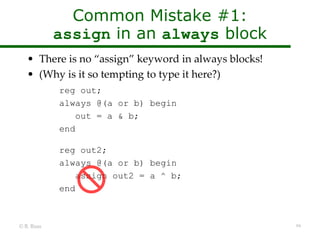
Common Mistake #1:
assign in an always block
• There is no “assign” keyword in always blocks!
• (Why is it so tempting to type it here?)
reg out;
always @(a or b) begin
out = a & b;
end
reg out2;
always @(a or b) begin
assign out2 = a ^ b;
end
module
endmodule
© B. Baas 85
Common Mistake #2:
Setting the same reg in multiple always blocks
• Simulators will typically do what
you tell them to do
• Synthesis tools and lint checkers
will typically give a warning
• Never do this in Hardware verilog
• You might be able to get away
with it in testing verilog but
normally don’t do it
always @(a or b) begin
x = a ^ b;
end
always @(reset) begin
x = 1’b0;
end
© B. Baas 86
Mistake #3: Inferring State In Combinational
Circuits By: An Incomplete Sensitivity List
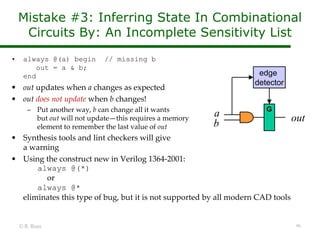
• always @(a) begin // missing b
out = a & b;
end
• out updates when a changes as expected
• out does not update when b changes!
– Put another way, b can change all it wants
but out will not update—this requires a memory
element to remember the last value of out
• Synthesis tools and lint checkers will give
a warning
• Using the construct new in Verilog 1364-2001:
always @(*)
or
always @*
eliminates this type of bug, but it is not supported by all modern CAD tools
a out
b
edge
detector
G
// this "always" block does not
// instantiate combinational logic
always @(freq or xyz or abc) begin
if (xyz == 4’b0010) begin
freq_c = abc;
end
case (freq) begin
3’b000: freq_c = abc;
3’b001: freq_c = abc + 3’b001;
endcase
end
© B. Baas 87
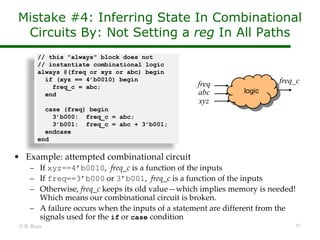
• Example: attempted combinational circuit
– If xyz==4’b0010, freq_c is a function of the inputs
– If freq==3’b000 or 3’b001, freq_c is a function of the inputs
– Otherwise, freq_c keeps its old value—which implies memory is needed!
Which means our combinational circuit is broken.
– A failure occurs when the inputs of a statement are different from the
signals used for the if or case condition
Mistake #4: Inferring State In Combinational
Circuits By: Not Setting a reg In All Paths
freq_c
logic
abc
xyz
freq
// this "always" block does instantiate combinational logic
always @(freq or xyz or abc) begin
// “default” section of always block
freq_c = freq; // some default value
// main logic block
if (xyz==4’b0010) begin
freq_c = abc;
end
else begin // perhaps not always applicable
freq_c = ...;
end
case (freq) begin
3’b000: freq_c = abc;
3’b001: freq_c = abc+3’b001;
default: freq_c = ...; // perhaps you know freq should never be anything
endcase // other than 000 or 001, or perhaps you do want
end // freq_c equal to something in these six cases
© B. Baas 88
• Example: successful combinational circuit
– Solution: freq_c is set regardless of the values of all inputs
– One solution: always declare default values at beginning of always
blocks
– If helpful, declare default case in case statements
Mistake #4: Inferring State In Combinational
Circuits By: Not Setting a reg In All Paths
freq_c
logic
abc
xyz
freq
Fixes
all
Fixes
if
Fixes
only
case
© B. Baas 89
For Combinational Circuits:
Avoid Inferring State by:
1. Including all input variables in the sensitivity list!
2. Set the value of all regs in all paths through every
always block
• A nice solution is to set default values for all output
variables immediately after entering an always block
o You will eliminate the chance of this bug if you do

Handout14.verilog4.pdf

  • 1.
  • 2.
    © B. Baas84 Common Mistake #1: assign in an always block • There is no “assign” keyword in always blocks! • (Why is it so tempting to type it here?) reg out; always @(a or b) begin out = a & b; end reg out2; always @(a or b) begin assign out2 = a ^ b; end
  • 3.
    module endmodule © B. Baas85 Common Mistake #2: Setting the same reg in multiple always blocks • Simulators will typically do what you tell them to do • Synthesis tools and lint checkers will typically give a warning • Never do this in Hardware verilog • You might be able to get away with it in testing verilog but normally don’t do it always @(a or b) begin x = a ^ b; end always @(reset) begin x = 1’b0; end
  • 4.
    © B. Baas86 Mistake #3: Inferring State In Combinational Circuits By: An Incomplete Sensitivity List • always @(a) begin // missing b out = a & b; end • out updates when a changes as expected • out does not update when b changes! – Put another way, b can change all it wants but out will not update—this requires a memory element to remember the last value of out • Synthesis tools and lint checkers will give a warning • Using the construct new in Verilog 1364-2001: always @(*) or always @* eliminates this type of bug, but it is not supported by all modern CAD tools a out b edge detector G
  • 5.
    // this "always"block does not // instantiate combinational logic always @(freq or xyz or abc) begin if (xyz == 4’b0010) begin freq_c = abc; end case (freq) begin 3’b000: freq_c = abc; 3’b001: freq_c = abc + 3’b001; endcase end © B. Baas 87 • Example: attempted combinational circuit – If xyz==4’b0010, freq_c is a function of the inputs – If freq==3’b000 or 3’b001, freq_c is a function of the inputs – Otherwise, freq_c keeps its old value—which implies memory is needed! Which means our combinational circuit is broken. – A failure occurs when the inputs of a statement are different from the signals used for the if or case condition Mistake #4: Inferring State In Combinational Circuits By: Not Setting a reg In All Paths freq_c logic abc xyz freq
  • 6.
    // this "always"block does instantiate combinational logic always @(freq or xyz or abc) begin // “default” section of always block freq_c = freq; // some default value // main logic block if (xyz==4’b0010) begin freq_c = abc; end else begin // perhaps not always applicable freq_c = ...; end case (freq) begin 3’b000: freq_c = abc; 3’b001: freq_c = abc+3’b001; default: freq_c = ...; // perhaps you know freq should never be anything endcase // other than 000 or 001, or perhaps you do want end // freq_c equal to something in these six cases © B. Baas 88 • Example: successful combinational circuit – Solution: freq_c is set regardless of the values of all inputs – One solution: always declare default values at beginning of always blocks – If helpful, declare default case in case statements Mistake #4: Inferring State In Combinational Circuits By: Not Setting a reg In All Paths freq_c logic abc xyz freq Fixes all Fixes if Fixes only case
  • 7.
    © B. Baas89 For Combinational Circuits: Avoid Inferring State by: 1. Including all input variables in the sensitivity list! 2. Set the value of all regs in all paths through every always block • A nice solution is to set default values for all output variables immediately after entering an always block o You will eliminate the chance of this bug if you do