PCI Design Handbook
8th Edition
Content and Updates
Jared E. Brewe, Ph.D., P.E., S.E.
Simpson Gumpertz & Heger
Chicago, Illinois
Learning Objectives
• Identify the content and reference standards in the
PCI Design Handbook
• Follow the updates from the 7th to the 8th Edition
• Explain new component and connection design
concepts
• Describe the new information included in appendixes
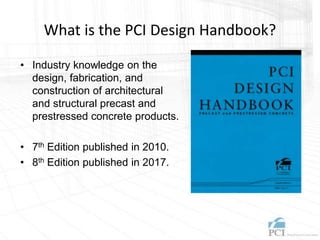
What is the PCI Design Handbook?
• Industry knowledge on the
design, fabrication, and
construction of architectural
and structural precast and
prestressed concrete products.
• 7th Edition published in 2010.
• 8th Edition published in 2017.
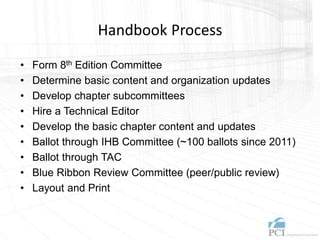
Handbook Process
• Form 8th Edition Committee
• Determine basic content and organization updates
• Develop chapter subcommittees
• Hire a Technical Editor
• Develop the basic chapter content and updates
• Ballot through IHB Committee (~100 ballots since 2011)
• Ballot through TAC
• Blue Ribbon Review Committee (peer/public review)
• Layout and Print
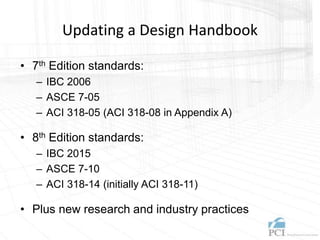
Updating a Design Handbook
• 7th Edition standards:
– IBC 2006
– ASCE 7-05
– ACI 318-05 (ACI 318-08 in Appendix A)
• 8th Edition standards:
– IBC 2015
– ASCE 7-10
– ACI 318-14 (initially ACI 318-11)
• Plus new research and industry practices
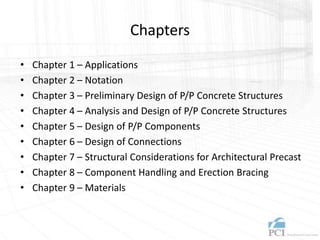
Chapters
• Chapter 1 – Applications
• Chapter 2 – Notation
• Chapter 3 – Preliminary Design of P/P Concrete Structures
• Chapter 4 – Analysis and Design of P/P Concrete Structures
• Chapter 5 – Design of P/P Components
• Chapter 6 – Design of Connections
• Chapter 7 – Structural Considerations for Architectural Precast
• Chapter 8 – Component Handling and Erection Bracing
• Chapter 9 – Materials
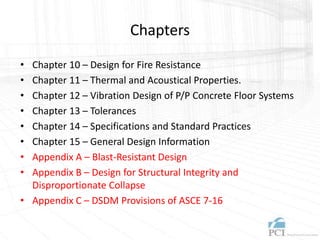
Chapters
• Chapter 10 – Design for Fire Resistance
• Chapter 11 – Thermal and Acoustical Properties.
• Chapter 12 – Vibration Design of P/P Concrete Floor Systems
• Chapter 13 – Tolerances
• Chapter 14 – Specifications and Standard Practices
• Chapter 15 – General Design Information
• Appendix A – Blast-Resistant Design
• Appendix B – Design for Structural Integrity and
Disproportionate Collapse
• Appendix C – DSDM Provisions of ASCE 7-16
Chapter 1 – Applications
• Overview of precast and prestressed concrete
• Precast applications in the built environment
• Updated Section 1.1.3 – Sustainability
• New Section 1.2.1.8 – Storm Shelters
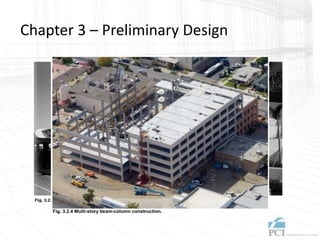
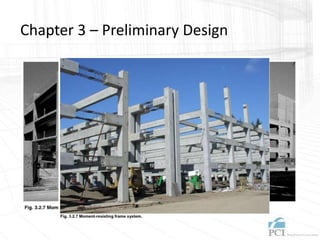
Chapter 3 – Preliminary Design
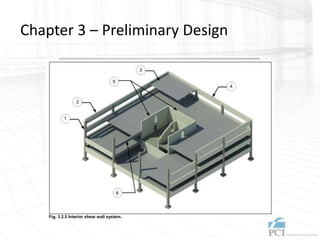
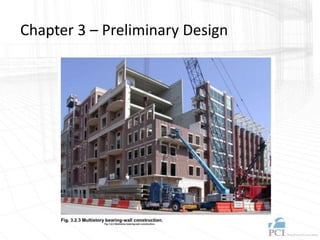
• Overview of preliminary structural design
– Gravity and lateral force resisting systems
• Design tables for preliminary component size
• Updated tables, figures, and photos
• Removed double-tee wall panel design aid
Chapter 3 – Preliminary Design
1
2
Chapter 3 – Preliminary Design
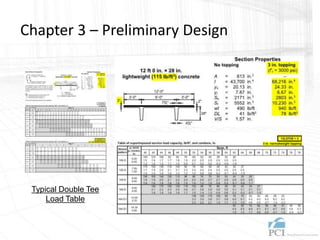
• Double tee load tables
– Checked and verified all load tables
– Added single drape profile to several tables
– Updated to reflect current practice
– Removed 8ft double tee tables
– Removed 15’-0”x26” tables
Chapter 3 – Preliminary Design
Typical Double Tee
Load Table
Chapter 4 – Analysis of Structures
• Definition of Loads, Load Effects, and Combinations
• Consideration of Volume Changes
• Structural Modeling
• Gravity Systems
• Lateral Load Resisting Systems
• Diaphragms
Chapter 4 – Analysis of Structures
• Updates:
– Reference Standards
– New Examples
– Changes to Design Aids
• Relocate:
– Structural Integrity: Moved to Appendix B with expanded
discussion of Disproportionate Collapse
– Blast: Moved to Appendix A
Chapter 4 – Analysis of Structures
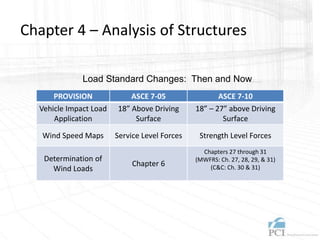
Load Standard Changes: Then and Now
PROVISION ASCE 7-05 ASCE 7-10
Vehicle Impact Load
Application
18” Above Driving
Surface
18” – 27” above Driving
Surface
Wind Speed Maps Service Level Forces Strength Level Forces
Determination of
Wind Loads
Chapter 6
Chapters 27 through 31
(MWFRS: Ch. 27, 28, 29, & 31)
(C&C: Ch. 30 & 31)
Chapter 4 – Analysis of Structures
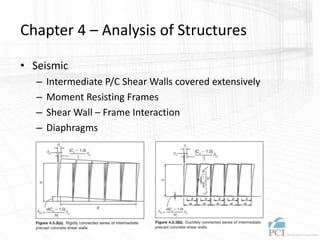
• Seismic
– Intermediate P/C Shear Walls covered extensively
– Moment Resisting Frames
– Shear Wall – Frame Interaction
– Diaphragms
Chapter 4 – Analysis of Structures
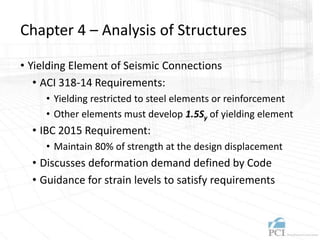
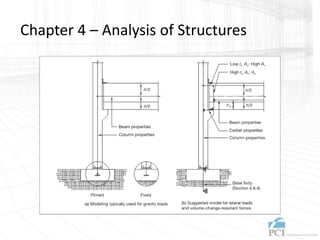
• Yielding Element of Seismic Connections
• ACI 318-14 Requirements:
• Yielding restricted to steel elements or reinforcement
• Other elements must develop 1.5Sy of yielding element
• IBC 2015 Requirement:
• Maintain 80% of strength at the design displacement
• Discusses deformation demand defined by Code
• Guidance for strain levels to satisfy requirements
Chapter 4 – Analysis of Structures
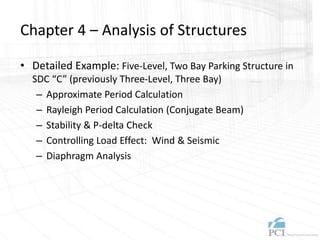
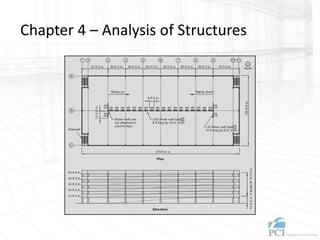
• Detailed Example: Five-Level, Two Bay Parking Structure in
SDC “C” (previously Three-Level, Three Bay)
– Approximate Period Calculation
– Rayleigh Period Calculation (Conjugate Beam)
– Stability & P-delta Check
– Controlling Load Effect: Wind & Seismic
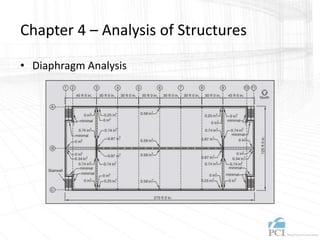
– Diaphragm Analysis
Chapter 4 – Analysis of Structures
• Diaphragm Analysis
Chapter 4 – Analysis of Structures
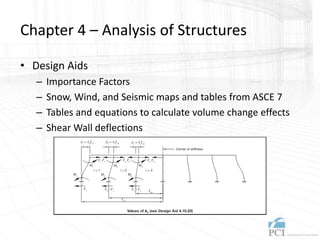
• Design Aids
– Importance Factors
– Snow, Wind, and Seismic maps and tables from ASCE 7
– Tables and equations to calculate volume change effects
– Shear Wall deflections
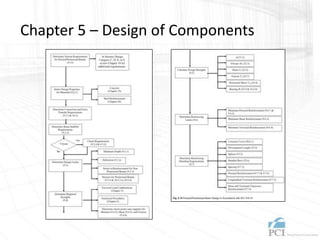
Chapter 5 – Design of Components
• Covers both Reinforced (Precast) and Prestressed
• Refers to PCI Standard Design Practice
• Contains 40 worked examples
• Includes information not in ACI 318
• ACI 318-14 §9.5.4.7 – Torsion of solid precast sections
with h/bt > 4.5
• Reinforced Concrete Bearing
• 8th Ed. includes Updates, Revisions and New Research
Chapter 5 – Design of Components
• Updated to ACI 318-14
• Code provisions and references updated
• Chapter Organization unchanged
• Section 5.14 added to assist with the transition
• “Design Procedure following ACI 318-14”
Chapter 5 – Design of Components
• Removed several tables and design aids
• Rarely used or obsolete
• Design examples updated to current practices
• Corrected decompression force calculation for
determining the moment of inertia of a cracked
prestressed section
• Clarified the m-factor terms used for calculating the
hanger steel in ledger beams and inverted tees
Chapter 5 – Design of Components
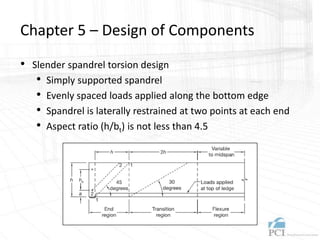
• Slender spandrel torsion design
• Simply supported spandrel
• Evenly spaced loads applied along the bottom edge
• Spandrel is laterally restrained at two points at each end
• Aspect ratio (h/bt) is not less than 4.5
Chapter 5 – Design of Components
• New Research
• Dapped ends of thin stem members (8 in. or less)
• Study included full-scale tests and analytical models
• Several reinforcement configurations were tested
• New shear checks for the extended nib
• New cover and bend requirements
• Complete design example for new configurations
• Design for dapped ends of beams has not changed
Chapter 5 – Design of Components
• New Research
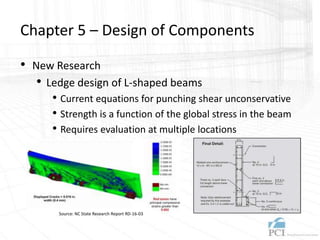
• Ledge design of L-shaped beams
• Current equations for punching shear unconservative
• Strength is a function of the global stress in the beam
• Requires evaluation at multiple locations
Source: NC State Research Report RD-16-03
Chapter 5 – Design of Components
• New Research
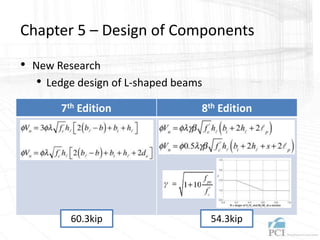
• Ledge design of L-shaped beams
7th Edition 8th Edition
60.3kip 54.3kip
Chapter 5 – Design of Components
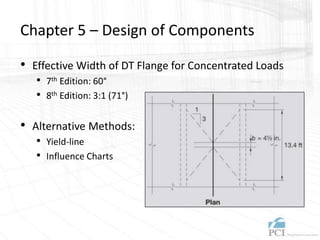
• Effective Width of DT Flange for Concentrated Loads
• 7th Edition: 60°
• 8th Edition: 3:1 (71°)
• Alternative Methods:
• Yield-line
• Influence Charts
Chapter 6 – Design of Connections
• Connections between components
• Details necessary for precast construction
• Contains 26 worked examples
• Deleted Table 6.2.1
• Diaphragm Overstrength Factors, Y
Chapter 6 – Design of Connections
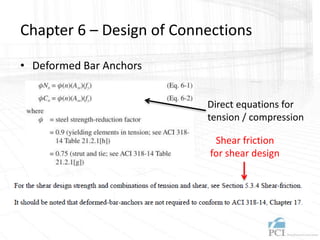
• Deformed Bar Anchors
Direct equations for
tension / compression
Shear friction
for shear design
Chapter 6 – Design of Connections
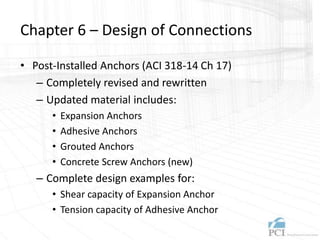
• Post-Installed Anchors (ACI 318-14 Ch 17)
– Completely revised and rewritten
– Updated material includes:
• Expansion Anchors
• Adhesive Anchors
• Grouted Anchors
• Concrete Screw Anchors (new)
– Complete design examples for:
• Shear capacity of Expansion Anchor
• Tension capacity of Adhesive Anchor
Chapter 6 – Design of Connections
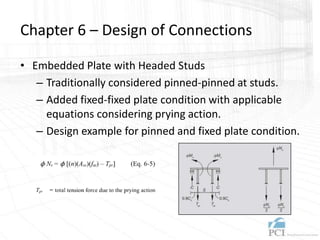
• Embedded Plate with Headed Studs
– Traditionally considered pinned-pinned at studs.
– Added fixed-fixed plate condition with applicable
equations considering prying action.
– Design example for pinned and fixed plate condition.
Chapter 6 – Design of Connections
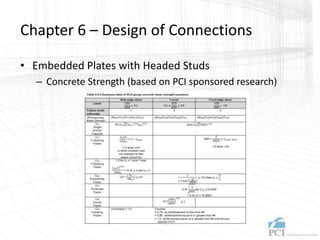
• Embedded Plates with Headed Studs
– Concrete Strength (based on PCI sponsored research)
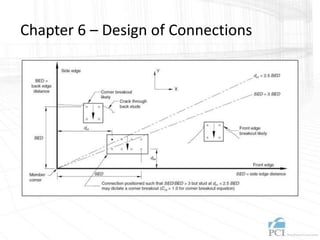
Chapter 6 – Design of Connections
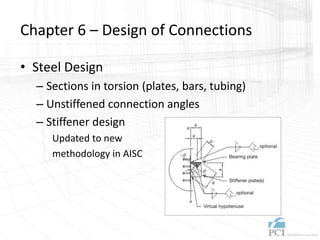
• Steel Design
– Sections in torsion (plates, bars, tubing)
– Unstiffened connection angles
– Stiffener design
Updated to new
methodology in AISC
Chapter 6 – Design of Connections
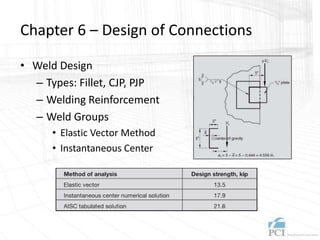
• Weld Design
– Types: Fillet, CJP, PJP
– Welding Reinforcement
– Weld Groups
• Elastic Vector Method
• Instantaneous Center
Chapter 6 – Design of Connections
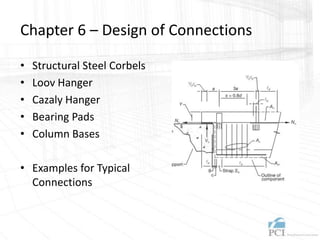
• Structural Steel Corbels
• Loov Hanger
• Cazaly Hanger
• Bearing Pads
• Column Bases
• Examples for Typical
Connections
Chapter 6 – Design of Connections
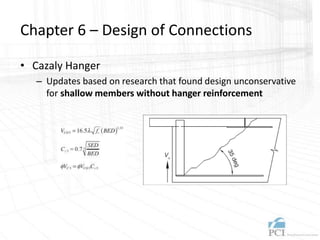
• Cazaly Hanger
– Updates based on research that found design unconservative
for shallow members without hanger reinforcement
Chapter 6 – Design of Connections
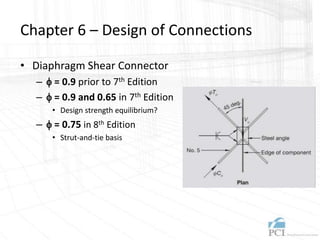
• Diaphragm Shear Connector
– f = 0.9 prior to 7th Edition
– f = 0.9 and 0.65 in 7th Edition
• Design strength equilibrium?
– f = 0.75 in 8th Edition
• Strut-and-tie basis
Chapter 6 – Design of Connections
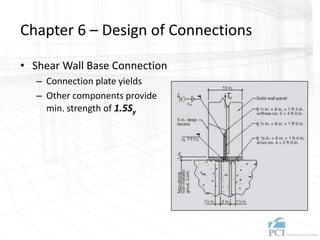
• Shear Wall Base Connection
– Connection plate yields
– Other components provide
min. strength of 1.5Sy
Chapter 6 – Design of Connections
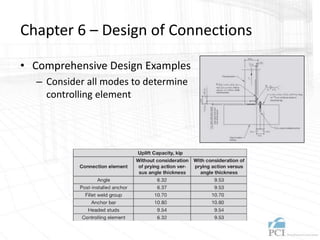
• Comprehensive Design Examples
– Consider all modes to determine
controlling element
Chapter 6 – Design of Connections
• Design Aids
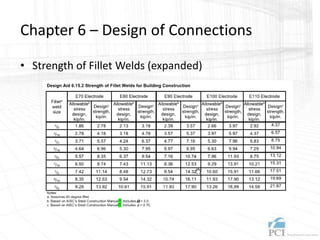
– Allowable and Design Stress of Welds
– Strength of Fillet Welds
– Min. Length to Develop Strength of Reinforcement
• Longitudinal Weld to Plate
• Butt Weld to Plate
• Through Plate
• Splice
– Steel Corbels
– Plates with Headed Studs
Chapter 6 – Design of Connections
• Strength of Fillet Welds (expanded)
7th Edition
Chapter 6 – Design of Connections
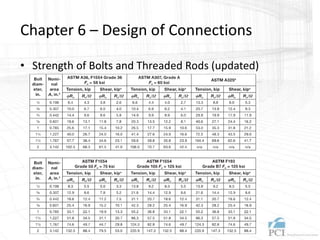
• Strength of Bolts and Threaded Rods (updated)
Chapter 7 – Architectural Precast
• Types and Functions of Arch. Precast Components
– Non-loadbearing: wall panels, spandrels, and column
covers
– Loadbearing: wall panels and spandrels
• Structural and Connection Considerations
– Component and Cladding Wind Loads
– Seismic Design Considerations
Chapter 7 – Architectural Precast
• New Section 7.3.1 oriented toward the SEoR
• SEoR must provide in the contract documents:
– Building codes, loads, and design criteria
– Story drifts at each floor level
– Acceptable locations for gravity supports
– Acceptable locations for tieback connections
– Any special loading conditions
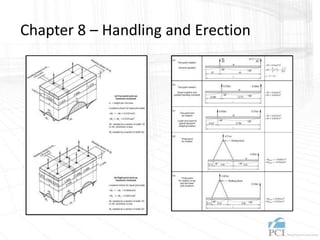
Chapter 8 – Handling and Erection
• Handling
– Stripping (from the casting bed)
– Yarding and Storage (at the plant)
– Transportation
• Erection
– Handling (erecting to final location)
– Stability (overall structure and component)
• These are sometimes the maximum demands the
component will experience.
Chapter 8 – Handling and Erection
• Updates
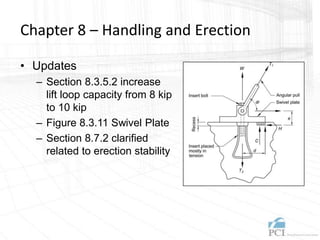
– Section 8.3.5.2 increase
lift loop capacity from 8 kip
to 10 kip
– Figure 8.3.11 Swivel Plate
– Section 8.7.2 clarified
related to erection stability
Chapter 8 – Handling and Erection
• Updates
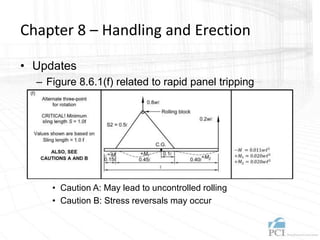
– Figure 8.6.1(f) related to rapid panel tripping
• Caution A: May lead to uncontrolled rolling
• Caution B: Stress reversals may occur
Chapter 9 – Materials
• Descriptions of types and uses of concrete
– HPC, SCC, LWC, FRC
• Discussion of aggregate durability
• Discussion of admixtures
• Discussion of fresh concrete properties
– Slump, air content, workability, curing
• Discussion of hardened concrete properties
– Elastic modulus, shrinkage, creep, deterioration
mechanisms (durability and reactivity)
• Strand bond and the Peterman test
Chapter 9 – Materials
• Discussion and caution on welding of structural bolts,
anchor bolts, nuts and washers due to chemical
composition and heat treatments
– Acceptable for A307 but requires SR S1 and appropriate
preheat and procedure
– Not recommended for A325 and A193 B7
– Not permitted for A490
– F1554 anchor bolts
• Acceptable for Grade 36 where composition is known
• Acceptable for Grade 55 but requires SR S1
• Not recommended for Grade 105
Chapter 10 – Fire Resistance
• PCI MNL-124: Design for Fire Resistance Manual
• Background of Fire Testing
• Designing for Heat Transmission
• Fire Endurance by Rational Design
• Fire Resistance by Concrete Cover
• Miscellaneous Considerations
• Postfire Examination
• Design Aids for Rational Design and Concrete Cover
Chapter 11 – Thermal and Acoustical
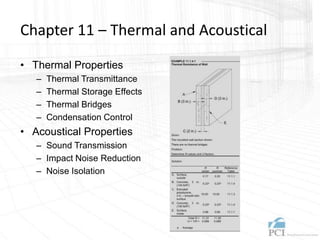
• Thermal Properties
– Thermal Transmittance
– Thermal Storage Effects
– Thermal Bridges
– Condensation Control
• Acoustical Properties
– Sound Transmission
– Impact Noise Reduction
– Noise Isolation
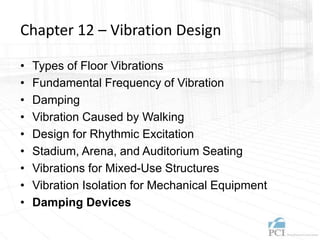
Chapter 12 – Vibration Design
• Types of Floor Vibrations
• Fundamental Frequency of Vibration
• Damping
• Vibration Caused by Walking
• Design for Rhythmic Excitation
• Stadium, Arena, and Auditorium Seating
• Vibrations for Mixed-Use Structures
• Vibration Isolation for Mechanical Equipment
• Damping Devices
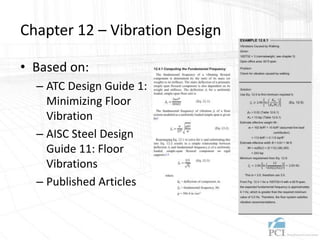
Chapter 12 – Vibration Design
• Based on:
– ATC Design Guide 1:
Minimizing Floor
Vibration
– AISC Steel Design
Guide 11: Floor
Vibrations
– Published Articles
Chapter 13 - Tolerances
• PCI MNL 135: Tolerance Manual for Precast and
Prestressed Concrete Construction
• ACI 117: Specification for Tolerances for Concrete
Construction and Materials
• ACI ITG-7-09: Specification for Tolerances for Precast
Concrete
• PCI Quality Control Manuals
• Discusses purpose and responsibility for tolerances
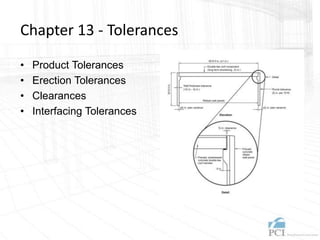
Chapter 13 - Tolerances
• Product Tolerances
• Erection Tolerances
• Clearances
• Interfacing Tolerances
Chapter 14 – Specs and Standard Practice
• Definition and Terminology of Project Participants
• Discussion of typical contract requirements
– Shop drawings, tests and inspections, delivery
– Erection responsibilities
– Warranty
• Responsibility for Design and Construction
– Owner, PDP, SER, GC, Precaster, SSE
• PCI Standard Design Practice yet to be published.
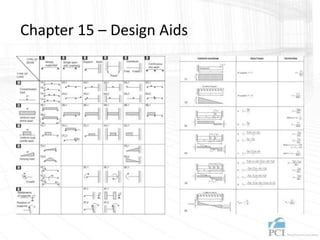
Chapter 15 – Design Aids
• Design Information (loads, equations, and diagrams)
• Material Properties – Prestressing Steel
• Material Properties – Reinforcing Bars
• Material Properties – Welded-Wire Reinforcement
• Standard, Bolts, Nuts, and Washers
• Welding Information
• Section Properties
• Metric Conversion
• [Quick and easy reference for licensing exams]
Chapter 15 – Design Aids
Appendix A – Blast-Resistant Design
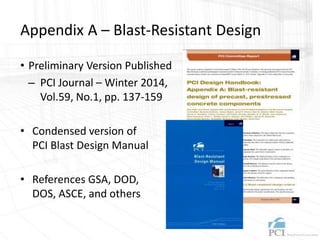
• Preliminary Version Published
– PCI Journal – Winter 2014,
Vol.59, No.1, pp. 137-159
• Condensed version of
PCI Blast Design Manual
• References GSA, DOD,
DOS, ASCE, and others
Appendix A – Blast-Resistant Design
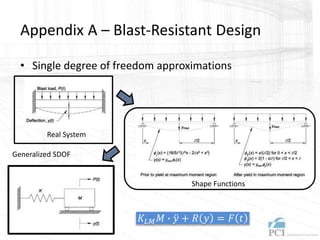
• Single degree of freedom approximations
Real System
Shape Functions
Generalized SDOF
𝐾𝐿𝑀𝑀 ∙ 𝑦 + 𝑅 𝑦 = 𝐹 𝑡
Appendix A – Blast-Resistant Design
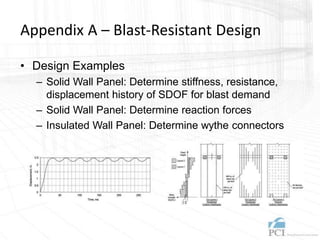
• Design Examples
– Solid Wall Panel: Determine stiffness, resistance,
displacement history of SDOF for blast demand
– Solid Wall Panel: Determine reaction forces
– Insulated Wall Panel: Determine wythe connectors
Appendix B – Collapse Resistance
• Structural Integrity and Disproportionate Collapse
• Historical Developments
• Design Approaches
• Building Code Criteria
• Criteria for Government Facilities (UFC, GSA)
• Design Strategies
Appendix B – Collapse Resistance
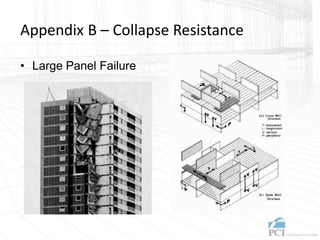
• Large Panel Failure
Appendix B – Collapse Resistance
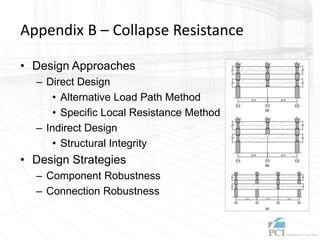
• Design Approaches
– Direct Design
• Alternative Load Path Method
• Specific Local Resistance Method
– Indirect Design
• Structural Integrity
• Design Strategies
– Component Robustness
– Connection Robustness
Appendix C – DSDM per ASCE 7-16
• Pankow Project: “Seismic Design Methodology
Document for Precast Concrete Diaphragms”
– 10 years of research
– Initially design appears more difficult
– Improved analysis, connection details, and system
layout will improve system performance
• Code Force Level Changes
• Diaphragm Connection Qualifications
Appendix C – DSDM per ASCE 7-16
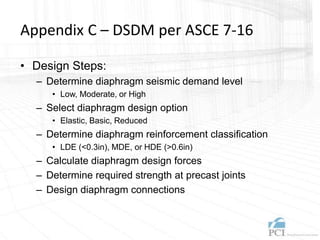
• Design Steps:
– Determine diaphragm seismic demand level
• Low, Moderate, or High
– Select diaphragm design option
• Elastic, Basic, Reduced
– Determine diaphragm reinforcement classification
• LDE (<0.3in), MDE, or HDE (>0.6in)
– Calculate diaphragm design forces
– Determine required strength at precast joints
– Design diaphragm connections
Appendix C – DSDM per ASCE 7-16
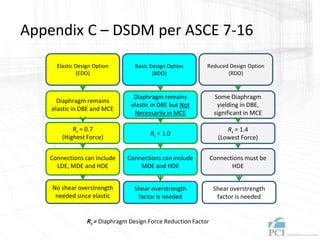
Elastic Design Option
(EDO)
Basic Design Option
(BDO)
Reduced Design Option
(RDO)
Diaphragm remains
elastic in DBE and MCE
Rs = 0.7
(Highest Force)
Connections can include
LDE, MDE and HDE
Diaphragm remains
elastic in DBE but Not
Necessarily in MCE
Rs = 1.0
Connections can include
MDE and HDE
Some Diaphragm
yielding in DBE,
significant in MCE
Rs = 1.4
(Lowest Force)
Connections must be
HDE
Shear overstrength
factor is needed
No shear overstrength
needed since elastic
Shear overstrength
factor is needed
Rs = Diaphragm Design Force Reduction Factor
Appendix C – DSDM per ASCE 7-16
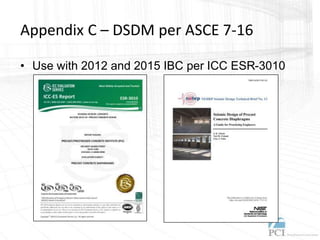
• Use with 2012 and 2015 IBC per ICC ESR-3010
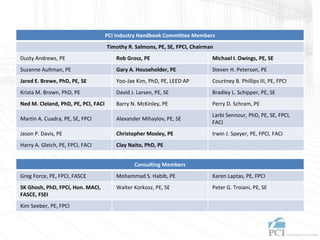
PCI Industry Handbook Committee Members
Timothy R. Salmons, PE, SE, FPCI, Chairman
Dusty Andrews, PE Rob Grosz, PE Michael I. Owings, PE, SE
Suzanne Aultman, PE Gary A. Householder, PE Steven H. Peterson, PE
Jared E. Brewe, PhD, PE, SE Yoo-Jae Kim, PhD, PE, LEED AP Courtney B. Phillips III, PE, FPCI
Krista M. Brown, PhD, PE David J. Larsen, PE, SE Bradley L. Schipper, PE, SE
Ned M. Cleland, PhD, PE, PCI, FACI Barry N. McKinley, PE Perry D. Schram, PE
Martin A. Cuadra, PE, SE, FPCI Alexander Mihaylov, PE, SE
Larbi Sennour, PhD, PE, SE, FPCI,
FACI
Jason P. Davis, PE Christopher Mosley, PE Irwin J. Speyer, PE, FPCI, FACI
Harry A. Gleich, PE, FPCI, FACI Clay Naito, PhD, PE
Consulting Members
Greg Force, PE, FPCI, FASCE Mohammad S. Habib, PE Karen Laptas, PE, FPCI
SK Ghosh, PhD, FPCI, Hon. MACI,
FASCE, FSEI
Walter Korkosz, PE, SE Peter G. Troiani, PE, SE
Kim Seeber, PE, FPCI
Thank You!
Jared E. Brewe, Ph.D., P.E., S.E.
Simpson Gumpertz & Heger
JEBrewe@sgh.com

PCI Design Handbook Content and Updates.pptx

  • 1.
    PCI Design Handbook 8thEdition Content and Updates Jared E. Brewe, Ph.D., P.E., S.E. Simpson Gumpertz & Heger Chicago, Illinois
  • 2.
    Learning Objectives • Identifythe content and reference standards in the PCI Design Handbook • Follow the updates from the 7th to the 8th Edition • Explain new component and connection design concepts • Describe the new information included in appendixes
  • 3.
    What is thePCI Design Handbook? • Industry knowledge on the design, fabrication, and construction of architectural and structural precast and prestressed concrete products. • 7th Edition published in 2010. • 8th Edition published in 2017.
  • 4.
    Handbook Process • Form8th Edition Committee • Determine basic content and organization updates • Develop chapter subcommittees • Hire a Technical Editor • Develop the basic chapter content and updates • Ballot through IHB Committee (~100 ballots since 2011) • Ballot through TAC • Blue Ribbon Review Committee (peer/public review) • Layout and Print
  • 5.
    Updating a DesignHandbook • 7th Edition standards: – IBC 2006 – ASCE 7-05 – ACI 318-05 (ACI 318-08 in Appendix A) • 8th Edition standards: – IBC 2015 – ASCE 7-10 – ACI 318-14 (initially ACI 318-11) • Plus new research and industry practices
  • 6.
    Chapters • Chapter 1– Applications • Chapter 2 – Notation • Chapter 3 – Preliminary Design of P/P Concrete Structures • Chapter 4 – Analysis and Design of P/P Concrete Structures • Chapter 5 – Design of P/P Components • Chapter 6 – Design of Connections • Chapter 7 – Structural Considerations for Architectural Precast • Chapter 8 – Component Handling and Erection Bracing • Chapter 9 – Materials
  • 7.
    Chapters • Chapter 10– Design for Fire Resistance • Chapter 11 – Thermal and Acoustical Properties. • Chapter 12 – Vibration Design of P/P Concrete Floor Systems • Chapter 13 – Tolerances • Chapter 14 – Specifications and Standard Practices • Chapter 15 – General Design Information • Appendix A – Blast-Resistant Design • Appendix B – Design for Structural Integrity and Disproportionate Collapse • Appendix C – DSDM Provisions of ASCE 7-16
  • 8.
    Chapter 1 –Applications • Overview of precast and prestressed concrete • Precast applications in the built environment • Updated Section 1.1.3 – Sustainability • New Section 1.2.1.8 – Storm Shelters
  • 9.
    Chapter 3 –Preliminary Design • Overview of preliminary structural design – Gravity and lateral force resisting systems • Design tables for preliminary component size • Updated tables, figures, and photos • Removed double-tee wall panel design aid
  • 10.
    Chapter 3 –Preliminary Design
  • 11.
    Chapter 3 –Preliminary Design
  • 12.
    Chapter 3 –Preliminary Design 1 2
  • 13.
    Chapter 3 –Preliminary Design
  • 14.
    Chapter 3 –Preliminary Design • Double tee load tables – Checked and verified all load tables – Added single drape profile to several tables – Updated to reflect current practice – Removed 8ft double tee tables – Removed 15’-0”x26” tables
  • 15.
    Chapter 3 –Preliminary Design Typical Double Tee Load Table
  • 16.
    Chapter 4 –Analysis of Structures • Definition of Loads, Load Effects, and Combinations • Consideration of Volume Changes • Structural Modeling • Gravity Systems • Lateral Load Resisting Systems • Diaphragms
  • 17.
    Chapter 4 –Analysis of Structures • Updates: – Reference Standards – New Examples – Changes to Design Aids • Relocate: – Structural Integrity: Moved to Appendix B with expanded discussion of Disproportionate Collapse – Blast: Moved to Appendix A
  • 18.
    Chapter 4 –Analysis of Structures Load Standard Changes: Then and Now PROVISION ASCE 7-05 ASCE 7-10 Vehicle Impact Load Application 18” Above Driving Surface 18” – 27” above Driving Surface Wind Speed Maps Service Level Forces Strength Level Forces Determination of Wind Loads Chapter 6 Chapters 27 through 31 (MWFRS: Ch. 27, 28, 29, & 31) (C&C: Ch. 30 & 31)
  • 19.
    Chapter 4 –Analysis of Structures • Seismic – Intermediate P/C Shear Walls covered extensively – Moment Resisting Frames – Shear Wall – Frame Interaction – Diaphragms
  • 20.
    Chapter 4 –Analysis of Structures • Yielding Element of Seismic Connections • ACI 318-14 Requirements: • Yielding restricted to steel elements or reinforcement • Other elements must develop 1.5Sy of yielding element • IBC 2015 Requirement: • Maintain 80% of strength at the design displacement • Discusses deformation demand defined by Code • Guidance for strain levels to satisfy requirements
  • 21.
    Chapter 4 –Analysis of Structures
  • 22.
    Chapter 4 –Analysis of Structures • Detailed Example: Five-Level, Two Bay Parking Structure in SDC “C” (previously Three-Level, Three Bay) – Approximate Period Calculation – Rayleigh Period Calculation (Conjugate Beam) – Stability & P-delta Check – Controlling Load Effect: Wind & Seismic – Diaphragm Analysis
  • 23.
    Chapter 4 –Analysis of Structures
  • 24.
    Chapter 4 –Analysis of Structures • Diaphragm Analysis
  • 25.
    Chapter 4 –Analysis of Structures • Design Aids – Importance Factors – Snow, Wind, and Seismic maps and tables from ASCE 7 – Tables and equations to calculate volume change effects – Shear Wall deflections
  • 26.
    Chapter 5 –Design of Components • Covers both Reinforced (Precast) and Prestressed • Refers to PCI Standard Design Practice • Contains 40 worked examples • Includes information not in ACI 318 • ACI 318-14 §9.5.4.7 – Torsion of solid precast sections with h/bt > 4.5 • Reinforced Concrete Bearing • 8th Ed. includes Updates, Revisions and New Research
  • 27.
    Chapter 5 –Design of Components • Updated to ACI 318-14 • Code provisions and references updated • Chapter Organization unchanged • Section 5.14 added to assist with the transition • “Design Procedure following ACI 318-14”
  • 28.
    Chapter 5 –Design of Components
  • 29.
    Chapter 5 –Design of Components • Removed several tables and design aids • Rarely used or obsolete • Design examples updated to current practices • Corrected decompression force calculation for determining the moment of inertia of a cracked prestressed section • Clarified the m-factor terms used for calculating the hanger steel in ledger beams and inverted tees
  • 30.
    Chapter 5 –Design of Components • Slender spandrel torsion design • Simply supported spandrel • Evenly spaced loads applied along the bottom edge • Spandrel is laterally restrained at two points at each end • Aspect ratio (h/bt) is not less than 4.5
  • 31.
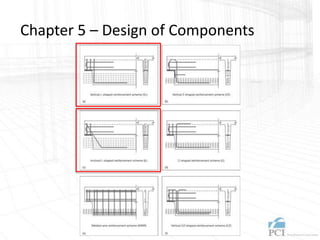
    Chapter 5 –Design of Components • New Research • Dapped ends of thin stem members (8 in. or less) • Study included full-scale tests and analytical models • Several reinforcement configurations were tested • New shear checks for the extended nib • New cover and bend requirements • Complete design example for new configurations • Design for dapped ends of beams has not changed
  • 32.
    Chapter 5 –Design of Components
  • 33.
    Chapter 5 –Design of Components • New Research • Ledge design of L-shaped beams • Current equations for punching shear unconservative • Strength is a function of the global stress in the beam • Requires evaluation at multiple locations Source: NC State Research Report RD-16-03
  • 34.
    Chapter 5 –Design of Components • New Research • Ledge design of L-shaped beams 7th Edition 8th Edition 60.3kip 54.3kip
  • 35.
    Chapter 5 –Design of Components • Effective Width of DT Flange for Concentrated Loads • 7th Edition: 60° • 8th Edition: 3:1 (71°) • Alternative Methods: • Yield-line • Influence Charts
  • 36.
    Chapter 6 –Design of Connections • Connections between components • Details necessary for precast construction • Contains 26 worked examples • Deleted Table 6.2.1 • Diaphragm Overstrength Factors, Y
  • 37.
    Chapter 6 –Design of Connections • Deformed Bar Anchors Direct equations for tension / compression Shear friction for shear design
  • 38.
    Chapter 6 –Design of Connections • Post-Installed Anchors (ACI 318-14 Ch 17) – Completely revised and rewritten – Updated material includes: • Expansion Anchors • Adhesive Anchors • Grouted Anchors • Concrete Screw Anchors (new) – Complete design examples for: • Shear capacity of Expansion Anchor • Tension capacity of Adhesive Anchor
  • 39.
    Chapter 6 –Design of Connections • Embedded Plate with Headed Studs – Traditionally considered pinned-pinned at studs. – Added fixed-fixed plate condition with applicable equations considering prying action. – Design example for pinned and fixed plate condition.
  • 40.
    Chapter 6 –Design of Connections • Embedded Plates with Headed Studs – Concrete Strength (based on PCI sponsored research)
  • 41.
    Chapter 6 –Design of Connections
  • 42.
    Chapter 6 –Design of Connections • Steel Design – Sections in torsion (plates, bars, tubing) – Unstiffened connection angles – Stiffener design Updated to new methodology in AISC
  • 43.
    Chapter 6 –Design of Connections • Weld Design – Types: Fillet, CJP, PJP – Welding Reinforcement – Weld Groups • Elastic Vector Method • Instantaneous Center
  • 44.
    Chapter 6 –Design of Connections • Structural Steel Corbels • Loov Hanger • Cazaly Hanger • Bearing Pads • Column Bases • Examples for Typical Connections
  • 45.
    Chapter 6 –Design of Connections • Cazaly Hanger – Updates based on research that found design unconservative for shallow members without hanger reinforcement
  • 46.
    Chapter 6 –Design of Connections • Diaphragm Shear Connector – f = 0.9 prior to 7th Edition – f = 0.9 and 0.65 in 7th Edition • Design strength equilibrium? – f = 0.75 in 8th Edition • Strut-and-tie basis
  • 47.
    Chapter 6 –Design of Connections • Shear Wall Base Connection – Connection plate yields – Other components provide min. strength of 1.5Sy
  • 48.
    Chapter 6 –Design of Connections • Comprehensive Design Examples – Consider all modes to determine controlling element
  • 49.
    Chapter 6 –Design of Connections • Design Aids – Allowable and Design Stress of Welds – Strength of Fillet Welds – Min. Length to Develop Strength of Reinforcement • Longitudinal Weld to Plate • Butt Weld to Plate • Through Plate • Splice – Steel Corbels – Plates with Headed Studs
  • 50.
    Chapter 6 –Design of Connections • Strength of Fillet Welds (expanded) 7th Edition
  • 51.
    Chapter 6 –Design of Connections • Strength of Bolts and Threaded Rods (updated)
  • 52.
    Chapter 7 –Architectural Precast • Types and Functions of Arch. Precast Components – Non-loadbearing: wall panels, spandrels, and column covers – Loadbearing: wall panels and spandrels • Structural and Connection Considerations – Component and Cladding Wind Loads – Seismic Design Considerations
  • 53.
    Chapter 7 –Architectural Precast • New Section 7.3.1 oriented toward the SEoR • SEoR must provide in the contract documents: – Building codes, loads, and design criteria – Story drifts at each floor level – Acceptable locations for gravity supports – Acceptable locations for tieback connections – Any special loading conditions
  • 54.
    Chapter 8 –Handling and Erection • Handling – Stripping (from the casting bed) – Yarding and Storage (at the plant) – Transportation • Erection – Handling (erecting to final location) – Stability (overall structure and component) • These are sometimes the maximum demands the component will experience.
  • 55.
    Chapter 8 –Handling and Erection • Updates – Section 8.3.5.2 increase lift loop capacity from 8 kip to 10 kip – Figure 8.3.11 Swivel Plate – Section 8.7.2 clarified related to erection stability
  • 56.
    Chapter 8 –Handling and Erection
  • 57.
    Chapter 8 –Handling and Erection • Updates – Figure 8.6.1(f) related to rapid panel tripping • Caution A: May lead to uncontrolled rolling • Caution B: Stress reversals may occur
  • 58.
    Chapter 9 –Materials • Descriptions of types and uses of concrete – HPC, SCC, LWC, FRC • Discussion of aggregate durability • Discussion of admixtures • Discussion of fresh concrete properties – Slump, air content, workability, curing • Discussion of hardened concrete properties – Elastic modulus, shrinkage, creep, deterioration mechanisms (durability and reactivity) • Strand bond and the Peterman test
  • 59.
    Chapter 9 –Materials • Discussion and caution on welding of structural bolts, anchor bolts, nuts and washers due to chemical composition and heat treatments – Acceptable for A307 but requires SR S1 and appropriate preheat and procedure – Not recommended for A325 and A193 B7 – Not permitted for A490 – F1554 anchor bolts • Acceptable for Grade 36 where composition is known • Acceptable for Grade 55 but requires SR S1 • Not recommended for Grade 105
  • 60.
    Chapter 10 –Fire Resistance • PCI MNL-124: Design for Fire Resistance Manual • Background of Fire Testing • Designing for Heat Transmission • Fire Endurance by Rational Design • Fire Resistance by Concrete Cover • Miscellaneous Considerations • Postfire Examination • Design Aids for Rational Design and Concrete Cover
  • 61.
    Chapter 11 –Thermal and Acoustical • Thermal Properties – Thermal Transmittance – Thermal Storage Effects – Thermal Bridges – Condensation Control • Acoustical Properties – Sound Transmission – Impact Noise Reduction – Noise Isolation
  • 62.
    Chapter 12 –Vibration Design • Types of Floor Vibrations • Fundamental Frequency of Vibration • Damping • Vibration Caused by Walking • Design for Rhythmic Excitation • Stadium, Arena, and Auditorium Seating • Vibrations for Mixed-Use Structures • Vibration Isolation for Mechanical Equipment • Damping Devices
  • 63.
    Chapter 12 –Vibration Design • Based on: – ATC Design Guide 1: Minimizing Floor Vibration – AISC Steel Design Guide 11: Floor Vibrations – Published Articles
  • 64.
    Chapter 13 -Tolerances • PCI MNL 135: Tolerance Manual for Precast and Prestressed Concrete Construction • ACI 117: Specification for Tolerances for Concrete Construction and Materials • ACI ITG-7-09: Specification for Tolerances for Precast Concrete • PCI Quality Control Manuals • Discusses purpose and responsibility for tolerances
  • 65.
    Chapter 13 -Tolerances • Product Tolerances • Erection Tolerances • Clearances • Interfacing Tolerances
  • 66.
    Chapter 14 –Specs and Standard Practice • Definition and Terminology of Project Participants • Discussion of typical contract requirements – Shop drawings, tests and inspections, delivery – Erection responsibilities – Warranty • Responsibility for Design and Construction – Owner, PDP, SER, GC, Precaster, SSE • PCI Standard Design Practice yet to be published.
  • 67.
    Chapter 15 –Design Aids • Design Information (loads, equations, and diagrams) • Material Properties – Prestressing Steel • Material Properties – Reinforcing Bars • Material Properties – Welded-Wire Reinforcement • Standard, Bolts, Nuts, and Washers • Welding Information • Section Properties • Metric Conversion • [Quick and easy reference for licensing exams]
  • 68.
    Chapter 15 –Design Aids
  • 69.
    Appendix A –Blast-Resistant Design • Preliminary Version Published – PCI Journal – Winter 2014, Vol.59, No.1, pp. 137-159 • Condensed version of PCI Blast Design Manual • References GSA, DOD, DOS, ASCE, and others
  • 70.
    Appendix A –Blast-Resistant Design • Single degree of freedom approximations Real System Shape Functions Generalized SDOF 𝐾𝐿𝑀𝑀 ∙ 𝑦 + 𝑅 𝑦 = 𝐹 𝑡
  • 71.
    Appendix A –Blast-Resistant Design • Design Examples – Solid Wall Panel: Determine stiffness, resistance, displacement history of SDOF for blast demand – Solid Wall Panel: Determine reaction forces – Insulated Wall Panel: Determine wythe connectors
  • 72.
    Appendix B –Collapse Resistance • Structural Integrity and Disproportionate Collapse • Historical Developments • Design Approaches • Building Code Criteria • Criteria for Government Facilities (UFC, GSA) • Design Strategies
  • 73.
    Appendix B –Collapse Resistance • Large Panel Failure
  • 74.
    Appendix B –Collapse Resistance • Design Approaches – Direct Design • Alternative Load Path Method • Specific Local Resistance Method – Indirect Design • Structural Integrity • Design Strategies – Component Robustness – Connection Robustness
  • 75.
    Appendix C –DSDM per ASCE 7-16 • Pankow Project: “Seismic Design Methodology Document for Precast Concrete Diaphragms” – 10 years of research – Initially design appears more difficult – Improved analysis, connection details, and system layout will improve system performance • Code Force Level Changes • Diaphragm Connection Qualifications
  • 76.
    Appendix C –DSDM per ASCE 7-16 • Design Steps: – Determine diaphragm seismic demand level • Low, Moderate, or High – Select diaphragm design option • Elastic, Basic, Reduced – Determine diaphragm reinforcement classification • LDE (<0.3in), MDE, or HDE (>0.6in) – Calculate diaphragm design forces – Determine required strength at precast joints – Design diaphragm connections
  • 77.
    Appendix C –DSDM per ASCE 7-16 Elastic Design Option (EDO) Basic Design Option (BDO) Reduced Design Option (RDO) Diaphragm remains elastic in DBE and MCE Rs = 0.7 (Highest Force) Connections can include LDE, MDE and HDE Diaphragm remains elastic in DBE but Not Necessarily in MCE Rs = 1.0 Connections can include MDE and HDE Some Diaphragm yielding in DBE, significant in MCE Rs = 1.4 (Lowest Force) Connections must be HDE Shear overstrength factor is needed No shear overstrength needed since elastic Shear overstrength factor is needed Rs = Diaphragm Design Force Reduction Factor
  • 78.
    Appendix C –DSDM per ASCE 7-16 • Use with 2012 and 2015 IBC per ICC ESR-3010
  • 79.
    PCI Industry HandbookCommittee Members Timothy R. Salmons, PE, SE, FPCI, Chairman Dusty Andrews, PE Rob Grosz, PE Michael I. Owings, PE, SE Suzanne Aultman, PE Gary A. Householder, PE Steven H. Peterson, PE Jared E. Brewe, PhD, PE, SE Yoo-Jae Kim, PhD, PE, LEED AP Courtney B. Phillips III, PE, FPCI Krista M. Brown, PhD, PE David J. Larsen, PE, SE Bradley L. Schipper, PE, SE Ned M. Cleland, PhD, PE, PCI, FACI Barry N. McKinley, PE Perry D. Schram, PE Martin A. Cuadra, PE, SE, FPCI Alexander Mihaylov, PE, SE Larbi Sennour, PhD, PE, SE, FPCI, FACI Jason P. Davis, PE Christopher Mosley, PE Irwin J. Speyer, PE, FPCI, FACI Harry A. Gleich, PE, FPCI, FACI Clay Naito, PhD, PE Consulting Members Greg Force, PE, FPCI, FASCE Mohammad S. Habib, PE Karen Laptas, PE, FPCI SK Ghosh, PhD, FPCI, Hon. MACI, FASCE, FSEI Walter Korkosz, PE, SE Peter G. Troiani, PE, SE Kim Seeber, PE, FPCI
  • 80.
    Thank You! Jared E.Brewe, Ph.D., P.E., S.E. Simpson Gumpertz & Heger JEBrewe@sgh.com

Editor's Notes

  • #9 Updated photos throughout
  • #73 Structural integrity requirements, while serving to provide resistance to disproportionate collapse, are also used to provide a minimum level of continuity between elements of a structural system. A design that does not meet structural integrity requirements can result in a disproportionate collapse. The requirements address loading which is outside the quantitative provisions of the load standard