.
A WATER RESOURCES TECHNICAL PUBLICATION
ENGINEERING MONOGRAPH NO. 27
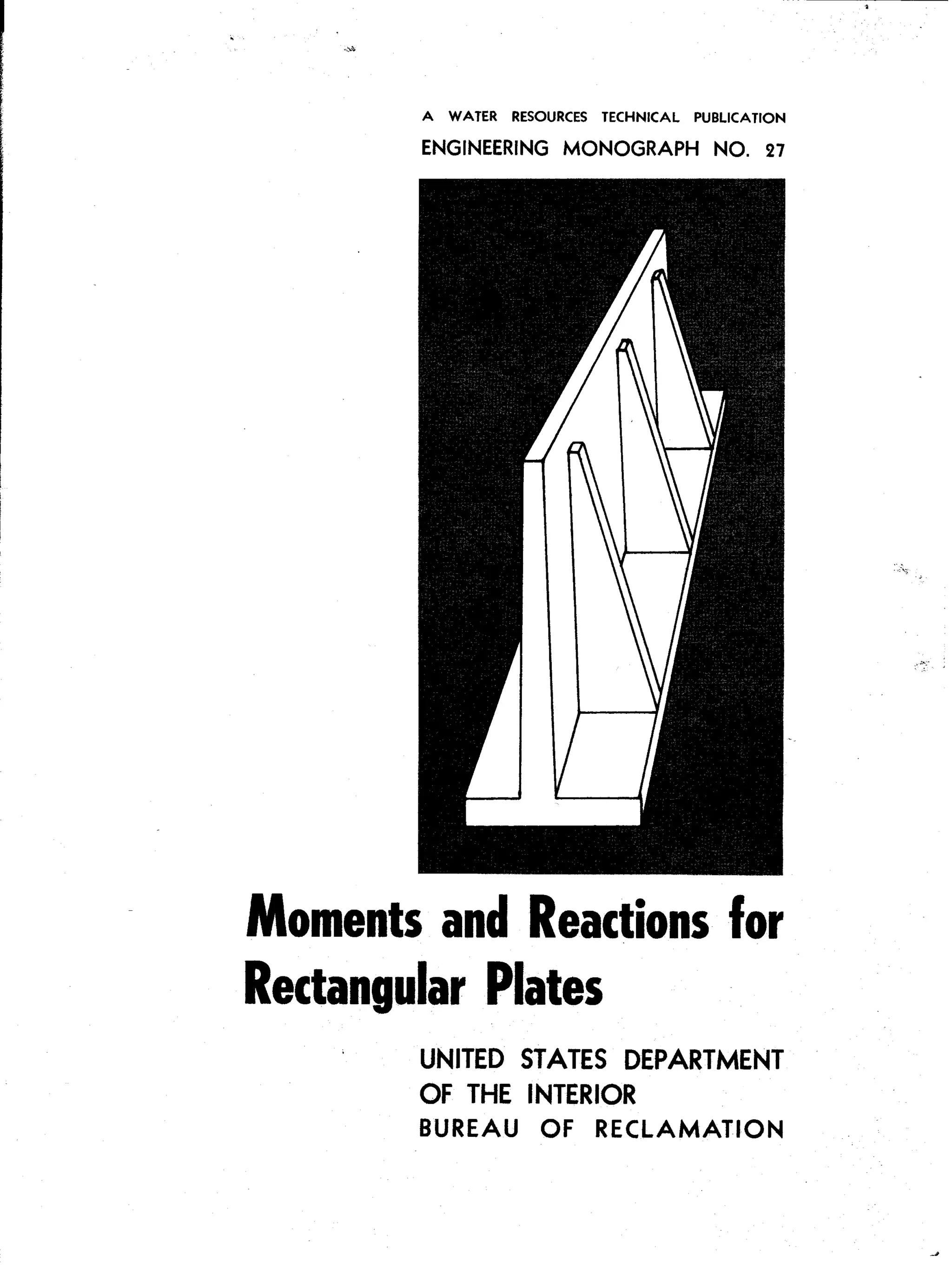
Moments and Reactionsfor
Rectangular Plates
UNITED STATES DEPARTMENT
OF THE INTERIOR
BUREAU OF RECLAMATION
A WATER RESOURCES TECHNICAL PUBLICATION
Engineering Monograph NO. P7
Moments and Reactionsfor
RectangularPlates
By W. T. MOODY
Division of Design
Denver, Colorado
United States Department of the Interior
BUREAU OF RECLAMATION
As the Nation’s principal conservation agency, the Department of the
Interior has responsibility for most of our nationally owned public
lands and natural resources. This includes fostering the wisest use of
our land and water resources, protecting our fish and wildlife, preserv-
ing the environmental and cultural values of our national parks and
historical places, and providing for the enjoyment of life through out-
door recreation. The Department assesses our energy and mineral
resources and works to assure that their development is in the best
interests of all our people. The Department also has a major respon-
sibility for American Indian reservation communities and for people
who live in Island Territories under U.S. Administration.
First Printing: October 1963
Revised: July 1963
Reprinted: April 1966
Reprinted: July 1970
Reprinted: June 1975
Reprinted: December 1976
Reprinted: January 1978
Reprinted: April 1980
Reprinted: March 1983
Reprinted: June 1986
Reprinted: August 1990
U.S. GOVERNMENT PRINTING OFFICE
WASHINGTON : 1978
Preface
THIS MONOGRAPH presents a series of tables con-
taining computed data for use in the design of
components of structures which can be idealized
as rectangular plates or slabs. Typical examples
are wall and footing panels of counterfort retaining
walls. The tables provide the designer with a
rapid and economical means of analyzing the
structures at representative points. The data
presented, as indicated in the accompanying
figure on the frontispiece, were computed for fivl:
sets of boundary conditions, nine ratios of lateral
dimensions, and eleven loadings typical of those
encountered in design.
As supplementary guides to the use and devel-
opment of the data compiled in this monograph,
two appendixes are included. The first appendix
presents an example of application of the data to
a typical structure. The second appendix explains
the basic mathematical considerations and develops
the application of the finite difference method to
the solution of plate problems. A series of
drawings in the appendixes presents basic relations
which will aid in application of the method to
other problems. Other drawings illustrate appli-
cation of the method to one of the specific cases
and lateral dimension ratios included in the
monograph.
Acknowledgments
The writer was assisted in the numerical The figures were prepared by H. E. Willmann.
computations by W. S. Young, J. R. Brizzolara, Solutions of the simultaneous equations were
and D. Misterek. H. J. Kahm assisted in the performed using an electronic calculator under the
computations and in checking the results obtained. direction of F. E. Swain.
CASE I
LOAD I
CASE 2 CASE 3 CASE 4
L-p-A
LOAD n
“NWORY LOAD OVER
e/3 THE “EIBHT
OF THE PLITE
LOAD H
BOUNDARY CONOITIONS
LOAD PII
LOAD IU
“NlFORY LOAD OVER
113 THE HEIOHT
OF THE PLATE
f-------0
L!klI-id- pd
LOAD Ip
“WlFORYLI “ARIINO LOAD
OVER THE FVLL HEIGHT
OF THE PLATE
LOAD Pm LOAD iI
“NlFORYL” “AWlNO LOAD UNIFORMYOYEW ALOW UNIFORMLINE LOAD
OVER l/6 THE “ElB”f IHE soce y - b FOR ILOWOWE FREEEOBE
OF T”E PLATE OASES I, L. AND 5 FOR OASES I AND 3
f-
P
7--
P-q
k-----a----+
LOAD H
“WIFORYLI “ARIIYB LOAD
p - 0 ALON0 x - a,*
LOADING CONDITIONS
NOTES
The variaus cases are analyzed for the indicated
ratios of o/b.
Coses I, e, and 3: I/B, 1f4, 3/s, I/Z, 3/a, I, ond 3/z.
Cose 4 : l/8, l/4, 3/0, I/2, 314, and I.
Case 5 : 310, I/S?, s/8, 3/4, 7/e, ond I.
All results are bored on a Poisson’s ratio of 0.2.
CASE 5
PLATE FIXED *Lowe
FOVR EOBES
f----Gi-d;pd
LOAD Y
“NlFORYLl “ARIINO LOAD
OVER e/3 TM ns,en*
OF THE PLATE
-H p L-
LOAD I
“WIFORYL” “m”I*e LOAD
D- o ALOWOy-b/e
INDEX OF BOUNDARY AND LOADING CONDITIONS
-FRONTISPIECE
Contents
Preface and Acknowledgments -----____-___________--__
Frontispiece __------________________________________---------
Introduction ________________________.______-_________________
Method of Analysis ______________________________-- ______
Results ________________________________________--------- ______
Effect of Poisson’s Ratio- ___________________________- ________
Accuracy of Method of Analysis---------------------
Appendix I ______________________________-_________________
An Application to a Design Problem-- - - ___________- ___________
Appendix II________________________________________________
The Finite Difference Method- ____________________________- _-
Introduction____________________________----------------
General Mathematical Relations- _____-__ ______________-_ _
Application to Plate Fixed Along Three Edges and Free Along
the Fourth__________________________________---------
List of ,Re erences------------------------------------_____f
LIST OF FIGURES
Number
1. Plate fixed along three edges,moment and reaction coefficients, Load
I, uniform load- ------------------ >---------_--------------
2. Plate fixed along three edges,moment and reaction coefficients, Load
II, 213 uniform load________________________________________
3. Plate fixed along three edges,moment and reaction coefficients, Load
III, l/3 uniform load--------- ______________________________
4. Plate fixed along three edges,moment and reaction coefficients, Load
IV, uniformly varying load__________________________________
Page
.. .
ill
iv
1
3
5
6
43
45
45
49
49
49
49
54
89
PW
7
8
9
10
V
vi
Number
CONTENTS
5. Plate fixed along three edges, moment and reaction coefficients, Load
V, 213 uniformly varyingload _---__--_______ ------- ________
6. Plate fixed along three edges, moment and reaction coefficients, Load
VI, l/3 uniformly varying load -------- ____________________
7. Plate fixed along three edges, moment and reaction coefficients, Load
VII, l/6 uniformly varyingload--_-----..------ ______________
8. Plate fixed along three edges, moment and reaction coefficients, Load
VIII, moment at free edge------- _____ ---------- ____________
9. Plate fixed along three edges, moment and reaction coefficients, Load
IX, lineload at free edge---------------------- _____________
10. Plate fixed along three edges-Hinged along one edge, moment and
reaction coefficients, Load I, uniform load---- - - - _- ____________
11. Plate fixed along three edges-Hinged along one edge, moment and
reaction coefficients, Load II, 213 uniform load_ - ______________
12. Plate fixed along three edges-Hinged along one edge, moment and
reaction coefficients, Load III, l/3 uniform load- - - - __ ________
13. Plate fixed along three edges-Hinged along one edge, moment and
reaction coefficients, Load IV, uniformly varying load - _________
14. Plate fixed along three edges-Hinged along one edge, moment and
reaction coefficients, Load V, 213 uniformly varying load--_ _____
15. Plate fixed along three edges-Hinged along one edge, moment and
reaction coefficients, Load VI, l/3 uniformly varying load_- _____
16. Plate fixed along three edges-Hinged along one edge, moment and
reaction coefficients, Load VII, l/6 uniformly varying load- _____
17. Plate fixed along three edges-Hinged along one edge, moment and
reaction coefficients, Load VIII, moment at hinged edge- - - - - - __
18. Plate fixed along one edge-Hinged along two opposite edges, mo-
ment and reaction coefficients, Load I, uniform load--- ________
19. Plate fixed along one edge-Hinged along two opposite edges, mo-
ment and react,ion coefficients, Load II, 213 uniform load __ _____
20. Plate fixed along one edge-Hinged along two opposite edges, mo-
ment and reaction coefficients, Load III, l/3 uniform load- _- __
21. Plate fixed along one edge-Hinged along two opposite edges, mo-
ment and reaction coefficients, Load IV, uniformly varying load.
22. Plate fixed along one edge-Hinged along two opposite edges, mo-
ment and reaction coefficients, Load V, 213 uniformly varying
load----_______-----____________________------------------
23. Plate fixed along one edge-Hinged along two opposite edges, mo-
ment and reaction coefficients, Load VI, l/3 uniformly varying
load_-__-------_________________________------------------
24. Plate fixed along one edge-Hinged along two opposite edges, mo-
ment and reaction coefficients, Load VII, l/6 uniformly varying
load- ---__-_-_-----__------~~~~~~~~--~~------------------
25. Plate fixed along one edge-Hinged along two opposite edges, mo-
ment and reaction coefficients, Load VIII, moment at free edge- -
26. Plate fixed along one edge-Hinged along two opposite edges,
moment and reaction coefficients, Load IX, line load at free edge-
27. Plate fixed along two adjacent edges, moment and reaction coefll-
cients, Load I, uniform load--- __________- ------------------
me
11
12
13
14
15
16
17
18
19
20
21
22
23
24
25
26
27
28
29
30
31
32
33
CONTENTS
Number
28. Plate fixed along two adjacent edges, moment and reaction coef-
ficients, Load II, 213 uniform load------------- ______________
29. Plate fixed along two adjacent edges, moment and reaction coef-
ficients, Load III, l/3 uniform load- _- - - - - - - _________________
30. Plate fixed along two adjacent edges, moment and reaction coef-
ficients, Load IV, uniformly varying load- - _- - _- - - - __________ _
31. Plate fixed along two adjacent edges, moment and reaction coef-
ficients, Load V, 2/3 uniformly varying load- _- - - - - - - __________
32. Plate fixed along two adjacent edges, moment and reaction coef-
ficients, Load VI, l/3 uniformly varying load- _- - - - ____________
33. Plate fixed along two adjacent edges, moment and reaction coef-
ficients, Load VII, l/6 uniformly varying load-- _______________
34. Plate fixed along four edges, moment and reaction coefficients, Load
I,uniformload____-----------_____________________--------
35. Plate fixed along four edges, moment and reaction coefficients, Load
X, uniformly varying load, p=O along y=b/2------- __________
36. Plate fixed along four edges, moment and reaction coefficients, Load
XI, uniformly varying load, p=O along x=a/2---------------..
37. Counterfort wall, design example---~---------------~-~~~~~-~..~
38. Grid point designation system and notation- _- - - _- _- - __________
39. Load-deflection relations, Sheet I _______________ --__--_--------
40. Load-deflection relations, Sheet II-----------------------------
41. Load-deflection relations, Sheet III----------------------------
42. Load-deflection relations, Sheet IV __________ -___--_-------_----
43. Load-deflection relations, vertical spacing: 3 at h; 1 at h/2, Sheet V-
44. Load-deflection relations, vertical spacing: 2 at h; 2 at h/2, Sheet VI-
45. Load-deflection relations, vertical spacing: 2 at h; 1 at h/2; 1 at h/4,
SheetVII___-_-----______________________-----------------
46. Load-deflection relations, vertical spacing: 1 at h; 3 at h/2, Sheet
VIII--__-----_-_-----------------------------------------
47. Load-deflection relations, vertical spacing: 1 at h; 1 at h/2; 2 at h/4,
SheetIX___-_________-_-______________________-----------
48. Load-deflection relations, vertical spacing: 1 each at h, h/2, h/4,
and h/8, Sheet X------------- _____________________________
49. Load-deflection relations, vertical spacing: 4 at h/2, Sheet Xl _____
50. Load-deflection relations, vertical spacing: 1 at h/2; 3 at h/4, Sheet
XII------------------------- -------------------------- ---
51. Load-deflection relations, vertical spacing: 1 at h/2 ; 1 at h/4; 2 at
h/8, Sheet XIII--------------- _______-_____________________
52. Load-deflection relations, vertical spacing: 4 at h/4, Sheet XIV--- -
53. Load-deflection relations, vertical spacing: 1 at h/4; 3 at h/8, Sheet
xv ____ -------------------- ------------------------------
54. Load-deflection relations, vertical spacing: 4 at h/8, Sheet XVI----
55. Load-deflection relations, horizontal spacing: 4 at rh/2, Sheet XVII-
56. Load-deflection relations, horizontal spacing: 3 at rh/2; 1 at rh,
SheetXVIII_-------_-------------------------------------
57. Load-deflection relations, horizontal spacing: 2 at rh/2; 2 at rh,
SheetXIX _______________________ --- _________ -_-_-_- ______
58. Load-deflection relations, horizontal spacing: 1 at rh/2 ; 3 at rh,
Sheet xX-__-_------_--_--________________________________
page
vii
34
35
36
37
38
39
40
41
42
46
50
56
57
58
59
60
61
62
63
64
6.5
66
67
68
69
70
71
72
73
74
75
Viii CONTENTS
Number
59. Load-deflection relations, horizontal spacing: 4 at rh, Sheet XXI- _
60. Moment-deflectionrelations--- ______________--_--___-- ________
61. Moment-deflection relations, various point spacings- _____________
62. Shear-deflection relations, Sheet I--- __- - - - __- - - ________________
63. Shear-deflection relations, Sheet II-------------- ____- __________
64. Shear-deflection relations, Sheet III- ___________________________
65. Load-deflection coefficients, r=1/4, p=O.2------- ____ -- _________
66. Plate fixed along three edges-30 equations for determining unknown
deflections. a/b=114 _______________--______ --- ____--- _____
67. Plate fixed along three edges, deflection coefficients. a/b=114
Variousloadings________--_---____________---___----_______
68. Plate fixed along three edges-20 equations for determining unknown
deflections. a/b=114 _______________________---___---- _____
69. Numerical values of typical moment and reaction arrays, r=1/4,
p=o.2 __-____-___-------______________________------------
70. Plate fixed along three edges, deflections-reactions-bending
moments,Load I. a/b=1/4, p=O.2----------- ____ ----- _______
PW
76
77
78
79
80
81
82
83
84
85
86
87
LIST OF TABLES
NUmb6T Pap
1. Effect of Poisson’s Ratio (p) on Coefficients of Maximum Bending
Moment at the Center of a Uniformly Loaded Rectangular Plate
Fixed along Four Edges_______--_-___-___----_------ _____--- 6
2. Comparison of Coefficients of Maximum Bending Moment at the
Center of a Uniformly Loaded Rectangular Plate Fixed along
FourEdges____________--________-____________________-____ 43
3. M, for Heel Slab at Supports------- ________--- _____-_---- ______ 47
4. M, for Heel Slab at Supports- ____-- ______--__- _________-- ______ 47
5. M,forWallSlabatSupports ____-- _-____________________- _____ 48
6. M, for Wall Slab at Supports- _________________________________ 48
Introduction
CERTAIN COMPONENTSof many structures may be
logically idealized as laterally loaded, rectangular
plates or slabs having various conditions of edge
support. This monograph presents tables of
coefficients which can be used to determine
moments and reactions in such structures for
various loading conditions ,and for several ratios
of lateral dimensions.
The finite difference method was used in the
analysis of the structures and in the development
of the tables. This method, described in Appendix
II of this monograph, makes possible the analysis
of rectangular plates for any of the usual types
of edge conditions, and in addition it can readily
take into account virtually all types of loading.
An inherent disadvantage of the method lies in
the great amount of work required in solution of
the large number of simultaneous equations to
which it gives rise. However, such equations can
be readily systematized and solved by an electronic
calculator, thus largely offsetting this disadvan-
tage.
Method of Analysis
THE FINITE difference method is based on t,he
usual approximate theory for the bending of thin
plates subjected to lateral loads.‘* The custom-
ary assumptions are made, therefore, with regard
to homogeneity, isotropy, conformance with
Hooke’s law, and relative magnitudes of de-
flections, thickness, and lateral dimensions. (See
Appendix II.)
Solution by finite differences provides a means
of determining a set of deflections for discrete
points of a plate subjected to given loading and
edge conditions. The deflections are determined
in such a manner that the deflection of any point,
together with those of certain nearby points,
satisfy finite difference relations which correspond
to the differential expressions of the usual plate
theory. These expressions relate coordinates and
deflections to load and edge conditions.
*Numbers in superscript refer to publications in List of References on
page 89.
In this study, for each load and ratio of lateral
dimensions, deflections were determined at 30 or
more grid points by solution of an equal number of
simultaneous equations. A relatively closer spac-
ing of points was used in some instances near
fixed boundaries t’o attain the desired accuracy in
this region of high curvature. For the a/b ratios
l/4 and l/8, one and two additional sets, respec-
tively, of five deflections were determmed in the
vicinity of the x axis. Owing to the limitations on
computer capacity, these deflections were com-
puted by solutions of supplementary sets of 20
equations whose right-hand members were func-
tions of certain of the initially computed deflections
as well as of the loads. In each case, the solution
of the equations was made through the use of an
electronic calculator.
Computations of moments and reactions were
made using desk calculators and the appropriate
finite difference relations. The finite difference
relations used are discussed in Appendix II.
FIGURES1 through 36 present the results of these
studies as tables of dimensionless coefficients for
the rectangular components of bending moment
and for reactions at the supports. The studies
were carried out for the following edge, or boun-
dary, conditions :
Case 1: Plate fixed along three edges and
free along the fourth edge.
Case 2: Plate fixed along three edges and
hinged along the fourth edge.
Case 3: Plate fixed along one edge, free
along the opposite edge, and hinged along
the other two edges.
Case 4: Plate fixed along two adjacent
edges and free along the other two edges.
Case 5: Plate fixed along four edges.
The loads, selected because they are represent-
ative of conditions frequently’ ‘encountered in
structures, are:
Load I: Uniform load over the full height
of the plate.
Load II: Uniform load over 2/3 the height
of the plate.
Load III: Uniform load over l/3 the height
of the plate.
Load IV: Uniformly varying load over the
full height of the plate.
Load V: Uniformly varying load over 213
the height of the plate.
Load VI: Uniformly varying load over l/3
the height of the plate.
Load VII : Uniformly varying load over l/6
the height of the plate.
Load VIII: Uniform moment along the
edge y=b of the plate for Cases 1, 2, and 3.
Load IX: Uniform line load along the free
edge of the plate for Cases 1 and 3.
Load X: Uniformly varying load, p=O
along y=b/2.
Load XI : Uniformly varying load, p = 0
along x=a/2.
Plates with the following ratios of lateral
dimensions, a, to height b, were studied for
the first four cases: l/8, l/4, 318, l/2, 314, 1, 312.
The analysis was carried out for these cases
using Loads I through IX and all dimension
ratios, except that Load IX was omitted from
Case 2 for obvious reasons, and Loads VIII and
IX and the ratio a/b=312 were omitted from
Case 4. It will be noted that for the first three
cases,which have symmetry about a vertical axis,
the dimension a denotes one-half of the plate
width, and for the fourth, unsymmetrical case, a
denotes the full width. For Case 5, lateral
5
6 MOMENTS AND REACTIONS FOR RECTANGULAR PLATES
dimension ratios of 318, l/2, 518, 3/4, 718 and 1 can be determined easily, since the deflections
were studied, subjected to Loads I, X, and XI. computed from finite difference theory are in-
For this case, a and b denote the full lateral dependent of Poisson’s ratio. Futhermore, the
dimensions. All numerical results are based on bending moments at, and normal to, the fixed
a value of Poisson’s ratio of 0.2. edges are unaffected by this factor. It is reason-
The arrangement of the tables is such t,hat able then to conclude that insofar as the moments
each coefficient, both for reaction and moment, which are most important in design are concerned,
appears in the tables at a point which corresponds the maximum effect for this case will occur at
geometrically to its location in the plate as shown the center of the slab.
in each accompanying sketch. Table 1 shows a comparison of maximum bend-
ing moment coeflicients at the center of a uniformly
Effect of Poisson’s Ratio
loaded plate for several values of p and for each
ratio of a/b for which Case 5 was computed.
A question which frequently arises is: What For a change in Poisson’s ratio from 0.2 to 0.3
effect does Poisson’s ratio have on the bending it is noted that the maximum effect on the bending
moments in a plate? For the plate fixed along moment coefficient occurs at a/b= 1, where the
four sides, a clear understanding of this effect change in the coefficient is less than 8 percent.
TABLE l.-Effect of Poisson’s Ratio (p) on Coeficienk of Maximum Bending Moment at the Center of a Uniformly
Loaded Rectangular Plate Fixed Along Four Edges
Values of M./pa*
-%“;I 0
0. 375
0. 5
0.625
0. 75
0. 875
1. 0
- 0.0423
- 0.0403
-0.0358
-0.0298
-0. 0235
-0.0177
0.1
-0.0424 -0. 0424 -0.0425
- 0.0407 -0.0411 -0.0415
-0.0367 -0.0376 -0. 0384
-0.0311 -0. 0324 -0.0337
-0.0251 -0.0267 -0. 0283
-0. 0195 -0.0213 -0. 0230
0.2 0.3
__.--.-...-.-._-_ -..
RESULTS
Moment-: (Coefflctent) (pb’)
Reaction : (Coefftclent) (pb)
POSITIVE SIGN CONVENTION
FIGURE l.-Plate .tixed along three edges, moment and reaction coeficients, Load I, uniform load.
X
8 MOMENTS AND REACTIONS FOR RECTANGULAR PLATES
IO IO lo IO IO I
32 i-.0039 1 0 n I n.
.“a-<
31-.029sl 0 I 0 I 0 I 0 I 0 I 0
Moment = (Goefficient)(pfl)
Reaction = (Goefficient)( pb)
POSITIVE SIGN CONVENTION
FIGURE 2.-P&e $xed along three edges, moment and reaction coeflcients, Load ZZ, 913 uniform load.
RESULTS
Y
FIGURE 3.-Plate $xed along three
Moment = (Coefficieni) (pb’)
Reaction = (Coefficient) (pb)
MI v
P
--
@
Rx
RV
’ 0 My
tX
W I
POSITIVE SIQN CONVENTION
edges, moment and reaction coeflcients, Load III, l/S uniform load.
I “._.-..-.- ~..
10 MOMENTS AND REACTIONS FOR RECTANGULAR PLATES
t
I I , ..“T”..
I I 0 I+ IlId7 I+ on99
I I 1.0 I+ 3177 lt.oe57r;
Moment = (Goefficient)(pb*)
I?eOCflOn= (Coefficient)(pb)
MI I/’-+--.I
%iiJ
4RV0 ,
’ Mv
+X
WV I
POSITIVE SIGN CONVENTION
FIGURE k--Plate fixed along three edges, moment and reaction coeficients, Load IV, uniformly varying loud.
_.-.-.--.--.- .______-
RESULTS
I I I 0 I- 0155 I+ 0025 I
t
. .
mbI+ 001,, I+ 1712 I+ 2595
I # ---- I --- It .3224 +. 3329 t.3356
I
Y ”
Moment : (Coefficlent)( pb2.)
Reaction = (Coefflcient)( pb)
1
MI IJP-+-
’ Rx
w
b
0
X
” M,
W
POSITIVE SIGN CONVENTION
FIGURE B.-Plate Jixed along three edges, moment and reaction coeficients, Load V, .9/S uniformly varying load.
Moment = (Coefficient)ipb’)
Reaction = (Goefficient)( pb )
W.
I
POSITIVE SIGN CONVENTION
FIQURE B.-Plate fixed along three edges, moment and reaction coeficients, Load VI, l/S uniformly varying load.
-.-..--.__-. .._
RESULTS
*--0_-_i_,---O---~---Gee, t
ill.ii -i-,0
Moment f (Coefficient)(pb*)
Aeoction = (Coefficient)( pb)
+X
W
I
POSITIVE SISN CONVENTION
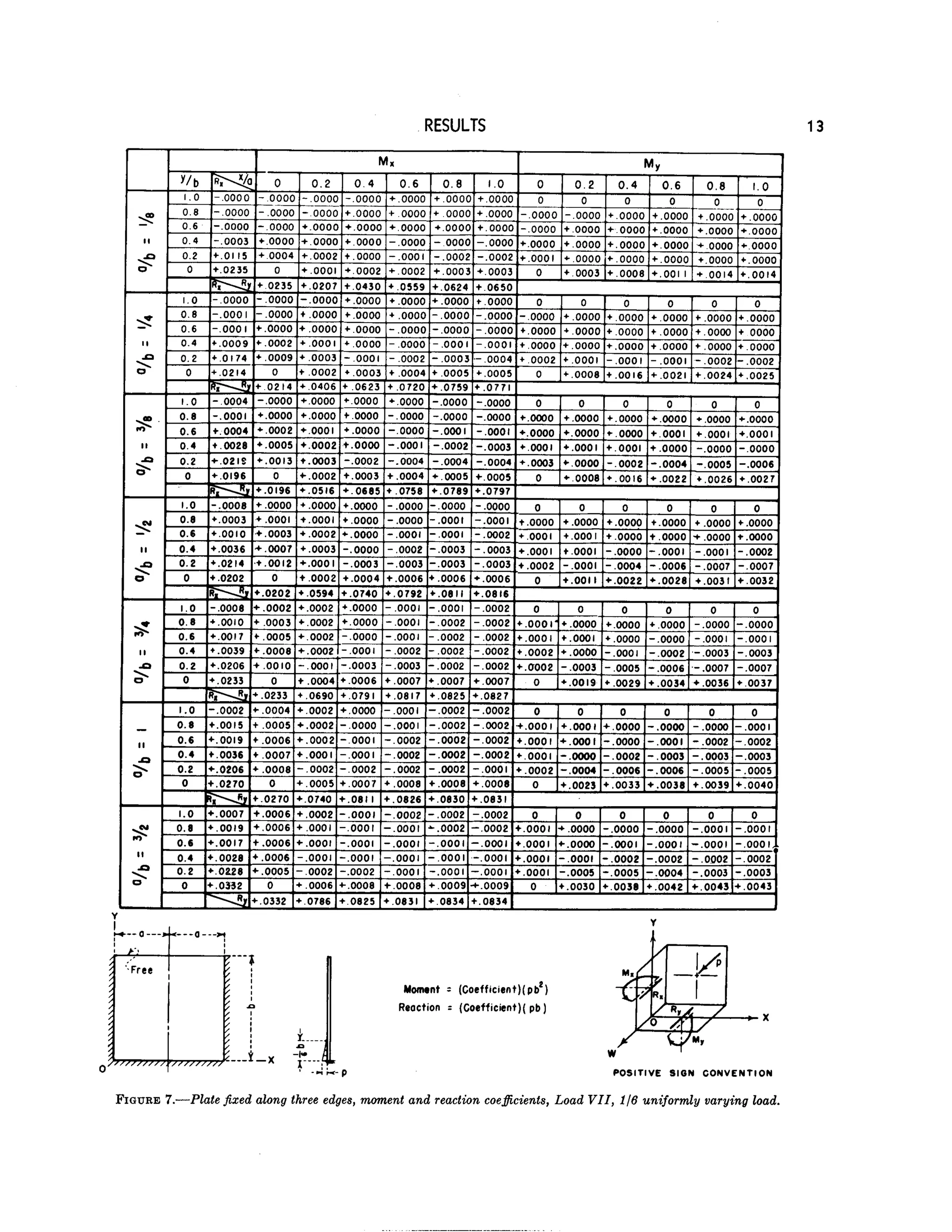
FIGURE 7.-Plate jixed along three edges, moment and reaction coejkients, Load VII, l/6 uniformly varying load.
FIGURE 8.-Plate jked along three edges, moment and reaction coejkients, Load VIII, moment at free edge.
f-P
1
Moment : (Coefficient)( M)
Reaction : (Coefficient)($)
Al--l .
M. JI p--
. I
X
FOSITIVE SIQN CCNVENTION
RESULTS
0.2
-~~~ $0036~ +:0056/+.007g/
I-.OiSO I-.0004~*.0004~+.0006~+.0004[+.0001 I-.OOOOI-.o001 1+.0003 +:0010 +.001, +.0022 t.0024
+ 0185 t 0226
~,-.012’,+~~O036~~1-- -’
i.0261 +.0264 +.wg,
+.0064 l .0107 t.0147 +01j4 + 0164
.“..,T
-39111 n I n I n I n I n I n
Moment = (GoeffIcient)
Reaction = (Goefflcient)(F)
;I+.0746 +.0666I+.O655 +.0644]
15
W
I
POSITIVE SIGN CONVENTION
moment and reaction coeflcients, Load IX, line load at free edge.
16
a
MOMENTS AND REACTIONS FOR RECTANGULAR PLATES
.__-~-++---+IF.,I _---hinged T
IIriIll
a
i---- - -X
Moment = (Coefficient)(pb*)
Reoctiin = (Coefficicnt)( pb)
POSITIVE SION CONVENTION
Fxa UaE lO.-Plate jixed along three edges-Hinged along one edge, moment and reaction coeficiente, Load I, uniform load.
RESULTS 17
4,
0.8 I.o 0 1 0.2 [ 0.4 1 0.6 [ 0.6 [ 1.0
+.0017 +.0020
0 0 0 IO lo IO I” In
Moment = (Coefficient)(pb’)
Reaction = (Coefficient)( pb )
LE Il.-Plate jized along three edges-Hinged along one edge, moment and reaction coejicients, Load ZZ, d/S unifol vn load.
MOMENTS AND REACTIONS FOR RECTANGULAR PLATES
X
POSITIVE SIQN CONVENTION
FIQURE l2.-Plate fixed along three edges-Hinged along one edge, moment and reaction coefficients, Load III, l/S unifor .rn load.
Moment = (Coefficient)(pb’)
Aeoction = (Coefficient)( pb)
RESULTS
0
Moment = (Coefficirnt)(pb*)
Reaction = (Coefficicnt)( pb )
X
POSITIVE SIGN CONVENTION
FIGURE 13.-Plate fixed along three edges-Hinged along one edge, moment and reaction coeficients, Load IV, uniformly varying
load.
-.--_._-_-.._-.----..--.
MOMENTS AND REACTIONS FOR RECTANGULAR PLATES
Moment = (Coefficient)(pff)
Reaction = (Coefficient)( pb )
+-X
POSITIVE SIQN CONVENTION
FIGURE 14.-Plate fxed along three edges-Hinged along one edge, moment and reaction coefkients, Load V, d/3 uniformly
varying load.
.._...-..-.---..--.--
0
Moment = (Coefficient)(pb*)
Reaction = (Coefficient)( pb)
POSITIVE SIGN CONVENTION
FIGURE 15.-Plate fixed along three edges-Hinged along one edge, moment and reaction coejkients, Load VI, l/3 uniformly
varying load.
MOMENTS AND REACTIONS FOR RECTANGULAR PLATES
Moment = (Goefficient)(pb?
Reaction = (Coefficient)( pb)
POSITIVE SIGN CONVENTION
FIGURE 16.-Plate jixed along three edges--Hinged along one edge, moment and reaction coejicients, Load VII, l/6 uniformly
varying load.
RESULTS 23
0
Moment = (Coefficient)( M )
Reaction = (Coefficient)($),
POSITIVE SIGN CONVENTION
FIGURE 17.-Plate $xed along three edges-Hinged along one edge, moment and reaction coeficiente, Load VIII, moment
hinged edge.
at
MOMENTS AND REACTIONS FOR RECTANGULAR PLATES
Y
~+--*--+*
._-
--_
0
-f
I
I
0
L-x
FIQURE 18.-Plate fixed along one edge-Hinged along two
Moment = (Coefficlent) (pb’)
Reaction = (Coefficient) (pb )
POSITIVE SIGN CONVENTION
opposite
load.
edges, and reaction coefkients, Load I, uniform
25
FIG
gt-.00371-.00531-.00631-.0067i
r1-.02’351 0 ~-.0140~-.0220~-.026lt-.0277kO262i
Moment = (Coefficient) (pb’)
Reoctlon = (GoeffIcIent) (pb)
f&l
M. I/-+-
’ R.^ .
POSITIVE SIGN CONVENTION
E lg.-Plate fixed along one edge-Hinged along two opposite edges, moment and reaction coeficients, Load II,
uniform load.
MOMENTS AND REACTIONS FOR RECTANGULAR PLATES
Moment : (Coefficient) (pb*)
Reaction = (Coefficient) (pb )
Y
MI v
P
--
@
’ h
fb
’ I My
W
tX
POSITIVE SION CONVENTION
FIQURE 20.-Plate jkced along one edge-Hinged along two opposite edges, moment and reaction coejkients, Load III,
uniform load.
l/S
RESULTS
0
Moment = (Coefflclent) (pb’)
Reoctaon = (Coeffxlent) (pb)
Ma IA-+-
d&iJ-
’R.Rv X
I
MY
W.
POSITIVE SIGN CONVENTION
FIGURE 21.-Plate jixed along one edge-Hinged along two opposite edges, moment and reaction coeflcients, Load IV, unifol
varying load.
- .-._- __--
28 MOMENTS AND REACTIONS FOR RECTANGULAR PLATES
--_
f
Moment = (caefflclent)(pb’)
f?eactlon = (Coefflcient)( pb)
+X
W
I
POSITIVE SIGN CONVENTION
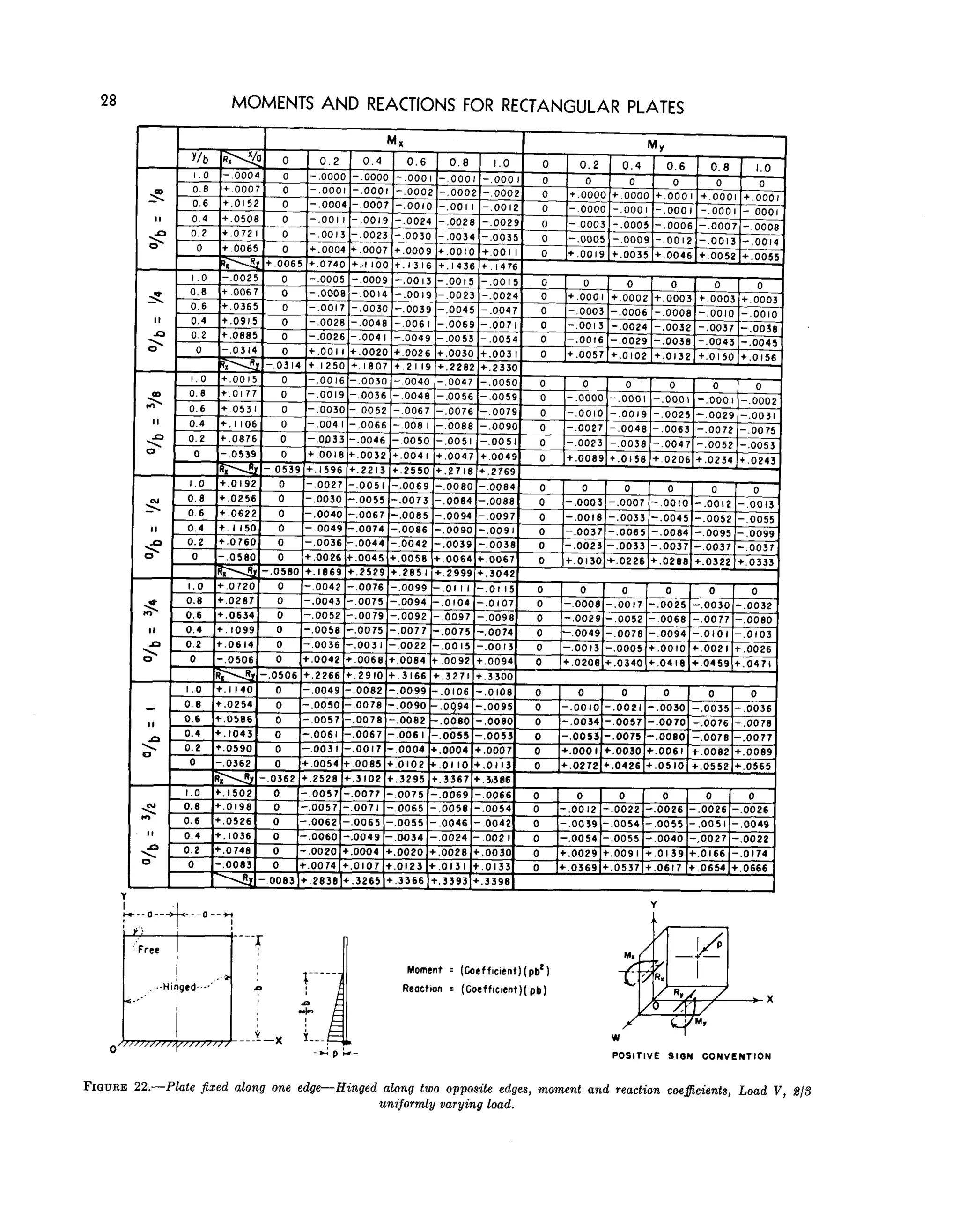
FIGURE 22.-Plate fixed along one edge-Hinged along two opposite edges, moment and reaction coeficients, Load V,
uniformly varying load.
29
FI:GuRE 23.-Plate fixed along
Moment = (Coefficlent)(pb*)
Reaction = (Coefficient)( pb)
along two opposite edges,
uniformly varying load.
moment and reaction coejicients, Load VI, 11s
POSITIVE SIQN CONVENTION
MOMENTS AND REACTIONS FOR RECTANGULAR PLATES
Moment = (Coofficiant)( pb’)
heOCtiOn = (Coefflcient)( pb)
i
W
POSITIVE SION CONVENTION
FIGURE 24.-Plate fized along one edge-Hinged along two opposite edges, moment and reaction coeficients, Load VII, l/6
uniformly varying load.
0
FIG
Moment - (Coefflcient)( M)
Reaction = (Coeffxwnt)(j-1
POSITIVE SIGN CONVENTION
URE 25.-Plate jixeu along one edge-Hinged along two opposite edges, mom&t and reaction coeficients, Load VIII, momen
at free edge.
tt
_.-.-.-__.-.- ._-__..
32
FIGURE 26.-Plate fixed along one
Moment = (Coefftcient)( Fb)
Reoctlon : (Coefficient)( F )
along two opposite edges,
load at free edge.
and reaction coqjicients, Load IX, 1ine
POSITIVE SIQN CONVENTION
RESULTS
~.0160~+.0061~+.0029~+.0002) 0
““151-.00241-.00301
~00061+~00l71+ 00321+.00471 0 0 1+.00291+ 0066~+.0159~+ 02361+,0304
.ol76 I+.0060 1t.0002 0 1 +.OlZl I+.0067 I+.0020 l-.0018
0 -
Rx-.0401 t.0011 +.I576 t.3024 +.5696 l .9739
I.0 +.6290+. 1977 +.0952 t.0296 -.0059 ~0162 0 0 0 0 0
0 6.
0 0__..
+.7827 ‘--- -- - --- ^ ^.__ _---
~_ I- .003Zl- .OllO 1
0.6 1 - .0023 - .0079
~+.0377~+.OlZOl+ OOOII- .0026 1 -0 ~~+.0165~+.006’~-.00051-.004z~-.UUb~(-.~0
1 -~3 LO.2 I+.0741 ~.0282~+.0144(+.0077~+ .00721+ .0061 1 0 1

0 d -.0696 0 +.0041 +.0125 + .0221 + .0326
-.0696 +.0333 +.2595 +.4574 +.7920 +I.1266
,
I 1 0 I- .oesrl 0 I+ .00721+.0207)+ .03451+.04941 0 0 ~1+.03621
LY;
I
---.- 0 .---.+.
I
Moment = (GoefficIent) (pb*)
Reaction : (Coefficient) (pb)
I
04~~~/~~~/~~~~J
--Y- x p4 W
;p& POSITIVE SIGN CONVENTION
FIGURE 27.-Plate fixed along two adjacent edges, moment and reaction coeficients, Load I, uniform load.
34 MOMENTS AND REACTIONS FOR RECTANGULAR PLATES
1 ! 0.6 j 0.6 1 I. 00.2 0.4 0.6 0.6 1.0 0 0.2 0.d
I 1
I.0 l-.0014 +.00021*.00021+.0002l+ 0001 1+.0001 I 0 0 I 0 I 0 I 0 I 0 I 0
1 -co 1 0.8 ~+.00751+.OOll ~+.0006~+.0006~+.0004~+ 00021 0 I+ 0002/+ 00021+.00021+ 0002/+.00031+.00031
~6~+.0035~+.0019~+.0008)+.0001 ( 0 ~+.00~~j+.00071+.00031+.00001- OOOII-.00021
+.I209 +.0067 +.0040 + 0021 +.0008 +.0001 0
l .0046 0 +.0001 +.ooos t.0009 +.0013 0
+.0046j-.Ob61 +.0505 +. 1061 l 2023 + 3114
-.0167 +.0028: +.0031 t.0026 + 0020 + 0011
y-.0822Ra - OOl2(+ 1050 +.2030 l .3661 + 5432
I.0 -.0462 +.0102 +.0106 +.0065 +.0055 +.0026 0 0 0 I. 0. ‘1 0 1 0 I 0
0. e t.0819 +.0213 +.0149 +.009
-0.6. t.2733
+ ~-~ -r -- - r --+-- -,----A - ( - c , I I 4
,Ib
0.4 +.3352 t.0384 +.0165 t.0063 - 0003 -.0022
[~~+:I&]+ .%$,@7
L .- 1 ! 0 !+.0077~~.00241- 0~~-.00~6~~.00~6~/~.0ll6 1
-.0003 - 0010 1 0
0 1+.0011 t.0031 +.0055 t.0079 0
-.0069~+.0125~+.1333 +.22851+.39631+.5629
+.0019 + 0053 +.00691+.0125 0
-.0250~+.0436[+.l939~+.3C7l 1+.46931+.6544
-I!+.0524 +.034l +.0153 +.0026 -.0022 0
I I
+.0542 +.0113 -.0042 -.00741-.0051 t-7
Moment : (Coefficient) (pb’)
Reoctlon = (Coefficient) (pb)
3-X
W I
POSITIVE Sl(iN CONVENTION
FIQURE 28.-Plate jbed along two adjacent edges, moment and reaction coeficients, Load II, $713uniform load.
RESULTS
I - I 0.2 ~+.1774~+.0131~+.0020~-.00171-.00241-.00171 0 I+.Ofi261-.OOl71-.00471-.00641
f ~Y~+.00481+.16151+.2512~+.2874~t.3312~+.3489~R. I
I.0 t .0052 t.0104 t .0059 +.0016 -.0006 -.OOl I 0 0 0 0 0 0 0
0. a t.0356 t.0116 l .0053 t.0011 -.0008 -.OOlO 0 +.0023 t .OOl2 + .0002 - .0007 - .0014 - .0020
-
0. 6 + .0430 t .Ol26 t.0041 - .0002 - .OOl6 - .0013 0 f.0025 t.0008 - .0012 -.0026 - .OOM - .0046
II
- 0.4 +.I052 +.0135 +.OOl3 -.0022 -.0025 -.0017 0 t .0027 - .002 I - .0053 - .0069 - .0075 - .0060
0. 2 + .I682 f.0094 -.0015 -.0023 -.0015 -.0005 0 t .0019 - .0045 - .0055 - .0043 - .0029 - .0020
0 It.oos + .0033 + .0057 +.0072 t .I3383 0 0
+ .2052 + .2808 t .3064 t .3372 t .3473
Moment = (Coefficient) (pb*)
Reaction = (Coefficient) (pb)
Y
POSITIVE SIQN CONVENTION
FIGURE 29.-Plate fixed along two adjacent edges, moment and reaction coeficients, Load III, l/S uniform load.
36 MOMENTS AND REACTIONS FOR RECTANGULAR PLATES
+.0075 +.0007 +.0006 +.0004 +.oooz +.0001 0 0
;.0252 +.0017 t.0011 +.0006 +.0003 +.OOOl 0 + .0003
I l .0056 -.0008 .o
I
0.4 ~+.2050j+.~246~+.0122 1~+.0045~+.0002 l-.0012 0 (+.0049~+.0017~.
m 0.2 [+.I413 ~+.0162~+.0056~+.0010 )-.0005 I-.0004) 0 I+.oo52/+
i? 0.60.8 +.2067+.2303 +.0467+.0459 +.0242+.0195 +.0046+,0064 -.0002-.0023 -.0027-.0036 0 +.0097 +.0040
-
00040 +.0092 +.oozo -.0044 -.0093 - 0129
I, 0.4 +.2363 t.0360 +.Ol2l +.OOlO -.0030 -.0029 0 +.0072 -.0003 -.0060 -.0096 -.Oll7
1 p 1 0.2 ~*.1193~+.01~0~+.0042~+.0005~+.0006(+.00l6 I 0 I,
I I ~~ I I
+,0032 +.oooa +.0019 +.0050 +.ooe3 +.01oLl
-.0194 0 +.0029 +.0070 +.0110 +.014a 0 0 +.0147 +.0352 l .0546 + 0740 t.0696
I R” nv-.0194~+.1105~+.2399(+.32: 561+.44891+.5505iI ----1
I.0 +.I917 +.0662 +.0291 +.0056 -.0059 -.0077 0 I 0 I ’ 0
- 0.6 )+.23641+.0518 I+.0173 l+.OOO4!-.00591-.0054 I
+.0046 t.0103 t.0152 l .0197 0 +.0232 +.0515 +.0759 +.0987 + 1157
c 0-A
Moment = (Coefficient) (pb*)
Reoctton = (Coefftcient) ( pb)
POSITIVE SIGN CONVENTION
FIGIURE 30.-Plate $xed along two adjacent edges, moment and reaction coeficients, Load IV, uniformly varying load.
RESULTS 37
I Mx MY
O.SlI.0 0 lo2looln~lnnlln0.2 0.4 0.6 -.- -. . -.v .,.- ..”
1.0 -.OOOJ +.oooo +.oooo +.oooo +.oooo +.oooo 0 0 0 0 0 0 0
2
0. e +.0001 +.0001 +.0001 +.0001 +.0001 +.oooo o -+.oooo +.oooo +.oooo +.0001 +.0001 +.0001
0.6 + 0144 +.OOi I +.0007 t.0004 +.OOOZ +.OOOI o +.oooe +.0002 +.0001 +.0001 +.0001 +.0001
-. ..-
II 0.4 +.os& +.0030 +.0019 ;.&so +.0004 +.0001 0 + 0006 +.0004 +.OOOi +.0001 - boo0 -.OOOI
.-
c, 0.2 +.0843 +.0044 +.0026 COO13 COO04 + 0000 0 + ones -7Mms -
I - I 0.6 I+ 00311+.00171+.00141+ 00111+.0007(+.0003) o 1+.ooo3~+.ooo3~+.ooo4~+.ooo57+.ooo6~
I I , 0 +.0022 + 0061 t.0103 t.0146 t.0181
I+.1661 1+.2646/+.35441
s
II
s
I.0 -.0169 +.0022 +.0027 +.0023 +.0016 +.0006 0 0 0 0 0 0 0
0.0 +.0147 l .0053 t.0040 +.0027 t.0015 +.0006 0 +.ooll +.0009 +.0009 +.oooe +.0009 +.0010
-- -~-.__-..- _.-..
0.6 . +.0565 l .0099 + 0059 +.0029 t 0010 -.OOOO 0 t.0020 +.0012 +.0005 -.OOOl -.0006 -.0009
0.4 +.1351 t.0148 +.0069 +.0020 -.0004 - 0011 0 +.0030 +.0008 -.OOlZ -.0029 -.0042 -iOil
0.2 r.1353 T.0117 t.0040 +.0003 -.OOll -.OOll 0 +.0023 +.OOOO -.0019 -.0033 -.0042 -.0049
0 +.Ol25 0 +.oooe +.0019 +.0031 +.0043 0 0 +.0038 +.0097 t.0156 +.0213 + 0257
WY +.0125 +.0460 +.I236 +.I740 +.25381+.3159I?.
I.0 -.0220 +.0052 +.0053 t.0039 +.0023 t.0010 0 0 0 0 0 0 0
0.8 +.0298 +.0095 + 0065 +.0036 +.0016 t.0005 0 COO19 t.0014 +.OOlO +.0006 +.0004 +.0003
~~- ~~~~~~__ ~~~ -~ -.~
0. 6 +.0753 +.0143 +.00!6 t.0030 t.0004 -.0005 0 +.0029 +.OOl4 -.OOOl -.0014 -.0025 -.0031
0.4 +.I506 +.0176 +.0068 +.OOlO -.0015 -.0017 0 +.0036 +.0002 -.0026 -.0052 -.0070 -.0062
0.2 +.1313 +.0119 +.0030 -.0005 -.0014 -.OOlO 0 +.0024 -.0005 -.0025 -.0036 -.0041 -.0044
0 t.0050 0 +.0013 +.060 +.0046 +.0060 0 0 +.0063 +.0146 t.0226 +.0301 +.0358
WY +.0050 +.0755 +.I616 +.2132 +.2673 +.3382R.
-
II
”
0
I.0 -.0036 +.0130 +.0092 +.0045 +.OOlZ -.0003 0 0 0 0 0 0 0
0.8 +.0540 +.0163 +.0090 +.0036 +.0005 -.0006 0 +.0033 +.0016 +.oobs -.0007 -.0016 -.0023
0.6 +.093 t.0191 + 0079 +.0016 -.OOlZ -.0016 0 +.0036 +.0009 -.0020 -.0043 -.0060 --.0072
0.4 +.I561 CO193 t.0048 -.OOll -.0027 -.0022 0 +.0039 -.0014 -.0055 -.OOSl -.0097 -.01oa
0.2 +.I218 r~.ollo l .ooll -.OOlZ -.OOlb -.oooz -. b t.0022 -.0013 -.G23 -.OO:; -.0006 +.0002
0 -.oooo 0 +.0024 +.0649 +‘.0070 +:OOEB 0 0 +.01&i +.0246 +.0348 +.0438 +.0507
-.OOOO +.I274 +.2163 +.2612 t.3210 r.3569
1.0 +.0261 +.Ol96 +.OlO3 +.0027
0.8 +.0667 t.0207 +.0069 +0017
0.6 +.0943 +.0209 +.0064 1:0004
0.4 +.15;2 +.OI88 +:0026 -.0024
0.2 +.I166 +.0096 +.OOOO -.OOlZ -.0003 +.0008 0 +.ool9 -.0016 -.0008 +.0016 l .004l +.0059
-
0 t.0016 0 +.0035 +.0066 +.ooee +.0107 0 0 +.o174 To329 +.0440 +.0534 l .0603
VY +.OOlS t.1676 r.2512 +.2879 +.3346 +.3567
Y
b .__._ 0 _____ y
Moment = (Goefficient)(pb*)
Reaction = (Coefficient) (pb)
W. I
POSITIVE S ION CONVENTION
edges, moment and reaction coefkients, Load V, S/S unijormly varying load.FIQ URE 31.-Plate fixed along two adjacent
38
ho ,URE 32.-Pkztejixed along
MOMENTS AND REACTIONS FOR RECTANGULAR PLATES
0.6 l .oolo +.0007 *.0006 +.0005 +.0003 +.0001 0 +.0001 +.00011+.00021+.00021+.0002lt,0003
0.6 +.0039 +.0015 +.OOll +.0006 t.0003 t.0001 0 l ,000
I ,, 1 0.4 ~+.0207(+.0032~+.0016~+.0006~-.00001-.0002[ 0
ia 0.2 +.0756 +.0051 +.0013 -.0004 -.0006 -.0007 o +.OOlO -.0002 -.0013 -.0021 -.0026 -.0030
+.0221 0
0.6
0.4 +.0244 +.0036 +.0016 t.0003 -.0003 -.0004 0
0.2 +.0747 +.0049 +.0006 -.0006 -.OOlO -.0007 0
0 I+.0201 1 0 ~+.0007~+.0015)*.0020~+.0025~ 0 I 0 ~+.0037~+.0074~+.01021*.
0.6 ~+.0066~+.0024~+.0014(+.0006~+.0001 l-.0001 1 0 ~+.0005~*.0003~+.00021+:00001-.00011-
0.4 .~+.0256~+.0041~*.0010(-.0003~‘.0006/-.0005[ 0 l+.OOOfi
0 1t.02151 0 )+.0012(+.0021~+.0027~*.0030~ fl 0 l+.O(
0.6 I+.0091 I+.0031 ~+.0014~+.0003~-.00021-.00031 d ~+.0006~+.0003~+.0001 I-.(
I I 1 I I I 1
+.0111 +.0034~+.0011~-.00001-.0004)-.00031 0 1+.00071+.00031-.00031-.00071-.OOlOi-.OOl2 I
J
+.0246 +.0039 +.0004 -.0006 -.0007 -.0004 0 *.0006 -.0004 - 0013 -.0017 -.0019 -.002l
0.2 1+ 0723 +.0034 -.0006 -.OOlO -.0006 -.0003 0 +.0007 -.0019 -.0025 -.0023 -.oOl9 -.0017
Moment : (Coefficient) (pd)
Reaction = (Coefficient) (pb)
edges, moment and reaction coeficients, Load VI, i/3 uniformly varying locr
Y
A
M. IA-+-
@
’ R,
5
0
’ MY
W.
-3-X
POSITIVE SIGN CONVENTION
rd.
I 1 y/b h%‘I 0 IO.2 IO.4 IO.6 IO.8 1 1.0 1 0 IO.2 IO.4 I 0.6 IO.8 1 I.0 I.
1.0 -.oooo +.oooo +.oooo t.oooo + 0000 t.oooo 0 0 0 0 0 0 0
9
0. 8 -.oooo +.oooo t.OOOO +.oooo +.oooo t.oooo 0 +.oooo +..oooo +.oooo +.oooo +.oooo +.oooo
0. 6 -.OOOl +.oooo +.oooo +.oooo +.oooo +.oooo 0 +.oooo +.oooo +.oooo +.oooo +.oooo t.0000
0. 4 -.OOOI +.oooi +.OOOI +.oooo +.oooo +.oooa 0 +.oooo +.oooo +.oooo +.oooo +.oooo +,oooo
0. 2 t.0137 l .0006 +.0004 +.oooz +.0001 t.oooo 0 +.ooot +.0001 +.0001 +.oooo +.oooo +.oooo
0 t.0050 0 +.0001 +.oooz +.0003 t.0004 0 0 t.0004 t.0010 +.0016 +.ooee +.0027
I ~Y~+,0050~t.0I69~+.0463~t.0669~+.09611(c.11651
I. 0 -.0007 +.oooo +.ooot +.ooot +.0001 +.oooo 0 0 0 0 0 0 0
0.6 +.0001 +.0001 +.0001 +.0001 +.0001 +.oooo 0 +.oooo +.oooo +.oooo +,oooo +.oooo +.0001
0.6 t.0004 '.0003 +.0002 +.0001 +.0001 t.oooo 0 +.0001 +.oooi t.0001 +.a001 +.OOOI t.0001
1+.0212l+.00~i~+.00031-.0001 I- 00021-.00011 0 1+.0003)+.00001-.OOOZ/-.00041-.00051-.00061
Ill-.00021-.0002l-.000I1 0 1+.00021-.00011-.00041-.00051-.0006l-.0007l
nl- 0001~-.ooo3~-.0002~-.oaa1 I 0 )+.00021-.00031-.00051-,00061-.0006(-.0006l
I I+ nnnsl+ m-ml+ nnnll- ooool-.ooool 0 It.ooOl lt.OOOll+.OO~OOl-.OOOOl-.OOaol-.oooll
017 1+.ooo21-.00041-.00061-.00051-.00051-.0005l
Moment q (Goefficlenf)(pb?
Jeoction : (Coefftclent) (pb)
Y
M, IA-+-
45J-
’ R”
RY0 I X
MY
W
POSITIVE SIGN CONVENTION
FIGURE 33.-Plate fixed along two adjacent edges, moment and reaction coeficients, Load VII, l/6 unijownly varying load.
MOMENTS AND REACTIONS FOR RECTANGULAR PLATES
ieo-rl POSITIVE SIQN CONVENTION
FIGURE 34.-Plate $zed along four edgeqmcnnent and reaction coeflcients, Load I, uniform load.
Moment = (Coefficient)(po*)
Reaction = (Coefficient)(po)
FIG m 35.-Plate fixed along four edges, moment
Moment = (Coefficient)(po*)
Reoctmn = (Coefficaent)( po)
and reaction coeficients,
y= b/2.
Load
X
POSITIVE SISN CONVENTION
uniformly varying load, p=O al0 lng
_--_---._-_-
42 MOMENTS AND REACTIONS FOR RECTANGULAR PLATES
Moment = (Coefflcient)( pa*)
Reaction = (Coefficient)(po)
POSITIVE SIGN CONVENTION
FIGURE 36.-Plate fixed along four edges, moment and reaction coeficients, Load XI, uniformly varying load, p=O alox
x= al.%
Accuracy of
Method of Analysis
THE FINITE difference method is inherently
approximate. A factor directly affecting its
accuracy is the closeness of spacing, hence the
number, of grid points. In obtaining the solutions
presented in this monograph, a maximum number
of points was used, consistent with the objectives
of the study and the capacity of the available
electronic calculator.
A few instances may be found where there
appear to be irregularities in the orderly progres-
sion of the coefficients as the ratio a/b changes.
Such instances are most likely to occur in the
low values of the ratio where, to gain accuracy,
the number of points used in the analysis was
increased as a/b decreased. Although these incon-
sistencies are undesirable from an academic
standpoint, they are not of sufficient magnitude
to affect materially the usefulness of the results.
As a general check on the finite difference
method, problems for which “exact” solutions are
known have been computed. The results indicate
that for spacings comparable to those used in this
study, errors in the maximum moments may be
of the order of five percent. Such accuracy is
considered to be satisfactory for design purposes.
Percentage errors for small numerical values of
the coefficients may, of course, be somewhat
higher.
For Case 5 a comparison is given in Table 2
TABLE 2.-Comparison of Coeficients of Maximzcm Bending
Moment at the Center of a Uniformly Loaded Rectangular
Plate Fixed Along Four Edges
Valuar of M./pa* from
b/a
Timoshenko 1 Method of this
Monograph 2
-
1. 1 - 0.0264 - 0.0269
1.2 - 0.0299 - 0.0301
1.3 - 0.0327 - 0.0329
1.4 - 0.0349 - 0.0352
1.6 - 0.0381 - 0.0384
1.7 - 0.0392 - 0.0395
1. 8 - 0.0401 - 0.0404
1. 9 - 0.0407 -0.0410
1 These values taken directly from page 223, Reference 1, with due regard
for difference in sign conventions.
2 These values interpolated from the column for p=O.3 of the preceding
table.
43
44 MOMENTS AND REACTIONS FOR RECTANGULAR PLATES
between values found on page 228 of Reference 1
and directly equivalent values obtained by the
method of this monograph. In this particular
case, the relative differences are, for the most part,
less than one percent.
Comparisons have also been made with other
existing results 2 for full uniformly varying load
and certain ratios of a/b. These indicated very
good agreement.
All coefficients have been computed to four
decimal places for consistency and to indicate
significant figures for many conditions which
would have no significance to three decimal
places. This should not be taken as an indication
that the percentage accuracy is greater than
no ted above.
Appendix I
An Application to a Design Problem
THIS appendix illustrates use of the tabulated
coefficients by an application to a typical design
problem. Figure 37 shows essential dimensions
and typical loads acting on an interior panel of a
counterfort retaining wall. Both wall and heel
slabs approximate the condition of a plate fixed
along three edges and free along the fourth. The
variations in thickness of the wall slab and the
relatively great thickness of the heel slab com-
pared with its lesser lateral dimension are both,
perhaps to some degree, in violation of basic
assumptions. Ignoring these, however, is done
with the conviction that results obtained in this
manner are more nearly correct than what might
be determined by other available methods.
Center line dimensions have been used for both
slabs. The net loads, as determined from equi-
librium conditions, have been broken into com-
ponents similar to certain of the typical Loads I
through XI. These are illustrated together with
a table of their numerical values in Figure 37.
It will be noted that for the wall slab, r=a/b=
0.2. This requires interpolation on r for the
various loads and in the case of pB, interpolation
both on r and the load. For the heel slab,
r=a/b=1/2, and since both component loads act
over the full area, no interpolation is required.
For illustrative purposes, moments have been
computed along the assumed lines of support for
both the wall and heel slabs. Where interpola-
tion was required to obtain the moment coeffi-
cients, second degree interpolation was used. The
moment coe5cients and actual computed moments
are given in Tables 3 through 6.
45
MOMENTS AND REACTIONS FOR RECTANGULAR PLATES
FRONT ELEVATION
DESIGN DATA
Unit Weights
Concrete 150 Ib/ft3
Moist earth
Saturated earth
120 Ib/ft3
135 lb/+
Water 62.4 Ib/ft3
Surcharge Pressures
Vertical 360 Ib/fte
Horizontal
Equivalent Fluid Weights
120 Ib/ft’
Moist earth 40 Ib/ft3
Saturated earth 75 Ib/ft’
Water surface
elevatiorv’t
--- --
! -
,
END ELEVATION
COUNTERFORT RETAINING WALL
DIMENSIONS AND TYPICAL DESIGN LOADS
L pw -H pq-A i.6
WATER LOAD SURCHARGE LOAD EARTH LOAD
COUNTERFORT WALL SLAB - INTERIOR PANEL
IDEALIZED DIMENSIONS AND COMPONENT LOADS
Ffq+/iii??j
NET LOAD ON w----pu----H ~---p”----~
HEEL SLAG COMPONENT LOADS
COUNTERFORT HEEL SLAB - INTERIOR PANEL
IDEALIZE0 DIMENSIONS AND COMPONENT LOADS
FIGURE 37.-Counterfort wall, design example.
I
1L
i-- ps-4
PORE PRESSURE LOAD
.- .--- ---- -_-..
APPENDIX I
TABLE 3.-M. for Heel Slab at Supports
47
T -
Moment coefficients
I-Values of pb2+ Moments (foot-kips)-
--
-
Total moment
(foot-kips)
1118.5
--
x
a
-Y
b PU
0 1.0 + 0.0852
0 0.8 + 0.0807
0 0.6 $0.0712
0 0.4 + 0.0545
0 0. 2 + 0.0250
0 0 0
0.2 0 $0.0019
0.4 0 + 0.0050
0.6 0 + 0.0080
0.8 0 +o. 0100
1.0 0 $0.0107
-1032.3
PP
q-o.0151
$0.0216
+ 0.0273
+ 0.0277
$0.0160
0
+o. 0014
+ 0.0033
+ 0.0050
$0.0061
+ 0.0065
-
-_
-
M" M”
--
+ 95.30 - 15.59
$90.26 -22.30
+79.64 -28.18
+ 60.96 - 28.59
$27.96 - 16.52
0 0
$2.13 -1.45
+5.59 -3.41
+8.95 -5.16
$11.18 -6.30
$11.97 -6.71
-
--
+79.7
+68.0
+51.5
$32.4
$11.4
0
$0.7
+2. 2
+3.8
$4.9
f5.3
TABLE 4.-M, for Heel Slab at Supports
-
I
-
Moment coefficients
Velues of pbb Moments (foot-kips)-
--
--
-
--
--
-
Total moment
(foot-kips)
-1032.3
PV
0
$0. 0043
$0. 0055
+ 0.0055
+O. 0032
0
+o. 0068
$0. 0167
+ 0.0252
$0. 0307
+ 0.0325
1118.5
x
-ii
sb
Pu
0 1.0 0
0 0.8 + 0.0161
0 0.6 +O. 0142
0 0.4 +o. 0109
0 0. 2 +o. 0050
0 0 0
0. 2 0 + 0.0094
0. 4 0 +O. 0252
0, 6 0 + 0.0399
0. 8 0 $0. 0499
1.0 0 + 0.0534
M.
0
+ 18.01
+ 15.88
$12. 19
f5.59
0
+ 10.51
f28. 19
+ 44.63
t-55. 81
f59. 73
M,
0 0
-4.44 $13. 6
-5.68 +10.2
-5.68 +6. 5
-3.30 +a. 3
0 0
-7.02 $3. 5
-17. 24 +11.0
-26. 01 $18. 6
-31. 69 +24. 1
-33. 55 +26.2
48 MOMENTS AND REACTIONS FOR RECTANGULAR PLATES
TABLE 5.-M. for Wall Slab at Supports
T
T
-
--
-
Moment we&icients
M0ment.Y
(foot-kips)-i- -7
Total
moment
(foot-kips)
--
f5. 0
+9. 1
+17.1
+25. 7
+24.0
0
+O. 8
+l. 8
+3. 2
+4. 0
-k4. 2
-
_-
_-
-
-985.5
PW
- 0.0000
+o. 0000
+ 0.0000
+o. 0009
+O. 0032
0
+o. 0002
+o. 0005
+o. 0007
+o. 0009
+o. 0010
157.7
--
Pa
+o. 0133
+o. 0131
$0.0134
+o. 0133
+o. 0103
0
+o. 0003
+o. 0009
+o. 0013
+O. 0016
+o 0018
1905.4
PO
--
+0.0012
+o. 0028
+ 0.0054
+o. 0079
+ 0.0079
0
+o. 0003
+ 0.0007
+o. 0011
+o. 0014
+o. 0015
1399.9
P8
+ 0.0004
+o. 0012
+o. 0034
+ 0.0068
+ 0.0075
0
+o. 0003
+O. 0006
+o. 0011
+o. 0014
+o 0015
--
*
s
0
0
0
0
0
0
0. 2
0. 4
0. 6
0. 8
1. 0
-
--
-
-_
_-
-
-.
--
-
-_
--
-
-
_-
-
-
--
-
--
M.
+2.29
+5.34
+ 10. 29
+ 15.05
+ 15.05
+“o. 57
+1.33
+2. 10
+2. 67
+2. 86
-
-_
-
Y
b
1. 0
0. 8
0. 6
0. 4
0. 2
0
0
0
0
0
0
M”
+o. 00
-0.00
-0.00
-0. 89
-3. 15
0
-0. 20
-0.49
-0.69
-0. 89
-0.99
M.
$2. 10
s2.07
f2.11
+2. 10
$1. 62
0
+o. 05
i-0. 14
4-o. 21
-l-O. 25
+O. 28
M.
$0.56
+l. 67
$4.74
f9.47
+ 10. 45
0
+O. 42
+O. 84
+1.53
-I- 1. 95
+2.09
TABLE 6.-M, for Wall Slab at Supports
TMoment coefficients
Moments
(foot-kips)
Values of
pbz-1 Total
moment
(foot-kips)
-
--
--
-985.5 157.7
-
_-
1905.4 1392.9
?!
b
PW PS PW
--
--
PO
_- -- --
1. 0 0 0 0 0
0. 8 -0.0000 +O. 0026 +o. 0005 +o. 0002
0. 6 $0.0000 +O. 0027 +o. 0011 +o. 0007
0. 4 +o. 0002 $0.0026 +O. 0016 +o. 0014
0. 2 +O. 0006 +o. 0020 +O. 0016 +o. 0015
0 0 0 0 0
0 +o. 0011 4-O. 0015 + 0.0014 + 0.0014
0 +O. 0025 +o. 0041 +O. 0036 +O. 0036
0 + 0.0036 -i-o. 0066 +O. 0056 +o. 0055
0 + 0.0043 +o. 0082 + 0.0069 + 0.0068
0 +O. 0046 $0.0088 +o. 0074 +O. 0072
- -
-
_-
-
--
--
-
-
_-
-
-
_-
-
-
_-
-
x
a
0
0
0
0
0
0
0. 2
0. 4
0. 6
0. 8
1. 0
M”
+:. 00
-0.00
-0. 20
-0.59
0
-1.08
-2. 46
-3.55
-4.24
-4.53
MQ
0
+o. 41
+o. 43
+o. 41
+O. 32
0
+O. 24
+O. 65
fl. 04
+1.29
+1.39
M.
0
+o. 95
+2.10
+3.05
+3.05
0
+2.67
+6. 86
+ 10. 67
+13.15
+ 14. 10
M,
--
0 0
+O. 28 +l. 6
+O. 98 +3. 5
+1.95 +5. 2
+2.09 +4. 9
0 0
+1.95 +3. 8
+5.01 +10.1
f7.66 +15. 8
+9.47 +19.7
+ 10.03 +21.0
-
Appendix II
The Finite Difference Method
Introduction
The bending of thin elastic plates or slabs sub-
jected to loads normal to their surfaces has been
studied by many investigators.’ throughe A large
number of specific problems have been solved by
exact or approximate means, and these results are
available. (See, for instance,3.) Exact and cer-
tain approximate methods are frequently difficult
to apply except to structures where some sym-
metry exists and where a simple loading is used.
The finite difference method, however, is readily
adaptable to rectangular plates having any of the
usual edge conditions and subjected to any loading.
In Denmark, as early as 1918, N. J. Nielsen
applied the finite difference method to the solution
of plate problems. In his book 4 he has analyzed
t,he problem in considerable detail and has given
numerical solutions for a number of cases.
H. Marcus published an excellent book 5 in
Germany in 1924 on this subject in which he in-
cluded numerous examples. In the United States,
Wise, Holl, and Barton u.7a have contributed to
the literature of finite difference solutions for
rectangular plates, and Jensen e has extended the
method to provide a useful tool in the analysis of
skew slabs.
General Mathematical Relations
The partial differential equation, frequently
called Lagrange’s equation, which relates the
rectangular coordinates, the load, the deflections,
and the physical and elastic constants of a laterally
loaded plate, is well known. Its application to
the solution of problems of bending of plates or
slabs is justified if the following conditions are met:
(a) the plate or slab is composed of material which
may be assumed to be homogeneous, isotropic, and
elastic; (b) the plate is of /a uniform thickness
which is small as compared with its lateral dimen-
sions; (c) the deflections of the loaded plate are
small as compared with its thickness. The addi-
tional differential expressions relating the deflec-
tions to the boundary conditions, moments, and
shears are perhaps equally well known. (See, for
instance,‘.) They will therefore only be stated
here, using the notation and sign convention shown
in Figure 38.
49
50 MOMENTS AND REACTIONS FOR RECTANGULAR PLATES
(0) INTERIOR POINT
P
Q,b
h
r
Y
Z,N,E,...NE:ki
n,e,s ,... SW,“W
“3 t
Ml, MY
by * Myx
VI, VY
‘?I, Ry
P
R
E
I
P
D
v’
(bl SUB-DIVIDED GRID
GRID POINT DESIGNATION SYSTEM
0
I : x
(C) POSITIVE SIGN CONVENTION
Intensity of pressure, normal to the plane of the plate.
Lateral dimensions of the plate.
Loterol dimension in the y direction of the grid elements of the plate.
Ratio of lateral dimensions of the grid elements.
Deflection of the middle surface of the plate, normal to the XOY plane.
Rectangular coordinates in the plone of the plate.
Designotion of active grid points. Also used to represent the value
of the deflection of the plate ot the point so lettered.
Designation of additional points on sub-divided grid.
Subscripts used to indicate directions normal ond tangential to on edge.
Bending moment per unit length acting on planes perpendicular to the x and y axes respectively.
Twisting moment Ser unit length in planes perpendicular to the x ond y axes respectively.
Shearing force per unit length acting normal to the plane of the plate, in planes normal to
the x and y axes respectively.
Shearing reactions per unit length acting normal to the plane of the plate, in planes normal to
the x ond y axes respectively.
Concentrated load acting at o grid point: positive in the some direction OS D.
Concentrated reaction acting at 0 supported grid point; positive direction opposite to thot of p
Young’s modulus for the material of the plate.
Moment of inertia per unit length of o section of the plate.
Poisson’s ratio for the material of the plate.
Flexural rigidity per unit length of the plate; 0 = EI/(I-$1.
Difference quotient operator: V’w = +- + 2 & + $.
NOTATION
FIGURE 38.-Grid point designation system and notation.
APPENDIX II 51
Partial differential equation:
Fixed edge conditions :
w=o,
bW
T&=0.
Hinged edge conditions :
w=o,
$+p s?&J
Free edge conditions :
Free corner conditions :
g=O (both directions) J
g+h4 s =0 (both directions),
d2W
--
bndt-”
Bending moments :
M =DY b2W~~d2~
by2 3x2 *1
Twisting moments :
(1)
(2.01)
(2.02)
(3.01)
(3.02)
(4.01)
(4.02)
(5.01)
(5.02)
(5.03)
(6.01)
(6.02)
(7)
Shears :
V =
x -
D
(8.01)
V E-DY b3”+ b3W
bY3 bx2by .1 (8.02)
In the above expressions the partial derivatives
with respect to n indicate rates of change in a
direction normal to the edge, and those with
respect to t indicate rates of change tangential to
the edge.
A solution to any specific problem consists of
determining a deflection surface which satisfies the
basic equation (l), and the appropriate sets of
boundary conditions (2.01) through (5.03). The
moments and shears required for design purposes
may then be computed from (6.01) through
(8.02).
In general, it is difficult to obtain an analytical
expression for a deflection surface which satisfies
all of these conditions. If, however, an approxi-
mate solution is acceptable, it is always possible
in analyzing a rectangular plate to determine a
set of deflections for a finite number of discrete
points such that approximate relations correspond-
ing to (1) through (5.03) are satisfied. From
these deflections it is possible to compute moments,
reactions, and shears at the selected points, using
relations similar to (6.01) through (8.02).
The approximate relations referred to above
are obtained by replacing the partial derivatives
by corresponding finite difference quotients. Such
relations are simplest if the discrete points deter-
mined by values of the independent variables are
equally spaced with respect to both variables.
However, in this application it will be advan-
tageous for the relations to be developed on the
more general basis of having the equal spacing in
one coordinate direction bear a given ratio to the
spacing in the perpendicular direction.
Figure 38(a) represents a portion of the interior
of a plate subdivided by grid lines into rectangular
grid elements. The grid lines are spaced h units
apart in the y direction and rh units apart in the
x direction. The int,ersections of the grid lines
will be referred to as grid points. Certain of
these, lettered for identification, will be spoken of
as active points, and the central point of the
active group will be called the focal point. For
simplicity in writing the equations, the identifying
letters for each active point %ill also be used to
represent the value of the deflection, w, of the
middle surface of the plate at that point. The
double letters refer in every case to the deflection
at the individual point so lettered; they do not
indicate products of deflections at points desig-
nated by only one letter.
52 MOMENTS AND REACTIONS FOR RECTANGULAR PLATES
Based on the usual methods of finite differ- -4(l+r’)(E+W)--4r2(1+r2)(N+S)
ences,” the difference quotient relations required
in this development can be written directly and
+2(3+4r2+31d)Z]. (10)
are given below. All of the difference quotients
are given with reference to the focal point, lettered
This may be considered as an operator, and the
Z.
portion within the brackets can be conveniently
Aw 1
portrayed as an array of coefficients. This expres-
bx=2rh (E--W), (9.01) sion, multiplied by h4, is shown in array form at
(a) of Figure 39. Each element of the array
A2w 1
represents the coefficient of the deflection of one
z=13h2 W--274+W), (9.02) of the active grid points in a group similar to that
shown at (a) of Figure 38. The location of the
A3w 1
-- (EE--2E+2W-WW), (9.03)
coefficients in the array is congruent to the physical
s---2?h3 locations of the points and the heavily outlined
A4w 1
coefficient applies at the focal point-the point
-== (EE-4E+6Z--4W+WW), (9.04) for which the relation is to be determined.
Ax4 Since the solution deals with discrete points,
g=$ (N-S),
the distributed load intensity p in the right-hand
(9.05) member of (1) is replaced by an average intensity
P/rh” at each of the interior grid points. Here P
$=$ (N--2Z+S), (9.06)
represents a concentrated load whose magnitude
at any grid point is a function of the distribution
of p on the four adjoining grid elements. If each
A3w 1
e=2h3 (NN-2N+S-SS), (9.07)
of these elements is considered as an infinitely
rigid plate supported at its four corners, then the
‘$=; (NN-4N+6Z-4S+SS), (9.08)
A%V
-=-1 (NE-NW+SIW-SE), (9.09)
AxAy 4rh2
A3w 1
LX2ay=2r2h3
- (NE-2N+NW-&+2S-SW),
(9.10)
A3w
-=k3 (NE-2E+SE-NW-b-2W-SW),
(9.11)
A%
7=&4 (NE-2E+SE-2N
Ax Ay’
+4Z---2S+NW--2W+SW). (9.12)
force Pz, at the focal point, is equal in magnitude
and opposite in direction to the sum of the reac-
tions at all corners common to Z. This can be
expressed mathematically as:
p,=p,,,+p,s,+p,,,+p~~~ (11)
in which PZNE represents the contribution from
the grid element Z-N-NE-E and similarly for the
other right-hand members. Thus it is seen that
the concentrated loads Pz are the static equivalent
of p.
It can be shown, if p varies linearly-a usual
condition for structures-and if this variation is
constant over the four grid elements adjoining
The approximate counterparts of the basic
any focal point Z, that the magnitude of the
relations (1) through (8.02) may now be written.
statically equivalent average load is:
For instance if V4w is used to represent the differ-
ence quotient equivalent to the left-hand member
of equation (l), and the partial derivatives are
replaced by their corresponding difference quo-
tients, (9.04)) (9.08), and (9.12)) there results:
v’w=& [EE+WW+r4(NN+SS)
+2r2(NE+SE+SW+NW)
Pz/rh2=(1/6)(p~+pE+Ps+p~S2P~), (12)
where pN represents the intensity of p at point N,
etc.
The approximate counterpart of (1) may now
be written:
PZ
v4y=m2* (13)
APPENDIX II 53
Multiplying both sides of (13) by h4 and replacing In like manner for elements with centers at w,
V% by the deflections as given by (10) leads to : n, and s:
$ [EE+WW+r4(NN+SS)
+2r2(NE+SE+SW+NW)
-40 +3(E+W)--4r2(1 +r%N+S)
+2(3+4ra+3r4)Zl=~z g* (14)
This is the general load-deflection relation for an
interior point. It is written at (a) of Figure 39 in
the convenient array form previously described.
This general form of the equations has been used
for the special cases which include the boundary
conditions and, in fact, for all of the relations
connecting the deflections with load, moments,
reactions, and shears. These load-deflection equa-
tions establish a linear relation between the load
at the focal point and the unknown deflections of
the plate at that and the other active grid points.
It is these linear equations which are to be solved
simultaneously to determine the approximate
deflections of the plate at the grid points.
Equation (14) may be derived directly by a
second method which considers equilibrium of
certain elements of the plate. Referring to the
subdivided grid of Figure 38(b), consider the
rectangular element ne-se-sw-nw with center at
Z. Equilibrium of forces normal to the plate
requires that
(V.,-V.,)h+(V,,-V,,)rh+Pz=O. (15)
For the similar element with center at e, equilib-
rium of moments about the center line ne-se re-
quires that
(Mxz -M&+ (M,,B-M,.,Jrh
+w.,+vx,> r;=o.
However, if the elements are sufficiently small,
f (v.,+v.,)
may be replaced with VXe so that
ME---M.&+ OLne -M,.,,)rh+V.~rh2=0.
(16.01)
W.,----M,)h+ Wrxnna-M,.,,)rh+V+rh2=0,
(16.02)
Of,, ---M&h+ (MxYne--Mxy,,)h+V,,,rh2=0,
(16.03)
(M,,--M,s)rh+(M,,,e-M,,,)h+V,,rh2=0.
(16.04)
If equations (15) and (16.01) through (16.04) are
combined to eliminate the shears, noting at the
same time that MIY=MYX, there results
; CM,, --2M,,+M,,)+2(M,,,e--M,,,,+M,,,
--MxYBJ +r(M,,--2M,,+M,,) =Pe. (17)
An approximation to each moment in terms of
deflections is obtained if the partial differentials
of the definitions (6.01); (6.02), and (7) are re-
placed by their proper difference quotients corre-
sponding to (9.02), (9.06), and (9.09). For in-
stance,
M.,=-& [E-2Z+W+Lcr*(N-2Z+S)] (18)
and
M ‘une W-P)=--- [NE-N+Z--El.
rh2
(19)
Substituting these and corresponding relations for
the other moments into (l7), and multiplying
both sides by h2/rD gives
f (WW-4W+GZ--4E+EE)+$ (NW-2N
+NE-2W+4Z-2E+SW-2S+SE)
+(NN--4N+6Z--4S+SS)=s
which, with some rearrangement, is the same as (14).
This second method is easily adapted to de-
riving expressions involving nonuniform spacings,
moment-free boundaries, etc. It was applied to
obtain all of the load-deflection arrays shown in
Figures 39 through 59, which were required in the
solution of the problems covered by this mono-
graph.
54 MOMENTS AND REACTIONS FOR RECTANGULAR PLATES
Where boundary conditions involve a reaction,
the load P may be replaced by the net load,
(P-R), which is the difference between load and
reaction. Note that R represents a concentrated
force whose positive direction is opposite to that
of p, R. and R,, on the other hand, represent
intensities of shearing reactions whose positive
directions conform to V, and V,.
Relations connecting the deflections with mo-
ments and with shears are given in Figures 60
through 64. It should be noted that shears com-
puted by finite difference methods are inherently
less accurate than moments. This is because the
shears are functions of odd numbered difference
quotients which are determined by a grid spacing
double the value found in the even numbered
quotients which define the moments.
ApplicaEion to Plate Fixed Along Three &?gesand
Free Along llie Fourth
As an example of the use of this general method,
its application to the problem of a plate fixed along
three edgesand free along the fourth is given below.
The a/b ratio of l/4 has been used to illustrate use
of the 20 supplementary equations. Loads I, II,
and IV only are included.
The plate is divided into grid elements and the
grid points numbered systematically for identifica-
tion. Layout of Plate, Figure 66, shows the
method used in this case. Because of symmetry
of the plate and loading about the line x=a, points
which are symmetrical about this line will have
equal deflections and are, therefore, numbered
alike. This reduces considerably the number of
unknown deflections to be determined.
With r=l/4 and p=O.2, the left-hand side of
each of the loaddeflection relations yields an array
of numerical coefficients corresponding to the type
of point it represents. These values have been
computed for typical points and they are shown
in Figure 65. They are used in writing the left-
hand members of the simultaneous equations.
Solution of these equations determines the de-
flections.
One equation must be written for each grid
point having an unknown deflection. The equa-
tion corresponding to any point is formed as
follows :
a. Select the array of load-deflection co-
efficients having edge conditions and
spacings which correspond to those of
the given point.
b. Orient the focal point of this array at the
given point.
c. Multiply the unknown which represents
the deflection of each active grid point
by the corresponding coe5cient.
d. Equate the sum of these products to the
load term for the given point.
For example, for Point 45 the array at (b) of
Figure 65 must be used in order that the free edges
correspond properly. Then, following the pro-
cedure outlined above, the left-hand member of
the equation for Point 45 is
+256wpI,+32wg,- 1088wa~+28.&Jw,,+w,,
-68~,,+(1669+256)w,h--59.6~~
+32wM- 1088w,+28.8wM.
Noting that RZ=O along the free edge it is seen
that in this case the general expression for the
right-hand terms is always (P&h*) (h’/D). Since
these load terms are to be expressedas coefficients
of ph’/D, it remains to evaluate the Pz/rhg in
terms of p for each point and each loading. At
Point 45 the right-hand members for Loads I and
IV may be obtained by direct application of (12).
However, a discontinuity occurs in the magnitude
of Load II within the grid elements adjoining
Point 45. For this reason, the more general
method expressed by (11) must be employed.
In particular for Load II, the elements 45-35-
36-46 and 4546-56-55 carry no load, and accord-
ingly they make no contribution to P,. The
elements 45-44-34-35 and 45-55-5444 each
carry an equal portion of the uniform load.
Under the assumptions leading to (11) it is found,
by statics, that the contribution of each of these
elements to P,, is ph*/144. Hence, P,,=ph*/72
and P&h*=p/18.
The complete set of 30 equations and the right-
hand (load) terms are shown as two matrices in
Figure 66. Simultaneous solution of the equa-
tions establishes a set of deflections for each of the
30 grid points, corresponding to each load. These
results are tabulated in the upper portion of
Figure 67.
The 20 supplementary equations used to deter-
mine the deflections of the row of points at y=ih
are set up in a similar manner. Equations are
APPENDIX II 55
written for each point of the 3-, 2-, l-, and 7-rows
(see Figure 68). However, in writing equations
for the 3- and 2-rows use is made of the previously
computed deflections for the 4- and 5-rows. In
addition, the solution of the 20 equations gives
new and improved values of deflections for the
3-, 2-, and l-rows. For Point 42, for example, the
array (f) of Figure 65 is used to conform with the
spacing of the grid points involved. The equation
for Load I is
Substituting numerical values for PsO and the
various deflections, this becomes
R3,,=0.03125ph2+ e
(h2) (g)
[--(32)(0.004944)-(16)(0.021325)
+(128)(0.007860)-(32)(0.009833)]
=(0.03125+0.192016)ph2=0.223266ph2.
-28w21+21Owzz+ low,,+ 176~31-936~~~
5057
-SW,,+? ~~,-364w~~+~ w42
This represents a concentrated force acting at
Point 30. Assuming that it is uniformly distrib-
uted over a distance rh, it can be expressed ‘as
an average shearing reaction per unit length
+ 176w51-
3 ph4
936w&w~=4 D-~44.
R,,,=R3&h=0.893064ph,
Substituting for Point 44, its deflection as deter-
mined from the 30 equations gives, for the
right-hand member
or in terms of b
R,,,=O.l78613pb,
(0.75-0.100572) ‘;=0.649428 ‘;.
The complete set of 20 equations for Loads I, II,
and IV is given in Figure 68. Solution of these
gives the deflections shown on the lower portion
of Figure 67. Where improved values of the
deflection were obtained, the former ones have
been discarded as indicated in the figure. Com-
parison of old and new values shows that they
approach closely for the points where y/b=O.4.
which is in the units used in Figures 1 through 33.
Similarly, for example, the bending moment
M, at Point 23 is computed using array (g) of
Figure 69. Thus
Again inserting numerical values
Having determined the deflections, reactions
and moments may be computed by operating
upon the deflections with the appropriate relations,
typical samples of which are given in Figure 69.
These numerical arrays were obtained similarly to
those for the load-deflection relations, by inserting
numerical values for r and p in the proper general
expressions of the referenced figures.
Mx23=(;) @) [(16)(0.015283)
t-(0.2)(0.029914)-(32.4)(0.043935)
+(0.2)(0.046526)+(16)(0.073156)]
=0.006818ph2=0.000273pb2.
To illustrate the method of computation of
reactions and moments, an example of each
(Load I, a/b=l/4) is given below. At Point 30,
for instance, using array (f) of Figure 69, the
reaction is :
Upon completion of computation of the reac-
tions, a partial check of the solution may be
obtained from equilibrium considerations. For
Load I, a/b=1/4, the total load on one-half
of the plate is p(5h)(5h/4)=6.25 ph2. The
summation of the R/ph2 column of Figure 70
should agree with this, and it is seen to be in
error by something less than 0.015 percent.
56 MOMENTS AND REACTIONS FOR RECTANGULAR PLATES
+ r4
+I
+ 2r* -4r*- 4r4 + 2r*
-4-4r* +6+8r*+ 6r’ -4 - 4re +I = p .h’
rh2O
+ 2r* - 4r*- 4r4 + 2r*
+ r4
(0) INTERIOR POINT
I + r4 I
(b) POINT ADJACENT TO A FIXED X-EDGE
= P h4
rhe T’
/ + r4
/
/ +
/
-4rt- 4r4 + 2 r*
=
/ + - 4+ 4r4 +2rg
/
/
/ + r4
(C) POINT ADJACENT TO A FIXED Y-EDGE
+ r4
(d) POINT ADJACENT TO A FIXED CORNER
NOTES
Except where otherwise indicated horizontol spacing of grid points
is rh units ond vertical spacing h units.
An osterisk (*I indicates thot no coefficient is required because the
fixed-edge deflection ot thot point is zero.
An edge porollel to the X-Axis is designoted OS on X-Edge.
An edge porollel to the Y-Axis is designated OS o Y-Edge.
A fixed edge is indicated thus: T7T/777TTTT
A moment-free edge is indicated thus:
Any factor preceding on array of coefficients is o multiplier
of each element of the orroy.
FIGURE 39.-Load-dejlection relations, Sheet I.
APPENDIX II 57
(0) POINT ADJACENT TO A MOMENT-FREE CORNER
(b) POINT ADJACENT TO A MOMENT-FREE X-EDGE
= P h’--
rh2 D
P h’
rhe -6’
P h’
-z-b’
=
(c) POINT ADJACENT TO A MOMENT-FREE Y-EDGE
++ =
(cl) POINT ADJACENT TO A MOMENT-FREE X-EDGE AND A FIXED Y-EDGE
+r4
+ 20 -40 - 4r4 +(2-p)r*
-2-212-p) 0 =
P h’-.
rkQ
////////////////////////////////////////////////~
(a) POINT ADJACENT TO A MOMENT-FREE Y-EDQE AN0 A FIXED X-EDQL
NOT&--For general notes see Figure 39.
FIGURE 40.-Load-deflection relations, Sheet ZZ.
58 MOMENTS AND REACTIONS FOR RECTANGULAR PLATES
I + r4
I
(0)CONANT-FREE X-EDGE
+ I + 4(1 (P-R) h’
=
- 0’r h*
(b) POINT ON A MOMENT-FREE Y-EDGE
MOMENT-FREE Y-EDGE(C) POINT ON A MOMENT-FREE X-EDGE ADJACENT TO A
t(2 - fi)rp -2(i-u)r~2(1-u~)r4
++(i-gz)r4
(d) POINT ON A MOMENT-FREE Y-EDGE ADJACENT TO A
=
(P-R) h4
rh* -D--’
MOMENT-FREE X-EDGE
(13) POINT ON A MOMENT-FREE X-EDGE ADJACENT TO A FIXED Y-EDGE
++(I-p*)r4
(f) POINT ON A MOMENT-FREE Y-EDGE ADJACENT TO A FIXED X-EDGE
NOT&-For general notes see Figure 39.
FIGURE 41.-Load-dejlection relations, Sheet III.
APPENDIX II 59
(0) POINT ON A MOMENT-FREE CORNER
(b) POINT ON A FIXED CORNER
(d) POINT ON A FIXED Y-EDGE
(0) POINT ON A FIXED X-EDGE
ADJACENT TO A FIXED CORNER
-l.,;,,,fi/,z ~
(0) POINT ON A FIXED X-EDGE ADJACENT
TO A MOMENT-FREE Y-EDGE
!!I,
D
*++2r2
L
r4
k* -4-4r* +I
9 *
(t) POINT ON A FIXED Y-EDGE
ADJACENT TO A FIXED CORNER
= (P-RI
r h2
h’
T-’
(h) POINT ON A FIXED Y-EDGE ADJACENT
TO A MOMENT-FREE X-EDGE
(i 1 POINT ON A FIXED X- ht0htE~T-FREE Y-CORNER ( j) POINT ON A FIXED Y- MOMENT-FREE X-CORNER
Nom.-For general notes see Figure 39.
FIQURE 42.-Load-deflection relations, Sheet IV.
60 MOMENTS AND REACTIONS FOR RECTANGULAR PLATES
i
Ph
Th
I +r’ I
+ 2 rp - 4 rz - 4 r4 + 2re
I
-P
P h’=
37 T’
I
7
+2r* 1 -4r*- 6r4 +2r*
+--rh-s+< ____ rh--.+ ____ rh ____ ++-rh--+l
(0) INTERIOR POINT
I + r4 I
I +2 rt -4P - 6r4 + (2 -pL)r*
P h’
= X0’
,+ r,, -+,+.- rh --__ + ---- rh ----- ,j
(b) POINT ADJACENT TO A MOMENT-FREE Y-EDGE
I ++(I -p) r*
+ (2-p)? -2(1-p)r*-2(1-p*)r
+ (2-P)@ -2(l -/L)+3(l-Z)r’
++(I -PI r’
b---rh---+j+ _____ rh----A
(c) POINT ON A MOMENT-FREE Y-EDGE
Nom-For general notes see Figure 39.
FIGURE 43.-Load-de$ection l’elations, vertical spacing: S at h; 1 at h/B, Sheet V.
APPENDIX II 61
s
+128 -&+Zr*
I-& 1+$+4r’
+ r4
I
= P h'- -.
rh' 0
p--rh---* _____ rh ----* ---- rh ____ *---rh--q
(a) INTERIOR POINT
+ r4
I +8r4
I
k-rh--*-- rh ---+ __-_- rh ---- +/
(b) POINT ADJACENT TO A MOMENT-FREE Y-EDGE
+t(t-pe)r4
+ * - & +(2-tc)r*
+*-2(l-p)rc
-3(1-p*) r*
I
7
1 +4(1 -P)r’
km-- rh---e ____ rh _____ 4
(c) POINT ON A MOMENT-FREE Y-EDGE
NOTE.-FOI general notes see Figure 39.
FIGURE 44.-Load-dejlection relations, vertical spacing: d at h; d at h/d; Sheet VI.
62 MOMENTS AND REACTIONS FOR RECTANGULAR PLATES
%
i
$‘h
f
f ‘h
k
7
I I-64
+&+4+ -&.
I
t3rt-40r4
I
+&+4rr
I
+ 64 r43
I
5+128
IJ
+105128 = L&+.
7
-64
,+t-- r’++ --__ r,, ---+ __--- +-++-~‘,--~
(a) INTERIOR POINT
-&
7 35
+=+4r= -z - are-40r4 +&+2(2-p)r*
+64 r4
3
/-+- rh--* ____ rh ____+f+-- ____ rh _- ____4
(b) POINT ADJACENT TO A MOMENT-FREE Y-EDGE
= PA!.
rh2 D
+ + (I -pe) r4
= IP-R) h’ .
rh2 0
-is- + $ + 2(2-p)r* -&-4(1-p)rL-20(i-p1)P
+ + (I-pz)r*
p ____ rh---+-------rh _______ 4
(c) POINT ON A MOMENT-FREE Y-EDGE
NOTE.--For general notes see Figure 39.
FIGURE 45.-Load-deflection relations, vertical spacing: 2 at h; 1 at h/2; 1 at h/4, Sheet VIZ.
APPENDIX II 63
7-
h
x
%
i,h
*
+‘h
+
+‘h
P
+4rP -are- 32r4 +4re
I +6r4
I
P h’= --.rh* D
(a) INTERIOR POINT
I +$ r4
I
+4rp -Ore- 32r’ +2(2 -p)r*
+0r4
= I' h4--.
rh* D
+-rh--4---rh ---- *-----rh-----+/
(b) POINT ADJACENT TO A MOMENT-FREE Y-EDGE
+ 2(2 -PC) r* -4wF12(1-pV
I
7 +t -I -4(2-pL)r’
++-+ 0(1 -p)r*
+ 661,-pcljr4
+2(2-p)r* -~-p)r*-i6(1-pe)r’
I +4(1 -p*)r’
k--- rh ----* _____ rh - ___- 4
(P-R) h4= --.
rh' 0
(c) POINT ON A MOMENT-FREE Y-EDGE
NOTE.-For general notes see Figure 39.
FIGURE 46.-Load-deflection relations, vertical spacing: 1 at h; 3 at h/B, Sheet VIII.
64
I 105
+256
- Lg -,2p 496
++$+24r’+-j-r
.- _ 105
=-,2rg +105 = +A!..
256
rh 0r’
-Tk +&+gre -g- 16rL - 192r4 + &-+ 0r r --A
b--rh--e --___ rh ----+ ______ rh----++--rh--4
(a) INTERIOR POINT
I ++r .
I
5
+zz
105
+isd
-6
-&+4rg
I
25
+i56
- 6r’- 4oP
I
-& +2(2-pL)r
I
F
= Lx..
rh’ 0
MOMENTS AND REACTIONS FOR RECTANGULAR PLATES
+ f r’
+&+Br ?. -35
I
G-l6r*-192r4 +&t4(2-p)r
I
I +64t’
I
b--rh--e---- rh ----_ e -_____ rh------d
(b) POINT ADJACENT TO A MOMENT-FREE Y-EDGE
c
I +$(I -2) r*
II
5
+256I-$ +2(2 -p)r*
I
+A-4(1-p)r*-20(1-p*)+
II
-6s + & t 4(2-p)+ - & - 9(1 -p)r~9ql-p*) r*
+32(1 -/4r’
II
km-- rh ---* __---___ rh------A
(c) POINT ON A MOMENT-FREE Y-EDGE
= P-R) h’ .
rh* D
NOTE.--For general notes see Figure 39.
FIGURE 47.-Load-deflection relations, vertical spacing: 1 at h; 1 at h/2; 2 at h/4, Sheet IX.
APPENDIX II 65
+ $ r4
= P h'--.
rh* D
-7 +&- +8r’ -$+ -16r’
-320r’
7
+3-i-++rP
7
126 -128
A
+ 51e r4
3
+-rf+-+ _____ rh ____4---rh---~--rh--~
(a) INTERIOR POINT
++ r4
- * +& + 69 -$$ -16r*-320r’ +& +4(2-p)r*
+w r*
be- rh --+ _____ rh ----+ ______ rh ____- 4
P h'= --.
rh* D
(b) POINT ADJACENT TO A MOMENT-FREE Y-EDGE
f
$
*fh
xf;,f
+ f (I -p*) r*
5
+e56
-& + 2(2-p)r* +A -4(1-p)r*-20(1-p*)r’
I =. P-R) h’ .
r) rh' D
-T&i +* +4(2-p)r * -&-8(1-p)rc-i60(i-$)r4
+?(I -p*)r4
II
b--fh---e ______rh _______4
(c) POINT ON A MOMENT-FREE Y-EDGE
Nom-For general notes see Figure 39.
FIQURE 48.-Load-dejlection relations, vertical spacing: 1 each at h, h/d, h/4, and h/8, Sheet X.
66 MOMENTS AND REACTIONS FOR RECTANGULAR PLATES
b---r,, -+,+- --__ r,, ----- +-s-v rh ----- +-- r,,+..,
(0) INTERIOR POINT
I +gr*
I
+4rz -8r’- 32r’ +2(2-p)r*
+4rc - 8rg- 32r4 +2(2-p) r*
b--rh---+/.+ __-_ rh _____ T ______ rh _____ ++
(b) POINT ADJACENT TO A MOMENT-FREE Y-EDGE
I+2(2-p) rc I -4(1-p)r1-16(1-p)r411
.f+----rh ____ *- __--- rh ----- 4
(Cl POINT ON A MOMENT-FREE Y-EDGE
NOTE.-For general notes see Figure 39.
FIGURE 49.-Load-dejfection relations, vertical spacing: 4 at h/8, Sheet XI.
$h
4
APPENDIX II
+ 64 r.3
+ 9r* -l6r*- 192r4
+6rP - 16r* - 256r’
+64r4
+6r2
I
J
b-rh--+----rh ____ +----rh ----+--rh--d
(0) INTERIOR POINT
I l +y r’
I
p
I +64r*
I
P h’= --.
rh* D
~-rh-~--- rh---++g-----rh ____ 4
(b) POINT ADJACENT TO A MOMENT-FREE Y-EDGE
I +4(2 -p)”
I-++-+ -8(2-p)P
+4(2-p)r’
+y (I-p*)+
II
-6(l-p)r’- 96(1-p’) r4
(I
-e(l-p)re-126(1-pc)r4
+ 32(l -PL)r4
67
+-c-m r,, -+ _______ r,, - _____ +,
II
(c) POINT ON A MOMENT-FREE Y-EDGE
NOTE.-FOT general notes see Figure 39.
FIGURE 50.-Load-deflection relations, vertical spacing: 1 at h/B; 3 at h/4, Sheet XII.
68 MOMENTS AND REACTIONS FOR RECTANGULAR PLATES
I
r)
+IoI
512
-j+$-24r’ +z+46rt+yr4 -j$-24rt +s = f’ h’ .
rh’ D
- & +& + 16r’ -.&-32~1536r4 +& + 16r’ - &
b--rh--+-----rh ____ h _____ rh _____ *---rh--~
(a) INTERIOR POINT
+ 84 r4
3
-!-
r4
-&
+&+16r* - & -32r’- 1536r4 + & + 6(2-p) r*
+512r4
k--rh-e -____ rh ____ +j+----- rh _____ 4
(b) POINT ADJACENT TO A MOMENT-FREE Y-EDGE
I ++(I -p*)r*
II
p At.
-3-D
5
+sle -&+4(2-p)rE t$ -6(l-~)+l6OfJ+)+
= (P-R) h’--.
rh’ D
-I
256 +&+6(2-p)r* -& - 16(1-/~)+766(1 +,r’
+256(1 -PC)+
II
b---rh ____ + _______ rh _______ 4
(cl POINT ON A MOMENT-FREE Y-EDGE
NOTE.--For general notes see Figure 39.
FIQIJRE 51.-Load-deflection relations, vertical spacing: 1 at h/d; 1 at h/4; 8 at h/8, Sheet XIII.
APPENDIX II 69
$
xf'h
x
f'h
f
flh
9
-I
f:h
*
t:”
*
flh
*
+@h
k
- 16r*- 256r4
=
+6r* -16rz- 266r. + 6re
+64r4
bt---rh.--+ _____rh ____e _____rh ____+-rh--d
(a) INTERIOR POINT
I I7+Tc
P h'
-;i;p T-'
+64r4
+Ort -l6r’- 256r’
P h'
= Ti;fO'
+6re --16+ -256r4 +4(2-p) rt
+64r4
f+--rh---* ____ rh _____ * ______ rh _____ -f
(b) POINT ADJACENT TO A MOMENT-FREE Y-EDGE
,+--r,,/+ _____- r,, ----- +,
(c) POINT ON A MOMENT-FREE Y-EDGE
NOTE.-For general notes see Figure 39.
FIGURE 52.-Load-deflection relations, vertical spacing: ,$ at h/4, Sheet XIV.
70 MOMENTS AND REACTIONS FOR RECTANGULAR PLATES
I +16r’ -32r’ - 1536r’ ( +,6,.F1
b--rh--+ -_____ rh ---- *-----rh ____ 4--,-h--d
(a) INTERIOR POINT
f
fh
+ l6r* - 32r’ - 1536r4 +6(2 -p)rc
+I++ -+q++& = m$+.
+ l6r* -32r* - 2046r’ +6(2-p)r*
+ 512r4
(b) POINT ADJACENT TO A MOMENT-FREE Y-EDGE
I +?(I -pE)r4
II
+ 6(2 -p)r* -160 +)r’- 766(1-/L*) r’
k--rh --+ ______ rh _____ -4
(c) POINT ON A MOMENT-FREE Y-EDGE
NOTE.-For general notes see Figure 39.
FIGURE 53.-Load-deflection relations, vertical spacing: 1 at h/4; S at h/8, Sheet XV.
APPENDIX II 71
+512r4
+16r’ - 32re- 2046P +l6r*
+ 512 r’
kc-- rh ---*-----rh _____ * -____ rh _____ G---rh --+
(a) INTERIOR POINT
P h’
rhL 0’
I
+512 r4
+ 16r’ - 32r*- 2046P
+16r’ - 32 r’- 2046 r4 +6(2 -pL)r*
+s12r4
k--rh---* ____ rh _____ pj+ ______ rh ------~
(b) POINT ADJACENT TO A MOMENT-FREE Y-EDGE
+256(1- PL) r’
+6(2 -pLr* --16(1 -~)r’-lO24(1-~~
+6(2-p)+ -16(1-~)+1024(1-cp)
+c---rh--+ ____ -rh------4
(c) POINT ON A MOMENT-FREE Y-EDGE
NOTE.-For general notes see Figure 39.
FIGURE 54.-Load-dejlection relations, vertical spacing: 4 at h/8, Sheet XVI.
MOMENTS AND REACTIONS FOR RECTANGULAR PLATES
b-irh +--+rh---h--s rh---h-irh-F(
I +4r’ I
birh+--+rh--+--+rh--+-$rh-4
= (P-R) h'--.
rh* D
-16r*- tzr'
I +4r4 I
bkrh-*--irh--h--$rh--+-irh-4
+ + r'
+4rz -6rz- 2r4 +4r'
NOTE.-FOT general notes see Figure 39.
= (P-ax,
rh' D
FIGURE 55.-Load-deflection relations, horizontal spacing: .$ at rhl%, Sheet XVII.
APPENDIX II 73
Th
f
i”
$.,,
r2
= (P-R) ‘.
rh’ 0
+ 6P - 16P*- 16f’ +er’
+4r4
I
7
+ 6r’ - 16f’- 16f4 + 6P
+4r’
+-+rh -+--$ rh---+--+rh ---+- rh -4
I + 4 r4
I
b-$rhh--frh--h--irh--*-rh-c(
I +$r
l I
+ 4r’ - 8r’ - 3r’ +4r’
+ $r*
1 + 4r* 1 - 6~’ - 2r4 1 +4r* 1
,+,,++$ rh ---wf+--3rh --+- rh -4
= P 2.
rhTD
P h’
P 7 -=
rh D
NOTE.--For general notes see Figure 39.
FIGURE 50.-Load-dejlection relations, horizontal spacing: 3 at rh/d; 1 at th, Sheet XVIII.
74 MOMENTS AND REACTIONS FOR RECTANGULAR PLATES
+6f'
+ 8rP - 12r* - 24r' + 4r*
+6r4
1
b-irh-rt<---$rh--+ ____ rh---+--rh-+
+2r'
+ 6fP - i2r2- 24r4 + 4rg
+6r'
b-$rh-+---irh --+f+----rh---*--rh--,../
+ Jr’
4
L +6
r'
+6rp - 12r* - 16r. +4r*
+6r'
b-$rh h---+rh---Zt, ____ rh---+--rh--+
+Jr’4
+4rz - 6r* - 3r'
+2r*
b-irh-+---krh --+----,-h ---*--rh-+
I + Jr’4 I
+4r* -6r* - Jr4 +2r2
+zr*
4
Nom.-For general notes see Figure 39.
= (P-A) h'
7 --
rh D
P h'
= --.
rh' 0
P h4
= --.
rh' D
P h4
=
2 --
rh 0
P h'
= - -.
rh' D
FIGURE 57.-Load-deflection relations, horizontal spacing: 2 at rh/d; 2 at rh, Sheet XIX.
APPENDIX II 75
Th
f h
;f”
i;”
$,,r2
I
+6r'
I
b-krh* _-__ ,-h---e--- rh ---e--,-h-+
I3 1
+ =r'
k-irh-4 ___- rh ---e ---_ ,-h ---*-,-h -4
= (P-RI h4--.
rh' D
P
= h'
I--.
rh 0
khrh 4--rh --e---rh---*-rhd
+r'
I P ha
7 2-*
rh D
+2 r* -4r* - 6r' + 2rP
+ 8r'
3
bhrh b--rh--+=-/+---rh--+-j+-rh -4
I +r4
I
+2r* - 4r" - 4r4 + 2rp
+r*
birh +---rh --e---rh--W/N- rh 4
P h'
= --.
rh* D
Nom.-For general notes see Figure 39.
FIGURE 58.-Load-desection relations, horizontal spacing: 1 at rh/8; 3 at rh, Sheet XX.
76 MOMENTS AND REACTIONS FOR RECTANGULAR PLATES
+6r4
+4rt - 6r* - 32r' + 4rt
(P-R) h'
= --.
rh' D
+4r' - 6P - 32r' + 4r'
+ 6r'
j-e-rh-+--rh--+---rh---+--rh-4
+ Lr'
3
P
= h'--.
rh* D
+4r' -6r'- 32r' +4r'
+ 6r*
+r4
I
7 +P
+4r' - er'- 24r4 +4r*
+6r'
P h4
=
77-D'
b-rhh---rh --+---rh--4--rh-c(
+r4
P h*
= --.
rh' D
+2r1 - 4r'- 6r' +2r'
++rb
b-r h-4--- rh --4--- rh---h- rh--f
+ r*
P h'
= --.
rh* D
+2re -4r' - 4r' +2r*
+r*
+-rh-+--- rh ---+--- rh--+- rh-4
NOTE.-For general notes see Figure 3%
FIGURE 59.-Load deJEection relations, horizontal spa&a: .4 at rh. Sheet XXI.
APPENDIX II 77
I I
I+-rh--+a---h-+-j
(a)
l+rh+t+rh+
(4
INTERIOR POINT
Mx = $31
My = 0 t+-rh-+-rh -4
k4 (e)
*
+2rx
-t H
b=?pry!t *
4
Mx = pm,
(h)
EDGE AND CORNER POINTS
I J
I-c-rh-+k--rh-+I
b)
+e(l-p)r*
tJIMy=++ * I
M, = 0
(i)
I+-rh--+--rh--4 I+-rh-+I+-rh-+I
(i) (k) (ml
INTERIOR AND EDGE POINTS - NONUNIFORM SPACING
Mr = 0 MI - 0
(4 1s) (t)
EDGE AND CORNER POINTS - FRACTIONAL VERTICAL SPACING
NOTES
4 = M, = 0 at either a fixed or moment-free corner.
Mxv = MYI = 0 ot any point on o fixed edge.
NOTE.--For general notes see hgure 39.
FIQURE 6O.-Momentdejlection relations.
78 MOMENTS AND REACTIONS FOR RECTANGULAR PLATES
Mx P
ah*
L - 0
,--rh-+--rh -v,
MyP
He
b-+-rh +-rh-w,
Nom.-For general notes see Figure 39.
FIGURE 61.-Moment-dejlection relations, various point spacings.
APPENDIX II
INTERIOR POINT
-(l-IL) +2 I I -u) -(I-P)
vy=$&0 t r2 0
eF
+I -2(l t r2) +I
+r2
POINT ADJACENT TO A MOMENT-FREE EOQE
(e)
POINT ON A MOMENT-FREE EDGE
(4
D I
v, =Tm
(f)
-r2(l-fi)
+2re(i-Cc)
E0
-2+(1-u)
+r2( I-u)
(9) (h)
POINT ON A MOMENT-FREE EDGE ADJACENT TO A MOMENT-FREE CORNER
NOTE.-FOT general notes see Figure 39.
FIGURE 62.-Shear-deflection Telations, Sheet I.
80 MOMENTS AND REACTIONS FOR RECTANGULAR PLATES
v,=P ’
h’ 2
(b)
POINT ADJACENT TO A FIXED EWE
(cl
(4
POINT ON A FIXED EDGE
(4
/
/
/ *
/
, + -2
VY = -$-&r
IfI
POINT ON A FIXED EOQE ADJACENT TO A FIXED CORNER
(e) (h)
POINT 0N.A MOMENT-FREE EDQE ADJACENT TO A FIXED EDQE
NOTE.--For general notes see Figure 39.
FIGURE 63.~Shear-dejlection relations, Sheet ZZ.
APPENDIX II 81
ph
vx =-
r3
b-rh-+-rhe
k- r h -+- rh+
I
b- rh +-rh+
-6(2 +r2) +4
Note: These orroys opply Only where the load at corresponding
points on opposite sides of the centerline is equol in
magnitude but opposite in direction.
Nom.-For general notes see Figure 39.
FIGURE &I.-Shear-de$ection relations, Sheet ZZZ.
82 MOMENTS AND REACTIONS FOR RECTANGULAR PLATES
+ 32 -66 +32
+256 - I066 + 1670 -1086 +256
+32 -66 +32
(a) INTERIOR POINT (b) POINT ADJACENT TO A FREE X-EDGE
i [
+26.6 -59.6 +26.6
+ 256 -1066 + 1669 - I066 + 256
f
+32 -66 +32
f +I
+32 -66 +122.66 -517. 12 +76X46 -517.12 +122.66
+ 256 -1066 +50(1
3
+32 -70
-;!;6 +256 ] f’[
tb-fh--*--fh--*--th--~--~h--~
(C) INTERIOR POINT
VERTICAL SPACING: 3 AT h; I AT +h
(d) POINT ON A FREE X-EDGE
f
+ 64 - 152 + 64
t I26 - 640 +G 3 - 640 +I26
+64 -I60 +64
+a
l tl
+ IO -6 -10 -6 + IO
t 210 -936 +y -936 +210
-26 + 176 - 336 + 176 -26
+64
3
p-v f ,,++& + ,,++-- $ ,,-+-- f h-4
(0) INTERIOR POINT
VERTICAL SPACING: IATh; SAT+h
(f) INTERIOR POINT
VERTICAL SPACING: 2 AT h; I AT fh; I AT fh
FIGURE 65.-Load-deflection coeficients, r=M, p=O.Z.
--xi...
84 MOMENTS AND REACTIONS FOR RECTANGULAR PLATES
I I DEFLE(
I
IO.1 I +.005659*I +.ol!
1 1.0 1 +.000426
Deflection = (Coefficient)(ph’/D)
beep-t;
LOAO I
cc-p -4
LOAD Iz
k-p -ti
LOAD m
Y
IJP-+-
l@J
POSITIVE SIQN CONVENTION
Deflection = (Coefficient)(ph’/D)
NOTE
Starred values computed from 30 equations are discorded
when the corresponding improved value is oljtoined
from the 20 equations.
FIGURE 67.-P&e $xed along three edges, deflection coefiients. a/b=%. Various loadings.
i5
%
,”
I:
i
.Nxxm31ay”w-*“sIYloXIYMN
86 MOMENTS AND REACTIONS FOR RECTANGULAR PLATES
(0) POINT ON A FIXED Y-
FREE X-CORNER
[FIQURE 39 II,]
(b) POINT ON A FIXED I-EOQE
ADJACENT TO A MOMENT-FREE X-EWE
[FIGURE 39 (II,]
(C) POINT ON A FIXED Y-EDBE
VERTICAL SP.oI*G: h ANO + h
[FIGURE 42 iol]
tcfh-++hc( I+ h -+-fh+
(d) POINT ON A FIXED Y-EWE
“ERTlCAL SPACING: + II ANO + h
[FIGURE 44 to)]
(0) POINT ON A FIXED CORNER (f) POINT ON A FIXED X-EWE
[FIGURE 49 (Ol] [FIGURE 49 IO,]
REACTION-DEFLECTION COEFFICIENTS
r = l/4 p = 0.2
T
h
i
l+h -++hd
k+h+++hd CC+h-Ct(-+h+
(0) INTERIOR POINT (h) POINT ON A FREE EDQE (i) INTERIOR POINT
[FIGURE se to)] [FIGURE !N! Ml] “E”TIOAL scAaIw0: h A”0 f h
[ .=IGURE se (I,]
BENDING MOMENT-DEFLECTION COEFFICIENTS (M,)
r = l/4 jl = 0.2
+fh+-+h+i
(j) INTERIOR POINT
[FIGURE se (b)]
l++h -+fh tl
(k) POINT ON A FIXED EDQE (m) INTERIOR PQINT
[FIGURE se (PI] “ERTlCAL SFAOIW: h AGO + b
[FIGURE se km)]
BENDING MOMENT-DEFLECTION COEFFICIENTS (MY)
r = I/4 p - 0.2
NOTES
To find the net reaction or the bendinq moment at ony focal point,
compute the products of the coefficients of the oppropiote orroy by
the deflection of the correspondinq points ond multiply their sum by (O/h’).
Figure numbers in brackets refer to qenerol expressions from which
these numeric01 orroys were computed.
FIGURE W.-Numerical values of typical moment and reaction arrays, r=x’, p=O.B.
APPENDIX II 87
POINT
Yfl DEFLECTIONS - w/(ph4/D)
0 I
I 1 I
6 0 +.017022 1 t.049660 1 + .063466 1 t. 107935 +.I16792
5 1 0 + .016122 t .046640 + .076499 +. 101377 + .I09650
4 1 0 + .016030 t.046526 t .077914 +. 100572 +.I06761
1310 1 +.015263 1 +.043935 1 t .073156
2 0 + .010730 + .029914 + .046903
I 0 + .004699 t.013261 + .02 1325
7 0 + .001835 + .004944 + .007660
0 0 0 0 0
t.010522 I
04 1 t.125 +I.131256 +I.256256
03 1 +.I25 +I.131056 + I .‘256056 .-_-.
02 t.09375 t .736474 + .a32224 +. 190464
01 + SO46675 +.I78392 + .225267
07 +.03125 - .000992 + .030256
00 [ t .Ol5625 -.056720 1 - .043095 1 + .029514
IO 1 t .03125 I -.001712 I t.029536 I + .023630I I
20 + .03125 +.I10096 + .I41346 +. I I3077
30 + .03125 +.I92016 + .223266 +.I78613
40 + .03125 + .240512 + .271762 t.217410
50 + .03125 t .256320 + .207570 + .230056
I c” +6.249145 * lncludrs only of bo.
POINT
NO. BENDING MOMENT - MJpb*
0 I 2 3 4 5
6 __-_. ,
5 + .020636 + .009346 + .000622 1 -.005565 1 -.009301 1 -.010539
+ 020917 7 +.009607 1 t .000693 1 -.005724 1 -.009592 1 -.010863 I
1 t -000553 1 -.005621 1 - .009305 1 - .010531 14 + .020516 + .009253
3 + .019562 + .006526 1 t .000273 1 - .005438 I -.006766 I - .009690 I,
2 + .013734 t .005335 - .000330 -.003930 -.005917 1 - .006549
0 0 + .000470 + .001266 + .002012 + .0025 I7 t .002694
POINT
NO.
BENDING MOMENT - My/pbe
-T
SE?1 0UhllJ - I I 2 3 4 5
I
6 1 0 I 0 0 0 0 0
I !I t 004127 I +.001901 + .00022 I - .000949 -.001639 - .001666
4 + .004104 + .OOl625 t .00002 3 -.001264 - .002076 - .002344
3 + .003912 t .001559 - .000364 -.001636 - .002734 - .003036
2 + .002747 + .000703 -.001051 - .002366 - .003177 - .003449
+ .006326 t .01006 I + .012566 + .0134600 1 0 + .002349
FIGURE 70.-Plate fixed along three edges, dejlections-reactions-bending moments, Load I. a/b= xi, p=O.6.
List of References
1. Timoshenko, S., l%eory of Plates and SheuS,
McGraw-Hill, New York, 1940.
2. Anonymous, “Rectangular Concrete Tanks,”
Concrete lnjormation Bulletin No. ST63,
Portland Cement Association, 1947.
3. Westergaard, H. M., and Slater, W. A.,
“Moments and Stresses in Slabs,” Proceed-
ings, American Concrete Institute, Vol.
XVII, page 415,192l.
4. Nielsen, N. J., Bestemmebeaj Spaendinger i
PZuder,JpLrgenson,Copenhagen, 1920.
5. Marcus, H., Die Th-eorie elaatischer Qkwebe,
2nd Edition, Julius Springer, Berlin, 1932.
6. Wise, J. A., “The Calculation of Flat Plates by
the Elastic Web Method,” Proceedings,
American Concrete Institute, Vol. XXIV,
page 408, 1928.
7. HoII, D. L., “Analysis of Plate Examples by
Difference Methods and the Superposition
Principle,” Jvurnd of Applied Me&nice,
Vol. 58, page A-81, 1936.
8. Barton, M. V., Finite LX@rence Equutions for
the Analysis of Thin Rectangular Plabs,
University of Texas, 1948.
9. Jensen, V. P., “Analyses of Skew Slabs,”
Bulletin S&s No. $%?, University of
IIhnois, Engineering Experiment Station,
1941.
10. Scarborough, J. B., NumerieaZ Mahmuhal
Andy&, John Hopkins Press, Baltimore,
1950.
89
*U.S. GOVERNMENT PRINTING 0mcE: 19~5-8341-386
.
Mission of the Bureau of Reclamation
The Bureau of Reclamation of the U.S. Department of the interior is
rewonsible for the development and conservation of the Nation’s
water resources in the Western United States.
The Bureau’s original purpose “to provide for the reclamation of arid
and semiarid lands in the West” today covers a wide range of interre-
lated functions. These include providing municipal and industrial water
supplies; hydroelectric power generation; irrigation water for agricul-
ture; water quality improvement; flood control; river navigation; river
regulation and control; fish and wildlife enhancement; outdoor recrea-
tion; and research on water-related design, construction, materiels,
atmowheric management, and wind and solar power.
Bureau programs most frequendy are the result of close cooperation
with the U.S. Congress, other Federal agencies, States, local govern-
ments, academic institutions, water-user organizations, and other
concerned groups.
A free pamphlet is available from the Bureau entitled “Publications
for Sale.” It describes some of the technical publications currently
available, their cost, and how to order them. The pamphlet can be
obtained upon request from the Bureau of Reclamation, Attn D-7923A,
PO Box 25007, Denver Federal Center, Denver CO 80225-0007.

Moody's charts

  • 1.
    . A WATER RESOURCESTECHNICAL PUBLICATION ENGINEERING MONOGRAPH NO. 27 Moments and Reactionsfor Rectangular Plates UNITED STATES DEPARTMENT OF THE INTERIOR BUREAU OF RECLAMATION
  • 2.
    A WATER RESOURCESTECHNICAL PUBLICATION Engineering Monograph NO. P7 Moments and Reactionsfor RectangularPlates By W. T. MOODY Division of Design Denver, Colorado United States Department of the Interior BUREAU OF RECLAMATION
  • 3.
    As the Nation’sprincipal conservation agency, the Department of the Interior has responsibility for most of our nationally owned public lands and natural resources. This includes fostering the wisest use of our land and water resources, protecting our fish and wildlife, preserv- ing the environmental and cultural values of our national parks and historical places, and providing for the enjoyment of life through out- door recreation. The Department assesses our energy and mineral resources and works to assure that their development is in the best interests of all our people. The Department also has a major respon- sibility for American Indian reservation communities and for people who live in Island Territories under U.S. Administration. First Printing: October 1963 Revised: July 1963 Reprinted: April 1966 Reprinted: July 1970 Reprinted: June 1975 Reprinted: December 1976 Reprinted: January 1978 Reprinted: April 1980 Reprinted: March 1983 Reprinted: June 1986 Reprinted: August 1990 U.S. GOVERNMENT PRINTING OFFICE WASHINGTON : 1978
  • 4.
    Preface THIS MONOGRAPH presentsa series of tables con- taining computed data for use in the design of components of structures which can be idealized as rectangular plates or slabs. Typical examples are wall and footing panels of counterfort retaining walls. The tables provide the designer with a rapid and economical means of analyzing the structures at representative points. The data presented, as indicated in the accompanying figure on the frontispiece, were computed for fivl: sets of boundary conditions, nine ratios of lateral dimensions, and eleven loadings typical of those encountered in design. As supplementary guides to the use and devel- opment of the data compiled in this monograph, two appendixes are included. The first appendix presents an example of application of the data to a typical structure. The second appendix explains the basic mathematical considerations and develops the application of the finite difference method to the solution of plate problems. A series of drawings in the appendixes presents basic relations which will aid in application of the method to other problems. Other drawings illustrate appli- cation of the method to one of the specific cases and lateral dimension ratios included in the monograph. Acknowledgments The writer was assisted in the numerical The figures were prepared by H. E. Willmann. computations by W. S. Young, J. R. Brizzolara, Solutions of the simultaneous equations were and D. Misterek. H. J. Kahm assisted in the performed using an electronic calculator under the computations and in checking the results obtained. direction of F. E. Swain.
  • 5.
    CASE I LOAD I CASE2 CASE 3 CASE 4 L-p-A LOAD n “NWORY LOAD OVER e/3 THE “EIBHT OF THE PLITE LOAD H BOUNDARY CONOITIONS LOAD PII LOAD IU “NlFORY LOAD OVER 113 THE HEIOHT OF THE PLATE f-------0 L!klI-id- pd LOAD Ip “WlFORYLI “ARIINO LOAD OVER THE FVLL HEIGHT OF THE PLATE LOAD Pm LOAD iI “NlFORYL” “AWlNO LOAD UNIFORMYOYEW ALOW UNIFORMLINE LOAD OVER l/6 THE “ElB”f IHE soce y - b FOR ILOWOWE FREEEOBE OF T”E PLATE OASES I, L. AND 5 FOR OASES I AND 3 f- P 7-- P-q k-----a----+ LOAD H “WIFORYLI “ARIIYB LOAD p - 0 ALON0 x - a,* LOADING CONDITIONS NOTES The variaus cases are analyzed for the indicated ratios of o/b. Coses I, e, and 3: I/B, 1f4, 3/s, I/Z, 3/a, I, ond 3/z. Cose 4 : l/8, l/4, 3/0, I/2, 314, and I. Case 5 : 310, I/S?, s/8, 3/4, 7/e, ond I. All results are bored on a Poisson’s ratio of 0.2. CASE 5 PLATE FIXED *Lowe FOVR EOBES f----Gi-d;pd LOAD Y “NlFORYLl “ARIINO LOAD OVER e/3 TM ns,en* OF THE PLATE -H p L- LOAD I “WIFORYL” “m”I*e LOAD D- o ALOWOy-b/e INDEX OF BOUNDARY AND LOADING CONDITIONS -FRONTISPIECE
  • 6.
    Contents Preface and Acknowledgments-----____-___________--__ Frontispiece __------________________________________--------- Introduction ________________________.______-_________________ Method of Analysis ______________________________-- ______ Results ________________________________________--------- ______ Effect of Poisson’s Ratio- ___________________________- ________ Accuracy of Method of Analysis--------------------- Appendix I ______________________________-_________________ An Application to a Design Problem-- - - ___________- ___________ Appendix II________________________________________________ The Finite Difference Method- ____________________________- _- Introduction____________________________---------------- General Mathematical Relations- _____-__ ______________-_ _ Application to Plate Fixed Along Three Edges and Free Along the Fourth__________________________________--------- List of ,Re erences------------------------------------_____f LIST OF FIGURES Number 1. Plate fixed along three edges,moment and reaction coefficients, Load I, uniform load- ------------------ >---------_-------------- 2. Plate fixed along three edges,moment and reaction coefficients, Load II, 213 uniform load________________________________________ 3. Plate fixed along three edges,moment and reaction coefficients, Load III, l/3 uniform load--------- ______________________________ 4. Plate fixed along three edges,moment and reaction coefficients, Load IV, uniformly varying load__________________________________ Page .. . ill iv 1 3 5 6 43 45 45 49 49 49 49 54 89 PW 7 8 9 10 V
  • 7.
    vi Number CONTENTS 5. Plate fixedalong three edges, moment and reaction coefficients, Load V, 213 uniformly varyingload _---__--_______ ------- ________ 6. Plate fixed along three edges, moment and reaction coefficients, Load VI, l/3 uniformly varying load -------- ____________________ 7. Plate fixed along three edges, moment and reaction coefficients, Load VII, l/6 uniformly varyingload--_-----..------ ______________ 8. Plate fixed along three edges, moment and reaction coefficients, Load VIII, moment at free edge------- _____ ---------- ____________ 9. Plate fixed along three edges, moment and reaction coefficients, Load IX, lineload at free edge---------------------- _____________ 10. Plate fixed along three edges-Hinged along one edge, moment and reaction coefficients, Load I, uniform load---- - - - _- ____________ 11. Plate fixed along three edges-Hinged along one edge, moment and reaction coefficients, Load II, 213 uniform load_ - ______________ 12. Plate fixed along three edges-Hinged along one edge, moment and reaction coefficients, Load III, l/3 uniform load- - - - __ ________ 13. Plate fixed along three edges-Hinged along one edge, moment and reaction coefficients, Load IV, uniformly varying load - _________ 14. Plate fixed along three edges-Hinged along one edge, moment and reaction coefficients, Load V, 213 uniformly varying load--_ _____ 15. Plate fixed along three edges-Hinged along one edge, moment and reaction coefficients, Load VI, l/3 uniformly varying load_- _____ 16. Plate fixed along three edges-Hinged along one edge, moment and reaction coefficients, Load VII, l/6 uniformly varying load- _____ 17. Plate fixed along three edges-Hinged along one edge, moment and reaction coefficients, Load VIII, moment at hinged edge- - - - - - __ 18. Plate fixed along one edge-Hinged along two opposite edges, mo- ment and reaction coefficients, Load I, uniform load--- ________ 19. Plate fixed along one edge-Hinged along two opposite edges, mo- ment and react,ion coefficients, Load II, 213 uniform load __ _____ 20. Plate fixed along one edge-Hinged along two opposite edges, mo- ment and reaction coefficients, Load III, l/3 uniform load- _- __ 21. Plate fixed along one edge-Hinged along two opposite edges, mo- ment and reaction coefficients, Load IV, uniformly varying load. 22. Plate fixed along one edge-Hinged along two opposite edges, mo- ment and reaction coefficients, Load V, 213 uniformly varying load----_______-----____________________------------------ 23. Plate fixed along one edge-Hinged along two opposite edges, mo- ment and reaction coefficients, Load VI, l/3 uniformly varying load_-__-------_________________________------------------ 24. Plate fixed along one edge-Hinged along two opposite edges, mo- ment and reaction coefficients, Load VII, l/6 uniformly varying load- ---__-_-_-----__------~~~~~~~~--~~------------------ 25. Plate fixed along one edge-Hinged along two opposite edges, mo- ment and reaction coefficients, Load VIII, moment at free edge- - 26. Plate fixed along one edge-Hinged along two opposite edges, moment and reaction coefficients, Load IX, line load at free edge- 27. Plate fixed along two adjacent edges, moment and reaction coefll- cients, Load I, uniform load--- __________- ------------------ me 11 12 13 14 15 16 17 18 19 20 21 22 23 24 25 26 27 28 29 30 31 32 33
  • 8.
    CONTENTS Number 28. Plate fixedalong two adjacent edges, moment and reaction coef- ficients, Load II, 213 uniform load------------- ______________ 29. Plate fixed along two adjacent edges, moment and reaction coef- ficients, Load III, l/3 uniform load- _- - - - - - - _________________ 30. Plate fixed along two adjacent edges, moment and reaction coef- ficients, Load IV, uniformly varying load- - _- - _- - - - __________ _ 31. Plate fixed along two adjacent edges, moment and reaction coef- ficients, Load V, 2/3 uniformly varying load- _- - - - - - - __________ 32. Plate fixed along two adjacent edges, moment and reaction coef- ficients, Load VI, l/3 uniformly varying load- _- - - - ____________ 33. Plate fixed along two adjacent edges, moment and reaction coef- ficients, Load VII, l/6 uniformly varying load-- _______________ 34. Plate fixed along four edges, moment and reaction coefficients, Load I,uniformload____-----------_____________________-------- 35. Plate fixed along four edges, moment and reaction coefficients, Load X, uniformly varying load, p=O along y=b/2------- __________ 36. Plate fixed along four edges, moment and reaction coefficients, Load XI, uniformly varying load, p=O along x=a/2---------------.. 37. Counterfort wall, design example---~---------------~-~~~~~-~..~ 38. Grid point designation system and notation- _- - - _- _- - __________ 39. Load-deflection relations, Sheet I _______________ --__--_-------- 40. Load-deflection relations, Sheet II----------------------------- 41. Load-deflection relations, Sheet III---------------------------- 42. Load-deflection relations, Sheet IV __________ -___--_-------_---- 43. Load-deflection relations, vertical spacing: 3 at h; 1 at h/2, Sheet V- 44. Load-deflection relations, vertical spacing: 2 at h; 2 at h/2, Sheet VI- 45. Load-deflection relations, vertical spacing: 2 at h; 1 at h/2; 1 at h/4, SheetVII___-_-----______________________----------------- 46. Load-deflection relations, vertical spacing: 1 at h; 3 at h/2, Sheet VIII--__-----_-_----------------------------------------- 47. Load-deflection relations, vertical spacing: 1 at h; 1 at h/2; 2 at h/4, SheetIX___-_________-_-______________________----------- 48. Load-deflection relations, vertical spacing: 1 each at h, h/2, h/4, and h/8, Sheet X------------- _____________________________ 49. Load-deflection relations, vertical spacing: 4 at h/2, Sheet Xl _____ 50. Load-deflection relations, vertical spacing: 1 at h/2; 3 at h/4, Sheet XII------------------------- -------------------------- --- 51. Load-deflection relations, vertical spacing: 1 at h/2 ; 1 at h/4; 2 at h/8, Sheet XIII--------------- _______-_____________________ 52. Load-deflection relations, vertical spacing: 4 at h/4, Sheet XIV--- - 53. Load-deflection relations, vertical spacing: 1 at h/4; 3 at h/8, Sheet xv ____ -------------------- ------------------------------ 54. Load-deflection relations, vertical spacing: 4 at h/8, Sheet XVI---- 55. Load-deflection relations, horizontal spacing: 4 at rh/2, Sheet XVII- 56. Load-deflection relations, horizontal spacing: 3 at rh/2; 1 at rh, SheetXVIII_-------_------------------------------------- 57. Load-deflection relations, horizontal spacing: 2 at rh/2; 2 at rh, SheetXIX _______________________ --- _________ -_-_-_- ______ 58. Load-deflection relations, horizontal spacing: 1 at rh/2 ; 3 at rh, Sheet xX-__-_------_--_--________________________________ page vii 34 35 36 37 38 39 40 41 42 46 50 56 57 58 59 60 61 62 63 64 6.5 66 67 68 69 70 71 72 73 74 75
  • 9.
    Viii CONTENTS Number 59. Load-deflectionrelations, horizontal spacing: 4 at rh, Sheet XXI- _ 60. Moment-deflectionrelations--- ______________--_--___-- ________ 61. Moment-deflection relations, various point spacings- _____________ 62. Shear-deflection relations, Sheet I--- __- - - - __- - - ________________ 63. Shear-deflection relations, Sheet II-------------- ____- __________ 64. Shear-deflection relations, Sheet III- ___________________________ 65. Load-deflection coefficients, r=1/4, p=O.2------- ____ -- _________ 66. Plate fixed along three edges-30 equations for determining unknown deflections. a/b=114 _______________--______ --- ____--- _____ 67. Plate fixed along three edges, deflection coefficients. a/b=114 Variousloadings________--_---____________---___----_______ 68. Plate fixed along three edges-20 equations for determining unknown deflections. a/b=114 _______________________---___---- _____ 69. Numerical values of typical moment and reaction arrays, r=1/4, p=o.2 __-____-___-------______________________------------ 70. Plate fixed along three edges, deflections-reactions-bending moments,Load I. a/b=1/4, p=O.2----------- ____ ----- _______ PW 76 77 78 79 80 81 82 83 84 85 86 87 LIST OF TABLES NUmb6T Pap 1. Effect of Poisson’s Ratio (p) on Coefficients of Maximum Bending Moment at the Center of a Uniformly Loaded Rectangular Plate Fixed along Four Edges_______--_-___-___----_------ _____--- 6 2. Comparison of Coefficients of Maximum Bending Moment at the Center of a Uniformly Loaded Rectangular Plate Fixed along FourEdges____________--________-____________________-____ 43 3. M, for Heel Slab at Supports------- ________--- _____-_---- ______ 47 4. M, for Heel Slab at Supports- ____-- ______--__- _________-- ______ 47 5. M,forWallSlabatSupports ____-- _-____________________- _____ 48 6. M, for Wall Slab at Supports- _________________________________ 48
  • 10.
    Introduction CERTAIN COMPONENTSof manystructures may be logically idealized as laterally loaded, rectangular plates or slabs having various conditions of edge support. This monograph presents tables of coefficients which can be used to determine moments and reactions in such structures for various loading conditions ,and for several ratios of lateral dimensions. The finite difference method was used in the analysis of the structures and in the development of the tables. This method, described in Appendix II of this monograph, makes possible the analysis of rectangular plates for any of the usual types of edge conditions, and in addition it can readily take into account virtually all types of loading. An inherent disadvantage of the method lies in the great amount of work required in solution of the large number of simultaneous equations to which it gives rise. However, such equations can be readily systematized and solved by an electronic calculator, thus largely offsetting this disadvan- tage.
  • 12.
    Method of Analysis THEFINITE difference method is based on t,he usual approximate theory for the bending of thin plates subjected to lateral loads.‘* The custom- ary assumptions are made, therefore, with regard to homogeneity, isotropy, conformance with Hooke’s law, and relative magnitudes of de- flections, thickness, and lateral dimensions. (See Appendix II.) Solution by finite differences provides a means of determining a set of deflections for discrete points of a plate subjected to given loading and edge conditions. The deflections are determined in such a manner that the deflection of any point, together with those of certain nearby points, satisfy finite difference relations which correspond to the differential expressions of the usual plate theory. These expressions relate coordinates and deflections to load and edge conditions. *Numbers in superscript refer to publications in List of References on page 89. In this study, for each load and ratio of lateral dimensions, deflections were determined at 30 or more grid points by solution of an equal number of simultaneous equations. A relatively closer spac- ing of points was used in some instances near fixed boundaries t’o attain the desired accuracy in this region of high curvature. For the a/b ratios l/4 and l/8, one and two additional sets, respec- tively, of five deflections were determmed in the vicinity of the x axis. Owing to the limitations on computer capacity, these deflections were com- puted by solutions of supplementary sets of 20 equations whose right-hand members were func- tions of certain of the initially computed deflections as well as of the loads. In each case, the solution of the equations was made through the use of an electronic calculator. Computations of moments and reactions were made using desk calculators and the appropriate finite difference relations. The finite difference relations used are discussed in Appendix II.
  • 14.
    FIGURES1 through 36present the results of these studies as tables of dimensionless coefficients for the rectangular components of bending moment and for reactions at the supports. The studies were carried out for the following edge, or boun- dary, conditions : Case 1: Plate fixed along three edges and free along the fourth edge. Case 2: Plate fixed along three edges and hinged along the fourth edge. Case 3: Plate fixed along one edge, free along the opposite edge, and hinged along the other two edges. Case 4: Plate fixed along two adjacent edges and free along the other two edges. Case 5: Plate fixed along four edges. The loads, selected because they are represent- ative of conditions frequently’ ‘encountered in structures, are: Load I: Uniform load over the full height of the plate. Load II: Uniform load over 2/3 the height of the plate. Load III: Uniform load over l/3 the height of the plate. Load IV: Uniformly varying load over the full height of the plate. Load V: Uniformly varying load over 213 the height of the plate. Load VI: Uniformly varying load over l/3 the height of the plate. Load VII : Uniformly varying load over l/6 the height of the plate. Load VIII: Uniform moment along the edge y=b of the plate for Cases 1, 2, and 3. Load IX: Uniform line load along the free edge of the plate for Cases 1 and 3. Load X: Uniformly varying load, p=O along y=b/2. Load XI : Uniformly varying load, p = 0 along x=a/2. Plates with the following ratios of lateral dimensions, a, to height b, were studied for the first four cases: l/8, l/4, 318, l/2, 314, 1, 312. The analysis was carried out for these cases using Loads I through IX and all dimension ratios, except that Load IX was omitted from Case 2 for obvious reasons, and Loads VIII and IX and the ratio a/b=312 were omitted from Case 4. It will be noted that for the first three cases,which have symmetry about a vertical axis, the dimension a denotes one-half of the plate width, and for the fourth, unsymmetrical case, a denotes the full width. For Case 5, lateral 5
  • 15.
    6 MOMENTS ANDREACTIONS FOR RECTANGULAR PLATES dimension ratios of 318, l/2, 518, 3/4, 718 and 1 can be determined easily, since the deflections were studied, subjected to Loads I, X, and XI. computed from finite difference theory are in- For this case, a and b denote the full lateral dependent of Poisson’s ratio. Futhermore, the dimensions. All numerical results are based on bending moments at, and normal to, the fixed a value of Poisson’s ratio of 0.2. edges are unaffected by this factor. It is reason- The arrangement of the tables is such t,hat able then to conclude that insofar as the moments each coefficient, both for reaction and moment, which are most important in design are concerned, appears in the tables at a point which corresponds the maximum effect for this case will occur at geometrically to its location in the plate as shown the center of the slab. in each accompanying sketch. Table 1 shows a comparison of maximum bend- ing moment coeflicients at the center of a uniformly Effect of Poisson’s Ratio loaded plate for several values of p and for each ratio of a/b for which Case 5 was computed. A question which frequently arises is: What For a change in Poisson’s ratio from 0.2 to 0.3 effect does Poisson’s ratio have on the bending it is noted that the maximum effect on the bending moments in a plate? For the plate fixed along moment coefficient occurs at a/b= 1, where the four sides, a clear understanding of this effect change in the coefficient is less than 8 percent. TABLE l.-Effect of Poisson’s Ratio (p) on Coeficienk of Maximum Bending Moment at the Center of a Uniformly Loaded Rectangular Plate Fixed Along Four Edges Values of M./pa* -%“;I 0 0. 375 0. 5 0.625 0. 75 0. 875 1. 0 - 0.0423 - 0.0403 -0.0358 -0.0298 -0. 0235 -0.0177 0.1 -0.0424 -0. 0424 -0.0425 - 0.0407 -0.0411 -0.0415 -0.0367 -0.0376 -0. 0384 -0.0311 -0. 0324 -0.0337 -0.0251 -0.0267 -0. 0283 -0. 0195 -0.0213 -0. 0230 0.2 0.3 __.--.-...-.-._-_ -..
  • 16.
    RESULTS Moment-: (Coefflctent) (pb’) Reaction: (Coefftclent) (pb) POSITIVE SIGN CONVENTION FIGURE l.-Plate .tixed along three edges, moment and reaction coeficients, Load I, uniform load. X
  • 17.
    8 MOMENTS ANDREACTIONS FOR RECTANGULAR PLATES IO IO lo IO IO I 32 i-.0039 1 0 n I n. .“a-< 31-.029sl 0 I 0 I 0 I 0 I 0 I 0 Moment = (Goefficient)(pfl) Reaction = (Goefficient)( pb) POSITIVE SIGN CONVENTION FIGURE 2.-P&e $xed along three edges, moment and reaction coeflcients, Load ZZ, 913 uniform load.
  • 18.
    RESULTS Y FIGURE 3.-Plate $xedalong three Moment = (Coefficieni) (pb’) Reaction = (Coefficient) (pb) MI v P -- @ Rx RV ’ 0 My tX W I POSITIVE SIQN CONVENTION edges, moment and reaction coeflcients, Load III, l/S uniform load. I “._.-..-.- ~..
  • 19.
    10 MOMENTS ANDREACTIONS FOR RECTANGULAR PLATES t I I , ..“T”.. I I 0 I+ IlId7 I+ on99 I I 1.0 I+ 3177 lt.oe57r; Moment = (Goefficient)(pb*) I?eOCflOn= (Coefficient)(pb) MI I/’-+--.I %iiJ 4RV0 , ’ Mv +X WV I POSITIVE SIGN CONVENTION FIGURE k--Plate fixed along three edges, moment and reaction coeficients, Load IV, uniformly varying loud. _.-.-.--.--.- .______-
  • 20.
    RESULTS I I I0 I- 0155 I+ 0025 I t . . mbI+ 001,, I+ 1712 I+ 2595 I # ---- I --- It .3224 +. 3329 t.3356 I Y ” Moment : (Coefficlent)( pb2.) Reaction = (Coefflcient)( pb) 1 MI IJP-+- ’ Rx w b 0 X ” M, W POSITIVE SIGN CONVENTION FIGURE B.-Plate Jixed along three edges, moment and reaction coeficients, Load V, .9/S uniformly varying load.
  • 21.
    Moment = (Coefficient)ipb’) Reaction= (Goefficient)( pb ) W. I POSITIVE SIGN CONVENTION FIQURE B.-Plate fixed along three edges, moment and reaction coeficients, Load VI, l/S uniformly varying load. -.-..--.__-. .._
  • 22.
    RESULTS *--0_-_i_,---O---~---Gee, t ill.ii -i-,0 Momentf (Coefficient)(pb*) Aeoction = (Coefficient)( pb) +X W I POSITIVE SISN CONVENTION FIGURE 7.-Plate jixed along three edges, moment and reaction coejkients, Load VII, l/6 uniformly varying load.
  • 23.
    FIGURE 8.-Plate jkedalong three edges, moment and reaction coejkients, Load VIII, moment at free edge. f-P 1 Moment : (Coefficient)( M) Reaction : (Coefficient)($) Al--l . M. JI p-- . I X FOSITIVE SIQN CCNVENTION
  • 24.
    RESULTS 0.2 -~~~ $0036~ +:0056/+.007g/ I-.OiSOI-.0004~*.0004~+.0006~+.0004[+.0001 I-.OOOOI-.o001 1+.0003 +:0010 +.001, +.0022 t.0024 + 0185 t 0226 ~,-.012’,+~~O036~~1-- -’ i.0261 +.0264 +.wg, +.0064 l .0107 t.0147 +01j4 + 0164 .“..,T -39111 n I n I n I n I n I n Moment = (GoeffIcient) Reaction = (Goefflcient)(F) ;I+.0746 +.0666I+.O655 +.0644] 15 W I POSITIVE SIGN CONVENTION moment and reaction coeflcients, Load IX, line load at free edge.
  • 25.
    16 a MOMENTS AND REACTIONSFOR RECTANGULAR PLATES .__-~-++---+IF.,I _---hinged T IIriIll a i---- - -X Moment = (Coefficient)(pb*) Reoctiin = (Coefficicnt)( pb) POSITIVE SION CONVENTION Fxa UaE lO.-Plate jixed along three edges-Hinged along one edge, moment and reaction coeficiente, Load I, uniform load.
  • 26.
    RESULTS 17 4, 0.8 I.o0 1 0.2 [ 0.4 1 0.6 [ 0.6 [ 1.0 +.0017 +.0020 0 0 0 IO lo IO I” In Moment = (Coefficient)(pb’) Reaction = (Coefficient)( pb ) LE Il.-Plate jized along three edges-Hinged along one edge, moment and reaction coejicients, Load ZZ, d/S unifol vn load.
  • 27.
    MOMENTS AND REACTIONSFOR RECTANGULAR PLATES X POSITIVE SIQN CONVENTION FIQURE l2.-Plate fixed along three edges-Hinged along one edge, moment and reaction coefficients, Load III, l/S unifor .rn load. Moment = (Coefficient)(pb’) Aeoction = (Coefficient)( pb)
  • 28.
    RESULTS 0 Moment = (Coefficirnt)(pb*) Reaction= (Coefficicnt)( pb ) X POSITIVE SIGN CONVENTION FIGURE 13.-Plate fixed along three edges-Hinged along one edge, moment and reaction coeficients, Load IV, uniformly varying load. -.--_._-_-.._-.----..--.
  • 29.
    MOMENTS AND REACTIONSFOR RECTANGULAR PLATES Moment = (Coefficient)(pff) Reaction = (Coefficient)( pb ) +-X POSITIVE SIQN CONVENTION FIGURE 14.-Plate fxed along three edges-Hinged along one edge, moment and reaction coefkients, Load V, d/3 uniformly varying load. .._...-..-.---..--.--
  • 30.
    0 Moment = (Coefficient)(pb*) Reaction= (Coefficient)( pb) POSITIVE SIGN CONVENTION FIGURE 15.-Plate fixed along three edges-Hinged along one edge, moment and reaction coejkients, Load VI, l/3 uniformly varying load.
  • 31.
    MOMENTS AND REACTIONSFOR RECTANGULAR PLATES Moment = (Goefficient)(pb? Reaction = (Coefficient)( pb) POSITIVE SIGN CONVENTION FIGURE 16.-Plate jixed along three edges--Hinged along one edge, moment and reaction coejicients, Load VII, l/6 uniformly varying load.
  • 32.
    RESULTS 23 0 Moment =(Coefficient)( M ) Reaction = (Coefficient)($), POSITIVE SIGN CONVENTION FIGURE 17.-Plate $xed along three edges-Hinged along one edge, moment and reaction coeficiente, Load VIII, moment hinged edge. at
  • 33.
    MOMENTS AND REACTIONSFOR RECTANGULAR PLATES Y ~+--*--+* ._- --_ 0 -f I I 0 L-x FIQURE 18.-Plate fixed along one edge-Hinged along two Moment = (Coefficlent) (pb’) Reaction = (Coefficient) (pb ) POSITIVE SIGN CONVENTION opposite load. edges, and reaction coefkients, Load I, uniform
  • 34.
    25 FIG gt-.00371-.00531-.00631-.0067i r1-.02’351 0 ~-.0140~-.0220~-.026lt-.0277kO262i Moment= (Coefficient) (pb’) Reoctlon = (GoeffIcIent) (pb) f&l M. I/-+- ’ R.^ . POSITIVE SIGN CONVENTION E lg.-Plate fixed along one edge-Hinged along two opposite edges, moment and reaction coeficients, Load II, uniform load.
  • 35.
    MOMENTS AND REACTIONSFOR RECTANGULAR PLATES Moment : (Coefficient) (pb*) Reaction = (Coefficient) (pb ) Y MI v P -- @ ’ h fb ’ I My W tX POSITIVE SION CONVENTION FIQURE 20.-Plate jkced along one edge-Hinged along two opposite edges, moment and reaction coejkients, Load III, uniform load. l/S
  • 36.
    RESULTS 0 Moment = (Coefflclent)(pb’) Reoctaon = (Coeffxlent) (pb) Ma IA-+- d&iJ- ’R.Rv X I MY W. POSITIVE SIGN CONVENTION FIGURE 21.-Plate jixed along one edge-Hinged along two opposite edges, moment and reaction coeflcients, Load IV, unifol varying load. - .-._- __--
  • 37.
    28 MOMENTS ANDREACTIONS FOR RECTANGULAR PLATES --_ f Moment = (caefflclent)(pb’) f?eactlon = (Coefflcient)( pb) +X W I POSITIVE SIGN CONVENTION FIGURE 22.-Plate fixed along one edge-Hinged along two opposite edges, moment and reaction coeficients, Load V, uniformly varying load.
  • 38.
    29 FI:GuRE 23.-Plate fixedalong Moment = (Coefficlent)(pb*) Reaction = (Coefficient)( pb) along two opposite edges, uniformly varying load. moment and reaction coejicients, Load VI, 11s POSITIVE SIQN CONVENTION
  • 39.
    MOMENTS AND REACTIONSFOR RECTANGULAR PLATES Moment = (Coofficiant)( pb’) heOCtiOn = (Coefflcient)( pb) i W POSITIVE SION CONVENTION FIGURE 24.-Plate fized along one edge-Hinged along two opposite edges, moment and reaction coeficients, Load VII, l/6 uniformly varying load.
  • 40.
    0 FIG Moment - (Coefflcient)(M) Reaction = (Coeffxwnt)(j-1 POSITIVE SIGN CONVENTION URE 25.-Plate jixeu along one edge-Hinged along two opposite edges, mom&t and reaction coeficients, Load VIII, momen at free edge. tt _.-.-.-__.-.- ._-__..
  • 41.
    32 FIGURE 26.-Plate fixedalong one Moment = (Coefftcient)( Fb) Reoctlon : (Coefficient)( F ) along two opposite edges, load at free edge. and reaction coqjicients, Load IX, 1ine POSITIVE SIQN CONVENTION
  • 42.
    RESULTS ~.0160~+.0061~+.0029~+.0002) 0 ““151-.00241-.00301 ~00061+~00l71+ 00321+.004710 0 1+.00291+ 0066~+.0159~+ 02361+,0304 .ol76 I+.0060 1t.0002 0 1 +.OlZl I+.0067 I+.0020 l-.0018 0 - Rx-.0401 t.0011 +.I576 t.3024 +.5696 l .9739 I.0 +.6290+. 1977 +.0952 t.0296 -.0059 ~0162 0 0 0 0 0 0 6. 0 0__.. +.7827 ‘--- -- - --- ^ ^.__ _--- ~_ I- .003Zl- .OllO 1 0.6 1 - .0023 - .0079 ~+.0377~+.OlZOl+ OOOII- .0026 1 -0 ~~+.0165~+.006’~-.00051-.004z~-.UUb~(-.~0 1 -~3 LO.2 I+.0741 ~.0282~+.0144(+.0077~+ .00721+ .0061 1 0 1 0 d -.0696 0 +.0041 +.0125 + .0221 + .0326 -.0696 +.0333 +.2595 +.4574 +.7920 +I.1266 , I 1 0 I- .oesrl 0 I+ .00721+.0207)+ .03451+.04941 0 0 ~1+.03621 LY; I ---.- 0 .---.+. I Moment = (GoefficIent) (pb*) Reaction : (Coefficient) (pb) I 04~~~/~~~/~~~~J --Y- x p4 W ;p& POSITIVE SIGN CONVENTION FIGURE 27.-Plate fixed along two adjacent edges, moment and reaction coeficients, Load I, uniform load.
  • 43.
    34 MOMENTS ANDREACTIONS FOR RECTANGULAR PLATES 1 ! 0.6 j 0.6 1 I. 00.2 0.4 0.6 0.6 1.0 0 0.2 0.d I 1 I.0 l-.0014 +.00021*.00021+.0002l+ 0001 1+.0001 I 0 0 I 0 I 0 I 0 I 0 I 0 1 -co 1 0.8 ~+.00751+.OOll ~+.0006~+.0006~+.0004~+ 00021 0 I+ 0002/+ 00021+.00021+ 0002/+.00031+.00031 ~6~+.0035~+.0019~+.0008)+.0001 ( 0 ~+.00~~j+.00071+.00031+.00001- OOOII-.00021 +.I209 +.0067 +.0040 + 0021 +.0008 +.0001 0 l .0046 0 +.0001 +.ooos t.0009 +.0013 0 +.0046j-.Ob61 +.0505 +. 1061 l 2023 + 3114 -.0167 +.0028: +.0031 t.0026 + 0020 + 0011 y-.0822Ra - OOl2(+ 1050 +.2030 l .3661 + 5432 I.0 -.0462 +.0102 +.0106 +.0065 +.0055 +.0026 0 0 0 I. 0. ‘1 0 1 0 I 0 0. e t.0819 +.0213 +.0149 +.009 -0.6. t.2733 + ~-~ -r -- - r --+-- -,----A - ( - c , I I 4 ,Ib 0.4 +.3352 t.0384 +.0165 t.0063 - 0003 -.0022 [~~+:I&]+ .%$,@7 L .- 1 ! 0 !+.0077~~.00241- 0~~-.00~6~~.00~6~/~.0ll6 1 -.0003 - 0010 1 0 0 1+.0011 t.0031 +.0055 t.0079 0 -.0069~+.0125~+.1333 +.22851+.39631+.5629 +.0019 + 0053 +.00691+.0125 0 -.0250~+.0436[+.l939~+.3C7l 1+.46931+.6544 -I!+.0524 +.034l +.0153 +.0026 -.0022 0 I I +.0542 +.0113 -.0042 -.00741-.0051 t-7 Moment : (Coefficient) (pb’) Reoctlon = (Coefficient) (pb) 3-X W I POSITIVE Sl(iN CONVENTION FIQURE 28.-Plate jbed along two adjacent edges, moment and reaction coeficients, Load II, $713uniform load.
  • 44.
    RESULTS I - I0.2 ~+.1774~+.0131~+.0020~-.00171-.00241-.00171 0 I+.Ofi261-.OOl71-.00471-.00641 f ~Y~+.00481+.16151+.2512~+.2874~t.3312~+.3489~R. I I.0 t .0052 t.0104 t .0059 +.0016 -.0006 -.OOl I 0 0 0 0 0 0 0 0. a t.0356 t.0116 l .0053 t.0011 -.0008 -.OOlO 0 +.0023 t .OOl2 + .0002 - .0007 - .0014 - .0020 - 0. 6 + .0430 t .Ol26 t.0041 - .0002 - .OOl6 - .0013 0 f.0025 t.0008 - .0012 -.0026 - .OOM - .0046 II - 0.4 +.I052 +.0135 +.OOl3 -.0022 -.0025 -.0017 0 t .0027 - .002 I - .0053 - .0069 - .0075 - .0060 0. 2 + .I682 f.0094 -.0015 -.0023 -.0015 -.0005 0 t .0019 - .0045 - .0055 - .0043 - .0029 - .0020 0 It.oos + .0033 + .0057 +.0072 t .I3383 0 0 + .2052 + .2808 t .3064 t .3372 t .3473 Moment = (Coefficient) (pb*) Reaction = (Coefficient) (pb) Y POSITIVE SIQN CONVENTION FIGURE 29.-Plate fixed along two adjacent edges, moment and reaction coeficients, Load III, l/S uniform load.
  • 45.
    36 MOMENTS ANDREACTIONS FOR RECTANGULAR PLATES +.0075 +.0007 +.0006 +.0004 +.oooz +.0001 0 0 ;.0252 +.0017 t.0011 +.0006 +.0003 +.OOOl 0 + .0003 I l .0056 -.0008 .o I 0.4 ~+.2050j+.~246~+.0122 1~+.0045~+.0002 l-.0012 0 (+.0049~+.0017~. m 0.2 [+.I413 ~+.0162~+.0056~+.0010 )-.0005 I-.0004) 0 I+.oo52/+ i? 0.60.8 +.2067+.2303 +.0467+.0459 +.0242+.0195 +.0046+,0064 -.0002-.0023 -.0027-.0036 0 +.0097 +.0040 - 00040 +.0092 +.oozo -.0044 -.0093 - 0129 I, 0.4 +.2363 t.0360 +.Ol2l +.OOlO -.0030 -.0029 0 +.0072 -.0003 -.0060 -.0096 -.Oll7 1 p 1 0.2 ~*.1193~+.01~0~+.0042~+.0005~+.0006(+.00l6 I 0 I, I I ~~ I I +,0032 +.oooa +.0019 +.0050 +.ooe3 +.01oLl -.0194 0 +.0029 +.0070 +.0110 +.014a 0 0 +.0147 +.0352 l .0546 + 0740 t.0696 I R” nv-.0194~+.1105~+.2399(+.32: 561+.44891+.5505iI ----1 I.0 +.I917 +.0662 +.0291 +.0056 -.0059 -.0077 0 I 0 I ’ 0 - 0.6 )+.23641+.0518 I+.0173 l+.OOO4!-.00591-.0054 I +.0046 t.0103 t.0152 l .0197 0 +.0232 +.0515 +.0759 +.0987 + 1157 c 0-A Moment = (Coefficient) (pb*) Reoctton = (Coefftcient) ( pb) POSITIVE SIGN CONVENTION FIGIURE 30.-Plate $xed along two adjacent edges, moment and reaction coeficients, Load IV, uniformly varying load.
  • 46.
    RESULTS 37 I MxMY O.SlI.0 0 lo2looln~lnnlln0.2 0.4 0.6 -.- -. . -.v .,.- ..” 1.0 -.OOOJ +.oooo +.oooo +.oooo +.oooo +.oooo 0 0 0 0 0 0 0 2 0. e +.0001 +.0001 +.0001 +.0001 +.0001 +.oooo o -+.oooo +.oooo +.oooo +.0001 +.0001 +.0001 0.6 + 0144 +.OOi I +.0007 t.0004 +.OOOZ +.OOOI o +.oooe +.0002 +.0001 +.0001 +.0001 +.0001 -. ..- II 0.4 +.os& +.0030 +.0019 ;.&so +.0004 +.0001 0 + 0006 +.0004 +.OOOi +.0001 - boo0 -.OOOI .- c, 0.2 +.0843 +.0044 +.0026 COO13 COO04 + 0000 0 + ones -7Mms - I - I 0.6 I+ 00311+.00171+.00141+ 00111+.0007(+.0003) o 1+.ooo3~+.ooo3~+.ooo4~+.ooo57+.ooo6~ I I , 0 +.0022 + 0061 t.0103 t.0146 t.0181 I+.1661 1+.2646/+.35441 s II s I.0 -.0169 +.0022 +.0027 +.0023 +.0016 +.0006 0 0 0 0 0 0 0 0.0 +.0147 l .0053 t.0040 +.0027 t.0015 +.0006 0 +.ooll +.0009 +.0009 +.oooe +.0009 +.0010 -- -~-.__-..- _.-.. 0.6 . +.0565 l .0099 + 0059 +.0029 t 0010 -.OOOO 0 t.0020 +.0012 +.0005 -.OOOl -.0006 -.0009 0.4 +.1351 t.0148 +.0069 +.0020 -.0004 - 0011 0 +.0030 +.0008 -.OOlZ -.0029 -.0042 -iOil 0.2 r.1353 T.0117 t.0040 +.0003 -.OOll -.OOll 0 +.0023 +.OOOO -.0019 -.0033 -.0042 -.0049 0 +.Ol25 0 +.oooe +.0019 +.0031 +.0043 0 0 +.0038 +.0097 t.0156 +.0213 + 0257 WY +.0125 +.0460 +.I236 +.I740 +.25381+.3159I?. I.0 -.0220 +.0052 +.0053 t.0039 +.0023 t.0010 0 0 0 0 0 0 0 0.8 +.0298 +.0095 + 0065 +.0036 +.0016 t.0005 0 COO19 t.0014 +.OOlO +.0006 +.0004 +.0003 ~~- ~~~~~~__ ~~~ -~ -.~ 0. 6 +.0753 +.0143 +.00!6 t.0030 t.0004 -.0005 0 +.0029 +.OOl4 -.OOOl -.0014 -.0025 -.0031 0.4 +.I506 +.0176 +.0068 +.OOlO -.0015 -.0017 0 +.0036 +.0002 -.0026 -.0052 -.0070 -.0062 0.2 +.1313 +.0119 +.0030 -.0005 -.0014 -.OOlO 0 +.0024 -.0005 -.0025 -.0036 -.0041 -.0044 0 t.0050 0 +.0013 +.060 +.0046 +.0060 0 0 +.0063 +.0146 t.0226 +.0301 +.0358 WY +.0050 +.0755 +.I616 +.2132 +.2673 +.3382R. - II ” 0 I.0 -.0036 +.0130 +.0092 +.0045 +.OOlZ -.0003 0 0 0 0 0 0 0 0.8 +.0540 +.0163 +.0090 +.0036 +.0005 -.0006 0 +.0033 +.0016 +.oobs -.0007 -.0016 -.0023 0.6 +.093 t.0191 + 0079 +.0016 -.OOlZ -.0016 0 +.0036 +.0009 -.0020 -.0043 -.0060 --.0072 0.4 +.I561 CO193 t.0048 -.OOll -.0027 -.0022 0 +.0039 -.0014 -.0055 -.OOSl -.0097 -.01oa 0.2 +.I218 r~.ollo l .ooll -.OOlZ -.OOlb -.oooz -. b t.0022 -.0013 -.G23 -.OO:; -.0006 +.0002 0 -.oooo 0 +.0024 +.0649 +‘.0070 +:OOEB 0 0 +.01&i +.0246 +.0348 +.0438 +.0507 -.OOOO +.I274 +.2163 +.2612 t.3210 r.3569 1.0 +.0261 +.Ol96 +.OlO3 +.0027 0.8 +.0667 t.0207 +.0069 +0017 0.6 +.0943 +.0209 +.0064 1:0004 0.4 +.15;2 +.OI88 +:0026 -.0024 0.2 +.I166 +.0096 +.OOOO -.OOlZ -.0003 +.0008 0 +.ool9 -.0016 -.0008 +.0016 l .004l +.0059 - 0 t.0016 0 +.0035 +.0066 +.ooee +.0107 0 0 +.o174 To329 +.0440 +.0534 l .0603 VY +.OOlS t.1676 r.2512 +.2879 +.3346 +.3567 Y b .__._ 0 _____ y Moment = (Goefficient)(pb*) Reaction = (Coefficient) (pb) W. I POSITIVE S ION CONVENTION edges, moment and reaction coefkients, Load V, S/S unijormly varying load.FIQ URE 31.-Plate fixed along two adjacent
  • 47.
    38 ho ,URE 32.-Pkztejixedalong MOMENTS AND REACTIONS FOR RECTANGULAR PLATES 0.6 l .oolo +.0007 *.0006 +.0005 +.0003 +.0001 0 +.0001 +.00011+.00021+.00021+.0002lt,0003 0.6 +.0039 +.0015 +.OOll +.0006 t.0003 t.0001 0 l ,000 I ,, 1 0.4 ~+.0207(+.0032~+.0016~+.0006~-.00001-.0002[ 0 ia 0.2 +.0756 +.0051 +.0013 -.0004 -.0006 -.0007 o +.OOlO -.0002 -.0013 -.0021 -.0026 -.0030 +.0221 0 0.6 0.4 +.0244 +.0036 +.0016 t.0003 -.0003 -.0004 0 0.2 +.0747 +.0049 +.0006 -.0006 -.OOlO -.0007 0 0 I+.0201 1 0 ~+.0007~+.0015)*.0020~+.0025~ 0 I 0 ~+.0037~+.0074~+.01021*. 0.6 ~+.0066~+.0024~+.0014(+.0006~+.0001 l-.0001 1 0 ~+.0005~*.0003~+.00021+:00001-.00011- 0.4 .~+.0256~+.0041~*.0010(-.0003~‘.0006/-.0005[ 0 l+.OOOfi 0 1t.02151 0 )+.0012(+.0021~+.0027~*.0030~ fl 0 l+.O( 0.6 I+.0091 I+.0031 ~+.0014~+.0003~-.00021-.00031 d ~+.0006~+.0003~+.0001 I-.( I I 1 I I I 1 +.0111 +.0034~+.0011~-.00001-.0004)-.00031 0 1+.00071+.00031-.00031-.00071-.OOlOi-.OOl2 I J +.0246 +.0039 +.0004 -.0006 -.0007 -.0004 0 *.0006 -.0004 - 0013 -.0017 -.0019 -.002l 0.2 1+ 0723 +.0034 -.0006 -.OOlO -.0006 -.0003 0 +.0007 -.0019 -.0025 -.0023 -.oOl9 -.0017 Moment : (Coefficient) (pd) Reaction = (Coefficient) (pb) edges, moment and reaction coeficients, Load VI, i/3 uniformly varying locr Y A M. IA-+- @ ’ R, 5 0 ’ MY W. -3-X POSITIVE SIGN CONVENTION rd.
  • 48.
    I 1 y/bh%‘I 0 IO.2 IO.4 IO.6 IO.8 1 1.0 1 0 IO.2 IO.4 I 0.6 IO.8 1 I.0 I. 1.0 -.oooo +.oooo +.oooo t.oooo + 0000 t.oooo 0 0 0 0 0 0 0 9 0. 8 -.oooo +.oooo t.OOOO +.oooo +.oooo t.oooo 0 +.oooo +..oooo +.oooo +.oooo +.oooo +.oooo 0. 6 -.OOOl +.oooo +.oooo +.oooo +.oooo +.oooo 0 +.oooo +.oooo +.oooo +.oooo +.oooo t.0000 0. 4 -.OOOI +.oooi +.OOOI +.oooo +.oooo +.oooa 0 +.oooo +.oooo +.oooo +.oooo +.oooo +,oooo 0. 2 t.0137 l .0006 +.0004 +.oooz +.0001 t.oooo 0 +.ooot +.0001 +.0001 +.oooo +.oooo +.oooo 0 t.0050 0 +.0001 +.oooz +.0003 t.0004 0 0 t.0004 t.0010 +.0016 +.ooee +.0027 I ~Y~+,0050~t.0I69~+.0463~t.0669~+.09611(c.11651 I. 0 -.0007 +.oooo +.ooot +.ooot +.0001 +.oooo 0 0 0 0 0 0 0 0.6 +.0001 +.0001 +.0001 +.0001 +.0001 +.oooo 0 +.oooo +.oooo +.oooo +,oooo +.oooo +.0001 0.6 t.0004 '.0003 +.0002 +.0001 +.0001 t.oooo 0 +.0001 +.oooi t.0001 +.a001 +.OOOI t.0001 1+.0212l+.00~i~+.00031-.0001 I- 00021-.00011 0 1+.0003)+.00001-.OOOZ/-.00041-.00051-.00061 Ill-.00021-.0002l-.000I1 0 1+.00021-.00011-.00041-.00051-.0006l-.0007l nl- 0001~-.ooo3~-.0002~-.oaa1 I 0 )+.00021-.00031-.00051-,00061-.0006(-.0006l I I+ nnnsl+ m-ml+ nnnll- ooool-.ooool 0 It.ooOl lt.OOOll+.OO~OOl-.OOOOl-.OOaol-.oooll 017 1+.ooo21-.00041-.00061-.00051-.00051-.0005l Moment q (Goefficlenf)(pb? Jeoction : (Coefftclent) (pb) Y M, IA-+- 45J- ’ R” RY0 I X MY W POSITIVE SIGN CONVENTION FIGURE 33.-Plate fixed along two adjacent edges, moment and reaction coeficients, Load VII, l/6 unijownly varying load.
  • 49.
    MOMENTS AND REACTIONSFOR RECTANGULAR PLATES ieo-rl POSITIVE SIQN CONVENTION FIGURE 34.-Plate $zed along four edgeqmcnnent and reaction coeflcients, Load I, uniform load. Moment = (Coefficient)(po*) Reaction = (Coefficient)(po)
  • 50.
    FIG m 35.-Platefixed along four edges, moment Moment = (Coefficient)(po*) Reoctmn = (Coefficaent)( po) and reaction coeficients, y= b/2. Load X POSITIVE SISN CONVENTION uniformly varying load, p=O al0 lng _--_---._-_-
  • 51.
    42 MOMENTS ANDREACTIONS FOR RECTANGULAR PLATES Moment = (Coefflcient)( pa*) Reaction = (Coefficient)(po) POSITIVE SIGN CONVENTION FIGURE 36.-Plate fixed along four edges, moment and reaction coeficients, Load XI, uniformly varying load, p=O alox x= al.%
  • 52.
    Accuracy of Method ofAnalysis THE FINITE difference method is inherently approximate. A factor directly affecting its accuracy is the closeness of spacing, hence the number, of grid points. In obtaining the solutions presented in this monograph, a maximum number of points was used, consistent with the objectives of the study and the capacity of the available electronic calculator. A few instances may be found where there appear to be irregularities in the orderly progres- sion of the coefficients as the ratio a/b changes. Such instances are most likely to occur in the low values of the ratio where, to gain accuracy, the number of points used in the analysis was increased as a/b decreased. Although these incon- sistencies are undesirable from an academic standpoint, they are not of sufficient magnitude to affect materially the usefulness of the results. As a general check on the finite difference method, problems for which “exact” solutions are known have been computed. The results indicate that for spacings comparable to those used in this study, errors in the maximum moments may be of the order of five percent. Such accuracy is considered to be satisfactory for design purposes. Percentage errors for small numerical values of the coefficients may, of course, be somewhat higher. For Case 5 a comparison is given in Table 2 TABLE 2.-Comparison of Coeficients of Maximzcm Bending Moment at the Center of a Uniformly Loaded Rectangular Plate Fixed Along Four Edges Valuar of M./pa* from b/a Timoshenko 1 Method of this Monograph 2 - 1. 1 - 0.0264 - 0.0269 1.2 - 0.0299 - 0.0301 1.3 - 0.0327 - 0.0329 1.4 - 0.0349 - 0.0352 1.6 - 0.0381 - 0.0384 1.7 - 0.0392 - 0.0395 1. 8 - 0.0401 - 0.0404 1. 9 - 0.0407 -0.0410 1 These values taken directly from page 223, Reference 1, with due regard for difference in sign conventions. 2 These values interpolated from the column for p=O.3 of the preceding table. 43
  • 53.
    44 MOMENTS ANDREACTIONS FOR RECTANGULAR PLATES between values found on page 228 of Reference 1 and directly equivalent values obtained by the method of this monograph. In this particular case, the relative differences are, for the most part, less than one percent. Comparisons have also been made with other existing results 2 for full uniformly varying load and certain ratios of a/b. These indicated very good agreement. All coefficients have been computed to four decimal places for consistency and to indicate significant figures for many conditions which would have no significance to three decimal places. This should not be taken as an indication that the percentage accuracy is greater than no ted above.
  • 54.
    Appendix I An Applicationto a Design Problem THIS appendix illustrates use of the tabulated coefficients by an application to a typical design problem. Figure 37 shows essential dimensions and typical loads acting on an interior panel of a counterfort retaining wall. Both wall and heel slabs approximate the condition of a plate fixed along three edges and free along the fourth. The variations in thickness of the wall slab and the relatively great thickness of the heel slab com- pared with its lesser lateral dimension are both, perhaps to some degree, in violation of basic assumptions. Ignoring these, however, is done with the conviction that results obtained in this manner are more nearly correct than what might be determined by other available methods. Center line dimensions have been used for both slabs. The net loads, as determined from equi- librium conditions, have been broken into com- ponents similar to certain of the typical Loads I through XI. These are illustrated together with a table of their numerical values in Figure 37. It will be noted that for the wall slab, r=a/b= 0.2. This requires interpolation on r for the various loads and in the case of pB, interpolation both on r and the load. For the heel slab, r=a/b=1/2, and since both component loads act over the full area, no interpolation is required. For illustrative purposes, moments have been computed along the assumed lines of support for both the wall and heel slabs. Where interpola- tion was required to obtain the moment coeffi- cients, second degree interpolation was used. The moment coe5cients and actual computed moments are given in Tables 3 through 6. 45
  • 55.
    MOMENTS AND REACTIONSFOR RECTANGULAR PLATES FRONT ELEVATION DESIGN DATA Unit Weights Concrete 150 Ib/ft3 Moist earth Saturated earth 120 Ib/ft3 135 lb/+ Water 62.4 Ib/ft3 Surcharge Pressures Vertical 360 Ib/fte Horizontal Equivalent Fluid Weights 120 Ib/ft’ Moist earth 40 Ib/ft3 Saturated earth 75 Ib/ft’ Water surface elevatiorv’t --- -- ! - , END ELEVATION COUNTERFORT RETAINING WALL DIMENSIONS AND TYPICAL DESIGN LOADS L pw -H pq-A i.6 WATER LOAD SURCHARGE LOAD EARTH LOAD COUNTERFORT WALL SLAB - INTERIOR PANEL IDEALIZED DIMENSIONS AND COMPONENT LOADS Ffq+/iii??j NET LOAD ON w----pu----H ~---p”----~ HEEL SLAG COMPONENT LOADS COUNTERFORT HEEL SLAB - INTERIOR PANEL IDEALIZE0 DIMENSIONS AND COMPONENT LOADS FIGURE 37.-Counterfort wall, design example. I 1L i-- ps-4 PORE PRESSURE LOAD .- .--- ---- -_-..
  • 56.
    APPENDIX I TABLE 3.-M.for Heel Slab at Supports 47 T - Moment coefficients I-Values of pb2+ Moments (foot-kips)- -- - Total moment (foot-kips) 1118.5 -- x a -Y b PU 0 1.0 + 0.0852 0 0.8 + 0.0807 0 0.6 $0.0712 0 0.4 + 0.0545 0 0. 2 + 0.0250 0 0 0 0.2 0 $0.0019 0.4 0 + 0.0050 0.6 0 + 0.0080 0.8 0 +o. 0100 1.0 0 $0.0107 -1032.3 PP q-o.0151 $0.0216 + 0.0273 + 0.0277 $0.0160 0 +o. 0014 + 0.0033 + 0.0050 $0.0061 + 0.0065 - -_ - M" M” -- + 95.30 - 15.59 $90.26 -22.30 +79.64 -28.18 + 60.96 - 28.59 $27.96 - 16.52 0 0 $2.13 -1.45 +5.59 -3.41 +8.95 -5.16 $11.18 -6.30 $11.97 -6.71 - -- +79.7 +68.0 +51.5 $32.4 $11.4 0 $0.7 +2. 2 +3.8 $4.9 f5.3 TABLE 4.-M, for Heel Slab at Supports - I - Moment coefficients Velues of pbb Moments (foot-kips)- -- -- - -- -- - Total moment (foot-kips) -1032.3 PV 0 $0. 0043 $0. 0055 + 0.0055 +O. 0032 0 +o. 0068 $0. 0167 + 0.0252 $0. 0307 + 0.0325 1118.5 x -ii sb Pu 0 1.0 0 0 0.8 + 0.0161 0 0.6 +O. 0142 0 0.4 +o. 0109 0 0. 2 +o. 0050 0 0 0 0. 2 0 + 0.0094 0. 4 0 +O. 0252 0, 6 0 + 0.0399 0. 8 0 $0. 0499 1.0 0 + 0.0534 M. 0 + 18.01 + 15.88 $12. 19 f5.59 0 + 10.51 f28. 19 + 44.63 t-55. 81 f59. 73 M, 0 0 -4.44 $13. 6 -5.68 +10.2 -5.68 +6. 5 -3.30 +a. 3 0 0 -7.02 $3. 5 -17. 24 +11.0 -26. 01 $18. 6 -31. 69 +24. 1 -33. 55 +26.2
  • 57.
    48 MOMENTS ANDREACTIONS FOR RECTANGULAR PLATES TABLE 5.-M. for Wall Slab at Supports T T - -- - Moment we&icients M0ment.Y (foot-kips)-i- -7 Total moment (foot-kips) -- f5. 0 +9. 1 +17.1 +25. 7 +24.0 0 +O. 8 +l. 8 +3. 2 +4. 0 -k4. 2 - _- _- - -985.5 PW - 0.0000 +o. 0000 + 0.0000 +o. 0009 +O. 0032 0 +o. 0002 +o. 0005 +o. 0007 +o. 0009 +o. 0010 157.7 -- Pa +o. 0133 +o. 0131 $0.0134 +o. 0133 +o. 0103 0 +o. 0003 +o. 0009 +o. 0013 +O. 0016 +o 0018 1905.4 PO -- +0.0012 +o. 0028 + 0.0054 +o. 0079 + 0.0079 0 +o. 0003 + 0.0007 +o. 0011 +o. 0014 +o. 0015 1399.9 P8 + 0.0004 +o. 0012 +o. 0034 + 0.0068 + 0.0075 0 +o. 0003 +O. 0006 +o. 0011 +o. 0014 +o 0015 -- * s 0 0 0 0 0 0 0. 2 0. 4 0. 6 0. 8 1. 0 - -- - -_ _- - -. -- - -_ -- - - _- - - -- - -- M. +2.29 +5.34 + 10. 29 + 15.05 + 15.05 +“o. 57 +1.33 +2. 10 +2. 67 +2. 86 - -_ - Y b 1. 0 0. 8 0. 6 0. 4 0. 2 0 0 0 0 0 0 M” +o. 00 -0.00 -0.00 -0. 89 -3. 15 0 -0. 20 -0.49 -0.69 -0. 89 -0.99 M. $2. 10 s2.07 f2.11 +2. 10 $1. 62 0 +o. 05 i-0. 14 4-o. 21 -l-O. 25 +O. 28 M. $0.56 +l. 67 $4.74 f9.47 + 10. 45 0 +O. 42 +O. 84 +1.53 -I- 1. 95 +2.09 TABLE 6.-M, for Wall Slab at Supports TMoment coefficients Moments (foot-kips) Values of pbz-1 Total moment (foot-kips) - -- -- -985.5 157.7 - _- 1905.4 1392.9 ?! b PW PS PW -- -- PO _- -- -- 1. 0 0 0 0 0 0. 8 -0.0000 +O. 0026 +o. 0005 +o. 0002 0. 6 $0.0000 +O. 0027 +o. 0011 +o. 0007 0. 4 +o. 0002 $0.0026 +O. 0016 +o. 0014 0. 2 +O. 0006 +o. 0020 +O. 0016 +o. 0015 0 0 0 0 0 0 +o. 0011 4-O. 0015 + 0.0014 + 0.0014 0 +O. 0025 +o. 0041 +O. 0036 +O. 0036 0 + 0.0036 -i-o. 0066 +O. 0056 +o. 0055 0 + 0.0043 +o. 0082 + 0.0069 + 0.0068 0 +O. 0046 $0.0088 +o. 0074 +O. 0072 - - - _- - -- -- - - _- - - _- - - _- - x a 0 0 0 0 0 0 0. 2 0. 4 0. 6 0. 8 1. 0 M” +:. 00 -0.00 -0. 20 -0.59 0 -1.08 -2. 46 -3.55 -4.24 -4.53 MQ 0 +o. 41 +o. 43 +o. 41 +O. 32 0 +O. 24 +O. 65 fl. 04 +1.29 +1.39 M. 0 +o. 95 +2.10 +3.05 +3.05 0 +2.67 +6. 86 + 10. 67 +13.15 + 14. 10 M, -- 0 0 +O. 28 +l. 6 +O. 98 +3. 5 +1.95 +5. 2 +2.09 +4. 9 0 0 +1.95 +3. 8 +5.01 +10.1 f7.66 +15. 8 +9.47 +19.7 + 10.03 +21.0 -
  • 58.
    Appendix II The FiniteDifference Method Introduction The bending of thin elastic plates or slabs sub- jected to loads normal to their surfaces has been studied by many investigators.’ throughe A large number of specific problems have been solved by exact or approximate means, and these results are available. (See, for instance,3.) Exact and cer- tain approximate methods are frequently difficult to apply except to structures where some sym- metry exists and where a simple loading is used. The finite difference method, however, is readily adaptable to rectangular plates having any of the usual edge conditions and subjected to any loading. In Denmark, as early as 1918, N. J. Nielsen applied the finite difference method to the solution of plate problems. In his book 4 he has analyzed t,he problem in considerable detail and has given numerical solutions for a number of cases. H. Marcus published an excellent book 5 in Germany in 1924 on this subject in which he in- cluded numerous examples. In the United States, Wise, Holl, and Barton u.7a have contributed to the literature of finite difference solutions for rectangular plates, and Jensen e has extended the method to provide a useful tool in the analysis of skew slabs. General Mathematical Relations The partial differential equation, frequently called Lagrange’s equation, which relates the rectangular coordinates, the load, the deflections, and the physical and elastic constants of a laterally loaded plate, is well known. Its application to the solution of problems of bending of plates or slabs is justified if the following conditions are met: (a) the plate or slab is composed of material which may be assumed to be homogeneous, isotropic, and elastic; (b) the plate is of /a uniform thickness which is small as compared with its lateral dimen- sions; (c) the deflections of the loaded plate are small as compared with its thickness. The addi- tional differential expressions relating the deflec- tions to the boundary conditions, moments, and shears are perhaps equally well known. (See, for instance,‘.) They will therefore only be stated here, using the notation and sign convention shown in Figure 38. 49
  • 59.
    50 MOMENTS ANDREACTIONS FOR RECTANGULAR PLATES (0) INTERIOR POINT P Q,b h r Y Z,N,E,...NE:ki n,e,s ,... SW,“W “3 t Ml, MY by * Myx VI, VY ‘?I, Ry P R E I P D v’ (bl SUB-DIVIDED GRID GRID POINT DESIGNATION SYSTEM 0 I : x (C) POSITIVE SIGN CONVENTION Intensity of pressure, normal to the plane of the plate. Lateral dimensions of the plate. Loterol dimension in the y direction of the grid elements of the plate. Ratio of lateral dimensions of the grid elements. Deflection of the middle surface of the plate, normal to the XOY plane. Rectangular coordinates in the plone of the plate. Designotion of active grid points. Also used to represent the value of the deflection of the plate ot the point so lettered. Designation of additional points on sub-divided grid. Subscripts used to indicate directions normal ond tangential to on edge. Bending moment per unit length acting on planes perpendicular to the x and y axes respectively. Twisting moment Ser unit length in planes perpendicular to the x ond y axes respectively. Shearing force per unit length acting normal to the plane of the plate, in planes normal to the x and y axes respectively. Shearing reactions per unit length acting normal to the plane of the plate, in planes normal to the x ond y axes respectively. Concentrated load acting at o grid point: positive in the some direction OS D. Concentrated reaction acting at 0 supported grid point; positive direction opposite to thot of p Young’s modulus for the material of the plate. Moment of inertia per unit length of o section of the plate. Poisson’s ratio for the material of the plate. Flexural rigidity per unit length of the plate; 0 = EI/(I-$1. Difference quotient operator: V’w = +- + 2 & + $. NOTATION FIGURE 38.-Grid point designation system and notation.
  • 60.
    APPENDIX II 51 Partialdifferential equation: Fixed edge conditions : w=o, bW T&=0. Hinged edge conditions : w=o, $+p s?&J Free edge conditions : Free corner conditions : g=O (both directions) J g+h4 s =0 (both directions), d2W -- bndt-” Bending moments : M =DY b2W~~d2~ by2 3x2 *1 Twisting moments : (1) (2.01) (2.02) (3.01) (3.02) (4.01) (4.02) (5.01) (5.02) (5.03) (6.01) (6.02) (7) Shears : V = x - D (8.01) V E-DY b3”+ b3W bY3 bx2by .1 (8.02) In the above expressions the partial derivatives with respect to n indicate rates of change in a direction normal to the edge, and those with respect to t indicate rates of change tangential to the edge. A solution to any specific problem consists of determining a deflection surface which satisfies the basic equation (l), and the appropriate sets of boundary conditions (2.01) through (5.03). The moments and shears required for design purposes may then be computed from (6.01) through (8.02). In general, it is difficult to obtain an analytical expression for a deflection surface which satisfies all of these conditions. If, however, an approxi- mate solution is acceptable, it is always possible in analyzing a rectangular plate to determine a set of deflections for a finite number of discrete points such that approximate relations correspond- ing to (1) through (5.03) are satisfied. From these deflections it is possible to compute moments, reactions, and shears at the selected points, using relations similar to (6.01) through (8.02). The approximate relations referred to above are obtained by replacing the partial derivatives by corresponding finite difference quotients. Such relations are simplest if the discrete points deter- mined by values of the independent variables are equally spaced with respect to both variables. However, in this application it will be advan- tageous for the relations to be developed on the more general basis of having the equal spacing in one coordinate direction bear a given ratio to the spacing in the perpendicular direction. Figure 38(a) represents a portion of the interior of a plate subdivided by grid lines into rectangular grid elements. The grid lines are spaced h units apart in the y direction and rh units apart in the x direction. The int,ersections of the grid lines will be referred to as grid points. Certain of these, lettered for identification, will be spoken of as active points, and the central point of the active group will be called the focal point. For simplicity in writing the equations, the identifying letters for each active point %ill also be used to represent the value of the deflection, w, of the middle surface of the plate at that point. The double letters refer in every case to the deflection at the individual point so lettered; they do not indicate products of deflections at points desig- nated by only one letter.
  • 61.
    52 MOMENTS ANDREACTIONS FOR RECTANGULAR PLATES Based on the usual methods of finite differ- -4(l+r’)(E+W)--4r2(1+r2)(N+S) ences,” the difference quotient relations required in this development can be written directly and +2(3+4r2+31d)Z]. (10) are given below. All of the difference quotients are given with reference to the focal point, lettered This may be considered as an operator, and the Z. portion within the brackets can be conveniently Aw 1 portrayed as an array of coefficients. This expres- bx=2rh (E--W), (9.01) sion, multiplied by h4, is shown in array form at (a) of Figure 39. Each element of the array A2w 1 represents the coefficient of the deflection of one z=13h2 W--274+W), (9.02) of the active grid points in a group similar to that shown at (a) of Figure 38. The location of the A3w 1 -- (EE--2E+2W-WW), (9.03) coefficients in the array is congruent to the physical s---2?h3 locations of the points and the heavily outlined A4w 1 coefficient applies at the focal point-the point -== (EE-4E+6Z--4W+WW), (9.04) for which the relation is to be determined. Ax4 Since the solution deals with discrete points, g=$ (N-S), the distributed load intensity p in the right-hand (9.05) member of (1) is replaced by an average intensity P/rh” at each of the interior grid points. Here P $=$ (N--2Z+S), (9.06) represents a concentrated load whose magnitude at any grid point is a function of the distribution of p on the four adjoining grid elements. If each A3w 1 e=2h3 (NN-2N+S-SS), (9.07) of these elements is considered as an infinitely rigid plate supported at its four corners, then the ‘$=; (NN-4N+6Z-4S+SS), (9.08) A%V -=-1 (NE-NW+SIW-SE), (9.09) AxAy 4rh2 A3w 1 LX2ay=2r2h3 - (NE-2N+NW-&+2S-SW), (9.10) A3w -=k3 (NE-2E+SE-NW-b-2W-SW), (9.11) A% 7=&4 (NE-2E+SE-2N Ax Ay’ +4Z---2S+NW--2W+SW). (9.12) force Pz, at the focal point, is equal in magnitude and opposite in direction to the sum of the reac- tions at all corners common to Z. This can be expressed mathematically as: p,=p,,,+p,s,+p,,,+p~~~ (11) in which PZNE represents the contribution from the grid element Z-N-NE-E and similarly for the other right-hand members. Thus it is seen that the concentrated loads Pz are the static equivalent of p. It can be shown, if p varies linearly-a usual condition for structures-and if this variation is constant over the four grid elements adjoining The approximate counterparts of the basic any focal point Z, that the magnitude of the relations (1) through (8.02) may now be written. statically equivalent average load is: For instance if V4w is used to represent the differ- ence quotient equivalent to the left-hand member of equation (l), and the partial derivatives are replaced by their corresponding difference quo- tients, (9.04)) (9.08), and (9.12)) there results: v’w=& [EE+WW+r4(NN+SS) +2r2(NE+SE+SW+NW) Pz/rh2=(1/6)(p~+pE+Ps+p~S2P~), (12) where pN represents the intensity of p at point N, etc. The approximate counterpart of (1) may now be written: PZ v4y=m2* (13)
  • 62.
    APPENDIX II 53 Multiplyingboth sides of (13) by h4 and replacing In like manner for elements with centers at w, V% by the deflections as given by (10) leads to : n, and s: $ [EE+WW+r4(NN+SS) +2r2(NE+SE+SW+NW) -40 +3(E+W)--4r2(1 +r%N+S) +2(3+4ra+3r4)Zl=~z g* (14) This is the general load-deflection relation for an interior point. It is written at (a) of Figure 39 in the convenient array form previously described. This general form of the equations has been used for the special cases which include the boundary conditions and, in fact, for all of the relations connecting the deflections with load, moments, reactions, and shears. These load-deflection equa- tions establish a linear relation between the load at the focal point and the unknown deflections of the plate at that and the other active grid points. It is these linear equations which are to be solved simultaneously to determine the approximate deflections of the plate at the grid points. Equation (14) may be derived directly by a second method which considers equilibrium of certain elements of the plate. Referring to the subdivided grid of Figure 38(b), consider the rectangular element ne-se-sw-nw with center at Z. Equilibrium of forces normal to the plate requires that (V.,-V.,)h+(V,,-V,,)rh+Pz=O. (15) For the similar element with center at e, equilib- rium of moments about the center line ne-se re- quires that (Mxz -M&+ (M,,B-M,.,Jrh +w.,+vx,> r;=o. However, if the elements are sufficiently small, f (v.,+v.,) may be replaced with VXe so that ME---M.&+ OLne -M,.,,)rh+V.~rh2=0. (16.01) W.,----M,)h+ Wrxnna-M,.,,)rh+V+rh2=0, (16.02) Of,, ---M&h+ (MxYne--Mxy,,)h+V,,,rh2=0, (16.03) (M,,--M,s)rh+(M,,,e-M,,,)h+V,,rh2=0. (16.04) If equations (15) and (16.01) through (16.04) are combined to eliminate the shears, noting at the same time that MIY=MYX, there results ; CM,, --2M,,+M,,)+2(M,,,e--M,,,,+M,,, --MxYBJ +r(M,,--2M,,+M,,) =Pe. (17) An approximation to each moment in terms of deflections is obtained if the partial differentials of the definitions (6.01); (6.02), and (7) are re- placed by their proper difference quotients corre- sponding to (9.02), (9.06), and (9.09). For in- stance, M.,=-& [E-2Z+W+Lcr*(N-2Z+S)] (18) and M ‘une W-P)=--- [NE-N+Z--El. rh2 (19) Substituting these and corresponding relations for the other moments into (l7), and multiplying both sides by h2/rD gives f (WW-4W+GZ--4E+EE)+$ (NW-2N +NE-2W+4Z-2E+SW-2S+SE) +(NN--4N+6Z--4S+SS)=s which, with some rearrangement, is the same as (14). This second method is easily adapted to de- riving expressions involving nonuniform spacings, moment-free boundaries, etc. It was applied to obtain all of the load-deflection arrays shown in Figures 39 through 59, which were required in the solution of the problems covered by this mono- graph.
  • 63.
    54 MOMENTS ANDREACTIONS FOR RECTANGULAR PLATES Where boundary conditions involve a reaction, the load P may be replaced by the net load, (P-R), which is the difference between load and reaction. Note that R represents a concentrated force whose positive direction is opposite to that of p, R. and R,, on the other hand, represent intensities of shearing reactions whose positive directions conform to V, and V,. Relations connecting the deflections with mo- ments and with shears are given in Figures 60 through 64. It should be noted that shears com- puted by finite difference methods are inherently less accurate than moments. This is because the shears are functions of odd numbered difference quotients which are determined by a grid spacing double the value found in the even numbered quotients which define the moments. ApplicaEion to Plate Fixed Along Three &?gesand Free Along llie Fourth As an example of the use of this general method, its application to the problem of a plate fixed along three edgesand free along the fourth is given below. The a/b ratio of l/4 has been used to illustrate use of the 20 supplementary equations. Loads I, II, and IV only are included. The plate is divided into grid elements and the grid points numbered systematically for identifica- tion. Layout of Plate, Figure 66, shows the method used in this case. Because of symmetry of the plate and loading about the line x=a, points which are symmetrical about this line will have equal deflections and are, therefore, numbered alike. This reduces considerably the number of unknown deflections to be determined. With r=l/4 and p=O.2, the left-hand side of each of the loaddeflection relations yields an array of numerical coefficients corresponding to the type of point it represents. These values have been computed for typical points and they are shown in Figure 65. They are used in writing the left- hand members of the simultaneous equations. Solution of these equations determines the de- flections. One equation must be written for each grid point having an unknown deflection. The equa- tion corresponding to any point is formed as follows : a. Select the array of load-deflection co- efficients having edge conditions and spacings which correspond to those of the given point. b. Orient the focal point of this array at the given point. c. Multiply the unknown which represents the deflection of each active grid point by the corresponding coe5cient. d. Equate the sum of these products to the load term for the given point. For example, for Point 45 the array at (b) of Figure 65 must be used in order that the free edges correspond properly. Then, following the pro- cedure outlined above, the left-hand member of the equation for Point 45 is +256wpI,+32wg,- 1088wa~+28.&Jw,,+w,, -68~,,+(1669+256)w,h--59.6~~ +32wM- 1088w,+28.8wM. Noting that RZ=O along the free edge it is seen that in this case the general expression for the right-hand terms is always (P&h*) (h’/D). Since these load terms are to be expressedas coefficients of ph’/D, it remains to evaluate the Pz/rhg in terms of p for each point and each loading. At Point 45 the right-hand members for Loads I and IV may be obtained by direct application of (12). However, a discontinuity occurs in the magnitude of Load II within the grid elements adjoining Point 45. For this reason, the more general method expressed by (11) must be employed. In particular for Load II, the elements 45-35- 36-46 and 4546-56-55 carry no load, and accord- ingly they make no contribution to P,. The elements 45-44-34-35 and 45-55-5444 each carry an equal portion of the uniform load. Under the assumptions leading to (11) it is found, by statics, that the contribution of each of these elements to P,, is ph*/144. Hence, P,,=ph*/72 and P&h*=p/18. The complete set of 30 equations and the right- hand (load) terms are shown as two matrices in Figure 66. Simultaneous solution of the equa- tions establishes a set of deflections for each of the 30 grid points, corresponding to each load. These results are tabulated in the upper portion of Figure 67. The 20 supplementary equations used to deter- mine the deflections of the row of points at y=ih are set up in a similar manner. Equations are
  • 64.
    APPENDIX II 55 writtenfor each point of the 3-, 2-, l-, and 7-rows (see Figure 68). However, in writing equations for the 3- and 2-rows use is made of the previously computed deflections for the 4- and 5-rows. In addition, the solution of the 20 equations gives new and improved values of deflections for the 3-, 2-, and l-rows. For Point 42, for example, the array (f) of Figure 65 is used to conform with the spacing of the grid points involved. The equation for Load I is Substituting numerical values for PsO and the various deflections, this becomes R3,,=0.03125ph2+ e (h2) (g) [--(32)(0.004944)-(16)(0.021325) +(128)(0.007860)-(32)(0.009833)] =(0.03125+0.192016)ph2=0.223266ph2. -28w21+21Owzz+ low,,+ 176~31-936~~~ 5057 -SW,,+? ~~,-364w~~+~ w42 This represents a concentrated force acting at Point 30. Assuming that it is uniformly distrib- uted over a distance rh, it can be expressed ‘as an average shearing reaction per unit length + 176w51- 3 ph4 936w&w~=4 D-~44. R,,,=R3&h=0.893064ph, Substituting for Point 44, its deflection as deter- mined from the 30 equations gives, for the right-hand member or in terms of b R,,,=O.l78613pb, (0.75-0.100572) ‘;=0.649428 ‘;. The complete set of 20 equations for Loads I, II, and IV is given in Figure 68. Solution of these gives the deflections shown on the lower portion of Figure 67. Where improved values of the deflection were obtained, the former ones have been discarded as indicated in the figure. Com- parison of old and new values shows that they approach closely for the points where y/b=O.4. which is in the units used in Figures 1 through 33. Similarly, for example, the bending moment M, at Point 23 is computed using array (g) of Figure 69. Thus Again inserting numerical values Having determined the deflections, reactions and moments may be computed by operating upon the deflections with the appropriate relations, typical samples of which are given in Figure 69. These numerical arrays were obtained similarly to those for the load-deflection relations, by inserting numerical values for r and p in the proper general expressions of the referenced figures. Mx23=(;) @) [(16)(0.015283) t-(0.2)(0.029914)-(32.4)(0.043935) +(0.2)(0.046526)+(16)(0.073156)] =0.006818ph2=0.000273pb2. To illustrate the method of computation of reactions and moments, an example of each (Load I, a/b=l/4) is given below. At Point 30, for instance, using array (f) of Figure 69, the reaction is : Upon completion of computation of the reac- tions, a partial check of the solution may be obtained from equilibrium considerations. For Load I, a/b=1/4, the total load on one-half of the plate is p(5h)(5h/4)=6.25 ph2. The summation of the R/ph2 column of Figure 70 should agree with this, and it is seen to be in error by something less than 0.015 percent.
  • 65.
    56 MOMENTS ANDREACTIONS FOR RECTANGULAR PLATES + r4 +I + 2r* -4r*- 4r4 + 2r* -4-4r* +6+8r*+ 6r’ -4 - 4re +I = p .h’ rh2O + 2r* - 4r*- 4r4 + 2r* + r4 (0) INTERIOR POINT I + r4 I (b) POINT ADJACENT TO A FIXED X-EDGE = P h4 rhe T’ / + r4 / / + / -4rt- 4r4 + 2 r* = / + - 4+ 4r4 +2rg / / / + r4 (C) POINT ADJACENT TO A FIXED Y-EDGE + r4 (d) POINT ADJACENT TO A FIXED CORNER NOTES Except where otherwise indicated horizontol spacing of grid points is rh units ond vertical spacing h units. An osterisk (*I indicates thot no coefficient is required because the fixed-edge deflection ot thot point is zero. An edge porollel to the X-Axis is designoted OS on X-Edge. An edge porollel to the Y-Axis is designated OS o Y-Edge. A fixed edge is indicated thus: T7T/777TTTT A moment-free edge is indicated thus: Any factor preceding on array of coefficients is o multiplier of each element of the orroy. FIGURE 39.-Load-dejlection relations, Sheet I.
  • 66.
    APPENDIX II 57 (0)POINT ADJACENT TO A MOMENT-FREE CORNER (b) POINT ADJACENT TO A MOMENT-FREE X-EDGE = P h’-- rh2 D P h’ rhe -6’ P h’ -z-b’ = (c) POINT ADJACENT TO A MOMENT-FREE Y-EDGE ++ = (cl) POINT ADJACENT TO A MOMENT-FREE X-EDGE AND A FIXED Y-EDGE +r4 + 20 -40 - 4r4 +(2-p)r* -2-212-p) 0 = P h’-. rkQ ////////////////////////////////////////////////~ (a) POINT ADJACENT TO A MOMENT-FREE Y-EDQE AN0 A FIXED X-EDQL NOT&--For general notes see Figure 39. FIGURE 40.-Load-deflection relations, Sheet ZZ.
  • 67.
    58 MOMENTS ANDREACTIONS FOR RECTANGULAR PLATES I + r4 I (0)CONANT-FREE X-EDGE + I + 4(1 (P-R) h’ = - 0’r h* (b) POINT ON A MOMENT-FREE Y-EDGE MOMENT-FREE Y-EDGE(C) POINT ON A MOMENT-FREE X-EDGE ADJACENT TO A t(2 - fi)rp -2(i-u)r~2(1-u~)r4 ++(i-gz)r4 (d) POINT ON A MOMENT-FREE Y-EDGE ADJACENT TO A = (P-R) h4 rh* -D--’ MOMENT-FREE X-EDGE (13) POINT ON A MOMENT-FREE X-EDGE ADJACENT TO A FIXED Y-EDGE ++(I-p*)r4 (f) POINT ON A MOMENT-FREE Y-EDGE ADJACENT TO A FIXED X-EDGE NOT&-For general notes see Figure 39. FIGURE 41.-Load-dejlection relations, Sheet III.
  • 68.
    APPENDIX II 59 (0)POINT ON A MOMENT-FREE CORNER (b) POINT ON A FIXED CORNER (d) POINT ON A FIXED Y-EDGE (0) POINT ON A FIXED X-EDGE ADJACENT TO A FIXED CORNER -l.,;,,,fi/,z ~ (0) POINT ON A FIXED X-EDGE ADJACENT TO A MOMENT-FREE Y-EDGE !!I, D *++2r2 L r4 k* -4-4r* +I 9 * (t) POINT ON A FIXED Y-EDGE ADJACENT TO A FIXED CORNER = (P-RI r h2 h’ T-’ (h) POINT ON A FIXED Y-EDGE ADJACENT TO A MOMENT-FREE X-EDGE (i 1 POINT ON A FIXED X- ht0htE~T-FREE Y-CORNER ( j) POINT ON A FIXED Y- MOMENT-FREE X-CORNER Nom.-For general notes see Figure 39. FIQURE 42.-Load-deflection relations, Sheet IV.
  • 69.
    60 MOMENTS ANDREACTIONS FOR RECTANGULAR PLATES i Ph Th I +r’ I + 2 rp - 4 rz - 4 r4 + 2re I -P P h’= 37 T’ I 7 +2r* 1 -4r*- 6r4 +2r* +--rh-s+< ____ rh--.+ ____ rh ____ ++-rh--+l (0) INTERIOR POINT I + r4 I I +2 rt -4P - 6r4 + (2 -pL)r* P h’ = X0’ ,+ r,, -+,+.- rh --__ + ---- rh ----- ,j (b) POINT ADJACENT TO A MOMENT-FREE Y-EDGE I ++(I -p) r* + (2-p)? -2(1-p)r*-2(1-p*)r + (2-P)@ -2(l -/L)+3(l-Z)r’ ++(I -PI r’ b---rh---+j+ _____ rh----A (c) POINT ON A MOMENT-FREE Y-EDGE Nom-For general notes see Figure 39. FIGURE 43.-Load-de$ection l’elations, vertical spacing: S at h; 1 at h/B, Sheet V.
  • 70.
    APPENDIX II 61 s +128-&+Zr* I-& 1+$+4r’ + r4 I = P h'- -. rh' 0 p--rh---* _____ rh ----* ---- rh ____ *---rh--q (a) INTERIOR POINT + r4 I +8r4 I k-rh--*-- rh ---+ __-_- rh ---- +/ (b) POINT ADJACENT TO A MOMENT-FREE Y-EDGE +t(t-pe)r4 + * - & +(2-tc)r* +*-2(l-p)rc -3(1-p*) r* I 7 1 +4(1 -P)r’ km-- rh---e ____ rh _____ 4 (c) POINT ON A MOMENT-FREE Y-EDGE NOTE.-FOI general notes see Figure 39. FIGURE 44.-Load-dejlection relations, vertical spacing: d at h; d at h/d; Sheet VI.
  • 71.
    62 MOMENTS ANDREACTIONS FOR RECTANGULAR PLATES % i $‘h f f ‘h k 7 I I-64 +&+4+ -&. I t3rt-40r4 I +&+4rr I + 64 r43 I 5+128 IJ +105128 = L&+. 7 -64 ,+t-- r’++ --__ r,, ---+ __--- +-++-~‘,--~ (a) INTERIOR POINT -& 7 35 +=+4r= -z - are-40r4 +&+2(2-p)r* +64 r4 3 /-+- rh--* ____ rh ____+f+-- ____ rh _- ____4 (b) POINT ADJACENT TO A MOMENT-FREE Y-EDGE = PA!. rh2 D + + (I -pe) r4 = IP-R) h’ . rh2 0 -is- + $ + 2(2-p)r* -&-4(1-p)rL-20(i-p1)P + + (I-pz)r* p ____ rh---+-------rh _______ 4 (c) POINT ON A MOMENT-FREE Y-EDGE NOTE.--For general notes see Figure 39. FIGURE 45.-Load-deflection relations, vertical spacing: 2 at h; 1 at h/2; 1 at h/4, Sheet VIZ.
  • 72.
    APPENDIX II 63 7- h x % i,h * +‘h + +‘h P +4rP-are- 32r4 +4re I +6r4 I P h’= --.rh* D (a) INTERIOR POINT I +$ r4 I +4rp -Ore- 32r’ +2(2 -p)r* +0r4 = I' h4--. rh* D +-rh--4---rh ---- *-----rh-----+/ (b) POINT ADJACENT TO A MOMENT-FREE Y-EDGE + 2(2 -PC) r* -4wF12(1-pV I 7 +t -I -4(2-pL)r’ ++-+ 0(1 -p)r* + 661,-pcljr4 +2(2-p)r* -~-p)r*-i6(1-pe)r’ I +4(1 -p*)r’ k--- rh ----* _____ rh - ___- 4 (P-R) h4= --. rh' 0 (c) POINT ON A MOMENT-FREE Y-EDGE NOTE.-For general notes see Figure 39. FIGURE 46.-Load-deflection relations, vertical spacing: 1 at h; 3 at h/B, Sheet VIII.
  • 73.
    64 I 105 +256 - Lg-,2p 496 ++$+24r’+-j-r .- _ 105 =-,2rg +105 = +A!.. 256 rh 0r’ -Tk +&+gre -g- 16rL - 192r4 + &-+ 0r r --A b--rh--e --___ rh ----+ ______ rh----++--rh--4 (a) INTERIOR POINT I ++r . I 5 +zz 105 +isd -6 -&+4rg I 25 +i56 - 6r’- 4oP I -& +2(2-pL)r I F = Lx.. rh’ 0 MOMENTS AND REACTIONS FOR RECTANGULAR PLATES + f r’ +&+Br ?. -35 I G-l6r*-192r4 +&t4(2-p)r I I +64t’ I b--rh--e---- rh ----_ e -_____ rh------d (b) POINT ADJACENT TO A MOMENT-FREE Y-EDGE c I +$(I -2) r* II 5 +256I-$ +2(2 -p)r* I +A-4(1-p)r*-20(1-p*)+ II -6s + & t 4(2-p)+ - & - 9(1 -p)r~9ql-p*) r* +32(1 -/4r’ II km-- rh ---* __---___ rh------A (c) POINT ON A MOMENT-FREE Y-EDGE = P-R) h’ . rh* D NOTE.--For general notes see Figure 39. FIGURE 47.-Load-deflection relations, vertical spacing: 1 at h; 1 at h/2; 2 at h/4, Sheet IX.
  • 74.
    APPENDIX II 65 +$ r4 = P h'--. rh* D -7 +&- +8r’ -$+ -16r’ -320r’ 7 +3-i-++rP 7 126 -128 A + 51e r4 3 +-rf+-+ _____ rh ____4---rh---~--rh--~ (a) INTERIOR POINT ++ r4 - * +& + 69 -$$ -16r*-320r’ +& +4(2-p)r* +w r* be- rh --+ _____ rh ----+ ______ rh ____- 4 P h'= --. rh* D (b) POINT ADJACENT TO A MOMENT-FREE Y-EDGE f $ *fh xf;,f + f (I -p*) r* 5 +e56 -& + 2(2-p)r* +A -4(1-p)r*-20(1-p*)r’ I =. P-R) h’ . r) rh' D -T&i +* +4(2-p)r * -&-8(1-p)rc-i60(i-$)r4 +?(I -p*)r4 II b--fh---e ______rh _______4 (c) POINT ON A MOMENT-FREE Y-EDGE Nom-For general notes see Figure 39. FIQURE 48.-Load-dejlection relations, vertical spacing: 1 each at h, h/d, h/4, and h/8, Sheet X.
  • 75.
    66 MOMENTS ANDREACTIONS FOR RECTANGULAR PLATES b---r,, -+,+- --__ r,, ----- +-s-v rh ----- +-- r,,+.., (0) INTERIOR POINT I +gr* I +4rz -8r’- 32r’ +2(2-p)r* +4rc - 8rg- 32r4 +2(2-p) r* b--rh---+/.+ __-_ rh _____ T ______ rh _____ ++ (b) POINT ADJACENT TO A MOMENT-FREE Y-EDGE I+2(2-p) rc I -4(1-p)r1-16(1-p)r411 .f+----rh ____ *- __--- rh ----- 4 (Cl POINT ON A MOMENT-FREE Y-EDGE NOTE.-For general notes see Figure 39. FIGURE 49.-Load-dejfection relations, vertical spacing: 4 at h/8, Sheet XI.
  • 76.
    $h 4 APPENDIX II + 64r.3 + 9r* -l6r*- 192r4 +6rP - 16r* - 256r’ +64r4 +6r2 I J b-rh--+----rh ____ +----rh ----+--rh--d (0) INTERIOR POINT I l +y r’ I p I +64r* I P h’= --. rh* D ~-rh-~--- rh---++g-----rh ____ 4 (b) POINT ADJACENT TO A MOMENT-FREE Y-EDGE I +4(2 -p)” I-++-+ -8(2-p)P +4(2-p)r’ +y (I-p*)+ II -6(l-p)r’- 96(1-p’) r4 (I -e(l-p)re-126(1-pc)r4 + 32(l -PL)r4 67 +-c-m r,, -+ _______ r,, - _____ +, II (c) POINT ON A MOMENT-FREE Y-EDGE NOTE.-FOT general notes see Figure 39. FIGURE 50.-Load-deflection relations, vertical spacing: 1 at h/B; 3 at h/4, Sheet XII.
  • 77.
    68 MOMENTS ANDREACTIONS FOR RECTANGULAR PLATES I r) +IoI 512 -j+$-24r’ +z+46rt+yr4 -j$-24rt +s = f’ h’ . rh’ D - & +& + 16r’ -.&-32~1536r4 +& + 16r’ - & b--rh--+-----rh ____ h _____ rh _____ *---rh--~ (a) INTERIOR POINT + 84 r4 3 -!- r4 -& +&+16r* - & -32r’- 1536r4 + & + 6(2-p) r* +512r4 k--rh-e -____ rh ____ +j+----- rh _____ 4 (b) POINT ADJACENT TO A MOMENT-FREE Y-EDGE I ++(I -p*)r* II p At. -3-D 5 +sle -&+4(2-p)rE t$ -6(l-~)+l6OfJ+)+ = (P-R) h’--. rh’ D -I 256 +&+6(2-p)r* -& - 16(1-/~)+766(1 +,r’ +256(1 -PC)+ II b---rh ____ + _______ rh _______ 4 (cl POINT ON A MOMENT-FREE Y-EDGE NOTE.--For general notes see Figure 39. FIQIJRE 51.-Load-deflection relations, vertical spacing: 1 at h/d; 1 at h/4; 8 at h/8, Sheet XIII.
  • 78.
    APPENDIX II 69 $ xf'h x f'h f flh 9 -I f:h * t:” * flh * +@h k -16r*- 256r4 = +6r* -16rz- 266r. + 6re +64r4 bt---rh.--+ _____rh ____e _____rh ____+-rh--d (a) INTERIOR POINT I I7+Tc P h' -;i;p T-' +64r4 +Ort -l6r’- 256r’ P h' = Ti;fO' +6re --16+ -256r4 +4(2-p) rt +64r4 f+--rh---* ____ rh _____ * ______ rh _____ -f (b) POINT ADJACENT TO A MOMENT-FREE Y-EDGE ,+--r,,/+ _____- r,, ----- +, (c) POINT ON A MOMENT-FREE Y-EDGE NOTE.-For general notes see Figure 39. FIGURE 52.-Load-deflection relations, vertical spacing: ,$ at h/4, Sheet XIV.
  • 79.
    70 MOMENTS ANDREACTIONS FOR RECTANGULAR PLATES I +16r’ -32r’ - 1536r’ ( +,6,.F1 b--rh--+ -_____ rh ---- *-----rh ____ 4--,-h--d (a) INTERIOR POINT f fh + l6r* - 32r’ - 1536r4 +6(2 -p)rc +I++ -+q++& = m$+. + l6r* -32r* - 2046r’ +6(2-p)r* + 512r4 (b) POINT ADJACENT TO A MOMENT-FREE Y-EDGE I +?(I -pE)r4 II + 6(2 -p)r* -160 +)r’- 766(1-/L*) r’ k--rh --+ ______ rh _____ -4 (c) POINT ON A MOMENT-FREE Y-EDGE NOTE.-For general notes see Figure 39. FIGURE 53.-Load-deflection relations, vertical spacing: 1 at h/4; S at h/8, Sheet XV.
  • 80.
    APPENDIX II 71 +512r4 +16r’- 32re- 2046P +l6r* + 512 r’ kc-- rh ---*-----rh _____ * -____ rh _____ G---rh --+ (a) INTERIOR POINT P h’ rhL 0’ I +512 r4 + 16r’ - 32r*- 2046P +16r’ - 32 r’- 2046 r4 +6(2 -pL)r* +s12r4 k--rh---* ____ rh _____ pj+ ______ rh ------~ (b) POINT ADJACENT TO A MOMENT-FREE Y-EDGE +256(1- PL) r’ +6(2 -pLr* --16(1 -~)r’-lO24(1-~~ +6(2-p)+ -16(1-~)+1024(1-cp) +c---rh--+ ____ -rh------4 (c) POINT ON A MOMENT-FREE Y-EDGE NOTE.-For general notes see Figure 39. FIGURE 54.-Load-dejlection relations, vertical spacing: 4 at h/8, Sheet XVI.
  • 81.
    MOMENTS AND REACTIONSFOR RECTANGULAR PLATES b-irh +--+rh---h--s rh---h-irh-F( I +4r’ I birh+--+rh--+--+rh--+-$rh-4 = (P-R) h'--. rh* D -16r*- tzr' I +4r4 I bkrh-*--irh--h--$rh--+-irh-4 + + r' +4rz -6rz- 2r4 +4r' NOTE.-FOT general notes see Figure 39. = (P-ax, rh' D FIGURE 55.-Load-deflection relations, horizontal spacing: .$ at rhl%, Sheet XVII.
  • 82.
    APPENDIX II 73 Th f i” $.,, r2 =(P-R) ‘. rh’ 0 + 6P - 16P*- 16f’ +er’ +4r4 I 7 + 6r’ - 16f’- 16f4 + 6P +4r’ +-+rh -+--$ rh---+--+rh ---+- rh -4 I + 4 r4 I b-$rhh--frh--h--irh--*-rh-c( I +$r l I + 4r’ - 8r’ - 3r’ +4r’ + $r* 1 + 4r* 1 - 6~’ - 2r4 1 +4r* 1 ,+,,++$ rh ---wf+--3rh --+- rh -4 = P 2. rhTD P h’ P 7 -= rh D NOTE.--For general notes see Figure 39. FIGURE 50.-Load-dejlection relations, horizontal spacing: 3 at rh/d; 1 at th, Sheet XVIII.
  • 83.
    74 MOMENTS ANDREACTIONS FOR RECTANGULAR PLATES +6f' + 8rP - 12r* - 24r' + 4r* +6r4 1 b-irh-rt<---$rh--+ ____ rh---+--rh-+ +2r' + 6fP - i2r2- 24r4 + 4rg +6r' b-$rh-+---irh --+f+----rh---*--rh--,../ + Jr’ 4 L +6 r' +6rp - 12r* - 16r. +4r* +6r' b-$rh h---+rh---Zt, ____ rh---+--rh--+ +Jr’4 +4rz - 6r* - 3r' +2r* b-irh-+---krh --+----,-h ---*--rh-+ I + Jr’4 I +4r* -6r* - Jr4 +2r2 +zr* 4 Nom.-For general notes see Figure 39. = (P-A) h' 7 -- rh D P h' = --. rh' 0 P h4 = --. rh' D P h4 = 2 -- rh 0 P h' = - -. rh' D FIGURE 57.-Load-deflection relations, horizontal spacing: 2 at rh/d; 2 at rh, Sheet XIX.
  • 84.
    APPENDIX II 75 Th fh ;f” i;” $,,r2 I +6r' I b-krh* _-__ ,-h---e--- rh ---e--,-h-+ I3 1 + =r' k-irh-4 ___- rh ---e ---_ ,-h ---*-,-h -4 = (P-RI h4--. rh' D P = h' I--. rh 0 khrh 4--rh --e---rh---*-rhd +r' I P ha 7 2-* rh D +2 r* -4r* - 6r' + 2rP + 8r' 3 bhrh b--rh--+=-/+---rh--+-j+-rh -4 I +r4 I +2r* - 4r" - 4r4 + 2rp +r* birh +---rh --e---rh--W/N- rh 4 P h' = --. rh* D Nom.-For general notes see Figure 39. FIGURE 58.-Load-desection relations, horizontal spacing: 1 at rh/8; 3 at rh, Sheet XX.
  • 85.
    76 MOMENTS ANDREACTIONS FOR RECTANGULAR PLATES +6r4 +4rt - 6r* - 32r' + 4rt (P-R) h' = --. rh' D +4r' - 6P - 32r' + 4r' + 6r' j-e-rh-+--rh--+---rh---+--rh-4 + Lr' 3 P = h'--. rh* D +4r' -6r'- 32r' +4r' + 6r* +r4 I 7 +P +4r' - er'- 24r4 +4r* +6r' P h4 = 77-D' b-rhh---rh --+---rh--4--rh-c( +r4 P h* = --. rh' D +2r1 - 4r'- 6r' +2r' ++rb b-r h-4--- rh --4--- rh---h- rh--f + r* P h' = --. rh* D +2re -4r' - 4r' +2r* +r* +-rh-+--- rh ---+--- rh--+- rh-4 NOTE.-For general notes see Figure 3% FIGURE 59.-Load deJEection relations, horizontal spa&a: .4 at rh. Sheet XXI.
  • 86.
    APPENDIX II 77 II I+-rh--+a---h-+-j (a) l+rh+t+rh+ (4 INTERIOR POINT Mx = $31 My = 0 t+-rh-+-rh -4 k4 (e) * +2rx -t H b=?pry!t * 4 Mx = pm, (h) EDGE AND CORNER POINTS I J I-c-rh-+k--rh-+I b) +e(l-p)r* tJIMy=++ * I M, = 0 (i) I+-rh--+--rh--4 I+-rh-+I+-rh-+I (i) (k) (ml INTERIOR AND EDGE POINTS - NONUNIFORM SPACING Mr = 0 MI - 0 (4 1s) (t) EDGE AND CORNER POINTS - FRACTIONAL VERTICAL SPACING NOTES 4 = M, = 0 at either a fixed or moment-free corner. Mxv = MYI = 0 ot any point on o fixed edge. NOTE.--For general notes see hgure 39. FIQURE 6O.-Momentdejlection relations.
  • 87.
    78 MOMENTS ANDREACTIONS FOR RECTANGULAR PLATES Mx P ah* L - 0 ,--rh-+--rh -v, MyP He b-+-rh +-rh-w, Nom.-For general notes see Figure 39. FIGURE 61.-Moment-dejlection relations, various point spacings.
  • 88.
    APPENDIX II INTERIOR POINT -(l-IL)+2 I I -u) -(I-P) vy=$&0 t r2 0 eF +I -2(l t r2) +I +r2 POINT ADJACENT TO A MOMENT-FREE EOQE (e) POINT ON A MOMENT-FREE EDGE (4 D I v, =Tm (f) -r2(l-fi) +2re(i-Cc) E0 -2+(1-u) +r2( I-u) (9) (h) POINT ON A MOMENT-FREE EDGE ADJACENT TO A MOMENT-FREE CORNER NOTE.-FOT general notes see Figure 39. FIGURE 62.-Shear-deflection Telations, Sheet I.
  • 89.
    80 MOMENTS ANDREACTIONS FOR RECTANGULAR PLATES v,=P ’ h’ 2 (b) POINT ADJACENT TO A FIXED EWE (cl (4 POINT ON A FIXED EDGE (4 / / / * / , + -2 VY = -$-&r IfI POINT ON A FIXED EOQE ADJACENT TO A FIXED CORNER (e) (h) POINT 0N.A MOMENT-FREE EDQE ADJACENT TO A FIXED EDQE NOTE.--For general notes see Figure 39. FIGURE 63.~Shear-dejlection relations, Sheet ZZ.
  • 90.
    APPENDIX II 81 ph vx=- r3 b-rh-+-rhe k- r h -+- rh+ I b- rh +-rh+ -6(2 +r2) +4 Note: These orroys opply Only where the load at corresponding points on opposite sides of the centerline is equol in magnitude but opposite in direction. Nom.-For general notes see Figure 39. FIGURE &I.-Shear-de$ection relations, Sheet ZZZ.
  • 91.
    82 MOMENTS ANDREACTIONS FOR RECTANGULAR PLATES + 32 -66 +32 +256 - I066 + 1670 -1086 +256 +32 -66 +32 (a) INTERIOR POINT (b) POINT ADJACENT TO A FREE X-EDGE i [ +26.6 -59.6 +26.6 + 256 -1066 + 1669 - I066 + 256 f +32 -66 +32 f +I +32 -66 +122.66 -517. 12 +76X46 -517.12 +122.66 + 256 -1066 +50(1 3 +32 -70 -;!;6 +256 ] f’[ tb-fh--*--fh--*--th--~--~h--~ (C) INTERIOR POINT VERTICAL SPACING: 3 AT h; I AT +h (d) POINT ON A FREE X-EDGE f + 64 - 152 + 64 t I26 - 640 +G 3 - 640 +I26 +64 -I60 +64 +a l tl + IO -6 -10 -6 + IO t 210 -936 +y -936 +210 -26 + 176 - 336 + 176 -26 +64 3 p-v f ,,++& + ,,++-- $ ,,-+-- f h-4 (0) INTERIOR POINT VERTICAL SPACING: IATh; SAT+h (f) INTERIOR POINT VERTICAL SPACING: 2 AT h; I AT fh; I AT fh FIGURE 65.-Load-deflection coeficients, r=M, p=O.Z.
  • 92.
  • 93.
    84 MOMENTS ANDREACTIONS FOR RECTANGULAR PLATES I I DEFLE( I IO.1 I +.005659*I +.ol! 1 1.0 1 +.000426 Deflection = (Coefficient)(ph’/D) beep-t; LOAO I cc-p -4 LOAD Iz k-p -ti LOAD m Y IJP-+- l@J POSITIVE SIQN CONVENTION Deflection = (Coefficient)(ph’/D) NOTE Starred values computed from 30 equations are discorded when the corresponding improved value is oljtoined from the 20 equations. FIGURE 67.-P&e $xed along three edges, deflection coefiients. a/b=%. Various loadings.
  • 94.
  • 95.
    86 MOMENTS ANDREACTIONS FOR RECTANGULAR PLATES (0) POINT ON A FIXED Y- FREE X-CORNER [FIQURE 39 II,] (b) POINT ON A FIXED I-EOQE ADJACENT TO A MOMENT-FREE X-EWE [FIGURE 39 (II,] (C) POINT ON A FIXED Y-EDBE VERTICAL SP.oI*G: h ANO + h [FIGURE 42 iol] tcfh-++hc( I+ h -+-fh+ (d) POINT ON A FIXED Y-EWE “ERTlCAL SPACING: + II ANO + h [FIGURE 44 to)] (0) POINT ON A FIXED CORNER (f) POINT ON A FIXED X-EWE [FIGURE 49 (Ol] [FIGURE 49 IO,] REACTION-DEFLECTION COEFFICIENTS r = l/4 p = 0.2 T h i l+h -++hd k+h+++hd CC+h-Ct(-+h+ (0) INTERIOR POINT (h) POINT ON A FREE EDQE (i) INTERIOR POINT [FIGURE se to)] [FIGURE !N! Ml] “E”TIOAL scAaIw0: h A”0 f h [ .=IGURE se (I,] BENDING MOMENT-DEFLECTION COEFFICIENTS (M,) r = l/4 jl = 0.2 +fh+-+h+i (j) INTERIOR POINT [FIGURE se (b)] l++h -+fh tl (k) POINT ON A FIXED EDQE (m) INTERIOR PQINT [FIGURE se (PI] “ERTlCAL SFAOIW: h AGO + b [FIGURE se km)] BENDING MOMENT-DEFLECTION COEFFICIENTS (MY) r = I/4 p - 0.2 NOTES To find the net reaction or the bendinq moment at ony focal point, compute the products of the coefficients of the oppropiote orroy by the deflection of the correspondinq points ond multiply their sum by (O/h’). Figure numbers in brackets refer to qenerol expressions from which these numeric01 orroys were computed. FIGURE W.-Numerical values of typical moment and reaction arrays, r=x’, p=O.B.
  • 96.
    APPENDIX II 87 POINT YflDEFLECTIONS - w/(ph4/D) 0 I I 1 I 6 0 +.017022 1 t.049660 1 + .063466 1 t. 107935 +.I16792 5 1 0 + .016122 t .046640 + .076499 +. 101377 + .I09650 4 1 0 + .016030 t.046526 t .077914 +. 100572 +.I06761 1310 1 +.015263 1 +.043935 1 t .073156 2 0 + .010730 + .029914 + .046903 I 0 + .004699 t.013261 + .02 1325 7 0 + .001835 + .004944 + .007660 0 0 0 0 0 t.010522 I 04 1 t.125 +I.131256 +I.256256 03 1 +.I25 +I.131056 + I .‘256056 .-_-. 02 t.09375 t .736474 + .a32224 +. 190464 01 + SO46675 +.I78392 + .225267 07 +.03125 - .000992 + .030256 00 [ t .Ol5625 -.056720 1 - .043095 1 + .029514 IO 1 t .03125 I -.001712 I t.029536 I + .023630I I 20 + .03125 +.I10096 + .I41346 +. I I3077 30 + .03125 +.I92016 + .223266 +.I78613 40 + .03125 + .240512 + .271762 t.217410 50 + .03125 t .256320 + .207570 + .230056 I c” +6.249145 * lncludrs only of bo. POINT NO. BENDING MOMENT - MJpb* 0 I 2 3 4 5 6 __-_. , 5 + .020636 + .009346 + .000622 1 -.005565 1 -.009301 1 -.010539 + 020917 7 +.009607 1 t .000693 1 -.005724 1 -.009592 1 -.010863 I 1 t -000553 1 -.005621 1 - .009305 1 - .010531 14 + .020516 + .009253 3 + .019562 + .006526 1 t .000273 1 - .005438 I -.006766 I - .009690 I, 2 + .013734 t .005335 - .000330 -.003930 -.005917 1 - .006549 0 0 + .000470 + .001266 + .002012 + .0025 I7 t .002694 POINT NO. BENDING MOMENT - My/pbe -T SE?1 0UhllJ - I I 2 3 4 5 I 6 1 0 I 0 0 0 0 0 I !I t 004127 I +.001901 + .00022 I - .000949 -.001639 - .001666 4 + .004104 + .OOl625 t .00002 3 -.001264 - .002076 - .002344 3 + .003912 t .001559 - .000364 -.001636 - .002734 - .003036 2 + .002747 + .000703 -.001051 - .002366 - .003177 - .003449 + .006326 t .01006 I + .012566 + .0134600 1 0 + .002349 FIGURE 70.-Plate fixed along three edges, dejlections-reactions-bending moments, Load I. a/b= xi, p=O.6.
  • 98.
    List of References 1.Timoshenko, S., l%eory of Plates and SheuS, McGraw-Hill, New York, 1940. 2. Anonymous, “Rectangular Concrete Tanks,” Concrete lnjormation Bulletin No. ST63, Portland Cement Association, 1947. 3. Westergaard, H. M., and Slater, W. A., “Moments and Stresses in Slabs,” Proceed- ings, American Concrete Institute, Vol. XVII, page 415,192l. 4. Nielsen, N. J., Bestemmebeaj Spaendinger i PZuder,JpLrgenson,Copenhagen, 1920. 5. Marcus, H., Die Th-eorie elaatischer Qkwebe, 2nd Edition, Julius Springer, Berlin, 1932. 6. Wise, J. A., “The Calculation of Flat Plates by the Elastic Web Method,” Proceedings, American Concrete Institute, Vol. XXIV, page 408, 1928. 7. HoII, D. L., “Analysis of Plate Examples by Difference Methods and the Superposition Principle,” Jvurnd of Applied Me&nice, Vol. 58, page A-81, 1936. 8. Barton, M. V., Finite LX@rence Equutions for the Analysis of Thin Rectangular Plabs, University of Texas, 1948. 9. Jensen, V. P., “Analyses of Skew Slabs,” Bulletin S&s No. $%?, University of IIhnois, Engineering Experiment Station, 1941. 10. Scarborough, J. B., NumerieaZ Mahmuhal Andy&, John Hopkins Press, Baltimore, 1950. 89 *U.S. GOVERNMENT PRINTING 0mcE: 19~5-8341-386
  • 100.
    . Mission of theBureau of Reclamation The Bureau of Reclamation of the U.S. Department of the interior is rewonsible for the development and conservation of the Nation’s water resources in the Western United States. The Bureau’s original purpose “to provide for the reclamation of arid and semiarid lands in the West” today covers a wide range of interre- lated functions. These include providing municipal and industrial water supplies; hydroelectric power generation; irrigation water for agricul- ture; water quality improvement; flood control; river navigation; river regulation and control; fish and wildlife enhancement; outdoor recrea- tion; and research on water-related design, construction, materiels, atmowheric management, and wind and solar power. Bureau programs most frequendy are the result of close cooperation with the U.S. Congress, other Federal agencies, States, local govern- ments, academic institutions, water-user organizations, and other concerned groups. A free pamphlet is available from the Bureau entitled “Publications for Sale.” It describes some of the technical publications currently available, their cost, and how to order them. The pamphlet can be obtained upon request from the Bureau of Reclamation, Attn D-7923A, PO Box 25007, Denver Federal Center, Denver CO 80225-0007.