Rubrics One Step in Creating a Common Learning Vocabulary
What Is a Good PBL Problem?Using a Rubric to Assess
Good PBL Problems…relate to real world, motivate studentsrequire decision-making or judgmentsare multi-page, multi-stageare designed for group-solvingpose open-ended initial questions that encourage discussionincorporate course content objectives, higher order thinking, other skills
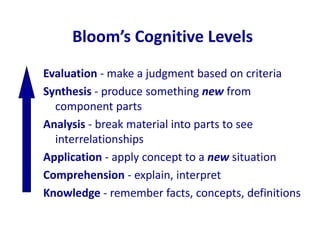
Bloom’s Cognitive LevelsEvaluation - make a judgment based on criteriaSynthesis - produce something new from component partsAnalysis - break material into parts to see interrelationshipsApplication - apply concept to anew situationComprehension - explain, interpretKnowledge - remember facts, concepts, definitions
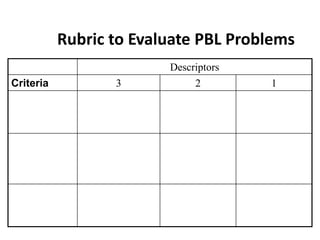
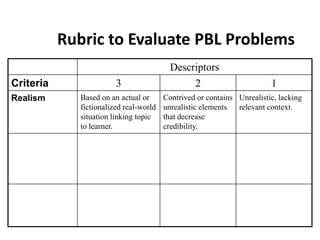
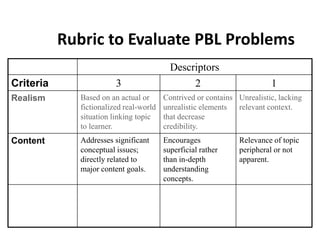
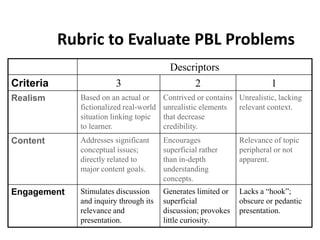
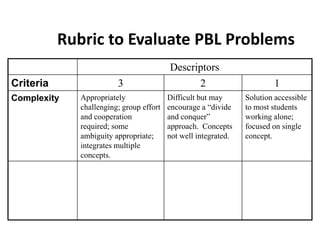
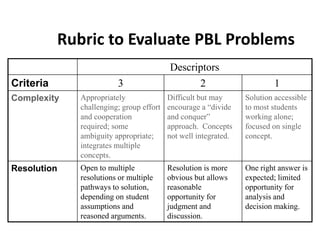
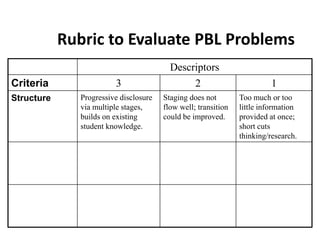
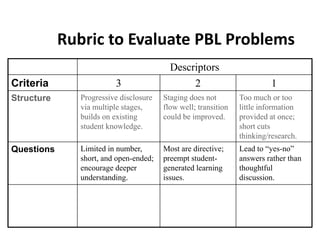
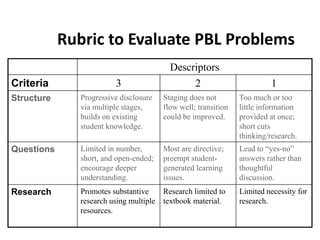
Rubric to Evaluate PBL Problems
Another TaskAfter you design your project this afternoon, apply the rubric to it.
Why Rubrics?Common Learning VocabularyTool for metacognitionTool for facilitating more peer reviewMake Explicit What  We Value (derived from or lead to overarching standards)Carry skills acquisition across disciplinesShift conversation to progress over grades
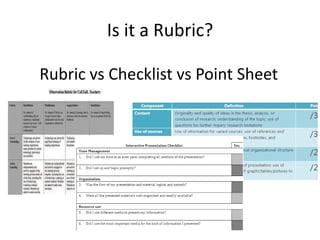
Is it a Rubric?Rubric vs Checklist vs Point Sheet
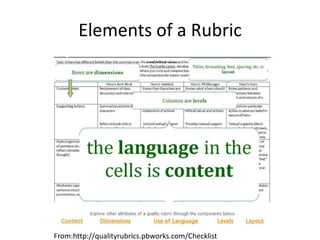
Elements of a RubricFrom:http://qualityrubrics.pbworks.com/Checklist
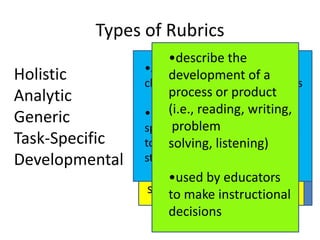
Types of Rubrics•describe domains of a product or performance separately•have limited descriptors for each attribute•allow for specific diagnostic feedback•describe the development of a process or product (i.e., reading, writing, problem solving, listening)•used by educators to make instructional decisions•Are written so that they may be used with more than one task of performance•Can be used across genres and even domains (problem solving, reading)•Are written for specific classroom tasks or assignments •Include language that specifically connects the rubric to the task or assignment students will completeHolisticAnalyticGenericTask-SpecificDevelopmental•Describe a product or performance as a whole•Rely on multiple descriptors•Are limited in value in terms of providing precise diagnostic information•May cause more scoring dilemmas
Some ConsiderationsSchool-wide Rubrics for Make the top category really exemplaryMove away from equating the numbers to a grade, shift emphasis to are you making progress and showing growthUse rubrics for Feedback
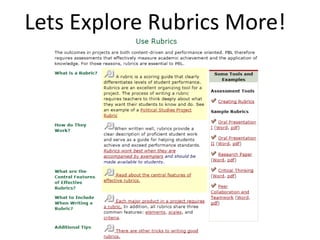
Lets Explore Rubrics More!
Some Tools Canvas Chalk and Wire

Pbl rubrics

  • 1.
    Rubrics One Stepin Creating a Common Learning Vocabulary
  • 2.
    What Is aGood PBL Problem?Using a Rubric to Assess
  • 3.
    Good PBL Problems…relateto real world, motivate studentsrequire decision-making or judgmentsare multi-page, multi-stageare designed for group-solvingpose open-ended initial questions that encourage discussionincorporate course content objectives, higher order thinking, other skills
  • 4.
    Bloom’s Cognitive LevelsEvaluation- make a judgment based on criteriaSynthesis - produce something new from component partsAnalysis - break material into parts to see interrelationshipsApplication - apply concept to anew situationComprehension - explain, interpretKnowledge - remember facts, concepts, definitions
  • 5.
    Rubric to EvaluatePBL Problems
  • 6.
    Rubric to EvaluatePBL Problems
  • 7.
    Rubric to EvaluatePBL Problems
  • 8.
    Rubric to EvaluatePBL Problems
  • 9.
    Rubric to EvaluatePBL Problems
  • 10.
    Rubric to EvaluatePBL Problems
  • 11.
    Rubric to EvaluatePBL Problems
  • 12.
    Rubric to EvaluatePBL Problems
  • 13.
    Rubric to EvaluatePBL Problems
  • 14.
    Another TaskAfter youdesign your project this afternoon, apply the rubric to it.
  • 15.
    Why Rubrics?Common LearningVocabularyTool for metacognitionTool for facilitating more peer reviewMake Explicit What We Value (derived from or lead to overarching standards)Carry skills acquisition across disciplinesShift conversation to progress over grades
  • 16.
    Is it aRubric?Rubric vs Checklist vs Point Sheet
  • 17.
    Elements of aRubricFrom:http://qualityrubrics.pbworks.com/Checklist
  • 18.
    Types of Rubrics•describedomains of a product or performance separately•have limited descriptors for each attribute•allow for specific diagnostic feedback•describe the development of a process or product (i.e., reading, writing, problem solving, listening)•used by educators to make instructional decisions•Are written so that they may be used with more than one task of performance•Can be used across genres and even domains (problem solving, reading)•Are written for specific classroom tasks or assignments •Include language that specifically connects the rubric to the task or assignment students will completeHolisticAnalyticGenericTask-SpecificDevelopmental•Describe a product or performance as a whole•Rely on multiple descriptors•Are limited in value in terms of providing precise diagnostic information•May cause more scoring dilemmas
  • 20.
    Some ConsiderationsSchool-wide Rubricsfor Make the top category really exemplaryMove away from equating the numbers to a grade, shift emphasis to are you making progress and showing growthUse rubrics for Feedback
  • 21.
  • 22.
    Some Tools CanvasChalk and Wire