Rubrics One Step in Creating a Common Learning Vocabulary
Why Rubrics?Common Learning VocabularyTool for metacognitionTool for facilitating more peer reviewMake Explicit What  We Value (derived from or lead to overarching standards)Carry skills acquisition across disciplinesShift conversation to progress over grades
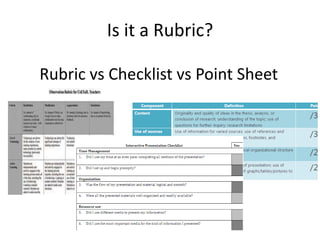
Is it a Rubric?Rubric vs Checklist vs Point Sheet
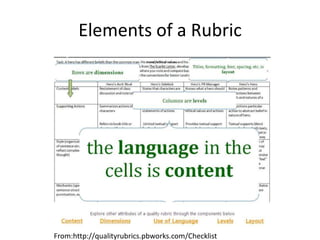
Elements of a RubricFrom:http://qualityrubrics.pbworks.com/Checklist
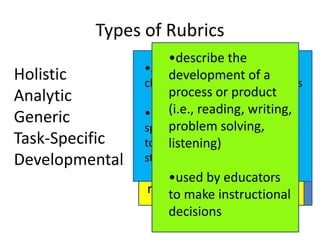
Types of Rubrics•describe domains of a product or performance separately•have limited descriptors for each attribute•allow for specific diagnostic feedback•describe the development of a process or product (i.e., reading, writing, problem solving, listening)•used by educators to make instructional decisions•Are written so that they may be used with more than one task of performance•Can be used across genres and even domains (problem solving, reading)•Are written for specific classroom tasks or assignments •Include language that specifically connects the rubric to the task or assignment students will completeHolisticAnalyticGenericTask-SpecificDevelopmental•Describe a product or performance as a whole•Rely on multiple descriptors•Are limited in value in terms of providing precise diagnostic information•May cause more scoring dilemmas
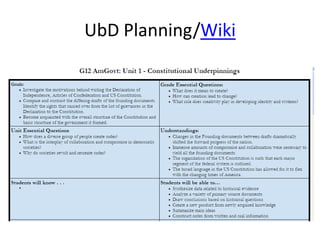
UbD Planning/Wiki
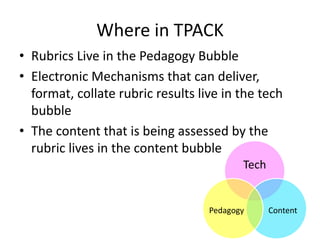
Where in TPACKRubrics Live in the Pedagogy BubbleElectronic Mechanisms that can deliver, format, collate rubric results live in the tech bubbleThe content that is being assessed by the rubric lives in the content bubble
AssignmentsCollaboration/Team Work - ArtCritical Thinking - MathDigital Product - HelfantPresentation - HistoryProblem Solving - ScienceResearch - LibraryWriting - English
Descriptors to ConsiderImpact (audience)Aesthetics Function Others?Sample at http://delicious.com/ehelfant/ACrubricsShared Dropbox folder

Rubrics

  • 1.
    Rubrics One Stepin Creating a Common Learning Vocabulary
  • 2.
    Why Rubrics?Common LearningVocabularyTool for metacognitionTool for facilitating more peer reviewMake Explicit What We Value (derived from or lead to overarching standards)Carry skills acquisition across disciplinesShift conversation to progress over grades
  • 3.
    Is it aRubric?Rubric vs Checklist vs Point Sheet
  • 4.
    Elements of aRubricFrom:http://qualityrubrics.pbworks.com/Checklist
  • 5.
    Types of Rubrics•describedomains of a product or performance separately•have limited descriptors for each attribute•allow for specific diagnostic feedback•describe the development of a process or product (i.e., reading, writing, problem solving, listening)•used by educators to make instructional decisions•Are written so that they may be used with more than one task of performance•Can be used across genres and even domains (problem solving, reading)•Are written for specific classroom tasks or assignments •Include language that specifically connects the rubric to the task or assignment students will completeHolisticAnalyticGenericTask-SpecificDevelopmental•Describe a product or performance as a whole•Rely on multiple descriptors•Are limited in value in terms of providing precise diagnostic information•May cause more scoring dilemmas
  • 8.
  • 10.
    Where in TPACKRubricsLive in the Pedagogy BubbleElectronic Mechanisms that can deliver, format, collate rubric results live in the tech bubbleThe content that is being assessed by the rubric lives in the content bubble
  • 11.
    AssignmentsCollaboration/Team Work -ArtCritical Thinking - MathDigital Product - HelfantPresentation - HistoryProblem Solving - ScienceResearch - LibraryWriting - English
  • 12.
    Descriptors to ConsiderImpact(audience)Aesthetics Function Others?Sample at http://delicious.com/ehelfant/ACrubricsShared Dropbox folder

Editor's Notes

  • #9 https://docs.google.com/View?id=dd36n378_61gsztzpd4