Group Assignment
NO. Name ID
1 Abush Tibebe……………………..ugr/51162/13
2 Addis T/mariam……………….,..ugr/35718/12
3 Aderaw Alemie…………………..ugr/35168/12
4 Afrim Kassay……………………….ugr/51235/13
5 Alembirhan Beyene…………….ugr/51338/13
6 Amanual Degefu………………….ugr/51917/13
7 Amare Nigus………………………..ugr/53913/13
8 Aster Gezahagn………………….ugr/51190/13
9 Banchamelak Amare …………..ugr/50974/13
10 Bayush Esubalew…………………ugr/50978/13
Patient Education
OBJECTIVES
• Definition of Patient education
• The Benefits and Importance of Patient
Education
• Model of Patient Education Outcomes
• Patient Education - Steps
Definition of Patient education
• Patient education is the process of providing
patients with information relevant to their
condition, such as symptoms and warning
signs, available treatment plans, expected
outcomes and side effects, prevention
guidelines, etc.
• Patient education starts as soon as the patient
is diagnosed or as early as possible
Cont…
• It helps patients better understand their
condition and available options in terms of
treatment.
• Although there are different types, patient
education aims to increase patient engagement
and involvement to improve the patient’s physical
and mental health.
• Hospital discharge and chronic disease are two
common cases where patient education is
required.
Cont…
• Patients that have undergone certain
procedures receive discharge patient
education with instructions about how to take
their medications, handle special equipment,
signs of common side effects and treatment,
etc.
Cont…
• To patients with chronic illness, the health
educator suggests lifestyle changes that will
help them keep their illness under control,
handle emergencies and side effects from
drugs, and maintain a high standard of living.
• Healthcare education is usually provided by
trained healthcare professionals, like primary
care physicians, specialist doctors, nurses, and
professional health.
Cont…
• Patient education is a significant
component of modern health care.
• A process of assisting the patient to
gain knowledge, skill, and a value or
attitude related to a health problem
or for health promotion
Cont..
• Patient education can be divided
into two large categories—clinical
patient education (or clinical
teaching and learning) and health
education.
Cont…
• Clinical patient education is a
planned, systematic, sequential,
and logical process of teaching
and learning provided to patients
and clients in all clinical settings.
Cont..
• Clinical patient education is also a continuous
teaching and learning process involving the
health care provider and the patient or client
(and/or the patient’s family).
• The goals of clinical teaching and learning are
based on the patient’s assessment, evaluation,
diagnosis, prognosis, and individual needs and
requirements related to interventions.
cont…
• Health education is also a teaching and
learning process similar to patient education.
• However, it concentrates mostly on wellness,
prevention, and health promotion.
• Additionally, health education can be
provided to individuals, groups, and
communities.
• The basic focus of health education is to
change and improve societal health behaviors.
Cont…
The are three important objectives of patient
education that may result in positive health
outcome.
• Changing health behaviors
• Improving health status
• Improving patient compliance
The Benefits and Importance of
Patient Education
1 Patient Empowerment
Most people finding themselves in uncharted
waters, especially regarding a health
problem, are bound to feel powerless and at
a loss. Patient education helps them
understand their condition, available
treatments, and what they entail, including
possible side effects.
Cont…
2 Better Health
Outcomes As we mentioned before, patient
education has a positive impact on patient
engagement.
Apart from being more knowledgeable, patients
who receive health education are also more
cooperative and well-disposed because they
trust their doctors and the treatment they’re
receiving.
Cont….
3 Lower Readmission Rates
Similar to the point discussed above, when
patients can take proper care of themselves,
they are less likely to have complications and
need to return to the hospital or visit their
doctors more often than initially planned.
. This can be achieved with proper discharge
patient education focusing on practical
instructions and general health advice.
Cont….
4 Better Quality of Life for Patients With Chronic
Diseases
Health education is tremendously important for
people with medical conditions like heart disease,
hypertension, diabetes, and other chronic
illnesses. Chronic disease management takes
place outside of medical facilities as the patient’s
needs are recurring, and often the patient needs
to make permanent lifestyle changes.
Cont….
5 Better Healthcare Experience and Satisfaction
• Higher patient satisfaction is another benefit
of healthcare education.
• And it’s no wonder why being properly
informed, patients feel more reassured and
optimistic about their future and have a say in
critical decisions.
Cont….
6 Lower Healthcare System Costs
• When patients don’t follow their treatment
plan as they should, they don’t heal as
expected or even get worse and need to be
readmitted to the hospital.
• This increases the cost and burdens the
healthcare system by reducing capacity.
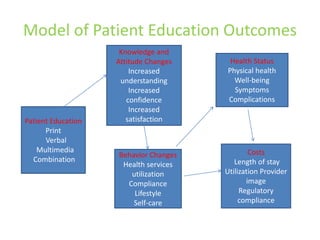
Model of Patient Education Outcomes
Knowledge and
Attitude Changes
Increased
understanding
Increased
confidence
Increased
satisfaction
Health Status
Physical health
Well-being
Symptoms
Complications
Patient Education
Print
Verbal
Multimedia
Combination
Costs
Length of stay
Utilization Provider
image
Regulatory
compliance
Behavior Changes
Health services
utilization
Compliance
Lifestyle
Self-care
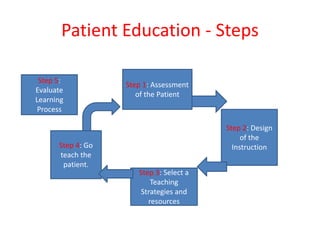
Patient Education - Steps
Step 1: Assessment
of the Patient
Step 2: Design
of the
Instruction
Step 4: Go
teach the
patient.
Step 3: Select a
Teaching
Strategies and
resources
Step 5:
Evaluate
Learning
Process
Cont…
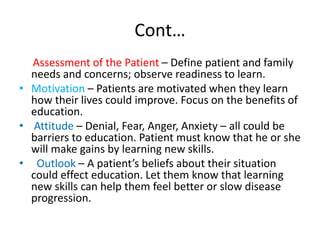
Assessment of the Patient – Define patient and family
needs and concerns; observe readiness to learn.
• Motivation – Patients are motivated when they learn
how their lives could improve. Focus on the benefits of
education.
• Attitude – Denial, Fear, Anger, Anxiety – all could be
barriers to education. Patient must know that he or she
will make gains by learning new skills.
• Outlook – A patient’s beliefs about their situation
could effect education. Let them know that learning
new skills can help them feel better or slow disease
progression.
Cont…
Design of the Instruction Plan – Set objectives
with your patient; select materials.
• Goals should focus on what is necessary / critical
to patient survival first.
• Pay attention to patient concerns – they could
stand in the way of progress.
• Respect stated limits – if a patient has refused to
do something, try to work around the problem
and incorporate something new as best you can
• Helping a Patient understands the need for
changing behavior.
Cont…
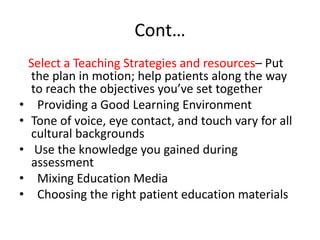
Select a Teaching Strategies and resources– Put
the plan in motion; help patients along the way
to reach the objectives you’ve set together
• Providing a Good Learning Environment
• Tone of voice, eye contact, and touch vary for all
cultural backgrounds
• Use the knowledge you gained during
assessment
• Mixing Education Media
• Choosing the right patient education materials
Cont…
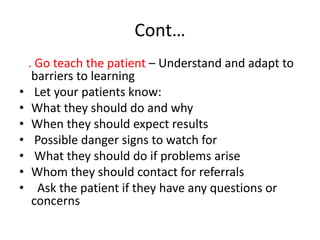
. Go teach the patient – Understand and adapt to
barriers to learning
• Let your patients know:
• What they should do and why
• When they should expect results
• Possible danger signs to watch for
• What they should do if problems arise
• Whom they should contact for referrals
• Ask the patient if they have any questions or
concerns
Cont…
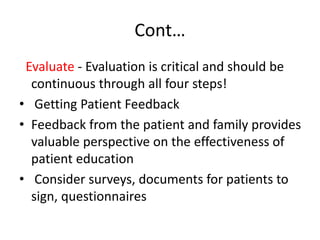
Evaluate - Evaluation is critical and should be
continuous through all four steps!
• Getting Patient Feedback
• Feedback from the patient and family provides
valuable perspective on the effectiveness of
patient education
• Consider surveys, documents for patients to
sign, questionnaires
THANK YOU

attachment-3.pptx

  • 1.
    Group Assignment NO. NameID 1 Abush Tibebe……………………..ugr/51162/13 2 Addis T/mariam……………….,..ugr/35718/12 3 Aderaw Alemie…………………..ugr/35168/12 4 Afrim Kassay……………………….ugr/51235/13 5 Alembirhan Beyene…………….ugr/51338/13 6 Amanual Degefu………………….ugr/51917/13 7 Amare Nigus………………………..ugr/53913/13 8 Aster Gezahagn………………….ugr/51190/13 9 Banchamelak Amare …………..ugr/50974/13 10 Bayush Esubalew…………………ugr/50978/13
  • 2.
  • 3.
    OBJECTIVES • Definition ofPatient education • The Benefits and Importance of Patient Education • Model of Patient Education Outcomes • Patient Education - Steps
  • 4.
    Definition of Patienteducation • Patient education is the process of providing patients with information relevant to their condition, such as symptoms and warning signs, available treatment plans, expected outcomes and side effects, prevention guidelines, etc. • Patient education starts as soon as the patient is diagnosed or as early as possible
  • 5.
    Cont… • It helpspatients better understand their condition and available options in terms of treatment. • Although there are different types, patient education aims to increase patient engagement and involvement to improve the patient’s physical and mental health. • Hospital discharge and chronic disease are two common cases where patient education is required.
  • 6.
    Cont… • Patients thathave undergone certain procedures receive discharge patient education with instructions about how to take their medications, handle special equipment, signs of common side effects and treatment, etc.
  • 7.
    Cont… • To patientswith chronic illness, the health educator suggests lifestyle changes that will help them keep their illness under control, handle emergencies and side effects from drugs, and maintain a high standard of living. • Healthcare education is usually provided by trained healthcare professionals, like primary care physicians, specialist doctors, nurses, and professional health.
  • 8.
    Cont… • Patient educationis a significant component of modern health care. • A process of assisting the patient to gain knowledge, skill, and a value or attitude related to a health problem or for health promotion
  • 9.
    Cont.. • Patient educationcan be divided into two large categories—clinical patient education (or clinical teaching and learning) and health education.
  • 10.
    Cont… • Clinical patienteducation is a planned, systematic, sequential, and logical process of teaching and learning provided to patients and clients in all clinical settings.
  • 11.
    Cont.. • Clinical patienteducation is also a continuous teaching and learning process involving the health care provider and the patient or client (and/or the patient’s family). • The goals of clinical teaching and learning are based on the patient’s assessment, evaluation, diagnosis, prognosis, and individual needs and requirements related to interventions.
  • 12.
    cont… • Health educationis also a teaching and learning process similar to patient education. • However, it concentrates mostly on wellness, prevention, and health promotion. • Additionally, health education can be provided to individuals, groups, and communities. • The basic focus of health education is to change and improve societal health behaviors.
  • 13.
    Cont… The are threeimportant objectives of patient education that may result in positive health outcome. • Changing health behaviors • Improving health status • Improving patient compliance
  • 14.
    The Benefits andImportance of Patient Education 1 Patient Empowerment Most people finding themselves in uncharted waters, especially regarding a health problem, are bound to feel powerless and at a loss. Patient education helps them understand their condition, available treatments, and what they entail, including possible side effects.
  • 15.
    Cont… 2 Better Health OutcomesAs we mentioned before, patient education has a positive impact on patient engagement. Apart from being more knowledgeable, patients who receive health education are also more cooperative and well-disposed because they trust their doctors and the treatment they’re receiving.
  • 16.
    Cont…. 3 Lower ReadmissionRates Similar to the point discussed above, when patients can take proper care of themselves, they are less likely to have complications and need to return to the hospital or visit their doctors more often than initially planned. . This can be achieved with proper discharge patient education focusing on practical instructions and general health advice.
  • 17.
    Cont…. 4 Better Qualityof Life for Patients With Chronic Diseases Health education is tremendously important for people with medical conditions like heart disease, hypertension, diabetes, and other chronic illnesses. Chronic disease management takes place outside of medical facilities as the patient’s needs are recurring, and often the patient needs to make permanent lifestyle changes.
  • 18.
    Cont…. 5 Better HealthcareExperience and Satisfaction • Higher patient satisfaction is another benefit of healthcare education. • And it’s no wonder why being properly informed, patients feel more reassured and optimistic about their future and have a say in critical decisions.
  • 19.
    Cont…. 6 Lower HealthcareSystem Costs • When patients don’t follow their treatment plan as they should, they don’t heal as expected or even get worse and need to be readmitted to the hospital. • This increases the cost and burdens the healthcare system by reducing capacity.
  • 20.
    Model of PatientEducation Outcomes Knowledge and Attitude Changes Increased understanding Increased confidence Increased satisfaction Health Status Physical health Well-being Symptoms Complications Patient Education Print Verbal Multimedia Combination Costs Length of stay Utilization Provider image Regulatory compliance Behavior Changes Health services utilization Compliance Lifestyle Self-care
  • 21.
    Patient Education -Steps Step 1: Assessment of the Patient Step 2: Design of the Instruction Step 4: Go teach the patient. Step 3: Select a Teaching Strategies and resources Step 5: Evaluate Learning Process
  • 22.
    Cont… Assessment of thePatient – Define patient and family needs and concerns; observe readiness to learn. • Motivation – Patients are motivated when they learn how their lives could improve. Focus on the benefits of education. • Attitude – Denial, Fear, Anger, Anxiety – all could be barriers to education. Patient must know that he or she will make gains by learning new skills. • Outlook – A patient’s beliefs about their situation could effect education. Let them know that learning new skills can help them feel better or slow disease progression.
  • 23.
    Cont… Design of theInstruction Plan – Set objectives with your patient; select materials. • Goals should focus on what is necessary / critical to patient survival first. • Pay attention to patient concerns – they could stand in the way of progress. • Respect stated limits – if a patient has refused to do something, try to work around the problem and incorporate something new as best you can • Helping a Patient understands the need for changing behavior.
  • 24.
    Cont… Select a TeachingStrategies and resources– Put the plan in motion; help patients along the way to reach the objectives you’ve set together • Providing a Good Learning Environment • Tone of voice, eye contact, and touch vary for all cultural backgrounds • Use the knowledge you gained during assessment • Mixing Education Media • Choosing the right patient education materials
  • 25.
    Cont… . Go teachthe patient – Understand and adapt to barriers to learning • Let your patients know: • What they should do and why • When they should expect results • Possible danger signs to watch for • What they should do if problems arise • Whom they should contact for referrals • Ask the patient if they have any questions or concerns
  • 26.
    Cont… Evaluate - Evaluationis critical and should be continuous through all four steps! • Getting Patient Feedback • Feedback from the patient and family provides valuable perspective on the effectiveness of patient education • Consider surveys, documents for patients to sign, questionnaires
  • 27.