MEDICAL IMAGING
INFORMATICS
Prepared By: M.C. SALVADOR, RRT
INFORMATICS
• Derived from the term “ information” – refers to a useful,
meaningful, and organized data.
• COMPUTER – convert the data into information,
computer application in medical imaging includes
modalities such as CR, DR, DM, and DF
• INFORMATICS REFERS TO THE PROCESS OF CHANGING
DATA INTO INFORMATION
INFORMATION TECHNOLOGY
• A general term that describes technology that helps
to produced, manipulate, store, communicate, and/
or disseminate information (Williams, 2007)
• Involves the used of two major technology :
computer technology and communication
technology.
COMPUTER TECHNOLOGY
• Deals with the structure and functions and how
it can be used to solved problems
• COMPUTER – made up of software and
hardware
• FUNDAMENTAL OPERATION: input, processing,
storage, output and communications
COMMUNICATIONS TECHNOLOGY
• Deals with the use of electromagnetic
devices and systems for communicating
over long distances.
• Consist of the following key elements:
Modem, communication media and
communication network
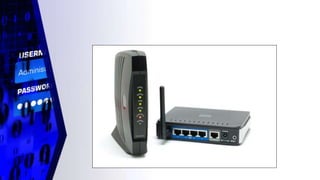
MODEM
• MOdulate – DEModulate: used to send
and receive signals from a computer by
converting digital signal into analog
signal
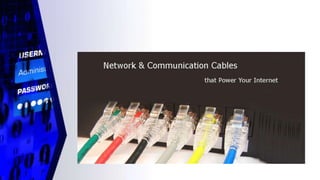
COMMUNICATIONS MEDIA
• Used for data transmission
• Includes : coaxial cables, fiber optics,
microwave, satellite transmission and
protocols
• DICOM is an example of one standard
used in medical imaging to address in
communication of images
COMMUNICATION NETWORK
• The technology area which deals with
communication through computer system is
called COMPUTER NETWORKING
• Types of network: LAN, MAN, WAN
• LAN : LOCAL AREA NETWORK : computer
network that spans in a relatively small area,
usually established in a building
COMMUNICATION NETWORK
MAN: METROPOLITAN AREA NETWORK
• Covers geographical area larger than LAN
• A computer network, extending over a large
geographical area such as an urban area and
providing integraded communication services
such as data, voice, and video (IEEE, 2002)
• Usually established in a campus or city and
connects LANS using high – speed backbones
COMMUNICATION NETWORK
WAN : WIDE AREA NETWORK
• Covers large geographic area
• Consist of nodes located in a state,
province, country and even worldwide
• Usually connected over the telephone
carriers
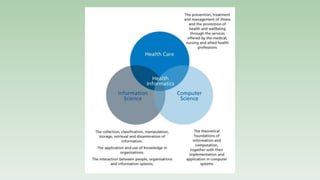
HEALTH CARE INFOMATICS/ MEDICAL
INFORMATICS
MEDICAL INFORMATICS
• An interdisciplinary science underlying
the acquisition, maintenance, retrieval
and application of biomedical
knowledge and information to improve
patient care, medical information, and
health science research.
HEALTH CARE INFOMATICS
• Application of IT to healthcare is
referred to as health informatics/
medical informatics
• The practice of information and
knowledge management across clinical
healthcare and public health domain.
www.amia.org
Biomedical Informatics
Biomedical informatics (BMI) is
the interdisciplinary field that
studies and pursues the effective
uses of biomedical data,
information, and knowledge for
scientific inquiry, problem solving,
and decision making, motivated
by efforts to improve human
health.
www.amia.org
Biomedical Informatics:
Corollaries to the Definition
1. BMI develops, studies and applies
theories, methods and processes
for the generation, storage, retrieval,
use, and sharing of biomedical data,
information, and knowledge.
2. BMI builds on computing,
communication and information
sciences and technologies and their
application in biomedicine.
www.amia.org
Biomedical Informatics:
Corollaries to the Definition
3. BMI investigates and supports reasoning, modeling,
simulation, experimentation and translation across
the spectrum from molecules to populations, dealing
with a variety of biological systems, bridging basic
and clinical research and practice, and the healthcare
enterprise.
4. BMI, recognizing that people are the ultimate users of
biomedical information, draws upon the social and
behavioral sciences to inform the design and
evaluation of technical solutions and the evolution of
complex economic, ethical, social, educational, and
organizational systems.
www.amia.org
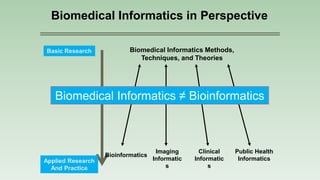
Biomedical Informatics in Perspective
Basic Research
Applied Research
And Practice
Biomedical Informatics Methods,
Techniques, and Theories
Bioinformatics
Clinical
Informatic
s
Imaging
Informatic
s
Public Health
Informatics
Biomedical Informatics ≠ Bioinformatics
www.amia.org
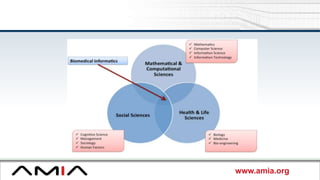
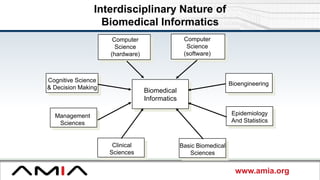
Interdisciplinary Nature of
Biomedical Informatics
Biomedical
Informatics
Cognitive Science
& Decision Making
Management
Sciences
Clinical
Sciences
Basic Biomedical
Sciences
Epidemiology
And Statistics
Bioengineering
Computer
Science
(hardware)
Computer
Science
(software)
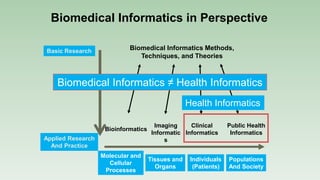
Biomedical Informatics in Perspective
Basic Research
Applied Research
And Practice
Biomedical Informatics Methods,
Techniques, and Theories
Imaging
Informatic
s
Clinical
Informatics
Bioinformatics
Public Health
Informatics
Molecular and
Cellular
Processes
Tissues and
Organs
Individuals
(Patients)
Populations
And Society
Biomedical Informatics ≠ Health Informatics
Health Informatics
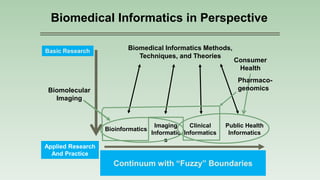
Biomedical Informatics in Perspective
Basic Research
Applied Research
And Practice
Biomedical Informatics Methods,
Techniques, and Theories
Imaging
Informatic
s
Clinical
Informatics
Bioinformatics
Public Health
Informatics
Molecular and
Cellular
Processes
Tissues and
Organs
Individuals
(Patients)
Populations
And SocietyContinuum with “Fuzzy” Boundaries
Biomolecular
Imaging
Consumer
Health
Pharmaco-
genomics
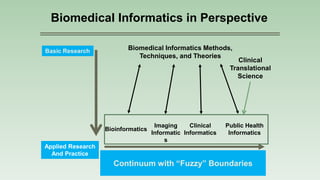
Biomedical Informatics in Perspective
Basic Research
Applied Research
And Practice
Biomedical Informatics Methods,
Techniques, and Theories
Imaging
Informatic
s
Clinical
Informatics
Bioinformatics
Public Health
Informatics
Molecular and
Cellular
Processes
Tissues and
Organs
Individuals
(Patients)
Populations
And SocietyContinuum with “Fuzzy” Boundaries
Clinical
Translational
Science
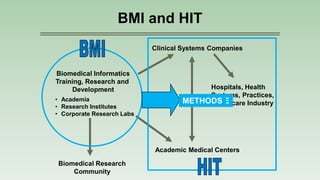
BMI and HIT
Biomedical Informatics
Training, Research and
Development
• Academia
• Research Institutes
• Corporate Research Labs
Clinical Systems Companies
Academic Medical Centers
Hospitals, Health
Systems, Practices,
Healthcare Industry
Biomedical Research
Community
PEOPLEIDEASSOFTWAREMETHODS
HEALTH INFORMATION SYSTEMS
• Information system is a computer based
system used to collect and process data to
provide its users with information needed for
problem solving and decision making
HOSPITAL INFORMATION SYSTEM
• 2 Major component systems:
CLINICAL INFORMATION SYSTEM AND
ADMINISTRATIVE INFORMATION SYSTEM
CLINICAL INFORMATION SYSTEM
• Uses computers to manage clinical
information, this information includes
medical history and other relevant
information, which helps health care
personnel make decision
Laboratory Information system (LIS)
• Uses computer to manage lab test and
lab result
• LIS provide a standard for the delivery
of real time laboratory result to an
electronic health record
Nursing Information System
• The used of computer to improve
nursing care by managing charting, staff
scheduling and the integration of
clinical information
Pharmacy Information System
• Monitor drug allergies and interactions
and fill and track prescription
• Track inventory and create patient drug
profiles
Radiology Information System
• Manage patients in radiology
department including scheduling
appointments, tracking film and
reporting result
• The RIS allows the adding of images to a
patient’s electronic record by
interacting with the EMR
ADMINISTRATIVE INFORMATION SYSTEM
• Include information systems dealing with
registration, scheduling, financial payroll
and human resources
Financial Information system
• Concerned with the financial details of
running a hospital.
• These include payroll, patient accounting
(all charges that a patient generates as an
inpatient or outpatient), accounts payable,
accounts receivable, assets, claims, and
contract management
PICTURE ARCHIVING AND
COMMUNICATION SYSTEM
• Manage digital image
• Allows digital image to be immediately
available on the monitor and can be shared
over a network
• Can enhance images and eliminate film
• Standard protocol of imaging devices DICOM
MEDICAL IMAGING INFORMATICS
• Application of IT in medical imaging
• A subdiscipline in radiology that includes task such as
digital image acquisition, digital image processing
and image display, image storage and archiving ,
computer networking, and image transmission
BIOMEDICAL IMAGING
• Biomedical imaging involves the
complex chain of acquiring, processing,
and visualizing structural or functional
images of living objects or systems,
including extraction and processing of
image-related information.
BIOMEDICAL IMAGING
• Biomedical imaging has developed from
early, simple uses of X-rays for diagnosis of
fractures and detection of foreign
bodies into a compendium of powerful
techniques, not only for patient care but
also for the study of biological
structure and function, and for addressing
fundamental questions in biomedicine.
BIOMEDICAL IMAGING
• Technological developments in digital
radiography, X-ray computed tomography(CT),
nuclear (including positron emission
tomography (PET)), ultrasound, optical
and magnetic resonance imaging (MRI) have
produced a spectrum of methods for
interrogating intact 3-dimensional bodies non-
invasively. A variety of new microscopies has also
flourished, making use of novel phenomena such
as non-linear photon interactions and the sensing
of atomic forces at surfaces.

Rt131 lec 2

  • 1.
  • 2.
    INFORMATICS • Derived fromthe term “ information” – refers to a useful, meaningful, and organized data. • COMPUTER – convert the data into information, computer application in medical imaging includes modalities such as CR, DR, DM, and DF • INFORMATICS REFERS TO THE PROCESS OF CHANGING DATA INTO INFORMATION
  • 3.
    INFORMATION TECHNOLOGY • Ageneral term that describes technology that helps to produced, manipulate, store, communicate, and/ or disseminate information (Williams, 2007) • Involves the used of two major technology : computer technology and communication technology.
  • 4.
    COMPUTER TECHNOLOGY • Dealswith the structure and functions and how it can be used to solved problems • COMPUTER – made up of software and hardware • FUNDAMENTAL OPERATION: input, processing, storage, output and communications
  • 5.
    COMMUNICATIONS TECHNOLOGY • Dealswith the use of electromagnetic devices and systems for communicating over long distances. • Consist of the following key elements: Modem, communication media and communication network
  • 6.
    MODEM • MOdulate –DEModulate: used to send and receive signals from a computer by converting digital signal into analog signal
  • 8.
    COMMUNICATIONS MEDIA • Usedfor data transmission • Includes : coaxial cables, fiber optics, microwave, satellite transmission and protocols • DICOM is an example of one standard used in medical imaging to address in communication of images
  • 10.
    COMMUNICATION NETWORK • Thetechnology area which deals with communication through computer system is called COMPUTER NETWORKING • Types of network: LAN, MAN, WAN • LAN : LOCAL AREA NETWORK : computer network that spans in a relatively small area, usually established in a building
  • 11.
    COMMUNICATION NETWORK MAN: METROPOLITANAREA NETWORK • Covers geographical area larger than LAN • A computer network, extending over a large geographical area such as an urban area and providing integraded communication services such as data, voice, and video (IEEE, 2002) • Usually established in a campus or city and connects LANS using high – speed backbones
  • 12.
    COMMUNICATION NETWORK WAN :WIDE AREA NETWORK • Covers large geographic area • Consist of nodes located in a state, province, country and even worldwide • Usually connected over the telephone carriers
  • 13.
    HEALTH CARE INFOMATICS/MEDICAL INFORMATICS
  • 14.
    MEDICAL INFORMATICS • Aninterdisciplinary science underlying the acquisition, maintenance, retrieval and application of biomedical knowledge and information to improve patient care, medical information, and health science research.
  • 15.
    HEALTH CARE INFOMATICS •Application of IT to healthcare is referred to as health informatics/ medical informatics • The practice of information and knowledge management across clinical healthcare and public health domain.
  • 16.
    www.amia.org Biomedical Informatics Biomedical informatics(BMI) is the interdisciplinary field that studies and pursues the effective uses of biomedical data, information, and knowledge for scientific inquiry, problem solving, and decision making, motivated by efforts to improve human health.
  • 17.
    www.amia.org Biomedical Informatics: Corollaries tothe Definition 1. BMI develops, studies and applies theories, methods and processes for the generation, storage, retrieval, use, and sharing of biomedical data, information, and knowledge. 2. BMI builds on computing, communication and information sciences and technologies and their application in biomedicine.
  • 18.
    www.amia.org Biomedical Informatics: Corollaries tothe Definition 3. BMI investigates and supports reasoning, modeling, simulation, experimentation and translation across the spectrum from molecules to populations, dealing with a variety of biological systems, bridging basic and clinical research and practice, and the healthcare enterprise. 4. BMI, recognizing that people are the ultimate users of biomedical information, draws upon the social and behavioral sciences to inform the design and evaluation of technical solutions and the evolution of complex economic, ethical, social, educational, and organizational systems.
  • 19.
  • 20.
    Biomedical Informatics inPerspective Basic Research Applied Research And Practice Biomedical Informatics Methods, Techniques, and Theories Bioinformatics Clinical Informatic s Imaging Informatic s Public Health Informatics Biomedical Informatics ≠ Bioinformatics
  • 21.
    www.amia.org Interdisciplinary Nature of BiomedicalInformatics Biomedical Informatics Cognitive Science & Decision Making Management Sciences Clinical Sciences Basic Biomedical Sciences Epidemiology And Statistics Bioengineering Computer Science (hardware) Computer Science (software)
  • 22.
    Biomedical Informatics inPerspective Basic Research Applied Research And Practice Biomedical Informatics Methods, Techniques, and Theories Imaging Informatic s Clinical Informatics Bioinformatics Public Health Informatics Molecular and Cellular Processes Tissues and Organs Individuals (Patients) Populations And Society Biomedical Informatics ≠ Health Informatics Health Informatics
  • 23.
    Biomedical Informatics inPerspective Basic Research Applied Research And Practice Biomedical Informatics Methods, Techniques, and Theories Imaging Informatic s Clinical Informatics Bioinformatics Public Health Informatics Molecular and Cellular Processes Tissues and Organs Individuals (Patients) Populations And SocietyContinuum with “Fuzzy” Boundaries Biomolecular Imaging Consumer Health Pharmaco- genomics
  • 24.
    Biomedical Informatics inPerspective Basic Research Applied Research And Practice Biomedical Informatics Methods, Techniques, and Theories Imaging Informatic s Clinical Informatics Bioinformatics Public Health Informatics Molecular and Cellular Processes Tissues and Organs Individuals (Patients) Populations And SocietyContinuum with “Fuzzy” Boundaries Clinical Translational Science
  • 26.
    BMI and HIT BiomedicalInformatics Training, Research and Development • Academia • Research Institutes • Corporate Research Labs Clinical Systems Companies Academic Medical Centers Hospitals, Health Systems, Practices, Healthcare Industry Biomedical Research Community PEOPLEIDEASSOFTWAREMETHODS
  • 27.
    HEALTH INFORMATION SYSTEMS •Information system is a computer based system used to collect and process data to provide its users with information needed for problem solving and decision making
  • 28.
    HOSPITAL INFORMATION SYSTEM •2 Major component systems: CLINICAL INFORMATION SYSTEM AND ADMINISTRATIVE INFORMATION SYSTEM
  • 29.
    CLINICAL INFORMATION SYSTEM •Uses computers to manage clinical information, this information includes medical history and other relevant information, which helps health care personnel make decision
  • 30.
    Laboratory Information system(LIS) • Uses computer to manage lab test and lab result • LIS provide a standard for the delivery of real time laboratory result to an electronic health record
  • 31.
    Nursing Information System •The used of computer to improve nursing care by managing charting, staff scheduling and the integration of clinical information
  • 32.
    Pharmacy Information System •Monitor drug allergies and interactions and fill and track prescription • Track inventory and create patient drug profiles
  • 33.
    Radiology Information System •Manage patients in radiology department including scheduling appointments, tracking film and reporting result • The RIS allows the adding of images to a patient’s electronic record by interacting with the EMR
  • 34.
    ADMINISTRATIVE INFORMATION SYSTEM •Include information systems dealing with registration, scheduling, financial payroll and human resources
  • 35.
    Financial Information system •Concerned with the financial details of running a hospital. • These include payroll, patient accounting (all charges that a patient generates as an inpatient or outpatient), accounts payable, accounts receivable, assets, claims, and contract management
  • 36.
    PICTURE ARCHIVING AND COMMUNICATIONSYSTEM • Manage digital image • Allows digital image to be immediately available on the monitor and can be shared over a network • Can enhance images and eliminate film • Standard protocol of imaging devices DICOM
  • 37.
  • 38.
    MEDICAL IMAGING INFORMATICS •Application of IT in medical imaging • A subdiscipline in radiology that includes task such as digital image acquisition, digital image processing and image display, image storage and archiving , computer networking, and image transmission
  • 39.
    BIOMEDICAL IMAGING • Biomedicalimaging involves the complex chain of acquiring, processing, and visualizing structural or functional images of living objects or systems, including extraction and processing of image-related information.
  • 40.
    BIOMEDICAL IMAGING • Biomedicalimaging has developed from early, simple uses of X-rays for diagnosis of fractures and detection of foreign bodies into a compendium of powerful techniques, not only for patient care but also for the study of biological structure and function, and for addressing fundamental questions in biomedicine.
  • 41.
    BIOMEDICAL IMAGING • Technologicaldevelopments in digital radiography, X-ray computed tomography(CT), nuclear (including positron emission tomography (PET)), ultrasound, optical and magnetic resonance imaging (MRI) have produced a spectrum of methods for interrogating intact 3-dimensional bodies non- invasively. A variety of new microscopies has also flourished, making use of novel phenomena such as non-linear photon interactions and the sensing of atomic forces at surfaces.

Editor's Notes

  • #4 INODER OF FOR THE DIGITAL DEVICES TO COMMUNICATE WITH EACH OTHER REGARDING THE IMAGES AND TEXTUAL INFORMATION WE NEED THE USED OF IT.
  • #11 COMPUTER NETWORKS ARE CLASSIFIED INTO THREE CATEGORIES IN ACCORDANCE WITH THEIR COVERED GEOGRAPHICAL AREA A NETWORK ALLOWS THE DEVICES TO BE CONNECTED TOGETHER TO UTILIZE DATA AND INFORMATION
  • #13 Internet is the most popular wan
  • #15 Involves improving the clarity of diagnostic images, improving image guided and minimally invasive surgery, developing simulations that allow health care workers improve treatments without practicing on human objects
  • #16 The term medical informatics was widely adopted in the united states in 1980, when the physician, scientist, and engineers begun to study how computer applications could be used in medical care and in 198 AMERICAN MEDICAL INFORMATICS ASSOCIATION OR AMIA was established. The medical informatics is not frequent used nowadays having replaced by health informatics Health care informatics is the creation of new solution to improve health care using information technology
  • #27 HIT – PROVIDE LEADERSHIP FOR THE DEVELOPMENT AND NATIONWIDE IMPLEMENTATION OF AN INTEROPERABLE HEALTH INFORMATION INFRASTRUCTURE BY CONNECTING THE PEOPLE WITH DIVERSE COMPUTER SYSTEM. MAKING EHR
  • #28 Health care information system and hospital information system both refer to a group of systems used within a hospital or enterprise that support and enhance healthcare
  • #33 Because PIS receives prescription they need to interact with CIS
  • #34 THE CHARATERISTIC FEATURES OF A RIS
  • #36 Oldest and most widely used computerized information