Shop@Farm
Utkarsh Bagri
Ahsen Parwez
Deepak Choudhary
Shilpa Jaiswal
Riya Khurana
Problem Faced By Small Land Holding Farmers
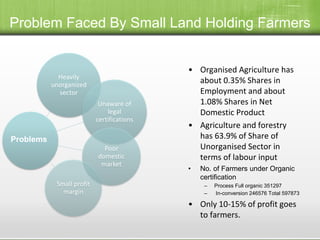
• Organised Agriculture has
about 0.35% Shares in
Employment and about
1.08% Shares in Net
Domestic Product
• Agriculture and forestry
has 63.9% of Share of
Unorganised Sector in
terms of labour input
• No. of Farmers under Organic
certification
– Process Full organic 351297
– In-conversion 246576 Total 597873
• Only 10-15% of profit goes
to farmers.
Heavily
unorganized
sector
Unaware of
legal
certifications
Poor
domestic
market
Small profit
margin
Problems
Problems Faced By Urban Population
• Unavailability of Organic Vegetables
– Most vegetables artificially produced,
with high content of fertilizers and
pesticides
– Organic products unavailable or scarce
– Time constraint for people to visit
vegetable market
• Land Usability and Maintenance:
- Every residential township has to allot
certain percentage of land as free space.
- Free space starts of as park or garden but
turns into a dump-yard due to lack of
maintenance.
• Unhygienic Subji-Mandis
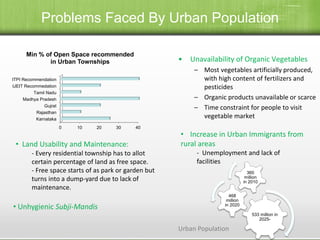
533 million in
2025-
468
million
in 2020
360
million
in 2010
0 10 20 30 40
Karnataka
Rajasthan
Gujrat
Madhya Pradesh
Tamil Nadu
IJEIT Recommedation
ITPI Recommendation
Min % of Open Space recommended
in Urban Townships
• Increase in Urban Immigrants from
rural areas
- Unemployment and lack of
facilities
Urban Population
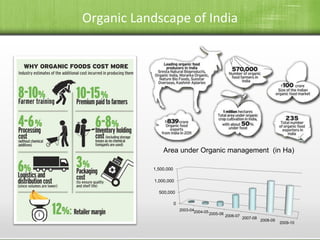
Organic Landscape of India
0
500,000
1,000,000
1,500,000
2003-042004-052005-06
2006-07
2007-08
2008-09
2009-10
Area under Organic management (in Ha)
Solution
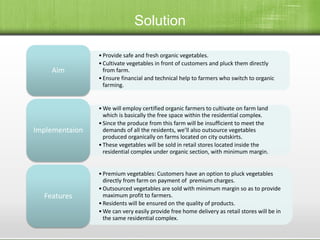
•Provide safe and fresh organic vegetables.
•Cultivate vegetables in front of customers and pluck them directly
from farm.
•Ensure financial and technical help to farmers who switch to organic
farming.
Aim
•We will employ certified organic farmers to cultivate on farm land
which is basically the free space within the residential complex.
•Since the produce from this farm will be insufficient to meet the
demands of all the residents, we’ll also outsource vegetables
produced organically on farms located on city outskirts.
•These vegetables will be sold in retail stores located inside the
residential complex under organic section, with minimum margin.
Implementaion
•Premium vegetables: Customers have an option to pluck vegetables
directly from farm on payment of premium charges.
•Outsourced vegetables are sold with minimum margin so as to provide
maximum profit to farmers.
•Residents will be ensured on the quality of products.
•We can very easily provide free home delivery as retail stores will be in
the same residential complex.
Features
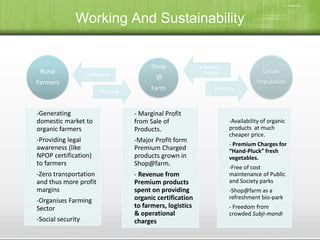
Working And Sustainability
-Generating
domestic market to
organic farmers
-Providing legal
awareness (like
NPOP certification)
to farmers
-Zero transportation
and thus more profit
margins
-Organises Farming
Sector
-Social security
Rural
Farmers
- Marginal Profit
from Sale of
Products.
-Major Profit form
Premium Charged
products grown in
Shop@farm.
- Revenue from
Premium products
spent on providing
organic certification
to farmers, logistics
& operational
charges
Shop
@
Farm
-Availability of organic
products at much
cheaper price.
- Premium Charges for
“Hand-Pluck” fresh
vegetables.
-Free of cost
maintenance of Public
and Society parks
-Shop@farm as a
refreshment bio-park
- Freedom from
crowded Subji-mandi
Urban
Population
Premium
Charges
Products
Certification
Products
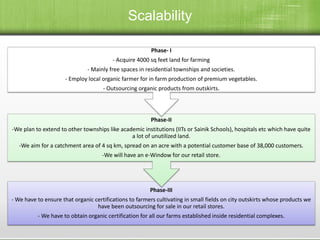
Phase-III
- We have to ensure that organic certifications to farmers cultivating in small fields on city outskirts whose products we
have been outsourcing for sale in our retail stores.
- We have to obtain organic certification for all our farms established inside residential complexes.
Phase-II
-We plan to extend to other townships like academic institutions (IITs or Sainik Schools), hospitals etc which have quite
a lot of unutilized land.
-We aim for a catchment area of 4 sq km, spread on an acre with a potential customer base of 38,000 customers.
-We will have an e-Window for our retail store.
Phase- I
- Acquire 4000 sq feet land for farming
- Mainly free spaces in residential townships and societies.
- Employ local organic farmer for in farm production of premium vegetables.
- Outsourcing organic products from outskirts.
Scalability
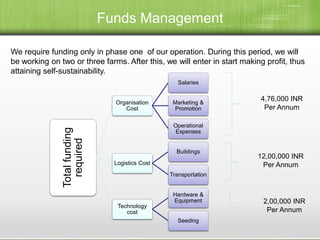
Funds Management
Totalfunding
required
Organisation
Cost
Salaries
Marketing &
Promotion
Operational
Expenses
Logistics Cost
Buildings
Transportation
Technology
cost
Hardware &
Equipment
Seeding
4,76,000 INR
Per Annum
12,00,000 INR
Per Annum
2,00,000 INR
Per Annum
We require funding only in phase one of our operation. During this period, we will
be working on two or three farms. After this, we will enter in start making profit, thus
attaining self-sustainability.
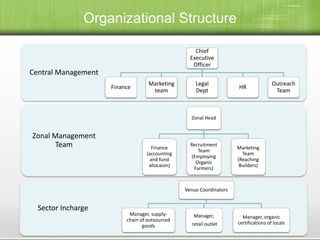
Organizational Structure
Central Management
Chief
Executive
Officer
Finance
Marketing
team
Legal
Dept
HR
Outreach
Team
Zonal Management
Team
Zonal Head
Finance
(accounting
and fund
allocaion)
Recruitment
Team
(Employing
Organic
Farmers)
Marketing
Team
(Reaching
Builders)
Sector Incharge
Venue Coordinators
Manager, supply-
chain of outsourced
goods
Manager,
retail outlet
Manager, organic
certifications of locals
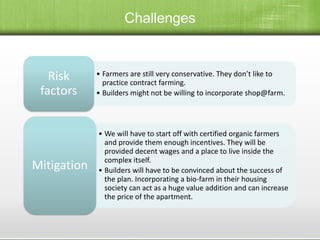
Challenges
• Farmers are still very conservative. They don’t like to
practice contract farming.
• Builders might not be willing to incorporate shop@farm.
Risk
factors
• We will have to start off with certified organic farmers
and provide them enough incentives. They will be
provided decent wages and a place to live inside the
complex itself.
• Builders will have to be convinced about the success of
the plan. Incorporating a bio-farm in their housing
society can act as a huge value addition and can increase
the price of the apartment.
Mitigation
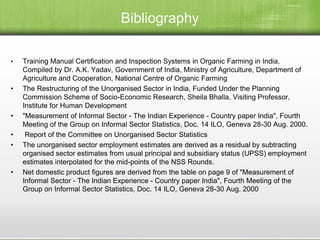
Bibliography
• Training Manual Certification and Inspection Systems in Organic Farming in India,
Compiled by Dr. A.K. Yadav, Government of India, Ministry of Agriculture, Department of
Agriculture and Cooperation, National Centre of Organic Farming
• The Restructuring of the Unorganised Sector in India, Funded Under the Planning
Commission Scheme of Socio-Economic Research, Sheila Bhalla, Visiting Professor,
Institute for Human Development
• "Measurement of Informal Sector - The Indian Experience - Country paper India", Fourth
Meeting of the Group on Informal Sector Statistics, Doc. 14 ILO, Geneva 28-30 Aug. 2000.
• Report of the Committee on Unorganised Sector Statistics
• The unorganised sector employment estimates are derived as a residual by subtracting
organised sector estimates from usual principal and subsidiary status (UPSS) employment
estimates interpolated for the mid-points of the NSS Rounds.
• Net domestic product figures are derived from the table on page 9 of "Measurement of
Informal Sector - The Indian Experience - Country paper India", Fourth Meeting of the
Group on Informal Sector Statistics, Doc. 14 ILO, Geneva 28-30 Aug. 2000

Pathbreakers

  • 1.
    Shop@Farm Utkarsh Bagri Ahsen Parwez DeepakChoudhary Shilpa Jaiswal Riya Khurana
  • 2.
    Problem Faced BySmall Land Holding Farmers • Organised Agriculture has about 0.35% Shares in Employment and about 1.08% Shares in Net Domestic Product • Agriculture and forestry has 63.9% of Share of Unorganised Sector in terms of labour input • No. of Farmers under Organic certification – Process Full organic 351297 – In-conversion 246576 Total 597873 • Only 10-15% of profit goes to farmers. Heavily unorganized sector Unaware of legal certifications Poor domestic market Small profit margin Problems
  • 3.
    Problems Faced ByUrban Population • Unavailability of Organic Vegetables – Most vegetables artificially produced, with high content of fertilizers and pesticides – Organic products unavailable or scarce – Time constraint for people to visit vegetable market • Land Usability and Maintenance: - Every residential township has to allot certain percentage of land as free space. - Free space starts of as park or garden but turns into a dump-yard due to lack of maintenance. • Unhygienic Subji-Mandis 533 million in 2025- 468 million in 2020 360 million in 2010 0 10 20 30 40 Karnataka Rajasthan Gujrat Madhya Pradesh Tamil Nadu IJEIT Recommedation ITPI Recommendation Min % of Open Space recommended in Urban Townships • Increase in Urban Immigrants from rural areas - Unemployment and lack of facilities Urban Population
  • 4.
    Organic Landscape ofIndia 0 500,000 1,000,000 1,500,000 2003-042004-052005-06 2006-07 2007-08 2008-09 2009-10 Area under Organic management (in Ha)
  • 5.
    Solution •Provide safe andfresh organic vegetables. •Cultivate vegetables in front of customers and pluck them directly from farm. •Ensure financial and technical help to farmers who switch to organic farming. Aim •We will employ certified organic farmers to cultivate on farm land which is basically the free space within the residential complex. •Since the produce from this farm will be insufficient to meet the demands of all the residents, we’ll also outsource vegetables produced organically on farms located on city outskirts. •These vegetables will be sold in retail stores located inside the residential complex under organic section, with minimum margin. Implementaion •Premium vegetables: Customers have an option to pluck vegetables directly from farm on payment of premium charges. •Outsourced vegetables are sold with minimum margin so as to provide maximum profit to farmers. •Residents will be ensured on the quality of products. •We can very easily provide free home delivery as retail stores will be in the same residential complex. Features
  • 6.
    Working And Sustainability -Generating domesticmarket to organic farmers -Providing legal awareness (like NPOP certification) to farmers -Zero transportation and thus more profit margins -Organises Farming Sector -Social security Rural Farmers - Marginal Profit from Sale of Products. -Major Profit form Premium Charged products grown in Shop@farm. - Revenue from Premium products spent on providing organic certification to farmers, logistics & operational charges Shop @ Farm -Availability of organic products at much cheaper price. - Premium Charges for “Hand-Pluck” fresh vegetables. -Free of cost maintenance of Public and Society parks -Shop@farm as a refreshment bio-park - Freedom from crowded Subji-mandi Urban Population Premium Charges Products Certification Products
  • 7.
    Phase-III - We haveto ensure that organic certifications to farmers cultivating in small fields on city outskirts whose products we have been outsourcing for sale in our retail stores. - We have to obtain organic certification for all our farms established inside residential complexes. Phase-II -We plan to extend to other townships like academic institutions (IITs or Sainik Schools), hospitals etc which have quite a lot of unutilized land. -We aim for a catchment area of 4 sq km, spread on an acre with a potential customer base of 38,000 customers. -We will have an e-Window for our retail store. Phase- I - Acquire 4000 sq feet land for farming - Mainly free spaces in residential townships and societies. - Employ local organic farmer for in farm production of premium vegetables. - Outsourcing organic products from outskirts. Scalability
  • 8.
    Funds Management Totalfunding required Organisation Cost Salaries Marketing & Promotion Operational Expenses LogisticsCost Buildings Transportation Technology cost Hardware & Equipment Seeding 4,76,000 INR Per Annum 12,00,000 INR Per Annum 2,00,000 INR Per Annum We require funding only in phase one of our operation. During this period, we will be working on two or three farms. After this, we will enter in start making profit, thus attaining self-sustainability.
  • 9.
    Organizational Structure Central Management Chief Executive Officer Finance Marketing team Legal Dept HR Outreach Team ZonalManagement Team Zonal Head Finance (accounting and fund allocaion) Recruitment Team (Employing Organic Farmers) Marketing Team (Reaching Builders) Sector Incharge Venue Coordinators Manager, supply- chain of outsourced goods Manager, retail outlet Manager, organic certifications of locals
  • 10.
    Challenges • Farmers arestill very conservative. They don’t like to practice contract farming. • Builders might not be willing to incorporate shop@farm. Risk factors • We will have to start off with certified organic farmers and provide them enough incentives. They will be provided decent wages and a place to live inside the complex itself. • Builders will have to be convinced about the success of the plan. Incorporating a bio-farm in their housing society can act as a huge value addition and can increase the price of the apartment. Mitigation
  • 11.
    Bibliography • Training ManualCertification and Inspection Systems in Organic Farming in India, Compiled by Dr. A.K. Yadav, Government of India, Ministry of Agriculture, Department of Agriculture and Cooperation, National Centre of Organic Farming • The Restructuring of the Unorganised Sector in India, Funded Under the Planning Commission Scheme of Socio-Economic Research, Sheila Bhalla, Visiting Professor, Institute for Human Development • "Measurement of Informal Sector - The Indian Experience - Country paper India", Fourth Meeting of the Group on Informal Sector Statistics, Doc. 14 ILO, Geneva 28-30 Aug. 2000. • Report of the Committee on Unorganised Sector Statistics • The unorganised sector employment estimates are derived as a residual by subtracting organised sector estimates from usual principal and subsidiary status (UPSS) employment estimates interpolated for the mid-points of the NSS Rounds. • Net domestic product figures are derived from the table on page 9 of "Measurement of Informal Sector - The Indian Experience - Country paper India", Fourth Meeting of the Group on Informal Sector Statistics, Doc. 14 ILO, Geneva 28-30 Aug. 2000