Rajesh Kumar MBA-Agribusiness(btach2009) College of agribusiness management ,GBPUA&T, pantnagar ORGANIC FARMING
CONTENT Introduction Farming type (1)Chemical farming (2)Organic farming Organic farming   (1) objective (2) Principles (3)Components (4)Comparative advantage & advantage of OF. Statistical data(India & world) Constellation of organic farming conclusion
FARMING TYPES Mainly two types of Farming  Chemical Farming Organic Farming Q.Why Organic Farming 1-To restore our natural resources. 2-To safeguard our environment. 3-And to obtain pesticide-residue free vegetables, fruits, spices and other commodities. Organic or ecological farming has been observed to be feasible in the long run in terms of soil fertility, stability of crop yields and economy.
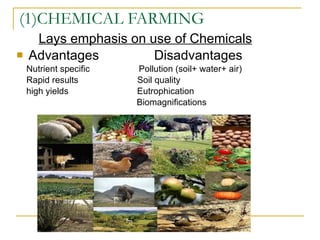
(1)CHEMICAL FARMING Lays emphasis on use of Chemicals Advantages  Disadvantages Nutrient specific   Pollution (soil+ water+ air) Rapid results   Soil quality high yields  Eutrophication  Biomagnifications
(2) ORGANIC FARMING Objective of Organic Farming:- International federation of organic agriculture movement (IFOAM) 1:-To provide food of high quality in sufficient quantity. 2:-To work within natural system and cycles. 3:-To encourage and enhance biological cycles involving micro-organism,soil flora and fauna,plant and animals. 4:-To promote the sustainable use of natural resources. 5:-To maintain and increase the soil fertility for long term.
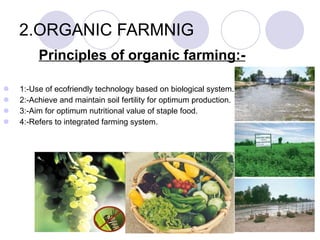
2.ORGANIC FARMNIG Principles of organic farming:- 1:-Use of ecofriendly technology based on biological system. 2:-Achieve and maintain soil fertility for optimum production. 3:-Aim for optimum nutritional value of staple food. 4:-Refers to integrated farming system.
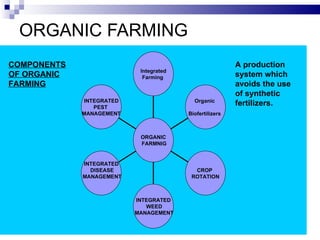
ORGANIC FARMING COMPONENTS OF ORGANIC FARMING A production system which avoids the use of synthetic fertilizers.  INTEGRATED PEST  MANAGEMENT INTEGRATED DISEASE MANAGEMENT INTEGRATED WEED MANAGEMENT CROP  ROTATION Organic  Biofertilizers  Integrated Farming  ORGANIC FARMNIG
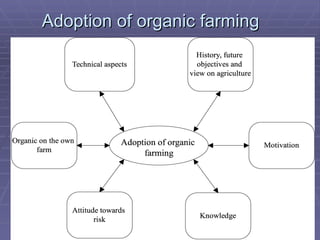
Adoption of organic farming
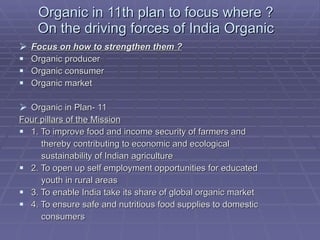
Organic in 11th plan to focus where ? On the driving forces of India Organic Focus on how to strengthen them ? Organic producer Organic consumer Organic market Organic in Plan- 11 Four pillars of the Mission 1. To improve food and income security of farmers and thereby contributing to economic and ecological sustainability of Indian agriculture 2. To open up self employment opportunities for educated youth in rural areas 3. To enable India take its share of global organic market 4. To ensure safe and nutritious food supplies to domestic consumers
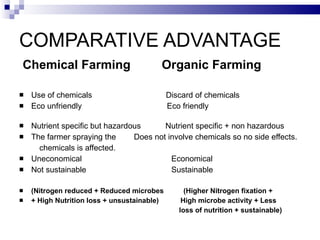
COMPARATIVE ADVANTAGE Chemical Farming  Organic Farming  Use of chemicals  Discard of chemicals Eco unfriendly  Eco friendly  Nutrient specific but hazardous  Nutrient specific + non hazardous The farmer spraying the  Does not involve chemicals so no side effects. chemicals is affected. Uneconomical  Economical Not sustainable  Sustainable (Nitrogen reduced + Reduced microbes  (Higher Nitrogen fixation +  + High Nutrition loss + unsustainable)  High microbe activity + Less loss of nutrition + sustainable)
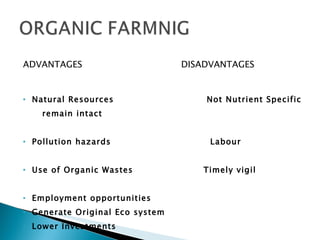
ADVANTAGES  DISADVANTAGES Natural Resources  Not Nutrient Specific remain intact Pollution hazards  Labour Use of Organic Wastes  Timely vigil Employment opportunities Generate Original Eco system Lower Investments
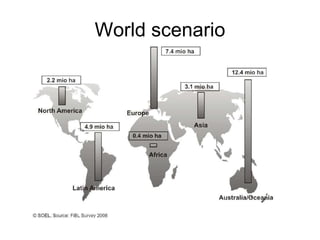
World scenario
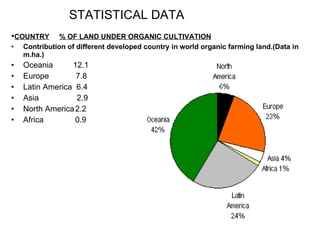
STATISTICAL DATA • COUNTRY   % OF LAND UNDER ORGANIC CULTIVATION Contribution of different developed country in world organic farming land.(Data in m.ha.) Oceania  12.1 Europe  7.8  Latin America  6.4 Asia  2.9 North America 2.2 Africa 0.9  
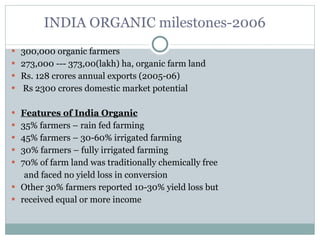
INDIA ORGANIC milestones-2006 300,000 organic farmers 273,000 --- 373,00(lakh) ha, organic farm land Rs. 128 crores annual exports (2005-06) Rs 2300 crores domestic market potential Features of India Organic 35% farmers – rain fed farming 45% farmers – 30-60% irrigated farming 30% farmers – fully irrigated farming 70% of farm land was traditionally chemically free and faced no yield loss in conversion Other 30% farmers reported 10-30% yield loss but received equal or more income
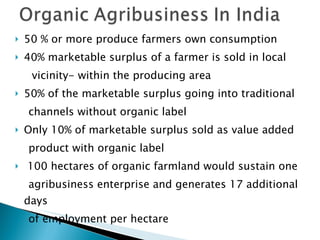
50 % or more produce farmers own consumption 40% marketable surplus of a farmer is sold in local vicinity- within the producing area 50% of the marketable surplus going into traditional channels without organic label Only 10% of marketable surplus sold as value added product with organic label 100 hectares of organic farmland would sustain one agribusiness enterprise and generates 17 additional days of employment per hectare
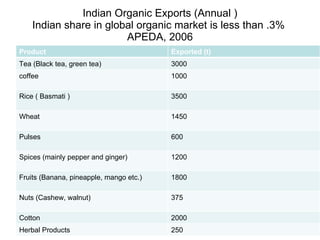
Indian Organic Exports (Annual ) Indian share in global organic market is less than .3%  APEDA, 2006 Product Exported (t) Tea (Black tea, green tea) 3000 coffee 1000 Rice ( Basmati ) 3500 Wheat 1450 Pulses 600 Spices (mainly pepper and ginger) 1200 Fruits (Banana, pineapple, mango etc.) 1800 Nuts (Cashew, walnut) 375 Cotton 2000 Herbal Products 250
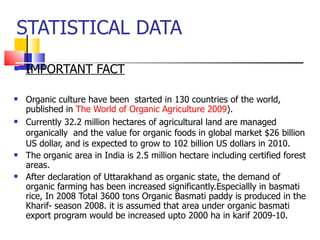
STATISTICAL DATA IMPORTANT FACT Organic culture have been  started in 130 countries of the world, published in  The World of Organic Agriculture 2009 ). Currently 32.2 million hectares of agricultural land are managed organically  and the value for organic foods in global market $26 billion US dollar, and is expected to grow to 102 billion US dollars in 2010.  The organic area in India is 2.5 million hectare including certified forest areas. After declaration of Uttarakhand as organic state, the demand of organic farming has been increased significantly.Especiallly in basmati rice, In 2008 Total 3600 tons Organic Basmati paddy is produced in the Kharif- season 2008. it is assumed that area under organic basmati export program would be increased upto 2000 ha in karif 2009-10.
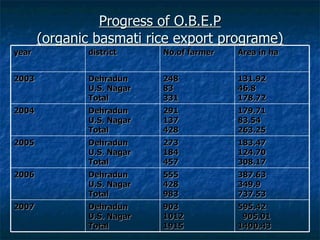
Progress of O.B.E.P (organic basmati rice export programe) year district No.of farmer Area in ha 2003 Dehradun U.S. Nagar Total  248 83 331 131.92 46.8 178.72 2004 Dehradun U.S. Nagar Total  291 137 428  179.71 83.54 263.25  2005 Dehradun U.S. Nagar Total  273 184 457  183.47 124.70 308.17 2006 Dehradun U.S. Nagar Total  555 428  983  387.63 349.9  737.53 2007 Dehradun U.S. Nagar Total  903 1012  1915  595.42   905.01  1400.43
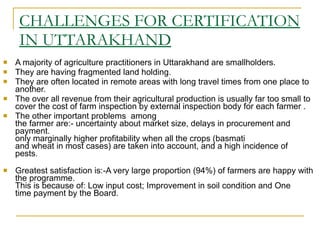
CHALLENGES FOR CERTIFICATION IN UTTARAKHAND A majority of agriculture practitioners in Uttarakhand are smallholders.  They are having fragmented land holding.  They are often located in remote areas with long travel times from one place to another. The over all revenue from their agricultural production is usually far too small to cover the cost of farm inspection by external inspection body for each farmer . The other important problems  among the farmer are:- uncertainty about market size, delays in procurement and payment. only marginally higher profitability when all the crops (basmati and wheat in most cases) are taken into account, and a high incidence of pests. Greatest satisfaction is:-A very large proportion (94%) of farmers are happy with the programme. This is because of: Low input cost; Improvement in soil condition and One time payment by the Board.
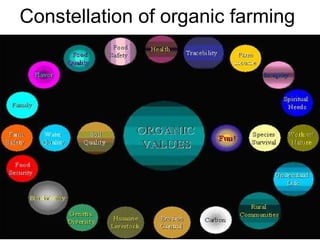
Constellation of organic farming
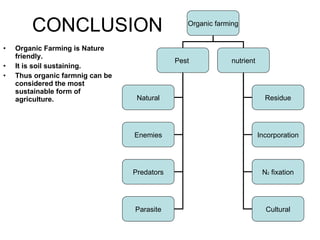
CONCLUSION Organic Farming is Nature friendly. It is soil sustaining. Thus organic farmnig can be considered the most sustainable form of agriculture. Organic farming Pest  nutrient Natural Enemies Predators Parasite Residue Incorporation N 2  fixation Cultural
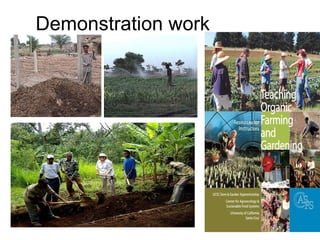
Demonstration work
Thank you….. Have a nice day…..

Rajesh(Organic Farmin Presentation)

  • 1.
    Rajesh Kumar MBA-Agribusiness(btach2009)College of agribusiness management ,GBPUA&T, pantnagar ORGANIC FARMING
  • 2.
    CONTENT Introduction Farmingtype (1)Chemical farming (2)Organic farming Organic farming (1) objective (2) Principles (3)Components (4)Comparative advantage & advantage of OF. Statistical data(India & world) Constellation of organic farming conclusion
  • 3.
    FARMING TYPES Mainlytwo types of Farming Chemical Farming Organic Farming Q.Why Organic Farming 1-To restore our natural resources. 2-To safeguard our environment. 3-And to obtain pesticide-residue free vegetables, fruits, spices and other commodities. Organic or ecological farming has been observed to be feasible in the long run in terms of soil fertility, stability of crop yields and economy.
  • 4.
    (1)CHEMICAL FARMING Laysemphasis on use of Chemicals Advantages Disadvantages Nutrient specific Pollution (soil+ water+ air) Rapid results Soil quality high yields Eutrophication Biomagnifications
  • 5.
    (2) ORGANIC FARMINGObjective of Organic Farming:- International federation of organic agriculture movement (IFOAM) 1:-To provide food of high quality in sufficient quantity. 2:-To work within natural system and cycles. 3:-To encourage and enhance biological cycles involving micro-organism,soil flora and fauna,plant and animals. 4:-To promote the sustainable use of natural resources. 5:-To maintain and increase the soil fertility for long term.
  • 6.
    2.ORGANIC FARMNIG Principlesof organic farming:- 1:-Use of ecofriendly technology based on biological system. 2:-Achieve and maintain soil fertility for optimum production. 3:-Aim for optimum nutritional value of staple food. 4:-Refers to integrated farming system.
  • 7.
    ORGANIC FARMING COMPONENTSOF ORGANIC FARMING A production system which avoids the use of synthetic fertilizers. INTEGRATED PEST MANAGEMENT INTEGRATED DISEASE MANAGEMENT INTEGRATED WEED MANAGEMENT CROP ROTATION Organic Biofertilizers Integrated Farming ORGANIC FARMNIG
  • 8.
  • 9.
    Organic in 11thplan to focus where ? On the driving forces of India Organic Focus on how to strengthen them ? Organic producer Organic consumer Organic market Organic in Plan- 11 Four pillars of the Mission 1. To improve food and income security of farmers and thereby contributing to economic and ecological sustainability of Indian agriculture 2. To open up self employment opportunities for educated youth in rural areas 3. To enable India take its share of global organic market 4. To ensure safe and nutritious food supplies to domestic consumers
  • 10.
    COMPARATIVE ADVANTAGE ChemicalFarming Organic Farming Use of chemicals Discard of chemicals Eco unfriendly Eco friendly Nutrient specific but hazardous Nutrient specific + non hazardous The farmer spraying the Does not involve chemicals so no side effects. chemicals is affected. Uneconomical Economical Not sustainable Sustainable (Nitrogen reduced + Reduced microbes (Higher Nitrogen fixation + + High Nutrition loss + unsustainable) High microbe activity + Less loss of nutrition + sustainable)
  • 11.
    ADVANTAGES DISADVANTAGESNatural Resources Not Nutrient Specific remain intact Pollution hazards Labour Use of Organic Wastes Timely vigil Employment opportunities Generate Original Eco system Lower Investments
  • 12.
  • 13.
    STATISTICAL DATA •COUNTRY % OF LAND UNDER ORGANIC CULTIVATION Contribution of different developed country in world organic farming land.(Data in m.ha.) Oceania 12.1 Europe 7.8 Latin America 6.4 Asia 2.9 North America 2.2 Africa 0.9  
  • 14.
    INDIA ORGANIC milestones-2006300,000 organic farmers 273,000 --- 373,00(lakh) ha, organic farm land Rs. 128 crores annual exports (2005-06) Rs 2300 crores domestic market potential Features of India Organic 35% farmers – rain fed farming 45% farmers – 30-60% irrigated farming 30% farmers – fully irrigated farming 70% of farm land was traditionally chemically free and faced no yield loss in conversion Other 30% farmers reported 10-30% yield loss but received equal or more income
  • 15.
    50 % ormore produce farmers own consumption 40% marketable surplus of a farmer is sold in local vicinity- within the producing area 50% of the marketable surplus going into traditional channels without organic label Only 10% of marketable surplus sold as value added product with organic label 100 hectares of organic farmland would sustain one agribusiness enterprise and generates 17 additional days of employment per hectare
  • 16.
    Indian Organic Exports(Annual ) Indian share in global organic market is less than .3% APEDA, 2006 Product Exported (t) Tea (Black tea, green tea) 3000 coffee 1000 Rice ( Basmati ) 3500 Wheat 1450 Pulses 600 Spices (mainly pepper and ginger) 1200 Fruits (Banana, pineapple, mango etc.) 1800 Nuts (Cashew, walnut) 375 Cotton 2000 Herbal Products 250
  • 17.
    STATISTICAL DATA IMPORTANTFACT Organic culture have been started in 130 countries of the world, published in The World of Organic Agriculture 2009 ). Currently 32.2 million hectares of agricultural land are managed organically and the value for organic foods in global market $26 billion US dollar, and is expected to grow to 102 billion US dollars in 2010. The organic area in India is 2.5 million hectare including certified forest areas. After declaration of Uttarakhand as organic state, the demand of organic farming has been increased significantly.Especiallly in basmati rice, In 2008 Total 3600 tons Organic Basmati paddy is produced in the Kharif- season 2008. it is assumed that area under organic basmati export program would be increased upto 2000 ha in karif 2009-10.
  • 18.
    Progress of O.B.E.P(organic basmati rice export programe) year district No.of farmer Area in ha 2003 Dehradun U.S. Nagar Total 248 83 331 131.92 46.8 178.72 2004 Dehradun U.S. Nagar Total 291 137 428 179.71 83.54 263.25 2005 Dehradun U.S. Nagar Total 273 184 457 183.47 124.70 308.17 2006 Dehradun U.S. Nagar Total 555 428 983 387.63 349.9 737.53 2007 Dehradun U.S. Nagar Total 903 1012 1915 595.42   905.01 1400.43
  • 19.
    CHALLENGES FOR CERTIFICATIONIN UTTARAKHAND A majority of agriculture practitioners in Uttarakhand are smallholders. They are having fragmented land holding. They are often located in remote areas with long travel times from one place to another. The over all revenue from their agricultural production is usually far too small to cover the cost of farm inspection by external inspection body for each farmer . The other important problems among the farmer are:- uncertainty about market size, delays in procurement and payment. only marginally higher profitability when all the crops (basmati and wheat in most cases) are taken into account, and a high incidence of pests. Greatest satisfaction is:-A very large proportion (94%) of farmers are happy with the programme. This is because of: Low input cost; Improvement in soil condition and One time payment by the Board.
  • 20.
  • 21.
    CONCLUSION Organic Farmingis Nature friendly. It is soil sustaining. Thus organic farmnig can be considered the most sustainable form of agriculture. Organic farming Pest nutrient Natural Enemies Predators Parasite Residue Incorporation N 2 fixation Cultural
  • 22.
  • 23.
    Thank you….. Havea nice day…..