PASTERN
ARTHRODESIS
Dane Tatarniuk, DVM
SIGNALMENT
 Presenting complaint: Chronic left forelimb lameness
 20 years old
 Percheron / Quarter horse
 Mare
 Current use: Retired
HISTORY
 Chronic left forelimb lameness
 First noted October of 2011, attended by DVM #1
    Recommendations: Rest, NSAIDs

 Lameness did not improve, slowly worsened.
 Evaluated by DVM #2 in April of 2012.
    Diagnosed straight sesamoidean desmitis by ultrasound.
    Recommendations: Rest, NSAIDs, Stem cell therapy (offered but not
     performed)
 Has not responded to rest/NSAID therapy; progressively has
  worsened
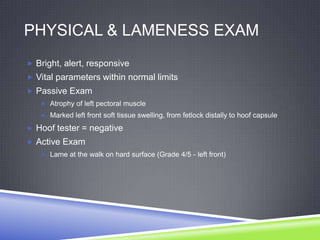
PHYSICAL & LAMENESS EXAM
 Bright, alert, responsive
 Vital parameters within normal limits
 Passive Exam
    Atrophy of left pectoral muscle
    Marked left front soft tissue swelling, from fetlock distally to hoof capsule

 Hoof tester = negative
 Active Exam
    Lame at the walk on hard surface (Grade 4/5 - left front)
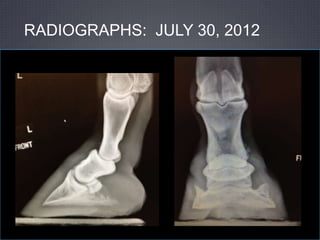
RADIOGRAPHS: JULY 30, 2012
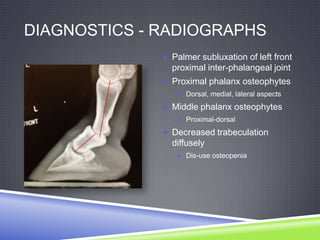
DIAGNOSTICS - RADIOGRAPHS
               Palmer subluxation of left front
                proximal inter-phalangeal joint
               Proximal phalanx osteophytes
                  Dorsal, medial, lateral aspects

               Middle phalanx osteophytes
                  Proximal-dorsal

               Decreased trabeculation
                diffusely
                  Dis-use osteopenia
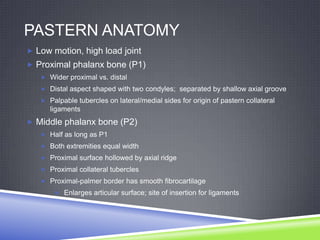
PASTERN ANATOMY
 Low motion, high load joint
 Proximal phalanx bone (P1)
    Wider proximal vs. distal
    Distal aspect shaped with two condyles; separated by shallow axial groove
    Palpable tubercles on lateral/medial sides for origin of pastern collateral
      ligaments
 Middle phalanx bone (P2)
    Half as long as P1
    Both extremities equal width
    Proximal surface hollowed by axial ridge
    Proximal collateral tubercles
    Proximal-palmer border has smooth fibrocartilage
        Enlarges articular surface; site of insertion for ligaments
PASTERN ANATOMY
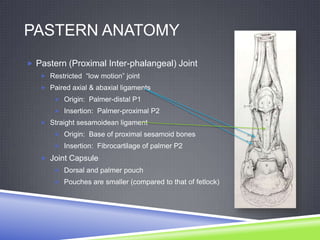
 Pastern (Proximal Inter-phalangeal) Joint
    Restricted “low motion” joint
    Paired axial & abaxial ligaments
        Origin: Palmer-distal P1
        Insertion: Palmer-proximal P2
    Straight sesamoidean ligament
        Origin: Base of proximal sesamoid bones
        Insertion: Fibrocartilage of palmer P2

    Joint Capsule
        Dorsal and palmer pouch
        Pouches are smaller (compared to that of fetlock)
PASTERN ANATOMY
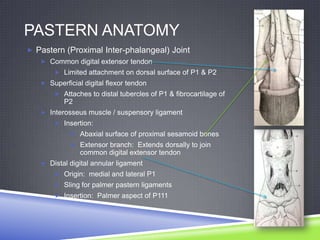
 Pastern (Proximal Inter-phalangeal) Joint
    Common digital extensor tendon
        Limited attachment on dorsal surface of P1 & P2
    Superficial digital flexor tendon
        Attaches to distal tubercles of P1 & fibrocartilage of
          P2
    Interosseus muscle / suspensory ligament
        Insertion:
             Abaxial surface of proximal sesamoid bones
             Extensor branch: Extends dorsally to join
                common digital extensor tendon
    Distal digital annular ligament
        Origin: medial and lateral P1
        Sling for palmer pastern ligaments
        Insertion: Palmer aspect of P111
DIAGNOSTICS - ULTRASOUND
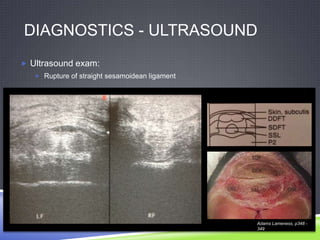
 Ultrasound exam:
    Rupture of straight sesamoidean ligament


                                                Adams Lameness, p348 -
                                                349
TREATMENT OPTIONS
 Non-surgical management:
    Electrical stimulation
    External coaptation with confinement
    Monoiodoacetate
    Ethyl alcohol
    Laser without implants

 Rarely successful – remaining cartilage within joint
 Surgical management:
    Trans-articular lag screws
    Dorsal plate
    Combination dorsal plate & trans-articular lag screws
PASTERN ARTHRODESIS
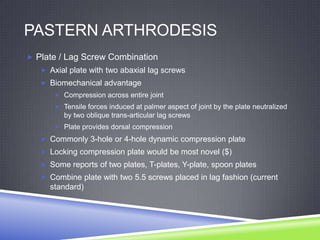
 Plate / Lag Screw Combination
    Axial plate with two abaxial lag screws
    Biomechanical advantage
       Compression across entire joint
       Tensile forces induced at palmer aspect of joint by the plate neutralized
         by two oblique trans-articular lag screws
       Plate provides dorsal compression

    Commonly 3-hole or 4-hole dynamic compression plate
    Locking compression plate would be most novel ($)
    Some reports of two plates, T-plates, Y-plate, spoon plates
    Combine plate with two 5.5 screws placed in lag fashion (current
     standard)
PASTERN ARTHRODESIS
 Lag Technique Only
    Two or three tran-sarticular screws
    Parallel or diverging
    4.5mm screws more likely to fail compared to 5.5mm screws
    Two 5.5mm screws similar strength compared to three 5.5mm screws
    Can be placed using a minimally-invasive (stab incision) approach
    Drawback:
        Minimal compression of dorsal surface
        Discomfort from excessive bone formation impinging on extensor
          tendon and / or coffin joint
SURGICAL TECHNIQUE
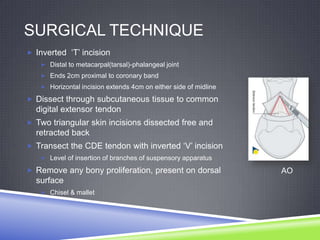
 Inverted „T‟ incision
    Distal to metacarpal(tarsal)-phalangeal joint
    Ends 2cm proximal to coronary band
    Horizontal incision extends 4cm on either side of midline

 Dissect through subcutaneous tissue to common
  digital extensor tendon
 Two triangular skin incisions dissected free and
  retracted back
 Transect the CDE tendon with inverted „V‟ incision
    Level of insertion of branches of suspensory apparatus

 Remove any bony proliferation, present on dorsal               AO
  surface
    Chisel & mallet
SURGICAL TECHNIQUE
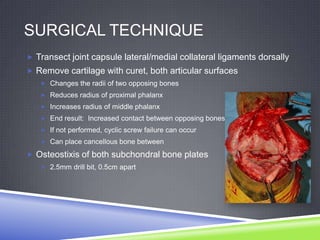
 Transect joint capsule lateral/medial collateral ligaments dorsally
 Remove cartilage with curet, both articular surfaces
    Changes the radii of two opposing bones
    Reduces radius of proximal phalanx
    Increases radius of middle phalanx
    End result: Increased contact between opposing bones
    If not performed, cyclic screw failure can occur
    Can place cancellous bone between

 Osteostixis of both subchondral bone plates
    2.5mm drill bit, 0.5cm apart
SURGICAL TECHNIQUE
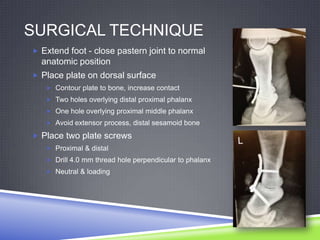
 Extend foot - close pastern joint to normal
  anatomic position
 Place plate on dorsal surface
    Contour plate to bone, increase contact
    Two holes overlying distal proximal phalanx
    One hole overlying proximal middle phalanx
    Avoid extensor process, distal sesamoid bone

 Place two plate screws
    Proximal & distal
    Drill 4.0 mm thread hole perpendicular to phalanx
    Neutral & loading
SURGICAL TECHNIQUE
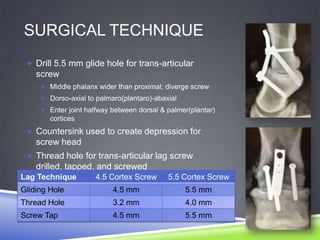
  Drill 5.5 mm glide hole for trans-articular
    screw
      Middle phalanx wider than proximal; diverge screw
      Dorso-axial to palmaro(plantaro)-abaxial
      Enter joint halfway between dorsal & palmer(plantar)
        cortices
  Countersink used to create depression for
    screw head
  Thread hole for trans-articular lag screw
    drilled, tapped, and screwed
Lag Technique         4.5 Cortex Screw      5.5 Cortex Screw
Gliding Hole               4.5 mm                 5.5 mm
Thread Hole                3.2 mm                 4.0 mm
Screw Tap                  4.5 mm                 5.5 mm
SURGICAL TECHNIQUE
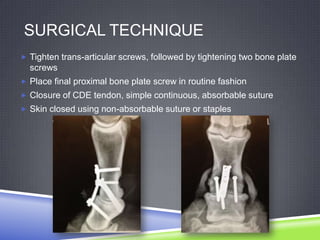
 Tighten trans-articular screws, followed by tightening two bone plate
  screws
 Place final proximal bone plate screw in routine fashion
 Closure of CDE tendon, simple continuous, absorbable suture
 Skin closed using non-absorbable suture or staples
CAST PLACEMENT
 Objectives:
    Placed to protect fixation in recovery
    Support healing of soft tissue structures
    Provide addition fixation / stabilization of the joint

 Placement:
    Foam cast padding
    Stockinet
    Synthetic cast material
        Sets in 5 minutes, allows weight bearing in 30 minutes
        Permeable, yet still resistant to water
    3-4 rolls circumferentially with 50% overlap
    1-2 rolls in dorsal-palmer direction
    Methyl-methacrylate on solar surface
POST OPERATIVE CARE
 ¼ tube omeprazole, SID, PO
 Phenylbutazone
    Varies depending on comfort level
    Mostly - 1 gram phenylbutazone, BID, PO
    Occasionally – 2 grams phenylbutazone in AM, 1 gram in PM, PO

 Twice daily physical examinations
 Check cast / check bandage splint Q6hr
 Monitor weight bearing, up/down Q1hr
POST OPERATIVE CARE
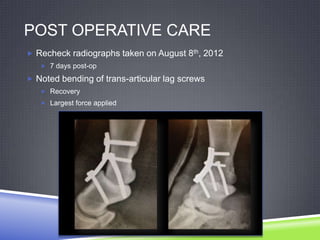
 Recheck radiographs taken on August 8th, 2012
    7 days post-op

 Noted bending of trans-articular lag screws
    Recovery
    Largest force applied
POST OPERATIVE CARE
 First cast change on August 28th, 2012
    Under general anesthesia

 Sutures removed from incision
    Appeared healthy

 Cast sores
    Moderate cast sore noted on the palmer fetlock
    Mild, superficial sore on the dorsal proximal cannon bone
    Silver sulfadiazine applied prior to second cast placement

 Recovery from anesthesia unremarkable
 Recheck radiographs – no change in screw bending
CAST MANAGEMENT
 Cast Sores
    Dorsal-Proximal aspect of metacarpus / metatarsus III
        Compression at breakover or cast loosening
    Palmer / plantar aspect of fetlock; abaxial sesamoid
        Pressure applied during stance / load phase

 Signs
    Decreased weight bearing
    Suppuration through cast (flies)
    Swelling above cast
    Increased heat on palpation

 May necessitate early cast removal
 Other cast complications
    Breakage, osteopenia, joint stiffness, tendon laxity
POST OPERATIVE CARE
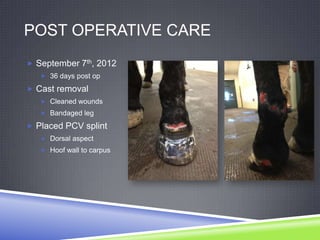
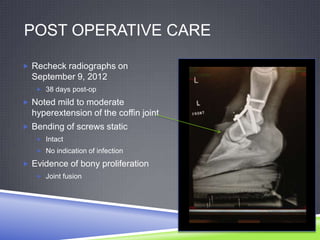
 September 7th, 2012
    36 days post op

 Cast removal
    Cleaned wounds
    Bandaged leg

 Placed PCV splint
    Dorsal aspect
    Hoof wall to carpus
POST OPERATIVE CARE

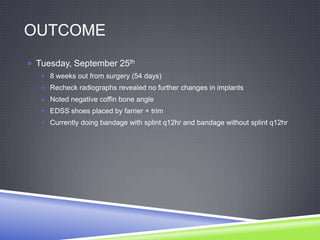
 Recheck radiographs on
  September 9, 2012
    38 days post-op

 Noted mild to moderate
  hyperextension of the coffin joint
 Bending of screws static
    Intact
    No indication of infection

 Evidence of bony proliferation
    Joint fusion
OUTCOME
 Tuesday, September 25th
    8 weeks out from surgery (54 days)
    Recheck radiographs revealed no further changes in implants
    Noted negative coffin bone angle
    EDSS shoes placed by farrier + trim
    Currently doing bandage with splint q12hr and bandage without splint q12hr
REHABILITATION
 Confine horse to stall rest
    Minimum 3 months

 Hand-walking is sometimes considered at 6 weeks post-op
 Small paddock turn-out following stall rest
    Additional 3 months

 Return to exercise / intended use
    Considered at 6 months post-op, in most cases

 Time from surgery to return to use ranges from 6 to 12 months
PROGNOSIS
 Success rates, forelimbs: 50 to 86%
 Success rates, hindlimbs: 80 to 95%
 Combining studies, overall success rate is 78%
 Complications reduce prognosis
    Post-operative pain
    Cast sores
    Incisional infections
    Implant infections
    Construct failure
    Distal inter-phalangeal joint pathology
    Support limb laminitis
LITERATURE
 “Proximal interphalangeal joint arthrodesis using a combination
  plate-screw technique in 53 horses.” Knox et al. 2006
    47% osteoarthritis
    21% joint luxation
    13% subchondral bone cysts
    11% fractures

 60% had 3 hole DCP, 32% had 4 hole DCP
 93% wore cast for 14 days or less, only one cast applied
 11% experienced cast sores on dorsal MC3/MT3 & back of fetlock
 Median hospitalization duration 25 days
LITERATURE
 Knox et al, continued.
 87% used for intended use
    81% forelimb
    95% hindlimb

 18% developed implant infections
    Enterbacter, Streptococcus, Staphylococcus, Pseudomonas
    7% had implants removed

 PIP joint degeneration pre-op not predictive of post-op success
 Early cast removal: shorter hospitalization, improved comfort; but
  increased cyclic load on implants
LITERATURE
 “A Technique for Laser-Facilitated Equine Pastern Arthrodesis
  Using Parallel Screws Inserted in Lag Fashion.” Watts et al,
  2010.
    Sample size = 7 joints
    Diode laser, 2000 J of energy to joint
    3 parallel 5.5mm lag screws
    Lag screws placed using stab incisions (minimally invasive)
    Bandage or bandage casts for 3 weeks
    Turn-out by 3 months

 Results: at 6 months
    5 horses sound
    4 horses with radiographic evidence of joint fusion
    5 horses returned to intended use
    2 horses with lameness / did not return to previous use
LITERATURE
 Watts et al, continued.
 Laser – vaporization of synovial fluid, chondrocyte death
 Heating – collagen contraction, joint capsule shrinking
 Decrease nerve innervation
 Decreased cost, decreased post-operative pain
 1 horse had soft tissue necrosis at site of needle-laser insertion
 More dorsal peri-articular bone formation
 Further investigations:
    Histopathology of cartilage / ankylosis after laser
    Determine optimal laser dose
LITERATURE
 “Minimally invasive plate fixation of lower limb injury in horses: 32
  cases” James et. al, 2006
 Articular cartilage removed using 5.5mm drill bit
 Stab incision to place tran-sarticular lag screws
 Small incision made over mid-P1, 3 cm length, proximal aspect of
  site
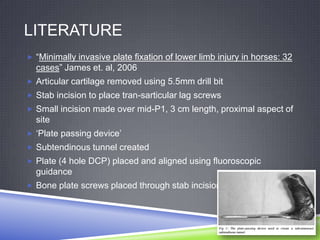
 „Plate passing device‟
 Subtendinous tunnel created
 Plate (4 hole DCP) placed and aligned using fluoroscopic
  guidance
 Bone plate screws placed through stab incisions
LITERATURE
 James et al., continued.
 5 joints treated for PIP arthrodesis
    All hindlimbs treated

 All 5 returned to previous function
 Decreases post-op pain, decreases post-operative hospitalization
 Maintaining soft tissue envelope decreases risk of infection
    Decreased exposure to OR air, surgical field contamination
    Increased tissue handling & tissue dehydration decreases tissue immunity

 Doubling of infection rate with each hour of surgery
 Less complete cartilage destruction?
LITERATURE
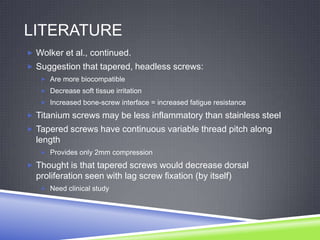
 “Arthrodesis of the Equine Proximal Interphalangeal Joint: A
  biomechanical comparison of two parallel headless, tapered,
  variable-pitched, titanium compression screws and two parallel
  5.5 mm stainless-steel cortical screws” Wolker et al., 2009.
 Cadaver limbs, 10 each group
 3-point bending materials-testing machine
    Force applied in dorsal-palmer direction
    Measured maximal bending moment at time of failure & composite stiffness

 No biomechanical difference between two screw types
 1 horse in tapered group had failure at screws
    Rest in study failed at bone, not screw
LITERATURE
 Wolker et al., continued.
 Suggestion that tapered, headless screws:
    Are more biocompatible
    Decrease soft tissue irritation
    Increased bone-screw interface = increased fatigue resistance

 Titanium screws may be less inflammatory than stainless steel
 Tapered screws have continuous variable thread pitch along
  length
    Provides only 2mm compression

 Thought is that tapered screws would decrease dorsal
  proliferation seen with lag screw fixation (by itself)
    Need clinical study
LITERATURE
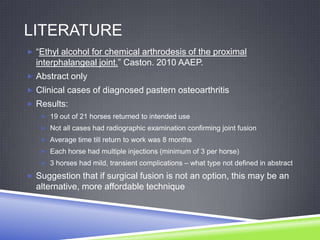
 “Ethyl alcohol for chemical arthrodesis of the proximal
  interphalangeal joint.” Caston. 2010 AAEP.
 Abstract only
 Clinical cases of diagnosed pastern osteoarthritis
 Results:
    19 out of 21 horses returned to intended use
    Not all cases had radiographic examination confirming joint fusion
    Average time till return to work was 8 months
    Each horse had multiple injections (minimum of 3 per horse)
    3 horses had mild, transient complications – what type not defined in abstract

 Suggestion that if surgical fusion is not an option, this may be an
  alternative, more affordable technique
LITERATURE
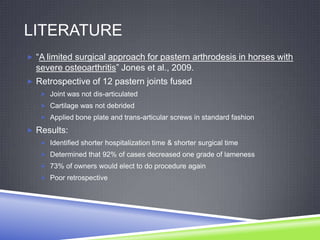
 “A limited surgical approach for pastern arthrodesis in horses with
  severe osteoarthritis” Jones et al., 2009.
 Retrospective of 12 pastern joints fused
    Joint was not dis-articulated
    Cartilage was not debrided
    Applied bone plate and trans-articular screws in standard fashion

 Results:
    Identified shorter hospitalization time & shorter surgical time
    Determined that 92% of cases decreased one grade of lameness
    73% of owners would elect to do procedure again
    Poor retrospective
LITERATURE
 “Distal limb cast sores in horses: Risk factors and early detection
  using thermography” Levet et al., 2009.
 Prospective analysis: 70 horses
    Superficial dermal sore / deep dermal sore / full thickness sore
    Thermography prior to cast removal at coolest site, dorsal cannon bone, and
      palmer/plantar fetlock
 Results:
    80% had superficial dermal sore
    34% had deep dermal sore
    1% had full thickness sore

 No influence of type of injury, clipped skin,
 Incidence increased with duration of cast and age of horse
LITERATURE
 Levet et al., continued.
 Cosmetic blemish
    5% - alopecia, leukotrichia, or scar

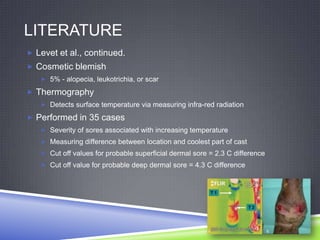
 Thermography
    Detects surface temperature via measuring infra-red radiation

 Performed in 35 cases
    Severity of sores associated with increasing temperature
    Measuring difference between location and coolest part of cast
    Cut off values for probable superficial dermal sore = 2.3 C difference
    Cut off value for probable deep dermal sore = 4.3 C difference
REFERENCES
 Auer JA: Arthrodesis techniques, in Auer JA, Stick JA (eds): Equine Surgery (ed 4).
    Philadelphia, PA, WB Saunders, 2006, pp 1073–1086
   Johnson JE: Ringbone: treatment by ankylosis. Proc Am Assoc Equine Pract 20:67–80, 1974
   Knox, P.M. and Watkins, J.P. (2006) Proximal interphalangeal joint arthrodesis using a
    combination plate-screw technique in 53 horses (1994-2003). Equine vet. J. 38, 538-542.
   MacLellan, K., Crawford, W.H. and MacDonald, D.G. (2001) Proximal interphalangeal joint
    arthrodesis in 34 horses using two parallel 5.5-mm cortical bone screws. Vet. Surg. 30, 454-
    459.
   Read EK, Chandler D, Wilson DG: Arthrodesis of the equine proximal interphalangeal joint: a
    mechanical comparison of 2 parallel 5.5 mm cortical screws and 3 parallel 5.5 mm cortical
    screws. Vet Surg 34:142–147, 2005
   Schaer, T.P., Bramlage, L.R., Embertson, R.M. and Hance, S. (2001) Proximal interphalangeal
    arthrodesis in 22 horses. Equine vet. J. 33, 360-365.
   Stashak TS: The Pastern, in Stashak TS (ed): Adams‟ Lame- ness in Horses (ed 5).
    Philadelphia, PA, Lippincott, Wil- liams & Wilkins, 2002, pp 733–741
   Watt BC, Edwards RB, Markel MD, et al: Arthrodesis of the equine proximal interphalangeal
    joint: a biomechanical comparison of three 4.5mm and two 5.5mm cortical screws. Vet Surg
    30:287–294, 2001

Pastern Arthrodesis

  • 1.
  • 2.
    SIGNALMENT  Presenting complaint:Chronic left forelimb lameness  20 years old  Percheron / Quarter horse  Mare  Current use: Retired
  • 3.
    HISTORY  Chronic leftforelimb lameness  First noted October of 2011, attended by DVM #1  Recommendations: Rest, NSAIDs  Lameness did not improve, slowly worsened.  Evaluated by DVM #2 in April of 2012.  Diagnosed straight sesamoidean desmitis by ultrasound.  Recommendations: Rest, NSAIDs, Stem cell therapy (offered but not performed)  Has not responded to rest/NSAID therapy; progressively has worsened
  • 4.
    PHYSICAL & LAMENESSEXAM  Bright, alert, responsive  Vital parameters within normal limits  Passive Exam  Atrophy of left pectoral muscle  Marked left front soft tissue swelling, from fetlock distally to hoof capsule  Hoof tester = negative  Active Exam  Lame at the walk on hard surface (Grade 4/5 - left front)
  • 5.
  • 6.
    DIAGNOSTICS - RADIOGRAPHS  Palmer subluxation of left front proximal inter-phalangeal joint  Proximal phalanx osteophytes  Dorsal, medial, lateral aspects  Middle phalanx osteophytes  Proximal-dorsal  Decreased trabeculation diffusely  Dis-use osteopenia
  • 7.
    PASTERN ANATOMY  Lowmotion, high load joint  Proximal phalanx bone (P1)  Wider proximal vs. distal  Distal aspect shaped with two condyles; separated by shallow axial groove  Palpable tubercles on lateral/medial sides for origin of pastern collateral ligaments  Middle phalanx bone (P2)  Half as long as P1  Both extremities equal width  Proximal surface hollowed by axial ridge  Proximal collateral tubercles  Proximal-palmer border has smooth fibrocartilage  Enlarges articular surface; site of insertion for ligaments
  • 8.
    PASTERN ANATOMY  Pastern(Proximal Inter-phalangeal) Joint  Restricted “low motion” joint  Paired axial & abaxial ligaments  Origin: Palmer-distal P1  Insertion: Palmer-proximal P2  Straight sesamoidean ligament  Origin: Base of proximal sesamoid bones  Insertion: Fibrocartilage of palmer P2  Joint Capsule  Dorsal and palmer pouch  Pouches are smaller (compared to that of fetlock)
  • 9.
    PASTERN ANATOMY  Pastern(Proximal Inter-phalangeal) Joint  Common digital extensor tendon  Limited attachment on dorsal surface of P1 & P2  Superficial digital flexor tendon  Attaches to distal tubercles of P1 & fibrocartilage of P2  Interosseus muscle / suspensory ligament  Insertion:  Abaxial surface of proximal sesamoid bones  Extensor branch: Extends dorsally to join common digital extensor tendon  Distal digital annular ligament  Origin: medial and lateral P1  Sling for palmer pastern ligaments  Insertion: Palmer aspect of P111
  • 10.
    DIAGNOSTICS - ULTRASOUND Ultrasound exam:  Rupture of straight sesamoidean ligament Adams Lameness, p348 - 349
  • 11.
    TREATMENT OPTIONS  Non-surgicalmanagement:  Electrical stimulation  External coaptation with confinement  Monoiodoacetate  Ethyl alcohol  Laser without implants  Rarely successful – remaining cartilage within joint  Surgical management:  Trans-articular lag screws  Dorsal plate  Combination dorsal plate & trans-articular lag screws
  • 12.
    PASTERN ARTHRODESIS  Plate/ Lag Screw Combination  Axial plate with two abaxial lag screws  Biomechanical advantage  Compression across entire joint  Tensile forces induced at palmer aspect of joint by the plate neutralized by two oblique trans-articular lag screws  Plate provides dorsal compression  Commonly 3-hole or 4-hole dynamic compression plate  Locking compression plate would be most novel ($)  Some reports of two plates, T-plates, Y-plate, spoon plates  Combine plate with two 5.5 screws placed in lag fashion (current standard)
  • 13.
    PASTERN ARTHRODESIS  LagTechnique Only  Two or three tran-sarticular screws  Parallel or diverging  4.5mm screws more likely to fail compared to 5.5mm screws  Two 5.5mm screws similar strength compared to three 5.5mm screws  Can be placed using a minimally-invasive (stab incision) approach  Drawback:  Minimal compression of dorsal surface  Discomfort from excessive bone formation impinging on extensor tendon and / or coffin joint
  • 14.
    SURGICAL TECHNIQUE  Inverted„T‟ incision  Distal to metacarpal(tarsal)-phalangeal joint  Ends 2cm proximal to coronary band  Horizontal incision extends 4cm on either side of midline  Dissect through subcutaneous tissue to common digital extensor tendon  Two triangular skin incisions dissected free and retracted back  Transect the CDE tendon with inverted „V‟ incision  Level of insertion of branches of suspensory apparatus  Remove any bony proliferation, present on dorsal AO surface  Chisel & mallet
  • 15.
    SURGICAL TECHNIQUE  Transectjoint capsule lateral/medial collateral ligaments dorsally  Remove cartilage with curet, both articular surfaces  Changes the radii of two opposing bones  Reduces radius of proximal phalanx  Increases radius of middle phalanx  End result: Increased contact between opposing bones  If not performed, cyclic screw failure can occur  Can place cancellous bone between  Osteostixis of both subchondral bone plates  2.5mm drill bit, 0.5cm apart
  • 16.
    SURGICAL TECHNIQUE  Extendfoot - close pastern joint to normal anatomic position  Place plate on dorsal surface  Contour plate to bone, increase contact  Two holes overlying distal proximal phalanx  One hole overlying proximal middle phalanx  Avoid extensor process, distal sesamoid bone  Place two plate screws  Proximal & distal  Drill 4.0 mm thread hole perpendicular to phalanx  Neutral & loading
  • 17.
    SURGICAL TECHNIQUE Drill 5.5 mm glide hole for trans-articular screw  Middle phalanx wider than proximal; diverge screw  Dorso-axial to palmaro(plantaro)-abaxial  Enter joint halfway between dorsal & palmer(plantar) cortices  Countersink used to create depression for screw head  Thread hole for trans-articular lag screw drilled, tapped, and screwed Lag Technique 4.5 Cortex Screw 5.5 Cortex Screw Gliding Hole 4.5 mm 5.5 mm Thread Hole 3.2 mm 4.0 mm Screw Tap 4.5 mm 5.5 mm
  • 18.
    SURGICAL TECHNIQUE  Tightentrans-articular screws, followed by tightening two bone plate screws  Place final proximal bone plate screw in routine fashion  Closure of CDE tendon, simple continuous, absorbable suture  Skin closed using non-absorbable suture or staples
  • 19.
    CAST PLACEMENT  Objectives:  Placed to protect fixation in recovery  Support healing of soft tissue structures  Provide addition fixation / stabilization of the joint  Placement:  Foam cast padding  Stockinet  Synthetic cast material  Sets in 5 minutes, allows weight bearing in 30 minutes  Permeable, yet still resistant to water  3-4 rolls circumferentially with 50% overlap  1-2 rolls in dorsal-palmer direction  Methyl-methacrylate on solar surface
  • 20.
    POST OPERATIVE CARE ¼ tube omeprazole, SID, PO  Phenylbutazone  Varies depending on comfort level  Mostly - 1 gram phenylbutazone, BID, PO  Occasionally – 2 grams phenylbutazone in AM, 1 gram in PM, PO  Twice daily physical examinations  Check cast / check bandage splint Q6hr  Monitor weight bearing, up/down Q1hr
  • 21.
    POST OPERATIVE CARE Recheck radiographs taken on August 8th, 2012  7 days post-op  Noted bending of trans-articular lag screws  Recovery  Largest force applied
  • 22.
    POST OPERATIVE CARE First cast change on August 28th, 2012  Under general anesthesia  Sutures removed from incision  Appeared healthy  Cast sores  Moderate cast sore noted on the palmer fetlock  Mild, superficial sore on the dorsal proximal cannon bone  Silver sulfadiazine applied prior to second cast placement  Recovery from anesthesia unremarkable  Recheck radiographs – no change in screw bending
  • 23.
    CAST MANAGEMENT  CastSores  Dorsal-Proximal aspect of metacarpus / metatarsus III  Compression at breakover or cast loosening  Palmer / plantar aspect of fetlock; abaxial sesamoid  Pressure applied during stance / load phase  Signs  Decreased weight bearing  Suppuration through cast (flies)  Swelling above cast  Increased heat on palpation  May necessitate early cast removal  Other cast complications  Breakage, osteopenia, joint stiffness, tendon laxity
  • 24.
    POST OPERATIVE CARE September 7th, 2012  36 days post op  Cast removal  Cleaned wounds  Bandaged leg  Placed PCV splint  Dorsal aspect  Hoof wall to carpus
  • 25.
    POST OPERATIVE CARE Recheck radiographs on September 9, 2012  38 days post-op  Noted mild to moderate hyperextension of the coffin joint  Bending of screws static  Intact  No indication of infection  Evidence of bony proliferation  Joint fusion
  • 26.
    OUTCOME  Tuesday, September25th  8 weeks out from surgery (54 days)  Recheck radiographs revealed no further changes in implants  Noted negative coffin bone angle  EDSS shoes placed by farrier + trim  Currently doing bandage with splint q12hr and bandage without splint q12hr
  • 27.
    REHABILITATION  Confine horseto stall rest  Minimum 3 months  Hand-walking is sometimes considered at 6 weeks post-op  Small paddock turn-out following stall rest  Additional 3 months  Return to exercise / intended use  Considered at 6 months post-op, in most cases  Time from surgery to return to use ranges from 6 to 12 months
  • 28.
    PROGNOSIS  Success rates,forelimbs: 50 to 86%  Success rates, hindlimbs: 80 to 95%  Combining studies, overall success rate is 78%  Complications reduce prognosis  Post-operative pain  Cast sores  Incisional infections  Implant infections  Construct failure  Distal inter-phalangeal joint pathology  Support limb laminitis
  • 29.
    LITERATURE  “Proximal interphalangealjoint arthrodesis using a combination plate-screw technique in 53 horses.” Knox et al. 2006  47% osteoarthritis  21% joint luxation  13% subchondral bone cysts  11% fractures  60% had 3 hole DCP, 32% had 4 hole DCP  93% wore cast for 14 days or less, only one cast applied  11% experienced cast sores on dorsal MC3/MT3 & back of fetlock  Median hospitalization duration 25 days
  • 30.
    LITERATURE  Knox etal, continued.  87% used for intended use  81% forelimb  95% hindlimb  18% developed implant infections  Enterbacter, Streptococcus, Staphylococcus, Pseudomonas  7% had implants removed  PIP joint degeneration pre-op not predictive of post-op success  Early cast removal: shorter hospitalization, improved comfort; but increased cyclic load on implants
  • 31.
    LITERATURE  “A Techniquefor Laser-Facilitated Equine Pastern Arthrodesis Using Parallel Screws Inserted in Lag Fashion.” Watts et al, 2010.  Sample size = 7 joints  Diode laser, 2000 J of energy to joint  3 parallel 5.5mm lag screws  Lag screws placed using stab incisions (minimally invasive)  Bandage or bandage casts for 3 weeks  Turn-out by 3 months  Results: at 6 months  5 horses sound  4 horses with radiographic evidence of joint fusion  5 horses returned to intended use  2 horses with lameness / did not return to previous use
  • 32.
    LITERATURE  Watts etal, continued.  Laser – vaporization of synovial fluid, chondrocyte death  Heating – collagen contraction, joint capsule shrinking  Decrease nerve innervation  Decreased cost, decreased post-operative pain  1 horse had soft tissue necrosis at site of needle-laser insertion  More dorsal peri-articular bone formation  Further investigations:  Histopathology of cartilage / ankylosis after laser  Determine optimal laser dose
  • 33.
    LITERATURE  “Minimally invasiveplate fixation of lower limb injury in horses: 32 cases” James et. al, 2006  Articular cartilage removed using 5.5mm drill bit  Stab incision to place tran-sarticular lag screws  Small incision made over mid-P1, 3 cm length, proximal aspect of site  „Plate passing device‟  Subtendinous tunnel created  Plate (4 hole DCP) placed and aligned using fluoroscopic guidance  Bone plate screws placed through stab incisions
  • 34.
    LITERATURE  James etal., continued.  5 joints treated for PIP arthrodesis  All hindlimbs treated  All 5 returned to previous function  Decreases post-op pain, decreases post-operative hospitalization  Maintaining soft tissue envelope decreases risk of infection  Decreased exposure to OR air, surgical field contamination  Increased tissue handling & tissue dehydration decreases tissue immunity  Doubling of infection rate with each hour of surgery  Less complete cartilage destruction?
  • 35.
    LITERATURE  “Arthrodesis ofthe Equine Proximal Interphalangeal Joint: A biomechanical comparison of two parallel headless, tapered, variable-pitched, titanium compression screws and two parallel 5.5 mm stainless-steel cortical screws” Wolker et al., 2009.  Cadaver limbs, 10 each group  3-point bending materials-testing machine  Force applied in dorsal-palmer direction  Measured maximal bending moment at time of failure & composite stiffness  No biomechanical difference between two screw types  1 horse in tapered group had failure at screws  Rest in study failed at bone, not screw
  • 36.
    LITERATURE  Wolker etal., continued.  Suggestion that tapered, headless screws:  Are more biocompatible  Decrease soft tissue irritation  Increased bone-screw interface = increased fatigue resistance  Titanium screws may be less inflammatory than stainless steel  Tapered screws have continuous variable thread pitch along length  Provides only 2mm compression  Thought is that tapered screws would decrease dorsal proliferation seen with lag screw fixation (by itself)  Need clinical study
  • 37.
    LITERATURE  “Ethyl alcoholfor chemical arthrodesis of the proximal interphalangeal joint.” Caston. 2010 AAEP.  Abstract only  Clinical cases of diagnosed pastern osteoarthritis  Results:  19 out of 21 horses returned to intended use  Not all cases had radiographic examination confirming joint fusion  Average time till return to work was 8 months  Each horse had multiple injections (minimum of 3 per horse)  3 horses had mild, transient complications – what type not defined in abstract  Suggestion that if surgical fusion is not an option, this may be an alternative, more affordable technique
  • 38.
    LITERATURE  “A limitedsurgical approach for pastern arthrodesis in horses with severe osteoarthritis” Jones et al., 2009.  Retrospective of 12 pastern joints fused  Joint was not dis-articulated  Cartilage was not debrided  Applied bone plate and trans-articular screws in standard fashion  Results:  Identified shorter hospitalization time & shorter surgical time  Determined that 92% of cases decreased one grade of lameness  73% of owners would elect to do procedure again  Poor retrospective
  • 39.
    LITERATURE  “Distal limbcast sores in horses: Risk factors and early detection using thermography” Levet et al., 2009.  Prospective analysis: 70 horses  Superficial dermal sore / deep dermal sore / full thickness sore  Thermography prior to cast removal at coolest site, dorsal cannon bone, and palmer/plantar fetlock  Results:  80% had superficial dermal sore  34% had deep dermal sore  1% had full thickness sore  No influence of type of injury, clipped skin,  Incidence increased with duration of cast and age of horse
  • 40.
    LITERATURE  Levet etal., continued.  Cosmetic blemish  5% - alopecia, leukotrichia, or scar  Thermography  Detects surface temperature via measuring infra-red radiation  Performed in 35 cases  Severity of sores associated with increasing temperature  Measuring difference between location and coolest part of cast  Cut off values for probable superficial dermal sore = 2.3 C difference  Cut off value for probable deep dermal sore = 4.3 C difference
  • 41.
    REFERENCES  Auer JA:Arthrodesis techniques, in Auer JA, Stick JA (eds): Equine Surgery (ed 4). Philadelphia, PA, WB Saunders, 2006, pp 1073–1086  Johnson JE: Ringbone: treatment by ankylosis. Proc Am Assoc Equine Pract 20:67–80, 1974  Knox, P.M. and Watkins, J.P. (2006) Proximal interphalangeal joint arthrodesis using a combination plate-screw technique in 53 horses (1994-2003). Equine vet. J. 38, 538-542.  MacLellan, K., Crawford, W.H. and MacDonald, D.G. (2001) Proximal interphalangeal joint arthrodesis in 34 horses using two parallel 5.5-mm cortical bone screws. Vet. Surg. 30, 454- 459.  Read EK, Chandler D, Wilson DG: Arthrodesis of the equine proximal interphalangeal joint: a mechanical comparison of 2 parallel 5.5 mm cortical screws and 3 parallel 5.5 mm cortical screws. Vet Surg 34:142–147, 2005  Schaer, T.P., Bramlage, L.R., Embertson, R.M. and Hance, S. (2001) Proximal interphalangeal arthrodesis in 22 horses. Equine vet. J. 33, 360-365.  Stashak TS: The Pastern, in Stashak TS (ed): Adams‟ Lame- ness in Horses (ed 5). Philadelphia, PA, Lippincott, Wil- liams & Wilkins, 2002, pp 733–741  Watt BC, Edwards RB, Markel MD, et al: Arthrodesis of the equine proximal interphalangeal joint: a biomechanical comparison of three 4.5mm and two 5.5mm cortical screws. Vet Surg 30:287–294, 2001

Editor's Notes

  • #6 Digital radiographs of the left front pastern/foot region revealed a palmar subluxation of the proximal interphalangeal joint with osteophyte formation on the dorso-proximal aspect of P2.  Osteophyte formation was also present on the distal aspect of P1, with significant osteoarthritis. Slight loss of boney definition of P3 likely due to disuse atrophy and significant soft tissue opacity at the level of P1 and P2 on the left front foot.
  • #7 PIP: Hyper extended and subluxated
  • #8 Former days, horses at pasture were hobbled and hobbles were called “pasterns”. The narrowest part of limb above the hoof was easiest to attach the pastern hobble – and eventually the area became called ‘the pastern’.
  • #12 Change to conservative, chemical and surgical
  • #17 Check drill to screw sizes
  • #20 Strong cast material
  • #32 980nm diode laserNeedle in dorsal and palmer/plantar pouch – confirmed using thru-thru lavageFluroscopic guidance1cm stab incisionsIntended use – pleasure riding, pasture, low level hunter