International Research Journal of Engineering and Technology (IRJET) e-ISSN: 2395-0056
Volume: 05 Issue: 01 | Jan-2018 www.irjet.net p-ISSN: 2395-0072
© 2018, IRJET | Impact Factor value: 6.171 | ISO 9001:2008 Certified Journal | Page 869
SPRINGLESS TYPE MAGNETIC SUSPENSION
Munjal Mehta1, Abhishek Panchal2, Kishan Jha3, Rutvik Prajapati4
1,2,3,4 Student, Dept of Mechanical Engineering, Shankersinh Vaghela Bapu Institute of Technology, Gujarat, India
---------------------------------------------------------------------***---------------------------------------------------------------------
Abstract - Magnetic suspension is technology for supporting
an object without contact by means of a magnetic force.
Magnetic suspension system have many advantages like It
provides more stable effect, Friction is very Less possibility for
direct shock etc. So far, many kinds of magnetic levitation
systems have been proposed and developed. These magnetic
levitation systemuse variousmethodstocontrolthesuspension
force. Two types of systems are electromagnetic suspension
systems which control the coil current so as to vary the
suspension force in order to achieve stable suspension. The
suspension direction of this system is horizontal (both the
suspension device and the permanent magnet are onlymoving
in the horizontal direction).This suspension system has two
parts the magnet part including a Permanent magnet and the
frame part including the bell crank lever and another two
links which makes mechanism connect with the magnetic
arrangement with pvc pipe and reducers. This all
arrangement is being mounted. In a working model of this
suspension PVC pipe carrying 10 magnets floating arround it
.Out of 10 magnets 3 magnets fixed in one reducer and asingle
magnet same in second reducer .other magnets floating on
pipe in mode of repulsion .magnets are arrange in such
manner that (4,3,2,1). In the frame there are several parts
which is square bar.frame is a basic structure to hold the
objects like wheel hub, suspension unit, links and more. The
frame is joined by welding. The frame is made by M.S material
and it support wheel hub very well because the weight of
wheel hub is more.
Key Words: Magnets, Frame, Mild steel materials.
1.INTRODUCTION
Magnetic Suspension is a shock absorbing device. Magnetic
suspension is a method by which an object is suspended
with no supports other than magnetic fields. Generally the
suspensions are used as of spring type. The direct shock on
spring is reduced in magnetic suspension. The magnets are
arranged in a manner that givesmore repulsion.Magnetsare
of required quality with required magnetic field strength.
Magnetic suspension systems have been extensively
studied and have found numerous applications. Most
magnetic suspension systems are electromagnetic
suspension systems (EMS systems) that utilize
electromagnets, but here permanent magnets are used
instead of that. Various mechanisms are used for various
suspensions like wishbone, dual link, multi links,etc.Whena
lever (Bell crank ) used in suspension it consist of lever and
two links for horizontal arrangement of suspension.
The levitation directions horizontal, and in the equilibrium
position, the magnet’s attractive force is equal to the forceof
the suspended object. Then, based on the principle that the
magnetic force is inversely proportional to the square of the
gap between the magnet and the ferromagnetic body, the
mechanism controls the air gap between the magnet as per
load and the object so as to adjust the attractive force.
In the frame there are several parts which is square
bar.frame is a basic structure to hold the objects like wheel
hub, suspension unit, links and more. The frame is joined by
welding. The frame is made by M.S material and it support
wheel hub very well because he weight of wheelhubismore.
Magnetic suspension can adapt to uneven road surfaces
several hundred times per second, in fact it takes only a few
milliseconds to adjust any one of the shock absorbers.
Magnetic suspension is described as the fastest reacting
suspension in the world assensorsmonitor the road surface
up to 1000 timesper second and an ECU canmakevariations
within a few milliseconds resulting in the possibility of
multiple damping variations being made in a second.
Magnetic ride control uses a system known as magneto
rheological technology for suspension damping. Each
absorber is filled with a polymer liquid containing many
small magnetic particles. An electrical charge is sent to the
liquid in the absorber which immediately changes the
position of the particles in the liquid and its viscosity. The
viscosity of the polymer liquid can be changed to an almost
solid state similar to plastic or rubber in composition. Asthe
viscosity of the liquid changes, it offers a difference in the
damping. Each of the four dampersare adjusted individually
and independently even when it seems that all of them are
doing the same thing. This ensures a comfortable ride along
various road surfaces. Magnetic suspension reduces
vibrations, bouncing, noise and body roll very effectively on
all road surfaces and at any speed that the vehicle could
travel. The reduction of body roll may reduce the need
for antiroll bars. Another benefit isthat thesedamperseasily
offers the best of both worlds in the ride comfort/handling
compromise that many other suspension systems are
subjected to. Although this type of suspension offers a very
comfortable ride, sport settingscan be applied or tuned into
the system to cater for performance vehicles.
TheCadillac CTS-V usesmagnetic suspension/magnetic ride
control and has earned the respect of many for its ride
comfort/handling compromise as much as its powerful
engine. Magnetic dampers are designed with similar
dimensions and connection points to other typesofdampers
so they are usually attached to the chassis of the vehicle
International Research Journal of Engineering and Technology (IRJET) e-ISSN: 2395-0056
Volume: 05 Issue: 01 | Jan-2018 www.irjet.net p-ISSN: 2395-0072
© 2018, IRJET | Impact Factor value: 6.171 | ISO 9001:2008 Certified Journal | Page 870
similar to how a coil spring suspension would. Magnetic
suspension or magnetic ride control is used by a range of
Cadillac vehicles and several other high end vehicles from
General Motors (GM) like the Chevrolet Corvette. Other
companies, such as Ferrari and Audi are also known to use
magnetic suspension in their vehicles. Ferrari uses them in
most of their vehicles and Audi usesthem in the TT andtheir
supercar, the R8. Whether the magnetic suspension is soft
for comfort or firm for performance it maintains the quick
reaction time to change the damping immediately when
required.
When people think of automobile performance, they
normally think of horse power torque and zero-to-60
acceleration. But all of the power generated by a piston
engine is useless if the driver can't control the car. That's
why automobile engineers turned their attention to the
suspension system almost as soon as they had mastered the
four-stroke ic engine.
The job of a car suspension is to maximize the friction
between the tries and the road surface, to provide steering
stability with good handling and to ensure the comfortofthe
passengers. In this article, we'll explore howcarsuspensions
work, how they've evolved over the years and where the
design of suspensions is headed in the future.
If a road were perfectly flat, with no irregularities,
suspensions wouldn't be necessary. But roads are far from
flat. Even freshly paved highwayshave subtle imperfections
that can interact with the wheels of a car. It's these
imperfections that apply forces to the wheels. According to
Newton's laws of motion, all forces have
bothmagnitude and direction. A bump in the roadcausesthe
wheel to move up and down perpendicular to the road
surface. The magnitude, of course, depends on whether the
wheel is striking a giant bump or a tiny speck. Either way,
the car wheel experiences a vertical acceleration asitpasses
over an imperfection.Without an intervening structure,allof
wheel's vertical energy is transferred to the frame, which
moves in the same direction. In such a situation, the wheels
can lose contact with the road completely. Then, under the
downward force of gravity, the wheelscanslambackintothe
road surface. What you need is a system that will absorb the
energy of the vertically accelerated wheel, allowing the
frame and body to ride undisturbed while the wheelsfollow
bumps in the road.
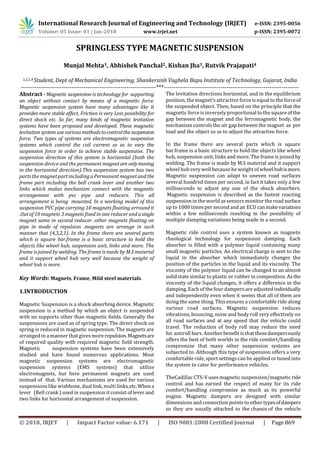
2. FRAME INTODUCTION
In the frame there are several parts which is square
bar.frame is a basic structure to hold the objects like wheel
hub, suspension unit, links and more. The frame is joined by
welding. The frame is made by M.S material and it support
wheel hub very well because the weight of wheel hub is
more.
Fig -2.1: FRAME
2.1 PROBLEM STATEMENT
There are lots of energy, power and force consumption used
tomove anobjectwith physically contactwiththemovement
elements and it also cause much of energy and power loss
especially when dealing with an object with large amount of
weight. It may also leads to damage due to friction and
pressure occurs in a system that leads to often maintenance
routine which needs cost and manpower or skills. Therefore
this research is to study about the relationship between the
technology of levitation and the reducing of power, energy
and force consumption so that this physics technology of
levitation can be implemented in a new technology
application to reduce power, energy and force and at the
same time reduce maintenance cost and avoiding damages.
Even though the stability is a concern butit can be controlled
by using servomechanism, use of diamagnetic material or
system involving eddy current throughwhich stabilitycanbe
achieved.
3. OBJECTIVES
Suspension is a mechanical arrangement contributing to
vehicle's road handling behaviour. If roads were perfectly
flat with no irregularities, suspensions wouldn't be
necessary. It's these imperfections that apply force to the
wheels.There are many typesof suspensions such asdouble
wishbone, trailing arm and air shocks. Butthesesuspensions
possess some disadvantages such as vibration, mechanical
failure and stiffness variation. So in this paper we have
introduced the idea of “MAGNETIC SUSPENSION”.
The basic role of suspension is to isolate the vehiclefromthe
road shocks and vibration so that it could be a comfortable
ride for these passenger and goods are in their proper
condition too. The suspensions act as a link between vehicle
tires and chassis. The vibrations from the wheels are
reduced by suspension only. The suspension gives the
cushioning effect.
International Research Journal of Engineering and Technology (IRJET) e-ISSN: 2395-0056
Volume: 05 Issue: 01 | Jan-2018 www.irjet.net p-ISSN: 2395-0072
© 2018, IRJET | Impact Factor value: 6.171 | ISO 9001:2008 Certified Journal | Page 871
There are mechanical failure, changesin stiffnessof springs,
change of ride height due to uneven distribution of loads
during non-flat tapered road resulting in change in spring
stiffness and its arrangement. Some other problemsare that
the spring cannot be adjusted by the person himself who is
driving the car, even though high end car have adjustable
ride height but it is not in accessto all categories of peopleof
the society.
4. DESIGN AND CALCULATIONS
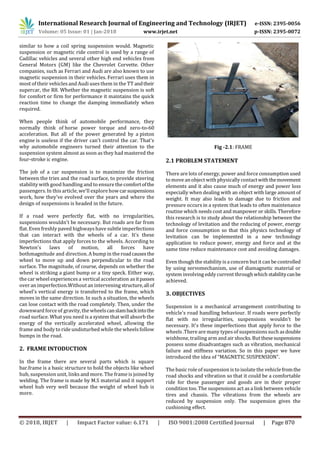
In the project the 10 magnets are arranged on the pipe.
These magnets are in repulsion mode. The two reducers are
used. As shown in fig 4.1 in upper reducer the one magnet is
fixed by araldite and at lower reducer the four magnets are
fixed and inserted. The design of springless type magnetic
suspension is in a such a manner that it is in repulsionmode.
The magnetic suspension works on the principle of
repulsion.In the magnetic suspension there are 10 magnets
and all the magnets are in repulsion mode.the order of
magnets are in 4,3,2,1 . the one side of magnetic suspension
is fixed and other side of suspension. The one side of
suspension is attached to links and lever and other side os
suspension is attached with frame . This suspension system
has two parts the magnet part including a Permanent
magnet and the frame part including the bell crank leverand
another two linkswhich makesmechanism connectwiththe
magnetic arrangement with pvc pipe and reducers.
Fig -4.1: DESIGN OF MAGNETIC SUSPENSION IN
AUTOCAD
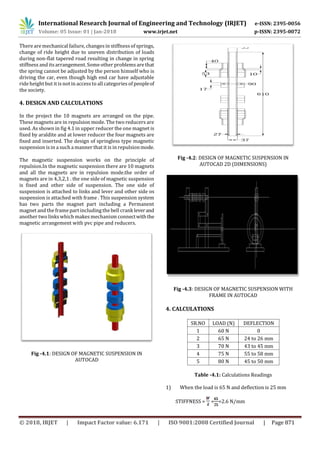
Fig -4.2: DESIGN OF MAGNETIC SUSPENSION IN
AUTOCAD 2D (DIMENSIONS)
Fig -4.3: DESIGN OF MAGNETIC SUSPENSION WITH
FRAME IN AUTOCAD
4. CALCULATIONS
SR.NO LOAD (N) DEFLECTION
1 60 N 0
2 65 N 24 to 26 mm
3 70 N 43 to 45 mm
4 75 N 55 to 58 mm
5 80 N 45 to 50 mm
Table -4.1: Calculations Readings
1) When the load is 65 N and deflection is 25 mm
STIFFNESS = = =2.6 N/mm
International Research Journal of Engineering and Technology (IRJET) e-ISSN: 2395-0056
Volume: 05 Issue: 01 | Jan-2018 www.irjet.net p-ISSN: 2395-0072
© 2018, IRJET | Impact Factor value: 6.171 | ISO 9001:2008 Certified Journal | Page 872
2) When the load is 70 N and deflection is 44 mm
STIFFNESS = = =1.59 N/mm
3) When the load is 75 N and deflection is 56 mm
STIFFNESS = = =1.339 N/mm
4) When the load is 80 N and deflection is 47 mm
STIFFNESS = = =1.702 N/mm
5. FUTURE SCOPE
In this type of suspension it can be used Neodium magnets
instead of ferrous magnets.To improve the efficiency of
whole suspension copper coil also can be used. The
aluminum alloy components can be used instead of other
material.(because it is rust proof ).
6. CONCLUSION
As we have seen the magnetic suspension is a revolutionary
idea which will provide a comfortable ridebyminimizingthe
vibrations and other factors.
It would also allow to set the suspension stiffness as per
requirement. Thereby magnetic suspension will be a best
substitute for current problems and providing ultimate
vehicle dynamics.
An approach of the magnetic suspension system has been
presented. The simplified mathematical model has been
developed.
The MSS has the ability to givemuch smoother ride than any
luxury sedan, and less roll and pitch than any sports car.
REFERENCES
[1] http:/en.wikipedia.org/wiki/Earnshaw %.
[2] Dr H C Verma, ‘Physics by H C Verma’ volume 2
[3] Dr Kirpal Singh, ‘automobile engineering’ volume 1

IRJET-Springless Type Magnetic Suspension

  • 1.
    International Research Journalof Engineering and Technology (IRJET) e-ISSN: 2395-0056 Volume: 05 Issue: 01 | Jan-2018 www.irjet.net p-ISSN: 2395-0072 © 2018, IRJET | Impact Factor value: 6.171 | ISO 9001:2008 Certified Journal | Page 869 SPRINGLESS TYPE MAGNETIC SUSPENSION Munjal Mehta1, Abhishek Panchal2, Kishan Jha3, Rutvik Prajapati4 1,2,3,4 Student, Dept of Mechanical Engineering, Shankersinh Vaghela Bapu Institute of Technology, Gujarat, India ---------------------------------------------------------------------***--------------------------------------------------------------------- Abstract - Magnetic suspension is technology for supporting an object without contact by means of a magnetic force. Magnetic suspension system have many advantages like It provides more stable effect, Friction is very Less possibility for direct shock etc. So far, many kinds of magnetic levitation systems have been proposed and developed. These magnetic levitation systemuse variousmethodstocontrolthesuspension force. Two types of systems are electromagnetic suspension systems which control the coil current so as to vary the suspension force in order to achieve stable suspension. The suspension direction of this system is horizontal (both the suspension device and the permanent magnet are onlymoving in the horizontal direction).This suspension system has two parts the magnet part including a Permanent magnet and the frame part including the bell crank lever and another two links which makes mechanism connect with the magnetic arrangement with pvc pipe and reducers. This all arrangement is being mounted. In a working model of this suspension PVC pipe carrying 10 magnets floating arround it .Out of 10 magnets 3 magnets fixed in one reducer and asingle magnet same in second reducer .other magnets floating on pipe in mode of repulsion .magnets are arrange in such manner that (4,3,2,1). In the frame there are several parts which is square bar.frame is a basic structure to hold the objects like wheel hub, suspension unit, links and more. The frame is joined by welding. The frame is made by M.S material and it support wheel hub very well because the weight of wheel hub is more. Key Words: Magnets, Frame, Mild steel materials. 1.INTRODUCTION Magnetic Suspension is a shock absorbing device. Magnetic suspension is a method by which an object is suspended with no supports other than magnetic fields. Generally the suspensions are used as of spring type. The direct shock on spring is reduced in magnetic suspension. The magnets are arranged in a manner that givesmore repulsion.Magnetsare of required quality with required magnetic field strength. Magnetic suspension systems have been extensively studied and have found numerous applications. Most magnetic suspension systems are electromagnetic suspension systems (EMS systems) that utilize electromagnets, but here permanent magnets are used instead of that. Various mechanisms are used for various suspensions like wishbone, dual link, multi links,etc.Whena lever (Bell crank ) used in suspension it consist of lever and two links for horizontal arrangement of suspension. The levitation directions horizontal, and in the equilibrium position, the magnet’s attractive force is equal to the forceof the suspended object. Then, based on the principle that the magnetic force is inversely proportional to the square of the gap between the magnet and the ferromagnetic body, the mechanism controls the air gap between the magnet as per load and the object so as to adjust the attractive force. In the frame there are several parts which is square bar.frame is a basic structure to hold the objects like wheel hub, suspension unit, links and more. The frame is joined by welding. The frame is made by M.S material and it support wheel hub very well because he weight of wheelhubismore. Magnetic suspension can adapt to uneven road surfaces several hundred times per second, in fact it takes only a few milliseconds to adjust any one of the shock absorbers. Magnetic suspension is described as the fastest reacting suspension in the world assensorsmonitor the road surface up to 1000 timesper second and an ECU canmakevariations within a few milliseconds resulting in the possibility of multiple damping variations being made in a second. Magnetic ride control uses a system known as magneto rheological technology for suspension damping. Each absorber is filled with a polymer liquid containing many small magnetic particles. An electrical charge is sent to the liquid in the absorber which immediately changes the position of the particles in the liquid and its viscosity. The viscosity of the polymer liquid can be changed to an almost solid state similar to plastic or rubber in composition. Asthe viscosity of the liquid changes, it offers a difference in the damping. Each of the four dampersare adjusted individually and independently even when it seems that all of them are doing the same thing. This ensures a comfortable ride along various road surfaces. Magnetic suspension reduces vibrations, bouncing, noise and body roll very effectively on all road surfaces and at any speed that the vehicle could travel. The reduction of body roll may reduce the need for antiroll bars. Another benefit isthat thesedamperseasily offers the best of both worlds in the ride comfort/handling compromise that many other suspension systems are subjected to. Although this type of suspension offers a very comfortable ride, sport settingscan be applied or tuned into the system to cater for performance vehicles. TheCadillac CTS-V usesmagnetic suspension/magnetic ride control and has earned the respect of many for its ride comfort/handling compromise as much as its powerful engine. Magnetic dampers are designed with similar dimensions and connection points to other typesofdampers so they are usually attached to the chassis of the vehicle
  • 2.
    International Research Journalof Engineering and Technology (IRJET) e-ISSN: 2395-0056 Volume: 05 Issue: 01 | Jan-2018 www.irjet.net p-ISSN: 2395-0072 © 2018, IRJET | Impact Factor value: 6.171 | ISO 9001:2008 Certified Journal | Page 870 similar to how a coil spring suspension would. Magnetic suspension or magnetic ride control is used by a range of Cadillac vehicles and several other high end vehicles from General Motors (GM) like the Chevrolet Corvette. Other companies, such as Ferrari and Audi are also known to use magnetic suspension in their vehicles. Ferrari uses them in most of their vehicles and Audi usesthem in the TT andtheir supercar, the R8. Whether the magnetic suspension is soft for comfort or firm for performance it maintains the quick reaction time to change the damping immediately when required. When people think of automobile performance, they normally think of horse power torque and zero-to-60 acceleration. But all of the power generated by a piston engine is useless if the driver can't control the car. That's why automobile engineers turned their attention to the suspension system almost as soon as they had mastered the four-stroke ic engine. The job of a car suspension is to maximize the friction between the tries and the road surface, to provide steering stability with good handling and to ensure the comfortofthe passengers. In this article, we'll explore howcarsuspensions work, how they've evolved over the years and where the design of suspensions is headed in the future. If a road were perfectly flat, with no irregularities, suspensions wouldn't be necessary. But roads are far from flat. Even freshly paved highwayshave subtle imperfections that can interact with the wheels of a car. It's these imperfections that apply forces to the wheels. According to Newton's laws of motion, all forces have bothmagnitude and direction. A bump in the roadcausesthe wheel to move up and down perpendicular to the road surface. The magnitude, of course, depends on whether the wheel is striking a giant bump or a tiny speck. Either way, the car wheel experiences a vertical acceleration asitpasses over an imperfection.Without an intervening structure,allof wheel's vertical energy is transferred to the frame, which moves in the same direction. In such a situation, the wheels can lose contact with the road completely. Then, under the downward force of gravity, the wheelscanslambackintothe road surface. What you need is a system that will absorb the energy of the vertically accelerated wheel, allowing the frame and body to ride undisturbed while the wheelsfollow bumps in the road. 2. FRAME INTODUCTION In the frame there are several parts which is square bar.frame is a basic structure to hold the objects like wheel hub, suspension unit, links and more. The frame is joined by welding. The frame is made by M.S material and it support wheel hub very well because the weight of wheel hub is more. Fig -2.1: FRAME 2.1 PROBLEM STATEMENT There are lots of energy, power and force consumption used tomove anobjectwith physically contactwiththemovement elements and it also cause much of energy and power loss especially when dealing with an object with large amount of weight. It may also leads to damage due to friction and pressure occurs in a system that leads to often maintenance routine which needs cost and manpower or skills. Therefore this research is to study about the relationship between the technology of levitation and the reducing of power, energy and force consumption so that this physics technology of levitation can be implemented in a new technology application to reduce power, energy and force and at the same time reduce maintenance cost and avoiding damages. Even though the stability is a concern butit can be controlled by using servomechanism, use of diamagnetic material or system involving eddy current throughwhich stabilitycanbe achieved. 3. OBJECTIVES Suspension is a mechanical arrangement contributing to vehicle's road handling behaviour. If roads were perfectly flat with no irregularities, suspensions wouldn't be necessary. It's these imperfections that apply force to the wheels.There are many typesof suspensions such asdouble wishbone, trailing arm and air shocks. Butthesesuspensions possess some disadvantages such as vibration, mechanical failure and stiffness variation. So in this paper we have introduced the idea of “MAGNETIC SUSPENSION”. The basic role of suspension is to isolate the vehiclefromthe road shocks and vibration so that it could be a comfortable ride for these passenger and goods are in their proper condition too. The suspensions act as a link between vehicle tires and chassis. The vibrations from the wheels are reduced by suspension only. The suspension gives the cushioning effect.
  • 3.
    International Research Journalof Engineering and Technology (IRJET) e-ISSN: 2395-0056 Volume: 05 Issue: 01 | Jan-2018 www.irjet.net p-ISSN: 2395-0072 © 2018, IRJET | Impact Factor value: 6.171 | ISO 9001:2008 Certified Journal | Page 871 There are mechanical failure, changesin stiffnessof springs, change of ride height due to uneven distribution of loads during non-flat tapered road resulting in change in spring stiffness and its arrangement. Some other problemsare that the spring cannot be adjusted by the person himself who is driving the car, even though high end car have adjustable ride height but it is not in accessto all categories of peopleof the society. 4. DESIGN AND CALCULATIONS In the project the 10 magnets are arranged on the pipe. These magnets are in repulsion mode. The two reducers are used. As shown in fig 4.1 in upper reducer the one magnet is fixed by araldite and at lower reducer the four magnets are fixed and inserted. The design of springless type magnetic suspension is in a such a manner that it is in repulsionmode. The magnetic suspension works on the principle of repulsion.In the magnetic suspension there are 10 magnets and all the magnets are in repulsion mode.the order of magnets are in 4,3,2,1 . the one side of magnetic suspension is fixed and other side of suspension. The one side of suspension is attached to links and lever and other side os suspension is attached with frame . This suspension system has two parts the magnet part including a Permanent magnet and the frame part including the bell crank leverand another two linkswhich makesmechanism connectwiththe magnetic arrangement with pvc pipe and reducers. Fig -4.1: DESIGN OF MAGNETIC SUSPENSION IN AUTOCAD Fig -4.2: DESIGN OF MAGNETIC SUSPENSION IN AUTOCAD 2D (DIMENSIONS) Fig -4.3: DESIGN OF MAGNETIC SUSPENSION WITH FRAME IN AUTOCAD 4. CALCULATIONS SR.NO LOAD (N) DEFLECTION 1 60 N 0 2 65 N 24 to 26 mm 3 70 N 43 to 45 mm 4 75 N 55 to 58 mm 5 80 N 45 to 50 mm Table -4.1: Calculations Readings 1) When the load is 65 N and deflection is 25 mm STIFFNESS = = =2.6 N/mm
  • 4.
    International Research Journalof Engineering and Technology (IRJET) e-ISSN: 2395-0056 Volume: 05 Issue: 01 | Jan-2018 www.irjet.net p-ISSN: 2395-0072 © 2018, IRJET | Impact Factor value: 6.171 | ISO 9001:2008 Certified Journal | Page 872 2) When the load is 70 N and deflection is 44 mm STIFFNESS = = =1.59 N/mm 3) When the load is 75 N and deflection is 56 mm STIFFNESS = = =1.339 N/mm 4) When the load is 80 N and deflection is 47 mm STIFFNESS = = =1.702 N/mm 5. FUTURE SCOPE In this type of suspension it can be used Neodium magnets instead of ferrous magnets.To improve the efficiency of whole suspension copper coil also can be used. The aluminum alloy components can be used instead of other material.(because it is rust proof ). 6. CONCLUSION As we have seen the magnetic suspension is a revolutionary idea which will provide a comfortable ridebyminimizingthe vibrations and other factors. It would also allow to set the suspension stiffness as per requirement. Thereby magnetic suspension will be a best substitute for current problems and providing ultimate vehicle dynamics. An approach of the magnetic suspension system has been presented. The simplified mathematical model has been developed. The MSS has the ability to givemuch smoother ride than any luxury sedan, and less roll and pitch than any sports car. REFERENCES [1] http:/en.wikipedia.org/wiki/Earnshaw %. [2] Dr H C Verma, ‘Physics by H C Verma’ volume 2 [3] Dr Kirpal Singh, ‘automobile engineering’ volume 1