By: Dian Puspita
Introduction
• Active voice is a sentence, where the subject is the one
  whose are responsible for the action. Otherwise, in the
  passive voice, the object is the one whose are responsible
  for the action, instead of the subject.
• Kalimat aktif (active voice) adalah kalimat dimana subject-
  nya melakukan pekerjaan, sebaliknya, kalimat pasif
  (passive voice) adalah kalimat dimana subject-nya dikenai
  pekerjaan oleh object kalimat.
• We often find the passive voice in thearticle of
  newspapers, magazines, and scientific literature. Passive
  voice is used, because the object from the active voice, is
  the more important information than the subjects.
• Sering kita temukan passive voice di surat-surat
  kabar, artikel-artikel di majalah-majalah dan tulisan-
  tulisan ilmiah. Passive voice digunakan karena object dari
  active voice merupakan informasi yang lebih penting
  dibandingkan dengan subject-nya.
Forms of Passive Voice
There are some general forms that used in the passive voice.
  Things that differentiate it, is when the moments occur. Is it
  already happens, is happens, or will happens.
Ada beberapa bentuk umum yang sering digunakan dalam
  membentuk passive voice. Yang membedakan adalah waktu
  berlangsungnya kejadian yang diterangkan, sudah
  terjadi, sedang terjadi atau akan terjadi. Beberapa
  diantaranya yang sering digunakan adalah sebagai berikut:

NO.   Struktur                                Maksud
1     S + is/am/are/was/were + V3             di [...]
2     S + is/am/are/was/were + being + V3     sedang [...]
3     S + has/have/had + been + V3            telah di [...]
4                                             akan/dapat/mungkin/pasti di
      S + will/shall/can/may/must, etc + V3
                                              [...]
Passive Voice Formula
Present
Present     Formula                         Example
Simple      S + is/am/are + V3              The book is bought by Nanik
                                            The book is being bought by
Continous   S + is/am/are + being + V3
                                            Nanik
                                            The book has been bought by
Perfect     S + have/has + been + v3
                                            Nanik
Perfect     S + have/has + been + being The book has been being
continous   + v3                        bought by Nanik

Past
Past        Pasif                        Example
Simple      S + was/were + V3            The book was bought by Nanik
            S + was/were + being +       The book was being bought by
Continous
            V3                           Nanik
                                         The book had been bought by
Perfect     S + had + been + v3
                                         Nanik
Perfect     S + had + been + being       The book had been being bought
continous   + v3                         by Nanik
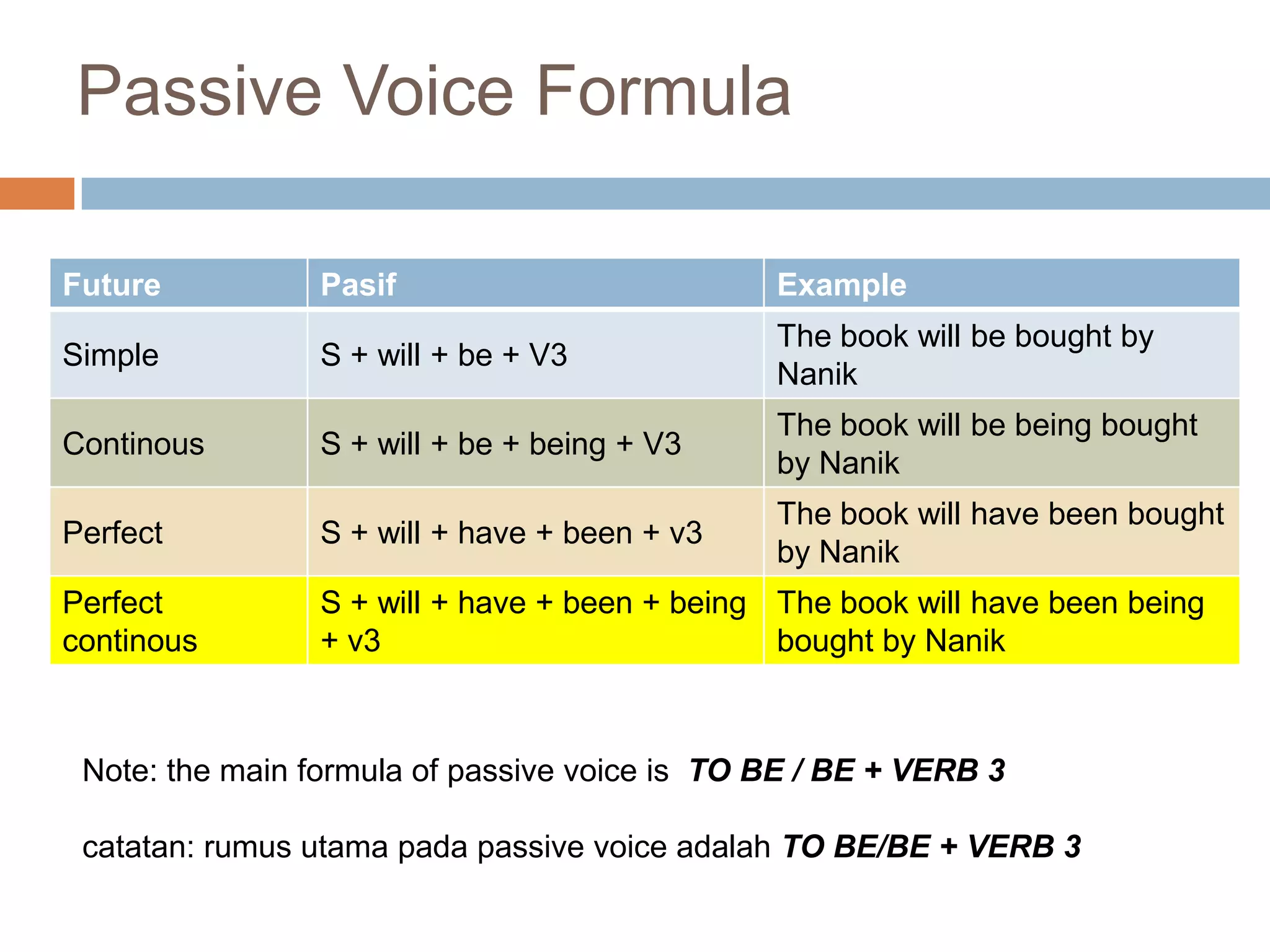
Passive Voice Formula

Future           Pasif                         Example
                                               The book will be bought by
Simple           S + will + be + V3
                                               Nanik
                                               The book will be being bought
Continous        S + will + be + being + V3
                                               by Nanik
                                               The book will have been bought
Perfect          S + will + have + been + v3
                                               by Nanik
Perfect          S + will + have + been + being The book will have been being
continous        + v3                           bought by Nanik


 Note: the main formula of passive voice is TO BE / BE + VERB 3

 catatan: rumus utama pada passive voice adalah TO BE/BE + VERB 3
Example
Converting the active voice, to the
               passive voice
          Tenses                ACTIVE                        PASSIVE
Simple Present        Jane helps Tina.              Tina is helped by Jane.
Present Progressive   Jane is helping Tina.         Tina is being helped by
                                                    Jane.
Present Perfect       Jane has helped Tina.         Tina has been helped by
                                                    Jane.
Simple Past           Jane helped Tina.             Tina was helped by Jane.
Past Progressive      Jane was helping Tina.        Tina was being helped by
                                                    Jane.
Past Perfect          Jane had helped Tina.         Tina had been helped by
                                                    Jane.
Simple Future         Jane will help Tina.          Tina will be helped by Jane.
To Be Going To        Jane is going to help Tina. Tina is going to be helped
                                                  by Jane.
Future perfect        Jane will have helped Tina. Tina will have been helped
                                                  by Jane.
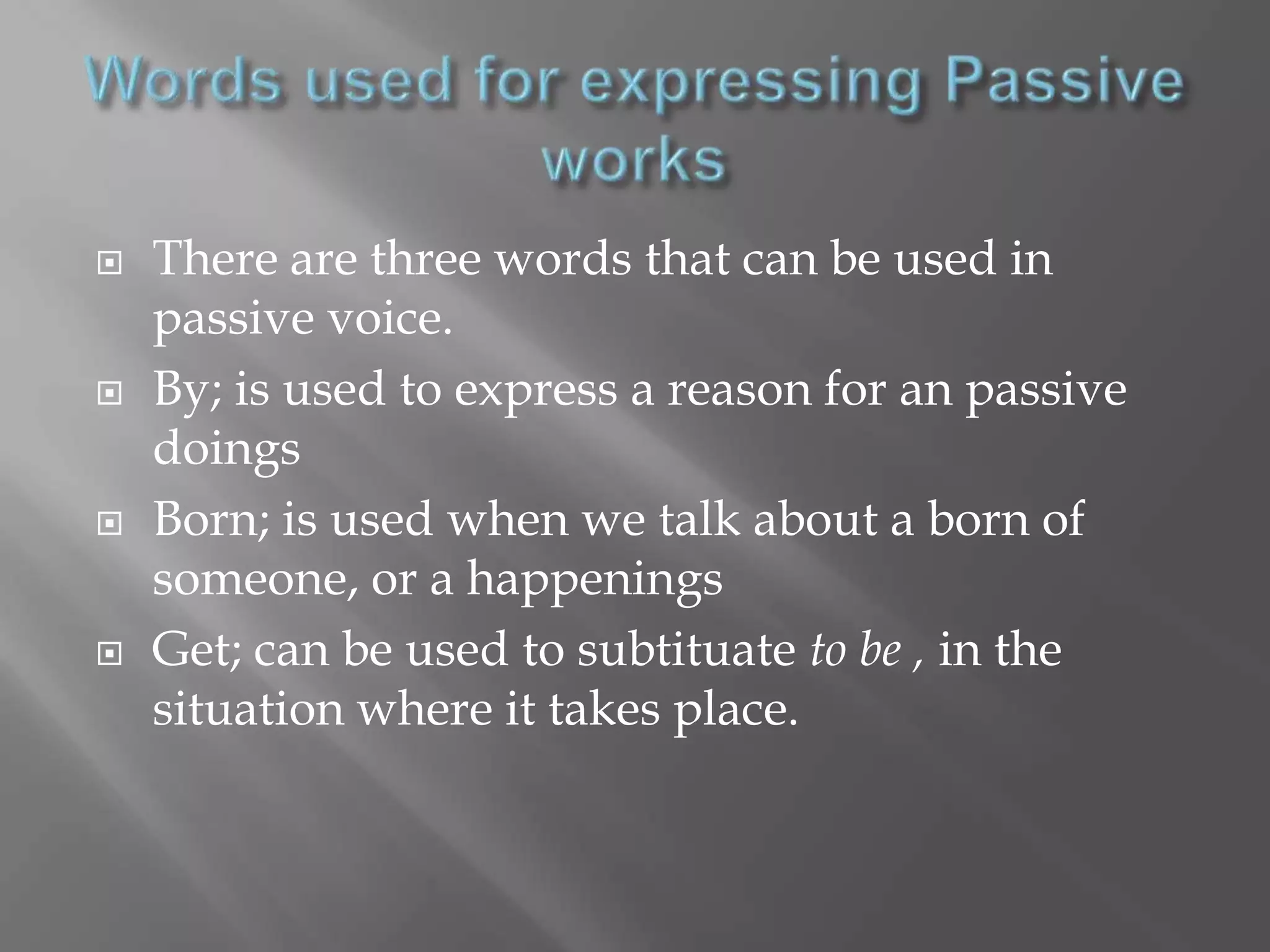
   There are three words that can be used in
    passive voice.
   By; is used to express a reason for an passive
    doings
   Born; is used when we talk about a born of
    someone, or a happenings
   Get; can be used to subtituate to be , in the
    situation where it takes place.
    Untuk menyatakan apa penyebab sebuah tindakan pasif, kita bisa
     menggunakan by. Contoh:
Ø   This photo was taken by my friend.
Ø   I was given this by my brother.
    Seringkali tidak diperlukan untuk menyatakan penyebab
     tindakan pasif, khususnya jika dipahami dengan jelas atau tidak
     relevan. Sebagai contoh:
Ø   The meeting was cancelled (pertemuan itu dibatalkan). (Informasi
     penting yang ingin disampaikan adalah pembatalan
     pertemuan, bukan siapa yang membatalkannya.)
Ø   These boots were made in Italy (sepatu-sepatu boot ini dibuat di
     Italia). (Informasi yang penting dalam kalimat ini adalah bahwa
     sepatu-sepatu tersebut dibuat di Italia, bukan siapa yang
     membuatnya).
    Get bisa digunakan menggantikan to be pada situasi dimana
     sesuatu terjadi. Contoh:
Ø   Our flight got cancelled = Our flight was cancelled.
Ø   I got paid today = I was paid today.
    Get tidak bisa digunakan pada situasi-situasi umum dan apabila
     bersama dengan kata kerja yang menyatakan keadaan (bukan
     tindakan). Contoh:
Ø   He is liked by a lot of people. – Benar
Ø    He gets liked by a lot of people. - Tidak benar
Ø    She is known to be a hard-working employee. – Benar
Ø    She gets known to be a hard-working employee.- Tidak benar
    Get digunakan lebih sering dalam bahasa Inggris informal.
   Ketika berbicara tentang kelahiran orang
    tertentu atau suatu peristiwa, kita
    menggunakan bentuk pasif “to be born”.
    Contoh:
   Ø I was born in Iran.
   Ø The twins were born just last year.
Indirect Object as Passive Object

 ACTIVE:               Someone gave Mrs. Grim an award.
 PASSIVE:              Mrs. Grim was given an award by someone.
 ACTIVE:               Someone gave an award to Mrs. Grim.
 PASSIVE:              An award was given to Mrs. Grim.
Direct Object (Object Langsung): Sesuatu.
Indirect Object (Object tak langsung): yang menerima sesuatu.


Contoh 4 kalimat di atas semuanya mempunyai makna yang sama.


Mrs. Grim: sebagai object tak langsung (Indirect Object), dan an award: sebagai object langsung (Direct
Object).


Baik Object langsung ataupun Object tak langsung bisa menjadi Subject dalam bentuk kalimat pasif.


CATATAN: Ketika object langsung menjadi subject, frase “to” biasanya digunakan didepan atau sebelum
object tak langsung (lihat contoh kalimat ke 4).
Passive voice by modal auxiliaries and
similar expression
• On the previous slide, I’ve explaining about
  the use and example of passive voice, that is
  used in some tenses. And for now, we will
  study about the passive voice by using modal
  auxiliaries and similar expression.
• Pada bagian yang sebelumnya saya sudah
  menjelaskan tentang penggunaan dan contoh
  Passive Voice yang digunakan pada beberapa
  tenses, dan untuk saat ini kita akan
  membahas tentang penggunaan Passive Voice
  dengan menggunakan Modal Auxiliaries and
  Similar Expression (ekspresi serupa).
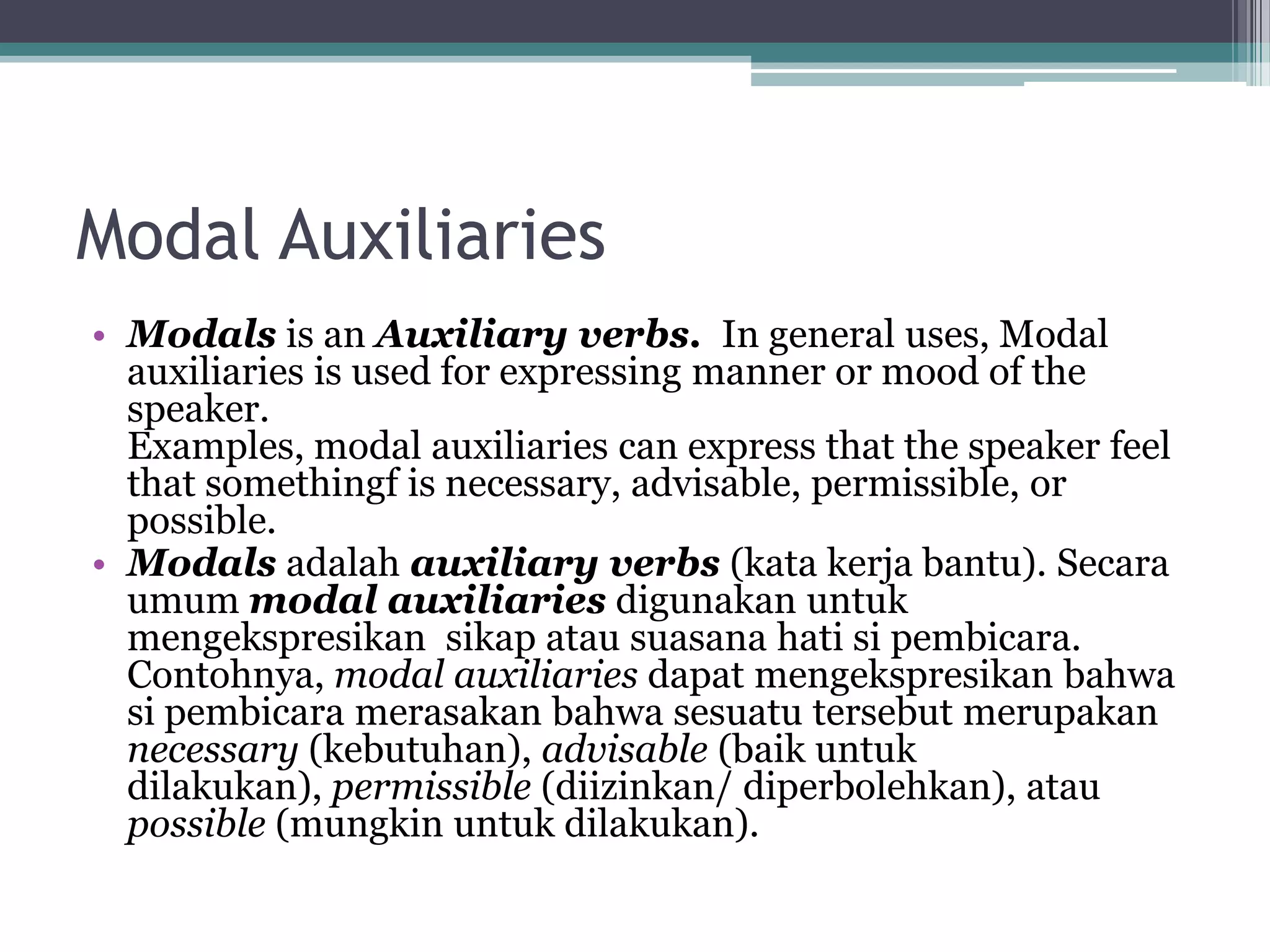
Modal Auxiliaries
• Modals is an Auxiliary verbs. In general uses, Modal
  auxiliaries is used for expressing manner or mood of the
  speaker.
  Examples, modal auxiliaries can express that the speaker feel
  that somethingf is necessary, advisable, permissible, or
  possible.
• Modals adalah auxiliary verbs (kata kerja bantu). Secara
  umum modal auxiliaries digunakan untuk
  mengekspresikan sikap atau suasana hati si pembicara.
  Contohnya, modal auxiliaries dapat mengekspresikan bahwa
  si pembicara merasakan bahwa sesuatu tersebut merupakan
  necessary (kebutuhan), advisable (baik untuk
  dilakukan), permissible (diizinkan/ diperbolehkan), atau
  possible (mungkin untuk dilakukan).
Passive Voice by Modal Auxiliaries
Pada kalimat positif MODAL + be + VERB    Pada kalimat positif
                     3
Pada kalimat negatif MODAL + NOT + be +   Pada kalimat negatif
                     VERB 3
Pada bentuk lampau MODAL + have been +    Pada bentuk       lampau
kalimat pasif        VERB 3               kalimat pasif
Modal Auxiliaries and        The example of
 Similar Expression           Passive Voice
                             (Kalimat Pasif)
     Can - Could        The    door    can     be  (Artinya: Pintunya dapat
     (bisa/dapat)       opened.                              dibuka.)
      be able to        Shania is able to be         (Artinya: Shania dapat
     (bisa/dapat)       hired for Chemical Staff dipekerjakan untuk bagian
                        Department.                    staf bahan kimia.)
     Will - Would       Tom will be invited to (Artinya: Tom akan diundang
        (akan)          the party by Kim.              ke pesta oleh Kim.)
      May - Might       The Cooking club may        (Artinya: Klub memasak
   (boleh/ mungkin)     be joined by everyone.      boleh diikuti oleh semua
                                                             orang.)
    Must - Have to      My homework must be (Artinya: Pekerjaan rumah
    (harus/ pasti)      finished as soon as          saya harus diselesaikan
                        possible.                      secepat mungkin.)
   Should - Ought to    That book should not        (Artinya: Buku itu tidak
     (seharusnya)       be stolen by him.         seharusnya dicuri oleh dia.)
    be supposed to      Fred is supposed to be (Artinya: Fred seharusnya
     (seharusnya)       told about the meeting.        diberitahu tentang
                                                     pertemuan atau rapat.)
      be going to       He is going to be fired        (Artinya: Dia akan
        (akan)          from his position as soon      diberhentikan dari
                        as possible.                jabatannya secepatnya.)
Contoh The Past Passive Voice
(Bentuk Lampau Kalimat Pasif)
Dengan Menggunakan Modal
Auxiliaries
   Modal Auxiliaries    The Past – Passive Form (Bentuk
                              Lampau Kalimat Pasif)
        Should         The letter should have been sent
                       last week.
                       (Artinya: Suratnya seharusnya sudah
                       dikirim minggu lalu.)
         Must          This house must have been built
                       over 200 years ago.
                       (Artinya: Rumah ini pasti sudah
                       dibangun lebih dari 200 tahun yang
                       lalu.)
       Ought to        Jack ought to have been invited to
                       the party.
                       (Artinya: Jack seharusnya sudah
                       diundang ke pesta.)

Passive voice

  • 1.
  • 2.
    Introduction • Active voiceis a sentence, where the subject is the one whose are responsible for the action. Otherwise, in the passive voice, the object is the one whose are responsible for the action, instead of the subject. • Kalimat aktif (active voice) adalah kalimat dimana subject- nya melakukan pekerjaan, sebaliknya, kalimat pasif (passive voice) adalah kalimat dimana subject-nya dikenai pekerjaan oleh object kalimat. • We often find the passive voice in thearticle of newspapers, magazines, and scientific literature. Passive voice is used, because the object from the active voice, is the more important information than the subjects. • Sering kita temukan passive voice di surat-surat kabar, artikel-artikel di majalah-majalah dan tulisan- tulisan ilmiah. Passive voice digunakan karena object dari active voice merupakan informasi yang lebih penting dibandingkan dengan subject-nya.
  • 4.
    Forms of PassiveVoice There are some general forms that used in the passive voice. Things that differentiate it, is when the moments occur. Is it already happens, is happens, or will happens. Ada beberapa bentuk umum yang sering digunakan dalam membentuk passive voice. Yang membedakan adalah waktu berlangsungnya kejadian yang diterangkan, sudah terjadi, sedang terjadi atau akan terjadi. Beberapa diantaranya yang sering digunakan adalah sebagai berikut: NO. Struktur Maksud 1 S + is/am/are/was/were + V3 di [...] 2 S + is/am/are/was/were + being + V3 sedang [...] 3 S + has/have/had + been + V3 telah di [...] 4 akan/dapat/mungkin/pasti di S + will/shall/can/may/must, etc + V3 [...]
  • 5.
    Passive Voice Formula Present Present Formula Example Simple S + is/am/are + V3 The book is bought by Nanik The book is being bought by Continous S + is/am/are + being + V3 Nanik The book has been bought by Perfect S + have/has + been + v3 Nanik Perfect S + have/has + been + being The book has been being continous + v3 bought by Nanik Past Past Pasif Example Simple S + was/were + V3 The book was bought by Nanik S + was/were + being + The book was being bought by Continous V3 Nanik The book had been bought by Perfect S + had + been + v3 Nanik Perfect S + had + been + being The book had been being bought continous + v3 by Nanik
  • 6.
    Passive Voice Formula Future Pasif Example The book will be bought by Simple S + will + be + V3 Nanik The book will be being bought Continous S + will + be + being + V3 by Nanik The book will have been bought Perfect S + will + have + been + v3 by Nanik Perfect S + will + have + been + being The book will have been being continous + v3 bought by Nanik Note: the main formula of passive voice is TO BE / BE + VERB 3 catatan: rumus utama pada passive voice adalah TO BE/BE + VERB 3
  • 7.
  • 8.
    Converting the activevoice, to the passive voice Tenses ACTIVE PASSIVE Simple Present Jane helps Tina. Tina is helped by Jane. Present Progressive Jane is helping Tina. Tina is being helped by Jane. Present Perfect Jane has helped Tina. Tina has been helped by Jane. Simple Past Jane helped Tina. Tina was helped by Jane. Past Progressive Jane was helping Tina. Tina was being helped by Jane. Past Perfect Jane had helped Tina. Tina had been helped by Jane. Simple Future Jane will help Tina. Tina will be helped by Jane. To Be Going To Jane is going to help Tina. Tina is going to be helped by Jane. Future perfect Jane will have helped Tina. Tina will have been helped by Jane.
  • 9.
    There are three words that can be used in passive voice.  By; is used to express a reason for an passive doings  Born; is used when we talk about a born of someone, or a happenings  Get; can be used to subtituate to be , in the situation where it takes place.
  • 10.
    Untuk menyatakan apa penyebab sebuah tindakan pasif, kita bisa menggunakan by. Contoh: Ø This photo was taken by my friend. Ø I was given this by my brother.  Seringkali tidak diperlukan untuk menyatakan penyebab tindakan pasif, khususnya jika dipahami dengan jelas atau tidak relevan. Sebagai contoh: Ø The meeting was cancelled (pertemuan itu dibatalkan). (Informasi penting yang ingin disampaikan adalah pembatalan pertemuan, bukan siapa yang membatalkannya.) Ø These boots were made in Italy (sepatu-sepatu boot ini dibuat di Italia). (Informasi yang penting dalam kalimat ini adalah bahwa sepatu-sepatu tersebut dibuat di Italia, bukan siapa yang membuatnya).
  • 11.
    Get bisa digunakan menggantikan to be pada situasi dimana sesuatu terjadi. Contoh: Ø Our flight got cancelled = Our flight was cancelled. Ø I got paid today = I was paid today.  Get tidak bisa digunakan pada situasi-situasi umum dan apabila bersama dengan kata kerja yang menyatakan keadaan (bukan tindakan). Contoh: Ø He is liked by a lot of people. – Benar Ø He gets liked by a lot of people. - Tidak benar Ø She is known to be a hard-working employee. – Benar Ø She gets known to be a hard-working employee.- Tidak benar  Get digunakan lebih sering dalam bahasa Inggris informal.
  • 12.
    Ketika berbicara tentang kelahiran orang tertentu atau suatu peristiwa, kita menggunakan bentuk pasif “to be born”. Contoh:  Ø I was born in Iran.  Ø The twins were born just last year.
  • 13.
    Indirect Object asPassive Object  ACTIVE: Someone gave Mrs. Grim an award.  PASSIVE: Mrs. Grim was given an award by someone.  ACTIVE: Someone gave an award to Mrs. Grim.  PASSIVE: An award was given to Mrs. Grim. Direct Object (Object Langsung): Sesuatu. Indirect Object (Object tak langsung): yang menerima sesuatu. Contoh 4 kalimat di atas semuanya mempunyai makna yang sama. Mrs. Grim: sebagai object tak langsung (Indirect Object), dan an award: sebagai object langsung (Direct Object). Baik Object langsung ataupun Object tak langsung bisa menjadi Subject dalam bentuk kalimat pasif. CATATAN: Ketika object langsung menjadi subject, frase “to” biasanya digunakan didepan atau sebelum object tak langsung (lihat contoh kalimat ke 4).
  • 14.
    Passive voice bymodal auxiliaries and similar expression • On the previous slide, I’ve explaining about the use and example of passive voice, that is used in some tenses. And for now, we will study about the passive voice by using modal auxiliaries and similar expression. • Pada bagian yang sebelumnya saya sudah menjelaskan tentang penggunaan dan contoh Passive Voice yang digunakan pada beberapa tenses, dan untuk saat ini kita akan membahas tentang penggunaan Passive Voice dengan menggunakan Modal Auxiliaries and Similar Expression (ekspresi serupa).
  • 15.
    Modal Auxiliaries • Modalsis an Auxiliary verbs. In general uses, Modal auxiliaries is used for expressing manner or mood of the speaker. Examples, modal auxiliaries can express that the speaker feel that somethingf is necessary, advisable, permissible, or possible. • Modals adalah auxiliary verbs (kata kerja bantu). Secara umum modal auxiliaries digunakan untuk mengekspresikan sikap atau suasana hati si pembicara. Contohnya, modal auxiliaries dapat mengekspresikan bahwa si pembicara merasakan bahwa sesuatu tersebut merupakan necessary (kebutuhan), advisable (baik untuk dilakukan), permissible (diizinkan/ diperbolehkan), atau possible (mungkin untuk dilakukan).
  • 16.
    Passive Voice byModal Auxiliaries Pada kalimat positif MODAL + be + VERB Pada kalimat positif 3 Pada kalimat negatif MODAL + NOT + be + Pada kalimat negatif VERB 3 Pada bentuk lampau MODAL + have been + Pada bentuk lampau kalimat pasif VERB 3 kalimat pasif
  • 17.
    Modal Auxiliaries and The example of Similar Expression Passive Voice (Kalimat Pasif) Can - Could The door can be (Artinya: Pintunya dapat (bisa/dapat) opened. dibuka.) be able to Shania is able to be (Artinya: Shania dapat (bisa/dapat) hired for Chemical Staff dipekerjakan untuk bagian Department. staf bahan kimia.) Will - Would Tom will be invited to (Artinya: Tom akan diundang (akan) the party by Kim. ke pesta oleh Kim.) May - Might The Cooking club may (Artinya: Klub memasak (boleh/ mungkin) be joined by everyone. boleh diikuti oleh semua orang.) Must - Have to My homework must be (Artinya: Pekerjaan rumah (harus/ pasti) finished as soon as saya harus diselesaikan possible. secepat mungkin.) Should - Ought to That book should not (Artinya: Buku itu tidak (seharusnya) be stolen by him. seharusnya dicuri oleh dia.) be supposed to Fred is supposed to be (Artinya: Fred seharusnya (seharusnya) told about the meeting. diberitahu tentang pertemuan atau rapat.) be going to He is going to be fired (Artinya: Dia akan (akan) from his position as soon diberhentikan dari as possible. jabatannya secepatnya.)
  • 18.
    Contoh The PastPassive Voice (Bentuk Lampau Kalimat Pasif) Dengan Menggunakan Modal Auxiliaries Modal Auxiliaries The Past – Passive Form (Bentuk Lampau Kalimat Pasif) Should The letter should have been sent last week. (Artinya: Suratnya seharusnya sudah dikirim minggu lalu.) Must This house must have been built over 200 years ago. (Artinya: Rumah ini pasti sudah dibangun lebih dari 200 tahun yang lalu.) Ought to Jack ought to have been invited to the party. (Artinya: Jack seharusnya sudah diundang ke pesta.)