The document discusses passive voice and how to identify and form passive sentences. It provides examples of active sentences and their passive equivalents to demonstrate how the subject and object are changed in passive constructions. The key aspects covered are:
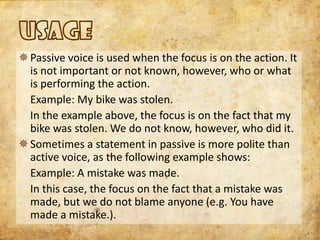
- Passive voice focuses on the action rather than the doer and is sometimes more polite.
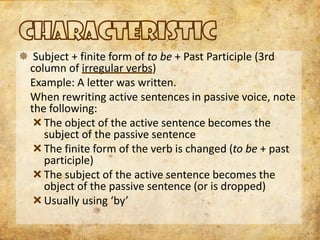
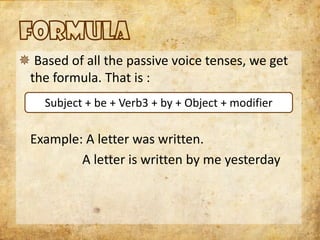
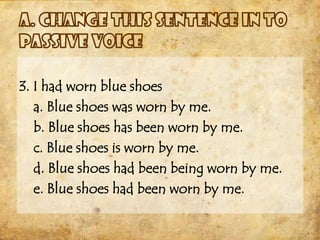
- To form passive, use the form of "to be" plus the past participle of the main verb and make the original object the subject.
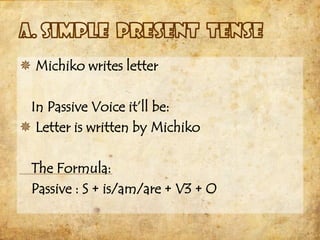
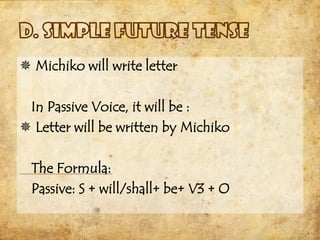
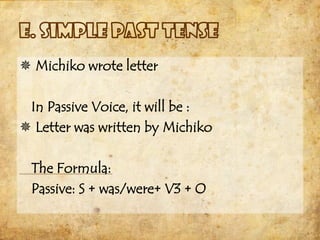
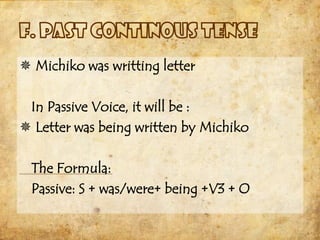
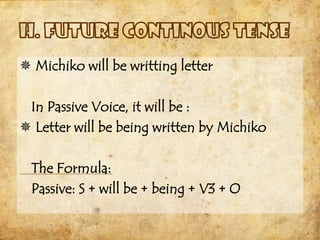
- Various tenses like simple present, past, future etc. are discussed along with their passive forms.
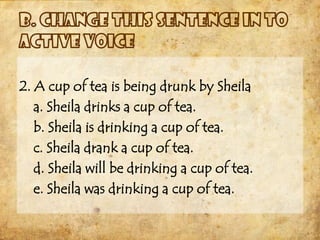
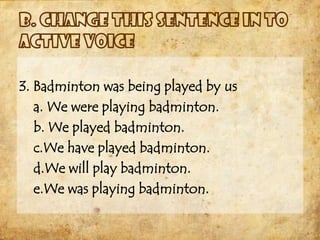
- Practice exercises with answers are provided to help understand passive voice better.











![Basic Grammar Spelling[1]](https://cdn.slidesharecdn.com/ss_thumbnails/spelling1-140219072212-phpapp01-thumbnail.jpg?width=640&height=640&fit=bounds)


