Partogram
Prepared and presented by
โ€ข Ahmed Mustafa
โ€ข Aisha Salem
โ€ข Alaauldin Mohammed
โ€ข Yahya Abdulkarim
โ€ข Fatima Elmosrati
โ€ข Mohamed fathy
โ€ข Eman Emad
โ€ข Hanan Sami
โ€ข Habiba mahroos
We extend our sincere gratitude to Dr. Rabia Aljadi and Dr.
Asmaa Alfarsy for their guidance and support throughout this
project.
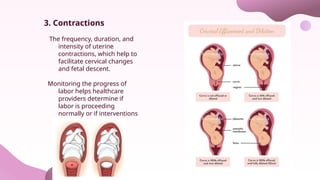
Table of contents
01 04
02 05
03 06
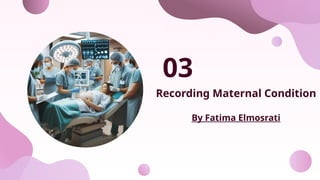
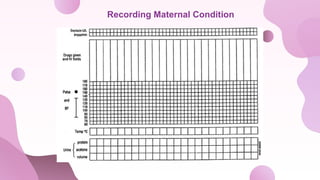
Introduction & history
Components of Partogram
Recording the condition of
mother
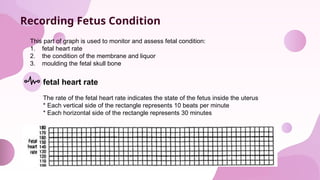
Recording The Condition
Of Fetus
Recording The Progress
Of Labor
Comments and Important
Points In Partogram
07
08
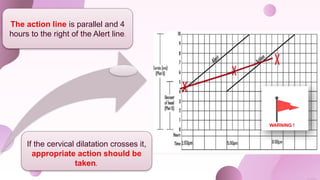
09
Advantages and
Limitations of
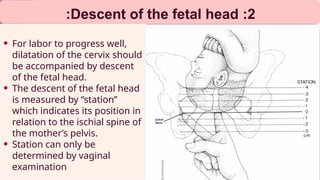
Partogram
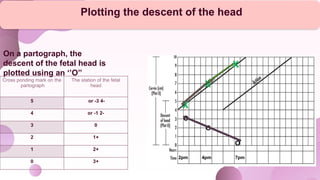
Summary and Conclusion
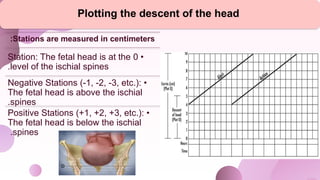
Reference
Introduction and History Of
Partogram
By Yahya Abdulkarim
01
1. Introduction
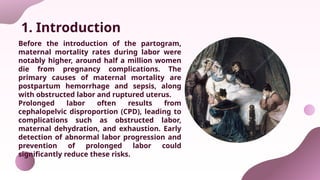
Before the introduction of the partogram,
maternal mortality rates during labor were
notably higher, around half a million women
die from pregnancy complications. The
primary causes of maternal mortality are
postpartum hemorrhage and sepsis, along
with obstructed labor and ruptured uterus.
Prolonged labor often results from
cephalopelvic disproportion (CPD), leading to
complications such as obstructed labor,
maternal dehydration, and exhaustion. Early
detection of abnormal labor progression and
prevention of prolonged labor could
significantly reduce these risks.
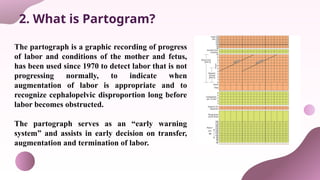
The partograph is a graphic recording of progress
of labor and conditions of the mother and fetus,
has been used since 1970 to detect labor that is not
progressing normally, to indicate when
augmentation of labor is appropriate and to
recognize cephalopelvic disproportion long before
labor becomes obstructed.
The partograph serves as an โ€œearly warning
systemโ€ and assists in early decision on transfer,
augmentation and termination of labor.
2. What is Partogram?
3. HISTORY OF THE PARTOGRAPH
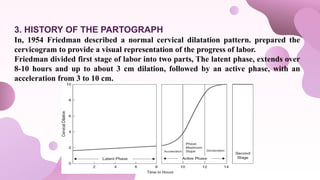
In, 1954 Friedman described a normal cervical dilatation pattern. prepared the
cervicogram to provide a visual representation of the progress of labor.
Friedman divided first stage of labor into two parts, The latent phase, extends over
8-10 hours and up to about 3 cm dilation, followed by an active phase, with an
acceleration from 3 to 10 cm.
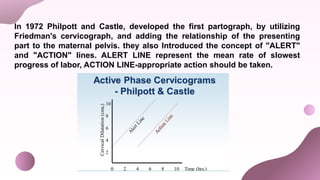
In 1972 Philpott and Castle, developed the first partograph, by utilizing
Friedman's cervicograph, and adding the relationship of the presenting
part to the maternal pelvis. they also Introduced the concept of "ALERT"
and "ACTION" lines. ALERT LINE represent the mean rate of slowest
progress of labor, ACTION LINE-appropriate action should be taken.
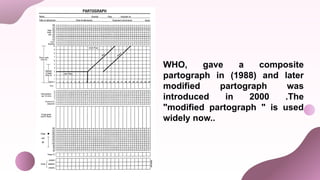
WHO, gave a composite
partograph in (1988) and later
modified partograph was
introduced in 2000 .The
"modified partograph " is used
widely now..
Components Of Partogram :
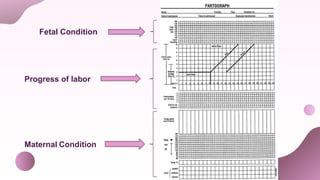
the partograph is basically a graphic representation of the events of labor
plotted against time in hours. It consists of three components:
I. Mother Condition II. Fetus Condition III. Progress Of
Labor
Components of Partogram
By Habiba Mahroos & Hanan Sami
02
Fetal Condition
Progress of labor
Maternal Condition
I. Maternal Condition
"monitored regularly"
1. Personal data of pt
(name, age, G:P:A, BG, time date of admission)
2. Drugs given to patient, IV fluid
3. Vital signs: -
Maternal pulse (every 30 min) - Blood pressure( every 2-4 hours)
- Temperature (every 4 hours)
4. Urine output and analysis (protein, glucose, acetone)
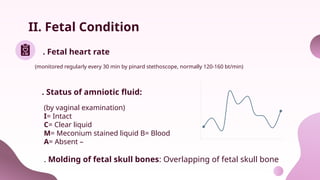
II. Fetal Condition
. Fetal heart rate
. Status of amniotic fluid:
(monitored regularly every 30 min by pinard stethoscope, normally 120-160 bt/min)
(by vaginal examination)
I= Intact
C= Clear liquid
M= Meconium stained liquid B= Blood
A= Absent โ€“
. Molding of fetal skull bones: Overlapping of fetal skull bone
III. Progress Of Labor
We have two stages :
a. Latent phase:
โ€ข It's initial stage of labour.
โ€ข characterized by gradual
onset of contractions and
the beginning of cervical
dilatation.
โ€ข contractions may be
irregular and mild.
โ€ข the cervix typically dilated
from (0) to (3-4)
centimeters.
โ€ข this phase can last for
several hours to days
especially for first-time
mothers.
refers to the series of
physical changes and
events that occur during
the labor process as a
woman prepares to give
birth.
It typically involves three
key components:
1. Cervical Changes :
This includes the dilation
(opening) and effacement
(thinning) of the cervix,
which prepares it for the
passage of the baby.
b. Active phase
โ€ข this phase follows the latent
phase.
โ€ข contraction more regular and
stronger.
โ€ข the cervix dilates from (4) to
(10) centimeters.
โ€ข contractions become more
frequent and intense,
occurring every 3 to 5
minutes and lasting about
40 to 60 seconds.
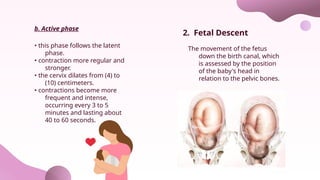
The movement of the fetus
down the birth canal, which
is assessed by the position
of the baby's head in
relation to the pelvic bones.
2. Fetal Descent
3. Contractions
The frequency, duration, and
intensity of uterine
contractions, which help to
facilitate cervical changes
and fetal descent.
Monitoring the progress of
labor helps healthcare
providers determine if
labor is proceeding
normally or if interventions
are needed.
Recording Maternal Condition
By Fatima Elmosrati
03
Recording Maternal Condition
All observation for
the motherโ€™s
condition is written at
the bottom of the
paragraph
Recording the
condition of mother :
motherโ€™s
information
Name, age, date
&time of admission,
gravidity and parity ,
time of rupture
membrane.
Medications
-Oxytocin drip (if
labour augmented )
Oxytocin unit per
volume IV fluids
[ oxytocin U/L ] in
drops per minute
[ drops/min ] every 30
minutes
-Drugs and other
intravenous
fluids(if used)
Includes: analgesic
(pain relief e.g
pethidine),
antibiotics ,etcโ€ฆ
Should be written
the name of drug &
dose in the long
box at the particle
point of time.
Vital sings
Assess maternal
condition regularly by By
repeat the monitoring
her pulse ,Bp, and
temprture.
-pulse : should be
checked every half to 1
hour and marked with a
dot [ โ€ข ]
-Blood pressure :
measured every 4 hours
and marked with arrows
[ ] if high risk case,
should be measured
more frequent time every
half to 1 hour.
Urine volume ,analysis
for patien & acetone
During course of labour ,
checking hydration by
volume of urine , and
check urine sample
looked for proteins &
ketone , is absent marked
by [ _ ]
In case of maternal
distress the volume may
be decreased.
-Temperature: recorded every 4
hours.
Recording Maternal Condition
Recording Fetus Condition
By Mohamed Fathy
04
Recording Fetus Condition
This part of graph is used to monitor and assess fetal condition:
1. fetal heart rate
2. the condition of the membrane and liquor
3. moulding the fetal skull bone
fetal heart rate
The rate of the fetal heart rate indicates the state of the fetus inside the uterus
* Each vertical side of the rectangle represents 10 beats per minute
* Each horizontal side of the rectangle represents 30 minutes
Fetal heart beat
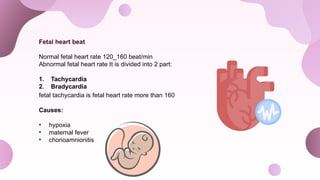
Normal fetal heart rate 120_160 beat/min
Abnormal fetal heart rate It is divided into 2 part:
1. Tachycardia
2. Bradycardia
fetal tachycardia is fetal heart rate more than 160
Causes:
โ€ข hypoxia
โ€ข maternal fever
โ€ข chorioamnionitis
fetal Bradycardia is fetal heart rate less than 120 beat
Causes
โ€ข fetal distress
Amniotic fluid:
โ€ข Record the color at ever vaginal examination
1- intact membranes โ€ฆโ€ฆโ€ฆโ€ฆโ€ฆโ€ฆ.I
2- ruptured membranes + clear liquor โ€ฆโ€ฆโ€ฆ.C
3- ruptured membranes + meconium- stained liquor โ€ฆโ€ฆ..M
4- ruptured membranes + blood โ€“ stained liquor โ€ฆโ€ฆโ€ฆโ€ฆB
5- ruptured membranes + absent liquor โ€ฆโ€ฆโ€ฆ....A
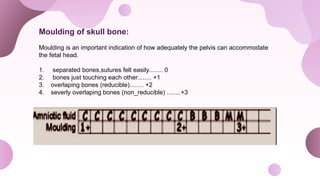
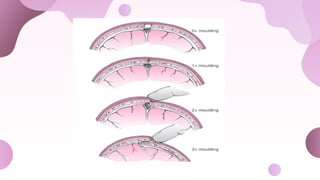
Moulding of skull bone:
Moulding is an important indication of how adequately the pelvis can accommodate
the fetal head.
1. separated bones,sutures felt easily........ 0
2. bones just touching each other........ +1
3. overlaping bones (reducible)........ +2
4. severly overlaping bones (non_reducible) ........+3
Recording The Progress Of Labor
By Eman Emad & Aisha Salem
05
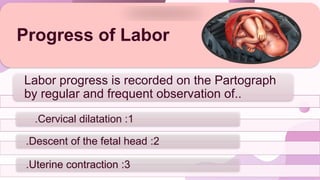
Labor progress is recorded on the Partograph
by regular and frequent observation of..
1
:
Cervical dilatation
.
2
:
Descent of the fetal head
.
3
:
Uterine contraction
.
Progress of Labor
1
:
Cervical dilatation
:
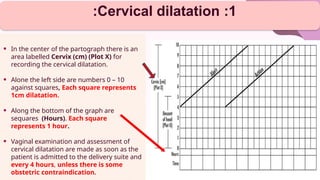
โ€ข In the center of the partograph there is an
area labelled Cervix (cm) (Plot X) for
recording the cervical dilatation.
โ€ข Alone the left side are numbers 0 โ€“ 10
against squares, Each square represents
1cm dilatation.
โ€ข Along the bottom of the graph are
sequares (Hours). Each square
represents 1 hour.
โ€ข Vaginal examination and assessment of
cervical dilatation are made as soon as the
patient is admitted to the delivery suite and
every 4 hours, unless there is some
obstetric contraindication.
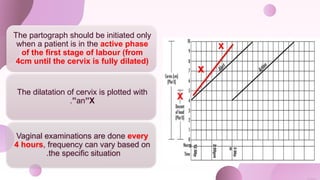
The partograph should be initiated only
when a patient is in the active phase
of the first stage of labour (from
4cm until the cervix is fully dilated)
The dilatation of cervix is plotted with
anโ€™โ€™X
โ€™โ€™
.
Vaginal examinations are done every
4 hours, frequency can vary based on
the specific situation
.
X
12:00p
m
2:00pm
x
x
3:00p
m
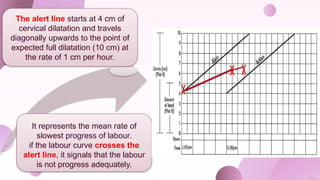
The alert line starts at 4 cm of
cervical dilatation and travels
diagonally upwards to the point of
expected full dilatation (10 cm) at
the rate of 1 cm per hour.
It represents the mean rate of
slowest progress of labour.
if the labour curve crosses the
alert line, it signals that the labour
is not progress adequately.
The action line is parallel and 4
hours to the right of the Alert line.
If the cervical dilatation crosses it,
appropriate action should be
taken.
WARNING !
2
:
Descent of the fetal head
:
โ€ข For labor to progress well,
dilatation of the cervix should
be accompanied by descent
of the fetal head.
โ€ข The descent of the fetal head
is measured by โ€˜โ€™stationโ€™โ€™
which indicates its position in
relation to the ischial spine of
the motherโ€™s pelvis.
โ€ข Station can only be
determined by vaginal
examination
On a partograph, the
descent of the fetal head is
plotted using an โ€˜โ€™Oโ€™โ€™
Cross ponding mark on the
partograph
The station of the fetal
head
5 -
4
or -3
4 -
2
or -1
3 0
2 +
1
1 +
2
0 +
3
Plotting the descent of the head
2pm 4pm 7pm
X
X
X
O
O
O
Plotting the descent of the head
Stations are measured in centimeters
:
โ€ข
0
Station: The fetal head is at the
level of the ischial spines
.
โ€ข
Negative Stations (-1, -2, -3, etc.):
The fetal head is above the ischial
spines
.
โ€ข
Positive Stations (+1, +2, +3, etc.):
The fetal head is below the ischial
spines
.
3
:
Uterine Contraction
:
โ— โ—Observation every half an hour for 10 minutes during active phase
โ— โ—Assess the frequency, duration and amplitude in each 10 min
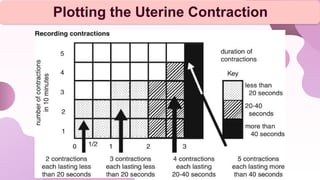
โ— โ—Frequency: number of contractions in 10 min ( each square represent one
contraction)
โ— โ—Duration: measuring the time when the contraction starts to were it ends in
seconds(the shade of each square)
โ— โ—Whatโ€™s the effective contraction?
โ— 3 to 5 contractions Every 10 min For 40-60 sec with an amplitude of 50-60 mmhg
โ— โ—More than 5 contractions per 10 minutes in 2 consecutive intervals indicate
ใ€Š Uterine tachysystole ใ€‹
โ— โ—If the contraction are less than 3 itโ€™s called hypotonic uterine contraction
Plotting the Uterine Contraction
Comments and Important Points
In Partogram
By Alaauldin Mohammed
06
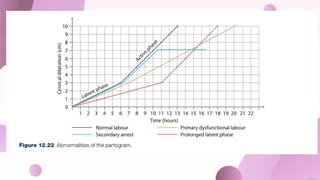
1. If there is slow cervical
dilatation progress ( indicate
prolonged labor) may the
defect in passage or
passenger, or power so may
need induction of labor or
S/c.
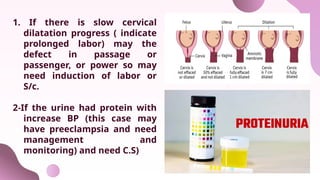
2-If the urine had protein with
increase BP (this case may
have preeclampsia and need
management and
monitoring) and need C.S)
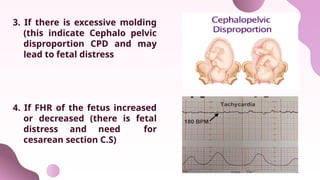
3. If there is excessive molding
(this indicate Cephalo pelvic
disproportion CPD and may
lead to fetal distress
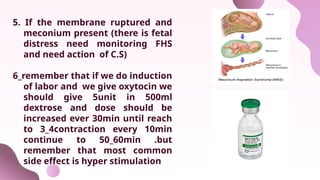
4. If FHR of the fetus increased
or decreased (there is fetal
distress and need for
cesarean section C.S)
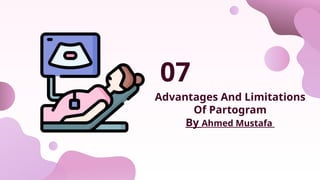
5. If the membrane ruptured and
meconium present (there is fetal
distress need monitoring FHS
and need action of C.S)
6_remember that if we do induction
of labor and we give oxytocin we
should give 5unit in 500ml
dextrose and dose should be
increased ever 30min until reach
to 3_4contraction every 10min
continue to 50_60min .but
remember that most common
side effect is hyper stimulation
Advantages And Limitations
Of Partogram
By Ahmed Mustafa
07
Advantages Of Partogram
โ€ข Early identification of labor abnormalities
โ€ข Improved decision-making
โ€ข Enhanced communication
โ€ข Improved documentation
โ€ข Increased patient awareness
โ€ข Reduced risk of maternal and fetal complications
Limitations Of Partogram
โ€ข Subjectivity in assessment
โ€ข Limited sensitivity
โ€ข Dependency on accurate data
โ€ข Cultural and linguistic barriers
โ€ข Lack of standardization
โ€ข Limited applicability in certain situations
Summary and Conclusion
By Ahmed Mustafa
08
Summary
The partogram is an essential tool in obstetric care that visually tracks
labor progress and maternal and fetal conditions. Introduced in the
1970s, it helps identify labor abnormalities early, reducing
complications. Key components include monitoring maternal vital
signs, fetal heart rates, and cervical dilation, using alert and action
lines for timely interventions.
Conclusion
In conclusion, the partogram is vital for modern childbirth practices,
promoting early detection of complications. While it offers advantages
like improved decision-making, it also has limitations, such as
subjective assessments. Overall, its effective use is crucial for
enhancing maternal and infant safety during labor.
Reference
09
References
1.World Health Organization (WHO). (1988). "Partograph in Management of Labour." Available at:
[WHO Partograph Guidelines](https://www.who.int/publications/i/item/partograph-in-
management-of-labour)
2.Friedman, E. A. (1954). "Labor and Delivery." American Journal of Obstetrics and Gynecology.
3.Philpott, R. H., & Castle, W. M. (1972). "The Partograph: A New Tool for the Management of
Labor." Journal of Obstetrics and Gynaecology.
4.Roberts, J. A., & Morrison, J. (2020). Textbook of Obstetrics. 3rd Edition. Elsevier.
5.Wikipedia. "Partogram." Available at: [Wikipedia Partogram
Page](https://en.wikipedia.org/wiki/Partogram)
6.Khan, K. N., et al. (2016). "The Use of Partogram in Labor Management: A Review." International
Journal of Obstetric Anesthesia, 25(2), 89-94.
7.Madhuri, R. M., et al. (2017). "Evaluation of Partogram in the Management of Labor." Journal of
Clinical and Diagnostic Research, 11(7), QC05-QC08.
8.Choudhury, R., & Singh, R. (2019). "Role of Partograph in Labor Management: A Review." Journal
of Obstetrics and Gynaecology, 39(4), 477-481.
CREDITS: This presentation template was created by Slidesgo, and
includes icons by Flaticon and infographics & images by Freepik
Thanks

Partogram Partogram Partogram Partogram

  • 1.
    Partogram Prepared and presentedby โ€ข Ahmed Mustafa โ€ข Aisha Salem โ€ข Alaauldin Mohammed โ€ข Yahya Abdulkarim โ€ข Fatima Elmosrati โ€ข Mohamed fathy โ€ข Eman Emad โ€ข Hanan Sami โ€ข Habiba mahroos We extend our sincere gratitude to Dr. Rabia Aljadi and Dr. Asmaa Alfarsy for their guidance and support throughout this project.
  • 2.
    Table of contents 0104 02 05 03 06 Introduction & history Components of Partogram Recording the condition of mother Recording The Condition Of Fetus Recording The Progress Of Labor Comments and Important Points In Partogram 07 08 09 Advantages and Limitations of Partogram Summary and Conclusion Reference
  • 3.
    Introduction and HistoryOf Partogram By Yahya Abdulkarim 01
  • 4.
    1. Introduction Before theintroduction of the partogram, maternal mortality rates during labor were notably higher, around half a million women die from pregnancy complications. The primary causes of maternal mortality are postpartum hemorrhage and sepsis, along with obstructed labor and ruptured uterus. Prolonged labor often results from cephalopelvic disproportion (CPD), leading to complications such as obstructed labor, maternal dehydration, and exhaustion. Early detection of abnormal labor progression and prevention of prolonged labor could significantly reduce these risks.
  • 5.
    The partograph isa graphic recording of progress of labor and conditions of the mother and fetus, has been used since 1970 to detect labor that is not progressing normally, to indicate when augmentation of labor is appropriate and to recognize cephalopelvic disproportion long before labor becomes obstructed. The partograph serves as an โ€œearly warning systemโ€ and assists in early decision on transfer, augmentation and termination of labor. 2. What is Partogram?
  • 6.
    3. HISTORY OFTHE PARTOGRAPH In, 1954 Friedman described a normal cervical dilatation pattern. prepared the cervicogram to provide a visual representation of the progress of labor. Friedman divided first stage of labor into two parts, The latent phase, extends over 8-10 hours and up to about 3 cm dilation, followed by an active phase, with an acceleration from 3 to 10 cm.
  • 7.
    In 1972 Philpottand Castle, developed the first partograph, by utilizing Friedman's cervicograph, and adding the relationship of the presenting part to the maternal pelvis. they also Introduced the concept of "ALERT" and "ACTION" lines. ALERT LINE represent the mean rate of slowest progress of labor, ACTION LINE-appropriate action should be taken.
  • 8.
    WHO, gave acomposite partograph in (1988) and later modified partograph was introduced in 2000 .The "modified partograph " is used widely now..
  • 9.
    Components Of Partogram: the partograph is basically a graphic representation of the events of labor plotted against time in hours. It consists of three components: I. Mother Condition II. Fetus Condition III. Progress Of Labor
  • 10.
    Components of Partogram ByHabiba Mahroos & Hanan Sami 02
  • 11.
    Fetal Condition Progress oflabor Maternal Condition
  • 12.
    I. Maternal Condition "monitoredregularly" 1. Personal data of pt (name, age, G:P:A, BG, time date of admission) 2. Drugs given to patient, IV fluid 3. Vital signs: - Maternal pulse (every 30 min) - Blood pressure( every 2-4 hours) - Temperature (every 4 hours) 4. Urine output and analysis (protein, glucose, acetone)
  • 13.
    II. Fetal Condition .Fetal heart rate . Status of amniotic fluid: (monitored regularly every 30 min by pinard stethoscope, normally 120-160 bt/min) (by vaginal examination) I= Intact C= Clear liquid M= Meconium stained liquid B= Blood A= Absent โ€“ . Molding of fetal skull bones: Overlapping of fetal skull bone
  • 14.
    III. Progress OfLabor We have two stages : a. Latent phase: โ€ข It's initial stage of labour. โ€ข characterized by gradual onset of contractions and the beginning of cervical dilatation. โ€ข contractions may be irregular and mild. โ€ข the cervix typically dilated from (0) to (3-4) centimeters. โ€ข this phase can last for several hours to days especially for first-time mothers. refers to the series of physical changes and events that occur during the labor process as a woman prepares to give birth. It typically involves three key components: 1. Cervical Changes : This includes the dilation (opening) and effacement (thinning) of the cervix, which prepares it for the passage of the baby.
  • 15.
    b. Active phase โ€ขthis phase follows the latent phase. โ€ข contraction more regular and stronger. โ€ข the cervix dilates from (4) to (10) centimeters. โ€ข contractions become more frequent and intense, occurring every 3 to 5 minutes and lasting about 40 to 60 seconds. The movement of the fetus down the birth canal, which is assessed by the position of the baby's head in relation to the pelvic bones. 2. Fetal Descent
  • 16.
    3. Contractions The frequency,duration, and intensity of uterine contractions, which help to facilitate cervical changes and fetal descent. Monitoring the progress of labor helps healthcare providers determine if labor is proceeding normally or if interventions are needed.
  • 17.
  • 18.
    Recording Maternal Condition Allobservation for the motherโ€™s condition is written at the bottom of the paragraph Recording the condition of mother : motherโ€™s information Name, age, date &time of admission, gravidity and parity , time of rupture membrane. Medications -Oxytocin drip (if labour augmented ) Oxytocin unit per volume IV fluids [ oxytocin U/L ] in drops per minute [ drops/min ] every 30 minutes -Drugs and other intravenous fluids(if used) Includes: analgesic (pain relief e.g pethidine), antibiotics ,etcโ€ฆ Should be written the name of drug & dose in the long box at the particle point of time.
  • 19.
    Vital sings Assess maternal conditionregularly by By repeat the monitoring her pulse ,Bp, and temprture. -pulse : should be checked every half to 1 hour and marked with a dot [ โ€ข ] -Blood pressure : measured every 4 hours and marked with arrows [ ] if high risk case, should be measured more frequent time every half to 1 hour. Urine volume ,analysis for patien & acetone During course of labour , checking hydration by volume of urine , and check urine sample looked for proteins & ketone , is absent marked by [ _ ] In case of maternal distress the volume may be decreased. -Temperature: recorded every 4 hours.
  • 20.
  • 21.
  • 22.
    Recording Fetus Condition Thispart of graph is used to monitor and assess fetal condition: 1. fetal heart rate 2. the condition of the membrane and liquor 3. moulding the fetal skull bone fetal heart rate The rate of the fetal heart rate indicates the state of the fetus inside the uterus * Each vertical side of the rectangle represents 10 beats per minute * Each horizontal side of the rectangle represents 30 minutes
  • 23.
    Fetal heart beat Normalfetal heart rate 120_160 beat/min Abnormal fetal heart rate It is divided into 2 part: 1. Tachycardia 2. Bradycardia fetal tachycardia is fetal heart rate more than 160 Causes: โ€ข hypoxia โ€ข maternal fever โ€ข chorioamnionitis
  • 24.
    fetal Bradycardia isfetal heart rate less than 120 beat Causes โ€ข fetal distress Amniotic fluid: โ€ข Record the color at ever vaginal examination 1- intact membranes โ€ฆโ€ฆโ€ฆโ€ฆโ€ฆโ€ฆ.I 2- ruptured membranes + clear liquor โ€ฆโ€ฆโ€ฆ.C 3- ruptured membranes + meconium- stained liquor โ€ฆโ€ฆ..M 4- ruptured membranes + blood โ€“ stained liquor โ€ฆโ€ฆโ€ฆโ€ฆB 5- ruptured membranes + absent liquor โ€ฆโ€ฆโ€ฆ....A
  • 25.
    Moulding of skullbone: Moulding is an important indication of how adequately the pelvis can accommodate the fetal head. 1. separated bones,sutures felt easily........ 0 2. bones just touching each other........ +1 3. overlaping bones (reducible)........ +2 4. severly overlaping bones (non_reducible) ........+3
  • 27.
    Recording The ProgressOf Labor By Eman Emad & Aisha Salem 05
  • 28.
    Labor progress isrecorded on the Partograph by regular and frequent observation of.. 1 : Cervical dilatation . 2 : Descent of the fetal head . 3 : Uterine contraction . Progress of Labor
  • 29.
    1 : Cervical dilatation : โ€ข Inthe center of the partograph there is an area labelled Cervix (cm) (Plot X) for recording the cervical dilatation. โ€ข Alone the left side are numbers 0 โ€“ 10 against squares, Each square represents 1cm dilatation. โ€ข Along the bottom of the graph are sequares (Hours). Each square represents 1 hour. โ€ข Vaginal examination and assessment of cervical dilatation are made as soon as the patient is admitted to the delivery suite and every 4 hours, unless there is some obstetric contraindication.
  • 30.
    The partograph shouldbe initiated only when a patient is in the active phase of the first stage of labour (from 4cm until the cervix is fully dilated) The dilatation of cervix is plotted with anโ€™โ€™X โ€™โ€™ . Vaginal examinations are done every 4 hours, frequency can vary based on the specific situation . X 12:00p m 2:00pm x x 3:00p m
  • 31.
    The alert linestarts at 4 cm of cervical dilatation and travels diagonally upwards to the point of expected full dilatation (10 cm) at the rate of 1 cm per hour. It represents the mean rate of slowest progress of labour. if the labour curve crosses the alert line, it signals that the labour is not progress adequately.
  • 32.
    The action lineis parallel and 4 hours to the right of the Alert line. If the cervical dilatation crosses it, appropriate action should be taken. WARNING !
  • 33.
    2 : Descent of thefetal head : โ€ข For labor to progress well, dilatation of the cervix should be accompanied by descent of the fetal head. โ€ข The descent of the fetal head is measured by โ€˜โ€™stationโ€™โ€™ which indicates its position in relation to the ischial spine of the motherโ€™s pelvis. โ€ข Station can only be determined by vaginal examination
  • 34.
    On a partograph,the descent of the fetal head is plotted using an โ€˜โ€™Oโ€™โ€™ Cross ponding mark on the partograph The station of the fetal head 5 - 4 or -3 4 - 2 or -1 3 0 2 + 1 1 + 2 0 + 3 Plotting the descent of the head 2pm 4pm 7pm X X X O O O
  • 35.
    Plotting the descentof the head Stations are measured in centimeters : โ€ข 0 Station: The fetal head is at the level of the ischial spines . โ€ข Negative Stations (-1, -2, -3, etc.): The fetal head is above the ischial spines . โ€ข Positive Stations (+1, +2, +3, etc.): The fetal head is below the ischial spines .
  • 36.
    3 : Uterine Contraction : โ— โ—Observationevery half an hour for 10 minutes during active phase โ— โ—Assess the frequency, duration and amplitude in each 10 min โ— โ—Frequency: number of contractions in 10 min ( each square represent one contraction) โ— โ—Duration: measuring the time when the contraction starts to were it ends in seconds(the shade of each square) โ— โ—Whatโ€™s the effective contraction? โ— 3 to 5 contractions Every 10 min For 40-60 sec with an amplitude of 50-60 mmhg โ— โ—More than 5 contractions per 10 minutes in 2 consecutive intervals indicate ใ€Š Uterine tachysystole ใ€‹ โ— โ—If the contraction are less than 3 itโ€™s called hypotonic uterine contraction
  • 37.
  • 39.
    Comments and ImportantPoints In Partogram By Alaauldin Mohammed 06
  • 40.
    1. If thereis slow cervical dilatation progress ( indicate prolonged labor) may the defect in passage or passenger, or power so may need induction of labor or S/c. 2-If the urine had protein with increase BP (this case may have preeclampsia and need management and monitoring) and need C.S)
  • 41.
    3. If thereis excessive molding (this indicate Cephalo pelvic disproportion CPD and may lead to fetal distress 4. If FHR of the fetus increased or decreased (there is fetal distress and need for cesarean section C.S)
  • 42.
    5. If themembrane ruptured and meconium present (there is fetal distress need monitoring FHS and need action of C.S) 6_remember that if we do induction of labor and we give oxytocin we should give 5unit in 500ml dextrose and dose should be increased ever 30min until reach to 3_4contraction every 10min continue to 50_60min .but remember that most common side effect is hyper stimulation
  • 43.
    Advantages And Limitations OfPartogram By Ahmed Mustafa 07
  • 44.
    Advantages Of Partogram โ€ขEarly identification of labor abnormalities โ€ข Improved decision-making โ€ข Enhanced communication โ€ข Improved documentation โ€ข Increased patient awareness โ€ข Reduced risk of maternal and fetal complications
  • 45.
    Limitations Of Partogram โ€ขSubjectivity in assessment โ€ข Limited sensitivity โ€ข Dependency on accurate data โ€ข Cultural and linguistic barriers โ€ข Lack of standardization โ€ข Limited applicability in certain situations
  • 46.
    Summary and Conclusion ByAhmed Mustafa 08
  • 47.
    Summary The partogram isan essential tool in obstetric care that visually tracks labor progress and maternal and fetal conditions. Introduced in the 1970s, it helps identify labor abnormalities early, reducing complications. Key components include monitoring maternal vital signs, fetal heart rates, and cervical dilation, using alert and action lines for timely interventions. Conclusion In conclusion, the partogram is vital for modern childbirth practices, promoting early detection of complications. While it offers advantages like improved decision-making, it also has limitations, such as subjective assessments. Overall, its effective use is crucial for enhancing maternal and infant safety during labor.
  • 48.
  • 49.
    References 1.World Health Organization(WHO). (1988). "Partograph in Management of Labour." Available at: [WHO Partograph Guidelines](https://www.who.int/publications/i/item/partograph-in- management-of-labour) 2.Friedman, E. A. (1954). "Labor and Delivery." American Journal of Obstetrics and Gynecology. 3.Philpott, R. H., & Castle, W. M. (1972). "The Partograph: A New Tool for the Management of Labor." Journal of Obstetrics and Gynaecology. 4.Roberts, J. A., & Morrison, J. (2020). Textbook of Obstetrics. 3rd Edition. Elsevier. 5.Wikipedia. "Partogram." Available at: [Wikipedia Partogram Page](https://en.wikipedia.org/wiki/Partogram) 6.Khan, K. N., et al. (2016). "The Use of Partogram in Labor Management: A Review." International Journal of Obstetric Anesthesia, 25(2), 89-94. 7.Madhuri, R. M., et al. (2017). "Evaluation of Partogram in the Management of Labor." Journal of Clinical and Diagnostic Research, 11(7), QC05-QC08. 8.Choudhury, R., & Singh, R. (2019). "Role of Partograph in Labor Management: A Review." Journal of Obstetrics and Gynaecology, 39(4), 477-481.
  • 50.
    CREDITS: This presentationtemplate was created by Slidesgo, and includes icons by Flaticon and infographics & images by Freepik Thanks