Partnership
Development
An overview of Stages and Essential behaviors
5 Stages in Partnership
Development
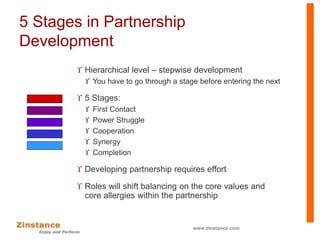
 Hierarchical level – stepwise development
 You have to go through a stage before entering the next
 5 Stages:
 First Contact
 Power Struggle
 Cooperation
 Synergy
 Completion
 Developing partnership requires effort
 Roles will shift balancing on the core values and
core allergies within the partnership
www.zinstance.com
Stage 1: First Contact
 This stage of relationships is characterized by a fascination with
the other organization or project or person and a desire to learn
more about them, as well as a desire to share things about your
own organisation.
 It's new, it’s fun and it feels good. This is the time when positive
possibilities are sensed and explored.
www.zinstance.com
Stage1: First Contact
Essential Skills for success
 Be interested, not merely interesting Active listening
 Look for and focus on the best in others, e.g Imagining people at a party
 Acknowledge/compliment others on the good you see in them and their accomplishments Even
your allergy can be a means to discover their core competencies
 Help people to relax with you - put them at ease
 Know what the most important things are for people to know about you and weave those things
into your conversations so you feel they "get" who you are. Be transparant
 To simply "be" with others without an agenda and be authentic
 Keep your word to build trust
 Dress to show respect
 Speech acts to learn and master: Greeting, Making requests, Declining requests, Making
promises, Making apologies, High performance listening
www.zinstance.com
Stage 1: First Contact
What to avoid:
 Lying
 The need to be seen as… (better, competent, interested, ..)
 Jumping to conclusions verify your assumptions
 To AssUMe is making an Ass out of U and Me
 Moving too quickly into a commitment conversation
 Expecting people to read your mind and anticipate your conditions
for satisfaction
 Keeping people in the dark about your mind by explaining how you
think and what you are thinking
 Stereotyping or categorizing
www.zinstance.com
Stage 2: Power Struggle
 This is the stage where organisations and people start testing
each other. Who is going to get whose way and how?
 This stage is really about building trust.
 Distrust from your unresolved past will manifest
 Often a fear of loss of control; heavy judgments of the other
partner start to show up.
 It is one of the most difficult stages. Many organisations and
people never move beyond this stage and partnerships many
end here.
www.zinstance.com
Stage 2: Power Struggle
Essential Skills for success
 Communicate without blame and control your temper
 Self-reflection:
 observe your thoughts, feelings and behaviours without judgment;
 know and identify your feelings and speak congruently with your emotions
 Observe your automatic interpretations of others and events
 Be present to someone else’s upset without defence
 Know and articulate your requirements for trust
 Be able to restore trust when broken and use current upsets to resolve the past
 Ask for help
 Forgive yourself and others
 Own/take responsibility for your mistakes and make correction without invalidation
 Take the initiative - be responsible for your own needs
 Turn complaints into requests
 Be clear-headed and rational while feeling intense feelings or while in the presence of others intense
feelings
www.zinstance.com
Stage 2: Power Struggle
What to avoid:
 Giving ultimatums
 Blaming others
 Gossiping or participating in gossip
 Being mean, attacking, hurtful or hypercritical
 Saying things you'll regret
 Don't control others or make their choices for them
 Don't sacrifice - be generous
www.zinstance.com
Stage 3: Cooperation
 This is the stage where you learn to trust both one another and
your ability to resolve upsets to your mutual satisfaction and
benefit.
 You learn to share power and appreciate each other's unique
abilities and gifts. However, it is still self oriented - "What can I
get out of this partnership?" rather than "What can we create
with this partnership?"
 Beware of false cooperation in which one organisation keeps
quiet to the other in order to "keep the peace". This form of
Cooperation is still Power Struggle, only in a more subtle form.
www.zinstance.com
Stage 3: Cooperation
Essential Skills for success
 Know and articulate the essence of your organisational objectives and desires
 Assess trustworthiness in others and assume trust rather than suspicion
 Inspire high level of trust from others
 Care deeply and feel connected with your partner; Read others emotions
 Generate enthusiasm
 Find and define a common path; Ability to articulate higher path, especially during
stress
 Know and articulate how others affect you, e.g., their losing/winning,
problems/thriving
 Make choices for long-term gains - overcome the need for instant gratification
 Competency with creation techniques, e.g., visualization, goal setting, etc.
 Know and articulate changing conditions for satisfaction
 Neutralize competition while inspiring cooperation
 Be diplomatic and cordial even when worried, upset and during stress
 Facilitate conversations for: Speculation and possibility, Planning and design,
Commitment and action
www.zinstance.com
Stage 3: Cooperation
What to avoid:
 Making assumptions
 Sacrifice - it always leads to resentment
 Withholding important communication out of fear
www.zinstance.com
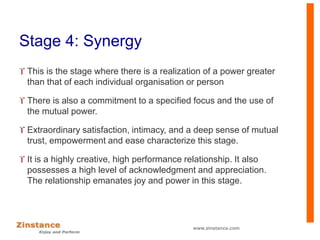
Stage 4: Synergy
 This is the stage where there is a realization of a power greater
than that of each individual organisation or person
 There is also a commitment to a specified focus and the use of
the mutual power.
 Extraordinary satisfaction, intimacy, and a deep sense of mutual
trust, empowerment and ease characterize this stage.
 It is a highly creative, high performance relationship. It also
possesses a high level of acknowledgment and appreciation.
The relationship emanates joy and power in this stage.
www.zinstance.com
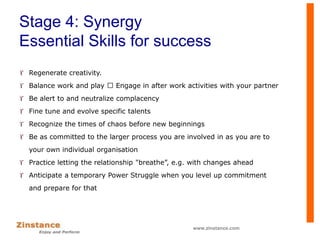
Stage 4: Synergy
Essential Skills for success
 Regenerate creativity.
 Balance work and play Engage in after work activities with your partner
 Be alert to and neutralize complacency
 Fine tune and evolve specific talents
 Recognize the times of chaos before new beginnings
 Be as committed to the larger process you are involved in as you are to
your own individual organisation
 Practice letting the relationship "breathe”, e.g. with changes ahead
 Anticipate a temporary Power Struggle when you level up commitment
and prepare for that
www.zinstance.com
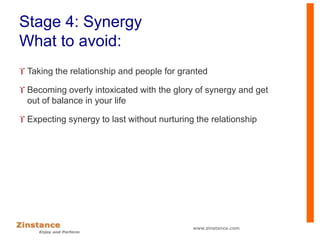
Stage 4: Synergy
What to avoid:
 Taking the relationship and people for granted
 Becoming overly intoxicated with the glory of synergy and get
out of balance in your life
 Expecting synergy to last without nurturing the relationship
www.zinstance.com
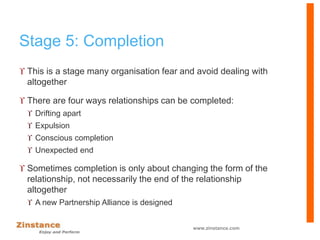
Stage 5: Completion
 This is a stage many organisation fear and avoid dealing with
altogether
 There are four ways relationships can be completed:
 Drifting apart
 Expulsion
 Conscious completion
 Unexpected end
 Sometimes completion is only about changing the form of the
relationship, not necessarily the end of the relationship
altogether
 A new Partnership Alliance is designed
www.zinstance.com
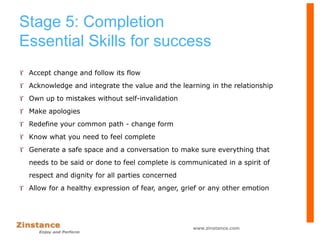
Stage 5: Completion
Essential Skills for success
 Accept change and follow its flow
 Acknowledge and integrate the value and the learning in the relationship
 Own up to mistakes without self-invalidation
 Make apologies
 Redefine your common path - change form
 Know what you need to feel complete
 Generate a safe space and a conversation to make sure everything that
needs to be said or done to feel complete is communicated in a spirit of
respect and dignity for all parties concerned
 Allow for a healthy expression of fear, anger, grief or any other emotion
www.zinstance.com
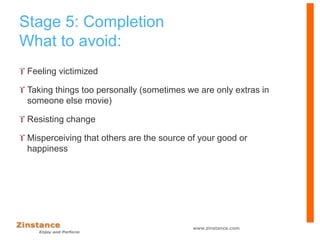
Stage 5: Completion
What to avoid:
 Feeling victimized
 Taking things too personally (sometimes we are only extras in
someone else movie)
 Resisting change
 Misperceiving that others are the source of your good or
happiness
www.zinstance.com

Partnership development: An overview of Stages and Essential behaviors

  • 1.
    Partnership Development An overview ofStages and Essential behaviors
  • 2.
    5 Stages inPartnership Development  Hierarchical level – stepwise development  You have to go through a stage before entering the next  5 Stages:  First Contact  Power Struggle  Cooperation  Synergy  Completion  Developing partnership requires effort  Roles will shift balancing on the core values and core allergies within the partnership www.zinstance.com
  • 3.
    Stage 1: FirstContact  This stage of relationships is characterized by a fascination with the other organization or project or person and a desire to learn more about them, as well as a desire to share things about your own organisation.  It's new, it’s fun and it feels good. This is the time when positive possibilities are sensed and explored. www.zinstance.com
  • 4.
    Stage1: First Contact EssentialSkills for success  Be interested, not merely interesting Active listening  Look for and focus on the best in others, e.g Imagining people at a party  Acknowledge/compliment others on the good you see in them and their accomplishments Even your allergy can be a means to discover their core competencies  Help people to relax with you - put them at ease  Know what the most important things are for people to know about you and weave those things into your conversations so you feel they "get" who you are. Be transparant  To simply "be" with others without an agenda and be authentic  Keep your word to build trust  Dress to show respect  Speech acts to learn and master: Greeting, Making requests, Declining requests, Making promises, Making apologies, High performance listening www.zinstance.com
  • 5.
    Stage 1: FirstContact What to avoid:  Lying  The need to be seen as… (better, competent, interested, ..)  Jumping to conclusions verify your assumptions  To AssUMe is making an Ass out of U and Me  Moving too quickly into a commitment conversation  Expecting people to read your mind and anticipate your conditions for satisfaction  Keeping people in the dark about your mind by explaining how you think and what you are thinking  Stereotyping or categorizing www.zinstance.com
  • 6.
    Stage 2: PowerStruggle  This is the stage where organisations and people start testing each other. Who is going to get whose way and how?  This stage is really about building trust.  Distrust from your unresolved past will manifest  Often a fear of loss of control; heavy judgments of the other partner start to show up.  It is one of the most difficult stages. Many organisations and people never move beyond this stage and partnerships many end here. www.zinstance.com
  • 7.
    Stage 2: PowerStruggle Essential Skills for success  Communicate without blame and control your temper  Self-reflection:  observe your thoughts, feelings and behaviours without judgment;  know and identify your feelings and speak congruently with your emotions  Observe your automatic interpretations of others and events  Be present to someone else’s upset without defence  Know and articulate your requirements for trust  Be able to restore trust when broken and use current upsets to resolve the past  Ask for help  Forgive yourself and others  Own/take responsibility for your mistakes and make correction without invalidation  Take the initiative - be responsible for your own needs  Turn complaints into requests  Be clear-headed and rational while feeling intense feelings or while in the presence of others intense feelings www.zinstance.com
  • 8.
    Stage 2: PowerStruggle What to avoid:  Giving ultimatums  Blaming others  Gossiping or participating in gossip  Being mean, attacking, hurtful or hypercritical  Saying things you'll regret  Don't control others or make their choices for them  Don't sacrifice - be generous www.zinstance.com
  • 9.
    Stage 3: Cooperation This is the stage where you learn to trust both one another and your ability to resolve upsets to your mutual satisfaction and benefit.  You learn to share power and appreciate each other's unique abilities and gifts. However, it is still self oriented - "What can I get out of this partnership?" rather than "What can we create with this partnership?"  Beware of false cooperation in which one organisation keeps quiet to the other in order to "keep the peace". This form of Cooperation is still Power Struggle, only in a more subtle form. www.zinstance.com
  • 10.
    Stage 3: Cooperation EssentialSkills for success  Know and articulate the essence of your organisational objectives and desires  Assess trustworthiness in others and assume trust rather than suspicion  Inspire high level of trust from others  Care deeply and feel connected with your partner; Read others emotions  Generate enthusiasm  Find and define a common path; Ability to articulate higher path, especially during stress  Know and articulate how others affect you, e.g., their losing/winning, problems/thriving  Make choices for long-term gains - overcome the need for instant gratification  Competency with creation techniques, e.g., visualization, goal setting, etc.  Know and articulate changing conditions for satisfaction  Neutralize competition while inspiring cooperation  Be diplomatic and cordial even when worried, upset and during stress  Facilitate conversations for: Speculation and possibility, Planning and design, Commitment and action www.zinstance.com
  • 11.
    Stage 3: Cooperation Whatto avoid:  Making assumptions  Sacrifice - it always leads to resentment  Withholding important communication out of fear www.zinstance.com
  • 12.
    Stage 4: Synergy This is the stage where there is a realization of a power greater than that of each individual organisation or person  There is also a commitment to a specified focus and the use of the mutual power.  Extraordinary satisfaction, intimacy, and a deep sense of mutual trust, empowerment and ease characterize this stage.  It is a highly creative, high performance relationship. It also possesses a high level of acknowledgment and appreciation. The relationship emanates joy and power in this stage. www.zinstance.com
  • 13.
    Stage 4: Synergy EssentialSkills for success  Regenerate creativity.  Balance work and play Engage in after work activities with your partner  Be alert to and neutralize complacency  Fine tune and evolve specific talents  Recognize the times of chaos before new beginnings  Be as committed to the larger process you are involved in as you are to your own individual organisation  Practice letting the relationship "breathe”, e.g. with changes ahead  Anticipate a temporary Power Struggle when you level up commitment and prepare for that www.zinstance.com
  • 14.
    Stage 4: Synergy Whatto avoid:  Taking the relationship and people for granted  Becoming overly intoxicated with the glory of synergy and get out of balance in your life  Expecting synergy to last without nurturing the relationship www.zinstance.com
  • 15.
    Stage 5: Completion This is a stage many organisation fear and avoid dealing with altogether  There are four ways relationships can be completed:  Drifting apart  Expulsion  Conscious completion  Unexpected end  Sometimes completion is only about changing the form of the relationship, not necessarily the end of the relationship altogether  A new Partnership Alliance is designed www.zinstance.com
  • 16.
    Stage 5: Completion EssentialSkills for success  Accept change and follow its flow  Acknowledge and integrate the value and the learning in the relationship  Own up to mistakes without self-invalidation  Make apologies  Redefine your common path - change form  Know what you need to feel complete  Generate a safe space and a conversation to make sure everything that needs to be said or done to feel complete is communicated in a spirit of respect and dignity for all parties concerned  Allow for a healthy expression of fear, anger, grief or any other emotion www.zinstance.com
  • 17.
    Stage 5: Completion Whatto avoid:  Feeling victimized  Taking things too personally (sometimes we are only extras in someone else movie)  Resisting change  Misperceiving that others are the source of your good or happiness www.zinstance.com