
Biological Aspect Of
Proton And High LET
Source
PREPARED BY MAHRAN ALNAHMI
SUPERVISOR PROF.DR. ANWAR MICHAEL
2
• Modern radiotherapy is usually given by linear
accelerators producing X-rays with high-energy of
4–25 MV
– Energetic enough to ionize molecules in tissues
– this ionization that results in the biological effects seen
in radiotherapy
– have roughly the same biological effect per unit dose
INTRODUCTION
3
• Electron beams are quantum-mechanically similar to
X-rays and produce similar biological effects
• Two other classes of radiations
– Light particles – e.g. protons, neutrons and α-
particles
– Heavy particles – e.g. fully stripped carbon, neon,
silicon or argon ions
INTRODUCTION
4
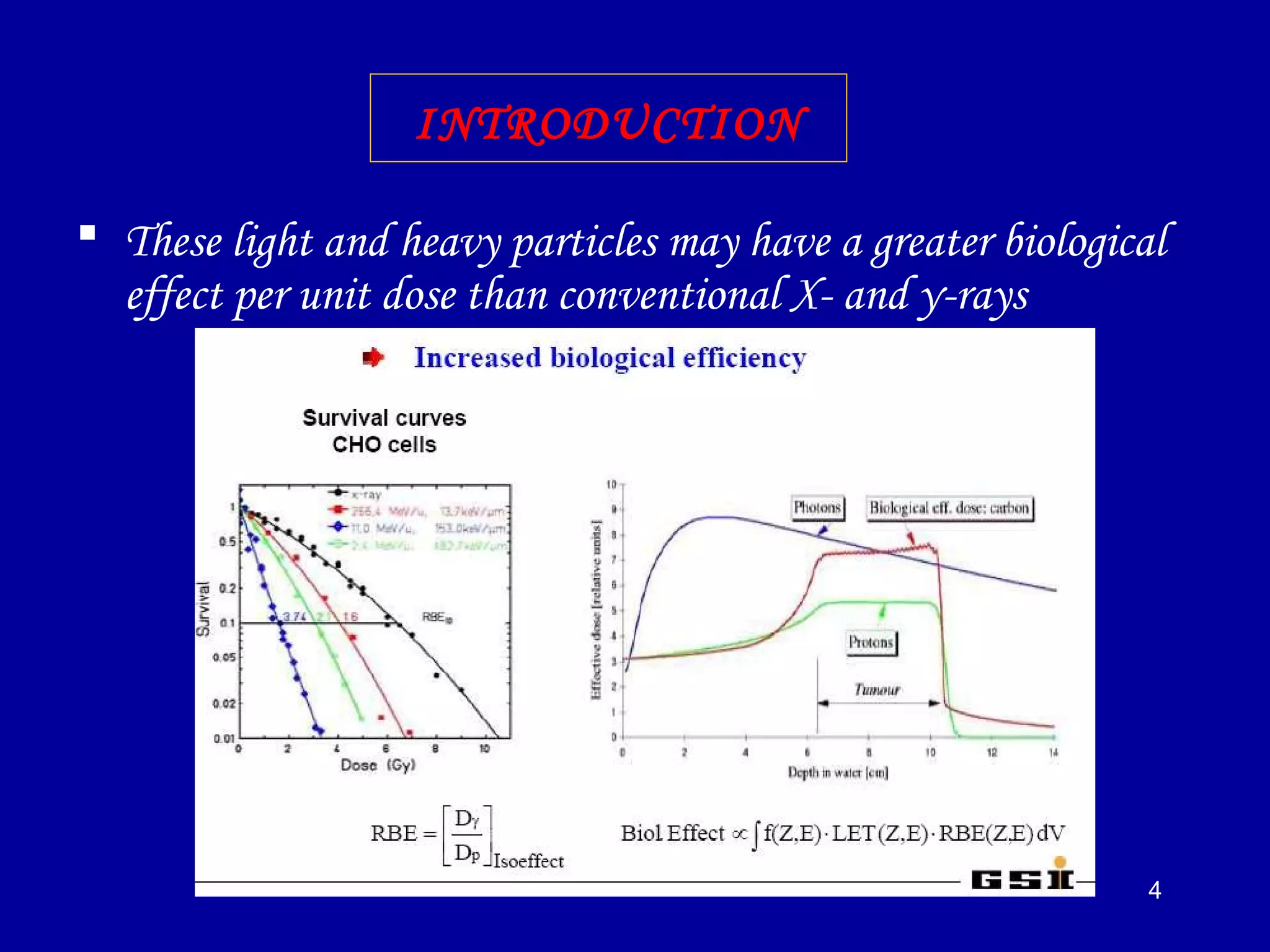
 These light and heavy particles may have a greater biological
effect per unit dose than conventional X- and γ-rays
INTRODUCTION
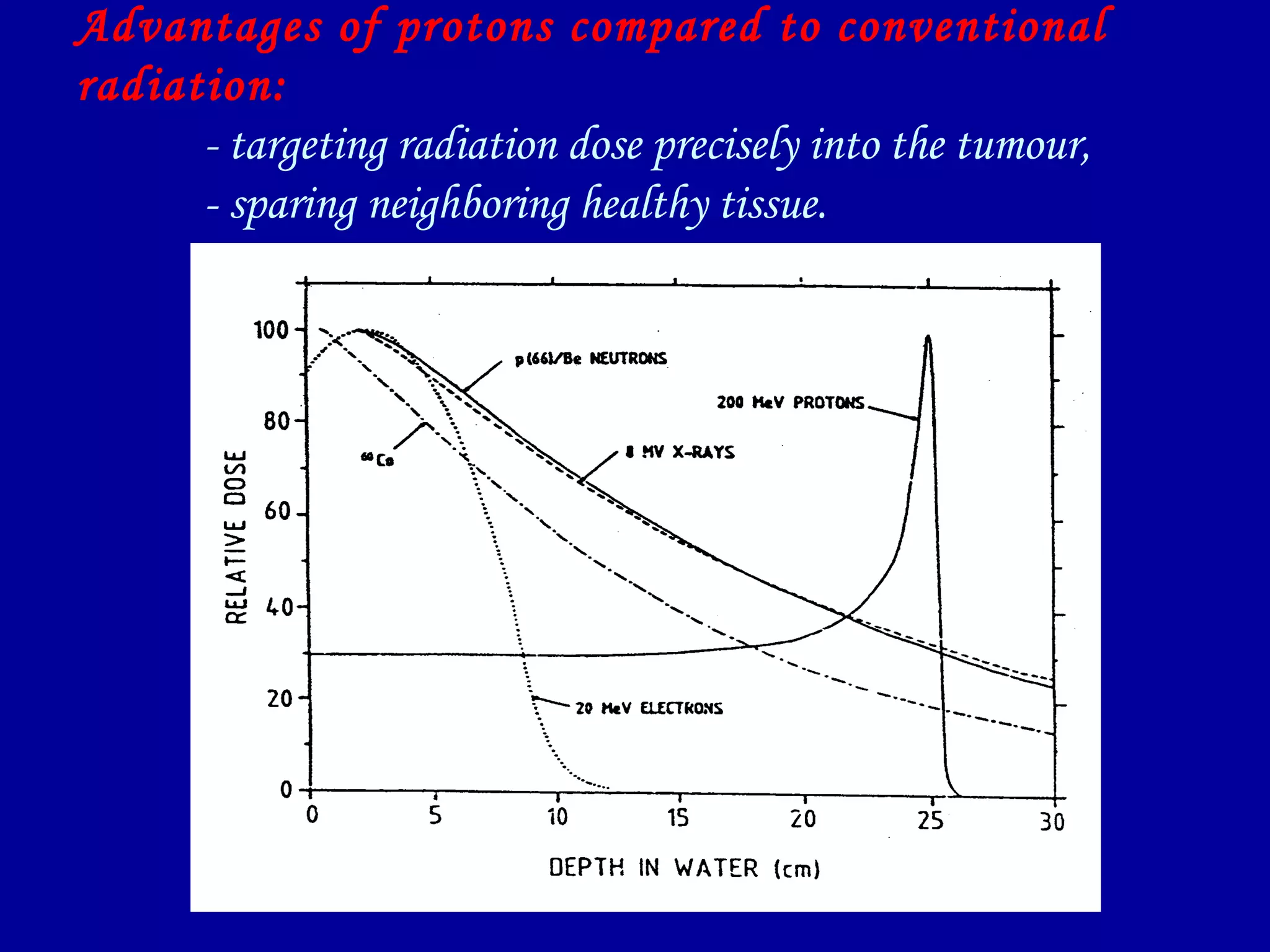
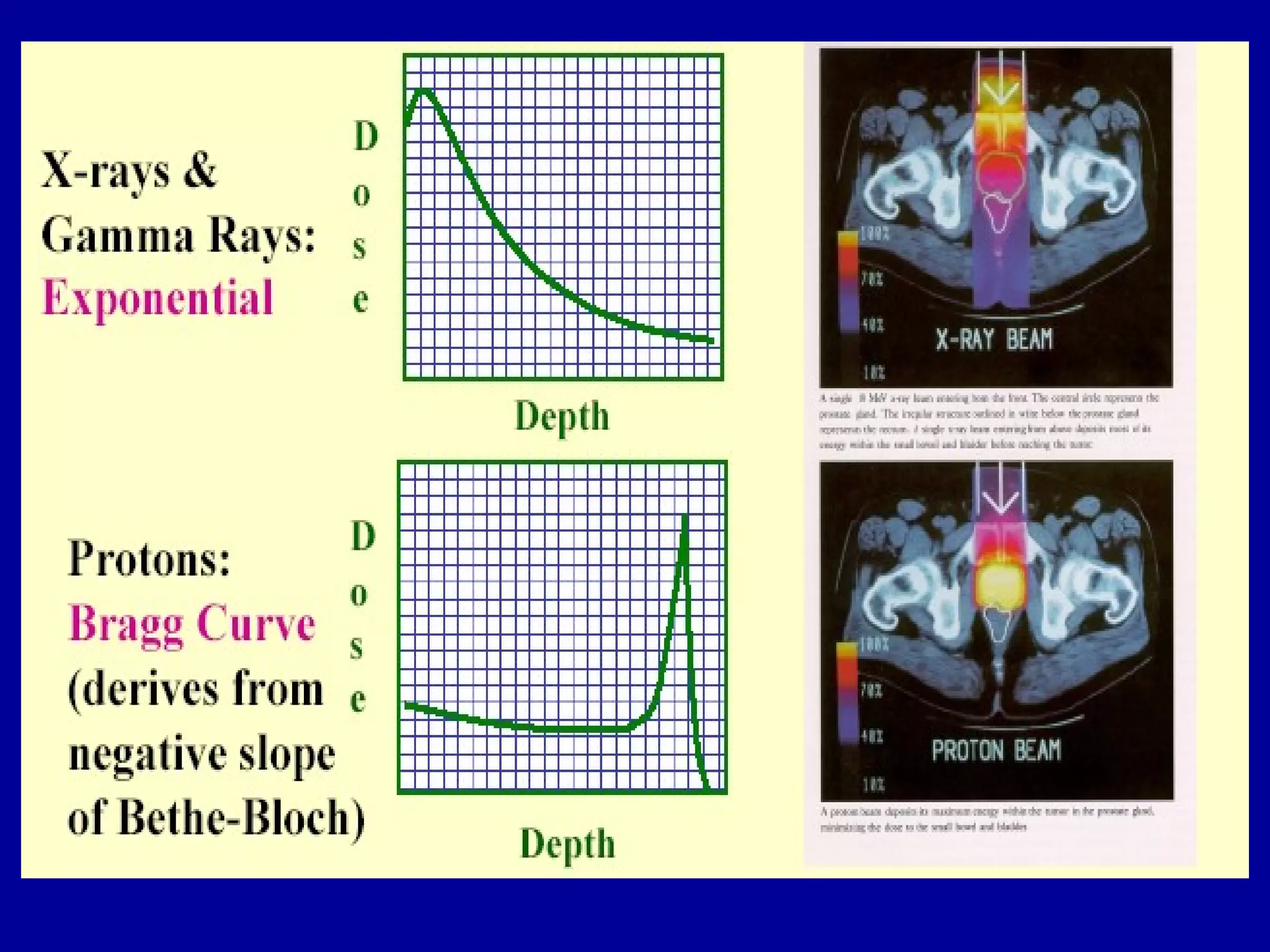
Advantages of protons compared to conventional
radiation:
- targeting radiation dose precisely into the tumour,
- sparing neighboring healthy tissue.
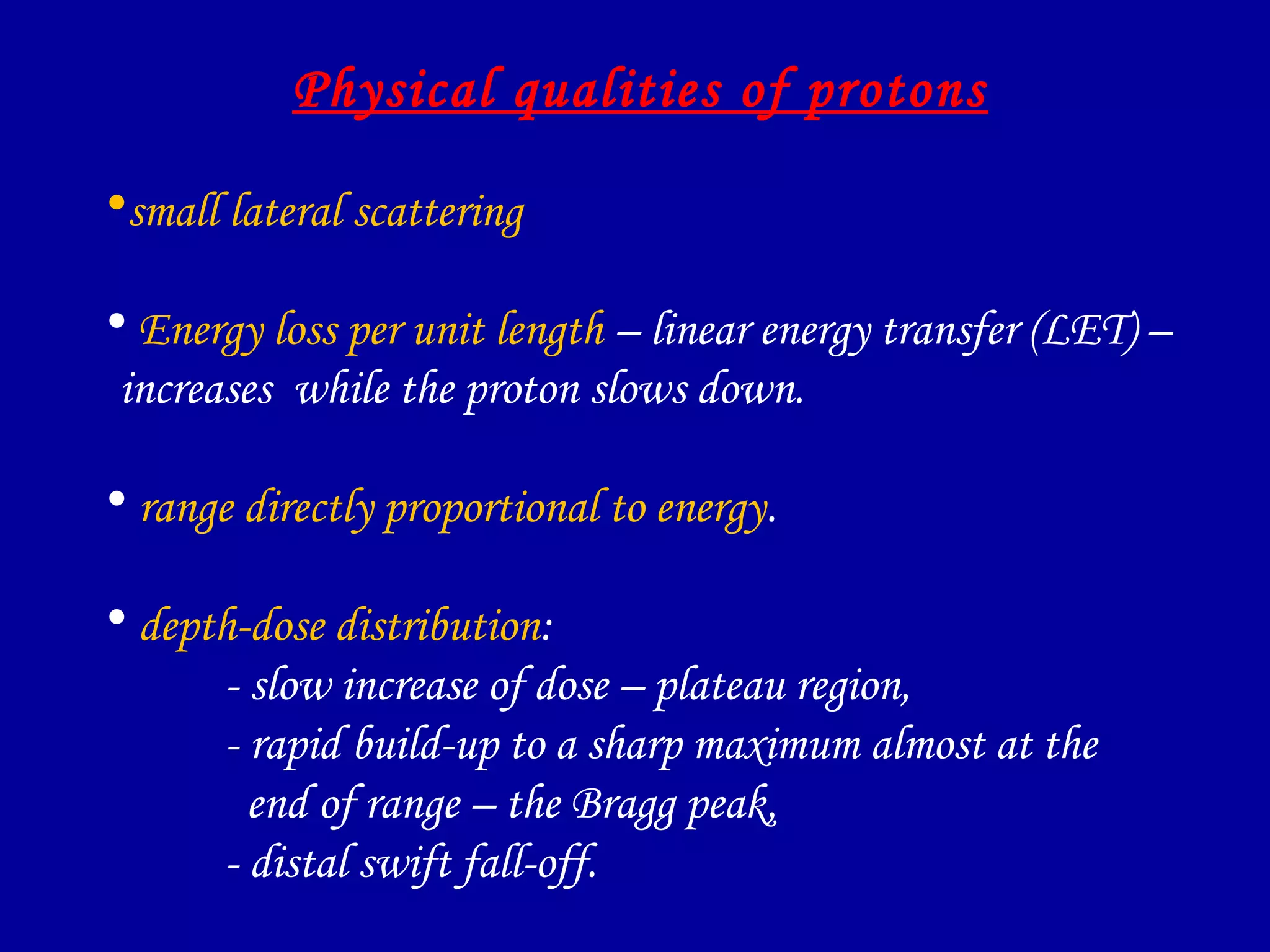
Physical qualities of protons
•small lateral scattering
• Energy loss per unit length – linear energy transfer (LET) –
increases while the proton slows down.
• range directly proportional to energy.
• depth-dose distribution:
- slow increase of dose – plateau region,
- rapid build-up to a sharp maximum almost at the
end of range – the Bragg peak,
- distal swift fall-off.
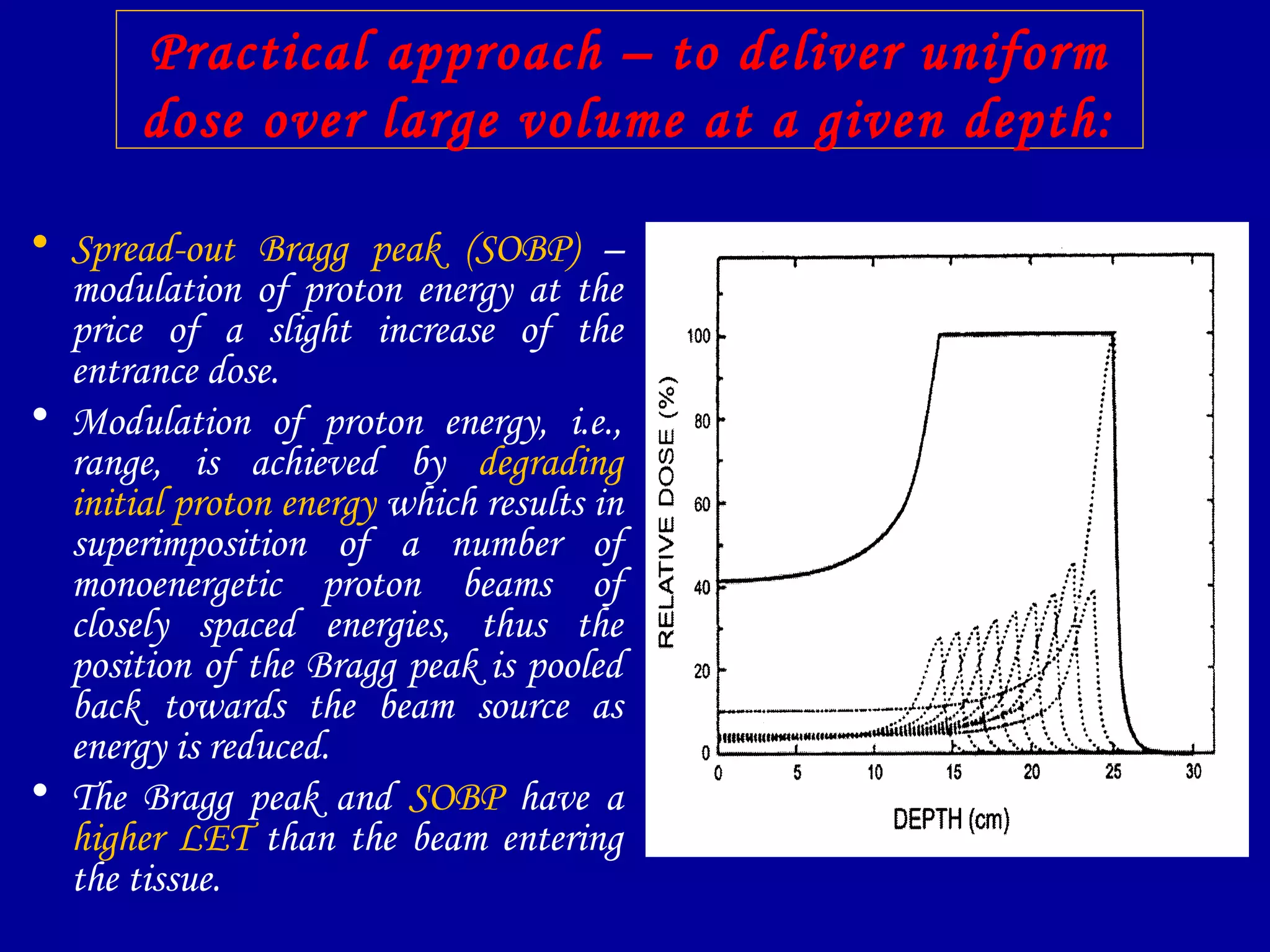
Practical approach – to deliver uniform
dose over large volume at a given depth:
• Spread-out Bragg peak (SOBP) –
modulation of proton energy at the
price of a slight increase of the
entrance dose.
• Modulation of proton energy, i.e.,
range, is achieved by degrading
initial proton energy which results in
superimposition of a number of
monoenergetic proton beams of
closely spaced energies, thus the
position of the Bragg peak is pooled
back towards the beam source as
energy is reduced.
• The Bragg peak and SOBP have a
higher LET than the beam entering
the tissue.
9
MICRODOSIMETR
Y
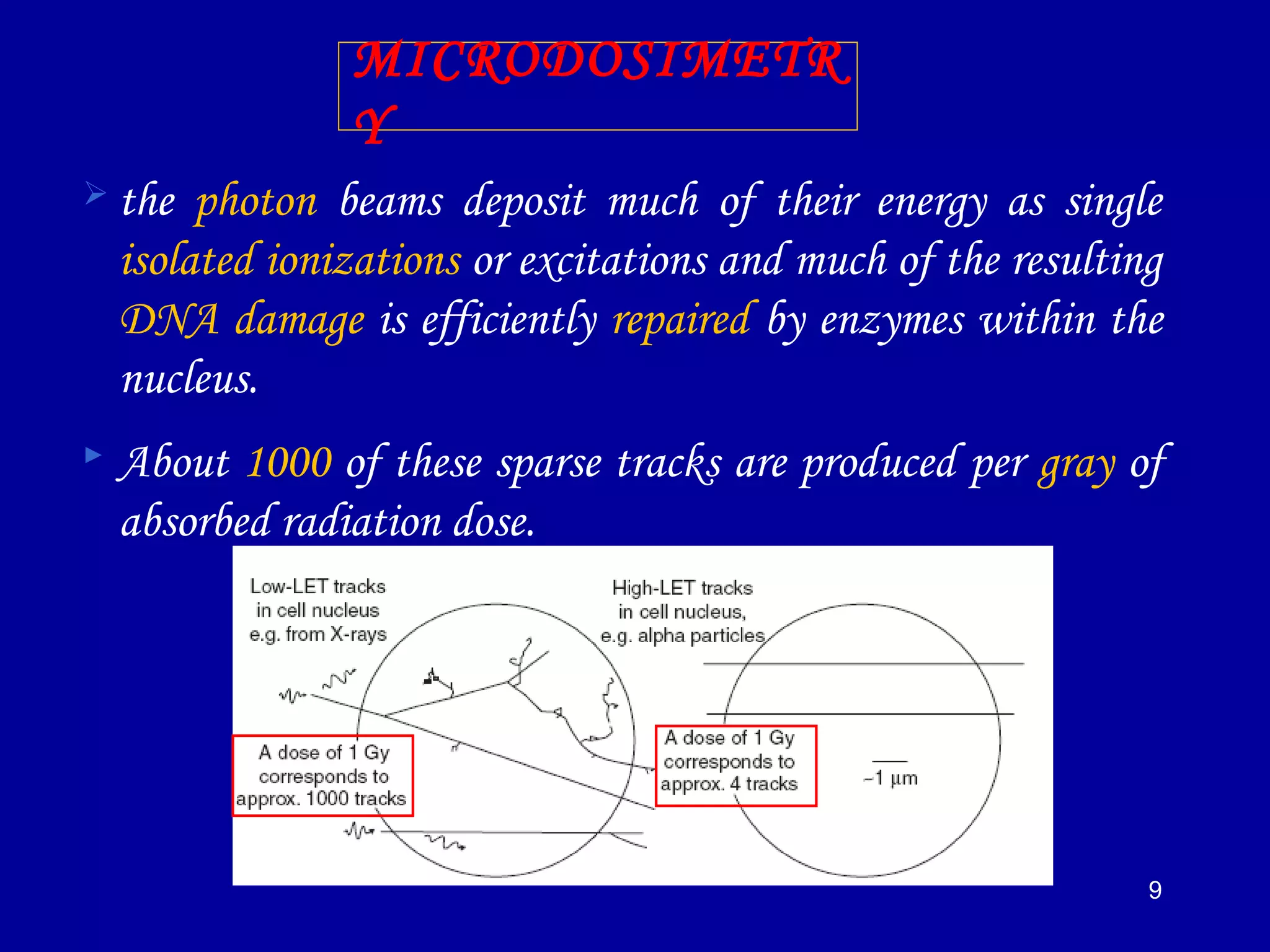
 the photon beams deposit much of their energy as single
isolated ionizations or excitations and much of the resulting
DNA damage is efficiently repaired by enzymes within the
nucleus.
 About 1000 of these sparse tracks are produced per gray of
absorbed radiation dose.
10
MICRODOSIMET
RY
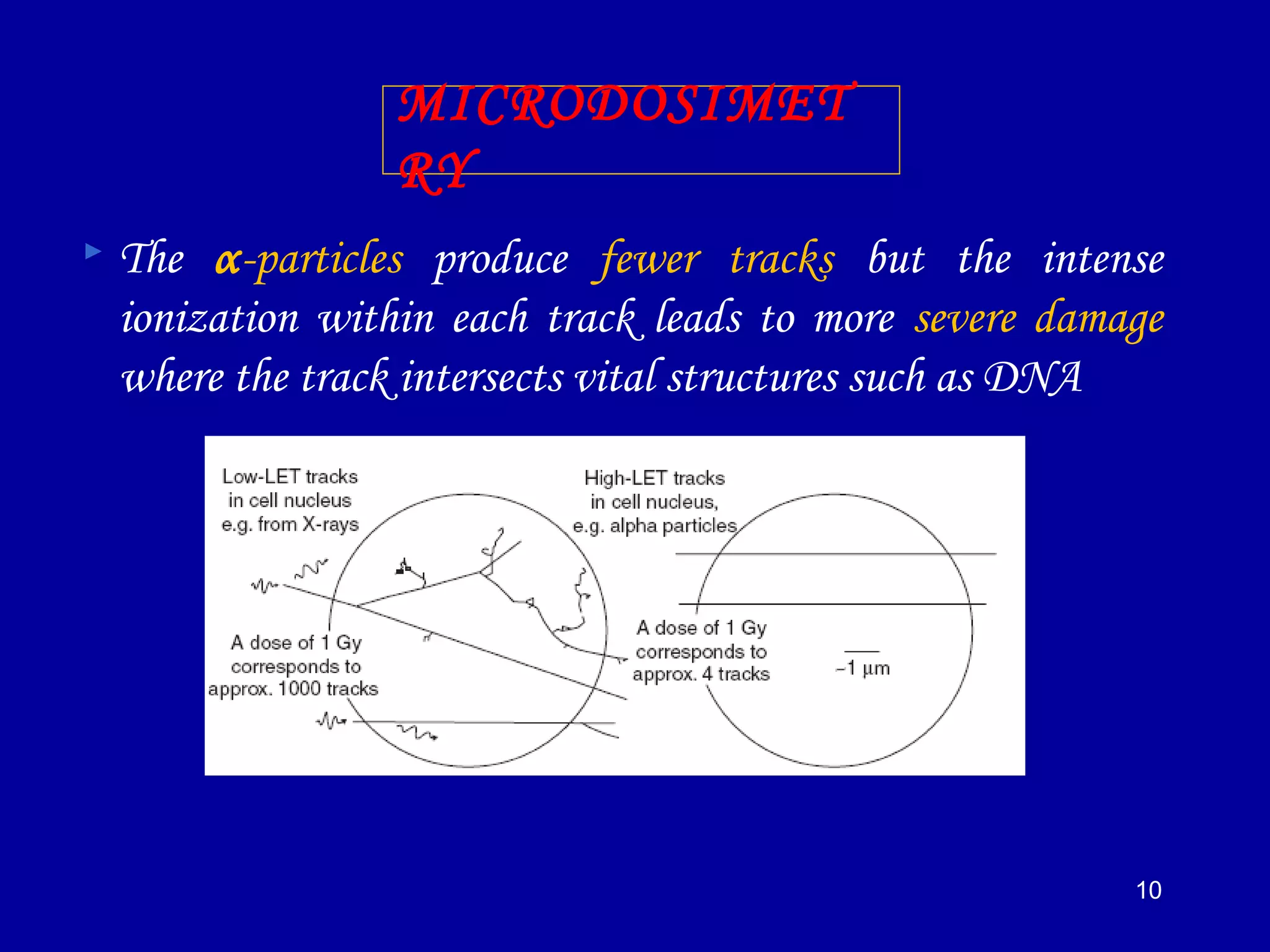
 The α-particles produce fewer tracks but the intense
ionization within each track leads to more severe damage
where the track intersects vital structures such as DNA
11
MICRODOSIMETR
Y
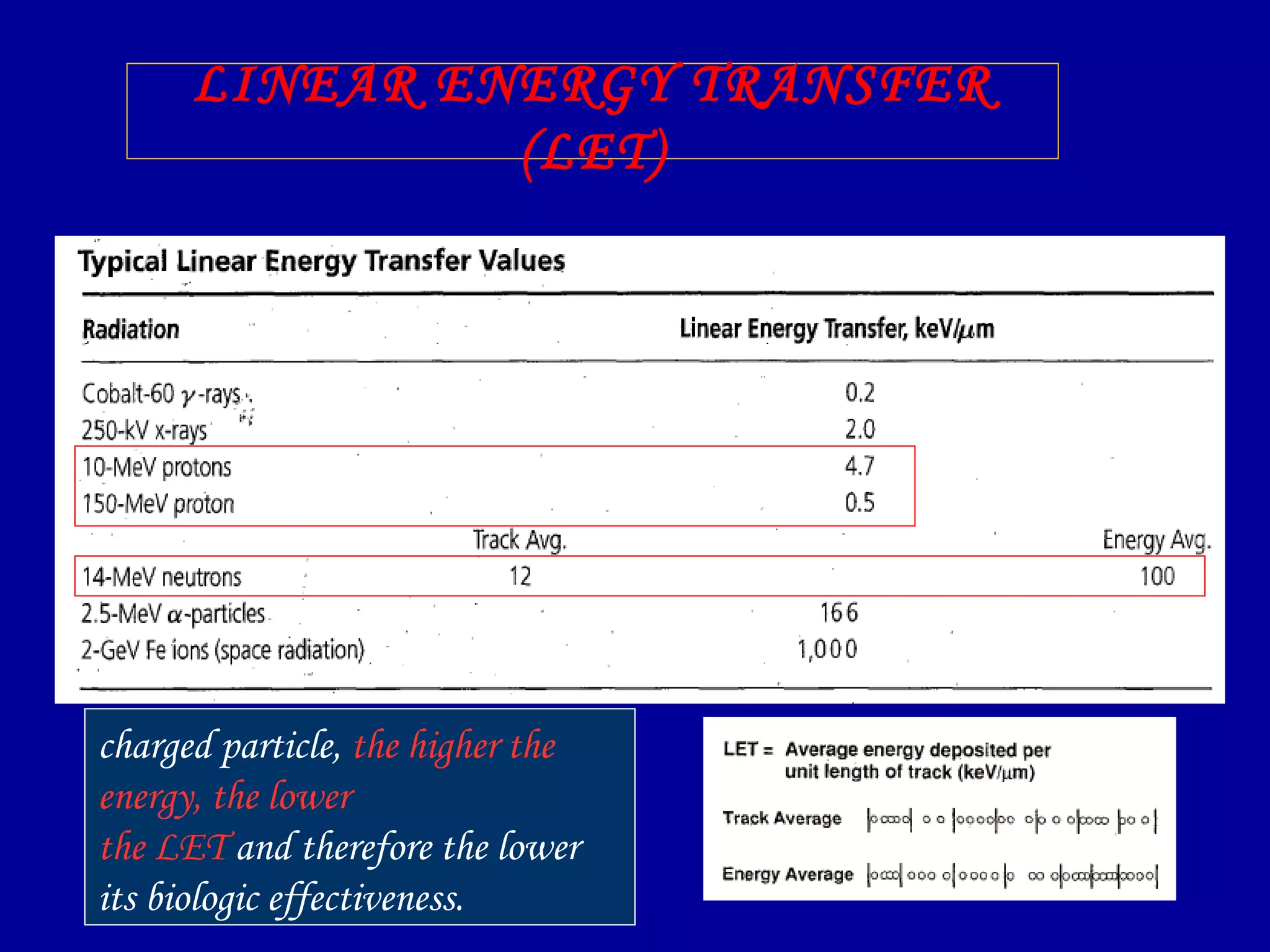
 Linear energy transfer (LET) is the term used to
describe the density of ionization in particle tracks
◦ LET is the average energy (in keV) given up by a charged
particle traversing a distance of 1μm
◦ the γ-rays have an LET of about 0.3 keV/μm and are
described as low-LET radiation.
◦ The α-particles have an LET of about 100 keV/μm and
are an example of high-LET radiation
12
LINEAR ENERGY TRANSFER
(LET)
 the energy transferred per unit length of the track
(keV/mm)
 In 1962, the ICRU defined:
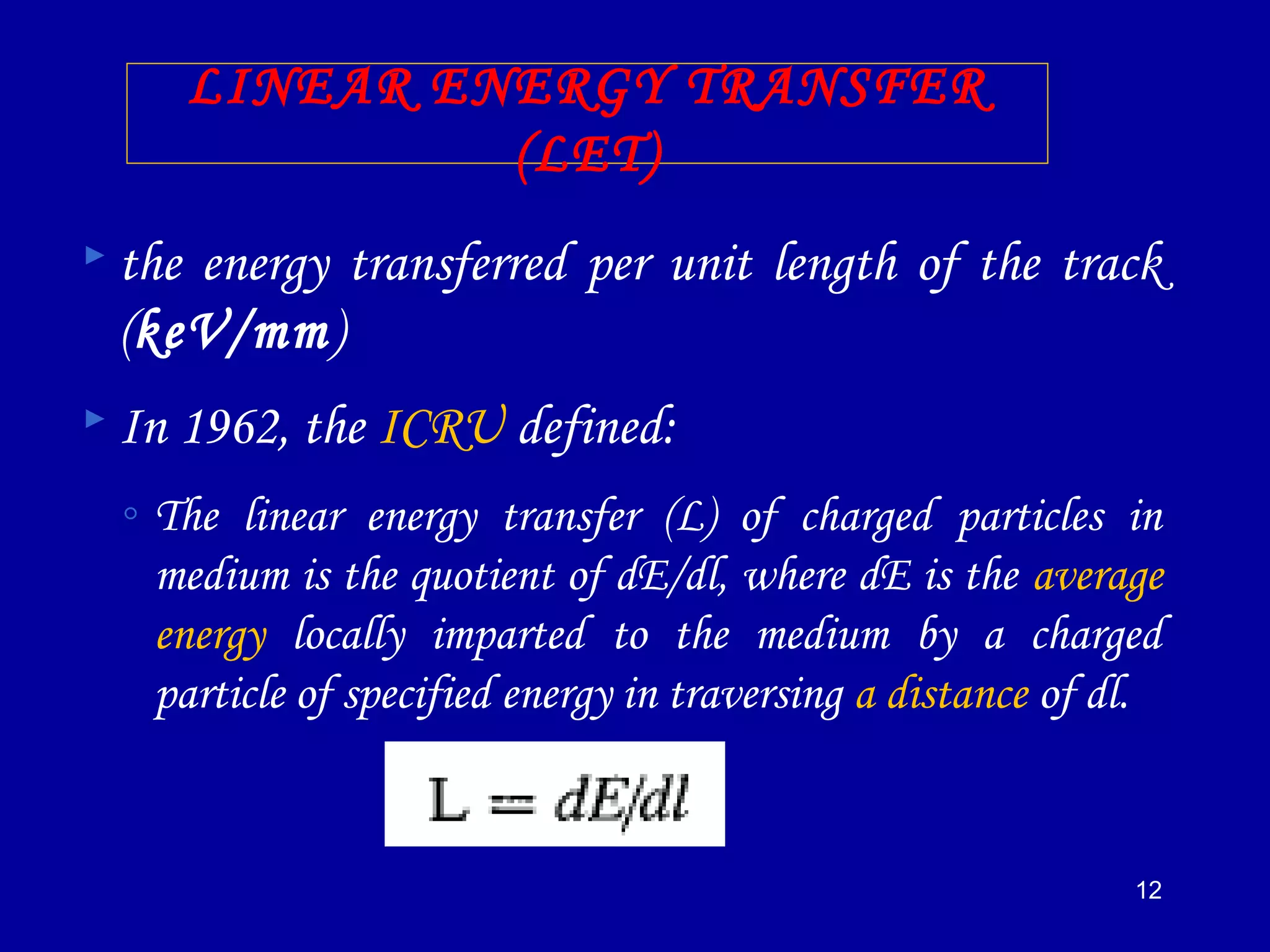
◦ The linear energy transfer (L) of charged particles in
medium is the quotient of dE/dl, where dE is the average
energy locally imparted to the medium by a charged
particle of specified energy in traversing a distance of dl.
13
LINEAR ENERGY TRANSFER
(LET)
charged particle, the higher the
energy, the lower
the LET and therefore the lower
its biologic effectiveness.
14
BIOLOGICAL EFFECTS DEPEND
UPON LET
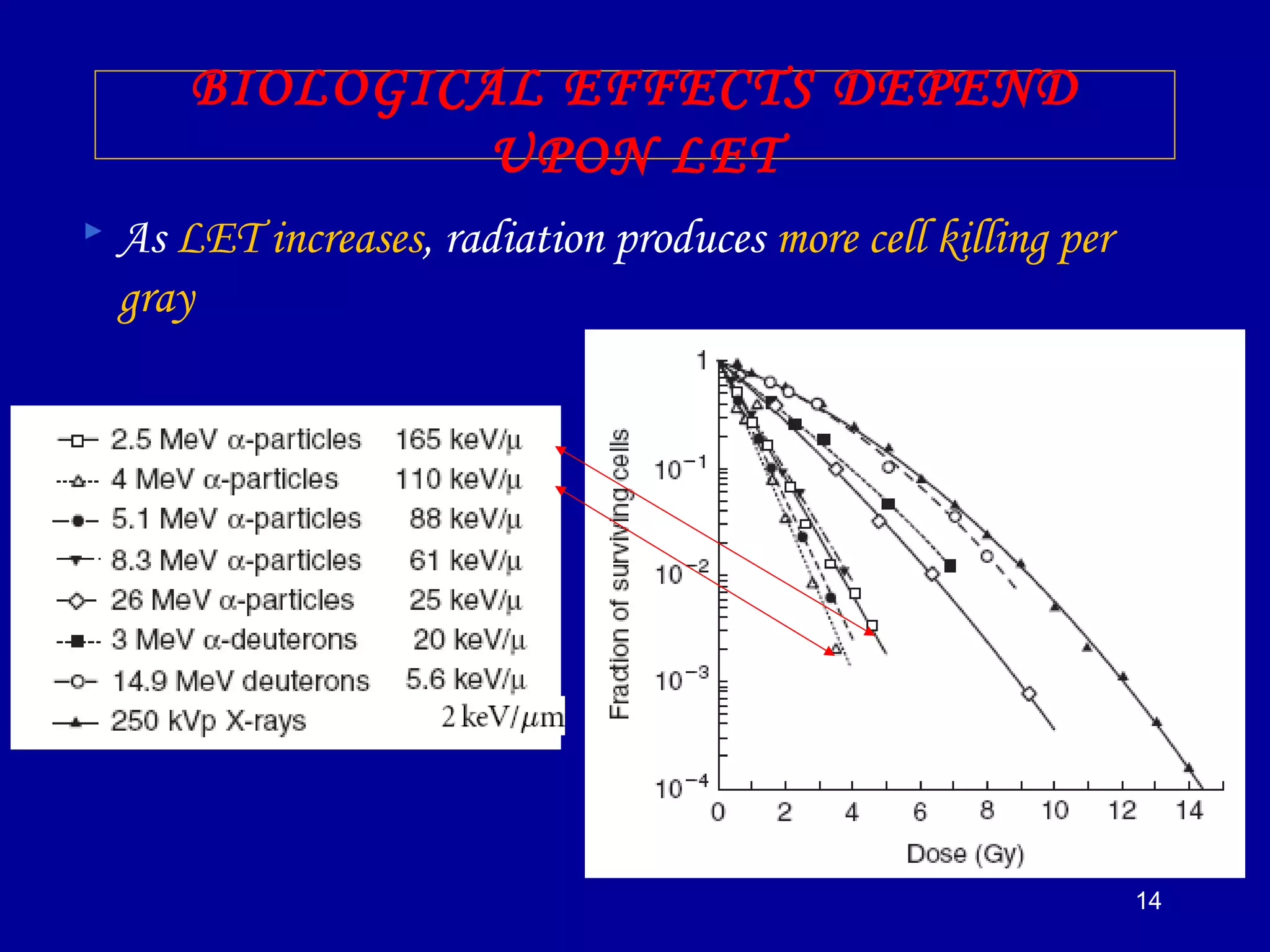
 As LET increases, radiation produces more cell killing per
gray
15
BIOLOGICAL EFFECTS DEPEND
UPON LET
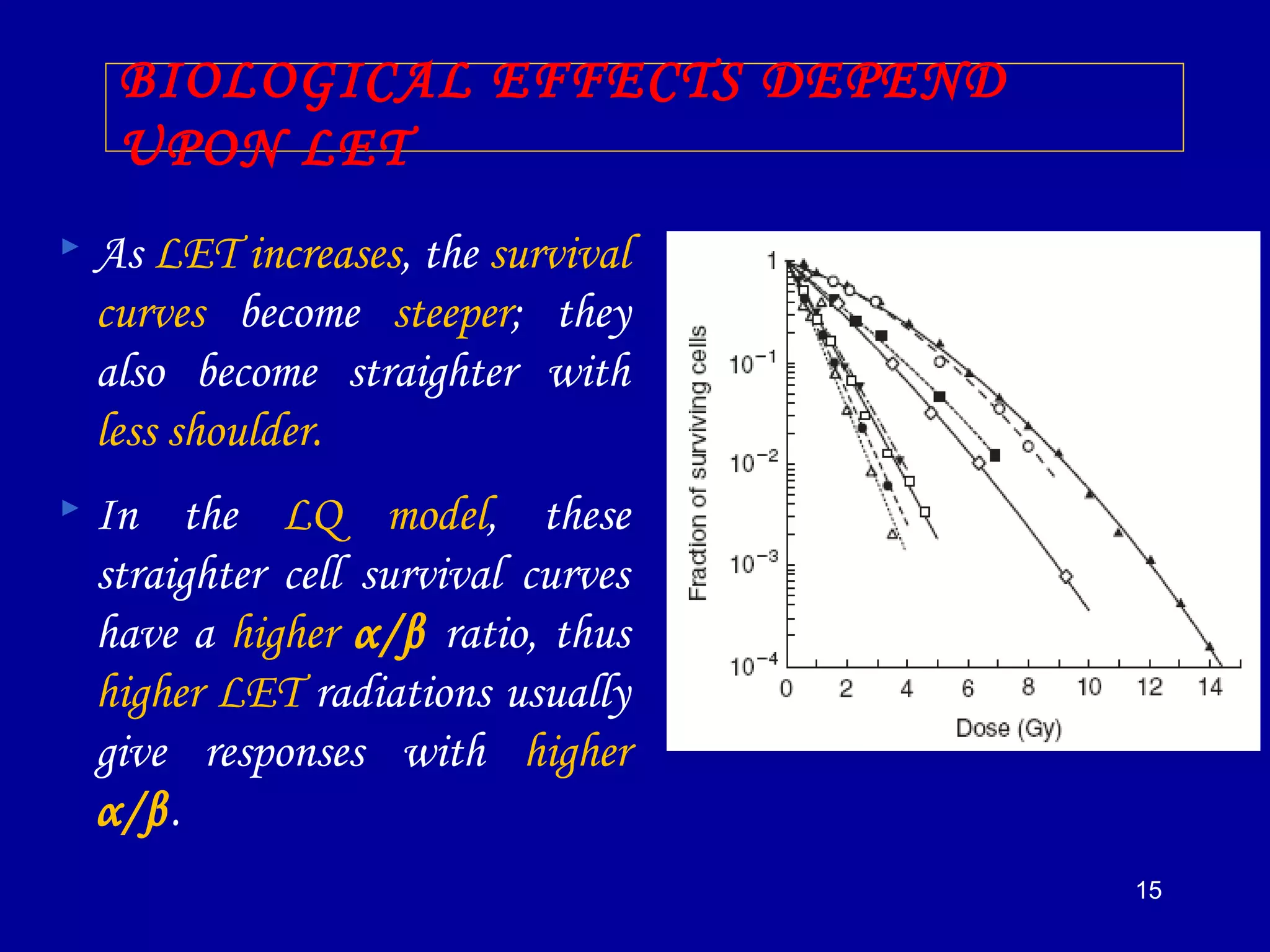
 As LET increases, the survival
curves become steeper; they
also become straighter with
less shoulder.
 In the LQ model, these
straighter cell survival curves
have a higher α/β ratio, thus
higher LET radiations usually
give responses with higher
α/β.
16
BIOLOGICAL EFFECTS DEPEND
UPON LET
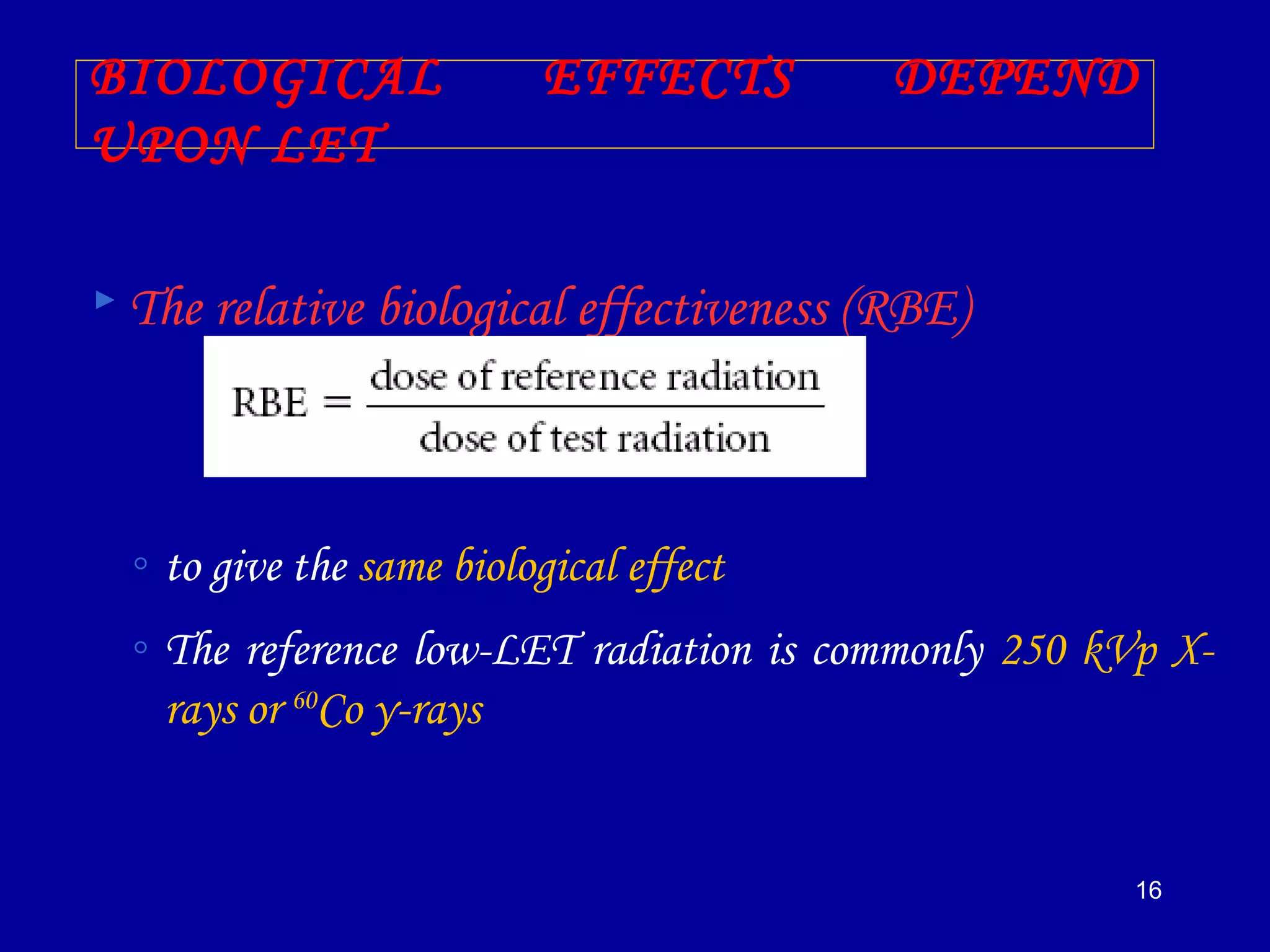
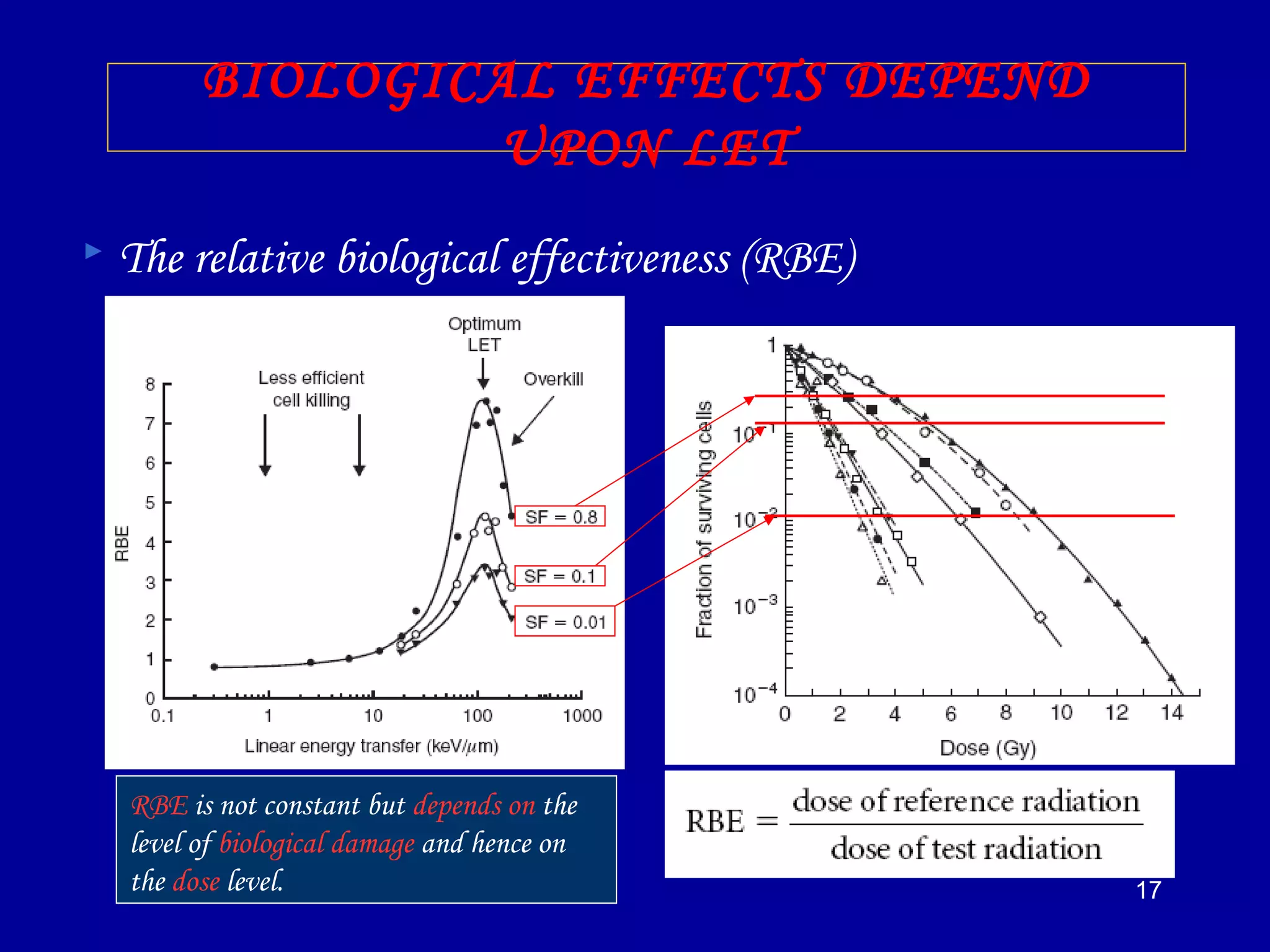
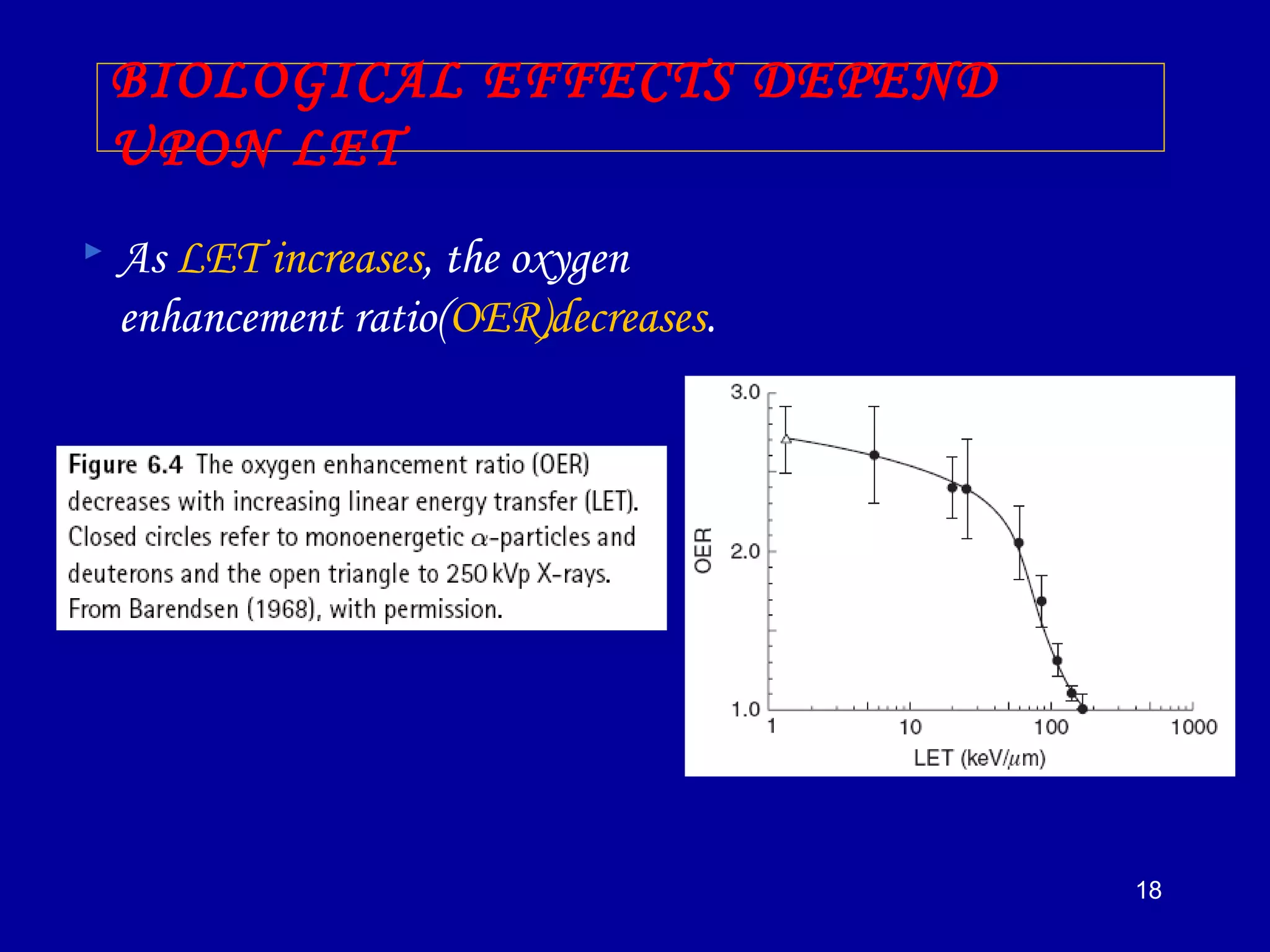
 The relative biological effectiveness (RBE)
◦ to give the same biological effect
◦ The reference low-LET radiation is commonly 250 kVp X-
rays or 60
Co γ-rays
17
BIOLOGICAL EFFECTS DEPEND
UPON LET
 The relative biological effectiveness (RBE)
RBE is not constant but depends on the
level of biological damage and hence on
the dose level.
18
BIOLOGICAL EFFECTS DEPEND
UPON LET
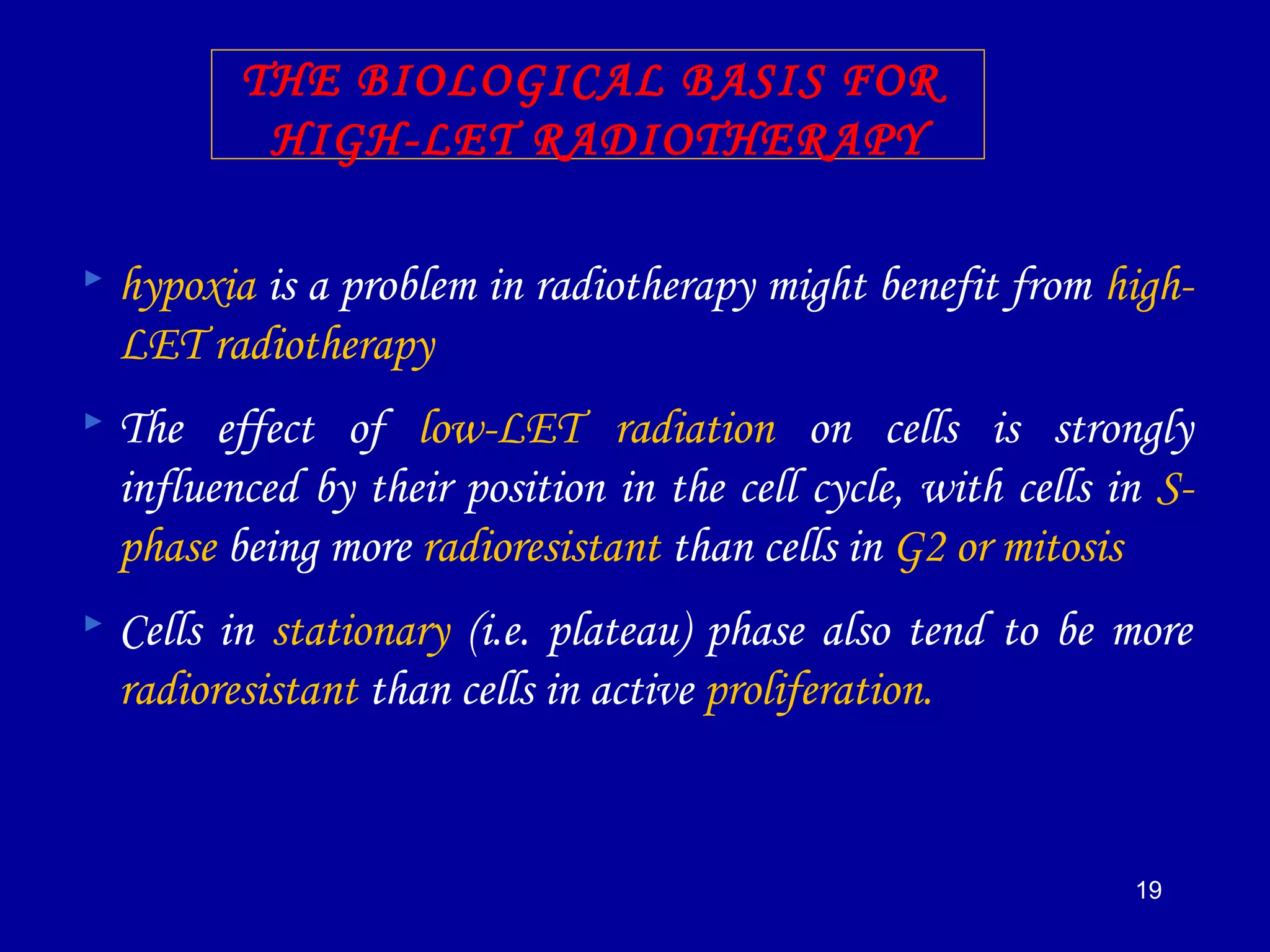
 As LET increases, the oxygen
enhancement ratio(OER)decreases.
19
THE BIOLOGICAL BASIS FOR
HIGH-LET RADIOTHERAPY
 hypoxia is a problem in radiotherapy might benefit from high-
LET radiotherapy
 The effect of low-LET radiation on cells is strongly
influenced by their position in the cell cycle, with cells in S-
phase being more radioresistant than cells in G2 or mitosis
 Cells in stationary (i.e. plateau) phase also tend to be more
radioresistant than cells in active proliferation.
20
THE BIOLOGICAL BASIS
FOR
HIGH-LET
RADIOTHERAPY
 the effect of fractionated radiotherapy on more rapidly cycling
cells compared with those cycling slowly or not at all.
◦ ‘cell-cycle resensitization’
 This differential radiosensitivity due to cell-cycle position is
considerably reduced with high-LET radiation.
 might expect high-LET radiotherapy to be beneficial in some
slowly growing, X-ray-resistant tumours.
21
THE BIOLOGICAL BASIS
FOR
HIGH-LET
RADIOTHERAPY
 the range of radiation response of different cell types is
reduced with high-LET radiation
 if tumour cells are already more radiosensitive to X-rays than
the critical normal-cell population, high-LET radiation should
not be used
◦ Possible examples are seminomas, lymphomas and
Hodgkin’s disease.
22
THE PHYSICAL BASIS FOR
CHARGED-PARTICLE
THERAPY
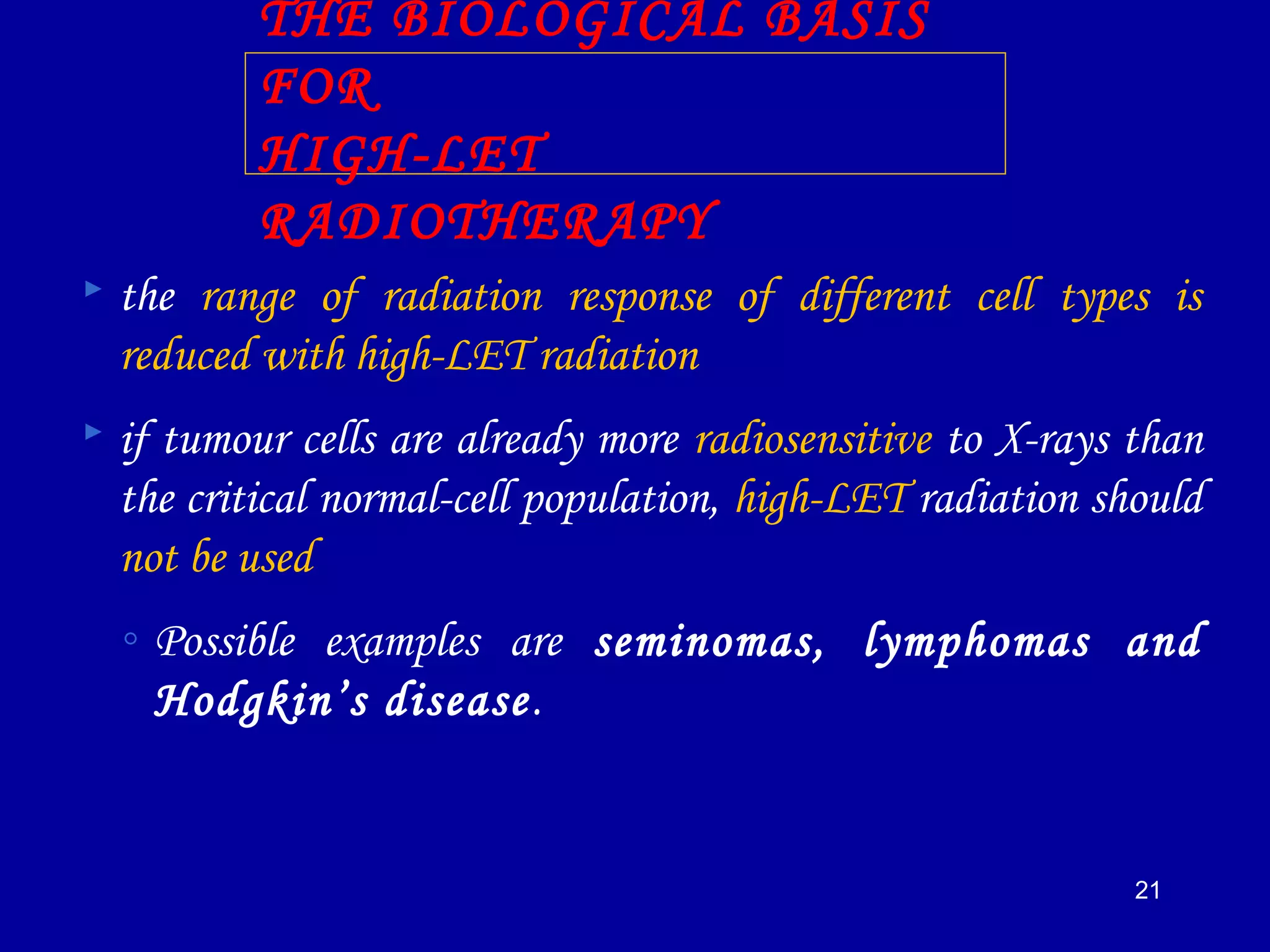
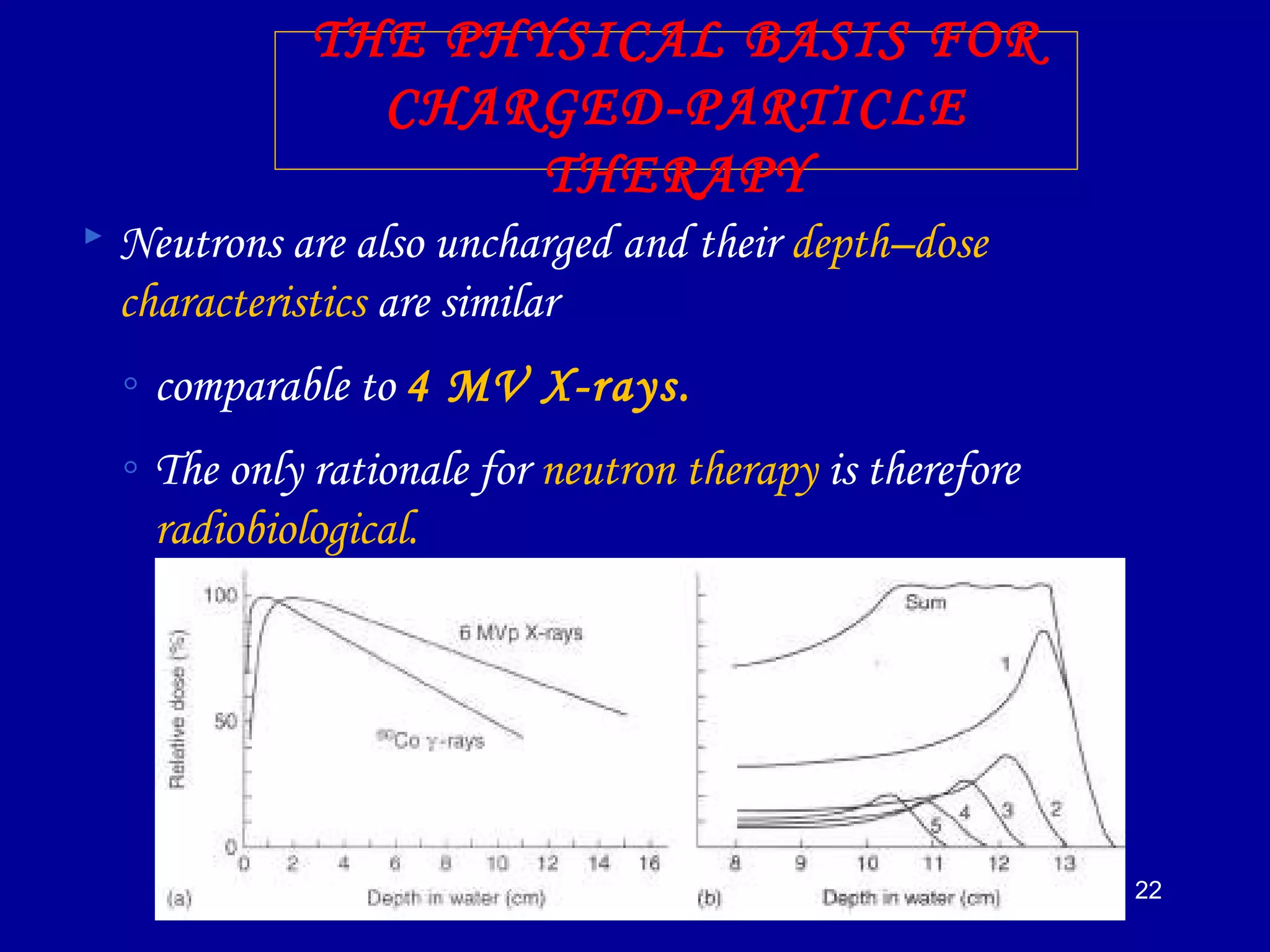
 Neutrons are also uncharged and their depth–dose
characteristics are similar
◦ comparable to 4 MV X-rays.
◦ The only rationale for neutron therapy is therefore
radiobiological.
23
THE PHYSICAL BASIS FOR
CHARGED-PARTICLE
THERAPY
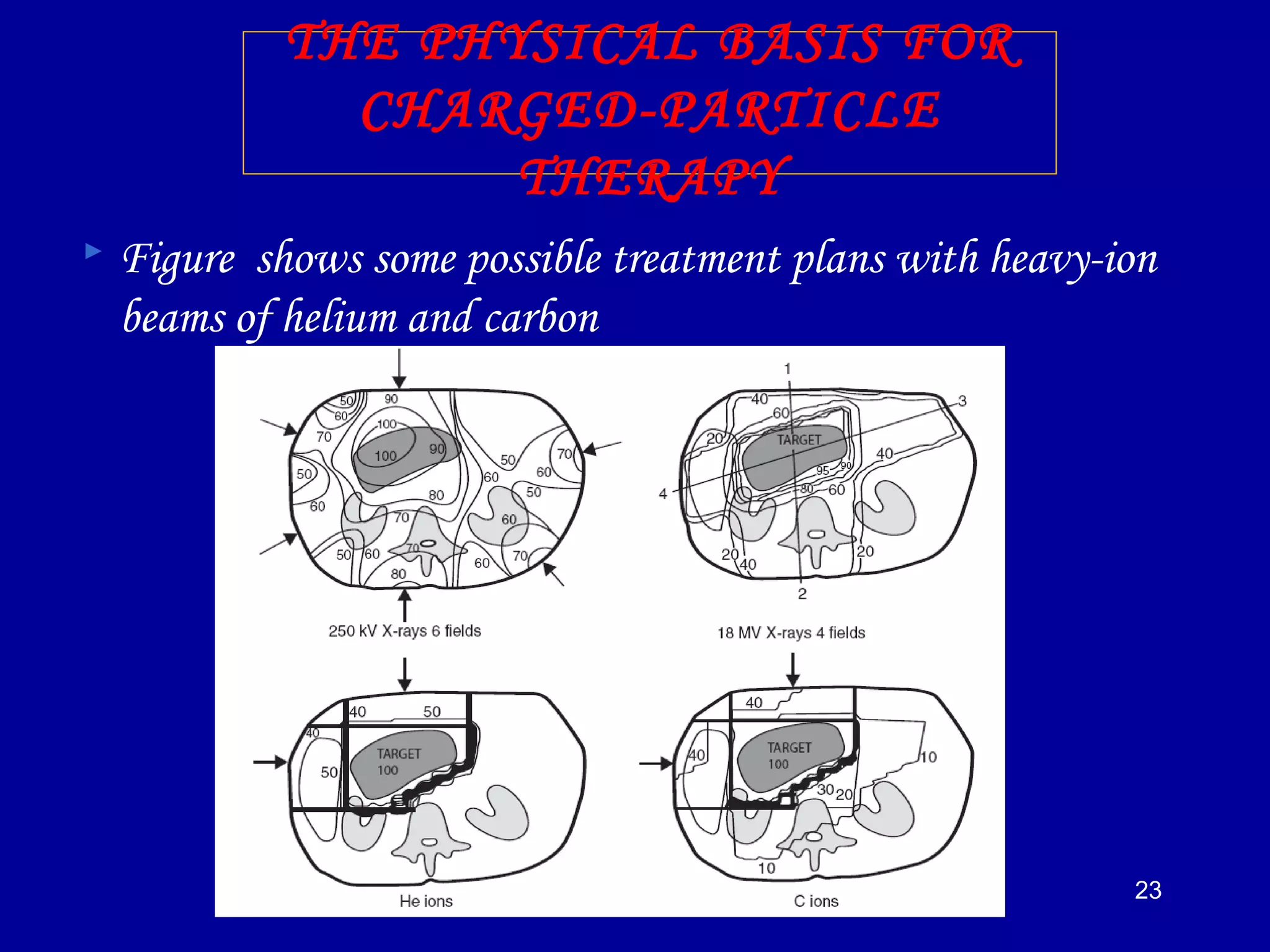
 Figure shows some possible treatment plans with heavy-ion
beams of helium and carbon
24
THE PHYSICAL BASIS FOR
CHARGED-PARTICLE
THERAPY
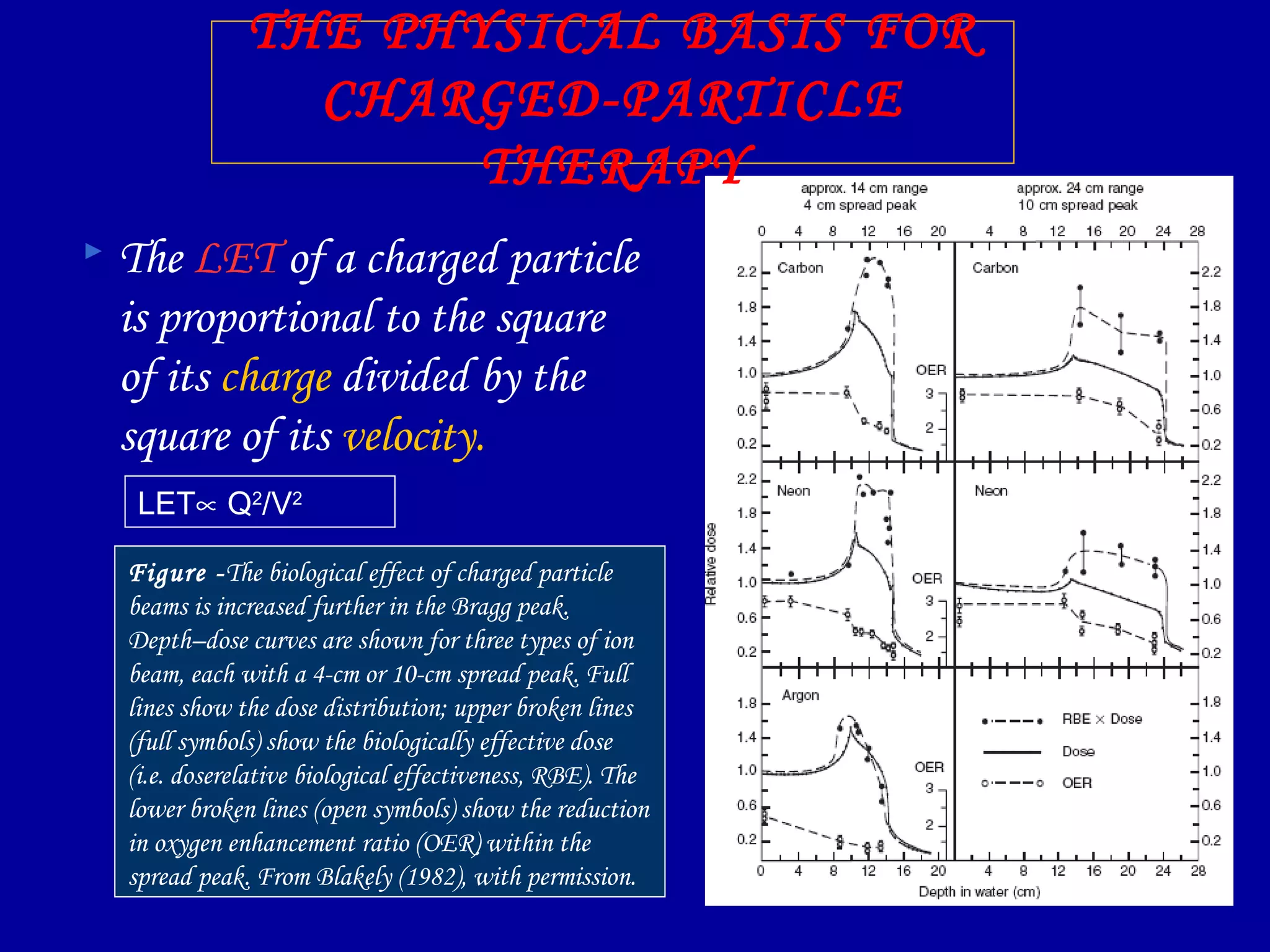
 The LET of a charged particle
is proportional to the square
of its charge divided by the
square of its velocity.
Figure -The biological effect of charged particle
beams is increased further in the Bragg peak.
Depth–dose curves are shown for three types of ion
beam, each with a 4-cm or 10-cm spread peak. Full
lines show the dose distribution; upper broken lines
(full symbols) show the biologically effective dose
(i.e. doserelative biological effectiveness, RBE). The
lower broken lines (open symbols) show the reduction
in oxygen enhancement ratio (OER) within the
spread peak. From Blakely (1982), with permission.
LET∝ Q2
/V2
25
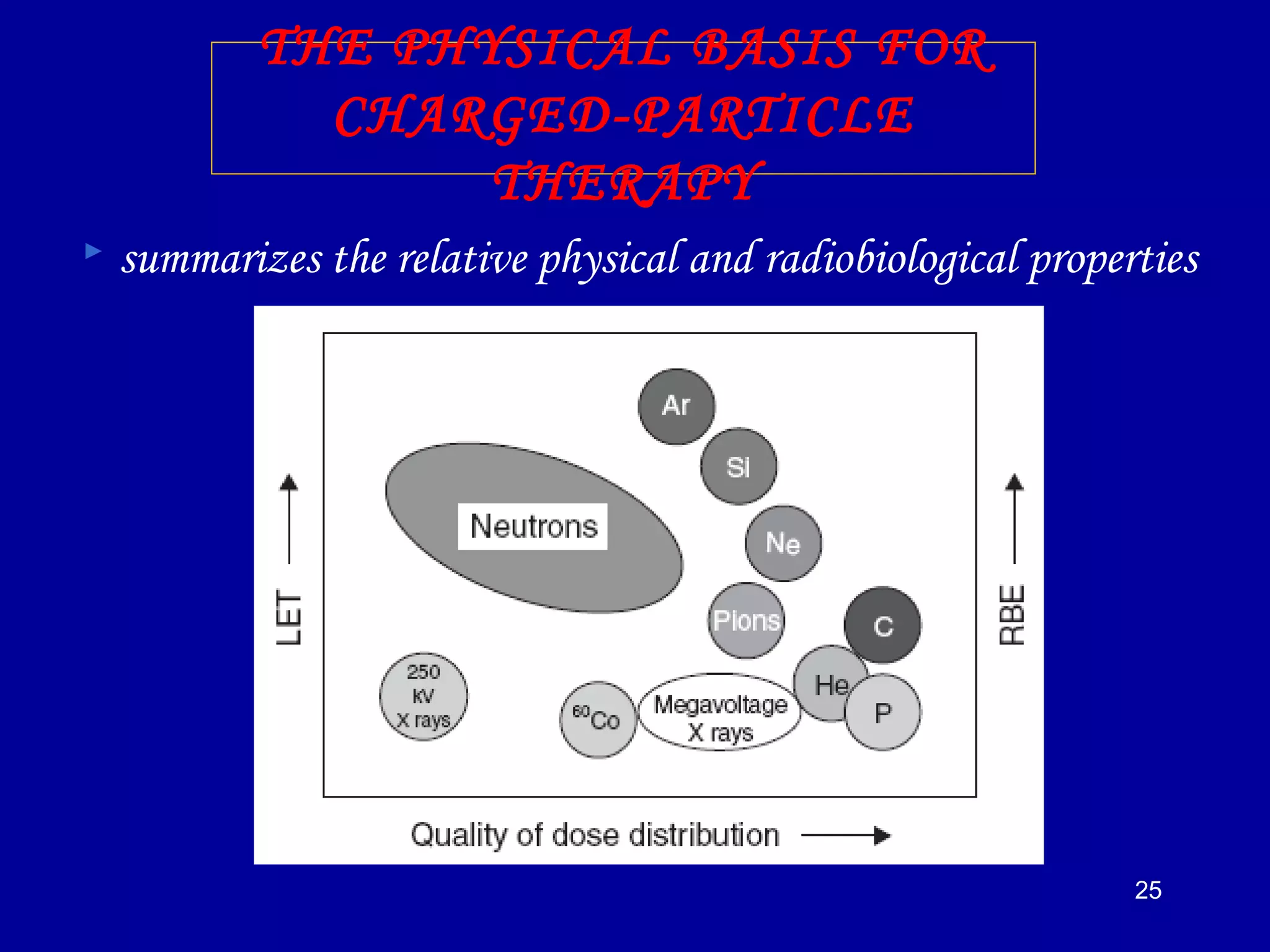
THE PHYSICAL BASIS FOR
CHARGED-PARTICLE
THERAPY
 summarizes the relative physical and radiobiological properties
26
Key
points
 X-rays and γ-rays are low LET. Some particle radiations (e.g.
neutrons, α-particles or heavy ions) have a high LET
 High-LET radiations are biologically more effective per gray
than low-LET radiations. Measured by the RBE.
 RBE increases as the LET increases up to about 100 keV/μm
above which RBE decreases because of cellular overkill.
 The OER also decreases rapidly over the same range of LET.
27
Key
points
 Heavy particles such as He, C and Ne ions have a high-LET
and in addition they have improved physical depth–dose
distributions.
 Proton beams provide the best improvement in dose
distribution for the lowest cost; their RBE is similar to low-
energy photons.
28
Thank you forThank you for
youryour
attentionattention !!

Biological basis of proton and high let beam

  • 1.
    Biological Aspect Of ProtonAnd High LET Source PREPARED BY MAHRAN ALNAHMI SUPERVISOR PROF.DR. ANWAR MICHAEL
  • 2.
    2 • Modern radiotherapyis usually given by linear accelerators producing X-rays with high-energy of 4–25 MV – Energetic enough to ionize molecules in tissues – this ionization that results in the biological effects seen in radiotherapy – have roughly the same biological effect per unit dose INTRODUCTION
  • 3.
    3 • Electron beamsare quantum-mechanically similar to X-rays and produce similar biological effects • Two other classes of radiations – Light particles – e.g. protons, neutrons and α- particles – Heavy particles – e.g. fully stripped carbon, neon, silicon or argon ions INTRODUCTION
  • 4.
    4  These lightand heavy particles may have a greater biological effect per unit dose than conventional X- and γ-rays INTRODUCTION
  • 5.
    Advantages of protonscompared to conventional radiation: - targeting radiation dose precisely into the tumour, - sparing neighboring healthy tissue.
  • 6.
    Physical qualities ofprotons •small lateral scattering • Energy loss per unit length – linear energy transfer (LET) – increases while the proton slows down. • range directly proportional to energy. • depth-dose distribution: - slow increase of dose – plateau region, - rapid build-up to a sharp maximum almost at the end of range – the Bragg peak, - distal swift fall-off.
  • 7.
    Practical approach –to deliver uniform dose over large volume at a given depth: • Spread-out Bragg peak (SOBP) – modulation of proton energy at the price of a slight increase of the entrance dose. • Modulation of proton energy, i.e., range, is achieved by degrading initial proton energy which results in superimposition of a number of monoenergetic proton beams of closely spaced energies, thus the position of the Bragg peak is pooled back towards the beam source as energy is reduced. • The Bragg peak and SOBP have a higher LET than the beam entering the tissue.
  • 9.
    9 MICRODOSIMETR Y  the photonbeams deposit much of their energy as single isolated ionizations or excitations and much of the resulting DNA damage is efficiently repaired by enzymes within the nucleus.  About 1000 of these sparse tracks are produced per gray of absorbed radiation dose.
  • 10.
    10 MICRODOSIMET RY  The α-particlesproduce fewer tracks but the intense ionization within each track leads to more severe damage where the track intersects vital structures such as DNA
  • 11.
    11 MICRODOSIMETR Y  Linear energytransfer (LET) is the term used to describe the density of ionization in particle tracks ◦ LET is the average energy (in keV) given up by a charged particle traversing a distance of 1μm ◦ the γ-rays have an LET of about 0.3 keV/μm and are described as low-LET radiation. ◦ The α-particles have an LET of about 100 keV/μm and are an example of high-LET radiation
  • 12.
    12 LINEAR ENERGY TRANSFER (LET) the energy transferred per unit length of the track (keV/mm)  In 1962, the ICRU defined: ◦ The linear energy transfer (L) of charged particles in medium is the quotient of dE/dl, where dE is the average energy locally imparted to the medium by a charged particle of specified energy in traversing a distance of dl.
  • 13.
    13 LINEAR ENERGY TRANSFER (LET) chargedparticle, the higher the energy, the lower the LET and therefore the lower its biologic effectiveness.
  • 14.
    14 BIOLOGICAL EFFECTS DEPEND UPONLET  As LET increases, radiation produces more cell killing per gray
  • 15.
    15 BIOLOGICAL EFFECTS DEPEND UPONLET  As LET increases, the survival curves become steeper; they also become straighter with less shoulder.  In the LQ model, these straighter cell survival curves have a higher α/β ratio, thus higher LET radiations usually give responses with higher α/β.
  • 16.
    16 BIOLOGICAL EFFECTS DEPEND UPONLET  The relative biological effectiveness (RBE) ◦ to give the same biological effect ◦ The reference low-LET radiation is commonly 250 kVp X- rays or 60 Co γ-rays
  • 17.
    17 BIOLOGICAL EFFECTS DEPEND UPONLET  The relative biological effectiveness (RBE) RBE is not constant but depends on the level of biological damage and hence on the dose level.
  • 18.
    18 BIOLOGICAL EFFECTS DEPEND UPONLET  As LET increases, the oxygen enhancement ratio(OER)decreases.
  • 19.
    19 THE BIOLOGICAL BASISFOR HIGH-LET RADIOTHERAPY  hypoxia is a problem in radiotherapy might benefit from high- LET radiotherapy  The effect of low-LET radiation on cells is strongly influenced by their position in the cell cycle, with cells in S- phase being more radioresistant than cells in G2 or mitosis  Cells in stationary (i.e. plateau) phase also tend to be more radioresistant than cells in active proliferation.
  • 20.
    20 THE BIOLOGICAL BASIS FOR HIGH-LET RADIOTHERAPY the effect of fractionated radiotherapy on more rapidly cycling cells compared with those cycling slowly or not at all. ◦ ‘cell-cycle resensitization’  This differential radiosensitivity due to cell-cycle position is considerably reduced with high-LET radiation.  might expect high-LET radiotherapy to be beneficial in some slowly growing, X-ray-resistant tumours.
  • 21.
    21 THE BIOLOGICAL BASIS FOR HIGH-LET RADIOTHERAPY the range of radiation response of different cell types is reduced with high-LET radiation  if tumour cells are already more radiosensitive to X-rays than the critical normal-cell population, high-LET radiation should not be used ◦ Possible examples are seminomas, lymphomas and Hodgkin’s disease.
  • 22.
    22 THE PHYSICAL BASISFOR CHARGED-PARTICLE THERAPY  Neutrons are also uncharged and their depth–dose characteristics are similar ◦ comparable to 4 MV X-rays. ◦ The only rationale for neutron therapy is therefore radiobiological.
  • 23.
    23 THE PHYSICAL BASISFOR CHARGED-PARTICLE THERAPY  Figure shows some possible treatment plans with heavy-ion beams of helium and carbon
  • 24.
    24 THE PHYSICAL BASISFOR CHARGED-PARTICLE THERAPY  The LET of a charged particle is proportional to the square of its charge divided by the square of its velocity. Figure -The biological effect of charged particle beams is increased further in the Bragg peak. Depth–dose curves are shown for three types of ion beam, each with a 4-cm or 10-cm spread peak. Full lines show the dose distribution; upper broken lines (full symbols) show the biologically effective dose (i.e. doserelative biological effectiveness, RBE). The lower broken lines (open symbols) show the reduction in oxygen enhancement ratio (OER) within the spread peak. From Blakely (1982), with permission. LET∝ Q2 /V2
  • 25.
    25 THE PHYSICAL BASISFOR CHARGED-PARTICLE THERAPY  summarizes the relative physical and radiobiological properties
  • 26.
    26 Key points  X-rays andγ-rays are low LET. Some particle radiations (e.g. neutrons, α-particles or heavy ions) have a high LET  High-LET radiations are biologically more effective per gray than low-LET radiations. Measured by the RBE.  RBE increases as the LET increases up to about 100 keV/μm above which RBE decreases because of cellular overkill.  The OER also decreases rapidly over the same range of LET.
  • 27.
    27 Key points  Heavy particlessuch as He, C and Ne ions have a high-LET and in addition they have improved physical depth–dose distributions.  Proton beams provide the best improvement in dose distribution for the lowest cost; their RBE is similar to low- energy photons.
  • 28.
    28 Thank you forThankyou for youryour attentionattention !!