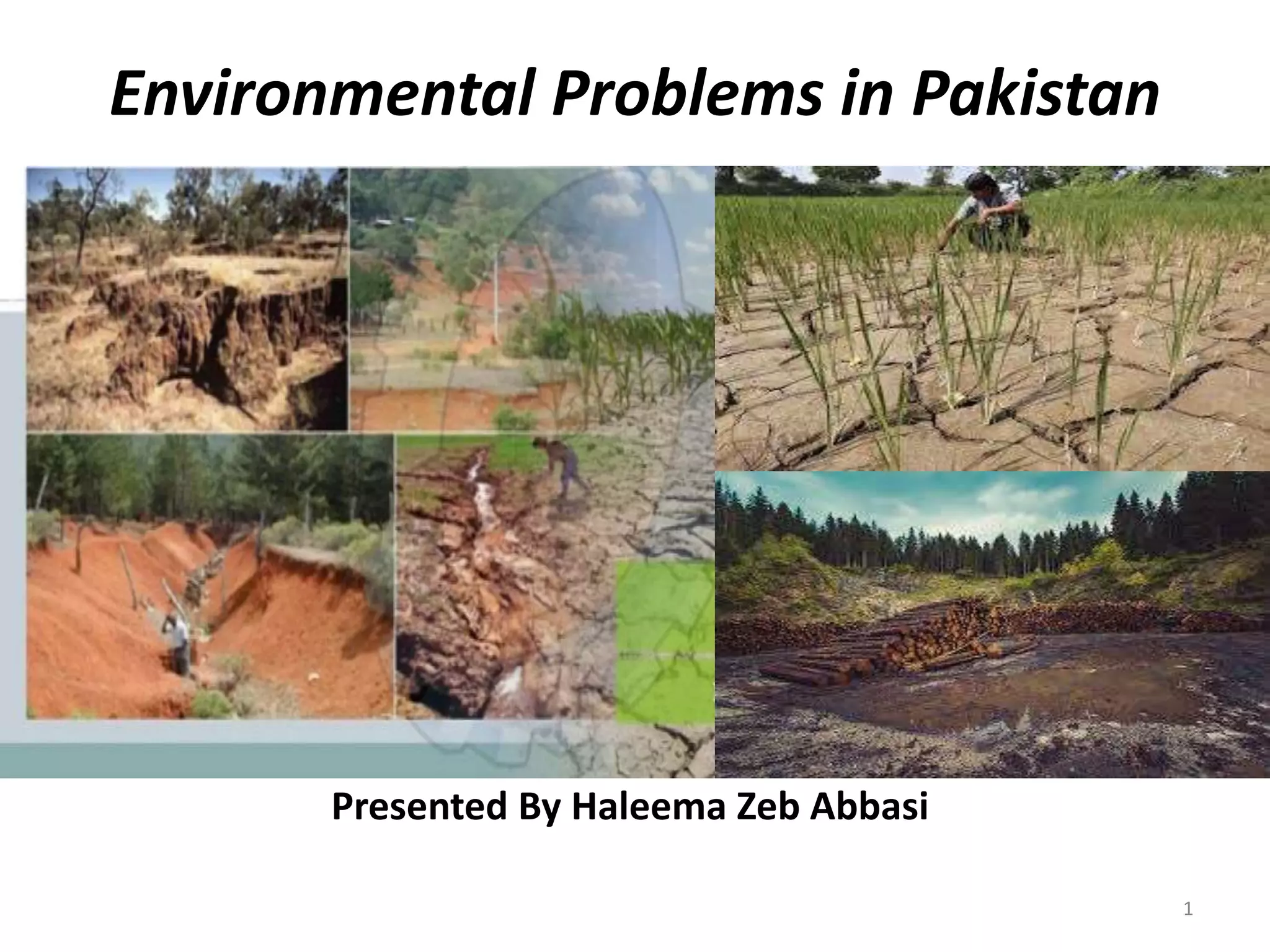
Environmental Problems in Pakistan
Presented By Haleema Zeb Abbasi
1
• The upper layer of earth in which plants grow,
a black or dark brown material typically
consisting of a mixture of organic remains,
clay, and rock particles.
2
Soil Problems in Pakistan
• Decline soil fertility,
• Soil salinity,
• Soil erosion,
• Soil contamination,
• Deforestation,
• Desertification,
• Scarcity of essential minerals
• Steadily depletion of organic matter contents.
3
1. Decline Soil Fertility
Soil fertility decline is defined as;
• The decline in chemical soil fertility or a
decrease in the level of soil organic matter,
PH, cation exchange capacity and plant
nutrients
4
Causes of decline soil fertility
• Soil erosion
• Growing crops
• Leaching
• Limited rainfall
• Crop burning
5
Effects
• Nutrient depletion or nutrient decline (larger
removal than addition of nutrients).
• Nutrient mining (large removal of nutrients and
no inputs).
• Acidification (decline in pH and=or an increase in
exchangeable Al).
• The loss of organic matter.
6
Remedies
• Introducing pasture phases and leguminous
Crops
• Adding inorganic fertilizers
• Addition of lime
• Reduced tillage system
• Retaining crop residues on site
7
2. Desertification
• Desertification is land degradation process in
arid and semi-arid areas.
• It is a process by which fertile land is
transformed into desert.
8
Main Causes of desertification
• Overgrazing
• Drought
• Urbanization
• Climate change
• Over cultivation
• Deforestation
• Natural disasters.
9
Effects
• Loss of biodiversity.
• More chance of Floods.
• Soil erosion.
• More chance of Desertification
and drought
10
• Loss of nutrients
• Poor Water Quality
• Hunger problems
• Increase in sand storms
11
Remediation for Desertification
• Rising awareness of the problem
• Planting indigenous trees and shrubs
• Developing sustainable agricultural practices
• Controlled grazing
• Crop rotation (increase fertility & reduce soil
erosion)
• Proper land management
• Soil and water management
• Introduce proper technologies
• Manage dry land resources
• Tree planting schemes to reduce soil erosion
12
3. Soil salinity
• Soil salinity is the salt content in the soil; the
process of increasing the salt content is known
as salinization.
• Salts occur naturally within soils and water.
13
Causes of Salinization
• The presence of soluble salts, such as sulfates of sodium,
calcium, and magnesium in the soil
• Low annual rainfall in semiarid areas
• A high water table
• At the base of hill slopes
• And in flat, low-lying areas surrounding sloughs and shallow
bodies of water
• A high rate of evaporation
14
Effects of Salinization
• High levels of salt in the soil have a similar effect as
doughtiness by making water less available for uptake
by plant roots.
• Few plants grow well on saline soils
• Salinization often restricts options for cropping in a
given land area.
• Salinization degrades the quality of shallow ground
water and surface water resources, such as ponds,
sloughs, and dugouts.
15
Remedies to Control Salinization
• By managing the area contributing excess
water to the soil(recharge area) or
• By managing the area where the excess water
comes to the surface (discharge area).
16
4. Soil Erosion
• Soil erosion is the washing or blowing away
(by water or wind) of the top layer
of soil (dirt).
• It is one form of soil degradation.
• If the soil has eroded, the crops that make
food will not grow very well.
17
Causes of Soil Erosion
• Rainfall & flooding
• Wind
• Overgrazing
• Lack of vegetation
• Deforestation
• Farming
18
Effects of Soil Erosion
• Loss of topsoil
• Soil compaction
• Reduced organic matter
• Poor drainage
• Long term erosion
• Water pollution
• Issue with plant production
19
Remediation Measures
• Forest protection
• Careful tilling
• Crop rotation
• Mulching
• Buffer strips
• Contour farming
• Wind breakers
20
5. Deforestation
• Deforestation is when forests are destroyed
by cutting trees (logging) and not replanting
them.
• This can include clearing the land for
agriculture or grazing, or using the timber for
fuel, construction or manufacturing.
21
22
23
The Effect of Deforestation on
Nutrient Cycling
24
Remediation
• Law and policies
• Controlled logging
• Afforestation
• Conservation
25
26
27

Environmental problems in pakistan

  • 1.
    Environmental Problems inPakistan Presented By Haleema Zeb Abbasi 1
  • 2.
    • The upperlayer of earth in which plants grow, a black or dark brown material typically consisting of a mixture of organic remains, clay, and rock particles. 2
  • 3.
    Soil Problems inPakistan • Decline soil fertility, • Soil salinity, • Soil erosion, • Soil contamination, • Deforestation, • Desertification, • Scarcity of essential minerals • Steadily depletion of organic matter contents. 3
  • 4.
    1. Decline SoilFertility Soil fertility decline is defined as; • The decline in chemical soil fertility or a decrease in the level of soil organic matter, PH, cation exchange capacity and plant nutrients 4
  • 5.
    Causes of declinesoil fertility • Soil erosion • Growing crops • Leaching • Limited rainfall • Crop burning 5
  • 6.
    Effects • Nutrient depletionor nutrient decline (larger removal than addition of nutrients). • Nutrient mining (large removal of nutrients and no inputs). • Acidification (decline in pH and=or an increase in exchangeable Al). • The loss of organic matter. 6
  • 7.
    Remedies • Introducing pasturephases and leguminous Crops • Adding inorganic fertilizers • Addition of lime • Reduced tillage system • Retaining crop residues on site 7
  • 8.
    2. Desertification • Desertificationis land degradation process in arid and semi-arid areas. • It is a process by which fertile land is transformed into desert. 8
  • 9.
    Main Causes ofdesertification • Overgrazing • Drought • Urbanization • Climate change • Over cultivation • Deforestation • Natural disasters. 9
  • 10.
    Effects • Loss ofbiodiversity. • More chance of Floods. • Soil erosion. • More chance of Desertification and drought 10
  • 11.
    • Loss ofnutrients • Poor Water Quality • Hunger problems • Increase in sand storms 11
  • 12.
    Remediation for Desertification •Rising awareness of the problem • Planting indigenous trees and shrubs • Developing sustainable agricultural practices • Controlled grazing • Crop rotation (increase fertility & reduce soil erosion) • Proper land management • Soil and water management • Introduce proper technologies • Manage dry land resources • Tree planting schemes to reduce soil erosion 12
  • 13.
    3. Soil salinity •Soil salinity is the salt content in the soil; the process of increasing the salt content is known as salinization. • Salts occur naturally within soils and water. 13
  • 14.
    Causes of Salinization •The presence of soluble salts, such as sulfates of sodium, calcium, and magnesium in the soil • Low annual rainfall in semiarid areas • A high water table • At the base of hill slopes • And in flat, low-lying areas surrounding sloughs and shallow bodies of water • A high rate of evaporation 14
  • 15.
    Effects of Salinization •High levels of salt in the soil have a similar effect as doughtiness by making water less available for uptake by plant roots. • Few plants grow well on saline soils • Salinization often restricts options for cropping in a given land area. • Salinization degrades the quality of shallow ground water and surface water resources, such as ponds, sloughs, and dugouts. 15
  • 16.
    Remedies to ControlSalinization • By managing the area contributing excess water to the soil(recharge area) or • By managing the area where the excess water comes to the surface (discharge area). 16
  • 17.
    4. Soil Erosion •Soil erosion is the washing or blowing away (by water or wind) of the top layer of soil (dirt). • It is one form of soil degradation. • If the soil has eroded, the crops that make food will not grow very well. 17
  • 18.
    Causes of SoilErosion • Rainfall & flooding • Wind • Overgrazing • Lack of vegetation • Deforestation • Farming 18
  • 19.
    Effects of SoilErosion • Loss of topsoil • Soil compaction • Reduced organic matter • Poor drainage • Long term erosion • Water pollution • Issue with plant production 19
  • 20.
    Remediation Measures • Forestprotection • Careful tilling • Crop rotation • Mulching • Buffer strips • Contour farming • Wind breakers 20
  • 21.
    5. Deforestation • Deforestationis when forests are destroyed by cutting trees (logging) and not replanting them. • This can include clearing the land for agriculture or grazing, or using the timber for fuel, construction or manufacturing. 21
  • 22.
  • 23.
  • 24.
    The Effect ofDeforestation on Nutrient Cycling 24
  • 25.
    Remediation • Law andpolicies • Controlled logging • Afforestation • Conservation 25
  • 26.
  • 27.