Post Harvest Management in Rice
S. K. Goyal, Ph.D.
Assistant Professor-cum-Scientist
(Agricultural Engineering),
Specialisation: Agricultural Process & Food Engineering
KVK - Institute of Agricultural Sciences,
Banaras Hindu University,
Rajiv Gandhi South Campus, Barkachha,
Mirzapur – 231 001 (U.P.)
Outline
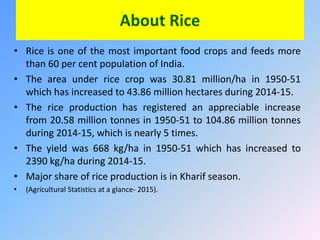
• Rice
• Threshing
• Drying
• Parboiling
• Milling
• Byproducts: Husk & Bran
• Processed rice products
About Rice
• Rice is one of the most important food crops and feeds more
than 60 per cent population of India.
• The area under rice crop was 30.81 million/ha in 1950-51
which has increased to 43.86 million hectares during 2014-15.
• The rice production has registered an appreciable increase
from 20.58 million tonnes in 1950-51 to 104.86 million tonnes
during 2014-15, which is nearly 5 times.
• The yield was 668 kg/ha in 1950-51 which has increased to
2390 kg/ha during 2014-15.
• Major share of rice production is in Kharif season.
• (Agricultural Statistics at a glance- 2015).
Reasons for post harvest losses
1. Poor product coming into storage
2. Poor storage management
3. Poor quality paddy + poor milling techniques
Present situation
Approx. 25-50% of the total grain value (quantity +
quality) is lost between harvest and consumption in
developing countries.
Threshing
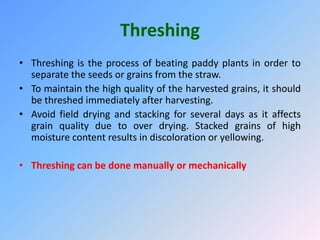
• Threshing is the process of beating paddy plants in order to
separate the seeds or grains from the straw.
• To maintain the high quality of the harvested grains, it should
be threshed immediately after harvesting.
• Avoid field drying and stacking for several days as it affects
grain quality due to over drying. Stacked grains of high
moisture content results in discoloration or yellowing.
• Threshing can be done manually or mechanically
Manual threshing
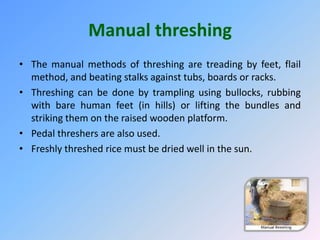
• The manual methods of threshing are treading by feet, flail
method, and beating stalks against tubs, boards or racks.
• Threshing can be done by trampling using bullocks, rubbing
with bare human feet (in hills) or lifting the bundles and
striking them on the raised wooden platform.
• Pedal threshers are also used.
• Freshly threshed rice must be dried well in the sun.
Machine threshing
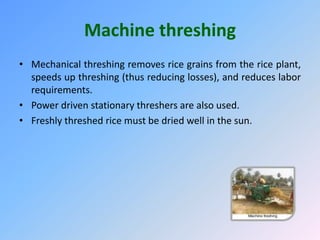
• Mechanical threshing removes rice grains from the rice plant,
speeds up threshing (thus reducing losses), and reduces labor
requirements.
• Power driven stationary threshers are also used.
• Freshly threshed rice must be dried well in the sun.
Drying
• Drying is the process of removal of excess moisture from the
grains.
• Once dried, the rice grain, now called rough rice, is ready for
processing.
• Proper drying results in increased storage life of the grains,
prevention of deterioration in quality, reduction of biological
respiration that leads to quality loss of grains, and optimum
milling recovery.
• Safe moisture level as Grain = 14% & as Seed = 12%
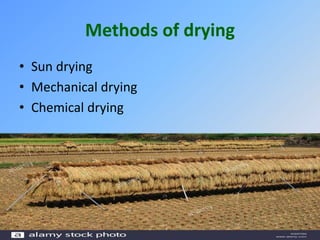
Methods of drying
• Sun drying
• Mechanical drying
• Chemical drying
Sun Drying
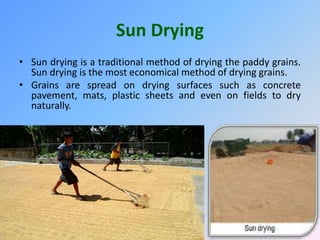
• Sun drying is a traditional method of drying the paddy grains.
Sun drying is the most economical method of drying grains.
• Grains are spread on drying surfaces such as concrete
pavement, mats, plastic sheets and even on fields to dry
naturally.
Mechanical Drying
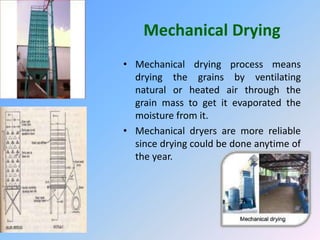
• Mechanical drying process means
drying the grains by ventilating
natural or heated air through the
grain mass to get it evaporated the
moisture from it.
• Mechanical dryers are more reliable
since drying could be done anytime of
the year.
Chemical Drying
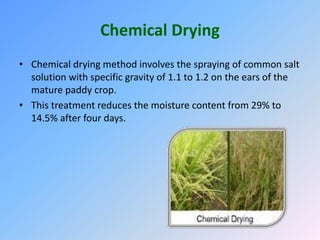
• Chemical drying method involves the spraying of common salt
solution with specific gravity of 1.1 to 1.2 on the ears of the
mature paddy crop.
• This treatment reduces the moisture content from 29% to
14.5% after four days.
Parboiling
• Parboiling is a pre-milling hydrothermal treatment given to
unhulled rice (rough rice) to improve its milling quality,
nutritive value, cooking quality and storability.
• The process is accomplished in three steps: soaking,
steaming and drying.
• Single boiling method involves soaking the unhulled rice in
water at room temperature followed by open steaming for
20-30 minutes using iron kettles and then sun drying.
• In double streaming method, the unhusked rice is first
steamed to raise its temperature and then soaked in cold
water for 24-36 hrs. After soaking, it is steamed second
time for 20-30 minutes followed by sun drying.
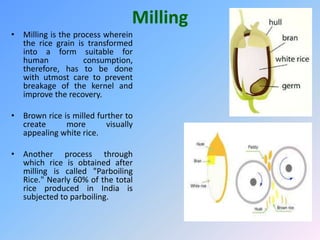
Milling
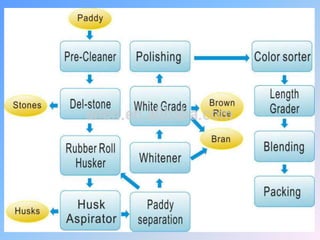
• Milling is the process wherein
the rice grain is transformed
into a form suitable for
human consumption,
therefore, has to be done
with utmost care to prevent
breakage of the kernel and
improve the recovery.
• Brown rice is milled further to
create more visually
appealing white rice.
• Another process through
which rice is obtained after
milling is called "Parboiling
Rice." Nearly 60% of the total
rice produced in India is
subjected to parboiling.
Methods of Milling
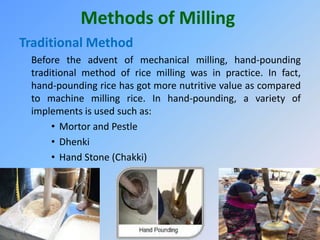
Traditional Method
Before the advent of mechanical milling, hand-pounding
traditional method of rice milling was in practice. In fact,
hand-pounding rice has got more nutritive value as compared
to machine milling rice. In hand-pounding, a variety of
implements is used such as:
• Mortor and Pestle
• Dhenki
• Hand Stone (Chakki)
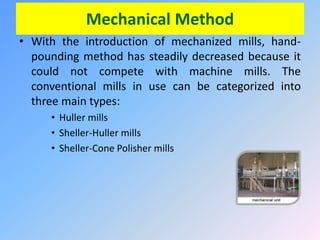
Mechanical Method
• With the introduction of mechanized mills, hand-
pounding method has steadily decreased because it
could not compete with machine mills. The
conventional mills in use can be categorized into
three main types:
• Huller mills
• Sheller-Huller mills
• Sheller-Cone Polisher mills
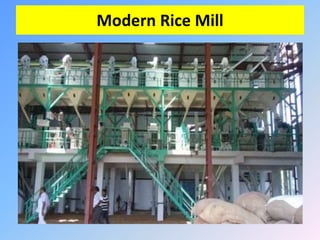
Modern Rice Mill
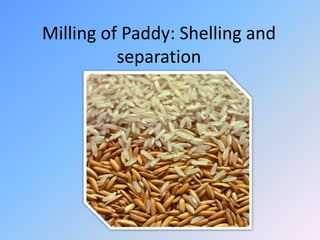
Milling of Paddy: Shelling and
separation
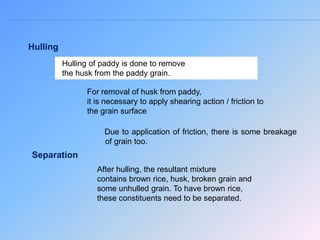
Separation
Hulling
For removal of husk from paddy,
it is necessary to apply shearing action / friction to
the grain surface
Hulling of paddy is done to remove
the husk from the paddy grain.
Due to application of friction, there is some breakage
of grain too.
After hulling, the resultant mixture
contains brown rice, husk, broken grain and
some unhulled grain. To have brown rice,
these constituents need to be separated.
Hulling of paddy
Hulling machines are known by different names such as
hullers, huskers, dehuskers, shellers.
Machines used in hulling paddy are under-runner disc
huller, Engleberg huller, centrifugal sheller and the
rubber roll sheller.
The efficiency of a huller is defined as the percentage
of grain hulled with minimum breakage.
Efficiency of a huller depends upon the construction of
machine, its precision, its maintenance, adjustment and
its operation.
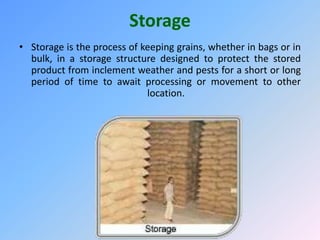
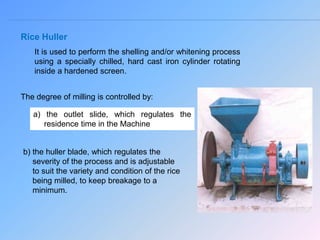
Rice Huller
It is used to perform the shelling and/or whitening process
using a specially chilled, hard cast iron cylinder rotating
inside a hardened screen.
The degree of milling is controlled by:
a) the outlet slide, which regulates the
residence time in the Machine
b) the huller blade, which regulates the
severity of the process and is adjustable
to suit the variety and condition of the rice
being milled, to keep breakage to a
minimum.
Under-runner disc huller
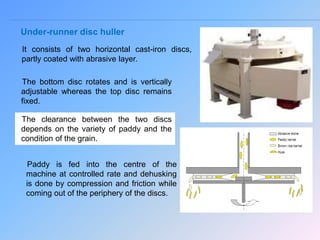
It consists of two horizontal cast-iron discs,
partly coated with abrasive layer.
The bottom disc rotates and is vertically
adjustable whereas the top disc remains
fixed.
The clearance between the two discs
depends on the variety of paddy and the
condition of the grain.
Paddy is fed into the centre of the
machine at controlled rate and dehusking
is done by compression and friction while
coming out of the periphery of the discs.
Under-runner disc huller
Advantages
Capacity is higher than steel huller type.
Percentage of cracked and broken grains produced is
less than that produced by steel huller type.
More power efficient than steel huller type.
Easy to operate.
Low operation cost.
Machine is very durable.
Hulling efficiency is nearly comparable to
rubber roll huller.
Under-runner disc huller
Disadvantages
Machine is very heavy and requires a
moderate size operating space.
This process scratches the rice kernel.
As the abrasive stone wears, sand and silicon dislodges and
mixes with rice and bran.
Machine capacity is less than the rubber roll sheller.
Huller efficiency in this machine is 85% - 90 %.
Does not work well with paddy of mixed varieties
(different kernel dimensions)
Rubber roll huller
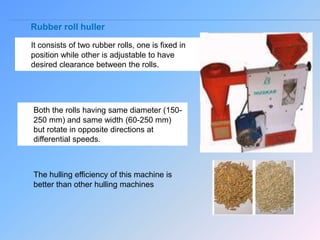
It consists of two rubber rolls, one is fixed in
position while other is adjustable to have
desired clearance between the rolls.
Both the rolls having same diameter (150-
250 mm) and same width (60-250 mm)
but rotate in opposite directions at
differential speeds.
The hulling efficiency of this machine is
better than other hulling machines
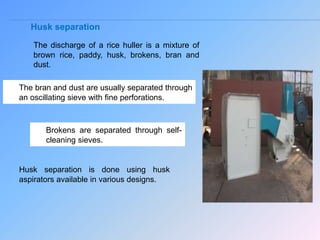
Husk separation
The discharge of a rice huller is a mixture of
brown rice, paddy, husk, brokens, bran and
dust.
The bran and dust are usually separated through
an oscillating sieve with fine perforations.
Brokens are separated through self-
cleaning sieves.
Husk separation is done using husk
aspirators available in various designs.
Paddy separation
After separation of husk, dust, bran and small brokens, a
mixture of brown rice and paddy is obtained.
The paddy is separated from brown rice
using paddy separator.
There are 3 types of paddy separators namely:
compartment type, tray type and screen type.
 However, the most commonly used paddy separator is
compartment type.
Compartment type paddy separator
 It consists of a number of compartments in one, two,
three or four decks.
 The number of compartments depends upon capacity
of rice mill and varies from 5 to 80.
 Up to 10 compartments single deck is used;
 Up to 12-20 compartments, two decks are used;
 Up to 51 compartments, 3 decks are used
 Up to 80 compartments 4 decks are used.
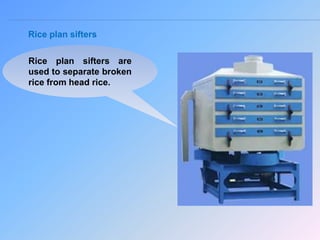
Rice plan sifters
Rice plan sifters are
used to separate broken
rice from head rice.
Characteristics Considered for Grading of
Milled Rice
• Head rice, brokens and brewers percentages
• Defectives
• Foreign matter
• Presence of paddy
• Whiteness
• Chalkiness
• Moisture content
Objectives of establishing standards and grades
• To ensure only edible rice reaches to the consumer.
• To improve post harvest practices so as to eliminate or
reduce waste.
• To improve agronomic practices to increase farm yields.
• To improve processing practices for better milling
recoveries and for market expansion.
• To protect consumers from price/quality manipulation.
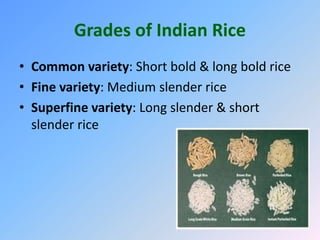
Grades of Indian Rice
• Common variety: Short bold & long bold rice
• Fine variety: Medium slender rice
• Superfine variety: Long slender & short
slender rice
Storage
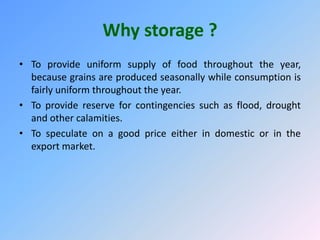
• Storage is the process of keeping grains, whether in bags or in
bulk, in a storage structure designed to protect the stored
product from inclement weather and pests for a short or long
period of time to await processing or movement to other
location.
Why storage ?
• To provide uniform supply of food throughout the year,
because grains are produced seasonally while consumption is
fairly uniform throughout the year.
• To provide reserve for contingencies such as flood, drought
and other calamities.
• To speculate on a good price either in domestic or in the
export market.
What is required of a good storage
system
• Prevention of moisture re-entering the grain after
drying
• Protection from insects, rodents and birds
• Ease of loading and unloading.
• Efficient use of space
• Ease of maintenance and management.
Levels of Storage
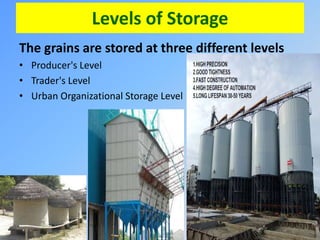
The grains are stored at three different levels
• Producer's Level
• Trader's Level
• Urban Organizational Storage Level
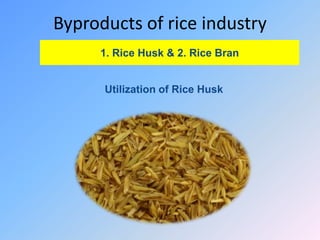
Utilization of Rice Husk
Byproducts of rice industry
1. Rice Husk & 2. Rice Bran
• Rice husk is major by-product of paddy processing.
• The rice husk accounts for about one fifth of the paddy
produced, on weight basis.
• Estimated annual production of rice husk is about 20 m tonnes.
• Economic utilization of this by-product is highly desirable.
Rice Husk
Constituents of rice husk
• The main constituents of rice husk are cellulose, pentosan, lignin
and silica.
• All these constituents have valuable industrial applications.
• Pentosan is considered a good source for furfural production.
• Amorphous silica is a very good source for preparation of pure
silicon and a number of silicon compounds such as silicon
carbide, silicon nitride, cement, ceramic and other silicate
materials.
• Cellulose is raw material for pulp and paper making.
Properties of Rice Husk
• Rice hull has thermal conductivity of about 0.0359 W/(m.°C),
which is comparable with thermal conductivity of excellent
insulating materials.
• Energy content of rice hull is 11.9-13 MJ/kg at 14% moisture
content.
• In terms of nutrients, it has less than 10% total digestible
nutrients.
• Rice hull has a bulk density of 100-160 kg/m3.
Uses of Rice Husk
• Fuel
• Building material (Fibre boards)
• Ash and pure silica
• Production of furfural
• Cattle feed
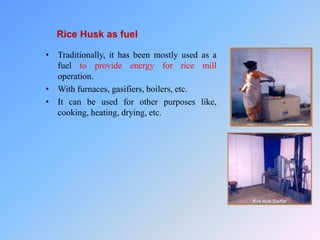
Rice Husk as fuel
• Traditionally, it has been mostly used as a
fuel to provide energy for rice mill
operation.
• With furnaces, gasifiers, boilers, etc.
• It can be used for other purposes like,
cooking, heating, drying, etc.
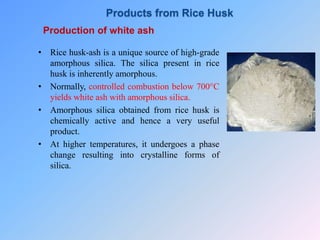
Production of white ash
• Rice husk-ash is a unique source of high-grade
amorphous silica. The silica present in rice
husk is inherently amorphous.
• Normally, controlled combustion below 700°C
yields white ash with amorphous silica.
• Amorphous silica obtained from rice husk is
chemically active and hence a very useful
product.
• At higher temperatures, it undergoes a phase
change resulting into crystalline forms of
silica.
Products from Rice Husk
Rice husk as feed
• Rice hull forms the major part of the concentrate fed
to the cattle in India.
• However, it is low in total digestible nutrient level.
• It is suggested that the level of husk should not
exceed more than 15% in cattle, and 25% in lambs.
• To improve the digestibility of husk, some treatments
like treatment with alkali (NaOH), fermentation is
suggested.
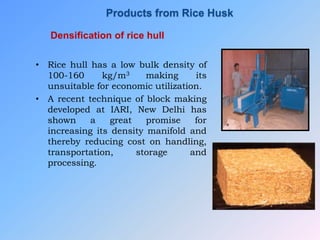
Densification of rice hull
• Rice hull has a low bulk density of
100-160 kg/m3 making its
unsuitable for economic utilization.
• A recent technique of block making
developed at IARI, New Delhi has
shown a great promise for
increasing its density manifold and
thereby reducing cost on handling,
transportation, storage and
processing.
Products from Rice Husk
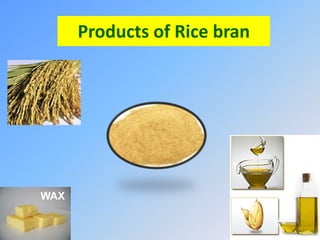
Products of Rice bran
WAX
OIL
Rice bran
Bran is the hard outer layer of grain and
consists of aleurone , pericarp, germ and a
part of endosperm.
When bran is removed from grains, the grains
lose a portion of their nutritional value.
•Bran removal amounts to 4% to 9% weight
of the paddy milled.
Bran is characterized by its high fat and
protein content along with vitamins, minerals
and many other useful chemicals.
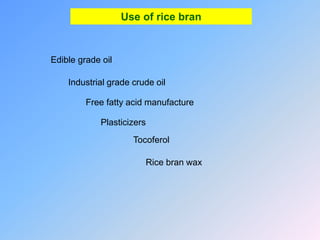
Use of rice bran
Edible grade oil
Industrial grade crude oil
Free fatty acid manufacture
Plasticizers
Tocoferol
Rice bran wax
Products of rice bran
Edible grade oil
Rice bran oil has very low content of linolenic acid
and high content of tocopherol. Therefore, bran oil
has distinct advantages over other vegetable oils.
Different grades of bran oil such as Salad oil,
Cooking oil, Shortenings. could be produced by
refining and hydrogenation.
Products of rice bran
Industrial grade crude oil
Soap manufacture:
Rice bran oil with high Free Fatty Acid (FFA) content is
highly suitable for the manufacturer of soft soap and
liquid soap. In addition, other soaps like aluminium,
barium and calcium soaps can be manufactured as
components of lubricants
Free fatty acid manufacture
Bran oil can also be used to manufacture pure stearic and
oleic acid.
Products of rice bran
Protective coatings:
Rice bran oil can be used to manufacture surface
coatings like alkyd and resin based paints,
enamels, varnishes and lacquers (a clear or
coloured varnish).
Products of rice bran
Plasticizers
Crude bran oil contains 2-4% tocoferol
which has nutritional and antacid effects.
Tocoferol
Bran oil can also be used to manufacture plasticisers
for use in plastic and rubber industries.
Products of rice bran
Rice bran wax
A good substitute of carnauba wax (hard
yellowish to brownish wax from leaves of
the carnauba palm used especially in floor
waxes and polishes).
It can also be used as component in
formulations like carbon paper base,
stencils, candles etc.
Products of rice bran
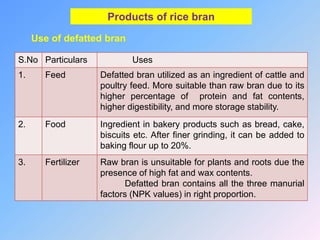
Use of defatted bran
S.No Particulars Uses
1. Feed Defatted bran utilized as an ingredient of cattle and
poultry feed. More suitable than raw bran due to its
higher percentage of protein and fat contents,
higher digestibility, and more storage stability.
2. Food Ingredient in bakery products such as bread, cake,
biscuits etc. After finer grinding, it can be added to
baking flour up to 20%.
3. Fertilizer Raw bran is unsuitable for plants and roots due the
presence of high fat and wax contents.
Defatted bran contains all the three manurial
factors (NPK values) in right proportion.
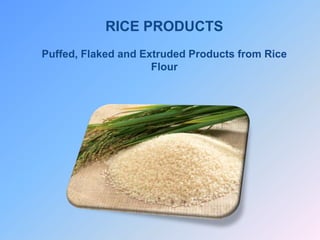
RICE PRODUCTS
Puffed, Flaked and Extruded Products from Rice
Flour
Importance
• Product diversification
• Possibility for nutritional fortification
• Value addition
• Enhanced marketability
• Flexibility to convert by-product into value added processed
product
Puffed, Flaked and Extruded Products from Rice Flour
Puffed rice
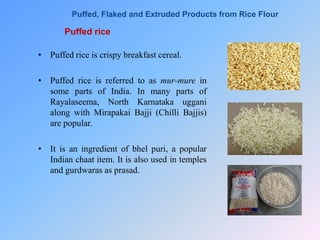
• Puffed rice is crispy breakfast cereal.
• Puffed rice is referred to as mur-mure in
some parts of India. In many parts of
Rayalaseema, North Karnataka uggani
along with Mirapakai Bajji (Chilli Bajjis)
are popular.
• It is an ingredient of bhel puri, a popular
Indian chaat item. It is also used in temples
and gurdwaras as prasad.
Puffed, Flaked and Extruded Products from Rice Flour
Manufacturing process of Puffed rice
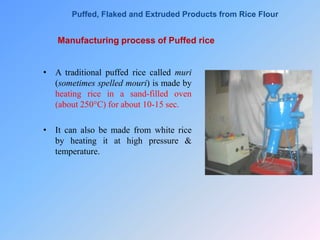
• A traditional puffed rice called muri
(sometimes spelled mouri) is made by
heating rice in a sand-filled oven
(about 250°C) for about 10-15 sec.
• It can also be made from white rice
by heating it at high pressure &
temperature.
Puffed, Flaked and Extruded Products from Rice Flour
Flaked rice
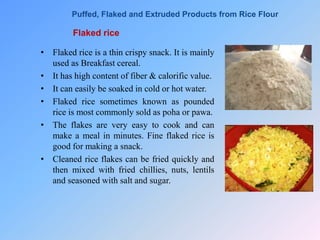
• Flaked rice is a thin crispy snack. It is mainly
used as Breakfast cereal.
• It has high content of fiber & calorific value.
• It can easily be soaked in cold or hot water.
• Flaked rice sometimes known as pounded
rice is most commonly sold as poha or pawa.
• The flakes are very easy to cook and can
make a meal in minutes. Fine flaked rice is
good for making a snack.
• Cleaned rice flakes can be fried quickly and
then mixed with fried chillies, nuts, lentils
and seasoned with salt and sugar.
Puffed, Flaked and Extruded Products from Rice Flour
Manufacturing of flaked rice
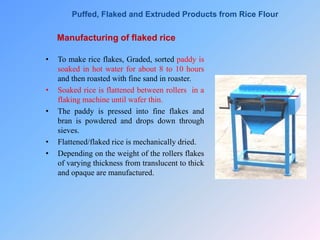
• To make rice flakes, Graded, sorted paddy is
soaked in hot water for about 8 to 10 hours
and then roasted with fine sand in roaster.
• Soaked rice is flattened between rollers in a
flaking machine until wafer thin.
• The paddy is pressed into fine flakes and
bran is powdered and drops down through
sieves.
• Flattened/flaked rice is mechanically dried.
• Depending on the weight of the rollers flakes
of varying thickness from translucent to thick
and opaque are manufactured.
Puffed, Flaked and Extruded Products from Rice Flour
Extruded rice snack
• Extruded puffed snacks can be made from rice and other cereals.
• There has been a remarkable growth in the varieties and popularity of such
products because they are easily affordable, tasty, easy to make and
nutritive.
• These products can be flavoured with cheese, spices, onion, garlic or
chilly.
Puffed, Flaked and Extruded Products from Rice Flour
Manufacturing process
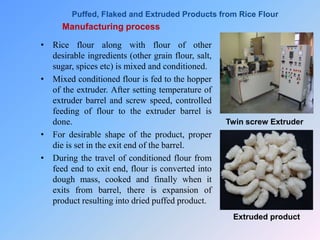
• Rice flour along with flour of other
desirable ingredients (other grain flour, salt,
sugar, spices etc) is mixed and conditioned.
• Mixed conditioned flour is fed to the hopper
of the extruder. After setting temperature of
extruder barrel and screw speed, controlled
feeding of flour to the extruder barrel is
done.
• For desirable shape of the product, proper
die is set in the exit end of the barrel.
• During the travel of conditioned flour from
feed end to exit end, flour is converted into
dough mass, cooked and finally when it
exits from barrel, there is expansion of
product resulting into dried puffed product.
Twin screw Extruder
Extruded product
Puffed, Flaked and Extruded Products from Rice Flour
Manufacturing process
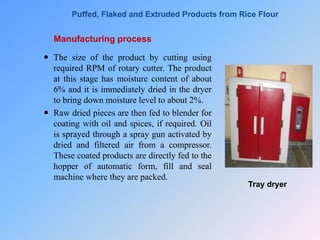
 The size of the product by cutting using
required RPM of rotary cutter. The product
at this stage has moisture content of about
6% and it is immediately dried in the dryer
to bring down moisture level to about 2%.
 Raw dried pieces are then fed to blender for
coating with oil and spices, if required. Oil
is sprayed through a spray gun activated by
dried and filtered air from a compressor.
These coated products are directly fed to the
hopper of automatic form, fill and seal
machine where they are packed.
Tray dryer
Puffed, Flaked and Extruded Products from Rice Flour
Post Harvest Management in Rice

Post Harvest Management in Rice

  • 1.
    Post Harvest Managementin Rice S. K. Goyal, Ph.D. Assistant Professor-cum-Scientist (Agricultural Engineering), Specialisation: Agricultural Process & Food Engineering KVK - Institute of Agricultural Sciences, Banaras Hindu University, Rajiv Gandhi South Campus, Barkachha, Mirzapur – 231 001 (U.P.)
  • 2.
    Outline • Rice • Threshing •Drying • Parboiling • Milling • Byproducts: Husk & Bran • Processed rice products
  • 3.
    About Rice • Riceis one of the most important food crops and feeds more than 60 per cent population of India. • The area under rice crop was 30.81 million/ha in 1950-51 which has increased to 43.86 million hectares during 2014-15. • The rice production has registered an appreciable increase from 20.58 million tonnes in 1950-51 to 104.86 million tonnes during 2014-15, which is nearly 5 times. • The yield was 668 kg/ha in 1950-51 which has increased to 2390 kg/ha during 2014-15. • Major share of rice production is in Kharif season. • (Agricultural Statistics at a glance- 2015).
  • 4.
    Reasons for postharvest losses 1. Poor product coming into storage 2. Poor storage management 3. Poor quality paddy + poor milling techniques Present situation Approx. 25-50% of the total grain value (quantity + quality) is lost between harvest and consumption in developing countries.
  • 5.
    Threshing • Threshing isthe process of beating paddy plants in order to separate the seeds or grains from the straw. • To maintain the high quality of the harvested grains, it should be threshed immediately after harvesting. • Avoid field drying and stacking for several days as it affects grain quality due to over drying. Stacked grains of high moisture content results in discoloration or yellowing. • Threshing can be done manually or mechanically
  • 6.
    Manual threshing • Themanual methods of threshing are treading by feet, flail method, and beating stalks against tubs, boards or racks. • Threshing can be done by trampling using bullocks, rubbing with bare human feet (in hills) or lifting the bundles and striking them on the raised wooden platform. • Pedal threshers are also used. • Freshly threshed rice must be dried well in the sun.
  • 7.
    Machine threshing • Mechanicalthreshing removes rice grains from the rice plant, speeds up threshing (thus reducing losses), and reduces labor requirements. • Power driven stationary threshers are also used. • Freshly threshed rice must be dried well in the sun.
  • 8.
    Drying • Drying isthe process of removal of excess moisture from the grains. • Once dried, the rice grain, now called rough rice, is ready for processing. • Proper drying results in increased storage life of the grains, prevention of deterioration in quality, reduction of biological respiration that leads to quality loss of grains, and optimum milling recovery. • Safe moisture level as Grain = 14% & as Seed = 12%
  • 9.
    Methods of drying •Sun drying • Mechanical drying • Chemical drying
  • 10.
    Sun Drying • Sundrying is a traditional method of drying the paddy grains. Sun drying is the most economical method of drying grains. • Grains are spread on drying surfaces such as concrete pavement, mats, plastic sheets and even on fields to dry naturally.
  • 11.
    Mechanical Drying • Mechanicaldrying process means drying the grains by ventilating natural or heated air through the grain mass to get it evaporated the moisture from it. • Mechanical dryers are more reliable since drying could be done anytime of the year.
  • 12.
    Chemical Drying • Chemicaldrying method involves the spraying of common salt solution with specific gravity of 1.1 to 1.2 on the ears of the mature paddy crop. • This treatment reduces the moisture content from 29% to 14.5% after four days.
  • 13.
    Parboiling • Parboiling isa pre-milling hydrothermal treatment given to unhulled rice (rough rice) to improve its milling quality, nutritive value, cooking quality and storability. • The process is accomplished in three steps: soaking, steaming and drying. • Single boiling method involves soaking the unhulled rice in water at room temperature followed by open steaming for 20-30 minutes using iron kettles and then sun drying. • In double streaming method, the unhusked rice is first steamed to raise its temperature and then soaked in cold water for 24-36 hrs. After soaking, it is steamed second time for 20-30 minutes followed by sun drying.
  • 14.
    Milling • Milling isthe process wherein the rice grain is transformed into a form suitable for human consumption, therefore, has to be done with utmost care to prevent breakage of the kernel and improve the recovery. • Brown rice is milled further to create more visually appealing white rice. • Another process through which rice is obtained after milling is called "Parboiling Rice." Nearly 60% of the total rice produced in India is subjected to parboiling.
  • 15.
    Methods of Milling TraditionalMethod Before the advent of mechanical milling, hand-pounding traditional method of rice milling was in practice. In fact, hand-pounding rice has got more nutritive value as compared to machine milling rice. In hand-pounding, a variety of implements is used such as: • Mortor and Pestle • Dhenki • Hand Stone (Chakki)
  • 16.
    Mechanical Method • Withthe introduction of mechanized mills, hand- pounding method has steadily decreased because it could not compete with machine mills. The conventional mills in use can be categorized into three main types: • Huller mills • Sheller-Huller mills • Sheller-Cone Polisher mills
  • 17.
  • 19.
    Milling of Paddy:Shelling and separation
  • 20.
    Separation Hulling For removal ofhusk from paddy, it is necessary to apply shearing action / friction to the grain surface Hulling of paddy is done to remove the husk from the paddy grain. Due to application of friction, there is some breakage of grain too. After hulling, the resultant mixture contains brown rice, husk, broken grain and some unhulled grain. To have brown rice, these constituents need to be separated.
  • 21.
    Hulling of paddy Hullingmachines are known by different names such as hullers, huskers, dehuskers, shellers. Machines used in hulling paddy are under-runner disc huller, Engleberg huller, centrifugal sheller and the rubber roll sheller. The efficiency of a huller is defined as the percentage of grain hulled with minimum breakage. Efficiency of a huller depends upon the construction of machine, its precision, its maintenance, adjustment and its operation.
  • 22.
    Rice Huller It isused to perform the shelling and/or whitening process using a specially chilled, hard cast iron cylinder rotating inside a hardened screen. The degree of milling is controlled by: a) the outlet slide, which regulates the residence time in the Machine b) the huller blade, which regulates the severity of the process and is adjustable to suit the variety and condition of the rice being milled, to keep breakage to a minimum.
  • 23.
    Under-runner disc huller Itconsists of two horizontal cast-iron discs, partly coated with abrasive layer. The bottom disc rotates and is vertically adjustable whereas the top disc remains fixed. The clearance between the two discs depends on the variety of paddy and the condition of the grain. Paddy is fed into the centre of the machine at controlled rate and dehusking is done by compression and friction while coming out of the periphery of the discs.
  • 24.
    Under-runner disc huller Advantages Capacityis higher than steel huller type. Percentage of cracked and broken grains produced is less than that produced by steel huller type. More power efficient than steel huller type. Easy to operate. Low operation cost. Machine is very durable. Hulling efficiency is nearly comparable to rubber roll huller.
  • 25.
    Under-runner disc huller Disadvantages Machineis very heavy and requires a moderate size operating space. This process scratches the rice kernel. As the abrasive stone wears, sand and silicon dislodges and mixes with rice and bran. Machine capacity is less than the rubber roll sheller. Huller efficiency in this machine is 85% - 90 %. Does not work well with paddy of mixed varieties (different kernel dimensions)
  • 26.
    Rubber roll huller Itconsists of two rubber rolls, one is fixed in position while other is adjustable to have desired clearance between the rolls. Both the rolls having same diameter (150- 250 mm) and same width (60-250 mm) but rotate in opposite directions at differential speeds. The hulling efficiency of this machine is better than other hulling machines
  • 27.
    Husk separation The dischargeof a rice huller is a mixture of brown rice, paddy, husk, brokens, bran and dust. The bran and dust are usually separated through an oscillating sieve with fine perforations. Brokens are separated through self- cleaning sieves. Husk separation is done using husk aspirators available in various designs.
  • 28.
    Paddy separation After separationof husk, dust, bran and small brokens, a mixture of brown rice and paddy is obtained. The paddy is separated from brown rice using paddy separator. There are 3 types of paddy separators namely: compartment type, tray type and screen type.  However, the most commonly used paddy separator is compartment type.
  • 29.
    Compartment type paddyseparator  It consists of a number of compartments in one, two, three or four decks.  The number of compartments depends upon capacity of rice mill and varies from 5 to 80.  Up to 10 compartments single deck is used;  Up to 12-20 compartments, two decks are used;  Up to 51 compartments, 3 decks are used  Up to 80 compartments 4 decks are used.
  • 30.
    Rice plan sifters Riceplan sifters are used to separate broken rice from head rice.
  • 31.
    Characteristics Considered forGrading of Milled Rice • Head rice, brokens and brewers percentages • Defectives • Foreign matter • Presence of paddy • Whiteness • Chalkiness • Moisture content
  • 32.
    Objectives of establishingstandards and grades • To ensure only edible rice reaches to the consumer. • To improve post harvest practices so as to eliminate or reduce waste. • To improve agronomic practices to increase farm yields. • To improve processing practices for better milling recoveries and for market expansion. • To protect consumers from price/quality manipulation.
  • 33.
    Grades of IndianRice • Common variety: Short bold & long bold rice • Fine variety: Medium slender rice • Superfine variety: Long slender & short slender rice
  • 34.
    Storage • Storage isthe process of keeping grains, whether in bags or in bulk, in a storage structure designed to protect the stored product from inclement weather and pests for a short or long period of time to await processing or movement to other location.
  • 35.
    Why storage ? •To provide uniform supply of food throughout the year, because grains are produced seasonally while consumption is fairly uniform throughout the year. • To provide reserve for contingencies such as flood, drought and other calamities. • To speculate on a good price either in domestic or in the export market.
  • 36.
    What is requiredof a good storage system • Prevention of moisture re-entering the grain after drying • Protection from insects, rodents and birds • Ease of loading and unloading. • Efficient use of space • Ease of maintenance and management.
  • 37.
    Levels of Storage Thegrains are stored at three different levels • Producer's Level • Trader's Level • Urban Organizational Storage Level
  • 38.
    Utilization of RiceHusk Byproducts of rice industry 1. Rice Husk & 2. Rice Bran
  • 39.
    • Rice huskis major by-product of paddy processing. • The rice husk accounts for about one fifth of the paddy produced, on weight basis. • Estimated annual production of rice husk is about 20 m tonnes. • Economic utilization of this by-product is highly desirable. Rice Husk
  • 40.
    Constituents of ricehusk • The main constituents of rice husk are cellulose, pentosan, lignin and silica. • All these constituents have valuable industrial applications. • Pentosan is considered a good source for furfural production. • Amorphous silica is a very good source for preparation of pure silicon and a number of silicon compounds such as silicon carbide, silicon nitride, cement, ceramic and other silicate materials. • Cellulose is raw material for pulp and paper making.
  • 41.
    Properties of RiceHusk • Rice hull has thermal conductivity of about 0.0359 W/(m.°C), which is comparable with thermal conductivity of excellent insulating materials. • Energy content of rice hull is 11.9-13 MJ/kg at 14% moisture content. • In terms of nutrients, it has less than 10% total digestible nutrients. • Rice hull has a bulk density of 100-160 kg/m3.
  • 42.
    Uses of RiceHusk • Fuel • Building material (Fibre boards) • Ash and pure silica • Production of furfural • Cattle feed
  • 43.
    Rice Husk asfuel • Traditionally, it has been mostly used as a fuel to provide energy for rice mill operation. • With furnaces, gasifiers, boilers, etc. • It can be used for other purposes like, cooking, heating, drying, etc.
  • 44.
    Production of whiteash • Rice husk-ash is a unique source of high-grade amorphous silica. The silica present in rice husk is inherently amorphous. • Normally, controlled combustion below 700°C yields white ash with amorphous silica. • Amorphous silica obtained from rice husk is chemically active and hence a very useful product. • At higher temperatures, it undergoes a phase change resulting into crystalline forms of silica. Products from Rice Husk
  • 45.
    Rice husk asfeed • Rice hull forms the major part of the concentrate fed to the cattle in India. • However, it is low in total digestible nutrient level. • It is suggested that the level of husk should not exceed more than 15% in cattle, and 25% in lambs. • To improve the digestibility of husk, some treatments like treatment with alkali (NaOH), fermentation is suggested.
  • 46.
    Densification of ricehull • Rice hull has a low bulk density of 100-160 kg/m3 making its unsuitable for economic utilization. • A recent technique of block making developed at IARI, New Delhi has shown a great promise for increasing its density manifold and thereby reducing cost on handling, transportation, storage and processing. Products from Rice Husk
  • 47.
    Products of Ricebran WAX OIL
  • 48.
    Rice bran Bran isthe hard outer layer of grain and consists of aleurone , pericarp, germ and a part of endosperm. When bran is removed from grains, the grains lose a portion of their nutritional value. •Bran removal amounts to 4% to 9% weight of the paddy milled. Bran is characterized by its high fat and protein content along with vitamins, minerals and many other useful chemicals.
  • 49.
    Use of ricebran Edible grade oil Industrial grade crude oil Free fatty acid manufacture Plasticizers Tocoferol Rice bran wax
  • 50.
    Products of ricebran Edible grade oil Rice bran oil has very low content of linolenic acid and high content of tocopherol. Therefore, bran oil has distinct advantages over other vegetable oils. Different grades of bran oil such as Salad oil, Cooking oil, Shortenings. could be produced by refining and hydrogenation.
  • 51.
    Products of ricebran Industrial grade crude oil Soap manufacture: Rice bran oil with high Free Fatty Acid (FFA) content is highly suitable for the manufacturer of soft soap and liquid soap. In addition, other soaps like aluminium, barium and calcium soaps can be manufactured as components of lubricants Free fatty acid manufacture Bran oil can also be used to manufacture pure stearic and oleic acid.
  • 52.
    Products of ricebran Protective coatings: Rice bran oil can be used to manufacture surface coatings like alkyd and resin based paints, enamels, varnishes and lacquers (a clear or coloured varnish).
  • 53.
    Products of ricebran Plasticizers Crude bran oil contains 2-4% tocoferol which has nutritional and antacid effects. Tocoferol Bran oil can also be used to manufacture plasticisers for use in plastic and rubber industries.
  • 54.
    Products of ricebran Rice bran wax A good substitute of carnauba wax (hard yellowish to brownish wax from leaves of the carnauba palm used especially in floor waxes and polishes). It can also be used as component in formulations like carbon paper base, stencils, candles etc.
  • 55.
    Products of ricebran Use of defatted bran S.No Particulars Uses 1. Feed Defatted bran utilized as an ingredient of cattle and poultry feed. More suitable than raw bran due to its higher percentage of protein and fat contents, higher digestibility, and more storage stability. 2. Food Ingredient in bakery products such as bread, cake, biscuits etc. After finer grinding, it can be added to baking flour up to 20%. 3. Fertilizer Raw bran is unsuitable for plants and roots due the presence of high fat and wax contents. Defatted bran contains all the three manurial factors (NPK values) in right proportion.
  • 56.
    RICE PRODUCTS Puffed, Flakedand Extruded Products from Rice Flour
  • 57.
    Importance • Product diversification •Possibility for nutritional fortification • Value addition • Enhanced marketability • Flexibility to convert by-product into value added processed product Puffed, Flaked and Extruded Products from Rice Flour
  • 58.
    Puffed rice • Puffedrice is crispy breakfast cereal. • Puffed rice is referred to as mur-mure in some parts of India. In many parts of Rayalaseema, North Karnataka uggani along with Mirapakai Bajji (Chilli Bajjis) are popular. • It is an ingredient of bhel puri, a popular Indian chaat item. It is also used in temples and gurdwaras as prasad. Puffed, Flaked and Extruded Products from Rice Flour
  • 59.
    Manufacturing process ofPuffed rice • A traditional puffed rice called muri (sometimes spelled mouri) is made by heating rice in a sand-filled oven (about 250°C) for about 10-15 sec. • It can also be made from white rice by heating it at high pressure & temperature. Puffed, Flaked and Extruded Products from Rice Flour
  • 60.
    Flaked rice • Flakedrice is a thin crispy snack. It is mainly used as Breakfast cereal. • It has high content of fiber & calorific value. • It can easily be soaked in cold or hot water. • Flaked rice sometimes known as pounded rice is most commonly sold as poha or pawa. • The flakes are very easy to cook and can make a meal in minutes. Fine flaked rice is good for making a snack. • Cleaned rice flakes can be fried quickly and then mixed with fried chillies, nuts, lentils and seasoned with salt and sugar. Puffed, Flaked and Extruded Products from Rice Flour
  • 61.
    Manufacturing of flakedrice • To make rice flakes, Graded, sorted paddy is soaked in hot water for about 8 to 10 hours and then roasted with fine sand in roaster. • Soaked rice is flattened between rollers in a flaking machine until wafer thin. • The paddy is pressed into fine flakes and bran is powdered and drops down through sieves. • Flattened/flaked rice is mechanically dried. • Depending on the weight of the rollers flakes of varying thickness from translucent to thick and opaque are manufactured. Puffed, Flaked and Extruded Products from Rice Flour
  • 62.
    Extruded rice snack •Extruded puffed snacks can be made from rice and other cereals. • There has been a remarkable growth in the varieties and popularity of such products because they are easily affordable, tasty, easy to make and nutritive. • These products can be flavoured with cheese, spices, onion, garlic or chilly. Puffed, Flaked and Extruded Products from Rice Flour
  • 63.
    Manufacturing process • Riceflour along with flour of other desirable ingredients (other grain flour, salt, sugar, spices etc) is mixed and conditioned. • Mixed conditioned flour is fed to the hopper of the extruder. After setting temperature of extruder barrel and screw speed, controlled feeding of flour to the extruder barrel is done. • For desirable shape of the product, proper die is set in the exit end of the barrel. • During the travel of conditioned flour from feed end to exit end, flour is converted into dough mass, cooked and finally when it exits from barrel, there is expansion of product resulting into dried puffed product. Twin screw Extruder Extruded product Puffed, Flaked and Extruded Products from Rice Flour
  • 64.
    Manufacturing process  Thesize of the product by cutting using required RPM of rotary cutter. The product at this stage has moisture content of about 6% and it is immediately dried in the dryer to bring down moisture level to about 2%.  Raw dried pieces are then fed to blender for coating with oil and spices, if required. Oil is sprayed through a spray gun activated by dried and filtered air from a compressor. These coated products are directly fed to the hopper of automatic form, fill and seal machine where they are packed. Tray dryer Puffed, Flaked and Extruded Products from Rice Flour