Theme Paper Micro Enterprises as a catalyst in Village development Village: Katang seoni  Block: Niwas District: Mandla State: Madhya Pradesh Theme Paper Guide: Prof. Arvind Gupta Host organization: Foundation for Ecological    security (FES) Submitted by: Viney Rao (28051)
Objectives  To explore about the existing Micro Enterprises and their economic viability To know about their contribution in the income level  To categorize the people among the benefited and affected ones To asses the potential for establishment of new Micro Enterprises
Continued… To spot the problems which are being faced by Micro Enterprises in the village To identify the key factors or institutions promoting Micro Enterprises in the area To study the effect of Micro enterprises on environment
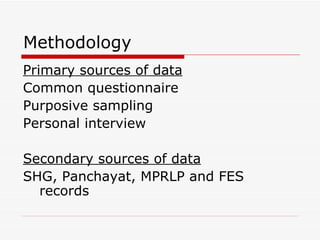
Methodology Primary sources of data Common questionnaire Purposive sampling Personal interview Secondary sources of data SHG, Panchayat, MPRLP and FES records
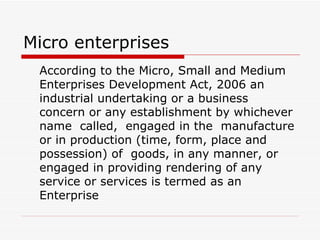
Micro enterprises According to the Micro, Small and Medium Enterprises Development Act, 2006 an industrial undertaking or a business concern or any establishment by whichever name  called,  engaged in the  manufacture or in production (time, form, place and possession) of  goods, in any manner, or engaged in providing rendering of any service or services is termed as an Enterprise
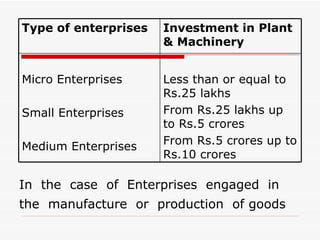
In  the  case  of  Enterprises  engaged  in  the  manufacture  or  production  of goods   Less than or equal to Rs.25 lakhs  From Rs.25 lakhs up to Rs.5 crores From Rs.5 crores up to Rs.10 crores  Micro Enterprises  Small Enterprises  Medium Enterprises  Investment in Plant & Machinery  Type of enterprises
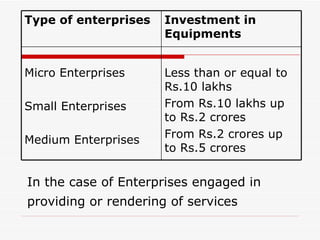
In the case of Enterprises engaged in providing or rendering of services   Less than or equal to Rs.10 lakhs  From Rs.10 lakhs up to Rs.2 crores From Rs.2 crores up to Rs.5 crores  Micro Enterprises  Small Enterprises  Medium Enterprises  Investment in Equipments   Type of enterprises
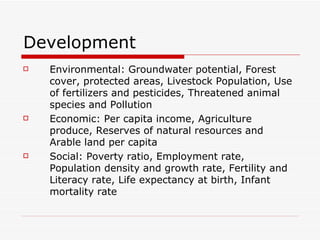
Development Environmental: Groundwater potential, Forest cover, protected areas, Livestock Population, Use of fertilizers and pesticides, Threatened animal species and Pollution Economic: Per capita income, Agriculture produce, Reserves of natural resources and Arable land per capita Social: Poverty ratio, Employment rate, Population density and growth rate, Fertility and Literacy rate, Life expectancy at birth, Infant mortality rate
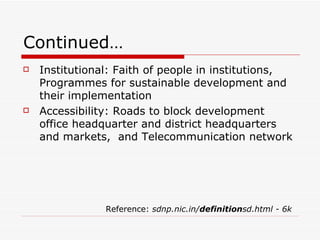
Continued… Institutional: Faith of people in institutions, Programmes for sustainable development and their implementation  Accessibility: Roads to block development office headquarter and district headquarters and markets,  and Telecommunication network   Reference:  sdnp.nic.in/ definition sd.html - 6k
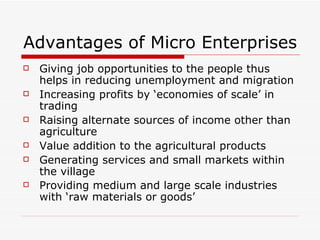
Advantages of Micro Enterprises Giving job opportunities to the people thus helps in reducing unemployment and migration Increasing profits by ‘economies of scale’ in trading  Raising alternate sources of income other than agriculture  Value addition to the agricultural products Generating services and small markets within the village Providing medium and large scale industries with ‘raw materials or goods’
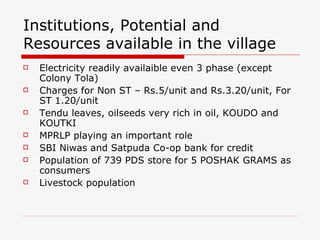
Institutions, Potential and Resources available in the village  Electricity readily availaible even 3 phase (except Colony Tola) Charges for Non ST – Rs.5/unit and Rs.3.20/unit, For ST 1.20/unit Tendu leaves, oilseeds very rich in oil, KOUDO and KOUTKI MPRLP playing an important role SBI Niwas and Satpuda Co-op bank for credit Population of 739 PDS store for 5 POSHAK GRAMS as consumers Livestock population
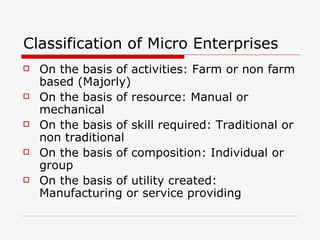
Classification of Micro Enterprises  On the basis of activities: Farm or non farm based (Majorly) On the basis of resource: Manual or mechanical  On the basis of skill required: Traditional or non traditional On the basis of composition: Individual or group On the basis of utility created: Manufacturing or service providing
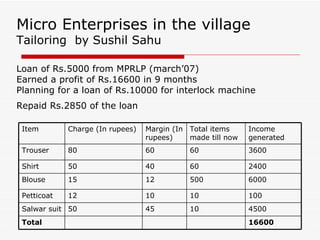
Micro Enterprises in the village Tailoring  by Sushil Sahu Loan of Rs.5000 from MPRLP (march’07) Earned a profit of Rs.16600 in 9 months Planning for a loan of Rs.10000 for interlock machine Repaid Rs.2850 of the loan     16600 Total 4500 10 45 50 Salwar suit 100 10 10 12 Petticoat 6000 500 12 15 Blouse 2400 60 40 50 Shirt 3600 60 60 80 Trouser Income generated  Total items made till now  Margin (In rupees)  Charge (In rupees)  Item
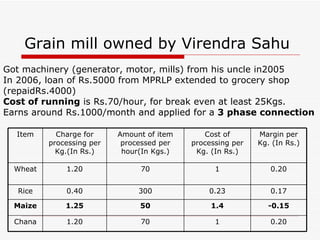
Grain mill owned by Virendra Sahu Got machinery (generator, motor, mills) from his uncle in2005  In 2006, loan of Rs.5000 from MPRLP extended to grocery shop (repaidRs.4000) Cost of running  is Rs.70/hour, for break even at least 25Kgs.  Earns around Rs.1000/month and applied for a  3 phase connection 0.20 1 70 1.20 Chana -0.15 1.4 50 1.25 Maize 0.17 0.23 300 0.40 Rice 0.20 1 70 1.20 Wheat Margin per Kg. (In Rs.) Cost of processing per Kg. (In Rs.) Amount of item processed per hour(In Kgs.) Charge for processing per Kg.(In Rs.) Item
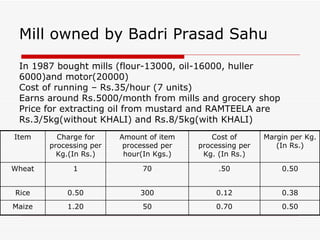
Mill owned by Badri Prasad Sahu In 1987 bought mills (flour-13000, oil-16000, huller 6000)and motor(20000)  Cost of running – Rs.35/hour (7 units) Earns around Rs.5000/month from mills and grocery shop Price for extracting oil from mustard and RAMTEELA are Rs.3/5kg(without KHALI) and Rs.8/5kg(with KHALI)    0.50 0.70 50 1.20 Maize 0.38 0.12 300 0.50 Rice 0.50 .50 70 1 Wheat Margin per Kg. (In Rs.) Cost of processing per Kg. (In Rs.) Amount of item processed per hour(In Kgs.) Charge for processing per Kg.(In Rs.) Item
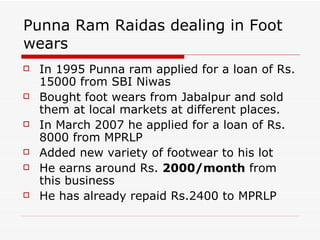
Punna Ram Raidas dealing in Foot wears In 1995 Punna ram applied for a loan of Rs. 15000 from SBI Niwas  Bought foot wears from Jabalpur and sold them at local markets at different places.  In March 2007 he applied for a loan of Rs. 8000 from MPRLP  Added new variety of footwear to his lot  He earns around Rs.  2000/month  from this business  He has already repaid Rs.2400 to MPRLP
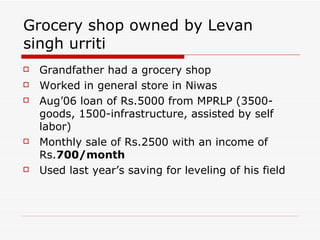
Grocery shop owned by Levan singh urriti Grandfather had a grocery shop Worked in general store in Niwas Aug’06 loan of Rs.5000 from MPRLP (3500-goods, 1500-infrastructure, assisted by self labor) Monthly sale of Rs.2500 with an income of Rs. 700/month Used last year’s saving for leveling of his field
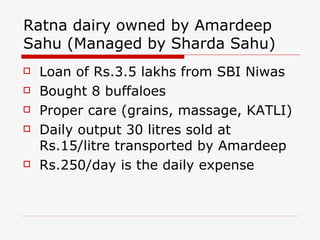
Ratna dairy owned by Amardeep Sahu (Managed by Sharda Sahu) Loan of Rs.3.5 lakhs from SBI Niwas Bought 8 buffaloes Proper care (grains, massage, KATLI) Daily output 30 litres sold at Rs.15/litre transported by Amardeep Rs.250/day is the daily expense
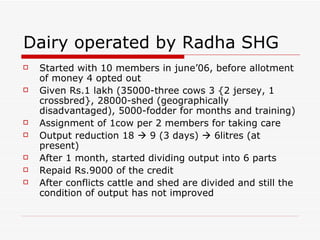
Dairy operated by Radha SHG Started with 10 members in june’06, before allotment of money 4 opted out Given Rs.1 lakh (35000-three cows 3 {2 jersey, 1 crossbred}, 28000-shed (geographically disadvantaged), 5000-fodder for months and training) Assignment of 1cow per 2 members for taking care Output reduction 18    9 (3 days)    6litres (at present) After 1 month, started dividing output into 6 parts Repaid Rs.9000 of the credit After conflicts cattle and shed are divided and still the condition of output has not improved
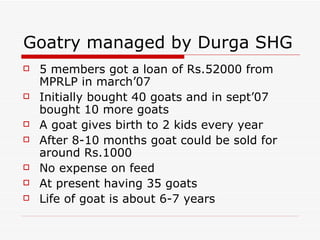
Goatry managed by Durga SHG  5 members got a loan of Rs.52000 from MPRLP in march’07 Initially bought 40 goats and in sept’07 bought 10 more goats A goat gives birth to 2 kids every year After 8-10 months goat could be sold for around Rs.1000 No expense on feed At present having 35 goats Life of goat is about 6-7 years
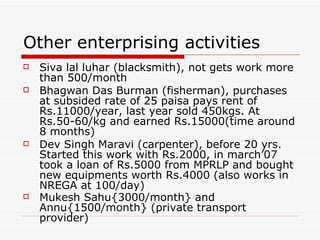
Other enterprising activities Siva lal luhar (blacksmith), not gets work more than 500/month Bhagwan Das Burman (fisherman), purchases at subsided rate of 25 paisa pays rent of Rs.11000/year, last year sold 450kgs. At Rs.50-60/kg and earned Rs.15000(time around 8 months)  Dev Singh Maravi (carpenter), before 20 yrs. Started this work with Rs.2000, in march’07 took a loan of Rs.5000 from MPRLP and bought new equipments worth Rs.4000 (also works in NREGA at 100/day) Mukesh Sahu{3000/month} and Annu{1500/month} (private transport provider)
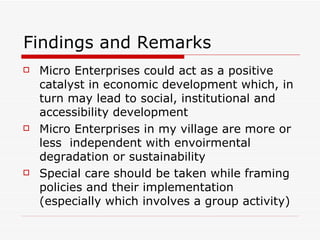
Findings and Remarks Micro Enterprises could act as a positive catalyst in economic development which, in turn may lead to social, institutional and accessibility development Micro Enterprises in my village are more or less  independent with envoirmental degradation or sustainability Special care should be taken while framing policies and their implementation (especially which involves a group activity)
Limitations  No analysis on macro level Sowing, Harvesting and festival season Communication problem
Thank You

Micro Enterprises As A Catalyst In Village Development

  • 1.
    Theme Paper MicroEnterprises as a catalyst in Village development Village: Katang seoni Block: Niwas District: Mandla State: Madhya Pradesh Theme Paper Guide: Prof. Arvind Gupta Host organization: Foundation for Ecological security (FES) Submitted by: Viney Rao (28051)
  • 2.
    Objectives Toexplore about the existing Micro Enterprises and their economic viability To know about their contribution in the income level To categorize the people among the benefited and affected ones To asses the potential for establishment of new Micro Enterprises
  • 3.
    Continued… To spotthe problems which are being faced by Micro Enterprises in the village To identify the key factors or institutions promoting Micro Enterprises in the area To study the effect of Micro enterprises on environment
  • 4.
    Methodology Primary sourcesof data Common questionnaire Purposive sampling Personal interview Secondary sources of data SHG, Panchayat, MPRLP and FES records
  • 5.
    Micro enterprises Accordingto the Micro, Small and Medium Enterprises Development Act, 2006 an industrial undertaking or a business concern or any establishment by whichever name called, engaged in the manufacture or in production (time, form, place and possession) of goods, in any manner, or engaged in providing rendering of any service or services is termed as an Enterprise
  • 6.
    In the case of Enterprises engaged in the manufacture or production of goods Less than or equal to Rs.25 lakhs From Rs.25 lakhs up to Rs.5 crores From Rs.5 crores up to Rs.10 crores Micro Enterprises Small Enterprises Medium Enterprises Investment in Plant & Machinery Type of enterprises
  • 7.
    In the caseof Enterprises engaged in providing or rendering of services Less than or equal to Rs.10 lakhs From Rs.10 lakhs up to Rs.2 crores From Rs.2 crores up to Rs.5 crores Micro Enterprises Small Enterprises Medium Enterprises Investment in Equipments Type of enterprises
  • 8.
    Development Environmental: Groundwaterpotential, Forest cover, protected areas, Livestock Population, Use of fertilizers and pesticides, Threatened animal species and Pollution Economic: Per capita income, Agriculture produce, Reserves of natural resources and Arable land per capita Social: Poverty ratio, Employment rate, Population density and growth rate, Fertility and Literacy rate, Life expectancy at birth, Infant mortality rate
  • 9.
    Continued… Institutional: Faithof people in institutions, Programmes for sustainable development and their implementation Accessibility: Roads to block development office headquarter and district headquarters and markets, and Telecommunication network Reference: sdnp.nic.in/ definition sd.html - 6k
  • 10.
    Advantages of MicroEnterprises Giving job opportunities to the people thus helps in reducing unemployment and migration Increasing profits by ‘economies of scale’ in trading Raising alternate sources of income other than agriculture Value addition to the agricultural products Generating services and small markets within the village Providing medium and large scale industries with ‘raw materials or goods’
  • 11.
    Institutions, Potential andResources available in the village Electricity readily availaible even 3 phase (except Colony Tola) Charges for Non ST – Rs.5/unit and Rs.3.20/unit, For ST 1.20/unit Tendu leaves, oilseeds very rich in oil, KOUDO and KOUTKI MPRLP playing an important role SBI Niwas and Satpuda Co-op bank for credit Population of 739 PDS store for 5 POSHAK GRAMS as consumers Livestock population
  • 12.
    Classification of MicroEnterprises On the basis of activities: Farm or non farm based (Majorly) On the basis of resource: Manual or mechanical On the basis of skill required: Traditional or non traditional On the basis of composition: Individual or group On the basis of utility created: Manufacturing or service providing
  • 13.
    Micro Enterprises inthe village Tailoring by Sushil Sahu Loan of Rs.5000 from MPRLP (march’07) Earned a profit of Rs.16600 in 9 months Planning for a loan of Rs.10000 for interlock machine Repaid Rs.2850 of the loan 16600 Total 4500 10 45 50 Salwar suit 100 10 10 12 Petticoat 6000 500 12 15 Blouse 2400 60 40 50 Shirt 3600 60 60 80 Trouser Income generated Total items made till now Margin (In rupees) Charge (In rupees) Item
  • 14.
    Grain mill ownedby Virendra Sahu Got machinery (generator, motor, mills) from his uncle in2005 In 2006, loan of Rs.5000 from MPRLP extended to grocery shop (repaidRs.4000) Cost of running is Rs.70/hour, for break even at least 25Kgs. Earns around Rs.1000/month and applied for a 3 phase connection 0.20 1 70 1.20 Chana -0.15 1.4 50 1.25 Maize 0.17 0.23 300 0.40 Rice 0.20 1 70 1.20 Wheat Margin per Kg. (In Rs.) Cost of processing per Kg. (In Rs.) Amount of item processed per hour(In Kgs.) Charge for processing per Kg.(In Rs.) Item
  • 15.
    Mill owned byBadri Prasad Sahu In 1987 bought mills (flour-13000, oil-16000, huller 6000)and motor(20000) Cost of running – Rs.35/hour (7 units) Earns around Rs.5000/month from mills and grocery shop Price for extracting oil from mustard and RAMTEELA are Rs.3/5kg(without KHALI) and Rs.8/5kg(with KHALI) 0.50 0.70 50 1.20 Maize 0.38 0.12 300 0.50 Rice 0.50 .50 70 1 Wheat Margin per Kg. (In Rs.) Cost of processing per Kg. (In Rs.) Amount of item processed per hour(In Kgs.) Charge for processing per Kg.(In Rs.) Item
  • 16.
    Punna Ram Raidasdealing in Foot wears In 1995 Punna ram applied for a loan of Rs. 15000 from SBI Niwas Bought foot wears from Jabalpur and sold them at local markets at different places. In March 2007 he applied for a loan of Rs. 8000 from MPRLP Added new variety of footwear to his lot He earns around Rs. 2000/month from this business He has already repaid Rs.2400 to MPRLP
  • 17.
    Grocery shop ownedby Levan singh urriti Grandfather had a grocery shop Worked in general store in Niwas Aug’06 loan of Rs.5000 from MPRLP (3500-goods, 1500-infrastructure, assisted by self labor) Monthly sale of Rs.2500 with an income of Rs. 700/month Used last year’s saving for leveling of his field
  • 18.
    Ratna dairy ownedby Amardeep Sahu (Managed by Sharda Sahu) Loan of Rs.3.5 lakhs from SBI Niwas Bought 8 buffaloes Proper care (grains, massage, KATLI) Daily output 30 litres sold at Rs.15/litre transported by Amardeep Rs.250/day is the daily expense
  • 19.
    Dairy operated byRadha SHG Started with 10 members in june’06, before allotment of money 4 opted out Given Rs.1 lakh (35000-three cows 3 {2 jersey, 1 crossbred}, 28000-shed (geographically disadvantaged), 5000-fodder for months and training) Assignment of 1cow per 2 members for taking care Output reduction 18  9 (3 days)  6litres (at present) After 1 month, started dividing output into 6 parts Repaid Rs.9000 of the credit After conflicts cattle and shed are divided and still the condition of output has not improved
  • 20.
    Goatry managed byDurga SHG 5 members got a loan of Rs.52000 from MPRLP in march’07 Initially bought 40 goats and in sept’07 bought 10 more goats A goat gives birth to 2 kids every year After 8-10 months goat could be sold for around Rs.1000 No expense on feed At present having 35 goats Life of goat is about 6-7 years
  • 21.
    Other enterprising activitiesSiva lal luhar (blacksmith), not gets work more than 500/month Bhagwan Das Burman (fisherman), purchases at subsided rate of 25 paisa pays rent of Rs.11000/year, last year sold 450kgs. At Rs.50-60/kg and earned Rs.15000(time around 8 months) Dev Singh Maravi (carpenter), before 20 yrs. Started this work with Rs.2000, in march’07 took a loan of Rs.5000 from MPRLP and bought new equipments worth Rs.4000 (also works in NREGA at 100/day) Mukesh Sahu{3000/month} and Annu{1500/month} (private transport provider)
  • 22.
    Findings and RemarksMicro Enterprises could act as a positive catalyst in economic development which, in turn may lead to social, institutional and accessibility development Micro Enterprises in my village are more or less independent with envoirmental degradation or sustainability Special care should be taken while framing policies and their implementation (especially which involves a group activity)
  • 23.
    Limitations Noanalysis on macro level Sowing, Harvesting and festival season Communication problem
  • 24.