Prepared by-
Parth shah
FMCG ANALYSIS
FMCG
 The fast moving consumer goods (FMCG) sector is the
fourth largest sector of the economy with the size of about
more than Rs 500 billion.
 FMCG products are those that get replaced within a year.
These products are purchased by the customers in small
quantity as per the need of individual or family.
 It may include perishable and non perishable products,
durable and non durable goods.
 FMCG sector generally includes a wide range of frequently
purchased consumer product such as soaps, dairy
products, confectionary ,softdrinks, fruits and veg-etables
and batteries.
 FMCG products usually have a low unit cost but large
volumes.
Conti...
 A subset of FMCGs are Fast Moving Consumer Electronics
which include innovative electronic products such as mobile
phones, MP3 players, digital cameras, GPS Systems and
Laptops.
 In 2005, the Rs. 48,000-crore FMCG segment was one of the
fast growing industries in India.
 The middle class and the rural segments of the Indian
population are the most promising market for FMCG, and give
brand makers the opportunity to convert them to branded
products.
 According to the study conducted by AC Nielsen, 62 of the top
100 brands are owned by MNCs, and the balance by Indian
companies. Fifteen companies own these 62 brands, and 27 of
these are owned by Hindustan Lever. Pepsi is at number three
followed by Thums Up. Britannia takes the fifth place, followed
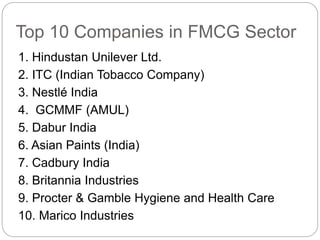
Top 10 Companies in FMCG Sector
1. Hindustan Unilever Ltd.
2. ITC (Indian Tobacco Company)
3. Nestlé India
4. GCMMF (AMUL)
5. Dabur India
6. Asian Paints (India)
7. Cadbury India
8. Britannia Industries
9. Procter & Gamble Hygiene and Health Care
10. Marico Industries
Scope of FMCG
 The Indian FMCG sector with a market size of
US$13.1 billion is the fourth largest sector in the
economy. A well-established distribution network.
 FMCG Sector is expected to grow by over 60%
by 2010. That will translate into an annual growth
of 10% over a 5-year period.
 It has been estimated that FMCG sector will rise
from around Rs 56,500 crores in 2005 to Rs
92,100 crores in 2010.
 Better infrastructure facilities will improve their
supply chain.
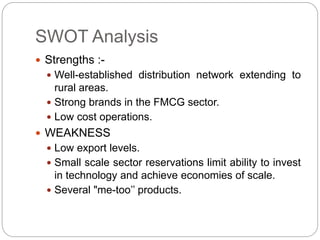
SWOT Analysis
 Strengths :-
 Well-established distribution network extending to
rural areas.
 Strong brands in the FMCG sector.
 Low cost operations.
 WEAKNESS
 Low export levels.
 Small scale sector reservations limit ability to invest
in technology and achieve economies of scale.
 Several "me-too’’ products.
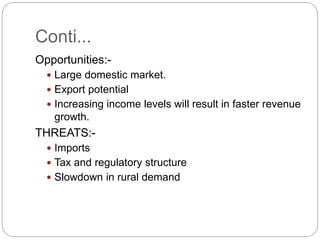
Conti...
Opportunities:-
 Large domestic market.
 Export potential
 Increasing income levels will result in faster revenue
growth.
THREATS:-
 Imports
 Tax and regulatory structure
 Slowdown in rural demand
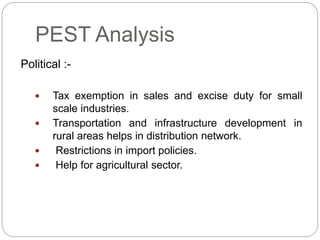
PEST Analysis
Political :-
 Tax exemption in sales and excise duty for small
scale industries.
 Transportation and infrastructure development in
rural areas helps in distribution network.
 Restrictions in import policies.
 Help for agricultural sector.
Conti...
Economical :-
 The GDP rate of Indian economy is increasing
every year. It is expected in future it would be better
only in comparison with other countries.
 The FMCG sector is a 4 th largest sector of Indian
economy with market size of more than 60,000 cr.
The Indian Territory is very large and number of
customers is also very high.
Conti...
Social :-
 Year strivers achievers rich
 2003 131 46 3
 2013 96 124 11
 The Indian culture, social & life styles are changing
drastically
 The total population is nearly 115 crores and
population includes rich, poor, middle class, male,
female, located in rural, urban and sub urban areas,
different level of education etc.
Conti...
 Technology :-
 Technology has been simplified and available in the
industry. Where technology is not available then it is
brought from foreign countries to meet FMCG
sector requirements.
 With research and development facilities the new
technologies are developed.
SOFT DRINKS
ANALYSIS
MAJOR PLAYERS IN SOFT
DRINKS SEGMENT
 “thanda matlab coca cola!!!”
 YEH DIL MAANGE MORE!!!
 Most preferable soft drink.
HEALTH ISSUES CAUSED BY
SOFT DRINKS
 CERTAIN SOFT DRINKS AND CANCER MAY BE
RELATED
 SOFT DRINKS OFFEND THE KIDNEYS
 COLA DRINKS PROVIDE ZERO NUTRIENTS
 CAFFEINE IS ADDICTIVE; COLAS PROVIDE IT
 BIRTH DEFECTS AREA POSSIBILITY
 BLOOD PRESSURE ALTERATION: ON THE
HIGH SIDE
 HEALTH DANGERS OF REUSING PLASTIC
Analysis on
 The Coca Cola Company is the largest beverage
business in the world serving more than 200
countries and offering more than 500 brands.
 Coca cola gives employment to more than
146,200 emplyee as per the survey in 2012
 Revenue of coca cola in 2012 is $48.01 billion.
Different product of coca cola
GHOONTH BHAR
SHARARAT KAR LEY!!!
“ LIME AND LEMONI!!!
TASTE THE THUNDER!!!
“SPIRITE
BHUJAYE PYAAS
BAKI SAB
BAKWAAS!!!
YAARI DOSTI TAAZA MAAZA!!!
Coca Cola SWOT analysis
Strengths:-
 The best global brand in the world in terms of value.
 World’s largest market share in beverage - about
40%.
 Strong marketing and advertising
 Most extensive beverage distribution channel.
 Customer loyalty.
 Corporate Social Responsibility (CSR).
Conti...
 Weaknesses
 Significant focus on carbonated drinks.
 High debt level due to acquisitions.
 Negative publicity
 Opportunities
 Bottled water consumption growth.
 Increasing demand for healthy food and beverages.
 Growth through acquisitions.
Conti...
 Threats
 Changes in consumer tastes.
 Legal requirements to disclose negative information
on product labels.
 Decreasing gross profit and net profit margins.
 Competition from PepsiCo.
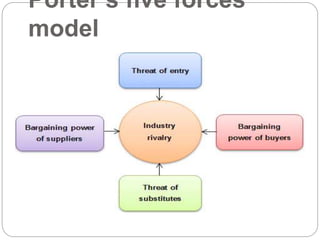
Porter’s five forces
model
Conti...
Threat of new entry Threat of substitutes
 Amount of capital
required
 Retaliation by existing
companies
 Legal barriers (patents,
copyrights, etc.)
 Brand reputation
 Product differentiation
 Access to suppliers and
distributors
 Economies of scale
 Sunk costs
 Number of
substitutes
 Performance of
substitutes
 Cost of changing
Conti...
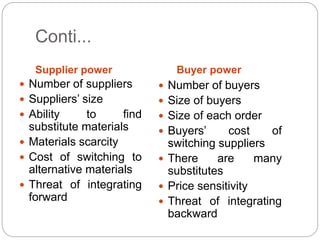
Supplier power Buyer power
 Number of suppliers
 Suppliers’ size
 Ability to find
substitute materials
 Materials scarcity
 Cost of switching to
alternative materials
 Threat of integrating
forward
 Number of buyers
 Size of buyers
 Size of each order
 Buyers’ cost of
switching suppliers
 There are many
substitutes
 Price sensitivity
 Threat of integrating
backward
Conti...
 Rivalry among existing competitors
 Number of competitors
 Cost of leaving an industry
 Industry growth rate and size
 Product differentiation
 Competitors’ size
 Customer loyalty
 Threat of horizontal integration
 Level of advertising expense
Parth

Parth

  • 1.
  • 2.
    FMCG  The fastmoving consumer goods (FMCG) sector is the fourth largest sector of the economy with the size of about more than Rs 500 billion.  FMCG products are those that get replaced within a year. These products are purchased by the customers in small quantity as per the need of individual or family.  It may include perishable and non perishable products, durable and non durable goods.  FMCG sector generally includes a wide range of frequently purchased consumer product such as soaps, dairy products, confectionary ,softdrinks, fruits and veg-etables and batteries.  FMCG products usually have a low unit cost but large volumes.
  • 3.
    Conti...  A subsetof FMCGs are Fast Moving Consumer Electronics which include innovative electronic products such as mobile phones, MP3 players, digital cameras, GPS Systems and Laptops.  In 2005, the Rs. 48,000-crore FMCG segment was one of the fast growing industries in India.  The middle class and the rural segments of the Indian population are the most promising market for FMCG, and give brand makers the opportunity to convert them to branded products.  According to the study conducted by AC Nielsen, 62 of the top 100 brands are owned by MNCs, and the balance by Indian companies. Fifteen companies own these 62 brands, and 27 of these are owned by Hindustan Lever. Pepsi is at number three followed by Thums Up. Britannia takes the fifth place, followed
  • 4.
    Top 10 Companiesin FMCG Sector 1. Hindustan Unilever Ltd. 2. ITC (Indian Tobacco Company) 3. Nestlé India 4. GCMMF (AMUL) 5. Dabur India 6. Asian Paints (India) 7. Cadbury India 8. Britannia Industries 9. Procter & Gamble Hygiene and Health Care 10. Marico Industries
  • 5.
    Scope of FMCG The Indian FMCG sector with a market size of US$13.1 billion is the fourth largest sector in the economy. A well-established distribution network.  FMCG Sector is expected to grow by over 60% by 2010. That will translate into an annual growth of 10% over a 5-year period.  It has been estimated that FMCG sector will rise from around Rs 56,500 crores in 2005 to Rs 92,100 crores in 2010.  Better infrastructure facilities will improve their supply chain.
  • 6.
    SWOT Analysis  Strengths:-  Well-established distribution network extending to rural areas.  Strong brands in the FMCG sector.  Low cost operations.  WEAKNESS  Low export levels.  Small scale sector reservations limit ability to invest in technology and achieve economies of scale.  Several "me-too’’ products.
  • 7.
    Conti... Opportunities:-  Large domesticmarket.  Export potential  Increasing income levels will result in faster revenue growth. THREATS:-  Imports  Tax and regulatory structure  Slowdown in rural demand
  • 8.
    PEST Analysis Political :- Tax exemption in sales and excise duty for small scale industries.  Transportation and infrastructure development in rural areas helps in distribution network.  Restrictions in import policies.  Help for agricultural sector.
  • 9.
    Conti... Economical :-  TheGDP rate of Indian economy is increasing every year. It is expected in future it would be better only in comparison with other countries.  The FMCG sector is a 4 th largest sector of Indian economy with market size of more than 60,000 cr. The Indian Territory is very large and number of customers is also very high.
  • 10.
    Conti... Social :-  Yearstrivers achievers rich  2003 131 46 3  2013 96 124 11  The Indian culture, social & life styles are changing drastically  The total population is nearly 115 crores and population includes rich, poor, middle class, male, female, located in rural, urban and sub urban areas, different level of education etc.
  • 11.
    Conti...  Technology :- Technology has been simplified and available in the industry. Where technology is not available then it is brought from foreign countries to meet FMCG sector requirements.  With research and development facilities the new technologies are developed.
  • 12.
  • 13.
    MAJOR PLAYERS INSOFT DRINKS SEGMENT  “thanda matlab coca cola!!!”  YEH DIL MAANGE MORE!!!
  • 14.
  • 15.
    HEALTH ISSUES CAUSEDBY SOFT DRINKS  CERTAIN SOFT DRINKS AND CANCER MAY BE RELATED  SOFT DRINKS OFFEND THE KIDNEYS  COLA DRINKS PROVIDE ZERO NUTRIENTS  CAFFEINE IS ADDICTIVE; COLAS PROVIDE IT  BIRTH DEFECTS AREA POSSIBILITY  BLOOD PRESSURE ALTERATION: ON THE HIGH SIDE  HEALTH DANGERS OF REUSING PLASTIC
  • 16.
  • 17.
     The CocaCola Company is the largest beverage business in the world serving more than 200 countries and offering more than 500 brands.  Coca cola gives employment to more than 146,200 emplyee as per the survey in 2012  Revenue of coca cola in 2012 is $48.01 billion.
  • 18.
    Different product ofcoca cola GHOONTH BHAR SHARARAT KAR LEY!!! “ LIME AND LEMONI!!! TASTE THE THUNDER!!! “SPIRITE BHUJAYE PYAAS BAKI SAB BAKWAAS!!! YAARI DOSTI TAAZA MAAZA!!!
  • 19.
    Coca Cola SWOTanalysis Strengths:-  The best global brand in the world in terms of value.  World’s largest market share in beverage - about 40%.  Strong marketing and advertising  Most extensive beverage distribution channel.  Customer loyalty.  Corporate Social Responsibility (CSR).
  • 20.
    Conti...  Weaknesses  Significantfocus on carbonated drinks.  High debt level due to acquisitions.  Negative publicity  Opportunities  Bottled water consumption growth.  Increasing demand for healthy food and beverages.  Growth through acquisitions.
  • 21.
    Conti...  Threats  Changesin consumer tastes.  Legal requirements to disclose negative information on product labels.  Decreasing gross profit and net profit margins.  Competition from PepsiCo.
  • 22.
  • 23.
    Conti... Threat of newentry Threat of substitutes  Amount of capital required  Retaliation by existing companies  Legal barriers (patents, copyrights, etc.)  Brand reputation  Product differentiation  Access to suppliers and distributors  Economies of scale  Sunk costs  Number of substitutes  Performance of substitutes  Cost of changing
  • 24.
    Conti... Supplier power Buyerpower  Number of suppliers  Suppliers’ size  Ability to find substitute materials  Materials scarcity  Cost of switching to alternative materials  Threat of integrating forward  Number of buyers  Size of buyers  Size of each order  Buyers’ cost of switching suppliers  There are many substitutes  Price sensitivity  Threat of integrating backward
  • 25.
    Conti...  Rivalry amongexisting competitors  Number of competitors  Cost of leaving an industry  Industry growth rate and size  Product differentiation  Competitors’ size  Customer loyalty  Threat of horizontal integration  Level of advertising expense