1
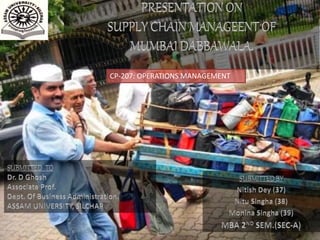
CP-207: OPERATIONS MANAGEMENT
CONTENTS
• Supply Chain Management
• Objectives
• Supply Chain Stages & Structure
• Mumbai Dabbawala
• Approach Discipline
• Logistic & Coding
• Journey Of Mumbai Dabbawala
• Awards & Achievement
• Six Sigma Quality Certification
• Conclusion 2
What is Supply Chain.
A supply chain consists of all parties involved
directly in fulfilling customers request.
The Supply Chain not only includes the
manufacturer and suppliers, but also
transporters, warehouses, retailers, and
customers themselves.
Within each organization, such as a manufacturers,
the supply chain includes all functions involved in
receiving and filling a customer request.
3
OBJECTIVE OF SUPPLY CHAIN
• The objective of supply chain is to maximize the
overall value generated.
• The value of supply chain generates is the
difference between what the final product is
worth to the customer and the efforts the supply
chain expends in filling the customers request.
• Make the product available at the right time, right quality, right
people and at right place. E.g. Dell Computers.
4
SUPPLY CHAIN STAGES
SUPPLIER
MANUFACTU
RER
DISTRIBUTOR
RETAILER
CUSOTMER
5
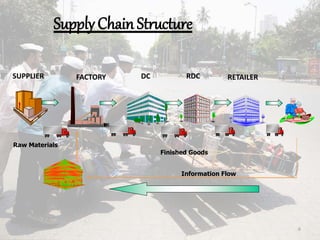
Supply Chain Structure
Information Flow
Raw Materials
RETAILERFACTORY DC RDCSUPPLIER
Finished Goods
6
MUMBAI DABBAWALA
Introduction
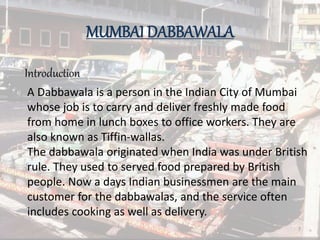
A Dabbawala is a person in the Indian City of Mumbai
whose job is to carry and deliver freshly made food
from home in lunch boxes to office workers. They are
also known as Tiffin-wallas.
The dabbawala originated when India was under British
rule. They used to served food prepared by British
people. Now a days Indian businessmen are the main
customer for the dabbawalas, and the service often
includes cooking as well as delivery.
7
For the efficiency of their supply chain it has been claimed that this
virtually achieves a Six-Sigma performance rating(i.e. 99.99999%)
of deliveries are made without error. Though the work sounds
simple, it is actually a highly specialized trade that is over a century
old and which has become integral to Mumbai’s culture.
NMTBSA
Nutan Mumbai Tiffin Box Suppliers Association.
History: Started in 1880.
Charitable trust: Registered in 1956.
Average literacy rate: 8th grade schooling.
Total area coverage: 60 kms.
Employee strength: 5000+ persons
Nos. of tiffins: 2,00,000 tiffin boxes i.e. 4,00,000 transactions per
day.
Time taken: 3 hrs. 8
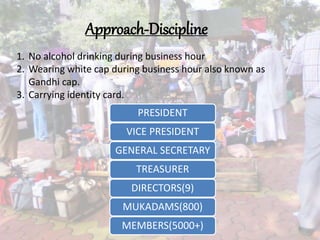
Approach-Discipline
1. No alcohol drinking during business hour
2. Wearing white cap during business hour also known as
Gandhi cap.
3. Carrying identity card.
PRESIDENT
VICE PRESIDENT
GENERAL SECRETARY
TREASURER
DIRECTORS(9)
MUKADAMS(800)
MEMBERS(5000+) 9
LOGISTICS AND CODING
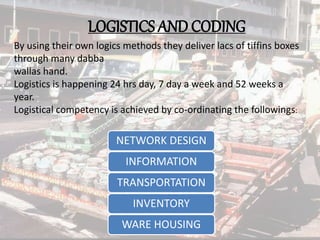
By using their own logics methods they deliver lacs of tiffins boxes
through many dabba
wallas hand.
Logistics is happening 24 hrs day, 7 day a week and 52 weeks a
year.
Logistical competency is achieved by co-ordinating the followings:
NETWORK DESIGN
INFORMATION
TRANSPORTATION
INVENTORY
WARE HOUSING 10
CODING
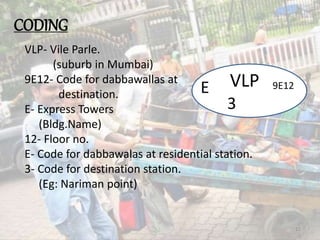
VLP- Vile Parle.
(suburb in Mumbai)
9E12- Code for dabbawallas at
destination.
E- Express Towers
(Bldg.Name)
12- Floor no.
E- Code for dabbawalas at residential station.
3- Code for destination station.
(Eg: Nariman point)
E VLP 9E12
3
11
JOURNEY OF DABBAWALA
9.30 A.M-10.30A.M:- Pick up dabba from
Residence/Caterer and being it to Andheri station.
10.34A.M-11.20A.M:- Journey in local train.
11.20A.M-12.30P.M:- Unloading and sorting at
destination station.
12.30P.M- 1.00P.M:- Delivery to respective customers.
1.15P.M- 2.30P.M:- Collection of empty dabba.
2.45P.M-3.30P.M:- Sorting at destination station.
3.30P.M- 4.40P.M:- Returning dabba to Resident/
Caterer.
12
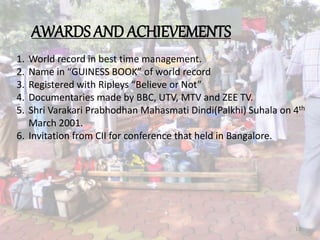
AWARDS AND ACHIEVEMENTS
1. World record in best time management.
2. Name in “GUINESS BOOK” of world record
3. Registered with Ripleys “Believe or Not”
4. Documentaries made by BBC, UTV, MTV and ZEE TV.
5. Shri Varakari Prabhodhan Mahasmati Dindi(Palkhi) Suhala on 4th
March 2001.
6. Invitation from CII for conference that held in Bangalore.
13
Six Sigma Quality Certification
• The Six Sigma quality certification was established by the
International Quality Federation in 1986, to judge the quality
standards of an organization. The Six-sigma rating means that they
have a 99.99 % efficiency in delivering the lunch-boxes to the right
people. According to quality standards the dabbawalla’s are at par
with various companies like Motorola, Honeywell and GE. Apart
from this the dabbawalla’s have been called to various CII
Conferences and leading institutes’ like IIM’s to deliver speech.
Secretary of the Nutan Mumbai Tiffin Box Suppliers Charity Trust
Gangaram Talekar and M Medge, a tiffin carrier contractor – in a
raw form both are essentially dabbawalla’s have been called to
speak at various leading institutes, FII Conferences, WTC etc. The
New York Times reported in 2007 that the 125 year old dabbawala
industry continues to grow at a rate of 5-10% per year. In its July 11,
2008 issue, The Economist news magazine reported that
dabbawallas are a model of Six Sigma management, holding
a delivery accuracy rate of “99.9999%.” 14
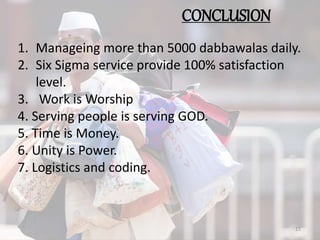
1. Manageing more than 5000 dabbawalas daily.
2. Six Sigma service provide 100% satisfaction
level.
3. Work is Worship
4. Serving people is serving GOD.
5. Time is Money.
6. Unity is Power.
7. Logistics and coding.
CONCLUSION
15
16

Mumbai dabbawala ppt

  • 1.
  • 2.
    CONTENTS • Supply ChainManagement • Objectives • Supply Chain Stages & Structure • Mumbai Dabbawala • Approach Discipline • Logistic & Coding • Journey Of Mumbai Dabbawala • Awards & Achievement • Six Sigma Quality Certification • Conclusion 2
  • 3.
    What is SupplyChain. A supply chain consists of all parties involved directly in fulfilling customers request. The Supply Chain not only includes the manufacturer and suppliers, but also transporters, warehouses, retailers, and customers themselves. Within each organization, such as a manufacturers, the supply chain includes all functions involved in receiving and filling a customer request. 3
  • 4.
    OBJECTIVE OF SUPPLYCHAIN • The objective of supply chain is to maximize the overall value generated. • The value of supply chain generates is the difference between what the final product is worth to the customer and the efforts the supply chain expends in filling the customers request. • Make the product available at the right time, right quality, right people and at right place. E.g. Dell Computers. 4
  • 5.
  • 6.
    Supply Chain Structure InformationFlow Raw Materials RETAILERFACTORY DC RDCSUPPLIER Finished Goods 6
  • 7.
    MUMBAI DABBAWALA Introduction A Dabbawalais a person in the Indian City of Mumbai whose job is to carry and deliver freshly made food from home in lunch boxes to office workers. They are also known as Tiffin-wallas. The dabbawala originated when India was under British rule. They used to served food prepared by British people. Now a days Indian businessmen are the main customer for the dabbawalas, and the service often includes cooking as well as delivery. 7
  • 8.
    For the efficiencyof their supply chain it has been claimed that this virtually achieves a Six-Sigma performance rating(i.e. 99.99999%) of deliveries are made without error. Though the work sounds simple, it is actually a highly specialized trade that is over a century old and which has become integral to Mumbai’s culture. NMTBSA Nutan Mumbai Tiffin Box Suppliers Association. History: Started in 1880. Charitable trust: Registered in 1956. Average literacy rate: 8th grade schooling. Total area coverage: 60 kms. Employee strength: 5000+ persons Nos. of tiffins: 2,00,000 tiffin boxes i.e. 4,00,000 transactions per day. Time taken: 3 hrs. 8
  • 9.
    Approach-Discipline 1. No alcoholdrinking during business hour 2. Wearing white cap during business hour also known as Gandhi cap. 3. Carrying identity card. PRESIDENT VICE PRESIDENT GENERAL SECRETARY TREASURER DIRECTORS(9) MUKADAMS(800) MEMBERS(5000+) 9
  • 10.
    LOGISTICS AND CODING Byusing their own logics methods they deliver lacs of tiffins boxes through many dabba wallas hand. Logistics is happening 24 hrs day, 7 day a week and 52 weeks a year. Logistical competency is achieved by co-ordinating the followings: NETWORK DESIGN INFORMATION TRANSPORTATION INVENTORY WARE HOUSING 10
  • 11.
    CODING VLP- Vile Parle. (suburbin Mumbai) 9E12- Code for dabbawallas at destination. E- Express Towers (Bldg.Name) 12- Floor no. E- Code for dabbawalas at residential station. 3- Code for destination station. (Eg: Nariman point) E VLP 9E12 3 11
  • 12.
    JOURNEY OF DABBAWALA 9.30A.M-10.30A.M:- Pick up dabba from Residence/Caterer and being it to Andheri station. 10.34A.M-11.20A.M:- Journey in local train. 11.20A.M-12.30P.M:- Unloading and sorting at destination station. 12.30P.M- 1.00P.M:- Delivery to respective customers. 1.15P.M- 2.30P.M:- Collection of empty dabba. 2.45P.M-3.30P.M:- Sorting at destination station. 3.30P.M- 4.40P.M:- Returning dabba to Resident/ Caterer. 12
  • 13.
    AWARDS AND ACHIEVEMENTS 1.World record in best time management. 2. Name in “GUINESS BOOK” of world record 3. Registered with Ripleys “Believe or Not” 4. Documentaries made by BBC, UTV, MTV and ZEE TV. 5. Shri Varakari Prabhodhan Mahasmati Dindi(Palkhi) Suhala on 4th March 2001. 6. Invitation from CII for conference that held in Bangalore. 13
  • 14.
    Six Sigma QualityCertification • The Six Sigma quality certification was established by the International Quality Federation in 1986, to judge the quality standards of an organization. The Six-sigma rating means that they have a 99.99 % efficiency in delivering the lunch-boxes to the right people. According to quality standards the dabbawalla’s are at par with various companies like Motorola, Honeywell and GE. Apart from this the dabbawalla’s have been called to various CII Conferences and leading institutes’ like IIM’s to deliver speech. Secretary of the Nutan Mumbai Tiffin Box Suppliers Charity Trust Gangaram Talekar and M Medge, a tiffin carrier contractor – in a raw form both are essentially dabbawalla’s have been called to speak at various leading institutes, FII Conferences, WTC etc. The New York Times reported in 2007 that the 125 year old dabbawala industry continues to grow at a rate of 5-10% per year. In its July 11, 2008 issue, The Economist news magazine reported that dabbawallas are a model of Six Sigma management, holding a delivery accuracy rate of “99.9999%.” 14
  • 15.
    1. Manageing morethan 5000 dabbawalas daily. 2. Six Sigma service provide 100% satisfaction level. 3. Work is Worship 4. Serving people is serving GOD. 5. Time is Money. 6. Unity is Power. 7. Logistics and coding. CONCLUSION 15
  • 16.