Part 4 :- DPSP
Articles 36 to 51
Also has a part 4A , which has article 51A
Borrowed from :- Irish Constitution (1937), (irish borrowed it from Spanish Const)
Origin:- Sapru report of 1945 distinguished FR as Justifiable and Non Justifiable.
The non justifiable came under DPSP.
The Instruments of Instructions under the Government of India Act 1935 was also an immediate source of
the Directive Principles of State Policy. However the basic difference was that the Instruments of
Instructions directs the executive while the DPSP direct to the “State” as defined in Article 12 of the
Constitution of India.
The IOI was incorporated as a DPSP in 1950.
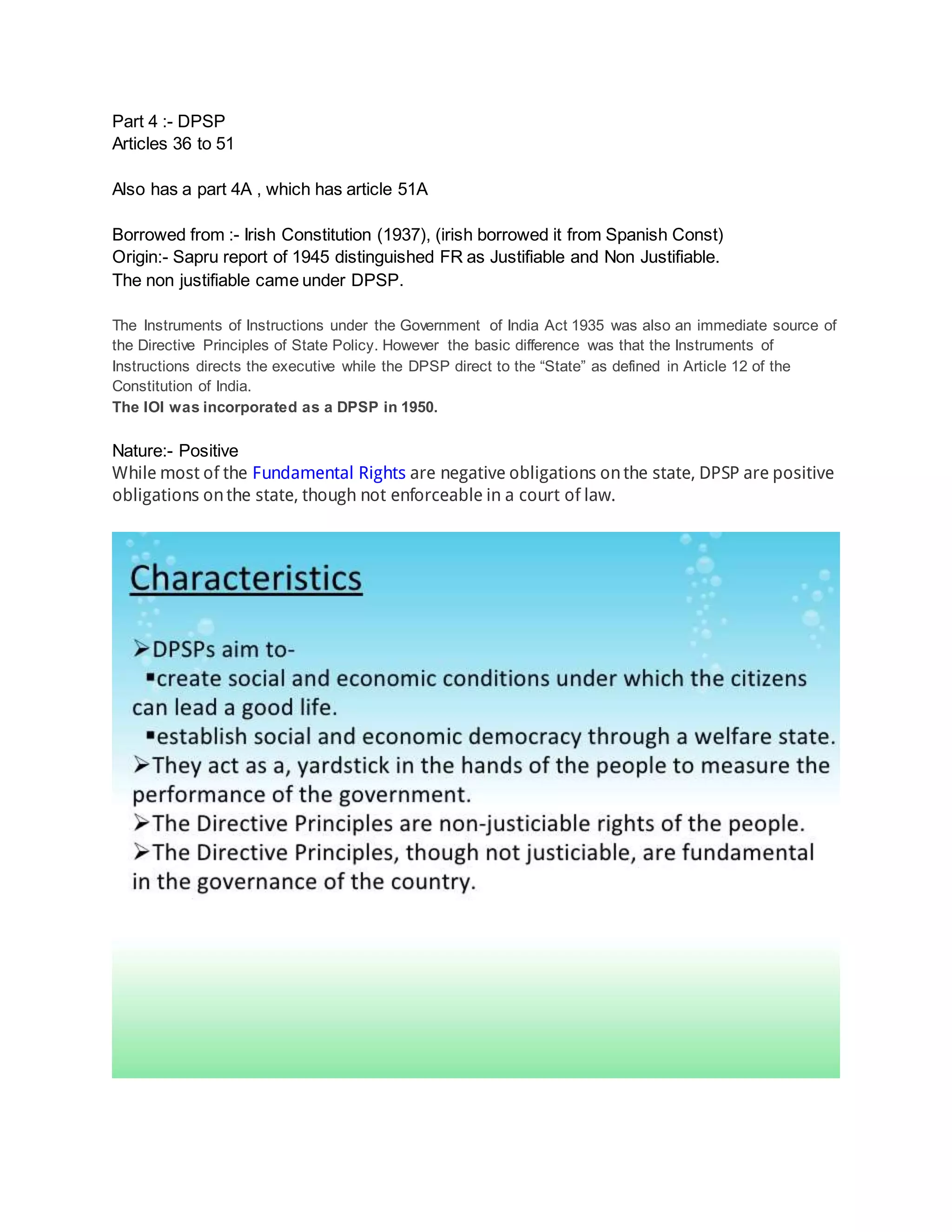
Nature:- Positive
While most of the Fundamental Rights are negative obligations onthe state, DPSP are positive
obligations onthe state, though not enforceable in a court of law.
A 36:- Definition of the State.
A 37:- Applicationofthe Principles contained inthis part (its a duty of the state and these
principles shall not be enforced by law)
A 38:- promotionof social and economic welfare,
minimizationof inequality. (strive to minimise the inequalities in income, and endeavour to
eliminate inequalities in status, facilities and opportunities, not only amongst individuals but also amongst
groups of people residing in different areas or engaged in different vocations.)
A 39:- a. men and women have equal rights to adequate means of livelihood.
b. that the ownership and control of the material resources of the community are
so distributed as best to subserve the common good.
c. that the operation of the economic system does not result in the concentration
of wealth and means of production to the common detriment
d. that there is equal pay for equal work for both men and women;
e. that the health and strength of workers, men and women, and the tender age of
children are not abused and that citizens are not forced by economic necessity to enter
avocations unsuited to their age or strength

Part4 dpsp

  • 1.
    Part 4 :-DPSP Articles 36 to 51 Also has a part 4A , which has article 51A Borrowed from :- Irish Constitution (1937), (irish borrowed it from Spanish Const) Origin:- Sapru report of 1945 distinguished FR as Justifiable and Non Justifiable. The non justifiable came under DPSP. The Instruments of Instructions under the Government of India Act 1935 was also an immediate source of the Directive Principles of State Policy. However the basic difference was that the Instruments of Instructions directs the executive while the DPSP direct to the “State” as defined in Article 12 of the Constitution of India. The IOI was incorporated as a DPSP in 1950. Nature:- Positive While most of the Fundamental Rights are negative obligations onthe state, DPSP are positive obligations onthe state, though not enforceable in a court of law.
  • 2.
    A 36:- Definitionof the State. A 37:- Applicationofthe Principles contained inthis part (its a duty of the state and these principles shall not be enforced by law) A 38:- promotionof social and economic welfare, minimizationof inequality. (strive to minimise the inequalities in income, and endeavour to eliminate inequalities in status, facilities and opportunities, not only amongst individuals but also amongst groups of people residing in different areas or engaged in different vocations.) A 39:- a. men and women have equal rights to adequate means of livelihood. b. that the ownership and control of the material resources of the community are so distributed as best to subserve the common good. c. that the operation of the economic system does not result in the concentration of wealth and means of production to the common detriment d. that there is equal pay for equal work for both men and women; e. that the health and strength of workers, men and women, and the tender age of children are not abused and that citizens are not forced by economic necessity to enter avocations unsuited to their age or strength