DIRECTIVE PRINCIPLES OF
STATE POLICY
PRESENTED BY-
SUBHAM CHATTERJEE
ASSISTANT PROFESSOR, SCHOOL OF LAW
INTRODUCTION
Enumerated in
Part IV of the
Indian
Constitution
The provisions
are entwined
from Articles
36-51 of the
Indian
constitution.
Dr. B.R.
Ambedkar
described this
principles as
“novel
features”.
Granville
Austin has
described the
DPSPs as the
‘Conscience of
the
Constitution’.
Borrowed from
the Irish
Constitution in
1937 which in
turn was taken
from the
Spanish
Constitution.
FEATURES OF THE DPSPs
Ideals that the State should keep in mind while enacting laws and
formulating policies.
‘State’ under Article 36 has same meaning as that of ‘State’ under
Article 12 of Part III of the Indian constitution.
They resemble with the ‘Instrument of Instructions’ mandated under
the Government of India Act, 1935.
They constitute a comprehensive economic, social, and political
programme for the modern state.
They are non-justiciable in nature.
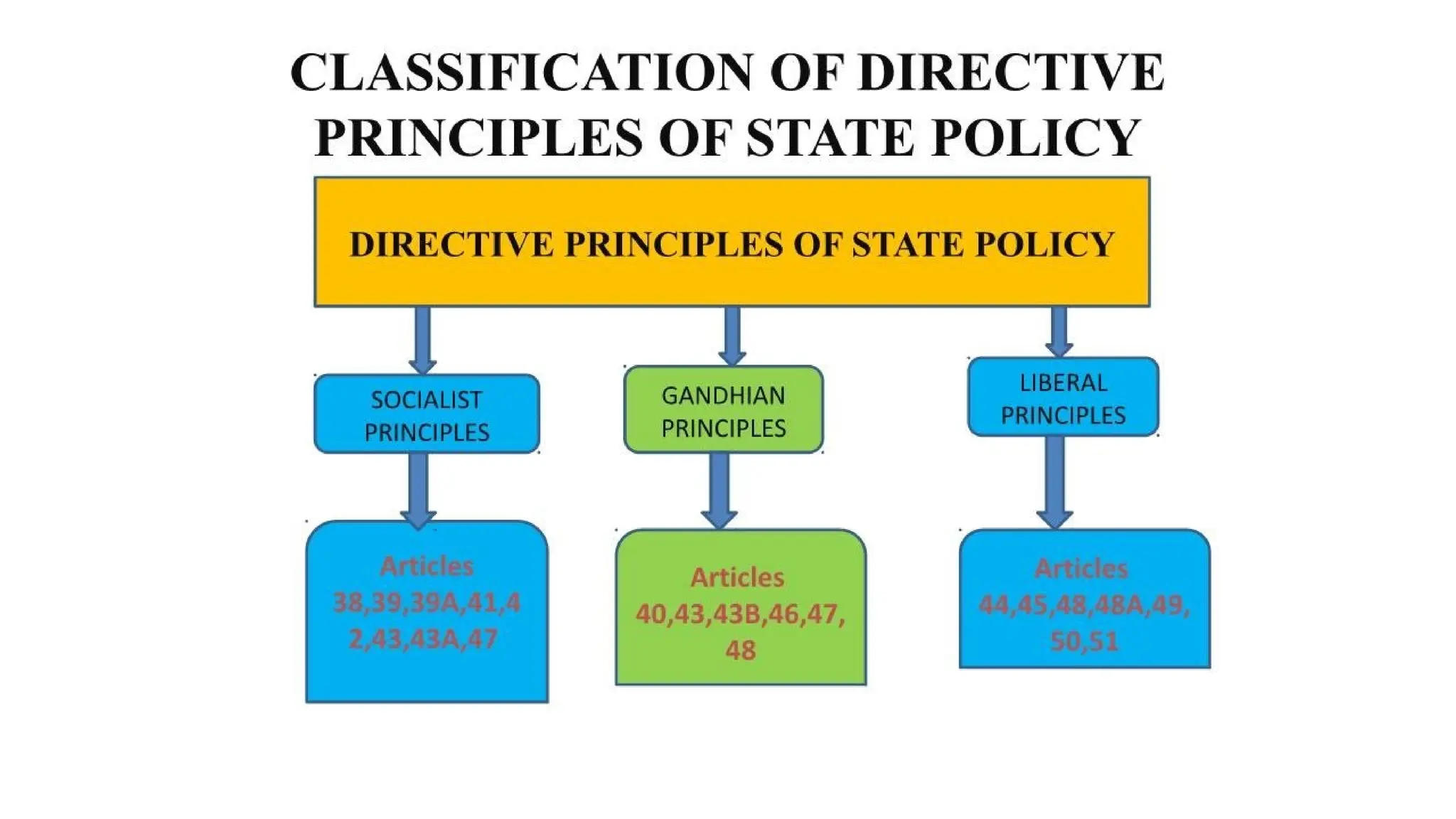
SOCIALIST PRINCIPLES (1/2)
To promote the welfare of the people by
securing a social order permeated by the
social, economic, and political justice AND
[minimize inequalities of income, status,
facilities, and opportunities(Added via 42nd
Amendment Act, 1976)]. (Article 38)
Article 39 seeks to
achieve:-
(Added via 42nd
Amendment Act, 1976)
The right to adequate means of livelihood
The equitable distribution of material resources for the common good of the society.
Equal pay for equal work
Prohibition of centralization of wealth
Opportunities for healthy development of the child.
Prohibition of forcible abuse against the child
SOCIALIST PRINCIPLES (2/2)
Article 39A: To promote equal justice and provide free legal aid to the poor.
(Added via 42nd
Amendment Act, 1976).
Article 41: To secure the right to work, to education, and to public assistance in
cases of unemployment, old age, sickness, and disablement.
Article 42: To secure a living wage, a decent standard of life and social &
cultural opportunities for all workers.
Article 43A: To take steps to secure participation of workers in the management
of industries. (Added via 42nd
Amendment Act, 1976).
Article 47: To raise the level of nutrition and the standard of living of people
and to improve public health.
GANDHIAN PRINCIPLES
Article 40: Organization of village panchayats and give them necessary powers & authority to
enable them to function as units of self government.
Article 43: Promotion of cottage industries on an individual or co-operation basis in rural areas.
Article 43B: Promotion of voluntary formation, autonomous functioning, democratic control and
professional management of co-operative societies. (Added via 97th
Amendment Act, 2011)
Article 46: Promotion of educational & economic opportunities for SCs, STs, and other weaker
sections.
Article 47: Prohibition of consumption of intoxication of drugs and liquor that are injurious to
health.
Article 48: Prohibition of cow, calves and other form of milch slaughter and their breeds.
LIBERAL-INTELLECTUAL PRINCIPLES
Article 44: Securing Uniform Civil Code throughout the country.
Article 45: Providing early childhood care and education for all children until they complete 6
years.
Article 48: Organizing agriculture and animal husbandry on modern and scientific basis.
Article 48A: Protection of environment & safeguard of forests and wildlife.
Article 49: Protection of monuments, places and objects of artistic & historic interest.
Article 50: Separation of judiciary from executive.
WHY THE DPSPs ARE NON-JUSTICIABLE?
The country did not possess
sufficient financial resources
to implement them.
The presence of the vast
diversity and backwardness in
the country would stand in the
way of their implementation.
The newly born independent
Indian states with its many
preoccupations might be
crushed under the burden
unless it was free to decide the
order, the time, the place, and
the mode of fulfilling them.
CRITICISMS OF DPSPs
No legal force. (K.T.
Shah dubbed them as
pious superfluities’ &
compared them with ‘a
cheque on the bank,
payable only when the
resources of the bank
permit.’
These are merely
the resolutions
taken on 1st
of
January and
broken on the
second of the
January.
They are not
arranged in a
logical manner.
They’re neither
properly
classified nor
logically
arranged.
It is based purely on
sentiment and prejudice.
Sdyney Webb &
Beatrice Webb
stalks through
DPSPs and
opines it as
‘Fabian
Socialism
without
socialism.’
It creates a constitutional conflict
between: (a) Centre & the States;
(b) The President & the Prime
Minister; and (c) the Governor &
the Chief Minister.
UTILITY OF DPSPs
K.M Singhvi says, :They constitute the stuff of the Constitution and its philosophy of social justice.
Dr. Ambedkar says that this is of great value as they distinguish ‘economic democracy’ from ‘political
democracy’.
B.N. Rau, the constitutional advisor to the Constituent Assembly states this principles as ‘moral precepts for the
authorities of the State.’
They have served as useful beacon-lights to the courts.
They form dominating background to all the State action.
They strengthen the position of opposition in the legislative bodies.
They serve as a common political manifesto.
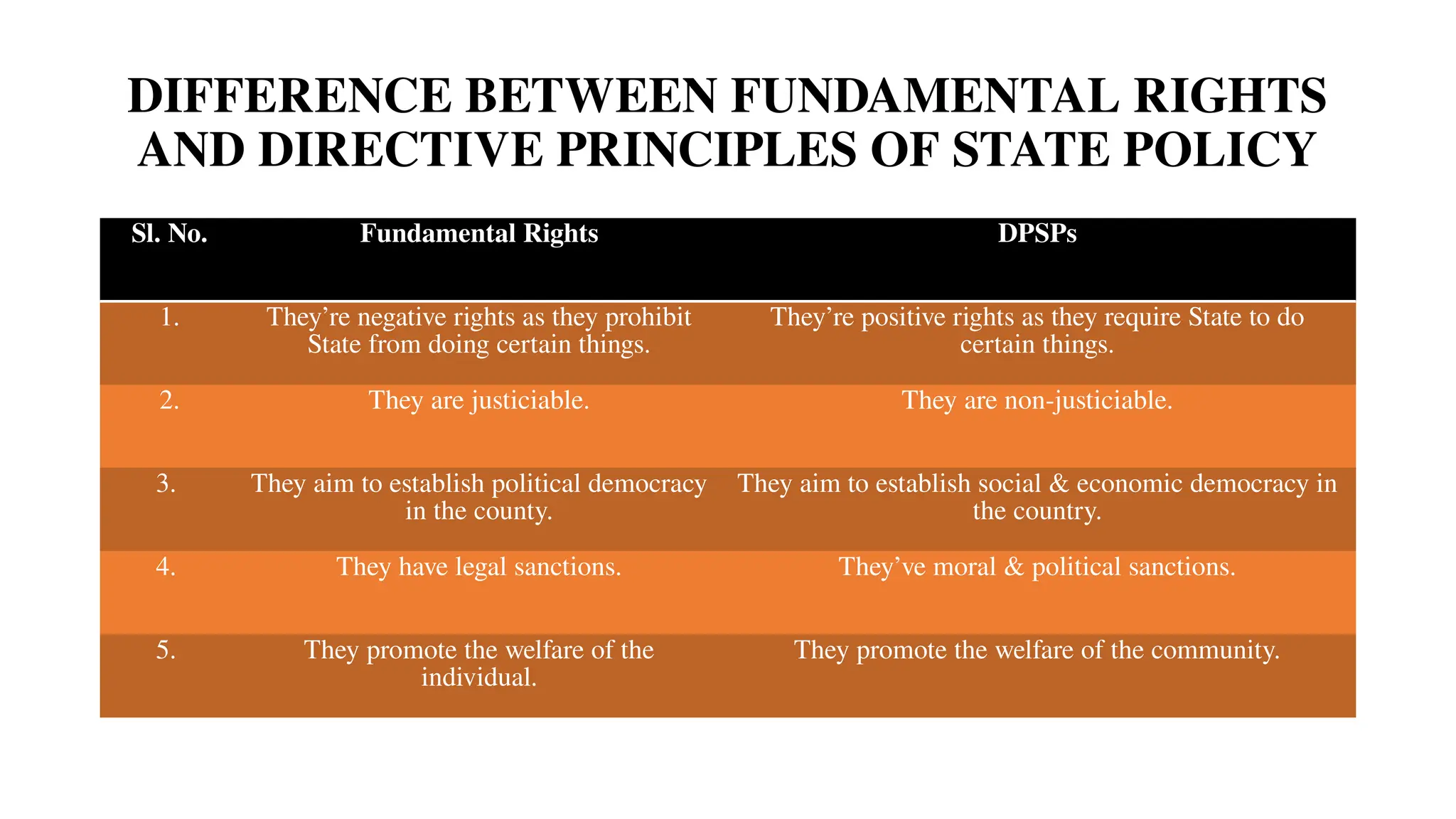
DIFFERENCE BETWEEN FUNDAMENTAL RIGHTS
AND DIRECTIVE PRINCIPLES OF STATE POLICY
Sl. No. Fundamental Rights DPSPs
1. They’re negative rights as they prohibit
State from doing certain things.
They’re positive rights as they require State to do
certain things.
2. They are justiciable. They are non-justiciable.
3. They aim to establish political democracy
in the county.
They aim to establish social & economic democracy in
the country.
4. They have legal sanctions. They’ve moral & political sanctions.
5. They promote the welfare of the
individual.
They promote the welfare of the community.
TUSSLE BETWEEN FUNDAMENTAL RIGHTS AND
DIRECTIVE PRINCIPLES OF STATE POLICY
CASE JUDGEMENT
State of Madras v.
Champakam
Dorairajam (AIR
1951 SC 226)
The Supreme Court held that if a Parliament made a law which contravenes the
Fundamental Right then that law would be void but it will not apply to the Directive
Principle of State Policy. It shows that fundamental rights are on higher pedestal than
Directive principles of state policy.
Re. Kerala education
Bill (AIR 1951 SCR
995)
In this case the Apex Court said that if there is any conflict between the Fundamental
Right and Directive Principle of State Policy then the Doctrine of Harmonious
Construction will apply.
Minerva Mills v. UoI
(AIR 1980)
In this case the Apex Court said that if there is any conflict between the Fundamental
Right and Directive Principle of State Policy then the Doctrine of Harmonious
Construction will apply.
Unni Krishna v. State
of Andhra Pradesh
[1993 SCC (1) 645]
In this case the Apex Court said that if there is any conflict between the Fundamental
Right and Directive Principle of State Policy then the Doctrine of Harmonious
Construction will apply.
IMPLEMENTATION OF DPSPs
• Establishment of Planning Commission which was later replaced by the NITI
Aayog in 2015.
• Enactment of Land Reforms for abolition of zamindari system, imposition of
ceilings on land holdings, and cooperative farming as well as tenancy
reforms.
• Enactment of laws for labour elfare such as:-
a) The Minimum Wages Act, 1948
b) The Payment of Wages Act, 1936
c) The Trade Unions Act, 1926
d) The Mines Act, 1952
THANK YOU

Directive Principles of State Policy.pptx

  • 1.
    DIRECTIVE PRINCIPLES OF STATEPOLICY PRESENTED BY- SUBHAM CHATTERJEE ASSISTANT PROFESSOR, SCHOOL OF LAW
  • 2.
    INTRODUCTION Enumerated in Part IVof the Indian Constitution The provisions are entwined from Articles 36-51 of the Indian constitution. Dr. B.R. Ambedkar described this principles as “novel features”. Granville Austin has described the DPSPs as the ‘Conscience of the Constitution’. Borrowed from the Irish Constitution in 1937 which in turn was taken from the Spanish Constitution.
  • 3.
    FEATURES OF THEDPSPs Ideals that the State should keep in mind while enacting laws and formulating policies. ‘State’ under Article 36 has same meaning as that of ‘State’ under Article 12 of Part III of the Indian constitution. They resemble with the ‘Instrument of Instructions’ mandated under the Government of India Act, 1935. They constitute a comprehensive economic, social, and political programme for the modern state. They are non-justiciable in nature.
  • 5.
    SOCIALIST PRINCIPLES (1/2) Topromote the welfare of the people by securing a social order permeated by the social, economic, and political justice AND [minimize inequalities of income, status, facilities, and opportunities(Added via 42nd Amendment Act, 1976)]. (Article 38) Article 39 seeks to achieve:- (Added via 42nd Amendment Act, 1976) The right to adequate means of livelihood The equitable distribution of material resources for the common good of the society. Equal pay for equal work Prohibition of centralization of wealth Opportunities for healthy development of the child. Prohibition of forcible abuse against the child
  • 6.
    SOCIALIST PRINCIPLES (2/2) Article39A: To promote equal justice and provide free legal aid to the poor. (Added via 42nd Amendment Act, 1976). Article 41: To secure the right to work, to education, and to public assistance in cases of unemployment, old age, sickness, and disablement. Article 42: To secure a living wage, a decent standard of life and social & cultural opportunities for all workers. Article 43A: To take steps to secure participation of workers in the management of industries. (Added via 42nd Amendment Act, 1976). Article 47: To raise the level of nutrition and the standard of living of people and to improve public health.
  • 7.
    GANDHIAN PRINCIPLES Article 40:Organization of village panchayats and give them necessary powers & authority to enable them to function as units of self government. Article 43: Promotion of cottage industries on an individual or co-operation basis in rural areas. Article 43B: Promotion of voluntary formation, autonomous functioning, democratic control and professional management of co-operative societies. (Added via 97th Amendment Act, 2011) Article 46: Promotion of educational & economic opportunities for SCs, STs, and other weaker sections. Article 47: Prohibition of consumption of intoxication of drugs and liquor that are injurious to health. Article 48: Prohibition of cow, calves and other form of milch slaughter and their breeds.
  • 8.
    LIBERAL-INTELLECTUAL PRINCIPLES Article 44:Securing Uniform Civil Code throughout the country. Article 45: Providing early childhood care and education for all children until they complete 6 years. Article 48: Organizing agriculture and animal husbandry on modern and scientific basis. Article 48A: Protection of environment & safeguard of forests and wildlife. Article 49: Protection of monuments, places and objects of artistic & historic interest. Article 50: Separation of judiciary from executive.
  • 9.
    WHY THE DPSPsARE NON-JUSTICIABLE? The country did not possess sufficient financial resources to implement them. The presence of the vast diversity and backwardness in the country would stand in the way of their implementation. The newly born independent Indian states with its many preoccupations might be crushed under the burden unless it was free to decide the order, the time, the place, and the mode of fulfilling them.
  • 10.
    CRITICISMS OF DPSPs Nolegal force. (K.T. Shah dubbed them as pious superfluities’ & compared them with ‘a cheque on the bank, payable only when the resources of the bank permit.’ These are merely the resolutions taken on 1st of January and broken on the second of the January. They are not arranged in a logical manner. They’re neither properly classified nor logically arranged. It is based purely on sentiment and prejudice. Sdyney Webb & Beatrice Webb stalks through DPSPs and opines it as ‘Fabian Socialism without socialism.’ It creates a constitutional conflict between: (a) Centre & the States; (b) The President & the Prime Minister; and (c) the Governor & the Chief Minister.
  • 11.
    UTILITY OF DPSPs K.MSinghvi says, :They constitute the stuff of the Constitution and its philosophy of social justice. Dr. Ambedkar says that this is of great value as they distinguish ‘economic democracy’ from ‘political democracy’. B.N. Rau, the constitutional advisor to the Constituent Assembly states this principles as ‘moral precepts for the authorities of the State.’ They have served as useful beacon-lights to the courts. They form dominating background to all the State action. They strengthen the position of opposition in the legislative bodies. They serve as a common political manifesto.
  • 12.
    DIFFERENCE BETWEEN FUNDAMENTALRIGHTS AND DIRECTIVE PRINCIPLES OF STATE POLICY Sl. No. Fundamental Rights DPSPs 1. They’re negative rights as they prohibit State from doing certain things. They’re positive rights as they require State to do certain things. 2. They are justiciable. They are non-justiciable. 3. They aim to establish political democracy in the county. They aim to establish social & economic democracy in the country. 4. They have legal sanctions. They’ve moral & political sanctions. 5. They promote the welfare of the individual. They promote the welfare of the community.
  • 13.
    TUSSLE BETWEEN FUNDAMENTALRIGHTS AND DIRECTIVE PRINCIPLES OF STATE POLICY CASE JUDGEMENT State of Madras v. Champakam Dorairajam (AIR 1951 SC 226) The Supreme Court held that if a Parliament made a law which contravenes the Fundamental Right then that law would be void but it will not apply to the Directive Principle of State Policy. It shows that fundamental rights are on higher pedestal than Directive principles of state policy. Re. Kerala education Bill (AIR 1951 SCR 995) In this case the Apex Court said that if there is any conflict between the Fundamental Right and Directive Principle of State Policy then the Doctrine of Harmonious Construction will apply. Minerva Mills v. UoI (AIR 1980) In this case the Apex Court said that if there is any conflict between the Fundamental Right and Directive Principle of State Policy then the Doctrine of Harmonious Construction will apply. Unni Krishna v. State of Andhra Pradesh [1993 SCC (1) 645] In this case the Apex Court said that if there is any conflict between the Fundamental Right and Directive Principle of State Policy then the Doctrine of Harmonious Construction will apply.
  • 14.
    IMPLEMENTATION OF DPSPs •Establishment of Planning Commission which was later replaced by the NITI Aayog in 2015. • Enactment of Land Reforms for abolition of zamindari system, imposition of ceilings on land holdings, and cooperative farming as well as tenancy reforms. • Enactment of laws for labour elfare such as:- a) The Minimum Wages Act, 1948 b) The Payment of Wages Act, 1936 c) The Trade Unions Act, 1926 d) The Mines Act, 1952
  • 15.