Presented by
Megha K N
Social Science
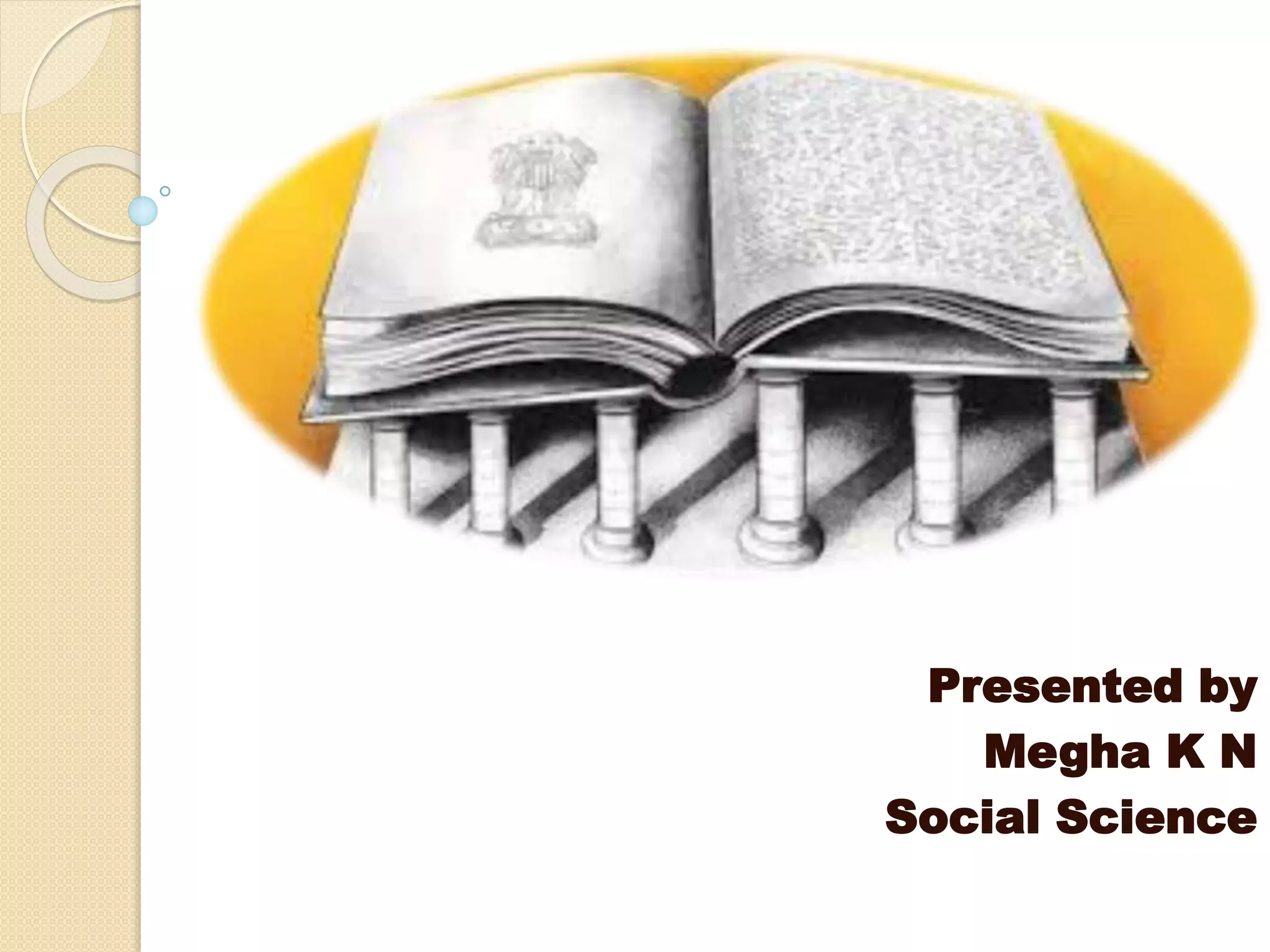
DIRECTIVE PRINCIPLES OF STATE
POLICY
 The Directive Principles of State Policy (DPSP) has been taken from the Irish
constitution and enumerated in Part IV of the Indian Constitution.
 The concept behind the DPSP is to create a ‘Welfare State’.
 These are some basic principles or instructions or guidelines for the government
while formulating laws/policies of the country and in executing them.
 According to Dr B R Ambedkar, these principles are ‘novel features’ of the
Constitution
 DPSP covers the Articles from 36 to 51.
 DPSPs are non-justiciable.
 According to some scholars, DPSP is ‘the kernel of the Indian Constitution’.
 The expression “Justice – Social, economic and political” that is mentioned in the
preamble is the ultimate aim that has to be achieved through the formulation of the
DPSP.
Features
a. DPSP are not enforceable in a court of law.
b. They were made non-justifiable considering that the State
may not have enough resources to implement all of them or it
may even come up with some better and progressive laws.
c. It consists of all the ideals which the State should follow and
keep in mind while formulating policies and enacting laws for
the country.
d. The DPSPs are like a collection of instructions and
directions, which were issued under the Government of India
Act, 1935, to the Governors of the colonies of India.
e. It constitutes a very comprehensive economic, social and
political guidelines or principles and tips for a modern
democratic State that aimed towards inculcating the ideals of
justice, liberty, equality and fraternity as given in the
preamble. The Preamble consists of all the objectives that
needs to be achieved through the Constitution.
f. Adding DPSP was all about creating a “welfare state” which
works for the individuals of the country which was absent
during the colonial era.
g. Article 37 of the Indian constitution states about the application of
the directive principles
h. Directive principles are affirmative directions
Directive principles of state policy have been grouped into 4
categories. These are:
1. Economic and social principles
2. The Gandhian principles
3. Principles and policies relating to international peace and security
4. Miscellaneous
Economic And Social Principles
The state shall endeavour to achieve Social and
Economic welfare of the people by:
a. providing adequate means of livelihood for both men and
women.
b. reorganizing the economic system in a way to avoid
concentration of wealth in few hands.
c. securing equal pay for equal work for both men and women.
d. securing suitable employment and healthy working conditions
for men, women and children.
e. guarding the children against exploitation and moral
degradation.
f. making effective provisions for securing the right to work,
education and public assistance in case of unemployment, old
g. making provisions for securing just and humane
conditions of work and for maternity relief.
h. taking steps to secure the participation of workers in the
management of undertakings etc.
i. promoting education and economic interests of working
sections of the people especially the SCs and STs.
j. securing for all the workers reasonable leisure and
cultural opportunities.
k. making efforts to raise the standard of living and public
health.
l. providing early childhood care and education to all
children until they complete the age of 6 years.
The Gandhian Principles
There are certain principles, based on the ideals advocated
by Mahatma Gandhi. These Principles are as follows : -
a. To organize village Panchayats.
b. To promote cottage industries in rural areas.
c. To prohibit intoxicating drinks and drugs that are injurious to
health.
d. To preserve and improve the breeds of the cattle and prohibit
slaughter of cows, calves and other drought animals.
Principles Relating To International
Peace And Security :
India should render active cooperation for world peace and
security and for that the state shall endeavor to : -
a. promote international peace and security.
b. maintain just and honorable relations between nations.
c. foster respect for international laws and treaty obligations.
d. encourage settlements of international disputes by mutual
agreement.
Miscellaneous
a. To secure for all Indians a uniform civil code.
b. To protect historical monuments.
c. To save environment from pollution and protect wild life.
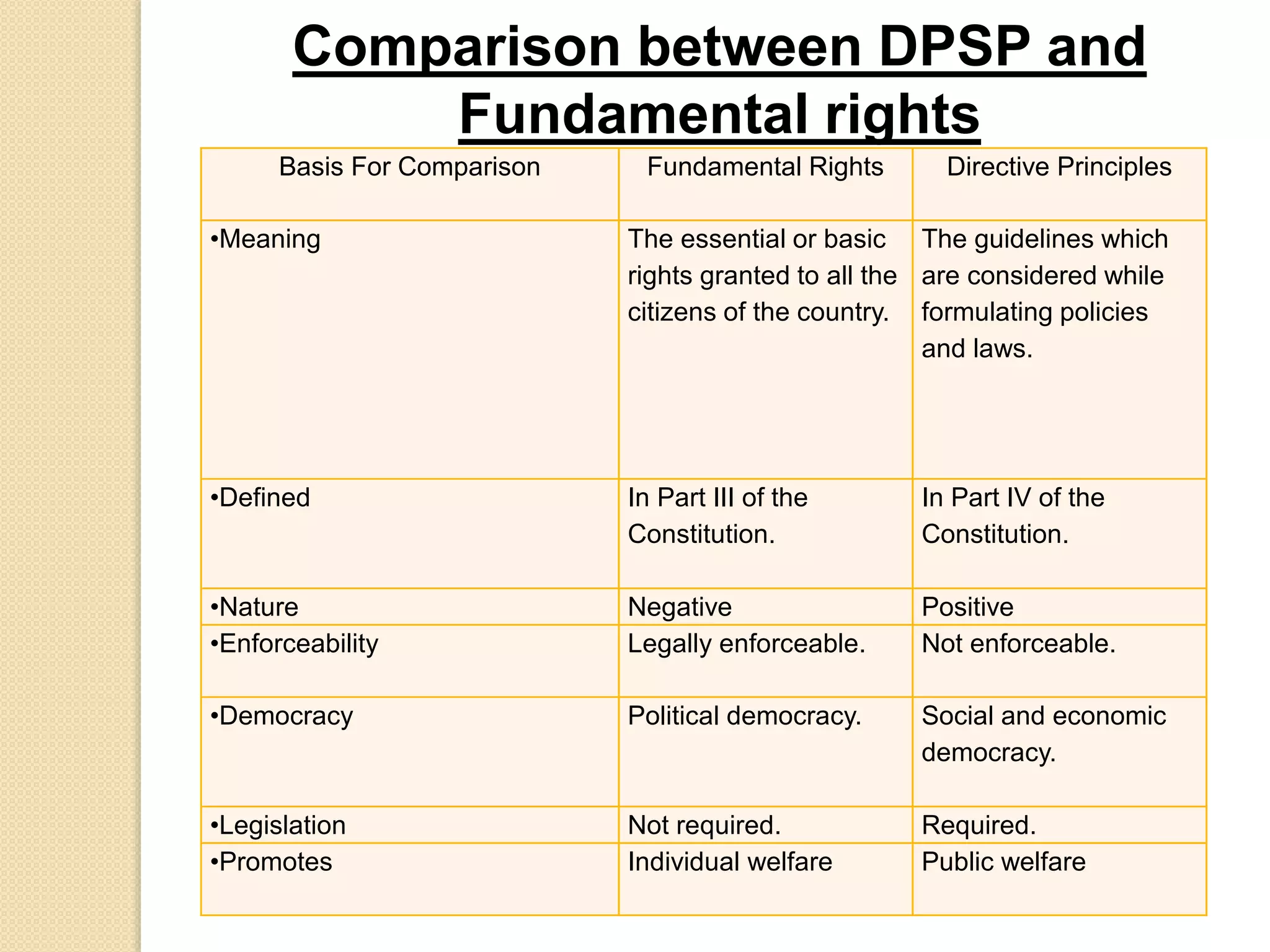
Basis For Comparison Fundamental Rights Directive Principles
•Meaning The essential or basic
rights granted to all the
citizens of the country.
The guidelines which
are considered while
formulating policies
and laws.
•Defined In Part III of the
Constitution.
In Part IV of the
Constitution.
•Nature Negative Positive
•Enforceability Legally enforceable. Not enforceable.
•Democracy Political democracy. Social and economic
democracy.
•Legislation Not required. Required.
•Promotes Individual welfare Public welfare
Comparison between DPSP and
Fundamental rights
Significance of DPSP
a. Directive Principles are non-justiciable but these are backed
by vox populi (voice of the people), which is the real
sanction behind every law in reality.
b. DPSP gives the philosophical foundations of a welfare
system.
c. Their nature is more of moral ideals.
d. Directive Principles act as a guide for the government which
helps them in making policies and laws for the purpose of
securing justice and welfare in the State.
e. DPSP are like a source of continuity in the Governance of
the country
f. Directive Principles can be called as the positive directions
for the State which helps in securing social and economical
dimensions of democracy
g. Directive Principles of State Policy make it possible for
people to measure the worth of a government and its
working.
h. The Directive Principles constitute a manifesto of a Nation.
DIRECTIVE PRINCIPLES OF STATE POLICY

DIRECTIVE PRINCIPLES OF STATE POLICY

  • 1.
    Presented by Megha KN Social Science
  • 2.
    DIRECTIVE PRINCIPLES OFSTATE POLICY  The Directive Principles of State Policy (DPSP) has been taken from the Irish constitution and enumerated in Part IV of the Indian Constitution.  The concept behind the DPSP is to create a ‘Welfare State’.  These are some basic principles or instructions or guidelines for the government while formulating laws/policies of the country and in executing them.  According to Dr B R Ambedkar, these principles are ‘novel features’ of the Constitution  DPSP covers the Articles from 36 to 51.  DPSPs are non-justiciable.  According to some scholars, DPSP is ‘the kernel of the Indian Constitution’.  The expression “Justice – Social, economic and political” that is mentioned in the preamble is the ultimate aim that has to be achieved through the formulation of the DPSP.
  • 3.
    Features a. DPSP arenot enforceable in a court of law. b. They were made non-justifiable considering that the State may not have enough resources to implement all of them or it may even come up with some better and progressive laws. c. It consists of all the ideals which the State should follow and keep in mind while formulating policies and enacting laws for the country. d. The DPSPs are like a collection of instructions and directions, which were issued under the Government of India Act, 1935, to the Governors of the colonies of India. e. It constitutes a very comprehensive economic, social and political guidelines or principles and tips for a modern democratic State that aimed towards inculcating the ideals of justice, liberty, equality and fraternity as given in the preamble. The Preamble consists of all the objectives that needs to be achieved through the Constitution. f. Adding DPSP was all about creating a “welfare state” which works for the individuals of the country which was absent during the colonial era.
  • 4.
    g. Article 37of the Indian constitution states about the application of the directive principles h. Directive principles are affirmative directions Directive principles of state policy have been grouped into 4 categories. These are: 1. Economic and social principles 2. The Gandhian principles 3. Principles and policies relating to international peace and security 4. Miscellaneous
  • 5.
    Economic And SocialPrinciples The state shall endeavour to achieve Social and Economic welfare of the people by: a. providing adequate means of livelihood for both men and women. b. reorganizing the economic system in a way to avoid concentration of wealth in few hands. c. securing equal pay for equal work for both men and women. d. securing suitable employment and healthy working conditions for men, women and children. e. guarding the children against exploitation and moral degradation. f. making effective provisions for securing the right to work, education and public assistance in case of unemployment, old
  • 6.
    g. making provisionsfor securing just and humane conditions of work and for maternity relief. h. taking steps to secure the participation of workers in the management of undertakings etc. i. promoting education and economic interests of working sections of the people especially the SCs and STs. j. securing for all the workers reasonable leisure and cultural opportunities. k. making efforts to raise the standard of living and public health. l. providing early childhood care and education to all children until they complete the age of 6 years.
  • 7.
    The Gandhian Principles Thereare certain principles, based on the ideals advocated by Mahatma Gandhi. These Principles are as follows : - a. To organize village Panchayats. b. To promote cottage industries in rural areas. c. To prohibit intoxicating drinks and drugs that are injurious to health. d. To preserve and improve the breeds of the cattle and prohibit slaughter of cows, calves and other drought animals.
  • 8.
    Principles Relating ToInternational Peace And Security : India should render active cooperation for world peace and security and for that the state shall endeavor to : - a. promote international peace and security. b. maintain just and honorable relations between nations. c. foster respect for international laws and treaty obligations. d. encourage settlements of international disputes by mutual agreement.
  • 9.
    Miscellaneous a. To securefor all Indians a uniform civil code. b. To protect historical monuments. c. To save environment from pollution and protect wild life.
  • 10.
    Basis For ComparisonFundamental Rights Directive Principles •Meaning The essential or basic rights granted to all the citizens of the country. The guidelines which are considered while formulating policies and laws. •Defined In Part III of the Constitution. In Part IV of the Constitution. •Nature Negative Positive •Enforceability Legally enforceable. Not enforceable. •Democracy Political democracy. Social and economic democracy. •Legislation Not required. Required. •Promotes Individual welfare Public welfare Comparison between DPSP and Fundamental rights
  • 11.
    Significance of DPSP a.Directive Principles are non-justiciable but these are backed by vox populi (voice of the people), which is the real sanction behind every law in reality. b. DPSP gives the philosophical foundations of a welfare system. c. Their nature is more of moral ideals. d. Directive Principles act as a guide for the government which helps them in making policies and laws for the purpose of securing justice and welfare in the State. e. DPSP are like a source of continuity in the Governance of the country f. Directive Principles can be called as the positive directions for the State which helps in securing social and economical dimensions of democracy g. Directive Principles of State Policy make it possible for people to measure the worth of a government and its working. h. The Directive Principles constitute a manifesto of a Nation.