


DPSP
BY GAGANBIHARI PAL
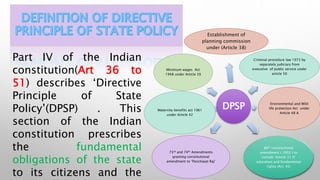
Part IV of the Indian
constitution(Art 36 to
51) describes ‘Directive
Principle of State
Policy’(DPSP) . This
section of the Indian
constitution prescribes
the fundamental
obligations of the state
to its citizens and the
DPSP
Establishment of
planning commission
under (Article 38)
Criminal procedure law 1973 by
separately judiciary from
executive of public service under
article 50
Environmental and Wild
life protection Act under
Article 48 A
86th constitutional
amendment ( 2002 ) to
include ‘Article 21 A’
education and fundamental
rights (Art. 45)
73rd and 74th Amendments
granting constitutional
amendment to ‘Panchayat Raj’
Maternity benefits act 1961
under Article 42
Minimum wages Act
1948 under Article 39
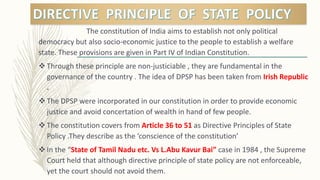
The constitution of India aims to establish not only political
democracy but also socio-economic justice to the people to establish a welfare
state. These provisions are given in Part IV of Indian Constitution.
 Through these principle are non-justiciable , they are fundamental in the
governance of the country . The idea of DPSP has been taken from Irish Republic
.
 The DPSP were incorporated in our constitution in order to provide economic
justice and avoid concertation of wealth in hand of few people.
 The constitution covers from Article 36 to 51 as Directive Principles of State
Policy .They describe as the ‘conscience of the constitution’
 In the “State of Tamil Nadu etc. Vs L.Abu Kavur Bai” case in 1984 , the Supreme
Court held that although directive principle of state policy are not enforceable,
yet the court should not avoid them.
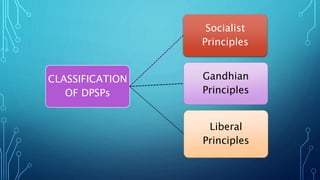
CLASSIFICATION
OF DPSPs
Socialist
Principles
Gandhian
Principles
Liberal
Principles
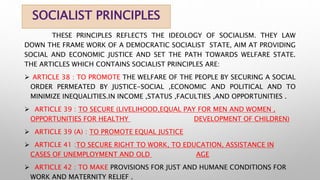
SOCIALIST PRINCIPLES
THESE PRINCIPLES REFLECTS THE IDEOLOGY OF SOCIALISM. THEY LAW
DOWN THE FRAME WORK OF A DEMOCRATIC SOCIALIST STATE, AIM AT PROVIDING
SOCIAL AND ECONOMIC JUSTICE AND SET THE PATH TOWARDS WELFARE STATE.
THE ARTICLES WHICH CONTAINS SOCIALIST PRINCIPLES ARE:
 ARTICLE 38 : TO PROMOTE THE WELFARE OF THE PEOPLE BY SECURING A SOCIAL
ORDER PERMEATED BY JUSTICE-SOCIAL ,ECONOMIC AND POLITICAL AND TO
MINIMIZE INEQUALITIES.IN INCOME ,STATUS ,FACULTIES ,AND OPPORTUNITIES .
 ARTICLE 39 : TO SECURE (LIVELIHOOD,EQUAL PAY FOR MEN AND WOMEN ,
OPPORTUNITIES FOR HEALTHY DEVELOPMENT OF CHILDREN)
 ARTICLE 39 (A) : TO PROMOTE EQUAL JUSTICE
 ARTICLE 41 :TO SECURE RIGHT TO WORK, TO EDUCATION, ASSISTANCE IN
CASES OF UNEMPLOYMENT AND OLD AGE
 ARTICLE 42 : TO MAKE PROVISIONS FOR JUST AND HUMANE CONDITIONS FOR
WORK AND MATERNITY RELIEF .
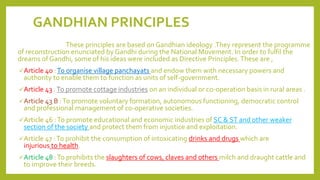
GANDHIAN PRINCIPLES
These principles are based on Gandhian ideology .They represent the programme
of reconstruction enunciated by Gandhi during the National Movement. In order to fulfil the
dreams of Gandhi, some of his ideas were included as Directive Principles.These are ,
Article 40 :To organise village panchayats and endow them with necessary powers and
authority to enable them to function as units of self-government.
Article 43 :To promote cottage industries on an individual or co-operation basis in rural areas .
Article 43 B :To promote voluntary formation, autonomous functioning, democratic control
and professional management of co-operative societies.
Article 46 :To promote educational and economic industries of SC & ST and other weaker
section of the society and protect them from injustice and exploitation.
Article 47 :To prohibit the consumption of intoxicating drinks and drugs which are
injurious to health.
Article 48 :To prohibits the slaughters of cows, claves and others milch and draught cattle and
to improve their breeds.
LIBERAL PRINCIPLES
THESE PRINCIPLES REPRESENTS THE IDEOLOGY OF LIBERALISM. THESE ARE
ARTICLE 44 : THE STATE WILL TRY TO SECURE FOR THE CITIZENS A UNIFORM CIVIL
CODE THROUGHOUT THE TERRITORY OF INDIA.
ARTICLE 45 : THE STATE SHALL ENDEAVOUR TO PROVIDE EARLY CHILDHOOD CARE
AND EDUCATION FOR ALL CHILDREN UNTIL THEY COMPLETE THE AGE OF SIX YEARS.
ARTICLE 48 :TO ORGANISE AGRICULTURE AND ANIMAL HUSBANDRY ON MODERN AND
SCIENTIFIC LINES .
ARTICLE 48 A: TO PROTECT AND IMPROVE THE ENVIRONMENT AND TO SAFEGUARD
FORESTS AND WILDLIFE .
ARTICLE 49 : TO PROMOTE MONUMENTS ,PLACES AND OBJECTS OF ARTISTIC OR
HISTORIC INTERESTS WHICH ARE DECLARED TO BE OF NATIONAL IMPORTANCE .
ARTICLE 50 : THE STATE SHALL SEPARATE THE JUDICIARY FROM THE EXECUTIVE IN
THE PUBLIC SERVICES OF THE STATE
ARTICLE 51 :TO PROMOTE INTERNATIONAL PEACE AND SECURITY .
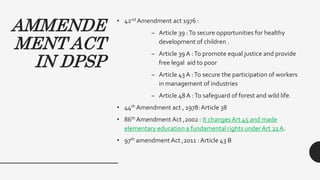
AMMENDE
MENT ACT
IN DPSP
• 42nd Amendment act 1976 :
– Article 39 :To secure opportunities for healthy
development of children .
– Article 39 A :To promote equal justice and provide
free legal aid to poor
– Article 43 A :To secure the participation of workers
in management of industries
– Article 48 A :To safeguard of forest and wild life.
• 44th Amendment act , 1978:Article 38
• 86th Amendment Act ,2002 : It changesArt 45 and made
elementary education a fundamental rights under Art 21 A.
• 97th amendment Act ,2011 : Article 43 B
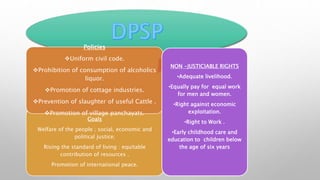
Goals
Welfare of the people ; social, economic and
political justice;
Rising the standard of living : equitable
contribution of resources .
Promotion of international peace.
Policies
Uniform civil code.
Prohibition of consumption of alcoholics
liquor.
Promotion of cottage industries.
Prevention of slaughter of useful Cattle .
Promotion of village panchayats.
NON -JUSTICIABLE RIGHTS
•Adequate livelihood.
•Equally pay for equal work
for men and women.
•Right against economic
exploitation.
•Right to Work .
•Early childhood care and
education to children below
the age of six years
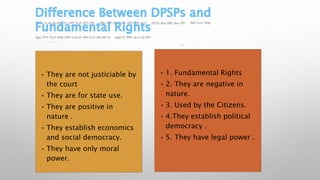
• They are not justiciable by
the court
• They are for state use.
• They are positive in
nature .
• They establish economics
and social democracy.
• They have only moral
power.
• 1. Fundamental Rights
• 2. They are negative in
nature.
• 3. Used by the Citizens.
• 4.They establish political
democracy .
• 5. They have legal power .
CONCLUSION
Directive Principle constitute a very comprehensive social, economic
and political programme for a modern and welfare state .
These principle emphasises that the State shall try to promote welfare of
people by providing them basic facilities like shelter ,food and clothing.
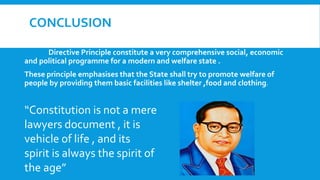
“Constitution is not a mere
lawyers document , it is
vehicle of life , and its
spirit is always the spirit of
the age”

Dpsp

  • 1.
  • 2.
    Part IV ofthe Indian constitution(Art 36 to 51) describes ‘Directive Principle of State Policy’(DPSP) . This section of the Indian constitution prescribes the fundamental obligations of the state to its citizens and the DPSP Establishment of planning commission under (Article 38) Criminal procedure law 1973 by separately judiciary from executive of public service under article 50 Environmental and Wild life protection Act under Article 48 A 86th constitutional amendment ( 2002 ) to include ‘Article 21 A’ education and fundamental rights (Art. 45) 73rd and 74th Amendments granting constitutional amendment to ‘Panchayat Raj’ Maternity benefits act 1961 under Article 42 Minimum wages Act 1948 under Article 39
  • 3.
    The constitution ofIndia aims to establish not only political democracy but also socio-economic justice to the people to establish a welfare state. These provisions are given in Part IV of Indian Constitution.  Through these principle are non-justiciable , they are fundamental in the governance of the country . The idea of DPSP has been taken from Irish Republic .  The DPSP were incorporated in our constitution in order to provide economic justice and avoid concertation of wealth in hand of few people.  The constitution covers from Article 36 to 51 as Directive Principles of State Policy .They describe as the ‘conscience of the constitution’  In the “State of Tamil Nadu etc. Vs L.Abu Kavur Bai” case in 1984 , the Supreme Court held that although directive principle of state policy are not enforceable, yet the court should not avoid them.
  • 4.
  • 5.
    SOCIALIST PRINCIPLES THESE PRINCIPLESREFLECTS THE IDEOLOGY OF SOCIALISM. THEY LAW DOWN THE FRAME WORK OF A DEMOCRATIC SOCIALIST STATE, AIM AT PROVIDING SOCIAL AND ECONOMIC JUSTICE AND SET THE PATH TOWARDS WELFARE STATE. THE ARTICLES WHICH CONTAINS SOCIALIST PRINCIPLES ARE:  ARTICLE 38 : TO PROMOTE THE WELFARE OF THE PEOPLE BY SECURING A SOCIAL ORDER PERMEATED BY JUSTICE-SOCIAL ,ECONOMIC AND POLITICAL AND TO MINIMIZE INEQUALITIES.IN INCOME ,STATUS ,FACULTIES ,AND OPPORTUNITIES .  ARTICLE 39 : TO SECURE (LIVELIHOOD,EQUAL PAY FOR MEN AND WOMEN , OPPORTUNITIES FOR HEALTHY DEVELOPMENT OF CHILDREN)  ARTICLE 39 (A) : TO PROMOTE EQUAL JUSTICE  ARTICLE 41 :TO SECURE RIGHT TO WORK, TO EDUCATION, ASSISTANCE IN CASES OF UNEMPLOYMENT AND OLD AGE  ARTICLE 42 : TO MAKE PROVISIONS FOR JUST AND HUMANE CONDITIONS FOR WORK AND MATERNITY RELIEF .
  • 6.
    GANDHIAN PRINCIPLES These principlesare based on Gandhian ideology .They represent the programme of reconstruction enunciated by Gandhi during the National Movement. In order to fulfil the dreams of Gandhi, some of his ideas were included as Directive Principles.These are , Article 40 :To organise village panchayats and endow them with necessary powers and authority to enable them to function as units of self-government. Article 43 :To promote cottage industries on an individual or co-operation basis in rural areas . Article 43 B :To promote voluntary formation, autonomous functioning, democratic control and professional management of co-operative societies. Article 46 :To promote educational and economic industries of SC & ST and other weaker section of the society and protect them from injustice and exploitation. Article 47 :To prohibit the consumption of intoxicating drinks and drugs which are injurious to health. Article 48 :To prohibits the slaughters of cows, claves and others milch and draught cattle and to improve their breeds.
  • 7.
    LIBERAL PRINCIPLES THESE PRINCIPLESREPRESENTS THE IDEOLOGY OF LIBERALISM. THESE ARE ARTICLE 44 : THE STATE WILL TRY TO SECURE FOR THE CITIZENS A UNIFORM CIVIL CODE THROUGHOUT THE TERRITORY OF INDIA. ARTICLE 45 : THE STATE SHALL ENDEAVOUR TO PROVIDE EARLY CHILDHOOD CARE AND EDUCATION FOR ALL CHILDREN UNTIL THEY COMPLETE THE AGE OF SIX YEARS. ARTICLE 48 :TO ORGANISE AGRICULTURE AND ANIMAL HUSBANDRY ON MODERN AND SCIENTIFIC LINES . ARTICLE 48 A: TO PROTECT AND IMPROVE THE ENVIRONMENT AND TO SAFEGUARD FORESTS AND WILDLIFE . ARTICLE 49 : TO PROMOTE MONUMENTS ,PLACES AND OBJECTS OF ARTISTIC OR HISTORIC INTERESTS WHICH ARE DECLARED TO BE OF NATIONAL IMPORTANCE . ARTICLE 50 : THE STATE SHALL SEPARATE THE JUDICIARY FROM THE EXECUTIVE IN THE PUBLIC SERVICES OF THE STATE ARTICLE 51 :TO PROMOTE INTERNATIONAL PEACE AND SECURITY .
  • 8.
    AMMENDE MENT ACT IN DPSP •42nd Amendment act 1976 : – Article 39 :To secure opportunities for healthy development of children . – Article 39 A :To promote equal justice and provide free legal aid to poor – Article 43 A :To secure the participation of workers in management of industries – Article 48 A :To safeguard of forest and wild life. • 44th Amendment act , 1978:Article 38 • 86th Amendment Act ,2002 : It changesArt 45 and made elementary education a fundamental rights under Art 21 A. • 97th amendment Act ,2011 : Article 43 B
  • 9.
    Goals Welfare of thepeople ; social, economic and political justice; Rising the standard of living : equitable contribution of resources . Promotion of international peace. Policies Uniform civil code. Prohibition of consumption of alcoholics liquor. Promotion of cottage industries. Prevention of slaughter of useful Cattle . Promotion of village panchayats. NON -JUSTICIABLE RIGHTS •Adequate livelihood. •Equally pay for equal work for men and women. •Right against economic exploitation. •Right to Work . •Early childhood care and education to children below the age of six years
  • 10.
    • They arenot justiciable by the court • They are for state use. • They are positive in nature . • They establish economics and social democracy. • They have only moral power. • 1. Fundamental Rights • 2. They are negative in nature. • 3. Used by the Citizens. • 4.They establish political democracy . • 5. They have legal power .
  • 11.
    CONCLUSION Directive Principle constitutea very comprehensive social, economic and political programme for a modern and welfare state . These principle emphasises that the State shall try to promote welfare of people by providing them basic facilities like shelter ,food and clothing. “Constitution is not a mere lawyers document , it is vehicle of life , and its spirit is always the spirit of the age”