10/5/20
Data management
planning
Training for trainers
5.10.2020
Mari Elisa Kuusniemi
ORCID: 0000-0002-7675-287X

Tuuli Office
310/5/20
Tuuli
Promotes data management planning
as an important part of good research
practice
Provides
• Tuuli Office: National coordination
for DMP requirements and
guidance
• DMPTuuli: Data management
planning tool
Funded by Ministry of Education and
Culture, Finland
510/5/20
Research
Data
Management
(RDM) is a term that
describes the organisation,
storage, preservation, and
sharing of data collected and
used in a research project.
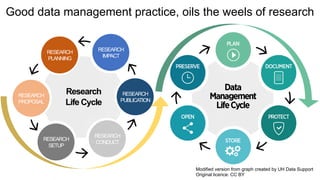
RESEARCH
PUBLICATION
RESEARCH
PLANNING
RESEARCH
PROPOSAL
RESEARCH
SETUP
RESEARCH
CONDUCT
RESEARCH
IMPACT
Research
Life Cycle
Modified version from graph created by UH Data Support
Original licence: CC BY
Good data management practice, oils the weels of research
8810/5/20
Main requirements for a trainer
• You understand importance of research data management.
• You like to find ways to motivate researchers.
• You can search practical solutions with researchers (not
necessarily for them).
910/5/20
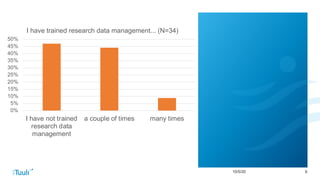
0%
5%
10%
15%
20%
25%
30%
35%
40%
45%
50%
I have not trained
research data
management
a couple of times many times
I have trained research data management... (N=34)
121210/5/20
During the training
• We go through main challenges when training data
management planning
• We try to find examples how to overcome these challenges
1410/5/20
Data
Management
Plan
(DMP) is a document that
outlines how data are to be
or is handled both during a
research project,
and after the project is
completed.
1610/5/20
Challenge 1
Your course participants do not
understand the need of data
management planning
181810/5/20
Why manage your research data and write
a data management plan (DMP)?
• It is good research practice!
• It helps you save time and money.
• You will reduce the risk of losing your data.
• You will be able to anticipate complex ownership and user
rights issues in advance.
• It helps you support open access to create productive future
collaborations.
• You will meet your funder’s requirements.
• Your DMP reflects your managerial skills as a project leader.
202010/5/20
Topics of a Data Management Plan (DMP)
• General description of the data
• Ethical and legal compliance
• Documentation and metadata
• Storage and backup during the research project
• Opening, publishing and archiving the data after the
research project
• Data management responsibilities and resources
Reference: Tuuli-project. (2020, January 24). General Finnish DMP guidance (Version 2020).
Zenodo. http://doi.org/10.5281/zenodo.3630309
2210/5/20
General
description of
the data
Identify the data of your
research project
242410/5/20
General description of the data
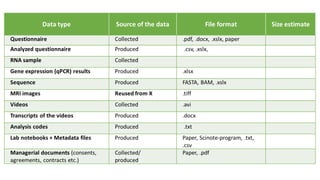
• What kinds of data is your research based on?
• What data will be collected, produced or reused?
• What file formats will the data be in?
• Give a rough estimate of the size of the data
produced/collected.
• How will the consistency and quality of data be
controlled?
2610/5/20
Challenge 2
Your course participants are not
used to describe the data they
use, collect or produce
They are not familiar with the
concept “research data”
Tekijä
282810/5/20
What is research data?
“…any information that has been collected,
observed, generated or created to validate original
research findings.”
"...materials generated or collected during the course
of conducting research..."
“Although usually digital, research data also includes
non-digital formats such as, photos, diaries and
(laboratory) notebooks.”
303010/5/20
In the DMP data is quite often understood
as a broad term including
• data collected by various methods (such as
surveys, interviews, measurements, imaging
techniques etc.),
• data produced during the research (such as
analysis results),
• research sources (such as archive material), and
• source code and software.
3210/5/20
Challenge 3
Your course participants are not
used to describe the data they
use, collect or produce
They don’t know how to phrase
description of the data or how
write it down
Tekijä
3510/5/20
Ethical and legal
compliance
Make sure you have
right to use data
373710/5/20
Ethical and legal compliance
• What legal issues are related to your data
management? (For example, GDPR and other
legislation affecting data processing.)
• How will you manage the rights of the data you use,
produce and share?
3910/5/20
Challenge 4
Your course participants do not
think ethics and legal compliance
concerns them because they do
not use sensitive data
They don’t see the need of
agreements about data rights
414110/5/20
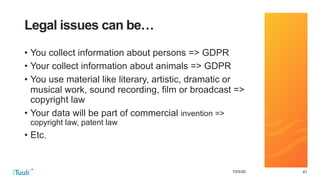
Legal issues can be…
• You collect information about persons => GDPR
• Your collect information about animals => GDPR
• You use material like literary, artistic, dramatic or
musical work, sound recording, film or broadcast =>
copyright law
• Your data will be part of commercial invention =>
copyright law, patent law
• Etc.
424210/5/20
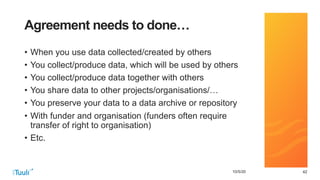
Agreement needs to done…
• When you use data collected/created by others
• You collect/produce data, which will be used by others
• You collect/produce data together with others
• You share data to other projects/organisations/…
• You preserve your data to a data archive or repository
• With funder and organisation (funders often require
transfer of right to organisation)
• Etc.
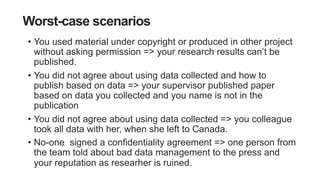
Worst-case scenarios
• You used material under copyright or produced in other project
without asking permission => your research results can’t be
published.
• You did not agree about using data collected and how to
publish based on data => your supervisor published paper
based on data you collected and you name is not in the
publication
• You did not agree about using data collected => you colleague
took all data with her, when she left to Canada.
• No-one signed a confidentiality agreement => one person from
the team told about bad data management to the press and
your reputation as researher is ruined.
4410/5/20
Challenge 5
Data privacy, protection & GDPR
are huge topics! You can’t cover
all on a data management
planning training.
Ask help from a data protection
officer of your institution.
4510/5/20
Documentation
and metadata
Your data needs to be
understandable
to yourself and reviewers
Documentation and metadata
• How will you document your data in order to make the data
findable, accessible, interoperable and re-usable for you and
others?
• What kind of metadata standards, README files or other
documentation will you use to help others to understand and
use your data?
4710/5/20
Challenge 6
Your course participants do not
understand the concepts of data
documentation or metadata
Therefore they struggle to see the
importance of metadata and value
of data documentation for
themselves and others
484810/5/20
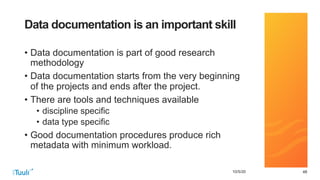
Data documentation is an important skill
• Data documentation is part of good research
methodology
• Data documentation starts from the very beginning
of the projects and ends after the project.
• There are tools and techniques available
• discipline specific
• data type specific
• Good documentation procedures produce rich
metadata with minimum workload.
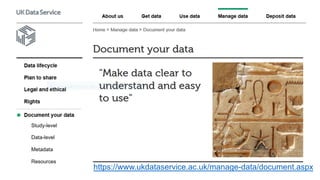
https://www.ukdataservice.ac.uk/manage-data/document.aspx
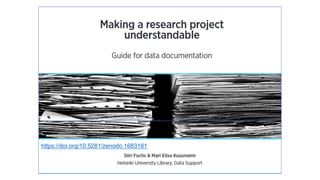
https://doi.org/10.5281/zenodo.1683181
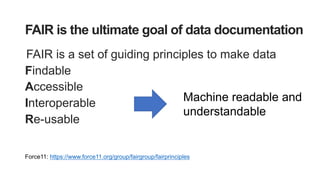
FAIR is the ultimate goal of data documentation
FAIR is a set of guiding principles to make data
Findable
Accessible
Interoperable
Re-usable
Force11: https://www.force11.org/group/fairgroup/fairprinciples
Machine readable and
understandable
10/5/20
Be Prepared
Scout motto
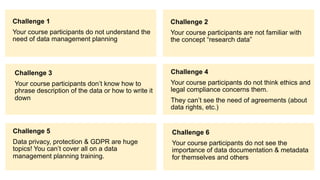
Challenge 1
Your course participants do not understand the
need of data management planning
Challenge 2
Your course participants are not familiar with
the concept “research data”
Challenge 3
Your course participants don’t know how to
phrase description of the data or how to write it
down
Challenge 5
Data privacy, protection & GDPR are huge
topics! You can’t cover all on a data
management planning training.
Challenge 4
Your course participants do not think ethics and
legal compliance concerns them.
They can’t see the need of agreements (about
data rights, etc.)
Challenge 6
Your course participants do not see the
importance of data documentation & metadata
for themselves and others
575710/5/20
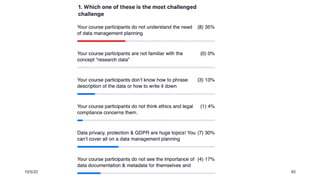
Poll
Which of the challenges is the most difficult for you to
overcome?
Tekijä
585810/5/20
Group work
• Random small groups in breakout rooms (click to join the
group)
• Working time: 15 min
Tekijä
595910/5/20
Task: How can you as a trainer be
prepared for this challenge?
• One challenge/group.
• Your group number tells the challenge number you work with
(you see the number when you join the group)
• Write the answer to the google doc:
http://bit.ly/DMPtrainercallenges
• Each group will present the findings to all, after the group
work
Tekijä
10/5/20 60
6110/5/20
Thanks!
Mari Elisa ”Mek” Kuusniemi
mari.elisa.kuusniemi@helsinki.fi

Part I: Data management planning - Training for trainers

  • 1.
    10/5/20 Data management planning Training fortrainers 5.10.2020 Mari Elisa Kuusniemi ORCID: 0000-0002-7675-287X Tuuli Office
  • 2.
    310/5/20 Tuuli Promotes data managementplanning as an important part of good research practice Provides • Tuuli Office: National coordination for DMP requirements and guidance • DMPTuuli: Data management planning tool Funded by Ministry of Education and Culture, Finland
  • 3.
    510/5/20 Research Data Management (RDM) is aterm that describes the organisation, storage, preservation, and sharing of data collected and used in a research project.
  • 4.
    RESEARCH PUBLICATION RESEARCH PLANNING RESEARCH PROPOSAL RESEARCH SETUP RESEARCH CONDUCT RESEARCH IMPACT Research Life Cycle Modified versionfrom graph created by UH Data Support Original licence: CC BY Good data management practice, oils the weels of research
  • 5.
    8810/5/20 Main requirements fora trainer • You understand importance of research data management. • You like to find ways to motivate researchers. • You can search practical solutions with researchers (not necessarily for them).
  • 6.
    910/5/20 0% 5% 10% 15% 20% 25% 30% 35% 40% 45% 50% I have nottrained research data management a couple of times many times I have trained research data management... (N=34)
  • 7.
    121210/5/20 During the training •We go through main challenges when training data management planning • We try to find examples how to overcome these challenges
  • 8.
    1410/5/20 Data Management Plan (DMP) is adocument that outlines how data are to be or is handled both during a research project, and after the project is completed.
  • 9.
    1610/5/20 Challenge 1 Your courseparticipants do not understand the need of data management planning
  • 10.
    181810/5/20 Why manage yourresearch data and write a data management plan (DMP)? • It is good research practice! • It helps you save time and money. • You will reduce the risk of losing your data. • You will be able to anticipate complex ownership and user rights issues in advance. • It helps you support open access to create productive future collaborations. • You will meet your funder’s requirements. • Your DMP reflects your managerial skills as a project leader.
  • 11.
    202010/5/20 Topics of aData Management Plan (DMP) • General description of the data • Ethical and legal compliance • Documentation and metadata • Storage and backup during the research project • Opening, publishing and archiving the data after the research project • Data management responsibilities and resources Reference: Tuuli-project. (2020, January 24). General Finnish DMP guidance (Version 2020). Zenodo. http://doi.org/10.5281/zenodo.3630309
  • 12.
    2210/5/20 General description of the data Identifythe data of your research project
  • 13.
    242410/5/20 General description ofthe data • What kinds of data is your research based on? • What data will be collected, produced or reused? • What file formats will the data be in? • Give a rough estimate of the size of the data produced/collected. • How will the consistency and quality of data be controlled?
  • 14.
    2610/5/20 Challenge 2 Your courseparticipants are not used to describe the data they use, collect or produce They are not familiar with the concept “research data” Tekijä
  • 15.
    282810/5/20 What is researchdata? “…any information that has been collected, observed, generated or created to validate original research findings.” "...materials generated or collected during the course of conducting research..." “Although usually digital, research data also includes non-digital formats such as, photos, diaries and (laboratory) notebooks.”
  • 16.
    303010/5/20 In the DMPdata is quite often understood as a broad term including • data collected by various methods (such as surveys, interviews, measurements, imaging techniques etc.), • data produced during the research (such as analysis results), • research sources (such as archive material), and • source code and software.
  • 17.
    3210/5/20 Challenge 3 Your courseparticipants are not used to describe the data they use, collect or produce They don’t know how to phrase description of the data or how write it down Tekijä
  • 19.
    3510/5/20 Ethical and legal compliance Makesure you have right to use data
  • 20.
    373710/5/20 Ethical and legalcompliance • What legal issues are related to your data management? (For example, GDPR and other legislation affecting data processing.) • How will you manage the rights of the data you use, produce and share?
  • 21.
    3910/5/20 Challenge 4 Your courseparticipants do not think ethics and legal compliance concerns them because they do not use sensitive data They don’t see the need of agreements about data rights
  • 22.
    414110/5/20 Legal issues canbe… • You collect information about persons => GDPR • Your collect information about animals => GDPR • You use material like literary, artistic, dramatic or musical work, sound recording, film or broadcast => copyright law • Your data will be part of commercial invention => copyright law, patent law • Etc.
  • 23.
    424210/5/20 Agreement needs todone… • When you use data collected/created by others • You collect/produce data, which will be used by others • You collect/produce data together with others • You share data to other projects/organisations/… • You preserve your data to a data archive or repository • With funder and organisation (funders often require transfer of right to organisation) • Etc.
  • 24.
    Worst-case scenarios • Youused material under copyright or produced in other project without asking permission => your research results can’t be published. • You did not agree about using data collected and how to publish based on data => your supervisor published paper based on data you collected and you name is not in the publication • You did not agree about using data collected => you colleague took all data with her, when she left to Canada. • No-one signed a confidentiality agreement => one person from the team told about bad data management to the press and your reputation as researher is ruined.
  • 25.
    4410/5/20 Challenge 5 Data privacy,protection & GDPR are huge topics! You can’t cover all on a data management planning training. Ask help from a data protection officer of your institution.
  • 26.
    4510/5/20 Documentation and metadata Your dataneeds to be understandable to yourself and reviewers
  • 27.
    Documentation and metadata •How will you document your data in order to make the data findable, accessible, interoperable and re-usable for you and others? • What kind of metadata standards, README files or other documentation will you use to help others to understand and use your data?
  • 28.
    4710/5/20 Challenge 6 Your courseparticipants do not understand the concepts of data documentation or metadata Therefore they struggle to see the importance of metadata and value of data documentation for themselves and others
  • 29.
    484810/5/20 Data documentation isan important skill • Data documentation is part of good research methodology • Data documentation starts from the very beginning of the projects and ends after the project. • There are tools and techniques available • discipline specific • data type specific • Good documentation procedures produce rich metadata with minimum workload.
  • 30.
  • 31.
  • 32.
    FAIR is theultimate goal of data documentation FAIR is a set of guiding principles to make data Findable Accessible Interoperable Re-usable Force11: https://www.force11.org/group/fairgroup/fairprinciples Machine readable and understandable
  • 33.
  • 34.
    Challenge 1 Your courseparticipants do not understand the need of data management planning Challenge 2 Your course participants are not familiar with the concept “research data” Challenge 3 Your course participants don’t know how to phrase description of the data or how to write it down Challenge 5 Data privacy, protection & GDPR are huge topics! You can’t cover all on a data management planning training. Challenge 4 Your course participants do not think ethics and legal compliance concerns them. They can’t see the need of agreements (about data rights, etc.) Challenge 6 Your course participants do not see the importance of data documentation & metadata for themselves and others
  • 35.
    575710/5/20 Poll Which of thechallenges is the most difficult for you to overcome? Tekijä
  • 36.
    585810/5/20 Group work • Randomsmall groups in breakout rooms (click to join the group) • Working time: 15 min Tekijä
  • 37.
    595910/5/20 Task: How canyou as a trainer be prepared for this challenge? • One challenge/group. • Your group number tells the challenge number you work with (you see the number when you join the group) • Write the answer to the google doc: http://bit.ly/DMPtrainercallenges • Each group will present the findings to all, after the group work Tekijä
  • 38.
  • 39.
    6110/5/20 Thanks! Mari Elisa ”Mek”Kuusniemi mari.elisa.kuusniemi@helsinki.fi