Isabel Chadwick & Dan Crane
Research Support Librarians
library-research-support@open.ac.uk
Writing successful
Data Management Plans
19th January 2018
Overview of the webinar
• Why write a DMP?
• What to include
• What do funders want?
• DMPOnline tool
• Questions?
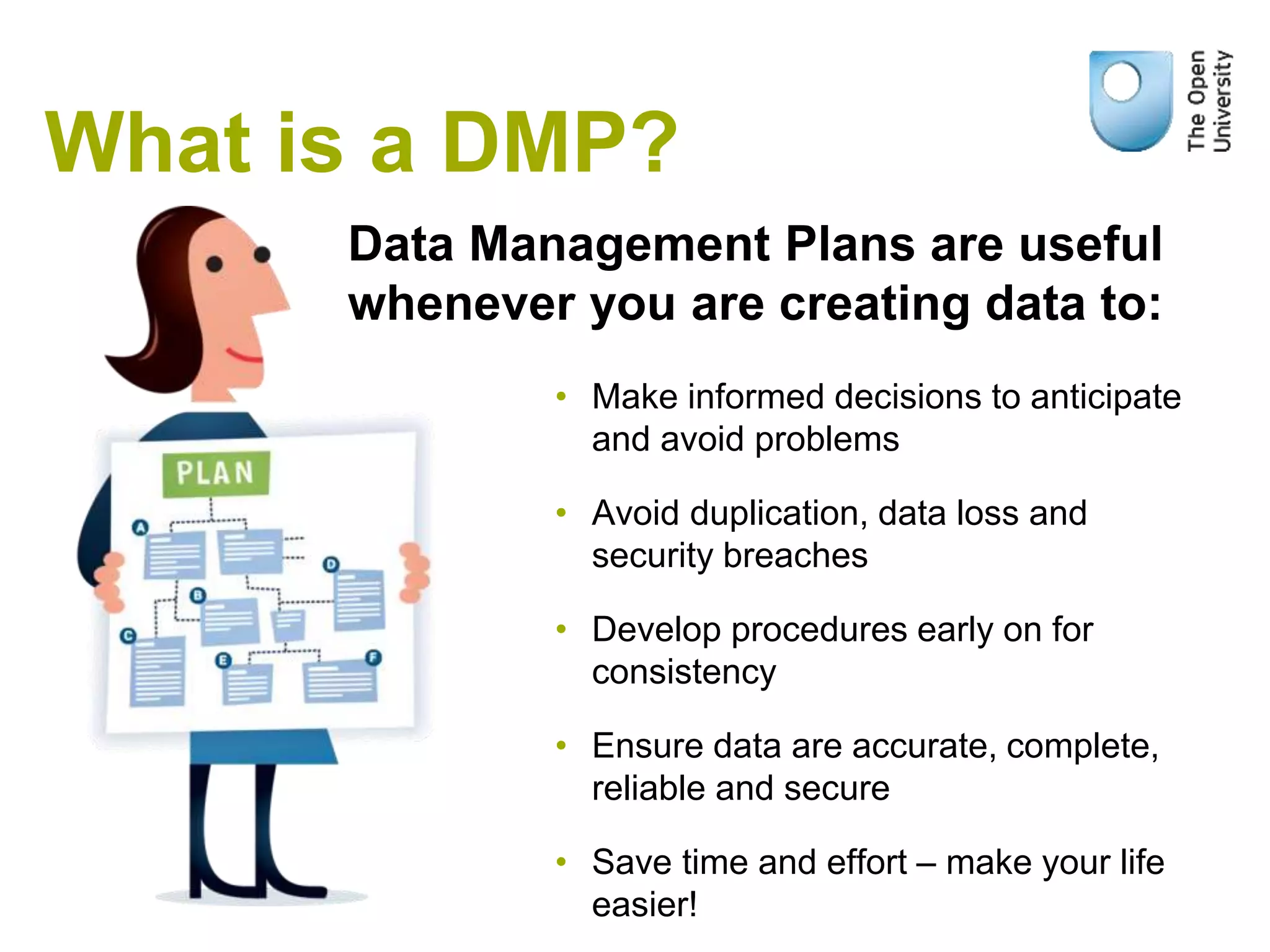
What is a DMP?
• Make informed decisions to anticipate
and avoid problems
• Avoid duplication, data loss and
security breaches
• Develop procedures early on for
consistency
• Ensure data are accurate, complete,
reliable and secure
• Save time and effort – make your life
easier!
Data Management Plans are useful
whenever you are creating data to:
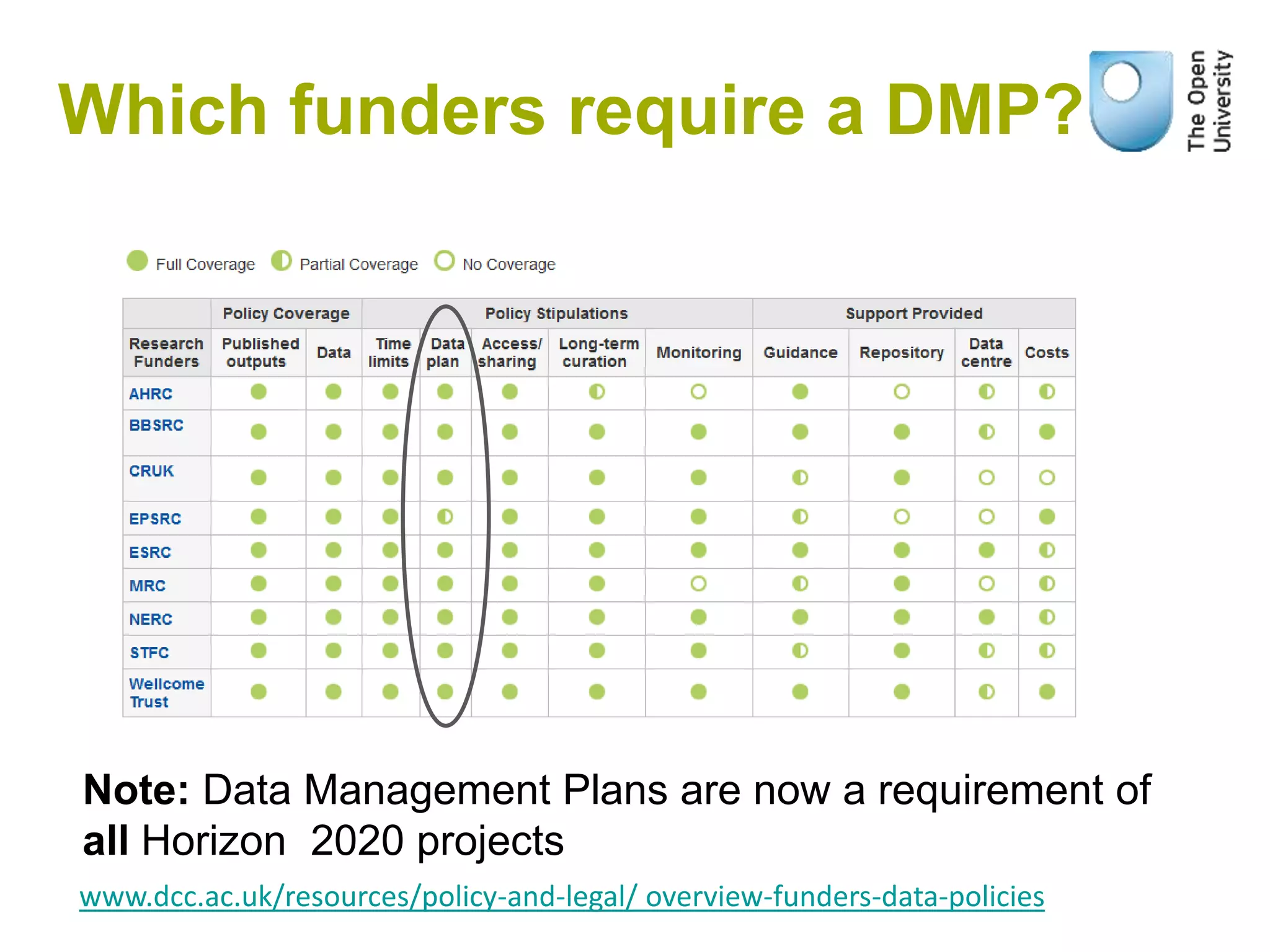
Which funders require a DMP?
www.dcc.ac.uk/resources/policy-and-legal/ overview-funders-data-policies
Note: Data Management Plans are now a requirement of
all Horizon 2020 projects
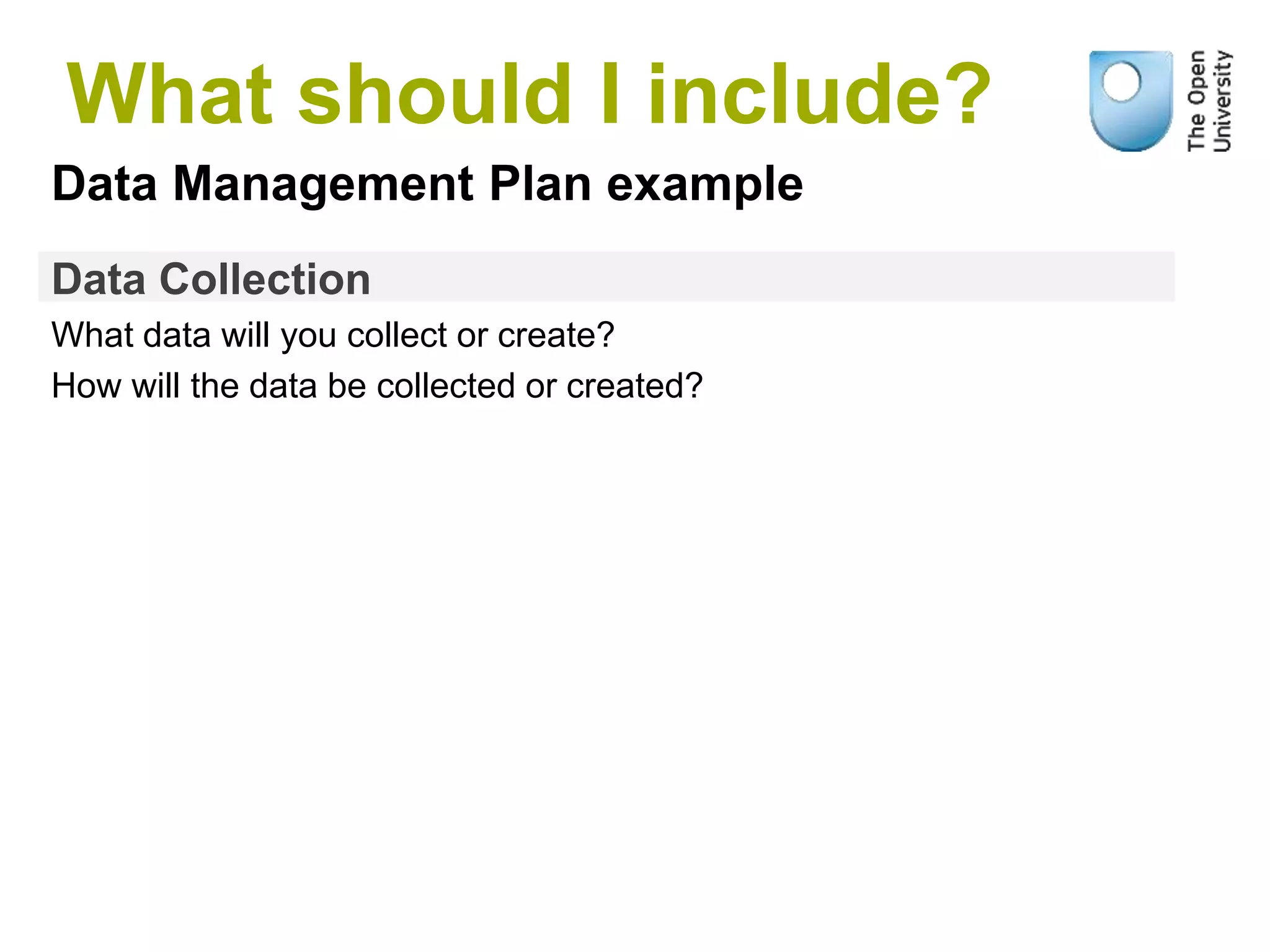
Data Collection
What data will you collect or create?
How will the data be collected or created?
What should I include?
Data Management Plan example
Data Collection
What data will you collect or create?
How will the data be collected or created?
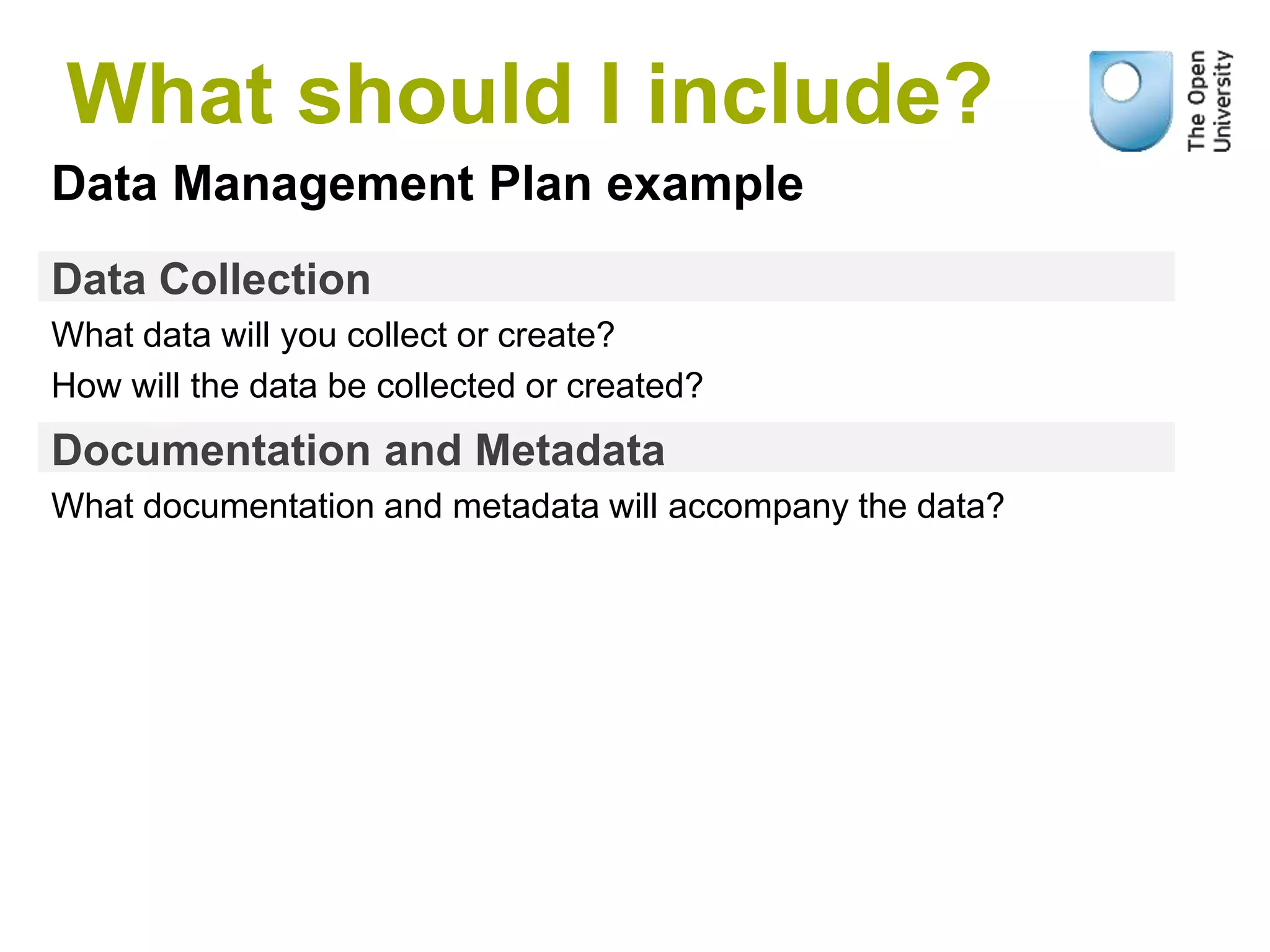
Data Management Plan example
Documentation and Metadata
What documentation and metadata will accompany the data?
What should I include?
Data Collection
What data will you collect or create?
How will the data be collected or created?
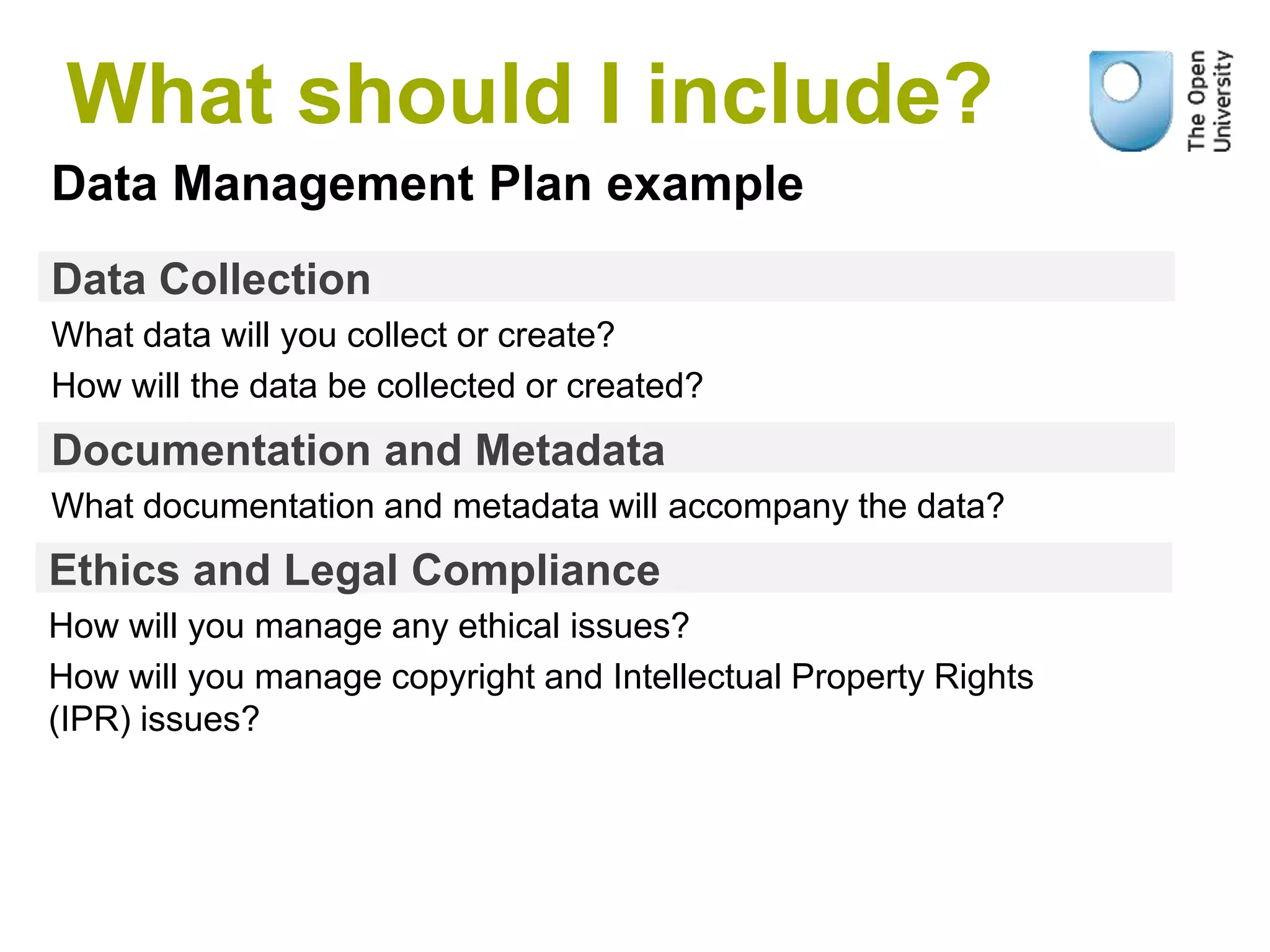
Data Management Plan example
Documentation and Metadata
What documentation and metadata will accompany the data?
Ethics and Legal Compliance
How will you manage any ethical issues?
How will you manage copyright and Intellectual Property Rights
(IPR) issues?
What should I include?
Storage and Backup
How will the data be stored and backed up during the research?
How will you manage access and security?
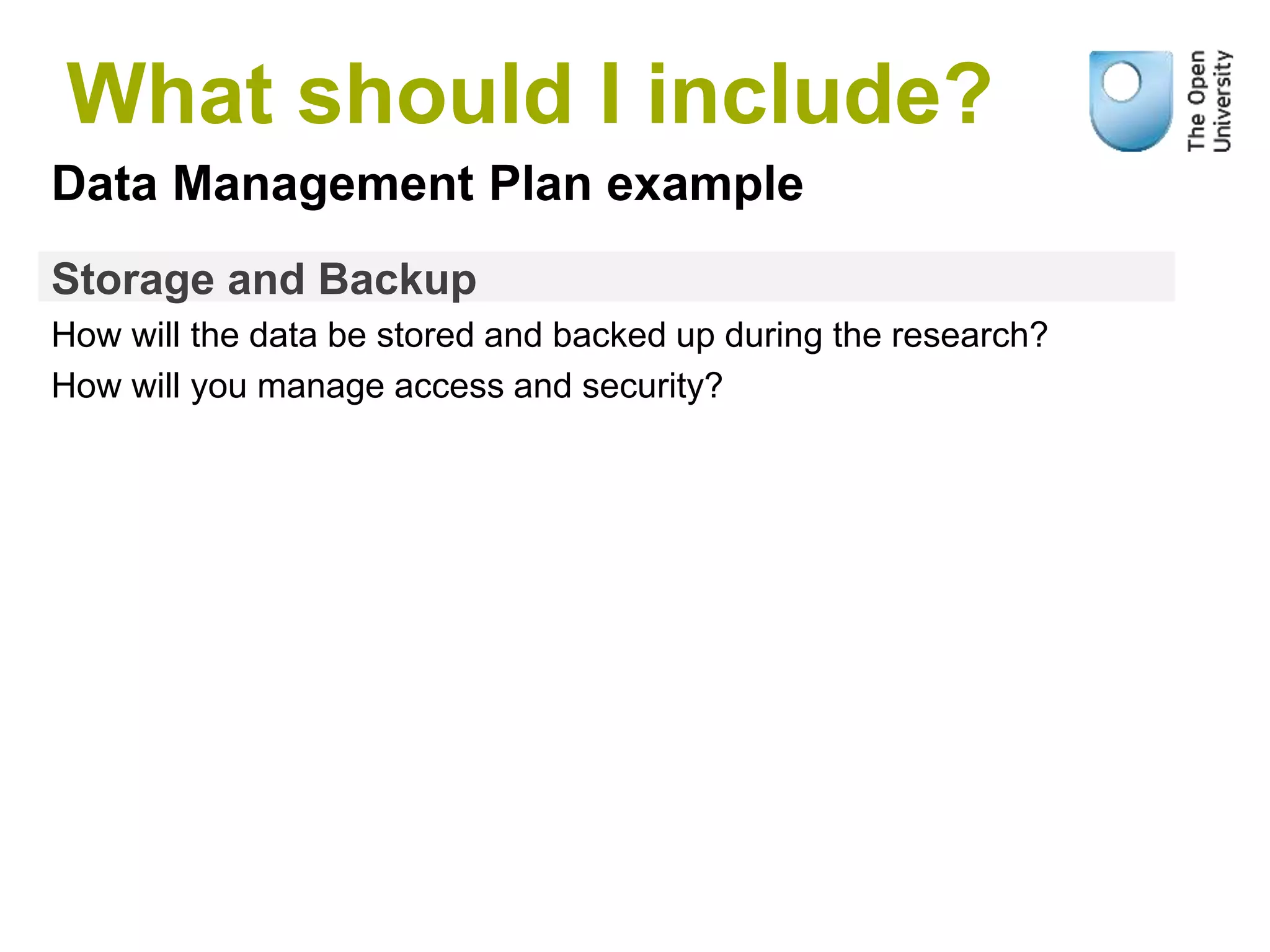
Data Management Plan example
What should I include?
Storage and Backup
How will the data be stored and backed up during the research?
How will you manage access and security?
Data Management Plan example
Selection and Preservation
Which data should be retained, shared, and/or preserved?
What is the long-term preservation plan for the dataset?
What should I include?
Storage and Backup
How will the data be stored and backed up during the research?
How will you manage access and security?
Data Management Plan example
Selection and Preservation
Which data should be retained, shared, and/or preserved?
What is the long-term preservation plan for the dataset?
Data Sharing
How will you share the data?
Are any restrictions on data sharing required?
What should I include?
Storage and Backup
How will the data be stored and backed up during the research?
How will you manage access and security?
Data Management Plan example
Selection and Preservation
Which data should be retained, shared, and/or preserved?
What is the long-term preservation plan for the dataset?
Data Sharing
How will you share the data?
Are any restrictions on data sharing required?
Responsibilities and Resources
Who will be responsible for data management?
What resources will you require to deliver your plan?
What should I include?
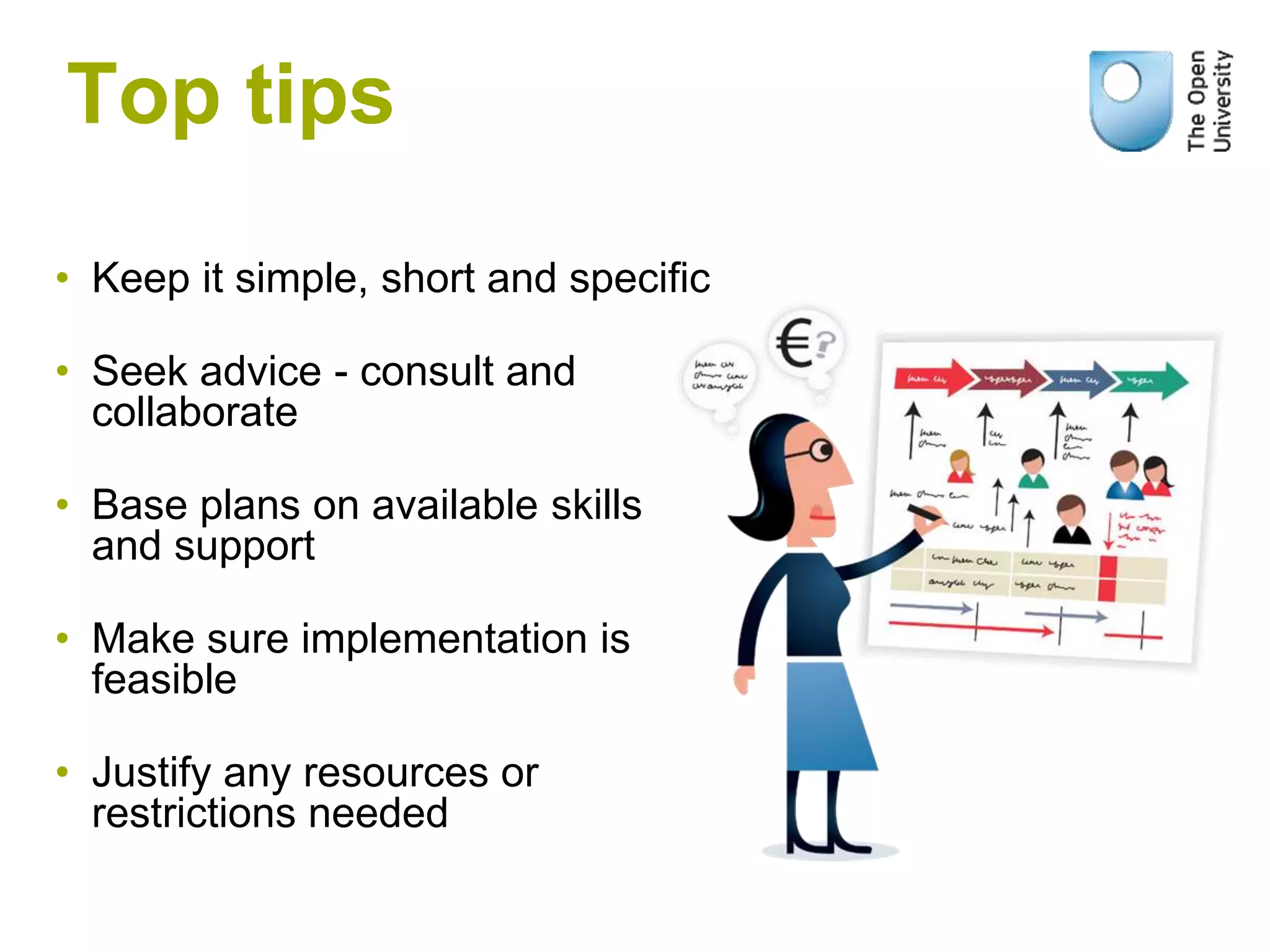
• Keep it simple, short and specific
• Seek advice - consult and
collaborate
• Base plans on available skills
and support
• Make sure implementation is
feasible
• Justify any resources or
restrictions needed
Top tips
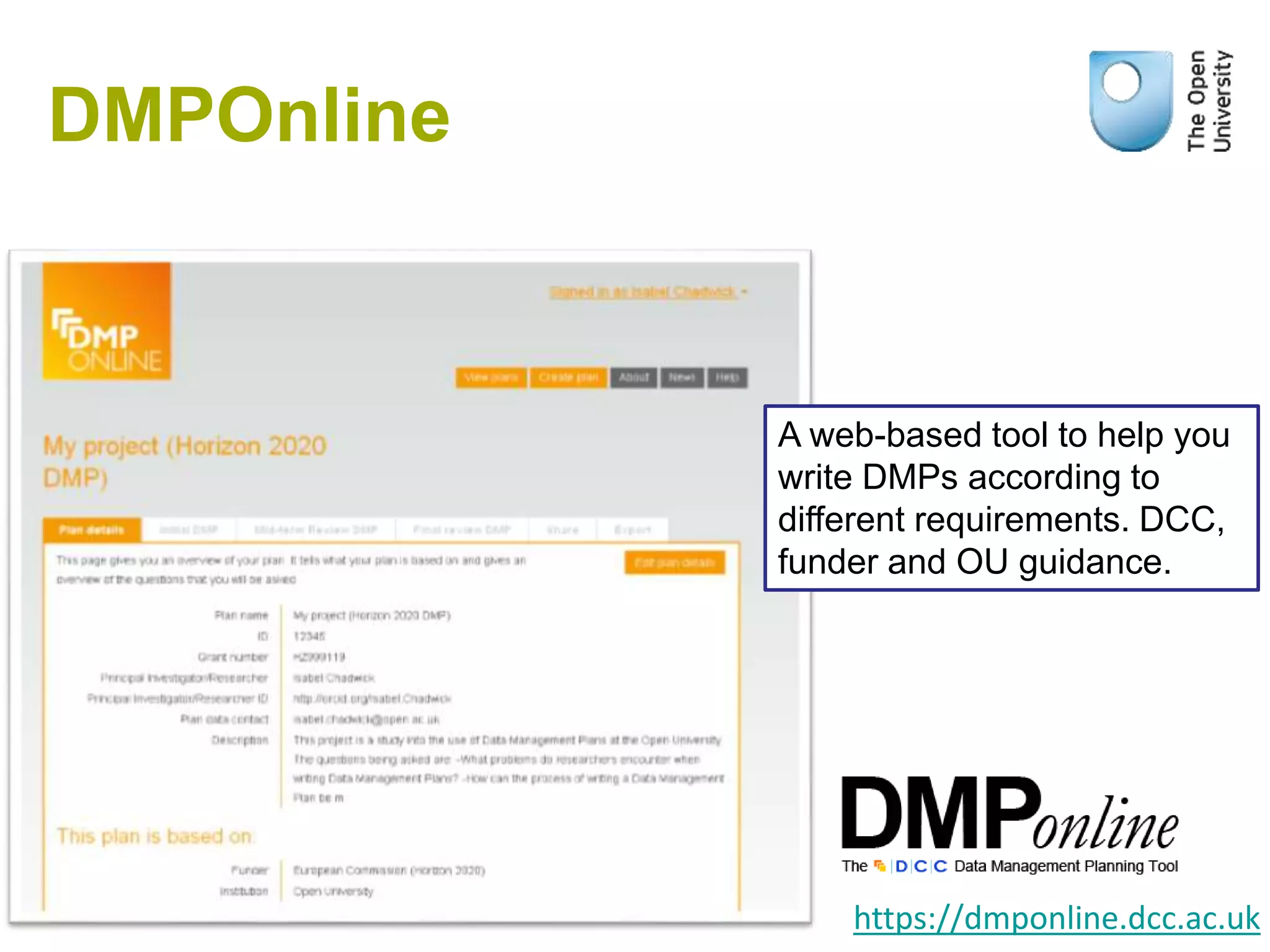
DMPOnline
https://dmponline.dcc.ac.uk
A web-based tool to help you
write DMPs according to
different requirements. DCC,
funder and OU guidance.
Example DMPs
• OU examples: http://www.open.ac.uk/library-
research-support/research-data-
management/data-management-plans
• DCC examples:
http://www.dcc.ac.uk/resources/data-
management-plans/guidance-examples
• RIO journal:
https://riojournal.com/browse_us
er_collection_documents.php?c
ollection_id=3&journal_id=17
Library Services
How we can help
• Data Management Plan checking
• Online Guidance -
http://www.open.ac.uk/library-research-
support/
• DMPOnline
• Ask us who to ask!
Email: library-research-support@open.ac.uk
Questions?
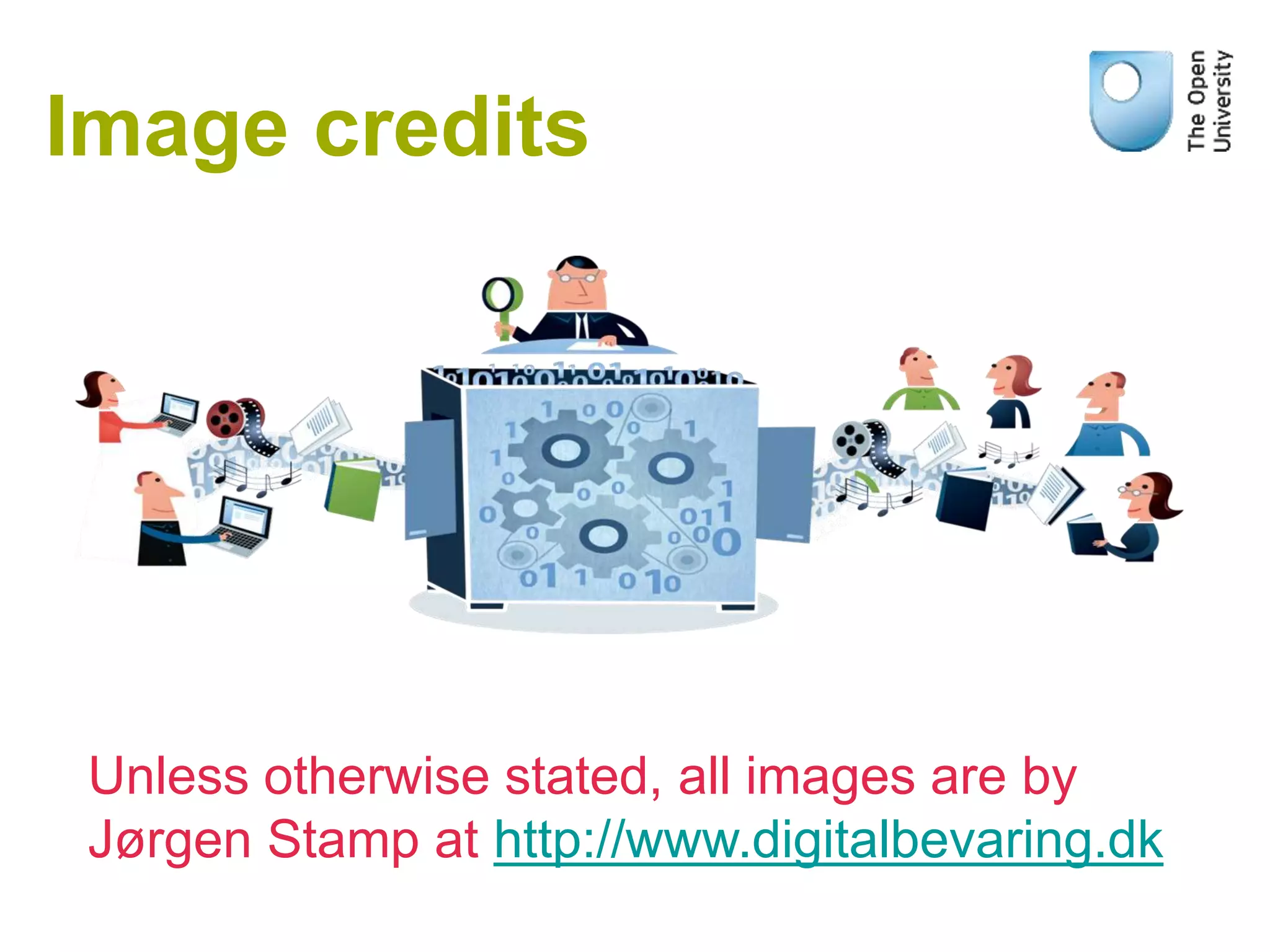
Image credits
Unless otherwise stated, all images are by
Jørgen Stamp at http://www.digitalbevaring.dk

Writing successful data management plans

  • 1.
    Isabel Chadwick &Dan Crane Research Support Librarians library-research-support@open.ac.uk Writing successful Data Management Plans 19th January 2018
  • 2.
    Overview of thewebinar • Why write a DMP? • What to include • What do funders want? • DMPOnline tool • Questions?
  • 3.
    What is aDMP? • Make informed decisions to anticipate and avoid problems • Avoid duplication, data loss and security breaches • Develop procedures early on for consistency • Ensure data are accurate, complete, reliable and secure • Save time and effort – make your life easier! Data Management Plans are useful whenever you are creating data to:
  • 4.
    Which funders requirea DMP? www.dcc.ac.uk/resources/policy-and-legal/ overview-funders-data-policies Note: Data Management Plans are now a requirement of all Horizon 2020 projects
  • 5.
    Data Collection What datawill you collect or create? How will the data be collected or created? What should I include? Data Management Plan example
  • 6.
    Data Collection What datawill you collect or create? How will the data be collected or created? Data Management Plan example Documentation and Metadata What documentation and metadata will accompany the data? What should I include?
  • 7.
    Data Collection What datawill you collect or create? How will the data be collected or created? Data Management Plan example Documentation and Metadata What documentation and metadata will accompany the data? Ethics and Legal Compliance How will you manage any ethical issues? How will you manage copyright and Intellectual Property Rights (IPR) issues? What should I include?
  • 8.
    Storage and Backup Howwill the data be stored and backed up during the research? How will you manage access and security? Data Management Plan example What should I include?
  • 9.
    Storage and Backup Howwill the data be stored and backed up during the research? How will you manage access and security? Data Management Plan example Selection and Preservation Which data should be retained, shared, and/or preserved? What is the long-term preservation plan for the dataset? What should I include?
  • 10.
    Storage and Backup Howwill the data be stored and backed up during the research? How will you manage access and security? Data Management Plan example Selection and Preservation Which data should be retained, shared, and/or preserved? What is the long-term preservation plan for the dataset? Data Sharing How will you share the data? Are any restrictions on data sharing required? What should I include?
  • 11.
    Storage and Backup Howwill the data be stored and backed up during the research? How will you manage access and security? Data Management Plan example Selection and Preservation Which data should be retained, shared, and/or preserved? What is the long-term preservation plan for the dataset? Data Sharing How will you share the data? Are any restrictions on data sharing required? Responsibilities and Resources Who will be responsible for data management? What resources will you require to deliver your plan? What should I include?
  • 12.
    • Keep itsimple, short and specific • Seek advice - consult and collaborate • Base plans on available skills and support • Make sure implementation is feasible • Justify any resources or restrictions needed Top tips
  • 13.
    DMPOnline https://dmponline.dcc.ac.uk A web-based toolto help you write DMPs according to different requirements. DCC, funder and OU guidance.
  • 14.
    Example DMPs • OUexamples: http://www.open.ac.uk/library- research-support/research-data- management/data-management-plans • DCC examples: http://www.dcc.ac.uk/resources/data- management-plans/guidance-examples • RIO journal: https://riojournal.com/browse_us er_collection_documents.php?c ollection_id=3&journal_id=17
  • 15.
    Library Services How wecan help • Data Management Plan checking • Online Guidance - http://www.open.ac.uk/library-research- support/ • DMPOnline • Ask us who to ask! Email: library-research-support@open.ac.uk
  • 16.
  • 17.
    Image credits Unless otherwisestated, all images are by Jørgen Stamp at http://www.digitalbevaring.dk

Editor's Notes

  • #2 1 • Welcome • Introduce myself • Housekeeping
  • #3 1 (2) Overview of the workshop If you have any questions please stick them in the chat box and I will answer them at the end. I’ll make the recording and slides available after the session.
  • #4 2 (4) What is a Data Management Plan?  Funding bodies increasingly require grant-holders to develop and implement Data Management and Sharing Plans (DMPs). But even if you’re not asked to do one, it can be a useful way of addressing all the data management issues you will encounter during your research. Plans typically state what data will be created and how, and outline the plans for sharing and preservation, noting what is appropriate given the nature of the data and any restrictions that may need to be applied.
  • #5 2 (6) – Which funders require a DMP? (2 mins) 66 • Quick overview – point out EPSRC does not require one, and Horizon 2020 pilot has now ended and they want a plan for all projects. Also DFID, Royal Society, Different funders have different requirements for DMPs, and all supply templates which can be accessed either through the funder or through DMPONline – a tool I’ll show you later on. • However, the OU recommends that all researchers write a DMP regardless of whether their funder requires them to do so or not, as it is a useful exercise for ensuring that data will be managed responsibly throughout the lifecycle. We have put an OU template together which can be accessed at DMPOnline.
  • #6 2 (8) I’m going to run through an example of a DMP, this doesn’t correspond to any particular funder, but these questions are asked by all funders requiring a DMP. Be thorough in your description – include details of quality assurance, if you’re working in a big team how will you ensure that data collection is consistent? Mention file formats Can you estimate how much data you’re going to collect? If it’s audiovisual for example this may have cost impllications on the grant.
  • #7 2 (10) Documentation and metadata make it easier to understand what’s what. It’s a good idea to assign this information from the very beginning, or you may end up in the situation where you can’t understand your own data, let alone anyone else! This documentation might be integral to the file – like headings and file properties or it might sit alongside your data, like README files, data lists and lab notebooks. You need to think about what a 3rd party would need to understand your data – contextual information, explanation of fields and codes, methods adopted to collect data.
  • #8 3 (13) We’re running another webinar on legal and ethical issues in sharing data on 28th February which will go into more detail. You need to include details of how you will obtain consent to share data, and whether you will be anonymizing you data, if so how? Will you be using any community standards or employing an external company – if the latter what confidentiality agreements are in place? Briefly, IP for research data collected or produced by OU employees lies with the institution, although if you are collaborating with other institutions or with commercial partners IP will be shared and in these cases it’s wise to draw up an agreement. If you are using secondary data you need to make sure you understand any IP issues related to using and reproducing this.
  • #9 2 (15) Again, be thorough. The OU recommends storing on OU servers which are regularly backed up, but you may want to back up to an external hard drive to be extra secure.  In terms of access and security this becomes more complicated if you are working with collaborators outside the institution, particularly if those collaborators are overseas. You need to consider whether there are any legal issues regarding data transfer overseas – look at the data protection legislation for the respective countries. Think carefully about who needs access to what, it may be that not everyone on your team needs to access everything. Transferring only anonymized data is less risky than transferring personally identifiable data.
  • #10 2 (17) You don’t need to keep everything (although in some cases you might want to). If your audio recordings have been transcribed and anonymized then do you need to keep the recordings? Likewise, you may only want to put a subset of your data into a repository, this is particularly relevant if you have a lot of data which would take a long time to prepare and upload. Most funders (*and the OU) require you to preserve your data for a minimum of 10 years post project. How will you do this?
  • #11 3 (20) When choosing a data archive or repository the order of preference should be: Funder archive Discipline specific archive Institutional archive Online data sharing service (like Figshare/Zenodo) This will help ensure discoverability. You might want to assign access restrictions to parts of your dataset – are there files which should only be accessible to academics working in your field for example?
  • #12 3 (23) Be thorough. Tasks here might include: designing and overseeing the research collecting, processing and analysing data generating metadata and documentation designing databases And you may need to think about people outside of your direct research team e.g. external contractors involved in data collection, data entry, transcribing, processing or analysis support staff managing and administering research and research funding, providing ethical review and assessing Intellectual Property rights institutional IT services staff providing data storage, security and backup services external data centres or web archives that facilitate data sharing In addition to this, some funders (Including RCUK) allow research data management as a cost within a grant so if any of this costs money, make sure you ask for it and justify that properly.
  • #13 1 (24) Keep it simple – not all the reviewers are going to be data management experts Be specific – instead of saying “we will follow standards” explain WHICH standards, instead of “we will create a large amount of data” HOW MUCH data? Short – some funders have requirements for how long the plan should be (eg. ESRC 3 pages) Seek advice – from other researchers at the university who have written plans, or done similar projects. Example of the listening experience database taking advice from colleagues who had worked on the reading experience database. Be realistic! RDM is an allowable cost for all RCUK funders, but any costs have to be fully accounted for. All expenditure on direct costs must take place before the actual end date of the project and must be fully auditable. No expenditure can be ‘double funded’ (a service that is centrally supported by the indirect costs paid on all research grants cannot then also be included as a direct cost on a grant)
  • #14 2 (26) DMPOnline is a tool developed by the DCC which helps you to write your data management plan. There are templates for dmps for all the research councils, Horizon 2020, Wellcome Trust and CRUK. It takes you through the sections of the templates and gives guidance as you work. We’ve now incorporated some OU guidance into this as well. There is also an OU template for researchers who are not funded by any of the bodies for which there is a template, but feel it would be helpful to write a data management plan anyway. I’m going give a very quick demo of what DMPOnline does.
  • #16 1 (27) Send DMPs in advance of bid submission! Preferably a week ahead, if possible. But later is better than never! I am happy to meet with Pis  and project teams at the beginning of projects to discuss strategies for managing data and clarify funder requirements. Also able to set up bespoke training sessions for departments/research groups At the end of your project, hopefully your data will have been managed in a way that facilitates sharing, but if in doubt get in touch for help Guidance is on the intranet site, and will soon be on the public facing library research support website. URL on next slide. Send enquiries to email at bottom of screen, this way anyone from the team can pick it up if I’m away.
  • #17 3 (30)