Sunday Rocks! 
A Presentation of Rocks Discussed by Helen Claire Gould, 
author & geologist, 
on Luke Chillingsworth’s Sunday Show 
On Sunday 12th October, 2014.
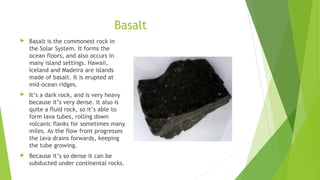
Basalt 
 Basalt is the commonest rock in 
the Solar System. It forms the 
ocean floors, and also occurs in 
many island settings. Hawaii, 
Iceland and Madeira are islands 
made of basalt. It is erupted at 
mid-ocean ridges. 
 It’s a dark rock, and is very heavy 
because it’s very dense. It also is 
quite a fluid rock, so it’s able to 
form lava tubes, rolling down 
volcanic flanks for sometimes many 
miles. As the flow front progresses 
the lava drains forwards, keeping 
the tube growing. 
 Because it’s so dense it can be 
subducted under continental rocks.
Vesicular Basalt 
 A vesicle is a hole in the rock, and 
this has loads! They’re formed by 
escaping gas bubbles as the 
basaltic magma comes to the 
surface. 
 This rock has sharp edges, and also 
feels quite heavy. 
 When the vesicles become infilled, 
over time, with minerals, they are 
known as amygdales.
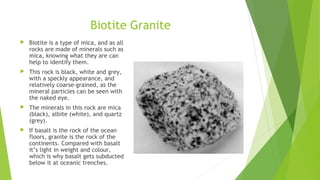
Biotite Granite 
 Biotite is a type of mica, and as all 
rocks are made of minerals such as 
mica, knowing what they are can 
help to identify them. 
 This rock is black, white and grey, 
with a speckly appearance, and 
relatively coarse-grained, as the 
mineral particles can be seen with 
the naked eye. 
 The minerals in this rock are mica 
(black), albite (white), and quartz 
(grey). 
 If basalt is the rock of the ocean 
floors, granite is the rock of the 
continents. Compared with basalt 
it’s light in weight and colour, 
which is why basalt gets subducted 
below it at oceanic trenches.
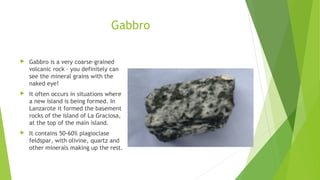
Gabbro 
 Gabbro is a very coarse-grained 
volcanic rock – you definitely can 
see the mineral grains with the 
naked eye! 
 It often occurs in situations where 
a new island is being formed. In 
Lanzarote it formed the basement 
rocks of the island of La Graciosa, 
at the top of the main island. 
 It contains 50-60% plagioclase 
feldspar, with olivine, quartz and 
other minerals making up the rest.
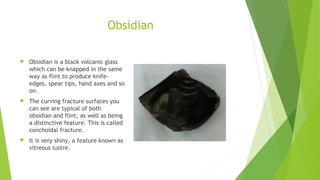
Obsidian 
 Obsidian is a black volcanic glass 
which can be knapped in the same 
way as flint to produce knife-edges, 
spear tips, hand axes and so 
on. 
 The curving fracture surfaces you 
can see are typical of both 
obsidian and flint, as well as being 
a distinctive feature. This is called 
conchoidal fracture. 
 It is very shiny, a feature known as 
vitreous lustre.
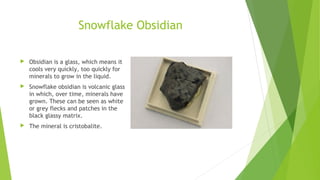
Snowflake Obsidian 
 Obsidian is a glass, which means it 
cools very quickly, too quickly for 
minerals to grow in the liquid. 
 Snowflake obsidian is volcanic glass 
in which, over time, minerals have 
grown. These can be seen as white 
or grey flecks and patches in the 
black glassy matrix. 
 The mineral is cristobalite.
Pumice 
 Pumice is well-known as the stuff 
used to get rid of hard skin on the 
feet. 
 It’s such a light rock that it floats 
on the sea surface when erupted 
beside an ocean or undersea. 
Compare it with basalt and you’ll 
really notice the difference. 
 The lightness of this rock is due to 
it being, effectively, a froth of 
glass. The magma contains lots of 
gas, which escapes on eruption, 
and the remaining material cools 
very quickly, before crystals can 
form.
Agglomerate 
 Magma can be erupted as a variety 
of sizes of solid particles, ranging 
in size from fine ash to blocks and 
bombs. 
 The larger particles can be as big 
as a house. But smaller blocks and 
bombs can form into a rock layer, 
similar to the way some sediments 
become sedimentary rocks. The 
particles fuse together due to the 
heat as they fall back to the 
ground, and layers can build up on 
top of one another during 
successive eruptions.
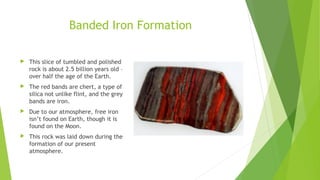
Banded Iron Formation 
 This slice of tumbled and polished 
rock is about 2.5 billion years old – 
over half the age of the Earth. 
 The red bands are chert, a type of 
silica not unlike flint, and the grey 
bands are iron. 
 Due to our atmosphere, free iron 
isn’t found on Earth, though it is 
found on the Moon. 
 This rock was laid down during the 
formation of our present 
atmosphere.

Helen Gould Rocks

  • 1.
    Sunday Rocks! APresentation of Rocks Discussed by Helen Claire Gould, author & geologist, on Luke Chillingsworth’s Sunday Show On Sunday 12th October, 2014.
  • 2.
    Basalt  Basaltis the commonest rock in the Solar System. It forms the ocean floors, and also occurs in many island settings. Hawaii, Iceland and Madeira are islands made of basalt. It is erupted at mid-ocean ridges.  It’s a dark rock, and is very heavy because it’s very dense. It also is quite a fluid rock, so it’s able to form lava tubes, rolling down volcanic flanks for sometimes many miles. As the flow front progresses the lava drains forwards, keeping the tube growing.  Because it’s so dense it can be subducted under continental rocks.
  • 3.
    Vesicular Basalt A vesicle is a hole in the rock, and this has loads! They’re formed by escaping gas bubbles as the basaltic magma comes to the surface.  This rock has sharp edges, and also feels quite heavy.  When the vesicles become infilled, over time, with minerals, they are known as amygdales.
  • 4.
    Biotite Granite Biotite is a type of mica, and as all rocks are made of minerals such as mica, knowing what they are can help to identify them.  This rock is black, white and grey, with a speckly appearance, and relatively coarse-grained, as the mineral particles can be seen with the naked eye.  The minerals in this rock are mica (black), albite (white), and quartz (grey).  If basalt is the rock of the ocean floors, granite is the rock of the continents. Compared with basalt it’s light in weight and colour, which is why basalt gets subducted below it at oceanic trenches.
  • 5.
    Gabbro  Gabbrois a very coarse-grained volcanic rock – you definitely can see the mineral grains with the naked eye!  It often occurs in situations where a new island is being formed. In Lanzarote it formed the basement rocks of the island of La Graciosa, at the top of the main island.  It contains 50-60% plagioclase feldspar, with olivine, quartz and other minerals making up the rest.
  • 6.
    Obsidian  Obsidianis a black volcanic glass which can be knapped in the same way as flint to produce knife-edges, spear tips, hand axes and so on.  The curving fracture surfaces you can see are typical of both obsidian and flint, as well as being a distinctive feature. This is called conchoidal fracture.  It is very shiny, a feature known as vitreous lustre.
  • 7.
    Snowflake Obsidian Obsidian is a glass, which means it cools very quickly, too quickly for minerals to grow in the liquid.  Snowflake obsidian is volcanic glass in which, over time, minerals have grown. These can be seen as white or grey flecks and patches in the black glassy matrix.  The mineral is cristobalite.
  • 8.
    Pumice  Pumiceis well-known as the stuff used to get rid of hard skin on the feet.  It’s such a light rock that it floats on the sea surface when erupted beside an ocean or undersea. Compare it with basalt and you’ll really notice the difference.  The lightness of this rock is due to it being, effectively, a froth of glass. The magma contains lots of gas, which escapes on eruption, and the remaining material cools very quickly, before crystals can form.
  • 9.
    Agglomerate  Magmacan be erupted as a variety of sizes of solid particles, ranging in size from fine ash to blocks and bombs.  The larger particles can be as big as a house. But smaller blocks and bombs can form into a rock layer, similar to the way some sediments become sedimentary rocks. The particles fuse together due to the heat as they fall back to the ground, and layers can build up on top of one another during successive eruptions.
  • 10.
    Banded Iron Formation  This slice of tumbled and polished rock is about 2.5 billion years old – over half the age of the Earth.  The red bands are chert, a type of silica not unlike flint, and the grey bands are iron.  Due to our atmosphere, free iron isn’t found on Earth, though it is found on the Moon.  This rock was laid down during the formation of our present atmosphere.