

By : Subham kumar vishwakarma
B. PHARM
PARKINSON'S DISEASE
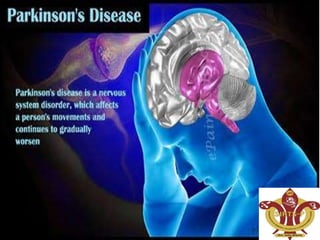
Parkinsan's disease (PD) is typically considered a
chronic, progressive neurodegenerative
movement disorder. Lake of Dopamine is
responsible for the Parkinson's disease.
Dopamine
Dopamine is an amine synthesized by removing a
carboxyl group from a molecule of its precursor
chemical L-DOPA,which is synthesized in the brain
and kidneys.
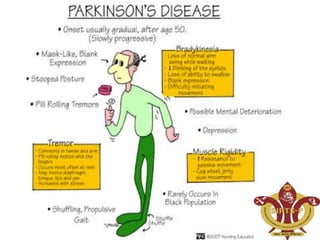
Major symptoms
Tremor
Rigidity
Bradykinesia/akinesia
Postural Instability
Fatigue
Tremor
Rest tremor, easily recognized, is unilateral,
occurs at frequencies between 4 & 6 Hz, is almost
always prominent in distal extremities, and
disappears with action and during sleep.
Supination-pronation (pillrolling) tremor spread
from one hand to the other. Rest tremor can also
involve the lips, chin, jaw and legs. The neck,
head, or voice are usually uninvolved.
Rigidity
Rigidity is increased resistance, usually
demonstrated by the cogwheel phenomenon
circular jerking rigidity in flexion and extension in
a background of tremor, which continues
throughout an entire range of movement. It can
be painful, and painful shoulder is one of PD's
most frequent initial manifestations. Rigidity of
the neck and trunk may cause postural
deformities, generally late in the disease.
Bradykinesia
Bradykinesia, or slow movement, is PD's most
characteristics clinical feature. Initially, it creates
difficulty with ordinary activities and slow
movement and reaction times. Eventually,
patients become frozen and cannot gesture, drool
because of impaired swallowing, loose facial
expression. Bradykinesia appears to be related to
degree of dopamine deficiency.
Postural Instability
Postural instability occurs as the patient loses
postural reflexes, often at the late stage of PD'S.
Postural instability frequently causes falls, many
of which lead to hip fractures.
Causes
Idiopathic
Genetic
Drug induced
Toxins
Head Trauma
Cerebral Anoxia
Pathophysiology
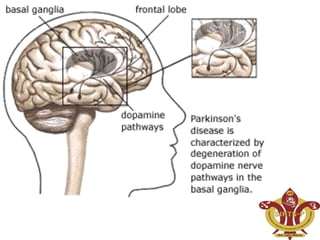
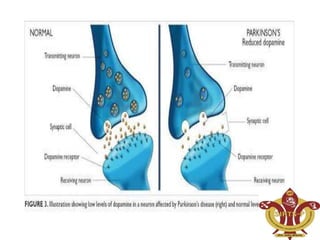
Decreased stimulation of the motor cortex by the
basal ganglia, usually due to the madequate
production and action of dopamine.
The specific region affected seems to be the pars
compact in the substantia nigra where there is a
marked loss in dopaminergic cells.
High presence of lewy bodies in dopaminergic
cells.
Pathophysiology
Loss of dopaminergic neurones in the substantia
nigra and appearance of eosinophilic inclusion
bodies (Lewy bodies)
Parkinson's disease & pathophysiology

Parkinson's disease & pathophysiology

  • 1.
    By : Subhamkumar vishwakarma B. PHARM
  • 3.
    PARKINSON'S DISEASE Parkinsan's disease(PD) is typically considered a chronic, progressive neurodegenerative movement disorder. Lake of Dopamine is responsible for the Parkinson's disease.
  • 5.
    Dopamine Dopamine is anamine synthesized by removing a carboxyl group from a molecule of its precursor chemical L-DOPA,which is synthesized in the brain and kidneys.
  • 6.
  • 7.
    Tremor Rest tremor, easilyrecognized, is unilateral, occurs at frequencies between 4 & 6 Hz, is almost always prominent in distal extremities, and disappears with action and during sleep. Supination-pronation (pillrolling) tremor spread from one hand to the other. Rest tremor can also involve the lips, chin, jaw and legs. The neck, head, or voice are usually uninvolved.
  • 8.
    Rigidity Rigidity is increasedresistance, usually demonstrated by the cogwheel phenomenon circular jerking rigidity in flexion and extension in a background of tremor, which continues throughout an entire range of movement. It can be painful, and painful shoulder is one of PD's most frequent initial manifestations. Rigidity of the neck and trunk may cause postural deformities, generally late in the disease.
  • 9.
    Bradykinesia Bradykinesia, or slowmovement, is PD's most characteristics clinical feature. Initially, it creates difficulty with ordinary activities and slow movement and reaction times. Eventually, patients become frozen and cannot gesture, drool because of impaired swallowing, loose facial expression. Bradykinesia appears to be related to degree of dopamine deficiency.
  • 10.
    Postural Instability Postural instabilityoccurs as the patient loses postural reflexes, often at the late stage of PD'S. Postural instability frequently causes falls, many of which lead to hip fractures.
  • 12.
  • 13.
    Pathophysiology Decreased stimulation ofthe motor cortex by the basal ganglia, usually due to the madequate production and action of dopamine. The specific region affected seems to be the pars compact in the substantia nigra where there is a marked loss in dopaminergic cells. High presence of lewy bodies in dopaminergic cells.
  • 14.
    Pathophysiology Loss of dopaminergicneurones in the substantia nigra and appearance of eosinophilic inclusion bodies (Lewy bodies)