A Locality Sensitive Hashing Filter
 for Encrypted Vector Databases
           Junpei Kawamoto
     (University of Tsukuba, Japan)


         This work is partly supported by The Nakajima Foundation
Dec. 4, 2012            A Locality Sensitive Hashing Filter for Encrypted Vector Databases   2


Vector databases
• A kind of databases consists of vectors and values.
  • eg. a picture database

                   feature vector                       picture (value)


               (129, 251, 94, …. )T


               (98, 112, 49, …. )T
Dec. 4, 2012               A Locality Sensitive Hashing Filter for Encrypted Vector Databases   3


Vector databases
• A kind of databases consist of vectors and values.


• Simply assume the scheme is (k, v)
   • k: key vector attribute (feature vector, etc.)
   • v: value attribute (do not care about the data type)


• Queries
  • Only over the key vector attribute.
  • Find tuples having key vectors k s.t. sim(k, q) ≧ α
       • q: query vector
       • α: threshold                                      We employ cosine similarity and
                                                          assume all vectors are normalised.
Dec. 4, 2012              A Locality Sensitive Hashing Filter for Encrypted Vector Databases           4


Vector databases
• A query example.

          Query vector:                              feature vector                  picture (value)
            (129, 251, 90, …. )T
          Threshold:
            0.8                                 (129, 251, 94, …. )T


                (129, 251, 94, …. )T             (98, 112, 49, …. )T
Dec. 4, 2012                 A Locality Sensitive Hashing Filter for Encrypted Vector Databases   5


Cloud sourced vector databases
• A database owner wants to deploy it on a cloud service
  • To share data easily


                                               VDB
                                                                        deploy
                         access

                                                                                          VDB


                 Colleagues                                              Database owner
               (Database user)

   • The owner does not have to manage any servers.
Dec. 4, 2012               A Locality Sensitive Hashing Filter for Encrypted Vector Databases   6


Privacy and security concerns
• Can the owner and the users trust the cloud services?
                                                                 Malicious services can read
 Malicious services can read                                           data in the VDB.
     queries from users.
                                             VDB
                                                                      deploy
                        access

                                                                                        VDB


               Database user                                           Database owner
   • VDB might have sensitive information.
   • Queries (i.e. query vectors) also might be sensitive information.
Dec. 4, 2012                 A Locality Sensitive Hashing Filter for Encrypted Vector Databases   7


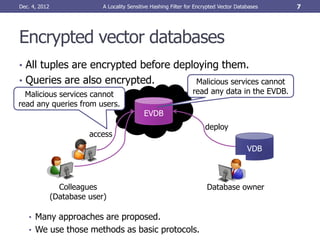
Encrypted vector databases
• All tuples are encrypted before deploying them.
• Queries are also encrypted.                                       Malicious services cannot
  Malicious services cannot                                        read any data in the EVDB.
read any queries from users.
                                              EVDB
                                                                        deploy
                         access
                                                                                          VDB


                 Colleagues                                              Database owner
               (Database user)

   • Many approaches are proposed.
   • We use those methods as basic protocols.
Dec. 4, 2012         A Locality Sensitive Hashing Filter for Encrypted Vector Databases   8


Encrypted vector databases
• All tuples are encrypted before deploying them.
  • Enck: An algorithm to encrypt key vectors
  • Encv: An algorithm to encrypt values
  • A plain tuple (k, v) is encrypted to (Enck(k), Encv(v))


• Queries are also encrypted.
  • Encq: An algorithm to encrypt query vector
  • A query vector q is encrypted to Encq(q)


• An important property of those encryption algorithm
  • Invariance of similarity
  • k・q = Enck(k)・Encq(q) (cosine similarities are same after encryption)
Dec. 4, 2012          A Locality Sensitive Hashing Filter for Encrypted Vector Databases   9


Encrypted vector databases
• Decryption algorithm are also shared in owner and users.
  • Deck: An decryption algorithm for key vectors
  • Decv: An decryption algorithm for values


   • Decryption algorithms for query vectors are not necessary.


• All encryption/decryption algorithms are
  • defined by each existing protocol,
  • secret for servers.        We do not define those algorithms in this work.
Dec. 4, 2012               A Locality Sensitive Hashing Filter for Encrypted Vector Databases   10


Encrypted vector databases
• Malicious cloud services cannot read any data.

       Cannot decrypt any data.


                                            EVDB
  find tuples s.t.                                                   (Enck(k), Encv(v))
Enck(k)・Encq(q) ≧ α

                                                                                        VDB


               Database user
                                                                       Database owner

• Cloud services also cannot optimise query processes.
  • Must compute similarities for all tuples.
Dec. 4, 2012          A Locality Sensitive Hashing Filter for Encrypted Vector Databases   11


The Problem of existing protocols
• Cloud services (servers) must check all tuples.
• Because of encryptions
   • Structures of vectors are not same after encryption
   • Structure based indexing such as R-tree cannot work well


   • Server also cannot cache query results, since cannot know which
      queries are same.


• We introduce a filtering method based on LSH.
  • We focus the fact that even after encryption,
    the similarities are not changed.
  • LSH is a compressed data structure to estimate similarities of vectors.
Dec. 4, 2012             A Locality Sensitive Hashing Filter for Encrypted Vector Databases   12


Locality sensitive hashing (LSH)
• Approximate similarities with small data
• LSH consists of       m functions: hi (I = 1, 2, …, m)
                    1; v・bi ≧ 0
          hi(v) =                             (bi is the base vector of function hi)
                    0; otherwise
• LSH value of a vector v
   • lsh(v) = (h1(v), h2(v), …, hm(v))
• Property
   cos(u, v )  cos( (1  Pr[ lsh (u )  lsh ( v )]))
   • Pr[lsh(u)=lsh(v)]:
      how many hash values of the two vectors u and v have same values
      i.e. hi(u) = hi(v)
Dec. 4, 2012              A Locality Sensitive Hashing Filter for Encrypted Vector Databases             13


Locality sensitive hashing (LSH)
• eg.
                                                                                               b1
   • lsh(u) = (1, 1, 0)                                                            u
   • lsh(v) = (1, 1, 1)
                                                                                         v
   • Pr[lsh(u) = lsh(v)] = 2/3                                                                      b2


   • cos(u, v) 〜 cos(π(1 – 2/3)) = 1/2

                                                                                             b3
• The accuracy of the approximation depends on
  • the number of base vectors m
  • the distribution of target vectors
Dec. 4, 2012         A Locality Sensitive Hashing Filter for Encrypted Vector Databases            14


Locality sensitive hashing (LSH)
• If the distribution of encrypted vectors is lopsided,
  LSH cannot distinguish those vectors efficiently
                        b1 To distinguish v1-v3, additional                               b1 b4
                       v1    base vectors are needed.                                v1
                          v2                                                              v2 b 5
                        v3                                                            v3
                             b2                                                             b2


                        b3                                                            b3

   • In worst case, the number of base vectors m = the number of tuples

• We employ whitening transformation to reduce skew of the
  vector space.
Dec. 4, 2012         A Locality Sensitive Hashing Filter for Encrypted Vector Databases   15


Whitening transformation
• A technique to remove correlations from vectors
  • At first, compute the average vector μ and covariance matrix Σ.

                   S = E((v - m )(v - m ) )                   T


   • Then, decompose Σ.

                   S = FLF-1
   • The whitening matrix Wk is

                   Wk = FL-1/2
Dec. 4, 2012          A Locality Sensitive Hashing Filter for Encrypted Vector Databases   16


Whitening transformation
• For any vector v, the whitened vector vw is
               v w = W (v - m )
                      k
                       T


• The covariance matrix of whitened vectors is

               E(v w vT )
                      w

               = E(WkT (v - m )(v - m )T Wk )
               = E(L -1/2FT SFL -1/2 ) = I
   • there are no correlations between the whitened vectors.
Dec. 4, 2012         A Locality Sensitive Hashing Filter for Encrypted Vector Databases   17


Applying Whitening
• Original protocol (typical EVDB protocols)
  • encrypted vector of k: Enck(k)
  • query condition of q: find Enck(k) s.t. Enck(k)・Encq(q)≧α


• Our proposal protocol           Whitening

  • encrypted vector of k: WkT(Enck(k) – μ)
  • query condition of q:
    find WkT(Enck(k)–μ) s.t. WkT(Enck(k)–μ)・Wk-1Encq(q)≧α–μ・Encq(q)
                                                                          Counter whitening
• The following two conditions are same
   • find Enck(k) s.t. Enck(k)・Encq(q)≧α
   • find WkT(Enck(k)–μ) s.t. WkT(Enck(k)–μ)・Wk-1Encq(q)≧α–μ・Encq(q)
Dec. 4, 2012        A Locality Sensitive Hashing Filter for Encrypted Vector Databases   18


Applying Whitening
• Define wrapped algorithms:
  • Enck*(k) = WkT(Enck(k) – μ)
  • Encq*(q) = Wk-1Encq(q)
  • Deck*(ke) = Deck((WkT)-1ke + μ)


• These algorithms are shared between owner and users.
Dec. 4, 2012          A Locality Sensitive Hashing Filter for Encrypted Vector Databases   19


   Preparing the LSH filter
   • At first, servers add LSH values to all tuples


                                                     converted by the server
deploy by the owner   (Enck*(k), Encv(v))


   VDB                                                      (lsh(Enck*(k)), Enck*(k), Encv(v))


                                                                                server
  Database owner
Dec. 4, 2012               A Locality Sensitive Hashing Filter for Encrypted Vector Databases   20


Preparing the LSH filter
• Make groups by LSH values.


               LSH value                                         tuple
          (1, 0, ……, 0)                       ((1, 0, ….., 0), Enck*(k1), Encv(v1))
                                              ((1, 0, ….., 0), Enck*(k2), Encv(v2))


          (1, 1, ……, 0)                       ((1, 1, ….., 0), Enck*(k1), Encv(v1))
Dec. 4, 2012          A Locality Sensitive Hashing Filter for Encrypted Vector Databases   21


    Filtering
    • After receiving queries, server computes lsh of quey vector

                                            Compute lsh(Encq*(q))


find Enck*(k) s.t.
  Enck*(k)・Encq*(q)≧α*
                                        LSH value                              tuple
                                     (1, 0, ……, 0) ((1, 0, ….., 0), Enck*(k1), Encv(v1))
                                                            ((1, 0, ….., 0), Enck*(k2), Encv(v2))


          Database user
                                     (1, 1, ……, 0) ((1, 1, ….., 0), Enck*(k1), Encv(v1))


where α* = α–μ・Encq(q)
Dec. 4, 2012            A Locality Sensitive Hashing Filter for Encrypted Vector Databases   22


    Filtering
    • After receiving queries, server computes lsh of quey vector

   Estimate similarity between                Compute lsh(Encq*(q))
   Encq*(q) and this group by
  Pr[(1,0,…,0)=lsh(Encq*(q))]
find Enck*(k) s.t.
  Enck*(k)・Encq*(q)≧α*
                                          LSH value                              tuple
                                       (1, 0, ……, 0) ((1, 0, ….., 0), Enck*(k1), Encv(v1))
                                                              ((1, 0, ….., 0), Enck*(k2), Encv(v2))


          Database user
                                       (1, 1, ……, 0) ((1, 1, ….., 0), Enck*(k1), Encv(v1))


 where α* = α–μ・Encq(q)
Dec. 4, 2012            A Locality Sensitive Hashing Filter for Encrypted Vector Databases   23


    Filtering
    • After receiving queries, server computes lsh of quey vector

   Estimate similarity between                Compute lsh(Encq*(q))
   Encq*(q) and this group by
  Pr[(1,0,…,0)=lsh(Encq*(q))]
find Enck*(k) s.t.
  Enck*(k)・Encq*(q)≧α*
                                          LSH value                              tuple
                                       (1, 0, ……, 0) ((1, 0, ….., 0), Enck*(k1), Encv(v1))
  If the estimated similarity <α*,                            ((1, 0, ….., 0), Enck*(k2), Encv(v2))
           skip this group
          Database user
                                       (1, 1, ……, 0) ((1, 1, ….., 0), Enck*(k1), Encv(v1))


 where α* = α–μ・Encq(q)
Dec. 4, 2012            A Locality Sensitive Hashing Filter for Encrypted Vector Databases   24


    Filtering
    • After receiving queries, server computes lsh of quey vector

   Estimate similarity between                Compute lsh(Encq*(q))
   Encq*(q) and this group by
  Pr[(1,1,…,0)=lsh(Encq*(q))]
find Enck*(k) s.t.
  Enck*(k)・Encq*(q)≧α*
                                          LSH value                              tuple
                                       (1, 0, ……, 0) ((1, 0, ….., 0), Enck*(k1), Encv(v1))
                                                              ((1, 0, ….., 0), Enck*(k2), Encv(v2))


          Database user
                                       (1, 1, ……, 0) ((1, 1, ….., 0), Enck*(k1), Encv(v1))


 where α* = α–μ・Encq(q)
Dec. 4, 2012            A Locality Sensitive Hashing Filter for Encrypted Vector Databases   25


    Filtering
    • After receiving queries, server computes lsh of quey vector

   Estimate similarity between                Compute lsh(Encq*(q))
   Encq*(q) and this group by
  Pr[(1,1,…,0)=lsh(Encq*(q))]
find Enck*(k) s.t.
  Enck*(k)・Encq*(q)≧α*
                                          LSH value                              tuple
                                       (1, 0, ……, 0) ((1, 0, ….., 0), Enck*(k1), Encv(v1))
  If the estimated similarity ≧α*,
                                                              ((1, 0, ….., 0), Enck*(k2), Encv(v2))
 check the actual query condition
      for all tuples in this group
           Database user
                                       (1, 1, ……, 0) ((1, 1, ….., 0), Enck*(k1), Encv(v1))


 where α* = α–μ・Encq(q)
Dec. 4, 2012               A Locality Sensitive Hashing Filter for Encrypted Vector Databases   26


    Filtering
    • After receiving queries, server computes lsh of quey vector

   Estimate similarity between                   Compute lsh(Encq*(q))
   Encq*(q) and this group by
  Pr[(1,1,…,0)=lsh(Encq*(q))]
find Enck*(k) s.t.
  Enck*(k)・Encq*(q)≧α*
                                             LSH value                              tuple
                                          (1, 0, ……, 0) ((1, 0, ….., 0), Enck*(k1), Encv(v1))
  If the estimated similarity ≧α*,
                                                                 ((1, 0, ….., 0), Compute), Encv(v2))
                                                                                  Enck*(k2
 check the actual query condition
      for all tuples in this group                                           Enck*(k)・Encq*(q)
           Database user
                                          (1, 1, ……, 0) ((1, 1, ….., 0), Enck*(k1), Encv(v1))


                  We can omit to computing similarity for less similar vectors
 where   α*   = α–μ・Encq(q)
Dec. 4, 2012          A Locality Sensitive Hashing Filter for Encrypted Vector Databases   27


Summary of our methodology
• Client side
  • Use Enck*(k), Encq*(q), and Deck*(ke)
  • instead of original algorithms defined by the associated protocol.


   • Use query conditions Enck*(k)・Encq*(q) ≧ α – μ・Encq(q)


• Server side
   • Add LSH values all tuples
   • Filter to less similar vectors using LSH values.
Dec. 4, 2012         A Locality Sensitive Hashing Filter for Encrypted Vector Databases   28


Experimental evaluations
• Effectiveness of whitening transformation.


• Recall of query results.
  • Our filter uses approximation of LSH
  • So that query results have errors.


• Query processing time.
Dec. 4, 2012            A Locality Sensitive Hashing Filter for Encrypted Vector Databases   29


Effectiveness of whitening transformation
• Comparing
  • how many different LSH values exist. (size)
  • how many vectors has same LSH values. (min, max)

                                                                 (the number of tuples = 10000)
    with whitening transformation                       without whitening transformation
Dec. 4, 2012              A Locality Sensitive Hashing Filter for Encrypted Vector Databases   30


Effectiveness of whitening transformation
• Comparing
  • how many different LSH values exist. (size)
  • how many vectors has same LSH values. (min, max)

                                                                  (the number of tuples = 100000)
    with whitening transformation                         without whitening transformation


       LSH filter can distinguish                              There is only one LSH value,
         key vectors minutely.                                 which means LSH filter
                                                               doesn’t work.
Dec. 4, 2012              A Locality Sensitive Hashing Filter for Encrypted Vector Databases   31


Effectiveness of whitening transformation
• Comparing
  • how many different LSH values exist. (size)
  • how many vectors has same LSH values. (min, max)
 In all cases, min. = 1                                           (the number of tuples = 100000)
    with whitening transformation                         without whitening transformation


   bigger m provides well
      distinguishability.                                                  almost vectors has the
                                                                              same LSH value.
Dec. 4, 2012     A Locality Sensitive Hashing Filter for Encrypted Vector Databases   32


Recall of query results
• Recalls depend on the number of base vectors
• Much base vectors achieves higher recalls.


                                                            (the number of tuples = 10000)
Dec. 4, 2012                              A Locality Sensitive Hashing Filter for Encrypted Vector Databases   33


    Query processing time
    • Calculate query processing times on an IPP EVDB.
      • IPP EVDB is a encrypted vector database†.
      • We omit the detail of IPP EVDB and the x-axis of the following fig.
                     time (sec) (log scale)


                                                                                       (the number of tuples = 100000)
†J. Kawamoto, M. Yoshikawa: Private Range Query by Perturbation and Matrix Based Encryption. In
Proc. of the 6th IEEE International Conf. on Digital Information Management, pp. 211–216. (2011)
Dec. 4, 2012                              A Locality Sensitive Hashing Filter for Encrypted Vector Databases   34


    Query processing time
    • Calculate query processing times on an IPP EVDB.
      • IPP EVDB is a encrypted vector database†.
      • We omit the detail of IPP EVDB and the x-axis of the following fig.

 We can reduce query
 processing time
                     time (sec) (log scale)


                                                                         m = 128 (recall = 0.6)


                                                                                       (the number of tuples = 100000)
†J. Kawamoto, M. Yoshikawa: Private Range Query by Perturbation and Matrix Based Encryption. In
Proc. of the 6th IEEE International Conf. on Digital Information Management, pp. 211–216. (2011)
Dec. 4, 2012         A Locality Sensitive Hashing Filter for Encrypted Vector Databases     35


Conclusion and future work
• Introduce a filtering methodology for EVDBs based on
   • locality sensitive hashing (LSH)
   • whitening transformation


• Our filter uses an approximation
  • Query results may have false negative errors
  • Applicable when users aren’t expecting perfect query results
  • We will modify our filter to increase the accuracy of query results


                                                                                      Thank you!

A Locality Sensitive Hashing Filter for Encrypted Vector Databases

  • 1.
    A Locality SensitiveHashing Filter for Encrypted Vector Databases Junpei Kawamoto (University of Tsukuba, Japan) This work is partly supported by The Nakajima Foundation
  • 2.
    Dec. 4, 2012 A Locality Sensitive Hashing Filter for Encrypted Vector Databases 2 Vector databases • A kind of databases consists of vectors and values. • eg. a picture database feature vector picture (value) (129, 251, 94, …. )T (98, 112, 49, …. )T
  • 3.
    Dec. 4, 2012 A Locality Sensitive Hashing Filter for Encrypted Vector Databases 3 Vector databases • A kind of databases consist of vectors and values. • Simply assume the scheme is (k, v) • k: key vector attribute (feature vector, etc.) • v: value attribute (do not care about the data type) • Queries • Only over the key vector attribute. • Find tuples having key vectors k s.t. sim(k, q) ≧ α • q: query vector • α: threshold We employ cosine similarity and assume all vectors are normalised.
  • 4.
    Dec. 4, 2012 A Locality Sensitive Hashing Filter for Encrypted Vector Databases 4 Vector databases • A query example. Query vector: feature vector picture (value) (129, 251, 90, …. )T Threshold: 0.8 (129, 251, 94, …. )T (129, 251, 94, …. )T (98, 112, 49, …. )T
  • 5.
    Dec. 4, 2012 A Locality Sensitive Hashing Filter for Encrypted Vector Databases 5 Cloud sourced vector databases • A database owner wants to deploy it on a cloud service • To share data easily VDB deploy access VDB Colleagues Database owner (Database user) • The owner does not have to manage any servers.
  • 6.
    Dec. 4, 2012 A Locality Sensitive Hashing Filter for Encrypted Vector Databases 6 Privacy and security concerns • Can the owner and the users trust the cloud services? Malicious services can read Malicious services can read data in the VDB. queries from users. VDB deploy access VDB Database user Database owner • VDB might have sensitive information. • Queries (i.e. query vectors) also might be sensitive information.
  • 7.
    Dec. 4, 2012 A Locality Sensitive Hashing Filter for Encrypted Vector Databases 7 Encrypted vector databases • All tuples are encrypted before deploying them. • Queries are also encrypted. Malicious services cannot Malicious services cannot read any data in the EVDB. read any queries from users. EVDB deploy access VDB Colleagues Database owner (Database user) • Many approaches are proposed. • We use those methods as basic protocols.
  • 8.
    Dec. 4, 2012 A Locality Sensitive Hashing Filter for Encrypted Vector Databases 8 Encrypted vector databases • All tuples are encrypted before deploying them. • Enck: An algorithm to encrypt key vectors • Encv: An algorithm to encrypt values • A plain tuple (k, v) is encrypted to (Enck(k), Encv(v)) • Queries are also encrypted. • Encq: An algorithm to encrypt query vector • A query vector q is encrypted to Encq(q) • An important property of those encryption algorithm • Invariance of similarity • k・q = Enck(k)・Encq(q) (cosine similarities are same after encryption)
  • 9.
    Dec. 4, 2012 A Locality Sensitive Hashing Filter for Encrypted Vector Databases 9 Encrypted vector databases • Decryption algorithm are also shared in owner and users. • Deck: An decryption algorithm for key vectors • Decv: An decryption algorithm for values • Decryption algorithms for query vectors are not necessary. • All encryption/decryption algorithms are • defined by each existing protocol, • secret for servers. We do not define those algorithms in this work.
  • 10.
    Dec. 4, 2012 A Locality Sensitive Hashing Filter for Encrypted Vector Databases 10 Encrypted vector databases • Malicious cloud services cannot read any data. Cannot decrypt any data. EVDB find tuples s.t. (Enck(k), Encv(v)) Enck(k)・Encq(q) ≧ α VDB Database user Database owner • Cloud services also cannot optimise query processes. • Must compute similarities for all tuples.
  • 11.
    Dec. 4, 2012 A Locality Sensitive Hashing Filter for Encrypted Vector Databases 11 The Problem of existing protocols • Cloud services (servers) must check all tuples. • Because of encryptions • Structures of vectors are not same after encryption • Structure based indexing such as R-tree cannot work well • Server also cannot cache query results, since cannot know which queries are same. • We introduce a filtering method based on LSH. • We focus the fact that even after encryption, the similarities are not changed. • LSH is a compressed data structure to estimate similarities of vectors.
  • 12.
    Dec. 4, 2012 A Locality Sensitive Hashing Filter for Encrypted Vector Databases 12 Locality sensitive hashing (LSH) • Approximate similarities with small data • LSH consists of m functions: hi (I = 1, 2, …, m) 1; v・bi ≧ 0 hi(v) = (bi is the base vector of function hi) 0; otherwise • LSH value of a vector v • lsh(v) = (h1(v), h2(v), …, hm(v)) • Property cos(u, v )  cos( (1  Pr[ lsh (u )  lsh ( v )])) • Pr[lsh(u)=lsh(v)]: how many hash values of the two vectors u and v have same values i.e. hi(u) = hi(v)
  • 13.
    Dec. 4, 2012 A Locality Sensitive Hashing Filter for Encrypted Vector Databases 13 Locality sensitive hashing (LSH) • eg. b1 • lsh(u) = (1, 1, 0) u • lsh(v) = (1, 1, 1) v • Pr[lsh(u) = lsh(v)] = 2/3 b2 • cos(u, v) 〜 cos(π(1 – 2/3)) = 1/2 b3 • The accuracy of the approximation depends on • the number of base vectors m • the distribution of target vectors
  • 14.
    Dec. 4, 2012 A Locality Sensitive Hashing Filter for Encrypted Vector Databases 14 Locality sensitive hashing (LSH) • If the distribution of encrypted vectors is lopsided, LSH cannot distinguish those vectors efficiently b1 To distinguish v1-v3, additional b1 b4 v1 base vectors are needed. v1 v2 v2 b 5 v3 v3 b2 b2 b3 b3 • In worst case, the number of base vectors m = the number of tuples • We employ whitening transformation to reduce skew of the vector space.
  • 15.
    Dec. 4, 2012 A Locality Sensitive Hashing Filter for Encrypted Vector Databases 15 Whitening transformation • A technique to remove correlations from vectors • At first, compute the average vector μ and covariance matrix Σ. S = E((v - m )(v - m ) ) T • Then, decompose Σ. S = FLF-1 • The whitening matrix Wk is Wk = FL-1/2
  • 16.
    Dec. 4, 2012 A Locality Sensitive Hashing Filter for Encrypted Vector Databases 16 Whitening transformation • For any vector v, the whitened vector vw is v w = W (v - m ) k T • The covariance matrix of whitened vectors is E(v w vT ) w = E(WkT (v - m )(v - m )T Wk ) = E(L -1/2FT SFL -1/2 ) = I • there are no correlations between the whitened vectors.
  • 17.
    Dec. 4, 2012 A Locality Sensitive Hashing Filter for Encrypted Vector Databases 17 Applying Whitening • Original protocol (typical EVDB protocols) • encrypted vector of k: Enck(k) • query condition of q: find Enck(k) s.t. Enck(k)・Encq(q)≧α • Our proposal protocol Whitening • encrypted vector of k: WkT(Enck(k) – μ) • query condition of q: find WkT(Enck(k)–μ) s.t. WkT(Enck(k)–μ)・Wk-1Encq(q)≧α–μ・Encq(q) Counter whitening • The following two conditions are same • find Enck(k) s.t. Enck(k)・Encq(q)≧α • find WkT(Enck(k)–μ) s.t. WkT(Enck(k)–μ)・Wk-1Encq(q)≧α–μ・Encq(q)
  • 18.
    Dec. 4, 2012 A Locality Sensitive Hashing Filter for Encrypted Vector Databases 18 Applying Whitening • Define wrapped algorithms: • Enck*(k) = WkT(Enck(k) – μ) • Encq*(q) = Wk-1Encq(q) • Deck*(ke) = Deck((WkT)-1ke + μ) • These algorithms are shared between owner and users.
  • 19.
    Dec. 4, 2012 A Locality Sensitive Hashing Filter for Encrypted Vector Databases 19 Preparing the LSH filter • At first, servers add LSH values to all tuples converted by the server deploy by the owner (Enck*(k), Encv(v)) VDB (lsh(Enck*(k)), Enck*(k), Encv(v)) server Database owner
  • 20.
    Dec. 4, 2012 A Locality Sensitive Hashing Filter for Encrypted Vector Databases 20 Preparing the LSH filter • Make groups by LSH values. LSH value tuple (1, 0, ……, 0) ((1, 0, ….., 0), Enck*(k1), Encv(v1)) ((1, 0, ….., 0), Enck*(k2), Encv(v2)) (1, 1, ……, 0) ((1, 1, ….., 0), Enck*(k1), Encv(v1))
  • 21.
    Dec. 4, 2012 A Locality Sensitive Hashing Filter for Encrypted Vector Databases 21 Filtering • After receiving queries, server computes lsh of quey vector Compute lsh(Encq*(q)) find Enck*(k) s.t. Enck*(k)・Encq*(q)≧α* LSH value tuple (1, 0, ……, 0) ((1, 0, ….., 0), Enck*(k1), Encv(v1)) ((1, 0, ….., 0), Enck*(k2), Encv(v2)) Database user (1, 1, ……, 0) ((1, 1, ….., 0), Enck*(k1), Encv(v1)) where α* = α–μ・Encq(q)
  • 22.
    Dec. 4, 2012 A Locality Sensitive Hashing Filter for Encrypted Vector Databases 22 Filtering • After receiving queries, server computes lsh of quey vector Estimate similarity between Compute lsh(Encq*(q)) Encq*(q) and this group by Pr[(1,0,…,0)=lsh(Encq*(q))] find Enck*(k) s.t. Enck*(k)・Encq*(q)≧α* LSH value tuple (1, 0, ……, 0) ((1, 0, ….., 0), Enck*(k1), Encv(v1)) ((1, 0, ….., 0), Enck*(k2), Encv(v2)) Database user (1, 1, ……, 0) ((1, 1, ….., 0), Enck*(k1), Encv(v1)) where α* = α–μ・Encq(q)
  • 23.
    Dec. 4, 2012 A Locality Sensitive Hashing Filter for Encrypted Vector Databases 23 Filtering • After receiving queries, server computes lsh of quey vector Estimate similarity between Compute lsh(Encq*(q)) Encq*(q) and this group by Pr[(1,0,…,0)=lsh(Encq*(q))] find Enck*(k) s.t. Enck*(k)・Encq*(q)≧α* LSH value tuple (1, 0, ……, 0) ((1, 0, ….., 0), Enck*(k1), Encv(v1)) If the estimated similarity <α*, ((1, 0, ….., 0), Enck*(k2), Encv(v2)) skip this group Database user (1, 1, ……, 0) ((1, 1, ….., 0), Enck*(k1), Encv(v1)) where α* = α–μ・Encq(q)
  • 24.
    Dec. 4, 2012 A Locality Sensitive Hashing Filter for Encrypted Vector Databases 24 Filtering • After receiving queries, server computes lsh of quey vector Estimate similarity between Compute lsh(Encq*(q)) Encq*(q) and this group by Pr[(1,1,…,0)=lsh(Encq*(q))] find Enck*(k) s.t. Enck*(k)・Encq*(q)≧α* LSH value tuple (1, 0, ……, 0) ((1, 0, ….., 0), Enck*(k1), Encv(v1)) ((1, 0, ….., 0), Enck*(k2), Encv(v2)) Database user (1, 1, ……, 0) ((1, 1, ….., 0), Enck*(k1), Encv(v1)) where α* = α–μ・Encq(q)
  • 25.
    Dec. 4, 2012 A Locality Sensitive Hashing Filter for Encrypted Vector Databases 25 Filtering • After receiving queries, server computes lsh of quey vector Estimate similarity between Compute lsh(Encq*(q)) Encq*(q) and this group by Pr[(1,1,…,0)=lsh(Encq*(q))] find Enck*(k) s.t. Enck*(k)・Encq*(q)≧α* LSH value tuple (1, 0, ……, 0) ((1, 0, ….., 0), Enck*(k1), Encv(v1)) If the estimated similarity ≧α*, ((1, 0, ….., 0), Enck*(k2), Encv(v2)) check the actual query condition for all tuples in this group Database user (1, 1, ……, 0) ((1, 1, ….., 0), Enck*(k1), Encv(v1)) where α* = α–μ・Encq(q)
  • 26.
    Dec. 4, 2012 A Locality Sensitive Hashing Filter for Encrypted Vector Databases 26 Filtering • After receiving queries, server computes lsh of quey vector Estimate similarity between Compute lsh(Encq*(q)) Encq*(q) and this group by Pr[(1,1,…,0)=lsh(Encq*(q))] find Enck*(k) s.t. Enck*(k)・Encq*(q)≧α* LSH value tuple (1, 0, ……, 0) ((1, 0, ….., 0), Enck*(k1), Encv(v1)) If the estimated similarity ≧α*, ((1, 0, ….., 0), Compute), Encv(v2)) Enck*(k2 check the actual query condition for all tuples in this group Enck*(k)・Encq*(q) Database user (1, 1, ……, 0) ((1, 1, ….., 0), Enck*(k1), Encv(v1)) We can omit to computing similarity for less similar vectors where α* = α–μ・Encq(q)
  • 27.
    Dec. 4, 2012 A Locality Sensitive Hashing Filter for Encrypted Vector Databases 27 Summary of our methodology • Client side • Use Enck*(k), Encq*(q), and Deck*(ke) • instead of original algorithms defined by the associated protocol. • Use query conditions Enck*(k)・Encq*(q) ≧ α – μ・Encq(q) • Server side • Add LSH values all tuples • Filter to less similar vectors using LSH values.
  • 28.
    Dec. 4, 2012 A Locality Sensitive Hashing Filter for Encrypted Vector Databases 28 Experimental evaluations • Effectiveness of whitening transformation. • Recall of query results. • Our filter uses approximation of LSH • So that query results have errors. • Query processing time.
  • 29.
    Dec. 4, 2012 A Locality Sensitive Hashing Filter for Encrypted Vector Databases 29 Effectiveness of whitening transformation • Comparing • how many different LSH values exist. (size) • how many vectors has same LSH values. (min, max) (the number of tuples = 10000) with whitening transformation without whitening transformation
  • 30.
    Dec. 4, 2012 A Locality Sensitive Hashing Filter for Encrypted Vector Databases 30 Effectiveness of whitening transformation • Comparing • how many different LSH values exist. (size) • how many vectors has same LSH values. (min, max) (the number of tuples = 100000) with whitening transformation without whitening transformation LSH filter can distinguish There is only one LSH value, key vectors minutely. which means LSH filter doesn’t work.
  • 31.
    Dec. 4, 2012 A Locality Sensitive Hashing Filter for Encrypted Vector Databases 31 Effectiveness of whitening transformation • Comparing • how many different LSH values exist. (size) • how many vectors has same LSH values. (min, max) In all cases, min. = 1 (the number of tuples = 100000) with whitening transformation without whitening transformation bigger m provides well distinguishability. almost vectors has the same LSH value.
  • 32.
    Dec. 4, 2012 A Locality Sensitive Hashing Filter for Encrypted Vector Databases 32 Recall of query results • Recalls depend on the number of base vectors • Much base vectors achieves higher recalls. (the number of tuples = 10000)
  • 33.
    Dec. 4, 2012 A Locality Sensitive Hashing Filter for Encrypted Vector Databases 33 Query processing time • Calculate query processing times on an IPP EVDB. • IPP EVDB is a encrypted vector database†. • We omit the detail of IPP EVDB and the x-axis of the following fig. time (sec) (log scale) (the number of tuples = 100000) †J. Kawamoto, M. Yoshikawa: Private Range Query by Perturbation and Matrix Based Encryption. In Proc. of the 6th IEEE International Conf. on Digital Information Management, pp. 211–216. (2011)
  • 34.
    Dec. 4, 2012 A Locality Sensitive Hashing Filter for Encrypted Vector Databases 34 Query processing time • Calculate query processing times on an IPP EVDB. • IPP EVDB is a encrypted vector database†. • We omit the detail of IPP EVDB and the x-axis of the following fig. We can reduce query processing time time (sec) (log scale) m = 128 (recall = 0.6) (the number of tuples = 100000) †J. Kawamoto, M. Yoshikawa: Private Range Query by Perturbation and Matrix Based Encryption. In Proc. of the 6th IEEE International Conf. on Digital Information Management, pp. 211–216. (2011)
  • 35.
    Dec. 4, 2012 A Locality Sensitive Hashing Filter for Encrypted Vector Databases 35 Conclusion and future work • Introduce a filtering methodology for EVDBs based on • locality sensitive hashing (LSH) • whitening transformation • Our filter uses an approximation • Query results may have false negative errors • Applicable when users aren’t expecting perfect query results • We will modify our filter to increase the accuracy of query results Thank you!