Exams
Sunday, 18 September 2011
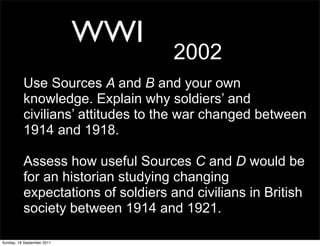
WWI
                                    2002
          Use Sources A and B and your own
          knowledge. Explain why soldiers’ and
          civilians’ attitudes to the war changed between
          1914 and 1918.

          Assess how useful Sources C and D would be
          for an historian studying changing
          expectations of soldiers and civilians in British
          society between 1914 and 1921.

Sunday, 18 September 2011
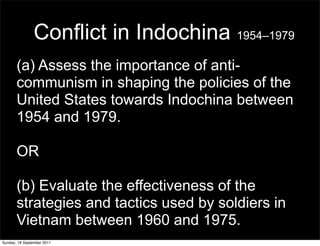
Conflict in Indochina 1954–1979
       (a) Assess the importance of anti-
       communism in shaping the policies of the
       United States towards Indochina between
       1954 and 1979.

       OR

       (b) Evaluate the effectiveness of the
       strategies and tactics used by soldiers in
       Vietnam between 1960 and 1975.
Sunday, 18 September 2011
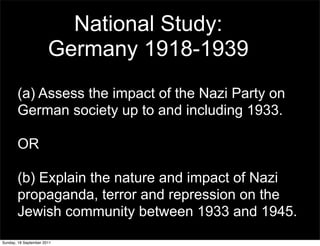
National Study:
                       Germany 1918-1939
       (a) Assess the impact of the Nazi Party on
       German society up to and including 1933.

       OR

       (b) Explain the nature and impact of Nazi
       propaganda, terror and repression on the
       Jewish community between 1933 and 1945.
Sunday, 18 September 2011
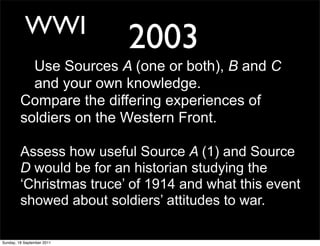
WWI
                            2003
           Use Sources A (one or both), B and C
           and your own knowledge.
         Compare the differing experiences of
         soldiers on the Western Front.

         Assess how useful Source A (1) and Source
         D would be for an historian studying the
         ‘Christmas truce’ of 1914 and what this event
         showed about soldiers’ attitudes to war.

Sunday, 18 September 2011
Conflict in Indochina 1954–1979

         (a) Discuss the significance of the 1964 Gulf
         of Tonkin incident in the growth of US
         intervention in Vietnam in the period 1954–
         1968.

         OR

         (b) Assess the impact the spread of conflict
         from Vietnam had on Cambodia in the period
         up to 1979.
Sunday, 18 September 2011
National Study:
                       Germany 1918-1939
         (a) Discuss the impact of the Depression on
         democracy in Germany in the period up to
         1934.

         OR

         (b) Evaluate the success of the Nazi Party in
         transforming Germany into a Nazi society in
         the period 1933–1945.
Sunday, 18 September 2011
2004
                            WWI
               Account for the different goals of the Big Three Allied
               leaders at the Paris Peace Conference.
               Use Sources A and B and your own knowledge to
               answer this question.

               Assess how useful Sources C and D would be for an
               historian studying peacemaking during World War I.


Sunday, 18 September 2011
Conflict in Indochina 1954–1979
         (a) Evaluate the view that North Vietnam’s
         determination to spread communism in
         Indochina caused the failure of the Geneva
         Peace Agreement by the 1960s.
         OR
         (b) To what extent were the Vietcong
         responsible for the withdrawal of the United
         States from Vietnam and the eventual defeat of
         the South Vietnamese forces in
         the period 1968–1975?

Sunday, 18 September 2011
National Study:
              Germany 1918-1939
       (a) Assess the view that the collapse of the Weimar
       Republic was primarily due to the appeal of Hitler
       and his Nazi Party.

       OR

       (b) Evaluate the significance of the Battle of
       Stalingrad in 1943 for the military defeat and
       collapse of Nazism in 1945.

Sunday, 18 September 2011
WWI                   2005
         How significant was the Battle of the Somme in
         attempts to break the stalemate on the Western
         Front?


         Assess how useful Sources C and D would be for
         a historian studying the nature of trench warfare
         during World War I.


Sunday, 18 September 2011
Conflict in Indochina 1954–1979
       (a) To what extent were anti-war movements
       responsible for the American decision to
       withdraw from Vietnam in 1973?

       OR

       (b) Evaluate the view that US intervention was
       primarily responsible for the suffering of
       villagers in South Vietnam and Cambodia.


Sunday, 18 September 2011
National Study:
                       Germany 1918-1939
        (a) Assess the impact of conservative
        parties and elites on German politics in the
        period 1918–1934.

        OR

        (b) Evaluate the view that Germany was a
        totalitarian society in the period 1933–
        1945.
Sunday, 18 September 2011
2006
                    WWI
             Explain why US entry into World War I
             proved to be the most significant of the
             war’s turning points

             Assess how useful Sources C and D would
             be for an historian studying the impact of
             total war on the home fronts during World
             War I.


Sunday, 18 September 2011
Conflict in Indochina 1954–1979

        Evaluate the view that an inability to separate
        nationalism from communism dominated US
        policy towards Indochina in the period 1954–1968.


Assess the significance of the 1968 Tet Offensive as
part of North Vietnam’s strategy in achieving victory
in the Second Indochina War.


Sunday, 18 September 2011
National Study:
                       Germany 1918-1939
       Assess the importance of nationalism as a
       cause of the failure of democracy in Germany
       in the period 1918–1934.

       OR

       To what extent was Hitler responsible for the
       development and implementation of Nazi
       racist policies in Germany in the period to
       1939?
Sunday, 18 September 2011
Personality 20th C
        a) Outline the main features in the
        background and rise to prominence of the
        twentieth-century personality you have
        studied.

        (b) To what extent does history present us
        with a balanced interpretation of this
        personality?

Sunday, 18 September 2011
2007
                     WWI
       To what extent was the failure of Ludendorff’s
       Offensive responsible for Allied victory and
       the German collapse?

       Assess how useful Sources C and D would
       be for a historian studying the changing
       attitudes of Allied and German soldiers to the
       war.

Sunday, 18 September 2011
National Study:
                       Germany 1918-1939
    Explain how and why German social and
    cultural life changed in the period1923–
    1939.

    OR

    Assess the impact of Nazism on German
    foreign policy in the period 1933–1939.

Sunday, 18 September 2011
Personality 20th C
      (a) Describe the role played by the
      personality you have studied in national
      AND/OR international history.

      (b) ‘Events shape people more than
      people shape events.’
      How accurate is this statement in relation
      to the personality you have studied?

Sunday, 18 September 2011
Conflict in Indochina 1954–1979
               Assess the consequences of the Vietnamese
               victory against the French for in the period
               1954–1964.

               OR

               To what extent was the rise to power of Pol
               Pot’s regime a consequence of the spread of
               the Vietnam War to Cambodia?


Sunday, 18 September 2011
2008
                  WWI
    Assess the impact of tactics using new weapons in
    attempts to break the stalemate on the Western
    Front.

    Assess how useful Sources C and D would be for a
    historian studying the variety of attitudes to the war
    on the home fronts and how they changed over time
    in Britain and Germany.


Sunday, 18 September 2011
National Study:
                            Germany 1918-1939
        Account for the successes and failures of
        democracy in Germany in the period 1918–
        1933.

        OR

        To what extent can Nazism in power be
        seen as totalitarianism in the period 1933–
        1939?
Sunday, 18 September 2011
Personality 20th C
       Describe the personal background and the
       historical context of the personality you have
       studied.

       (b)‘History is about winners.’
       How accurate is this statement in relation to
       the personality you have studied?


Sunday, 18 September 2011
Conflict in Indochina 1954–1979

    To what extent was US involvement responsible
    for the ongoing conflict in Indochina in the
    period 1954–1979?

    OR

    Evaluate the view that the impact of war on
    civilians in Indochina was responsible for
    communist victory in the period 1968–1979.

Sunday, 18 September 2011
2009
                  WWI
          Explain why there was a stalemate on the
          Western Front by the end of 1914.

          Assess how useful Sources C and D would
          be for a historian studying the impact of
          World War I on women’s lives and
          experiences in Britain.


Sunday, 18 September 2011
National Study:
                            Germany 1918-1939
        To what extent did weaknesses in the Weimar
        Republic account for the growth and rise to
        power of the Nazi Party to 1933?

        OR

        Assess the impact of Nazi propaganda, terror
        and repression on the German people from 1933
        to 1939.

Sunday, 18 September 2011
Personality 20th C
      Outline the life of the personality you
      have studied.

      (b) ‘Individuals are products of their
      times.’
      How accurate is this statement in relation
      to the personality you have studied?


Sunday, 18 September 2011
Conflict in Indochina 1954–1979
     Assess the importance of the Geneva
     Peace Agreement to developments within
     North and South Vietnam to 1964.

     OR

     To what extent were the anti-war
     movements in the United States responsible
     for communist victory in the Second
     Indochina War?
Sunday, 18 September 2011
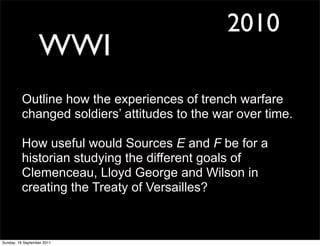
2010
                  WWI
          Outline how the experiences of trench warfare
          changed soldiers’ attitudes to the war over time.

          How useful would Sources E and F be for a
          historian studying the different goals of
          Clemenceau, Lloyd George and Wilson in
          creating the Treaty of Versailles?


Sunday, 18 September 2011
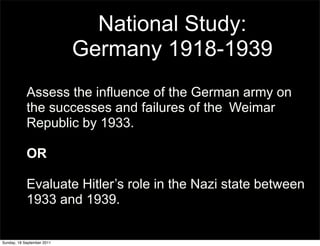
National Study:
                            Germany 1918-1939
            Assess the influence of the German army on
            the successes and failures of the Weimar
            Republic by 1933.

            OR

            Evaluate Hitler’s role in the Nazi state between
            1933 and 1939.

Sunday, 18 September 2011
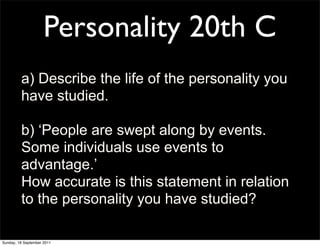
Personality 20th C
         a) Describe the life of the personality you
         have studied.

         b) ‘People are swept along by events.
         Some individuals use events to
         advantage.’
         How accurate is this statement in relation
         to the personality you have studied?

Sunday, 18 September 2011
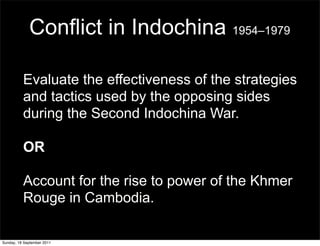
Conflict in Indochina 1954–1979

          Evaluate the effectiveness of the strategies
          and tactics used by the opposing sides
          during the Second Indochina War.

          OR

          Account for the rise to power of the Khmer
          Rouge in Cambodia.

Sunday, 18 September 2011

Hsc modern questions 2002 10

  • 1.
  • 2.
    WWI 2002 Use Sources A and B and your own knowledge. Explain why soldiers’ and civilians’ attitudes to the war changed between 1914 and 1918. Assess how useful Sources C and D would be for an historian studying changing expectations of soldiers and civilians in British society between 1914 and 1921. Sunday, 18 September 2011
  • 3.
    Conflict in Indochina1954–1979 (a) Assess the importance of anti- communism in shaping the policies of the United States towards Indochina between 1954 and 1979. OR (b) Evaluate the effectiveness of the strategies and tactics used by soldiers in Vietnam between 1960 and 1975. Sunday, 18 September 2011
  • 4.
    National Study: Germany 1918-1939 (a) Assess the impact of the Nazi Party on German society up to and including 1933. OR (b) Explain the nature and impact of Nazi propaganda, terror and repression on the Jewish community between 1933 and 1945. Sunday, 18 September 2011
  • 5.
    WWI 2003 Use Sources A (one or both), B and C and your own knowledge. Compare the differing experiences of soldiers on the Western Front. Assess how useful Source A (1) and Source D would be for an historian studying the ‘Christmas truce’ of 1914 and what this event showed about soldiers’ attitudes to war. Sunday, 18 September 2011
  • 6.
    Conflict in Indochina1954–1979 (a) Discuss the significance of the 1964 Gulf of Tonkin incident in the growth of US intervention in Vietnam in the period 1954– 1968. OR (b) Assess the impact the spread of conflict from Vietnam had on Cambodia in the period up to 1979. Sunday, 18 September 2011
  • 7.
    National Study: Germany 1918-1939 (a) Discuss the impact of the Depression on democracy in Germany in the period up to 1934. OR (b) Evaluate the success of the Nazi Party in transforming Germany into a Nazi society in the period 1933–1945. Sunday, 18 September 2011
  • 8.
    2004 WWI Account for the different goals of the Big Three Allied leaders at the Paris Peace Conference. Use Sources A and B and your own knowledge to answer this question. Assess how useful Sources C and D would be for an historian studying peacemaking during World War I. Sunday, 18 September 2011
  • 9.
    Conflict in Indochina1954–1979 (a) Evaluate the view that North Vietnam’s determination to spread communism in Indochina caused the failure of the Geneva Peace Agreement by the 1960s. OR (b) To what extent were the Vietcong responsible for the withdrawal of the United States from Vietnam and the eventual defeat of the South Vietnamese forces in the period 1968–1975? Sunday, 18 September 2011
  • 10.
    National Study: Germany 1918-1939 (a) Assess the view that the collapse of the Weimar Republic was primarily due to the appeal of Hitler and his Nazi Party. OR (b) Evaluate the significance of the Battle of Stalingrad in 1943 for the military defeat and collapse of Nazism in 1945. Sunday, 18 September 2011
  • 11.
    WWI 2005 How significant was the Battle of the Somme in attempts to break the stalemate on the Western Front? Assess how useful Sources C and D would be for a historian studying the nature of trench warfare during World War I. Sunday, 18 September 2011
  • 12.
    Conflict in Indochina1954–1979 (a) To what extent were anti-war movements responsible for the American decision to withdraw from Vietnam in 1973? OR (b) Evaluate the view that US intervention was primarily responsible for the suffering of villagers in South Vietnam and Cambodia. Sunday, 18 September 2011
  • 13.
    National Study: Germany 1918-1939 (a) Assess the impact of conservative parties and elites on German politics in the period 1918–1934. OR (b) Evaluate the view that Germany was a totalitarian society in the period 1933– 1945. Sunday, 18 September 2011
  • 14.
    2006 WWI Explain why US entry into World War I proved to be the most significant of the war’s turning points Assess how useful Sources C and D would be for an historian studying the impact of total war on the home fronts during World War I. Sunday, 18 September 2011
  • 15.
    Conflict in Indochina1954–1979 Evaluate the view that an inability to separate nationalism from communism dominated US policy towards Indochina in the period 1954–1968. Assess the significance of the 1968 Tet Offensive as part of North Vietnam’s strategy in achieving victory in the Second Indochina War. Sunday, 18 September 2011
  • 16.
    National Study: Germany 1918-1939 Assess the importance of nationalism as a cause of the failure of democracy in Germany in the period 1918–1934. OR To what extent was Hitler responsible for the development and implementation of Nazi racist policies in Germany in the period to 1939? Sunday, 18 September 2011
  • 17.
    Personality 20th C a) Outline the main features in the background and rise to prominence of the twentieth-century personality you have studied. (b) To what extent does history present us with a balanced interpretation of this personality? Sunday, 18 September 2011
  • 18.
    2007 WWI To what extent was the failure of Ludendorff’s Offensive responsible for Allied victory and the German collapse? Assess how useful Sources C and D would be for a historian studying the changing attitudes of Allied and German soldiers to the war. Sunday, 18 September 2011
  • 19.
    National Study: Germany 1918-1939 Explain how and why German social and cultural life changed in the period1923– 1939. OR Assess the impact of Nazism on German foreign policy in the period 1933–1939. Sunday, 18 September 2011
  • 20.
    Personality 20th C (a) Describe the role played by the personality you have studied in national AND/OR international history. (b) ‘Events shape people more than people shape events.’ How accurate is this statement in relation to the personality you have studied? Sunday, 18 September 2011
  • 21.
    Conflict in Indochina1954–1979 Assess the consequences of the Vietnamese victory against the French for in the period 1954–1964. OR To what extent was the rise to power of Pol Pot’s regime a consequence of the spread of the Vietnam War to Cambodia? Sunday, 18 September 2011
  • 22.
    2008 WWI Assess the impact of tactics using new weapons in attempts to break the stalemate on the Western Front. Assess how useful Sources C and D would be for a historian studying the variety of attitudes to the war on the home fronts and how they changed over time in Britain and Germany. Sunday, 18 September 2011
  • 23.
    National Study: Germany 1918-1939 Account for the successes and failures of democracy in Germany in the period 1918– 1933. OR To what extent can Nazism in power be seen as totalitarianism in the period 1933– 1939? Sunday, 18 September 2011
  • 24.
    Personality 20th C Describe the personal background and the historical context of the personality you have studied. (b)‘History is about winners.’ How accurate is this statement in relation to the personality you have studied? Sunday, 18 September 2011
  • 25.
    Conflict in Indochina1954–1979 To what extent was US involvement responsible for the ongoing conflict in Indochina in the period 1954–1979? OR Evaluate the view that the impact of war on civilians in Indochina was responsible for communist victory in the period 1968–1979. Sunday, 18 September 2011
  • 26.
    2009 WWI Explain why there was a stalemate on the Western Front by the end of 1914. Assess how useful Sources C and D would be for a historian studying the impact of World War I on women’s lives and experiences in Britain. Sunday, 18 September 2011
  • 27.
    National Study: Germany 1918-1939 To what extent did weaknesses in the Weimar Republic account for the growth and rise to power of the Nazi Party to 1933? OR Assess the impact of Nazi propaganda, terror and repression on the German people from 1933 to 1939. Sunday, 18 September 2011
  • 28.
    Personality 20th C Outline the life of the personality you have studied. (b) ‘Individuals are products of their times.’ How accurate is this statement in relation to the personality you have studied? Sunday, 18 September 2011
  • 29.
    Conflict in Indochina1954–1979 Assess the importance of the Geneva Peace Agreement to developments within North and South Vietnam to 1964. OR To what extent were the anti-war movements in the United States responsible for communist victory in the Second Indochina War? Sunday, 18 September 2011
  • 30.
    2010 WWI Outline how the experiences of trench warfare changed soldiers’ attitudes to the war over time. How useful would Sources E and F be for a historian studying the different goals of Clemenceau, Lloyd George and Wilson in creating the Treaty of Versailles? Sunday, 18 September 2011
  • 31.
    National Study: Germany 1918-1939 Assess the influence of the German army on the successes and failures of the Weimar Republic by 1933. OR Evaluate Hitler’s role in the Nazi state between 1933 and 1939. Sunday, 18 September 2011
  • 32.
    Personality 20th C a) Describe the life of the personality you have studied. b) ‘People are swept along by events. Some individuals use events to advantage.’ How accurate is this statement in relation to the personality you have studied? Sunday, 18 September 2011
  • 33.
    Conflict in Indochina1954–1979 Evaluate the effectiveness of the strategies and tactics used by the opposing sides during the Second Indochina War. OR Account for the rise to power of the Khmer Rouge in Cambodia. Sunday, 18 September 2011