CONTENT:
GERMANY 1918-1945
WEIMAR REPUBLIC (REPUBLIC - NO KING/QUEEN
LEADER WAS KAISER WILHELM II (OF GERMANY)
1919-1923 - CHALLENGES TO THE REPUBLIC
1923-1929 - WEIMAR STABILITY
1929-1935 - DOWNFALL OF THE WEIMAR GOV
HITLERS GERMANY
1919-1923 - HITLER & THE NAZI PARTY (EARLY DAYS)
1923-1929 - NAZI STEADY GROWTH
1923- MUNICH PUTSCH
1929-1933 - INCREASING SUPPORT FOR THE NAZIS + THE WALL STREET
CRASH
JAN 30TH 1933 - HITLER BECOMES CHANCELLOR OF GERMANY
JAN 1933 - AUG 1934 - CHANCELLOR TO DICTATOR
THE EFFECT OF WW1 ON GERMANY
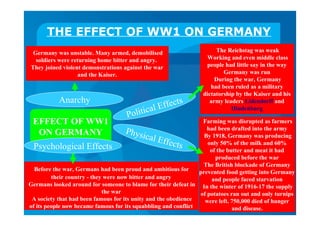
EFFECT OF WW1
ON GERMANY
The Reichstag was weak
Working and even middle class
people had little say in the way
Germany was run
During the war, Germany
had been ruled as a military
dictatorship by the Kaiser and his
army leaders Lidendorff and
Hindenburg
Farming was disrupted as farmers
had been drafted into the army
By 1918, Germany was producing
only 50% of the milk and 60%
of the butter and meat it had
produced before the war
The British blockade of Germany
prevented food getting into Germany
and people faced starvation
In the winter of 1916-17 the supply
of potatoes ran out and only turnips
were left. 750,000 died of hunger
and disease.
Political Effects
Physical EffectsPsychological Effects
Before the war, Germans had been proud and ambitious for
their country - they were now bitter and angry
Germans looked around for someone to blame for their defeat in
the war
A society that had been famous for its unity and the obedience
of its people now became famous for its squabbling and conflict
Germany was unstable. Many armed, demobilised
soldiers were returning home bitter and angry.
They joined violent demonstrations against the war
and the Kaiser.
Anarchy
THE EFFECT OF WW1 ON GERMANY
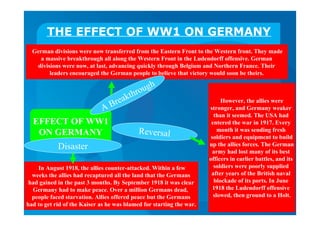
EFFECT OF WW1
ON GERMANY
However, the allies were
stronger, and Germany weaker
than it seemed. The USA had
entered the war in 1917. Every
month it was sending fresh
soldiers and equipment to build
up the allies forces. The German
army had lost many of its best
officers in earlier battles, and its
soldiers were poorly supplied
after years of the British naval
blockade of its ports. In June
1918 the Ludendorff offensive
slowed, then ground to a Holt.
Reversal
Disaster
In August 1918, the allies counter-attacked. Within a few
weeks the allies had recaptured all the land that the Germans
had gained in the past 3 months. By September 1918 it was clear
Germany had to make peace. Over a million Germans dead,
people faced starvation. Allies offered peace but the Germans
had to get rid of the Kaiser as he was blamed for starting the war.
German divisions were now transferred from the Eastern Front to the Western front. They made
a massive breakthrough all along the Western Front in the Ludendorff offensive. German
divisions were now, at last, advancing quickly through Belgium and Northern France. Their
leaders encouraged the German people to believe that victory would soon be theirs.
A Breakthrough
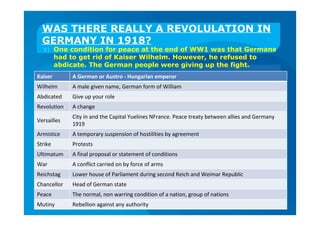
WAS THERE REALLY A REVOLULATION IN
GERMANY IN 1918?
1) One condition for peace at the end of WW1 was that Germans
had to get rid of Kaiser Wilhelm. However, he refused to
abdicate. The German people were giving up the fight.
Kaiser A German or Austro - Hungarian emperor
Wilhelm A male given name, German form of William
Abdicated Give up your role
Revolution A change
Versailles
City in and the Capital Yuelines NFrance. Peace treaty between allies and Germany
1919
Armistice A temporary suspension of hostilities by agreement
Strike Protests
Ultimatum A final proposal or statement of conditions
War A conflict carried on by force of arms
Reichstag Lower house of Parliament during second Reich and Weimar Republic
Chancellor Head of German state
Peace The normal, non warring condition of a nation, group of nations
Mutiny Rebellion against any authority
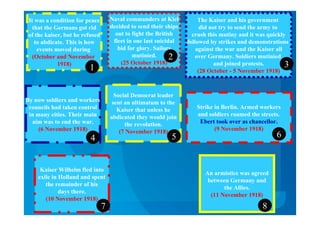
It was a condition for peace
that the Germans got rid
of the kaiser, but he refused
to abdicate. This is how
events moved during
(October and November
1918)
Naval commanders at Kiel
decided to send their ships
out to fight the British
fleet in one last suicidal
bid for glory. Sailors
mutinied.
(25 October 1918)
The Kaiser and his government
did not try to send the army to
crush this mutiny and it was quickly
followed by strikes and demonstrations
against the war and the Kaiser all
over Germany. Soldiers mutinied
and joined protests.
(28 October - 5 November 1918)
By now soldiers and workers
councils had taken control
in many cities. Their main
aim was to end the war.
(6 November 1918)
Social Democrat leader
sent an ultimatum to the
Kaiser that unless he
abdicated they would join
the revolution.
(7 November 1918)
Strike in Berlin. Armed workers
and soldiers roamed the streets.
Ebert took over as chancellor.
(9 November 1918)
Kaiser Wilhelm fled into
exile in Holland and spent
the remainder of his
days there.
(10 November 1918)
An armistice was agreed
between Germany and
the Allies.
(11 November 1918)
87
654
3
2
1
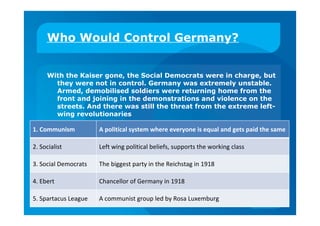
Who Would Control Germany?
With the Kaiser gone, the Social Democrats were in charge, but
they were not in control. Germany was extremely unstable.
Armed, demobilised soldiers were returning home from the
front and joining in the demonstrations and violence on the
streets. And there was still the threat from the extreme left-
wing revolutionaries
1. Communism A political system where everyone is equal and gets paid the same
2. Socialist Left wing political beliefs, supports the working class
3. Social Democrats The biggest party in the Reichstag in 1918
4. Ebert Chancellor of Germany in 1918
5. Spartacus League A communist group led by Rosa Luxemburg
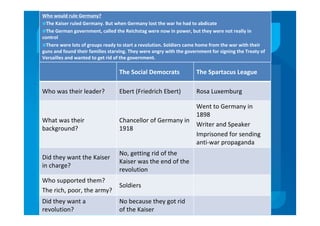
The Social Democrats The Spartacus League
Who was their leader? Ebert (Friedrich Ebert) Rosa Luxemburg
What was their
background?
Chancellor of Germany in
1918
Went to Germany in
1898
Writer and Speaker
Imprisoned for sending
anti-war propaganda
Did they want the Kaiser
in charge?
No, getting rid of the
Kaiser was the end of the
revolution
Who supported them?
The rich, poor, the army?
Soldiers
Did they want a
revolution?
No because they got rid
of the Kaiser
Who would rule Germany?
The Kaiser ruled Germany. But when Germany lost the war he had to abdicate
The German government, called the Reichstag were now in power, but they were not really in
control
There were lots of groups ready to start a revolution. Soldiers came home from the war with their
guns and found their families starving. They were angry with the government for signing the Treaty of
Versailles and wanted to get rid of the government.
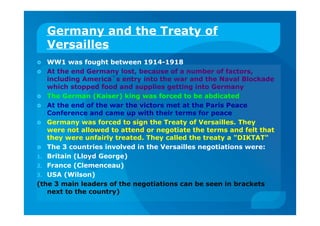
Germany and the Treaty of
Versailles
 WW1 was fought between 1914-1918
 At the end Germany lost, because of a number of factors,
including America`s entry into the war and the Naval Blockade
which stopped food and supplies getting into Germany
 The German (Kaiser) king was forced to be abdicated
 At the end of the war the victors met at the Paris Peace
Conference and came up with their terms for peace
 Germany was forced to sign the Treaty of Versailles. They
were not allowed to attend or negotiate the terms and felt that
they were unfairly treated. They called the treaty a "DIKTAT"
 The 3 countries involved in the Versailles negotiations were:
1. Britain (Lloyd George)
2. France (Clemenceau)
3. USA (Wilson)
(the 3 main leaders of the negotiations can be seen in brackets
next to the country)
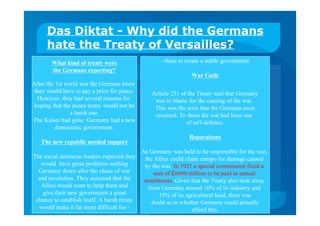
Das Diktat - Why did the Germans
hate the Treaty of Versailles?
What kind of treaty were
the Germans expecting?
After the 1st world war the Germans knew
they would have to pay a price for peace.
However, they had several reasons for
hoping that the peace treaty would not be
a harsh one.
The Kaiser had gone: Germany had a new
democratic government.
The new republic needed support
The social democrat leaders expected they
would have great problems settling
Germany down after the chaos of war
and revolution. They assumed that the
Allies would want to help them and
give their new government a good
chance to establish itself. A harsh treaty
would make it far more difficult for -
- them to create a stable government
War Guilt
Article 231 of the Treaty said that Germany
was to blame for the causing of the war.
This was the term that the Germans most
resented. To them the war had been one
of self-defence.
Reparations
As Germany was held to be responsible for the war,
the Allies could claim compo for damage caused
by the war. In 1921 a special commission fixed a
sum of £6600 million to be paid in annual
instalments. Given that the Treaty also took away
from Germany around 10% of its industry and
15% of its agricultural land, there was
doubt as to whether Germany could actually
afford this.
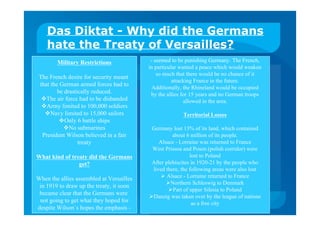
Das Diktat - Why did the Germans
hate the Treaty of Versailles?
Military Restrictions
The French desire for security meant
that the German armed forces had to
be drastically reduced.
The air force had to be disbanded
Army limited to 100,000 soldiers
Navy limited to 15,000 sailors
Only 6 battle ships
No submarines
President Wilson believed in a fair
treaty
What kind of treaty did the Germans
get?
When the allies assembled at Versailles
in 1919 to draw up the treaty, it soon
became clear that the Germans were
not going to get what they hoped for
despite Wilson`s hopes the emphasis -
- seemed to be punishing Germany. The French,
in particular wanted a peace which would weaken
so much that there would be no chance of it
attacking France in the future.
Additionally, the Rhineland would be occupied
by the allies for 15 years and no German troops
allowed in the area.
Territorial Losses
Germany lost 13% of its land, which contained
about 6 million of its people.
Alsace - Lorraine was returned to France
West Prissoa and Posen (polish corridor) were
lost to Poland
After plebiscites in 1920-21 by the people who
lived there, the following areas were also lost
 Alsace - Lorraine returned to France
Northern Schleswig to Denmark
Part of upper Silesia to Poland
Danzig was taken over by the league of nations
as a free city
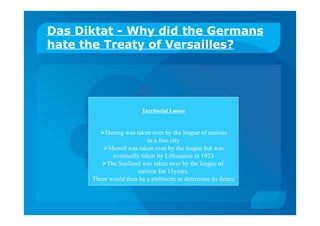
Das Diktat - Why did the Germans
hate the Treaty of Versailles?
Territorial Losses
Danzig was taken over by the league of nations
as a free city
Memel was taken over by the league but was
eventually taken by Lithunania in 1923
The Saalland was taken over by the league of
nations for 15years.
There would then be a plebiscite to determine its future
How did Germany react to the
treaty?
When the terms of the treaty first became known, the
German government refused to sign it, and resigned.
It was a hopeless gesture. The Allies made it clear
that if the Germans did not sign, they would resume
the war.
A new government was formed which did agree to sign
the treaty. It did not believe that the treaty was fair
any more than the previous government did, but
knew it had no choice. As responsible politicians they
had to sign. To allow war to restart would be suicidal
for Germany.
But from the moment the treaty was signed, many
promised to do all they could to overthrow it.
How did Germany react to the
treaty?
The "stab in the back" myth
The Treaty of Versailles greatly weakened the new
government of Germany. It suited many Germans to
believe that Germany had never really lost the war.
Army leaders like Ludendorff encouraged this view.
He said the army would have fought on to preserve
Germany`s honour, if only weak politicians and
Communist revolutionaries had not demanded peace.
A powerful myth developed which said that the army
had been "stabbed in the back" by weak politicians.
Right-wingers who looked back fondly to the pre-war
days when Germany was powerful were happy to
blame the new democratic government for making
peace.
The Treaty became a symbol of Germany`s humiliation
and defeat. This aroused strong feelings.
Problems of the Weimar
Government
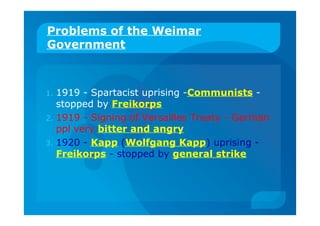
1. 1919 - Spartacist uprising -Communists -
stopped by Freikorps
2. 1919 - Signing of Versailles Treaty - German
ppl very bitter and angry
3. 1920 - Kapp (Wolfgang Kapp) uprising -
Freikorps - stopped by general strike
Problems of the Weimar Government
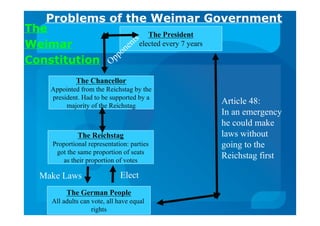
The
Weimar
Constitution
The President
elected every 7 years
The Reichstag
Proportional representation: parties
got the same proportion of seats
as their proportion of votes
The German People
All adults can vote, all have equal
rights
The Chancellor
Appointed from the Reichstag by the
president. Had to be supported by a
majority of the Reichstag
Article 48:
In an emergency
he could make
laws without
going to the
Reichstag first
ElectMake Laws
Opponents
The invasion of the Ruhr and
Hyperinflation
By 1923 Germany could no longer repay the reparation
repayments.
 When the Germans could no longer repay the £6.6 billion
pounds in reparations repayments the French were angry.
 They sent troops to an area called the Ruhr in Germany
which was very industrial and produced iron. They then
occupied this area to take resources from Germany.
 Germans in the area went on strike to stop the French
getting these resources. This was called, "passive
resistance"
 This meant that Germany had even less money as they
were no longer making money in this area
 Germany had to print more and more money to try and
pay the reparation repayments.
 This lead to hyperinflation
1923 - The Munich Putsch
(The Beer Hall Putsch)
Hitler the Failure:
8th November: What happened in the beer hall?
On November 8th Kahr, the Bavarian Prime Minister
and this two most senior Bavarian officials were
addressing a meeting of around 3000 businessmen at
a beer hall in Munich. Hitler and Goering arrived with
600 storm-troopers. Hitler stopped the meeting and
took Kahr and his ministers into a side room at
gunpoint where he persuaded them to support him in
overthrowing the Reich government.
1923 - The Munich Putsch
(The Beer Hall Putsch)
Hitler the Failure:
9th November: The March on Munich
The first part of Hitler`s plan had succeeded. But now he had
made a big mistake. He let Kahr and his colleagues go, while
he and Ludendorff planned how their supporters could seize
Munich the following day it was soon clear that Kahr`s
pledge of support, made at gunpoint, was worthless. When
news of the Putsch reached Berlin the government ordered
the army in Bavaria to crush it. Kahr would not attempt to
stop it. The Nazis could not backtrack now, however. They
would march on Munich the next day as planned. They would
challenge the army and the police not to fire on them, but to
support them. With Ludendorff as their leader, Hitler hoped
they might succeed.
1923 - The Munich Putsch
(The Beer Hall Putsch)
Hitler the Failure:
The results of the Munich Putsch
The Munich Putsch was a failure. As a result:
The Nazi party was banned, and Hitler was prevented from speaking
in public until 1927.
Hitler went to prison, where he wrote 'Mein Kampf'. Millions of
Germans read it, and Hitler's ideas became very well-known.
Hitler decided that he would never come to power by revolution; he
realised that he would have to use constitutional means, so he organised:
The Hitler Youth
Propaganda campaigns
Mergers with other right-wing parties
Local branches of the party, which tried to get Nazis elected to the Reichstag
The SS as his personal bodyguard, which was set up in 1925 It was this strategy
of gaining power legitimately that eventually brought him to power.
To what extent did the Weimar
Government recover after 1923?
Gustav Stresemann
 He was a businessman and politician
 His political beliefs are not easy to define as they do
not conform to the usual "left/right" classification
 He had business links with the USA before the 1st
world war
 After the war he set up the German Peoples part
(DVP) supported by many middle - and upper - class
protestants. The DVP stood for Christian family
values, secular education, lower tariffs, opposition
to welfare spending and agrarian subsides and
hostility to Marxism. The DVP gradually began co-
operating with centre and left-wing parties
To what extent did the Weimar
Government recover after 1923?
Gustav Stresemann
 Stresemann spent a brief period as chancellor but
failed to deal firmly enough with the culprits of the
Munich Putsch, and this lead the Social Democrats to
leave the coalition that he led
 For the next 8 years (the remainder of his life) he
continued as Foreign Minister, whatever the make-
up of the government
 He was friendly with many foreign leaders and won
the Nobel Peace Price in 1926 (shared with his
French Counterpart Aristide Briand)
 He died of a stroke aged 51 in 1929
To what extent did the Weimar
Government recover after 1923?
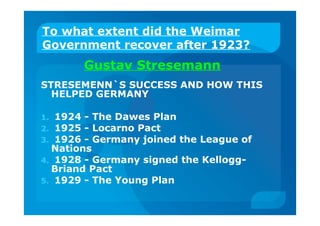
Gustav Stresemann
STRESEMENN`S SUCCESS AND HOW THIS
HELPED GERMANY
1. 1924 - The Dawes Plan
2. 1925 - Locarno Pact
3. 1926 - Germany joined the League of
Nations
4. 1928 - Germany signed the Kellogg-
Briand Pact
5. 1929 - The Young Plan
1924 - The Dawes Plan
How did this help Germany?
Stresemann was chancellor for just 4 months, but he was
foreign minister for 5 years. It was in this office that he had
his greatest success. In 1924 he negotiated the Dawes Plan
with the allies. Under the terms of the plan, the USA
agreed to loan Germany 800 million gold marks. Annual
repayments reduced payment until 1988. Payments ceased
in 1930.
1925 - Locarno Pact
How did this help Germany?
These economic measures, together with further loans
from the USA, helped the German economy to recover.
Between 1924 and 1929 Germany received over 25 billion
marks in loans, which enabled German industry to be
rebuilt. Stresemann also had great success in improving
relations with other countries. In 1925 he signed the
Locarno Pact with France and Belgium, in which countries
agreed to respect common orders.
1926 - Germany joined the League
of Nations
How did this help Germany?
In 1926 Germany joined the LEAGUE OF NATIONS.
1928 - Germany signed the
Kellogg-Briand Pact
How did this help Germany?
The international acceptance of Germany was reinforced in
1928 when it was one of 60 countries to sing the Kellogg
Briand Pact, which renounced war as an instrument of
foreign policy.
1929 - The Young Plan
How did this help Germany?
The introduction of the young plan meant that Germany`s
reparations were reduced by over 67% and the country was
given a timetable for making payments. The allied powers
adopted this in 1930, although the WALL STREET CRASH of
1929 had a major impact its implementation. Stresemann
was strongly criticised for being too willing to co-operate
with Germany`s further enemies.
Believed the Treaty of Versailles could not happen over
night.
To what extent did the Weimar
Government recover after 1923?
SUMMARY
Hyperinflation Problems:
 Retenmark
 Got the French to leave the Ruhr
1924 - Dawes Plan - USA gave loans to Germany
1925 - Locarno Pact - Agreed to maintain the borders of
countries
1926 - League of Nations - Germany was allowed to join the
League of Nations
1928 - Kellogg Briand Pact - 60 countries signed, they agreed
not to sort problems by war
1929 - The Young Plan - Reparation repayments reduced, extra
time to pay
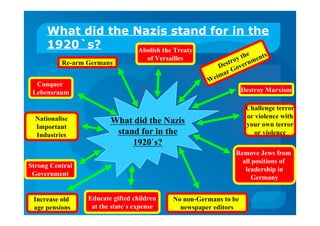
What did the Nazis stand for in the
1920`s?
What did the Nazis
stand for in the
1920`s?
Increase old
age pensions
Educate gifted children
at the state`s expense
No non-Germans to be
newspaper editors
Remove Jews from
all positions of
leadership in
Germany
Challenge terror
or violence with
your own terror
or violence
Destroy Marxism
Destroy the
Weimar Governments
Abolish the Treaty
of Versailles
Re-arm Germany
Conquer
Lebensraum
Nationalise
Important
Industries
Strong Central
Government
The Swastika
What did the Nazis stand for in the
1920`s?
Hitler personally designed the
Nazi flag, with its symbol,
the Swastika. The colours
red, white and black had also
been the colours of Germany`s
flag under the Kaiser. Very
quickly the Swastika became
the best known political symbol
in Germany.RED - Social idea of
movement
White - Nationalist idea
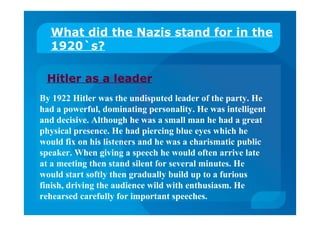
Hitler as a leader
What did the Nazis stand for in the
1920`s?
By 1922 Hitler was the undisputed leader of the party. He
had a powerful, dominating personality. He was intelligent
and decisive. Although he was a small man he had a great
physical presence. He had piercing blue eyes which he
would fix on his listeners and he was a charismatic public
speaker. When giving a speech he would often arrive late
at a meeting then stand silent for several minutes. He
would start softly then gradually build up to a furious
finish, driving the audience wild with enthusiasm. He
rehearsed carefully for important speeches.
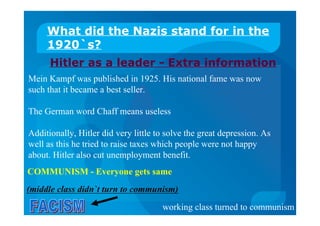
Hitler as a leader - Extra information
What did the Nazis stand for in the
1920`s?
Mein Kampf was published in 1925. His national fame was now
such that it became a best seller.
The German word Chaff means useless
Additionally, Hitler did very little to solve the great depression. As
well as this he tried to raise taxes which people were not happy
about. Hitler also cut unemployment benefit.
COMMUNISM - Everyone gets same
(middle class didn`t turn to communism)
working class turned to communism
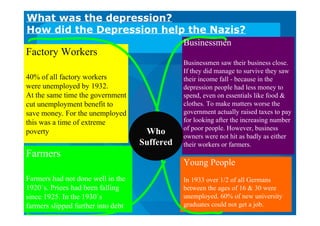
What was the depression?
How did the Depression help the Nazis?
Who
Suffered
Factory Workers
40% of all factory workers
were unemployed by 1932.
At the same time the government
cut unemployment benefit to
save money. For the unemployed
this was a time of extreme
poverty
Farmers
Farmers had not done well in the
1920`s. Prices had been falling
since 1925. In the 1930`s
farmers slipped further into debt
Businessmen
Businessmen saw their business close.
If they did manage to survive they saw
their income fall - because in the
depression people had less money to
spend, even on essentials like food &
clothes. To make matters worse the
government actually raised taxes to pay
for looking after the increasing number
of poor people. However, business
owners were not hit as badly as either
their workers or farmers.
Young People
In 1933 over 1/2 of all Germans
between the ages of 16 & 30 were
unemployed. 60% of new university
graduates could not get a job.
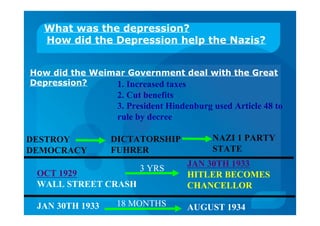
What was the depression?
How did the Depression help the Nazis?
How did the Weimar Government deal with the Great
Depression?
DESTROY
DEMOCRACY
DICTATORSHIP
FUHRER
NAZI 1 PARTY
STATE
1. Increased taxes
2. Cut benefits
3. President Hindenburg used Article 48 to
rule by decree
OCT 1929
WALL STREET CRASH
JAN 30TH 1933
JAN 30TH 1933
HITLER BECOMES
CHANCELLOR
AUGUST 1934
3 YRS
18 MONTHS
How did these problems help the
Nazis?
How did these problems
help the Nazis?
Promise to Voters!Promised restored
profits
Every sector of
German society
seemed to hear
something it
wanted to hear
Farmers higher
prices
Shop-keepers
protection against
competition. There
was something for
everyone
Workers promised jobs (Hitler could point to how the
Nazis [SA] had taken in the unemployed and fed & housed
them.
How did these problems help the
Nazis?
How did these problems
help the Nazis?
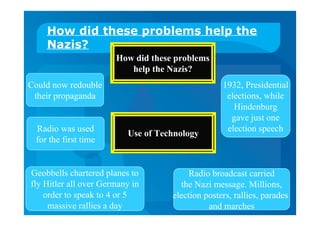
Use of Technology
Could now redouble
their propaganda
Radio was used
for the first time
1932, Presidential
elections, while
Hindenburg
gave just one
election speech
Radio broadcast carried
the Nazi message. Millions,
election posters, rallies, parades
and marches
Geobbells chartered planes to
fly Hitler all over Germany in
order to speak to 4 or 5
massive rallies a day
How did these problems help the
Nazis?
How did these problems
help the Nazis?
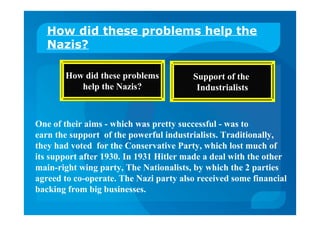
Support of the
Industrialists
One of their aims - which was pretty successful - was to
earn the support of the powerful industrialists. Traditionally,
they had voted for the Conservative Party, which lost much of
its support after 1930. In 1931 Hitler made a deal with the other
main-right wing party, The Nationalists, by which the 2 parties
agreed to co-operate. The Nazi party also received some financial
backing from big businesses.
How did these problems help the
Nazis?
How did these problems
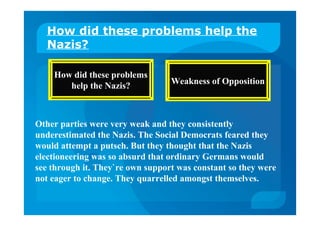
help the Nazis? Weakness of Opposition
Other parties were very weak and they consistently
underestimated the Nazis. The Social Democrats feared they
would attempt a putsch. But they thought that the Nazis
electioneering was so absurd that ordinary Germans would
see through it. They`re own support was constant so they were
not eager to change. They quarrelled amongst themselves.
How did these problems help the
Nazis?
How did these problems
help the Nazis?
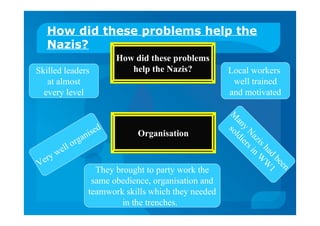
Organisation
Skilled leaders
at almost
every level
Local workers
well trained
and motivated
They brought to party work the
same obedience, organisation and
teamwork skills which they needed
in the trenches.
Very well organised
M
any
N
azishad
been
soldiersin
W
W
1
How did these problems help the
Nazis?
How did these problems
help the Nazis?
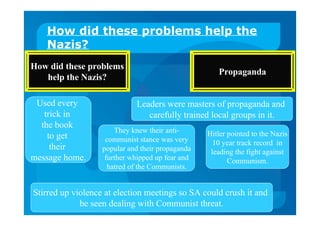
Propaganda
Stirred up violence at election meetings so SA could crush it and
be seen dealing with Communist threat.
Used every
trick in
the book
to get
their
message home.
Leaders were masters of propaganda and
carefully trained local groups in it.
Hitler pointed to the Nazis
10 year track record in
leading the fight against
Communism.
They knew their anti-
communist stance was very
popular and their propaganda
further whipped up fear and
hatred of the Communists.
How did these problems help the
Nazis?
How did these problems
help the Nazis?
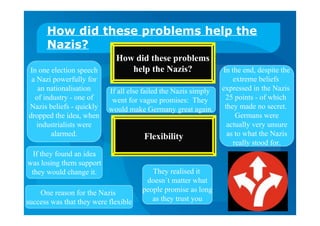
Flexibility
One reason for the Nazis
success was that they were flexible
If they found an idea
was losing them support
they would change it.
In the end, despite the
extreme beliefs
expressed in the Nazis
25 points - of which
they made no secret.
Germans were
actually very unsure
as to what the Nazis
really stood for.
If all else failed the Nazis simply
went for vague promises: They
would make Germany great again.
In one election speech
a Nazi powerfully for
an nationalisation
of industry - one of
Nazis beliefs - quickly
dropped the idea, when
industrialists were
alarmed.
They realised it
doesn`t matter what
people promise as long
as they trust you
How did these problems help the
Nazis?
How did these problems
help the Nazis?
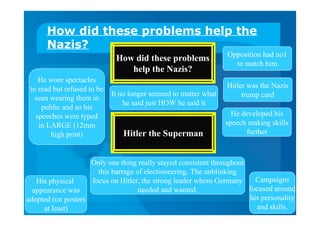
Hitler the Superman
Only one thing really stayed consistent throughout
this barrage of electioneering. The unblinking
focus on Hitler, the strong leader whom Germany
needed and wanted.
He wore spectacles
to read but refused to be
seen wearing them in
public and so his
speeches were typed
in LARGE (12mm
high print)
Opposition had no1
to match him
Hitler was the Nazis
trump card
He developed his
speech making skills
further
It no longer seemed to matter what
he said just HOW he said it
His physical
appearance was
adopted (on posters
at least)
Campaigns
focused around
his personality
and skills.
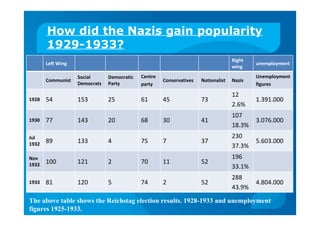
How did the Nazis gain popularity
1929-1933?
Left Wing
Right
wing
unemployment
Communist
Social
Democrats
Democratic
Party
Centre
party
Conservatives Nationalist Nazis
Unemployment
figures
54 153 25 61 45 73
12
2.6%
1.391.000
77 143 20 68 30 41
107
18.3%
3.076.000
89 133 4 75 7 37
230
37.3%
5.603.000
100 121 2 70 11 52
196
33.1%
81 120 5 74 2 52
288
43.9%
4.804.000
1928
1930
Jul
1932
Nov
1932
1933
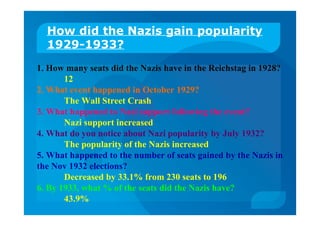
The above table shows the Reichstag election results. 1928-1933 and unemployment
figures 1925-1933.
How did the Nazis gain popularity
1929-1933?
1. How many seats did the Nazis have in the Reichstag in 1928?
12
2. What event happened in October 1929?
The Wall Street Crash
3. What happened to Nazi support following the event?
Nazi support increased
4. What do you notice about Nazi popularity by July 1932?
The popularity of the Nazis increased
5. What happened to the number of seats gained by the Nazis in
the Nov 1932 elections?
Decreased by 33.1% from 230 seats to 196
6. By 1933, what % of the seats did the Nazis have?
43.9%
Why was Hitler 'invited' to become
Chancellor of Germany?
By November 1932, Hitler was leader of the largest party in the
Reichstag. He now thought he should be given the role of
chancellor.
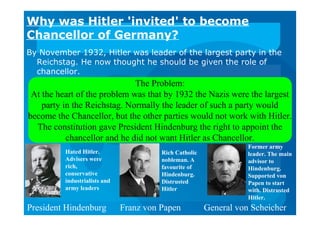
The Problem:
At the heart of the problem was that by 1932 the Nazis were the largest
party in the Reichstag. Normally the leader of such a party would
become the Chancellor, but the other parties would not work with Hitler.
The constitution gave President Hindenburg the right to appoint the
chancellor and he did not want Hitler as Chancellor.
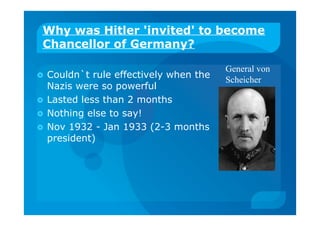
President Hindenburg Franz von Papen General von Scheicher
Hated Hitler.
Advisers were
rich,
conservative
industrialists and
army leaders
Rich Catholic
nobleman. A
favourite of
Hindenburg.
Distrusted
Hitler
Former army
leader. The main
advisor to
Hindenburg.
Supported von
Papen to start
with. Distrusted
Hitler.
Why was Hitler 'invited' to become
Chancellor of Germany?
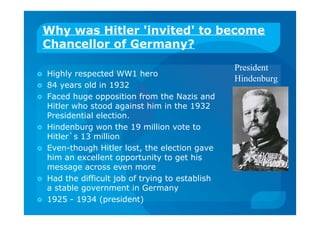
 Highly respected WW1 hero
 84 years old in 1932
 Faced huge opposition from the Nazis and
Hitler who stood against him in the 1932
Presidential election.
 Hindenburg won the 19 million vote to
Hitler`s 13 million
 Even-though Hitler lost, the election gave
him an excellent opportunity to get his
message across even more
 Had the difficult job of trying to establish
a stable government in Germany
 1925 - 1934 (president)
President
Hindenburg
Why was Hitler 'invited' to become
Chancellor of Germany?
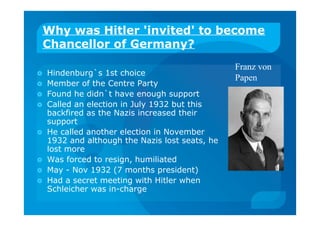
 Hindenburg`s 1st choice
 Member of the Centre Party
 Found he didn`t have enough support
 Called an election in July 1932 but this
backfired as the Nazis increased their
support
 He called another election in November
1932 and although the Nazis lost seats, he
lost more
 Was forced to resign, humiliated
 May - Nov 1932 (7 months president)
 Had a secret meeting with Hitler when
Schleicher was in-charge
Franz von
Papen
Why was Hitler 'invited' to become
Chancellor of Germany?
 Couldn`t rule effectively when the
Nazis were so powerful
 Lasted less than 2 months
 Nothing else to say!
 Nov 1932 - Jan 1933 (2-3 months
president)
General von
Scheicher
When did Hitler become chancellor
and what did this lead to?
Jan 30th 1933 (Hitler becomes Chancellor)
Feb 27th 1933 (Reichstag fire)
 Suspending all the articles in the constitution which guaranteed personal
liberty
 Freedom of speech
 Freedom of the press
 Freedom of assembly
Now in power Hitler could do the following things:
 Search houses
 Confiscate property
 Detain people indefinitely without trial
 It decreed the death penalty for a wide range of crimes
 Police could ban meetings
 Police could close newspapers
 Police could round up political opponents
 Police could drag them off to their hostly organised concentration camps
and detention centres
 Police seized the state Radio Station
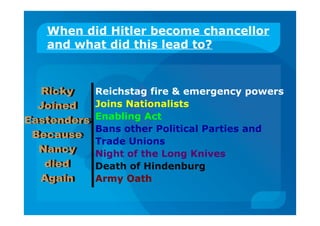
When did Hitler become chancellor
and what did this lead to?
Reichstag fire & emergency powers
Joins Nationalists
Enabling Act
Bans other Political Parties and
Trade Unions
Night of the Long Knives
Death of Hindenburg
Army Oath
When did Hitler become chancellor
and what did this lead to?
March 5th elections (1933)
 Nazis won 288 seats
 Hitler is still not happy as he has not got a majority and cannot
pass new laws. Therefore, he needs to think of something to
get their votes.
 He THEN BANS COMMUNIST PARTY (because of the Reichstag fire)
 Hitler then gets 50% of seats in the Reichstag
 AFTER THIS HE JOINS WITH NATIONALISTS
 This gives him 53% of the seats, which is a majority
Enabling Act
 This gives the power personally to Hitler. The Chancellor can make new
new laws without telling the Reichstag.
 Bans all other political parties
 Hitler bans all other parties including [Social Democrats], the party
that set up the Reichstag had now gone.
Night of the Long Knives
Hitler had an ultimatum and had to make a choice
between the SA and the Army.
 Hitler was finding the SA harder to control
 The SA had a violent reputation which Hitler did not
want to be associated with
 Rohm posed a particular threat - he was getting too
powerful
 Hitler would have to go along with ideas of the SA
On 29th June 1954 Hitler acted. He called a meeting
of SA leaders for the following day at Wiessee in
Bavaria.
30th June - becomes known as the Night of the Long
Knive.
Night of the Long Knives
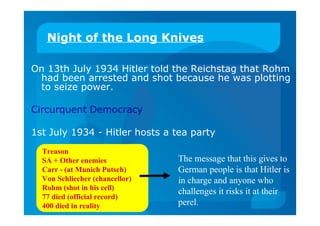
On 13th July 1934 Hitler told the Reichstag that Rohm
had been arrested and shot because he was plotting
to seize power.
Circurquent Democracy
1st July 1934 - Hitler hosts a tea party
Treason
SA + Other enemies
Carr - (at Munich Putsch)
Von Schliecher (chancellor)
Rohm (shot in his cell)
77 died (official record)
400 died in reality
The message that this gives to
German people is that Hitler is
in charge and anyone who
challenges it risks it at their
perel.
Night of the Long Knives
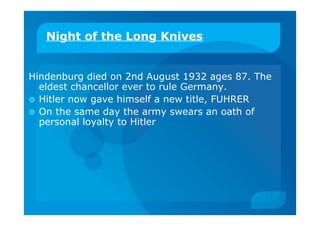
Hindenburg died on 2nd August 1932 ages 87. The
eldest chancellor ever to rule Germany.
 Hitler now gave himself a new title, FUHRER
 On the same day the army swears an oath of
personal loyalty to Hitler
Night of the Long Knives
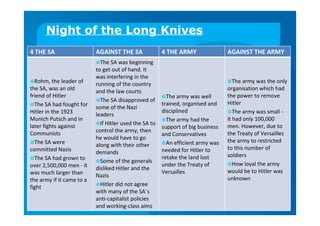
4 THE ARMY AGAINST THE ARMY
The army was well
trained, organised and
disciplined
The army had the
support of big business
and Conservatives
An efficient army was
needed for Hitler to
retake the land lost
under the Treaty of
Versailles
The army was the only
organisation which had
the power to remove
Hitler
The army was small -
it had only 100,000
men. However, due to
the Treaty of Versailles
the army to restricted
to this number of
soldiers
How loyal the army
would be to Hitler was
unknown
4 THE SA
Rohm, the leader of
the SA, was an old
friend of Hitler
The SA had fought for
Hitler in the 1923
Munich Putsch and in
later fights against
Communists
The SA were
committed Nazis
The SA had grown to
over 2,500,000 men - it
was much larger than
the army if it came to a
fight
AGAINST THE SA
The SA was beginning
to get out of hand. It
was interfering in the
running of the country
and the law courts
The SA disapproved of
some of the Nazi
leaders
If Hitler used the SA to
control the army, then
he would have to go
along with their other
demands
Some of the generals
disliked Hitler and the
Nazis
Hitler did not agree
with many of the SA`s
anti-capitalist policies
and working-class aims
Life in Nazi Germany?
How did the Nazis control Germany?
Some people went along with the Nazis simply because they were too
scared to speak out against them. They did not necessarily support
Hitler but feared the consequences of objecting to him. Special
organisations even existed to terrorise people into accepting Nazi
rules.
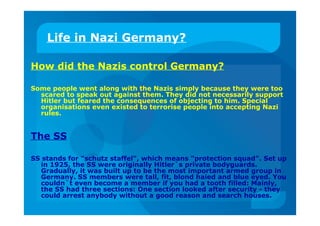
The SS
SS stands for "schutz staffel", which means "protection squad". Set up
in 1925, the SS were originally Hitler`s private bodyguards.
Gradually, it was built up to be the most important armed group in
Germany. SS members were tall, fit, blond haied and blue eyed. You
couldn`t even become a member if you had a tooth filled: Mainly,
the SS had three sections: One section looked after security - they
could arrest anybody without a good reason and search houses.
Education in Nazi Germany
Indoctrination - A set of beliefs constantly
repeated to implant ideas in the mind
Ideology - A set of ideas
Eugenic - How to produce perfect off-spring
The second area of influence over young people was their school.
The Nazis used their control over teachers to influence what
children learned at school. Many teachers were already very
nationalistic and accepted that they should teach Nazi ideas. Those
who were not were usually sacked. Many teachers attended teachers`
camps which concentrated on indoctrination and physical training.
97% of teachers joined the Nazi Teachers Association.
Education in Nazi Germany - The
Nazi Curriculum
The minds and bodies of young people were to be shaped to the Nazi
cause. Certain subjects became more important than others.
 Physical education was given 15% of school time, and some sports
such as boxing became compulsory for boys. Pupils had to pass an
examination, and unsatisfactory performance could lead to being
expelled
 History. This concentrated on the rise of the Nazi party, the
injustices of the Treaty of Versailles and the evils of Communism and
the Jews
 Biology explained Nazi ideas on race and population control. Pupils
were taught how to measure their skulls and to classify racial types:
also that Aryans were superior and should not marry inferior races
 German. This taught pupils to be conscious of their national identity
by reading about German heroes of the Hitler Youth and First World
War.
 Geography taught about the lands which were once part of Germany
and the need for more living space (Lebensraum) for Germans.
 Religious Studies became less important and by 1937 pupil could
drop the subject.
Education in Nazi Germany - The
Nazi Curriculum
Girls usually had a different curriculum from boys. They also studied
domestic science and eugenics (how to produce perfect offspring by
selecting ideal qualities in the parents). Additionally, life in school
became very difficult for those who were not Aryan, especially the
Jews.
Teachers in Nazi Germany
Membership of the Nazi Teachers` Association became compulsory after 1933.
1. This made the process of indoctrination much easier for the Nazi Party, with
teacher`s.
2. Virtually all Jewish teachers were dismissed in 1933 as it was deemed
'undesirable' to allow Jewish teachers to teach 'Aryan' pupils.
3. Some teachers remained as teachers in Jewish schools until these schools
were banned altogether in 1942. Those teachers who taught in 'Aryan' schools
however suffered increasing levels of harassment and by 1935 no Jewish
teachers were left in these schools at all.
What was life like in the Hitler
Youth?
The Youth Movement
There were multiple tasks of which could be done as a result of The Hitler
Youth Movement. For example:
 model making
 Reading Der Sturmer
 Chariot races
 Practising carrying 'dead' comrades to the funeral pyre as a part of a
Mid Summer festival
 Hitler Youth leaping through fire at a festival to mark the Summer
Solstice
Women/girls did slightly different activities for example,
javelin throwers in the League of German maidens.
Girls also had to run 60m in 14 seconds, throw a ball
12m, complete somersaults, a tightrope walk and a 2
hour march or swim 100m: and know how to make a
bed.
What was life like in the Hitler
Youth?
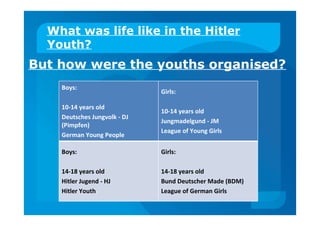
But how were the youths organised?
Boys:
10-14 years old
Deutsches Jungvolk - DJ
(Pimpfen)
German Young People
Girls:
10-14 years old
Jungmadelgund - JM
League of Young Girls
Boys:
14-18 years old
Hitler Jugend - HJ
Hitler Youth
Girls:
14-18 years old
Bund Deutscher Made (BDM)
League of German Girls
What was life like in the Hitler
Youth?
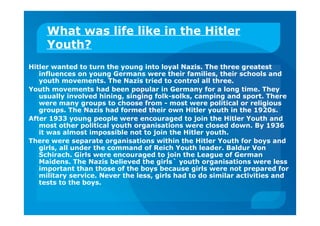
Hitler wanted to turn the young into loyal Nazis. The three greatest
influences on young Germans were their families, their schools and
youth movements. The Nazis tried to control all three.
Youth movements had been popular in Germany for a long time. They
usually involved hining, singing folk-solks, camping and sport. There
were many groups to choose from - most were political or religious
groups. The Nazis had formed their own Hitler youth in the 1920s.
After 1933 young people were encouraged to join the Hitler Youth and
most other political youth organisations were closed down. By 1936
it was almost impossible not to join the Hitler youth.
There were separate organisations within the Hitler Youth for boys and
girls, all under the command of Reich Youth leader. Baldur Von
Schirach. Girls were encouraged to join the League of German
Maidens. The Nazis believed the girls` youth organisations were less
important than those of the boys because girls were not prepared for
military service. Never the less, girls had to do similar activities and
tests to the boys.
Opposition to the Nazis - The
Youth
The Soldiers:
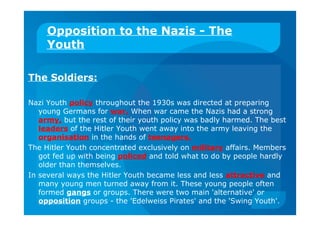
Nazi Youth policy throughout the 1930s was directed at preparing
young Germans for war. When war came the Nazis had a strong
army, but the rest of their youth policy was badly harmed. The best
leaders of the Hitler Youth went away into the army leaving the
organisation in the hands of teenagers.
The Hitler Youth concentrated exclusively on military affairs. Members
got fed up with being policed and told what to do by people hardly
older than themselves.
In several ways the Hitler Youth became less and less attractive and
many young men turned away from it. These young people often
formed gangs or groups. There were two main 'alternative' or
opposition groups - the 'Edelweiss Pirates' and the 'Swing Youth'.
Opposition to the Nazis - The
Youth
Swing Youth:
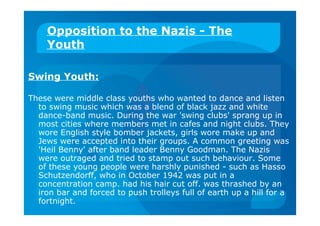
These were middle class youths who wanted to dance and listen
to swing music which was a blend of black jazz and white
dance-band music. During the war 'swing clubs' sprang up in
most cities where members met in cafes and night clubs. They
wore English style bomber jackets, girls wore make up and
Jews were accepted into their groups. A common greeting was
'Heil Benny' after band leader Benny Goodman. The Nazis
were outraged and tried to stamp out such behaviour. Some
of these young people were harshly punished - such as Hasso
Schutzendorff, who in October 1942 was put in a
concentration camp. had his hair cut off. was thrashed by an
iron bar and forced to push trolleys full of earth up a hill for a
fortnight.
Opposition to the Nazis - The
Youth
Edelweiss Pirates:
The edelweiss flower was a symbol of opposition adopted by
many groups of working class youths. Groups such as the
'Roving Dudes' and the 'Nacajos' all regarded themselves as
'Edelweiss Pirates'. They included girls and boys. At weekends
they would go on hikes, meet other groups, camp, sing, talk
and hope to beat up Hitler Youth patrols.
Some of the Edelweiss Pirates also got involved in direction
opposition to the Nazis. In Cologne the 'Navajos' sheltered
army deserters and concentration camps escapees, and
attacked military targets and Nazi officials. A group of them
killed the head of the Cologne Gestapo but were caught soon
after and executed in November 1944.
Women in Nazi Germany
These campaigns were particularly aimed at Aryan
women. They were the ones whom the Nazis really
wanted to have large families. They wanted to
mould Aryan women into their ideal mothers who:
Did not go
to work:
In all the jobs
they were directly
controlled. They
began to get rid of
women.15% of
teachers, all women
doctors and civil
servants
were sacked.
Looked like
this:
Blonde, heavy-
hipped, and athletic,
in a full shirt,
wearing flat heels
and no make-up
Cooked like this:
Always using up left-overs:
once a month on a Sunday
they had to prepare a one-
dish meal, a sort of stew
made of cheap meat and
left overs that everyone
was meant to eat. The SA
could come round and
check on whether this was
being observed.
Dressed like
this:
Always using
home -
produced
substitutes for
imported wool,
cotton and silk
Women in Nazi Germany
Kinder, Kuche, Kirche (children, kitchen, church)
1934, head of womens beneaue
The government offered special loans to new brides
who agreed not to take a job. 800,000 took this up.
Women who had large families were given the "Honour
cross of the German mother"
Bronze - 4 children
Silver - 6 children
gold - 8 children
Women in Nazi Germany
The 3H`s
 Laws against abortions were strictly enforced
 From 1936 the Nazis opened maternity homes,
designed to be breeding centres for the
production of pure Aryan babies - racially
approved Aryan women were matched with
men from the SS.
 From 1933 women started to be sacked from
jobs. Doctors and Civil servants were first.
Numbers of female teachers were drastically
reduced and from 1936 women could no longer
be judges.
How did the Nazi`s control
Germany?
Some people went along with the Nazi`s simply because they
were too scared to speak out against them. They did not
necessarily support Hitler but feared the consequences of
objecting to him. Special organisations even existed to
terrorise people into accepting Nazi rule.
How did the Nazi`s control
Germany?
SS stands for 'Schutz Staffel', which means 'protection squad'. Set up in
1925, the SS were originally Hitler`s private bodyguards. Gradually, it
was built up to be the most important armed group in Germany. SS
members were tall, fit, blond-haired and blue-eyed. You couldn`t even
become a member if you`d had a tooth filled! Mainly, the SS had three
sections: one special looked after security - they could arrest anybody
without a good reason and search houses. Another section was the Waffen
SS - providing elite units in the army. The final section was the Death`s
Head Units - they ran the concentration camps and, later, the death
camps.
How did the Nazi`s control
Germany?
Himmler was the man in charge of all aspects of 'Nazi
terror', a loyal Nazi who had known Hitler since 1923. He
was appointed leader of the SS in 1929. He was ruthless when
dealing with oppositon to Hitler and the Nazi Party.
How did the Nazi`s control
Germany?
The secret police were known as the Gestapo. Their major job was to
crush anyone who was against Hitler. They spied on people they thought
were a threat, tapped telephone lines and opened mail. They had the
power to arrest, imprison without trial and torture anyone. They set up a
huge network of informers who would report any 'grumblers' to them.
Even children were encouraged to report their parents or teachers if they
moaned or made an anti-Hitler joke.
Gestapo agents would pretend to be rebels and would visit people who
were suspected of being disloyal to the government. They would attempt
to trick them into incriminating themselves and their friends.
How did the Nazi`s control
Germany?
The ordinary police continued their regular work but
ignored most crimes committed by Nazi`s. The law courts
were under Nazi control too. New laws meant that the death
penalty could be given for, among other things, telling an
anti-Nazi joke, having sex with a Jew or listening to a foreign
radio station. In 1934 Hitler set up the People`s Court which
tried people for 'crimes against the state' - any opponent of
the Nazis was an enemy of the state.
How did the Nazi`s control
Germany?
Lots of thee were set up as soon as Hitler took power. They
were like large prisons where any 'enemies of the German
state' could be held for any length of time. Anyone the Nazis
did not like was sent there - Jews, homosexuals, gypsies, old
political opponents and anyone who had criticised Hitler.
Inmates were forced to work hard and listen to Nazi ideas all
day long. Some were even tortured or worked to death.
Note: These camps are different to the extermination camps.
How did the Nazi`s control
Germany?
The Nazis encouraged a climate where nobody ever criticised
the government or Hitler. German people learnt to 'speak
through a flower' - always saying nice, positive things
whatever their private thoughts might be. Before 193,
though, there was very little opposition to Hitler and what
did exist was soon destroyed. The SS and the Gestapo
terrified most Germans.
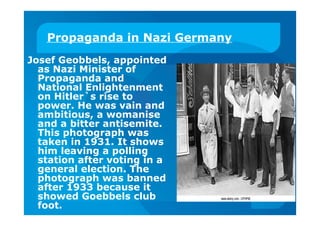
Propaganda in Nazi Germany
Josef Geobbels, appointed
as Nazi Minister of
Propaganda and
National Enlightenment
on Hitler`s rise to
power. He was vain and
ambitious, a womanise
and a bitter antisemite.
This photograph was
taken in 1931. It shows
him leaving a polling
station after voting in a
general election. The
photograph was banned
after 1933 because it
showed Goebbels club
foot.
Propaganda in Nazi Germany
What were the problems facing Goebbels
in 1933?
Newspapers:
Germany had no real national newspaper in 1933
but had 4700 local newspapers. Some were
owned by big Jewish publishing firms. All the
political parties had newspapers. The circulation
of Nazi newspapers was small.
Goebbels took over most of the publishers, put
controls on what journalists could write and set
up a press agency to tell newspapers what the
news should be. The propaganda ministry issued
daily orders to newspapers, such as that in source
3. SOURCE 3 ORDERS FROM THE PROPAGANDA
MINISTRY, 6TH APRIL 1935.
"Photos showing members of the Reich government at dining tables in
front of rows of bottles must not be published in future. Recently, because
of a great number of photos, the utterly absurd impression has been
among the public that members of the government are living it up"
Propaganda in Nazi Germany
Newspapers:
Anti Nazi newspapers were closed. By 1944 there
were only 1000 daily newspapers and most of
these were controlled by the Nazi Party.
Newspapers were put up in pubic display boxes.
Some Nazi newspapers threatened people who
cancelled their subscriptions. Even newspaper
sellers at train stations were checked on to see if
they were following Nazi instructions.
Propaganda in Nazi Germany
Radio
Problem: Hitler and Goebbels believed the spoken
word was more effective than the written word,
so radio was very important. The problem was
that much radio was local. States like Prussia and
Bavaria had their own radio. Hermann Goering,
who was Minister for Prussia, was determined he
should control radio in Prussia. Goebbels wanted
control of all radio in a Reich Radio company. The
other problem was to make sure people listened
to the radio. Few people owned radios as they
were expensive.
Propaganda in Nazi Germany
Radio
Goebbels: Goebbels won the power struggle for the
control of radio and formed the Reich radio company
which controlled all local radio stations. Millions of
very cheap radios called 'The People`s Receiver'
were made. These could not pick up foreign broadcasts.
By 1939 70% of German households had a radio. For those
who did not, 6000 loudspeaker pillars were erected in
public squares all over Germany where Nazi propaganda
programmes could be heard.
Local radio wardens encouraged the spread of radio and
made sure orders such as the newspapers announcements
were obeyed.
Propaganda in Nazi Germany
Films
Problem: These were seen as another very important
means of propaganda. The problem wa that Germans
were used to films which were made to a high
standard and were very entertaining. The 1920`s had
been a golden age in German film-making, with
Germany producing some of the most celebrated
directors and stars. Would people watch political
films if they were used to such good films?
Propaganda in Nazi Germany
Films
Goebbels: The cinema was popular so Goebbels
encouraged new films. Well over a thousand films
were made during the Third Reich. Most of these
were love stories, comedies or adventure films; the
rest were political films. Two examples of
propaganda films are Jud Suss which told the story of
an 'evil' Jew, and Ohm Kruger, an anti-British films
about the Boer War. Admission to cinemas was only
allowed at the beginning of the entire programme, so
you also had to watch newsreels and short
documentary films which carried the Nazi message.
Propaganda in Nazi Germany
Festivals & Celebrations
Problem: Goebbels had successfully used marches,
rallies and festivals to attract people in the battle to
win power. Now they had to be used to keep people
loyal, to make people feel important and part of the
New Germany. They needed to be impresive. But
what should the rallies and parades be like? What
events from the history of the Nazi party could be
celebrated each year?
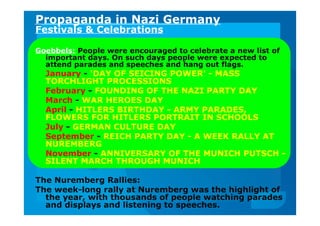
Propaganda in Nazi Germany
Festivals & Celebrations
Goebbels: People were encouraged to celebrate a new list of
important days. On such days people were expected to
attend parades and speeches and hang out flags.
January - 'DAY OF SEICING POWER' - MASS
TORCHLIGHT PROCESSIONS
February - FOUNDING OF THE NAZI PARTY DAY
March - WAR HEROES DAY
April - HITLERS BIRTHDAY - ARMY PARADES,
FLOWERS FOR HITLERS PORTRAIT IN SCHOOLS
July - GERMAN CULTURE DAY
September - REICH PARTY DAY - A WEEK RALLY AT
NUREMBERG
November - ANNIVERSARY OF THE MUNICH PUTSCH -
SILENT MARCH THROUGH MUNICH
The Nuremberg Rallies:
The week-long rally at Nuremberg was the highlight of
the year, with thousands of people watching parades
and displays and listening to speeches.
Propaganda in Nazi Germany
Culture
Problem: The Nazis were very critical of the culture
(the music, theatre, literature and art) of Weimar
Germany. They thought it undermined what they saw
as traditional German values. But how do you control
the work of artists and writers? And what do you do
about existing art, books, films and plays that Hitler
does not approve of?
Propaganda in Nazi Germany
Culture
Goebbels: Goebbels set up the Reich Chamber of
Culture. Musicians, writers and actors had to be
members of the chamber. Goebbels could stop any
musician, actor, writer or artist from workng by
ending his or her membership of the Chamber of
Culture - many who were thought to be unsuitable
were banned. Some left Germany in protest, some
buckled under and started to produce work which
was acceptable to the Nazis.
Propaganda in Nazi Germany
Music
Goebbels drew up guidelines for what was
acceptable. Music should be German: folk
songs, marching music and classical music
by Bach, Beethoven and Mozart were to be
preferred. Some popular music was
permitted, but never jazz which was 'black'
music and therefore racialy inferior.
Propaganda in Nazi Germany
Theatre
Theatre should concentrate on German history
and political drama. Cheap theatre tickets
were available. If you joined the Nazi
'cultural association' you could see ten plays
at half price, but you could not choose which
plays or when; Goebbels controlled that too.
Propaganda in Nazi Germany
Literature
Goebbels drew up a list of banned books which were removed by the
Gestapo from bookshops and libraries. In May 1933 the Nazis
encouraged students to burn the books they believed were un-
German and Jewish. Goebbels wanted books about race, war and
the Nazi movement. One popular topic was the heroic actions of
German soldiers in the First World War. Such books described the
thrill of combat and how Germans should be prepared to die for the
fatherland.
A model Nazi book was written by Goebbels in 1924.
A novel with the title Michael, It contained the
following Nazi themes:
 The comradeship of the battlefield
 The superriority of Nardic blood
 The evil influence of Communists and Jews
 The idea of motherhood and the home
 The inspired leadership of Hitler
 The heroic way of life under the Nazis
25 Point Plan
Rein Kampf
Radio
Newspapers - Der Sturmer
Films
Shops + businesses
Nuremburg Laws
Kristallnacht
WW2
Nazi treatment of the Jews
Background:
Anti-semitism (hatred of the Jews) had been
common in Europe for many centuries. In the
early Twentieth Century it was particulary
harsh in Russia and many Russian Jews moved
to Germany and other European countries
where the attitude to Jews was more tolerant.
Many German Jews were poor but some had done
well. In 1933 although Jews made up less than
1% of the German population they were
prominent in some professions - for example
16% of lawyers and 17% of bankers were
Jews. There were 10,000 Jewish doctors.
How far did life improve for people
in Nazi Germany?
2nd August 1934 - Army swore oath to Hitler.
Hitler is now fuhur.
 The Depression/Wall Street Crash
 Hyperinflation
 Treaty of Versaillies - Reparations
 Jews (according to the Nazis)
How far did life improve for people
in Nazi Germany?
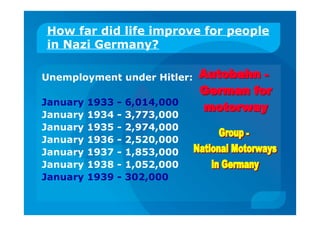
Unemployment under Hitler:
January 1933 - 6,014,000
January 1934 - 3,773,000
January 1935 - 2,974,000
January 1936 - 2,520,000
January 1937 - 1,853,000
January 1938 - 1,052,000
January 1939 - 302,000
How far did life improve for people
in Nazi Germany?
The National Labour Service [RAD]
Hitler`s first job once he came to power was to setup
the National Labour Services (rad) to provide the
jobs he had promised the German people.
This organisation gave men jobs in public works
schemes, for example, building schools, hospitals and
motorways and digging drainage ditches. Men in the
RAD had to wear a uniform and live in work camps.
Their wages were only really pocket money, but for
thousands, was an improvement of a life with no
work, at least they got free meals.
How far did life improve for people
in Nazi Germany?
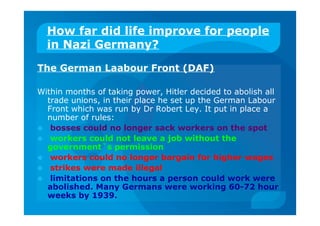
The German Laabour Front (DAF)
Within months of taking power, Hitler decided to abolish all
trade unions, in their place he set up the German Labour
Front which was run by Dr Robert Ley. It put in place a
number of rules:
 bosses could no longer sack workers on the spot
 workers could not leave a job without the
government`s permission
 workers could no longer bargain for higher wages
 strikes were made illegal
 limitations on the hours a person could work were
abolished. Many Germans were working 60-72 hour
weeks by 1939.
How far did life improve for people
in Nazi Germany?
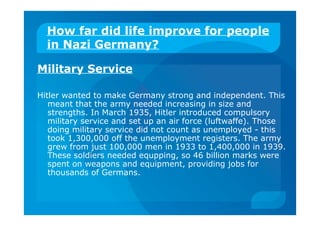
Military Service
Hitler wanted to make Germany strong and independent. This
meant that the army needed increasing in size and
strengths. In March 1935, Hitler introduced compulsory
military service and set up an air force (luftwaffe). Those
doing military service did not count as unemployed - this
took 1,300,000 off the unemployment registers. The army
grew from just 100,000 men in 1933 to 1,400,000 in 1939.
These soldiers needed equpping, so 46 billion marks were
spent on weapons and equipment, providing jobs for
thousands of Germans.
How far did life improve for people
in Nazi Germany?
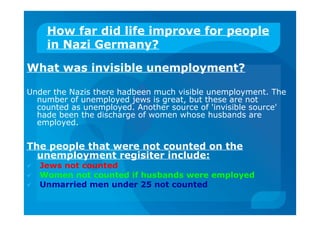
What was invisible unemployment?
Under the Nazis there hadbeen much visible unemployment. The
number of unemployed jews is great, but these are not
counted as unemployed. Another source of 'invisible source'
hade been the discharge of women whose husbands are
employed.
The people that were not counted on the
unemployment regisiter include:
 Jews not counted
 Women not counted if husbands were employed
 Unmarried men under 25 not counted
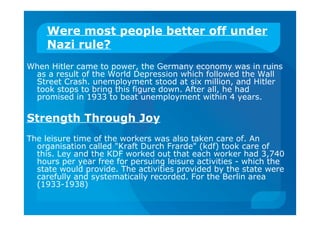
Were most people better off under
Nazi rule?
When Hitler came to power, the Germany economy was in ruins
as a result of the World Depression which followed the Wall
Street Crash. unemployment stood at six million, and Hitler
took stops to bring this figure down. After all, he had
promised in 1933 to beat unemployment within 4 years.
Strength Through Joy
The leisure time of the workers was also taken care of. An
organisation called "Kraft Durch Frarde" (kdf) took care of
this. Ley and the KDF worked out that each worker had 3,740
hours per year free for persuing leisure activities - which the
state would provide. The activities provided by the state were
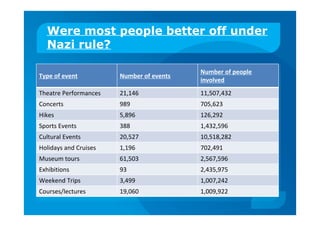
carefully and systematically recorded. For the Berlin area
(1933-1938)
Were most people better off under
Nazi rule?
Type of event Number of events
Number of people
involved
Theatre Performances 21,146 11,507,432
Concerts 989 705,623
Hikes 5,896 126,292
Sports Events 388 1,432,596
Cultural Events 20,527 10,518,282
Holidays and Cruises 1,196 702,491
Museum tours 61,503 2,567,596
Exhibitions 93 2,435,975
Weekend Trips 3,499 1,007,242
Courses/lectures 19,060 1,009,922
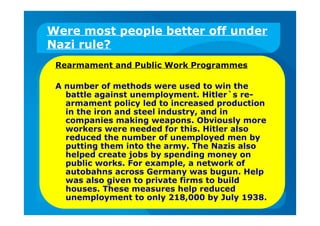
Were most people better off under
Nazi rule?
Rearmament and Public Work Programmes
A number of methods were used to win the
battle against unemployment. Hitler`s re-
armament policy led to increased production
in the iron and steel industry, and in
companies making weapons. Obviously more
workers were needed for this. Hitler also
reduced the number of unemployed men by
putting them into the army. The Nazis also
helped create jobs by spending money on
public works. For example, a network of
autobahns across Germany was bugun. Help
was also given to private firms to build
houses. These measures help reduced
unemployment to only 218,000 by July 1938.
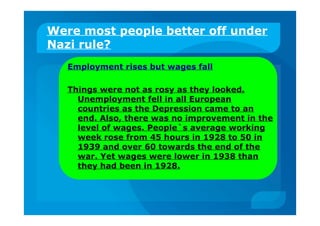
Were most people better off under
Nazi rule?
Employment rises but wages fall
Things were not as rosy as they looked.
Unemployment fell in all European
countries as the Depression came to an
end. Also, there was no improvement in the
level of wages. People`s average working
week rose from 45 hours in 1928 to 50 in
1939 and over 60 towards the end of the
war. Yet wages were lower in 1938 than
they had been in 1928.
Were most people better off under
Nazi rule?
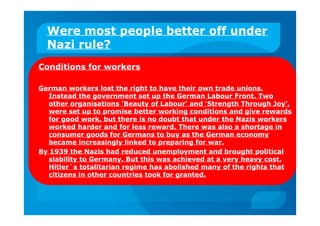
Conditions for workers
German workers lost the right to have their own trade unions.
Instead the government set up the German Labour Front. Two
other organisations 'Beauty of Labour' and 'Strength Through Joy',
were set up to promise better working conditions and give rewards
for good work, but there is no doubt that under the Nazis workers
worked harder and for less reward. There was also a shortage in
consumer goods for Germans to buy as the German economy
became increasingly linked to preparing for war.
By 1939 the Nazis had reduced unemployment and brought political
slability to Germany. But this was achieved at a very heavy cost.
Hitler`s totalitarian regime has abolished many of the rights that
citizens in other countries took for granted.
Were most people better off under
Nazi rule?
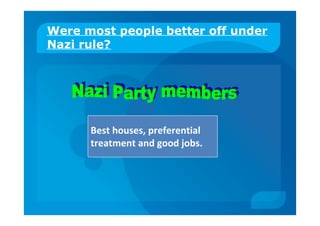
Best houses, preferential
treatment and good jobs.
Were most people better off under
Nazi rule?
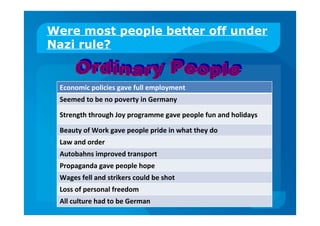
Economic policies gave full employment
Seemed to be no poverty in Germany
Strength through Joy programme gave people fun and holidays
Beauty of Work gave people pride in what they do
Law and order
Autobahns improved transport
Propaganda gave people hope
Wages fell and strikers could be shot
Loss of personal freedom
All culture had to be German
Were most people better off under
Nazi rule?
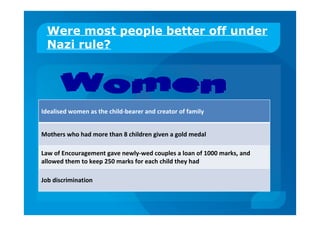
Idealised women as the child-bearer and creator of family
Mothers who had more than 8 children given a gold medal
Law of Encouragement gave newly-wed couples a loan of 1000 marks, and
allowed them to keep 250 marks for each child they had
Job discrimination
Were most people better off under
Nazi rule?
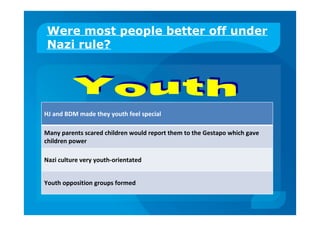
HJ and BDM made they youth feel special
Many parents scared children would report them to the Gestapo which gave
children power
Nazi culture very youth-orientated
Youth opposition groups formed
Were most people better off under
Nazi rule?
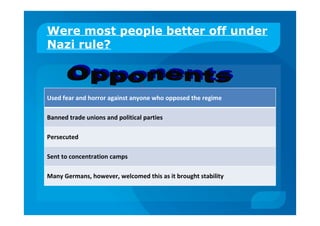
Used fear and horror against anyone who opposed the regime
Banned trade unions and political parties
Persecuted
Sent to concentration camps
Many Germans, however, welcomed this as it brought stability
Were most people better off under
Nazi rule?
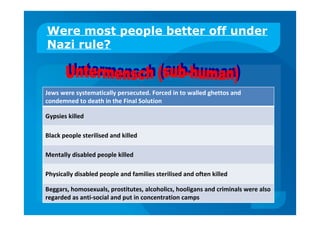
Jews were systematically persecuted. Forced in to walled ghettos and
condemned to death in the Final Solution
Gypsies killed
Black people sterilised and killed
Mentally disabled people killed
Physically disabled people and families sterilised and often killed
Beggars, homosexuals, prostitutes, alcoholics, hooligans and criminals were also
regarded as anti-social and put in concentration camps
Were people better off under Nazi
rule? Summary
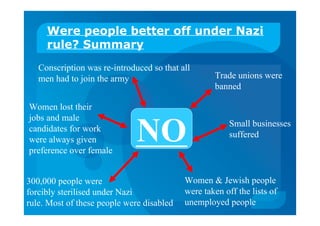
NO
Trade unions were
banned
Small businesses
suffered
Women & Jewish people
were taken off the lists of
unemployed people
Women lost their
jobs and male
candidates for work
were always given
preference over female
300,000 people were
forcibly sterilised under Nazi
rule. Most of these people were disabled
Conscription was re-introduced so that all
men had to join the army
Were people better off under Nazi
rule? Summary
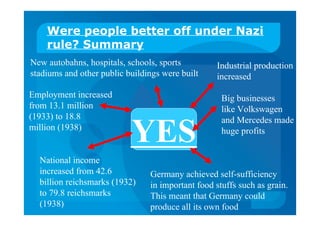
YES
Industrial production
increased
New autobahns, hospitals, schools, sports
stadiums and other public buildings were built
Employment increased
from 13.1 million
(1933) to 18.8
million (1938)
National income
increased from 42.6
billion reichsmarks (1932)
to 79.8 reichsmarks
(1938)
Big businesses
like Volkswagen
and Mercedes made
huge profits
Germany achieved self-sufficiency
in important food stuffs such as grain.
This meant that Germany could
produce all its own food
Were people better off under Nazi
rule? Summary
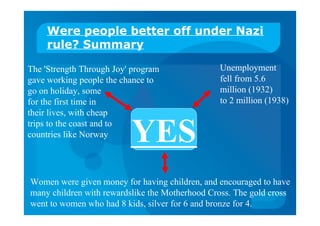
YES
The 'Strength Through Joy' program
gave working people the chance to
go on holiday, some
for the first time in
their lives, with cheap
trips to the coast and to
countries like Norway
Women were given money for having children, and encouraged to have
many children with rewardslike the Motherhood Cross. The gold cross
went to women who had 8 kids, silver for 6 and bronze for 4.
Unemployment
fell from 5.6
million (1932)
to 2 million (1938)
Were people better off under Nazi
rule? Summary
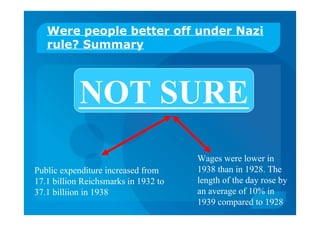
NOT SURE
Public expenditure increased from
17.1 billion Reichsmarks in 1932 to
37.1 billiion in 1938
Wages were lower in
1938 than in 1928. The
length of the day rose by
an average of 10% in
1939 compared to 1928
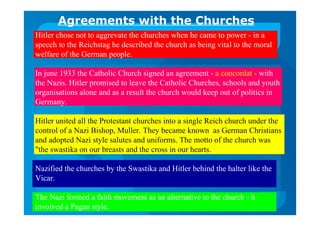
Agreements with the Churches
Hitler chose not to aggrevate the churches when he came to power - in a
speech to the Reichstag he described the church as being vital to the moral
welfare of the German people.
In june 1933 the Catholic Church signed an agreement - a concordat - with
the Nazis. Hitler promised to leave the Catholic Churches, schools and youth
organisations alone and as a result the church would keep out of politics in
Germany.
Hitler united all the Protestant churches into a single Reich church under the
control of a Nazi Bishop, Muller. They became known as German Christians
and adopted Nazi style salutes and uniforms. The motto of the church was
"the swastika on our breasts and the cross in our hearts.
Nazified the churches by the Swastika and Hitler behind the halter like the
Vicar.
The Nazi formed a faith movement as an alternative to the church - it
involved a Pagan style.
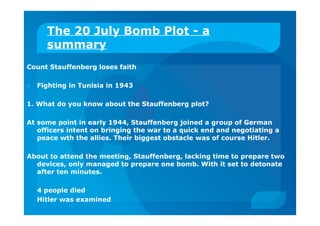
The 20 July Bomb Plot - a
summary
Count Stauffenberg loses faith
 Fighting in Tunisia in 1943
1. What do you know about the Stauffenberg plot?
At some point in early 1944, Stauffenberg joined a group of German
officers intent on bringing the war to a quick end and negotiating a
peace wth the allies. Their biggest obstacle was of course Hitler.
About to attend the meeting, Stauffenberg, lacking time to prepare two
devices, only managed to prepare one bomb. With it set to detonate
after ten minutes.
4 people died
Hitler was examined

Internation relations history revision 2

  • 2.
    CONTENT: GERMANY 1918-1945 WEIMAR REPUBLIC(REPUBLIC - NO KING/QUEEN LEADER WAS KAISER WILHELM II (OF GERMANY) 1919-1923 - CHALLENGES TO THE REPUBLIC 1923-1929 - WEIMAR STABILITY 1929-1935 - DOWNFALL OF THE WEIMAR GOV HITLERS GERMANY 1919-1923 - HITLER & THE NAZI PARTY (EARLY DAYS) 1923-1929 - NAZI STEADY GROWTH 1923- MUNICH PUTSCH 1929-1933 - INCREASING SUPPORT FOR THE NAZIS + THE WALL STREET CRASH JAN 30TH 1933 - HITLER BECOMES CHANCELLOR OF GERMANY JAN 1933 - AUG 1934 - CHANCELLOR TO DICTATOR
  • 3.
    THE EFFECT OFWW1 ON GERMANY EFFECT OF WW1 ON GERMANY The Reichstag was weak Working and even middle class people had little say in the way Germany was run During the war, Germany had been ruled as a military dictatorship by the Kaiser and his army leaders Lidendorff and Hindenburg Farming was disrupted as farmers had been drafted into the army By 1918, Germany was producing only 50% of the milk and 60% of the butter and meat it had produced before the war The British blockade of Germany prevented food getting into Germany and people faced starvation In the winter of 1916-17 the supply of potatoes ran out and only turnips were left. 750,000 died of hunger and disease. Political Effects Physical EffectsPsychological Effects Before the war, Germans had been proud and ambitious for their country - they were now bitter and angry Germans looked around for someone to blame for their defeat in the war A society that had been famous for its unity and the obedience of its people now became famous for its squabbling and conflict Germany was unstable. Many armed, demobilised soldiers were returning home bitter and angry. They joined violent demonstrations against the war and the Kaiser. Anarchy
  • 4.
    THE EFFECT OFWW1 ON GERMANY EFFECT OF WW1 ON GERMANY However, the allies were stronger, and Germany weaker than it seemed. The USA had entered the war in 1917. Every month it was sending fresh soldiers and equipment to build up the allies forces. The German army had lost many of its best officers in earlier battles, and its soldiers were poorly supplied after years of the British naval blockade of its ports. In June 1918 the Ludendorff offensive slowed, then ground to a Holt. Reversal Disaster In August 1918, the allies counter-attacked. Within a few weeks the allies had recaptured all the land that the Germans had gained in the past 3 months. By September 1918 it was clear Germany had to make peace. Over a million Germans dead, people faced starvation. Allies offered peace but the Germans had to get rid of the Kaiser as he was blamed for starting the war. German divisions were now transferred from the Eastern Front to the Western front. They made a massive breakthrough all along the Western Front in the Ludendorff offensive. German divisions were now, at last, advancing quickly through Belgium and Northern France. Their leaders encouraged the German people to believe that victory would soon be theirs. A Breakthrough
  • 5.
    WAS THERE REALLYA REVOLULATION IN GERMANY IN 1918? 1) One condition for peace at the end of WW1 was that Germans had to get rid of Kaiser Wilhelm. However, he refused to abdicate. The German people were giving up the fight. Kaiser A German or Austro - Hungarian emperor Wilhelm A male given name, German form of William Abdicated Give up your role Revolution A change Versailles City in and the Capital Yuelines NFrance. Peace treaty between allies and Germany 1919 Armistice A temporary suspension of hostilities by agreement Strike Protests Ultimatum A final proposal or statement of conditions War A conflict carried on by force of arms Reichstag Lower house of Parliament during second Reich and Weimar Republic Chancellor Head of German state Peace The normal, non warring condition of a nation, group of nations Mutiny Rebellion against any authority
  • 6.
    It was acondition for peace that the Germans got rid of the kaiser, but he refused to abdicate. This is how events moved during (October and November 1918) Naval commanders at Kiel decided to send their ships out to fight the British fleet in one last suicidal bid for glory. Sailors mutinied. (25 October 1918) The Kaiser and his government did not try to send the army to crush this mutiny and it was quickly followed by strikes and demonstrations against the war and the Kaiser all over Germany. Soldiers mutinied and joined protests. (28 October - 5 November 1918) By now soldiers and workers councils had taken control in many cities. Their main aim was to end the war. (6 November 1918) Social Democrat leader sent an ultimatum to the Kaiser that unless he abdicated they would join the revolution. (7 November 1918) Strike in Berlin. Armed workers and soldiers roamed the streets. Ebert took over as chancellor. (9 November 1918) Kaiser Wilhelm fled into exile in Holland and spent the remainder of his days there. (10 November 1918) An armistice was agreed between Germany and the Allies. (11 November 1918) 87 654 3 2 1
  • 7.
    Who Would ControlGermany? With the Kaiser gone, the Social Democrats were in charge, but they were not in control. Germany was extremely unstable. Armed, demobilised soldiers were returning home from the front and joining in the demonstrations and violence on the streets. And there was still the threat from the extreme left- wing revolutionaries 1. Communism A political system where everyone is equal and gets paid the same 2. Socialist Left wing political beliefs, supports the working class 3. Social Democrats The biggest party in the Reichstag in 1918 4. Ebert Chancellor of Germany in 1918 5. Spartacus League A communist group led by Rosa Luxemburg
  • 8.
    The Social DemocratsThe Spartacus League Who was their leader? Ebert (Friedrich Ebert) Rosa Luxemburg What was their background? Chancellor of Germany in 1918 Went to Germany in 1898 Writer and Speaker Imprisoned for sending anti-war propaganda Did they want the Kaiser in charge? No, getting rid of the Kaiser was the end of the revolution Who supported them? The rich, poor, the army? Soldiers Did they want a revolution? No because they got rid of the Kaiser Who would rule Germany? The Kaiser ruled Germany. But when Germany lost the war he had to abdicate The German government, called the Reichstag were now in power, but they were not really in control There were lots of groups ready to start a revolution. Soldiers came home from the war with their guns and found their families starving. They were angry with the government for signing the Treaty of Versailles and wanted to get rid of the government.
  • 9.
    Germany and theTreaty of Versailles  WW1 was fought between 1914-1918  At the end Germany lost, because of a number of factors, including America`s entry into the war and the Naval Blockade which stopped food and supplies getting into Germany  The German (Kaiser) king was forced to be abdicated  At the end of the war the victors met at the Paris Peace Conference and came up with their terms for peace  Germany was forced to sign the Treaty of Versailles. They were not allowed to attend or negotiate the terms and felt that they were unfairly treated. They called the treaty a "DIKTAT"  The 3 countries involved in the Versailles negotiations were: 1. Britain (Lloyd George) 2. France (Clemenceau) 3. USA (Wilson) (the 3 main leaders of the negotiations can be seen in brackets next to the country)
  • 10.
    Das Diktat -Why did the Germans hate the Treaty of Versailles? What kind of treaty were the Germans expecting? After the 1st world war the Germans knew they would have to pay a price for peace. However, they had several reasons for hoping that the peace treaty would not be a harsh one. The Kaiser had gone: Germany had a new democratic government. The new republic needed support The social democrat leaders expected they would have great problems settling Germany down after the chaos of war and revolution. They assumed that the Allies would want to help them and give their new government a good chance to establish itself. A harsh treaty would make it far more difficult for - - them to create a stable government War Guilt Article 231 of the Treaty said that Germany was to blame for the causing of the war. This was the term that the Germans most resented. To them the war had been one of self-defence. Reparations As Germany was held to be responsible for the war, the Allies could claim compo for damage caused by the war. In 1921 a special commission fixed a sum of £6600 million to be paid in annual instalments. Given that the Treaty also took away from Germany around 10% of its industry and 15% of its agricultural land, there was doubt as to whether Germany could actually afford this.
  • 11.
    Das Diktat -Why did the Germans hate the Treaty of Versailles? Military Restrictions The French desire for security meant that the German armed forces had to be drastically reduced. The air force had to be disbanded Army limited to 100,000 soldiers Navy limited to 15,000 sailors Only 6 battle ships No submarines President Wilson believed in a fair treaty What kind of treaty did the Germans get? When the allies assembled at Versailles in 1919 to draw up the treaty, it soon became clear that the Germans were not going to get what they hoped for despite Wilson`s hopes the emphasis - - seemed to be punishing Germany. The French, in particular wanted a peace which would weaken so much that there would be no chance of it attacking France in the future. Additionally, the Rhineland would be occupied by the allies for 15 years and no German troops allowed in the area. Territorial Losses Germany lost 13% of its land, which contained about 6 million of its people. Alsace - Lorraine was returned to France West Prissoa and Posen (polish corridor) were lost to Poland After plebiscites in 1920-21 by the people who lived there, the following areas were also lost  Alsace - Lorraine returned to France Northern Schleswig to Denmark Part of upper Silesia to Poland Danzig was taken over by the league of nations as a free city
  • 12.
    Das Diktat -Why did the Germans hate the Treaty of Versailles? Territorial Losses Danzig was taken over by the league of nations as a free city Memel was taken over by the league but was eventually taken by Lithunania in 1923 The Saalland was taken over by the league of nations for 15years. There would then be a plebiscite to determine its future
  • 13.
    How did Germanyreact to the treaty? When the terms of the treaty first became known, the German government refused to sign it, and resigned. It was a hopeless gesture. The Allies made it clear that if the Germans did not sign, they would resume the war. A new government was formed which did agree to sign the treaty. It did not believe that the treaty was fair any more than the previous government did, but knew it had no choice. As responsible politicians they had to sign. To allow war to restart would be suicidal for Germany. But from the moment the treaty was signed, many promised to do all they could to overthrow it.
  • 14.
    How did Germanyreact to the treaty? The "stab in the back" myth The Treaty of Versailles greatly weakened the new government of Germany. It suited many Germans to believe that Germany had never really lost the war. Army leaders like Ludendorff encouraged this view. He said the army would have fought on to preserve Germany`s honour, if only weak politicians and Communist revolutionaries had not demanded peace. A powerful myth developed which said that the army had been "stabbed in the back" by weak politicians. Right-wingers who looked back fondly to the pre-war days when Germany was powerful were happy to blame the new democratic government for making peace. The Treaty became a symbol of Germany`s humiliation and defeat. This aroused strong feelings.
  • 15.
    Problems of theWeimar Government 1. 1919 - Spartacist uprising -Communists - stopped by Freikorps 2. 1919 - Signing of Versailles Treaty - German ppl very bitter and angry 3. 1920 - Kapp (Wolfgang Kapp) uprising - Freikorps - stopped by general strike
  • 16.
    Problems of theWeimar Government The Weimar Constitution The President elected every 7 years The Reichstag Proportional representation: parties got the same proportion of seats as their proportion of votes The German People All adults can vote, all have equal rights The Chancellor Appointed from the Reichstag by the president. Had to be supported by a majority of the Reichstag Article 48: In an emergency he could make laws without going to the Reichstag first ElectMake Laws Opponents
  • 17.
    The invasion ofthe Ruhr and Hyperinflation By 1923 Germany could no longer repay the reparation repayments.  When the Germans could no longer repay the £6.6 billion pounds in reparations repayments the French were angry.  They sent troops to an area called the Ruhr in Germany which was very industrial and produced iron. They then occupied this area to take resources from Germany.  Germans in the area went on strike to stop the French getting these resources. This was called, "passive resistance"  This meant that Germany had even less money as they were no longer making money in this area  Germany had to print more and more money to try and pay the reparation repayments.  This lead to hyperinflation
  • 18.
    1923 - TheMunich Putsch (The Beer Hall Putsch) Hitler the Failure: 8th November: What happened in the beer hall? On November 8th Kahr, the Bavarian Prime Minister and this two most senior Bavarian officials were addressing a meeting of around 3000 businessmen at a beer hall in Munich. Hitler and Goering arrived with 600 storm-troopers. Hitler stopped the meeting and took Kahr and his ministers into a side room at gunpoint where he persuaded them to support him in overthrowing the Reich government.
  • 19.
    1923 - TheMunich Putsch (The Beer Hall Putsch) Hitler the Failure: 9th November: The March on Munich The first part of Hitler`s plan had succeeded. But now he had made a big mistake. He let Kahr and his colleagues go, while he and Ludendorff planned how their supporters could seize Munich the following day it was soon clear that Kahr`s pledge of support, made at gunpoint, was worthless. When news of the Putsch reached Berlin the government ordered the army in Bavaria to crush it. Kahr would not attempt to stop it. The Nazis could not backtrack now, however. They would march on Munich the next day as planned. They would challenge the army and the police not to fire on them, but to support them. With Ludendorff as their leader, Hitler hoped they might succeed.
  • 20.
    1923 - TheMunich Putsch (The Beer Hall Putsch) Hitler the Failure: The results of the Munich Putsch The Munich Putsch was a failure. As a result: The Nazi party was banned, and Hitler was prevented from speaking in public until 1927. Hitler went to prison, where he wrote 'Mein Kampf'. Millions of Germans read it, and Hitler's ideas became very well-known. Hitler decided that he would never come to power by revolution; he realised that he would have to use constitutional means, so he organised: The Hitler Youth Propaganda campaigns Mergers with other right-wing parties Local branches of the party, which tried to get Nazis elected to the Reichstag The SS as his personal bodyguard, which was set up in 1925 It was this strategy of gaining power legitimately that eventually brought him to power.
  • 21.
    To what extentdid the Weimar Government recover after 1923? Gustav Stresemann  He was a businessman and politician  His political beliefs are not easy to define as they do not conform to the usual "left/right" classification  He had business links with the USA before the 1st world war  After the war he set up the German Peoples part (DVP) supported by many middle - and upper - class protestants. The DVP stood for Christian family values, secular education, lower tariffs, opposition to welfare spending and agrarian subsides and hostility to Marxism. The DVP gradually began co- operating with centre and left-wing parties
  • 22.
    To what extentdid the Weimar Government recover after 1923? Gustav Stresemann  Stresemann spent a brief period as chancellor but failed to deal firmly enough with the culprits of the Munich Putsch, and this lead the Social Democrats to leave the coalition that he led  For the next 8 years (the remainder of his life) he continued as Foreign Minister, whatever the make- up of the government  He was friendly with many foreign leaders and won the Nobel Peace Price in 1926 (shared with his French Counterpart Aristide Briand)  He died of a stroke aged 51 in 1929
  • 23.
    To what extentdid the Weimar Government recover after 1923? Gustav Stresemann STRESEMENN`S SUCCESS AND HOW THIS HELPED GERMANY 1. 1924 - The Dawes Plan 2. 1925 - Locarno Pact 3. 1926 - Germany joined the League of Nations 4. 1928 - Germany signed the Kellogg- Briand Pact 5. 1929 - The Young Plan
  • 24.
    1924 - TheDawes Plan How did this help Germany? Stresemann was chancellor for just 4 months, but he was foreign minister for 5 years. It was in this office that he had his greatest success. In 1924 he negotiated the Dawes Plan with the allies. Under the terms of the plan, the USA agreed to loan Germany 800 million gold marks. Annual repayments reduced payment until 1988. Payments ceased in 1930.
  • 25.
    1925 - LocarnoPact How did this help Germany? These economic measures, together with further loans from the USA, helped the German economy to recover. Between 1924 and 1929 Germany received over 25 billion marks in loans, which enabled German industry to be rebuilt. Stresemann also had great success in improving relations with other countries. In 1925 he signed the Locarno Pact with France and Belgium, in which countries agreed to respect common orders.
  • 26.
    1926 - Germanyjoined the League of Nations How did this help Germany? In 1926 Germany joined the LEAGUE OF NATIONS.
  • 27.
    1928 - Germanysigned the Kellogg-Briand Pact How did this help Germany? The international acceptance of Germany was reinforced in 1928 when it was one of 60 countries to sing the Kellogg Briand Pact, which renounced war as an instrument of foreign policy.
  • 28.
    1929 - TheYoung Plan How did this help Germany? The introduction of the young plan meant that Germany`s reparations were reduced by over 67% and the country was given a timetable for making payments. The allied powers adopted this in 1930, although the WALL STREET CRASH of 1929 had a major impact its implementation. Stresemann was strongly criticised for being too willing to co-operate with Germany`s further enemies. Believed the Treaty of Versailles could not happen over night.
  • 29.
    To what extentdid the Weimar Government recover after 1923? SUMMARY Hyperinflation Problems:  Retenmark  Got the French to leave the Ruhr 1924 - Dawes Plan - USA gave loans to Germany 1925 - Locarno Pact - Agreed to maintain the borders of countries 1926 - League of Nations - Germany was allowed to join the League of Nations 1928 - Kellogg Briand Pact - 60 countries signed, they agreed not to sort problems by war 1929 - The Young Plan - Reparation repayments reduced, extra time to pay
  • 30.
    What did theNazis stand for in the 1920`s? What did the Nazis stand for in the 1920`s? Increase old age pensions Educate gifted children at the state`s expense No non-Germans to be newspaper editors Remove Jews from all positions of leadership in Germany Challenge terror or violence with your own terror or violence Destroy Marxism Destroy the Weimar Governments Abolish the Treaty of Versailles Re-arm Germany Conquer Lebensraum Nationalise Important Industries Strong Central Government
  • 31.
    The Swastika What didthe Nazis stand for in the 1920`s? Hitler personally designed the Nazi flag, with its symbol, the Swastika. The colours red, white and black had also been the colours of Germany`s flag under the Kaiser. Very quickly the Swastika became the best known political symbol in Germany.RED - Social idea of movement White - Nationalist idea
  • 32.
    Hitler as aleader What did the Nazis stand for in the 1920`s? By 1922 Hitler was the undisputed leader of the party. He had a powerful, dominating personality. He was intelligent and decisive. Although he was a small man he had a great physical presence. He had piercing blue eyes which he would fix on his listeners and he was a charismatic public speaker. When giving a speech he would often arrive late at a meeting then stand silent for several minutes. He would start softly then gradually build up to a furious finish, driving the audience wild with enthusiasm. He rehearsed carefully for important speeches.
  • 33.
    Hitler as aleader - Extra information What did the Nazis stand for in the 1920`s? Mein Kampf was published in 1925. His national fame was now such that it became a best seller. The German word Chaff means useless Additionally, Hitler did very little to solve the great depression. As well as this he tried to raise taxes which people were not happy about. Hitler also cut unemployment benefit. COMMUNISM - Everyone gets same (middle class didn`t turn to communism) working class turned to communism
  • 34.
    What was thedepression? How did the Depression help the Nazis? Who Suffered Factory Workers 40% of all factory workers were unemployed by 1932. At the same time the government cut unemployment benefit to save money. For the unemployed this was a time of extreme poverty Farmers Farmers had not done well in the 1920`s. Prices had been falling since 1925. In the 1930`s farmers slipped further into debt Businessmen Businessmen saw their business close. If they did manage to survive they saw their income fall - because in the depression people had less money to spend, even on essentials like food & clothes. To make matters worse the government actually raised taxes to pay for looking after the increasing number of poor people. However, business owners were not hit as badly as either their workers or farmers. Young People In 1933 over 1/2 of all Germans between the ages of 16 & 30 were unemployed. 60% of new university graduates could not get a job.
  • 35.
    What was thedepression? How did the Depression help the Nazis? How did the Weimar Government deal with the Great Depression? DESTROY DEMOCRACY DICTATORSHIP FUHRER NAZI 1 PARTY STATE 1. Increased taxes 2. Cut benefits 3. President Hindenburg used Article 48 to rule by decree OCT 1929 WALL STREET CRASH JAN 30TH 1933 JAN 30TH 1933 HITLER BECOMES CHANCELLOR AUGUST 1934 3 YRS 18 MONTHS
  • 36.
    How did theseproblems help the Nazis? How did these problems help the Nazis? Promise to Voters!Promised restored profits Every sector of German society seemed to hear something it wanted to hear Farmers higher prices Shop-keepers protection against competition. There was something for everyone Workers promised jobs (Hitler could point to how the Nazis [SA] had taken in the unemployed and fed & housed them.
  • 37.
    How did theseproblems help the Nazis? How did these problems help the Nazis? Use of Technology Could now redouble their propaganda Radio was used for the first time 1932, Presidential elections, while Hindenburg gave just one election speech Radio broadcast carried the Nazi message. Millions, election posters, rallies, parades and marches Geobbells chartered planes to fly Hitler all over Germany in order to speak to 4 or 5 massive rallies a day
  • 38.
    How did theseproblems help the Nazis? How did these problems help the Nazis? Support of the Industrialists One of their aims - which was pretty successful - was to earn the support of the powerful industrialists. Traditionally, they had voted for the Conservative Party, which lost much of its support after 1930. In 1931 Hitler made a deal with the other main-right wing party, The Nationalists, by which the 2 parties agreed to co-operate. The Nazi party also received some financial backing from big businesses.
  • 39.
    How did theseproblems help the Nazis? How did these problems help the Nazis? Weakness of Opposition Other parties were very weak and they consistently underestimated the Nazis. The Social Democrats feared they would attempt a putsch. But they thought that the Nazis electioneering was so absurd that ordinary Germans would see through it. They`re own support was constant so they were not eager to change. They quarrelled amongst themselves.
  • 40.
    How did theseproblems help the Nazis? How did these problems help the Nazis? Organisation Skilled leaders at almost every level Local workers well trained and motivated They brought to party work the same obedience, organisation and teamwork skills which they needed in the trenches. Very well organised M any N azishad been soldiersin W W 1
  • 41.
    How did theseproblems help the Nazis? How did these problems help the Nazis? Propaganda Stirred up violence at election meetings so SA could crush it and be seen dealing with Communist threat. Used every trick in the book to get their message home. Leaders were masters of propaganda and carefully trained local groups in it. Hitler pointed to the Nazis 10 year track record in leading the fight against Communism. They knew their anti- communist stance was very popular and their propaganda further whipped up fear and hatred of the Communists.
  • 42.
    How did theseproblems help the Nazis? How did these problems help the Nazis? Flexibility One reason for the Nazis success was that they were flexible If they found an idea was losing them support they would change it. In the end, despite the extreme beliefs expressed in the Nazis 25 points - of which they made no secret. Germans were actually very unsure as to what the Nazis really stood for. If all else failed the Nazis simply went for vague promises: They would make Germany great again. In one election speech a Nazi powerfully for an nationalisation of industry - one of Nazis beliefs - quickly dropped the idea, when industrialists were alarmed. They realised it doesn`t matter what people promise as long as they trust you
  • 43.
    How did theseproblems help the Nazis? How did these problems help the Nazis? Hitler the Superman Only one thing really stayed consistent throughout this barrage of electioneering. The unblinking focus on Hitler, the strong leader whom Germany needed and wanted. He wore spectacles to read but refused to be seen wearing them in public and so his speeches were typed in LARGE (12mm high print) Opposition had no1 to match him Hitler was the Nazis trump card He developed his speech making skills further It no longer seemed to matter what he said just HOW he said it His physical appearance was adopted (on posters at least) Campaigns focused around his personality and skills.
  • 44.
    How did theNazis gain popularity 1929-1933? Left Wing Right wing unemployment Communist Social Democrats Democratic Party Centre party Conservatives Nationalist Nazis Unemployment figures 54 153 25 61 45 73 12 2.6% 1.391.000 77 143 20 68 30 41 107 18.3% 3.076.000 89 133 4 75 7 37 230 37.3% 5.603.000 100 121 2 70 11 52 196 33.1% 81 120 5 74 2 52 288 43.9% 4.804.000 1928 1930 Jul 1932 Nov 1932 1933 The above table shows the Reichstag election results. 1928-1933 and unemployment figures 1925-1933.
  • 45.
    How did theNazis gain popularity 1929-1933? 1. How many seats did the Nazis have in the Reichstag in 1928? 12 2. What event happened in October 1929? The Wall Street Crash 3. What happened to Nazi support following the event? Nazi support increased 4. What do you notice about Nazi popularity by July 1932? The popularity of the Nazis increased 5. What happened to the number of seats gained by the Nazis in the Nov 1932 elections? Decreased by 33.1% from 230 seats to 196 6. By 1933, what % of the seats did the Nazis have? 43.9%
  • 46.
    Why was Hitler'invited' to become Chancellor of Germany? By November 1932, Hitler was leader of the largest party in the Reichstag. He now thought he should be given the role of chancellor. The Problem: At the heart of the problem was that by 1932 the Nazis were the largest party in the Reichstag. Normally the leader of such a party would become the Chancellor, but the other parties would not work with Hitler. The constitution gave President Hindenburg the right to appoint the chancellor and he did not want Hitler as Chancellor. President Hindenburg Franz von Papen General von Scheicher Hated Hitler. Advisers were rich, conservative industrialists and army leaders Rich Catholic nobleman. A favourite of Hindenburg. Distrusted Hitler Former army leader. The main advisor to Hindenburg. Supported von Papen to start with. Distrusted Hitler.
  • 47.
    Why was Hitler'invited' to become Chancellor of Germany?  Highly respected WW1 hero  84 years old in 1932  Faced huge opposition from the Nazis and Hitler who stood against him in the 1932 Presidential election.  Hindenburg won the 19 million vote to Hitler`s 13 million  Even-though Hitler lost, the election gave him an excellent opportunity to get his message across even more  Had the difficult job of trying to establish a stable government in Germany  1925 - 1934 (president) President Hindenburg
  • 48.
    Why was Hitler'invited' to become Chancellor of Germany?  Hindenburg`s 1st choice  Member of the Centre Party  Found he didn`t have enough support  Called an election in July 1932 but this backfired as the Nazis increased their support  He called another election in November 1932 and although the Nazis lost seats, he lost more  Was forced to resign, humiliated  May - Nov 1932 (7 months president)  Had a secret meeting with Hitler when Schleicher was in-charge Franz von Papen
  • 49.
    Why was Hitler'invited' to become Chancellor of Germany?  Couldn`t rule effectively when the Nazis were so powerful  Lasted less than 2 months  Nothing else to say!  Nov 1932 - Jan 1933 (2-3 months president) General von Scheicher
  • 50.
    When did Hitlerbecome chancellor and what did this lead to? Jan 30th 1933 (Hitler becomes Chancellor) Feb 27th 1933 (Reichstag fire)  Suspending all the articles in the constitution which guaranteed personal liberty  Freedom of speech  Freedom of the press  Freedom of assembly Now in power Hitler could do the following things:  Search houses  Confiscate property  Detain people indefinitely without trial  It decreed the death penalty for a wide range of crimes  Police could ban meetings  Police could close newspapers  Police could round up political opponents  Police could drag them off to their hostly organised concentration camps and detention centres  Police seized the state Radio Station
  • 51.
    When did Hitlerbecome chancellor and what did this lead to? Reichstag fire & emergency powers Joins Nationalists Enabling Act Bans other Political Parties and Trade Unions Night of the Long Knives Death of Hindenburg Army Oath
  • 52.
    When did Hitlerbecome chancellor and what did this lead to? March 5th elections (1933)  Nazis won 288 seats  Hitler is still not happy as he has not got a majority and cannot pass new laws. Therefore, he needs to think of something to get their votes.  He THEN BANS COMMUNIST PARTY (because of the Reichstag fire)  Hitler then gets 50% of seats in the Reichstag  AFTER THIS HE JOINS WITH NATIONALISTS  This gives him 53% of the seats, which is a majority Enabling Act  This gives the power personally to Hitler. The Chancellor can make new new laws without telling the Reichstag.  Bans all other political parties  Hitler bans all other parties including [Social Democrats], the party that set up the Reichstag had now gone.
  • 53.
    Night of theLong Knives Hitler had an ultimatum and had to make a choice between the SA and the Army.  Hitler was finding the SA harder to control  The SA had a violent reputation which Hitler did not want to be associated with  Rohm posed a particular threat - he was getting too powerful  Hitler would have to go along with ideas of the SA On 29th June 1954 Hitler acted. He called a meeting of SA leaders for the following day at Wiessee in Bavaria. 30th June - becomes known as the Night of the Long Knive.
  • 54.
    Night of theLong Knives On 13th July 1934 Hitler told the Reichstag that Rohm had been arrested and shot because he was plotting to seize power. Circurquent Democracy 1st July 1934 - Hitler hosts a tea party Treason SA + Other enemies Carr - (at Munich Putsch) Von Schliecher (chancellor) Rohm (shot in his cell) 77 died (official record) 400 died in reality The message that this gives to German people is that Hitler is in charge and anyone who challenges it risks it at their perel.
  • 55.
    Night of theLong Knives Hindenburg died on 2nd August 1932 ages 87. The eldest chancellor ever to rule Germany.  Hitler now gave himself a new title, FUHRER  On the same day the army swears an oath of personal loyalty to Hitler
  • 56.
    Night of theLong Knives 4 THE ARMY AGAINST THE ARMY The army was well trained, organised and disciplined The army had the support of big business and Conservatives An efficient army was needed for Hitler to retake the land lost under the Treaty of Versailles The army was the only organisation which had the power to remove Hitler The army was small - it had only 100,000 men. However, due to the Treaty of Versailles the army to restricted to this number of soldiers How loyal the army would be to Hitler was unknown 4 THE SA Rohm, the leader of the SA, was an old friend of Hitler The SA had fought for Hitler in the 1923 Munich Putsch and in later fights against Communists The SA were committed Nazis The SA had grown to over 2,500,000 men - it was much larger than the army if it came to a fight AGAINST THE SA The SA was beginning to get out of hand. It was interfering in the running of the country and the law courts The SA disapproved of some of the Nazi leaders If Hitler used the SA to control the army, then he would have to go along with their other demands Some of the generals disliked Hitler and the Nazis Hitler did not agree with many of the SA`s anti-capitalist policies and working-class aims
  • 57.
    Life in NaziGermany? How did the Nazis control Germany? Some people went along with the Nazis simply because they were too scared to speak out against them. They did not necessarily support Hitler but feared the consequences of objecting to him. Special organisations even existed to terrorise people into accepting Nazi rules. The SS SS stands for "schutz staffel", which means "protection squad". Set up in 1925, the SS were originally Hitler`s private bodyguards. Gradually, it was built up to be the most important armed group in Germany. SS members were tall, fit, blond haied and blue eyed. You couldn`t even become a member if you had a tooth filled: Mainly, the SS had three sections: One section looked after security - they could arrest anybody without a good reason and search houses.
  • 58.
    Education in NaziGermany Indoctrination - A set of beliefs constantly repeated to implant ideas in the mind Ideology - A set of ideas Eugenic - How to produce perfect off-spring The second area of influence over young people was their school. The Nazis used their control over teachers to influence what children learned at school. Many teachers were already very nationalistic and accepted that they should teach Nazi ideas. Those who were not were usually sacked. Many teachers attended teachers` camps which concentrated on indoctrination and physical training. 97% of teachers joined the Nazi Teachers Association.
  • 59.
    Education in NaziGermany - The Nazi Curriculum The minds and bodies of young people were to be shaped to the Nazi cause. Certain subjects became more important than others.  Physical education was given 15% of school time, and some sports such as boxing became compulsory for boys. Pupils had to pass an examination, and unsatisfactory performance could lead to being expelled  History. This concentrated on the rise of the Nazi party, the injustices of the Treaty of Versailles and the evils of Communism and the Jews  Biology explained Nazi ideas on race and population control. Pupils were taught how to measure their skulls and to classify racial types: also that Aryans were superior and should not marry inferior races  German. This taught pupils to be conscious of their national identity by reading about German heroes of the Hitler Youth and First World War.  Geography taught about the lands which were once part of Germany and the need for more living space (Lebensraum) for Germans.  Religious Studies became less important and by 1937 pupil could drop the subject.
  • 60.
    Education in NaziGermany - The Nazi Curriculum Girls usually had a different curriculum from boys. They also studied domestic science and eugenics (how to produce perfect offspring by selecting ideal qualities in the parents). Additionally, life in school became very difficult for those who were not Aryan, especially the Jews. Teachers in Nazi Germany Membership of the Nazi Teachers` Association became compulsory after 1933. 1. This made the process of indoctrination much easier for the Nazi Party, with teacher`s. 2. Virtually all Jewish teachers were dismissed in 1933 as it was deemed 'undesirable' to allow Jewish teachers to teach 'Aryan' pupils. 3. Some teachers remained as teachers in Jewish schools until these schools were banned altogether in 1942. Those teachers who taught in 'Aryan' schools however suffered increasing levels of harassment and by 1935 no Jewish teachers were left in these schools at all.
  • 61.
    What was lifelike in the Hitler Youth? The Youth Movement There were multiple tasks of which could be done as a result of The Hitler Youth Movement. For example:  model making  Reading Der Sturmer  Chariot races  Practising carrying 'dead' comrades to the funeral pyre as a part of a Mid Summer festival  Hitler Youth leaping through fire at a festival to mark the Summer Solstice Women/girls did slightly different activities for example, javelin throwers in the League of German maidens. Girls also had to run 60m in 14 seconds, throw a ball 12m, complete somersaults, a tightrope walk and a 2 hour march or swim 100m: and know how to make a bed.
  • 62.
    What was lifelike in the Hitler Youth? But how were the youths organised? Boys: 10-14 years old Deutsches Jungvolk - DJ (Pimpfen) German Young People Girls: 10-14 years old Jungmadelgund - JM League of Young Girls Boys: 14-18 years old Hitler Jugend - HJ Hitler Youth Girls: 14-18 years old Bund Deutscher Made (BDM) League of German Girls
  • 63.
    What was lifelike in the Hitler Youth? Hitler wanted to turn the young into loyal Nazis. The three greatest influences on young Germans were their families, their schools and youth movements. The Nazis tried to control all three. Youth movements had been popular in Germany for a long time. They usually involved hining, singing folk-solks, camping and sport. There were many groups to choose from - most were political or religious groups. The Nazis had formed their own Hitler youth in the 1920s. After 1933 young people were encouraged to join the Hitler Youth and most other political youth organisations were closed down. By 1936 it was almost impossible not to join the Hitler youth. There were separate organisations within the Hitler Youth for boys and girls, all under the command of Reich Youth leader. Baldur Von Schirach. Girls were encouraged to join the League of German Maidens. The Nazis believed the girls` youth organisations were less important than those of the boys because girls were not prepared for military service. Never the less, girls had to do similar activities and tests to the boys.
  • 64.
    Opposition to theNazis - The Youth The Soldiers: Nazi Youth policy throughout the 1930s was directed at preparing young Germans for war. When war came the Nazis had a strong army, but the rest of their youth policy was badly harmed. The best leaders of the Hitler Youth went away into the army leaving the organisation in the hands of teenagers. The Hitler Youth concentrated exclusively on military affairs. Members got fed up with being policed and told what to do by people hardly older than themselves. In several ways the Hitler Youth became less and less attractive and many young men turned away from it. These young people often formed gangs or groups. There were two main 'alternative' or opposition groups - the 'Edelweiss Pirates' and the 'Swing Youth'.
  • 65.
    Opposition to theNazis - The Youth Swing Youth: These were middle class youths who wanted to dance and listen to swing music which was a blend of black jazz and white dance-band music. During the war 'swing clubs' sprang up in most cities where members met in cafes and night clubs. They wore English style bomber jackets, girls wore make up and Jews were accepted into their groups. A common greeting was 'Heil Benny' after band leader Benny Goodman. The Nazis were outraged and tried to stamp out such behaviour. Some of these young people were harshly punished - such as Hasso Schutzendorff, who in October 1942 was put in a concentration camp. had his hair cut off. was thrashed by an iron bar and forced to push trolleys full of earth up a hill for a fortnight.
  • 66.
    Opposition to theNazis - The Youth Edelweiss Pirates: The edelweiss flower was a symbol of opposition adopted by many groups of working class youths. Groups such as the 'Roving Dudes' and the 'Nacajos' all regarded themselves as 'Edelweiss Pirates'. They included girls and boys. At weekends they would go on hikes, meet other groups, camp, sing, talk and hope to beat up Hitler Youth patrols. Some of the Edelweiss Pirates also got involved in direction opposition to the Nazis. In Cologne the 'Navajos' sheltered army deserters and concentration camps escapees, and attacked military targets and Nazi officials. A group of them killed the head of the Cologne Gestapo but were caught soon after and executed in November 1944.
  • 67.
    Women in NaziGermany These campaigns were particularly aimed at Aryan women. They were the ones whom the Nazis really wanted to have large families. They wanted to mould Aryan women into their ideal mothers who: Did not go to work: In all the jobs they were directly controlled. They began to get rid of women.15% of teachers, all women doctors and civil servants were sacked. Looked like this: Blonde, heavy- hipped, and athletic, in a full shirt, wearing flat heels and no make-up Cooked like this: Always using up left-overs: once a month on a Sunday they had to prepare a one- dish meal, a sort of stew made of cheap meat and left overs that everyone was meant to eat. The SA could come round and check on whether this was being observed. Dressed like this: Always using home - produced substitutes for imported wool, cotton and silk
  • 68.
    Women in NaziGermany Kinder, Kuche, Kirche (children, kitchen, church) 1934, head of womens beneaue The government offered special loans to new brides who agreed not to take a job. 800,000 took this up. Women who had large families were given the "Honour cross of the German mother" Bronze - 4 children Silver - 6 children gold - 8 children
  • 69.
    Women in NaziGermany The 3H`s  Laws against abortions were strictly enforced  From 1936 the Nazis opened maternity homes, designed to be breeding centres for the production of pure Aryan babies - racially approved Aryan women were matched with men from the SS.  From 1933 women started to be sacked from jobs. Doctors and Civil servants were first. Numbers of female teachers were drastically reduced and from 1936 women could no longer be judges.
  • 70.
    How did theNazi`s control Germany? Some people went along with the Nazi`s simply because they were too scared to speak out against them. They did not necessarily support Hitler but feared the consequences of objecting to him. Special organisations even existed to terrorise people into accepting Nazi rule.
  • 71.
    How did theNazi`s control Germany? SS stands for 'Schutz Staffel', which means 'protection squad'. Set up in 1925, the SS were originally Hitler`s private bodyguards. Gradually, it was built up to be the most important armed group in Germany. SS members were tall, fit, blond-haired and blue-eyed. You couldn`t even become a member if you`d had a tooth filled! Mainly, the SS had three sections: one special looked after security - they could arrest anybody without a good reason and search houses. Another section was the Waffen SS - providing elite units in the army. The final section was the Death`s Head Units - they ran the concentration camps and, later, the death camps.
  • 72.
    How did theNazi`s control Germany? Himmler was the man in charge of all aspects of 'Nazi terror', a loyal Nazi who had known Hitler since 1923. He was appointed leader of the SS in 1929. He was ruthless when dealing with oppositon to Hitler and the Nazi Party.
  • 73.
    How did theNazi`s control Germany? The secret police were known as the Gestapo. Their major job was to crush anyone who was against Hitler. They spied on people they thought were a threat, tapped telephone lines and opened mail. They had the power to arrest, imprison without trial and torture anyone. They set up a huge network of informers who would report any 'grumblers' to them. Even children were encouraged to report their parents or teachers if they moaned or made an anti-Hitler joke. Gestapo agents would pretend to be rebels and would visit people who were suspected of being disloyal to the government. They would attempt to trick them into incriminating themselves and their friends.
  • 74.
    How did theNazi`s control Germany? The ordinary police continued their regular work but ignored most crimes committed by Nazi`s. The law courts were under Nazi control too. New laws meant that the death penalty could be given for, among other things, telling an anti-Nazi joke, having sex with a Jew or listening to a foreign radio station. In 1934 Hitler set up the People`s Court which tried people for 'crimes against the state' - any opponent of the Nazis was an enemy of the state.
  • 75.
    How did theNazi`s control Germany? Lots of thee were set up as soon as Hitler took power. They were like large prisons where any 'enemies of the German state' could be held for any length of time. Anyone the Nazis did not like was sent there - Jews, homosexuals, gypsies, old political opponents and anyone who had criticised Hitler. Inmates were forced to work hard and listen to Nazi ideas all day long. Some were even tortured or worked to death. Note: These camps are different to the extermination camps.
  • 76.
    How did theNazi`s control Germany? The Nazis encouraged a climate where nobody ever criticised the government or Hitler. German people learnt to 'speak through a flower' - always saying nice, positive things whatever their private thoughts might be. Before 193, though, there was very little opposition to Hitler and what did exist was soon destroyed. The SS and the Gestapo terrified most Germans.
  • 77.
    Propaganda in NaziGermany Josef Geobbels, appointed as Nazi Minister of Propaganda and National Enlightenment on Hitler`s rise to power. He was vain and ambitious, a womanise and a bitter antisemite. This photograph was taken in 1931. It shows him leaving a polling station after voting in a general election. The photograph was banned after 1933 because it showed Goebbels club foot.
  • 78.
    Propaganda in NaziGermany What were the problems facing Goebbels in 1933? Newspapers: Germany had no real national newspaper in 1933 but had 4700 local newspapers. Some were owned by big Jewish publishing firms. All the political parties had newspapers. The circulation of Nazi newspapers was small. Goebbels took over most of the publishers, put controls on what journalists could write and set up a press agency to tell newspapers what the news should be. The propaganda ministry issued daily orders to newspapers, such as that in source 3. SOURCE 3 ORDERS FROM THE PROPAGANDA MINISTRY, 6TH APRIL 1935. "Photos showing members of the Reich government at dining tables in front of rows of bottles must not be published in future. Recently, because of a great number of photos, the utterly absurd impression has been among the public that members of the government are living it up"
  • 79.
    Propaganda in NaziGermany Newspapers: Anti Nazi newspapers were closed. By 1944 there were only 1000 daily newspapers and most of these were controlled by the Nazi Party. Newspapers were put up in pubic display boxes. Some Nazi newspapers threatened people who cancelled their subscriptions. Even newspaper sellers at train stations were checked on to see if they were following Nazi instructions.
  • 80.
    Propaganda in NaziGermany Radio Problem: Hitler and Goebbels believed the spoken word was more effective than the written word, so radio was very important. The problem was that much radio was local. States like Prussia and Bavaria had their own radio. Hermann Goering, who was Minister for Prussia, was determined he should control radio in Prussia. Goebbels wanted control of all radio in a Reich Radio company. The other problem was to make sure people listened to the radio. Few people owned radios as they were expensive.
  • 81.
    Propaganda in NaziGermany Radio Goebbels: Goebbels won the power struggle for the control of radio and formed the Reich radio company which controlled all local radio stations. Millions of very cheap radios called 'The People`s Receiver' were made. These could not pick up foreign broadcasts. By 1939 70% of German households had a radio. For those who did not, 6000 loudspeaker pillars were erected in public squares all over Germany where Nazi propaganda programmes could be heard. Local radio wardens encouraged the spread of radio and made sure orders such as the newspapers announcements were obeyed.
  • 82.
    Propaganda in NaziGermany Films Problem: These were seen as another very important means of propaganda. The problem wa that Germans were used to films which were made to a high standard and were very entertaining. The 1920`s had been a golden age in German film-making, with Germany producing some of the most celebrated directors and stars. Would people watch political films if they were used to such good films?
  • 83.
    Propaganda in NaziGermany Films Goebbels: The cinema was popular so Goebbels encouraged new films. Well over a thousand films were made during the Third Reich. Most of these were love stories, comedies or adventure films; the rest were political films. Two examples of propaganda films are Jud Suss which told the story of an 'evil' Jew, and Ohm Kruger, an anti-British films about the Boer War. Admission to cinemas was only allowed at the beginning of the entire programme, so you also had to watch newsreels and short documentary films which carried the Nazi message.
  • 84.
    Propaganda in NaziGermany Festivals & Celebrations Problem: Goebbels had successfully used marches, rallies and festivals to attract people in the battle to win power. Now they had to be used to keep people loyal, to make people feel important and part of the New Germany. They needed to be impresive. But what should the rallies and parades be like? What events from the history of the Nazi party could be celebrated each year?
  • 85.
    Propaganda in NaziGermany Festivals & Celebrations Goebbels: People were encouraged to celebrate a new list of important days. On such days people were expected to attend parades and speeches and hang out flags. January - 'DAY OF SEICING POWER' - MASS TORCHLIGHT PROCESSIONS February - FOUNDING OF THE NAZI PARTY DAY March - WAR HEROES DAY April - HITLERS BIRTHDAY - ARMY PARADES, FLOWERS FOR HITLERS PORTRAIT IN SCHOOLS July - GERMAN CULTURE DAY September - REICH PARTY DAY - A WEEK RALLY AT NUREMBERG November - ANNIVERSARY OF THE MUNICH PUTSCH - SILENT MARCH THROUGH MUNICH The Nuremberg Rallies: The week-long rally at Nuremberg was the highlight of the year, with thousands of people watching parades and displays and listening to speeches.
  • 86.
    Propaganda in NaziGermany Culture Problem: The Nazis were very critical of the culture (the music, theatre, literature and art) of Weimar Germany. They thought it undermined what they saw as traditional German values. But how do you control the work of artists and writers? And what do you do about existing art, books, films and plays that Hitler does not approve of?
  • 87.
    Propaganda in NaziGermany Culture Goebbels: Goebbels set up the Reich Chamber of Culture. Musicians, writers and actors had to be members of the chamber. Goebbels could stop any musician, actor, writer or artist from workng by ending his or her membership of the Chamber of Culture - many who were thought to be unsuitable were banned. Some left Germany in protest, some buckled under and started to produce work which was acceptable to the Nazis.
  • 88.
    Propaganda in NaziGermany Music Goebbels drew up guidelines for what was acceptable. Music should be German: folk songs, marching music and classical music by Bach, Beethoven and Mozart were to be preferred. Some popular music was permitted, but never jazz which was 'black' music and therefore racialy inferior.
  • 89.
    Propaganda in NaziGermany Theatre Theatre should concentrate on German history and political drama. Cheap theatre tickets were available. If you joined the Nazi 'cultural association' you could see ten plays at half price, but you could not choose which plays or when; Goebbels controlled that too.
  • 90.
    Propaganda in NaziGermany Literature Goebbels drew up a list of banned books which were removed by the Gestapo from bookshops and libraries. In May 1933 the Nazis encouraged students to burn the books they believed were un- German and Jewish. Goebbels wanted books about race, war and the Nazi movement. One popular topic was the heroic actions of German soldiers in the First World War. Such books described the thrill of combat and how Germans should be prepared to die for the fatherland. A model Nazi book was written by Goebbels in 1924. A novel with the title Michael, It contained the following Nazi themes:  The comradeship of the battlefield  The superriority of Nardic blood  The evil influence of Communists and Jews  The idea of motherhood and the home  The inspired leadership of Hitler  The heroic way of life under the Nazis
  • 91.
    25 Point Plan ReinKampf Radio Newspapers - Der Sturmer Films Shops + businesses Nuremburg Laws Kristallnacht WW2
  • 92.
    Nazi treatment ofthe Jews Background: Anti-semitism (hatred of the Jews) had been common in Europe for many centuries. In the early Twentieth Century it was particulary harsh in Russia and many Russian Jews moved to Germany and other European countries where the attitude to Jews was more tolerant. Many German Jews were poor but some had done well. In 1933 although Jews made up less than 1% of the German population they were prominent in some professions - for example 16% of lawyers and 17% of bankers were Jews. There were 10,000 Jewish doctors.
  • 93.
    How far didlife improve for people in Nazi Germany? 2nd August 1934 - Army swore oath to Hitler. Hitler is now fuhur.  The Depression/Wall Street Crash  Hyperinflation  Treaty of Versaillies - Reparations  Jews (according to the Nazis)
  • 94.
    How far didlife improve for people in Nazi Germany? Unemployment under Hitler: January 1933 - 6,014,000 January 1934 - 3,773,000 January 1935 - 2,974,000 January 1936 - 2,520,000 January 1937 - 1,853,000 January 1938 - 1,052,000 January 1939 - 302,000
  • 95.
    How far didlife improve for people in Nazi Germany? The National Labour Service [RAD] Hitler`s first job once he came to power was to setup the National Labour Services (rad) to provide the jobs he had promised the German people. This organisation gave men jobs in public works schemes, for example, building schools, hospitals and motorways and digging drainage ditches. Men in the RAD had to wear a uniform and live in work camps. Their wages were only really pocket money, but for thousands, was an improvement of a life with no work, at least they got free meals.
  • 96.
    How far didlife improve for people in Nazi Germany? The German Laabour Front (DAF) Within months of taking power, Hitler decided to abolish all trade unions, in their place he set up the German Labour Front which was run by Dr Robert Ley. It put in place a number of rules:  bosses could no longer sack workers on the spot  workers could not leave a job without the government`s permission  workers could no longer bargain for higher wages  strikes were made illegal  limitations on the hours a person could work were abolished. Many Germans were working 60-72 hour weeks by 1939.
  • 97.
    How far didlife improve for people in Nazi Germany? Military Service Hitler wanted to make Germany strong and independent. This meant that the army needed increasing in size and strengths. In March 1935, Hitler introduced compulsory military service and set up an air force (luftwaffe). Those doing military service did not count as unemployed - this took 1,300,000 off the unemployment registers. The army grew from just 100,000 men in 1933 to 1,400,000 in 1939. These soldiers needed equpping, so 46 billion marks were spent on weapons and equipment, providing jobs for thousands of Germans.
  • 98.
    How far didlife improve for people in Nazi Germany? What was invisible unemployment? Under the Nazis there hadbeen much visible unemployment. The number of unemployed jews is great, but these are not counted as unemployed. Another source of 'invisible source' hade been the discharge of women whose husbands are employed. The people that were not counted on the unemployment regisiter include:  Jews not counted  Women not counted if husbands were employed  Unmarried men under 25 not counted
  • 99.
    Were most peoplebetter off under Nazi rule? When Hitler came to power, the Germany economy was in ruins as a result of the World Depression which followed the Wall Street Crash. unemployment stood at six million, and Hitler took stops to bring this figure down. After all, he had promised in 1933 to beat unemployment within 4 years. Strength Through Joy The leisure time of the workers was also taken care of. An organisation called "Kraft Durch Frarde" (kdf) took care of this. Ley and the KDF worked out that each worker had 3,740 hours per year free for persuing leisure activities - which the state would provide. The activities provided by the state were carefully and systematically recorded. For the Berlin area (1933-1938)
  • 100.
    Were most peoplebetter off under Nazi rule? Type of event Number of events Number of people involved Theatre Performances 21,146 11,507,432 Concerts 989 705,623 Hikes 5,896 126,292 Sports Events 388 1,432,596 Cultural Events 20,527 10,518,282 Holidays and Cruises 1,196 702,491 Museum tours 61,503 2,567,596 Exhibitions 93 2,435,975 Weekend Trips 3,499 1,007,242 Courses/lectures 19,060 1,009,922
  • 101.
    Were most peoplebetter off under Nazi rule? Rearmament and Public Work Programmes A number of methods were used to win the battle against unemployment. Hitler`s re- armament policy led to increased production in the iron and steel industry, and in companies making weapons. Obviously more workers were needed for this. Hitler also reduced the number of unemployed men by putting them into the army. The Nazis also helped create jobs by spending money on public works. For example, a network of autobahns across Germany was bugun. Help was also given to private firms to build houses. These measures help reduced unemployment to only 218,000 by July 1938.
  • 102.
    Were most peoplebetter off under Nazi rule? Employment rises but wages fall Things were not as rosy as they looked. Unemployment fell in all European countries as the Depression came to an end. Also, there was no improvement in the level of wages. People`s average working week rose from 45 hours in 1928 to 50 in 1939 and over 60 towards the end of the war. Yet wages were lower in 1938 than they had been in 1928.
  • 103.
    Were most peoplebetter off under Nazi rule? Conditions for workers German workers lost the right to have their own trade unions. Instead the government set up the German Labour Front. Two other organisations 'Beauty of Labour' and 'Strength Through Joy', were set up to promise better working conditions and give rewards for good work, but there is no doubt that under the Nazis workers worked harder and for less reward. There was also a shortage in consumer goods for Germans to buy as the German economy became increasingly linked to preparing for war. By 1939 the Nazis had reduced unemployment and brought political slability to Germany. But this was achieved at a very heavy cost. Hitler`s totalitarian regime has abolished many of the rights that citizens in other countries took for granted.
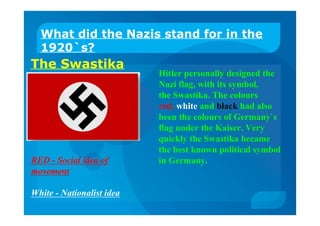
  • 104.
    Were most peoplebetter off under Nazi rule? Best houses, preferential treatment and good jobs.
  • 105.
    Were most peoplebetter off under Nazi rule? Economic policies gave full employment Seemed to be no poverty in Germany Strength through Joy programme gave people fun and holidays Beauty of Work gave people pride in what they do Law and order Autobahns improved transport Propaganda gave people hope Wages fell and strikers could be shot Loss of personal freedom All culture had to be German
  • 106.
    Were most peoplebetter off under Nazi rule? Idealised women as the child-bearer and creator of family Mothers who had more than 8 children given a gold medal Law of Encouragement gave newly-wed couples a loan of 1000 marks, and allowed them to keep 250 marks for each child they had Job discrimination
  • 107.
    Were most peoplebetter off under Nazi rule? HJ and BDM made they youth feel special Many parents scared children would report them to the Gestapo which gave children power Nazi culture very youth-orientated Youth opposition groups formed
  • 108.
    Were most peoplebetter off under Nazi rule? Used fear and horror against anyone who opposed the regime Banned trade unions and political parties Persecuted Sent to concentration camps Many Germans, however, welcomed this as it brought stability
  • 109.
    Were most peoplebetter off under Nazi rule? Jews were systematically persecuted. Forced in to walled ghettos and condemned to death in the Final Solution Gypsies killed Black people sterilised and killed Mentally disabled people killed Physically disabled people and families sterilised and often killed Beggars, homosexuals, prostitutes, alcoholics, hooligans and criminals were also regarded as anti-social and put in concentration camps
  • 110.
    Were people betteroff under Nazi rule? Summary NO Trade unions were banned Small businesses suffered Women & Jewish people were taken off the lists of unemployed people Women lost their jobs and male candidates for work were always given preference over female 300,000 people were forcibly sterilised under Nazi rule. Most of these people were disabled Conscription was re-introduced so that all men had to join the army
  • 111.
    Were people betteroff under Nazi rule? Summary YES Industrial production increased New autobahns, hospitals, schools, sports stadiums and other public buildings were built Employment increased from 13.1 million (1933) to 18.8 million (1938) National income increased from 42.6 billion reichsmarks (1932) to 79.8 reichsmarks (1938) Big businesses like Volkswagen and Mercedes made huge profits Germany achieved self-sufficiency in important food stuffs such as grain. This meant that Germany could produce all its own food
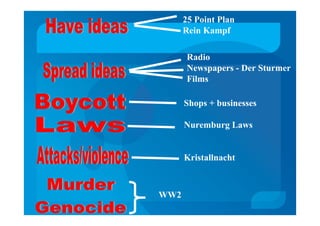
  • 112.
    Were people betteroff under Nazi rule? Summary YES The 'Strength Through Joy' program gave working people the chance to go on holiday, some for the first time in their lives, with cheap trips to the coast and to countries like Norway Women were given money for having children, and encouraged to have many children with rewardslike the Motherhood Cross. The gold cross went to women who had 8 kids, silver for 6 and bronze for 4. Unemployment fell from 5.6 million (1932) to 2 million (1938)
  • 113.
    Were people betteroff under Nazi rule? Summary NOT SURE Public expenditure increased from 17.1 billion Reichsmarks in 1932 to 37.1 billiion in 1938 Wages were lower in 1938 than in 1928. The length of the day rose by an average of 10% in 1939 compared to 1928
  • 114.
    Agreements with theChurches Hitler chose not to aggrevate the churches when he came to power - in a speech to the Reichstag he described the church as being vital to the moral welfare of the German people. In june 1933 the Catholic Church signed an agreement - a concordat - with the Nazis. Hitler promised to leave the Catholic Churches, schools and youth organisations alone and as a result the church would keep out of politics in Germany. Hitler united all the Protestant churches into a single Reich church under the control of a Nazi Bishop, Muller. They became known as German Christians and adopted Nazi style salutes and uniforms. The motto of the church was "the swastika on our breasts and the cross in our hearts. Nazified the churches by the Swastika and Hitler behind the halter like the Vicar. The Nazi formed a faith movement as an alternative to the church - it involved a Pagan style.
  • 115.
    The 20 JulyBomb Plot - a summary Count Stauffenberg loses faith  Fighting in Tunisia in 1943 1. What do you know about the Stauffenberg plot? At some point in early 1944, Stauffenberg joined a group of German officers intent on bringing the war to a quick end and negotiating a peace wth the allies. Their biggest obstacle was of course Hitler. About to attend the meeting, Stauffenberg, lacking time to prepare two devices, only managed to prepare one bomb. With it set to detonate after ten minutes. 4 people died Hitler was examined