
Paris Climate Change
Agreement 2016
By: Paul Young, CPA, CGA
Disclaimer
• This presentation discuss Paris Climate Change Agreement
Paul Young - Presenter
Bio
• CPA/CGA
• 25 years of experience in Academia, Industry and Financial solutions
• Youtube Channel -
https://www.youtube.com/channel/UCAArky1bAXPSuV2NLtUnyLg
Agenda
• What is Paris Climate Change Agreement?
• Major issues
What is Paris Climate Accord
The COP21 climate conference brought together scores of countries
and tens of thousands of people to answer one pressing question: How
can we keep global temperatures from rising too high? After two weeks
of debate, they left with an ambitious deal to put the world on a
serious carbon diet, and on April 22 about 160 countries are expected
to finally sign it.
Major Issues
• Limit temperature rise 'well below' 2 C
• First universal climate agreement
• Helping poorer nations
• Publishing greenhouse gas reduction targets Carbon neutral by
2050?
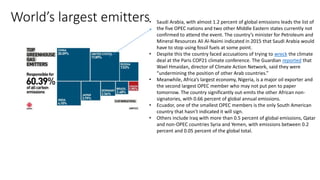
World’s largest emitters• Saudi Arabia, with almost 1.2 percent of global emissions leads the list of
the five OPEC nations and two other Middle Eastern states currently not
confirmed to attend the event. The country’s minister for Petroleum and
Mineral Resources Ali Al-Naimi indicated in 2015 that Saudi Arabia would
have to stop using fossil fuels at some point.
• Despite this the country faced accusations of trying to wreck the climate
deal at the Paris COP21 climate conference. The Guardian reported that
Wael Hmaidan, director of Climate Action Network, said they were
“undermining the position of other Arab countries.”
• Meanwhile, Africa’s largest economy, Nigeria, is a major oil exporter and
the second largest OPEC member who may not put pen to paper
tomorrow. The country significantly out-emits the other African non-
signatories, with 0.66 percent of global annual emissions.
• Ecuador, one of the smallest OPEC members is the only South American
country that hasn’t indicated it will sign.
• Others include Iraq with more than 0.5 percent of global emissions, Qatar
and non-OPEC countries Syria and Yemen, with emissions between 0.2
percent and 0.05 percent of the global total.
Issues/Carbon Free
• Planning for a zero-carbon economy by mid-century demands long lead times,
decades even, because it involves major decisions about power plants and
transmission lines, building codes and vehicle standards, Sachs said. But most
countries were still not looking as far down the road as 2050 – including the US.
Obama, despite a flurry of climate initiatives since 2013, had yet to produce a
coherent long-term plan for a 21st-century post-carbon economy, Sachs said.
• Countries that wait until 2030, the date envisaged in the Paris agreement, they
would have to cut global emissions by 6% a year to keep the 2c goal in sight. “The
longer we wait for effective climate policy, the more severe and the more traumatic
will be the emissions reductions in the future,” he said.
• Slow economic growth
• World is growing at 3.1 to 3.4%
• New tax/pricing will not help growth, but could lead to stagnation and loss of output
• Carbon replacement
• Steel is part of Wind Turbines
• Steel is part of the mining of resources, like Vanadium and Lithium
• Solar Panels require Silicon wafer (mining)
• Cell Phones are made up plastics (petrochemicals)
Other Sources:
• Foreign Aid - https://www.youtube.com/watch?v=WMAkt0h0X2g
• Clean Technology -
https://www.youtube.com/watch?v=k2MKGzGuoEM
• Clean Technology -
https://www.youtube.com/watch?v=zdMwQ7QsNcI

Paris Climate Change Agreement - April 2016

  • 1.
    Paris Climate Change Agreement2016 By: Paul Young, CPA, CGA
  • 2.
    Disclaimer • This presentationdiscuss Paris Climate Change Agreement
  • 3.
    Paul Young -Presenter Bio • CPA/CGA • 25 years of experience in Academia, Industry and Financial solutions • Youtube Channel - https://www.youtube.com/channel/UCAArky1bAXPSuV2NLtUnyLg
  • 4.
    Agenda • What isParis Climate Change Agreement? • Major issues
  • 5.
    What is ParisClimate Accord The COP21 climate conference brought together scores of countries and tens of thousands of people to answer one pressing question: How can we keep global temperatures from rising too high? After two weeks of debate, they left with an ambitious deal to put the world on a serious carbon diet, and on April 22 about 160 countries are expected to finally sign it.
  • 6.
    Major Issues • Limittemperature rise 'well below' 2 C • First universal climate agreement • Helping poorer nations • Publishing greenhouse gas reduction targets Carbon neutral by 2050?
  • 7.
    World’s largest emitters•Saudi Arabia, with almost 1.2 percent of global emissions leads the list of the five OPEC nations and two other Middle Eastern states currently not confirmed to attend the event. The country’s minister for Petroleum and Mineral Resources Ali Al-Naimi indicated in 2015 that Saudi Arabia would have to stop using fossil fuels at some point. • Despite this the country faced accusations of trying to wreck the climate deal at the Paris COP21 climate conference. The Guardian reported that Wael Hmaidan, director of Climate Action Network, said they were “undermining the position of other Arab countries.” • Meanwhile, Africa’s largest economy, Nigeria, is a major oil exporter and the second largest OPEC member who may not put pen to paper tomorrow. The country significantly out-emits the other African non- signatories, with 0.66 percent of global annual emissions. • Ecuador, one of the smallest OPEC members is the only South American country that hasn’t indicated it will sign. • Others include Iraq with more than 0.5 percent of global emissions, Qatar and non-OPEC countries Syria and Yemen, with emissions between 0.2 percent and 0.05 percent of the global total.
  • 8.
    Issues/Carbon Free • Planningfor a zero-carbon economy by mid-century demands long lead times, decades even, because it involves major decisions about power plants and transmission lines, building codes and vehicle standards, Sachs said. But most countries were still not looking as far down the road as 2050 – including the US. Obama, despite a flurry of climate initiatives since 2013, had yet to produce a coherent long-term plan for a 21st-century post-carbon economy, Sachs said. • Countries that wait until 2030, the date envisaged in the Paris agreement, they would have to cut global emissions by 6% a year to keep the 2c goal in sight. “The longer we wait for effective climate policy, the more severe and the more traumatic will be the emissions reductions in the future,” he said. • Slow economic growth • World is growing at 3.1 to 3.4% • New tax/pricing will not help growth, but could lead to stagnation and loss of output • Carbon replacement • Steel is part of Wind Turbines • Steel is part of the mining of resources, like Vanadium and Lithium • Solar Panels require Silicon wafer (mining) • Cell Phones are made up plastics (petrochemicals)
  • 9.
    Other Sources: • ForeignAid - https://www.youtube.com/watch?v=WMAkt0h0X2g • Clean Technology - https://www.youtube.com/watch?v=k2MKGzGuoEM • Clean Technology - https://www.youtube.com/watch?v=zdMwQ7QsNcI

Editor's Notes

  • #6 http://www.theglobeandmail.com/news/world/paris-climate-deal-primer/article27539363/
  • #7 http://www.cbc.ca/news/world/paris-agreement-key-climate-points-1.3362500
  • #8 http://www.cbc.ca/news/technology/paris-agreement-signing-faq-1.3545768 http://www.climatechangenews.com/2016/04/07/ratification-not-signing-is-critical-test-for-paris-climate-deal/ https://ecowatch.com/2016/04/21/countries-wont-sign-paris-agreement/
  • #9 http://www.theguardian.com/environment/2016/apr/22/paris-climate-agreement-united-nations