http://www.youtube.com/watch?v=74LXx0wSq
MI
Notre Dame, is a historic
Roman Catholic Marian
cathedral on the eastern
half of the Île de la Cité in
the fourth arrondissement of
Paris, France
The Eiffel Tower (French: La Tour Eiffel, [tuʁ
ɛfɛl]) is an iron lattice tower located on the
Champ de Mars in Paris, named after the
engineer Gustave Eiffel, whose company
designed and built the tower. Erected in
1889 as the entrance arch to the 1889
World's Fair, it has become both a global
cultural icon of France and one of the most
recognizable structures in the world. The
tower is the tallest structure in Paris and the
most-visited paid monument in the world;
7.1 million people ascended it in 2011
La Conciergerie (French pronunciation: ​[la sjɛʁʒəʁi]) is a
former royal palace and prison in Paris, France, located on the
west of the Île de la Cité (literally island of the city), near the
Cathedral of Notre-Dame. It is part of the larger complex
known as the Palais de Justice, which is still used for judicial
purposes. Hundreds of prisoners during the French Revolution
were taken from La Conciergerie to be executed on the
guillotine at a number of locations around Paris.
The Place de la Concorde
(French pronunciation: ​[plas də
la kɔʁd]) is one of the major
public squares in Paris, France.
Measuring 8.64 hectares (21.3
acres) in area, it is the largest
square in the French capital. It
is located in the city's eighth
arrondissement, at the eastern
end of the Champs-Élysées.
The Hôtel de Ville (French
pronunciation: ​[otɛl də
vil], City Hall) in
Paris, France, is the
building housing the city's
local administration.
Standing on the place de
l'Hôtel-de-Ville (formerly
place de Grève) in the
city's IVe
arrondissement, it has
been the location of the
municipality of Paris since
1357.
The Pont Neuf (French
pronunciation: ​[pɔ nœf], New
Bridge) is, despite its
name, the oldest standing
bridge across the river Seine in
Paris, France. Its name, which
was given to distinguish it
from older bridges that were
lined on both sides with
houses, has remained. It
stands by the western point of
the Île de la Cité, the island in
the middle of the river that
was the heart of medieval
Paris.
Montmartre (French
pronunciation: ​[ .maʁt
ʁ]) is a hill in the north
of Paris, France. It is
130 metres high and
gives its name to the
surrounding district, in
the 18th
arrondissement, a part
of the Right Bank.
Montmartre is
primarily known for the
white-domed Basilica of
the Sacré Cœur on its
summit and as a
nightclub district. The
other, older, church on
the hill is Saint Pierre
de Montmartre, which
.
Rue Montorgueil (French pronunciation: ​[ʁy tɔʁɡɛj]) is a
street in the 1st arrondissement and 2nd arrondissement (in
the Montorgueil-Saint Denis-Les Halles district) of
Paris, France. Lined with restaurants, cafés, bakeries, fish
stores, cheese shops, wine shops, produce stands and flower
shops, rue Montorgueil is a place for Parisians to socialize
while doing their daily shopping. At the southernmost tip of rue
Montorgueil is Saint-Eustache Church, and Les
Halles, containing the largest indoor (mostly underground)
shopping mall in central Paris; and to the north is the area
known as the Grand Boulevards.
The Île Saint-Louis (French
pronunciation: ​[il sɛ lwi]) is one of
two natural islands in the Seine
river, in Paris, France. The island is
named after King Louis IX of
France (Saint Louis).
With its 560 hectares area, its 72 glass and steel buildings and skyscrapers,
its 180,000 daily workers, and 3.5 million square metres of office space, La
Défense is Europe's largest purpose-built business district. Around its
Grande Arche and esplanade ("le Parvis"), La Défense contains many of the
Paris urban area's tallest high-rises, and is home to no fewer than 1,500
corporate head offices, including those of 15 of the top 50 companies in the
world
lies at the north end of the Pont au
Change, a bridge that connects the Île
de la Cité, near the Palais de Justice
and the Conciergerie, to. the right
bankThe Place du Châtelet (French
pronunciation: ​[plas dy ʃatlɛ]) is a
public square in Paris, on the right
bank of the river Seine, on the
borderline between the 1st and 4th
arrondissements. It
The Louvre Palace (French: Palais du Louvre), on the Right Bank of the Seine in
Paris, is a former royal palace situated between the Tuileries Gardens and the
church of Saint-Germain l'Auxerrois. Its origins date back to the medieval
period, and its present structure has evolved in stages since the 16th century. It
was the actual seat of power in France until Louis XIV moved to Versailles in
1682, bringing the government with him. The Louvre remained the nominal, or
formal, seat of government until the end of the Ancien Régime in 1789. Since
then it has housed the celebrated Musée du Louvre as well as various
government departments.
The Pont Alexandre III is an
arch bridge that spans the
Seine, connecting the
Champs-Élysées quarter
and the Invalides and Eiffel
Tower quarter, widely
regarded as the most
ornate, extravagant bridge
in Paris.It is classified as a
historical monument.
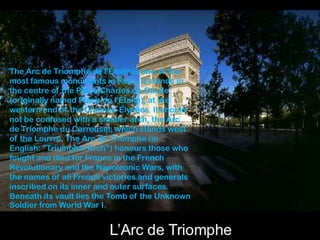
The Arc de Triomphe de l'Étoile is one of the
most famous monuments in Paris. It stands in
the centre of the Place Charles de Gaulle
(originally named Place de l'Étoile), at the
western end of the Champs-Élysées. It should
not be confused with a smaller arch, the Arc
de Triomphe du Carrousel, which stands west
of the Louvre. The Arc de Triomphe (in
English: "Triumphal Arch") honours those who
fought and died for France in the French
Revolutionary and the Napoleonic Wars, with
the names of all French victories and generals
inscribed on its inner and outer surfaces.
Beneath its vault lies the Tomb of the Unknown
Soldier from World War I.
Les Halles (pronounced [le al])
an area of Paris, France, locate
in the 1st arrondissement, jus
south of rue Montorgueil. It is
named for a large central
wholesale marketplace which
was demolished in 1971 and
replaced with an underground
modern shopping precinct, the
Forum des Halles, whose open
air center area is below street
level, like a sunken garden, an
contains
sculptures, fountains, and
mosaics.
The Pont Neuf (French pronunciation: ​[pɔ
nœf], New Bridge) is, despite its name, the
oldest standing bridge across the river
Seine in Paris, France. Its name, which
was given to distinguish it from older
bridges that were lined on both sides with
houses, has remained. It stands by the
western point of the Île de la Cité, the
island in the middle of the river that was
the heart of medieval Paris
The Place de la
Concorde (French
pronunciation: ​[plas
də la kɔʁd]) is one
of the major public
squares in
Paris, France.
Measuring 8.64
hectares (21.3
acres) in area, it is
the largest square
in the French
capital. It is located
in the city's eighth
arrondissement, at
the eastern end of
the Champs-
Élysées.
.

Paris

  • 1.
  • 2.
    Notre Dame, isa historic Roman Catholic Marian cathedral on the eastern half of the Île de la Cité in the fourth arrondissement of Paris, France
  • 3.
    The Eiffel Tower(French: La Tour Eiffel, [tuʁ ɛfɛl]) is an iron lattice tower located on the Champ de Mars in Paris, named after the engineer Gustave Eiffel, whose company designed and built the tower. Erected in 1889 as the entrance arch to the 1889 World's Fair, it has become both a global cultural icon of France and one of the most recognizable structures in the world. The tower is the tallest structure in Paris and the most-visited paid monument in the world; 7.1 million people ascended it in 2011
  • 4.
    La Conciergerie (Frenchpronunciation: ​[la sjɛʁʒəʁi]) is a former royal palace and prison in Paris, France, located on the west of the Île de la Cité (literally island of the city), near the Cathedral of Notre-Dame. It is part of the larger complex known as the Palais de Justice, which is still used for judicial purposes. Hundreds of prisoners during the French Revolution were taken from La Conciergerie to be executed on the guillotine at a number of locations around Paris.
  • 5.
    The Place dela Concorde (French pronunciation: ​[plas də la kɔʁd]) is one of the major public squares in Paris, France. Measuring 8.64 hectares (21.3 acres) in area, it is the largest square in the French capital. It is located in the city's eighth arrondissement, at the eastern end of the Champs-Élysées.
  • 6.
    The Hôtel deVille (French pronunciation: ​[otɛl də vil], City Hall) in Paris, France, is the building housing the city's local administration. Standing on the place de l'Hôtel-de-Ville (formerly place de Grève) in the city's IVe arrondissement, it has been the location of the municipality of Paris since 1357.
  • 7.
    The Pont Neuf(French pronunciation: ​[pɔ nœf], New Bridge) is, despite its name, the oldest standing bridge across the river Seine in Paris, France. Its name, which was given to distinguish it from older bridges that were lined on both sides with houses, has remained. It stands by the western point of the Île de la Cité, the island in the middle of the river that was the heart of medieval Paris.
  • 9.
    Montmartre (French pronunciation: ​[.maʁt ʁ]) is a hill in the north of Paris, France. It is 130 metres high and gives its name to the surrounding district, in the 18th arrondissement, a part of the Right Bank. Montmartre is primarily known for the white-domed Basilica of the Sacré Cœur on its summit and as a nightclub district. The other, older, church on the hill is Saint Pierre de Montmartre, which
  • 10.
    . Rue Montorgueil (Frenchpronunciation: ​[ʁy tɔʁɡɛj]) is a street in the 1st arrondissement and 2nd arrondissement (in the Montorgueil-Saint Denis-Les Halles district) of Paris, France. Lined with restaurants, cafés, bakeries, fish stores, cheese shops, wine shops, produce stands and flower shops, rue Montorgueil is a place for Parisians to socialize while doing their daily shopping. At the southernmost tip of rue Montorgueil is Saint-Eustache Church, and Les Halles, containing the largest indoor (mostly underground) shopping mall in central Paris; and to the north is the area known as the Grand Boulevards.
  • 12.
    The Île Saint-Louis(French pronunciation: ​[il sɛ lwi]) is one of two natural islands in the Seine river, in Paris, France. The island is named after King Louis IX of France (Saint Louis).
  • 13.
    With its 560hectares area, its 72 glass and steel buildings and skyscrapers, its 180,000 daily workers, and 3.5 million square metres of office space, La Défense is Europe's largest purpose-built business district. Around its Grande Arche and esplanade ("le Parvis"), La Défense contains many of the Paris urban area's tallest high-rises, and is home to no fewer than 1,500 corporate head offices, including those of 15 of the top 50 companies in the world
  • 14.
    lies at thenorth end of the Pont au Change, a bridge that connects the Île de la Cité, near the Palais de Justice and the Conciergerie, to. the right bankThe Place du Châtelet (French pronunciation: ​[plas dy ʃatlɛ]) is a public square in Paris, on the right bank of the river Seine, on the borderline between the 1st and 4th arrondissements. It
  • 15.
    The Louvre Palace(French: Palais du Louvre), on the Right Bank of the Seine in Paris, is a former royal palace situated between the Tuileries Gardens and the church of Saint-Germain l'Auxerrois. Its origins date back to the medieval period, and its present structure has evolved in stages since the 16th century. It was the actual seat of power in France until Louis XIV moved to Versailles in 1682, bringing the government with him. The Louvre remained the nominal, or formal, seat of government until the end of the Ancien Régime in 1789. Since then it has housed the celebrated Musée du Louvre as well as various government departments.
  • 18.
    The Pont AlexandreIII is an arch bridge that spans the Seine, connecting the Champs-Élysées quarter and the Invalides and Eiffel Tower quarter, widely regarded as the most ornate, extravagant bridge in Paris.It is classified as a historical monument.
  • 20.
    The Arc deTriomphe de l'Étoile is one of the most famous monuments in Paris. It stands in the centre of the Place Charles de Gaulle (originally named Place de l'Étoile), at the western end of the Champs-Élysées. It should not be confused with a smaller arch, the Arc de Triomphe du Carrousel, which stands west of the Louvre. The Arc de Triomphe (in English: "Triumphal Arch") honours those who fought and died for France in the French Revolutionary and the Napoleonic Wars, with the names of all French victories and generals inscribed on its inner and outer surfaces. Beneath its vault lies the Tomb of the Unknown Soldier from World War I.
  • 21.
    Les Halles (pronounced[le al]) an area of Paris, France, locate in the 1st arrondissement, jus south of rue Montorgueil. It is named for a large central wholesale marketplace which was demolished in 1971 and replaced with an underground modern shopping precinct, the Forum des Halles, whose open air center area is below street level, like a sunken garden, an contains sculptures, fountains, and mosaics.
  • 25.
    The Pont Neuf(French pronunciation: ​[pɔ nœf], New Bridge) is, despite its name, the oldest standing bridge across the river Seine in Paris, France. Its name, which was given to distinguish it from older bridges that were lined on both sides with houses, has remained. It stands by the western point of the Île de la Cité, the island in the middle of the river that was the heart of medieval Paris
  • 27.
    The Place dela Concorde (French pronunciation: ​[plas də la kɔʁd]) is one of the major public squares in Paris, France. Measuring 8.64 hectares (21.3 acres) in area, it is the largest square in the French capital. It is located in the city's eighth arrondissement, at the eastern end of the Champs- Élysées.
  • 28.