• The Arc de Triomphe de l'Étoile is one of the most famous monuments in Paris. It stands in
the centre of the Place Charles de Gaulle (originally named Place de l'Étoile), at the western
end of the Champs-Élysées. It should not be confused with a smaller arch, the Arc de
Triomphe du Carrousel, which stands west of the Louvre. The monument stands 50 metres
(164 ft) in height, 45 m (148 ft) wide and 22 m (72 ft) deep. The large vault is 29.19 m (95.8
ft) high and 14.62 m (48.0 ft) wide. The small vault is 18.68 m (61.3 ft) high and 8.44 m (27.7
ft) wide.
HISTORY
• The Arc is located on the right bank of the Seine at the centre of a dodecagonal configuration
of twelve radiating avenues. It was commissioned in 1806 after the victory at Austerlitz by
Emperor Napoleon at the peak of his fortunes. Laying the foundations alone took two years
and, in 1810, when Napoleon entered Paris from the west with his bride Archduchess Marie-
Louise of Austria, he had a wooden mock-up of the completed arch constructed. The
architect, Jean Chalgrin, died in 1811 and the work was taken over by Jean-Nicolas Huyot.
During the Bourbon Restoration, construction was halted and it would not be completed until
the reign of King Louis-Philippe, between 1833 and 1836, by the architects Goust, then
Huyot, under the direction of Héricart de Thury. On 15 December 1840, brought back to
France from Saint Helena, Napoleon's remains passed under it on their way to the Emperor's
final resting place at the Invalides.[8] Prior to burial in the Panthéon, the body of Victor Hugo
was exposed under the Arc during the night of 22 May 1885.
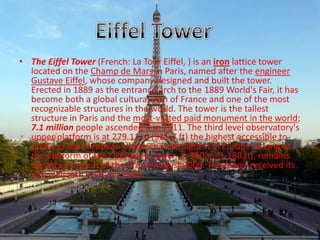
• The Eiffel Tower (French: La Tour Eiffel, ) is an iron lattice tower
located on the Champ de Mars in Paris, named after the engineer
Gustave Eiffel, whose company designed and built the tower.
Erected in 1889 as the entrance arch to the 1889 World's Fair, it has
become both a global cultural icon of France and one of the most
recognizable structures in the world. The tower is the tallest
structure in Paris and the most-visited paid monument in the world;
7.1 million people ascended it in 2011. The third level observatory's
upper platform is at 279.11 m (915.7 ft) the highest accessible to
public in the European Union and the highest in Europe as long as
the platform of the Ostankino Tower, at 360 m (1,180 ft), remains
closed as a result of the fire of August 2000. The tower received its
250 millionth visitor in 2010.
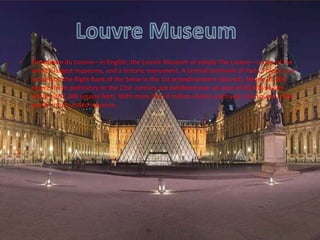
• The Musée du Louvre—in English, the Louvre Museum or simply The Louvre—is one of the
world's largest museums, and a historic monument. A central landmark of Paris, France, it is
located on the Right Bank of the Seine in the 1st arrondissement (district). Nearly 35,000
objects from prehistory to the 21st century are exhibited over an area of 60,600 square
metres (652,300 square feet). With more than 8 million visitors each year, the Louvre is the
world's most visited museum.
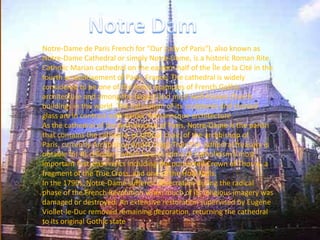
Notre-Dame de Paris French for "Our Lady of Paris"), also known as
Notre-Dame Cathedral or simply Notre-Dame, is a historic Roman Rite
Catholic Marian cathedral on the eastern half of the Île de la Cité in the
fourth arrondissement of Paris, France. The cathedral is widely
considered to be one of the finest examples of French Gothic
architecture and among the largest and most well-known church
buildings in the world. The naturalism of its sculptures and stained
glass are in contrast with earlier Romanesque architecture.
As the cathedral of the Archdiocese of Paris, Notre-Dame is the parish
that contains the cathedra, or official chair, of the archbishop of
Paris, currently Archbishop André Vingt-Trois.The cathedral treasury is
notable for its reliquary which houses some of Catholicism's most
important first-class relics including the purported Crown of Thorns, a
fragment of the True Cross, and one of the Holy Nails.
In the 1790s, Notre-Dame suffered desecration during the radical
phase of the French Revolution when much of its religious imagery was
damaged or destroyed. An extensive restoration supervised by Eugène
Viollet-le-Duc removed remaining decoration, returning the cathedral
to its original Gothic state

Franc i didac pringaos

  • 2.
    • The Arcde Triomphe de l'Étoile is one of the most famous monuments in Paris. It stands in the centre of the Place Charles de Gaulle (originally named Place de l'Étoile), at the western end of the Champs-Élysées. It should not be confused with a smaller arch, the Arc de Triomphe du Carrousel, which stands west of the Louvre. The monument stands 50 metres (164 ft) in height, 45 m (148 ft) wide and 22 m (72 ft) deep. The large vault is 29.19 m (95.8 ft) high and 14.62 m (48.0 ft) wide. The small vault is 18.68 m (61.3 ft) high and 8.44 m (27.7 ft) wide. HISTORY • The Arc is located on the right bank of the Seine at the centre of a dodecagonal configuration of twelve radiating avenues. It was commissioned in 1806 after the victory at Austerlitz by Emperor Napoleon at the peak of his fortunes. Laying the foundations alone took two years and, in 1810, when Napoleon entered Paris from the west with his bride Archduchess Marie- Louise of Austria, he had a wooden mock-up of the completed arch constructed. The architect, Jean Chalgrin, died in 1811 and the work was taken over by Jean-Nicolas Huyot. During the Bourbon Restoration, construction was halted and it would not be completed until the reign of King Louis-Philippe, between 1833 and 1836, by the architects Goust, then Huyot, under the direction of Héricart de Thury. On 15 December 1840, brought back to France from Saint Helena, Napoleon's remains passed under it on their way to the Emperor's final resting place at the Invalides.[8] Prior to burial in the Panthéon, the body of Victor Hugo was exposed under the Arc during the night of 22 May 1885.
  • 3.
    • The EiffelTower (French: La Tour Eiffel, ) is an iron lattice tower located on the Champ de Mars in Paris, named after the engineer Gustave Eiffel, whose company designed and built the tower. Erected in 1889 as the entrance arch to the 1889 World's Fair, it has become both a global cultural icon of France and one of the most recognizable structures in the world. The tower is the tallest structure in Paris and the most-visited paid monument in the world; 7.1 million people ascended it in 2011. The third level observatory's upper platform is at 279.11 m (915.7 ft) the highest accessible to public in the European Union and the highest in Europe as long as the platform of the Ostankino Tower, at 360 m (1,180 ft), remains closed as a result of the fire of August 2000. The tower received its 250 millionth visitor in 2010.
  • 4.
    • The Muséedu Louvre—in English, the Louvre Museum or simply The Louvre—is one of the world's largest museums, and a historic monument. A central landmark of Paris, France, it is located on the Right Bank of the Seine in the 1st arrondissement (district). Nearly 35,000 objects from prehistory to the 21st century are exhibited over an area of 60,600 square metres (652,300 square feet). With more than 8 million visitors each year, the Louvre is the world's most visited museum.
  • 5.
    Notre-Dame de ParisFrench for "Our Lady of Paris"), also known as Notre-Dame Cathedral or simply Notre-Dame, is a historic Roman Rite Catholic Marian cathedral on the eastern half of the Île de la Cité in the fourth arrondissement of Paris, France. The cathedral is widely considered to be one of the finest examples of French Gothic architecture and among the largest and most well-known church buildings in the world. The naturalism of its sculptures and stained glass are in contrast with earlier Romanesque architecture. As the cathedral of the Archdiocese of Paris, Notre-Dame is the parish that contains the cathedra, or official chair, of the archbishop of Paris, currently Archbishop André Vingt-Trois.The cathedral treasury is notable for its reliquary which houses some of Catholicism's most important first-class relics including the purported Crown of Thorns, a fragment of the True Cross, and one of the Holy Nails. In the 1790s, Notre-Dame suffered desecration during the radical phase of the French Revolution when much of its religious imagery was damaged or destroyed. An extensive restoration supervised by Eugène Viollet-le-Duc removed remaining decoration, returning the cathedral to its original Gothic state