Main prepositions
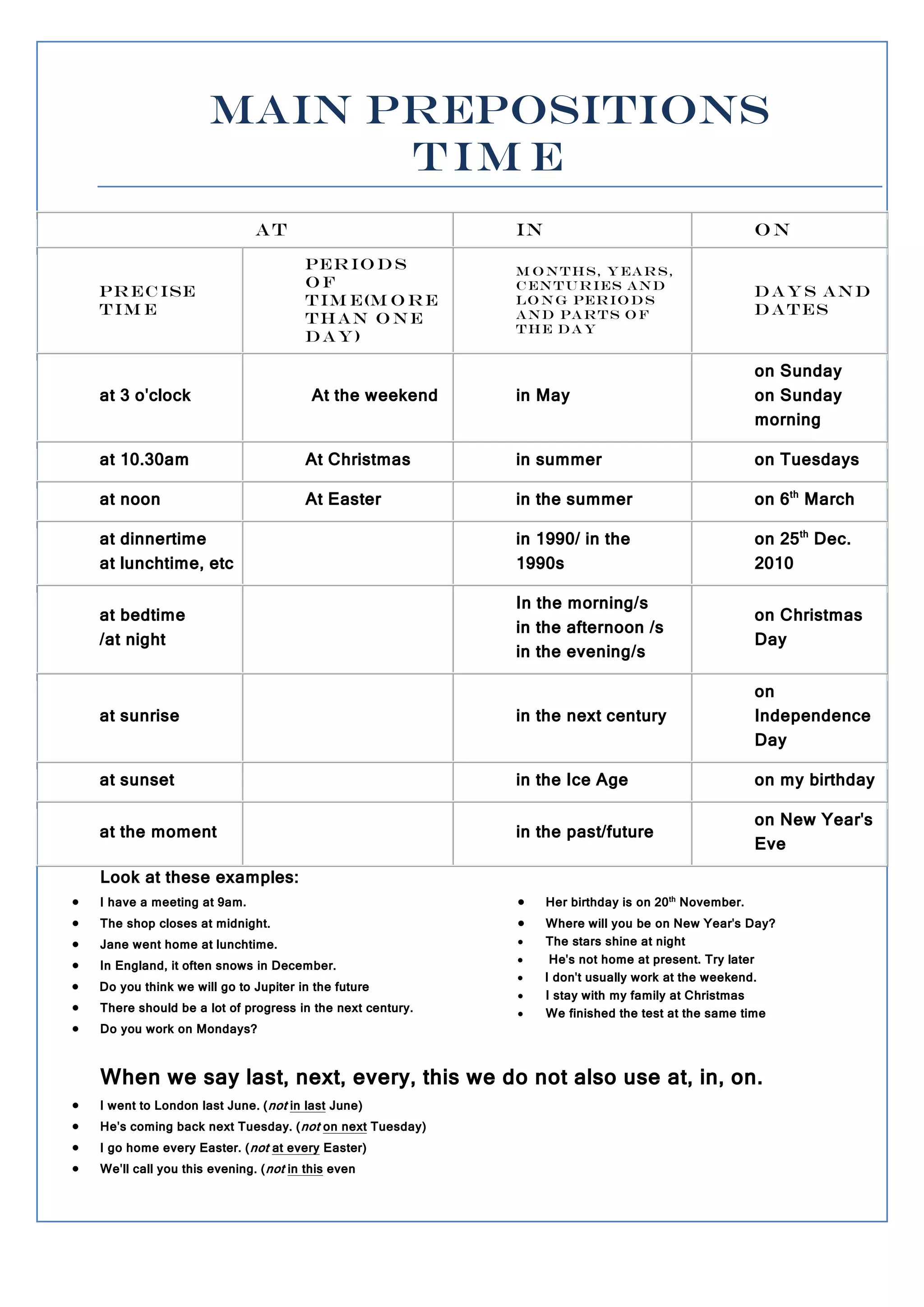
                             t im e
                               at                            in                                       on
                                        Per io d s           M O N T H S, Y EAR S,
                                        of                   C EN TU R IES an d
    PR EC ISE                                                                                         D AY S an d
                                        t im e(m o r e       LO N G PER IO D S
    TIM E                                                    a n d pa r t s o f                       D AT ES
                                        than o n e
                                                             the day
                                        day)

                                                                                                      on Sunday
    at 3 o'clock                          At the weekend     in May                                   on Sunday
                                                                                                      morning

    at 10.30am                          At Christmas         in summer                                on Tuesdays

    at noon                             At Easter            in the summer                            on 6th March

    at dinnertime                                            in 1990/ in the                          on 25th Dec.
    at lunchtime, etc                                        1990s                                    2010

                                                             In the morning/s
    at bedtime                                                                                        on Christmas
                                                             in the afternoon /s
    /at night                                                                                         Day
                                                             in the evening/s

                                                                                                      on
    at sunrise                                               in the next century                      Independence
                                                                                                      Day

    at sunset                                                in the Ice Age                           on my birthday

                                                                                                      on New Year's
    at the moment                                            in the past/future
                                                                                                      Eve
    Look at these examples:
   I have a meeting at 9am.                                     Her birthday is on 20th November.
   The shop closes at midnight.                                 Where will you be on New Year's Day?
   Jane went home at lunchtime.                                 The stars shine at night
   In England, it often snows in December.                       He's not home at present. Try later
                                                                 I don't usually work at the weekend.
   Do you think we will go to Jupiter in the future
                                                                 I stay with my family at Christmas
   There should be a lot of progress in the next century.       We finished the test at the same time
   Do you work on Mondays?


    When we say last, next, every, this we do not also use at, in, on.
   I went to London last June. (not in last June)
   He's coming back next Tuesday. (not on next Tuesday)
   I go home every Easter. (not at every Easter)
   We'll call you this evening. (not in this even
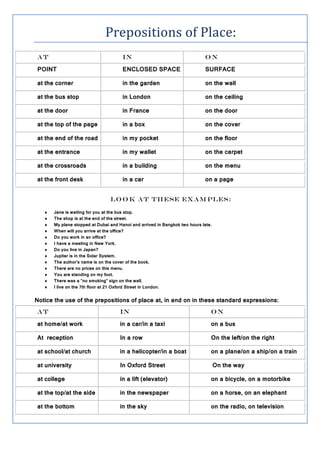
Prepositions of Place:
at                                     in                                    on

POINT                                  ENCLOSED SPACE                        SURFACE

at the corner                          in the garden                         on the wall

at the bus stop                        in London                             on the ceiling

at the door                            in France                             on the door

at the top of the page                 in a box                              on the cover

at the end of the road                 in my pocket                          on the floor

at the entrance                        in my wallet                          on the carpet

at the crossroads                      in a building                         on the menu

at the front desk                      in a car                              on a page


                                 Lo o k at th ese ex am ples:

      Jane is waiting for you at the bus stop.
      The shop is at the end of the street.
      My plane stopped at Dubai and Hanoi and arrived in Bangkok two hours late.
      When will you arrive at the office?
      Do you work in an office?
      I have a meeting in New York.
      Do you live in Japan?
      Jupiter is in the Solar System.
      The author's name is on the cover of the book.
      There are no prices on this menu.
      You are standing on my foot.
      There was a "no smoking" sign on the wall.
      I live on the 7th floor at 21 Oxford Street in London.


Notice the use of the prepositions of place at, in and on in these standard expressions:
at                                    in                                        on

at home/at work                       in a car/in a taxi                        on a bus

At reception                          In a row                                  On the left/on the right

at school/at church                   in a helicopter/in a boat                 on a plane/on a ship/on a train

at university                         In Oxford Street                              On the way

at college                            in a lift (elevator)                      on a bicycle, on a motorbike

at the top/at the side                in the newspaper                          on a horse, on an elephant

at the bottom                         in the sky                                on the radio, on television
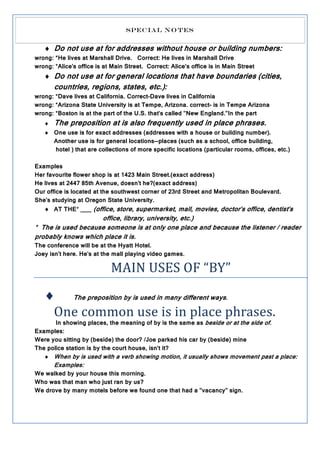
Spec ia l n o t es


    Do not use at for addresses without house or building numbers:
wrong: *He lives at Marshall Drive. Correct: He lives in Marshall Drive
wrong: *Alice's office is at Main Street. Correct: Alice’s office is in Main Street
    Do not use at for general locations that have boundaries (cities,
       countries, regions, states, etc.):
wrong: *Dave lives at California. Correct-Dave lives in California
wrong: *Arizona State University is at Tempe, Arizona. correct- is in Tempe Arizona
wrong: *Boston is at the part of the U.S. that's called "New England."In the part
      The preposition at is also frequently used in place phrases.
    One use is for exact addresses (addresses with a house or building number).
     Another use is for general locations--places (such as a school, office building,
     hotel ) that are collections of more specific locations (particular rooms, offices, etc.)

Examples
Her favourite flower shop is at 1423 Main Street.(exact address)
He lives at 2447 85th Avenue, doesn't he?(exact address)
Our office is located at the southwest corner of 23rd Street and Metropolitan Boulevard.
She's studying at Oregon State University.
    AT THE* ___ (office, store, supermarket, mall, movies, doctor's office, dentist's
                    office, library, university, etc.)
* The is used because someone is at only one place and because the listener / reader
probably knows which place it is.
The conference will be at the Hyatt Hotel.
Joey isn't here. He's at the mall playing video games.

                            MAIN USES OF “BY”
    The preposition by is used in many different ways.
    One common use is in place phrases.
       In showing places, the meaning of by is the same as beside or at the side of.
Examples:
Were you sitting by (beside) the door? /Joe parked his car by (beside) mine
The police station is by the court house, isn't it?
    When by is used with a verb showing motion, it usually shows movement past a place:
       Examples:
We walked by your house this morning.
Who was that man who just ran by us?
We drove by many motels before we found one that had a "vacancy" sign.
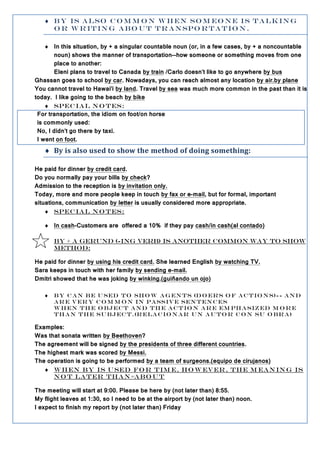
 B y is a l so c o m m o n w h e n so m e o n e is t a l k in g
     o r w r it in g a b o u t t r a n spo r t a t io n .

     In this situation, by + a singular countable noun (or, in a few cases, by + a noncountable
       noun) shows the manner of transportation--how someone or something moves from one
       place to another:
       Eleni plans to travel to Canada by train /Carlo doesn't like to go anywhere by bus
Ghassan goes to school by car. Nowadays, you can reach almost any location by air.by plane
You cannot travel to Hawai'i by land. Travel by sea was much more common in the past than it is
today. I like going to the beach by bike
     Spec ia l N o t es:
 For transportation, the idiom on foot/on horse
 is commonly used:
 No, I didn't go there by taxi.
 I went on foot.
    By is also used to show the method of doing something:

He paid for dinner by credit card.
Do you normally pay your bills by check?
Admission to the reception is by invitation only.
Today, more and more people keep in touch by fax or e-mail, but for formal, important
situations, communication by letter is usually considered more appropriate.
     SPEC IA L N O T ES:

    In cash-Customers are offered a 10% if they pay cash/in cash(al contado)

       By + a gerund (-ing verb) is another common way to show
       method:

He paid for dinner by using his credit card. She learned English by watching TV.
Sara keeps in touch with her family by sending e-mail.
Dmitri showed that he was joking by winking.(guiñando un ojo)

      b y c a n b e u sed t o sh o w ag en ts (d o er s o f a c t io n s)-- an d
       ar e v er y c o m m o n in passiv e sen t en c e s
       w h en t h e o b je c t a n d th e a c t io n ar e em ph a siz ed m o r e
       th a n t h e su b jec t .(r e la c io n ar u n au to r c o n su o br a)

Examples:
Was that sonata written by Beethoven?
The agreement will be signed by the presidents of three different countries.
The highest mark was scored by Messi.
The operation is going to be performed by a team of surgeons.(equipo de cirujanos)
    W h en by is u sed fo r tim e, h o w ev er , th e m ean in g is
      n o t la t er th a n =a bo u t

The meeting will start at 9:00. Please be here by (not later than) 8:55.
My flight leaves at 1:30, so I need to be at the airport by (not later than) noon.
I expect to finish my report by (not later than) Friday

Prepositions

  • 1.
    Main prepositions t im e at in on Per io d s M O N T H S, Y EAR S, of C EN TU R IES an d PR EC ISE D AY S an d t im e(m o r e LO N G PER IO D S TIM E a n d pa r t s o f D AT ES than o n e the day day) on Sunday at 3 o'clock At the weekend in May on Sunday morning at 10.30am At Christmas in summer on Tuesdays at noon At Easter in the summer on 6th March at dinnertime in 1990/ in the on 25th Dec. at lunchtime, etc 1990s 2010 In the morning/s at bedtime on Christmas in the afternoon /s /at night Day in the evening/s on at sunrise in the next century Independence Day at sunset in the Ice Age on my birthday on New Year's at the moment in the past/future Eve Look at these examples:  I have a meeting at 9am.  Her birthday is on 20th November.  The shop closes at midnight.  Where will you be on New Year's Day?  Jane went home at lunchtime.  The stars shine at night  In England, it often snows in December.  He's not home at present. Try later  I don't usually work at the weekend.  Do you think we will go to Jupiter in the future  I stay with my family at Christmas  There should be a lot of progress in the next century.  We finished the test at the same time  Do you work on Mondays? When we say last, next, every, this we do not also use at, in, on.  I went to London last June. (not in last June)  He's coming back next Tuesday. (not on next Tuesday)  I go home every Easter. (not at every Easter)  We'll call you this evening. (not in this even
  • 2.
    Prepositions of Place: at in on POINT ENCLOSED SPACE SURFACE at the corner in the garden on the wall at the bus stop in London on the ceiling at the door in France on the door at the top of the page in a box on the cover at the end of the road in my pocket on the floor at the entrance in my wallet on the carpet at the crossroads in a building on the menu at the front desk in a car on a page Lo o k at th ese ex am ples:  Jane is waiting for you at the bus stop.  The shop is at the end of the street.  My plane stopped at Dubai and Hanoi and arrived in Bangkok two hours late.  When will you arrive at the office?  Do you work in an office?  I have a meeting in New York.  Do you live in Japan?  Jupiter is in the Solar System.  The author's name is on the cover of the book.  There are no prices on this menu.  You are standing on my foot.  There was a "no smoking" sign on the wall.  I live on the 7th floor at 21 Oxford Street in London. Notice the use of the prepositions of place at, in and on in these standard expressions: at in on at home/at work in a car/in a taxi on a bus At reception In a row On the left/on the right at school/at church in a helicopter/in a boat on a plane/on a ship/on a train at university In Oxford Street On the way at college in a lift (elevator) on a bicycle, on a motorbike at the top/at the side in the newspaper on a horse, on an elephant at the bottom in the sky on the radio, on television
  • 3.
    Spec ia ln o t es  Do not use at for addresses without house or building numbers: wrong: *He lives at Marshall Drive. Correct: He lives in Marshall Drive wrong: *Alice's office is at Main Street. Correct: Alice’s office is in Main Street  Do not use at for general locations that have boundaries (cities, countries, regions, states, etc.): wrong: *Dave lives at California. Correct-Dave lives in California wrong: *Arizona State University is at Tempe, Arizona. correct- is in Tempe Arizona wrong: *Boston is at the part of the U.S. that's called "New England."In the part  The preposition at is also frequently used in place phrases.  One use is for exact addresses (addresses with a house or building number). Another use is for general locations--places (such as a school, office building, hotel ) that are collections of more specific locations (particular rooms, offices, etc.) Examples Her favourite flower shop is at 1423 Main Street.(exact address) He lives at 2447 85th Avenue, doesn't he?(exact address) Our office is located at the southwest corner of 23rd Street and Metropolitan Boulevard. She's studying at Oregon State University.  AT THE* ___ (office, store, supermarket, mall, movies, doctor's office, dentist's office, library, university, etc.) * The is used because someone is at only one place and because the listener / reader probably knows which place it is. The conference will be at the Hyatt Hotel. Joey isn't here. He's at the mall playing video games. MAIN USES OF “BY”  The preposition by is used in many different ways. One common use is in place phrases. In showing places, the meaning of by is the same as beside or at the side of. Examples: Were you sitting by (beside) the door? /Joe parked his car by (beside) mine The police station is by the court house, isn't it?  When by is used with a verb showing motion, it usually shows movement past a place: Examples: We walked by your house this morning. Who was that man who just ran by us? We drove by many motels before we found one that had a "vacancy" sign.
  • 4.
     B yis a l so c o m m o n w h e n so m e o n e is t a l k in g o r w r it in g a b o u t t r a n spo r t a t io n .  In this situation, by + a singular countable noun (or, in a few cases, by + a noncountable noun) shows the manner of transportation--how someone or something moves from one place to another: Eleni plans to travel to Canada by train /Carlo doesn't like to go anywhere by bus Ghassan goes to school by car. Nowadays, you can reach almost any location by air.by plane You cannot travel to Hawai'i by land. Travel by sea was much more common in the past than it is today. I like going to the beach by bike  Spec ia l N o t es: For transportation, the idiom on foot/on horse is commonly used: No, I didn't go there by taxi. I went on foot.  By is also used to show the method of doing something: He paid for dinner by credit card. Do you normally pay your bills by check? Admission to the reception is by invitation only. Today, more and more people keep in touch by fax or e-mail, but for formal, important situations, communication by letter is usually considered more appropriate.  SPEC IA L N O T ES:  In cash-Customers are offered a 10% if they pay cash/in cash(al contado) By + a gerund (-ing verb) is another common way to show method: He paid for dinner by using his credit card. She learned English by watching TV. Sara keeps in touch with her family by sending e-mail. Dmitri showed that he was joking by winking.(guiñando un ojo)  b y c a n b e u sed t o sh o w ag en ts (d o er s o f a c t io n s)-- an d ar e v er y c o m m o n in passiv e sen t en c e s w h en t h e o b je c t a n d th e a c t io n ar e em ph a siz ed m o r e th a n t h e su b jec t .(r e la c io n ar u n au to r c o n su o br a) Examples: Was that sonata written by Beethoven? The agreement will be signed by the presidents of three different countries. The highest mark was scored by Messi. The operation is going to be performed by a team of surgeons.(equipo de cirujanos)  W h en by is u sed fo r tim e, h o w ev er , th e m ean in g is n o t la t er th a n =a bo u t The meeting will start at 9:00. Please be here by (not later than) 8:55. My flight leaves at 1:30, so I need to be at the airport by (not later than) noon. I expect to finish my report by (not later than) Friday