UNIT 1
Chapter
01
Chapter
02
Chapter
03
Chapter
04
Knowing The Self Developing the
Whole Program
Developmental
Stages in Middle
and Late
Adolescence
The Challenge of
Middle and Late
Adolescence
CHAPTER 3
Developmental
Stages in Middle
and Late
Adolescence
OBJECTIVES
01
02
at the end of the chapter, students are expected to:
classify various developmental tasks according to developmental
stage;
evaluate their development in comparison to person in the
same age group
03
list ways to become a responsible adolescent prepared for adult life;
and
03 maintain a journal.
INTRODUCTION
This chapter will lead the to identify
developmental tasks of adolescents that will
serve as a foundation for responsibilities
during adulthood. They will trace the
transition process from childhood to
adolescence and evaluate their own
developmental in comparison to that of other
adolescents. Furthermore, they will learn how
to become a responsible individual and
commit to be one.
refer to tasks that arise during
certain periods in your life
(Encyclopedia of Aging, 2002). Any
concern that hinders compliance
with or accomplishment of these
tasks may lead to an inability to
perform tasks in the next period
or stage of development in life.
Developmental Tasks
Developmental
Tasks of
Adolescence
Adjust to new Physical Changes
Puberty bring many physiological changes and the
discomforts that these changes may affect self-
esteem. Thus, it has to be explained well to an
adolescent tat it is part of the natural maturation
process during that stage.
Adjust to new Intellectual Abilities
With the transition in cognitive
skills from concrete to abstract
thinking during adolescence,
one has to adjust within
oneself. Some adolescents
may be going overboard in
expressing themselves without
censorship and tact or without
considering the consequences
of their words.
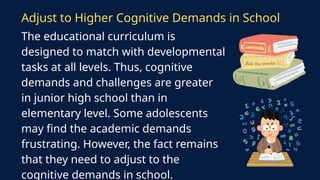
The educational curriculum is
designed to match with developmental
tasks at all levels. Thus, cognitive
demands and challenges are greater
in junior high school than in
elementary level. Some adolescents
may find the academic demands
frustrating. However, the fact remains
that they need to adjust to the
cognitive demands in school.
Adjust to Higher Cognitive Demands in School
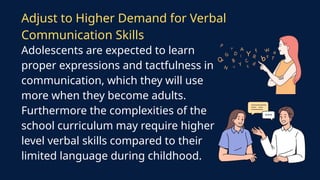
Adolescents are expected to learn
proper expressions and tactfulness in
communication, which they will use
more when they become adults.
Furthermore the complexities of the
school curriculum may require higher
level verbal skills compared to their
limited language during childhood.
Adjust to Higher Demand for Verbal
Communication Skills
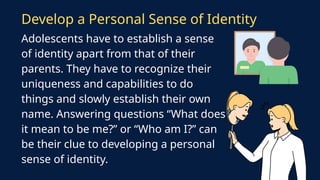
Adolescents have to establish a sense
of identity apart from that of their
parents. They have to recognize their
uniqueness and capabilities to do
things and slowly establish their own
name. Answering questions “What does
it mean to be me?” or “Who am I?” can
be their clue to developing a personal
sense of identity.
Develop a Personal Sense of Identity
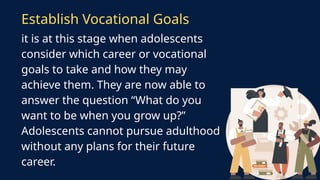
it is at this stage when adolescents
consider which career or vocational
goals to take and how they may
achieve them. They are now able to
answer the question “What do you
want to be when you grow up?”
Adolescents cannot pursue adulthood
without any plans for their future
career.
Establish Vocational Goals
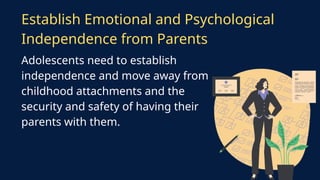
Adolescents need to establish
independence and move away from
childhood attachments and the
security and safety of having their
parents with them.
Establish Emotional and Psychological
Independence from Parents
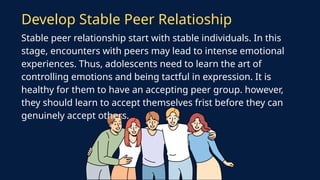
Stable peer relationship start with stable individuals. In this
stage, encounters with peers may lead to intense emotional
experiences. Thus, adolescents need to learn the art of
controlling emotions and being tactful in expression. It is
healthy for them to have an accepting peer group. however,
they should learn to accept themselves frist before they can
genuinely accept others.
Develop Stable Peer Relatioship
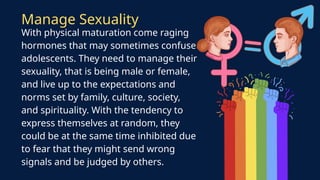
With physical maturation come raging
hormones that may sometimes confuse
adolescents. They need to manage their
sexuality, that is being male or female,
and live up to the expectations and
norms set by family, culture, society,
and spirituality. With the tendency to
express themselves at random, they
could be at the same time inhibited due
to fear that they might send wrong
signals and be judged by others.
Manage Sexuality
Parents provide their children
guidance in identifying right and
wrong. Eventually, the
adolescents’ desire to become
independent may lead them to
reconsider parental values
especially when these are in
conflict with those of peers and
society.
Adopt a Personal Value System
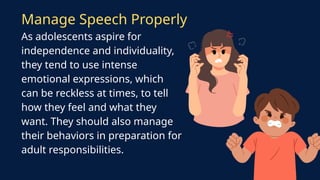
As adolescents aspire for
independence and individuality,
they tend to use intense
emotional expressions, which
can be reckless at times, to tell
how they feel and what they
want. They should also manage
their behaviors in preparation for
adult responsibilities.
Manage Speech Properly
ACTIVITY 3.1
Awareness of One’s
Developmental Task
and Progress
Transition from
Childhood to
Adolescence
Adolescents do not progress through
these multiple developmental tasks
separately. At any given time,
adolescents may be dealing with
several tasks. Further, the centrality
of specific developmental tasks
varies with early, middle, and late
adolescence.
Transition from Childhood to
Adolescence Stage
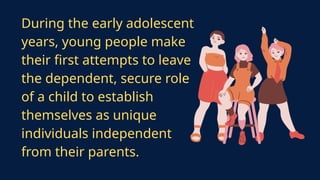
During the early adolescent
years, young people make
their first attempts to leave
the dependent, secure role
of a child to establish
themselves as unique
individuals independent
from their parents.
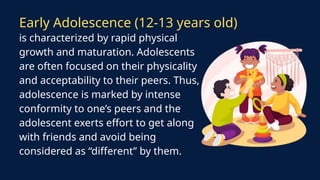
is characterized by rapid physical
growth and maturation. Adolescents
are often focused on their physicality
and acceptability to their peers. Thus,
adolescence is marked by intense
conformity to one’s peers and the
adolescent exerts effort to get along
with friends and avoid being
considered as “different” by them.
Early Adolescence (12-13 years old)
ACTIVITY 3.2
Commitment to
Becoming a
Responsible
What do you think is
your main responsibility
as an adolescent?
Chapter 3
Assessment

Personal Development UNIT 1 Week 3 Sir Kyle.pptx

  • 2.
    UNIT 1 Chapter 01 Chapter 02 Chapter 03 Chapter 04 Knowing TheSelf Developing the Whole Program Developmental Stages in Middle and Late Adolescence The Challenge of Middle and Late Adolescence
  • 3.
    CHAPTER 3 Developmental Stages inMiddle and Late Adolescence
  • 4.
    OBJECTIVES 01 02 at the endof the chapter, students are expected to: classify various developmental tasks according to developmental stage; evaluate their development in comparison to person in the same age group 03 list ways to become a responsible adolescent prepared for adult life; and 03 maintain a journal.
  • 5.
    INTRODUCTION This chapter willlead the to identify developmental tasks of adolescents that will serve as a foundation for responsibilities during adulthood. They will trace the transition process from childhood to adolescence and evaluate their own developmental in comparison to that of other adolescents. Furthermore, they will learn how to become a responsible individual and commit to be one.
  • 6.
    refer to tasksthat arise during certain periods in your life (Encyclopedia of Aging, 2002). Any concern that hinders compliance with or accomplishment of these tasks may lead to an inability to perform tasks in the next period or stage of development in life. Developmental Tasks
  • 7.
  • 8.
    Adjust to newPhysical Changes Puberty bring many physiological changes and the discomforts that these changes may affect self- esteem. Thus, it has to be explained well to an adolescent tat it is part of the natural maturation process during that stage.
  • 9.
    Adjust to newIntellectual Abilities With the transition in cognitive skills from concrete to abstract thinking during adolescence, one has to adjust within oneself. Some adolescents may be going overboard in expressing themselves without censorship and tact or without considering the consequences of their words.
  • 10.
    The educational curriculumis designed to match with developmental tasks at all levels. Thus, cognitive demands and challenges are greater in junior high school than in elementary level. Some adolescents may find the academic demands frustrating. However, the fact remains that they need to adjust to the cognitive demands in school. Adjust to Higher Cognitive Demands in School
  • 11.
    Adolescents are expectedto learn proper expressions and tactfulness in communication, which they will use more when they become adults. Furthermore the complexities of the school curriculum may require higher level verbal skills compared to their limited language during childhood. Adjust to Higher Demand for Verbal Communication Skills
  • 12.
    Adolescents have toestablish a sense of identity apart from that of their parents. They have to recognize their uniqueness and capabilities to do things and slowly establish their own name. Answering questions “What does it mean to be me?” or “Who am I?” can be their clue to developing a personal sense of identity. Develop a Personal Sense of Identity
  • 13.
    it is atthis stage when adolescents consider which career or vocational goals to take and how they may achieve them. They are now able to answer the question “What do you want to be when you grow up?” Adolescents cannot pursue adulthood without any plans for their future career. Establish Vocational Goals
  • 14.
    Adolescents need toestablish independence and move away from childhood attachments and the security and safety of having their parents with them. Establish Emotional and Psychological Independence from Parents
  • 15.
    Stable peer relationshipstart with stable individuals. In this stage, encounters with peers may lead to intense emotional experiences. Thus, adolescents need to learn the art of controlling emotions and being tactful in expression. It is healthy for them to have an accepting peer group. however, they should learn to accept themselves frist before they can genuinely accept others. Develop Stable Peer Relatioship
  • 16.
    With physical maturationcome raging hormones that may sometimes confuse adolescents. They need to manage their sexuality, that is being male or female, and live up to the expectations and norms set by family, culture, society, and spirituality. With the tendency to express themselves at random, they could be at the same time inhibited due to fear that they might send wrong signals and be judged by others. Manage Sexuality
  • 17.
    Parents provide theirchildren guidance in identifying right and wrong. Eventually, the adolescents’ desire to become independent may lead them to reconsider parental values especially when these are in conflict with those of peers and society. Adopt a Personal Value System
  • 18.
    As adolescents aspirefor independence and individuality, they tend to use intense emotional expressions, which can be reckless at times, to tell how they feel and what they want. They should also manage their behaviors in preparation for adult responsibilities. Manage Speech Properly
  • 19.
    ACTIVITY 3.1 Awareness ofOne’s Developmental Task and Progress
  • 20.
  • 21.
    Adolescents do notprogress through these multiple developmental tasks separately. At any given time, adolescents may be dealing with several tasks. Further, the centrality of specific developmental tasks varies with early, middle, and late adolescence. Transition from Childhood to Adolescence Stage
  • 22.
    During the earlyadolescent years, young people make their first attempts to leave the dependent, secure role of a child to establish themselves as unique individuals independent from their parents.
  • 23.
    is characterized byrapid physical growth and maturation. Adolescents are often focused on their physicality and acceptability to their peers. Thus, adolescence is marked by intense conformity to one’s peers and the adolescent exerts effort to get along with friends and avoid being considered as “different” by them. Early Adolescence (12-13 years old)
  • 30.
  • 31.
    What do youthink is your main responsibility as an adolescent?
  • 32.