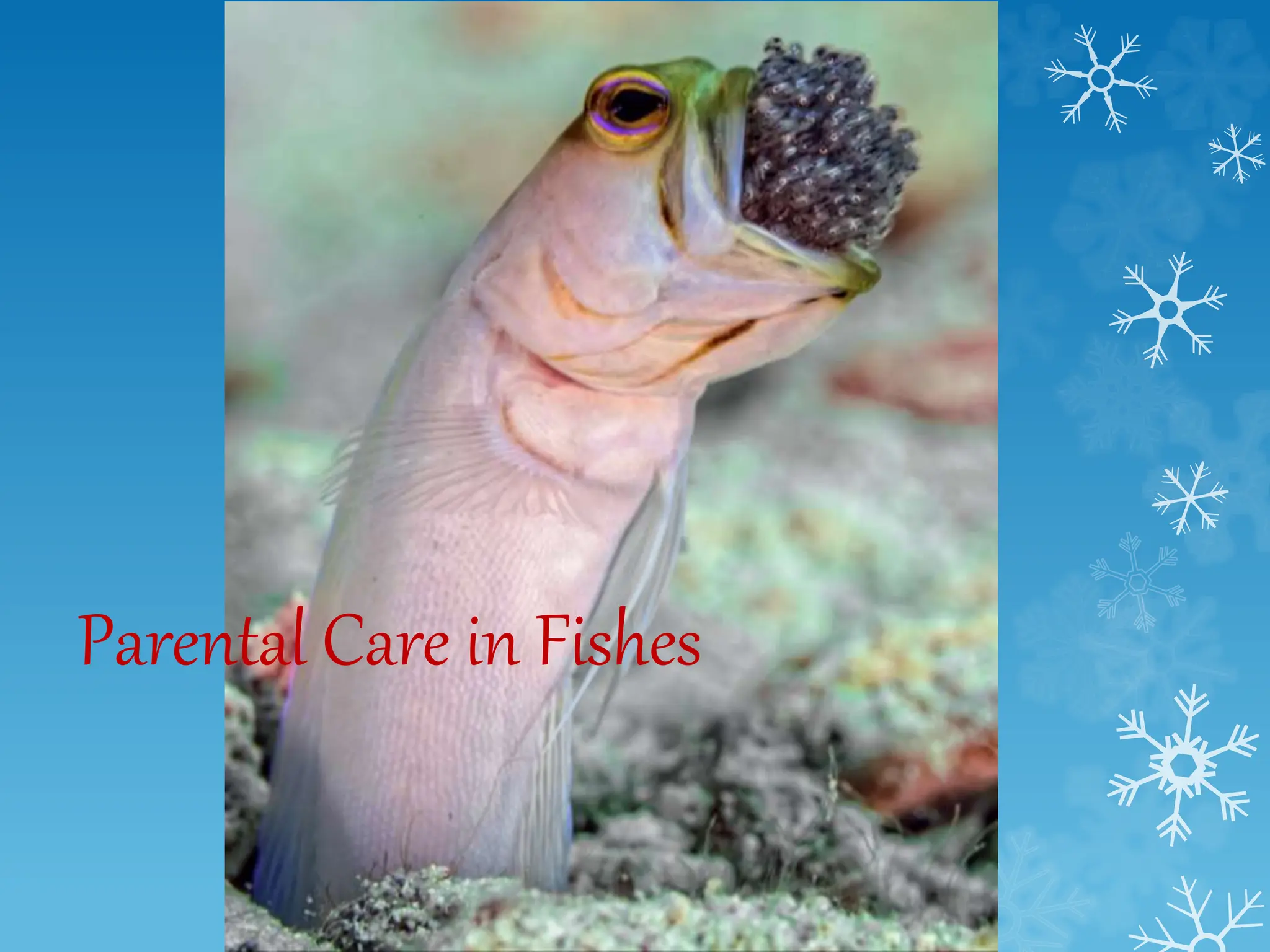
Parental Care in Fishes
 Parental care behaviour is any behaviour performed after
breeding, by one or both parents, that contributes to the
survival of their offspring and animal exhibit a great
diversity in care of their eggs and young during
development.
 Differences between species in parental care are
associated with differences in mating system.
Basis of Parental Care
Variation in Parental Care among Fishes
 Parental care behavior is not universal among all
fishes.
 79% of teleost families have no parental care
(Gross and Sargent, 1985).
 Fish show all grades of parental care behavior from
random spawning and from deposition of large
number of uncared eggs to the protection of young.
 Two general types of variation in parental care
behavior exist among fishes. First either both
parents (< 25% families), or one alone cares for the
offspring (usually male).
Male and Female Parental Care (PC)
Distribution wrt. Mode of fertilization
Sex involved in PC Internal
Fertilization
External
Fertilization
Male PC 2 61
Female PC 14 24
No PC 5 100
Table: Number of families of fishes in PC associated with
fertilization type (after Gross and Shine, 1981)
Hypotheses Study on Fish Parental Care
(Gross and Shine,1981)
 Male Fish PC is commonest with External Fertilization and
Female Fish PC with Internal Fertilization.
Hypothesis 1: Paternity Certainty- Reliability of
paternity will be affected by mode of fertilization. External
fertilization increases the paternity certainty as it occurs
at the time of oviposition, hence male partner takes care
of fertilized eggs. (No sperm competition within female’s
reproductive tract that would have reduced paternity).
[Trivers,1972]
 Hypothesis 2: Order of Gamete Release- Male partner
must wait until the eggs are laid before he can fertilize them, or
else his sperms will float away. Therefore, a female has the
opportunity to desert first and swim off while her male partner
still to fertilize her laid eggs. [Dawkins and Carlisle, 1976]. But
most common pattern of gamete release is simultaneous by
both sexes in nature.
 Out of 46 species of fishes, 36 species which show simultaneous
release of gametes provide monoparental care (by males).
 Callichthyidae and Belontiidae families have shown males to
build foamy nest in which sperms are laid first before females to
lay eggs on it. Males take parental care in them.
 Therefore Male PC is correlated with external fertilization independently of the
order of gamete release or opportunity to desert.
 Hypothesis 3: Association- Simply the association with
the developing embryos preadapts a sex for parental
care. With external fertilization, the eggs are often laid
in a male’s territory and it is the male who is most
closely associated with the embryos. Thus territoriality
for resource defence (best nesting site or nests by
males) preadapts males for providing parental care
associated with external fertilization. [Williams, 1975]
Types of parental care
 Care to fertilized eggs:
 Selection of spawning site
 Territorial behaviour by defending territories (increasing territoriality
affords protection for developing eggs).
 Nest Building with various nest building materials-
 Stone nest- Blennaidae family species
 Cyclopterus sp
 Open spawning site- British Spondyliosoma
 Sand and gravel nest- shallow basin like nest as in Salmon
 Weed nest- Male Stickle back prepares nest by aquatic algae bound
together with muco-protein strand produced by the kidney of male.
Nest building by fishes
 Tunnel nest or burrow: male Lepidosiren digs ‘L’ shaped burrow
at river bottom.
 Bubble nest: male Gourami (Macropodus sp) and Fighting fish
(Betta sp) forms surface bubblees by mouth secretions.
 Shell nest: Female Bitterling (Rhodus sp) lays eggs within the
mantle cavity of muzzel. Female Lumpsucker (Caraproctus sp)
lay eggs beneath the carapace of Kamchatk crab.
 Floating nest: body secretions forms a foam-like nest above
water surface by Gymnarchus sp.
 Crevice nest: Tompot blenny (Parablennius gattorugine) finds
crevices in rocky cliffs under water and after laying cover it by
grasses or sand.
Deposition of eggs
 Scattering eggs over aquatic plants- fishes such as pikes, Esox
lucius;carps, Cyprinus carpio, Carrassius auratus etc., eggs are
scattered usually over aquatic plants to which they are attached.
 Depositing eggs in sticky covering. In many carps, eggs are
usually laid with some special sticky covering by means of which
they are attached to each other and to the stones, weeds, etc. In
yellow perch, Perca flavescens eggs are deposited in a rope of single
mass.
Protection of egg by body
 Brood pouch: members of Syngnathidae family possess brood
pouch within which females deposit eggs. Eg: Pipe fish.
 Mouth cavity: Brazilian cat fish male individuals develop lower
lip enlargement as pouches to protect eggs.
 Head knob: male Kartes develop a depression over head to
deposit eggs for protection.
 Male Mystus sp attaches eggs to abdomen for protection.
 The Butter fish (Pholis sp) curls their ling body to hold eggs in
the coil of the body.
Care for Hatchlings
 Hatchlings after coming out of the eggs are actively protected or
defended by many fishes.
 Largest fresh water fish Arapaima sp protects its youngs by swimming
behind it (female).
 Both male and female mouth breeder cat fishes (Gallichthys sp)
shelters their youngs with in mouth cavity. Cichlids also cares
hatchlings within mouth.
 Micropterus sp creates devastating splashes to remove its enemies
when males accompany their hathclings.
 S. American Symphoysondon sp feed their newly hatchlings with
mucus covering of their body (both male and female).
Internal Incubation
 Viviparity describes the highest degree of parental care and
provide maximum protection to the young ones.
 Elasmobranches (e.g., Scoliodon, Mustelus) eggs develop in the
uterus. The mucous lining of the uterus forms fluid-filled protective
compartments, one for each embryo. Each embryo receives
nourishment from the uterine tissues through the yolk-sac
placenta.
 Bony fishes like line bearer of the family Pocilidae provides
development of embryo inside the vascularized, dilated fluid filled
ovarian follicle.
 In Gambusia sp, the embryos are nourished with the nutritive
secretions of endometrium.
Increasing brood fitness
Parental Care in Fisheghnnnhhhhhhhs.pptx

Parental Care in Fisheghnnnhhhhhhhs.pptx

  • 1.
  • 2.
     Parental carebehaviour is any behaviour performed after breeding, by one or both parents, that contributes to the survival of their offspring and animal exhibit a great diversity in care of their eggs and young during development.  Differences between species in parental care are associated with differences in mating system. Basis of Parental Care
  • 3.
    Variation in ParentalCare among Fishes  Parental care behavior is not universal among all fishes.  79% of teleost families have no parental care (Gross and Sargent, 1985).  Fish show all grades of parental care behavior from random spawning and from deposition of large number of uncared eggs to the protection of young.  Two general types of variation in parental care behavior exist among fishes. First either both parents (< 25% families), or one alone cares for the offspring (usually male).
  • 4.
    Male and FemaleParental Care (PC) Distribution wrt. Mode of fertilization Sex involved in PC Internal Fertilization External Fertilization Male PC 2 61 Female PC 14 24 No PC 5 100 Table: Number of families of fishes in PC associated with fertilization type (after Gross and Shine, 1981)
  • 5.
    Hypotheses Study onFish Parental Care (Gross and Shine,1981)  Male Fish PC is commonest with External Fertilization and Female Fish PC with Internal Fertilization. Hypothesis 1: Paternity Certainty- Reliability of paternity will be affected by mode of fertilization. External fertilization increases the paternity certainty as it occurs at the time of oviposition, hence male partner takes care of fertilized eggs. (No sperm competition within female’s reproductive tract that would have reduced paternity). [Trivers,1972]
  • 6.
     Hypothesis 2:Order of Gamete Release- Male partner must wait until the eggs are laid before he can fertilize them, or else his sperms will float away. Therefore, a female has the opportunity to desert first and swim off while her male partner still to fertilize her laid eggs. [Dawkins and Carlisle, 1976]. But most common pattern of gamete release is simultaneous by both sexes in nature.  Out of 46 species of fishes, 36 species which show simultaneous release of gametes provide monoparental care (by males).  Callichthyidae and Belontiidae families have shown males to build foamy nest in which sperms are laid first before females to lay eggs on it. Males take parental care in them.  Therefore Male PC is correlated with external fertilization independently of the order of gamete release or opportunity to desert.
  • 7.
     Hypothesis 3:Association- Simply the association with the developing embryos preadapts a sex for parental care. With external fertilization, the eggs are often laid in a male’s territory and it is the male who is most closely associated with the embryos. Thus territoriality for resource defence (best nesting site or nests by males) preadapts males for providing parental care associated with external fertilization. [Williams, 1975]
  • 9.
    Types of parentalcare  Care to fertilized eggs:  Selection of spawning site  Territorial behaviour by defending territories (increasing territoriality affords protection for developing eggs).  Nest Building with various nest building materials-  Stone nest- Blennaidae family species  Cyclopterus sp  Open spawning site- British Spondyliosoma  Sand and gravel nest- shallow basin like nest as in Salmon  Weed nest- Male Stickle back prepares nest by aquatic algae bound together with muco-protein strand produced by the kidney of male.
  • 10.
    Nest building byfishes  Tunnel nest or burrow: male Lepidosiren digs ‘L’ shaped burrow at river bottom.  Bubble nest: male Gourami (Macropodus sp) and Fighting fish (Betta sp) forms surface bubblees by mouth secretions.  Shell nest: Female Bitterling (Rhodus sp) lays eggs within the mantle cavity of muzzel. Female Lumpsucker (Caraproctus sp) lay eggs beneath the carapace of Kamchatk crab.  Floating nest: body secretions forms a foam-like nest above water surface by Gymnarchus sp.  Crevice nest: Tompot blenny (Parablennius gattorugine) finds crevices in rocky cliffs under water and after laying cover it by grasses or sand.
  • 11.
    Deposition of eggs Scattering eggs over aquatic plants- fishes such as pikes, Esox lucius;carps, Cyprinus carpio, Carrassius auratus etc., eggs are scattered usually over aquatic plants to which they are attached.  Depositing eggs in sticky covering. In many carps, eggs are usually laid with some special sticky covering by means of which they are attached to each other and to the stones, weeds, etc. In yellow perch, Perca flavescens eggs are deposited in a rope of single mass.
  • 12.
    Protection of eggby body  Brood pouch: members of Syngnathidae family possess brood pouch within which females deposit eggs. Eg: Pipe fish.  Mouth cavity: Brazilian cat fish male individuals develop lower lip enlargement as pouches to protect eggs.  Head knob: male Kartes develop a depression over head to deposit eggs for protection.  Male Mystus sp attaches eggs to abdomen for protection.  The Butter fish (Pholis sp) curls their ling body to hold eggs in the coil of the body.
  • 13.
    Care for Hatchlings Hatchlings after coming out of the eggs are actively protected or defended by many fishes.  Largest fresh water fish Arapaima sp protects its youngs by swimming behind it (female).  Both male and female mouth breeder cat fishes (Gallichthys sp) shelters their youngs with in mouth cavity. Cichlids also cares hatchlings within mouth.  Micropterus sp creates devastating splashes to remove its enemies when males accompany their hathclings.  S. American Symphoysondon sp feed their newly hatchlings with mucus covering of their body (both male and female).
  • 14.
    Internal Incubation  Viviparitydescribes the highest degree of parental care and provide maximum protection to the young ones.  Elasmobranches (e.g., Scoliodon, Mustelus) eggs develop in the uterus. The mucous lining of the uterus forms fluid-filled protective compartments, one for each embryo. Each embryo receives nourishment from the uterine tissues through the yolk-sac placenta.  Bony fishes like line bearer of the family Pocilidae provides development of embryo inside the vascularized, dilated fluid filled ovarian follicle.  In Gambusia sp, the embryos are nourished with the nutritive secretions of endometrium.
  • 15.