
Preparedby Muhammad AshiqToor
Paravertebral anesthesia
Regional anesthesia
• This term is used wherespecific nerves to the area concerned
are blocked.
• Examples include specific nerveblocks to the limbs; paravertebral
blocks; cornual block (for dehorning) and many others.
Paravertebral anesthesia
• Paravertebralanesthesia refers to the perineural injection of local anesthesia
about the spinal nerves as they emerge fromthe vertebralcanal through the
intervertebral foraminae.
• The technique may theoretically be carried out in any species, and at any
level of the spinal cord but in practice, its main useis to provide anesthesia of
the lumbar region in ruminants.
• Its advantageis that it provides analgesia and muscle relaxation of the whole
area covered by the segmental nerves blocked.
• Severaldifferent methods of achieving paravertebralanesthesia have been
described.
• All methods approaching fromthe dorsalsurfaceare equally effective.
• The method described whereby the needle is inserted ventralto the
transverseprocesses of thespine has the disadvantagethat the dorsal
branches of the segmental nerves are not blocked, thus someskin sensitivity
remains.
• Paravertebralanesthesia is easy to carry out, and almost always effective,
except in the very large beef breeds where it may be very difficult to locate the
necessary landmarks.
Proximal paravertebral block (Cambridge Technique)
Preparedby Muhammad AshiqToor
• Indicated for standing laparotomy surgery such as C-section, rumenotomy,
cecotomy, correction of gastrointestinal displacement, intestinal obstruction.
• The dorsalaspect of the transverseprocesses of thelast thoracic (T-13) and
firstand second lumbar (L-1 and L-2) vertebrae is the site for needle
placement.
• The dorsaland ventralnever roots of the last thoracic (T-13) and 1stand 2nd
lumbar spinalnerves emerge from the intervertebral foramina are
desensitized. 10-20 mlof 2% lidocaine is injected to each site onset occurs
usually within 10 minutes of injection. Duration of analgesia lasts
approximately 90 minutes.
Distal paravertebral block (Cornell technique)
• Indicated for same as proximal paravertebralblock above.
• The dorsaland ventral rami of the spinal nerves T13, L1 and L2 are
desensitized at the distal ends of L-1, L-2 and L-4. 7.5-cm, 18-gaugeneedleis
inserted ventral to the tips of the respectivetransverseprocesses in cows
whereapproximately 10-20 mlof a 2% lidocaine solution are injected in a fan-
shaped infiltration pattern.
• The procedureis repeated for the second and fourth lumbar transverse
processes.
• 10-20 ml2% lidocaine is used per site and onset and duration similar to
proximal technique.
SHEEP AND GOATS
Place a 6 cm spinal needle 2.5 to 3 cm fromthe midline, Inject0.5 to 1.0 mL of
local anaesthetic into the skin over the midpoint of each of the first, second
and third lumbar processes.
Preparedby Muhammad AshiqToor
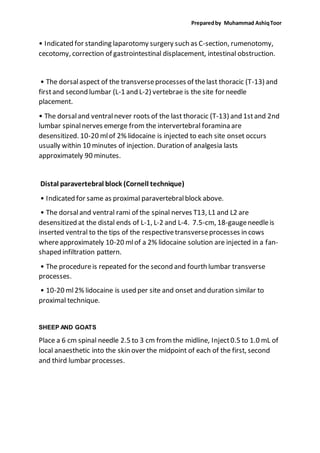
The proximal anddistal paravertebral blockat
the T-13, L1 andL2 in cattle.Thistechnique is
one of the mostcommonlyusedregional
analgesiaincattle forstandingsurgery
(Csection,and laparotomy
Preparedby Muhammad AshiqToor

Paravertebral anesthesia

  • 1.
    Preparedby Muhammad AshiqToor Paravertebralanesthesia Regional anesthesia • This term is used wherespecific nerves to the area concerned are blocked. • Examples include specific nerveblocks to the limbs; paravertebral blocks; cornual block (for dehorning) and many others. Paravertebral anesthesia • Paravertebralanesthesia refers to the perineural injection of local anesthesia about the spinal nerves as they emerge fromthe vertebralcanal through the intervertebral foraminae. • The technique may theoretically be carried out in any species, and at any level of the spinal cord but in practice, its main useis to provide anesthesia of the lumbar region in ruminants. • Its advantageis that it provides analgesia and muscle relaxation of the whole area covered by the segmental nerves blocked. • Severaldifferent methods of achieving paravertebralanesthesia have been described. • All methods approaching fromthe dorsalsurfaceare equally effective. • The method described whereby the needle is inserted ventralto the transverseprocesses of thespine has the disadvantagethat the dorsal branches of the segmental nerves are not blocked, thus someskin sensitivity remains. • Paravertebralanesthesia is easy to carry out, and almost always effective, except in the very large beef breeds where it may be very difficult to locate the necessary landmarks. Proximal paravertebral block (Cambridge Technique)
  • 2.
    Preparedby Muhammad AshiqToor •Indicated for standing laparotomy surgery such as C-section, rumenotomy, cecotomy, correction of gastrointestinal displacement, intestinal obstruction. • The dorsalaspect of the transverseprocesses of thelast thoracic (T-13) and firstand second lumbar (L-1 and L-2) vertebrae is the site for needle placement. • The dorsaland ventralnever roots of the last thoracic (T-13) and 1stand 2nd lumbar spinalnerves emerge from the intervertebral foramina are desensitized. 10-20 mlof 2% lidocaine is injected to each site onset occurs usually within 10 minutes of injection. Duration of analgesia lasts approximately 90 minutes. Distal paravertebral block (Cornell technique) • Indicated for same as proximal paravertebralblock above. • The dorsaland ventral rami of the spinal nerves T13, L1 and L2 are desensitized at the distal ends of L-1, L-2 and L-4. 7.5-cm, 18-gaugeneedleis inserted ventral to the tips of the respectivetransverseprocesses in cows whereapproximately 10-20 mlof a 2% lidocaine solution are injected in a fan- shaped infiltration pattern. • The procedureis repeated for the second and fourth lumbar transverse processes. • 10-20 ml2% lidocaine is used per site and onset and duration similar to proximal technique. SHEEP AND GOATS Place a 6 cm spinal needle 2.5 to 3 cm fromthe midline, Inject0.5 to 1.0 mL of local anaesthetic into the skin over the midpoint of each of the first, second and third lumbar processes.
  • 3.
    Preparedby Muhammad AshiqToor Theproximal anddistal paravertebral blockat the T-13, L1 andL2 in cattle.Thistechnique is one of the mostcommonlyusedregional analgesiaincattle forstandingsurgery (Csection,and laparotomy
  • 4.