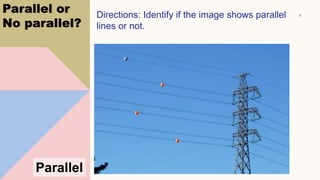
Parallel or
No parallel?
1
Directions: Identify if the image shows parallel
lines or not.
Parallel
Parallel or
No parallel?
2
Not Parallel
Parallel or
No parallel?
3
Parallel
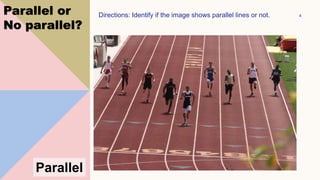
Parallel or
No parallel?
4
Directions: Identify if the image shows parallel lines or not.
Parallel
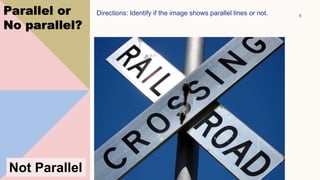
Parallel or
No parallel?
Directions: Identify if the image shows parallel lines or not. 5
Not Parallel
LESSON 4.7
PARALLEL LINES
AND
TRANSVERSALS
Prepared by: Ms. Sabatin, June Evan
M.
LEARNING OBJECTIVES:
At the end of the lesson, the students will be able to:
• Identify the pairs of angles formed when two parallel lines are cut by transversal;
• determine the relationship of the pairs of angles formed when two parallel lines
are cut by a transversal;
• solve the angles using the properties of parallel lines cut by a transversal; and
• show appreciation of the topic by applying the given relationship in real life
situation
8
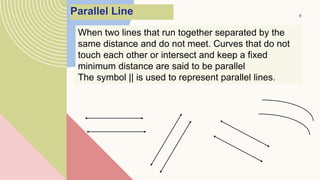
Parallel Line
When two lines that run together separated by the
same distance and do not meet. Curves that do not
touch each other or intersect and keep a fixed
minimum distance are said to be parallel
The symbol || is used to represent parallel lines.
9
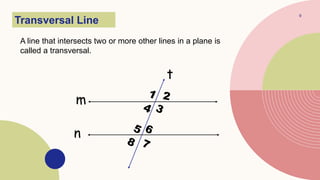
Transversal Line
A line that intersects two or more other lines in a plane is
called a transversal.
t
m
n
10
t
m
n
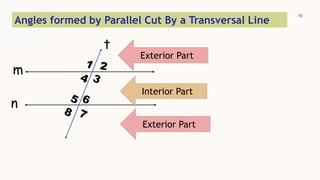
Interior Part
Exterior Part
Exterior Part
Angles formed by Parallel Cut By a Transversal Line
11
t
m
n
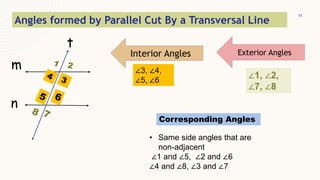
Interior Angles Exterior Angles
Angles formed by Parallel Cut By a Transversal Line
∠3, ∠4,
∠5, ∠6
∠1, ∠2,
∠7, ∠8
Corresponding Angles
• Same side angles that are
non-adjacent
∠1 and ∠5, ∠2 and ∠6
∠4 and ∠8, ∠3 and ∠7
12
t
m
n
Angles formed by Parallel Cut By a Transversal Line
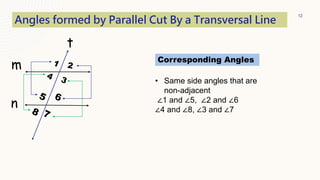
Corresponding Angles
• Same side angles that are
non-adjacent
∠1 and ∠5, ∠2 and ∠6
∠4 and ∠8, ∠3 and ∠7
13
t
m
n
Angles formed by Parallel Cut By a Transversal Line
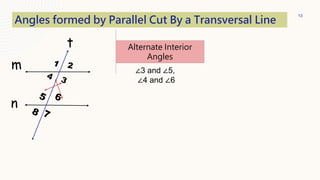
∠3 and ∠5,
∠4 and ∠6
Alternate Interior
Angles
14
t
m
n
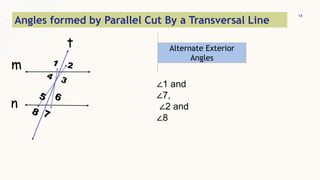
Alternate Exterior
Angles
Angles formed by Parallel Cut By a Transversal Line
∠1 and
∠7,
∠2 and
∠8
15
t
m
n
Angles formed by Parallel Cut By a Transversal Line
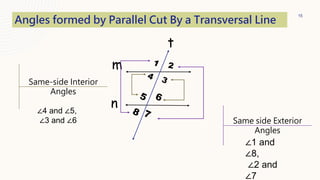
Same-side Interior
Angles
Same side Exterior
Angles
∠4 and ∠5,
∠3 and ∠6
∠1 and
∠8,
∠2 and
∠7
16
t
m
n
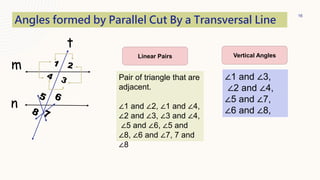
Angles formed by Parallel Cut By a Transversal Line
Pair of triangle that are
adjacent.
∠1 and ∠2, ∠1 and ∠4,
∠2 and ∠3, ∠3 and ∠4,
∠5 and ∠6, ∠5 and
∠8, ∠6 and ∠7, 7 and
∠8
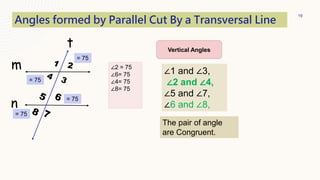
∠1 and ∠3,
∠2 and ∠4,
∠5 and ∠7,
∠6 and ∠8,
Linear Pairs Vertical Angles
Presentation title
17
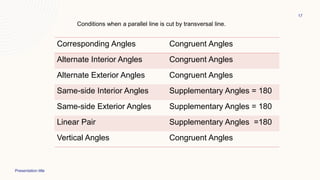
Corresponding Angles Congruent Angles
Alternate Interior Angles Congruent Angles
Alternate Exterior Angles Congruent Angles
Same-side Interior Angles Supplementary Angles = 180
Same-side Exterior Angles Supplementary Angles = 180
Linear Pair Supplementary Angles =180
Vertical Angles Congruent Angles
Conditions when a parallel line is cut by transversal line.
18
t
m
n
Angles formed by Parallel Cut By a Transversal Line
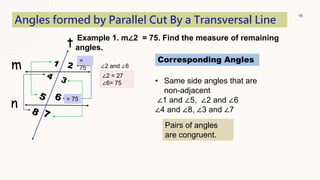
Corresponding Angles
• Same side angles that are
non-adjacent
∠1 and ∠5, ∠2 and ∠6
∠4 and ∠8, ∠3 and ∠7
Example 1. m∠2 = 75. Find the measure of remaining
angles.
=
75
= 75
Pairs of angles
are congruent.
∠2 = 27
∠6= 75
∠2 and ∠6
19
t
m
n
Angles formed by Parallel Cut By a Transversal Line
∠1 and ∠3,
∠2 and ∠4,
∠5 and ∠7,
∠6 and ∠8,
Vertical Angles
The pair of angle
are Congruent.
= 75
= 75
∠2 = 75
∠6= 75
∠4= 75
∠8= 75
= 75
= 75
20
t
m
n
Angles formed by Parallel Cut By a Transversal Line
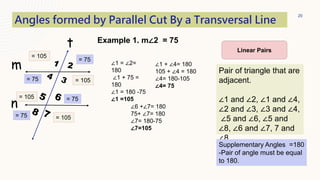
Pair of triangle that are
adjacent.
∠1 and ∠2, ∠1 and ∠4,
∠2 and ∠3, ∠3 and ∠4,
∠5 and ∠6, ∠5 and
∠8, ∠6 and ∠7, 7 and
∠8
Linear Pairs
Supplementary Angles =180
-Pair of angle must be equal
to 180.
∠1 = ∠2=
180
∠1 + 75 =
180
∠1 = 180 -75
∠1 =105
= 75
= 105
∠1 + ∠4= 180
105 + ∠4 = 180
∠4= 180-105
∠4= 75
= 75 = 105
Example 1. m∠2 = 75
= 75
= 105
∠6 +∠7= 180
75+ ∠7= 180
∠7= 180-75
∠7=105
= 75
= 105
THANK YOU

transversal.pptx

  • 1.
    Parallel or No parallel? 1 Directions:Identify if the image shows parallel lines or not. Parallel
  • 2.
  • 3.
  • 4.
    Parallel or No parallel? 4 Directions:Identify if the image shows parallel lines or not. Parallel
  • 5.
    Parallel or No parallel? Directions:Identify if the image shows parallel lines or not. 5 Not Parallel
  • 6.
  • 7.
    LEARNING OBJECTIVES: At theend of the lesson, the students will be able to: • Identify the pairs of angles formed when two parallel lines are cut by transversal; • determine the relationship of the pairs of angles formed when two parallel lines are cut by a transversal; • solve the angles using the properties of parallel lines cut by a transversal; and • show appreciation of the topic by applying the given relationship in real life situation
  • 8.
    8 Parallel Line When twolines that run together separated by the same distance and do not meet. Curves that do not touch each other or intersect and keep a fixed minimum distance are said to be parallel The symbol || is used to represent parallel lines.
  • 9.
    9 Transversal Line A linethat intersects two or more other lines in a plane is called a transversal. t m n
  • 10.
    10 t m n Interior Part Exterior Part ExteriorPart Angles formed by Parallel Cut By a Transversal Line
  • 11.
    11 t m n Interior Angles ExteriorAngles Angles formed by Parallel Cut By a Transversal Line ∠3, ∠4, ∠5, ∠6 ∠1, ∠2, ∠7, ∠8 Corresponding Angles • Same side angles that are non-adjacent ∠1 and ∠5, ∠2 and ∠6 ∠4 and ∠8, ∠3 and ∠7
  • 12.
    12 t m n Angles formed byParallel Cut By a Transversal Line Corresponding Angles • Same side angles that are non-adjacent ∠1 and ∠5, ∠2 and ∠6 ∠4 and ∠8, ∠3 and ∠7
  • 13.
    13 t m n Angles formed byParallel Cut By a Transversal Line ∠3 and ∠5, ∠4 and ∠6 Alternate Interior Angles
  • 14.
    14 t m n Alternate Exterior Angles Angles formedby Parallel Cut By a Transversal Line ∠1 and ∠7, ∠2 and ∠8
  • 15.
    15 t m n Angles formed byParallel Cut By a Transversal Line Same-side Interior Angles Same side Exterior Angles ∠4 and ∠5, ∠3 and ∠6 ∠1 and ∠8, ∠2 and ∠7
  • 16.
    16 t m n Angles formed byParallel Cut By a Transversal Line Pair of triangle that are adjacent. ∠1 and ∠2, ∠1 and ∠4, ∠2 and ∠3, ∠3 and ∠4, ∠5 and ∠6, ∠5 and ∠8, ∠6 and ∠7, 7 and ∠8 ∠1 and ∠3, ∠2 and ∠4, ∠5 and ∠7, ∠6 and ∠8, Linear Pairs Vertical Angles
  • 17.
    Presentation title 17 Corresponding AnglesCongruent Angles Alternate Interior Angles Congruent Angles Alternate Exterior Angles Congruent Angles Same-side Interior Angles Supplementary Angles = 180 Same-side Exterior Angles Supplementary Angles = 180 Linear Pair Supplementary Angles =180 Vertical Angles Congruent Angles Conditions when a parallel line is cut by transversal line.
  • 18.
    18 t m n Angles formed byParallel Cut By a Transversal Line Corresponding Angles • Same side angles that are non-adjacent ∠1 and ∠5, ∠2 and ∠6 ∠4 and ∠8, ∠3 and ∠7 Example 1. m∠2 = 75. Find the measure of remaining angles. = 75 = 75 Pairs of angles are congruent. ∠2 = 27 ∠6= 75 ∠2 and ∠6
  • 19.
    19 t m n Angles formed byParallel Cut By a Transversal Line ∠1 and ∠3, ∠2 and ∠4, ∠5 and ∠7, ∠6 and ∠8, Vertical Angles The pair of angle are Congruent. = 75 = 75 ∠2 = 75 ∠6= 75 ∠4= 75 ∠8= 75 = 75 = 75
  • 20.
    20 t m n Angles formed byParallel Cut By a Transversal Line Pair of triangle that are adjacent. ∠1 and ∠2, ∠1 and ∠4, ∠2 and ∠3, ∠3 and ∠4, ∠5 and ∠6, ∠5 and ∠8, ∠6 and ∠7, 7 and ∠8 Linear Pairs Supplementary Angles =180 -Pair of angle must be equal to 180. ∠1 = ∠2= 180 ∠1 + 75 = 180 ∠1 = 180 -75 ∠1 =105 = 75 = 105 ∠1 + ∠4= 180 105 + ∠4 = 180 ∠4= 180-105 ∠4= 75 = 75 = 105 Example 1. m∠2 = 75 = 75 = 105 ∠6 +∠7= 180 75+ ∠7= 180 ∠7= 180-75 ∠7=105 = 75 = 105
  • 21.