Parallels
Parallels
 §
§ 4.1
4.1 Parallel Lines and Planes
 §
§ 4.4
4.4 Proving Lines Parallel
 §
§ 4.3
4.3 Transversals and Corresponding Angles
 §
§ 4.2
4.2 Parallel Lines and Transversals
 §
§ 4.6
4.6 Equations of Lines
 §
§ 4.5
4.5 Slope
Parallel Lines and Planes
You will learn to describe relationships among lines,
parts of lines, and planes.
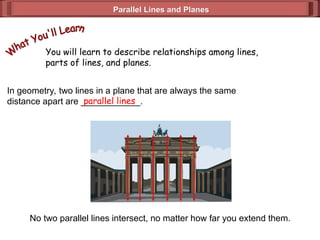
In geometry, two lines in a plane that are always the same
distance apart are ____________.
parallel lines
No two parallel lines intersect, no matter how far you extend them.
Parallel Lines and Planes
Definition of
Parallel
Lines
Two lines are parallel iff they are in the same plane and
do not ________.
intersect
Parallel Lines and Planes
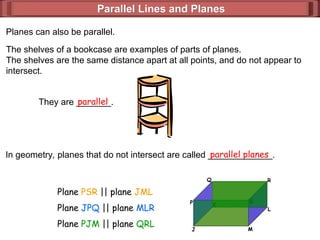
Planes can also be parallel.
The shelves of a bookcase are examples of parts of planes.
The shelves are the same distance apart at all points, and do not appear to
intersect.
They are _______.
parallel
In geometry, planes that do not intersect are called _____________.
parallel planes
Q
J
K
M
L
S
R
P
Plane PSR || plane JML
Plane JPQ || plane MLR
Plane PJM || plane QRL
Parallel Lines and Planes
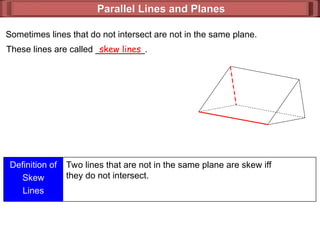
Sometimes lines that do not intersect are not in the same plane.
These lines are called __________.
skew lines
Definition of
Skew
Lines
Two lines that are not in the same plane are skew iff
they do not intersect.
Parallel Lines and Planes
A
C
B
E
G
H
D
F
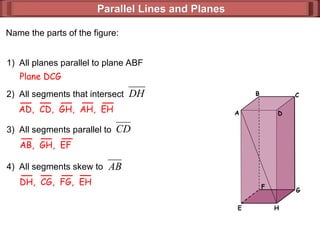
Name the parts of the figure:
1) All planes parallel to plane ABF
2) All segments that intersect DH
3) All segments parallel to CD
4) All segments skew to AB
Plane DCG
AD, CD, GH, AH, EH
AB, GH, EF
DH, CG, FG, EH
Parallel Lines and Transversals
You will learn to identify the relationships among pairs of
interior and exterior angles formed by two parallel lines
and a transversal.
Parallel Lines and Transversals
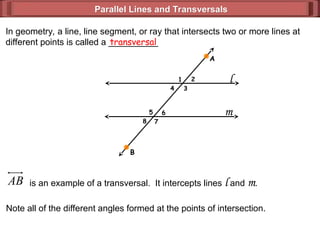
In geometry, a line, line segment, or ray that intersects two or more lines at
different points is called a __________
transversal
l
m
B
A
AB is an example of a transversal. It intercepts lines l and m.
Note all of the different angles formed at the points of intersection.
1 2
3
4
5
7
6
8
Parallel Lines and Transversals
Definition of
Transversal
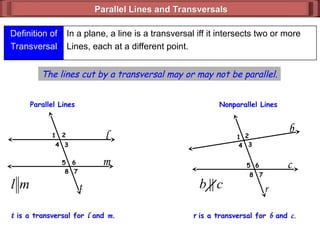
In a plane, a line is a transversal iff it intersects two or more
Lines, each at a different point.
The lines cut by a transversal may or may not be parallel.
l
m
1 2
3
4
5
7
6
8
m
l
Parallel Lines
t is a transversal for l and m.
t
1 2
3
4
5
7
6
8
b
c
c
b ||
Nonparallel Lines
r is a transversal for b and c.
r
Parallel Lines and Transversals
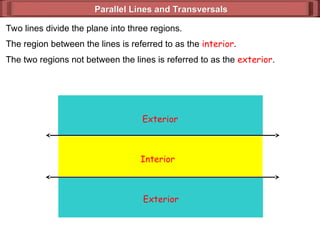
Two lines divide the plane into three regions.
The region between the lines is referred to as the interior.
The two regions not between the lines is referred to as the exterior.
Exterior
Exterior
Interior
l
m
1 2
3
4
5
7
6
8
Parallel Lines and Transversals
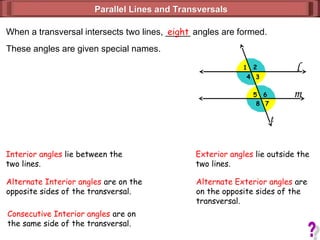
When a transversal intersects two lines, _____ angles are formed.
eight
These angles are given special names.
t
Interior angles lie between the
two lines.
Exterior angles lie outside the
two lines.
Alternate Interior angles are on the
opposite sides of the transversal.
Consecutive Interior angles are on
the same side of the transversal.
Alternate Exterior angles are
on the opposite sides of the
transversal.
Parallel Lines and Transversals
Theorem 4-1
Alternate
Interior
Angles
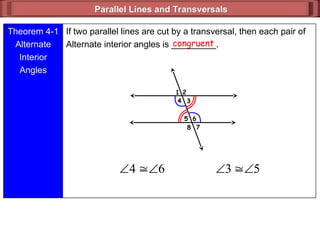
If two parallel lines are cut by a transversal, then each pair of
Alternate interior angles is _________.
1 2
3
4
5
7
6
8
6
4 

 5
3 


congruent
Parallel Lines and Transversals
1 2
3
4
5
7
6
8
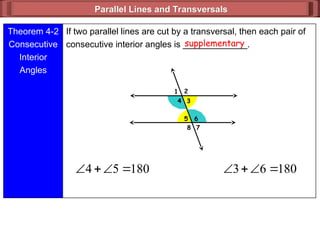
Theorem 4-2
Consecutive
Interior
Angles
If two parallel lines are cut by a transversal, then each pair of
consecutive interior angles is _____________.
supplementary
180
5
4 


 180
6
3 



Parallel Lines and Transversals
1 2
3
4
5
7
6
8
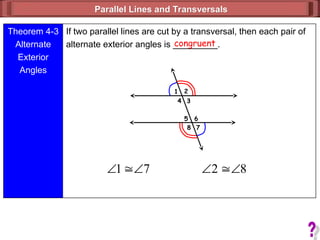
Theorem 4-3
Alternate
Exterior
Angles
If two parallel lines are cut by a transversal, then each pair of
alternate exterior angles is _________.
congruent
7
1 

 8
2 


Practice Problems:
1, 4, 6, 8, 10, 12, 14, 16, 18, 20, 22, 24, 26, 28, 30, 32, 34, 36,
38, 40, 42, 44, and 46 (total = 23)
Transversals and Corresponding Angles
You will learn to identify the relationships among pairs of
corresponding angles formed by two parallel lines and a
transversal.
Transversals and Corresponding Angles
l
m
1 2
3
4
5
7
6
8
t
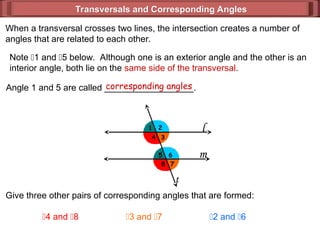
When a transversal crosses two lines, the intersection creates a number of
angles that are related to each other.
Note 1 and 5 below. Although one is an exterior angle and the other is an
interior angle, both lie on the same side of the transversal.
Angle 1 and 5 are called __________________.
corresponding angles
Give three other pairs of corresponding angles that are formed:
4 and 8 3 and 7 2 and 6
Transversals and Corresponding Angles
Postulate 4-1
Corresponding
Angles
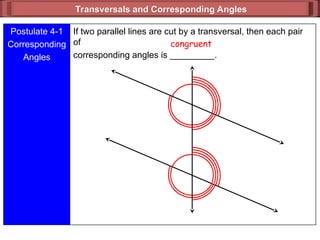
If two parallel lines are cut by a transversal, then each pair
of
corresponding angles is _________.
congruent
Transversals and Corresponding Angles
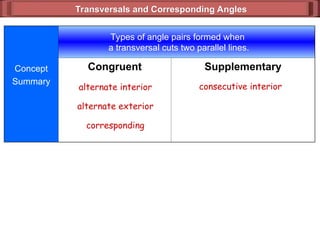
Concept
Summary
Congruent Supplementary
alternate interior
alternate exterior
corresponding
consecutive interior
Types of angle pairs formed when
a transversal cuts two parallel lines.
Transversals and Corresponding Angles
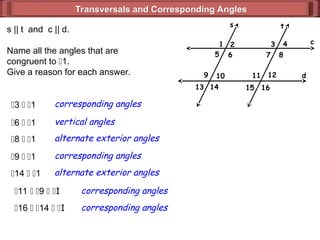
s t
c
d
1 2 3 4
5 6 7 8
9 10 11 12
13 14 15 16
s || t and c || d.
Name all the angles that are
congruent to 1.
Give a reason for each answer.
3  1 corresponding angles
6  1 vertical angles
8  1 alternate exterior angles
9  1 corresponding angles
11  9  1 corresponding angles
14  1 alternate exterior angles
16  14  1 corresponding angles
Practice Problems:
2, 4, 6, 8, 10, 12, 14, 16, 18, 20,
22, 24, 26, 28, 30, 32, 34, 36, and 38 (total = 19)
Proving Lines Parallel
You will learn to identify conditions that produce parallel lines.
Reminder: In Chapter 1, we discussed “if-then” statements (pg. 24).
Within those statements, we identified the “__________” and the
“_________”.
hypothesis
conclusion
I said then that in mathematics, we only use the term
“if and only if”
if the converse of the statement is true.
Proving Lines Parallel
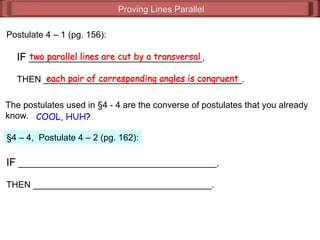
Postulate 4 – 1 (pg. 156):
IF ___________________________________,
THEN ________________________________________.
two parallel lines are cut by a transversal
each pair of corresponding angles is congruent
The postulates used in §4 - 4 are the converse of postulates that you already
know. COOL, HUH?
§4 – 4, Postulate 4 – 2 (pg. 162):
IF ________________________________________,
THEN ____________________________________.
each pair of corresponding angles is congruent
two parallel lines are cut by a transversal
Proving Lines Parallel
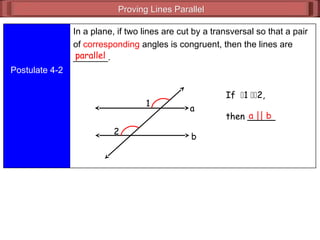
Postulate 4-2
In a plane, if two lines are cut by a transversal so that a pair
of corresponding angles is congruent, then the lines are
_______.
parallel
If 1 2,
then _____
a || b
1
2
a
b
Proving Lines Parallel
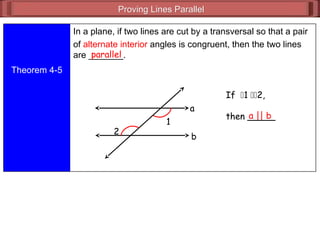
Theorem 4-5
In a plane, if two lines are cut by a transversal so that a pair
of alternate interior angles is congruent, then the two lines
are _______.
parallel
If 1 2,
then _____
a || b
1
2
a
b
Proving Lines Parallel
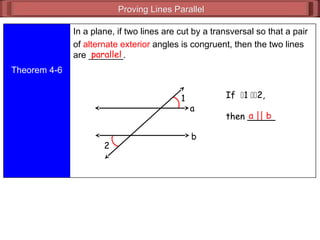
Theorem 4-6
In a plane, if two lines are cut by a transversal so that a pair
of alternate exterior angles is congruent, then the two lines
are _______.
parallel
If 1 2,
then _____
a || b
1
2
a
b
Proving Lines Parallel
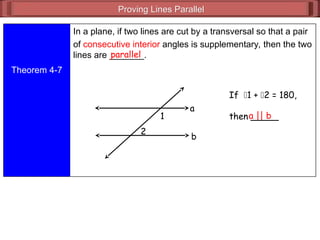
Theorem 4-7
In a plane, if two lines are cut by a transversal so that a pair
of consecutive interior angles is supplementary, then the two
lines are _______.
parallel
If 1 + 2 = 180,
then _____
a || b
1
2
a
b
Proving Lines Parallel
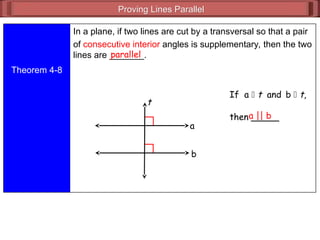
Theorem 4-8
In a plane, if two lines are cut by a transversal so that a pair
of consecutive interior angles is supplementary, then the two
lines are _______.
parallel
If a  t and b  t,
then _____
a || b
a
b
t
3 Transversal Lines in Two Parallel Lines.ppt

  • 1.
    Parallels Parallels  § § 4.1 4.1Parallel Lines and Planes  § § 4.4 4.4 Proving Lines Parallel  § § 4.3 4.3 Transversals and Corresponding Angles  § § 4.2 4.2 Parallel Lines and Transversals  § § 4.6 4.6 Equations of Lines  § § 4.5 4.5 Slope
  • 2.
    Parallel Lines andPlanes Parallel Lines and Planes You will learn to describe relationships among lines, parts of lines, and planes. In geometry, two lines in a plane that are always the same distance apart are ____________. parallel lines No two parallel lines intersect, no matter how far you extend them.
  • 3.
    Parallel Lines andPlanes Parallel Lines and Planes Definition of Parallel Lines Two lines are parallel iff they are in the same plane and do not ________. intersect
  • 4.
    Parallel Lines andPlanes Parallel Lines and Planes Planes can also be parallel. The shelves of a bookcase are examples of parts of planes. The shelves are the same distance apart at all points, and do not appear to intersect. They are _______. parallel In geometry, planes that do not intersect are called _____________. parallel planes Q J K M L S R P Plane PSR || plane JML Plane JPQ || plane MLR Plane PJM || plane QRL
  • 5.
    Parallel Lines andPlanes Parallel Lines and Planes Sometimes lines that do not intersect are not in the same plane. These lines are called __________. skew lines Definition of Skew Lines Two lines that are not in the same plane are skew iff they do not intersect.
  • 6.
    Parallel Lines andPlanes Parallel Lines and Planes A C B E G H D F Name the parts of the figure: 1) All planes parallel to plane ABF 2) All segments that intersect DH 3) All segments parallel to CD 4) All segments skew to AB Plane DCG AD, CD, GH, AH, EH AB, GH, EF DH, CG, FG, EH
  • 8.
    Parallel Lines andTransversals Parallel Lines and Transversals You will learn to identify the relationships among pairs of interior and exterior angles formed by two parallel lines and a transversal.
  • 9.
    Parallel Lines andTransversals Parallel Lines and Transversals In geometry, a line, line segment, or ray that intersects two or more lines at different points is called a __________ transversal l m B A AB is an example of a transversal. It intercepts lines l and m. Note all of the different angles formed at the points of intersection. 1 2 3 4 5 7 6 8
  • 10.
    Parallel Lines andTransversals Parallel Lines and Transversals Definition of Transversal In a plane, a line is a transversal iff it intersects two or more Lines, each at a different point. The lines cut by a transversal may or may not be parallel. l m 1 2 3 4 5 7 6 8 m l Parallel Lines t is a transversal for l and m. t 1 2 3 4 5 7 6 8 b c c b || Nonparallel Lines r is a transversal for b and c. r
  • 11.
    Parallel Lines andTransversals Parallel Lines and Transversals Two lines divide the plane into three regions. The region between the lines is referred to as the interior. The two regions not between the lines is referred to as the exterior. Exterior Exterior Interior
  • 12.
    l m 1 2 3 4 5 7 6 8 Parallel Linesand Transversals Parallel Lines and Transversals When a transversal intersects two lines, _____ angles are formed. eight These angles are given special names. t Interior angles lie between the two lines. Exterior angles lie outside the two lines. Alternate Interior angles are on the opposite sides of the transversal. Consecutive Interior angles are on the same side of the transversal. Alternate Exterior angles are on the opposite sides of the transversal.
  • 13.
    Parallel Lines andTransversals Parallel Lines and Transversals Theorem 4-1 Alternate Interior Angles If two parallel lines are cut by a transversal, then each pair of Alternate interior angles is _________. 1 2 3 4 5 7 6 8 6 4    5 3    congruent
  • 14.
    Parallel Lines andTransversals Parallel Lines and Transversals 1 2 3 4 5 7 6 8 Theorem 4-2 Consecutive Interior Angles If two parallel lines are cut by a transversal, then each pair of consecutive interior angles is _____________. supplementary 180 5 4     180 6 3    
  • 15.
    Parallel Lines andTransversals Parallel Lines and Transversals 1 2 3 4 5 7 6 8 Theorem 4-3 Alternate Exterior Angles If two parallel lines are cut by a transversal, then each pair of alternate exterior angles is _________. congruent 7 1    8 2   
  • 16.
    Practice Problems: 1, 4,6, 8, 10, 12, 14, 16, 18, 20, 22, 24, 26, 28, 30, 32, 34, 36, 38, 40, 42, 44, and 46 (total = 23)
  • 17.
    Transversals and CorrespondingAngles Transversals and Corresponding Angles You will learn to identify the relationships among pairs of corresponding angles formed by two parallel lines and a transversal.
  • 18.
    Transversals and CorrespondingAngles Transversals and Corresponding Angles l m 1 2 3 4 5 7 6 8 t When a transversal crosses two lines, the intersection creates a number of angles that are related to each other. Note 1 and 5 below. Although one is an exterior angle and the other is an interior angle, both lie on the same side of the transversal. Angle 1 and 5 are called __________________. corresponding angles Give three other pairs of corresponding angles that are formed: 4 and 8 3 and 7 2 and 6
  • 19.
    Transversals and CorrespondingAngles Transversals and Corresponding Angles Postulate 4-1 Corresponding Angles If two parallel lines are cut by a transversal, then each pair of corresponding angles is _________. congruent
  • 20.
    Transversals and CorrespondingAngles Transversals and Corresponding Angles Concept Summary Congruent Supplementary alternate interior alternate exterior corresponding consecutive interior Types of angle pairs formed when a transversal cuts two parallel lines.
  • 21.
    Transversals and CorrespondingAngles Transversals and Corresponding Angles s t c d 1 2 3 4 5 6 7 8 9 10 11 12 13 14 15 16 s || t and c || d. Name all the angles that are congruent to 1. Give a reason for each answer. 3  1 corresponding angles 6  1 vertical angles 8  1 alternate exterior angles 9  1 corresponding angles 11  9  1 corresponding angles 14  1 alternate exterior angles 16  14  1 corresponding angles
  • 22.
    Practice Problems: 2, 4,6, 8, 10, 12, 14, 16, 18, 20, 22, 24, 26, 28, 30, 32, 34, 36, and 38 (total = 19)
  • 23.
    Proving Lines Parallel ProvingLines Parallel You will learn to identify conditions that produce parallel lines. Reminder: In Chapter 1, we discussed “if-then” statements (pg. 24). Within those statements, we identified the “__________” and the “_________”. hypothesis conclusion I said then that in mathematics, we only use the term “if and only if” if the converse of the statement is true.
  • 24.
    Proving Lines Parallel ProvingLines Parallel Postulate 4 – 1 (pg. 156): IF ___________________________________, THEN ________________________________________. two parallel lines are cut by a transversal each pair of corresponding angles is congruent The postulates used in §4 - 4 are the converse of postulates that you already know. COOL, HUH? §4 – 4, Postulate 4 – 2 (pg. 162): IF ________________________________________, THEN ____________________________________. each pair of corresponding angles is congruent two parallel lines are cut by a transversal
  • 25.
    Proving Lines Parallel ProvingLines Parallel Postulate 4-2 In a plane, if two lines are cut by a transversal so that a pair of corresponding angles is congruent, then the lines are _______. parallel If 1 2, then _____ a || b 1 2 a b
  • 26.
    Proving Lines Parallel ProvingLines Parallel Theorem 4-5 In a plane, if two lines are cut by a transversal so that a pair of alternate interior angles is congruent, then the two lines are _______. parallel If 1 2, then _____ a || b 1 2 a b
  • 27.
    Proving Lines Parallel ProvingLines Parallel Theorem 4-6 In a plane, if two lines are cut by a transversal so that a pair of alternate exterior angles is congruent, then the two lines are _______. parallel If 1 2, then _____ a || b 1 2 a b
  • 28.
    Proving Lines Parallel ProvingLines Parallel Theorem 4-7 In a plane, if two lines are cut by a transversal so that a pair of consecutive interior angles is supplementary, then the two lines are _______. parallel If 1 + 2 = 180, then _____ a || b 1 2 a b
  • 29.
    Proving Lines Parallel ProvingLines Parallel Theorem 4-8 In a plane, if two lines are cut by a transversal so that a pair of consecutive interior angles is supplementary, then the two lines are _______. parallel If a  t and b  t, then _____ a || b a b t