The paragraph is a series of
sentences developing onetopic.
Adapted from Capital Community College
Paragraph Structure
© Capital Community College
THE TOPIC SENTENCE
The main point, argument, or
claim of a paragraph is stated
in the first sentence. This is
called the topic sentence.
© Capital Community College
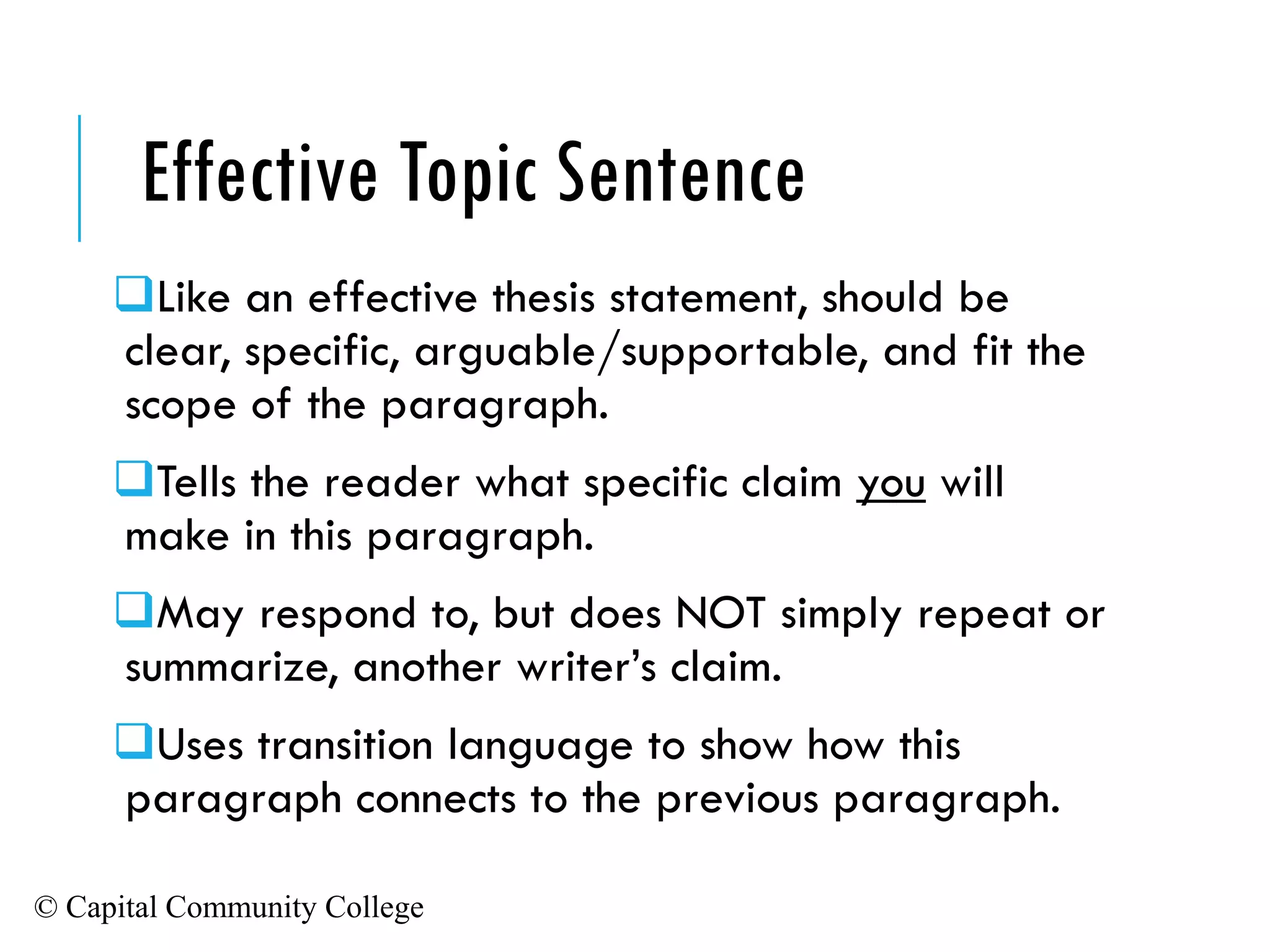
❑Like an effective thesis statement, should be
clear, specific, arguable/supportable, and fit the
scope of the paragraph.
❑Tells the reader what specific claim you will
make in this paragraph.
❑May respond to, but does NOT simply repeat or
summarize, another writer’s claim.
❑Uses transition language to show how this
paragraph connects to the previous paragraph.
Effective Topic Sentence
© Capital Community College
THE REST OF THE PARAGRAPH CONSISTS OF
SENTENCES THAT DEVELOP THE MAIN IDEA.
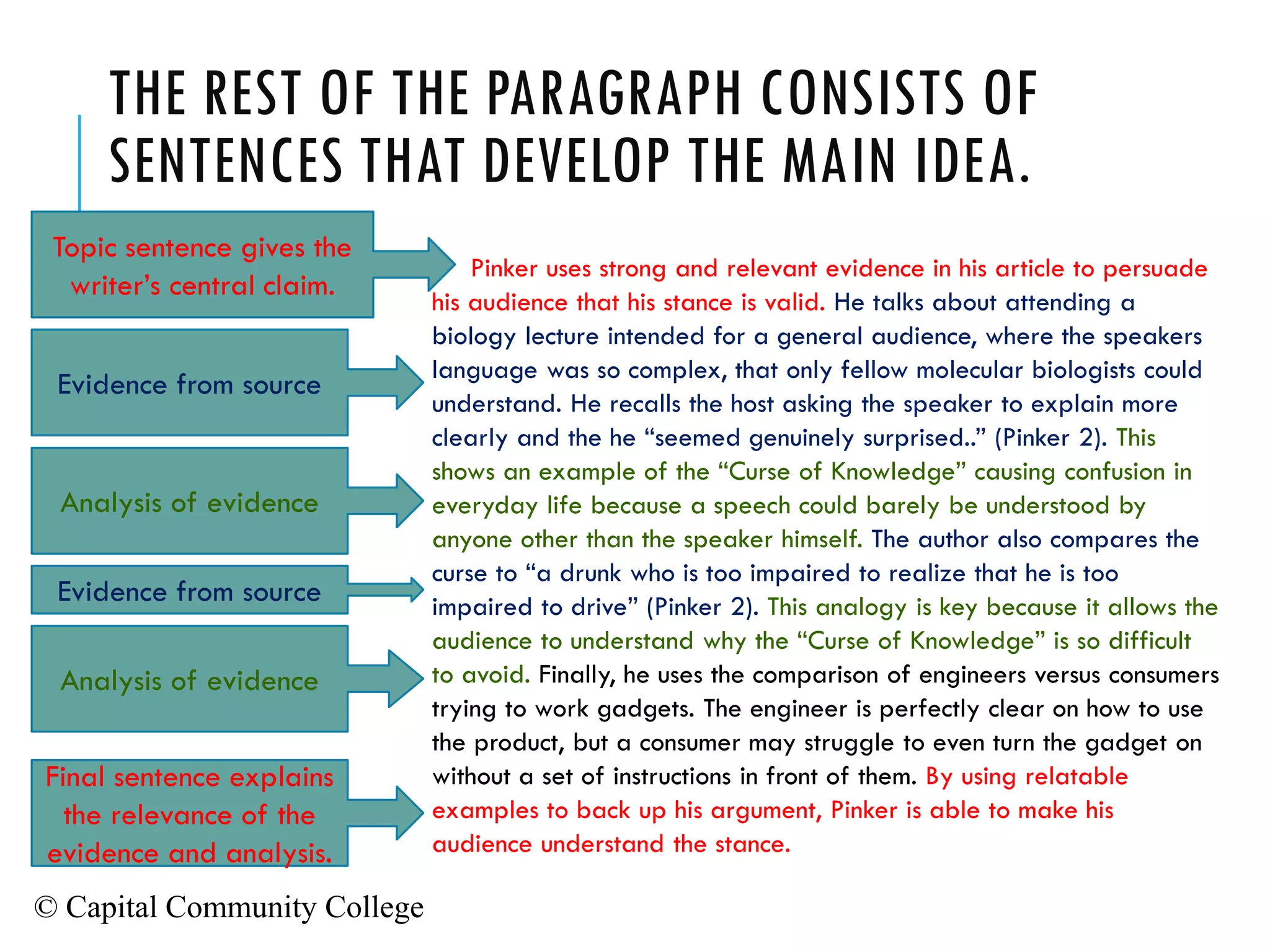
Pinker uses strong and relevant evidence in his article to persuade
his audience that his stance is valid. He talks about attending a
biology lecture intended for a general audience, where the speakers
language was so complex, that only fellow molecular biologists could
understand. He recalls the host asking the speaker to explain more
clearly and the he “seemed genuinely surprised..” (Pinker 2). This
shows an example of the “Curse of Knowledge” causing confusion in
everyday life because a speech could barely be understood by
anyone other than the speaker himself. The author also compares the
curse to “a drunk who is too impaired to realize that he is too
impaired to drive” (Pinker 2). This analogy is key because it allows the
audience to understand why the “Curse of Knowledge” is so difficult
to avoid. Finally, he uses the comparison of engineers versus consumers
trying to work gadgets. The engineer is perfectly clear on how to use
the product, but a consumer may struggle to even turn the gadget on
without a set of instructions in front of them. By using relatable
examples to back up his argument, Pinker is able to make his
audience understand the stance.
Topic sentence gives the
writer’s central claim.
Evidence from source
Analysis of evidence
Evidence from source
Analysis of evidence
Final sentence explains
the relevance of the
evidence and analysis.
© Capital Community College
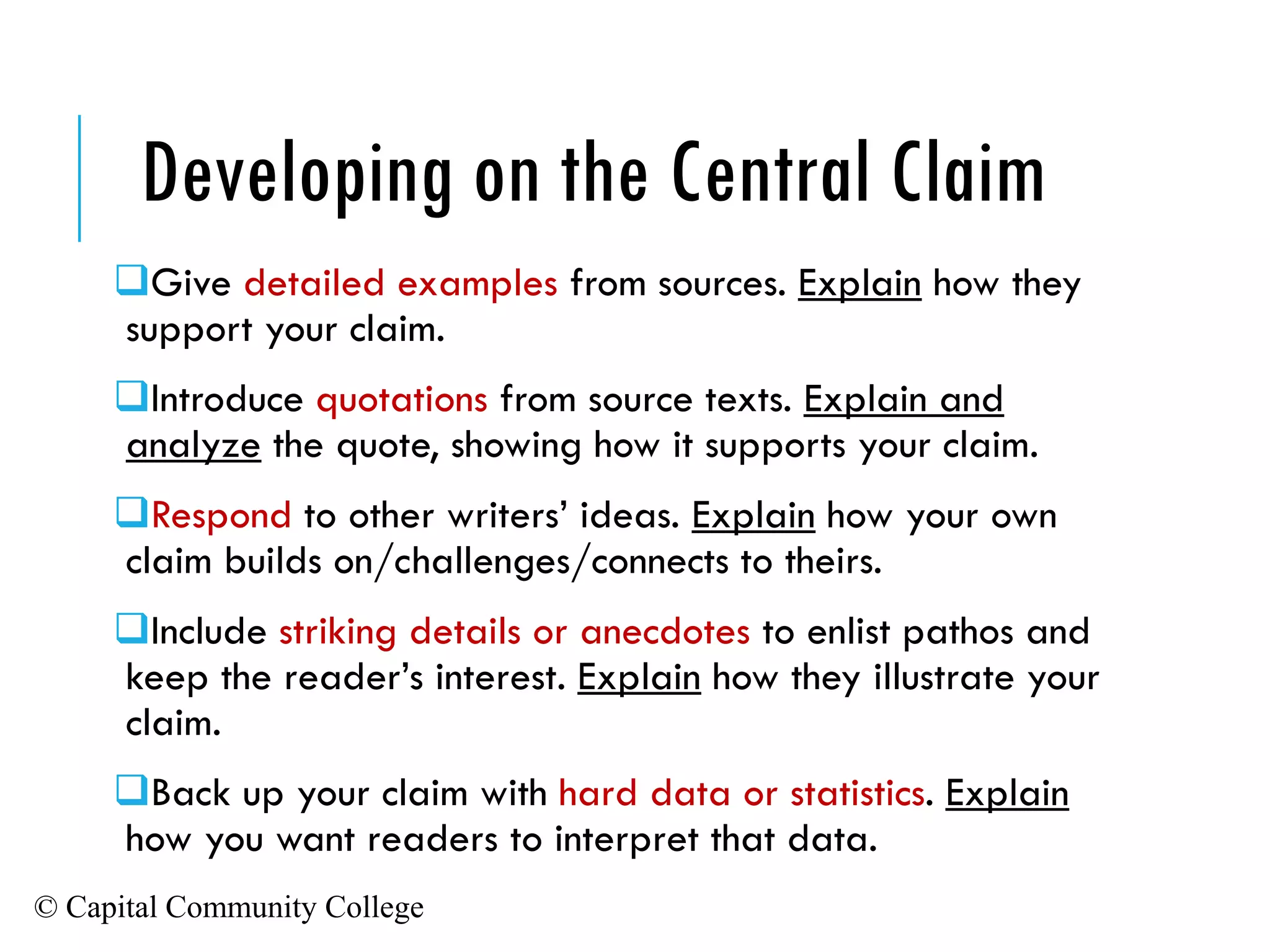
❑Give detailed examples from sources. Explain how they
support your claim.
❑Introduce quotations from source texts. Explain and
analyze the quote, showing how it supports your claim.
❑Respond to other writers’ ideas. Explain how your own
claim builds on/challenges/connects to theirs.
❑Include striking details or anecdotes to enlist pathos and
keep the reader’s interest. Explain how they illustrate your
claim.
❑Back up your claim with hard data or statistics. Explain
how you want readers to interpret that data.
Developing on the Central Claim
© Capital Community College
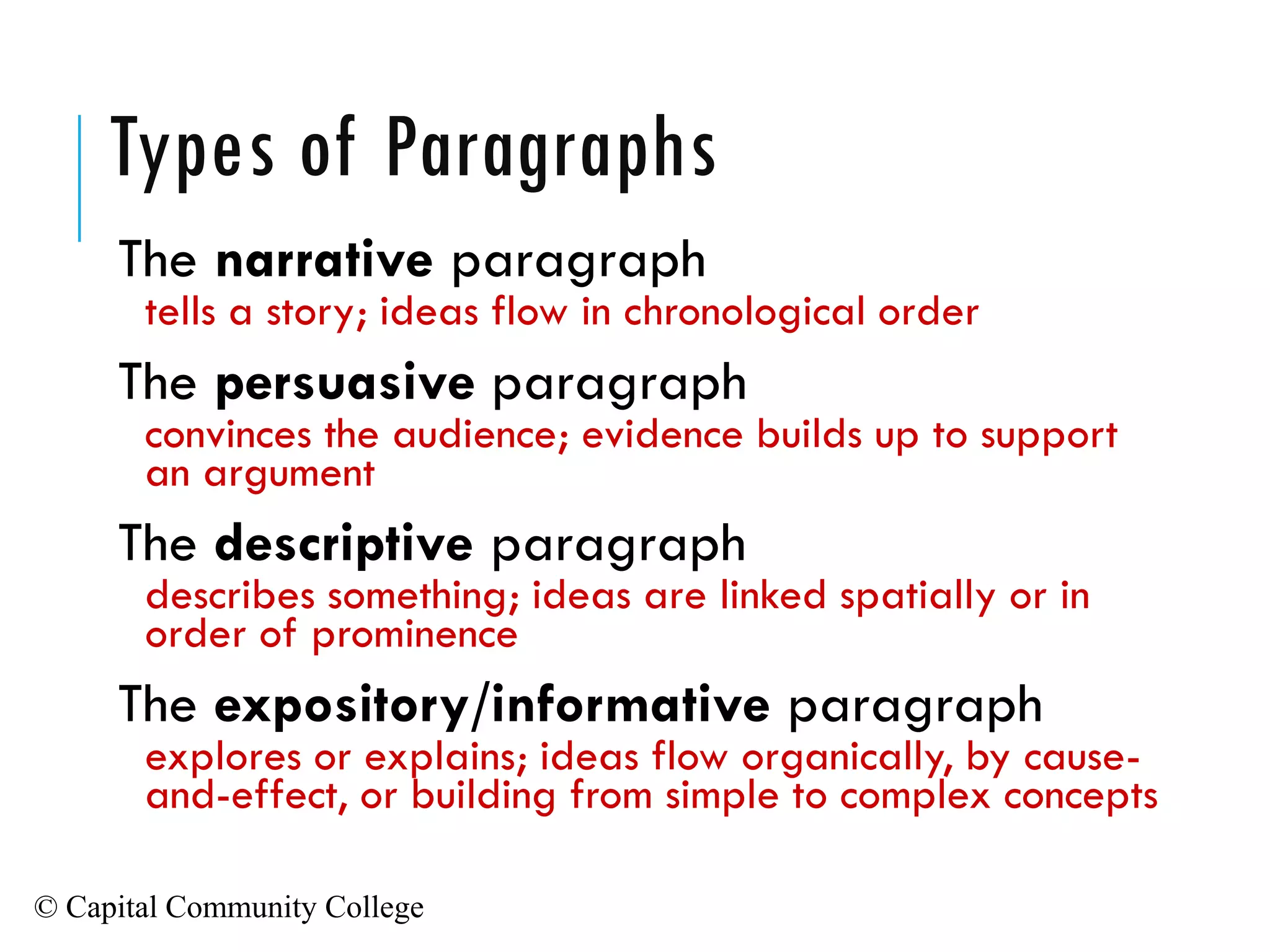
Types of Paragraphs
The narrative paragraph
tells a story; ideas flow in chronological order
The persuasive paragraph
convinces the audience; evidence builds up to support
an argument
The descriptive paragraph
describes something; ideas are linked spatially or in
order of prominence
The expository/informative paragraph
explores or explains; ideas flow organically, by cause-
and-effect, or building from simple to complex concepts
© Capital Community College
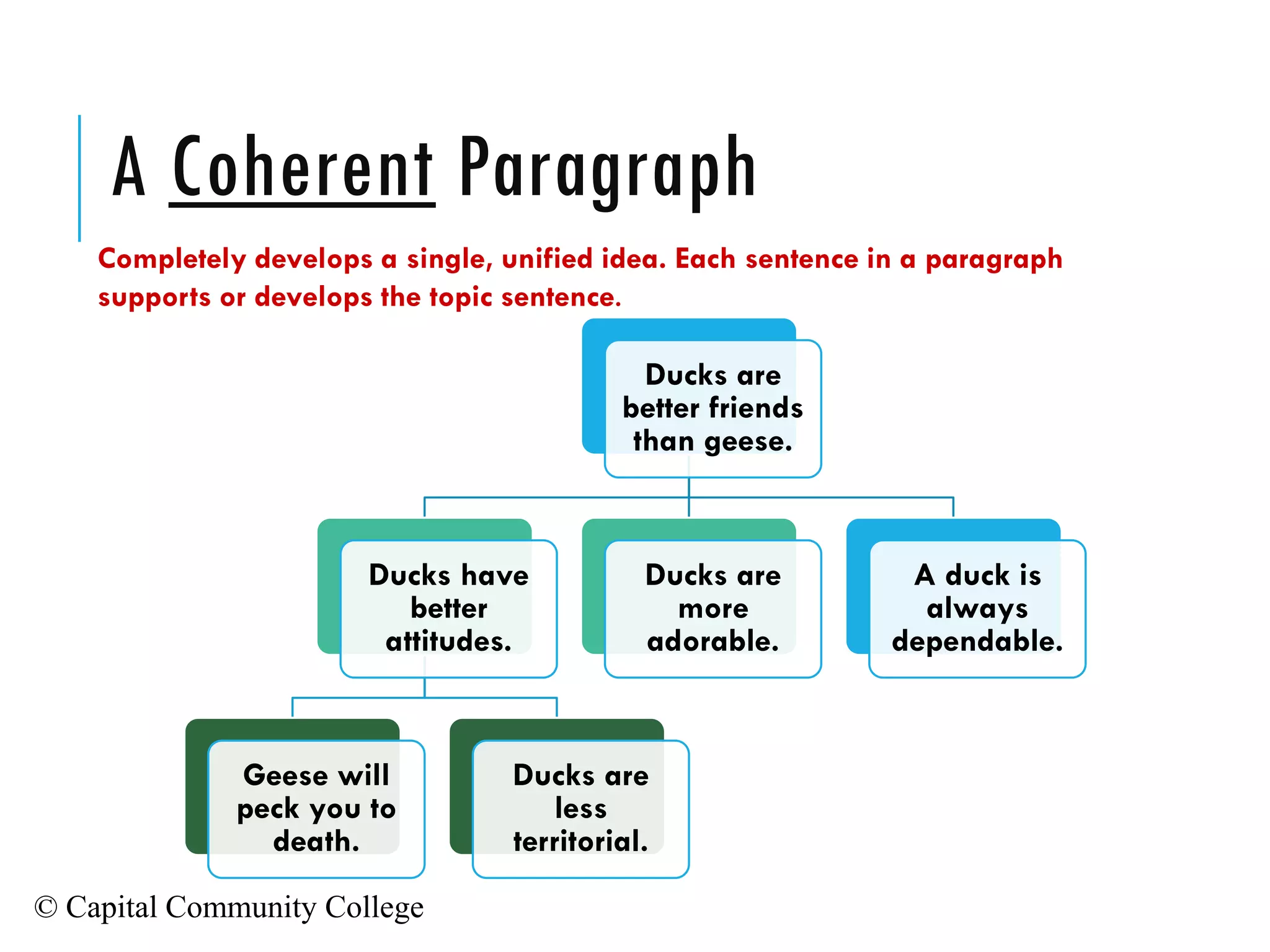
A Coherent Paragraph
Completely develops a single, unified idea. Each sentence in a paragraph
supports or develops the topic sentence.
Ducks are
better friends
than geese.
Ducks have
better
attitudes.
Geese will
peck you to
death.
Ducks are
less
territorial.
Ducks are
more
adorable.
A duck is
always
dependable.
© Capital Community College
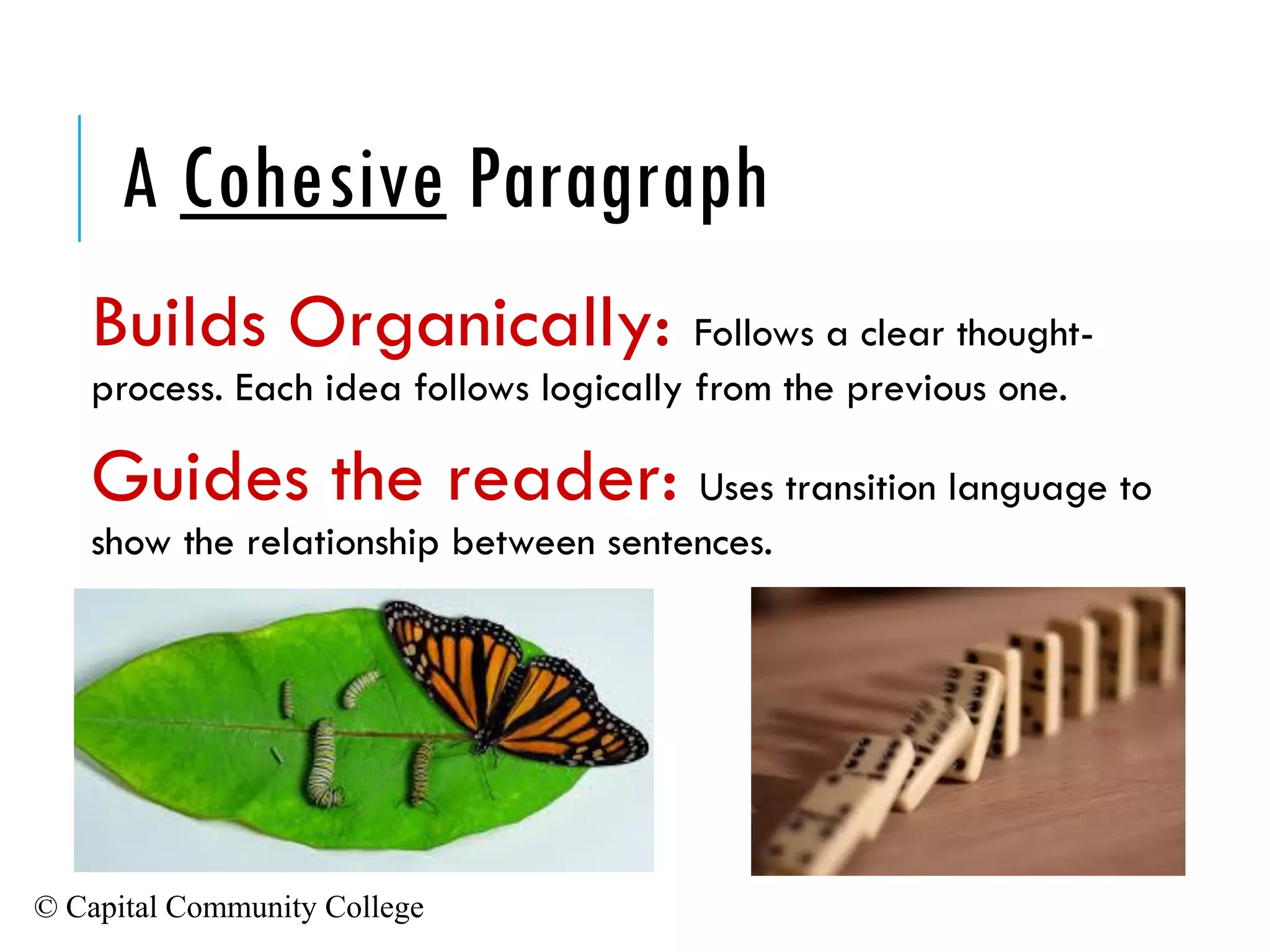
A Cohesive Paragraph
Builds Organically: Follows a clear thought-
process. Each idea follows logically from the previous one.
Guides the reader: Uses transition language to
show the relationship between sentences.
© Capital Community College
Coherent vs. Cohesive
BOTH ARE IMPORTANT! IF A PARAGRAPH IS…
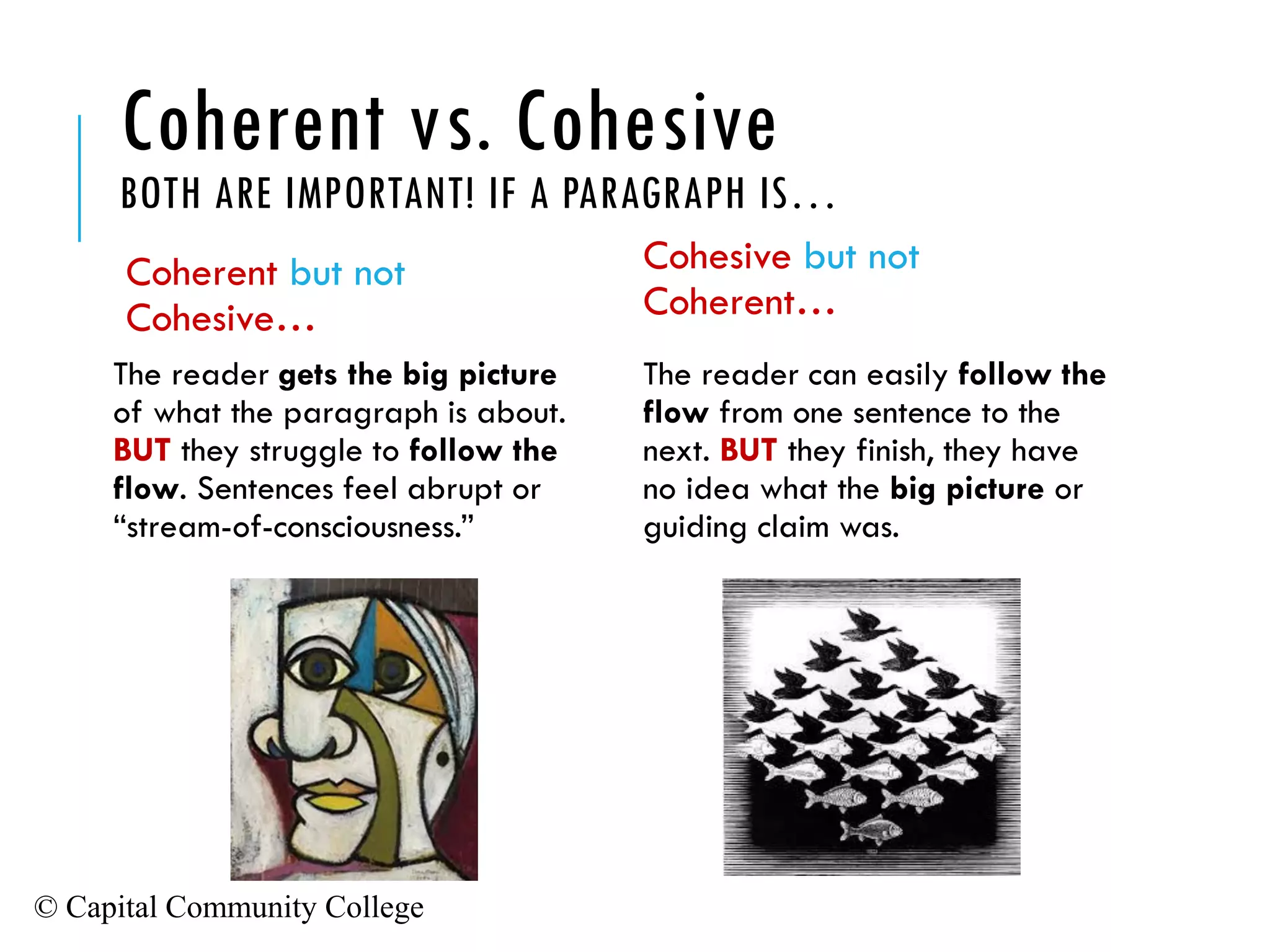
Coherent but not
Cohesive…
The reader gets the big picture
of what the paragraph is about.
BUT they struggle to follow the
flow. Sentences feel abrupt or
“stream-of-consciousness.”
Cohesive but not
Coherent…
The reader can easily follow the
flow from one sentence to the
next. BUT they finish, they have
no idea what the big picture or
guiding claim was.
© Capital Community College
Transition Language
chronological order
first
meanwhile
later
afterwards
finally
objects in relation to one
another
due to
despite
because
as a result
hence
in order of importance
however
furthermore
moreover
in fact
yet
additionally
for example
Transition words
© Capital Community College
THE CONCLUDING SENTENCE(S)
❑Sum up the main idea. What do you want the reader to
take away from the paragraph?
❑Use key words to help readers connect this paragraph to
your thesis statement.
❑Answer the question: “So what?” Tell readers why your
findings matter or what they mean.
❑Prepare readers to transition to the next paragraph.
Note: Not every concluding sentence will do all of these things.

Paragraph structure

  • 1.
    The paragraph isa series of sentences developing onetopic. Adapted from Capital Community College Paragraph Structure
  • 2.
    © Capital CommunityCollege THE TOPIC SENTENCE The main point, argument, or claim of a paragraph is stated in the first sentence. This is called the topic sentence.
  • 3.
    © Capital CommunityCollege ❑Like an effective thesis statement, should be clear, specific, arguable/supportable, and fit the scope of the paragraph. ❑Tells the reader what specific claim you will make in this paragraph. ❑May respond to, but does NOT simply repeat or summarize, another writer’s claim. ❑Uses transition language to show how this paragraph connects to the previous paragraph. Effective Topic Sentence
  • 4.
    © Capital CommunityCollege THE REST OF THE PARAGRAPH CONSISTS OF SENTENCES THAT DEVELOP THE MAIN IDEA. Pinker uses strong and relevant evidence in his article to persuade his audience that his stance is valid. He talks about attending a biology lecture intended for a general audience, where the speakers language was so complex, that only fellow molecular biologists could understand. He recalls the host asking the speaker to explain more clearly and the he “seemed genuinely surprised..” (Pinker 2). This shows an example of the “Curse of Knowledge” causing confusion in everyday life because a speech could barely be understood by anyone other than the speaker himself. The author also compares the curse to “a drunk who is too impaired to realize that he is too impaired to drive” (Pinker 2). This analogy is key because it allows the audience to understand why the “Curse of Knowledge” is so difficult to avoid. Finally, he uses the comparison of engineers versus consumers trying to work gadgets. The engineer is perfectly clear on how to use the product, but a consumer may struggle to even turn the gadget on without a set of instructions in front of them. By using relatable examples to back up his argument, Pinker is able to make his audience understand the stance. Topic sentence gives the writer’s central claim. Evidence from source Analysis of evidence Evidence from source Analysis of evidence Final sentence explains the relevance of the evidence and analysis.
  • 5.
    © Capital CommunityCollege ❑Give detailed examples from sources. Explain how they support your claim. ❑Introduce quotations from source texts. Explain and analyze the quote, showing how it supports your claim. ❑Respond to other writers’ ideas. Explain how your own claim builds on/challenges/connects to theirs. ❑Include striking details or anecdotes to enlist pathos and keep the reader’s interest. Explain how they illustrate your claim. ❑Back up your claim with hard data or statistics. Explain how you want readers to interpret that data. Developing on the Central Claim
  • 6.
    © Capital CommunityCollege Types of Paragraphs The narrative paragraph tells a story; ideas flow in chronological order The persuasive paragraph convinces the audience; evidence builds up to support an argument The descriptive paragraph describes something; ideas are linked spatially or in order of prominence The expository/informative paragraph explores or explains; ideas flow organically, by cause- and-effect, or building from simple to complex concepts
  • 7.
    © Capital CommunityCollege A Coherent Paragraph Completely develops a single, unified idea. Each sentence in a paragraph supports or develops the topic sentence. Ducks are better friends than geese. Ducks have better attitudes. Geese will peck you to death. Ducks are less territorial. Ducks are more adorable. A duck is always dependable.
  • 8.
    © Capital CommunityCollege A Cohesive Paragraph Builds Organically: Follows a clear thought- process. Each idea follows logically from the previous one. Guides the reader: Uses transition language to show the relationship between sentences.
  • 9.
    © Capital CommunityCollege Coherent vs. Cohesive BOTH ARE IMPORTANT! IF A PARAGRAPH IS… Coherent but not Cohesive… The reader gets the big picture of what the paragraph is about. BUT they struggle to follow the flow. Sentences feel abrupt or “stream-of-consciousness.” Cohesive but not Coherent… The reader can easily follow the flow from one sentence to the next. BUT they finish, they have no idea what the big picture or guiding claim was.
  • 10.
    © Capital CommunityCollege Transition Language chronological order first meanwhile later afterwards finally objects in relation to one another due to despite because as a result hence in order of importance however furthermore moreover in fact yet additionally for example Transition words
  • 11.
    © Capital CommunityCollege THE CONCLUDING SENTENCE(S) ❑Sum up the main idea. What do you want the reader to take away from the paragraph? ❑Use key words to help readers connect this paragraph to your thesis statement. ❑Answer the question: “So what?” Tell readers why your findings matter or what they mean. ❑Prepare readers to transition to the next paragraph. Note: Not every concluding sentence will do all of these things.