© Capital Community College
The paragraph is a series of
sentences developing one
topic.
© Capital Community College
The Topic
Sentence
• The topic of a paragraph is
stated in one sentence. This
is called the topic sentence.
© Capital Community College
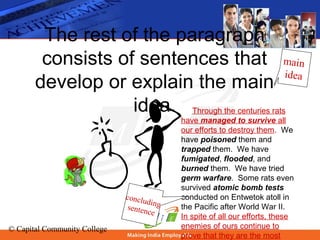
The rest of the paragraph
consists of sentences that
develop or explain the main
idea.• Through the centuries rats
have managed to survive all
our efforts to destroy them. We
have poisoned them and
trapped them. We have
fumigated, flooded, and
burned them. We have tried
germ warfare. Some rats even
survived atomic bomb tests
conducted on Entwetok atoll in
the Pacific after World War II.
In spite of all our efforts, these
enemies of ours continue to
prove that they are the most
main
idea
concludingsentence
© Capital Community College
A topic
sentence may
be developed
by telling
an
incident
A topic
sentence may
be developed
by telling
an
incident
Developing a Paragraph
A topic sentencemay be
developed
by giving
examples.
A topic sentencemay be
developed
by giving
examples.
• A topic sentence
may be developed
by giving details.
• A topic sentence
may be developed
by giving details.
© Capital Community College
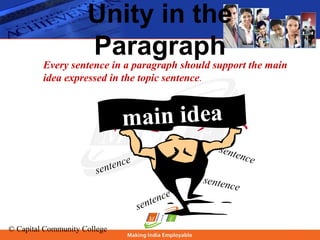
Unity in the
Paragraph
Every sentence in a paragraph should support the main
idea expressed in the topic sentence.
main idea
sentence
sentence
sentence
sentence
© Capital Community College
The concluding or
clincher sentence• Restate the topic sentence in different
words.
• A clincher sentence or concluding
sentence clinches the point made in the
paragraph.
• It summarizes the paragraph.
© Capital Community College
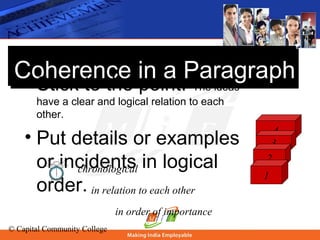
Coherence in a ParagraphCoherence in a Paragraph• Stick to the point: The ideas
have a clear and logical relation to each
other.
• Put details or examples
or incidents in logical
order.
4
3
2
1
chronological
in relation to each other
in order of importance
© Capital Community College
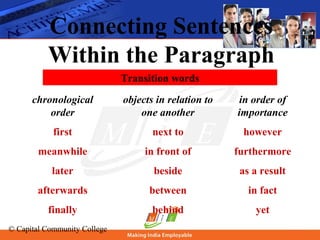
Connecting Sentences
Within the Paragraph
chronological
order
first
meanwhile
later
afterwards
finally
objects in relation to
one another
next to
in front of
beside
between
behind
in order of
importance
however
furthermore
as a result
in fact
yet
Transition words
© Capital Community College
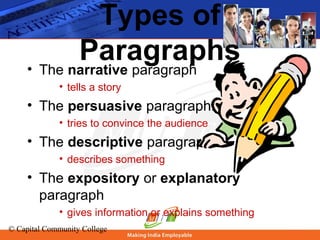
Types of
Paragraphs• The narrative paragraph
• tells a story
• The persuasive paragraph.
• tries to convince the audience
• The descriptive paragraph
• describes something
• The expository or explanatory
paragraph
• gives information or explains something
© Capital Community College
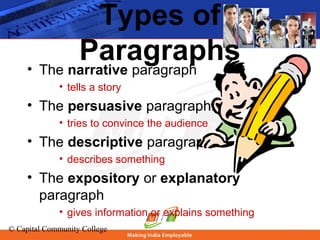
Types of
Paragraphs• The narrative paragraph
• tells a story
• The persuasive paragraph.
• tries to convince the audience
• The descriptive paragraph
• describes something
• The expository or explanatory
paragraph
• gives information or explains something

Paragraph

  • 1.
    © Capital CommunityCollege The paragraph is a series of sentences developing one topic.
  • 2.
    © Capital CommunityCollege The Topic Sentence • The topic of a paragraph is stated in one sentence. This is called the topic sentence.
  • 3.
    © Capital CommunityCollege The rest of the paragraph consists of sentences that develop or explain the main idea.• Through the centuries rats have managed to survive all our efforts to destroy them. We have poisoned them and trapped them. We have fumigated, flooded, and burned them. We have tried germ warfare. Some rats even survived atomic bomb tests conducted on Entwetok atoll in the Pacific after World War II. In spite of all our efforts, these enemies of ours continue to prove that they are the most main idea concludingsentence
  • 4.
    © Capital CommunityCollege A topic sentence may be developed by telling an incident A topic sentence may be developed by telling an incident Developing a Paragraph A topic sentencemay be developed by giving examples. A topic sentencemay be developed by giving examples. • A topic sentence may be developed by giving details. • A topic sentence may be developed by giving details.
  • 5.
    © Capital CommunityCollege Unity in the Paragraph Every sentence in a paragraph should support the main idea expressed in the topic sentence. main idea sentence sentence sentence sentence
  • 6.
    © Capital CommunityCollege The concluding or clincher sentence• Restate the topic sentence in different words. • A clincher sentence or concluding sentence clinches the point made in the paragraph. • It summarizes the paragraph.
  • 7.
    © Capital CommunityCollege Coherence in a ParagraphCoherence in a Paragraph• Stick to the point: The ideas have a clear and logical relation to each other. • Put details or examples or incidents in logical order. 4 3 2 1 chronological in relation to each other in order of importance
  • 8.
    © Capital CommunityCollege Connecting Sentences Within the Paragraph chronological order first meanwhile later afterwards finally objects in relation to one another next to in front of beside between behind in order of importance however furthermore as a result in fact yet Transition words
  • 9.
    © Capital CommunityCollege Types of Paragraphs• The narrative paragraph • tells a story • The persuasive paragraph. • tries to convince the audience • The descriptive paragraph • describes something • The expository or explanatory paragraph • gives information or explains something
  • 10.
    © Capital CommunityCollege Types of Paragraphs• The narrative paragraph • tells a story • The persuasive paragraph. • tries to convince the audience • The descriptive paragraph • describes something • The expository or explanatory paragraph • gives information or explains something