SUBJECTS NAME: ACADEMIC READING AND
WRITING
INSRUCTOR’S NAME: MS FARHANA
TABASSUM
PARAGRAPH WRITING
• LEARNING OBJECTIVES
• Upon completion of this lecture, students will be able
to:
I. Understand the parts, and structure of a paragraph.
II. create paragraphs that include a main idea, or topic
supporting sentences and concluding.
PARAGRAPH WRITING-INTRODUCTION
•Each paragraphs should be a single unit of
thought, a discrete package of ideas composed of
closely linked sentences.
DEFINITION
• A subdivision of a written composition that consists of
one or more sentences, deals with one point or gives
the words of one speaker, and begins on a new usually
indented line.
• Merriam Webster
PARAGRAPH-DEFINITION
•A paragraph is a component of fictional prose and
non-fiction writings.
•When writing essays, research papers, books, etc.,
new paragraphs are indented to show their
beginnings.
•Each new paragraph begins with a new
indentation.
PARGRAPH PURPOSE
• It may serve to describe a topic, explain a concept,
analyse findings, support or refute a contention,
qualify a claim, evaluate a study, compare or
contrast information.
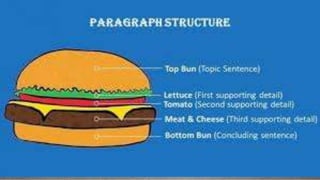
Structure of paragraph
WHAT IS A TOPIC SENTENCE?
•the point the writer wishes to make about that
subject.
• Generally, the topic sentence appears at the
beginning of the paragraph.
•the paragraph’s very first sentence.
WHAT IS A TOPIC SENTENCE?
•The opening ‘topic’ sentence alerts readers to a
change of subject and focus, and cues readers (in
‘signpost’ mode) about what the paragraph
covers.
•never link backwards to material that came
before).
WHAT IS A TOPIC SENTENCE
•Topic sentences should clearly signal a new focus
of attention.
•A signpost is just that — it is a very short cueing
or naming prompt, not a mini-tour guide or a
preview of the whole paragraph argument to
come.
A GOOD TOPIC SENTENCE:
•informs the reader,
•asserts the writer’s point of view or attitude,
•intrigues the reader to continue reading,
•is not vague, rambling, too narrow or too broad.
TOPIC SENTENCE- SAMPLE
• . First, I went to the
wrong classroom for math. I was sitting in the class,
surrounded by people taking notes and paying attention
to how to do equations, which would have been okay if I
was supposed to be in an algebra class. In reality, I was
supposed to be in geometry, and when I discovered my
error, I had already missed the first twenty minutes of a
one-hour class.
BODY SENTENCES/SUPPORTING DETAILS
• The main ‘body’ -the core argument of the paragraph.
• describe results, develop implications, elucidate
formulae, or elaborate and explain theoretical and
thematic points.
• the core of the unit of thought.
WRITING THE BODY PARAGRAPHS
• beginning with a topic sentence.
• supporting evidence with citations
• paraphrase and summarise your sources more often than
you quote.
• your own analysis and commentary.
WRITING THE BODY PARAGRAPHS
I. comparing and contrasting the ideas of others, asking
questions,
II. providing further examples or
III. making some conclusions based on your analysis
WRITING A CONCLUSION
• You do not need to add new information, arguments or
citations in a conclusion.
• Restate the research topic and give a brief summary of
how you have successfully addressed it – and provide
some of the key points.
• Suggest directions for further research
•
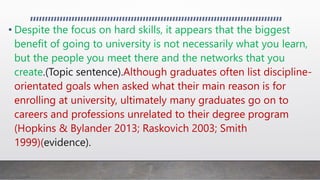
• Despite the focus on hard skills, it appears that the biggest
benefit of going to university is not necessarily what you learn,
but the people you meet there and the networks that you
create.(Topic sentence).Although graduates often list discipline-
orientated goals when asked what their main reason is for
enrolling at university, ultimately many graduates go on to
careers and professions unrelated to their degree program
(Hopkins & Bylander 2013; Raskovich 2003; Smith
1999)(evidence).
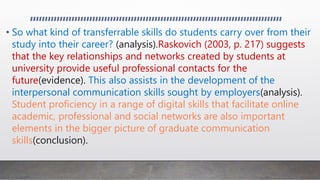
• So what kind of transferrable skills do students carry over from their
study into their career? (analysis).Raskovich (2003, p. 217) suggests
that the key relationships and networks created by students at
university provide useful professional contacts for the
future(evidence). This also assists in the development of the
interpersonal communication skills sought by employers(analysis).
Student proficiency in a range of digital skills that facilitate online
academic, professional and social networks are also important
elements in the bigger picture of graduate communication
skills(conclusion).
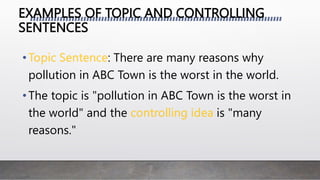
EXAMPLES OF TOPIC AND CONTROLLING
SENTENCES
• : There are many reasons why
pollution in ABC Town is the worst in the world.
•The topic is "pollution in ABC Town is the worst in
the world" and the is "many
reasons."
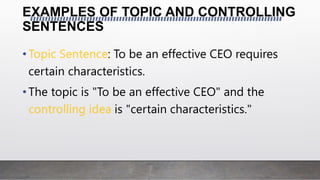
EXAMPLES OF TOPIC AND CONTROLLING
SENTENCES
• : To be an effective CEO requires
certain characteristics.
•The topic is "To be an effective CEO" and the
is "certain characteristics."
EXAMPLES OF TOPIC AND CONTROLLING
SENTENCES
• : There are many possible
contributing factors to global warming.
• The topic is "global warming" and the
is "contributing factors."
EXAMPLES OF TOPIC AND CONTROLLING
SENTENCES
• : Crime in poverty-stricken areas
occurs as a result of a systemic discrimination.
•The topic is "crime in poverty stricken areas" and
the is "systemic discrimination."
SIX COMMON PARAGRAPH PROBLEMS
• 1 The author starts with a backward link to the previous
paragraph.
•2 The paragraph begins from insubstantial
sentence (or perhaps several such sentences).
SIX COMMON PARAGRAPH PROBLEMS
• 3 The author starts the whole paragraph with another
author’s name and reference,
• EXAMPLE:
• ‘Harding (2007: 593) argues …’ This is a beginning especially
beloved of some PhDers and other unconfident authors,
creeping forward with their argument propped up on the
supports of other peoples’ work.
SIX COMMON PARAGRAPH PROBLEMS
•
•
•
CAMPARE AND CONTRAST
• Use this paragraph structure if you need to examine similarities and differences.
• This paragraph structure is useful for literature reviews and reports.
• TOPIC SENTENCE
• Introduce the items to be compared and contrasted, noting similarity or
differences.
• SUPPORTING SENTNECS:
• Identify describe, and discuss any similarities of differences
CAMPARE AND CONTRAST
CONCLUSION
Summarise and interpret the similarities and differences discussed
USEFUL TRANSITIONAL WORDS AND PHRASES
For Comparison: similar to, similarly, in the same way, like equally,
again, also, too
For Contrast: in contrast, on the other hand, different from, whereas,
while, unlike, but, though, however, conversely, yet,
ARGUE
• A Paragraph can be used to argue for against a point of view. Each
paragraph should focus on developing one main for or against the
position.
• Topic Sentence:
• Introduce the argument and position for or against
• Supporting Sentences:
• Develop the reasons for your position and present facts and examples to
support this: address any counter-argument
• Conclusion:
• Restate position
ARGUE
• Useful transitional words and phrases
For giving reasons:
• First, second, third, another, next, last. Finally, because, since, for
For Counter-arguments:
But, however, of course, nevertheless, although, despite
For Concluding:
Therefore, as a result, inconclusion, thus
CLASSIFY
• This paragraph structure can be used to organise information, items or
ideas into categories. The organisation of information will depend on
your purpose and subject area.
• Topic Sentence:
• Introduce the items being classified and/or the categories for
classification.
• Supporting Sentence:
• Provide more information about the items, and how their characteristics
fit into particular category
CLASSIFY
Conclusion:
Repeat what classification the item or category
belongs to
Useful Transition Words
Can be divided, can be classified, can be categorised,
the first/second/third
DEFINE
• Use this paragraph structure when you need to define concept,
and demonstrate and understanding of how it relates to particular
context or discipline
• Topic Sentence:
• Provide a simple definition of c concept.
• Supporting Sentences:
• Provide more information through description, explanation, and
examples: makes links between the concept and how it applies to
a particular context or field
DEFINE
• Useful transition words and phrases
• For example, for instance, an illustration of this,
another example, firstly , the first step , secondly,
the second step, finally, the final step
REFERENCES
• https://medium.com/advice-and-help-in-authoring-a-phd-
or-non-fiction/how-to-write-paragraphs-80781e2f3054
• https://owl.purdue.edu/engagement/ged_preparation/exerc
ise_answers/index.html
• https://www.deakin.edu.au/__data/assets/pdf_file/0011/810
596/Guide-to-essay-paragraph-structure_Deakin-Study-
Support.pdf
SW-LECTURE 1-PARAGRAPH WRIITNG.pptx

SW-LECTURE 1-PARAGRAPH WRIITNG.pptx

  • 2.
    SUBJECTS NAME: ACADEMICREADING AND WRITING INSRUCTOR’S NAME: MS FARHANA TABASSUM
  • 3.
    PARAGRAPH WRITING • LEARNINGOBJECTIVES • Upon completion of this lecture, students will be able to: I. Understand the parts, and structure of a paragraph. II. create paragraphs that include a main idea, or topic supporting sentences and concluding.
  • 4.
    PARAGRAPH WRITING-INTRODUCTION •Each paragraphsshould be a single unit of thought, a discrete package of ideas composed of closely linked sentences.
  • 5.
    DEFINITION • A subdivisionof a written composition that consists of one or more sentences, deals with one point or gives the words of one speaker, and begins on a new usually indented line. • Merriam Webster
  • 6.
    PARAGRAPH-DEFINITION •A paragraph isa component of fictional prose and non-fiction writings. •When writing essays, research papers, books, etc., new paragraphs are indented to show their beginnings. •Each new paragraph begins with a new indentation.
  • 7.
    PARGRAPH PURPOSE • Itmay serve to describe a topic, explain a concept, analyse findings, support or refute a contention, qualify a claim, evaluate a study, compare or contrast information.
  • 8.
  • 9.
    WHAT IS ATOPIC SENTENCE? •the point the writer wishes to make about that subject. • Generally, the topic sentence appears at the beginning of the paragraph. •the paragraph’s very first sentence.
  • 10.
    WHAT IS ATOPIC SENTENCE? •The opening ‘topic’ sentence alerts readers to a change of subject and focus, and cues readers (in ‘signpost’ mode) about what the paragraph covers. •never link backwards to material that came before).
  • 11.
    WHAT IS ATOPIC SENTENCE •Topic sentences should clearly signal a new focus of attention. •A signpost is just that — it is a very short cueing or naming prompt, not a mini-tour guide or a preview of the whole paragraph argument to come.
  • 12.
    A GOOD TOPICSENTENCE: •informs the reader, •asserts the writer’s point of view or attitude, •intrigues the reader to continue reading, •is not vague, rambling, too narrow or too broad.
  • 13.
    TOPIC SENTENCE- SAMPLE •. First, I went to the wrong classroom for math. I was sitting in the class, surrounded by people taking notes and paying attention to how to do equations, which would have been okay if I was supposed to be in an algebra class. In reality, I was supposed to be in geometry, and when I discovered my error, I had already missed the first twenty minutes of a one-hour class.
  • 14.
    BODY SENTENCES/SUPPORTING DETAILS •The main ‘body’ -the core argument of the paragraph. • describe results, develop implications, elucidate formulae, or elaborate and explain theoretical and thematic points. • the core of the unit of thought.
  • 15.
    WRITING THE BODYPARAGRAPHS • beginning with a topic sentence. • supporting evidence with citations • paraphrase and summarise your sources more often than you quote. • your own analysis and commentary.
  • 16.
    WRITING THE BODYPARAGRAPHS I. comparing and contrasting the ideas of others, asking questions, II. providing further examples or III. making some conclusions based on your analysis
  • 17.
    WRITING A CONCLUSION •You do not need to add new information, arguments or citations in a conclusion. • Restate the research topic and give a brief summary of how you have successfully addressed it – and provide some of the key points. • Suggest directions for further research •
  • 18.
    • Despite thefocus on hard skills, it appears that the biggest benefit of going to university is not necessarily what you learn, but the people you meet there and the networks that you create.(Topic sentence).Although graduates often list discipline- orientated goals when asked what their main reason is for enrolling at university, ultimately many graduates go on to careers and professions unrelated to their degree program (Hopkins & Bylander 2013; Raskovich 2003; Smith 1999)(evidence).
  • 19.
    • So whatkind of transferrable skills do students carry over from their study into their career? (analysis).Raskovich (2003, p. 217) suggests that the key relationships and networks created by students at university provide useful professional contacts for the future(evidence). This also assists in the development of the interpersonal communication skills sought by employers(analysis). Student proficiency in a range of digital skills that facilitate online academic, professional and social networks are also important elements in the bigger picture of graduate communication skills(conclusion).
  • 20.
    EXAMPLES OF TOPICAND CONTROLLING SENTENCES • : There are many reasons why pollution in ABC Town is the worst in the world. •The topic is "pollution in ABC Town is the worst in the world" and the is "many reasons."
  • 21.
    EXAMPLES OF TOPICAND CONTROLLING SENTENCES • : To be an effective CEO requires certain characteristics. •The topic is "To be an effective CEO" and the is "certain characteristics."
  • 22.
    EXAMPLES OF TOPICAND CONTROLLING SENTENCES • : There are many possible contributing factors to global warming. • The topic is "global warming" and the is "contributing factors."
  • 23.
    EXAMPLES OF TOPICAND CONTROLLING SENTENCES • : Crime in poverty-stricken areas occurs as a result of a systemic discrimination. •The topic is "crime in poverty stricken areas" and the is "systemic discrimination."
  • 24.
    SIX COMMON PARAGRAPHPROBLEMS • 1 The author starts with a backward link to the previous paragraph. •2 The paragraph begins from insubstantial sentence (or perhaps several such sentences).
  • 25.
    SIX COMMON PARAGRAPHPROBLEMS • 3 The author starts the whole paragraph with another author’s name and reference, • EXAMPLE: • ‘Harding (2007: 593) argues …’ This is a beginning especially beloved of some PhDers and other unconfident authors, creeping forward with their argument propped up on the supports of other peoples’ work.
  • 26.
    SIX COMMON PARAGRAPHPROBLEMS • • •
  • 27.
    CAMPARE AND CONTRAST •Use this paragraph structure if you need to examine similarities and differences. • This paragraph structure is useful for literature reviews and reports. • TOPIC SENTENCE • Introduce the items to be compared and contrasted, noting similarity or differences. • SUPPORTING SENTNECS: • Identify describe, and discuss any similarities of differences
  • 28.
    CAMPARE AND CONTRAST CONCLUSION Summariseand interpret the similarities and differences discussed USEFUL TRANSITIONAL WORDS AND PHRASES For Comparison: similar to, similarly, in the same way, like equally, again, also, too For Contrast: in contrast, on the other hand, different from, whereas, while, unlike, but, though, however, conversely, yet,
  • 29.
    ARGUE • A Paragraphcan be used to argue for against a point of view. Each paragraph should focus on developing one main for or against the position. • Topic Sentence: • Introduce the argument and position for or against • Supporting Sentences: • Develop the reasons for your position and present facts and examples to support this: address any counter-argument • Conclusion: • Restate position
  • 30.
    ARGUE • Useful transitionalwords and phrases For giving reasons: • First, second, third, another, next, last. Finally, because, since, for For Counter-arguments: But, however, of course, nevertheless, although, despite For Concluding: Therefore, as a result, inconclusion, thus
  • 31.
    CLASSIFY • This paragraphstructure can be used to organise information, items or ideas into categories. The organisation of information will depend on your purpose and subject area. • Topic Sentence: • Introduce the items being classified and/or the categories for classification. • Supporting Sentence: • Provide more information about the items, and how their characteristics fit into particular category
  • 32.
    CLASSIFY Conclusion: Repeat what classificationthe item or category belongs to Useful Transition Words Can be divided, can be classified, can be categorised, the first/second/third
  • 33.
    DEFINE • Use thisparagraph structure when you need to define concept, and demonstrate and understanding of how it relates to particular context or discipline • Topic Sentence: • Provide a simple definition of c concept. • Supporting Sentences: • Provide more information through description, explanation, and examples: makes links between the concept and how it applies to a particular context or field
  • 34.
    DEFINE • Useful transitionwords and phrases • For example, for instance, an illustration of this, another example, firstly , the first step , secondly, the second step, finally, the final step
  • 36.

Editor's Notes