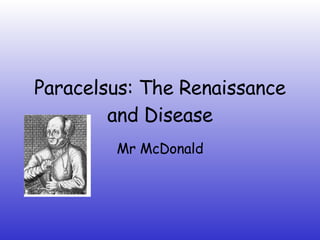
Paracelsus: The Renaissance and Disease Mr McDonald
What we will learn today: Who Paracelsus was. What kind of person he was. How he impacted on medical development. His reaction to the medical world. His legacy on Renaissance medicine.
Paracelsus 1493-1541 A controversial figure in Renaissance Medicine. He was a Swiss Scientist. His real name was  Philippus Aureolus Theophrastus Bombastus von Hohenheim. Can you imagine his mum telling him off!
They call me Mr Bombastic but I call myself Paracelsus! Better than Celsus!
Why so controversial? Well first he changed his name to Paracelsus meaning greater than Celsus. Celsus was famous in the world of medicine during the times of the Romans  So no great complex there then!
Greek + Roman = Wrong One of the greatest things Paracelsus did was to challenge the work of Galen and Hippocrates. At a time when everyone followed the thinking and ideals of these men, he said they were wrong. Yes he was a tad controversial!
Was he mad? He rejected the idea that disease was caused by an imbalance of the four humours and instead said it was more likely to do with the chemicals in the body. He said in a roundabout way that, if disease was a chemical issue then treatment should be as well.
Treatments Chemical treatments he used tended to be salt, sulphur and mercury. I would not go trying these at home next time you have a cold.
How to make friends and influence people – by Paracelsus So, he gets a job as a town doctor and Professor of medicine at Basel in Switzerland. How do you reckon he made the people feel all at home with his methods of teaching?
Did he teach in Latin? Yes of course – the sensible thing to do. No – he is Paracelsus. He is not like other mortals
Wrong!  You obviously have not learnt much about this man! Continue
Well Done! You clearly understand what kind of person he was Continue
Teaching Methods He was obviously a bit of a radical! He refused to wear academic robes! He refused to teach in latin! He burnt the texts of Galen and Ibn Sina’s  Canon  – the standard medical text of the middle ages!
A thoroughly modern man? Paracelsus would appear to be a very modern medical man. He rejected the authority of the traditionalists and investigated his own ideas on the use of chemicals as treatments. However, he was not all we might think
Messages from … Paracelsus believed he received messages from God. What is more, they were secret messages. And he saw things that might not be all they appear to be.
Nature’s Signatures Paracelsus believed you could see ‘signatures’ in some plants to show that they healed certain conditions. For instance the orchid was shaped like a testicle so it could be used to treat sexually transmitted infections!
 
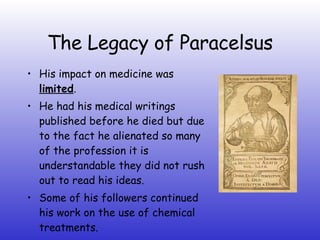
The Legacy of Paracelsus His impact on medicine was  limited . He had his medical writings published before he died but due to the fact he alienated so many of the profession it is understandable they did not rush out to read his ideas. Some of his followers continued his work on the use of chemical treatments.

Paracelsus

  • 1.
    Paracelsus: The Renaissanceand Disease Mr McDonald
  • 2.
    What we willlearn today: Who Paracelsus was. What kind of person he was. How he impacted on medical development. His reaction to the medical world. His legacy on Renaissance medicine.
  • 3.
    Paracelsus 1493-1541 Acontroversial figure in Renaissance Medicine. He was a Swiss Scientist. His real name was Philippus Aureolus Theophrastus Bombastus von Hohenheim. Can you imagine his mum telling him off!
  • 4.
    They call meMr Bombastic but I call myself Paracelsus! Better than Celsus!
  • 5.
    Why so controversial?Well first he changed his name to Paracelsus meaning greater than Celsus. Celsus was famous in the world of medicine during the times of the Romans So no great complex there then!
  • 6.
    Greek + Roman= Wrong One of the greatest things Paracelsus did was to challenge the work of Galen and Hippocrates. At a time when everyone followed the thinking and ideals of these men, he said they were wrong. Yes he was a tad controversial!
  • 7.
    Was he mad?He rejected the idea that disease was caused by an imbalance of the four humours and instead said it was more likely to do with the chemicals in the body. He said in a roundabout way that, if disease was a chemical issue then treatment should be as well.
  • 8.
    Treatments Chemical treatmentshe used tended to be salt, sulphur and mercury. I would not go trying these at home next time you have a cold.
  • 9.
    How to makefriends and influence people – by Paracelsus So, he gets a job as a town doctor and Professor of medicine at Basel in Switzerland. How do you reckon he made the people feel all at home with his methods of teaching?
  • 10.
    Did he teachin Latin? Yes of course – the sensible thing to do. No – he is Paracelsus. He is not like other mortals
  • 11.
    Wrong! Youobviously have not learnt much about this man! Continue
  • 12.
    Well Done! Youclearly understand what kind of person he was Continue
  • 13.
    Teaching Methods Hewas obviously a bit of a radical! He refused to wear academic robes! He refused to teach in latin! He burnt the texts of Galen and Ibn Sina’s Canon – the standard medical text of the middle ages!
  • 14.
    A thoroughly modernman? Paracelsus would appear to be a very modern medical man. He rejected the authority of the traditionalists and investigated his own ideas on the use of chemicals as treatments. However, he was not all we might think
  • 15.
    Messages from …Paracelsus believed he received messages from God. What is more, they were secret messages. And he saw things that might not be all they appear to be.
  • 16.
    Nature’s Signatures Paracelsusbelieved you could see ‘signatures’ in some plants to show that they healed certain conditions. For instance the orchid was shaped like a testicle so it could be used to treat sexually transmitted infections!
  • 17.
  • 18.
    The Legacy ofParacelsus His impact on medicine was limited . He had his medical writings published before he died but due to the fact he alienated so many of the profession it is understandable they did not rush out to read his ideas. Some of his followers continued his work on the use of chemical treatments.