Programming Turing Machines as a
      game for technology sense-making


Andrea Valente                                     Emanuela Marchetti
Department of Architecture, Design     Institute for Learning and Philosophy
and Media Technology
                   Aalborg University Esbjerg, Denmark
av@create.aau.dk                                       ema@create.aau.dk
http://www.create.aau.dk/av/         http://personprofil.aau.dk/profil/123867
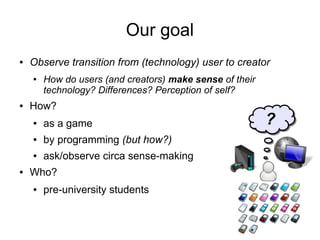
Our goal
●   Observe transition from (technology) user to creator
    ●   How do users (and creators) make sense of their
        technology? Differences? Perception of self?
●   How?
    ●   as a game                                         ?
    ●   by programming (but how?)
    ●   ask/observe circa sense-making
●   Who?
    ●   pre-university students
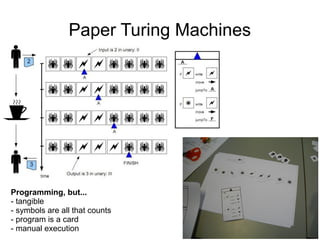
Paper Turing Machines


Programming, but...
- tangible
- symbols are all that counts
- program is a card
- manual execution
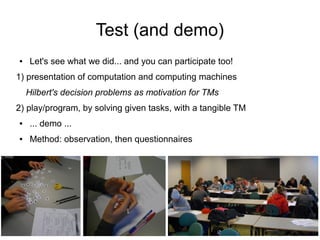
Test (and demo)
●   Let's see what we did... and you can participate too!
1) presentation of computation and computing machines
    Hilbert's decision problems as motivation for TMs
2) play/program, by solving given tasks, with a tangible TM
●   ... demo ...
●   Method: observation, then questionnaires
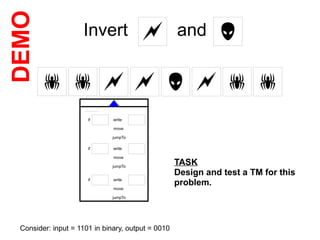
DEMO                Invert                         and       

                                                             
                      if      write

                              move

                              jumpTo

                      if      write

                              move

                              jumpTo
                                                   TASK
                                                   Design and test a TM for this
                      if      write
                                                   problem.
                              move

                              jumpTo


 Consider: input = 1101 in binary, output = 0010
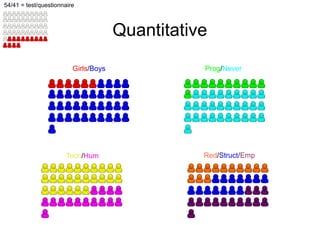
54/41 = test/questionnaire


                                      Quantitative
                         Girls/Boys              Prog/Never


                       Tech/Hum                  Red/Struct/Emp
Red/Struct/Emp
●   Actual question asked:
●   You are studing a complex thing (example: the human brain). Your position is:
    1) all I need to do is to study very well the components (example: neurons)
    2) the most important thing is the interaction among components

    3) no matter what I do, I will only get a partial understanding

●   Definitions:
●   Reductionism ... analyzing and describing a complex phenomenon ... in terms of
    phenomena that are held to represent a simpler or more fundamental level [google
    dictionary]
●   Structuralism ... focuses on relationships of contrast between elements in a
    conceptual system [google dictionary]
●   Empiricists assume obtaining a complete knowledge of the world is not possible, but
    fortunately it is also not needed in order to predict and even control the behavior of
    complex phenomena [Gödel, Escher and Bach]
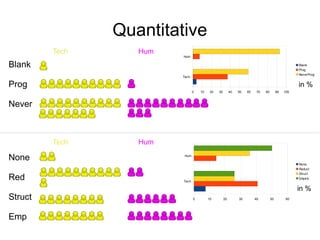
Quantitative
         Tech      Hum
                         Hum

Blank                                                                                              Blank
                                                                                                   Prog
                                                                                                   NeverProg
                         Tech

Prog                                                                                               in %
                                0   10    20   30        40   50   60    70   80        90   100


Never


         Tech      Hum

None                      Hum

                                                                                                   None
                                                                                                   Reduct
                                                                                                   Struct
Red                      Tech
                                                                                                   Empiric


                                                                                                   in %
Struct                          0        10         20        30        40         50         60


Emp
Qualitative
Observations:
●   Tinkering helps – low-fi can works just fine!
●   For some, easier to alter the formalism (creative/cheating)
●   Curiosity, pride, positive response to challenge
●   Social interaction: coaching/leading emerged in groups
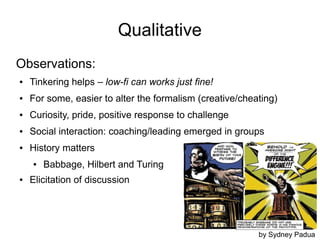
●   History matters
    ●   Babbage, Hilbert and Turing
●   Elicitation of discussion


                                                          by Sydney Padua
Conclusions and future work
●   In just 2 hours the visiting students learned about TMs, decision problems, and could
    work with programming tasks.
●   Technically inclined individuals tend to agree with reductionist positions and are more
    likely to have experienced programming before university.
●   Humanities inclined students instead are more frequently empiricists and might find
    technical subjects more attracting if historically contextualized.
●   Technical skills like programming, which originated from rationalism might appeal
    more naturally to reductionist individuals.
●   Historical grounding interests all and possibly motivates also HUMs.


●   Digital immigrants (me), digital natives (my daughter)... digital authors? (script
    kid)


●   New tasks and a more playful PTM is under development (turn-based!)
                                         
           Inv
           if        write
                              
                     move

                     jumpTo   Inv

           if
                    write

                     move


                                                   
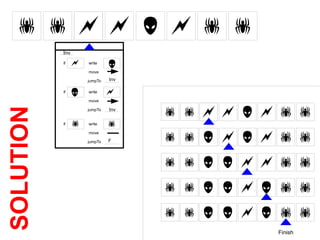
SOLUTION


                     jumpTo   Inv

           if       write    
                                                  
                     move

                     jumpTo   F


                                                  
                                                 
                                                 
                                                      Finish
Article
●   Programming Turing Machines as a Game for Technology Sense-Making
    http://secure3.computer.org/csdl/proceedings/icalt/2011/4346/00/4346a428-
    abs.html

Paper Turing Machine (ICALT 2011)

  • 1.
    Programming Turing Machinesas a game for technology sense-making Andrea Valente Emanuela Marchetti Department of Architecture, Design Institute for Learning and Philosophy and Media Technology Aalborg University Esbjerg, Denmark av@create.aau.dk ema@create.aau.dk http://www.create.aau.dk/av/ http://personprofil.aau.dk/profil/123867
  • 2.
    Our goal ● Observe transition from (technology) user to creator ● How do users (and creators) make sense of their technology? Differences? Perception of self? ● How? ● as a game ? ● by programming (but how?) ● ask/observe circa sense-making ● Who? ● pre-university students
  • 3.
    Paper Turing Machines Programming,but... - tangible - symbols are all that counts - program is a card - manual execution
  • 4.
    Test (and demo) ● Let's see what we did... and you can participate too! 1) presentation of computation and computing machines Hilbert's decision problems as motivation for TMs 2) play/program, by solving given tasks, with a tangible TM ● ... demo ... ● Method: observation, then questionnaires
  • 5.
    DEMO Invert and       if write move jumpTo if write move jumpTo TASK Design and test a TM for this if write problem. move jumpTo Consider: input = 1101 in binary, output = 0010
  • 6.
    54/41 = test/questionnaire Quantitative Girls/Boys Prog/Never Tech/Hum Red/Struct/Emp
  • 7.
    Red/Struct/Emp ● Actual question asked: ● You are studing a complex thing (example: the human brain). Your position is: 1) all I need to do is to study very well the components (example: neurons) 2) the most important thing is the interaction among components 3) no matter what I do, I will only get a partial understanding ● Definitions: ● Reductionism ... analyzing and describing a complex phenomenon ... in terms of phenomena that are held to represent a simpler or more fundamental level [google dictionary] ● Structuralism ... focuses on relationships of contrast between elements in a conceptual system [google dictionary] ● Empiricists assume obtaining a complete knowledge of the world is not possible, but fortunately it is also not needed in order to predict and even control the behavior of complex phenomena [Gödel, Escher and Bach]
  • 8.
    Quantitative Tech Hum Hum Blank Blank Prog NeverProg Tech Prog in % 0 10 20 30 40 50 60 70 80 90 100 Never Tech Hum None Hum None Reduct Struct Red Tech Empiric in % Struct 0 10 20 30 40 50 60 Emp
  • 9.
    Qualitative Observations: ● Tinkering helps – low-fi can works just fine! ● For some, easier to alter the formalism (creative/cheating) ● Curiosity, pride, positive response to challenge ● Social interaction: coaching/leading emerged in groups ● History matters ● Babbage, Hilbert and Turing ● Elicitation of discussion by Sydney Padua
  • 10.
    Conclusions and futurework ● In just 2 hours the visiting students learned about TMs, decision problems, and could work with programming tasks. ● Technically inclined individuals tend to agree with reductionist positions and are more likely to have experienced programming before university. ● Humanities inclined students instead are more frequently empiricists and might find technical subjects more attracting if historically contextualized. ● Technical skills like programming, which originated from rationalism might appeal more naturally to reductionist individuals. ● Historical grounding interests all and possibly motivates also HUMs. ● Digital immigrants (me), digital natives (my daughter)... digital authors? (script kid) ● New tasks and a more playful PTM is under development (turn-based!)
  • 11.
         Inv if write  move jumpTo Inv if  write move     SOLUTION jumpTo Inv if  write       move jumpTo F             Finish
  • 12.
    Article ● Programming Turing Machines as a Game for Technology Sense-Making http://secure3.computer.org/csdl/proceedings/icalt/2011/4346/00/4346a428- abs.html