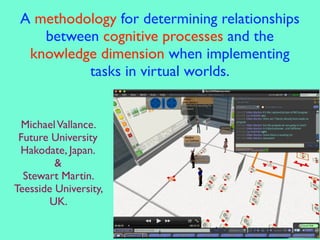
A methodology for determining relationships
    between cognitive processes and the
  knowledge dimension when implementing
          tasks in virtual worlds.


 Michael Vallance.
 Future University
 Hakodate, Japan.
         &
  Stewart Martin.
Teesside University,
        UK.

                       1
purpose of research

• To develop a framework for designing
  effective tasks in virtual worlds
 • NOT directly replicate real world tasks
 • BUT utilise the uniqueness of virtual
    world tools and communication
tasks in Second Life
robot to follow circuit instructions
tasks in Second Life
robot to follow circuit instructions
tasks in Second Life
robot to follow circuit instructions
tasks in Second Life


             develop and communicate a solution
robot to follow circuit instructions
tasks in Second Life


             develop and communicate a solution
robot to follow circuit instructions
tasks in Second Life


             develop and communicate a solution
robot to follow circuit instructions
    tasks in Second Life


                   develop and communicate a solution


test the program
robot to follow circuit instructions
    tasks in Second Life


                   develop and communicate a solution


test the program
robot to follow circuit instructions
    tasks in Second Life


                   develop and communicate a solution


                       further collaboration
test the program
robot to follow circuit instructions
    tasks in Second Life


                   develop and communicate a solution


                       further collaboration
test the program
robot to follow circuit instructions
    tasks in Second Life


                   develop and communicate a solution


                       further collaboration         end result
test the program
data collection

• Japan group (n=4) and UK group (n=4)
• 12 tasks: 1 per day over 3 weeks
• task given by researchers to one group:
  program LEGO robot to follow a pre-set circuit
• group A then teach group B: communication
  through Second Life using text and graphical
  objects (prims) as desired
• video capture of both groups
 • 60 hours to transcribe and analyse
Bloom’s Taxonomy
                                                                                                                        Instrument


Anderson,
L.W.,
Krathwohl,
D.R.,
Airasian,
P.W.,
Cruicshank,
K.A.,
Mayer,
R.E.,
Pintrich,
P.R.,
Raths,
J.
&
Wi@rock,

      M.C.
(2001)
A
taxonomy
for
learning,
teaching
and
assessing:
A
revision
of
Bloom’s
taxonomy
of

      educa:onal
objec:ves
(Abridged
ed.).
New
York:
Longman.
TRANSANA for transcribing
    and linking video clips
TAMS ANALYZER
  for data analysis
* Bloom’s coded analysis     * Share at Google Docs.
exported from TAMS to Excel.
   * Care with activity number
    (which group, which task)
Motion chart: pioneered by Hans Rosling of Gapminder
Motion chart
Motion chart
Motion chart: our data
Excel charts
Why dip in APPLY? Bloom’s definition: carry out a procedure in a
given situation.

 Compare to ANALYZE. Bloom’s definition: determine how parts
relate to one another and to an overall purpose.

 Decision early on: (1) only choose ONE cognitive process and ONE
knowledge dimension per communicative act. (2) Try to work within
definitions as objectively as humanly possible.

 Observation: if looking at a particular communicative act in isolation
then it may be deemed APPLY but within the context of what came
before some of the communication was obviously more than ‘carrying
out a given procedure’

 There was evidence in the communication and looking at the video
(in TRANSANA) of ANALYZE or other cognitive process categories.
initial observations
observation: as days went by for conceptual knowledge the amount
of analyzing, evaluating and creating increase.
observation: procedural  knowledge completely unrelated to
remembering.
There are links in applying and evaluating though.
observation: our tasks are limited in communicating evidence about
metacognitive knowledge.
observation: we have proven that the development of knowledge does
not necessarily occur as task challenge increases.
observation: components of the cognitive process and knowledge
domain can be developed based upon the specifics of the task
rather than simply increasing task complexity.
observation: just making that same task harder does not necessarily
engage in further occurrences of same components of the cognitive
process and knowledge domain.
observation: witnessed a challenge of human-robot interface and the
challenge of communication, i.e. that human intent must be
expressed in robot control values; this is a source of interaction
questions
question: Is it simply about task design? Can we say task
difficulty increases the likelihood of engaging, say, conceptual
knowledge?
question: What about the data we used?
Our data was drawn from transcriptions.
question: Would it be better to set up buttons to push at regular
intervals for students to acknowledge what they are doing at
that moment. See presentation by Prof. Paul van Schaik at 3 PM on
Tuesday:- Measuring flow experience in an immersive virtual
environment for collaborative learning.

question: Another method?
This is our Design Experiment (the iterative development and
collection of data analysed via a mixed methods approach).
How could you better measure how students are Applying or
Analyzing, for instance?
our
             resources
                                                                 references
                                                      •   Vallance, M., Martin, S., Wiz, C. & van
                                                          Schaik, P. (2010). Designing effective
•   Transana (www.transana.com)                           spaces, tasks and metrics for
                                                          communication in Second Life within the
                                                          context of programming LEGO NXT
•   TAMS Analyzer (http://tamsys.sourceforge.net/)
                                                          Mindstorms™ robots. International Journal
                                                          of Virtual and Personal Learning
•   LEGO Mindstorms 9797 (http://www.active-              Environments. Vol. 1 (1), pp. 20-37.
    robots.com/products/mindstorms4schools/lego-          January - March 2010. DOI: 10.4018/jvple.
    education-nxt.shtml)                                  2010091703. 

•   Gapminder (http://www.gapminder.org)
                                                      •   Vallance, M., Martin, S., Wiz, C. & van
                                                          Schaik, P. (2009). LEGO Mindstorms for
•   Google Motion Graphs (http://www.google.com/ig/       informed metrics in virtual worlds. In
    directory?url=www.google.com/ig/modules/              Proceedings of Human Computer
    motionchart.xml)                                      Interaction (HCI) 2009 - People and
                                                          Computers XXIII. Cambridge University,
                                                          UK. pp. 159-162.

Metrics in virtual worlds

  • 1.
    A methodology fordetermining relationships between cognitive processes and the knowledge dimension when implementing tasks in virtual worlds. Michael Vallance. Future University Hakodate, Japan. & Stewart Martin. Teesside University, UK. 1
  • 2.
    purpose of research •To develop a framework for designing effective tasks in virtual worlds • NOT directly replicate real world tasks • BUT utilise the uniqueness of virtual world tools and communication
  • 4.
  • 5.
  • 6.
    robot to followcircuit instructions tasks in Second Life
  • 7.
    robot to followcircuit instructions tasks in Second Life
  • 8.
    robot to followcircuit instructions tasks in Second Life develop and communicate a solution
  • 9.
    robot to followcircuit instructions tasks in Second Life develop and communicate a solution
  • 10.
    robot to followcircuit instructions tasks in Second Life develop and communicate a solution
  • 11.
    robot to followcircuit instructions tasks in Second Life develop and communicate a solution test the program
  • 12.
    robot to followcircuit instructions tasks in Second Life develop and communicate a solution test the program
  • 13.
    robot to followcircuit instructions tasks in Second Life develop and communicate a solution further collaboration test the program
  • 14.
    robot to followcircuit instructions tasks in Second Life develop and communicate a solution further collaboration test the program
  • 15.
    robot to followcircuit instructions tasks in Second Life develop and communicate a solution further collaboration end result test the program
  • 18.
    data collection • Japangroup (n=4) and UK group (n=4) • 12 tasks: 1 per day over 3 weeks • task given by researchers to one group: program LEGO robot to follow a pre-set circuit • group A then teach group B: communication through Second Life using text and graphical objects (prims) as desired • video capture of both groups • 60 hours to transcribe and analyse
  • 19.
    Bloom’s Taxonomy Instrument Anderson,
L.W.,
Krathwohl,
D.R.,
Airasian,
P.W.,
Cruicshank,
K.A.,
Mayer,
R.E.,
Pintrich,
P.R.,
Raths,
J.
&
Wi@rock,
 M.C.
(2001)
A
taxonomy
for
learning,
teaching
and
assessing:
A
revision
of
Bloom’s
taxonomy
of
 educa:onal
objec:ves
(Abridged
ed.).
New
York:
Longman.
  • 20.
    TRANSANA for transcribing and linking video clips
  • 21.
    TAMS ANALYZER for data analysis
  • 22.
    * Bloom’s codedanalysis * Share at Google Docs. exported from TAMS to Excel. * Care with activity number (which group, which task)
  • 23.
    Motion chart: pioneeredby Hans Rosling of Gapminder
  • 24.
    Motion chart: pioneeredby Hans Rosling of Gapminder
  • 25.
  • 26.
  • 27.
  • 28.
  • 29.
  • 30.
    Why dip inAPPLY? Bloom’s definition: carry out a procedure in a given situation. Compare to ANALYZE. Bloom’s definition: determine how parts relate to one another and to an overall purpose. Decision early on: (1) only choose ONE cognitive process and ONE knowledge dimension per communicative act. (2) Try to work within definitions as objectively as humanly possible. Observation: if looking at a particular communicative act in isolation then it may be deemed APPLY but within the context of what came before some of the communication was obviously more than ‘carrying out a given procedure’ There was evidence in the communication and looking at the video (in TRANSANA) of ANALYZE or other cognitive process categories.
  • 31.
    initial observations observation: asdays went by for conceptual knowledge the amount of analyzing, evaluating and creating increase. observation: procedural  knowledge completely unrelated to remembering. There are links in applying and evaluating though. observation: our tasks are limited in communicating evidence about metacognitive knowledge. observation: we have proven that the development of knowledge does not necessarily occur as task challenge increases. observation: components of the cognitive process and knowledge domain can be developed based upon the specifics of the task rather than simply increasing task complexity. observation: just making that same task harder does not necessarily engage in further occurrences of same components of the cognitive process and knowledge domain. observation: witnessed a challenge of human-robot interface and the challenge of communication, i.e. that human intent must be expressed in robot control values; this is a source of interaction
  • 32.
    questions question: Is itsimply about task design? Can we say task difficulty increases the likelihood of engaging, say, conceptual knowledge? question: What about the data we used? Our data was drawn from transcriptions. question: Would it be better to set up buttons to push at regular intervals for students to acknowledge what they are doing at that moment. See presentation by Prof. Paul van Schaik at 3 PM on Tuesday:- Measuring flow experience in an immersive virtual environment for collaborative learning. question: Another method? This is our Design Experiment (the iterative development and collection of data analysed via a mixed methods approach). How could you better measure how students are Applying or Analyzing, for instance?
  • 33.
    our resources references • Vallance, M., Martin, S., Wiz, C. & van Schaik, P. (2010). Designing effective • Transana (www.transana.com) spaces, tasks and metrics for communication in Second Life within the context of programming LEGO NXT • TAMS Analyzer (http://tamsys.sourceforge.net/) Mindstorms™ robots. International Journal of Virtual and Personal Learning • LEGO Mindstorms 9797 (http://www.active- Environments. Vol. 1 (1), pp. 20-37. robots.com/products/mindstorms4schools/lego- January - March 2010. DOI: 10.4018/jvple. education-nxt.shtml) 2010091703.  • Gapminder (http://www.gapminder.org) • Vallance, M., Martin, S., Wiz, C. & van Schaik, P. (2009). LEGO Mindstorms for • Google Motion Graphs (http://www.google.com/ig/ informed metrics in virtual worlds. In directory?url=www.google.com/ig/modules/ Proceedings of Human Computer motionchart.xml) Interaction (HCI) 2009 - People and Computers XXIII. Cambridge University, UK. pp. 159-162.