S y s t e m s T h i n k i n g i n A c t i o n ®:
                     Because Sustainable Success Doesn’t Just Happen


                     KEYNOTE DESCRIPTION


      Gaming the System: Design Principles for
      Building 21st-Century Skills

      Katie Salen

      What would it mean for our future workforce if students were to begin their investigation of a topic by
      asking “Can I try? Can I join in?” and demonstrate mastery by saying “Want me to show you how?”
      To help answer this question, Quest to Learn, a public school in New York City, uses the underlying
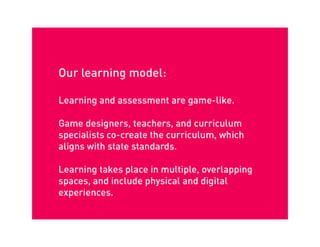
      principles of games to create a highly immersive learning experience. Games create a world in which
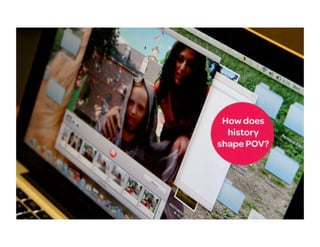
      players actively participate, use strategic thinking to make choices, solve complex problems, seek content
      knowledge, receive constant feedback, and consider others’ points of view.
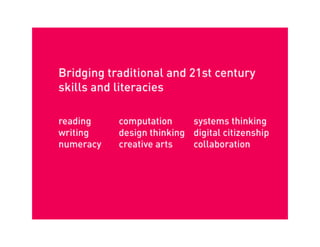
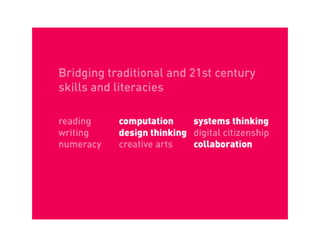
      In this session, Katie Salen will discuss the design thinking behind Quest’s learning model, including the
      emphasis on understanding systems as a key 21st-century skill.


      Katie Salen is a game designer and professor in the School of Computing and Digital Media at DePaul University.
      She serves as the executive director of the Institute of Play, a non-profit focused on games and learning. Katie led the team
      that founded Quest to Learn, a public school in New York City based on game design and systems thinking concepts.
      She currently serves as the school's executive director of design.


Copyright © 2011 by Pegasus Communications, Inc.   Session slides are reproduced with permission from presenter.                     Back to
ALL RIGHTS RESERVED. No part of this handout may be reproduced or transmitted in any form or by any means,                            Session
electronic or mechanical, including photocopying and recording, or by any information storage or retrieval                           Materials
system, without permission from the presenters or Pegasus Communications, Inc.                                                        HOME
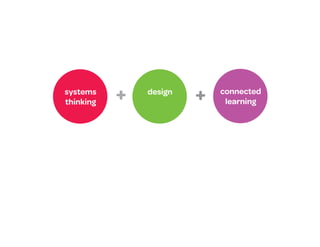
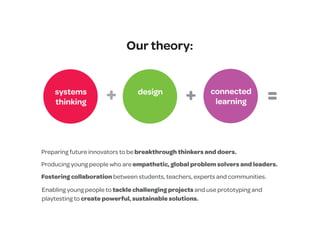
Our theory:


    systems
    thinking
                      +          design
                                                 +        connected
                                                           learning            =

Preparing future innovators to be breakthrough thinkers and doers.
Producing young people who are empathetic, global problem solvers and leaders.
Fostering collaboration between students, teachers, experts and communities.

Enabling young people to tackle challenging projects and use prototyping and
playtesting to create powerful, sustainable solutions.
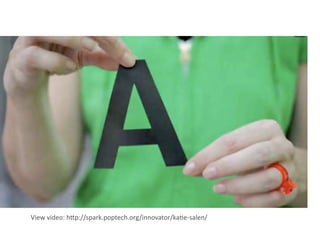
View
video:
h+p://spark.poptech.org/innovator/ka7e‐salen/

games
  are
dynamic
systems
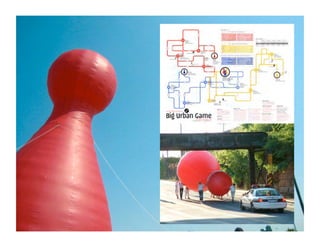
Big Urban
  Game
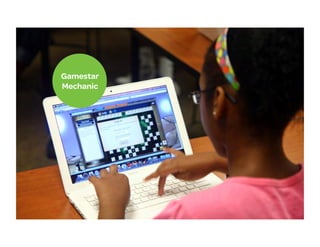
Gamestar
Mechanic
Our theory:


    systems
    thinking
                      +          design
                                                 +        connected
                                                           learning            =

Preparing future innovators to be breakthrough thinkers and doers.
Producing young people who are empathetic, global problem solvers and leaders.
Fostering collaboration between students, teachers, experts and communities.

Enabling young people to tackle challenging projects and use prototyping and
playtesting to create powerful, sustainable solutions.
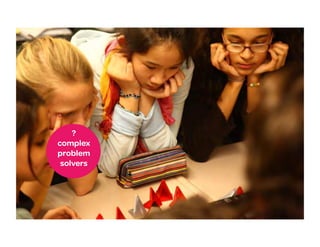
?
complex
problem
 solvers
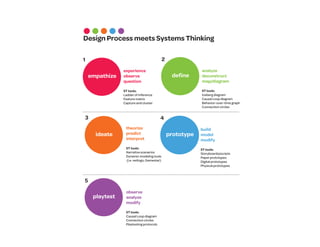
Design Process meets Systems Thinking

1                                           2
                experience                                  analyze
    empathize   observe                          define     deconstruct
                question                                    map/diagram

                ST tools:                                   ST tools:
                Ladder of inference                         Iceberg diagram
                Feature matrix                              Causal Loop diagram
                Capture and cluster                         Behavior-over-time graph
                                                            Connection circles


3                                        4
                 theorize                                   build
      ideate     predict                        prototype   model
                 interpret                                  modify
                 ST tools:                                  ST tools:
                 Narrative scenarios                        Storyboards/scripts
                 Dynamic modeling tools                     Paper prototypes
                 (i.e. netlogo, Gamestar)                   Digital prototypes
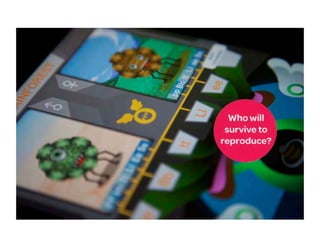
                                                            Physical prototypes


5
                 observe
     playtest    analyze
                 modify

                 ST tools:
                 Causal Loop diagram
                 Connection circles
                 Playtesting protocols
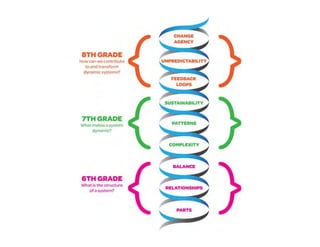
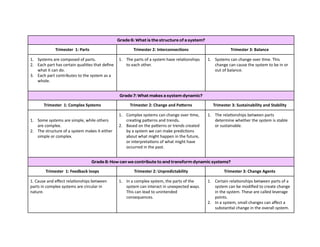
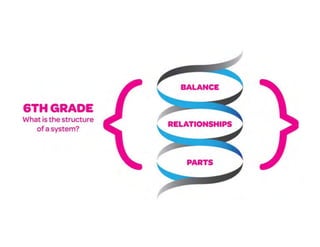
Grade 6: What is the structure of a system?

             !"#$%&'%"(()*(+,"'&                        !"#$%&'%"(-*(./'%"01//%021/&                      !"#$%&'%"(3*(4,5,/0%

!" #$%&'(%)*+'),-(.-%'/)-0).*+&%")            !" >3').*+&%)-0)*)%$%&'()3*?')+'8*9-5%34.%)     !" #$%&'(%),*5),3*5@')-?'+)9('")>34%)
1" 2*,3).*+&)3*%),'+&*45)67*849'%)&3*&)/':5')    &-)'*,3)-&3'+"))                                ,3*5@'),*5),*7%')&3')%$%&'()&-)=')45)-+)
   ;3*&)4&),*5)/-")                                                                              -7&)-0)=*8*5,'"
<" 2*,3).*+&),-5&+4=7&'%)&-)&3')%$%&'()*%)*)
   ;3-8'"


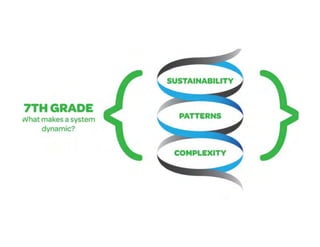
                                                 Grade 7: What makes a system dynamic?

       !"#$%&'%"(()*(61$75%8(9:&'%$&                  !"#$%&'%"(-*(6;,/<%(,/=(+,>%"/&           !"#$%&'%"(3*(9?&',#/,@#5#':(,/=(9',@#5#':

                                                !" D-(.8'B)%$%&'(%),*5),3*5@')-?'+)9('A)      !" >3')+'8*9-5%34.%)='&;''5).*+&%)
!" #-(')%$%&'(%)*+')%4(.8'A);348')-&3'+%)          ,+'*95@).*E'+5%)*5/)&+'5/%A                   /'&'+(45');3'&3'+)&3')%$%&'()4%)%&*=8')
   *+'),-(.8'B")                                1" F*%'/)-5)&3').*E'+5%)-+)&+'5/%),+'*&'/)       -+)%7%&*45*=8'"
1" >3')%&+7,&7+')-0)*)%$%&'()(*C'%)4&)'4&3'+)      =$)*)%$%&'();'),*5)(*C').+'/4,9-5%)
   %4(.8')-+),-(.8'B"                              *=-7&);3*&)(4@3&)3*..'5)45)&3')07&7+'A)
                                                   -+)45&'+.+'&*9-5%)-0);3*&)(4@3&)3*?')
                                                   -,,7++'/)45)&3').*%&"


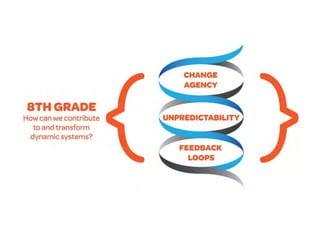
                                   Grade 8: How can we contribute to and transform dynamic systems?

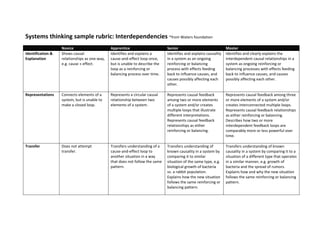
        !"#$%&'%"(()*(B%%=@,0C(5117&                    !"#$%&'%"(-*(D/7"%=#0',@#5#':                 !"#$%&'%"(3*(6;,/<%(E<%/'&

!")D*7%')*5/)'G',&)+'8*9-5%34.%)='&;''5)        !" H5)*),-(.8'B)%$%&'(A)&3').*+&%)-0)&3')     !" D'+&*45)+'8*9-5%34.%)='&;''5).*+&%)-0)*)
.*+&%)45),-(.8'B)%$%&'(%)*+'),4+,78*+)45)          %$%&'(),*5)45&'+*,&)45)75'B.',&'/);*$%")      %$%&'(),*5)=')(-/4:'/)&-),+'*&'),3*5@')
5*&7+'"                                            >34%),*5)8'*/)&-)7545&'5/'/)                  45)&3')%$%&'(")>3'%')*+'),*88'/)8'?'+*@')
                                                   ,-5%'67'5,'%")                                .-45&%"
                                                                                              1" H5)*)%$%&'(A)%(*88),3*5@'%),*5)*G',&)*)
                                                                                                 %7=%&*59*8),3*5@')45)&3')-?'+*88)%$%&'("
Boss
Levels
!"#$%&#'$()*+)*,'#-&./%'0120)34'5*$%06%.%*6%*3)%#'!"#$%&'()*#+&"$,-.()/$-'
&
'                   789)3%'                       :..0%*$)3%'                      !%*)80'                              ;-#$%0'
56%*$)<)3-$)8*'='   01$2+&3(,+(4&                 <.*-)/"/*+&(-.&*=54(/-+&(&       <.*-)/"/*+&(-.&*=54(/-+&3(,+(4/)7&   <.*-)/"/*+&(-.&34*(#47&*=54(/-+&)1*&
>?./-*-$)8*'!       #*4()/$-+1/5+&(+&$-*62(78&&   3(,+*6(-.6*""*3)&4$$5&$-3*8&     /-&(&+7+)*%&(+&(-&$-:$/-:&           /-)*#.*5*-.*-)&3(,+(4&#*4()/$-+1/5+&/-&(&
!                   *9:9&3(,+*&;&*""*3)9&&        >,)&/+&,-(>4*&)$&.*+3#/>*&)1*&   #*/-"$#3/-:&$#&>(4(-3/-:&            +7+)*%&(+&$-:$/-:&#*/-"$#3/-:&$#&
                                                  4$$5&(+&(&#*/-"$#3/-:&$#&        5#$3*++&2/)1&*""*3)+&"**./-:&        >(4(-3/-:&5#$3*++*+&2/)1&*""*3)+&"**./-:&
                                                  >(4(-3/-:&5#$3*++&$?*#&)/%*9&    >(3@&)$&/-"4,*-3*&3(,+*+8&(-.&       >(3@&)$&/-"4,*-3*&3(,+*+8&(-.&3(,+*+&
                                                                                   3(,+*+&5$++/>47&(""*3)/-:&*(31&      5$++/>47&(""*3)/-:&*(31&$)1*#9&
                                                                                   $)1*#9&
                                                                                   &
@%.0%#%*$-$)8*#!    A$--*3)+&*4*%*-)+&$"&(&       B*5#*+*-)+&(&3/#3,4(#&3(,+(4&    B*5#*+*-)+&3(,+(4&"**.>(3@&          B*5#*+*-)+&3(,+(4&"**.>(3@&(%$-:&)1#**&
                    +7+)*%8&>,)&/+&,-(>4*&)$&     #*4()/$-+1/5&>*)2**-&)2$&        (%$-:&)2$&$#&%$#*&*4*%*-)+&          $#&%$#*&*4*%*-)+&$"&(&+7+)*%&(-.C$#&
                    %(@*&(&34$+*.&4$$59&          *4*%*-)+&$"&(&+7+)*%9&           $"&(&+7+)*%&(-.C$#&3#*()*+&          3#*()*+&/-)*#3$--*3)*.&%,4)/54*&4$$5+9&&
                                                                                   %,4)/54*&4$$5+&)1()&/44,+)#()*&      B*5#*+*-)+&3(,+(4&"**.>(3@&#*4()/$-+1/5+&
                                                                                   ./""*#*-)&/-)*#5#*)()/$-+9&          (+&*/)1*#&#*/-"$#3/-:&$#&>(4(-3/-:9&
                                                                                   B*5#*+*-)+&3(,+(4&"**.>(3@&          D*+3#/>*+&1$2&)2$&$#&%$#*&
                                                                                   #*4()/$-+1/5+&(+&*/)1*#&             /-)*#.*5*-.*-)&"**.>(3@&4$$5+&(#*&
                                                                                   #*/-"$#3/-:&$#&>(4(-3/-:9&           3$%5(#(>47&%$#*&$#&4*++&5$2*#",4&$?*#&
                                                                                                                        )/%*9&
                                                                                                                        &
A0-*#<%0!           D$*+&-$)&())*%5)&             E#(-+"*#+&,-.*#+)(-./-:&$"&(&    E#(-+"*#+&,-.*#+)(-./-:&$"&          E#(-+"*#+&,-.*#+)(-./-:&$"&@-$2-&
                    )#(-+"*#9&                    3(,+*6(-.6*""*3)&4$$5&)$&        @-$2-&3(,+(4/)7&/-&(&+7+)*%&>7&      3(,+(4/)7&/-&(&+7+)*%&>7&3$%5(#/-:&/)&)$&(&
                                                  (-$)1*#&+/),()/$-&/-&(&2(7&      3$%5(#/-:&/)&)$&+/%/4(#&             +/),()/$-&$"&(&./""*#*-)&)75*&)1()&$5*#()*+&
                                                  )1()&.$*+&-$)&"$44$2&)1*&+(%*&   +/),()/$-&$"&)1*&+(%*&)75*8&*9:9&    /-&(&+/%/4(#&%(--*#8&*9:9&:#$2)1&$"&
                                                  5())*#-9&                        >/$4$:/3(4&:#$2)1&$"&>(3)*#/(&       >(3)*#/(&(-.&)1*&+5#*(.&$"&#,%$#+9&
                                                                                   ?+9&(&#(>>/)&5$5,4()/$-9&            F=54(/-+&1$2&(-.&217&)1*&-*2&+/),()/$-&
                                                                                   F=54(/-+&1$2&)1*&-*2&+/),()/$-&      "$44$2+&)1*&+(%*&#*/-"$#3/-:&$#&>(4(-3/-:&
                                                                                   "$44$2+&)1*&+(%*&#*/-"$#3/-:&$#&     5())*#-9&
                                                                                   >(4(-3/-:&5())*#-9&                  &
                                                                                   &
!
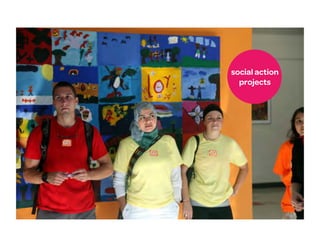
social action
  projects
Minecraft
  club
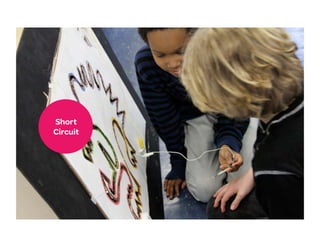
Short
Circuit
K02-salen: Systems Thinking in Action 2011

K02-salen: Systems Thinking in Action 2011

  • 1.
    S y st e m s T h i n k i n g i n A c t i o n ®: Because Sustainable Success Doesn’t Just Happen KEYNOTE DESCRIPTION Gaming the System: Design Principles for Building 21st-Century Skills Katie Salen What would it mean for our future workforce if students were to begin their investigation of a topic by asking “Can I try? Can I join in?” and demonstrate mastery by saying “Want me to show you how?” To help answer this question, Quest to Learn, a public school in New York City, uses the underlying principles of games to create a highly immersive learning experience. Games create a world in which players actively participate, use strategic thinking to make choices, solve complex problems, seek content knowledge, receive constant feedback, and consider others’ points of view. In this session, Katie Salen will discuss the design thinking behind Quest’s learning model, including the emphasis on understanding systems as a key 21st-century skill. Katie Salen is a game designer and professor in the School of Computing and Digital Media at DePaul University. She serves as the executive director of the Institute of Play, a non-profit focused on games and learning. Katie led the team that founded Quest to Learn, a public school in New York City based on game design and systems thinking concepts. She currently serves as the school's executive director of design. Copyright © 2011 by Pegasus Communications, Inc. Session slides are reproduced with permission from presenter. Back to ALL RIGHTS RESERVED. No part of this handout may be reproduced or transmitted in any form or by any means, Session electronic or mechanical, including photocopying and recording, or by any information storage or retrieval Materials system, without permission from the presenters or Pegasus Communications, Inc. HOME
  • 2.
    Our theory: systems thinking + design + connected learning = Preparing future innovators to be breakthrough thinkers and doers. Producing young people who are empathetic, global problem solvers and leaders. Fostering collaboration between students, teachers, experts and communities. Enabling young people to tackle challenging projects and use prototyping and playtesting to create powerful, sustainable solutions.
  • 3.
  • 4.
  • 7.
  • 10.
  • 18.
    Our theory: systems thinking + design + connected learning = Preparing future innovators to be breakthrough thinkers and doers. Producing young people who are empathetic, global problem solvers and leaders. Fostering collaboration between students, teachers, experts and communities. Enabling young people to tackle challenging projects and use prototyping and playtesting to create powerful, sustainable solutions.
  • 21.
  • 25.
    Design Process meetsSystems Thinking 1 2 experience analyze empathize observe define deconstruct question map/diagram ST tools: ST tools: Ladder of inference Iceberg diagram Feature matrix Causal Loop diagram Capture and cluster Behavior-over-time graph Connection circles 3 4 theorize build ideate predict prototype model interpret modify ST tools: ST tools: Narrative scenarios Storyboards/scripts Dynamic modeling tools Paper prototypes (i.e. netlogo, Gamestar) Digital prototypes Physical prototypes 5 observe playtest analyze modify ST tools: Causal Loop diagram Connection circles Playtesting protocols
  • 27.
    Grade 6: Whatis the structure of a system? !"#$%&'%"(()*(+,"'& !"#$%&'%"(-*(./'%"01//%021/& !"#$%&'%"(3*(4,5,/0% !" #$%&'(%)*+'),-(.-%'/)-0).*+&%") !" >3').*+&%)-0)*)%$%&'()3*?')+'8*9-5%34.%) !" #$%&'(%),*5),3*5@')-?'+)9('")>34%) 1" 2*,3).*+&)3*%),'+&*45)67*849'%)&3*&)/':5') &-)'*,3)-&3'+")) ,3*5@'),*5),*7%')&3')%$%&'()&-)=')45)-+) ;3*&)4&),*5)/-") -7&)-0)=*8*5,'" <" 2*,3).*+&),-5&+4=7&'%)&-)&3')%$%&'()*%)*) ;3-8'" Grade 7: What makes a system dynamic? !"#$%&'%"(()*(61$75%8(9:&'%$& !"#$%&'%"(-*(6;,/<%(,/=(+,>%"/& !"#$%&'%"(3*(9?&',#/,@#5#':(,/=(9',@#5#': !" D-(.8'B)%$%&'(%),*5),3*5@')-?'+)9('A) !" >3')+'8*9-5%34.%)='&;''5).*+&%) !" #-(')%$%&'(%)*+')%4(.8'A);348')-&3'+%) ,+'*95@).*E'+5%)*5/)&+'5/%A /'&'+(45');3'&3'+)&3')%$%&'()4%)%&*=8') *+'),-(.8'B") 1" F*%'/)-5)&3').*E'+5%)-+)&+'5/%),+'*&'/) -+)%7%&*45*=8'" 1" >3')%&+7,&7+')-0)*)%$%&'()(*C'%)4&)'4&3'+) =$)*)%$%&'();'),*5)(*C').+'/4,9-5%) %4(.8')-+),-(.8'B" *=-7&);3*&)(4@3&)3*..'5)45)&3')07&7+'A) -+)45&'+.+'&*9-5%)-0);3*&)(4@3&)3*?') -,,7++'/)45)&3').*%&" Grade 8: How can we contribute to and transform dynamic systems? !"#$%&'%"(()*(B%%=@,0C(5117& !"#$%&'%"(-*(D/7"%=#0',@#5#': !"#$%&'%"(3*(6;,/<%(E<%/'& !")D*7%')*5/)'G',&)+'8*9-5%34.%)='&;''5) !" H5)*),-(.8'B)%$%&'(A)&3').*+&%)-0)&3') !" D'+&*45)+'8*9-5%34.%)='&;''5).*+&%)-0)*) .*+&%)45),-(.8'B)%$%&'(%)*+'),4+,78*+)45) %$%&'(),*5)45&'+*,&)45)75'B.',&'/);*$%") %$%&'(),*5)=')(-/4:'/)&-),+'*&'),3*5@') 5*&7+'" >34%),*5)8'*/)&-)7545&'5/'/) 45)&3')%$%&'(")>3'%')*+'),*88'/)8'?'+*@') ,-5%'67'5,'%") .-45&%" 1" H5)*)%$%&'(A)%(*88),3*5@'%),*5)*G',&)*) %7=%&*59*8),3*5@')45)&3')-?'+*88)%$%&'("
  • 29.
  • 35.
    !"#$%&#'$()*+)*,'#-&./%'0120)34'5*$%06%.%*6%*3)%#'!"#$%&'()*#+&"$,-.()/$-' & ' 789)3%' :..0%*$)3%' !%*)80' ;-#$%0' 56%*$)<)3-$)8*'=' 01$2+&3(,+(4& <.*-)/"/*+&(-.&*=54(/-+&(& <.*-)/"/*+&(-.&*=54(/-+&3(,+(4/)7& <.*-)/"/*+&(-.&34*(#47&*=54(/-+&)1*& >?./-*-$)8*'! #*4()/$-+1/5+&(+&$-*62(78&& 3(,+*6(-.6*""*3)&4$$5&$-3*8& /-&(&+7+)*%&(+&(-&$-:$/-:& /-)*#.*5*-.*-)&3(,+(4&#*4()/$-+1/5+&/-&(& ! *9:9&3(,+*&;&*""*3)9&& >,)&/+&,-(>4*&)$&.*+3#/>*&)1*& #*/-"$#3/-:&$#&>(4(-3/-:& +7+)*%&(+&$-:$/-:&#*/-"$#3/-:&$#& 4$$5&(+&(&#*/-"$#3/-:&$#& 5#$3*++&2/)1&*""*3)+&"**./-:& >(4(-3/-:&5#$3*++*+&2/)1&*""*3)+&"**./-:& >(4(-3/-:&5#$3*++&$?*#&)/%*9& >(3@&)$&/-"4,*-3*&3(,+*+8&(-.& >(3@&)$&/-"4,*-3*&3(,+*+8&(-.&3(,+*+& 3(,+*+&5$++/>47&(""*3)/-:&*(31& 5$++/>47&(""*3)/-:&*(31&$)1*#9& $)1*#9& & @%.0%#%*$-$)8*#! A$--*3)+&*4*%*-)+&$"&(& B*5#*+*-)+&(&3/#3,4(#&3(,+(4& B*5#*+*-)+&3(,+(4&"**.>(3@& B*5#*+*-)+&3(,+(4&"**.>(3@&(%$-:&)1#**& +7+)*%8&>,)&/+&,-(>4*&)$& #*4()/$-+1/5&>*)2**-&)2$& (%$-:&)2$&$#&%$#*&*4*%*-)+& $#&%$#*&*4*%*-)+&$"&(&+7+)*%&(-.C$#& %(@*&(&34$+*.&4$$59& *4*%*-)+&$"&(&+7+)*%9& $"&(&+7+)*%&(-.C$#&3#*()*+& 3#*()*+&/-)*#3$--*3)*.&%,4)/54*&4$$5+9&& %,4)/54*&4$$5+&)1()&/44,+)#()*& B*5#*+*-)+&3(,+(4&"**.>(3@&#*4()/$-+1/5+& ./""*#*-)&/-)*#5#*)()/$-+9& (+&*/)1*#&#*/-"$#3/-:&$#&>(4(-3/-:9& B*5#*+*-)+&3(,+(4&"**.>(3@& D*+3#/>*+&1$2&)2$&$#&%$#*& #*4()/$-+1/5+&(+&*/)1*#& /-)*#.*5*-.*-)&"**.>(3@&4$$5+&(#*& #*/-"$#3/-:&$#&>(4(-3/-:9& 3$%5(#(>47&%$#*&$#&4*++&5$2*#",4&$?*#& )/%*9& & A0-*#<%0! D$*+&-$)&())*%5)& E#(-+"*#+&,-.*#+)(-./-:&$"&(& E#(-+"*#+&,-.*#+)(-./-:&$"& E#(-+"*#+&,-.*#+)(-./-:&$"&@-$2-& )#(-+"*#9& 3(,+*6(-.6*""*3)&4$$5&)$& @-$2-&3(,+(4/)7&/-&(&+7+)*%&>7& 3(,+(4/)7&/-&(&+7+)*%&>7&3$%5(#/-:&/)&)$&(& (-$)1*#&+/),()/$-&/-&(&2(7& 3$%5(#/-:&/)&)$&+/%/4(#& +/),()/$-&$"&(&./""*#*-)&)75*&)1()&$5*#()*+& )1()&.$*+&-$)&"$44$2&)1*&+(%*& +/),()/$-&$"&)1*&+(%*&)75*8&*9:9& /-&(&+/%/4(#&%(--*#8&*9:9&:#$2)1&$"& 5())*#-9& >/$4$:/3(4&:#$2)1&$"&>(3)*#/(& >(3)*#/(&(-.&)1*&+5#*(.&$"&#,%$#+9& ?+9&(&#(>>/)&5$5,4()/$-9& F=54(/-+&1$2&(-.&217&)1*&-*2&+/),()/$-& F=54(/-+&1$2&)1*&-*2&+/),()/$-& "$44$2+&)1*&+(%*&#*/-"$#3/-:&$#&>(4(-3/-:& "$44$2+&)1*&+(%*&#*/-"$#3/-:&$#& 5())*#-9& >(4(-3/-:&5())*#-9& & & !
  • 40.
  • 41.
  • 42.