Design Games to Learn: a New Approach to Playful Learning Through Digital Games. 
Emanuela Marchetti, 
Aalborg University, Department of Learning and Philosophy, Denmark 
ema@create.aau.dk 
Andrea Valente 
Maersk Mc-Kinney Moller Institute, University of Southern Denmark 
anva@mmmi.sdu.dk
How do children play? 
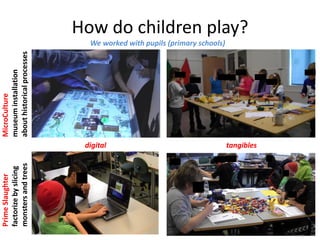
We worked with pupils (primary schools) 
digital 
tangibles 
MicroCulture museum installation about historical processes 
Prime Slaughter 
factorize by slicing monsters and trees
How do children play? 
•2 previous projects: 
–MicroCulture 
–Prime Slaughter 
•In both cases participatory workshops showed different ways of play: digital VS paper/low-tech 
•We observed: complex forms of play (e.g. playful play) happen more spontaneously in low-tech contexts
Pupils learn when desigining games 
•Research in games based learning (Kafai 2006) shows that learning through the design of digital games elicits a richer experience than learning through play 
•How to enable primary school pupils to design their own digital games? 
–difficult: it requires programming skills (or very good editors) 
•But: when looking at traditional forms of play (supported by tangibles, cards, drawing and modelling materials) children DO ENGAGE in: 
–designerly and playful play (Marchetti & Petersson 2013, Sutton-Smith 1997) 
–designerly ways of thinking and learning (Cross 2006) -> reflect on their new artefacts and the subject they are supposed to learn; social aspects support critical thinking 
•Our approach: seek for a middle ground between traditional tangible games, (card or tabletop), and digital games 
•So: the activity of designing a new digital game (or altering an existing one) is re-conceptualized as designing (or altering) a trading-card game
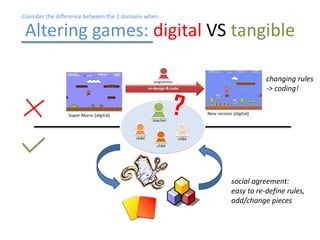
Altering games: digital VS tangible 
Consider the difference between the 2 domains when... 
social agreement: 
easy to re-define rules, 
add/change pieces 
changing rules 
-> coding!
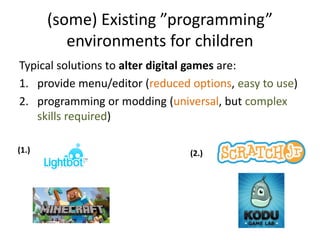
(some) Existing ”programming” environments for children 
Typical solutions to alter digital games are: 
1.provide menu/editor (reduced options, easy to use) 
2.programming or modding (universal, but complex skills required) 
(1.) 
(2.)
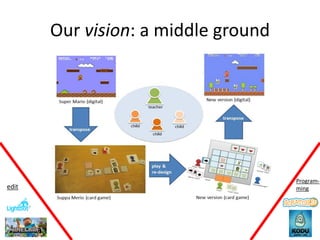
Our vision: a middle ground 
edit 
Program- ming
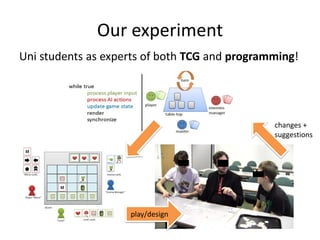
Our experiment 
Uni students as experts of both TCG and programming! 
changes + suggestions 
play/design
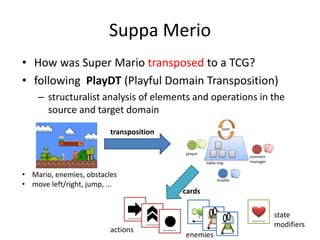
Suppa Merio 
•How was Super Mario transposed to a TCG? 
•following PlayDT (Playful Domain Transposition) 
–structuralist analysis of elements and operations in the source and target domain 
cards 
transposition 
•Mario, enemies, obstacles 
•move left/right, jump, ... 
actions 
state modifiers 
enemies
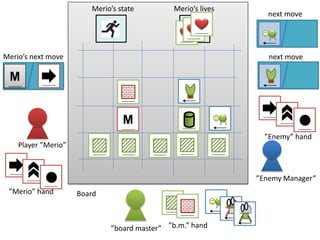
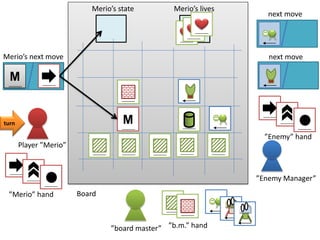
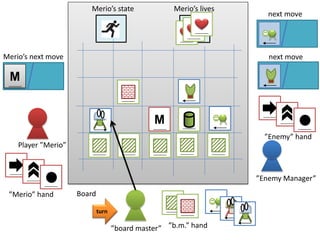
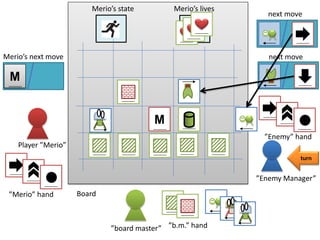
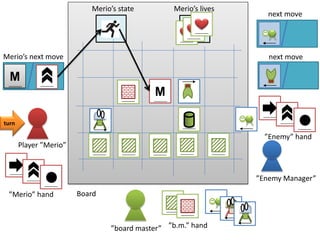
Example of game play
Player ”Merio” 
”board master” 
”Enemy Manager” 
Board 
”b.m.” hand 
”Enemy” hand 
M 
”Merio” hand 
M 
Merio’s next move 
next move 
next move 
Merio’s lives 
Merio’s state
Player ”Merio” 
”board master” 
”Enemy Manager” 
Board 
”b.m.” hand 
”Enemy” hand 
M 
”Merio” hand 
M 
Merio’s next move 
next move 
next move 
Merio’s lives 
Merio’s state 
turn
Player ”Merio” 
”board master” 
”Enemy Manager” 
Board 
”b.m.” hand 
”Enemy” hand 
M 
”Merio” hand 
M 
Merio’s next move 
next move 
next move 
Merio’s lives 
Merio’s state 
turn
Player ”Merio” 
”board master” 
”Enemy Manager” 
Board 
”b.m.” hand 
”Enemy” hand 
M 
”Merio” hand 
M 
Merio’s next move 
next move 
next move 
Merio’s lives 
Merio’s state 
turn
Player ”Merio” 
”board master” 
”Enemy Manager” 
Board 
”b.m.” hand 
”Enemy” hand 
M 
”Merio” hand 
M 
Merio’s next move 
next move 
next move 
Merio’s lives 
Merio’s state 
turn
Reflection 
•two fold contribution: 
–a new games based learning scenario in which children and their educators engage in game design as part of their lecture 
–a proof of concept of an alternative model for game programming in which digital games are re-conceptualised as card-based games. 
•Side effect: 
–We were (also) looking for an activity to explain programming, that is non-technical 
–And our cycle shows an alternative way to programming, through low- fi/tangibles 
–The main problem (to investigate further) is how to close the cycle in a semi-automatic, natural way 
–A kind of language to describe games (as in Fowler’s DSL)
On going work 
•Testing game(s) with pupils in local schools 
–transpose more games (related to school subjects) 
•Find out how children prefer to represent TCG rules 
–basis of our DSL 
•How to ”close the loop” automatically? Digital -> tangible -> re-design -> Digital 
•More technical question: Is there a minimal game that works as universal language to define interaction in the others?

Design games to learn (presented at ECGBL 2014)

  • 1.
    Design Games toLearn: a New Approach to Playful Learning Through Digital Games. Emanuela Marchetti, Aalborg University, Department of Learning and Philosophy, Denmark ema@create.aau.dk Andrea Valente Maersk Mc-Kinney Moller Institute, University of Southern Denmark anva@mmmi.sdu.dk
  • 2.
    How do childrenplay? We worked with pupils (primary schools) digital tangibles MicroCulture museum installation about historical processes Prime Slaughter factorize by slicing monsters and trees
  • 3.
    How do childrenplay? •2 previous projects: –MicroCulture –Prime Slaughter •In both cases participatory workshops showed different ways of play: digital VS paper/low-tech •We observed: complex forms of play (e.g. playful play) happen more spontaneously in low-tech contexts
  • 4.
    Pupils learn whendesigining games •Research in games based learning (Kafai 2006) shows that learning through the design of digital games elicits a richer experience than learning through play •How to enable primary school pupils to design their own digital games? –difficult: it requires programming skills (or very good editors) •But: when looking at traditional forms of play (supported by tangibles, cards, drawing and modelling materials) children DO ENGAGE in: –designerly and playful play (Marchetti & Petersson 2013, Sutton-Smith 1997) –designerly ways of thinking and learning (Cross 2006) -> reflect on their new artefacts and the subject they are supposed to learn; social aspects support critical thinking •Our approach: seek for a middle ground between traditional tangible games, (card or tabletop), and digital games •So: the activity of designing a new digital game (or altering an existing one) is re-conceptualized as designing (or altering) a trading-card game
  • 5.
    Altering games: digitalVS tangible Consider the difference between the 2 domains when... social agreement: easy to re-define rules, add/change pieces changing rules -> coding!
  • 6.
    (some) Existing ”programming”environments for children Typical solutions to alter digital games are: 1.provide menu/editor (reduced options, easy to use) 2.programming or modding (universal, but complex skills required) (1.) (2.)
  • 7.
    Our vision: amiddle ground edit Program- ming
  • 8.
    Our experiment Unistudents as experts of both TCG and programming! changes + suggestions play/design
  • 9.
    Suppa Merio •Howwas Super Mario transposed to a TCG? •following PlayDT (Playful Domain Transposition) –structuralist analysis of elements and operations in the source and target domain cards transposition •Mario, enemies, obstacles •move left/right, jump, ... actions state modifiers enemies
  • 10.
  • 11.
    Player ”Merio” ”boardmaster” ”Enemy Manager” Board ”b.m.” hand ”Enemy” hand M ”Merio” hand M Merio’s next move next move next move Merio’s lives Merio’s state
  • 12.
    Player ”Merio” ”boardmaster” ”Enemy Manager” Board ”b.m.” hand ”Enemy” hand M ”Merio” hand M Merio’s next move next move next move Merio’s lives Merio’s state turn
  • 13.
    Player ”Merio” ”boardmaster” ”Enemy Manager” Board ”b.m.” hand ”Enemy” hand M ”Merio” hand M Merio’s next move next move next move Merio’s lives Merio’s state turn
  • 14.
    Player ”Merio” ”boardmaster” ”Enemy Manager” Board ”b.m.” hand ”Enemy” hand M ”Merio” hand M Merio’s next move next move next move Merio’s lives Merio’s state turn
  • 15.
    Player ”Merio” ”boardmaster” ”Enemy Manager” Board ”b.m.” hand ”Enemy” hand M ”Merio” hand M Merio’s next move next move next move Merio’s lives Merio’s state turn
  • 16.
    Reflection •two foldcontribution: –a new games based learning scenario in which children and their educators engage in game design as part of their lecture –a proof of concept of an alternative model for game programming in which digital games are re-conceptualised as card-based games. •Side effect: –We were (also) looking for an activity to explain programming, that is non-technical –And our cycle shows an alternative way to programming, through low- fi/tangibles –The main problem (to investigate further) is how to close the cycle in a semi-automatic, natural way –A kind of language to describe games (as in Fowler’s DSL)
  • 17.
    On going work •Testing game(s) with pupils in local schools –transpose more games (related to school subjects) •Find out how children prefer to represent TCG rules –basis of our DSL •How to ”close the loop” automatically? Digital -> tangible -> re-design -> Digital •More technical question: Is there a minimal game that works as universal language to define interaction in the others?